

Introduction
The shea tree (Vitellaria paradoxa C.F. Gaertner) (Sapotaceae), better known by its former name, Butyrospermum parkii (G. Don) Kotschy, is a wild species generally protected and preserved in West Sudanian Africa and in the Sahel. It has a great socio-economic, cultural and ecological significance due to its numerous local uses. Most importantly, shea trees produce fruits that can be transformed into a high-value export product, namely shea butter. It is used in cosmetology (raw material for many skin and hair treatment products), in pharmacology (excipient for ointments used to treat dermatosis, burns, cracks, etc.) and as a substitute for cocoa butter in recipes (Sallé et al., Reference Sallé, Boussim, Raynal-Roques and Brunck1991). The development of shea tree cultivation as an economic and nutritional resource began in West Africa in the 1950s and its importance has increased considerably during the last decade (Masters, 2004). In spite of the wide range of shea products, trees remained until very recently, naturally grown, principally because of their excessively long pre-fruiting period (usually 17–20 years, and in extreme cases up to 30 years), and their rather irregular year-to-year productivity (Agbahungba and Depommier, Reference Agbahungba and Depommier1989; Sallé et al., Reference Sallé, Boussim, Raynal-Roques and Brunck1991). However, because of the growing socio-economic significance of shea products and the ageing of existing tree stands, commercial plantations are on the rise spurred by the development of vegetative propagation techniques, mainly by grafting (Masters, 2004; Sanou et al., Reference Sanou, Kambou, Teklehaimanot, Dembélé, Yossi, Sina, Djingdia and Bouvet2004).
Nowadays, shea tree use is one of the promising agricultural sub-sectors whose development has become a priority for several countries in West Africa, particularly for Benin. Biotic stress, however, consitutes one of the reasons for the presently observed decline of shea tree productivity (Sallé et al., Reference Sallé, Boussim, Raynal-Roques and Brunck1991). Records from Burkina Faso, Ghana, Mali, Nigeria and Togo indicate that trees can be affected by several insect species (Sallé et al., Reference Sallé, Boussim, Raynal-Roques and Brunck1991; Dwomoh, Reference Dwomoh2003, Reference Dwomoh2004; Odebiyi et al., Reference Odebiyi, Bada, Omoloye, Awodoyin and Oni2004; Lamien et al., Reference Lamien, Tigabu, Dabiré, Guinko and Oden2008). Related information for Benin is still scanty or limited to single pest species (Gnanglè, Reference Gnanglè2005; Douro Kpindou and Djègui, personal communication). As a prerequisite for the development of integrated management strategies against the most damaging species, the present study provides a detailed inventory of insects associated with shea trees in central and northern Benin.
Materials and methods
Study sites
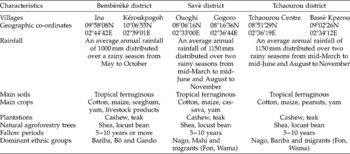
The study was carried out from June to October 2010 at six sites – in the districts of Savè, Tchaourou and Bembèrèkè (Fig. 1) – all situated within the five shea parklands of Benin as identified by Gnanglè (Reference Gnanglè2005). Additional site information is provided in Table 1.
Survey sites in Benin (a colour version of this figure can be found online at http://www.journals.cambridge.org/jti).

Study area characteristics*

*Sources: Gnanglè (Reference Gnanglè2005) and authors' own data (2010).
Shea tree selection
In each of the six villages chosen, an area of 5–7 ha containing about 125–150 shea trees of 8–12 m height was delimited and all fruit-producing trees therein were individually numbered with paint. Of these trees, 30 were randomly selected using a random number table. Thus, over the six villages, a total of 180 trees were surveyed to collect data on fruits, foliage and stems.
Insect collection
Fruit insects
In June 2010, i.e. during the fructification period, 50 fruits, half of them mature, were collected from each of the 30 selected trees. All insects found on or within the subsequently dissected fruits were counted by species, preserved in small glass vials containing 55% ethanol and labelled with their concomitant data.
Foliage insects
Samples were collected on three occasions at 6-week intervals from July to October 2010 using PACHA 25 EC, a broad-spectrum pyrethrinoid insecticide (PACHA 25EC: acetamipride 10 g/l and lambda-cyhalothrin 15 g/l, Savana, France) at a concentration of 5 ml/l and at a dose of 2 litres/tree. At 20–30 min after application using the knock-down insecticide with a mechanized knapsack sprayer, trees or branches were shaken and all insects that fell on a material sheet of 10 × 10 m size previously spread under the trees were collected, and sorted under a binocular microscope. They were preserved by species in vials filled with 55% alcohol. Lepidopteran samples were conserved in paper envelopes.
Twig and stemborers
At each site, two trees showing severe stemborer infestation were felled. Attacked trunks and twigs were cut into pieces of 80 cm size and brought back to the laboratory and maintained at an ambient temperature of 28°C until the emergence of adult insects, which were subsequently sorted and handled as above.
Insect identification
All insect specimens were cross-checked and reference samples submitted for determination at the Biosystematics Unit of the International Institute of Tropical Agriculture (IITA), Cotonou, Benin, where voucher specimens were stage-mounted and retained in the arthropod reference collection.
Results
Relative importance of insect fauna collected on shea trees
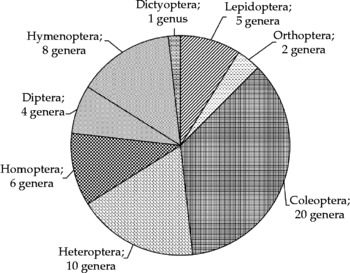
From June to October 2010, regular collections on 180 randomly chosen shea nut trees at six sites in central and northern Benin led to the collection of a total of 196 samples and 1415 specimens representing at least 61 insect species distributed in 8 orders, 36 families and 56 genera. Figure 2 shows the relative importance of each insect order. It appeared that insect orders such as Coleoptera, Heteroptera, Homoptera, Lepidoptera and Orthoptera that contained pest species were the most important according to genera diversity. However, some orders such as Hymenoptera, Dictyoptera and Diptera (Syrphidae) that generally contain predators or parasitoids were also encountered.
Relative importance of insect orders associated with shea trees in Benin

Shea tree foliage-inhabiting insects
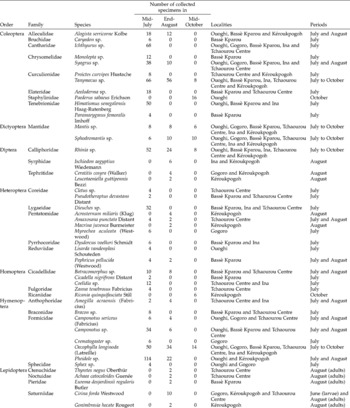
The 996 insect specimens collected from shea tree foliage belonged to 8 orders, 29 families, 45 genera and at least 47 species. Twenty-nine insects were identified to the species level. Table 2 shows the relative importance of foliage insects at each sampling period. This table also presents the list of the inventoried insects in shea tree foliage in Benin, the localities in which they were inventoried and the periods (month) of their census.
Shea foliage insects inventoried in Benin

Shea fruit insects
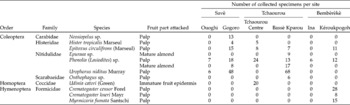
The 376 insect specimens collected on or within shea fruits belonged to 3 orders, 6 families, 10 genera and at least 11 species. Seven insects were identified to the species level. The Coleoptera order was the most important, with four families and seven genera. The majority of fruit insects (nine species) were collected in the pulps of fallen decomposing fruits. Two species feed on mature almonds that fall to the floor. Only one species of cochineal was recovered on the epidermis of immature shea fruits on the tree. Table 3 provides information related to all the species.
Inventoried insects on shea fruits

Shea twig and stemborers
The 41 insect specimens collected on shea twigs and stems belonged to only one order, two families, two genera and three species: Sphenoptera laplumei Kerremans (Coleoptera: Buprestidae), a shea branch insect and the stemborers Neoplocaedaerus denticornis (Fabricius) and N. iridescens (Atkinson) (both Coleoptera: Cerambycidae).
Discussion
A good knowledge of shea insects is the first step in the development of integrated management strategies against the most damaging insect pests. The results of the present survey show that in Benin, 56 genera of shea insects were identified while 53 and 33 genera were identified by Dwomoh (Reference Dwomoh2003) and Odebiyi et al. (Reference Odebiyi, Bada, Omoloye, Awodoyin and Oni2004), respectively, in Ghana and Nigeria. Insects of the mantid family in this survey were classified in the Dictyoptera order, whereas Dwomoh (Reference Dwomoh2003) and Odebiyi et al. (Reference Odebiyi, Bada, Omoloye, Awodoyin and Oni2004) classified them in the Hymenoptera and Orthoptera orders, respectively. The results of this survey also show the existence of a second genus of shea stemborers in Benin (Neoplocaedaerus) in addition to the Pachydissus genus discovered by Douro Kpindou and Djègui (personal communication) during their study. The discovery of a second shea stemborer genus explains the extent of stemborer-related damage in the parkland.
Among foliage insects, some were present throughout the survey period (mid-July to mid-October 2010). These are Oecophylla longinoda, Tanymecus sp., Rhinia sp., Sphodromantis sp. and Mantis sp. Others were present in all the three districts (Savè, Tchaourou and Bembèrèkè). These are Himatismus senegalensis Haag-Rutenberg (Coleoptera: Tenebrionidae), Xerophyllum platycorys (Westwood) (Orthoptera: Tetrigidae), Tanymecus sp. (Coleoptera: Curculionidae), Rhinia sp. (Diptera: Calliphoridae), O. longinoda (Latreille), Camponotus sp. (both Hymenoptera: Formicidae), Sphodromantis sp., Mantis sp. (both Dictyoptera: Mantidae) and Cirina forda Westwood (Lepidoptera: Saturniidae). As for the shea stemborers, they were present in all the three districts and their larvae and damage were visible throughout the survey period.
The defoliator C. forda and the stemborer Neoplocaedaerus spp. are pest species that have already been identified on shea trees. Odebiyi et al. (Reference Odebiyi, Bada, Omoloye, Awodoyin and Oni2004) and Dwomoh et al. (Reference Dwomoh, Akrofi and Ahadzi2004) have started research on control methods against C. forda. In contrast, no published data are available on the control of shea stemborers. Future research on the main insect pests will need to establish integrated management methods to safeguard shea parklands. Control methods developed for cerambycid stemborers on some tree species in northern Africa, Asia and Europe can possibly be applied to control shea stemborers. These are:
(a) biological control with natural enemies, entomopathogen agents such as Beauveria bassiana and nematodes (Taketsune, Reference Taketsune1983; El-Sebay, Reference El-Sebay1984; Luo, Reference Luo1997; Sone et al., Reference Sone, Tomimoto, Tokuraku, Matsuyama, Hata, Higuchi and Okabe2007);
(b) chemical control with ovicide and larvicide insecticides such as Endosulfan and Diazinon spray against adults (Hashemi Rad et al., Reference Hashemi Rad, Morovati, Bahreyney, Rajabi and Zeydabadi2005; López Pantoja et al., Reference López Pantoja, Domínguez and Sánchez Osorio2008). The adults of beetles are very sensitive to insecticides and can be controlled at the field level if insecticide spray is managed correctly and at the right time (peak time when adults appear) (Hashemi Rad et al., Reference Hashemi Rad, Morovati, Bahreyney, Rajabi and Zeydabadi2005).
However, the use of systemic insecticides to kill the stemborer larvae in shea trees should be considered only when all the other control options fail. This would avoid the problems of pesticide residues in the almonds and shea butter.
The method used for collection of foliage insects presents the following limitations:
(a) the insects that are found on the lower leaf surface (aphids and cochineals) cannot be detected;
(b) temporary insects that are not associated with the shea tree can be trapped.
In spite of these few limitations, our results were comparable to those obtained by Odebiyi et al. (Reference Odebiyi, Bada, Omoloye, Awodoyin and Oni2004) who used circular nets and vacuum cleaners. The fewer number of genera recorded by these authors can be explained by the fact that they were concerned only with the insect pest species.
Acknowledgements
The authors would like to express their gratitude to RIPIECSA, IRD and INRAB for their financial support. We are also pleased to thank all the Readers for their technical assistance, mainly Dr Fatondji Dougbédji, Mr Benjamin Datinon, Dr Kobi Douro Kpindou and Mr Siaka Kodjo. We are particularly grateful to Dr Georg Goergen for his contribution to insect species identification and manuscript reading. Many thanks also go to reviewers of this manuscript for their technical assistance.