INTRODUCTION
Phosphorus (P) is the most important nutrient for plant growth after nitrogen (N) and limited supply of this nutrient negatively affects crop productivity (Sahrawat et al., Reference Sahrawat, Rego, Burford, Rahman, Rao and Adam1995, Reference Sahrawat, Pardhasaradhi, Rego and Rahman1996; Sinclair and Vadez, Reference Sinclair and Vadez2002). Although total P may be high in many tropical soils, it is mostly fixed as insoluble complexes and is not available for plant uptake (Shailaja and Sahrawat, Reference Shailaja and Sahrawat1990). Hence improving yields requires P fertilizer application, but this is often not possible for smallholder farmers, because of cost and availability. In that context, although there is no substitute for fertilization, ensuring that seedling establishment is adequate in low soil P is a first critical step to improve plant stand and yield (Harris, Reference Harris1996; Harris et al., Reference Harris, Joshi, Khan, Gothkar and Sodhi1999; M'Ragwa et al., Reference M'Ragwa, Watson and Gourley2001; Rebafka et al., Reference Rebafka, Bationo and Marschner1993).
Early deficiency indeed affects the development of reproductive structures (Ma et al., Reference Ma, Longnecker and Dracup1997; Peltonen-Sainio, Reference Peltonen-Sainio1997; Rockstrom and de Rouw, Reference Rockström and De Rouw1997) and then crop management practices that support early growth vigour usually result in higher biomass production of cereal stands (Peltonen-Sainio et al., Reference Peltonen-Sainio, Kontturi and Peltonen2006; Welch, Reference Welch1986). In addition, flowering time is delayed in a number of crops facing early nutrient deficiencies such as P in pigeonpea (Chauhan et al., Reference Chauhan, Johansen and Venkataratnam1992), sorghum (Sahrawat et al., Reference Sahrawat, Rego, Burford, Rahman, Rao and Adam1995) and subterranean clover (Rossiter, Reference Rossiter1978), or N in narrow-leaf lupin (Ma et al., Reference Ma, Longnecker and Dracup1997). While this delay in flowering can be a beneficial adaptation (Nord and Lynch, Reference Nord and Lynch2008; Reference Nord and Lynch2009), it could become fatal for crops of the semi-arid tropics that are constrained by a short growing period, i.e. the time period when water is sufficient to support crop development.
Pearl millet (Pennisetum glaucum) is an important staple cereal for 150 million people in West Africa and India (FAO and ICRISAT, 1996). It is mostly grown on low P soils, and its small seed size with limited nutrient supply makes it prone to early deficiencies, leading to poor plant stand, low yield and even a sub-use of limited water in P-deficient soils (Payne et al., Reference Payne, Wendt and Lascano1990). It is grown in the semi-arid tropics because of its adaptation to a short cropping cycle, where any delay in phenological stages would be detrimental. So, options are needed to improve pearl millet establishment and to limit maturity delay in conditions where P is limited.
In a previous study, a treatment with a soluble P solution equivalent to 10–20 times the amount of P in a pearl millet seed, applied close to the roots at 4–5 days after sowing, dramatically enhanced the growth of pearl millet seedlings up to about 35–40 days after sowing in different low P Alfisol (Valluru et al., Reference Valluru, Vadez, Hash and Padmaja2009). Here a practical method (seed coating or priming) is developed to supply P to seeds and test the effect of seed coating/priming on the establishment of seedling at vegetative stages and on the stover and panicle yield at maturity. Seed priming with micronutrients (Harris et al., Reference Harris, Pathan, Gothkar, Joshi, Chivasa and Nyamudeza2001) and also macronutrients such as P (Ajouri et al., Reference Ajouri, Asgedom and Becker2004) has been found to be beneficial for seedling establishment. Seed coating has also been used in several staple crops to improve proper establishment in nutrient-deficient soil (Peltonen-Sainio et al., Reference Peltonen-Sainio1997; Peltonen-Sainio et al., Reference Peltonen-Sainio, Kontturi and Peltonen2006; Scott, Reference Scott1989; Scott et al., Reference Scott, Hill and Jessop1991). Coating pearl millet seeds with P fertilizers has shown its usefulness for Sahelian P deficient soils (Rebafka et al., Reference Rebafka, Bationo and Marschner1993). Here, seed coating and priming are tested in different types of low P Alfisols from India and in different genotypes.
The objectives of the experiments were four fold: (i) to determine the pearl millet seed coating and seed priming treatments that elicit a growth response, based on previous knowledge (Valluru et al., Reference Valluru, Vadez, Hash and Padmaja2009); (ii) to test the effect of the selected treatment on the early seedling growth; (iii) to compare the effect of the selected treatment on the stover and panicle yield in controlled and field-like conditions; and (iv) to compare the genotypic response across (i)–(iii).
MATERIALS AND METHODS
Plant materials and soil preparation
Three pearl millet hybrids, H77/833–2 × 843A, known as HHB67, ICMP 451-P8 × 90111A and 81B–P6 × 90111A were chosen to test the different P treatments. The second and third genotypes that have common female parents are called 81B-P6 and ICMP451-P8 in the text for brevity. The seeds used for planting were previously multiplied at the same time in a non-limiting-P field. The 100-seed weight of HHB67, ICMP 451-P8 and 81B–P6 hybrids were 1.28, 1.18 and 0.96 g respectively.
Two soils were used to study the seed coating and priming effects on plant growth. Both were sandy-clay loam Alfisols, with Olsen P of 0.8 mg kg−1 soil (RL24-A) and 3.8 mg kg−1 soil (RL24-E) (Olsen and Sommers, Reference Olsen, Sommers and Page1982), collected from the ICRISAT farm, Patancheru, India. Both soils used had a pH of 7 and came from adjacent fields with similar characteristics but different P content due to previous differences in management regarding P nutrition. The soil was sieved through a 10-mm mesh and used to fill pots of 15, 20, or 25-cm diameter for glasshouse experiments, or large PVC cylinders (1.2-m long, 25-cm diameter) for field-like conditions. In all the experiments moisture conditions were maintained close to field capacity throughout the crop growth period and the plants were maintained with non-limiting N nutrition through urea application. In pot trials, seedlings were thinned to three per pot at seven days after emergence (DAE) and each data point was the mean of these three plants. In the field-like conditions, seedlings were thinned to one plant per PVC cylinder at 7 DAE. Depending on the experiment, samples were harvested were at the vegetative stage (two, four or six weeks after sowing) or at maturity. Samples were dried for three days in an air-circulation oven set at 70 °C. At the vegetative stage, shoot biomass was assessed, and at maturity both shoot biomass (leaves plus stem) and panicle biomass were measured.
Development of P application methods and effect on early establishment
Seed priming. Preliminary testing showed that germination and seedling emergence were not affected if seeds were primed with KH2PO4 solution below 0.5M concentration. Hence, seed priming treatments of 0 (distilled water), 0.2, 0.3 and 0.5M KH2PO4 solutions were prepared, along with one control, i.e. no seed priming. The seed material was immersed in the different solutions overnight (approximately 12 h). The following day, the solution was drained off, the primed seeds were washed once with tap water to remove the excess solution and the seed material was blotted dry. Primed seeds were planted immediately.
Seed coating. KH2PO4 salt was first ground into powder using a pestle and mortar, then mixed with the seeds and a glue solution (0.1 ml g−1 seed; 2.5% gum Arabic, w/v), and then thoroughly mixed using a spatula until the P salt was homogenously coated onto all seeds. The seed material was immediately air dried and sown later. The amount of water added with the glue solution did not moisten the seeds enough to lead to their germination. For the control treatment seeds were coated with glue material only. Three P treatments, i.e. 15.5, 46.5 and 77.5 mg P g−1 seed, which would be equivalent to 77, 232 and 387 g P ha−1 (at a rate of 5 kg seeds ha−1), were used to coat the pearl millet seeds, by mixing KH2PO4 salt at a rate of 68.39, 205.16 and 341.93 mg g−1 seed. Based on the average seed size of the three hybrids, it corresponded to P additions of 992, 914 and 742 μg P seed−1 in the 77.5 mg P g−1 seed treatment; 595, 548 and 446 μg P seed−1 in the 46.5 mg P g−1 seed treatment; and 198, 183 and 149 μg P seed−1 in the 15.5 mg P g−1 seed treatment, for HHB67, ICMP 451-P8 and 81B–P6, respectively. Pearl millet seeds contain approximately 0.4% P, corresponding to about 40–50 μg P seed−1. The treatments above were then set to have a range of coating between 4- and 20-fold the amount of P contained in a standard seed. These rates of P application were those that led to a substantial early growth response in previous work (Valluru et al., Reference Valluru, Vadez, Hash and Padmaja2009).
Both priming and coating treatment were compared to a non-limiting P treatment in each soil, treated with di-ammonium phosphate (DAP) at a rate of 300 mg kg−1 soil. Both priming and coating experiments were carried out under glasshouse conditions between July and August 2007, using two low P soils (RL24-A and RL24-E) and the three hybrids. Pots were laid in a completely randomized design with four replications, and harvested at six weeks after sowing. Assigning soil to the main plot, genotype to the subplot and treatment to the sub-sub plot, analysis of variance (ANOVA) was carried out by factorial split-plot design.
Short-term effect of seed coating treatment. Based on results from the above experiments, one soil (RL24-A) and one coating treatment (77.5 mg P g−1 seed) were selected to test the effect of seed coating on the shoot biomass at two and four weeks after sowing in the three hybrids. Each sampling date was considered as a separate experiment. The coating treatment was compared to a no-coating treatment (control). A non-limiting P treatment grown in DAP-fertilized RL24-A (300 mg kg−1 soil, non-limiting P control) was also used to characterize non-limited growth. The experiment was carried out in 20-cm diameter pots containing 5.3 kg of RL24-A soil. The experimental design for both sampling dates was a completely randomized block design with P treatment as main factor and genotypes as sub-factor with five replications for each treatment and genotype. Seedlings were thinned to three per pot at 7 DAE.
Effect of seed coating treatment on yield and flowering time in pots
The effect of seed coating on the shoot and panicle yield and on the time to flowering and maturity was tested in the RL24-A soil, using three treatments: 77.5 mg P g−1 seed coating, no-coating (control) and growth in DAP-fertilized RL24-A (non-limiting P control). The experiment was carried out in 25-cm diameter pots containing 8.5 kg of soil. The experimental design was a completely randomized block design with P treatment as main factor and genotypes as sub-factor with five replications for each treatment and genotype. Seedlings were thinned to three per pot at 7 DAE.
To assess the simultaneous effect of the soil volume and of the seed coating treatment on the shoot biomass and panicle yield at harvest, a parallel experiment was carried out using the same soil, treatments and hybrid materials, except that the experiment was planted in 15-cm and 20-cm diameter pots holding 2.75 and 4.5 kg of soil. The purpose of testing the coating treatment in pots varying in size was to test whether and how much the soil volume available for P mining would interact with the extent of plant response to seed coating.
Effect of seed coating treatment on yield and flowering time in field-like conditions
The effect of the seed coating was tested in outdoor conditions in 1.2-m long and 25-cm cylinders made of PVC (Vadez et al., Reference Vadez, Rao, Kholova, Krishnamurthy, Kashiwagi, Ratnakumar, Sharma, Bhatnagar-Mathur and Basu2008), filled with low P RL24-A soil. These cylinders mimic closely the field conditions since they provide pearl millet plants with a volume of soil to exploit and a plant-to-plant spacing comparable to a field situation. Indeed, yield assessments from those cylinders are very similar to these obtained in field conditions (unpublished data; Ratnakumar et al., Reference Ratnakumar, Vadez, Nigam and Krishnamurthy2009). This setup also ensured a good homogeneity of the soil used to assess the effects of seed coating. Three treatments were used: 77.5 mg P g−1 seed coating, no-coating (control) and growth in DAP-fertilized RL24-A (non-limiting P control). The effect of these treatments was tested in two hybrids (HHB 67 and ICMP-451 P8). The experiment was laid in a randomized complete block design with P treatment as main factor and genotypes as sub-factor, with five replications. The soil moisture in these cylinders was maintained close to field capacity throughout the crop growth period by regular weighing of the cylinders and rewatering. The plants were maintained with non-limiting N conditions with urea application.
Statistical analysis
The different experiments were laid either in simple completely randomized design, or in split plot designs (see details above) and the analysis of variance (ANOVA) was carried out using the GenStat software, version 12. The data from each replication in pot experiments was the mean of three plants per pot, except the PVC cylinder experiment where data came from one plant per cylinder. Since the objective and focus were to test the effect of seed coating in low P soil, the non-limiting P treatment was not included in the ANOVA, although data have been provided in tables for comparison.
RESULTS
Development of P application methods and effect on early establishment
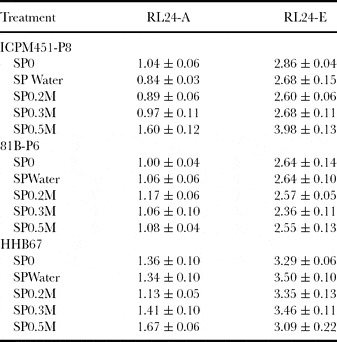
Seed priming. In general plant growth responded poorly to the seed priming treatment. In the RL24-E soil that had relatively higher Olsen P, the growth of plants across treatments was higher than in RL24-A soil. In RL24-E, none of the seed priming treatments showed any significant effect except at 0.5M for ICMP451-P8 (50% increase in growth). In RL24-A, hybrids also varied in their response to the seed priming treatment, and seed priming with 0.5M P increased shoot biomass by 90 and 25% over the water priming control in ICMP 451-P8 and HHB 67. In the case of 81B-P6 the effect of seed priming was non-significant (Table 1).
Effect of seed priming (SP) with P (KH2PO4 solution) at different concentrations (SP0.2M, SP0.3M and SP0.5M), including a seed priming with water (SP water) and no seed priming (SP0), on the shoot biomass (g plant−1) at six weeks on three hybrids of pearl millet and in two different low P Alfisol (RL24-A and RL24-E). Plants were grown in 20-cm diameter pots filled with 4.5 kg of soil. Data are means (±s.e.) of four replications and each replication is the mean value of three plants. Shoot biomass values of the non-limiting P treatment (DAP, 300 mg kg−1 soil) for ICMP451-P8, 81B-P6 and HHB67 were respectively 8.67, 8.34 and 10.3 g plant−1 in RL24-A and 7.15, 7.70 and 8.44 g plant−1 in RL24-E.

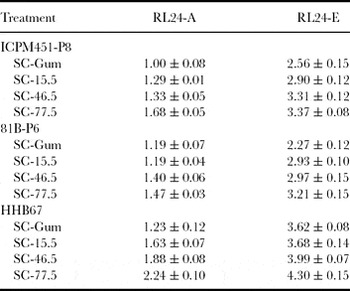
Seed coating. In the RL24-A soil, the shoot biomass increased significantly in all the P seed coating treatments in the range of 18–85 % over the no-coated control in the low P soil. The highest biomass response was seen in the P seed coating treatment with 77.5 mg P g−1 seed and this response was evident in all hybrids except 81B-P6 (Table 2). The highest response was found with HHB 67 whose shoot biomass increased by 84% over the non-coated control, whereas the biomass of ICMP451-P8 was increased by about 30% with the 77.5 mg P g−1 seed coating treatment. In RL24-E soil, a similar trend of shoot biomass increase of 12–41% over the control was seen in all hybrids and P seed coating treatments. However, the increase was less than in the RL24-A soil, which has lower P.
Effect of seed coating with different rates of P applications (15.5, 46.5 or 77.5 mg P g−1 seed, i.e. SC-15.5, SC-46.5 and SC-77.5), including a seed coating treatment with no P (SC-Gum) on the shoot biomass at six weeks after sowing on three hybrids of pearl millet in two low P alfisol (RL24A and RL24E). Plants were grown in 20-cm diameter pots filled with 4.5 kg soil. Data are means (± s.e.) of four replications and each replication is the mean value of three plants. For shoot biomass values of the non-limiting P treatment, see Table 1.

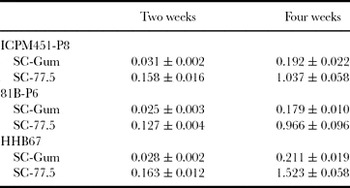
Short-term effect of the seed coating treatment. The coating of pearl millet seeds with P delayed and affected the germination and emergence of plants for about a day, regardless of genotype (data not shown). However, despite this short initial delay, there was a rapid and dramatic effect of coating on the shoot biomass in the initial two and four weeks after emergence of the plants (Table 3). In two-week-old seedlings, all three hybrids showed more than 400% increase in shoot biomass. In four-week-old seedlings, the seed coating with P increased shoot biomass of ICMP 451-P8 and 81B-P6 by 450% and 430% compared to the no-coating treatment. Hybrid HHB 67 appeared to be significantly more responsive to the seed coating treatment, since the seed coating with P led to a shoot biomass increased of 648% over control (Table 3). Yet, the seedling weight of the seed coated plants remained lower at 12–25% of the seedling weight under non-limiting P treatment.
Effect of P seed coating (0 and 77.5 mg P g−1seed, i.e. SC-Gum and SC-77.5) on the shoot biomass at two and four weeks after sowing in three hybrids of pearl millet. Plants were grown in 20-cm diameter pots filled with 4.5 kg of RL24-A soil. Data are means (± s.e.) of five replications and each replication is the mean value of three plants. Shoot biomass values of the non-limiting P treatment (DAP, 300 mg kg−1 soil) for ICMP451-P8, 81B-P6 and HHB67 were respectively 0.811, 0.571 and 0.628 g plant−1 at two weeks after sowing and 8.15, 6.22 and 6.76 g plant−1 at four weeks after sowing.

Effect of P seed coating treatment on flowering time and yield in pots
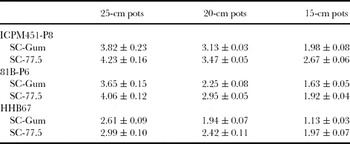
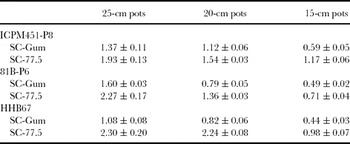
Biomass and yield: At maturity in 25-cm pots, the effect of coating seeds with P on shoot biomass compared to the no-coating control was moderate but significant in HHB 67 and 81B–P6 hybrid, but not in ICMP 451-P8. The effect was greater in HHB 67 (15% increase) than in 81B–P6 with the biomass increase with seed coating treatment of only 11% (Table 4). Seed coating significantly increased the panicle weight in all genotypes compared to the non-coated treatment, i.e. by 40% in ICMP451-P8 and 81B-P6, and by 115% in HHB67. Therefore, the seed coating effect was clearly greater on the panicle weight than on the shoot biomass (Table 4 and 5) and it benefited HHB67 more than other hybrids.
Response of shoot biomass (g plant−1) to seed coating with P (0 and 77.5 mg P g−1 seed, i.e. SC-Gum and SC-77.5) in three pearl millet hybrids grown in 25-, 20- and 15-cm diameter pots. Data are means (± s.e.) of five replications and each replication is the mean value of three plants. Shoot biomass values of the non-limiting P treatment (DAP, 300 mg kg−1 soil) for ICMP451-P8, 81B-P6 and HHB67 were respectively 14.29, 12.80 and 10.20 g plant−1 in the 25-cm pots, 11.97, 9.54 and 7.87 g plant−1 in the 20-cm pots, and 7.56, 6.85 and 4.99 g plant−1 in the 15-cm pots.

Response of panicle dry weight at maturity (g plant−1) to seed coating with P (0 and 77.5 mg P g−1seed, i.e. SC-Gum and SC-77.5) in three pearl millet hybrids grown in 25-, 20- and 15-cm diameter pots. Data are means (±s.e.) of five replications and each replication is the mean value of three plants. Panicle dry weight of the non-limiting P treatment (DAP, 300 mg kg−1 soil) for ICMP451-P8, 81B-P6 and HHB67 were respectively 9.87, 9.93 and 12.66 g plant−1 in 25-cm pots, 5.91, 5.64 and 9.13 g plant−1 in 20-cm pots, and 4.46, 3.33 and 5.44 g plant−1 in 15-cm pots.

Flowering and maturity time. The DAP treatment in 25-cm pots reached flowering stage 14 days earlier than the seed coating treatment, which itself flowered 11 days earlier than the non-coated control across the three hybrids. Maturity dates followed the same trend with similar differences in delays.
Interaction of seed coating and soil volume on the shoot and panicle weight. In the non-limiting P conditions, the shoot biomass in 15-cm pots was about 50% lower than in the 25-cm pot size (Table 4). Biomass reduction in the 20-cm pots compared to the 25-cm pots was only 10–20% (Table 4). The soil volume significantly affected the panicle weights, which in the 15-cm pots were 30–50% of those in the 25-cm pots, and in the 20-cm pots were 55–75% of those in the 25-cm pots (Table 5).
In the coated and non-coated treatment, the shoot weights in the 15-cm and 20-cm pots across hybrids were only 75% (15-cm) and 65–80% (20-cm) of those in 25-cm pots, showing a relatively similar reduction in shoot biomass in the 15-cm and 20-cm across treatment and genotypes. Similarly, panicle weights in the 15-cm and 20-cm pots across the coated and non-coated treatment and across hybrids were 50–64% (15-cm) and 55–85% (20-cm) of those in the 25-cm pots, showing a slightly higher reduction in the 15-cm than in the 20-cm pots, and a slightly higher effect of pot size on the panicle weight than on the shoot weight. Under these pot conditions and as compared to the non-coated treatment, the seed coating increased shoot biomass by 20–75% in 15-cm pots and 10–30% in 20-cm pots, showing a larger effect of seed coating in 15-cm pots (Table 4). Seed coating also increased the panicle weight by 50–120% in the 15-cm pots and 40–75% in the 20-cm pots showing that: (i) the effect of coating was again higher on the panicle weight than on the shoot weight (Table 4 and 5); (ii) the effect of coating on panicle weight was more beneficial in the 15-cm pots (Table 5). Hybrid HHB67 appeared to be the most responsive to seed coating.
Effect of seed coating treatment on yield and flowering time in field-like conditions
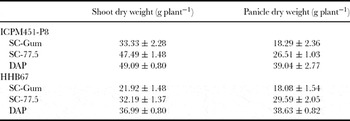
As mentioned above, the effect of seed coating clearly decreased over time in the potted experiment, likely because of soil volume limitation, so pearl millet plants were grown in cylinders to mimic the field conditions yet ensure soil homogeneity. ICMP-451 P8 and HHB 67 hybrids reached 50 and 70% higher shoot biomass in the seed P coating treatment than in the non-coated treatment (Table 6). In addition, the shoot biomass of the seed coating treatment in ICMP451-P8 was not significantly different from the shoot biomass of the non-limiting P (DAP) treatment and was only about 15% lower in the seed coated HHB67 than in the non-limiting P treatment. The seed coating treatment also significantly increased the dry panicle weight by 45% over the non-coated treatment in ICMP-451-P8 and 65% in HHB 67 (Table 6). Contrary to the shoot biomass, the panicle weight of the seed coating treatment remained lower than that in the non-limiting P treatment, being about 35–25% lower than in the DAP control in ICMP451-P8 and HHB67 (Table 6).
Effect of P seed coating (0 and 77.5 mg P g−1seed, i.e. SC-Gum and SC-77.5), compared to a non-limiting P control (DAP, 300 mg kg−1 soil) on the shoot and panicle dry weight at maturity in two pearl millet hybrids grown in field-like conditions in PVC cylinders.

The seed coating treatment significantly affected the number of days to 50% flowering and seed maturity in these conditions also. Flowering was delayed by 10 days in the non-coated treatment over the seed coating treatment (77.5 mg P g−1 seed) in ICMP 451-P8, and by 14 days in HHB67. In the DAP treatment, flowering was advanced by 10 days over the seed coating treatment across hybrids. A similar trend followed for the days to maturity; however a further delay of another seven days was seen in the non-coated treatment for the panicle maturity.
DISCUSSION
The results showed a clear effect of seed coating on the early establishment of pearl millet seedling in low soil P. Although the effect of the seed coating treatment on the shoot biomass progressively evened off and was almost negligible at maturity, seed coating maintained a significant effect on the panicle yield at maturity. When tested in conditions mimicking the field, the seed coating treatment had a dramatic effect on both shoot biomass and panicle weight; the effect on the shoot biomass was larger than on panicle weight, and shoot biomass was close to the non-limiting P treatment. There was a genotypic effect on the magnitude of the response to seed P coating. Finally, P deficiency delayed flowering but the seed coating treatment substantially reduced that delay in comparison to the non-limiting P treatment.
The findings showed that a practical method to supply P to the seeds of pearl millet was possible in quantities of P that were previously found to elicit a plant growth response (Valluru et al., Reference Valluru, Vadez, Hash and Padmaja2009). This agrees with previous work (Rebafka et al., Reference Rebafka, Bationo and Marschner1993) showing its potential in the Sahelian soil and shows that this practice could also be extended to other soils. The coating of P around the seeds appeared to be homogenous and provided for a uniform P supply as there were limited plant-to-plant differences within each pot and, therefore, P coating in individual seeds was not assessed. This simple technique of application would likely be possible to apply to farmers' conditions since gum Arabic, the substrate used to develop the glue solution, can be easily harvested under natural conditions in the area where this technique is targeted. Although some response to the priming method was found, the concentration needed to elicit a response was close to that where germination was reduced (data not shown), probably due to the small size of pearl millet seeds and the limited capacity to absorb P solution. Also, primed seeds had to be planted immediately after priming, which limited the practicality of the priming technique to supply P to pearl millet seedlings.
A very interesting point in the results, both in pots with limited soil volume and in cylinders where the soil volume was close to the field situation, was that P deficiency affected shoot biomass less than panicle yield. For instance in 25-cm pots, biomass in the non-limiting P treatment was three- to four-fold higher than in the non-coated treatment, whereas the panicle yield was seven- to twelve-fold higher. In addition, the shoot biomass in the seed coating treatment in the cylinders was very close to that in the non-limiting P treatment, whereas the panicle yield was about 65–75% of that in the non-limiting P treatment. These results together indicate that the biomass production suffered the early P deficiency less than the panicle yield. Once plants were established under these low P soils, they were capable of accumulating biomass and the coating treatment simply contributed to a faster plant establishment. In pots, it resulted in having a biomass at maturity that was only slightly higher in the coated than in the non-coated treatment. In the cylinder, where the soil volume was closer to that available in a field, the biomass of the coated treatment was similar or very close to that of the non-limiting P treatment. We interpret this as showing that the seed coating treatment would have promoted root establishment, leading to exploitation of more soil volume and eventually uptake of more P. Yet, a similar effect was not seen on the panicle yield, in agreement with previous data (Rebafka et al., Reference Rebafka, Bationo and Marschner1993). Our hypothesis is that developmental processes happening early during plant development (likely before panicle initiation) are affected by P deficiency, an effect that seed coating could only partially compensate. This can be seen in the shoot biomass at two weeks after sowing where the biomass of the coated treatment was only 15–20% of the non-limiting P control, although the seed coating increased biomass 400% over the non-coated control. In the cylinder, although coating contributed dramatically to seed yield under low P, the panicle yield remained 25–35% below that of the non-limiting P treatment. It suggests that the panicle initiation must have been affected at an early stage, which would have been partially compensated by the seed coating treatment, although not fully, in agreement with previous data on oat (Peltonen-Sainio et al., Reference Peltonen-Sainio, Kontturi and Peltonen2006). This would agree well with recent data showing that plant phenology interacts with tolerance to low P conditions with late maturing germplasm having more time to accumulate P (Nord and Lynch, Reference Nord and Lynch2008, Reference Nord and Lynch2009).
All genotypes did not respond the same way to the seed coating treatment. Although HHB67 was the genotype producing the lesser biomass and panicle weight under low soil P, it was also the most responsive to the seed coating treatment. This agrees with similar findings in response to minute amounts of P (Valluru et al., Reference Valluru, Vadez, Hash and Padmaja2009). The reasons for that are unclear and we may speculate that seed coating helps a better development of particular organ, e.g. root, that is otherwise limiting for P capture. Testing a larger range of genotypes to assess whether there is indeed large genotypic variation in the magnitude of the response to seed P coating would be an important task, as optimization of the technique requires consideration of the genotype as a component of such techniques.
It was also very important to notice that P deficiency delayed flowering time and maturity, in agreement with previous data (Chauhan et al., Reference Chauhan, Johansen and Venkataratnam1992; Ma et al., Reference Ma, Longnecker and Atkins2002; Sahrawat et al., Reference Sahrawat, Rego, Burford, Rahman, Rao and Adam1995). This is important for pearl millet grown in conditions constrained by a short growth period, where any delay in flowering would lead to having the completion of the crop cycle taking place well after the end of the rains and therefore under water stress. Importantly, the seed coating treatment helped reduce this delay. Again, this pointed to a likely effect of the early deficiency on the developmental processes, which the coating treatment partially helped to alleviate.
In conclusion, a seed coating technique confirmed its usefulness in enhancing the establishment of pearl millet seedlings and conferred a panicle and biomass yield advantage at maturity. The fact that this advantage was less for the panicle weight than for the shoot biomass suggests that P deficiency affects early development process that can only be partially compensated by the coating. Genotypes seemed to respond differently to the seed coating treatment. If these differences in the genotypic response to seed coating are confirmed from a larger range of germplasm, highly responsive genotypes would need to be used to optimize the chances of success of the seed coating technique.
Acknowledgements
The authors would like to thank Dr C. T. Hash and pearl millet breeding team, ICRISAT, for providing the seed material. Authors are also grateful for the excellent peer reviewing of Dr Kanwar Sahrawat and Dr Mainassara Zaman.