The London Stage puts under our noses a vivid story of ongoing competition, sometimes fierce, even destructive competition… . Night after night [the theatres] go head-to-head trying to attract an audience… . If we choose to pay attention, the performance calendar shows us how each management responded to success at the other theatre or attempted to capitalize on its own.
—Robert D. Hume, “Theatre History 1660–1800”Footnote 1In her recent book on celebrity pregnancy, legal scholar Renée Ann Cramer writes, “in the years from 1970 to 2000, popular culture became more open to performances of pregnancy; once kept secret and articulated as private, pregnancy became ‘public.’”Footnote 2 This is not wholly true. In the English-speaking world, “celebrity pregnancy,” with its overt performances of femininity and maternity, bodily monitoring, and careful dance between the concealment and revelation of private information, had its first public moment in the long eighteenth century. That century's professional theatre was a site for the intersection of two forms of women's labor: the maternal labor of pregnancy and birth, which affected women of all classes throughout a century with rapidly rising birth rates, and the theatrical labor of professional actresses. Although the latter has been the subject of much-needed study in recent decades, the impact of maternal labor on the professional theatre of the time is only beginning to be explored.Footnote 3 Between 1700 and 1800, birth rates for middle- and upper-class British woman rose significantly. Among the aristocracy, rates doubled from four to eight children, and middle-class women averaged seven births by the end of the century.Footnote 4 At the same time, women in the professional theatre were inventing and modeling new forms of public womanhood, capitalizing on a burgeoning culture of female celebrity, and, in some cases, wielding exceptional economic and artistic power. Though not all actresses had children, many did, and at rates that were not unlike those of their nontheatrical counterparts.Footnote 5 For these women, the successful balancing of maternal and theatrical labor could be vital to their careers and, in many cases, their family's survival.Footnote 6 The need to balance personal and professional demands was all the more imperative within the hectic and extremely competitive repertory system. The day-to-day repertory of a London company was of necessity a malleable thing, accommodating short runs of popular pieces, audience requests, illnesses and absences of company members, and the perpetual state of competition between the patent houses of Covent Garden and Drury Lane.Footnote 7 To compete profitably, managers needed competent and popular performers (bodies) and performance vehicles (texts) in which to feature them. As the available bodies changed, then, so too did the available plays for performance.Footnote 8
Within the eighteenth-century repertory system accommodating the pre- and postpartum bodies of female performers—especially those of celebrities—and navigating the challenges their absences presented was a vital form of managerial labor that contributed to a company's stability and success. The repertory shifts caused by these bodies of necessity affected other members of the company, and occasionally even the landscape of London theatre as a whole. As each celebrity performer had a particular specialty or line of business, for example, a manager might be unable to produce specific plays, or even entire genres, that relied on the popularity of the absent actress. Such limitations at one house were opportunities at the other; like ripples in a pond, a seemingly small disturbance could have wide-ranging consequences. That maternal bodies are largely invisible in our current scholarship means we are sometimes seeing effects without cause and missing vital pieces of the puzzle. For all that The London Stage can offer a reasonably accurate picture of who performed what where and when, it cannot always tell us why or how; these unanswered questions call us to resurrect the performing bodies that shaped and embodied the archival fragments left to us.
The work offered here builds on that of many others, and answers several calls. Susan Bennett writes of the “frequency and density of theater history's blind spots” and labels “gender … an axis on which questions of theater history inevitably turn.”Footnote 9 Actresses’ reproductive labor remains both a frequent and dense blind spot, and, as this article shows, provides a space from which to pivot our understandings of agency and power within the management of professional companies. Felicity Nussbaum's Rival Queens presents considerable evidence for the reframing of what Allardyce Nicoll called “‘an age … of the actor’” as “the age of the actress.”Footnote 10 She demonstrates that generations of scholars’ and writers’ attention to the activities of actors and managers like David Garrick and Richard Brinsley Sheridan have often left us unaware of the centrality of women in eighteenth-century theatrical life. The work of Laura Engel, Helen E. M. Brooks, Fiona Ritchie, Elizabeth Howe, Gilli Bush-Bailey, Jean I. Marsden, Kristina Straub, Julia H. Fawcett, and many others have anticipated or followed this call, extending our awareness of the ways women participated in and shaped the history of Restoration and eighteenth-century theatre.Footnote 11 Joseph Roach's study of the nature and power of celebrity, It, offers insightful and compelling criteria for identifying celebrity and articulating both its power and its inherent vulnerability across what he calls the “deep eighteenth century,” which connects that time and our own.Footnote 12 Recently, Laura Engel and Elaine McGirr's Stage Mothers: Women, Work and the Theater, 1660–1830 pushed research on celebrity and gender to consider the ways women's private maternal labor intersected with their public theatrical and literary labor. Building on this work, I employ the methods of Robert D. Hume and Judith Milhous focused on the archive, and the feminist historiographies of Bennett, Tracy C. Davis, Jacky Bratton, and others that go beyond it, to place the maternal bodies of working actresses at the center of our attention. Here, I focus on a singular and much-studied event to introduce the myriad ways in which recovering women's maternal bodies matters to our understanding of not simply individual careers, but company structure and the repertory system as a whole.
The so-called Battle of the Romeos of 1750 is one of the most famous events of eighteenth-century theatrical history. A twelve-night contest between the patent houses, the rival productions of Romeo and Juliet featured David Garrick and George Anne Bellamy at Drury Lane and Spranger Barry and Susannah Cibber at Covent Garden. The head-to-head dispute made the always-extant but often implicit competitive spirit of the professional theatre markedly explicit. After a series of increasingly hostile acts by the managers at both companies over the preceding two years, the rival Romeo and Juliets were a declaration of all-out war, and were framed as such in Garrick's correspondence and in prologues to each production. Scholars have used the critical commentary generated by this contest to better understand eighteenth-century acting style, staging conventions and technology, and editorial practices.Footnote 13 George Winchester Stone Jr., Kalman A. Burnim, and Leslie Ritchie, for example, have detailed Garrick's development of the performance texts for his 1748 and 1750 productions of the play, and Ritchie specifically has outlined the importance of Garrick's coaching to Spranger Barry's Romeo. Most recently, Elaine McGirr has asked us to consider how reputation and bias impact the historical record by focusing on the vastly different receptions of Theophilus Cibber's adaptation and production of Romeo and Juliet in 1744 (opposite his daughter, Jenny), and Garrick's in 1748 and 1750. Differences in personal reputation, then and now, have led us to value Garrick's alterations more highly despite significant borrowing from Cibber.Footnote 14 There is no doubt of the importance of Barry and Garrick's conflict both to the event and to the ensuing criticism, but, as McGirr's work demonstrates, there is much to be gained by turning our attention to those around that conflict and considering how reputation and bias impact our reading of history.
Paying close attention to the rival Juliets and to the performance calendar brings to light a growing conflict between the patent houses in the years between 1748–50 centered on the availability of female performers. The conflict variously arose from and was exacerbated by a series of celebrity pregnancies: between the fall of 1748 and January of 1751, four of London's leading actresses—Sarah Ward, George Anne Bellamy, Susannah Cibber, and Hannah Pritchard—gave birth to five children. The absences related to their pregnancies ranged from nine weeks to an entire season and therefore presented significant challenges to the managers of both companies; they also exacerbated existing competition around the hiring and retention of popular actresses because the celebrity actress was now a scanter commodity than in previous years. Ultimately, when looked at with this information in hand, the rival Romeo and Juliets become a case study in better understanding how women's bodies—pregnant or not, available or absent—functioned as an integral, driving force of the heavily competitive London repertory system. It also opens up a narrative about repertory making, intra- and intercompany competition, and the influence of pregnancy and related absences that improves our understanding of the commercial London theatre far beyond this singular event.
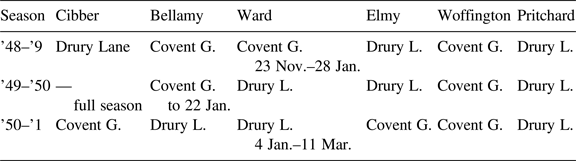
To understand the larger context of the rival Romeo and Juliets, it is necessary to understand background information for the two women involved, including their line of business and public reputation, for these were intimately connected to audience reception. As their absences had a significant influence on the companies in which they worked, moreover, I introduce several other women (Sarah Ward, Hannah Pritchard, Mary Elmy, and Peg Woffington) as needed in the ensuing sections. What follows is a chronological narrative starting in the fall of 1748 and culminating with the season of the rival Romeo and Juliets, 1750–1. For the sake of clarity, Table 1 shows company affiliations for each woman in each season, and lists dates of any maternity-related absences.
Company affiliations and maternity leaves, 1748–51
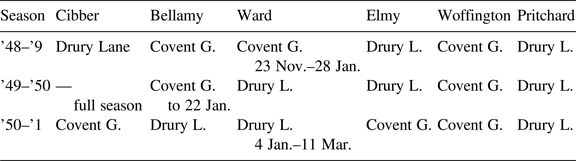
I have elected to use a chronological structure for one major reason: the premise upon which this essay operates is that the repertory system cannot be understood in a vacuum, and therefore a structure built around discussing each woman independently, for example, would obscure the connections that might otherwise exist in the “real time” of mid-eighteenth century London. This narrative models the ways the performance calendar might be read as the record of a living system that responded to and evolved with changing circumstances, answering Robert D. Hume's call given at the beginning of this essay to heed the insights this resource has to offer, while pushing beyond it. Drawing on parish records and other biographical sources reads otherwise invisible maternal bodies back into the performance calendar, deepening our understanding of the repertory system and daily working life in the eighteenth-century theatre.
The Rival Juliets
Susannah Cibber and George Anne Bellamy were popular performers specializing in tragic heroines designed to evoke pity, compassion, and heartfelt admiration in their spectators. They were also public women whose private lives were of abiding interest to their audiences. Audiences gleaned information about celebrities through print and visual media, but actresses’ public reputations also fed, and were fed by, the onstage roles they performed. Joseph Roach positions this reciprocal relationship between onstage appearances and celebrity persona as a key to “public intimacy,” the illusion that audiences know the “real” person behind the celebrity.Footnote 15 Felicity Nussbaum, in turn, argues eighteenth-century celebrity actresses’ public performances of self created an “interiority effect” that added depth to fictional characters.Footnote 16 Cibber's offstage status as a wronged wife and Bellamy's reputation for impulsive and passionate behavior bled into their onstage performances, bolstering their perceived validity and the illusion that acting revealed truths about their private characters. The similar nature of their individual repertoires meant that they never occupied the same company at the same time. Instead, Bellamy, being the less prominent of the two, found her career frequently shaped by Cibber's orbit: if Cibber left one company and entered the other, Bellamy was sure to traverse the same path in reverse.
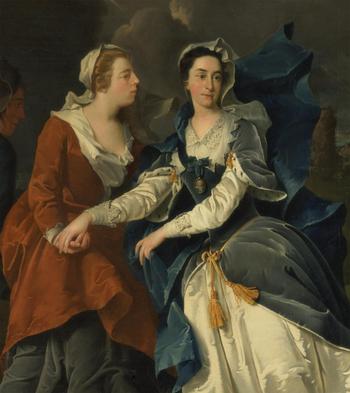
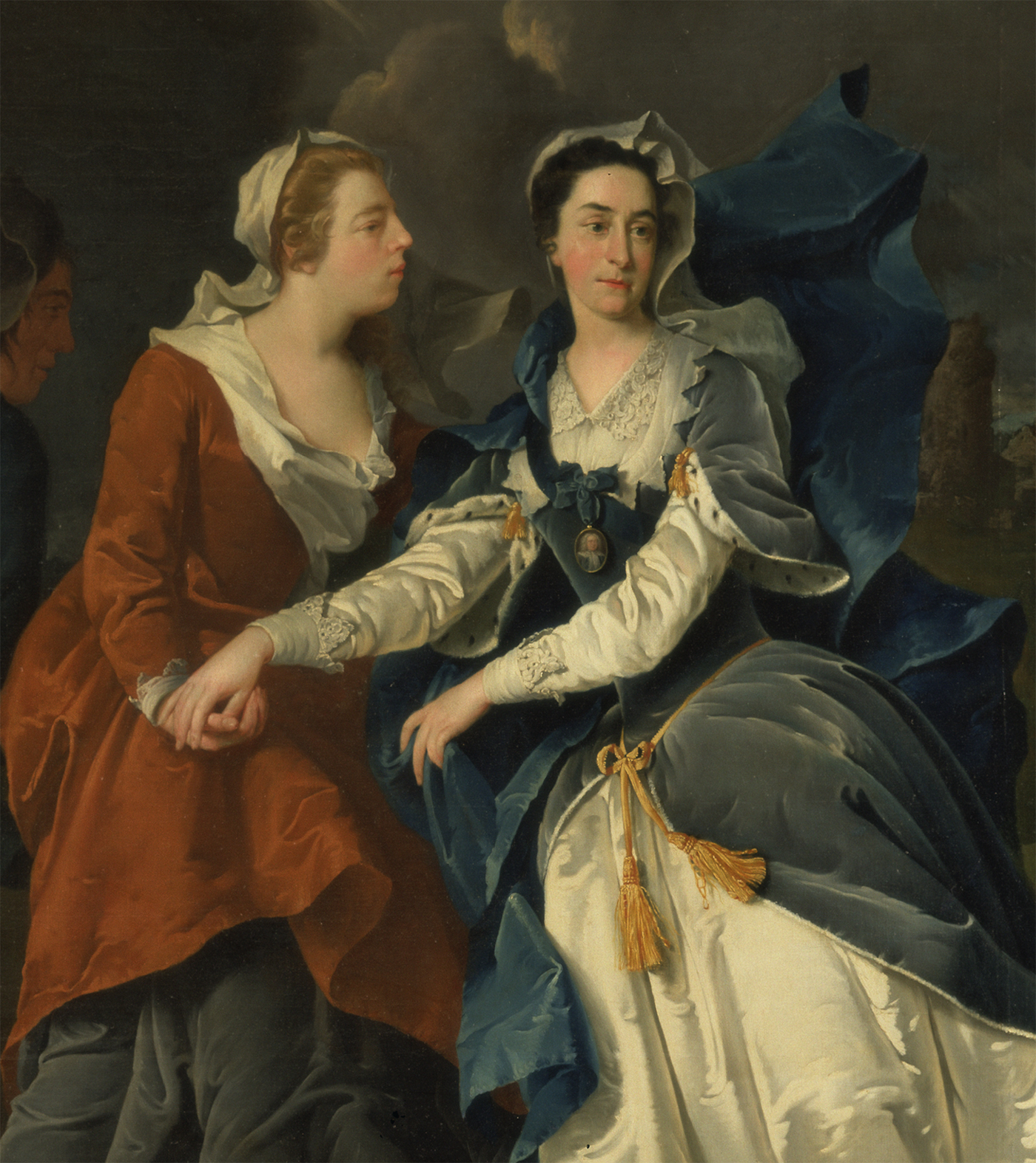
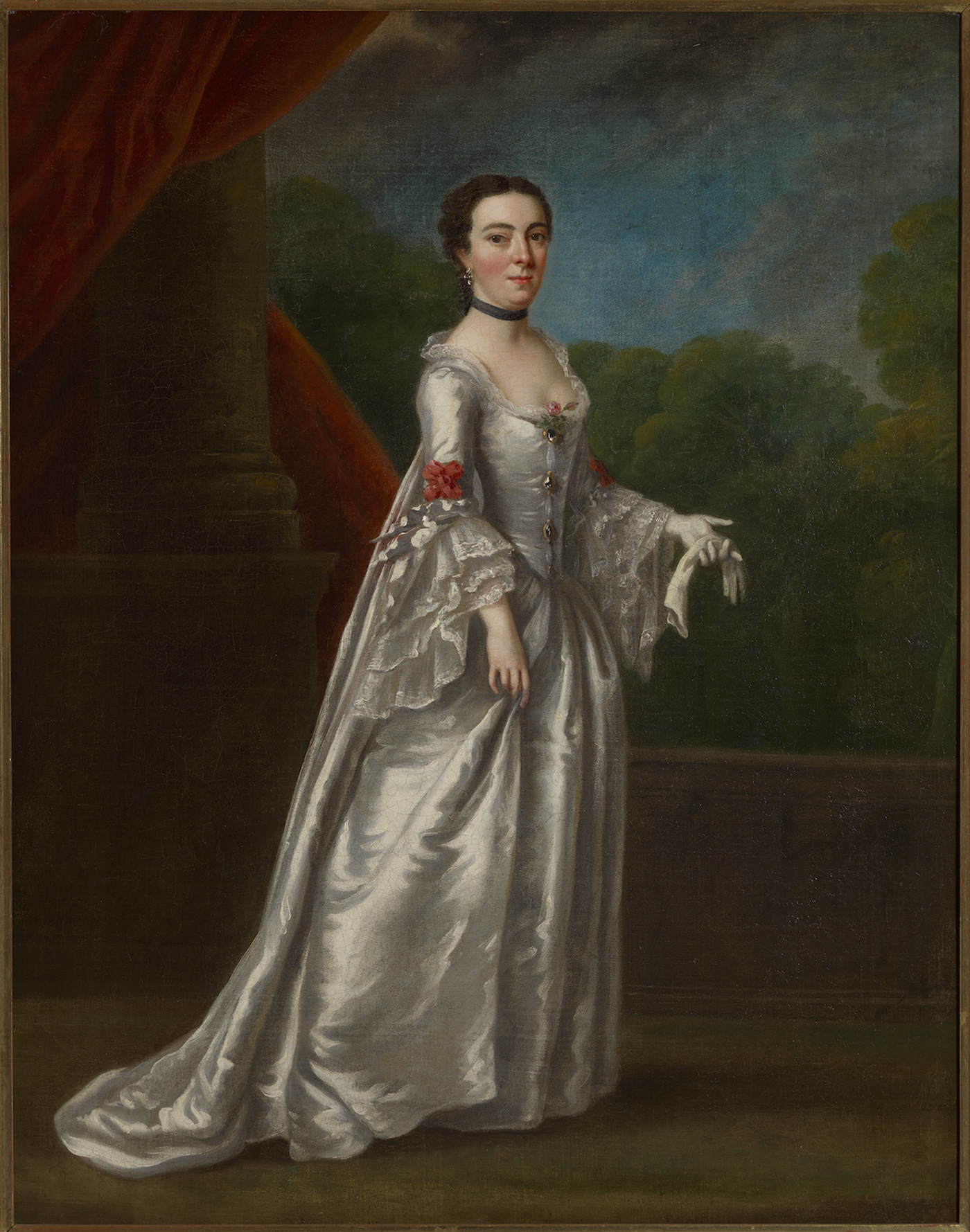
At the height of her career, Susannah Maria Cibber (née Arne) was the highest-paid actress of her day, exercised complete control over her repertoire, and specialized in pathetic tragic heroines, the “wronged and doomed object[s] of excessive desire.”Footnote 17 She was the favored partner of Barry, Garrick, and James Quin, and pursued her profession with tenacity, supposedly leading Garrick to label her “the greatest female plague belonging to my house” for her ability to get her way despite his best efforts to resist and manage her (Fig. 1).Footnote 18 Such testimony is crucial for understanding Cibber as an active agent in the shaping of her professional life and career. Between her own large salary, undeniable popularity, and connection to a wealthy lover, she was never dependent on her theatrical earnings for survival and therefore exerted considerable agency in ordering her career.Footnote 19 Unfortunately, the absence of substantial correspondence penned by Cibber, compounded by the tendency of “memoirists, managers, fellow actors, and audience members [to] consistently understat[e] the cultural—and economic—power that actresses might wield,” has left us with challenges to seeing and appreciating forms of agency not detailed in such sources.Footnote 20 For example, absence from the stage during pregnancy is often construed as involuntary—the result of temporary, forced retirement—but absence itself can be a form of agency, particularly in the case of a woman who was not dependent on the theatre for financial stability.Footnote 21
Pieter van Bleeck, 1700–64. Detail from Mrs. Cibber as Cordelia, 1755. Yale Center for British Art, Paul Mellon Collection, New Haven, CT. Public domain.
Susannah Cibber was already an established celebrity when she joined the company at Drury Lane in Garrick's first year as manager, 1747–8. She entered the profession as a singer in the early 1730s, and made her debut as a tragic actress in 1736. She enjoyed immediate success and remained popular despite a two-year hiatus after the scandalous breakdown of her marriage to Theophilus Cibber, Colley's errant son. Indeed, the adultery-related trials she endured seemed to confirm that the suffering women she played onstage were thinly veiled performances of her private experiences. Through the trials, the public learned that Theophilus had stolen his wife's salary and stage costumes to pay gambling debts and forced her into a relationship with a married man, William Sloper, who in return financially supported the Cibber household. When Susannah Cibber wanted to leave her husband to live with Sloper permanently, Theophilus sued Sloper for “criminal conversation.”Footnote 22 These events in her private life might have ruined her career. Instead, when she returned to the stage after a brief hiatus, Susannah Cibber was able to use the revelations of her private life to bolster claims to an acting style drawn from nature, through which she won sympathy and support from her audiences. Onstage she wept, trembled, blushed, and sighed; strong emotions acted on her small body visibly, creating the impression that she felt all that was expressed: “Her tenderness was natural, for it was said that in pathetic parts, she wept genuine tears; and that her agitation turned her face pale, even through the rouge.”Footnote 23 She enjoyed a following among the aristocracy, and was patronized by the Prince and Princess of Wales. In the summer of 1749, after two successful years at Drury Lane under Garrick's management and annual earnings of close to £1000 including benefits, Cibber withdrew from the company and gave birth to her last child. Many other women in the same situation remained onstage during pregnancy, and/or returned to work shortly thereafter.Footnote 24 Cibber did neither, a decision that had major implications for both London companies. The next we know of Cibber professionally is that she joined the Covent Garden company with Spranger Barry for the 1750–1 season, sparking Garrick's ire and setting in motion his plan to mount a rival production of Romeo and Juliet.
George Anne Bellamy arrived in London from Dublin during the summer of 1748, and signed with Covent Garden for the ensuing season. It was not her first contract with John Rich, for she had been in the company during 1744–5 before spending three years with Thomas Sheridan's company at Smock Alley in Dublin, where she had performed with both Spranger Barry and David Garrick in the 1745–6 season.Footnote 25 Bellamy was young, with a good figure, pleasing voice, and charming stage presence (Fig. 2). Her passionate portrayals of ill-fated women made her a popular performer, and she quickly established herself as a potential rival to Susannah Cibber by taking on parts long associated with the older actress. Offstage, she came to have a reputation for impulsivity and passion that mirrored those of many of the heroines she played. On 20 April 1749, so the story goes, Miss Bellamy absconded from Covent Garden with a lover, George Montgomery Metham, in the midst of acting Lady Fanciful in John Vanbrugh's The Provok'd Wife. Explaining to the audience why she did not appear in the final act, James Quin begged the audience's pardon
for the fantastical girl of quality, whose company they would be disappointed of at the conclusion of the piece, as she had left Heartfree, upon finding an admirer* that was made on purpose for her.
F[rancis]. Lindo, 1714–67, George Ann Bellamy. Courtesy of the Garrick Club, London.
*Alluding to what Lady Fanciful says in the 1st scene.Footnote 26
Quin thus made use of the readily available conflation of actress and role to excuse Bellamy's behavior as justified because motivated by love. Though Bellamy missed half the London season in 1749–50 for the birth of her first child, her reappearance in January gave her ample opportunity to showcase her repertoire of successful tragic heroines. By the time Garrick discovered Cibber's defection to Covent Garden and needed a new actress in the summer of 1750, Bellamy had made herself the natural choice. From Bellamy's perspective, the prospect of Cibber joining the Covent Garden company was potentially disastrous: it would greatly diminish her potential for advancement, and she would almost certainly be forced to give up parts Cibber wanted to play in both stock and new plays.Footnote 27 Though she frames it as an impetuous decision in her memoir, in actuality the move to Drury Lane was the most logical course of action to secure her personal advancement, and it set the stage for the rival productions of Romeo and Juliet.Footnote 28
Cibber and Bellamy's changes of company affiliation are tied to the pressures their reproductive bodies placed on both their individual careers and the larger repertory system in which they worked. To illustrate the ways in which their absences forced changes in the larger system, I begin in the 1748–9 season: Bellamy's first year at Covent Garden, and Cibber's last at Drury Lane.
The 1748–9 Season
The 1748–9 season is useful for understanding when, and possibly why, Susannah Cibber's relationship with David Garrick soured to such a degree that she left his company for Covent Garden in 1750–1. At Covent Garden, the season demonstrates the ways pregnancy might be planned for and accommodated by a repertory company. A new performer, Sarah Ward, entered the company heavily pregnant and gave birth in the middle of the season. Her experience makes it clear that such an event did not necessarily have a malignant effect on a performer's career, even for a new and as-yet unknown performer. Furthermore, Ward's pregnancy demonstrates the way such events might impact other performers. In this case, her condition helped ensure George Anne Bellamy's prominent place in the company.
Garrick took over the management of Drury Lane in 1747–8 with an extraordinarily strong company. In addition to Garrick and Cibber, it counted Spranger Barry, Kitty Clive, Hannah Pritchard, and, for the first year, Peg Woffington, among its ranks.Footnote 29 Clive, Woffington, and Pritchard were established and popular performers excelling in comedy, and Clive was also a fine singer. Pritchard and Garrick were exceptionally versatile, appearing in comedy and tragedy together with great success. Barry and Cibber, meanwhile, were considered unparalleled in their moving portrayals of melting pathos:
There was no passion of the tender kind so truly pathetic and forcible in any player as Barry, except Mrs. Cibber, who indeed excelled, in the expression of love, grief, tenderness, rage and jealousy, all I ever knew. Happy it was for the frequenters of the theatre when these two genuine children of nature united their efforts to charm an attentive audience.Footnote 30
In the first two years under Garrick's management, Cibber had successful partnerships with both of the company's leading men.Footnote 31 In 1748–9, Drury Lane scored two hits with remounts of Shakespeare: Garrick and Hannah Pritchard starred as the warring Benedict and Beatrice in Much Ado about Nothing on 14 November, enjoying an eight-night run, and Cibber and Barry debuted their Romeo and Juliet on 30 November. The latter was unequivocally the hit of the season, repeated fifteen times before Christmas, twenty-one times by the end of the season, and grossing the theatre £3000.Footnote 32 It was this production that Cibber and Barry would remount at Covent Garden for the rival Romeo and Juliets.Footnote 33
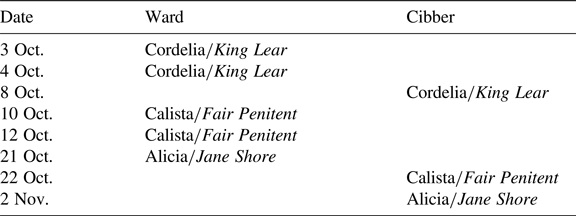
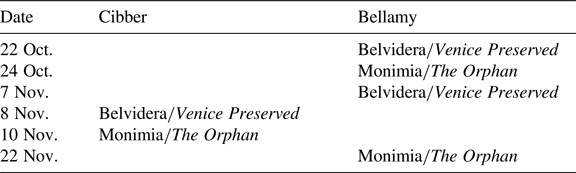
At Covent Garden, 1748–9 was a season of change. John Rich undertook a series of new hires to try and counter Garrick's formidable company at Drury Lane, particularly his impressive array of female celebrities. His key acquisition was Peg Woffington. With her real-life romantic relationship with Garrick ended and the competition for good parts at Drury Lane heavy, Woffington signed on at Covent Garden. Woffington's long-standing repertoire of popular comedic parts enabled her to compete directly with Clive and Pritchard. She was also developing an interest in tragedy and would, over the next two years, increasingly test her mettle against Hannah Pritchard in more serious parts.Footnote 34 In addition to Woffington, Rich hired two other new leading ladies, Sarah Ward and George Anne Bellamy. Both women were tested in Susannah Cibber's specialty of pathetic tragedy with parts closely associated with the other actress (see Tables 2 and 3). Having secured Woffington as a promising rival to Pritchard and Clive, Rich's hiring of these two women is a reflection of Cibber's popularity and her successful partnerships with Garrick and Barry in tragedy, advantages that Rich sought the means to counter directly. Drury Lane responded to these attempts with a schedule that—particularly in the first two months of the season—enabled audiences to compare Cibber to the new women at Covent Garden in the same roles, often only a few days apart.
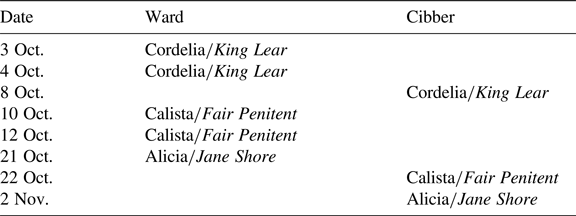
Selected repertory for Ward and Cibber, fall 1748
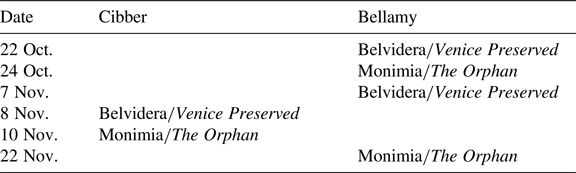
Selected repertory for Cibber and Bellamy, fall 1748
Sarah Ward, the first of Rich's two new leading ladies, came to London from Edinburgh. She was extraordinarily beautiful but ultimately unsuccessful during this first foray in London, particularly in direct competition with Cibber.Footnote 35 Before she left the stage in anticipation of her child's birth, Ward appeared in three parts that were strongly associated with Cibber. In each case, Drury Lane responded swiftly and directly, showcasing Cibber in the same part within days of Ward's appearances; in several cases, Cibber's appearances seem to have ensured that Ward's were not repeated (Table 2).
Ward's debut as Cordelia on 3 October was repeated the next night. After Cibber and Garrick performed the same roles on 8 October, however, Covent Garden left King Lear out of the repertory for the rest of the season. Ward's 10 and 12 October appearances as Calista in The Fair Penitent were followed by Cibber's performance in the same role on 22 October. Covent Garden did not mount The Fair Penitent again that season. Despite this initial lack of success, Ward is a valuable figure for understanding the way pregnancy's impact lies not simply with the individual, but with the larger company.
That Ward made her London debut while heavily pregnant is a circumstance missed in the brief biographical sketches we have of her in Highfill, Burnim, and Langhans's Biographical Dictionary and the Oxford Dictionary of National Biography.Footnote 36 George Anne Bellamy, however, plainly describes the circumstance in her Apology (1785), and the performance records for the season verify her account.Footnote 37 Importantly, this pregnancy neither prevented nor voided Ward's contract, nor did it cause her debut to be delayed until after the birth. Ward performed for five weeks in the fall, missed eleven weeks of the season between mid-November and the end of January, and returned to play the remainder of the season. Bellamy was the second hire, brought on, in Rich's words, as his “happy corps de reserve” to pregnant Mrs. Ward.Footnote 38 Facing the daunting rivals at Drury Lane and having hired an actress who would be unavoidably absent for part of the winter shaped Rich's approach to hiring and scheduling for the season. Ward needed to debut as soon as possible, “her pregnancy rendering such a step necessary,” and Rich consequently scheduled Ward's first foray for 3 October.Footnote 39 Bellamy, on the other hand, could be kept in reserve until the end of the month, a tactic that allowed him to maximize the impact of each woman's debut. Against Garrick's proven company of familiar faces, Rich offered youth and novelty.
Like Ward, Bellamy's repertoire made her attempts to rival Cibber immediately apparent (Table 3).Footnote 40 For her debut on 22 October she acted Belvidera in Otway's Venice Preserved; Cibber partnered Garrick in the piece at Drury Lane, and it was one of their most popular pairings. Bellamy's second appearance was Monimia in The Orphan on 24 October, another part strongly associated with Cibber.
Like Ward, she had limited success competing directly with Cibber, but was able to make her mark in roles that fell into the same general category. Over the course of her first full London season, 40 percent of Bellamy's appearances were in roles currently or formerly possessed by Cibber.Footnote 41 That Cibber and Bellamy were the two women involved in the episode of the rival Romeo and Juliets, then, is a partial consequence of the way in which Bellamy's career came to be understood in relation to Cibber's. Bellamy proved a valuable asset during Ward's absence, which enabled her to take on a more prominent role in the company soon after her debut while lessening the disruption to the repertory a pregnancy and birth might cause. While Ward was absent, for example, Bellamy took over her role as Alicia in Jane Shore, playing opposite Peg Woffington in parts both women would continue to play in succeeding seasons.Footnote 42
In the spring of 1749, two important events occurred in the lives of Cibber and Bellamy that would shape the London theatre in the short and long term. Cibber, who had experienced intermittent stomach problems since 1747, became ill and missed a number of performances that spring. The illness may have been related to the ongoing stomach complaint of which she eventually died in 1766, or may have been the early signs of her last pregnancy, as her son, Charles, was born sometime in the fall or winter of 1749/50. The illness caused Cibber to reject a part in a new play, and Garrick's unsympathetic response soured the relationship between them. That summer, at which point she almost certainly knew she was pregnant, Cibber withdrew from the company for the 1749–50 season.
The clues as to why she made these decisions are sparse, and recorded only decades after the actual event. Thomas Davies writes that Susannah Cibber “had particular objections to the manager's conduct, respecting those plays in which she acted principal parts,” and to this Genest attributes her absence in 1749–50.Footnote 43 The likeliest cause of a dispute between Cibber and Garrick involves an attempt at manipulation in which engaged Garrick during the 1748–9 season. Aaron Hill, the playwright whose Zara had launched Cibber's tragic career in 1736, desired her to play the lead in his new play, Merope. David Mallet, Hill's emissary, reported in November 1748 that Mrs. Cibber loved the play and wished to take the part; by late February 1749, however, she was reluctant to participate if he and Garrick planned to stage it before the end of the season, particularly as it would have to be prepared in the midst of the always-hectic benefit season.Footnote 44 When Mallet—genuinely believing her to be unwell—conveyed her answer to Garrick, the manager scoffed at the idea of an actual illness, assuming she was just being difficult. He suggested that Hill write a letter purporting to be delighted to have Hannah Pritchard play the part instead. Garrick would ensure Cibber saw the letter, which would make her “so jealous of the other's acquiring new reputation by a capital part,” that she would consent to play.Footnote 45 Garrick's gambit against his “rival Princesses” failed, however, and Pritchard debuted as Merope on 15 April, with Garrick playing her son, Eumenes.Footnote 46
Cibber was attempting to assert the limitations of her physical body. Garrick failed to respect this, and his reaction reflects a long history of mistrust around women's expressions of pain and illness.Footnote 47 It is also the kind of behavior that reflects poorly on Garrick, and is, perhaps, therefore more likely to be excused or ignored despite significant primary source evidence that Garrick could be as jealous and capricious toward his female performers as he frequently accused them of being toward each other.Footnote 48 Garrick's reaction suggested a lack of trust and respect beyond this singular incident, a theme in later evaluations of women's careers. Thomas Davies, for example, speculates that Cibber was uninterested in Merope not because of her health but because “she imagined the part did not suit her maidenly slim figure,” reiterating common tropes around vanity used to diminish women's professionalism and artistic legitimacy.Footnote 49 Cibber's own thinking has been lost to history. Garrick's manipulative behavior, however, perhaps especially in light of the pregnancy she discovered sometime that spring or early summer, may explain why Cibber was unwilling to continue working for him even after the birth of her child.Footnote 50
The pregnancy certainly helps us understand why Cibber was absent in 1749–50. Cibber's health was often delicate, and she had lost both her children by Theophilus Cibber shortly after their births in 1735 and 1736. Her surviving daughter, by longtime lover William Sloper, had been born in 1739 while she was in hiding from her husband and consequently not performing.Footnote 51 Facing another pregnancy at thirty-six and already exhausted by a busy season, Cibber may have made the decision to retire for the year solely on the basis of health. In this case, however, matters of reputation also played a role. Cibber's marriage to Theophilus Cibber had ended in spectacularly public fashion during two trials for criminal conversation in 1738 and 1739. The prosecutors went into such graphic sexual detail in the first trial that the judge, Sir William Lee, eventually asked them to desist: “We are not trying a Rape.”Footnote 52 Cibber's lover, William Sloper, was a wealthy married man with children by his legal wife; despite this, he now lived openly with Cibber and their daughter, Molly. Though his connection to Cibber was well known, it was largely ignored except on occasions when her public and private life intersected in highly visible ways.Footnote 53 Appearing on a public stage during pregnancy would rupture the separation between Cibber's public and private life, risking serious backlash from audiences that could materially damage her career. Despite an awareness of Charles's birth, Cibber's precarious health, and the potential furor her visible pregnancy might create, a number of sources—including the only biography of Cibber written in the twentieth century—suggest her withdrawal was done out of spite or because she was jealous of Garrick's new marriage, which took place in the summer of 1749.Footnote 54 Such reductive conclusions perpetuate stereotypes about professional actresses and women generally, and fail to take into consideration the careful work that went into building and maintaining a successful career.
Joseph Roach has described celebrity magnetism, “It,” as the “apparently effortless embodiment of contradictory qualities simultaneously: strength and vulnerability, innocence and experience, and singularity and typicality among them.”Footnote 55 The frisson of these contradictory forces leaves us spellbound, waiting to see if the center will hold, or if the celebrity will fall, exposing too much, dispelling the mystery and turning approbation to reprobation. Roach deems markers of strength “charismata” and those of vulnerability “stigmata”;Footnote 56 in Cibber's case, she turned possible stigmata (her marriage to Theophilus, their separation, her elopement with a savior/lover) into charismata through her compelling performances of wronged women, narratives that perpetually reminded the audience of her status as a victim deserving of their sympathy. If this was innocence or a charismatic vulnerability, however, she was also well known to have been an agent in her own escape and possess considerable extramarital sexual experience. A visible pregnancy risked overwhelming one Cibber—the innocent, the vulnerable victim—with the sexually experienced woman who was living with, and having children by, a married man. Instead of a wronged wife, she risked becoming a shameless mistress. In Cibber's case, an extended absence would avoid such exposure while increasing demand for her performances and presence upon her return—something she had experienced during her first hiatus from the London stage in the late 1730s.
In the spring of 1749, Bellamy's tendency to mirror Cibber's theatrical doings extended into the private realm, and she too became pregnant. Bellamy was in the bills until 5 May, but missed the remainder of the benefit season, having retired to Yorkshire with Metham. She remained in the north until after the birth of their son on 17 December, and returned to Covent Garden on 22 January 1750. In her Apology, Bellamy asserts her belief that the relationship with Metham would end in marriage after the birth of the child, and states that she would have been happy to retire to private life permanently.Footnote 57 Regardless of how serious that intention was at the time, Bellamy may also, like Cibber, have seen advantages in concealing her pregnant body because of its potential impact on her career. In her memoirs, for example, she attributes a disappointing benefit night in the 1748-9 season to the fact that, “the gentlemen were kept at a distance by a belief that Mr. Metham was a favoured lover,” suggesting that attempts to woo Bellamy by patronizing her benefit would be fruitless.Footnote 58 As Metham was in fact the father of her child, absenting her body may have been an attempt to starve these rumors (stigmata) and ensure the continued profitable illusion of her availability (charismata).Footnote 59 Her retirement also preserved her physical appearance, unchanged, in the minds of audiences. Her future body and performances would therefore not be haunted by the memory of her pregnant body and confirmed evidence of her sexual experience. As will be evident in critiques of the rival Romeo and Juliets, Cibber's maternity was conflated with her age. Since Bellamy's youth was crucial to her appeal, and a large and visible difference between herself and the woman she was attempting to rival, she may have wished to hide anything that suggested greater maturity.
The handling of pregnancy in the 1748–9 season was highly specific to the women involved and the companies in which they worked. Rich, knowing about Ward's pregnancy before the season began, was able to adjust his hiring to ensure that the company could accommodate her pregnancy and subsequent absence. Ward's absence demonstrates the way temporary shifts in casting during such events could aid the careers of other women, in this case Bellamy, by showcasing them in parts they would not normally have a chance to play. Though the impact of Cibber and Bellamy's pregnancies is only indirect here, the season also highlights the contrasting effects of Rich's successful and Garrick's unsuccessful managerial strategies in regards to the physical needs of female performers.
The 1749–50 Season
When the next season began, neither Cibber nor Bellamy was in London. Cibber was probably at Bath, where the waters were thought to be therapeutic for pregnant women;Footnote 60 Bellamy was in Yorkshire with her lover. The pregnancy-related absences of these two women impacted company makeup and repertory at both houses. Rich and Garrick took different approaches to filling the spaces these two leading ladies left, and therefore offer useful insight into potential managerial responses to such absences.
Planning for the coming season without Cibber, Garrick appeared determined to keep as many of her plays in the repertory as possible, probably because Spranger Barry, her frequent partner, would otherwise find himself without a worthwhile season.Footnote 61 It was not simply a matter of hiring someone new to fill her position, however, but also deciding if and how to reallocate the parts Cibber normally played among existing members of the company. Reallocating parts where possible might minimize the impact on the rest of the company and the season, but was an option only if the productions would succeed with her replacements. Unfortunately for Garrick, Cibber's repertoire was particularly difficult to reassign. Her combination of mature technique and girlish physicality meant that Garrick needed more than one person to help fill it.Footnote 62 To assist, Garrick targeted the other new member of the Covent Garden company for a solution: Sarah Ward.Footnote 63 While she had been unsuccessful in her attempts to compete directly with Cibber in the preceding season, Garrick clearly thought she had promise and might succeed in Cibber's absence. He accordingly convinced her to break her articles with Rich and join him at Drury Lane. The breaking of articles was problematic for both managers—when actors did it of their own accord, the managers were supposed to punish the infraction by refusing to employ the wayward performer to discourage such behavior.Footnote 64 However, in practice, neither manager enforced the rule universally, particularly not if it stood in the way of securing a popular or promising performer. Garrick's overt flouting of such conventions in this case contributed to an escalating conflict between the houses.
Unfortunately, once in the company Ward failed to live up to expectations. Actor and manager Tate Wilkinson observed:
Mrs. Cibber having withdrawn was a severe stroke upon the Drury Lane tragedies, Mrs. Ward being but a cold and inanimate substitute; and it fell heavier on Mr. Barry's plays than Mr. Garrick's, as Lear, Macbeth, Richard, with Mrs. Pritchard's Lady Macbeth, &c. would do without Mrs. Cibber; but Castalio [in The Orphan], Romeo, Veranes [in Theodosius], &c. were ruined without her helping hand: Indeed Barry refused acting Romeo with Mrs. Ward.Footnote 65
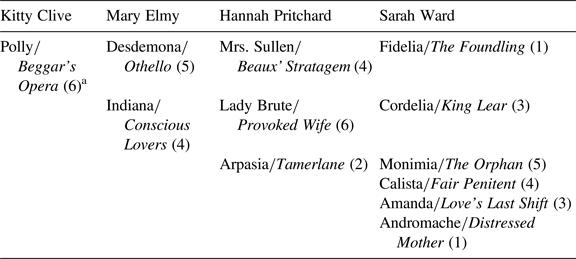
While George Anne Bellamy was able to capitalize on Sarah Ward's temporary absence in 1748–9, Ward was unable to do so during Cibber's absence in 1749–50. Ultimately, Garrick divided Cibber's parts among Ward and three other women in the company (Table 4): Hannah Pritchard and Kitty Clive undertook roles they had performed in previous seasons, while established second-tier actress Mary Elmy acted Desdemona in Othello and Indiana in The Conscious Lovers opposite Spranger Barry, with whom she had worked in Ireland.Footnote 66 Ward took six of Cibber's roles. In total, these four women appeared forty-four times in parts usually undertaken by Cibber, who had appeared seventy-four times in 1748–9.
Replacements for Susannah Cibber, 1749–50 (Drury Lane)
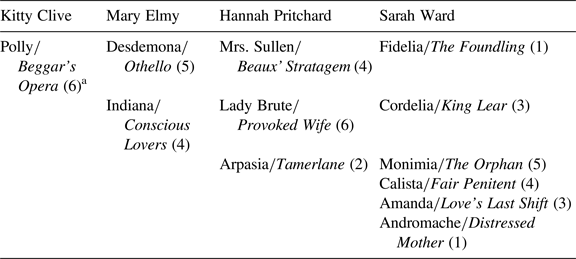
a aThis part was the subject of the Polly Wars in the mid-1730s, when Clive and Cibber rivaled each other for the part (perhaps more at Theophilus's instigation than Susannah's).
Finding his ranks of popular female performers somewhat diminished, Garrick built most of his season around Hannah Pritchard—also pregnant, though the child would not be born until June 1750—who appeared a staggering 104 nights in a 174-night season.Footnote 67 Pritchard's combination of forceful tragic women and sparkling comedy consequently shifted the overall generic balance of the season, which changed with these changing bodies.
Garrick left three plays out of the repertory entirely, two of which were staples in which both Garrick and Barry appeared: Jane Shore (in which Cibber typically played Alicia to Pritchard's Jane), and Venice Preserved (a successful vehicle for Garrick and Cibber). He did this despite the fact that Ward had played Alicia at Covent Garden the year before and could, in theory, step easily into the part. The third missing play was Romeo and Juliet. The previous year, the Cibber–Barry production had grossed the theatre £3000, but with Cibber gone and Barry refusing to mount the play with Ward as her replacement, Garrick had to plan his new season without being able to capitalize on a major success of the previous one. Cibber's absence directly and significantly impacted Drury Lane's repertory, as well as part assignments and hiring. While Cibber was gone, both Ward and Mary Elmy had the opportunity to rise to greater prominence in the company, and in audience's minds. Although Ward failed to capitalize, Elmy received an offer from John Rich at the end of the season and took it, joining Susannah Cibber and Spranger Barry's defection to Covent Garden.Footnote 68
At Covent Garden, Peg Woffington was having a busy season, performing popular comic roles against Pritchard and Clive at Drury Lane, and expanding the number of serious and tragic roles in her repertoire.Footnote 69 Rather than reallocate Bellamy's parts in her absence, the leadership simply removed the vast majority of plays in which Bellamy appeared from the Covent Garden repertory until after her return in January.Footnote 70 Like Garrick, Rich was in the position of building a season around one particular female performer, Peg Woffington, with support from a number of others; like Pritchard, Woffington could perform successfully in a range of comic and tragic parts, and the opening months of the season are consequently shaped by the repertoires of these two women.
Bellamy's return to Covent Garden after the birth of her child, therefore, had a considerable impact on both the company and its ability to compete with Drury Lane. Despite an extended tale of her eleven-day labor in her memoirs, the fact that Bellamy was pregnant in 1749 is sometimes missed in accounts of her absence, which is characterized as just as impulsive (and passive) as her return: “George Anne Bellamy … had been ‘abducted’ by an admirer in the interval of a performance, and had not returned … [until,] tired of the ‘abduction’ story, [she] resolved her complicated love affairs for the time being and returned to Covent Garden in January 1750.”Footnote 71 According to Bellamy, however, the motivation for her return was financial: she returned to London as soon after the birth as possible at the behest of James Quin, who had brokered a new and better contract for her with Rich: £7 a week with a “clear” benefit.Footnote 72 Bellamy's absence was ultimately advantageous—especially in a season when popular female performers were in short supply—for it underscored her economic value to the company and gave Quin leverage for his negotiations with Rich. Rather than an impulsive move, Bellamy's return to London can be framed as a strategic decision based on her economic worth, and Rich's recognition of it. The new offer from Rich, coupled with the fact that marriage with Metham had yet to materialize, throws light on why Bellamy's ability to earn her own living could have quickly become crucial to her survival, and resulted in her return to London for the second half of the season. Reading Bellamy's behavior as impetuous and emotional perpetuates stereotypes about women, actresses, and Bellamy in particular; reading it in context reframes her decisions as motivated by the need to balance the private and professional aspects of her life.
Once Bellamy returned, she reprised her tragic roles as Belvidera in Venice Preserved and Monimia in The Orphan, as well as Leonora in The Revenge, Athenais in Theodosius, Imoinda in Oroonoko, and Almeyda in Don Sebastian, all plays that had been left out of the repertory in her absence.Footnote 73 Bellamy's return, then, expanded the wider company's overall possible repertory and improved their ability to compete with Drury Lane. With Susannah Cibber still absent, moreover, Bellamy's return enabled Covent Garden to fulfill London audiences’ desire for the kinds of pathetic tragic parts the two women usually played throughout the season.
On a more individual level, Covent Garden took advantage of Cibber's absence to test Bellamy's success in two parts closely associated with the other actress.Footnote 74 The first was Calista in Nicholas Rowe's The Fair Penitent, which Bellamy chose for her benefit performance in the spring of 1750.Footnote 75 Benefit performances were a common way to make a bid for a new part or expanded line of business, and this appears to be Bellamy's goal.Footnote 76 The play had been kept out of the repertory that year, despite Woffington's appearance as Calista for her 1749 benefit, and so was not currently “owned” by anyone in the company. The other part in which Bellamy appeared was Juliet, in a production of Romeo and Juliet Rich mounted in March against a new play at Drury Lane.Footnote 77 Seeing Garrick unable to mount his own version of Romeo and Juliet again, Rich attempted to capitalize on Drury Lane's success from the previous year with his own production. Adding insult to injury, Bellamy's Covent Garden Romeo was Henry Lee, an actor who had broken his articles with Garrick earlier that year and gone over to Rich, having been frustrated by the lack of opportunity for young male leads in a company containing both David Garrick and Spranger Barry. Perhaps angered by Garrick's sharking of Sarah Ward, Rich had welcomed Lee into the company. This was the first time Romeo and Juliet was seen at Covent Garden; it was not, however, the first time Bellamy appeared in the part. Sheridan had mounted a production in Dublin in 1746–7, with himself as Romeo and Bellamy as Juliet, a production that Benjamin Victor recalled was “performed nine Nights to great Houses, an extraordinary thing then in Dublin.”Footnote 78 The success of the Cibber–Barry Romeo and Juliet, Cibber's subsequent absence, and Henry Lee's presence at Covent Garden enabled Bellamy to showcase her successful Juliet on the London stage and further position herself as Cibber's rival.
Bellamy's pregnancy and subsequent return to the boards in January 1750 ultimately aided her career, as she gained a better contract and was able to capitalize on Cibber's continuing absence to add new roles to her repertoire without competition from her more prominent rival. It furthermore made her well placed to become a star at Drury Lane when Cibber's defection to Covent Garden the following season left Garrick once again looking for a replacement, having been disappointed in Sarah Ward. Cibber's pregnancy and attendant absence from London had a significant impact on the landscape of the professional commercial theatre: her departure from Drury Lane in the summer of 1749 triggered a series of attempts by David Garrick to fill her position and by John Rich to capitalize on her absence. In both cases, the managers’ actions escalated a burgeoning conflict that would come to a head in the fall of 1750.
The 1750–1 Season
Between the fall of 1748 and that of 1750, the makeups of the two London companies underwent a dramatic shift: contracts were broken, schemes were devised, and open war was declared. Cibber's absence in 1749–50 meant that Spranger Barry was left without his preferred leading lady. Rich capitalized on the situation, apparently reaching out to Cibber through the medium of actor James Quin, an old friend.Footnote 79 By the beginning of June 1750, Garrick was certain Cibber would not perform with Drury Lane the following year, though it is unclear whether or not he knew of her communication with Rich: “Should not Bellamy be engaged, if Cibber will not?”Footnote 80 His partner, James Lacy, apparently had qualms about luring Bellamy away from Rich and delayed taking action, but Garrick saw no objection, pushing again on 22 June to hire her: “are we not a little too delicate, and may be put to some inconveniences from Lacy's too fine-spun politics? If Bellamy is disengaged, why are we not to engage her? We know Cibber will not be with us, and I think Elmy should not; and then how can we patch up our broken fortunes better than with Bellamy?”Footnote 81 By July, it was clear that Cibber and Barry were signed with Rich, and Bellamy was finally brought into the company.
The rival Romeo and Juliets showcase the complicated, long-term effects women's pregnancies could have on the repertory system. As we have seen, Cibber's pregnancy and announcement that she would not return to Drury Lane for the 1749–50 season triggered Garrick's stealing of Sarah Ward; in response, Rich patched up his relationship with Bellamy and induced her to enter the fray after her confinement ended in January 1750; despite Bellamy's efforts, later that year Rich successfully wooed Cibber and Barry into the company, causing Bellamy to sign with Garrick.Footnote 82 Cibber and Barry, reunited now at Covent Garden, could be relied upon to reprise the popular Romeo and Juliet of 1748–9 developed under Garrick's guidance at Drury Lane. With Rich's love of spectacle, Cibber's return after a year's absence, and the bad blood between the companies, it would be a major draw.Footnote 83 Garrick knew this and elected to challenge it head on with his own production, placing himself and Bellamy in the title roles. The rivalry began on 28 September 1750, and the houses competed for twelve nights.
In a famous letter to Lacy on 27 July 1750, Garrick lays out a campaign to harry Covent Garden with direct competition in the ensuing season:
Barry and Cibber are certainly engaged with Rich, which neither amazes nor intimidates me:—Let them do their worst, … I shall be soon ready in Romeo, which we will bring out early; … If Bellamy agrees with us, she may open with it;—then, if we can get out King John before ’em, (as we certainly may) … we shall cut their combs there too …
Come what, come may.—
My Soul's in arms, and eager for the fray. Footnote 84
Ending his letter to Lacy with a mash-up of lines from Macbeth and Colley Cibber's adaptation of Richard III, Garrick effectively equated the 1750–1 season with a battle. And a battle it was.
As Leslie Ritchie argues in her recent article on the subject, Barry and Cibber's defection and subsequent performances in Romeo and Juliet, a production developed under Garrick's leadership, reiterated the “play's thematic obsession with filial disobedience.”Footnote 85 These naughty children had absconded from their loving (or tyrannical) father, and were using his own weapons (his script, his production) against him. Ritchie uses the considerable amount of criticism generated by the event to offer a wider argument about Barry's position as Garrick's copy, and about the repetition, quotation, and comparison such a head-to-head contest invited. As both companies were using texts by Garrick (though the Drury Lane production included recent revisions), and Garrick added a funeral procession for Juliet to rival Rich's spectacular scene, it was truly the competing performances—the competing bodies and interpretations of the performers—in which the interest lay.
Ritchie's article contains a comprehensive view of the criticism focused on the male actors; I do not repeat it here, except to note that much criticism focused on each performer's figure and its suitability for the play. Barry was tall and handsome, the image of a lover; Garrick was not, but his emotive abilities, especially in the scene when Romeo learns of his banishment, were seen to make up for deficiencies in stature. In Roach's language, the charismata of his performance negated the stigmata of his stature. The women were divided along similar lines:
The competition between Mrs. Cibber and Mrs. Bellamy, who had both great merit in this character, seemed nearly to admit the same state of comparison as we have adopted for the contending heroes; one excelled in amorous rapture, the other called every power of distress and despair to her aid; Mrs. Bellamy was an object of love, Mrs. Cibber of admiration; Mrs. Bellamy’s execution was more natural, Mrs. Cibber’s more forceable; in the former there were traces of nonage; in the latter too much of the woman.Footnote 86
Bellamy had spent the preceding two seasons encouraging London audiences to see her as a rival to Cibber, to read her performances and career in light of the woman she called “the first female tragedian in the world.”Footnote 87 The rival Romeo and Juliets were the apotheosis of Bellamy's campaign. Indeed, several critics found Bellamy, young and beautiful, more physically appropriate for Juliet and more pleasing in the first half of the play, whereas Cibber's more mature talents were extolled in the latter half, particularly the tomb scene.Footnote 88 One critic specifically scoffed at the idea that a mother (Cibber) should pass herself off as Juliet: “Who therefore can help laughing to see a mother of children endeavouring to impose herself upon us for a raw girl just in her teens… .”Footnote 89 Apparently unaware that both Juliets were mothers, the conflation of Cibber's age with her maternal status highlights a potentially important motivation for Bellamy's decision not to perform while pregnant in 1749–50.
Garrick knew that physical suitability for the lovers’ parts would shape audience response, and he knew something we often forget: going into the contest, those at Drury Lane were the underdogs. Thomas Davies recalled,
Romeo and Juliet had raised [Barry and Cibber's] reputation for scenes of tender love and pathetic distress to a very high degree. The public in general were greatly prepossessed in their favour; they imagined that those characters, after seeing them represented by them, could not be tolerably filled by any other performers.Footnote 90
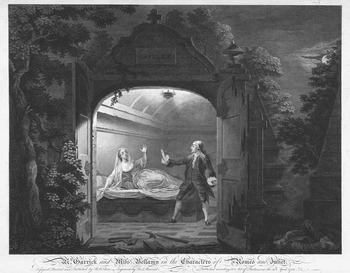
Cibber and Barry were formidable opponents. Without Bellamy, a head-to-head competition using Romeo and Juliet would have been nearly impossible, for Garrick had no one in his own company who would do—Pritchard, talented as she was, was physically unsuited. Though only three years older than Cibber, Pritchard's figure was inclining to the obese, and her age was beginning to show; though she was still in possession of a number of comic ingénue parts from her earlier career, adding a tender tragic heroine of eighteen (in Garrick's version) to the mix was unlikely to result in success. Sarah Ward was beautiful, but proving less than impressive as a performer; she was also pregnant and would be absent for much of the winter. Jenny Cibber, London's first Juliet in living memory, had neither the celebrity capital nor the training to appeal to Garrick for such a contest.Footnote 91 Mary Elmy, who had provided valuable support during Cibber's absence in 1749–50, had also gone over to Covent Garden. Garrick needed Bellamy—young, beautiful, vivacious Bellamy who had run away from the theatre for love of a handsome young man—or the contest would be over before it began. With her, they not only took the field, but surprised everyone with their success; Bellamy's aim of being seen as Cibber's legitimate rival was achieved (Fig. 3).Footnote 92
Simon Francois Ravenet, 1721–74, engraving after Benjamin Wilson, 1721–88. David Garrick and George Anne Bellamy in “Romeo and Juliet,” Act V, Scene iii, 1753. Yale Center for British Art, Paul Mellon Collection, New Haven, CT. Public domain.

After twelve nights and much spilled ink, the contest ended when Cibber declared herself ill and unable to continue. Drury Lane performed its production once more before moving on with the season. It is, perhaps, reflective of our biases that we remember Cibber's body ended the contest, but never acknowledge the role it played in its beginning. Hilary Mantel reminds us that “history is not the past—it is the method we have evolved of organising our ignorance of the past.”Footnote 93 Of necessity we build histories of this century's theatre around absences, in the repertory and in the archive; we often see and acknowledge absence as a hole or gap, but it can also be a vacuum, something that alters the space around it. Barry's absence could in many ways be mitigated by Garrick's presence; it was the absence of Cibber that was the larger challenge, and Bellamy the solution. There is a reason the contest was Romeo and Juliet and not Macbeth or Hamlet: it was a contest between Barry and Cibber against Garrick and Bellamy—as manager, Garrick was competing with two performers, not one.
Conclusion
Reading the maternal body back into eighteenth-century theatrical history offers a more comprehensive view of the century's theatre and culture, and reveals a host of ways that women's bodies shaped the archival remains upon which we build our understanding of the period. Attention to these bodies can also helpfully speak back to gendered assumptions that have often guided our interpretation of women and their careers: each woman mentioned here has been accused of jealousy, capriciousness, spite, or worse in an attempt to explain her periodic absences from the stage or seemingly overblown responses to issues such as casting and benefit order.Footnote 94 Such assumptions unhelpfully perpetuate stereotypes about female performers that continue to persist today, and fail to take into account the full circumstances in which women worked. Much like today, eighteenth-century actresses balanced professional and personal demands, the pressures of providing for growing families, and the need to maintain a popular and profitable celebrity identity throughout their careers. They did so in a world with extreme power differentials at play in both personal and professional environments, and with very little legal recourse to redress abusive or unfair behavior. Celebrity capital was one means by which women could access and use agency in their professional lives. The cases of Susannah Cibber and George Anne Bellamy remind us that part of this agency could lie in absence, particularly when their bodies might otherwise rupture an existing and profitable persona. Instead of reflexively reading absence as passive or capricious or any of the other codes with which commentators label them, then, we can read choices to absent oneself (or not) as one potential tool for women managing the complicated combination of public persona, private life, and professional career.
Such absences offer us important insight into the workings of the repertory system, a system dependent on the able and working bodies of performers. Susan Bennett warns that, “despite knowing that there is other work to be done, historiographic method inevitably pulls our history—even our alternative histories—back into the trajectory of what has always already been known.”Footnote 95 We have an invaluable if imperfect resource in The London Stage 1660–1800: a daily record of performance in the professional London theatre for 140 years. The ongoing work of scholars like Judith Milhous and Robert D. Hume to revise these catalogs, and Mattie Burkert to make them accessible in a searchable London Stage Database, offers immense value to those working on the professional London theatre of this century. Yet as we know, these records, gathered from archival fragments, do not themselves yield up embodied performance, memory, and experience.Footnote 96
One tactic for addressing the absences and biases of existing archives is to invest deeply in the importance of the bodies such records imply, for the available bodies at a manager's disposal determined, to a large degree, the variety and success of his (or her) managerial labor. Maternal bodies presented challenges and opportunities to actresses, their managers, and fellow company members, but there are several major barriers that have prevented this topic from wider study. First, pregnancy is both a temporary bodily change and was an incredibly common phenomenon during the century; audiences might observe pregnant performers and feel no need to comment on their bodies. Second, the markers these bodies leave on the archive are often invisible unless one is looking for them specifically. Fortunately, there is no need to rely solely on extant testimony of an audience member, manager, or historian, though these testimonies do in some cases exist. An actress's absence, particularly if of some duration (two or more weeks) is worth investigating. If no direct evidence of pregnancy or birth exists in our familiar archive, the exploration of parish records may yield clues. If a child's birth or baptism is recorded, then we have a rough idea of a time frame in which maternity could have affected the performance calendar and other archival sources. Absence of direct evidence of the maternal body's impact (such as a managerial complaint about a pregnancy or a detailed plan for an extended leave) does not necessarily mean the impact is not there; it means we have an imperfect understanding of what it might be and how to find it.
The rival Romeo and Juliets offer several valuable starting places. Examining the years leading up to the contest showcases many short-term effects maternity could have on a theatrical system. Temporary changes might impact company structure, giving other performers the opportunity to show their abilities and rise to greater prominence within their home company (Bellamy), or with a competing house (Ward). Pregnancy might generate conflict with a performer's public persona and hence need to be concealed (Cibber, possibly Bellamy), but those secure in their celebrity appeal could absent themselves without fear of losing status with audiences (Cibber); indeed, in some cases temporary absence could even enable women to underscore their material value to the company and leverage higher salaries (Bellamy). Long-term side effects of the shifts required to accommodate such bodies, such as those detailed surrounding the rival Romeo and Juliets, ask us to be carefully attuned to the complexities of what was, essentially, a living, breathing, and ever-changing repertory system created of the collisions of bodies and texts. Far from only a story of male egos and warring Romeos, the rival Romeo and Juliets was a conflict born in no small part from the complicated pressures the reproducing female body exerted on the repertory system.