For patients undergoing paediatric cardiac surgery, post-operative bleeding and thrombotic complications can be fatal. The aetiologies of significant post-operative bleeding requiring surgical reintervention or transfusion in paediatric patients who undergo cardiac surgery requiring cardiopulmonary bypass are complex, multi-factorial, and often institution-dependent.Reference Wickham1,Reference Bercovitz, Shewmake and Newman2 Intraoperative blood products can be administered in order to decrease a patient’s risk of post-operative bleeding, including novel products such as recombinant factor VIIa; however, these products are prothrombotic by their nature.Reference Faraoni3 Given an unknown risk–benefit ratio for recombinant factor VIIa in paediatric cardiac surgery patients, a randomised control trial is not currently possible. We aimed to evaluate the efficacy and safety of recombinant factor VIIa administration to decrease post-operative bleeding without an increase in thrombotic complications in the paediatric cardiac surgery patient. The arterial switch operation was selected to create a homogeneic patient population with a high risk for post-operative bleeding due to patients’ operative age and long length of suture lines.
Patients and methods
This retrospective cohort study was approved by the Baylor College of Medicine Institutional Review Board with waiver of informed consent.
The Texas Children’s Hospital cardiology and surgical databases were reviewed to identify all patients undergoing an arterial switch operation for transposition of the great arteries between 2012 and 2017. Patients were excluded if they were undergoing an arterial switch operation for any other indication. During the study period, patients were administered recombinant factor VIIa at the surgeon’s discretion between disconnection from cardiopulmonary bypass and chest closure. The standard in our institution for bleeding control post bypass is protamine, then platelets, then cryoprecipitate, and then fresh frozen plasma. If bleeding persists, then it is the surgeon’s preference (either another round of the same products or factor VIIa). If bleeding persists after one dose of factor VIIa, a second dose may be given 15 minutes later at the surgeon’s discretion. Recombinant factor VIIa was dosed as 90 micrograms per kilogram, with a second dose administered if inadequate haemostasis was achieved following the first vial. Given the lack of randomisation, patients who received recombinant factor VIIa were matched 1:1 using nearest-neighbour matching on a propensity score based on gender, age, and weight at operation, and associated cardiac defects to balance the complication risk between cases and controls. The operative technique, published elsewhere,Reference O’Connell, Wood, Wise, Lozier and Braun4 and operating surgeons did not vary during through the study period.
After the development of the study population, data were collected including intraoperative blood product utilisation, chest tube output in the first 24 hours post-operatively, laboratory coagulation quantification, and patient outcomes. Intraoperative blood product utilisation was collected from the anaesthesia record. Chest closure time was defined as the time between the cessation of cardiopulmonary bypass and closure of the chest based on the anaesthesia record. Patients with a delayed sternal closure were not included as they represent a different set of conditions, by definition, as chests are only left open for haemodynamic concerns. Due to mortality as a rare event, clinically evident thrombotic complications were evaluated. Thrombotic complications included the development of a thrombus or an event attributed to a thromboembolic event. Also considered were time to chest closure, post-operative chest tube output, and coagulation levels.
Statistical analysis was performed in SAS version 9.4 (SAS Institute, Cary, North Carolina) with graphics developed using R version 3.5.2 (R Foundation for Statistical Computing, Vienna, Austria) using ggplot2.Reference Wickham1 Categorical variables are presented as count and percentage and compared between cohorts using the Fisher’s exact test. Continuous variables are presented as median and range and compared using the Wilcoxon rank-sum test. Pre-test alpha was set at 0.05 for all statistical tests.
Results
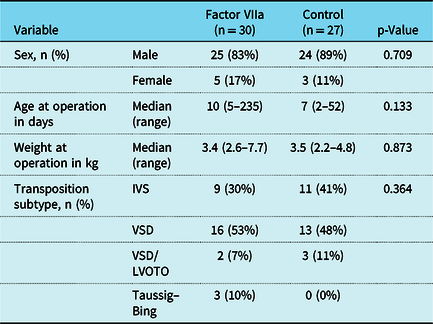
A total of 110 patients underwent an arterial switch operation for transposition of the great arteries during the study period. Recombinant factor VIIa was administered intraoperatively in 30 (27%) patients. The match procedure returned 27 control patients who did not receive recombinant factor VIIa. Baseline characteristics of patients in the recombinant factor VIIa and control cohorts are presented in Table 1.
Baseline characteristics of patients in the recombinant factor VIIa and control cohorts

IVS = intact ventricular septum; kg = kilogram; LVOTO = left ventricular outflow tract obstruction; VSD = ventricular septal defect
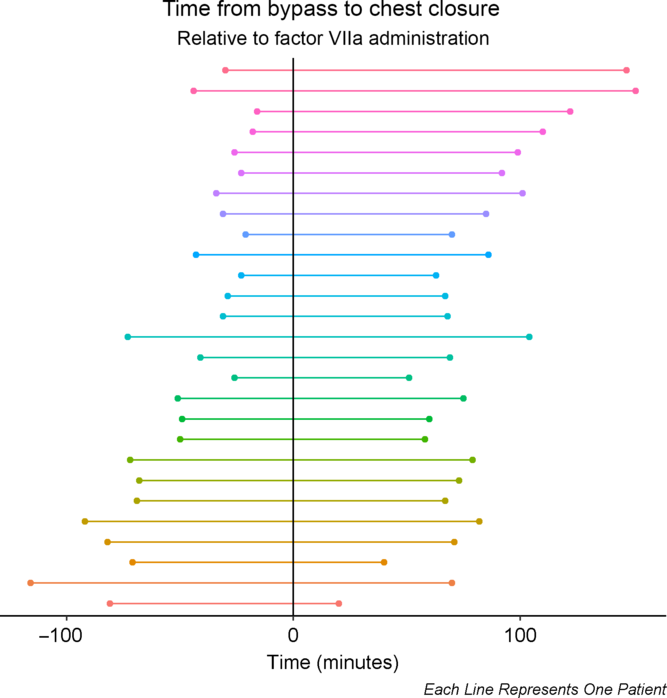
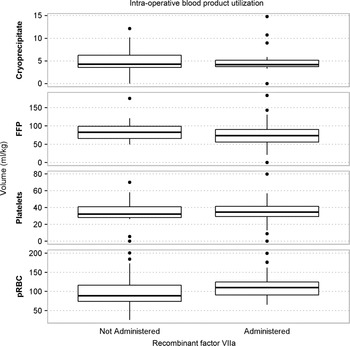
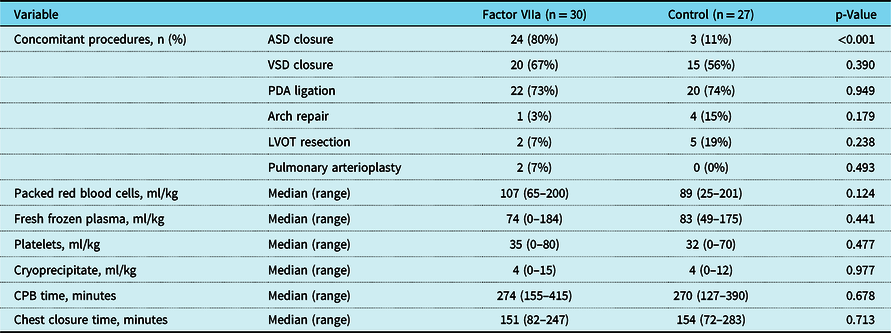
One surgeon performed 40% of the arterial switch operations, including 53% of the patients who received recombinant factor VIIa. Recombinant factor VIIa was administered at a median of 43 minutes (range 16–116) following the cessation of cardiopulmonary bypass and 73 minutes (range 20–151) prior to chest closure, the equivalent to being administered at a median 34% (range 12–80%) of the duration from cessation of bypass to chest closure (Fig 1). A LeCompte manoeuvre was performed in 55 (96%) patients as part of the arterial switch operation. All patients had at least one concomitant procedure with atrial septal defect closure (n = 53, 93%), patent ductus arteriosus ligation (n = 42, 74%), and ventricular septal defect closure (n = 35, 61%) being the most common. There was no difference in transfusion of packed red blood cells, fresh frozen plasma, platelets, or cryoprecipitate between the cohorts (Fig 2). There was no difference in cardiopulmonary bypass time nor chest closure time between the cohorts. Operative characteristics are compared in Table 2.
Time from cessation of bypass to chest closure with time in minutes on the x-axis. Time zero is the relative timing of administration of recombinant factor VIIa. Each line represents one patient.

Volume in millilitres of blood products per kilogram administered intraoperatively following the cessation of cardiopulmonary bypass compared between patients not receiving recombinant factor VIIa (left) and patients that received recombinant factor VIIa (right). Patients receiving recombinant factor VIIa received a higher volume of packed red blood cells (pRBC) than patients that did not receive recombinant factor VIIa. There was not a difference in the volume of platelets, fresh frozen plasma (FFP), or cryoprecipitate transfused between the two groups.

Operative characteristics of patients in the recombinant factor VIIa and control cohorts

ASD = atrial septal defect; CPB = cardiopulmonary bypass; LVOT = left ventricular outflow tract; ml = millilitre; PDA = patent ductus arteriosus; VSD = ventricular septal defect
Death, bleeding, and thrombosis
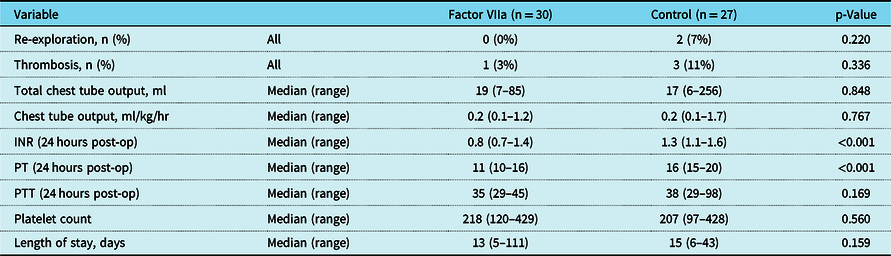
There were no deaths in the study population. Two patients had operative re-explorations for concern for tamponade, neither of whom received recombinant factor VIIa. No active sources of bleeding were identified in any of these patients. Four patients experienced thrombotic complications including one patient after receiving recombinant factor VIIa and three patients who did not receive recombinant factor VIIa (OR 0.28, 95% CI 0.005–3.77, p = 0.336). One patient in the factor VII cohort had a thrombus in the left centrum semi-ovale. In the non-factor VII cohort, two patients had a thrombus in the left external iliac artery and one patient had a thrombus in the left superficial femoral vein with extension into the popliteal vein.
Post-operative chest tube output and coagulation
Post-operatively, there was no difference between cohorts in the volume of chest tube output in the first 24 hours. Post-operative length of stay was not different between the cohorts. Table 3 contains a comparison of the study end points.
Post operative characteristics and comparison of the study end points between the two groups

INR = international normalised ratio; ml = millilitre; PT = prothrombin time; PTT = partial thromboplastin time
Comments
This propensity score-matched retrospective cohort analysis did not find an increase in thrombotic complications following the arterial switch operation in patients receiving recombinant factor VIIa compared to patients who did not receive recombinant factor VIIa. This study identified a 7% decrease in need for re-exploration for bleeding in the factor VIIa cohort compared to controls. To detect a 5–7% decrease in re-exploration in a randomised control study powered for β = 0.8 and α = 0.05, 107–152 patients would have to be enrolled in each cohort.
Recombinant factor VIIa stimulates haemostasis by activating the extrinsic pathway of the coagulation cascade. Following cessation of cardiopulmonary bypass, coagulation factors and platelets are reduced, and platelet function is altered, putting a patient at higher risk of post-operative bleeding. Therefore, recombinant factor VIIa has been used off-label intraoperatively in surgical patients to achieve haemostasis, reduce bleeding, and minimise blood transfusions.Reference Fraser5 The use of recombinant factor VIIa continues to be controversial due to mixed data surrounding its safety and efficacy in surgical patients.Reference Ekert, Brizard, Eyers, Cochrane and Henning6 A study evaluating thromboembolic adverse events after the use of recombinant factor VIIa identified 48 events (44% of total events) associated with the use of recombinant factor VIIa peri-operatively in a variety of surgical settings. Thromboembolic events were reported to have occurred in both the arterial and venous systems and included acute myocardial infarctions, cerebrovascular accidents, and pulmonary emboli.Reference Faraoni3
The data regarding the specific use of recombinant factor VIIa in paediatric cardiac surgery and the occurrence of thromboembolic events after recombinant factor VIIa administration are limited and are often evaluated in a small patient population with mixed cardiac surgical interventions, patient demographics, and inconsistent dosing of recombinant factor VIIa.Reference Faraoni3,Reference Ekert, Brizard, Eyers, Cochrane and Henning6 A study evaluating the use of recombinant factor VIIa in neonates who underwent cardiac surgery requiring cardiopulmonary bypass noted an increased occurrence of intravascular thrombus formation in the patients who received recombinant factor VIIa (22%) compared to patients who did not receive recombinant factor VIIa (6%). This included an unmatched subgroup of patients following the arterial switch operation in which 13% of patients who received recombinant factor VIIa had thrombotic complications compared to 4% who did not receive recombinant factor VIIa.Reference Niles, Burkhart, Duffey, Buhrman, Burzynski and Holt7 By comparison, the rate of thrombotic complication in this reportReference Niles, Burkhart, Duffey, Buhrman, Burzynski and Holt7 was higher than the other large series of patients following congenital heart surgeryReference Fraser5,Reference Christoff, Winlaw, Curtin, Barnes and Egan8 and our results reported here. The use of recombinant factor VIIa should still be reserved for patients at high risk for bleeding complications, such as following the arterial switch operation.
The optimal dosage for post-bypass haemostasis has not been established. A study focusing on elective administration of recombinant factor VIIa to shorten the time to chest closure and reduce blood loss in infants undergoing congenital heart surgery requiring cardiopulmonary bypass, a low dose of 40 mcg/kg was administered, as it was thought to be safe, as well as sufficient to induce haemostasis.Reference Fraser5 In contrast to other’s experience with low-dose recombinant factor VIIa administration, we did not find a difference in thrombotic complications or post-operative bleeding between patients receiving recombinant factor VIIa and the control group despite receiving a higher dose of 90 mcg/kg of recombinant factor VIIa. Specifically, there were no coronary ischemic events identified in either group. Other studies have found similar data in favour of recombinant factor VIIa administration to decrease post-operative bleeding without increasing a patient’s risk of thromboembolic complicationsReference Fraser5,Reference Christoff, Winlaw, Curtin, Barnes and Egan8,Reference Li, Zhao, Luo, Wu, Ding and Yan9,Reference Changlani, Devendaran, Murmu, Ganesan, Varghese and Kumar10 ; however, the dosage of recombinant factor VIIa in other studies ranged from 40 to 75 mcg/kg and was lower than what was administered in our study.
Study limitations
The primary limitation of this study was the lack of randomisation and standardisation of recombinant factor VIIa administration. One surgeon performed 41% of the arterial switch operations, which included 55% of the patients who received recombinant factor VIIa. Our study did not account for surgeon preference when to administer recombinant factor VIIa and did not standardise the amount of fresh frozen plasma, platelets, or cryoprecipitate that was administered prior to the surgeon administrating recombinant factor VIIa, including some patients who did not receive other product prior to receiving factor VIIa. Furthermore, the study included a small cohort of patients and was retrospective in nature with non-randomised cohort assignment. Additionally, our study did not include routine, post-operative imaging to evaluate for thrombus, and imaging was only performed in patients whose physical exam findings were suggestive of a thrombus. Finally, as our study focused on patients undergoing an arterial switch operation due to their risk profile, our results should not be extrapolated to other surgical procedures, cardiac or non-cardiac.
Conclusion
In patients who underwent the arterial switch operation, there was not enough evidence to identify a difference in thrombotic complications or post-operative bleeding in patients who received recombinant factor VIIa compared to those who did not. Clinical equipoise remains for the use of recombinant factor VIIa for haemostasis following cardiopulmonary bypass. Until large, randomised data are available, the use of recombinant factor VIIa should be reserved for high-risk patients with refractory bleeding.
Financial support
This research received no specific grant from any funding agency, commercial or not-for-profit sectors.
Conflicts of interest
None.
Ethical standards
The authors assert that all procedures contributing to this work comply with the ethical standards of the relevant national guidelines on human experimentation and with the Helsinki Declaration of 1975, as revised in 2008, and has been approved by the institutional review board of the Baylor College of Medicine.