Introduction
Agrilus planipennis Fairmaire (Coleoptera: Buprestidae) is a significant invasive pest of ash (Fraxinus Linnaeus) (Oleaceae) in Canada and the United States of America. Since its accidental introduction into North America in the early 1990s (Siegert et al. Reference Siegert, McCullough, Liebhold and Telewski2014), A. planipennis has killed millions of ash trees in infested areas. Potential costs of A. planipennis treatment in urban areas in the United States of America are estimated to be US$10.7 billion (Kovacs et al. Reference Kovacs, Haight, McCullough, Mercader, Siegert and Liebhold2010), while the potential combined costs of tree removals, replacements, and insecticide treatments resulting from A. planipennis depredations in Canadian urban centres may approach CAD$1.5 billion (McKenney et al. Reference McKenney, Pedlar, Yemshanov, Lyons, Campbell and Lawrence2012). Ash is a major component of hardwood and riparian forests throughout North America and its elimination in these habitats will lead to significant ecological disturbances (Poland and McCullough Reference Poland and McCullough2006; Gandhi and Herms Reference Gandhi and Herms2010; Gandhi et al. Reference Gandhi, Smith, Hartzler and Herms2014; Herms and McCullough Reference Herms and McCullough2014). In urban centres where ash has often been widely planted, systemic insecticides have been shown to prevent A. planipennis infestations in treated trees (McCullough and Mercader Reference McClure, Whistlecraft and McNeil2012); however applications in forested areas may not be practical due to prohibitive costs associated with application (Poland and McCullough Reference Poland and McCullough2006). In such areas, the release or augmentation of natural enemies has been identified as a potentially efficacious and cost-effective management strategy. Consequently, various research projects on parasitoids of A. planipennis have been completed or initiated.
Surveys in the native range of A. planipennis identified three parasitoids native to China that attacked A. planipennis and showed potential for use as classical biological control agents. These included Spathius agrili Yang (Hymenoptera: Braconidae), an ectoparasitoid previously observed in earlier surveys of A. planipennis populations, and two previously undescribed species, Tetrastichus planipennisi Yang (Hymenoptera: Eulophidae), and Oobius agrili Zhang and Huang (Hymenoptera: Encyrtidae) (Liu et al. Reference Liu, Bauer, Gao, Zhao, Petrice and Haack2003; Yang et al. Reference Yang, Strazanac, Marsh, Van Achterberg and Choi2005; Bauer et al. Reference Bauer, Liu, Miller and Gould2008). Host-specificity testing indicated that of all the larvae of several insect species implanted under bark on ash branches, T. planipennisi only attacked larvae of A. planipennis (Bauer et al. Reference Bauer, Liu, Miller and Gould2008). Spathius agrili attacked some other Agrilus Curtis species but preferred A. planipennis in choice tests and in olfactometer tests was only attracted to volatiles from Fraxinus and a Salix Linnaeus (Salicaceae) species (Bauer et al. Reference Bauer, Liu, Miller and Gould2008). Of the eggs of a variety of species presented to O. agrili, only species of native Agrilus that had eggs similar in size to A. planipennis were attacked. Following the development of rearing and release protocols, releases of all three non-native parasitoids began in Michigan in 2007 (Bauer et al. Reference Bauer, Liu, Miller and Gould2008). As of September 2014, one or more of these species has been released in 19 United States of America states (United States Department of Agriculture-Animal and Plant Health Inspection Service, 2014) and two Canadian provinces (D.B.L., personal observation).
Preliminary observations have shown that host parasitisation and overwintering have occurred in several sites, and that these released parasitoids show potential as established enemies of A. planipennis in North America (Duan et al. Reference Duan, Ulyshen, Bauer, Gould and Driesche2010, Reference Duan, Bauer, Abell, Lelito and Driesche2013; Abell et al. Reference Abell, Bauer, Duan and Van Driesche2014). While initial surveys detected few natural enemies in North America (Liu et al. Reference Liu, Bauer, Gao, Zhao, Petrice and Haack2003), recent surveys conducted in Michigan and Pennsylvania (United States of America), and Ontario (Canada) have shown parasitisation rates by several North American parasitoid species, including several Atanycolus Foerster (Hymenoptera: Braconidae) species and Balcha indica (Mani and Kaul) (Hymenoptera: Eupelmidae), to be higher than in earlier surveys (Cappaert and McCullough Reference Cappaert, McCullough, Poland and Siegert2009; Duan et al. Reference Duan, Ulyshen, Bauer, Gould and Driesche2010; Lyons Reference Lyons2010). Native natural enemies may be effective biological control agents as they are less likely to be affected by environmental factors that may hinder the establishment of imported classical biological control agents (Stiling Reference Stiling1993). In southwestern Ontario, captures from sticky band traps indicated that Phasgonophora sulcata Westwood (Hymenoptera: Chalcididae) densities in A. planipennis-infested sites were high. In addition, P. sulcata was commonly reared from logs containing A. planipennis recovered from several sites over several years (Lyons Reference Lyons2010). Consequently, investigations into the feasibility of incorporating P. sulcata into an augmentative biological control programme are underway.
Phasgonophora sulcata is a koinobiont endoparasitoid of buprestid beetles in North America (Bouček Reference Bouček1992). It is among a unique group of chalcidids that attack wood-boring beetle larvae, rather than exposed Diptera and Lepidoptera (Bouček Reference Bouček1988). Phasgonophora sulcata has been reported parasitising North American Agrilus species, including A. anxius Gory (Loerch and Cameron Reference Loerch and Cameron1983, Reference Loerch and Cameron1984) and A. bilineatus (Weber) (Haack and Benjamin Reference Haack and Benjamin1982). Although some life history parameters such as emergence times and adult longevities in relation to North American Agrilus species have been determined (Haack et al. Reference Haack, Benjamin and Schuh1981), a comprehensive knowledge of such parameters in relation to A. planipennis does not yet exist. Such knowledge is necessary for determining this parasitoid’s potential effectiveness as an augmentative biological control agent for A. planipennis.
A critical component of rearing biological control agents is establishing a thorough understanding of the species’ mating and courtship sequences (Quicke Reference Quicke1997), which is necessary for ensuring insect production and estimating population numbers after field releases (Shu and Jones Reference Shu and Jones1993; McNeil and Brodeur Reference McNeil and Brodeur1995; Canale et al. Reference Canale, Benelli and Lucchi2013). Hymenopteran parasitoids often follow a species-specific mating process (van den Assem Reference van den Assem1986) that is typically initiated by the release of sex pheromones by the female (Quicke Reference Quicke1997). These pheromones act at various ranges to orient males to the female’s location (Ruther et al. Reference Ruther, Homann and Steidle2000; Collatz et al. Reference Collatz, Tolasch and Steidle2009; Onagbola and Fadamiro Reference Onagbola and Fadamiro2011), and often initiate courtship actions in males once they have located the female (Vinson Reference Vinson1972; Ruther et al. Reference Ruther, Homann and Steidle2000; Canale et al. Reference Canale, Benelli and Lucchi2013). Initiated male actions may include wing fanning, rocking of the head or the body, and antennal stroking (Barras Reference Barras1960; van den Assem Reference van den Assem1986; Field and Keller Reference Field and Keller1993; Bin et al. Reference Bin, Wäckers, Romani and Isidoro1999; Ruther et al. Reference Ruther, Homann and Steidle2000). Mating pairs then partake in a number of repeatable events before copulation. In some species, pheromone production and mating receptiveness can be influenced by female reproductive status. Specifically, female age has been shown to influence the detectability of females by males (Collatz et al. Reference Collatz, Tolasch and Steidle2009). In some species, older females were less attractive to males (Schwörer et al. Reference Schwörer, Völkl and Hoffmann1999; McClure et al. Reference McCullough and Mercader2007), while in other species, newly emerged females were less attractive than older females (Tagawa et al. Reference Tagawa, Asano, Ohtsubo, Kamomae and Gotoh1985; Kainoh Reference Kainoh1986). For P. sulcata to be potentially used in an augmentative biological control programme, its mating and courtship sequences must be understood. Predicting when P. sulcata females are attractive to males should also be determined. Identified adult pheromones may also be useful as baits in traps which can be used to measure parasitoid population densities and delineate enemy ranges (Lewis et al. Reference Lewis, Snow and Jones1971; Jewett and Carpenter Reference Jewett and Carpenter2001). Effective passive trapping is essential particularly for wood-associated insects such as P. sulcata, as active destructive sampling of A. planipennis-infested trees is both costly and labour-intensive (Cappaert et al. Reference Cappaert and McCullough2005). At present, both the mating sequences and presence of pheromones in P. sulcata are unknown.
This study explored the mating processes of P. sulcata. Specifically, we sought to determine: (1) if a pheromone exists within P. sulcata, and to determine if parasitoid age has an effect on detectability by conspecifics; and (2) to describe the courtship and copulation sequences of adult P. sulcata. We predict that females will produce attractive pheromones that mediate the courtship sequence, and that courtship will consist of actions that are consistent between pairs. These results will contribute to some of the knowledge necessary to comprehensively evaluate P. sulcata as a potential biological control agent for A. planipennis.
Methods and materials
Insect rearing
Adults of P. sulcata originated from A. planipennis larvae infesting Fraxinus logs retrieved in October 2011 from sites in Lambton (42°39'36.7992"N, 81°33'10.7028"W) and Middlesex (42°38'24.9828"N, 81°49'8.1876"W) counties, Ontario, Canada. Logs were held at 4 °C in environmental chambers for at least six weeks. Logs were then placed in rearing cages and were incubated at 25±1°C with 60±5% relative humidity (RH). Following emergence, adult P. sulcata were kept in plastic cups that were sex-specific and age-specific at 26±1°C and 70±5% RH, and a photoperiod of 16:8 (light:dark), with up to eight parasitoids per cup. Cups were covered with lids containing a plastic mesh screen to facilitate air circulation. Adults were provided with water from a 12 mL vial plugged with two cotton dental wicks and a synthetic strip of fabric, and food from a streak of honey on the plastic screen of the lid; water and honey were replaced every two or three days.
Behavioural bioassays
A Y-tube olfactometer (Analytical Research Systems Inc., Gainesville, Florida, United States of America) was used to test the attraction of virgin 1–5 and 10–15-day-old adult male and female P. sulcata to conspecifics. Mean adult longevity of P. sulcata is ~30 days (Roscoe Reference Roscoe2014). The Y-tube consisted of an 11 cm main stem that branched into two distal 9 cm arms. The internal diameter of the tube was 1.5 cm. Each arm was attached to a connecting arm that either contained insects (treatment) or was left empty (control). Air was passed over five parasitoids of a treatment group in one arm, while clean air was pumped through the empty arm. A wire mesh screen inlayed on either end of the connecting arms prevented insects from escaping. Air was drawn into the olfactometer, humidified, purified, and emitted through a charcoal filter into the connecting arms and into the Y-tube at a rate of 900 mL/minute. Visual recognition by parasitoids was prevented by placing the treatment arm inside a paper sleeve. A desk lamp with a 40 W bulb was placed ~30 cm above the Y-tube to provide illumination.
For the bioassay, a single parasitoid was released into the base of the central arm and then observed for 10 minutes. A choice of either the treatment or control was recorded if the parasitoid reached the end of the distal arm and touched the wire sieve of the connecting tube. A non-response (NR) was recorded if the parasitoid did not make a choice within the allotted time. After three individual parasitoids had been tested, the Y-tube was flipped to prevent positional bias. After six to eight parasitoids had been tested using the same treatment, the Y-tube and connecting tubes were washed with hot soapy water, rinsed with acetone and air-dried. At least 20 parasitoids were used for each analysis and each was used only once. All bioassays were completed at ~26°C and ~60% RH. Data were first analysed using a χ2 goodness-of-fit test to determine if a significant proportion of individuals that responded versus did not make a choice differed from 1:1. In bioassays where a significant proportion responded to either the treatment or control, a second χ2 goodness-of-fit test that determined if the ratio of parasitoids choosing either the control or treatment outcomes differed significantly from 1:1 was carried out. Statistics were carried out in SigmaPlotTM (version 12) (Systat Software Inc., San Jose, California, United States of America).
Mating observations
To determine the mating sequences for adult P. sulcata, males and females were observed in an arena consisting of a 9.0 cm circular filter paper (catalogue number 1005 090; Whatman International Ltd., Maidstone, United Kingdom) with a 6.3 cm Pyrex glass lid enclosure. Preliminary results showed that males of various ages responded to females. Therefore, males used varied in age from one day old to 30 days old. Females were either newly emerged or 3–15 days old, as no females >15 days old were available for bioassays when experiment was conducted. Preliminary observations indicated that four distinct behaviours occurred before copulation: (1) lateral swaying of the male (herein referred to as “swaying”) while walking; (2) the male swaying in front of the female while attenating; female arrests movement; (3) swaying in front of female with erect antenna; and (4) mounting and copulation. For each bioassay one male parasitoid was first introduced into the arena, followed by one female parasitoid. The mating pair was observed by eye for up to 20 minutes or until copulation occurred and the occurrence of behaviours was recorded. Parasitoids were only used in a bioassay once. Experiments were carried out at ~26°C and ~60% RH.
Results
Y-tube olfactometer bioassay
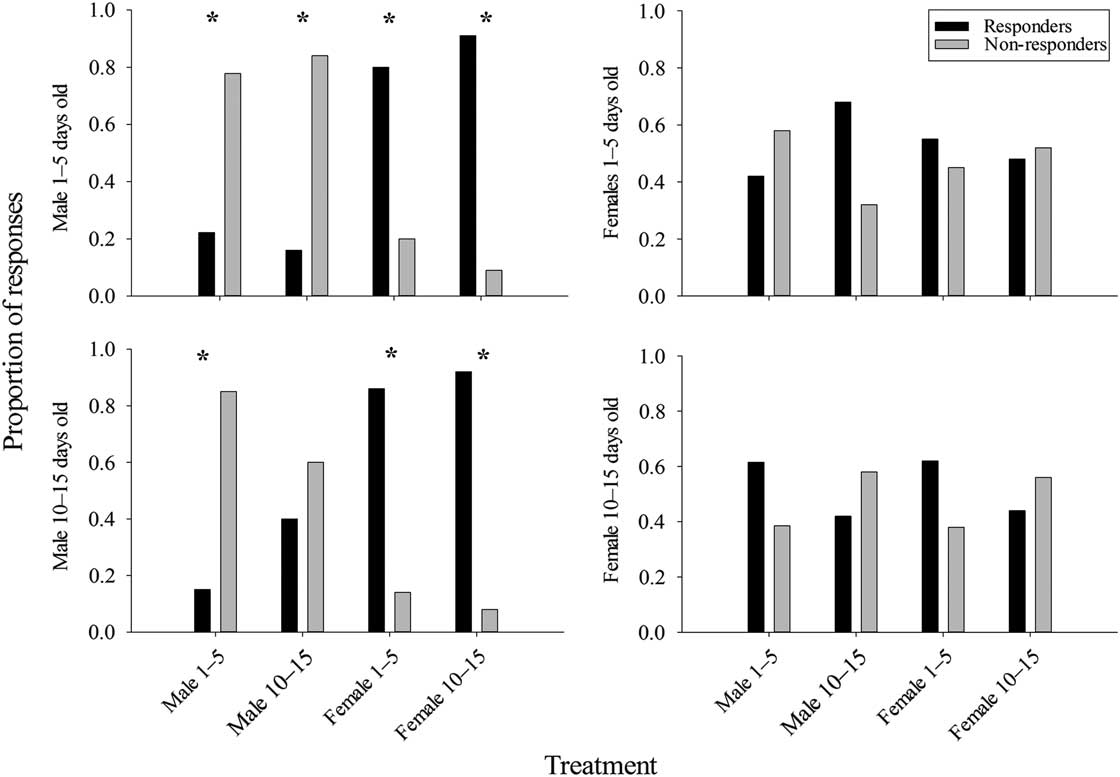
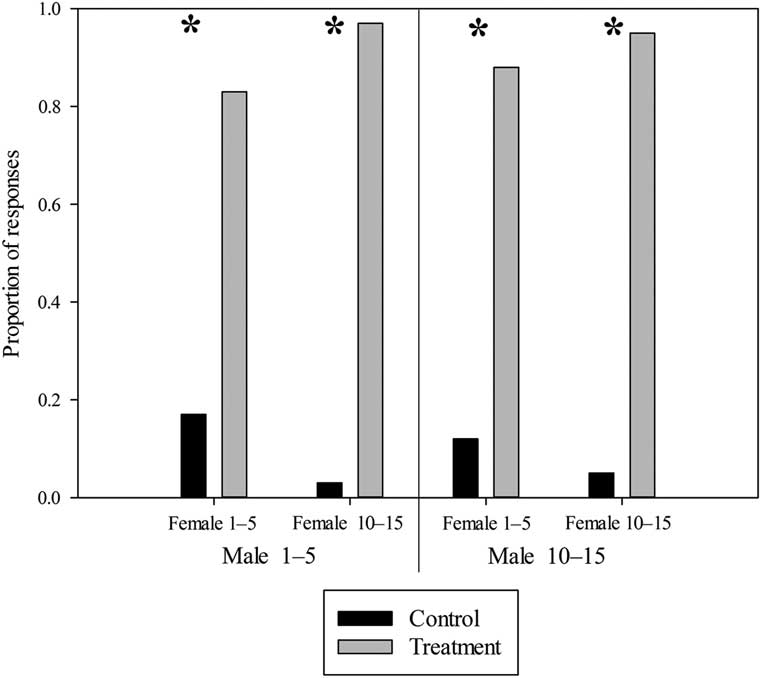
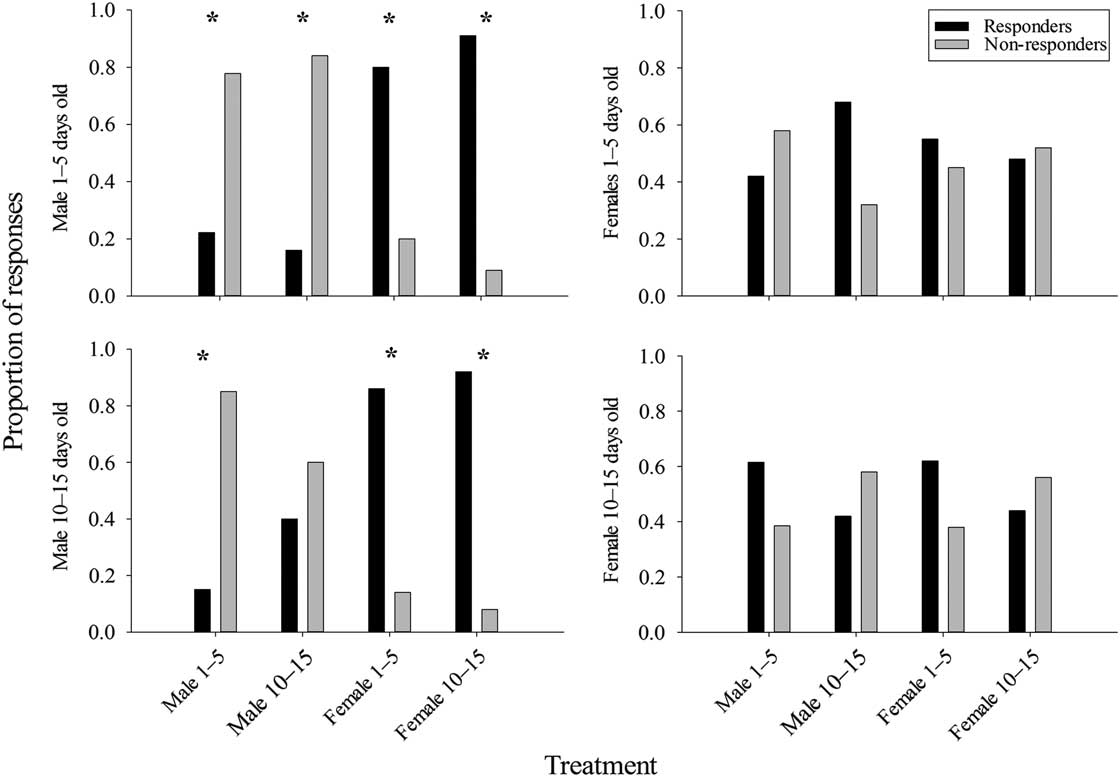
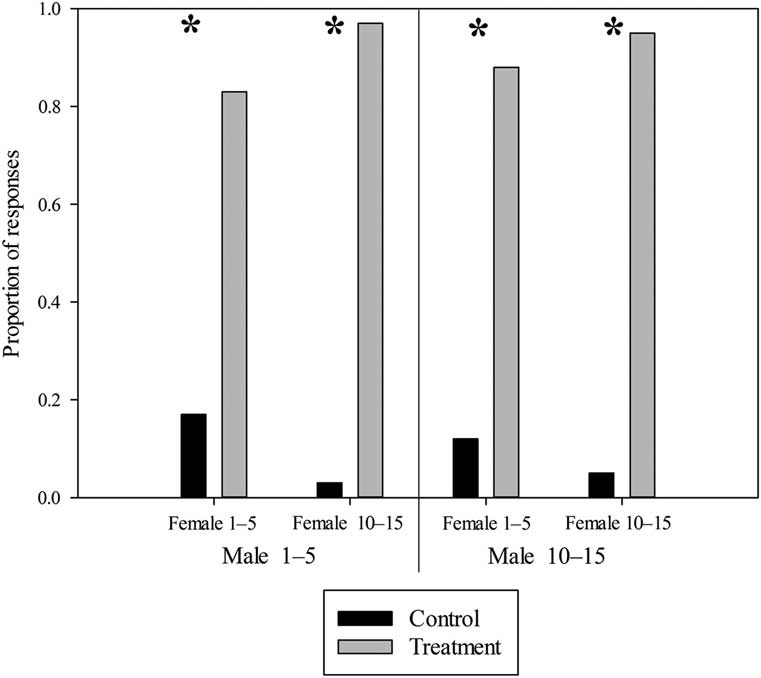
Significant differences in the proportion of responders and non-responders were observed in the Y-tube bioassay (χ2 test; P<0.05; Fig. 1). For males, significant differences were observed in bioassays where they were exposed to either females or males (Fig. 1). In bioassays where males were exposed to other males, significant proportions of males did not respond at all. In bioassays where males were exposed to females, significant proportions of males chose the female treatment with males orienting towards females regardless of their age or that of the females (χ 2 test; P<0.05; Fig. 2). In contrast, for females, there were no significant proportions of responders in bioassays where females were exposed to other females or to males at any age.
Y-tube olfactometer responses of virgin male (A, C) and female (B, D) Phasgonophora sulcata to airborne volatiles of male and female conspecifics. Proportions of parasitoid test groups responding to either control or treatment (Responders) or not choosing within 10 minutes (Non-responders) are shown. Asterisks (*) represent a significant difference between proportions of responses (χ2 test; P<0.05).
Proportions of 1–5-day-old and 10–15-day-old virgin male Phasgonophora sulcata responding to airborne volatiles of female conspecifics aged 1–5 and 10–15 days old in a Y-tube olfactometer. Figure shows proportions of male parasitoids responding to either clean air (control) or female conspecifics (treatment). Asterisks (*) represent a significant difference between proportions of responses (χ2 test; P<0.05).
Mating sequences of Phasgonophora sulcata
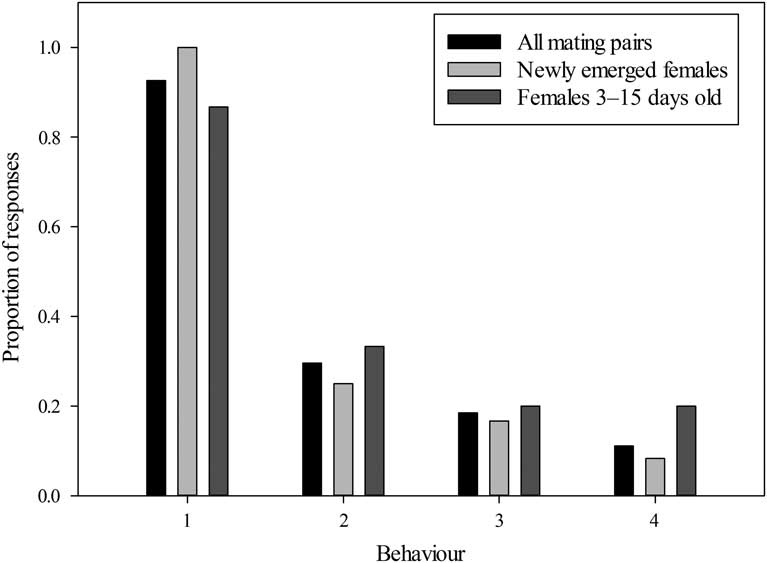
Twenty-seven male-female parasitoid pairs were observed. Of these, 12 pairs included newly emerged females, while 15 pairs included 3–15-day-old females. Copulation only occurred in three out of 27 cases (Fig. 3). One additional attempted copulation was observed, but the female ended the sequence shortly after it began. Behaviours 1–4 always occurred sequentially.
Young (newly emerged), old (3–15 days old), and total (sum of young and old groups) proportions of adult Phasgonophora sulcata pairs (n=27) exhibiting mating behaviours 1–4 (1=“swaying”; 2=“orienting in front of female”; 3=“swaying with straight antenna”; and 4=“mounting and copulation”) during observational study.
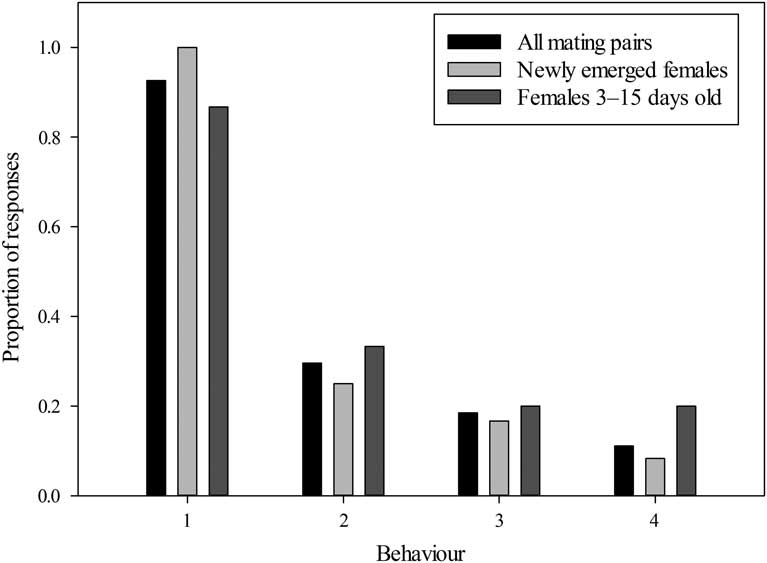
Behaviour 1, “swaying”, was observed by males when first encountering females in the arena and was observed in 92.6% of all pairs. In pairs with newly emerged females, this behaviour was observed in 100% of pairs but slightly less often with aged females (86.7%). Males would walk around the arena while conducting behaviour 1 while following the female. In some cases, males would also walk towards and investigate areas of the arena where the female had recently been. The male would approach the female from the rear or side and then attempt to move in front of the female. While approaching, the male would occasionally tap the female with his antenna. At all times, the male would be conducting behaviour 1. In most cases females ignored the male.
Behaviour 2, “orienting in front of female”, occurred in 29.6% of all mating pairs (Fig. 3), and in 32.0% of mating pairs that exhibited behaviour 1. This behaviour was observed in 25.0 and 33.3% of mating pairs with newly emerged and 3–15-day-old females, respectively. This behaviour occurred if the male had completed behaviour 1 and was directly in front of and facing the female. The swaying in behaviour 2 was different than in the previous behaviour, as males would stand upright on only their mesothoracic and metathoracic legs. This differed from the stance observed in behaviour 1, where males were usually walking with their bodies close to the substrate. Males were also usually walking around while swaying, whereas in behaviour 2 males would remain stationary in front of the female. Behaviours 2 and then 3 (described below) sometimes occurred in quick succession; however, females usually ignored males.
Behaviour 3, “swaying with straight antenna”, occurred in only 18.5% of all pairs, but was observed in 62.5% of mating pairs that had completed behaviours 1 and 2. This behaviour occurred in 16.7% and 20.0% of pairs with newly emerged and 3–15-day-old females immediately after behaviour 2 began. Here, males would be swaying in front of the female as in behaviour 2, but would also have their antenna straightened instead of relaxed. Besides arresting movement, females would also have their antenna extended out in front of their head in the direction of the male. While the female had her antenna extended, swaying males would alternately touch the tip of each antennae of the female with the front of their head.
Behaviour 4, “mounting and copulation”, occurred in only 11.1% of mating pairs (Fig. 3), but was observed in 60% of mating pairs that had exhibited behaviours 1–3. This behaviour occurred in 8.3% and 20.0% of newly emerged and 3–15-day-old females, respectively. Behaviour 4 only occurred if behaviour 3 had preceded it, and only in cases where touching of the female’s antenna by the male’s head took place. This behaviour would begin with the female lowering her head and antenna to the floor of the arena while raising the last segments of her abdomen to expose her genital pouch. The male would often briefly flick his wings and mount the female via her head. The male would then rotate his body and extend his aedeagus from the distal end of his abdomen. Upon reaching the female’s abdomen, the male inserted his aedeagus into the genital pocket of the female. Once inserted, the male thrust himself forwards at a rate of about once every second. In one instance, a female had lowered her body and raised her abdomen, but the male did not attempt to copulate. Once the male began to mount the female however copulation nearly always followed. Males and females showed no post-copulatory behaviours and continued walking around the arena as they did before copulation. Males never swayed when in contact with females after copulation.
Discussion
The responses of males to females in the olfactometer bioassays supports the conclusion that females likely produce a volatile sex pheromone within the age ranges tested. Age of males or females did not appear to affect attraction. We observed no evidence of intra-gender communication compounds, nor did we observe any evidence of female attraction to males. While courtship sequences included several actions that were consistent between opposite sex pairs, actual copulation events were rare. Although male-produced pheromones have been documented in other wasp parasitoids (Matthews et al. Reference Matthews, Yukawa and Gonzalez1985; Cossé et al. Reference Cossé, Petroski, Zilkowski, Vermillion, Lelito and Cooperband2012), sex pheromones are most often produced by females (Eller et al. Reference Eller, Bartelt, Jones and Kulman1984; Quicke Reference Quicke1997; Kainoh Reference Kainoh1999). As both young and old females were readily detected by males, female age in this case likely had no effect on attraction by males. Female pheromone production has been observed to vary depending on age in other parasitoids (Tagawa et al. Reference Tagawa, Asano, Ohtsubo, Kamomae and Gotoh1985; Schwörer et al. Reference Schwörer, Völkl and Hoffmann1999; McClure et al. Reference McCullough and Mercader2007; Collatz et al. Reference Collatz, Tolasch and Steidle2009). Female P. sulcata reared from A. planipennis live ~30 days (Roscoe Reference Roscoe2014), therefore the possibility that females older than 15 days may be unattractive does exist. The constant attraction in this case, however, could be related to mating status (Fauvergue et al. Reference Fauvergue, Hopper and Antolin1995; Collatz et al. Reference Collatz, Tolasch and Steidle2009), with mated females usually becoming less attractive to males than virgins due to decreases in the production of detectable pheromones (Quicke Reference Quicke1997; Ruther et al. Reference Ruther, Homann and Steidle2000). In our study, all female parasitoids were virgin, and may continue to produce volatiles unless mated. Continued studies would be required to confirm this.
We were not able to determine which structures on the female produced the compound; however the attraction of males to areas where females had previously walked may indicate that females may also deposit substrate-borne compounds in addition to airborne volatiles. Such compounds were found to be deposited by female parasitoids via tibial glands (Kainoh and Oishi Reference Kainoh and Oishi1993), or the abdominal tip (Danci et al. Reference Danci, Gries, Schaefer and Gries2006). Other potential areas of production include the cuticle (Nichols et al. Reference Nichols, Cossé, Bartelt and King2010) or mandibular glands (Völkl et al. Reference Völkl, Hübner and Dettner1994). Future studies are necessary to determine where P. sulcata pheromones are produced. The potential presence of pheromones is important as it may assist in the mating of insects in insectaries, and may be useful as part of a detection or retention protocol for natural P. sulcata populations. Traps baited with adult females have been proposed (Sullivan Reference Sullivan2002) and successfully used to quantify parasitoid populations in other studies, such as in the detection of Cardiochiles nigriceps Vierick (Hymenoptera: Braconidae) (Lewis et al. Reference Lewis, Snow and Jones1971) and Diapetimorpha introita (Cresson) (Hymenoptera: Ichneumonidae) (Jewett and Carpenter Reference Jewett and Carpenter2001). Detailed studies into the composition, isolation, and testing of a putative female-produced compound(s) in P. sulcata are underway.
Mating pairs exhibited repeated and sequential actions during courtship. The observed stages were divided into four behaviours, the majority of which were exhibited by males who undertook an active role while the female remained largely passive. The few actions undertaken by the female were necessary to continue the courtship process to copulation (i.e., arrestment, head-lowering). The actions observed in our study were similar to those described in other parasitoid species. The detection of airborne volatiles produced by the female is often interpreted as the first action of the courtship process (Leonard and Ringo Reference Leonard and Ringo1978; van den Assem Reference van den Assem1986; Field and Keller Reference Field and Keller1993). Upon detection, males initiate a specific action, such as wing-fanning and raising the abdomen (Vinson Reference Vinson1972; Field and Keller Reference Field and Keller1993; Ruther et al. Reference Ruther, Homann and Steidle2000), or mounting of the female (van den Assem and Vernel Reference van den Assem and Vernel1979; Abdurahiman et al. Reference Abdurahiman, Mohamed and Remadevi1983). In both Brachymeria intermedia (Nees) and Spilochalcis albifrons (Walsh) (Hymenoptera: Chalcididae), lateral swaying was observed as one of the first behaviours exhibited by the male after detecting the presence of the female (Leonard and Ringo Reference Leonard and Ringo1978; Hansen Reference Hansen1980). Body swaying in P. sulcata was observed, and was interpreted here as the first action of the courtship sequence following pheromone detection. For B. intermedia, the authors concluded lateral swaying assisted the males in detecting sex pheromones produced by the females (Leonard and Ringo Reference Leonard and Ringo1978). Swaying in male P. sulcata was observed in the olfactometer, and may have a similar role in assisting detection of volatiles produced by female P. sulcata. It has also been proposed that swaying assists the female in recognising the approaching insect as a mate (Leonard and Ringo Reference Leonard and Ringo1978), while others have suggested that swaying allows the male to better observe a non-moving female (Wigglesworth Reference Wigglesworth1950). Again, the exact purpose of this is unknown, but a likely explanation is that the male is using receptors on its antenna to detect the female pheromone in both the air and the substrate so that it may better orient itself to its potential mate. Future studies analysing the role of this behaviour in P. sulcata and other parasitoids are clearly necessary to determine its exact role in the mating sequence.
Once the male has closed the distance to the female, it would usually approach from the rear or the side before orienting itself in front of and facing the female. Leonard and Ringo (Reference Leonard and Ringo1978) also observed that males of B. intermedia would approach females from the rear, while Hansen (Reference Hansen1980) noted that S. albifrons would approach from the side. The continuation of the courtship process with the P. sulcata male directly facing the female was not observed in either B. intermedia or S. albifrons. Rather, these males would demonstrate from the rear or side of the female respectively, then mount the female, and continue the courtship sequence (Leonard and Ringo Reference Leonard and Ringo1978; Hansen Reference Hansen1980). Frontal approaches were, however, observed in Lariophagus distinguendus Först (Hymenoptera: Pteromalidae) (Ruther et al. Reference Ruther, Homann and Steidle2000). Frontal approaches may be necessary so the female is able to recognise the male as a potential mate, or so that the male is preventing the female from walking away from him. This latter reason may be necessary in P. sulcata, as inducing receptivity appeared to require the female to be facing the male directly. We also observed that males would touch the female’s antenna with his head. This action has been seen in several species, including S. albifrons (Hansen Reference Hansen1980), Antrocephalus hakonensis (Ashmead) (Hymenoptera: Chalcididae) (Abdurahiman et al. Reference Abdurahiman, Mohamed and Remadevi1983), L. distinguendus (Ruther et al. Reference Ruther, Homann and Steidle2000), and Nasonia vitripennis (Walker) (Hymenoptera: Pteromalidae) (Barras Reference Barras1960; van den Assem and Vernel Reference van den Assem and Vernel1979). In all of the above-mentioned parasitoids, however, the male had already mounted the female. In P. sulcata, the male sways its body so that its head is between the female’s antennae. In Pteromalus cerealellae (Ashmead) (Hymenoptera: Pteromalidae), the role of this “antennal touch” behaviour is thought to allow for the transmission of contact pheromones from a male to a female, and may be used to “calm” the female so that mating can occur (Onagbola and Fadamiro Reference Onagbola and Fadamiro2011). Analysis of antennal morphology in other parasitoids has shown that glands exist on male antennae, which may serve to transmit pheromones to the female (Isidoro and Bin Reference Isidoro and Bin1995; Isidoro et al. Reference Isidoro, Bin, Colazza and Vinson1996). Similar structures may exist on the antenna of male P. sulcata, and could serve a similar purpose in inducing female receptivity. Further analysis of antennal structure should be carried out to determine if these structures are present.
After this antennal touching, receptive females typically lower their antenna and head, while simultaneously exposing their genitalia by raising their abdomen (Leonard and Ringo Reference Leonard and Ringo1978; van den Assem and Vernel Reference van den Assem and Vernel1979; Abdurahiman et al. Reference Abdurahiman, Mohamed and Remadevi1983; Field and Keller Reference Field and Keller1993; Ruther et al. Reference Ruther, Homann and Steidle2000). In all of these species, the male is mounted on the female and copulation immediately follows. When P. sulcata females initiate these movements, males will mount the female from the front, rotate so they are facing the same direction as the female, and insert their aedeagus into the genitalia of the female. We observed males rhythmically and rapidly thrusting their bodies forward while connected to the female by its genitalia. Similar movements were observed in N. vitripennis (Barras Reference Barras1960), S. albifrons (Hansen Reference Hansen1980), and A. hakonensis (Abdurahiman et al. Reference Abdurahiman, Mohamed and Remadevi1983). It is possible that these movements aid in the transfer of sperm to the female, but further analysis would be required to confirm this. While copulation in P. sulcata took approximately one minute, times for other parasitoids varied from 28 to 36 seconds in A. hakonensis (Abdurahiman et al. Reference Abdurahiman, Mohamed and Remadevi1983) to three minutes in S. abifrons (Hansen Reference Hansen1980). No overt post-copulatory behaviours were observed in P. sulcata, an absence also observed in B. intermedia by Leonard and Ringo (Reference Leonard and Ringo1978). In some insects, post-copulatory behaviours may include the male remaining close to the female, likely as a way of preventing other males from mating with her (Alcock Reference Alcock1994). It is possible that these species may be monandrous and do not require mate guarding, as females usually are not receptive or detectable to further mating after copulation (Quicke Reference Quicke1997), however further studies are required to confirm this.
We observed that only 11.1% of all mating pairs actually copulated. This value is low when compared to studies of several other wasp species, where the proportion of mating pairs successfully copulating was ~50% (González and Matthews Reference González and Matthews2005; McClure et al. Reference McCullough and Mercader2007; Benelli et al. Reference Benelli, Bonsignori, Stefanini and Canale2012). Although mating pair observations were conducted in the same environmental conditions as the parasitoids were held at, it is possible that other factors could have impacted mating success. One possible factor is time of day. Benelli et al. (Reference Benelli, Bonsignori, Stefanini and Canale2012) observed that attempted matings by male Psyttalia concolor (Szépligeti) (Hymenoptera: Braconidae) were significantly higher in the morning than in the evening, while McClure et al. (Reference McCullough and Mercader2007) that proportions of male Aphidius ervi (Ashmead) (Hymenoptera: Braconidae) responding to female pheromones was also significantly higher in the morning. Other factors such as temperature and intensity of light have also been observed to affect courtship sequences (van den Assem and Werren Reference van den Assem and Werren1994). As our studies were completed in the afternoon, it is possible that one or more of these factors could be responsible for the low copulation attempts observed in our study. Male age may also have had an effect on mating success, as we did not control for this during the experiment. While adult males are usually able to mate at all points during their lifetime (Ramadan et al. Reference Ramadan, Wong and Wong1991; Schwörer et al. Reference Schwörer, Völkl and Hoffmann1999), female receptiveness can vary with male condition (Quicke Reference Quicke1997). It is possible that the low percentage of successful mating pairs may be related to females rejecting males due to age or some other factor related to male condition. Future studies that analyse the effects of these factors on copulation and courtship success should be undertaken.
The results of this study provide important information that may assist in the potential use of P. sulcata as an augmentative biological control agent against A. planipennis. This study also represents the first analysis of the mating and courtship sequences for any natural enemy of A. planipennis. Observations on the mating sequences of most potential biological control agents is necessary for the rearing of insects, and for measuring their numbers in the field (Canale et al. Reference Canale, Benelli and Lucchi2013). In determining the presence of attractive female-produced compounds, it may be possible to use them in a non-destructive trapping and detection protocol similar to those completed in studies of other natural enemies (Lewis et al. Reference Lewis, Snow and Jones1971; Jewett and Carpenter Reference Jewett and Carpenter2001). Such protocols could also be useful in evaluating the success of releases if they were to occur. Attractive compounds could also be used to retain or aggregate P. sulcata populations if parasitoid density is low. Studies into the chemical composition of these compounds are, however, required and are currently in progress.
Acknowledgements
The authors thank G. Jones and I. Ochoa (Canadian Forest Service) for technical assistance, and R. Van Driesche, T. Smith, D.C. Darling, and P. Kotanen for editing an earlier version of this manuscript. This work was funded by the Ontario Ministry of Natural Resources, Natural Resources Canada, and the Faculty of Forestry, University of Toronto.