Introduction
Human activities produce polluting compounds such as persistent organic pollutants (POPs), which may impair agriculture and consequently food safety (Antignac et al., Reference Antignac, Marchand, Gade, Matayron, Qannari, Le Bizec and Andre2006). These compounds have raised concern about the risk of transfer through the food chain and particularly via milk (Rychen et al., Reference Rychen, Crépineau-Ducoulombier, Grova, Jurjanz and Feidt2005 and Reference Rychen, Crépineau-Ducoulombier, Jurjanz, Méjean and Feidt2006). POPs are considered as persistent compounds in the environment. Particular attention has been given to compounds characterised by involuntary emission through incomplete combustion: polychlorodibenzo-p-dioxins (PCDDs), polychlorodibenzo-furans (PCDFs), polychlorobiphenyls (PCBs) or non-chlorinated compounds such as polycyclic aromatic hydrocarbons (PAHs). These hydrophobic compounds are known to be persistent in the environment depending on the chlorination and the number of aromatic cycles (Laurent et al., Reference Laurent, Feidt and Laurent2005). Atmospheric deposition is usually the primary vector of lipophilic contaminants into plants (Welsch-Pausch et al., Reference Welsch-Pausch, McLachlan and Umlauf1995; Thomas et al., Reference Thomas, Smith, Sweetman and Jones1998). Several authors have detected an increase of POP concentrations in milk produced near potential POP emission sources (Rappe et al., Reference Rappe, Nygren, Lindström, Buser, Blaser and Wüthrich1987; Stevens and Gerbec, Reference Stevens and Gerbec1988; Eitzer, Reference Eitzer1995; Hippelein et al., Reference Hippelein, Kaupp, Dörr, McLachlan and Hutzinger1996; Ramos et al., Reference Ramos, Eljarrat, Hernandez, Alonso, Rivera and Gonzalez1997; Grova et al., Reference Grova, Feidt, Crépineau, Laurent, Lafargue, Hachimi and Rychen2002a; Tieyu et al., 2005) such as steelworks, cementworks, waste incinerators or motorways. POP contamination has been described in different environmental matrices such as plants or soil (Bryselbout et al., Reference Bryselbout, Henner, Carsignol and Lichtfouse2000). Thus, lactating ruminants may be exposed to POPs when polluted roughage or soil is ingested during grazing. Indeed, cattle can ingest up to 1.5 kg soil (Fries, Reference Fries1996) per day depending on the climatic zone, season and grass density (Healy, Reference Healy1968; Mayland et al., Reference Mayland, Florence, Rosenau, Lazar and Turner1975).
The aim of this paper is to present an overview of the current knowledge on dairy ruminant exposure to POP via plants and soil and their transfer to milk.
Exposure of dairy ruminants to POPs via plants or soil
Contamination of plants
After being emitted, POPs are directed towards the earth’s surface in the form of gas or particulate deposits according to environmental conditions (Pavlíková et al., 2007). The atmospheric transport of these compounds may be responsible for the contamination of sites quite distant from any source of emissions (Lohman and Seigneur, Reference Lohman and Seigneur2001; Garban et al., 2002). Several authors (Bennett et al., Reference Bennett, McKone, Matthies and Kastenberg1998, Van Pul et al., Reference Van Pul, de Leeuw, Van Jaarsveld, van der Gaag and Sliggers1998; Beyer et al., Reference Beyer, Mackay, Matthies, Wania and Webster2000) have stated that some PCDD compounds tetrachlorodibenzo-p-dioxin (TCDD) and octachlorodibenzo-p-dioxin (OCDD) may be distributed over hundreds of kilometres. This phenomenon has also been observed for PCBs (Teil et al., Reference Teil, Blanchard and Chevreuil2004). Thus, Thomas et al. (Reference Thomas, Smith, Sweetman and Jones1998) did not find any differences in PCB grass contamination between a rural area and in grass collected in an industrial area. The levels and profiles of PAHs and platinum group elements (PGE except Rh) in highway grasses transferred to a remote area did not significantly decrease, suggesting a potential risk of contamination for dairy ruminants (Tankari Dan-Badjo et al., Reference Tankari Dan-Badjo, Crépineau-Ducoulombier, Soligot, Feidt and Rychen2007).
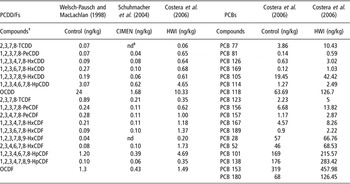
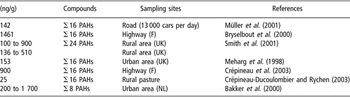
For PAHs, some compounds can also be transported over long distances (Menichini et al., Reference Menichini, Iacovella, Monfredini and Turrio-Baldassarri2007); however, the heaviest PAHs are generally deposited near the emission site (Koeleman et al., Reference Koeleman, Laak and Ietswaart1999). Crépineau et al. (Reference Crépineau, Rychen, Feidt, Le Roux, Lichtfouse and Laurent2003) showed, for example, that grass samples collected in a rural area may be significantly less contaminated than samples collected in the vicinity of motorways. Tables 1 and 2 indicate grass contamination levels by polychlorinated dibenzo-p-dioxins and dibenzofurans (PCDD/Fs), PCBs or PAHs and reveal different levels depending on environmental conditions such as emission sources or climate parameters. Highest concentrations are generally found in the vicinity of a hazardous waste incinerator (PCDD/Fs or PCBs) or in the vicinity of motorways (PAHs) (Lee et al., Reference Lee, Chang-Chien, Wang, Lee, Tsai, Wu and Lin2004 and Reference Lee, Chang-Chien, Wang, Lee, Wu and Tsai2005).
Polychlorinated dibenzo-p-dioxins and dibenzofurans (PCDD/Fs) and polychlorobiphenyls (PCBs) levels in grass samples collected near a cimentory (CIMEN), a hazardous waste incinerator (HWI) or a rural area (control)

†TCDD = tetrachlorodibenzo-p-dioxin; PeCDD = pentachlorodibenzo-p-dioxin; HxCDD = hexachlorodibenzo-p-dioxin; HpCDD = heptachlorodibenzo-p-dioxin; OCDD = octachlorodibenzo-p-dioxin; TCDF = tetrachlorodibenzofuran; PeCDF = pentachlorodibenzofuran; HxCDF = hexachlorodibenzofuran; HpCDF = heptachlorodibenzofuran; OCDF = octachlorodibenzofuran; ‡nd: not detected.
Mean polycyclic aromatic hydrocarbons (PAHs) levels in grass samples collected in different areas

Mode of contamination of plants
The plant being the interface between the soil and the atmosphere, its contamination is likely to occur either by atmospheric deposit or by root absorption (Yang and Zhu, Reference Yang and Zhu2007). Four ways of entry of POPs have been distinguished (Welsch-Pausch et al., Reference Welsch-Pausch, McLachlan and Umlauf1995; Bakker et al., Reference Bakker, Casado, Koerselman, Tolls and Kollöffel2000 and Reference Bakker, Tolls and Kollöffel2001; Teil et al., Reference Teil, Blanchard and Chevreuil2004): gas deposit, the dry deposit of particles, the wet deposit of particles and root absorption. Each mode of contamination must be taken into account in order to evaluate the entry of the pollutants into the plant, their availability for the ruminant, and to characterise and model the contamination of fodder. Contamination by root absorption is considered by many authors as negligible (Wild et al., Reference Wild, Jones and Johnston1992; Welsch-Pausch et al., Reference Welsch-Pausch, McLachlan and Umlauf1995; Kipopoulou et al., Reference Kipopoulou, Manoli and Samara1999; Ouvrard et al., Reference Ouvrard, Lapole and Morel2006) since the POPs are not very soluble in water but are very lipophilic compounds (Simonich and Hites, Reference Simonich and Hites1994). Gas deposit concerns the most-volatile compounds, namely the least-chlorinated PCBs and the low-molecular-weight PAHs with two or three aromatic cycles (Howsam et al., Reference Howsam, Jones and Ineson2000). The least-volatile compounds are found mainly in the form of particulate deposit (Welsch-Pausch et al., Reference Welsch-Pausch, McLachlan and Umlauf1995). Thus, PCDD/Fs are found deposited in the particulate form, PCBs are found primarily in the gas form (Thomas et al., Reference Thomas, Smith, Sweetman and Jones1998) and the PAHs are found in one form or the other, or in both forms according to their octanol–air partition coefficient (K OA). Generally, the concentration in the plants depends on the distribution and nature of the compounds in the atmosphere and their properties influencing the proportion between the particulate and the gas form.
Factors influencing POP deposit
Environmental conditions, characteristics of the plants and physicochemical properties of the compounds represent numerous factors that may influence the type of deposit and the quantity of pollutants found on the plant (Oleszczuk and Baran, Reference Oleszczuk and Baran2005). The main environmental conditions influencing the content of POPs in plants are temperature, rainfall and wind. Temperature affects the form in which the POP compounds are present in the atmosphere: gas or particulate (Howsam et al., Reference Howsam, Jones and Ineson2000; Bakker et al., Reference Bakker, Tolls and Kollöffel2001; Blais et al., Reference Blais, Kimpe, Backus, Comba and Schindler2003). Some compounds are thus present in the atmosphere in particulate or gas form according to the ambient temperature (K OA of the compounds is temperature dependent): this is the case, for example, of the TCDD, which is exclusively in gas form during the summer (Welsch-Pausch and MacLachlan, Reference Welsch-Pausch and MacLachlan1998). The concentration of the pollutants in vegetation also depends on temperature: it increases by a factor of 30 to 2000 when the temperature increases from 5°C to 50°C (Bakker et al., Reference Bakker, Tolls and Kollöffel2001). Wind speed and direction also affect the concentration of POPs in plants (Bakker et al., Reference Bakker, Tolls and Kollöffel2001; Lohman and Seigneur, Reference Lohman and Seigneur2001; Smith et al., Reference Smith, Thomas and Jones2001; Teil et al., Reference Teil, Blanchard and Chevreuil2004) by modifying the distribution of the compounds in the atmosphere. The role of rainfalls on the rinsing of the compounds depends on their nature and the plant concerned: for example, a lettuce washed with water involves a significant extraction of high-molecular-weight PAHs; however, water will extract only a weak part of high molecular PAHs or PCDD/Fs in corn (Bakker et al., Reference Bakker, Tolls and Kollöffel2001).
POP concentrations in plants are also dependent on the characteristics of the plant such as the pilosity of the sheet, the composition of the cuticle or the architecture of the plant. The cuticle, rich in waxes, can involve an increase in the accumulation of the lipophilic molecules (Müller et al., Reference Müller, Hawker, McLachlan and Connel2001). Cutin, composing the cuticle, is responsible for 70% to 90% of adsorption (Thomas et al., Reference Thomas, Smith, Sweetman and Jones1998) and it is the quality of waxes present rather than the thickness of the cuticle that modifies the concentration (Smith et al., Reference Smith, Thomas and Jones2001). There is a passive diffusion between the atmosphere and the cuticle in the case of gas deposits. The molecules are transferred until an air–plant balance is reached. The time to reach balance varies according to species: from 24 to 240 s for the citrus kind and from 58 to 580 days for the Ilex kind (Bakker et al., Reference Bakker, Tolls and Kollöffel2001). Thus for certain plants, a balance is never reached because the lifespan of the plant is too short (Thomas et al., Reference Thomas, Smith, Sweetman and Jones1998; Smith et al., Reference Smith, Thomas and Jones2001). Furthermore, the surface of deposit of the plants is also a major factor affecting POP deposit: it is, for example, 6 to 14 times higher than that of the soil on which they develop (Simonich and Hites, Reference Simonich and Hites1994).
The physicochemical characteristics of the various POPs are also among the principal factors influencing the contamination of grass. The proportion of the gas or particulate phase depends on the characteristics of the molecules (Howsam et al., Reference Howsam, Jones and Ineson2000) and, in particular, of their volatility (Bakker et al., Reference Bakker, Tolls and Kollöffel2001), their lipophilicity measured by the K OA value (coefficient of distribution octanol–air), their solubility in water, their steam pressure value, their constant of Henry (Meneses et al., Reference Meneses, Schuhmacher and Domingo2002) and their half-life (Kipopoulou et al., Reference Kipopoulou, Manoli and Samara1999). The value of K OA varies according to the compounds and directly influences the distribution of gas particles (Lohmann and Jones, Reference Lohmann and Jones1998). When the K OA is high, the particulate deposit increases. For example, PCBs with high chlorination have a low steam pressure and high K OA and thus are found in the particulate form (Jan et al., Reference Jan, Zupancic-Kralj, Kralj and Marsel1994). The PCDD/Fs having six chlorine atoms or more are also in the particulate form (Bakker et al., Reference Bakker, Tolls and Kollöffel2001). The PAHs with two and three cycles are exclusively in the gas form and those with more than five cycles are mainly in the particulate form. The PAHs with four cycles are distributed between the two forms according to the ambient temperature (Howsam et al., Reference Howsam, Jones and Ineson2000). This great variability is important for a better understanding of the profiles detected in the plants. For example, 95% of phenanthrene is always in the gas form whereas this value is less than 10% for benzo[g,h,i] perylene (Wild et al., Reference Wild, Jones and Johnston1992).
Contamination of soil
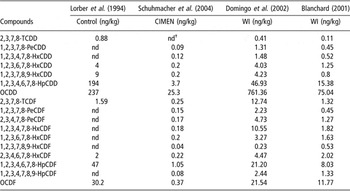
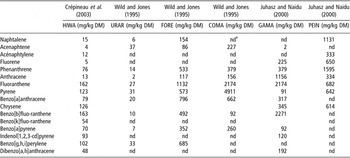
Soil contamination by organic pollutants occurs primarily by atmospheric deposit (Laurent et al., Reference Laurent, Feidt and Laurent2005). When deposited on the surface of the soil, these compounds tend to remain in the superficial surface (the first 15 cm of soil) (Fries, Reference Fries1982; Stevens and Gerbec, Reference Stevens and Gerbec1988; Jones et al., Reference Jones, Stratford, Tidridge, Waterhouse and Johnston1989). The sources of pollution of the soil correspond to three groups according to Wild and Jones (Reference Wild and Jones1995) and Lichtfouse et al. (Reference Lichtfouse, Albercht, Behar and Hayes1994 and Reference Lichtfouse, Budzinski, Garrigues and Eglinton1997): industrial activities (energy production, metallurgy, chemical industries, etc.), urban activities (the transport, management and processing of waste) and husbandries (mud spreading) (Tables 3 and 4). Highest concentrations of POPs in soil may be close to 1000 ng/kg dry matter (DM) for PCDD/Fs (Table 3), to 10 000 mg/kg DM for PAHs (Table 4) and 100 μg/kg for PCBs (Krauss and Wilcke, Reference Krauss and Wilcke2003). Many authors have highlighted the fact that the concentration of organic pollutants in the soil increases with the increasing density of the human activities. The industrial activities that are most polluting in PAHs and chlorinated compounds are those using fossil fuels (Edwards, Reference Edwards1983; Kakareka, Reference Kakareka2002; Krauss and Wilcke, Reference Krauss and Wilcke2003). Another source of contamination of the soil is the production of coke from coal. Indeed, the mechanisms of condensation, decantation and distillation of the tar from the furnace (tar being a by-product of the manufacture of coke) generate the formation of organic pollutants, which are then emitted into the atmosphere. In addition, soil contamination by PAHs, PCDD/Fs and PCBs is often concomitant with those of metal pollutants. It is known that lignite combustion generates large quantities of PAHs and certain metals (chromium and nickel). In the same way, the PCDD/Fs, the PCBs and 12 trace elements (Ag, Cd, Co, Cr, Cu, Mn, Ni, Pb, Sn, Tl, V, Zn) are released in the atmosphere bordering the sites of cementworks. Henner (2000) also points out that another source of soil pollution by PAHs is the sites of gas extraction. These direct contaminations of soil by atmospheric emissions, of anthropogenic origin, may be increased by indirect effects such as the degeneration of the plants. Indeed, 44 ± 18% of the atmospheric PAHs are introduced into the soil following their capture on waxy surfaces of plants followed by the decomposition of the plant (Simonich and Hites, Reference Simonich and Hites1994). The pollution of soil can also result from the natural contribution of organic pollutants (for example, the pyrolysis of humus during forest fires) (Laurent et al., Reference Laurent, Feidt and Laurent2005).
Polychlorinated dibenzo-p-dioxins and dibenzofurans (PCDD/Fs) levels in various soil samples collected near a waste incinerator (WI), a cimentery (CIMEN) or in rural area (control)Footnote †

† See foonote of Table 1 for abbreviations.
Polycyclic aromatic hydrocarbons (PAH) levels in various soil samples collected near a highway (HIWA), a coke manufacture (COMA), a gas manufacture (GAMA), a petrochemic industry (PEIN) or in an urban area (URAR) or a forest (FORE)Footnote †

† nd = not determined.
Because of their lipophilic character and a low aqueous solubility, there is a strong POP adsorption in the organic matter of the soil. The rinsing of the soil POPs is thus regarded as negligible (US EPA, 2000).
Availability of POPs in soil
The availability of pollutants in soil depends on their physicochemical properties (solubility, steam pressure, Kow (octanol–water coefficient), constant of Henry), environmental factors (temperature, precipitations, dissemination of the contaminated particles) and other specific factors such as the type of culture in relation to the characteristics of the root system (Duarte-Davidson and Jones, Reference Duarte-Davidson and Jones1996). However, the main factor results from the characteristics of the soil (composition and contents of organic matter and humic acid, pH and potential of oxydoreduction) (White et al., Reference White, Kelsey, Hatzinger and Alexander1997; Robertson and Alexander, Reference Robertson and Alexander1998; Moon et al., Reference Moon, Goltz, Ahn and Park2003). These parameters control the rates of absorption/desorption of the pollutants of the soil and thus the distribution of these substances in the three phases (liquid, gas and solid) of this matrix (Billeret et al., Reference Billeret, Berny, Mazallon and Buronfosse2000; Chiou et al., Reference Chiou, Kile, Rutherford, Sheng and Boyd2000; Huang et al., Reference Huang, Peng, Yu and Fu2003). For PAHs, Wild et al. (Reference Wild, McGrath and Jones1990) showed that time of half-life lies between 2 months and 9 years, respectively, for naphthalene and benzo[g,h,i]perylene. For the chlorinated compounds, times of half-life in the soil fluctuate between 6 months (example of the PCB ‘dioxins-like’) (Cousins and Jones, Reference Cousins and Jones1998) and tens of years (example of the OCDD) according to the degree of chlorination of the compounds (Laurent et al., Reference Laurent, Feidt and Laurent2005).
Abiotic and biotic degradation of bound soil organic pollutants
The degradation of POPs in soil can be carried out by photodegradation and microbial degradation (Laurent et al., Reference Laurent, Feidt and Laurent2005). These phenomena generate the appearance of metabolites, with a change in the chemical structure, and cause modifications of their toxicity (in particular, for the PAH) and of their behaviour in the soil compared with that of the parent compounds (Schiavon, Reference Schiavon1988). The photodegradation or abiotic degradation of the organic pollutants can take place only for the compounds located at the soil surface (Hebert and Miller, Reference Hebert and Miller1990). PAHs can be degraded by photo-oxidation and reactions of oxidation (Juhasz and Naidu, Reference Juhasz and Naidu2000). They react with ozone to form quinones and epoxides. This mechanism is relatively important and allows a clear reduction in soil PAHs. The mechanism of photodegradation of the PCDD/Fs and the PCBs ‘dioxins-like’ has been the subject of some studies (Moore and Ramworthy, Reference Moore and Ramworthy1984; Dougherty et al., Reference Dougherty, McPeter, Ovecash and Carbonell1993; McPeters and Overcash, Reference McPeters and Overcash1993). It implies a dechlorination (Helling et al., Reference Helling, Isensee, Woolson, Ensor, Jones, Plimmer and Kearney1973), the slightly chlorinated molecules being more easily photolysed than the octa-chlorinated compounds (Helling et al., Reference Helling, Isensee, Woolson, Ensor, Jones, Plimmer and Kearney1973; Dougherty et al., Reference Dougherty, McPeter, Ovecash and Carbonell1993). However, this mechanism would not be very important since soil limits the penetration of ultraviolet radiation. However, Miller et al. (Reference Miller, Hebert, Mille, Mitzel and Zepp1989), Kieaitwong et al. (Reference Kieaitwong, Nguyen, Herbert, Hackett, Miller, Miille and Mitzel1990) and Tysklind et al. (Reference Tysklind, Carey, Rappe and Miller1992) highlighted that the chlorine atoms, in a peri position (1,2,5,6), from the strongly chlorinated PCDD were eliminated, thus leading generally to the formation of the 2,3,7,8-TCDD.
The microbial or biotic degradation of the organic pollutants of the soil is a mechanism controlled by the temperature, by the properties of the soil (water and organic matter content, pH) and the compounds (molecular weight and log Kow) (Cerniglia, Reference Cerniglia1992; Bakker and Vries, 1996; Mhiri and Tandeau de Marsac, Reference Mhiri and Tandeau de Marsac1997). These activities of POP degradation in the soil play a role in the carbon cycle. PAHs are composed of carbon and hydrogen and thus form an integral part of this cycle (Gibson and Subramanian, Reference Gibson and Subramanian1984). Indeed, their similarity with other organic molecules means that telluric microorganisms have the enzymatic ability to degrade them. Thus, microbial degradation is a more important process of decontamination of soils than the process based on the photo-oxidation or self-oxidation. In a general way, the mechanism is accelerated in the presence of nutrients added (oil) to the soil (Wilson and Jones, Reference Wilson and Jones1993; Straube et al., Reference Straube, Jones-Meehan, Pritchard and Jones1999), of organic matter (Kästner and Mahro, Reference Kästner and Mahro1996), of a ventilation of the soil and an increase in temperature (Bonten et al., Reference Bonten, Grotenhuis and Rulkens1999), these different factors probably supporting the development of microorganisms.
Microbial degradation of PCBs is carried out accordingly in one of two ways: the strongly chlorinated compounds can undergo a dechlorination in anaerobic conditions while the others generally undergo an oxidation by bacteria developing in aerobiosis (Abramowicz, Reference Abramowicz1990). The importance of this microbial degradation is still being discussed (Pizzul et al., Reference Pizzul, Sjögren, Castillo M del and Stenström2007). According to Mhiri and Tandeau de Marsac (Reference Mhiri and Tandeau de Marsac1997), the biological breakdown of soil PCBs allows a significant elimination of these molecules, whereas for Sierra et al. (Reference Sierra, Valera, Marina and Laborda2003), these same molecules are slightly metabolised. It is the same for the PCDD/Fs: in a general way, the degradation of the PCDD/Fs by bacteria of the soil is regarded as a rather ineffective way of dissipation, requiring many years and particularly when the compounds are strongly chlorinated (Arthur and Frea, Reference Arthur and Frea1989; Parsons and Storms, Reference Parsons and Storms1989; Paustenbach et al., Reference Paustenbach, Weining, Lau, Harrington, Rennix and Parsons1992; Aust and Benson, Reference Aust and Benson1993; Beurskens et al., Reference Beurskens, Toussaint, de Wolf, van der Steen, Slot, Commandeur and Parsons1995; Ballerstedt et al., Reference Ballerstedt, Kraus and Lechner1997; Wittich, Reference Wittich1998). Habe et al. (Reference Habe, Chung, Lee, Kasuga, Yoshida, Nojiri and Omori2001 and Reference Habe, Die, Yotsumoto, Tsuji, Yoshida, Nojiri and Omori2002) highlighted that after 7 days of inoculation with Terrabactersp. (stock DBF63) the rate of degradation of the molecules with four to six chlorine atoms was close to 10%, whereas for the highest-chlorinated compounds it was close to zero.
Transfer of POPs to milk
The different ways of contamination of the dairy ruminant by POP are ingestion of polluted feed or soil, inhalation of contaminated air or absorption by dermal contact. In the lactating animal, the exposure by inhalation is considered as negligible when compared with the oral administration of contaminated feed or soil. The skin absorption of organic pollutants present in the soil or the plants was not studied, but several studies undertaken on laboratory animals suggest that this exposure is also negligible under the conventional conditions of breeding. Therefore, research work has been focused towards the contamination of the ruminant via the feed, i.e. the ingestion of roughage or soil. Indeed, a lactating ruminant may ingest daily from 1% to 10% soil when grazing (Healy, Reference Healy1968; Thornton and Abrahams, Reference Thornton and Abrahams1983). The contamination of milk by POPs depends on environmental factors, factors related to the rearing system (fodder and potentially contaminated soil, stage of lactation, medical state of the herd) and to the characteristics of the contaminants.
Factors influencing POP transfer to milk
Several authors measured the concentrations of PCDD/Fs in milk produced in farms located either near or far from polluting sources (Rappe et al., Reference Rappe, Nygren, Lindström, Buser, Blaser and Wüthrich1987; Schmid and Schlatter, Reference Schmid and Schlatter1992; Eitzer, Reference Eitzer1995; Harrison et al., Reference Harrison, Gem, Starting, Wright, Kelly and Rose1996; Hippelein et al., Reference Hippelein, Kaupp, Dörr, McLachlan and Hutzinger1996; Ramos et al., Reference Ramos, Eljarrat, Hernandez, Alonso, Rivera and Gonzalez1997; Schulz et al., Reference Schulz, Wiesmuller, Appuhn, Stehr, Severin, Landmann and Kamphues2005). In milks produced in isolated farms far from POP emission sources, the contents of PCDD/Fs were found to be between 1.3 and 2.5 pg I-TEQ/g of fat content. In the POP-exposed situations, the concentrations in PCDD/Fs were also generally lower than the threshold of 3 pg I-TEQ/g of fat content. However, in some extreme situations, values reaching 9 pg I-TEQ/g of fat content have been found (Costera et al., Reference Costera, Feidt, Marchand, Le Bizec and Rychen2006). An increase in the contents of 2,3,4,7,8-pentachlorodibenzofuran (PeCDF), 1,2,3,4,7,8-HxCDD/F, 1,2,3,6,7,8-HxCDD/F, 2,3,4,6,7,8-hexachlorodibenzofuran (HxCDF) and 2,3,7,8-TCDD is noted around chemical, metallurgical industries or waste incinerators. For PCDD, the concentrations of compounds in milk appeared to be linked to the number of chlorine atoms carried by the molecule (Ramos et al., Reference Ramos, Eljarrat, Hernandez, Alonso, Rivera and Gonzalez1997). The PCDD/F contents of milk are also dependent on rearing factors. Indeed, POP transfer to milk may fluctuate according to the physiological status of the animals. Tuinstra et al. (Reference Tuinstra, Roos, Berende, van Rhijn, Traag and Mengelers1992) showed, for example, that the disappearance of the PCDD/Fs in milk was linked to the body fat reserves of the animal. The mobilisation of these reserves during the cycle of lactation can thus have a significant impact on the content of PCDD/Fs in milk. Indeed, at the beginning of lactation, lactating animals do not manage to meet their needs via feed intake and therefore use their body fat reserves. Later during lactation, the opposite phenomenon (nutritive contribution in excess compared with the needs) occurs and POPs may be stored in body fat reserves (Jarrige, Reference Jarrige1988; Thomas et al., Reference Thomas, Sweetman and Jones1999). Thus, the peak of concentration of PCDD/Fs observed in the colostrum (Tuinstra et al., Reference Tuinstra, Roos, Berende, van Rhijn, Traag and Mengelers1992) could be related to the contamination of the animal during its phase of reconstitution of the body reserves during the previous lactation. The medical status of the lactating ruminant also modulates the contents of PCDD/Fs in milk. Indeed, Fries et al. (Reference Fries, Paustenbach, Mather and Luksemburg1999) noted an increase in the concentrations of PCDD/Fs strongly chlorinated during the infection of the mammary gland. This phenomenon can be explained by the structural modifications of the cells of the mammary gland at the time of a mastitis (with an increase in the permeability of the mammary epithelial barriers) (Fries et al., Reference Fries, Paustenbach, Mather and Luksemburg1999). Mammary epithelium could play a key role in the selective transfer of PAH from food to milk (Cavret et al., Reference Cavret, Feidt, Le Roux and Laurent2005).
Milk levels of POPs can also fluctuate during lactation according to seasons and according to the diets of the animals (Krokos et al., Reference Krokos, Creaser, Wright and Startin1996). Indeed, during the summer period (animals in pastures), the involuntary ingestion of soil whose POP contamination is generally higher than that of grass can represent a major concern (Fries and Paustenbauch, Reference Fries and Paustenbauch1990). Mamontova et al. (Reference Mamontova, Tarasova, Momontov, Kusmin, McLachlan and Khomutova2007) found, for example, a good correlation between PCB levels in autumn milk and in soil. These authors suggested that ingestion of pasture soil was the dominant source of PCBs in milk. However, these limited data suggest the need for further investigations.
Transfer rates of POPs to milk
When considering the transfer of POP to milk, the PAHs and the chlorinated compounds need to be distinguished: PCDD/Fs and PCBs are generally considered as persistent and bioaccumulable in the livestock products whereas PAH are considered as largely metabolised. Although the physicochemical characteristics of these compounds are well described, their interaction with the metabolism of the dairy ruminant is not yet well known.
Transfer of PCDD/Fs and PCBs to milk
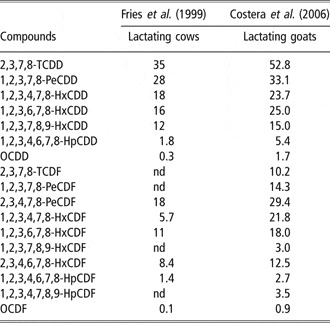
Table 5 indicates the values of the PCDD/Fs transfer rates ‘feed–milk’ determined by several authors. The obtained values oscillate between 1% and 52.8% according to the compounds and it is noticeable that all the individual PCDD/F compounds were found in milk. For the compounds whose log Kow is higher than 6.5, the transfer appeared to decrease with the increase of the log Kow value. Generally, transfer rates decreased with the number of chlorinations. Some exceptions however have been detected: among the PCDFs, the weak transfer of 2,3,7,8-tetrachlorodibenzofuran (TCDF), 1,2,3,7,8-PeCDF and 1,2,3,7,8,9-HxCDF may be related to the hepatic degradation of the compounds. The contents of PCBs in cow’s milk have been less studied: concentrations were usually in the range of 1 pg/g fat, except for PCB 118 whose concentrations reached levels 1000 times higher (Willett et al., Reference Willett, Liu, Durst, Smith and Redman1987 and Reference Willett, Loerch and Willett1989; Krokos et al., Reference Krokos, Creaser, Wright and Startin1996; Sewart and Jones, Reference Sewart and Jones1996; Focant et al., Reference Focant, Pirard, Massard and de Pauw2003). In a recent study (Mamontova et al., Reference Mamontova, Tarasova, Momontov, Kusmin, McLachlan and Khomutova2007), the relationship between PCB levels in cow’s milk and in pasture soil was assessed and proved.
‘Feed–milk’ transfer rates of polychlorinated dibenzo-p-dioxins and dibenzofuransFootnote †

† See foonote of Table 1 for abbreviations; nd = not determined.
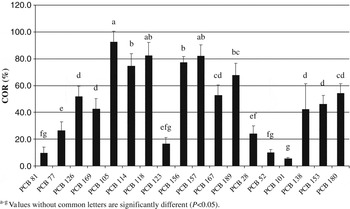
In another recent study (Costera et al., Reference Costera, Feidt, Marchand, Le Bizec and Rychen2006), the feed to milk transfer of 17 PCDD/Fs and 18 PCBs was established in lactating goats exposed to a 10-week intake of contaminated hay collected in the vicinity of a hazardous municipal waste incinerator. For PCDD/Fs (Table 5), 2,3,7,8-TCDD appeared as the compound having the highest carry-over rate (52.8%). For dioxin-like PCB, carry-over rates higher than 80% were obtained for PCBs 105, 118 and 157. Concerning indicators PCB, the carry-over rates ranged from 5% (PCB 101) to more than 40% (PCBs 118, 153 and 180) (Figure 1). According to Costera et al. (Reference Costera, Feidt, Marchand, Le Bizec and Rychen2006), the intensity of the transfers appeared as a function of both the physicochemical properties (chlorination or log Kow) of the compounds and their metabolic behaviour. This observation indicates a marked biotransformation of the different compounds by the ruminant (Firestone et al., Reference Firestone, Clower, Borsetti, Teske and Long1979; Rappe et al., Reference Rappe, Nygren, Lindström, Buser, Blaser and Wüthrich1987; Olling et al., Reference Olling, Derks, Berende, Liem and de Jong1991; Fries et al., Reference Fries, Paustenbach, Mather and Luksemburg1999; McLachlan, Reference McLachlan1999). According to Willett et al. (Reference Willett, Loerch and Willett1989), the PCBs may be partially degraded during the fermentation of the ration in the rumen. Results reported in Table 5 indicate similar carry-over rates of PCCD/Fs in lactating cows and lactating goats. These experimental carry-over rates obtained in different locations and feeding systems do argue for a similar behaviour of the chlorinated compounds in the two different animal species. Therefore, the lactating goat may be considered as a valuable ‘lactating animal model’ to investigate the POP transfer from feed to milk.
Carry-over rates of polychlorobiphenyls (PCBs) (%) from hay to milk in goats (Costera et al., Reference Costera, Feidt, Marchand, Le Bizec and Rychen2006). a−gValues without common letters are significantly different (P < 0.05).

PAH transfer to milk
Studies on PAH transfer in the terrestrial food chain appear limited owing to the fact that these compounds are known to be strongly metabolised. These molecules have nevertheless a recognised toxicity. PAH transfer to milk has been assessed recently (Rychen et al., Reference Rychen, Crépineau-Ducoulombier, Grova, Jurjanz and Feidt2005; Grova et al., Reference Grova, Rychen, Monteau, Le Bizec and Feidt2006). The aim of the studies was to characterise the transfer of the parent compounds and their main hydroxylated metabolites. First, milk samples coming from farms located near mobile sources (traffic on motorways) and from stationary sources (cementworks, steelworks, waste incinerators) were collected for PAH analysis. ‘Control farms’ distant from all potential sources of contamination (30 km) were also selected. The analyses of PAH revealed the presence of PAH in all collected milks. The total PAH concentrations varied from 20 to 30 ng/g fat. On the 16 PAHs sought, only the following 10 were detected: naphthalene, acenaphtylene, acenaphtene, fluorene, phenantrene, anthracene, fluoranthene, pyrene, benzo[a]anthracene and chrysene. All the detected compounds comprised less than four aromatic cycles (Grova et al., Reference Grova, Feidt, Crépineau, Laurent, Lafargue, Hachimi and Rychen2002a). The presence of PAH in conventional milks led these authors to study the transfer towards the milk of some model compounds in controlled situation (Grova et al., Reference Grova, Feidt, Laurent and Rychen2002b). Thus, three radioactive 14C-HAP (phenanthrene, pyrene and benzo[a]pyrene having, respectively, log Kow of 4.3; 4.5 and 6.5) and a dioxin compound (2,3,7,8-TCDD) were orally administered to lactating goats. Results of this study indicated a significantly different behaviour between the four compounds studied. Based on the ratio of radioactivity initially introduced and excreted in milk, three levels of excretion were observed: the TCDD with a rate of 7.8%, phenanthrene and pyrene with, respectively, 1.5% and 1.9% and benzo[a]pyrene with 0.2%. The rate of radioactivity associated with benzo[a]pyrene, phenanthrene and pyrene in urines (respectively, 6%, 11%, 40%) suggests a consequent biotransformation (Lapole et al., Reference Lapole, Rychen, Grova, Monteau, Le Bizec and Feidt2007). This study showed for the first time that the radioactivity related to PAHs orally distributed to lactating ruminants is transferred to milk at very low levels.
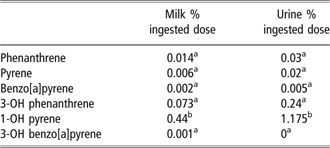
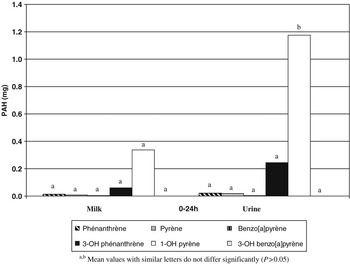
More recent work (Grova et al., Reference Grova, Monteau, Le Bizec, Feidt, André and Rychen2005) made it possible to specify the phenomenon of biotransformation of PAHs within the organism and the distribution of the native molecules and their metabolites in excretion products. Lapole et al. (Reference Lapole, Rychen, Grova, Monteau, Le Bizec and Feidt2007) demonstrated that recovery rates of pyrene and phenanthrene in milk appeared to be very low, whereas the transfer of their corresponding metabolites was significantly higher (Table 6, Figure 2). Recovery rates in urine were found to be significantly higher (1 to 10 times) than recovery rates in milk. The 1-ohpyrene was found to be the main metabolite in urine as well as in milk. Thus, this metabolite can be considered as a marker of ruminant exposure to PAHs. Furthermore, PAH metabolites should be taken into consideration when evaluating the safety of milk. Lapole et al. (Reference Lapole, Rychen, Grova, Monteau, Le Bizec and Feidt2007) also noticed that benzo[a]pyrene and 3OH-benzo[a]pyrene were transferred to milk and urine in very small amounts (less than 0.005%). This very limited transfer rate suggests a low risk of exposure by humans to benzo[a]pyrene or its major metabolite from milk or milk products.
Percentage of polycyclic aromatic hydrocarbons ingested transferred to milk and urine during 24 h (n = 4) (Lapole et al., Reference Lapole, Rychen, Grova, Monteau, Le Bizec and Feidt2007)
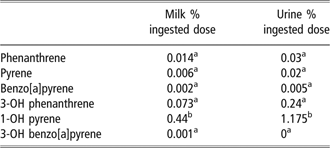
a,bFor each column, means followed by a similar letter do not differ significantly (P > 0.05).
Polycyclic aromatic hydrocarbons (PAHs) and hydroxy polycyclic aromatic hydrocarbons (OH-PAHs) excretion in milk and urine (0 to 24 h) after a single oral administration of the compounds (Lapole et al., Reference Lapole, Rychen, Grova, Monteau, Le Bizec and Feidt2007). a,bMean values with similar letters do not differ significantly (P > 0.05).

One of the remaining research perspectives is to better characterize the bioavailability of PAH from feed matrices or soil. Indeed, in most of the experiments (Grova et al., Reference Grova, Monteau, Le Bizec, Feidt, André and Rychen2005; Lapole et al., Reference Lapole, Rychen, Grova, Monteau, Le Bizec and Feidt2007) PAHs were orally administered to lactating animals in oil samples. However, Lutz et al. (Reference Lutz, Feidt, Monteau, Rychen, Le Bizec and Jurjanz2006) determined the transfer kinetics of soil-bound PAH to milk in lactating cows. They observed a significant increase of PAH metabolites in milk (up to 1.6% of the initial amount of PAHs). This result suggests a notable metabolism of the parent compounds after their extraction from soil during the digestive transfer. Costera (2007) compared the PAH metabolites transfer to milk and urine in lactating goats receiving either PAH-contaminated hay or PAH-contaminated soil. PAH hydroxy-metabolites concentrations were found to significantly increase in milk and in urine, but very similar kinetics were found for both hay and soil.
Transfer related to the hydrophobicity and the metabolic susceptibility of the compounds
The results presented in the previous paragraphs are focused on two distinct families of POPs, the chlorinated compounds (PCDD/Fs and PCBs considered as persistent and bioaccumulable in livestock products) and the non-chlorinated PAHs, which are considered as very largely metabolised within the animal organism (Cavret and Feidt, Reference Cavret and Feidt2005). Data given above are in agreement with this global vision since the transfer rate coefficients are higher for the first two families than for PAH. Nevertheless, in both cases there are also large differences within a given family. For PCBs the rate of transfer varies from 5% to 90%, for PCDD/Fs from 1% to 40% and for PAHs from 0.5% to 8%. The relation between hydrophobicity of the compounds and their transfer to milk does not sufficiently explain the behaviour of all the individual compounds. Among PCBs and PCDD/Fs, which are known to be metabolised, the observed transfer rates are lower than expected when considering their level of hydrophobicity. These questions have also been raised by authors evaluating pollutant transfer in the aquatic (Baussant et al., Reference Baussant, Sanni, Skadsheim, Jonsson, Borseth and Gaudebert2001; Dearden, Reference Dearden2002) or terrestrial (Fries et al., Reference Fries, Paustenbach and Luksemburg2002) food chain. The mechanisms responsible for these marked differences between compounds would be the in vivo biotransformation and/or absorption of the compounds. The ruminant animal seems to adapt to an increase in PAH exposure by an activation of its capacity of biotransformation, the contents of native molecules in milk increasing only slightly, whereas the hydroxyl metabolites increase in higher amounts. These metabolites are much less hydrophobic than the native molecules and can therefore be excreted through urine.
Conclusion
Data presented in this review indicate that POPs present in roughage or in soil are transferable towards livestock products and milk in particular. Knowledge of the levels of pollutants in roughage or soil highlights the potential presence of the pollutants in various agricultural types of mediums. Therefore, there is a real need to better evaluate the location of the contaminated area in order to reduce ruminant exposure. At the very least, rearing practices that lead to soil ingestion should be avoided. Further research work should be carried out in order to define threshold values that should not be exceeded either in feed matrices or in soil.
The animals are likely to intake varying quantities of POPs during grazing. In particular, the ruminant can involuntarily ingest soil whose level of contamination is generally higher than that of fodder. The analysis of the mechanisms of absorption, biotransformation and transfer also needs further research work. Scientific approaches such as toxicocinetic studies should be envisaged in order to better characterize the processes of absorption and elimination of the molecules in the dairy ruminant. The analytical approaches also need to be improved (gas chromatography/high-resolution mass spectrometry (GC-HRMS) and/or GC-MS/MS) for a better detection and quantification of the parent compounds and their metabolites. In addition, as human activities are likely to produce new polluting compounds (for example, polybrominated compounds) it would be necessary to evaluate the risks of transfer of the emerging compounds in the food chain. Thus, there are some major fields of investigation that represent important questions in terms of food safety.