
Introduction
In nanoscale films, regions near interfaces exhibit properties which are strongly perturbed from their respective bulk identities, such as modulus, glass-transition temperature (T g), density and relaxation dynamics, known as the nanoconfinement effect. As the characteristic size of the material decreases, these “interphase” regions constitute a larger fraction of the material by volume, and can greatly influence the macroscopic properties.[ Reference Ediger and Forrest 1 – Reference Hanakata, Douglas and Starr 4 ] Significant efforts have been carried out to quantify the extent to which polymer–air[ Reference Ediger and Forrest 1 , Reference Forrest, Dalnoki-Veress, Stevens and Dutcher 3 – Reference Paeng and Ediger 6 ] and polymer–substrate[ Reference Paeng, Richert and Ediger 7 – Reference Ye, Wiener, Tyagi, Uhrig, Orski, Soles, Vogt and Simmons 9 ] interfaces cause deviation from bulk properties for nanoscopically thin films. However, the behavior of polymer–polymer “soft” interfaces[ Reference Roth, McNerny, Jager and Torkelson 10 – Reference Lang, Merling and Simmons 16 ] occurring at the junction of immiscible polymers is far less understood. Interphases formed near these discontinuities approach each other as the characteristic feature dimensions become small. Our understanding of the interactions of these interphases, specifically whether they have additive or subtractive effects in thin films remains to be clarified.
Previous studies have shown that the nanoconfinement behavior of a polymer thin film can be highly sensitive to the presence of an underlying polymer layer, with mobility becoming altered by several orders of magnitude depending on the chemical species. A study was performed by Roth et al.[ Reference Roth, McNerny, Jager and Torkelson 10 ] on multilayer films of PMMA and PS using fluorescence microscopy, in which a fluorescent dye molecule was chemically bonded to polymer chains to allow for local estimation of the T g. It was observed that the outermost 14 nm layer of a supported PS film underwent a ~32 K T g reduction due to the free surface effect. However, this effect could be effectively eliminated when the PS film was placed atop a PMMA or P2VP supported layer of arbitrary thickness. Yoon and McKenna carried out a similar experiment using a direct dynamic particle embedment method and found that the T g in the upper layer probed by the particle underwent a less than 10 K reduction compared with the bulk, regardless of the lower-layer material.[ Reference Yoon and McKenna 11 ] More recently, Baglay and Roth used fluorescence microscopy to determine the local T g profile in polystyrene-poly(n-butyl methacrylate) (PS-PnBMA) bilayer films near the polymer–polymer interface.[ Reference Baglay and Roth 14 ] They observed that despite only a 7 nm interface thickness in the physical composition profile, the distance over which the local T g was perturbed from the bulk persists 350 nm into the rubbery PnBMA (293 K bulk T g) layer and nearly 400 nm into the glassier PS (373 K bulk T g) layer.
Despite a large body of experimental and simulation work which focused on mobility and free volume disturbances at various interfaces,[ Reference Ediger and Forrest 1 , Reference White, Price and Lipson 17 ] there is still considerable effort to be undertaken to characterize the local gradients in T g at sub-10 nm resolution near polymer–air, polymer–substrate, and polymer–polymer interfaces. Existing experimental methods have difficulty probing the local T g for layers at nanometer scale resolution, and the generic nature of simulations may not adequately represent the true thermomechanical behavior of a specific polymer material. Furthermore, there has been minimal work done to predict the combined T g-nanoconfinement effect at the coalescence of various interphase types, which is pertinent in understanding the physical behavior of ultrathin films.
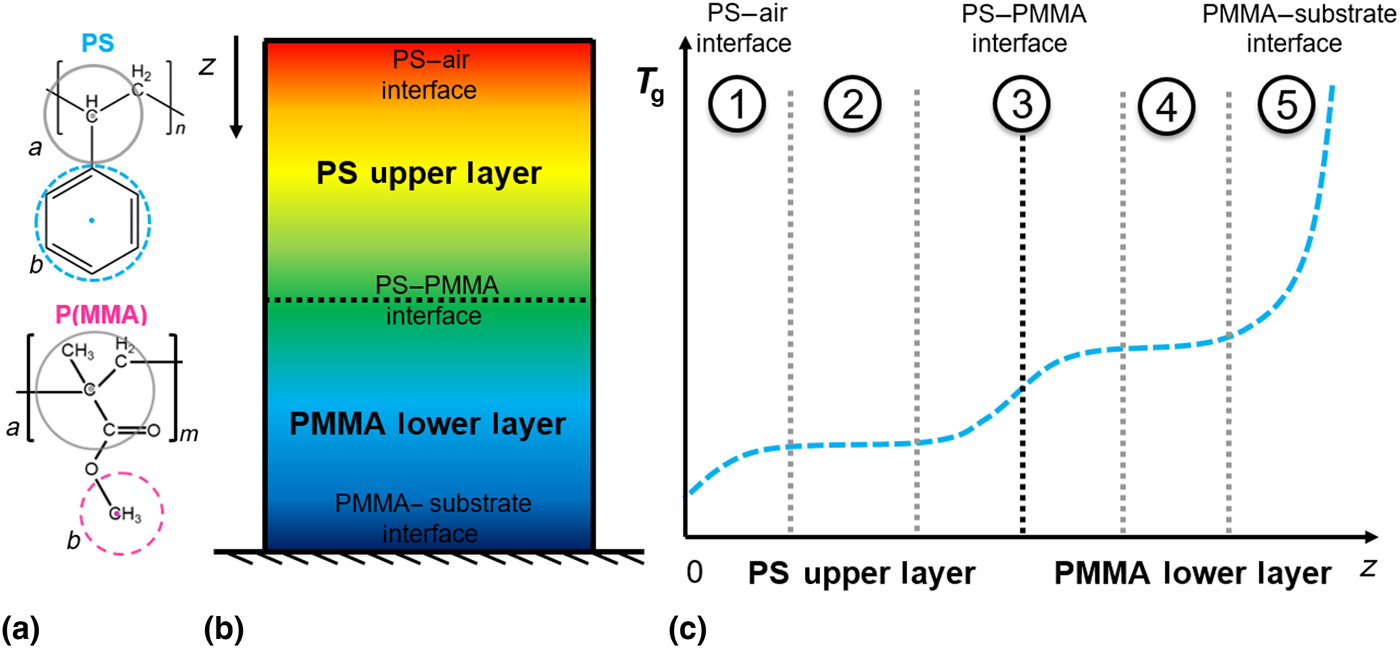
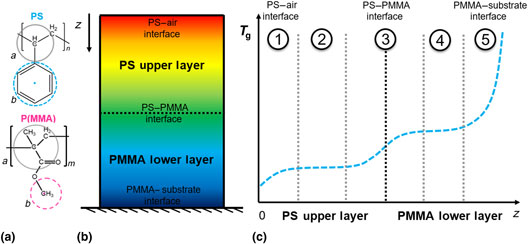
In the present study, we utilize polymer-specific coarse-grained (CG) models informed from atomistic systems to predict the local and system-averaged effects on T g due to the various interface types in PS and PMMA homopolymer films and bilayers. A PMMA lower-layer and a PS upper-layer are then combined within a supported bilayer system to understand how the various interphases interact below critical length scales (illustrated in Fig. 1). We then aim to establish a framework for predicting the effective local T g gradient for regions that are perturbed from the bulk properties as the result of more than one interphase type for ultrathin films.
(a) Coarse-grained mapping scheme for PS and PMMA models. (b) Bilayer system schematic consisting of a PMMA lower-layer and PS upper-layer depicting local T g gradient. (c) Schematic representation of the local T g versus z position and distinct T g transition regions.

Simulation methodology
We utilize polymer-specific CG models for PS and PMMA, which have been developed by our Thermomechanically Consistent Coarse-Graining (TCCG) method.[ Reference Hsu, Xia, Arturo and Keten 18 , Reference Hsu, Xia, Arturo and Keten 19 ] In these CG models, the bulk T g (371 and 396 K for PS and PMMA, respectively) has been tuned to that of the all-atomistic models by varying cohesive interactions. (See Tables SI–SIII for CG force field parameters in the Supporting Information.) PS freestanding thin films of varying thickness from 10 to 60 nm are generated using a random walk algorithm. We use 200 repeat units per chain and vary the number of chains to achieve the desired thickness, while maintaining a 9 × 9 nm2 cross section that is periodic in the x and y-directions. The z dimension (thickness direction) is non-periodic, and adequate space in the simulation box is allotted above the film surface to simulate the polymer–air interface. This also allows the system to expand and contract freely in the z-direction and is therefore effectively equivalent to an NPT ensemble with zero pressure at the film surfaces.
To model the substrate for supported PS and PMMA films, we add an implicit attractive wall, which interacts with the film through a Lennard–Jones 12–6 potential with resulting energy function of the form:
 $$E_{{\rm sp}} = 4\varepsilon _{{\rm sp}}\left[ {{\left( {\displaystyle{\sigma \over r}} \right)}^{12} - {\left( {\displaystyle{\sigma \over r}} \right)}^6} \right],\,\,\,\,\,\,\,r \lt r_{\rm c},$$
where ε sp is the substrate–polymer interaction energy equal to 10 kcal/mol to ensure that a clear interphase and strong enhancement of the local T g is achieved near the substrate interface. σ is defined as the point at which the energy crosses the zero line and is 4.5 Å to be consistent with the CG bead non-bonded parameter. The cutoff distance r c is set to 15 Å, similar to that of the non-bonded cohesive interactions.
For supported PS-PMMA bilayer films, we generate films with 12 × 12 nm2 cross sections in the x-y plane for improved sampling during local T g estimation. A PMMA lower-layer with a variable thickness from 2 to 36 nm in the z-direction and a PS upper-layer of 18 nm are generated. We enforce a reflective wall between the under- and over-layers to prevent beads from intermixing during the soft potential push-off step. Subsequently, we remove the reflective wall and employ an implicit attractive Lennard–Jones wall at the bottom surface of the PMMA lower-layer. We note that the attractive wall does not interact with the upper PS layer due to the short cutoff distance.
After these systems are generated, in the initial annealing step, we first minimize the system using the conjugate gradient method,[ Reference Payne, Teter, Allan, Arias and Joannopoulos 20 ] perform a soft potential push-off step, and then cycle the temperature between 210 and 750 K over a period of 4 ns using the Nose-Hoover[ Reference Hoover 21 ] NPT ensemble until the energy and density have converged. For all simulations, we use a 4 fs timestep and carry out calculations with the LAMMPS molecular dynamics software.[ Reference Plimpton and Hendrickson 22 ]
The T g of the overall film is estimated by calculating the α-relaxation time τ α via the self-part of the intermediate scattering function F s(q, t) as described in our previous work.[ Reference Hsu, Xia, Song and Keten 5 ] The α-relaxation time τ α is taken to be when F s(q, t) decays to 0.2. We use a computational measure of T g, which is estimated as the temperature at which τ α reaches 1 ns.[ Reference Hsu, Xia, Song and Keten 5 , Reference Marvin, Lang and Simmons 23 ] To capture the local T g, the film is divided into 2 nm layers along the z-axis, and the local F s(q, t) is employed to determine the local τ α of each layer. The T g of each bin layer is calculated for at least 5 samples, and the data sets presented in this work are based on the average T g values for each bin.
Results and discussion
Monolayer thin film systems
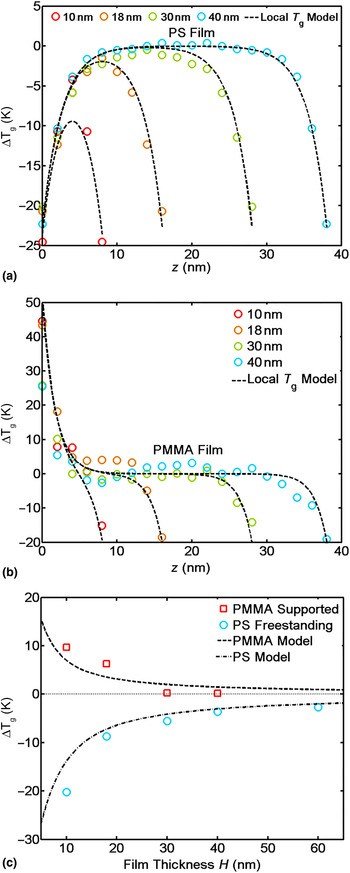
To understand how nanoconfinement behavior due to the free surface interface is affected by the film thickness, the local T g is calculated for freestanding monolayer PS thin films of various thicknesses. To isolate the free surface interphase T g profile, we use films that are sufficiently thick to ensure that the interphase regions at each of the two surfaces do not overlap. For PS freestanding films, we use a ~40 nm film thickness for which the local T g converges to a constant value in the interior region [Fig. 2(a)]. The PS film local T g profile experiences about 28 K depression relative to the bulk at the outermost 2 nm surface region. It converges to a constant value at 12 nm, and remains relatively constant within the ~16 nm interior region.
(a) Comparison of simulated local ΔT g depression in PS freestanding films and superposition model. (b) Local ΔT g profile for PMMA supported films compared with superposition model. (c) Overall T g of freestanding PS and supported PMMA versus film thickness from simulations and superposition model.

The local T g profile at the free surface interphase region can be described by the exponential function:
 $$\Delta T_{\rm g}^{{\rm fs}} \left( z \right) = - A^{{\rm fs}}{\rm e}^{\left( { - z/\lambda ^{{\rm fs}}} \right)},$$
where
 ${\rm \Delta} T_{\rm g}^{{\rm fs}} $
is defined as the bulk-like interior T
g substracted from the local freestanding film T
g. A
fs and λ
fs are empirical fitting parameters relating to the strength of the free surface effect and the characteristic length of the interphase, respectively. This is supported by other computational studies reporting the local T
g at the free surface, which could also be well described by the exponential function.[
Reference Hanakata, Douglas and Starr
4
,
Reference Zhou and Milner
24
]
A
fs and λ
fs for our PS model are found to be 22.7 K and 2.5 nm, respectively. The fitting results are shown as dashed lines in Fig. 2(a) and a summary of all fitting parameters are shown in Table SIV. Beyond interphase regions, the local τ
α
converges to a constant value, indicating a bulk-like interior of the film.[
Reference Hsu, Xia, Song and Keten
5
] We find that the interphase region size is nearly independent of the overall film thickness. This implies that there is a critical thickness
 $H_{{\rm crit}}^{{\rm fs}} $
for the polymer film, below which the two interphase regions (i.e., film top and bottom free-surface layers) may begin to interact.[
Reference DeFelice, Milner and Lipson
25
] In the case of the freestanding thin films,
 $H_{{\rm crit}}^{{\rm fs}} $
can simply be taken to be approximately twice the free surface interphase length scale 2ξ
fs, which is ~24 nm for the PS model. We find that the free surface gradient profile appears to be independent of the film thickness for PS films above
 $H_{{\rm crit}}^{{\rm fs}} $
. This result supports the findings from Tito et al. which also demonstrated that the interphase region behavior is not affected by film thickness as long as interphases do not overlap.[
Reference Tito, Lipson and Milner
12
]
Interestingly, the PS film interior does not appear to reach the bulk T g even for film thicknesses well over 40 nm. Although the PS film converges to a constant T g of 362 K in the center of the film, this is ~7 K below the T g found for bulk PS simulations. This is similar to the results recently reported by Rissanou and Harmandaris,[ Reference Rissanou and Harmandaris 26 ] where they find that the local segmental relaxation time for all-atomistic models of PS films supported by multi-layer graphene does not converge precisely to the bulk in the interior region for 12 nm films. However, Zhou and Milner do find the convergence of the T g within the film interior when using a united atom model for freestanding PS films.[ Reference Zhou and Milner 24 ] This discrepancy deserves additional investigation in future work. However, we do not expect this to affect the results reported in this study as we compare local T g perturbations to the “bulk-like” interior T g in ΔT g calculations and local T g gradient functions.
We next examine the local T
g for films thinner than
 $H_{{\rm crit}}^{{\rm fs}} $
to investigate the physical behavior of films where the interphase regions presumably intersect. For these systems, no interior convergence region is found, but rather a cusp at the local T
g maximum and greater T
g depression at the outermost free surfaces is observed in Fig. 2(a). We find that the superposition of analytical functions that we employed to describe the local T
g can capture film behavior down to 10 nm thick films as a reasonable approximation. This finding indicates that when the film is sufficiently thin that free surface interphases begin to interact, their combined effects can be well approximated to be additive. Therefore, we can describe the local T
g
of freestanding thin films by the following expression:
 $${\rm \Delta} T_{\rm g}^{{\rm fs}} \left( z \right) = - A_i^{{\rm fs}} \left( {{\rm e}^{\left( { - z/\lambda _i^{{\rm fs}}} \right)} + {\rm e}^{\left( {\left( {z - H} \right)/\lambda _i^{{\rm fs}}} \right)}} \right),$$
where the first and second exponential terms in the expression represent the lower and upper free surfaces, respectively. We find that this expression holds for all film thicknesses tested, both above and below
 $H_{{\rm crit}}^{{\rm fs}} $
down to ~10 nm.
Now that we have established the influence of free surfaces, we now apply a similar analysis to supported PMMA thin films. Supported films demonstrate an interphase region of reduced local T
g near the free surface with length scale ξ
fs, as well as an interphase region of enhanced local T
g near the attractive substrate with length scale ξ
sp.[
Reference Paeng, Richert and Ediger
7
,
Reference Xia, Mishra and Keten
8
,
Reference White, Price and Lipson
17
] Therefore, we begin by assuming that a critical thickness exists for supported films above which free surface and supported interphases do not interact. This can be expressed as
 $H_{{\rm crit}}^{{\rm sp}} = \xi ^{{\rm fs}} + \xi ^{{\rm sp}}$
. We find ξ
sp for both PS and PMMA by capturing the length scale near the supporting substrate, where the local T
g profile for 40 nm PS and PMMA supported films converges to the bulk. We simulate supported films for PS and PMMA with thicknesses varying from 10 to 40 nm. In this case, both PS and PMMA films are supported by an implicit wall with an interaction energy ε
sp = 10 kcal/mol. Although commonly used substrate materials such as silica will adhere with different strengths to PS and PMMA films (i.e., greater adhesion energy for PMMA due to the hydrogen-bonding with silica substrate), we choose to use a similar adhesion energy in order to directly compare substrate effects on these two systems resulting from differences in polymer chemistry.
For sufficiently thick films, we see an isolated region of T g depression near the free surface with behavior that matches our observations for the freestanding condition for both polymers. [See Fig. 2(b) for PMMA supported results and Fig. S2 for PS.] We find that the same analytical local T g parameters in Eq. (3) for the freestanding condition can readily capture the behavior in the free surface region of supported films thicker than a critical size. In the 2 nm region nearest to the substrate, we see a region in which T g is enhanced. For PMMA, T g appreciates 40 K above the bulk value and converges to a constant value ~8 nm from the substrate. For PS, T g enhancement is up to 50 K greater than the bulk and converges to the interior region at ~9 nm. Note that these large T g enhancements are due to a large interaction energy, which is used to highlight the substrate effect. The differences in magnitudes of the T g enhancement for PS and PMMA may be a result of chemical structure details, particularly pertaining to the bulkiness of backbone versus sidechain groups. In another study, we found that the degree of T g enhancement at an attractive substrate relative to the bulk can change with varying side-group size.[ Reference Xia, Song, Hsu and Keten 27 ] Comparisons between the effects of chemical structure on substrate T g nanoconfinement effect in PS and PMMA supported films is reserved for a future study.
Based on these measurements, the critical thickness
 $H_{{\rm crit}}^{{\rm sp}} $
of PS is found to be ~21 nm (
 $\xi _{{\rm PS}}^{{\rm fs}} $
= 12 nm,
 $\xi _{{\rm PS}}^{{\rm sp}} $
= 9 nm) and ~15 nm (
 $\xi _{{\rm PMMA}}^{{\rm fs}} $
= 7 nm,
 $\xi _{{\rm PMMA}}^{{\rm sp}} $
= 8 nm) for PMMA. Measuring the local T
g profile for films below the critical thickness, we find that within regions where the interphases overlap, the behavior follows the superposition of supported and free surface interphase regions. This suggests that the interaction between gradient profiles of dissimilar interphase types can be approximated as additive as well. Therefore, the entire supported film profile can be described by superposed exponential functions to describe the substrate and free surface interphase regions:
 $${\rm \Delta} T_{{\rm g},i}^{{\rm sp}} \left( z \right) = A_i^{{\rm sp}} {\rm e}^{\left( { - z/\lambda _i^{{\rm sp}}} \right)} - A_i^{{\rm fs}} {\rm e}^{\left( {\left( {z - H} \right)/\lambda _i^{{\rm fs}}} \right)}$$
with parameters developed for PS and PMMA with ε sp = 10 kcal/mol shown in Table SIV of the Supporting Information. Again, A sp and λ sp are related to the strength of T g enhancement and the length scale over which T g enhancement persists. Values for PS are found to be 60.5 K and 2.1 nm for A sp and λ sp, respectively, and 52.0 K and 1.7 nm for PMMA. This reflects a slightly greater T g enhancement effect on PS than for PMMA for equal substrate attraction energy as discussed earlier. The results for the PMMA local T g model are shown in Fig. 2(b), and PS results are shown in Fig. S2.
A multilayer model consisting of finite interfacial regions with enhanced or suppressed thermomechanical properties and an interior bulk-like region is often used to estimate the overall film T g as a function of thickness.[ Reference Forrest and Mattsson 28 ] We estimate the overall film T g at thicknesses above and below the critical thickness by taking the average value of the superposition model [e.g. Eqs. (4) and (6)]. We compare the results of this model with the simulation results for various film thicknesses ranging from 10 to 60 nm and find good agreement for PS freestanding and PMMA supported films shown as the open and filled symbols, respectively in Fig. 2(c). This provides additional verification that the superposition principle captures the behavior of interacting interphases. We note again, that the parameters describing the local T g profile are developed at large thicknesses where interphases do not interact. Yet, the local T g profile over the entire freestanding or supported films can be accurately modeled using superposition of analytical functions with these universal parameters even at significantly low film thicknesses.
Bilayer thin film systems
Now that we have analyzed the T g behavior of the freestanding and supported films and described how the interactions of interphase regions are approximately additive, we next investigate whether this principle can also be applied to PS–PMMA bilayer thin films. It is known that PS and PMMA polymer melts are immiscible and lead to phase separation in the blend state.[ Reference Ellingson, Strand, Cohen, Sammler and Carriere 29 ] In our CG models, we determine the non-bonded monomeric interactions between PS and PMMA by tuning the parameters to match the experimental interfacial tension of a blended system at 425 K, which is approximately 1.5 dyn/cm (see Fig. S1).[ Reference Ellingson, Strand, Cohen, Sammler and Carriere 29 ] The methodology to estimate the interfacial tension in the model and calculate the interfacial (i.e., cross interaction) parameters can be found in the Supporting Information. (Interfacial parameters can be found in Table SV.)
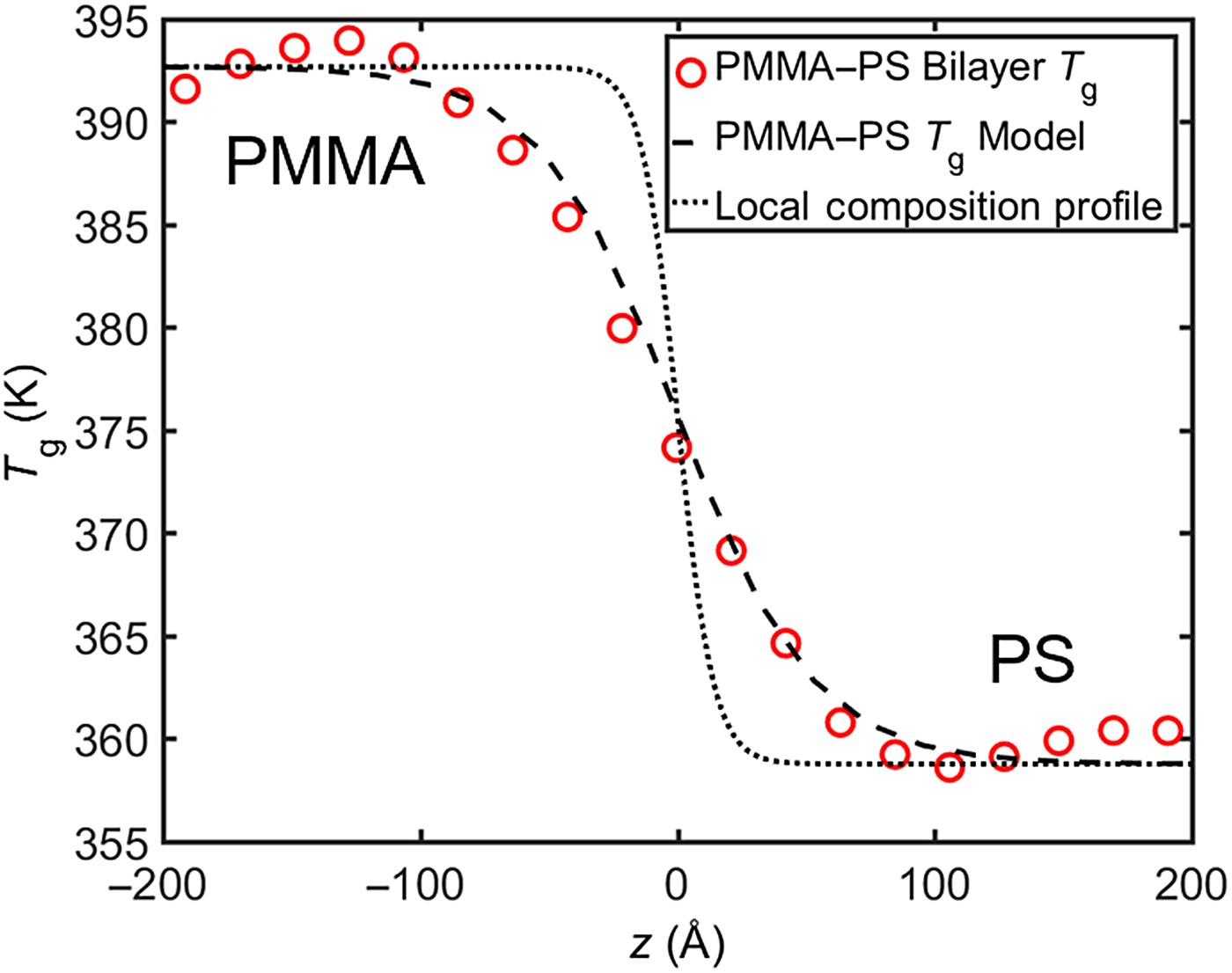
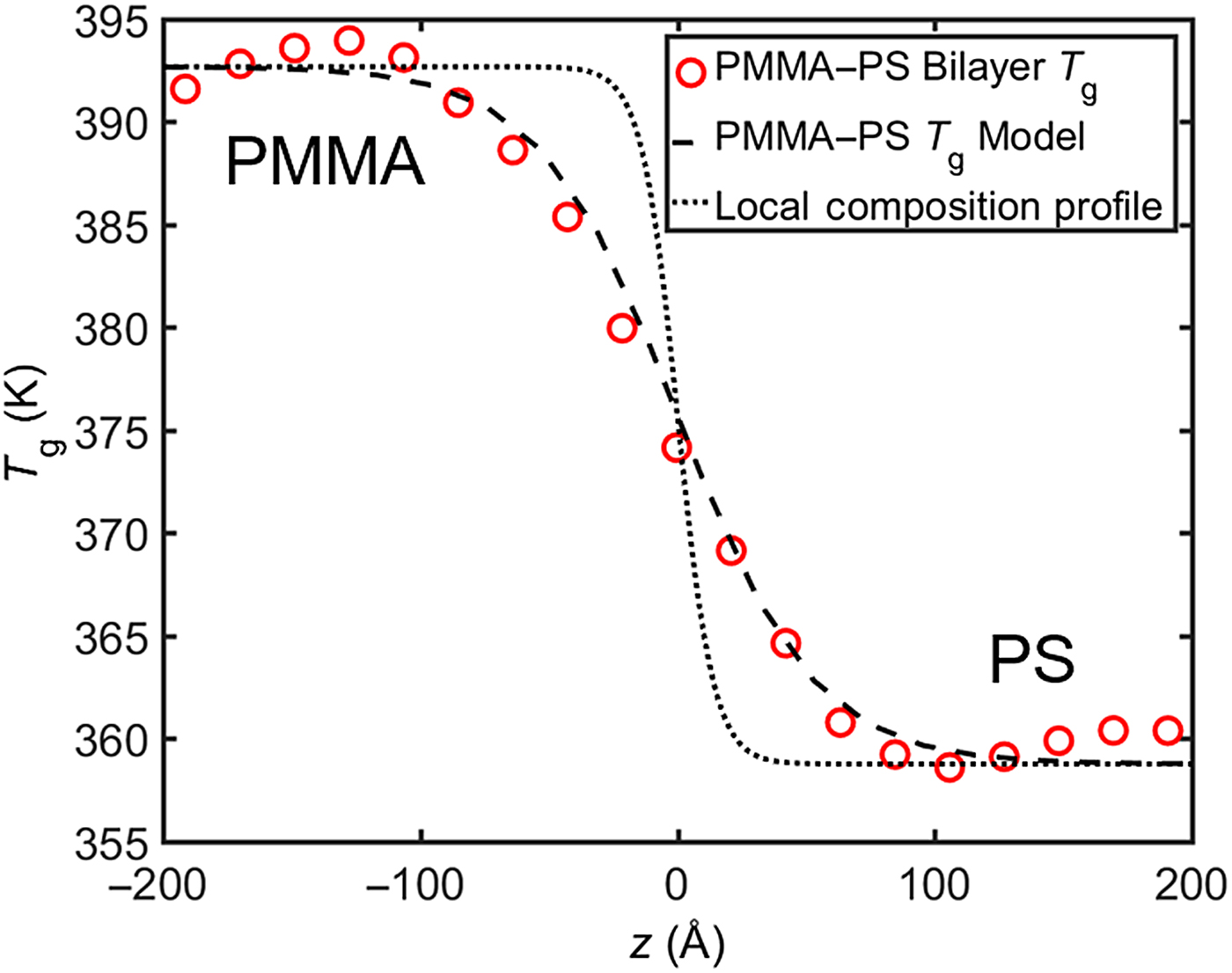
After determining the interfacial parameters based on the experimental measurement of the interfacial tension, we systematically investigate the local T g profile across the PS–PMMA interface. The bilayer film system consists of a 36 nm thick PS layer on top of a 36 nm PMMA layer with periodic boundary conditions in all directions. Due to the disparity between the bulk T g of the PS and PMMA CG models, we observe a smooth transition of the local T g from the PMMA phase to the PS phase (Fig. 3). The local composition profile, shown as dotted line in Fig. 3, demonstrates only an approximately ~5 nm thick interface by definition of the Gibbs dividing surface thickness, which agrees with experimental results that report an interfacial layer between 2 and 5 nm for PS–PMMA.[ Reference Anastasiadis, Russell, Satija and Majkrzak 30 , Reference Fernandez, Higgins, Penfold, Ward, Shackleton and Walsh 31 ] However, the T g confinement effect is nearly symmetric and penetrates about 10 nm into both the PS and PMMA phases. This symmetry differs from the results of Baglay and Roth,[ Reference Baglay and Roth 14 , Reference Baglay and Roth 15 ] who found that the T g alteration persists further into the glassy side. However, our results concur with studies performed by Slimani et al. which simulated lamellar diblock copolymer containing a hard and soft phase and reported that the gradient in mobility is found to persist approximately the same length scale in both phases.[ Reference Slimani, Moreno and Colmenero 32 ] Discrepancies in the observed interphase length scale and symmetry may be due to the difference in experimental measurement methods as well as sample preparation conditions. The observed length scales of the interphase in the bilayer systems into each layer are also similar to that of the free surface and substrate interphase. We fit the local T g bilayer interface transition to a function of the form:[ Reference Baglay and Roth 14 ]
 $$\eqalign{T_{\rm g}^{{\rm PS - PMMA}} (z) & = - A_{{\rm PS - PMMA}}^{{\rm bi}} \tanh \left( {\displaystyle{{ - z + \mu} \over {\lambda _{{\rm PS - PMMA}}}}} \right) \cr & \quad + \displaystyle{{T_{{\rm g,bulk}}^{{\rm PS}} + T_{{\rm g,bulk}}^{{\rm PMMA}}} \over 2},}$$
where
 $A_{{\rm PS - PMMA}}^{{\rm bi}} = \left( {T_{{\rm g,PMMA}}^{{\rm bulk}} - T_{{\rm g,PS}}^{{\rm bulk}}} \right)/2$
and λPS−PMMA is related to the size of the interphase region. Here, μ correlates with the midpoint of the transition region, which reduces to zero when choosing the x-y plane to bisect the PS–PMMA interface.
Local T g profile of PMMA–PS bilayer film interface and local composition profile.
These results are combined with the analysis of supported and freestanding films to predict the behavior of supported PS–PMMA bilayer films. A 2 to 36 nm PMMA lower-layer is deposited on an attractive substrate, which interacts with the film with interfacial energy consistent with previous conditions. We place a PS upper-layer on top of the PMMA lower-layer, which we maintain at 18 nm thickness. The resulting local T
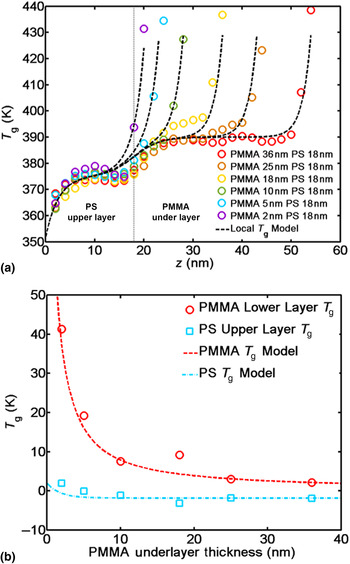
g profile for the bilayer film demonstrates a maximum of five distinct regimes [Fig. 4(a)]. This reflects T
g-nanoconfinement occurring as a result of the three interfaces, PS–air, PS–PMMA, and PMMA–substrate, as well as bulk-like convergence regions for the PS and PMMA layers between the interphases. When each layer thickness is greater than the respective critical thickness (i.e.,
 $H_{{\rm crit,PS}}^{{\rm bi}} = \xi _{{\rm PS}}^{{\rm fs}} + \xi _{{\rm PS - PMMA}}^{{\rm bi}} \approx 22\;{\rm nm}$
,
 $H_{{\rm crit,PMMA}}^{{\rm bi}} = \xi _{{\rm PMMA}}^{{\rm sp}} + \xi _{{\rm PS - PMMA}}^{{\rm bi}} \approx 18\;{\rm nm}$
), we are able to observe all five different regimes within the bilayer film system.
(a) Local T g results for supported PMMA–PS bilayer film. (b) Resulting layer T g calculated from simulation compared with the averaged local superposed T g model.

Locating the z-axis at the PS–air interface and pointing into the film, (1) The first regime at the PS–air interface shows a T
g depression indicating higher mobility at the surface which converges to the PS bulk T
g
after ~12 nm. (2) The second regime consists of a plateau region representing the bulk-like interior of the PS layer. In our study, the 18 nm PS film is below the critical thickness, and, hence, only a pseudo-convergence region with T
g about 5 to 10 K above the bulk PS T
g can be detected. (3) The third regime is indicative of the ~25 K T
g transition at the PS-PMMA polymer–polymer interface. (4) The fourth regime consists of a plateau region for the PMMA bulk-like interior region, which emerges above the critical thickness. (5) Finally, we see a fifth regime where the PMMA interior region T
g transitions to enhanced T
g at the PMMA–substrate interface which can locally attain values that are 30–40 K above the PMMA bulk T
g near the substrate. Larger PMMA layer thicknesses above
 $H_{{\rm crit,PMMA}}^{{\rm bi}} $
display each of the regions 3–5 in the lower-layer. However, as the PMMA layer thickness decreases below
 $H_{{\rm crit,PMMA}}^{{\rm bi}} $
, regime 3–5 begin to overlap and a clear distinction between the PMMA-substrate and PS–PMMA interphases does not exist. We confirm that the interactions between the three dissimilar interphase regions in bilayer films are also additive. We derive the master profile for the local T
g of the supported bilayer film using superposition (Eq. S2), which we apply to the PS-PMMA bilayer system for different PMMA thicknesses from 2 to 36 nm. We find that the model matches the simulation results remarkably well for all lower-layer thicknesses as shown in Fig. 4(a). (Fitting equations for bilayer films can be found in the Supporting Information, and parameters are included in Table SIV.)
The overall T
g for each individual layer is estimated by averaging the superposed local T
g
function (Eq. S2) over each polymer phase. These model results are compared with the overall T
g
for both the PMMA lower-layer and PS upper-layer from simulation, illustrating strong agreement between the model and simulations [Fig. 4(b)]. For PMMA lower-layer thicknesses much greater than
 $H_{{\rm crit,PMMA}}^{{\rm bi}} $
, the PMMA T
g
converges to within 0.5% of the bulk value at around 40 nm. As the PMMA lower-layer reduces in thickness, the PMMA–substrate interphase regime becomes an increasing portion of the PMMA layer by volume, which results in an appreciated T
g up to 40 K greater than the bulk when the PMMA layer thickness reaches 2 nm. Interestingly, any free surface effect for the PS layer is eliminated at almost all lower-layer thicknesses. This is consistent with the findings from Roth et al., who showed a suppressed free surface effect on the upper PS layer in bilayer films with a supported PMMA or P2VP lower-layer.[
Reference Roth, McNerny, Jager and Torkelson
10
,
Reference Yoon and McKenna
11
] Roth et al. attributed this finding to slower cooperative segmental motion near the attractive substrate, which persists through the lower-layer film thickness and across the polymer–polymer interface even for films up to 500 nm in thickness. Alternatively, they suggest the higher T
g of PMMA (393 K Bulk T
g
) or P2VP (374 K Bulk T
g
) relative to the PS layer may also cause the free surface effect to be suppressed.
Looking at the local T g bilayer data in Fig. 4(a), we find that this occurs due to increased T g in the PS phase near the PS–PMMA interface arising from the disparity in T g between PS and PMMA. Specifically, because PMMA has a ~25 K higher bulk T g than PS in the CG model, this so-called “soft” polymer–polymer interfacial nanoconfinement causes a smooth transition region in the PS phase where the local T g is enhanced and persists ~10 nm into the PS layer. This effectively cancels the ~28 K T g reduction found in the PS free surface interphase, which has a similar length scale of ~12 nm before converging to the interior region T g. This result suggests that substrate effects in the PMMA lower-layer are not the direct cause of elimination of T g reduction in the PS upper-layer, since the substrate interphase does not overlap with the PS layer for films above the critical thickness. However, we do find that PMMA-substrate effects can alter the PS upper-layer when the PMMA layer is sufficiently thin. At lower-layer thicknesses that are less than 5 nm, the PMMA-substrate interphase is able to penetrate the PS–PMMA interface and further augment the T g of the PS layer. Although the appreciation in PS layer T g is small, it is clear that this occurs from the enhanced local T g at the PS–PMMA interface at z = 18 nm, which is found to be ~394 K for the 2 nm PMMA layer condition in Fig. 4(a). This evidence supports the potential mechanism suggested by Roth et al., that arrested segmental motion near the attractive substrate can persist through the supporting layer and penetrate through the soft polymer interface.[ Reference Roth, McNerny, Jager and Torkelson 10 ] However, we find that this only occurs at very thin film layer thicknesses. Because the interphase length scales we measure are of the order of ~10 nm, as compared with several tens of nm through fluorescence methods, we find that penetration of the substrate effect through the PS–PMMA interface only applies for extremely thin lower-layers below 5 nm.
Conclusions
Studies on monolayer and bilayer systems over the past decade have shown that interphase regions on the length scale of tens of nanometers can have a large effect when the characteristic feature size approaches nanoscale dimensions. This understanding has helped explain how the overall thermomechanical properties deviate from the bulk for sufficiently thin homopolymer films. However, more recent studies on multilayer films, blends, block copolymer systems, and nanocomposites, have demonstrated thermomechanical behavior that has not yet been definitively interpreted. TCCG models uniquely enable us to measure local T g gradients at nanometer resolution for each of the interface types occurring in PS–PMMA bilayer systems.
In particular, we characterize the local T g profile at free surfaces and supported interfaces and demonstrate that the gradient size and shape are independent of the thickness above the critical thickness H crit, where the various interphases converge to the interior bulk-like T g and do not overlap with one another. Below the critical thickness H crit where interphase regions are unable to converge to the interior bulk-like T g and overlap with one another, the combined effect of both similar and dissimilar interphases are approximately additive, and can be estimated by the superposition of local T g gradient functions without changing fitting parameters. This significant result suggests a framework to predict the spatial T g in complex microphase-separated systems as a function of geometry at a wide range of characteristic length scales of local polymer phases.
We also measure the local T g at the PS–PMMA interface and show that the interphase length scale is much larger than the compositional interface itself, and penetrates approximately the same distance (~10 nm) into both phases. Moreover, the length scale of soft polymer interphase propagation into each layer is similar to that of the free surface and substrate interphase. Using this information, we show that the local T g of the entire supported PS–PMMA bilayer film can be predicted as a function of lower-layer thickness by superposing the gradient functions for each interphase type. The overall layer T g in all configurations is also accurately captured by the average of the local T g functions.
Through understanding the local behavior, we are able to provide insight into recent experimental PS–PMMA bilayer results. We find that T g enhancement in the PS phase at the PS–PMMA interface cancels out the PS-air free surface effect when PMMA is used as the lower-layer. This effect is found to be largely independent of the PMMA lower-layer thickness. We also see that arresting of segmental motion at the attractive substrate-PMMA interphase does not have a long-range effect on the PS layer T g except at exceedingly thin lower-layer thicknesses where penetration of the substrate effect can occur across the soft polymer interface. This provides evidence of two different mechanisms in which polymer layers can affect the overall T g of neighboring phases. Our findings provide an explanation of previously observed experimental phenomena in bilayer films, help elucidate the resulting local behavior of overlapping interphase regions, and provide a potential framework to predict the local and overall T g behavior of multilayer films, copolymers, and nanocomposites.
Supplementary Material Available: Additional supporting information has been provided regarding: (1) interfacial tension calculation methodology, (2) local T g results for supported PS film, (3) predictive models for local Bilayer T g behavior, and (4) tables containing local T g function parameters and CG potential parameters.
Supplementary material
The supplementary material for this article can be found at https://doi.org/10.1557/mrc.2017.113
Acknowledgment
The authors acknowledge support by the Dow Chemical Company and from the Department of Civil & Environmental Engineering, Mechanical Engineering and Materials Science and Engineering at Northwestern University. The authors acknowledge support by the National Institute of Standards and Technology (NIST) through the Center for Hierarchical Materials Design (CHiMaD). W.X. gratefully acknowledges the support from the NIST-CHiMaD Postdoctoral Fellowship. A supercomputing grant from Quest HPC System at Northwestern University is acknowledged.