The fall 2017 Atlantic hurricane season was one of the most destructive in US history, causing over 100 official deaths.1 The elderly, specifically the homebound, have traditionally been most affected by these types of events.Reference Dostal2 Much has been reported on the need for home health programs to strengthen their preparedness efforts to support local communities and increase the resilience of elderly patients in their communities.Reference Wyte-Lake, Claver and Der-Martirosian3, Reference Wyte-Lake, Der-Martirosian and Claver4 However, little has been reported on the actual efforts of these programs in the face of a real disaster.
The US Veterans Health Administration’s (VHA) Home-Based Primary Care (HBPC) program serves veterans with highly complex medical needs.Reference Edes, Kinosian and Vuckovic5 Each HBPC is affiliated with a “parent” US Department of Veterans Affairs (VA) Medical Center. Nine VA Medical Centers from Texas eastward to Florida, and south to Puerto Rico were impacted by the fall 2017 hurricane season. This study attempts to address gaps in the current research by understanding the role that HBPC played in patient preparedness and the response to the 2017 hurricanes.
METHODS
Study Design
This study used qualitative interview methods intended to elicit an in-depth sharing of study participants’ experiences during their HBPC programs’ response to Hurricanes Harvey, Irma, and Maria (fall 2017 hurricanes). The VA Greater Los Angeles Healthcare System Institutional Review Board (Los Angeles, California) approved this study.
Setting
This study was conducted in VHA HBPC programs. The HBPC program clinical staff generally include nurse practitioners, registered nurses, social workers, and occupational therapists. They can also include physicians, physical therapists, psychologists, and dieticians. The HBPC sites are structured such that a parent VA Medical Center, as well as any affiliated community-based outpatient clinic (CBOC) can house HBPC staff, generally with the HBPC program director based at the parent facility. At 8 of the 9 sites, the parent VA Medical Center was impacted by a hurricane. At 3 sites, an affiliated CBOC was more seriously impacted than the primary parent facility, whereas at the other 6 sites, both the parent facility and multiple affiliated CBOCs were impacted.
Sample
The sample was purposively chosen and included the 9 VHA HBPC programs impacted by the 2017 fall hurricane season. Leadership and all affiliated clinical staff from impacted sites were invited to participate in this study. One site had only a single respondent because it was minimally impacted by a hurricane, but all other sites had a minimum of 3 respondents, with up to 5 total per site.
Data Collection Methods
Data were collected through semi-structured, 30- to 60-minute telephone interviews with each site. Leadership personnel (ie, the HBPC program directors) were the first point of contact at each site and identified additional practitioners who were invited to participate. Recruitment of additional clinical staff then occurred by the research team via e-mail and phone, with instruction that only the research team would know who agreed to participate, and that all participation was voluntary. The interview addressed agency preparedness policies and procedures, continuity of care after the hurricanes, and facilitators and barriers to disaster response. In all cases but one, 1-on-1 interviews were conducted in order to allow for confidentiality of respondent information. Respondents were instructed to conduct the interview in a private office or other space where they could be alone. At 1 site, clinical staff suggested a group interview in order to facilitate scheduling of conflicting tours of duty and consented to sharing their experiences jointly with other staff. Interviews were conducted either jointly by the primary author (TW) and secondary author (MC) or singularly by the primary author. Interviews were audio recorded with the permission of the respondent.
Analysis Plan
Interview data were analyzed with Atlas.ti (v.7), using both structural and in-vivo coding methods.Reference Saldana6 Initial structural codes were established a priori, based on the interview guide. The code list was iteratively revised and expanded, based on in-vivo coding methods.Reference Saldana6 Authors TW and RJ independently coded each interview and resolved discrepancies by consensus.
RESULTS
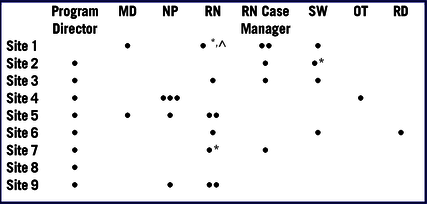
Thirty-four team members from 9 VHA HBPC programs impacted by the 2017 hurricanes participated in this research study. Respondents included site program directors and representatives from departments of nursing, social work, occupational therapy, and dietetics (Table 1). The patient census for these sites ranged from 45 at a recently opened CBOC to over 500 (ie, combined patient census for the parent facility and affiliated CBOC programs). The total patient census across all 9 HBPC programs was 3118. Not 1 HBPC program reported a loss of life due to the hurricanes. Two main themes emerged from the resulting data: (1) preparedness and response, and (2) learning experiences and recommendations.
The Number of Study Respondents From Each Site, by Respondent’s Role

MD = medical doctor; NP = nurse practitioner; OT = occupational therapist; RD = registered dietician; RN = registered nurse; SW = social worker.
* Holds a supervisory role.
^ Program manager at the affected community-based outpatient clinic.
Preparedness and Response
Through a combination of living in a hurricane-prone region and having to comply with The Joint Commission standards, every HBPC program demonstrated evidence of 3 identified levels of preparedness practices that incorporated discussing emergency preparedness with patients. The first level of patient preparedness, generally initiated upon admission, is classifying every patient with a risk category, identifying an evacuation plan, and collecting emergency contact information.
[When] the patient is admitted to our programs, we have the categories that we establish … Which are the patients that are in high-risk places or because they live near a flooding area, near a river or some that it, it can get inaccessible by car, or they have medical equipment like mechanical ventilators, oxygen, some sort of medical equipment that will need electricity … every month the nurses when they perform their visits they fill [the emergency form] … if they have oxygen from a community program … relatives where they [would evacuate to], or who to call, and to check out supplies and stuff like that. So we are just like prior to the season we have all that set up already. (Site 5)
The second level of preparedness activity for most programs was to begin reinforcing the patient’s emergency plan over the course of the hurricane season (June 1–November 30), which included frequent monitoring of a patient’s med box to prevent medication emergencies at the time of an event. At 8 of the sites, the emergency preparedness discussion between staff and patients began in late spring and continued through the end of the hurricane season. Only at 1 recently established CBOC was preparedness addressed only at the initial patient admission. One respondent mentioned: Well I should tell you that, before a hurricane even starts, they [staff] start to prepare with the hurricane calls and trying to make sure our patients are registered with their local shelters and so forth. (Site 3)
The more seasoned the staff, the earlier they started.
I started in May … printing out maps and stuff like that just to drive the point home this should be taken seriously. And what I like to drive home is where the food and water places are because I always get calls, are you guys [the HBPC program] going to bring us food? And we discuss that, that we’re not going to drive during or after [the Hurricane event] because it’s dangerous, there’s no lights and we don’t really have to. (Site 7)
The quote further illustrates the role of HBPC in fostering self-sufficiency of their patients in the event of an emergency, reminding them that the role of HBPC is not to act as a response agency.
In regions where the local county had resources available, the HBPC practitioners frequently encouraged patients to complete paperwork for transportation and emergency shelter registration. Depending on the program, social workers on the team would help the patients complete this paperwork.
The sum of these steps is to ensure that each patient has some type of evacuation plan by the beginning of the hurricane season. When a major hurricane’s arrival is acutely pending, all HBPC programs enter their third level of preparedness activities, the “pre-hurricane steps,” which occur 2–5 days prior to the hurricane and include calling each HBPC patient to finalize the emergency plan. Having a seasoned program director in place helped these “pre-hurricane” activation steps occur more smoothly. As noted by a seasoned program director:
We actually activated our emergency management response before the medical center did. We made a proactive decision to do that based upon just me being a Floridian, my nurse manager down south being a Floridian, her having gone through a hurricane and knowing that it was approaching the weekend we decided to active our response … we activated ahead of time to get the nurses to be able to go out to the homes to make sure all the patients had their med boxes and we started making calls at that point in time and trying to do some coordination efforts. I don’t think our medical center activated until Friday afternoon and that would have been a struggle for our staff who were already very worried about their own needs to evacuate. (Site 3)
The converse was noted by a fledgling director:
It was me and just working with the team there trying to get them, what they needed, trying to get the patients where they needed to be, what they needed to do. But at the same time, I also had to consider that the staff that lived there had families that also needed to get taken care of. And then once it got closer and then they … I could tell the team they were anxious … I have to go board up my house, I have this, I have that. (Site 1)
As noted by this respondent from Site 6, having a preparedness plan in place at the beginning of the hurricane season is an essential “pre-hurricane step.”
The hurricane [season] comes in June so we start giving in June all the papers, all the places that have shelters in our worst area and where they can call, what they need to put in their backpack … and when comes on August when the hurricane is going to come we call, do you remember that we had this document that says what you need to be in your backpack, what you need to have so you’re already prepared. (Site 5)
Programs located in regions at least peripherally affected by both Hurricanes Irma and Maria benefited from the pre-hurricane steps because they had initiated them previously for Irma. Their patients already had their plans in place, and the staff felt that their patients were more prepared in advance of Hurricane Maria.
Immediately after the storm, HBPC programs followed standard protocol by calling patients as soon as the staff were back at work, but more than 1 site reported that their staff were calling patients over the weekend. After the storm had passed [my staff said] oh, I continued to call Mr. So-and-so, or I continued to call this Veteran, I continued to have some concerns so I just continued to follow up with them over the weekend. I mean it’s just kind of what they do (Site 8). Additionally, sites were calling their patients to verify their status 1–3 days after the hurricane. The rapid response was possible because many HBPC staff telework, allowing them to make calls to patients, even if they themselves had evacuated. Many of the sites reported sporadic phone connectivity, and, in some cases, the staff completed home visits to check on their patients. Where there was extensive damage, program personnel sent their staff out in teams to ensure staff safety. Most sites tracked the whereabouts and status of all patients within 1 week of the hurricane. In the hardest hit site, staff were out seeing even their most rural patients within 2 weeks of the event. In some cases, HBPC program staff helped advocate for their patients, connecting them with services, such as clean water or housing support.
Learning Experiences/Recommendation
One of the most pronounced recommendations from respondents was the need for an increased ability to help patients when checking on them after the event. As described by 2 respondents from Site 5, staff reported frustration with only being able to check on the stability of a patient’s status rather than also providing any much-needed resources.
There’s people stuck in their houses, there were people with no gasoline so they cannot move. So we asked the pharmacy to give us medications and then we were visiting patients at any time, in our way home, in the middle of the day getting out … [it was] really tough getting supplies, getting medication. We complained to the executive people here because when finally we were able to get in touch with them, you know, going there to say are you okay and then leaving, it was tough. So we asked them to at least provide us with water and we ordered some, and they did … and that was a great relief. But, it took a while.
The view was really bad that some of the staff start to cry. They return crying. They [the staff] expressed that they want to do a lot of things but they can’t do because we don’t have resources. (Site 5)
For the site that had only limited disaster preparedness activities, there was a change in the personnel’s attitude post-hurricane when addressing preparedness with their patients.
Now when we admit a patient I know when I go out part of my assessment involves asking about their plans if they have if there is a natural disaster. And I’ll ask them, you know, what did you do during Hurricane Harvey? You know, and some of them have, you know, have changed their minds about what they would do. And so we talk more about, you know, planning. (Site 1)
Although only 3 facilities had the option of sheltering HBPC patients, 1 issue that emerged after the hurricane was a protocol for safe discharge. Without clear protocols in place prior to the hurricane, HBPC leadership had to advocate for patients who were being pushed to early discharge. Ventilator-dependent patients, for example, were being requested to be discharged to a home without electricity. No patients were discharged early in the end, but the importance of improved policies, where hospital staff more fully understand the needs of HBPC patients, was underscored.
In every disaster, effective communication is essential. Internal and external communication activities were highlighted by several respondents as either learning experiences or recommendations. Having pre-established daily phone “huddles” were deemed essential by sites that had them, as, oftentimes, the staff would not have access to other forms of communication. The staff noted the benefit of having a predetermined plan of who was calling which patients. At sites without a clear tracking protocol, some patients were called multiple times by multiple providers. Seasoned leadership seemed to have advantageous connections to hospital staff and administrators, but newer HBPC leadership struggled to (1) find a direct point of care to deal with issues arising for their patients in the community and (2) make hospital leadership aware of the unique needs of HBPC. Finally, personnel from programs that had not reinforced the need to follow up with patients after the hurricane struggled to track down patients after the storm. Those sites changed their policy after the hurricane to remind patients to provide their evacuation plan and contact information to the HBPC program to better support recovery activities.
Last, respondents were asked whether they thought HBPC patients are better prepared than the general patient population in the event of a hurricane. Overwhelmingly, the answer was yes. First, HBPC patients are better prepared because of the “number of eyes” on them, and the degree of preparedness and follow-up they receive. Second, in the few days following a hurricane, the hospital is likely to see a flood of patients coming into the emergency room (ER) for a variety of reasons; however, due to the HBPC’s preparedness efforts, patients coming to the ER are not the highly complex patients typically seen by HBPC. Also, finally, the HBPC program had access to information and resources that a general member of the population may not have.
I compare [our experiences] with someone of my family that are not Veteran and are not receiving any assistance for any home care. They don’t know about community agencies that provide care to them … not all the people received the same information and not all the people were able to answer the information [needed] to assist them. (Site 5)
I think [HBPC patients are] much better [prepared] because they have the medication boxes, because I’m talking to them about it every year because I’m borderline begging them to sign up for the special needs shelters and the fire department gives them one last chance to get out of there and offers them transportation. When they run into problems I’m calling the fire department and begging them to go get people. The normal 90-something-year-old patient or couple would maybe have dementia they don’t have any of those supports. We’re doing a great job compared to civilian peer. (Site 3)
DISCUSSION
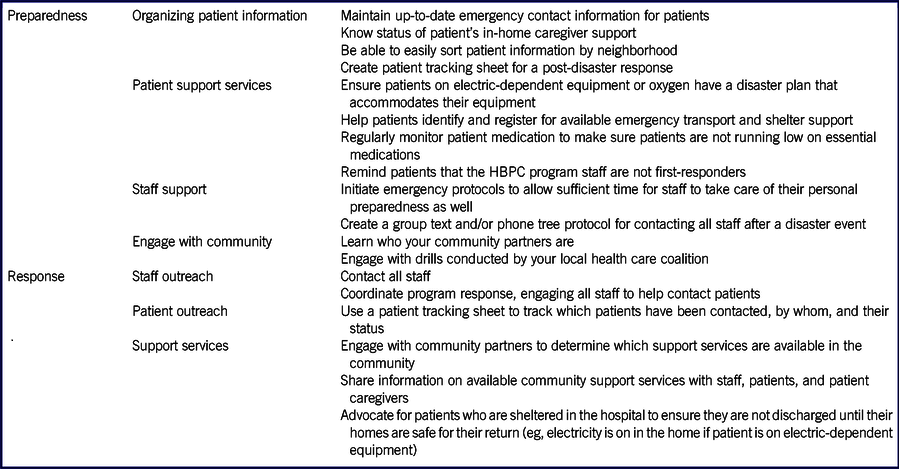
Appreciating a new “normal” for the increased frequency of natural disasters in the United States is no longer up for debate.Reference Balbus, Crimmins and Gamble7 The pressing question is how to best support affected regions and their unique population groups. The medically complex patients served by programs such as the VHA’s HBPC program represent a small subset of the population in a community, yet they have an outsized impact on health care resources and costsReference Edes, Kinosian and Vuckovic5 and, compared to the general population, are at heightened risk for morbidity and mortality during disasters.Reference Bethel, Foreman and Burke8 In non-emergency times, keeping these persons out of the hospital makes fiscal sense.Reference Edes, Kinosian and Vuckovic5 By extension, considering limited resources during times of emergency, an effort to keep these individuals out of an acute health care situation, becomes that much more essential. In this study, we sought to examine the VHA’s HBPC program to identify barriers to and best practices for similar programs providing this level of care to their patients in the event of future disasters. A summary of best practices for home-care programs can be found in Table 2.
Best Practices for Home Care Programs in Supporting Client Emergency Preparedness During a Pre- and Post-Disaster Event

The primary finding from this study is the central significance of preparation, which is an essential tenant in the field of emergency preparedness, yet continues to be a struggle for the field to effectively relay to the public.9 The lack of individual household preparedness is even more prevalent in medically vulnerable populationsReference Bethel, Foreman and Burke8 and, amongst the elderly,Reference Al-Rousan, Rubenstein and Wallace10 remains true even when they have a caregiver in the home.11 This is one of the principal areas where the HBPC programs have a role in their patients’ lives. Mandates by The Joint Commission and Medicare for home health agencies to support their patients’ preparedness activities recognize that these programs can make a difference to patient health and safety during disasters.Reference Wyte-Lake, Claver and Der-Martirosian12 Our results show the degree of effort required on the part of the home health programs to actualize these activities. Programs that weathered the disaster event with the most ease started their preparedness early and followed up regularly with their patients throughout the hurricane season. Monitoring medications, establishing a disaster plan early on with patients to minimize last-minute scrambling, reinforcing the patients’ needs to be self-sufficient if they are sheltering in place, and providing resources and support to sign up for local transportation assistance and special shelter registration all contributed to patients’ resilience during the event and throughout the recovery period.
Isolation and lack of social support amongst the elderly are issues in the recovery phase of a disaster event.13 As part of its standard operating procedures, each site had an established policy of tracking the status of all patients immediately after the hurricane. Although some sites reported confusion over who was tracking which patients, the ultimate outcome was knowledge of the status of most patients enrolled in the affected HBPC programs within a few days, with a small minority tracked within 2–3 weeks. The unique nature of the HBPC program and the special relationships between patients and staff are evident in places where telephone lines were down for extended periods and staff went out to visit patients directly to ensure their well-being, even when conditions were less than ideal. This aggressive tracking of patients not only gave patients a sense of security, but also provided an opportunity for early detection and intervention for any issues that arose during the hurricane, an opportunity to prevent escalation of a medical event into a hospital admission.
Appreciating the limitations of HBPC staff in responding to patient needs after a disaster event is paramount in supporting their role in bolstering community resilience. Staff repeatedly mentioned frustration with only being able to check on a patient’s well-being, without being able to provide essential resources like water or being able to transport medication, which are traditionally out of the purview of the HBPC program. In at least 1 site, this frustration led to a negotiation to allow potable water to be brought to patients. Having protocols in place to address these types of essential issues should be considered in advance of future hurricane events. Considerations should include setting aside resources, such as water, that could be distributed to patients at well-visits. The majority of home-based care organizations would not have the resources to have sufficient materials stockpiled in advance of a disaster event, and 1 solution is to have information on how to connect with non-profit organizations that support communities after disaster events in advance of a disaster event, rather than attempt to develop those relationships in the midst of a disaster response.14 Finally, more work needs to be done to include home-based care programs in local health care coalitions, which are the backbone of a health care community’s disaster response,Reference Carrier, Yee and Cross15 and could provide smoother integration into available resources available after a disaster event.
This study has a few limitations. First, due to the qualitative research design and the small study sample size, the study findings cannot be generalized to all VHA HBPC programs. Additionally, although efforts were made to include all HBPC staff, most respondents came from a nursing or social work background, which may not reflect the perspectives and viewpoints of clinicians trained in other professions. Finally, although not all sites were equally prepared, they were all located in traditional hurricane zones, and, therefore, their level of preparedness cannot be extrapolated to all VHA HBPC programs; and yet, their practices can be seen as examples of best practices. Future research should examine whether programs located in disaster-prone regions are more prepared than others and how to ensure adequate preparedness in regions that are less frequently impacted by disasters.
CONCLUSIONS
There is a growing awareness that community preparedness for public health emergencies requires targeted attention to vulnerable population groups. As our population ages, increased attention about how to support older adults during disasters becomes progressively more important. Mandating that home health programs serving these populations engage in disaster preparedness is an initial step in ensuring that adequate resources are in place during disasters. A deeper understanding as to what is involved in actualizing these requirements, as exemplified in this study, provides community leadership with a better appreciation of how they can best utilize and support these programs and their patients.
Financial Support
The author(s) disclosed receipt of the following financial support for the research, authorship, and/or publication of this article: This material is based on work supported by the US Department of Veterans Affairs, Veterans Health Administration, Office of Emergency Management, and the Office of Population Health.
Conflict of Interest Statement
The authors have no conflicts of interest to declare.
The views expressed in this article are those of the authors and do not necessarily reflect the position or policy of the Department of Veterans Affairs or the US Government.
Author Contributions
Wyte-Lake, Claver, and Dobalian were responsible for the study conception and design. Wyte-Lake and Claver contributed to the study conduct and interviews. Wyte-Lake and Johnson-Koenke were responsible for the reading of transcripts, coding, and data analysis. Wyte-Lake contributed to the drafting of the manuscript. Wyte-Lake, Claver, Johnson-Koenke, Davis, and Dobalian contributed to the interpretation of data, critical revision of the manuscript for important intellectual content, and final approval of the manuscript for submission.