The Kevserî Mecmûası is among the most fascinating of Ottoman music sources. Researchers have long known of the existence of this manuscript, which was written by a Mevlevî musician, Kevserî Mustafa Efendi, in the eighteenth century and contained exceptionally rich material, including notations. Since there are only a handful of collections of Ottoman music notations that predate the nineteenth century, with examples of music from the eighteenth century being particularly scarce, the manuscript has attracted great interest. However, since its owners have not allowed researchers access, its contents have remained largely unknown, and its inaccessibility, along with its importance, has given the Kevserî Mecmûası an esoteric status.
Given the stylistic discrepancy between the pieces recorded earlier and those recorded later, musicologists have postulated that significant transformations in the style of composition and performance took place sometime during the eighteenth century, but a lack of sources has prevented them from determining when and for how long. It has been believed that the Kevserî Mecmûası had the potential to elucidate this process of stylistic transformation because it was written sometime around the middle of the eighteenth century and contained a sizable collection of written music. Many researchers, unable to study the manuscript, have attempted to draw inferences from the information conveyed by a few earlier publications, but the scantiness and unreliability of this information has prevented them from reaching sound conclusions.
Fortunately, the present author has recently identified a microfilm copy of the Kevserî Mecmûası. While its publication in facsimile is still in progress, together with the transcription of the notations, this article aims to introduce this source and discuss its potential to answer the unresolved questions about the style of eighteenth-century Ottoman music. The article is organised roughly in two parts. First, it will briefly present the contents of the manuscript, integrating new evidence and clues about its date, author and purpose into existing knowledge. Second, it will focus on the collection of notations in the manuscript, and by comparing it with the earlier collections will argue that, contrary to the prevailing views expressed in the literature, no large-scale transformation in the style of Ottoman music took place in the early eighteenth century.
Literature Review
Ottoman Collections of Notations: The ‘Older’ and the ‘Newer’
The use of written music was a late practice in Ottoman musical tradition, which was predominantly oral. While many earlier musicians used to keep notebooks for song texts, it was not until the turn of the twentieth century that notation began to be used extensively for the purposes of performing and transmitting the music.Footnote 1 Although a number of music collections written in Hamparsum notation were compiled throughout the nineteenth century, they tended to be individual efforts and primarily served to preserve the music, having almost no practical or pedagogical function.
Of the handful of collections of notations that date from before the late eighteenth century, only three have been accessible for research so far. The first two were written by the same person, Ali Ufkî Bey (Albertus Bobovius), around the mid-seventeenth century. Although these two sources show considerable overlap in content, oneFootnote 2 looks like a personal scrapbook also including miscellaneous material unrelated to music, while the otherFootnote 3 is a more neatly prepared collection of notations and song texts. The thirdFootnote 4 was written by Demetrius Cantemir around the turn of the eighteenth century.Footnote 5 Unlike the collections of Ali Ufkî, Cantemir's Edvâr does not include vocal pieces but contains a larger set of instrumental compositions. In addition to these three collections, there are two others that have remained in private hands and could not be consulted up to now: the collection of Nâyi Osman Dede (d. 1729) and the Kevserî Mecmûası.
When compared with the compositions in the later collections in Hamparsum and European notations, which constitute the basis of the Ottoman classical music repertoire today, the pieces in the three available ‘older’ collections show certain significant stylistic differences. The most salient is that melodies in the older collections are considerably less florid than those in the later ones. While usûl strokes and melodies usually proceed hand in hand in the former set of notations, the use of much smaller note values in the latter often blurs the connection between melody and rhythm. This discrepancy alone was enough to lead some musicologists to assume that the style of composition and performance in Ottoman music underwent serious change during the eighteenth and early-nineteenth centuries.Footnote 6 While the transformation was evident from the stylistic differences between the ‘older’ and ‘newer’ collections, answers as to when exactly this process took place and whether it happened suddenly or gradually have been somewhat speculative due to the lack of sufficient documentation from the eighteenth century.
Examples of Ottoman music notated between the ‘older’ and ‘newer’ collections are extremely rare. Aside from a few, mostly incomplete, Turkish songs published in the accounts of European travellers,Footnote 7 the most noteworthy ones are those recorded by French orientalist Charles Fonton in 1751Footnote 8 and by Abdülbâki Nâsır Dede in 1794/5Footnote 9. The instrumental compositions among the former are more elaborate compared to those in the ‘older’ collections, and the one peşrev in a large usûl, Devr-i Kebîr, among the latter has even higher melodic density, although not as high as the peşrevs in the ‘newer’ collections. From these hints, Owen Wright and Walter Feldman concluded that the stylistic transformation was a long-term, probably an incremental, process. But this conclusion cannot be regarded as definitive: after all, Fonton and Abdülbâkî provide no more than a few compositions, and the notations written by the former are far from being totally reliable.Footnote 10 Ideally, a set of notations from the middle of the eighteenth century would be extremely helpful in identifying and explaining the transition between the ‘older’ and ‘newer’ styles.
It is in this respect that the Kevserî Mecmûası has been regarded potentially as a key source. Although it has remained in private hands and generally inaccessible, the publications by the few researchers who could see it have revealed that the manuscript contains the notations of hundreds of instrumental pieces and suggest that it was written around the middle of the eighteenth century. It has been known that the manuscript also includes valuable information about music theory and instruments, but what has made it special is the collection of notations. While the majority of the compositions therein were copied from Cantemir's collection, there remain dozens of others that are later additions and thus cannot be found elsewhere. It is this latter group especially that has been considered to have the potential to fill the lacuna between Cantemir and Hamparsum.
Studies Referring to the Kevserî Mecmûası
Despite the current lack of knowledge about the Kevserî Mecmûası, researchers into Ottoman music knew about this source long before they discovered most of the other early collections of notations. It was Raûf Yektâ Bey who first referred to it in a publication. After acquiring the manuscript for his personal library and studying it for some time, he introduced it to Turkish and European audiences through a number of articles published in 1907,Footnote 11 one of which included a sample piece, Nihâvend Peşrev.Footnote 12 Two years later he and his pupil Hüseyin Sadeddin (Arel) published two other music examples with their facsimiles.Footnote 13 After these, nothing substantial pertaining to the manuscript was written for decades. The manuscript remained in the personal library of Raûf Yektâ, and after his death researchers who wanted to study it were denied permission by his heirs. Only a few researchers were, exceptionally, permitted to inspect the manuscript, albeit within strict time limits. As a result İsmail Baha Sürelsan mentioned it in an article on Cantemir, where he also published the transcriptions and facsimiles of two pieces;Footnote 14 Yılmaz Öztuna included in his encyclopaedia the titles of several compositions written down by Kevserî;Footnote 15 and Eugenia Popescu-Judetz provided yet more information on the manuscript. After referring to it in a number of her works,Footnote 16 she wrote a brief monograph providing a synopsis of its contents and discussing its place in the theoretical literature of Ottoman music.Footnote 17 Despite its shortcomings, this monograph has, up to now, remained the most comprehensive source of information about the Kevserî Mecmûası.
Some partial copies of the Kevserî Mecmûası, which were written or published at different times between the eighteenth and the early twentieth centuries, have also been available.Footnote 18 These sources, which include excerpts from the theoretical sections of the manuscript and lists of the instrumental repertoire, have not attracted any special interest because they did not include the notations.
Even though a few researchers had access, albeit restricted, to the original and its partial copies have been available for study, the literature has failed to provide a clear idea of the full contents of the Kevserî Mecmûası. The rough outline given by Popescu-Judetz does not indicate how it explains and demonstrates the pitches, makâms and usûls, nor does it state whether the manuscript includes any significant information about performance, composition, or the musicians of the time. As regards the notations, three out of the four published examples had already been copied from the Edvâr, and the only original one, Nihâvend Peşrev (K538), provoked further questions about the contemporary style of music rather than shedding light on it.
There has also been very little information about the author. No other work written by Kevserî has been identified, and his name has not been encountered in any contemporary or later musical source. None of the later partial copies of the Kevserî Mecmûası mentions his name, as if the original manuscript was anonymous. There has also been no reference to him in the oral tradition as a performer, composer or scholar. Thus, it was only in the Kevserî Mecmûası itself where one could find information about Kevserî and his contribution to the musical life of his time.
In short, a unique manuscript which might be able to illuminate a relatively dark period of Ottoman music has remained hidden away in a private library, and knowledge of it and its author have remained severely limited. Fortunately, however, a microfilm copy of the Kevserî Mecmûası was recently discovered at the National Library in Ankara.Footnote 19 Although the original is still in private hands, this discovery has finally made it accessible for research.Footnote 20
The Kevserî Mecmûası
Contents
Consisting of 250 folios in total, the Kevserî Mecmûası is a compilation pertaining to music. Most of its contents have been taken from various sources, particularly the Edvâr. Nevertheless, there are also original additions in theory-related sections and in the collection of notations. A brief list of the contents is presented below. Although the material is not organised by chapters, it can be divided roughly into seven parts (pages are numbered by the present author):
1. Miscellaneous (ff. 1a–6a): In these haphazardly written pages, some verses about Mevlânâ, music and the ney, and a brief excerpt about the therapeutic functions of the makâms are inscribed.
2. Theory (ff. 6b–10b): This part starts with a two-page excerpt from the Edvâr.Footnote 21 Then the pitches used in Ottoman music are shown on figures of the ney (ff. 7b–8b), the violin (fol. 9a) and the tanbur (fol. 9b). The names of the main and subsidiary pitches (fol. 10a) and the 12 makâms corresponding to the 12 orifices of the human body (fol. 10b) are also given here.
3. Rhythms (ff. 11a–25b): This part, which presents a fairly comprehensive and reliable account of the usûls used at that time, appears to be original material written by Kevserî. It starts with a fascinating page showing the usûl Düyek on two weighing scales (fol. 11a)Footnote 22. Then, the cycles of 36 usûls are given (ff. 11b–19b). The following pages (ff. 20a–25b) are allocated to two-layer usûl cycles, given the common designation “uṣûl-i cedîd” (“new usûl”)Footnote 23.
4. Theory, etc. (ff. 26a–44b): This part of the manuscript appears to be largely compiled from other sources. The material here is not very congruent, and there are many blank pages as well. Texts and charts with various contents, including the relationship of makâms and pitches to the zodiac and the four classical elements (ff. 26b–27a)Footnote 24; the full and half-pitches (ff. 27b–28a); transposition (ff. 28b–31b); the moods of makâms, their psychological effects, and their relationship to the times of the day, the days of the week and celestial bodies (ff. 31b–35a) are inscribed here. Short passages on the religious acceptability of music (fol. 33b) and how to produce a good sound on the ney (fol. 43b) are also found in this part. Moreover, there is a fairly detailed sketch of a dervish playing the ney (fol. 44b). A note next to the sketch identifies the dervish as the Kutb-i Nâyî Dede, the chief neyzen of Mevlânâ.Footnote 25
5. Collection of notations (ff. 45a–182a): 539 instrumental pieces, i.e., peşrevs and semâîs, are recorded in Cantemir's style of notation.
6. Theory, etc. (ff. 183b–219a): Most of the material in this part is taken from the Edvâr. Instead of duplicating the theory-related section of the Edvâr as a whole, Kevserî divided it into smaller segments and copied them in a different order. There are also a few pages that refer to other sources, including the treatises of Akovalızâde Ahmed Hâtem Efendi and Hızır Ağa. The few remaining pages may be original. These include passages explaining how to bore the pitch holes on the ney and the relationship of makâms and pitches to the human body and celestial bodies (ff. 213a–217a), as well as some anecdotes and sayings relating to music (ff. 211b–212b, 216b–219a).
7. Ney-nâme (ff. 219b–249b): A poem by Dede Ömer Rûşenî (d. 1486/7) on the theme of the ney.
Surviving Mysteries
While finally disclosing the full content of the Kevserî Mecmûası, the discovery of its microfilm copy has still not been sufficient to completely demystify it. Even after a thorough examination of the microfilm, the lack of adequate information means that several important questions with regard to the date, the author and the purpose of the manuscript are yet to be fully resolved. Nevertheless, internal evidence makes it possible to amplify, and rectify, the existing knowledge in the literature and provides further clues for certain unresolved questions.
a) When was it written?
While it was evident that the Kevserî Mecmûası postdated Cantemir's Edvâr, researchers have not been able to arrive at a clear date for it. The general opinion has been that it must have been composed by the middle of the eighteenth century: Feldman, albeit without citing any source, wrote that the manuscript dated to circa 1750.Footnote 26 Popescu-Judetz, while being careful not to specify any date, suggested that Kevserî wrote the Mecmûa “half a century after” Cantemir wrote the Edvâr.Footnote 27 Öztuna made the same presumption.Footnote 28 After carefully examining the monograph by Popescu-Judetz, Wright lately proposed that the manuscript, particularly the collection of notations, should have been completed by 1730, i.e., 20 years after Cantemir left İstanbul.Footnote 29 However, without detailed scrutiny of the manuscript, it has been impossible to offer a more precise dating.
Unfortunately, our scrutiny has not yielded a conclusive answer to this question either, for there is no date of inscription to be found anywhere in the manuscript. Thus, the only way to proceed is through whatever clues the text offers. Since the Kevserî Mecmûası is largely a compilation, one of these could be the identity of the sources cited in it. In addition to the Edvâr, which supplied the bulk of the material, it contains excerpts from two other sources, the treatises of Hâtem Efendi and Hızır Ağa.Footnote 30 Although it has not been possible to establish when the former was written, the fact that none of the three references to HâtemFootnote 31 (ff. 31b, 193a, 211a) includes any expression such as “merḥûm” (i.e., the late) suggests that the Kevserî Mecmûası was compiled before his death, which occurred in 1755. The latter treatise is better known today, as a number of copies have survived,Footnote 32 but it is still not of much help with regard to dating the Kevserî Mecmûası. First, the date of Hızır's treatise itself is not exactly known,Footnote 33 and, second, when the two texts are compared it emerges that the passage in question (ff. 192a–193a) is not a verbatim copy, even though the contents partially match. Thus, unless the reference to Hızır is false, this passage should have been either copied from another, unknown, treatise by him, or compiled from different sources that drew on his treatise. Notwithstanding this ambiguity, the explicit reference to Hızır at least demonstrates that the Kevserî Mecmûası could not have been complete before he wrote a musical treatise. If we accept that Hızır was still alive around 1790,Footnote 34 it is unlikely that he wrote a treatise – and hence that Kevserî could have referred to it – during the first half of the eighteenth century. This prompts the conclusion that 1750 is the terminus post quem for the completion of the whole manuscript.
Further evidence for the date of the manuscript might be located among the names of the composers of the original notations written by Kevserî that do not appear in the Edvâr, i.e., Âmâ İbrâhim, Arabzâde, Bektaş Han, Dede, Karabaş Dede, Mehter Ahmed Ağa, Ser-Nâyî Ahmed and Sultan Veled. These could potentially be helpful in establishing how long after Cantemir Kevserî compiled his collection. But while it is certain that three of them, Âmâ İbrâhîm,Footnote 35 Mehter Ahmed Ağa,Footnote 36 and Sultân Veled, who was the son of Mevlânâ, were earlier figures, it has not been possible conclusively to identify the rest. Ser-Nâyî Ahmed could be Dervîş Ahmed (d. 1748/9), the chief neyzen of the Galata Mevlevî Lodge;Footnote 37 while Arabzâde may refer to Abdurrahmân Bâhir Efendi (d. 1746)Footnote 38 or Arabzâde Ali Dede (d. 1767/8/9), who would later become the chief neyzen and sheikh of the Beşiktaş Mevlevî Lodge,Footnote 39 but these identifications are by no means certain. Bektaş Han was the name of the Safavid governor of Baghdad at the time when the Ottoman Sultan Murad IV conquered the city;Footnote 40 yet in the absence of any known description of him as a composer such an association would be fanciful. The remaining Dede and Karabaş Dede are too vague to identify. As a result, the names in the collection fail to provide much help in narrowing the period when the Kevserî Mecmûası was written. The only useful conclusion might be that as only a few new names are encountered in the original part of the collection, the notations therein must have been compiled not too long after the Edvâr, possibly within a few decades. The suggestion of such an early date is supported by the remarkably large number of compositions attributed to Acemler (i.e., Persians), whose influence over Ottoman music is known to have declined after the seventeenth century. No fewer than 37 pieces by Persians are found among the original notations in the Kevserî Mecmûası, a higher proportion than in the Edvâr, whereas only five appear in the fairly comprehensive list of instrumental works prepared by Hekimbaşı Abdülaziz Efendi in the third quarter of the eighteenth centuryFootnote 41. Even if not all of these ascriptions are correct, they nonetheless attest that earlier, anonymous, Persian composers were still remembered and esteemed in the oral tradition.
Apart from the collection of notations, the Kevserî Mecmûası also includes a list of peşrevs, categorised according to makâm. Although the list is recorded intermittently on the margins of ff. 45b–114a, where the peşrevs from the Edvâr were copied, the handwriting and the orthography is more akin to those in the later pages, suggesting that it was inscribed later by Kevserî.Footnote 42 Names of five composers not found in earlier collections appear here, and although it has not been possible to identify two of these, Şâmlı and Mecnûn, with any certainty, the other three, Çukacı,Footnote 43 Esad Efendi (Şeyhülislâm, d. 1753) and CorciFootnote 44 are all known to have lived in the eighteenth century. The appearance of these names in the list supports the observation above that the Kevserî Mecmûası was not completed immediately after the Edvâr. On the other hand, the absence of any compositions by them among the notations shows that none of these recognised eighteenth-century composers were well known when the manuscript was written.Footnote 45 Further, none of the other important composers of that century, such as Musi, Tanbûrî İsak and Seyyid Ahmed Ağa, appear in Kevserî's list.
In summary, no trace of late-eighteenth-century composers has been found in the Kevserî Mecmûası. The original examples in the collection of notations provide strong evidence that seventeenth-century music was still influential, and that the major eighteenth-century composers had not yet established themselves when Kevserî compiled it. On the other hand, there are a few names in the collection of notations and the list of peşrevs that suggest that these parts of the manuscript could not have been written too early in the eighteenth century. Therefore, suggesting the time interval 1720–40 for the collection of notations sounds reasonable. This confirms Wright's educated guess.Footnote 46 With regard to the other parts of the manuscript, the appearance of Hızır's name hints that some of them may have been written later.
b) Who was the author?
One of the mysterious aspects of the Kevserî Mecmûası has been the identity of its author, as almost nothing is known about him. As mentioned before, no other piece of work by Kevserî is known, and there is no mention of him in historical biographies, so that the only source of information about him is the Mecmûa itself. However, the few researchers who have studied the manuscript were unable to extract much from it about when exactly Kevserî lived and in what capacity he was engaged in music, and, as a result, speculation has been the order of the day. Scrutiny of the Kevserî Mecmûası at least allows us to rectify certain errors in the literature, but not, given the limited nature of the data in the manuscript, to extract even the most basic information about the author's life, personality and musical career.
One of the major areas of error has been the full name of Kevserî. It was already known that the names Nâyî Kevserî Mustafa Efendi and Ser-Nâyî Ali Dede were recorded in the initial pages of the manuscript, and believing that they both belonged to the same person, researchers such as Popescu-Judetz,Footnote 47 SürelsanFootnote 48 and ÖztunaFootnote 49 collapsed these names together. Subsequently, many scholarly publications have referred to the author with different combinations of the names and titles Nâyî, Ali, Mustafa, Kevserî, Efendi and Dede.Footnote 50 Given that Ali Dede was a prominent neyzen of his time,Footnote 51 this has led to the impression that the Kevserî Mecmûası was written by a highly competent musician.
However, this identification with Ali Dede was mistaken. In fact, it is unlikely that two names having nothing in common except the title Nâyî, which is almost standard for all Mevlevî musicians, would belong to the same person. Examination of the manuscript has revealed that two different seals, one of which reads “Muṣṭafa” and the other “Chief Nâyî Ali Dede, the servant of the revered Mevlânâ”Footnote 52, are found on two different pages.Footnote 53 Moreover, while the author's name is encountered throughout the manuscript, though in various combinations of Nâyî, Mustafa, Kevserî and Efendi, nowhere are the name Ali and the title Dede shown together with it. Therefore, the suggestion that Kevserî was the same person as Ali Dede has no support at all.
A further error is Subhi Ezgi's attribution to Kevserî of a composition, Çârgâh Peşrev, from the Edvâr (E190). While Cantemir had recorded the composer of this piece as Dervîş Mustafa, Ezgi altered this name to Nâyî Mustafa Kevserî,Footnote 54 presumably reasoning that since Kevserî was a ney player, he must have been a dervish, and the probability of two different musician Dervîş Mustafas existing at the same time would be rather low. However sensible this interpretation may sound, our findings contradict it. In the Kevserî Mecmûası, this peşrev is actually recorded twice, in different variants (K131 and K400), but the name Kevserî is not mentioned in relation to either. While in the first one, which was copied from the Edvâr, the composer's name is given, again, as Dervîş Mustafa, the second one is listed as an anonymous piece. If the piece was really his own composition, Kevserî, who refers to himself in the manuscript as both an inventor and a composer, would hardly have hesitated to write his name on at least one of these two versions. Ezgi's attribution implies not only that Cantemir and Kevserî were contemporaries, even acquaintances, but also, bearing in mind that Cantemir attributed four pieces to Dervîş Mustafa in total,Footnote 55 that Kevserî was a well-established composer at that time. Invalidating the attribution leaves no support for these arguments.
Popescu-Judetz claims, without citing any reference, that Kevserî was a pupil of Osman Dede.Footnote 56 This is also very questionable. If so, one would have expected him to include some of the latter's compositions in the collection. But among the original pieces in the Kevserî Mecmûası only one piece, Büzürg Peşrev (K368), is attributed to Osman Dede, and if we ignore the reference to him as the composer of the Nevâ Peşrev (K175) copied from the Edvâr, this is the only place in the whole manuscript where the name Osman Dede appears. Even if Kevserî preferred not to include his compositions in the collection, one would expect at least some reference to Osman Dede in the theory-related sections of the manuscript, not only because he wrote books of music theory and developed a music notation, but also because he was a senior Mevlevî dervish.
Perhaps because of the significance of the Kevserî Mecmûası for researchers of Ottoman music today, modern literature has portrayed Kevserî as a connoisseur of music. In his encyclopaedia, Öztuna introduced him as a “Turkish composer and music scholar”.Footnote 57 In his discussion of whether K538 could have been composed by Cantemir, Feldman wrote “Kevserî was probably knowledgeable enough to know what Cantemir's output had been”.Footnote 58 Yet the most far-fetched assumption was made by Raûf Yektâ, who, paradoxically, studied the Kevserî Mecmûası the longest. Referring to the marginal note “inventor Kevserî”, which appears on several pages in the rhythm section of the manuscript, he averred that Kevserî was a “genius” of music, who invented of the usûls that have been used in Ottoman music for the last few centuries.Footnote 59
The Kevserî Mecmûası does indeed show Kevserî's genuine interest in music. He was a neyzen who carefully studied Cantemir's theoretical treatise and adopted his notation system, and he also referred to several other treatises of music while compiling his manuscript. The usûl cycles he prepared are quite comprehensive and accurate. He attempted to invent two makâms, named Âb-ı Kevser (fol. 116b) and Mâye-i Kevser (fol. 183b),Footnote 60 and to compose a couple of piecesFootnote 61. As mentioned earlier, there are even remarks in the manuscript portraying him as the “inventor” of certain concepts of music.
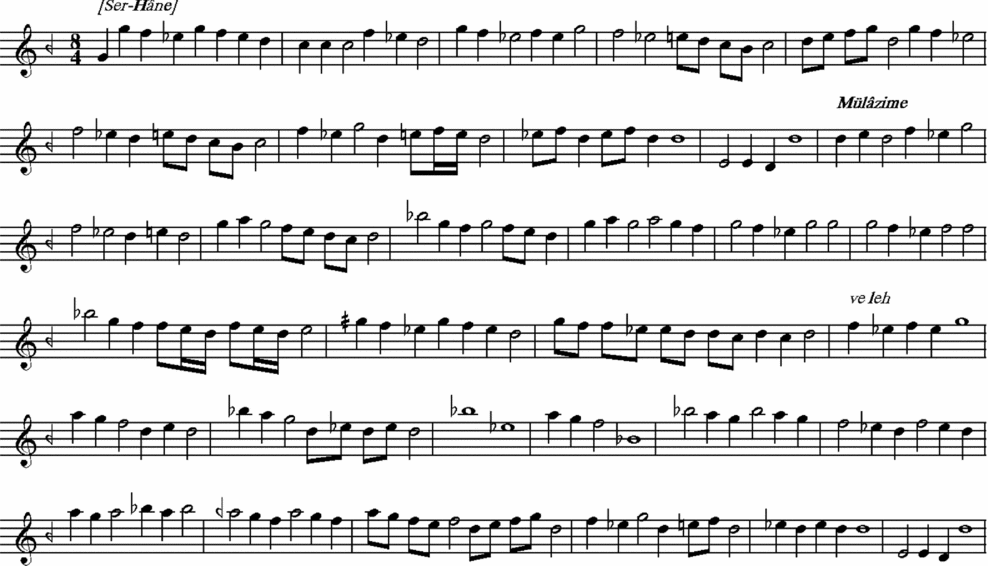
Although these indications may induce one to conclude that Kevserî was really a skilled and knowledgeable musician, other considerations run counter to this conclusion. First and foremost, the lack of any reference to him in the oral tradition is sufficient to make one suspicious about his musical reputation. Second, there is no evidence that other musicians have ever used the makâms that Kevserî invented, for the only other written works on music in which they appear are the partial copies of the Kevserî Mecmûası. Third, compared to the other pieces in the collection, his compositions are made up of quite unconventional, even grotesque, melodies (see Example 1). While these pieces may suggest that he was an avant-garde composer, he could equally well have been an incompetent one. Since the usûls he wrote down are found in many earlier sources, his self-proclamation that he was the inventor was obviously an exaggeration, too. He may indeed have developed a couple of novel ways to explain and demonstrate the usûls, such as the double cycles, which bring two distinct usûls together, and the use of weighing scales to show the balance of strokes in the usûl Düyek, but these can hardly be called inventions. This is probably why a later owner of the manuscript erased many of the marginal notes referring to Kevserî as an inventor.
Karcığâr Peşrev (“Âb-ı Kevser”), 1st hâne and mülâzime

What is more, it is by no means certain that the Kevserî Mecmûası is the work of only one person. After all, this is a sizable manuscript and neither the handwriting nor the pen appears to be uniform throughout. Particularly in the collection of notations, the differences in script suggest that at least two different hands were involved. The notations that were copied from the Edvâr were inscribed with rounder and smaller letters and are neater than the original notations, which were added afterwards.Footnote 62 The last letter of the word “ḫâne” appears as “ﮧ” in the former hand and as “ﻪ” in the latter. The pieces copied from the Edvâr usually end with letter “m” or with nothing at all, while the original ones usually end with the word “ṣaḥḥ”, meaning correct. In addition, some orthographical differences are to be observed between the two blocks, such as “Berevşân”, “Aġa-i Mü’mîn” and “Eyyûbli” in the former and “Berefşân”, “Aġa-i Mü’min” and “Eyyûbî” in the latter. These differences lead one to surmise that whoever copied the notations from the Edvâr was not the same person who wrote the original part of the collection. The inclusion in this part of 38 pieces that had already been copied from the Edvâr, often with different names, makâms, usûls and composers, supports this idea. Nevertheless, there is still not enough evidence to come to a definitive verdict. The differences in script and orthography are not too salient, and they, as well as the recurring pieces, may also be accounted for by the original notations being inscribed a long time after the collection of Cantemir was copied.
Whereas no reference to Kevserî as a copyist is encountered in the notations that were written in the first hand, his name was inscribed a number of times in the second one. In addition to the headings of the two pieces he composed, his name is to be found on ff. 124a, 125a and 126a as well. In these latter instances, he signed his name, next to the word “ṣaḥḥ”, which appears after every single piece in the original part of the collection except three (K310, K538 and K539). It is therefore very likely that the additional notations were almost exclusively written by Kevserî, while it remains unclear whether he was the one who started the collection. If he copied the notations from the Edvâr, he must have done this either considerably before he recorded the additional ones or without carefully examining them. If the copyist was a different person, Kevserî did not, again, spend much time examining the notations that were taken from the Edvâr.Footnote 63
In short, the internal evidence in the Kevserî Mecmûası is insufficient to answer even the most elementary questions about its author(s). How many hands were involved in the composition of the manuscript is unclear, and hints about its main contributor, Kevserî, are meagre and contradictory. Finding out more about him is crucial to assess the original notations in the collection, because his background and competence in music must have influenced how he wrote down the pieces. Did he record them as he played them or as a master musician did? If the former, whether he was a student or a virtuoso performer of the ney would make a big difference. Was he educated in a conservative circle? Did he have any contact with non-Mevlevî musicians? How much did he appreciate avant-garde styles of composition and performance, if there were any? Without finding satisfactory answers to such questions, larger conclusions from the Kevserî Mecmûası about the mainstream style of Ottoman music in the first half of the eighteenth century will remain somewhat questionable.
c) Why was it written?
The special characteristics of the Kevserî Mecmûası, such as its remarkably large size compared to other contemporary and earlier works on Ottoman music and its mixed and partially unique content, make one wonder with what motivations and for what audience it was written. Identifying the purpose of the manuscript is particularly important for making sense of the notations, for whether they were compiled for personal reference or for the use of others may have affected their precision and reliability.
That the bulk of the material in the Kevserî Mecmûası was taken from the Edvâr implies that Kevserî was fascinated by Cantemir's approach to music theory. Cantemir's treatise of music diverges from its antecedents through its rational and practical outlook and, unlike earlier theory books, it makes no explicit association of musical concepts with the human body, heavenly bodies or the zodiac. Nor did Cantemir attempt, as some did, to write his treatise as a didactic poem where style smothers content. As Wright argues, Cantemir's novel and straightforward approach was probably the reason why the Edvâr influenced many later theorists of Ottoman music.Footnote 64 Thus, just like several other treatises of the eighteenth and nineteenth centuries that include excerpts from the Edvâr, the Kevserî Mecmûası was possibly intended as a reproduction of this innovative account of music theory.
But what was Kevserî intention in copying the material in the Edvâr? Popescu-Judetz claims that he purposefully edited it the better to transmit it to following generations.Footnote 65 Looking at the copied notations only would indeed give this impression, for the compositions that were recorded haphazardly in the Edvâr are ordered in the Kevserî Mecmûası according to makâm. However, the theory-related text, which is logically organised and placed in chapters in the former but is quite disorganised and incomplete in the latter, runs counter to the argument of Popescu-Judetz.Footnote 66 Moreover, as mentioned earlier, Kevserî did devote several pages of the manuscript to the physiological, spiritual and cosmological associations of music. This indicates that no matter how much he appreciated the theoretical outlook of Cantemir, he could not free himself totally from the tendencies of the traditional school. If one assumes that he undertook the task of synthesising traditional and innovative approaches to music theory, it would be difficult to explain why he was not acknowledged as an important scholar of music, and why his name was not referred to in any Ottoman music source, including the later copies of the Kevserî Mecmûası. Because of these inconsistencies, and the lack of information about Kevserî's career in music, one should not overlook the possibility that he may have been no more than an average musician, even a dilettante, who wanted to copy for himself whatever he found interesting about music.
On the other hand, his enterprise of appending a number of pieces to Cantemir collection suggests a rather different conclusion. While the others who borrowed from Cantemir only utilised his theoretical account, being indifferent to his system of notation, Kevserî evidently made considerable efforts to comprehend it. Even if he might not be the one who copied the notations from the Edvâr, he used this system to record new examples of music for the first and, as far as we know, the last time after Cantemir.Footnote 67 In addition, the careful organisation of the collection, again, in makâm order, the absence of blank pages between makâm blocks, and the use of a fairly neat handwriting indicate his serious labour of collecting the pieces first, then writing their draft versions, putting them into order and finally copying them into the manuscript. For that reason, it is very unlikely that Kevserî composed it solely for personal purposes like, say, Ali Ufkî when composing the disorderly AUP.
As no dedicatory statement is found anywhere in the manuscript, Kevserî's aim in writing it was neither to present it to the sultan, like Cantemir, nor to donate it to the library of the Mevlevî lodge, like Abdülbâkî. Nevertheless, his concern for a later readership is still observable. While the loose, often haphazard, organisation of the theory-related texts suggests that he copied them primarily for himself, the neatly prepared parts, such as the collection of notations and the usûl cycles, indicate that he kept in mind that other people could utilise the manuscript in the future. In this regard, the Kevserî Mecmûası can be compared to the MSS Footnote 68 in terms of its preparation. Both manuscripts appear to have been written primarily from personal interest and curiosity but arranged in such a way that others could benefit from them as well.Footnote 69
The Collection of Notations
Being without doubt the most distinctive part of the Kevserî Mecmûası, the collection of notations deserves special attention. It is important because, first, as mentioned earlier, notations of Ottoman music predating the nineteenth century are relatively rare. Second, the almost 200 original examples in this collection were notated in the eighteenth century, when Ottoman music is argued to have undergone stylistic transformation. Thus, in addition to being a treasure of historical music, it holds also a significant musicological value.
The collection, which comprises 539 instrumental compositions in total, starts with 11 pieces (10 peşrevs and one semâî) copied from the Edvâr in no specific order. They are followed by 298 peşrevs, which were, except for two, also copied from the Edvâr (K12–K309). This block of peşrevs is ordered according to the final and/or characteristic pitches of their makâms. Then, nine peşrevs, one of which was taken from the Edvâr, appear randomly (K310–K318). The semâîs in the Edvâr follow them in makâm order as well (K319-K353). The pieces that come afterwards, except K505, were not copied from the Edvâr. The peşrevs (K355–K502) and semâîs (K506–K537) here are also ordered according to makâm, except K355. The three pieces between them (K503–K505), as well as the two pieces at the end (K538 and K539), are offered in no particular order.
Instead of just copying Cantemir's collection, the scribe apparently paid attention to its content, and often offered revisions whenever he found it necessary. For example, all the pieces that Cantemir referred to as in makâm Arazbâr were copied in the Kevserî Mecmûası with the makâm name “Gerdâniyâ” [sic], which better suits the general conception of the time.Footnote 70 The rearrangement of the pieces, which are randomly sequenced in the Edvâr, also shows the scribe's attempt at editing. Moreover, albeit in only a few pieces, he attempted to correct the time errors in the original. While these corrections are not always convincing in terms of melody–rhythm congruence, they at least equalise the number of time units in the melody to the time of the usûl. These hints indicate that the scribe had considerable knowledge of music theory and the Cantemir notation. Withal, it is still difficult to claim that the collection in the Kevserî Mecmûası was intended as a fully edited version of that in the Edvâr; as the copious number of remaining errors demonstrates that many pieces were not checked at all.
Bearing in mind that Kevserî was attached to the Mevlevî order, and that a highly revered Mevlevî musician and scholar, Osman Dede, had recently developed a notational system, it is puzzling to see him employ the Cantemir notation. According to Wright, he must have consciously selected the superior authority, for Cantemir's theoretical treatise is definitely more advanced and comprehensive than that of Osman Dede.Footnote 71 Yet, although this observation is correct, one cannot make comparisons of the same order between the two notational systems, which are in fact so similar to each other that one may suspect interaction or imitation in their creation.Footnote 72 Since neither is superior to the other in terms of precision or simplicity, in the Mecmûa, which is a compilation from different sources anyway, Kevserî could perfectly well have used Osman Dede's system, instead of Cantemir's, for recording new compositions, even if he did not borrow anything from his theoretical work. Perhaps the most plausible explanation for his preference for the latter is that the former was not very well known, even in Mevlevî circles, at that time. Since the only examples of it were in a small collection comprising approximately 70 instrumental pieces, it would be understandable if it did not attract much interest compared to the one employed in the sizable Edvâr. Alternatively, given the lack of evidence for his being acquainted with Osman Dede, or for his command on music sources, Kevserî may simply have been unaware of the Osman Dede notation.
The Original Repertoire: How Much ‘In-Between’?
Aside from the 344 compositions taken from the Edvâr, the remaining 195 (159 peşrev and 36 semâî) are original examples, which are not found elsewhere. This repertoire, which will be henceforth referred to as “Kevserî's collection”, offers invaluable material given the scarcity of notated sources from that period. The evidence it provides allows us to assess aspects of change and continuity in the general characteristics of Ottoman music during the first half of the eighteenth century, and thereby to determine the extent to which it demonstrates an intermediate stage between the earlier and later styles, helping our understanding of the putative transformation.
The striking differences between the pre- and post-eighteenth century notations in terms of melodic density, formal structure and modal progression make it evident that there was a change in the style of music during the time in-between. But when exactly and how rapidly this process took place has hitherto remained unclear. The prevailing argument in the literature has been that it had started as early as the late seventeenth century. This assumption is mainly based on the evidence in the Edvâr: While most of the compositions therein are stylistically akin to those in Ali Ufkî's collections, some towards the end of it show considerably more melodic detail. Seeing the higher degree of melodic density and/or contrast in these pieces, which were notated in the smallest metre (vezn-i asgarü’s-sagîr), researchers have argued that they reflect a change in the style of composition and performance.Footnote 73 It follows from this that one would expect the increase in melodic complexity, the concomitant decrease in tempo and all other changes related to form, rhythm and melodic progression that characterised this style to be manifested in later notations.
The only published example from the original repertoire in the Kevserî Mecmûası, i.e., K538, underpinned this argument. First, this piece was composed of remarkably longer and more elaborate melodies than the compositions recorded by Ali Ufkî and Cantemir. Second, due to the frequent use of the Hicâz tetrachord on nevâ, whereas the extant examples of makâm Nihâvend from the ‘older’ collections employed the Bûselik tetrachord, this composition appeared to resemble more those in the ‘newer’ ones. Third, the terms teslîm and mülâzime, which would later converge in meaning but used to have different functions in the ‘older’ collections, were used interchangeably in this example of notation. All these were sufficient for Feldman to suggest that Ottoman music had entered a new “period” after Cantemir's time.Footnote 74
However, the extent of these differences was such as to arouse suspicion. Particularly, the melody was too florid for a piece notated around the middle of the eighteenth century. While Wright's hypothesis of regular “elaboration” and “retardation” suggested an about 40 per cent increase in melodic density every half a century after 1700, this example was more than three times denser in melody than an average ‘older’-style piece.Footnote 75 The modulations and the length of hânes, inter alia, also resembled the nineteenth-century examples of Ottoman music. Such a radical change in the style of music taking place within only about half a century was hard to explain. To solve the conundrum, Wright, pointing out its difference in handwriting from the other published notations, concluded that the piece must have been added to the collection much later, presumably around the mid-nineteenth century.Footnote 76 This provided a sensible explanation for the stylistic peculiarity of this piece and allowed him to maintain his argument of incremental transformation.
Our examination of Kevserî's collection has confirmed that K538 was written by another hand. Besides, the other pieces in the collection do not share its stylistic characteristics peculiar to nineteenth-century Ottoman music.Footnote 77 Hence, arguments based on the assumption that it represents the original repertoire in the Kevserî Mecmûası now need revision. This is to say, since the compositions in Kevserî's collection are predominantly in the ‘older’ style, the music could not have been transformed in the early-eighteenth century to the extent that Feldman argues. Indeed, as demonstrated below, examination of the collection has revealed that the general characteristics of the repertoire, i.e. in makâm, usûl and melodic density, remained for the most part stable by Kevserî's time. This calls Wright's hypothesis of regular incremental transformation into question.
a) Makâm
The makâms of virtually all of the pieces in Kevserî's collection are encountered in that of Cantemir, either in separate compositions or in the multi-makâm külliyât peşrevs. Those that are found only in Kevserî, apart from Âb-ı Kevser, his own creation, are Hûzî and Şehnaz-Bûselik, and the former is mentioned in the theory section of the Edvâr. While this indicates that the makâm repertoire remained largely stable, some makâms, such as Bestenigâr, Büzürg and Arazbâr, differ in the two collections in terms of their scales and/or their finalis. For example, whereas the examples of makâm Bestenigâr in the Edvâr (E281 and E296) frequently use the perfect fifth between the pitches segâh and evc and finally rest on segâh, the peşrev in the same makâm in the Kevserî's collection (K365) employs the scale of the makâm Irâk, usually stops on çargâh and often modulates to the makâm Sabâ –which all coincide with the characteristic features of the Bestenigâr pieces that have survived in the oral tradition.Footnote 78 Compared to those in the Edvâr, the pieces in Büzürg and Arazbâr in Kevserî's collection, too, conform more to the traditional definitions of these makâms from the eighteenth century onwards. While these discrepancies may be because of Cantemir's different interpretation of traditional knowledge, they may also hint that the structures of certain makâms had changed. Yet, even if the latter is true, this would still not signify a large-scale transformation in the use of makâms, as the majority of them appear structurally unchanged compared to the earlier collections.
b) Usûl
Of the 159 peşrevs recorded in Kevserî's collection, 37 are in Düyek, 29 in Devr-i Kebîr, 19 in Sakîl, 16 in Çenber, 15 in Fâhte, 7 in Berefşân, 6 in Zencîr, 6 in Hafîf, 5 in Darbeyn, 5 in Muhammes, 5 in Evsat, 3 in Hezec, 2 in Hâvî, one apiece are in Çifte Düyek, Evfer and Remel, and one is unidentified (probably Düyek). Except for three, i.e., Hezec, Çifte Düyek and Evfer, all these cycles appear in Cantemir's collection. Furthermore, since Hezec and Evfer are presented in the theoretical part of the Edvâr, only Çifte Düyek could have been a novel creation. Yet, interestingly enough, the only peşrev in this usûl in the collection, i.e., Hüseynî Peşrev (K459), is not novel: it is recorded in both of Ali Ufkî's collections and assigned to usûl Düyek.Footnote 79 Thus, whether Çifte Düyek developed as a distinct usûl between Cantemir and Kevserî, or whether it had long been in practice, perhaps as a variant of Düyek, is open to question. Meanwhile, no peşrev in usûls Devr-i Revân, Fer-i Muhammes, Sofyân, Frenkçîn and Nîm Sakîl, which all appear in Cantemir's collection, was recorded by Kevserî. Yet, they had certainly not fallen out of use, for Kevserî gives their cycles along with the other usûls. Therefore, it is safe to conclude that no significant change in the corpus of usûls in the peşrev repertoire took place between Cantemir and Kevserî.
As regards the semâîs, all the 36 examples in Kevserî's collection are notated in the six-beat Semâî. There is no single case of the 10-beat Semâî-i Leng, which appears in six pieces in the Edvâr. This is somewhat unexpected, as the latter usûl has so far been considered to have replaced the former around the turn of the eighteenth century, developing into the Aksak Semâî, the standard usûl of the instrumental semâî form in the ‘newer’ repertoire.Footnote 80 The description of four distinct types of Semâî, i.e., Aksak Semâî, Semâî, Semâî-i Leng and Yürük Semâî,Footnote 81 in the rhythm section of the Kevserî Mecmûası could well be a sign of this change, as it indicates that a variety of practices were being employed in the performance of this usûl. Nevertheless, Kevserî's collection manifests that six-beat instrumental semâîs still prevailed during his time, and that Semâî remained predominantly a regular, rather than aksak, usûl until the second quarter of the eighteenth century.
c) Melodic complexity
Melodic complexity has been used in the recent literature of Ottoman music as a practical tool to trace stylistic change, and it will be given special emphasis here as well. Preliminary observation of Kevserî's collection has shown that the majority of pieces show similar characteristics in melodic density and contrast with the seventeenth-century material provided by Ali Ufkî and Cantemir.Footnote 82
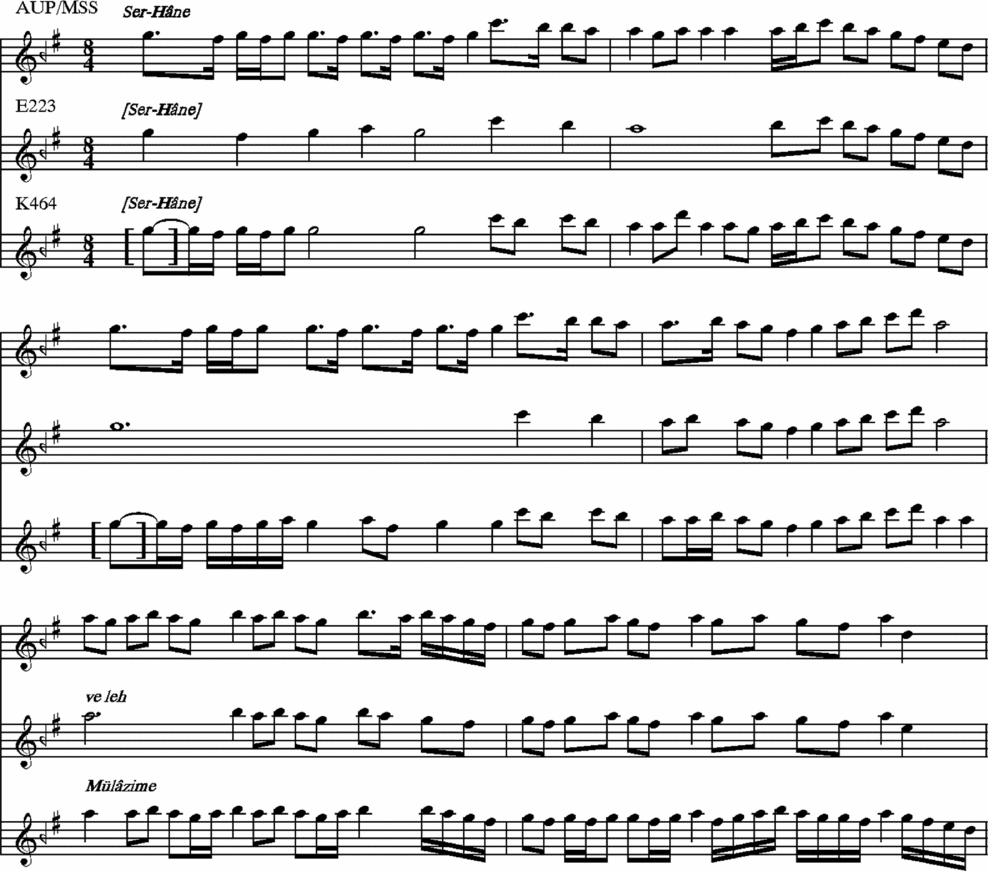
Juxtaposing different versions of pieces can be useful in demonstrating the variation in melodic complexity. Below are the first measures of a peşrev, in usûl Düyek, which can be found in all the four available seventeenth- and early eighteenth-century collections of notations (Example 2). As clearly seen, the Kevserî version (K464)Footnote 83 is more florid than the one in the Edvâr (E223)Footnote 84. However, since the earliest version recorded by Ali UfkîFootnote 85 is akin to the Kevserî version, it is not possible to suggest a gradual increase in melodic complexity. The overlapping embellishments in the Ali Ufkî and Kevserî versions underline a certain degree of stability in performance between the 1650s and in the second quarter of the eighteenth century.
Muhayyer Peşrev, 1st hâne and the introduction of mülâzime

Here it should be noted that the melodic simplicity in the Cantemir version is very unlikely to represent the actual performance. The comparison of his notations with their versions in the MSS has already shown his tendency to exclude some embellishments for some reason, which may be the playing technique of his instrument, the tanbur, or his lack of interest in recording all the details.Footnote 86 Thus, the relative bareness in his notations has not led any researcher to argue that there was a practice of melodic simplification in composition or performance at that time. On the other hand, the fewer more ornate pieces he supplied towards the end of his collection has been regarded as an indicator of the process of melodic elaboration, which would continue later in the eighteenth century with greater intensity.
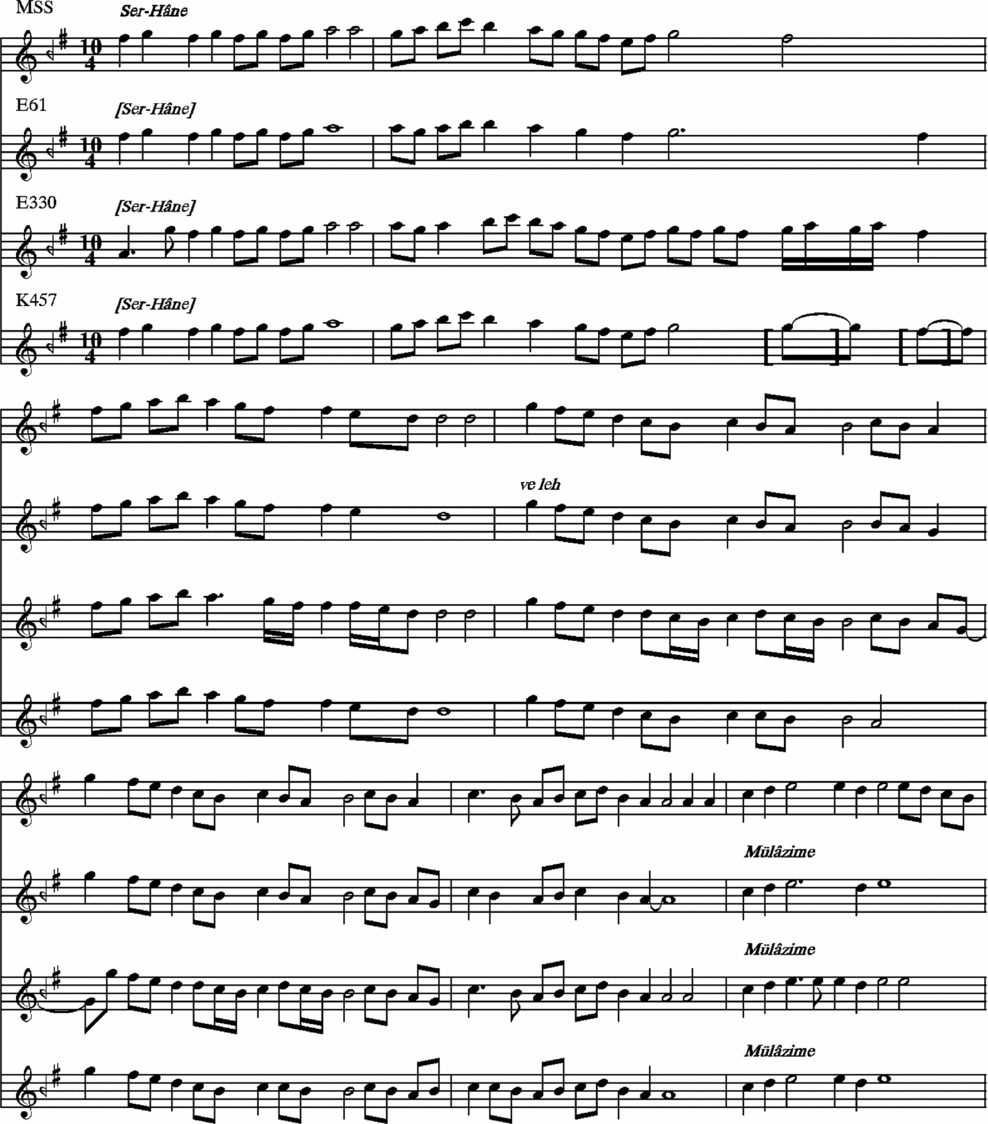
Among these melodically more complex pieces in the Edvâr, there is a peşrev in usûl Fâhte (E330)Footnote 87 which also appears earlier in the same collection in a plainer version (E61)Footnote 88. In terms of melodic density and contrast, the latter is quite like the Ali Ufkî version of the pieceFootnote 89. These three examples alone would fit perfectly both with Wright's hypothesis of gradual transformation and Feldman's suggestion of important changes in the late seventeenth century, as E61 would reflect the older style of performance, whereas E330 would work as a contemporary interpretation. However, bringing the Kevserî version (K457)Footnote 90 into the picture weakens this argument. Contrary to the expectation that it should involve at least a similar, if not greater, degree of melodic fragmentation compared to E330, as seen in Example 3, it is plainer, and, hence, stylistically closer to the earlier two versions.
Hüseynî/Arazbâr/Bayâtî Peşrev, 1st hâne and the introduction of mülâzime

Yet, what if the stylistic transformation was predominantly in composition but not in performance during the earlier stage of stylistic transformation? In other words, could the more complex style have first emerged in new compositions and only later affected the performance of older pieces? Cantemir explains in the Edvâr that the compositions with slower rhythm, and, hence, higher melodic elaboration, are more suitable to be notated in the smallest metre.Footnote 91 Taking this together with the fact that the peşrevs in this metre appear towards the end of his collection and that many of them are attributed to him, it could indeed be tempting to conclude that they were composed in a different style from those notated in larger metres, and, therefore, their performance should also have been different, possibly in a slower tempo.
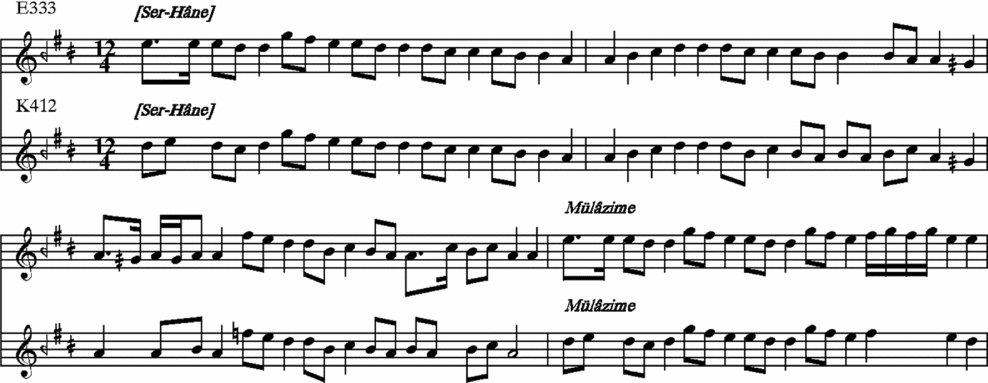
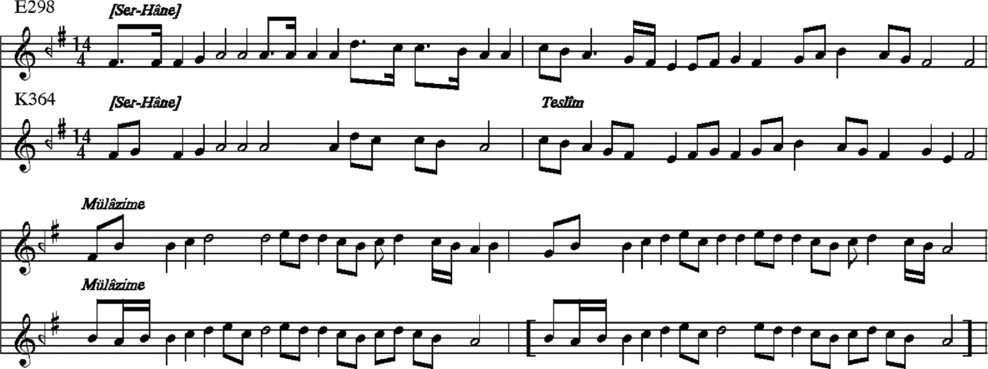
However, examination of the variants in Kevserî's collection of the peşrevs that Cantemir notated in the smallest metre demonstrates that they are not compositions in a different style. Some of them, such as the Uzzâl Peşrev Footnote 92 (E333 and K412; see Example 4) and the Irâk Peşrev Footnote 93 (E298 and K364; see Example 5) are recorded in a plainer form than the Cantemir versions; hence they do not appear stylistically different from seventeenth-century notations. Thus, it is not possible to claim that every piece Cantemir notated in the smallest metre was played in a slower tempo than the others.
Uzzâl Peşrev, 1st hâne and the introduction of mülâzime

Irâk Peşrev, 1st hâne and the introduction of mülâzime

Apparently, Cantemir preferred the smallest metre for both the above pieces in order to show very short note values, which correspond in our transcription to semiquavers, with ease. As to Kevserî's collection, however, not a single piece it includes is in the smallest metre. For these two compositions, Kevserî preferred to employ the large metre, even though, according to the standard practices of Cantemir notation, the shortest note value he could write in this metre would be the quaver.Footnote 94 Two implications can be drawn here: first, the selection of smaller or larger metre in Cantemir notation was primarily a decision between higher precision and higher convenience. Thus, tempo cannot be directly inferred from metre alone. Second, not all notes with short values were necessarily integral elements of the composition. In the both Examples 4 and 5, semiquavers notated in one version are not found in the other. Many such notes thus appear to be decorations, which may or may not be played. Even if they were often played, Kevserî evidently considered some of them too superfluous to write. This means that Cantemir's precision in some pieces does not automatically indicate their stylistic difference from the others. The more elaborate appearance of the later examples in the Edvâr is probably because he, unlike in the earlier ones, gave precedence to detail over speed, rather than because the style of music was changing. Therefore, one should be cautious before reaching general conclusions from the metre employed in notation or the incidence of notes with small values.
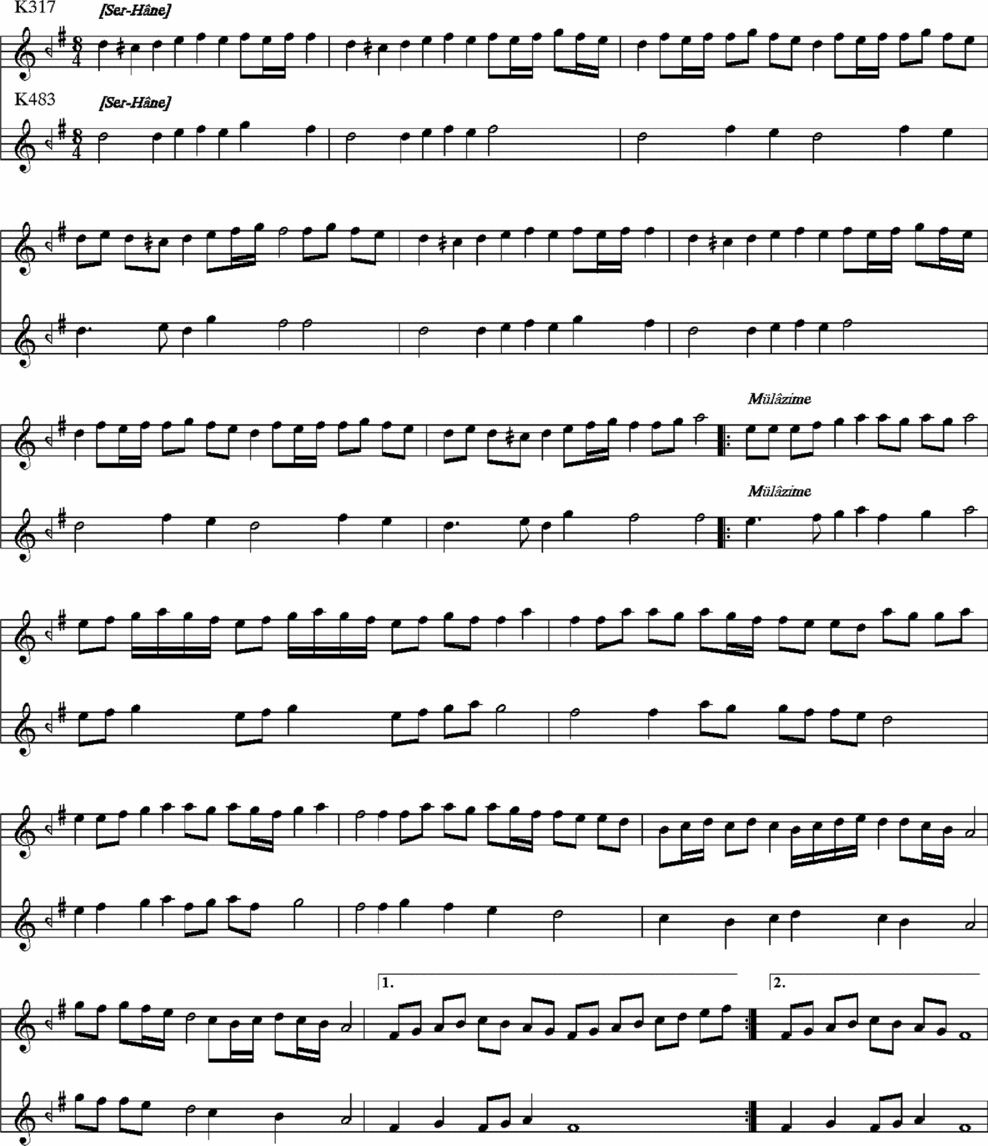
All these examples have demonstrated the relative stability in melodic complexity between the times of Ali Ufkî and Kevserî. Yet, this should not lead to the conclusion that the few more elaborate examples in the Edvâr are misleading about the contemporary style of music. That they do not represent a completely unusual style is readily understood from the fact that such examples are found, albeit few in number, in Kevserî's collection as well. One of them is the Evc Peşrev in usûl Düyek, which was in fact inscribed twice in two different versions (K317 and K483)Footnote 95. The disparity in the degree of melodic density and contrast between the two versions is striking. K317 is far more embellished compared to K483, which is stylistically similar to most of the peşrevs in this collection, as well as in the earlier ones (Example 6).
Evc Peşrev (“Maṭlûb”), 1st hâne and the 1st terkîb of mülâzime

The inclusion of just a small number of pieces having greater melodic density and/or contrast makes Kevserî's collection comparable to Cantemir's. Yet, unlike in the latter, such examples are not found towards the end, but around the middle. Additionally, they do not constitute a single and separate block at all, as pieces with lesser melodic fragmentation were recorded along with them. The concomitance of plain and ornate pieces makes it very difficult to suggest that the latter were written later and reflect a more recent style. Therefore, unless Kevserî deliberately simplified the melodies in almost all the compositions he notated, which is highly unlikely, there is enough reason to conclude that different styles of performance coexisted in Ottoman music in the early eighteenth century. This could have been caused by various factors including differences in the playing techniques of instruments (i.e., Kevserî may have notated each version of the Evc Peşrev above as played by different instruments), in the performing styles of musicians or in the physical setting of performance. Thus, the general evolution of Ottoman music to a more elaborate style could have been because some instruments became more dominant in ensembles, because some prominent musicians influenced the general style of performance, or because the music performed in a particular setting assimilated the style of all other settings. Unfortunately, it is not yet possible to determine which one of these possible factors was the exact, or the most prominent, cause of the stylistic transformation.
In summary, although not supplying much evidence to explain the stylistic transformation in the Ottoman music before the nineteenth century, the examination of Kevserî's collection has still been helpful to refine the arguments in this regard. Feldman's periodisation, which turned out to be incorrect in assuming that the published K538 reflected the mid-eighteenth-century style of Ottoman music, needs to be revised. Wright's hypothesis of incremental transformation after the seventeenth century should also be rectified, for the material in Kevserî's collection indicates that the style of composition and performance in Ottoman music was largely stable from the 1650s to at least the second quarter of the eighteenth century. A possible way of rectification could be taking the middle of the eighteenth century as the starting point for the transformation process. Alternatively, it can also be argued that the process began around the turn of that century, but its impact remained weak and limited for some decades.
That said, it should also be remarked that the conclusions above are by no means definitive. Since almost nothing substantial is known about Kevserî's career in music, any comparative analysis between his and other collections should be made with caution. Particular stylistic attributes of Kevserî's collection that imply in general that there was no major change in the style of composition and performance between Ali Ufkî and him can just as well be attributed to personal factors. For example, if Kevserî was not a competent performer of the ney, he may have notated many compositions in a relatively unsophisticated way while the leading musicians of the time increasingly preferred a more elaborate style of music.Footnote 96 Alternatively, Kevserî might have been educated in a highly conservative milieu, and this could have led him to exclude modern practices of ornamentation from his notations. In other words, if he was overly influenced by the traditional style, his notations would not differ very much stylistically from the earlier collections, even if a serious transformation in composition or performance was going on.
Concluding Remarks
The discovery of a microfilm copy has finally brought the Kevserî Mecmûası, an important source of Ottoman music, to light. This sizable manuscript puts an invaluable set of materials at the disposal of researchers into Ottoman music. As an initial, and celebratory, effort, this article has attempted to reintroduce this hitherto poorly known source. After outlining the main features of the manuscript, it has suggested corrections to various speculations in the literature with regard to its date, author and purpose. It has also reassessed its significance for our understanding of processes of change within the instrumental repertoire.
Researchers have long hoped to find in Kevserî's collection of notations answers to unresolved questions about the historical evolution of Ottoman music. Since it was compiled around the middle of the eighteenth century, they believed, it could bridge the gap between the ‘older’ and ‘newer’ collections. Yet, the preliminary findings presented in this article have indicated that Kevserî's collection is unlikely to satisfy these expectations. Contrarily to the prevailing view, which has held that Kevserî's collection should demonstrate conspicuous differences in style from the earlier collections of Ali Ufkî and Cantemir, it resembles them. In stylistic terms, Kevserî's collection has turned out to be another ‘older’ collection, not an intermediary one. While not offering much help in explaining the transition to the ‘newer’ style of the nineteenth century, it does run counter to the assumptions in the literature about the transformation process. The hints in the Edvâr had suggested that it should have started sometime between Ali Ufkî and Cantemir, while the absence of any documentation indicating an abrupt change in the style of Ottoman music had led to the hypothesis of gradual transformation. However, the strong stylistic resemblance between Kevserî's collection and the earlier ones means that at least one of these two conclusions needs to be revised. If the former is correct, then the transformation appears to have been irregular and have had limited impact for some decades; if the latter, then this process cannot have begun too long before Kevserî compiled his collection.
While preliminary scrutiny of the Kevserî Mecmûası has not provided much evidence to explain this process, more detailed investigation of the notations, preferably including comparison with other collections, can still enhance our understanding of it by yielding further insights into the contemporary practices of composition and performance. But as long as the shortage of examples of notations reflecting the intermediate stage persists, any argument with regard to the stylistic transformation up to the middle of the nineteenth century is bound to be largely speculative. Unless further eighteenth-century sources come to light, research into this area will need to call upon the still untapped potential of the earliest Hamparsum collections.