Introduction
Multiple sclerosis (MS) affects diverse functional systems including ambulation, fine motor, cognitive, and speech communication abilities (Benedict et al., Reference Benedict, Holtzer, Motl, Foley, Kaur, Hojnacki and Weinstock-Guttman2011; Hartelius, Buder, & Strand, Reference Hartelius, Buder and Strand1997). This autoimmune disease involves lymphocyte attack on myelinated fibers leading to widespread white and gray matter demyelinating lesions and atrophy (Compston & Coles, Reference Compston and Coles2008). Cognitive impairment is common, appearing in approximately 50% of cases (Arnett & Strober, Reference Arnett and Strober2011; Benedict & Bobholz, Reference Benedict and Bobholz2007). In addition, abnormalities in spoken communication are found in 40 to 50% of MS patients (Hartelius, Runmarker, & Andersen, Reference Hartelius, Runmarker and Andersen2000; Yorkston et al., Reference Yorkston, Klasner, Bowen, Ehde, Gibbons, Johnson and Kraft2003). Differences in spoken communication can also negatively impact work status and quality of life (Baylor, Yorkston, Bamer, Britton, & Amtmann, Reference Baylor, Yorkston, Bamer, Britton and Amtmann2010; Yorkston et al., Reference Yorkston, Klasner, Bowen, Ehde, Gibbons, Johnson and Kraft2003).
An important consideration in the clinical management of MS is how impairment in one functional system may impact or interact with another. Cognitive-speech motor interaction is an emerging area of interest. Arnett and colleagues (2008) examined relationships between cognition and oral-motor speed, using the Maximum Repetition Rate of Syllables task (Kent, Kent, & Rosenbek, Reference Kent, Kent and Rosenbek1987). They found robust correlation between syllable production rate and the Controlled Oral Word Association Test (COWAT; Benton, Sivan, Hamsher, Varney, & Spreen, Reference Benton, Sivan, Hamsher, Varney and Spreen1994), the Paced Auditory Serial Addition Test (PASAT; Gronwall, Reference Gronwall1977), and the oral-response version of the Symbol Digit Modalities Test (SDMT; Smith, Reference Smith1982). However, this study was limited by the use of a syllable repetition task for which inter-judge measurement reliability is low (Gadesmann & Miller, Reference Gadesmann and Miller2008), although this concern is not ubiquitous (Kent, Duffy, Kent, Vorperian, & Thomas, Reference Kent, Duffy, Kent, Vorperian and Thomas1999; Tjaden & Watling, Reference Tjaden and Watling2003). In addition, this task involves repeating nonsense syllables, and movement strategies for nonsense speaking tasks are quite different from those used for real-world spoken communication (Weismer, Reference Weismer2006; Westbury & Dembowski, Reference Westbury and Dembowski1993). Additionally, Mackenzie and Green (Reference Mackenzie and Green2009) showed that a composite of language-based cognitive tasks selected from the Arizona Battery for Communication Disorders of Dementia (Bayles & Tomoeda, Reference Bayles and Tomoeda1993) was significantly correlated with sentence intelligibility as indexed by the Sentence Intelligibility Test (Yorkston & Beukelman, Reference Yorkston and Beukelman1984). However, the study did not explore cognitive abilities beyond those directly tied to linguistic ability. In addition, the sample size was small (n = 24) and limited to patients referred for dysarthria treatment, such that problems with intelligibility may have been overrepresented.
The present study investigated the cognitive-speech motor relationship using connected speech tasks and neuropsychological tests from multiple cognitive domains. We hypothesized that (a) cognitive variables would explain more variance in rate measures for participants with MS than healthy controls and (b) in MS, self-generated speech would demonstrate higher cognitive demand as evidenced by cognitive variables having greater explanatory power for rate measures of the self-generated speech task as compared to the reading task.
Methods
Participants
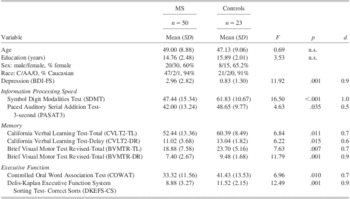
MS participants included 50 individuals with a mean age of 49.0±8.9 years and mean education of 14.8 ± 2.5 years. Expanded Disability Status Scale (EDSS; Kurtzke, Reference Kurtzke1983) scores ranged from 0 to 6.5 with a mean of 4.0 ± 1.9. The sample was 94% Caucasian, 60% female, and disease duration was 13.3 ± 8.0 years (see Table 1 for detail). There were 24 relapsing-remitting patients and 26 secondary-progressive patients as determined by their treating neurologist. Inclusion criteria were (a) diagnostic criteria for MS based on Polman et al. criteria (Reference Polman, Reingold, Edan, Filippi, Hartung, Kappos and Wolinsky2005), (b) no history of significant drug/alcohol abuse, (c) no sensory impairments that might interfere with cognitive or speech testing, (d) no history of ADHD or learning disability, (e) no comorbid medical conditions that may affect cognition or motor function, (f) absence of a recent relapse or corticosteroid use (within 4 weeks), (g) absence of a level of physical or neurological impairment that would make cognitive/language testing invalid, (h) native speaker of standard American English, (i) no neuropsychiatric disease predating MS (e.g., mood disorder), (j) no current or prior use of antipsychotic medication, (k) functional hearing with the ability to pass a pure tone audiometric screening (bilateral pure tone thresholds of at least 40 dB at 500 Hz and 1–4 KHz).
Between-group comparisons: Demographic and cognitive measures

Note. All p values were based on two-tail tests. n.s. = not significant.
Control participants (n = 23) were 8 men and 15 women with a mean age of 47.1 ± 9.1 years and mean education level of 15.9 ± 2.0 years. Control participants met the same inclusion criteria as MS participants. The study was approved by the Health Sciences Institutional Review Board at SUNY Buffalo. Study participants were paid for participation.
Measures of Cognitive Function
Measures of cognitive function were obtained using the Minimal Assessment of Cognitive Function in MS (MACFIMS; Benedict et al., Reference Benedict, Fischer, Archibald, Arnett, Beatty, Bobholz and Munschauer2002) that has well established reliability and validity, including strong correlation with brain magnetic resonance imaging (MRI) metrics (Benedict, Ramasamy, Munschauer, Weinstock-Guttman, & Zivadinov, Reference Benedict, Ramasamy, Munschauer, Weinstock-Guttman and Zivadinov2009; Benedict et al., Reference Benedict, Cookfair, Gavett, Gunther, Munschauer, Garg and Weinstock-Guttman2006).
The MACFIMS measures a broad array of cognitive functions. The oral form of the SDMT (Smith, Reference Smith1982) measures cognitive processing speed. Working memory and processing are assessed using the PASAT (Gronwall, Reference Gronwall1977). Verbal memory is assessed using the California Verbal Learning Test, 2nd Edition (CVLT2; Delis, Kramer, Kaplan, & Ober, Reference Delis, Kramer, Kaplan and Ober2000). The Brief Visual Memory Test, Revised (BVMTR; Benedict, Reference Benedict1997) measures visual learning and memory. The COWAT (Benton et al., Reference Benton, Sivan, Hamsher, Varney and Spreen1994) assesses verbal fluency. Finally, the Delis-Kaplan Executive Function System-Sorting Test (DKEFS; Delis, Kaplan, & Kramer, Reference Delis, Kaplan and Kramer2001) is used to assess categorical reasoning.
Speech Tasks, Procedures, and Measures
All speech tasks are part of the standard, clinical motor-speech examination used in speech pathology (Duffy, Reference Duffy2005). Speech materials were recorded and transduced using an Isomax ear-mounted microphone (model #E610P5L2) and digitized at a sampling rate of 22.05 kHz using the computer program TF32 (Milenkovic, Reference Milenkovic2002).
Descriptive speech measures
The Sentence Intelligibility Test (Yorkston, Beukelman, & Tice, Reference Yorkston, Beukelman and Tice1996) and the Maximum Repetition Rate of Syllables and Multisyllabic Combinations task (Kent et al., Reference Kent, Kent and Rosenbek1987) were obtained for the purpose of characterizing the study population. The Sentence Intelligibility Test involves audio-recording a talker as she/he reads 11 sentences aloud from a printed script. After recording, three speech-language pathologists were presented the sentences via headphones for orthographic transcription. The transcription was compared to the script of the passage and the mean percentage of words matching the script was used. The Maximum Repetition Rate of Syllables and Multisyllabic Combinations task is a syllable repetition task (Kent et al., Reference Kent, Kent and Rosenbek1987) involving the rapid repetition of the syllables “puh,” “tuh,” and “kuh” individually, as well as repetition of all three syllables in succession (i.e., “puh-tuh-kuh”). The score used was the average number of syllables produced per second for the individual syllables and the sequence. A more detailed description of procedures for collection is outlined in Tjaden and Watling (Reference Tjaden and Watling2003).
Experimental speech measures
Experimental speech materials consisted of a Reading Passage and a Self-Generated Passage used to prompt production of connected speech. Previous research suggests measures using real-world connected speech provide insight into factors related to speech-motor behavior for individuals with progressive neurologic disease (Huber & Darling, Reference Huber and Darling2011; Lowit, Brendel, Dobinson, & Howell, Reference Lowit, Brendel, Dobinson and Howell2006). The Reading Passage selected for use was the Grandfather Passage (Duffy, Reference Duffy2005). This 115-word passage contains most speech sounds in varying combinations and takes approximately 35 to 45 s to read aloud for individuals with normal reading skill. Participants were given a printed script of the Reading Passage to read aloud. The script was printed on a single white 8.5 × 11 page using a plain, Calibri, 16-point, black font. The examiner first read the passage aloud while participants followed along in silence, then the participant read. For the Self-Generated Passage, participants were instructed to talk about a topic of personal interest for several minutes. Topics were suggested by the examiner from a list that included favorite foods, pets, hobbies, a memorable vacation, jobs, and sports. Once the participant had selected a topic, audio-recording commenced and continued for 2 min. If the participant stopped speaking before a sufficient sample length was recorded, the examiner prompted with a question or comment.
Extemporaneous or self-generated speech is considered to be a more cognitively demanding than simply reading aloud from a printed script (Huber & Darling, Reference Huber and Darling2011; Tasko & McClean, Reference Tasko and McClean2004). A printed script is thought to invoke more automatic literacy-based neural pathways thereby reducing the demands on working memory. Self-generated speech, in contrast, requires planning what to say, creating or recalling content, and monitoring the conversation for understanding. Speech measures described below were obtained for the entire Reading Passage and the initial 45 s of the Self-Generated Passage. This duration of the Self-Generated Passage was selected for study to correspond to the mean duration of the Reading Passage for all participants. The initial 45 s was selected as best matching the conditions in the Reading Passage.
Procedures for calculating rate measures were similar to those reported in Tjaden and Wilding (Reference Tjaden and Wilding2011). The printed script of the Reading Passage and a transcribed script of each Self-Generated Passage was used to obtain syllable counts. A trained research assistant generated the initial orthographic transcription of each Self-Generated Passage which was then reviewed and edited by a second research assistant. In the case of any disagreements, repeated listening and discussion were used to reach consensus concerning content as well as syllable counts. Using TF32 (Milenkovic, Reference Milenkovic2002) speech acoustic software, stretches of speech and pauses were identified for both tasks. Pauses included silent pauses, operationally defined as a silent period between words of greater than 200 milliseconds (Tjaden & Wilding, Reference Tjaden and Wilding2004), and filled pauses, operationally defined as a non-lexical vocalization or sound hesitation such as “um” “uh” and so forth of any length (Clark & Fox Tree, Reference Clark and Fox Tree2002; Goldman-Eisler, Reference Goldman-Eisler1968). For each task, overall speech rate and articulation rate were calculated. Speech rate was calculated by counting the number of syllables spoken and dividing by the passage duration yielding speech rate in syllables per second. Articulation rate refers to the rate of speech per unit time excluding both silent and filled pauses. Thus, when calculating articulation rate in syllables per second, all filled and silent pause durations were subtracted from the passage duration.
Speech rate and articulation rate measures were repeated for a random sample of approximately 10% of the Reading Passages and Self-Generated Passages to determine measurement reliability. For both intra- and inter-judge measurement reliability, analysis of variance (ANOVA) indicated no significant difference in speech rate or articulation rate measures for the Reading Passage (p > .05). Similar findings held for the Self-Generated Passage.
Depression
The Beck Depression Inventory-Fast Screen (BDI-FS; Beck, Steer, & Brown, Reference Beck, Steer and Brown2000) was administered. The BDI-FS is a seven-item, self-report measure of depression. This measure has been validated for use with MS (Benedict, Fishman, McClellan, Bakshi, & Weinstock-Guttman, Reference Benedict, Fishman, McClellan, Bakshi and Weinstock-Guttman2003).
General Procedures
After recruitment and screening, study participants were tested on cognitive tasks (MACFIMS), completed depression screening, provided speech samples, and were examined by a neurologist to obtain an EDSS. Examiners included trained graduate students and neuropsychology fellows. Cognitive tests were administered under the supervision of a board-certified neuropsychologist. Tests and speech recordings were conducted in a standard clinical testing room.
Speech recording was conducted on the same day as cognitive testing whenever possible (69.9% of subjects). Of those patients not completing all measures on the same day (30.1%), the mean number of days to complete was 23.7 ± 45.4 days. No significant differences on NP or speech variables were detected between subjects with a delay, and those without (using ANOVA, p > .05). No significant differences were detected in the average delay of subjects in the healthy control group versus the MS groups (using ANOVA, p > .05).
Data Analysis
Data analysis was conducted with SPSS 19.0. Variables were assessed for deviation from normality by examining graphic representations and skewness/kurtosis statistics. All variables approximated a normal distribution. Between-group comparisons on demographic, cognitive, sentence intelligibility, and syllable repetition rates for the Maximum Repetition Rate of Syllables and Multisyllabic Combinations task were made to establish differences between MS and healthy controls. Although the number of between-group comparisons puts the findings at significant risk for type-1 error, no Bonferroni correction was used as these comparisons were descriptive in nature and not used to test hypotheses.
Following the between-group comparisons, all of the cognitive tests from the MACFIMS were normalized into Z-scores using a regression-based normative procedure as described in Parmenter, Testa, Schretlen, Weinstock-Guttman, and Benedict (2010). The regression model was derived from 152 healthy controls, an expanded sample from those used in the original study by Parmenter et al. (Reference Parmenter, Testa, Schretlen, Weinstock-Guttman and Benedict2010). Age and gender were the normalizing factors. To minimize the number of variables used to test hypotheses, we calculated three cognitive composites from the mean Z-scores for the cognitive tests. These composites and their component tests were selected based on a principle component analysis of the MACFIMS (Benedict et al., Reference Benedict, Cookfair, Gavett, Gunther, Munschauer, Garg and Weinstock-Guttman2006). The executive composite consisted of the COWAT and DKEFS-sorting correct sorts. The memory composite consisted of learning and delayed trials from the CVLT2 and BVMTR. The information processing speed composite included the SDMT and PASAT3-second.
The first hypothesis, that cognitive variables would explain more variance in rate measures for participants with MS than healthy controls, was tested using stepwise regression models. Four models were constructed, with speech rate and articulation rate measures for the Self-Generated Passage and the Reading Passage each as the dependent variable. Demographic variables (age and depression) were first entered as a block. Then the executive, memory, and information processing speed composites were included using forward stepwise progression with the composite accounting for the greatest variance added first, followed by the subsequent composites until no further significant (p < .05) composites remained. One follow-up analysis was used. To directly assess the possible influence of articulation, syllable repetition rate (“puh-tuh-kuh”) was included as an intermediary step between incidental variables and the cognitive composites.
The second hypothesis, that the Self-Generated Passage would be more strongly related to cognition than the Reading Passage for MS patients, was tested using the information processing speed composite as the dependent variable in a hierarchical regression using speech rate and articulation rate from the Self-Generated Passage and Reading Passage as predictors. Again, age and depression were entered as block 1, followed by differing orders of the rate measures.
Results
Between-Group Differences
Demographic variables
There were no statistically significant MS/control differences on age, education, gender, or race (see Table 1). On BDI-FS the MS group had higher scores (F[1,71] = 11.92; p = .001), with a mean of 3.0 ± 2.8 versus 0.8 ± 1.3 for normal controls.
Cognitive tests
Comparisons on cognitive test results revealed expected differences favoring controls (see Table 1). Most cognitive variables were statistically significant (using p < .01). Effect sizes ranged from d = 0.5 for PASAT3 to d = 1.0 for SDMT, representing medium to large effects, and replicating prior work with the same test battery (Benedict et al., Reference Benedict, Cookfair, Gavett, Gunther, Munschauer, Garg and Weinstock-Guttman2006).
Descriptive speech measures
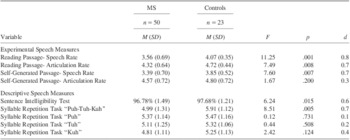
Speech measure comparisons are summarized in Table 2. Despite a marginally significant difference on the Sentence Intelligibility Test (F[1,70] = 6.24; p = .015), speech for both groups was almost 100% intelligible (97–98%). Thus, the group difference in these scores is not clinically meaningful. For the syllable repetition task, only the multi-syllable rate “puh-tuh-kuh” was significant (F[1,71] = 8.51; p = .005) for MS versus the control group, with faster rates for the control group.
Between-group comparisons for speech measures

Note. Speech rates, articulation rates, “puh-tuh-kuh” and individual syllable measures are calculated in syllables per second. All p-values were based on two-tailed tests.
Experimental speech tasks
MS patients had slower speech and articulation rates for the Reading Passage (see Table 2) with effects sizes of d = .8 and .7, respectively. Similar results were obtained for the Self-Generated Passage with effect sizes of d = .7 and .3, respectively. However, articulation rates for the Self-Generated Passage were not statistically significant (F[1,71] = 1.67; p = .200).
Hypothesis Testing Results
Cognition and rate measures
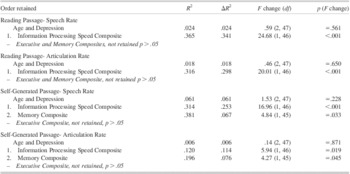
The results of the stepwise regression models for the MS group predicting the experimental speech rate measures are reported in Table 3. Age and depression were not significant contributors to any model.
Stepwise regression for MS: Cognition and rate measures

Note. The age and depression variables were force entered as a block. The subsequent order of composites was determined by forward stepwise regression with p < .05 required to retain a composite and composites retained in order of greatest variance accounted for.
For the Reading Passage, the information processing speed composite (SDMT and PASAT) accounted for substantial variance in speech and articulation rates, 34% and 30%, respectively. The executive and memory composites added negligible variance above and beyond information processing speed. For the Self-Generated Passage, the information processing speed composite again accounted for substantial variance in speech rate (25%) and a small amount of variance in articulation rate (11%). In the Self-Generated Passage, the memory composite (CVLT2 and BVMTR) was additionally retained in both models. This composite accounted for an additional 7% of variance in speech rate and 8% in articulation rate. The combination of information processing speed and memory composites accounted for a total of 32% (speech rate) and 19% (articulation rate) of the variance in the Self-Generated Passage. In contrast to the MS models, the stepwise models for the normal controls resulted in no cognitive composites retained at p < .05.
Follow-up analysis of the MS group with syllable repetition rate, “puh-tuh-kuh,” did not substantially change the results. Above and beyond incidental variables and “puh-tuh-kuh” rates, in the Reading Passage the information processing speed composite still accounted for 21% of variance (F change = 17.06; p < .001) in speech rate and 17% of variance (F change = 13.12; p = .001) in articulation rate. In the speech rate measure for the Self-Generated Passage, the additional contribution of the information processing speed composite was 12% (F change = 10.23; p = .003) and the memory composite still accounted for 5% of additional variance (F change = 4.77; p = .034). For articulation rate in the Self-Generated Passage, adding the articulation measure made both composites non-significant and not retained in the model.
Cognitive demand and rate measures
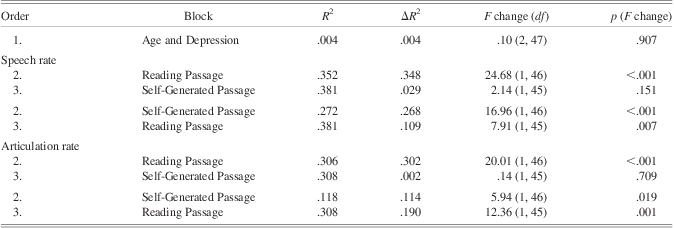
The models evaluating the cognitive demand of speech tasks are summarized in Table 4. The association between information processing speed and speech variables was much stronger for reading than it was for self-generated speech, contrary to our hypothesis. For speech rate, above and beyond age and depression, the Reading Passage accounted for 35% of the variance while the Self-Generated Passage accounted for only 3%. When the Self-Generated Passage was entered first, it accounts for 27% of the variance with the Reading Passage still accounting for an additional 11%. The results for articulation rate paralleled those for speech rate. Entered first, the Reading Passage accounted for 30% of the variance with a negligible amount of additional variance from the Self-Generated Passage. Self-Generated Passage entered first accounted for 11% of variance and the Reading Passage added 19%.
Influence of speech task: Information processing speed composite as the dependent variable
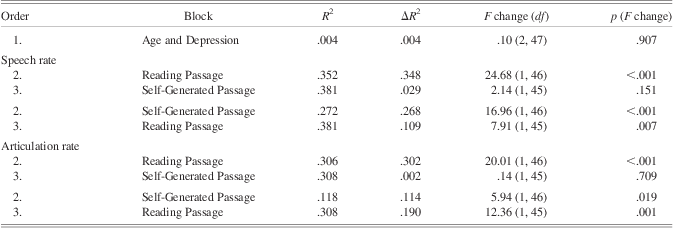
Note. Order column represents the order of variables entered into hierarchical regression models. For all models, age and depression were entered first, followed by differing orders of the speech or articulation rate measures from the Self-Generated or Reading Passages.
Discussion
In this prospective study, we found differences on rate measures for both oral reading and self-generated speech produced by MS patients compared to healthy controls. The effect sizes were of medium magnitude. Regression models predicting rate from cognitive abilities were statistically significant for patients but not healthy controls. Findings therefore support the hypothesis that cognitive changes may be a factor in speech-motor performance in MS, as measured by rate of speech. In addition, high sentence intelligibility scores suggest that cognitive rather than physiological (i.e., dysarthria or speech-motor) variables contributed to the slower speech and articulation rates for MS patients. This is further supported by closely similar results when a commonly used measure of articulation was included as a follow-up analysis.
Generally, these results replicate the findings of Benedict et al. (Reference Benedict, Holtzer, Motl, Foley, Kaur, Hojnacki and Weinstock-Guttman2011) who reported robust correlations between aspects of processing speed, ambulation, and manual speed/dexterity in MS. We extend those findings, tentatively, to speech-motor behavior during connected speech, in the form of speech rate and articulation rate measures. Benedict et al. (Reference Benedict, Holtzer, Motl, Foley, Kaur, Hojnacki and Weinstock-Guttman2011) hypothesized that shared neural networks involving frontal white matter mediate both gross motor control and cognitive processing, and that neuropathology in these shared networks may be a possible source of concurrent impairments. This relationship can also be seen in work with structural imaging and post-mortem studies of frontal and subcortical regions tied to processing speed being critical in regulating aspects of gait (e.g., step-length and support time; Rosano, Brach, Studenski, Longstreth, & Newman, Reference Rosano, Brach, Studenski, Longstreth and Newman2007; Rosano et al., Reference Rosano, Studenski, Aizenstein, Boudreau, Longstreth and Newman2012). Although these studies link gross motor skills to cognitive processing through shared neuropathology, there is limited research coupling cognition and speech-motor behavior in MS. The current study begins to elucidate this link. Impairments in information processing speed and real-world speech-motor function, (i.e., rate of connected, complex speech) may also reflect shared, common regions of brain pathology, a hypothesis we are considering for future research. Like Arnett et al. (Reference Arnett, Smith, Barwick, Benedict and Ahlstrom2008), we believe that oral motor impairment also impacts cognitive performance where speech is required.
Our data did not support the idea that self-generated speech is more difficult or relevant for cognition than simple reading. One possible explanation is that allowing participants to select a topic for the Self-Generated Passage from among several on a list (i.e., hobbies, jobs) yielded a familiar topic which the participants had prior experience discussing. This suggestion is borne out by the small contribution of the memory composite to rate measures in the Self-Generated Passage, but not the Reading Passage. Future studies could evaluate this idea by studying Self-Generated Passages where participants are and are not allowed to choose their own topic.
Limitations to the study include a small sample size (MS group [n = 50]) for conducting a multiple regression analysis. We attempted to minimize the number of variables through the use of composites. Also, no statistical correction was used in the regression models, indicating a risk of type-1 error. This was considered justified as this study is an initial exploration of the cognitive-speech motor relationship with real-world rate measures. Future research into these relationships should expand the sample size and potentially use more conservative statistical procedures (e.g., Bonferroni correction). There was also a time delay between collection of cognitive tests and speech measures, although subsequent analysis indicated this was not related to performance. Also, for the Self-Generated Passage, we did not evaluate the content or complexity of speech, which may provide additional evidence for the increased or decreased demand of the task.
This study benefited from using well-validated speech (Tjaden & Wilding, Reference Tjaden and Wilding2004; Yorkston et al., Reference Yorkston, Beukelman and Tice1996) and cognitive measures with demonstrated psychometric properties (Benedict et al., Reference Benedict, Cookfair, Gavett, Gunther, Munschauer, Garg and Weinstock-Guttman2002, Reference Benedict, Fischer, Archibald, Arnett, Beatty, Bobholz and Munschauer2006) and strong relationships to brain MRI (Benedict et al., Reference Benedict, Weinstock-Guttman, Fishman, Sharma, Tjoa and Bakshi2004). It also tested a range of cognitive constructs often compromised in MS. We provided an expansion of the existing work on the interplay between cognitive variables and speaking rate measures in MS. We conclude that cognitive abilities, particularly information processing speed, may be related to speech and articulation rate during connected speech for MS patients. Further imaging studies should evaluate the possibility of shared regional pathology that may explain the observed relationship between speech production and cognitive ability. Further research is also needed to evaluate the perceptual and clinical relevance of the speaking rate aberrancies for participants with MS. These aberrancies may contribute to reduced speech naturalness which may, in turn, have implications for potential employability, social relationships (Baylor et al., Reference Baylor, Yorkston, Bamer, Britton and Amtmann2010; Klugman & Ross, Reference Klugman and Ross2002), and perceived competence (Allard & Williams, Reference Allard and Williams2008). Finally, this study continued to demonstrate the utility of the SDMT as a component of comprehensive measurement of cognitive impairment in MS, as seen in prior studies (Benedict et al., Reference Benedict, Holtzer, Motl, Foley, Kaur, Hojnacki and Weinstock-Guttman2011; Drake et al., Reference Drake, Weinstock-Guttman, Morrow, Hojnacki, Munschauer and Benedict2010).
Acknowledgments
Research supported by NIH-NIDCD R01DC004689. PI: K. Tjaden. The authors report no conflicts of interest. The authors would like to acknowledge Ms. Marietta Hoogs for her contribution to recruitment and data collection.