1. Introduction
Stigmaria Brongniart is the large dichotomizing rhizomorph base of Carboniferous arborescent lycophytes, such as Lepidodendron Sternberg, Lepidophloios Sternberg and Sigillaria Brongniart, that bears spirally distributed roots or circular scars where the roots had once been.
Specimens referable to Stigmaria had been figured in early literature (Petiver, Reference Petiver1704; Volkmann, Reference Volkmann1720; Woodward, Reference Woodward1729; Martin, Reference Martin1809), although they were given various names and interpreted in different ways. There was much early debate on the nature of the stigmarian axes and Brongniart (Reference Brongniart1822) first used Stigmaria as a generic name for a type of cast that had been included by Sternberg (Reference Sternberg1820) in his genus Variolaria (a name already given to an extant lichen). Brongniart (Reference Brongniart1828) later gave a more detailed description of specimens of Stigmaria ficoides (Sternberg) Brongniart and made the first proposal for a relationship between Stigmaria and the extant quillwort Isoetes L., but it was Brown (Reference Brown1848) who demonstrated the relationship between Lepidodendron and Stigmaria.
The internal structure of Stigmaria was first published by Lindley & Hutton (Reference Lindley and Hutton1837) from a specimen that showed both external features and internal anatomy. Anatomical studies were described by many others including Brongniart (Reference Brongniart1839), Göppert (Reference Göppert1841), Binney (Reference Binney1844) and Corda (Reference Corda1845), but it was Williamson (Reference Williamson1887) that gave the first comprehensive study of large casts and of anatomy from petrifactions.
The extensive literature that followed on Stigmaria has been summarized to some extent by Jongmans (Reference Jongmans1936), Chaloner (Reference Chaloner and Boureau1967) and Frankenberg & Eggert (Reference Frankenberg and Eggert1969). Here we describe a new specimen of a virtually complete Stigmaria rhizomorph from Brymbo, north Wales that has a sizable trunk attached, which is rather unusual for this iconic Carboniferous plant fossil. We also show that preserved Stigmaria fossils are actually rarer than thought and few are well preserved; using this new find, we also summarize how these impressive rhizomorphs became preserved as fossils.
2. Geological setting
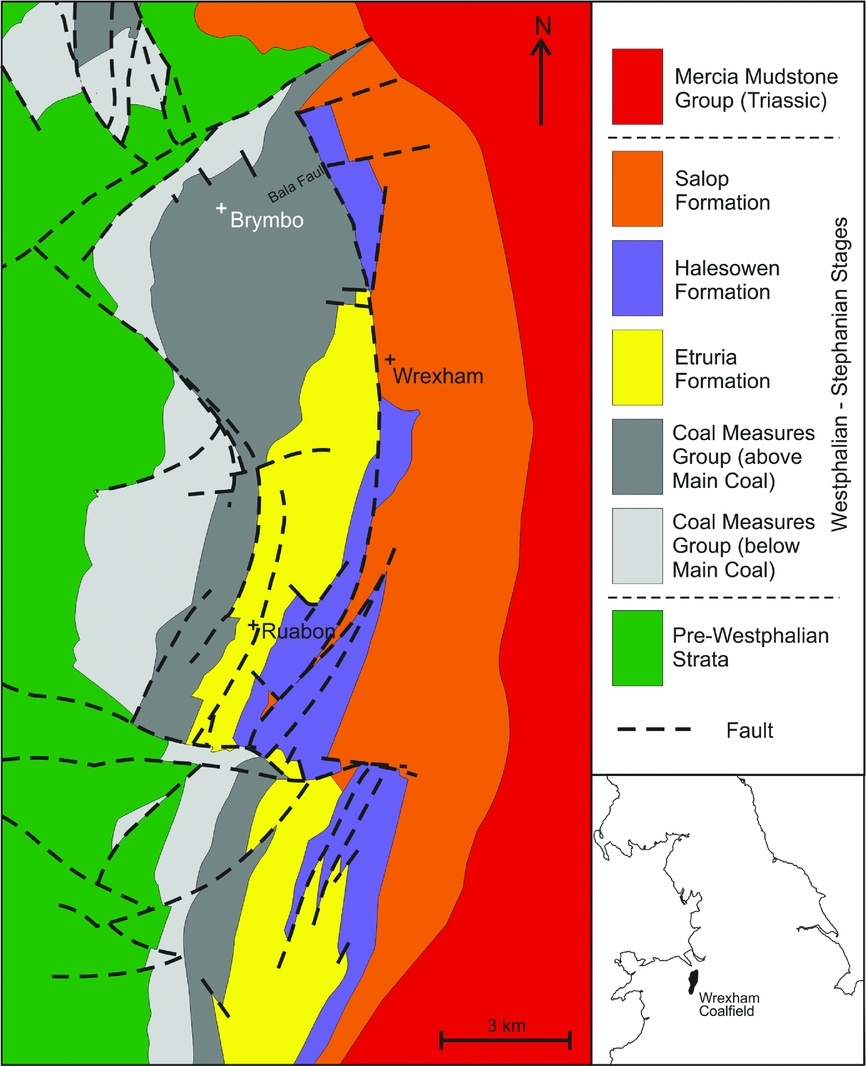
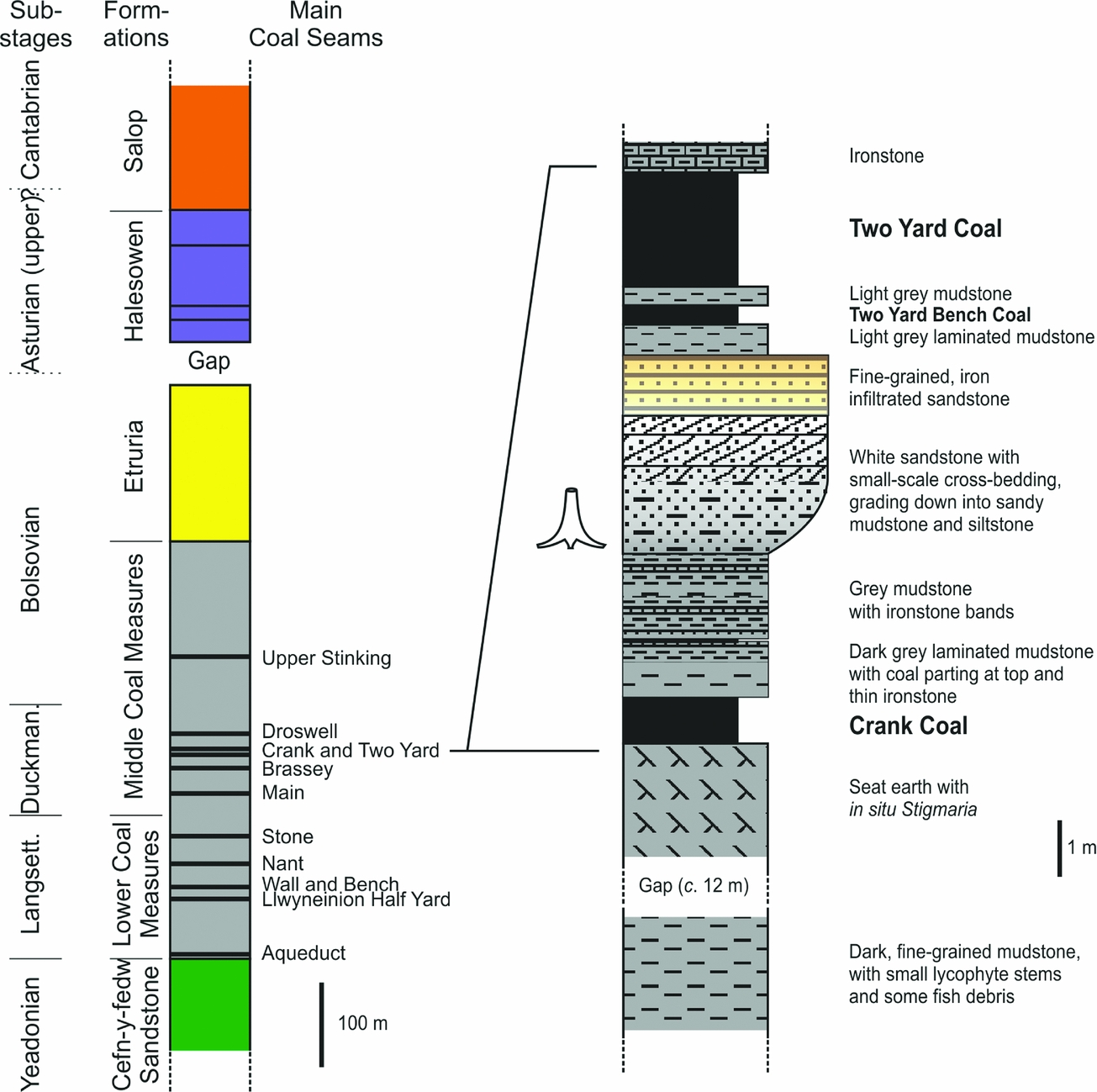
The Denbighshire Coalfield is on the southern margins of the Pennine Basin, with a relatively condensed succession of Pennsylvanian (upper Carboniferous) strata (Fig. 1). The succession (Fig. 2) consists in the lower part of grey coal-bearing beds (Lower and Middle Coal Measures) that pass upwards into barren red beds of the Etruria Formation. Recent opencast mining after the closure of the steelworks at Brymbo, Wrexham in north Wales revealed sediments from the Main Coal to the Two Yard Coal (middle–upper Bolsovian, Fig. 2). The Brymbo exposure shows the uppermost c. 14 m of the Coal Measures which are associated with two coal seams, the Crank Coal and the Two Yard Coal (Fig. 2). The lower part of the sequence is buried where there is a palaeosol with Stigmaria, some of which were removed for storage. The largest basal stump is c. 850 cm tall and 105 cm broad at its base, and is covered with vertical ridges suggesting that it was probably the base of a Sigillaria. These trunks broadened at their bases, but none had Stigmaria.
Geological map of the Denbigh Coalfield. Inset shows location of the coalfield in Britain. Figure reproduced with permission from Appleton et al. (Reference Appleton, Malpas, Thomas and Cleal2011).

A generalized sequence through the Denbigh Coalfield succession showing the main coal seams, together with a detailed graphical log of the sequence exposed at Brymbo. Langsett. – Langsettian; Duckman. – Duckmantian. The stump indicates the position of the Stigmaria removed for study. Figure adapted with permission from Appleton et al. (Reference Appleton, Malpas, Thomas and Cleal2011).
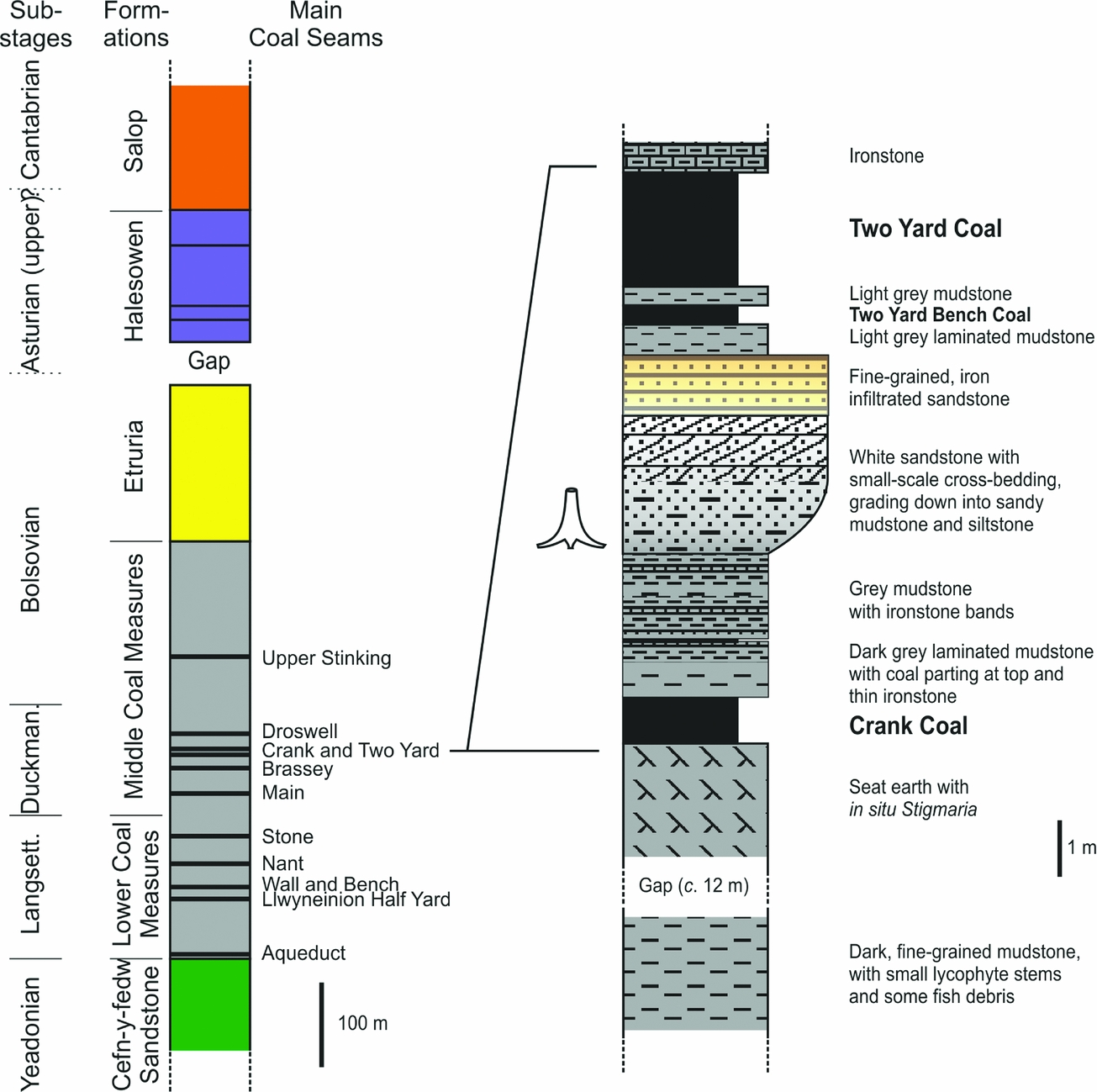
The Crank Coal is c. 0.8 m thick and is overlain by an essentially coarsening sequence of laminated carbonaceous mudstones, within the lowest metre of which is a thin band of ironstone. The succeeding 2 m unit grades from a mudstone to a siltstone with ‘inter-tonguing’ shallow sandstone lenses. This is overlain by a thin nodular mudstone, which in turn is overlain by a massive sheet-like sandstone. The next 1.5 m is a sequence of four interbedded sandstones with mudstones, which underlies the thin Two Yard Bench Coal. The Two Yard Bench Coal is separated from the Two Yard Coal at the top of the sequence by 70 cm of a mudstone palaeosol (Fig. 2). The sequence at Brymbo has been interpreted by Appleton et al. (Reference Appleton, Malpas, Thomas and Cleal2011) as a vegetated swampy floodplain (which produced the Crank Coal) that was flooded, and a lake formed (mudstones). As a fluvial delta encroached (coarsening sandstones) the lake shallowed and the floodplain emerged and became re-vegetated (eventually forming the Two Yard Coal).
3. The Brymbo lycophytes
A small area of exposed Carboniferous rocks at Brymbo was saved from opencast mining when a well-preserved assemblage of plant fossils was found. Most importantly, there were both arborescent lycophyte and calamite stems found in growth position at several horizons (Appleton et al. Reference Appleton, Malpas, Thomas and Cleal2011; Thomas, Reference Thomas2014).
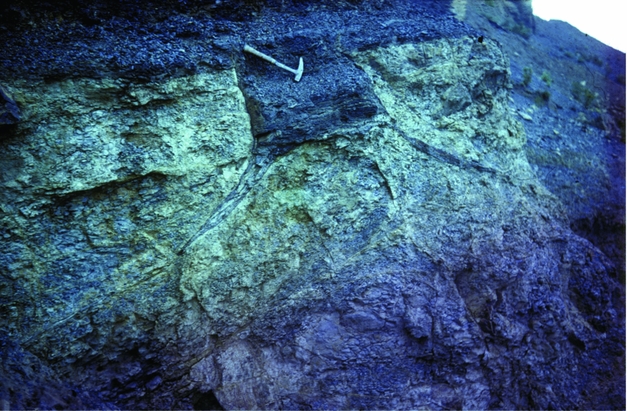
About 20 erect trunks have been found at the site with most being rooted in a thin 1–2-cm-thick coal parting c. 1.25 m above the Crank Coal. The trunks range up to 1.5 m in diameter and 2.5 m in height with their casts being formed either in sandstone or less durable mudstone, but there are no recognizable Stigmaria. The erect stems are therefore enclosed in the succeeding 2 m unit that consists of mudstone grading upwards to a siltstone with inter-tonguing sandstone lenses (Fig. 2). The basal part of one of the trunks was filled with yellow clay, composed dominantly of fluor-apatite (calcium halophosphate) with some goethite, which gave it a yellow colour. We have no explanation for this preservation as no other deposit of this clay has been found on the site.
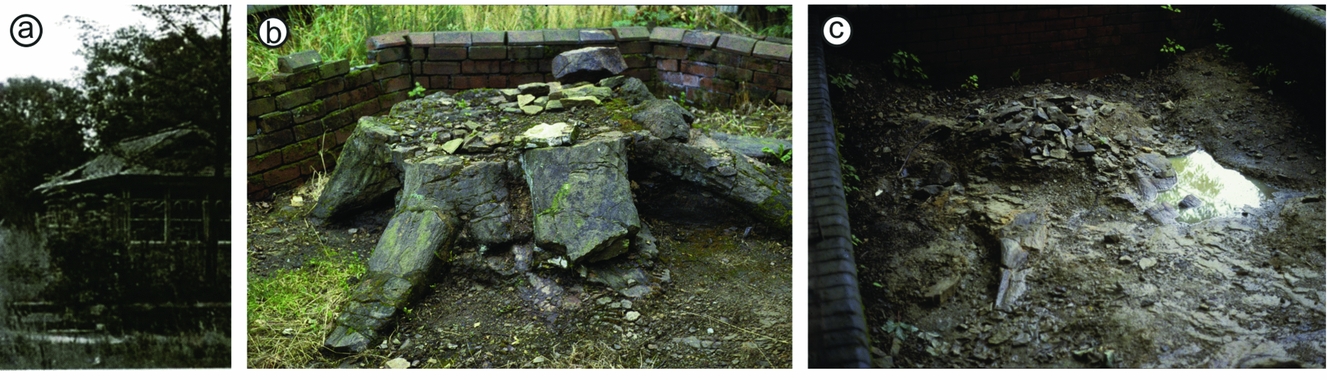
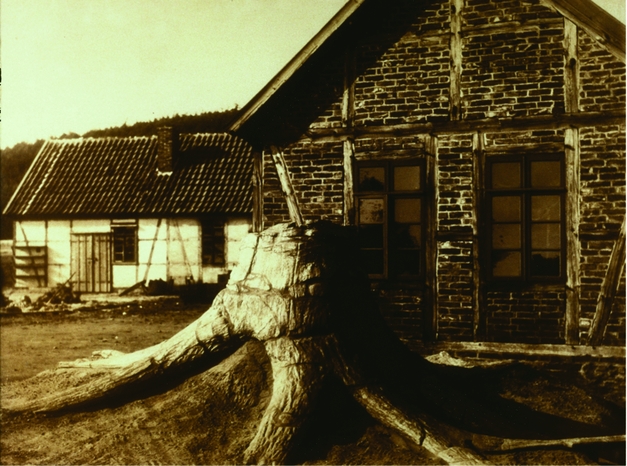
Several more or less flattened casts of prone trees have been found in the upper part of the unit. An exceptionally well-preserved trunk was found in this sandstone horizon and its Stigmaria was excavated to show it spreading out beneath the trunk (Fig. 3a), along with other casts of sigillarian tree stumps with small bases (Fig. 3b) and large fragments of Stigmaria (Fig. 3c).
Stigmaria in situ at Brymbo, North Wales. (a) Stigmaria and trunk in situ (photograph by author BAT, c. 2010). (b) Exposure face with a stem cast with stigmarian base (left) and the mould of another (right), both rooted in the same level. Yellow measure 1 m long (photograph by BAT, c. 2010). (c) Distal tapering fragment of an isolated portion of Stigmaria (photograph by BAT, c. 2010).

The complete spread of the dichotomizing stigmarian base is nearly 5 m and the amount of drop of the final Stigmaria ends from the base of the stem is c. 150 mm (Fig. 3a). This Stigmaria has a vertical stem cast that is 1.7 m tall, tapering slightly from a diameter of 540 mm to 480 mm (Fig. 3a). The outer surface shows some vertical striations but no other details. This Stigmaria and its trunk was removed from the exposure and safely stored with the intention of reconstructing it when the opportunity arises. Lithologically the cast is a siltstone, similar to the surrounding sediments.
In the upper part of this unit there was an isolated length of Stigmaria, 8 m long, that shows no tapering at all.
4. Other notable Stigmaria
There have been many descriptions of in situ lycophyte trunks in the literature (Buckland, Reference Buckland1840; Brown, Reference Brown1846, Reference Brown1848, Reference Brown1849; Young, Reference Young1868; Balfour, Reference Balfour1872; Brongniart, Reference Brongniart1828; Kidston, Reference Kidston1891; Lyell, Reference Lyell1843; Dawson, Reference Dawson1853, Reference Dawson1859, Reference Dawson1882; Lyell & Dawson, Reference Lyell and Dawson1853; Ferguson, Reference Ferguson1988; Scott, Reference Scott, Blundell and Scott1998; Falcon-Lang & Calder, Reference Falcon-Lang and Calder2004; Thomas, Reference Thomas, Bowden, Bureck and Wilding2005), but there are fewer accounts of in situ Stigmaria.
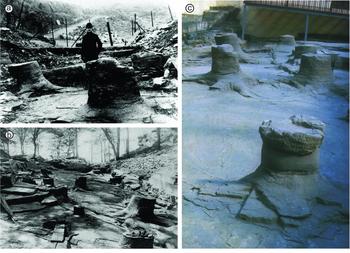
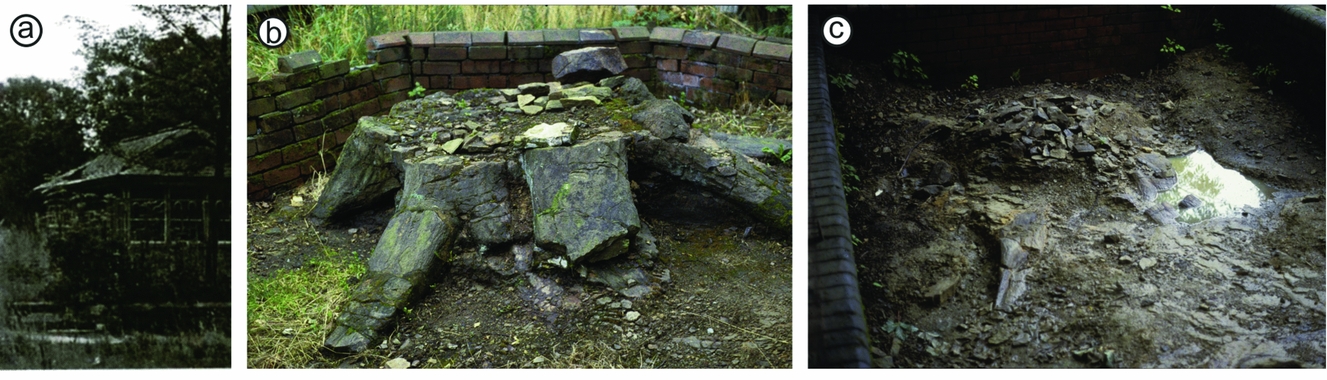
Hawkshaw (Reference Hawkshaw1839) reported erect trees preserved with their basal parts and Binney (Reference Binney1844) described Sigillarian fossil trees with their root-organs showing the characteristics of Stigmaria. Hooker (Reference Hooker1848) described some Bolton Railway trees from which Stigmaria extended outwards for “upwards of 20 feet” (over 6 m). In 1873, excavations for new buildings in the grounds of the Wadsley Asylum (later Middlewood Hospital and now a housing development) in Sheffield uncovered a group of lycophyte stumps with short lengths of Stigmaria rhizomorphs attached. Sorby, who was Professor of Geology at Sheffield at the time, ensured that special buildings (Fig. 4a) were constructed to protect several of them (Sorby, Reference Sorby1875). Unfortunately the buildings were left to deteriorate and collapsed sometime after the 1960s exposing the Stigmaria (Fig. 4b), which started to disintegrate (Fig. 4c).
Stigmaria in situ at Sheffield, England: (a) former building housing a Stigmaria (photograph by BAT, c. 1964); (b) a second Stigmaria exposed after the collapse of its building (photograph by BAT, c. 1964); and (c) the same Stigmaria shown in (b), after weathering (photograph by BAT, c. 2002).
The new housing developments at Middlewood provided the opportunity to excavate more of the site revealing remains of many stigmarian bases and fallen stems. After charting the remains, the site was covered over to preserve the remains from weathering (Boon, Reference Boon2004).
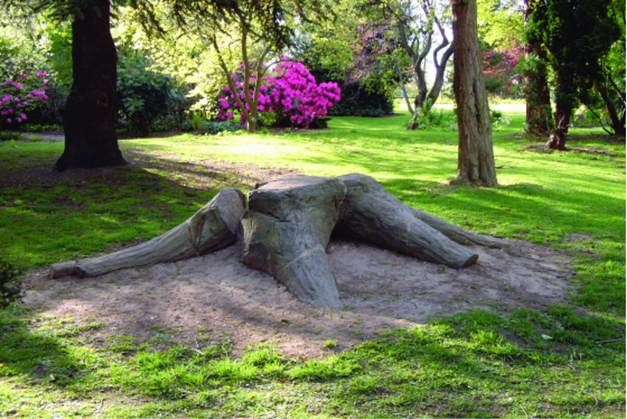
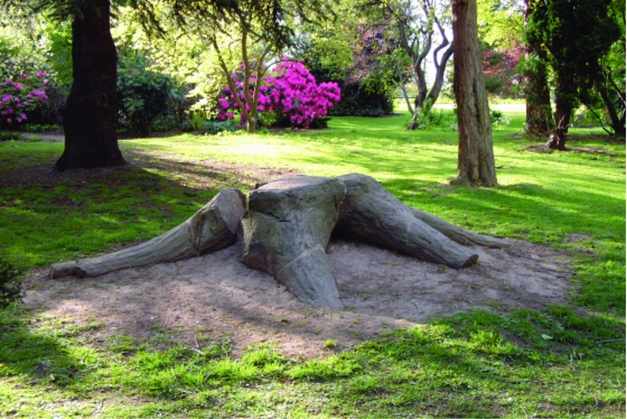
Soon after the Wadsley Stigmaria were found, another specimen was excavated from a railway cutting near Chappeltown. It was first taken to the contractor's garden at ‘High Hazels’, Darnall in 1875 where it remained for over 100 years. In the early 1980s it was transferred to the Sheffield Botanic Gardens (Hunter, Reference Hunter2013). The trunk is c. 80 cm in diameter and the total span is c. 2 m (Fig. 5).
Stigmaria in the Botanic Gardens, Sheffield, England. Courtesy of J. Hunter.
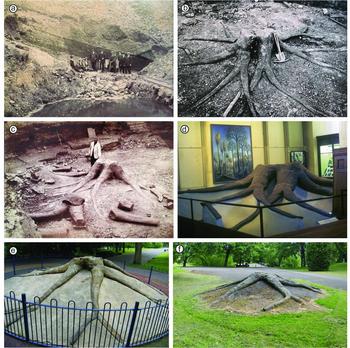
In 1886 William Crawford Williamson, the Professor of Natural History in Manchester, obtained a Stigmaria from a quarry at Clayton (Fig. 6a) near Bradford (Williamson, Reference Williamson, Watson and Thomas1896). It was 28 feet (c. 9 m) across when uncovered (Fig. 6b) and the discovery was just in time for Williamson to include a photograph and measurements of it in his monograph on Stigmaria (Fig. 6c; Williamson, Reference Williamson1887). He purchased the Stigmaria and paid for its removal to Manchester. Now mounted in the Manchester Museum, it is only 6 m across with the furthest extensions of the system not included in the reconstruction because of space constraints (Fig. 6d). This is probably the most well-known and often figured Stigmaria (e.g. Frankenberg & Eggert, Reference Frankenberg and Eggert1969; Cleal & Thomas, Reference Cleal and Thomas2009; Stewart & Rothwell, Reference Stewart and Rothwell1993, fig. 11.12). What is not so widely known is that two further specimens of complete Stigmaria were taken from the same quarry at Clayton and reconstructed in two Bradford parks. They are still there, with one in Whitfield Park (Fig. 6e) and the other in Lister Park (Fig. 6f).
Stigmaria from a quarry at Clayton, Bradford, England: (a) view of the quarry with a party of visiting geologists (c. 1880s), (b) in situ Stigmaria from Williamson (Reference Williamson1887); (c) dismantling the Stigmaria for removal to Manchester; (d) the Stigmaria after removal and reconstruction in the Manchester Museum (photograph courtesy of Dr Joan Watson); (e) a Clayton quarry Stigmaria reconstructed in Whitfield Park, Bradford (photograph by BAT); and (f) a Clayton quarry Stigmaria reconstructed in Lister Park, Bradford (photograph by BAT).

In 1887 a group of 11 Stigmaria (Fig. 7a, b) was uncovered during excavations of Namurian sandstone in the new Victoria Park in Glasgow, opened to honour Queen Victoria's Jubilee (Young & Glen, Reference Young and Glen1888). The Scottish palaeobotanist Robert Kidston had been involved in the excavation and played a crucial part in persuading Glasgow Council to construct the glass-roofed building to protect this world-famous ‘Fossil Grove’ (Fig. 7c). Interestingly, these Stigmaria are incomplete with only short lengths of the rhizomorphs (Fig. 7c). Preservation by incursion of sediments into the rhizomorphs must have been curtailed with none reaching the more distal parts. For further information on this site and the stigmarias see McGregor & Walton (Reference McGregor and Walton1948, Reference McGregor and Walton1972), McLean (Reference McLean and Bluck1973), Lawson & Lawson (Reference Lawson and Lawson1976), Gastaldo (Reference Gastaldo1986a ), Cleal & Thomas (Reference Cleal and Thomas1995), Thomas & Cleal (Reference Thomas and Cleal2005) and Thomas & Warren (Reference Thomas, Warren, Burek and Prosser2008).
Stigmaria at Victoria Park, Glasgow, Scotland: (a) excavation of the Victoria Park Stigmaria (1887); (b) the exposed Stigmaria (1887); and (c) the Stigmaria within the specially constructed building (recent photograph by BAT).

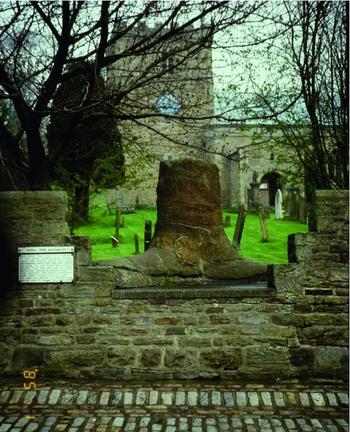
A similarly curtailed stigmarian base with a length of trunk attached was uncovered in 1915 and then reconstructed in the 1960s in a gap in a wall at St Thomas’ Church, Stanhope, County Durham, UK (Fig. 8). The original specimen was found at a quarry near Edmundbyers Cross just north of Stanhope. Two other similar specimens were also recovered, formerly on display at the Hancock Museum (now the Great North Museum, Hancock).
Stigmaria found at a quarry near Edmundbyers Cross, reconstructed in 1915 at Stanhope's St Thomas’ Church, County Durham, England (photograph by BAT).

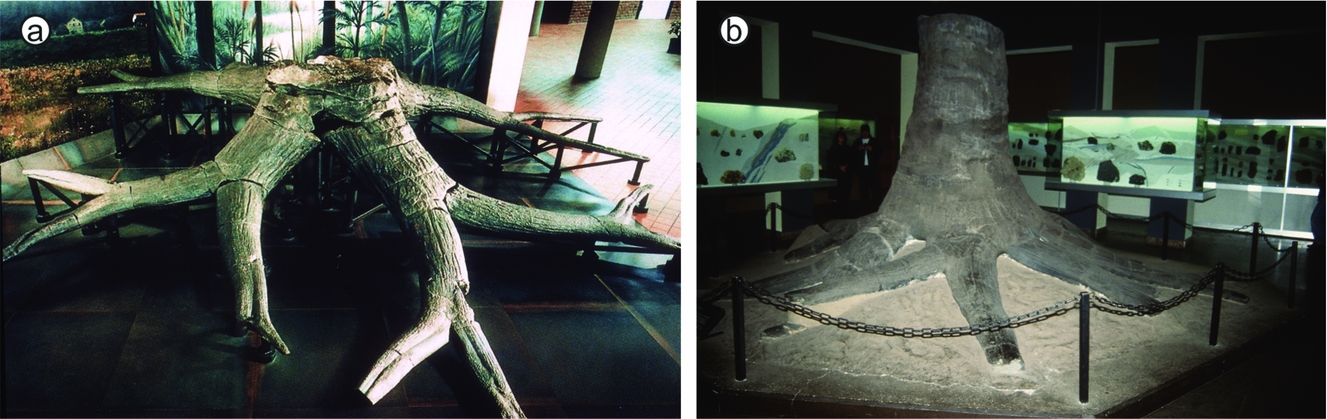
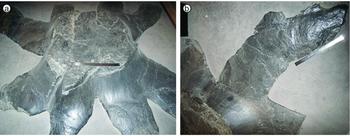
In Germany there are two Stigmaria currently on display. Both were recovered from the Westphalian (Middle Pennsylvanian) Piesberg colliery; one now stands in the Museum Am Schölerberg in Osnabrück (Fig. 9a), the other at the Deutsches Bergbau-Museum in Bochum (Fig. 9b). There was however a third specimen that was first reconstructed to stand outside the shaft of the Piesberg colliery (Fig. 10), but then was moved to the Berlin Bergakademie. Potonié (Reference Potonié1899), copied by Gothan & Remy (Reference Gothan and Remy1957) and Remy & Remy (Reference Remy and Remy1977), figured this large Stigmaria with the base of a trunk that was thought to be Sigillaria. This specimen was lost in the bombing of Berlin in the Second World War because it was too large to be moved to safety. Interestingly, perhaps reflecting their apparent rarity, there is a reproduction cast of the Stigmaria that is currently displayed at the Museum Am Schölerberg, Osnabrück in the Senckenberg museum, Frankfurt am Main.
Two surviving Stigmaria from the Piesberg colliery, Osnabrück, Germany: (a) specimen currently on display at the Museum Am Schölerberg in Osnabrück; and (b) the specimen currently on display at the Deutsches Bergbau-Museum in Bochum.

One of the Stigmaria from the Piesberg colliery, Osnabrück, Germany (photograph courtesy of Prof Dr Hans Kerp), reconstructed at the quarry site, before it was moved to Berlin where it was subsequently destroyed during World War II.

There is a somewhat curtailed Stigmaria on display in the Smithsonian Institution National Museum of Natural History, USA (Fig. 11a, b) from the Lower Freeport coal bed (late Desmoinesian in age, early Cantabrian) from the Stanley Mine, Sykesville, Pennsylvania which was purchased by the museum in 1915 after it had been given to Mr M. W. Harvey from a roof fall in the mine and displayed at his Sunday school.
Stigmaria (specimen number 34989) on display at the Smithsonian Institution National Museum of Natural History (both photographs courtesy of Dr W. A. DiMichele, 2014): (a) the spread of the specimen with clear dichotomizing axes; and (b) this specimen has a smooth outer surface as seen here on the longest axis of this Stigmaria (from the upper left portion of (a)). Measure in both photographs is 45 cm.

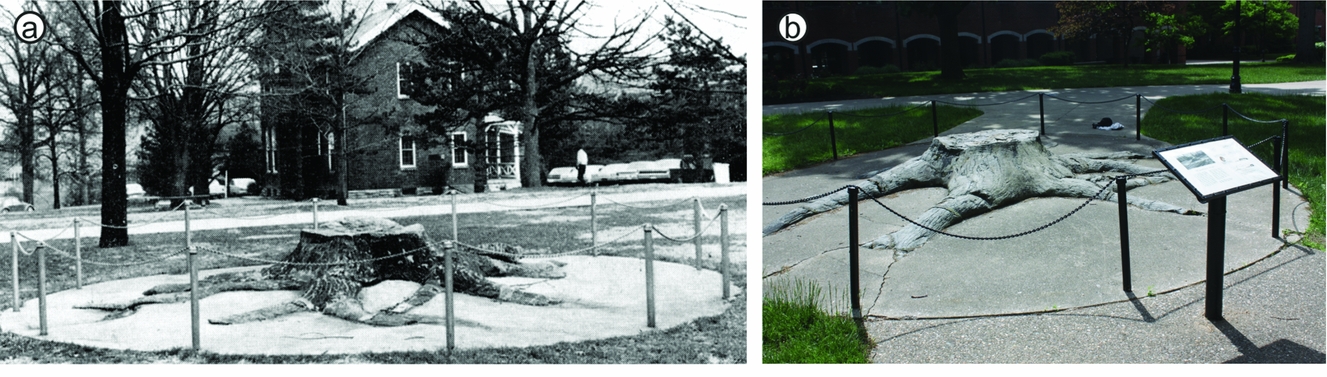
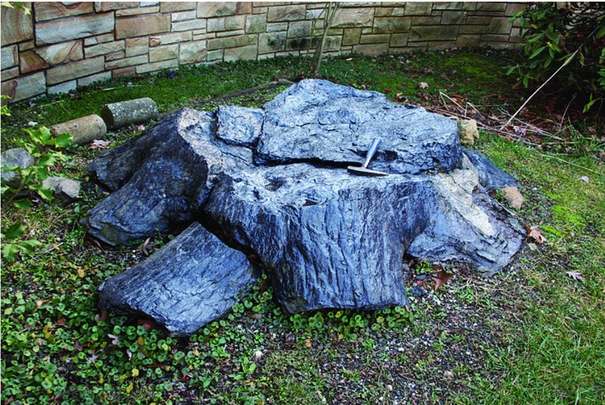
There is a Stigmaria on display at the campus of the University of Kentucky (Fig. 12a, b). It came from above the Pennsylvanian Harlan Coal Seam, Pikeville Formation of the Clover Fork Coal Company at Kitts, Harlan County in Eastern Kentucky. The manager of the mine, Mr George Whitfield, brought it to the surface in a special car after widening the mine's passageways and it remained on display at Kitts from the late 1930s to 1961 when it was donated to the University of Kentucky (Anon, 1967). Another is on display at the West Virginia Geological and Economic Survey (Fig. 13) from Consol's Itmann No. 1 Mine in 1974 Wyoming County West Virginia (Base of the Pottsville Formation, Namurian B). The Pocahontas No. 3 Coal was mined extensively at this mine, so the Stigmaria most probably came from above or below this seam.
Stigmaria from the Harlam coal seam, Clover Fork Coal Company pit, Eastern Kentucky, USA now on display at the campus of the University of Kentucky: (a) soon after its reconstruction at the University (early 1960s), courtesy Carolina Tips; and (b) recent photograph supplied by Dr F. R. Ettensohn.

Stigmaria at the Geological Survey for West Virginia.

There are reports of Stigmaria finds across Alabama. In situ lycopod forests are preserved across the Plateau Coal Field, Blount County, Alabama (upper Namurian – lower Westphalian), some trees as trunks, others as stumps with Stigmaria attached, or isolated stigmarian fragments (Gastaldo, Reference Gastaldo1986b ). From the Mary Lee coal cycle (Upper Pottsville Formation, Langsettian) of the Black Warrior Basin, Walker County, Alabama, Gastaldo, Stevanovic-Walls & Ware (Reference Gastaldo, Stevanovic-Walls, Ware, Pashin and Gastaldo2004) also reported upright trunks and Stigmaria.
5. Significant finds of lycophyte trunks without Stigmaria attached
There are significantly more finds of lycophyte trunks published than those of large Stigmaria, and here we briefly summarize key finds to highlight the difference in the numbers of finds between the stumps and Stigmaria.
5.a. UK
Fossil tree stumps were recorded in a sandstone quarry at Balgray, three miles north of Glasgow (Buckland, Reference Buckland1840). Another small group of five or six stumps was uncovered in a nearby sandstone quarry (Young, Reference Young1868). Balfour (Reference Balfour1872) described many stems near Morpeth (in Northumberland) as “standing erect at right angles to the planes of alternating strata of shale and sandstone” and varying “from 10 to 20 feet in height, and from one to three feet in diameter”. There were 20 portions of these trunks within half a mile, with all but four or five being upright. Brongniart (Reference Brongniart1828) also mentioned similar erect stems near St Etienne in France. Kidston (Reference Kidston1891) described some standing fossil trees from a marl pit near Hanley in Staffordshire whose outer surfaces only showed longitudinal striations. He detailed their dimensions but thought that it was impossible to say if they belonged to Lepidodendron or Sigillaria. The maximum height shown by these trunks was given as 18 feet (5.48 m) and maximum diameter was 7 feet 3 inches (2.2 m) on an 8-feet-tall (2.4 m) trunk.
5.b. Canada
There have been descriptions of other stands of lycophyte stems such as the cliffs at Joggins on the west coast of Nova Scotia, Canada (Lyell, Reference Lyell1843; Dawson, Reference Dawson1853, Reference Dawson1859, Reference Dawson1882; Lyell & Dawson, Reference Lyell and Dawson1853; see also Ferguson, Reference Ferguson1988; Scott, Reference Scott, Blundell and Scott1998; Falcon-Lang & Calder, Reference Falcon-Lang and Calder2004; Thomas, Reference Thomas, Bowden, Bureck and Wilding2005). A second lepidodendroid forest in Nova Scotia was reported by Brown (Reference Brown1846, Reference Brown1848, Reference Brown1849) on the coastal section at Sydney Mines, Cape Breton where there were standing trees both above and below the Sydney Main (Harbour) seam (Asturian). More details of the forest were given by Calder et al. (Reference Calder, Gibling, Eble, Scott and MacNeil1996) who described approximately 30 trees of mixed diameters within one of the clastic splits of the Harbour seam, where they were rooted in the No. 4 seam. This could have been the result of different ages of the same species or a mixture of species.
5.c. USA
DiMichele, Eble & Chaney (Reference DiMichele, Eble and Chaney1996) reported over 800 upright trunks above the Mahoning coal (lowest Conemaugh/Asturian) in Ohio. DiMichele et al. (Reference DiMichele, Nelson, Elrick and Ames2009) detail five–six upright sigillarian trunks with basal lobes only of their Stigmaria attached, rooted in top of the middle coal bed, from the Miller Creek Mine Jenlin Pit (Desmoinesian/early Asturian) in Indiana.
This summary highlights a bias in the fossil record of lycophyte tree remains preservation towards trunks rather than large Stigmaria, but the way the trunks are preserved does have a bearing on how we believe Stigmaria were also preserved.
6. Preservation of Stigmaria
The general view is that Stigmaria and/or trunk casts are assumed to have been filled by sediments deposited above or around them. The specimen exposed as a section in a quarry face near Sheffield (Fig. 14) clearly shows that the shale from the upper bed has infiltrated the Stigmaria in the lower sandstone layer. We believe that there are two key factors to the preservation of Stigmaria.
Specimen exposed in a quarry face near Sheffield, where the shale from the upper bed has infiltrated the Stigmaria in the lower sandstone layer (photograph by BAT, 1966).

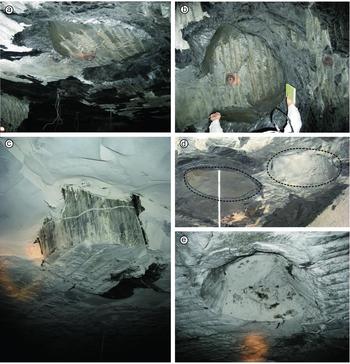
The critical limiting factor in preserving either Stigmaria or trunks is the amount of sediment that is brought into the lycophyte forests. This will determine how much of the plant is encased before the plant dies and decays. The decay rate would have been relatively rapid because, unlike conifer and angiosperm trees, they had comparatively little vascular tissue. The outer periderm, not the vascular tissue, was the main supporting tissue. The other limiting factor in preserving the Stigmaria at Brymbo was their position in the sedimentary sequence. It was only those growing as pioneers on open mud or silt that were preserved. Those growing in thin swamp peats that were covered by an inrush of sediments may have had their stems preserved, but their Stigmaria appear to have been incorporated into the peat and converted with it into coal. Those lycophytes growing on deep swamp peat may have had the basal portions of their stems preserved as casts that were eventually situated immediately above the coals. Sometimes the bases of such stumps are visible in the roofing shale after the underlying coal has been removed, and they can be a major hazard if they suddenly fall out of the roof. They are variously called kettle bottoms, bells, coal pipes, pots, caldron bottoms, tortoises or camelbacks and their surfaces are highly slickensided with a thin layer of coalified bark separating them from their casts in the surrounding sediments. Cohesion between the mould and the cast is weak and it is only the tensile strength along the bedding planes that prevents them from falling out of the roof (Fig. 15a–e).
Large fossilized plant remains can be hazardous structures in coal mines, in particular kettle bottoms which are stumps that are slickensided and liable to fall out of the mine roof. Examples from the Springfield (No. 5) Coal (late Desmoinesian age, early Cantabrian, Middle Pennsylvanian), USA (all photographs courtesy of Dr W. A. DiMichele): (a, b) a bolted stump in the roof of the Prosperity Mine, Illinois, (a) looking along the gallery and; (b) looking directly up at the stump in the roof (both photographs taken in 2007); (c) a tree trunk protrudes from the roof of the Galatia North Mine (2006); (d) two in situ kettle bottoms (inside dashed ellipses) side by side in the roof of a mine in Indiana (note the thin coalified layer surrounding each stump base, just inside dashed ellipses); and (e) space left after a kettle bottom has come out of the roof of the Galatia North Mine, Illinois (2006).

Chase & Sames (Reference Chase and Sames1983) made a study of kettle bottoms in the eastern United States which was primarily conducted in the Dunkard and Pocahontas coal basins. Those in the Dunkard Basin were usually rare, less than 2 feet in diameter and extending less than 2 feet into the roof. In contrast, some of the seams in the Pocahontas Basin had gained notoriety because of the numerous and unstable, large kettle bottoms that were 3–8 feet in diameter and extending 4–8 feet into the roof. Chase & Sames (Reference Chase and Sames1983) made the observation that sediments found on top of the coal within a kettle bottom often correspond to those deposited several feet above that same horizon. This suggests that the first inrush of sediment killed the trees, but it was later sediment that infilled the rotting stumps.
The amount of sediment infilling of the Stigmaria can also vary. Some, like the Brymbo, Manchester, Barnsley, Osnabrück and Kansas specimens, are virtually complete except for the apices which would have consisted of softer meristematic tissue (Rothwell, Reference Rothwell1984) and would therefore have been unlikely to be infilled with sediment. Others, like the Sheffield, Glasgow and West Virginia specimens, only have the larger parts of their dichotomizing axes preserved. The ends of the axes in these incomplete specimens appear as though they were broken, presumably resulting from the sedimentary infilling not reaching the more distant and smaller branches, possibly through complete tissue collapse.
The question remaining to be answered is how is the shape of the Stigmaria was retained while tissue rotted before it could be filled by the overlying sediments. Close examination of the Brymbo specimen showed it to be covered in a thin brown layer of an iron-bearing oxide mineral (FeO(OH)), the most common diagenetic iron oxyhydroxide frequently occurring on the bottom of lakes and smaller creeks (van der Zee et al. Reference Zee, van der, Roberts, Rancourt and Slomp2003) and the basis of gossan and bog iron. This precipitation would have been initiated through the water coming into contact with oxygen-rich cells of the Stigmaria, similar to the red ferric hydroxide that can be seen today in water emerging from springs or flowing from old underground workings. This precipitation would have resulted in a thin but hard layer surrounding the Brymbo Stigmaria that would have retained its shape while the tissues were rotting and breaking down and overlying sediment was entering the cavity.
Similar precipitation of ferric hydroxide has been reported in a study of Calamites pith casts from Brymbo (Thomas, Reference Thomas2014) while modern leaves have been shown to acquire a similar encrustation within a few weeks after entry into a stream or lake (Spicer, Reference Spicer1977). It is almost certain that similar analytical studies on other plant fossil remains will reveal that iron oxides play a much greater role than is recognized at present.
7. Ecological interpretations
Stigmaria give an insight to the arborescent lycophytes that dominated the Carboniferous palaeoequatorial regions of the world, and their presence shows the type of sediments in which they grew. Gastaldo (Reference Gastaldo1986a ) interpreted the silty mudstone in which the Stigmaria in the Glasgow Fossil Grove were growing as a palaeosol. The fact that Stigmaria are preserved suggests some catastrophic event, such as storm damage to the river levees, which allowed rapid ingress of large amounts of water-borne sediments such as crevasse-splay deposits to entomb them.
Stands of Stigmaria permit an estimation to be made of their abundance. For example, an extrapolation from the 11 Stigmaria in the Glasgow Fossil Grove gives an estimate of about 4500 trees per square kilometre. This suggests a dense coverage of arborescent lycophytes, possibly with overlapping crowns that would have prevented any regeneration from sporelings. The rate of growth and the lifespans of the trees are unknown, although their anatomy suggests a much more rapid growth rate and shorter lifespan than those of woody conifers and angiosperms. Clearly the plants would have produced vast numbers of spores but only in open areas, maybe after such catastrophic events outlined above, which would permit waterborne sexual reproduction (swimming of sperm from microspore antheridia to reach the archegonia formed by megaspores). Surfaces of some shales at Brymbo show large numbers of such lycophyte megaspores (up to a maximum density of c. 6 cm−2) which, given appropriate succeeding conditions, would have produced the next crop of arborescent lycophytes with their own Stigmaria.
Acknowledgments
We would like to thank Parkhill Estates, especially Colin Davis and Andrew Foster for access to the Brymbo site and for financial and logistic support for the excavation of the Stigmaria and Peter Appleton who oversaw its excavation; Sheila Jarvis and Lyn Relph for their help at Brymbo; and Prof Dr Hans Kerp for help with tracking the German Stigmaria. We thank Dr W. A. DiMichele for photographs and additional examples and Dr C. J. Cleal for images, and both for their helpful comments on the manuscript.
Declaration of interests
The authors declare no competing interests.