



1 Introduction
The complexity of a dynamical system can be measured by a number called entropy. There are two types of entropy that are measured on a continuous transformation
$T\colon X\to X$
 that preserves an invariant probability measure
$\mu $
 ; the topological entropy
$h_{\mathrm {top}}(T)$
 and the metric entropy
$h_\mu (T)$
 . The topological entropy only depends on T and it turns out that, if X is compact, the topological entropy is the supremum of the metric entropy among all the invariant probability measures,

A measure that attains this supremum is called a measure of maximal entropy (MME).
The study of measures of maximal entropy is one of the main topics in dynamical systems. The principal questions are as follows. Does there exists an MME? If it exists, is it unique? Are there finitely many ergodic ones? What statistical properties do they satisfy?
In the case of Anosov diffeomorphisms, this is well understood. There are finitely many MMEs and if the map is transitive, it admits a unique one. In both cases, they all have good statistical properties. See [Reference GouëzelG, Reference Guivarc’h and HardyGH, Reference KiferK2, Reference Parry and PollicottPP, Reference RuelleRu]. In addition, there are results for some class of non-Anosov systems that satisfies some non-uniform form of hyperbolicity [Reference YoungY1, Reference YoungY2].
Recently Buzzi, Crovisier, and Sarig proved that
$C^\infty $
 transitive diffeomorphisms with positive entropy have a unique MME [Reference Buzzi, Crovisier and SarigBCS2] and it satisfies good statistical properties [Reference Buzzi, Crovisier and SarigBCS3].
In this work, we deal with skew products, that is, maps of the form

We obtain the following result.
Theorem 1.1. Let M be a manifold, N be a surface, and
$F:M\times N\to M\times N$
 a skew product diffeomorphism over
$f:M\to M$
 such that f is a
$C^{1+}$
 Anosov diffeomorphism and F acts
$C^\infty $
 on the fibers. If
$h_{\mathrm {top}}(F)>h_{\mathrm {top}}(f)$
 , then F has a finite number of ergodic MMEs. Moreover, for each of them, there exists p such that
$f^p$
 has exponential decay of correlations, large deviation, and almost sure invariance principle for the Birkhoff sums of Hölder functions.
For skew products with circle fibers,
$N=S^1$
 , the finiteness of MME was proved to be generic when F is partially hyperbolic, and f Anosov in [Reference Rodríguez Hertz, Rodríguez Hertz, Tahzibi and UresRHTU] and in [Reference Mongez, Pacifico and PolettiMPP] when f is in a class of Derived from Anosov. It is important to note that in this work, we do not require F to be partially hyperbolic.
When M is a surface and
$f\in C^\infty $
 , we can remove the hypothesis of f being Anosov adding a condition on the entropy. Let
$h_{\mathrm {top}}(F\mid \pi )$
 be the supremum of the topological entropy along the fibers
$\{x\}\times N$
 .
Theorem 1.2. Let M and N be surfaces and
$F:M\times N\to M\times N$
 be a
$C^\infty $
 skew product diffeomorphism over
$f:M\to M$
 . If
$h_{\mathrm { top}}(F)>\max \{h_{\mathrm {top}}(f), h_{\mathrm {top}}(F\mid \pi )\}$
 , then F has a finite number of ergodic MMEs. Moreover, for each of them, there exists p such that
$f^p$
 has exponential decay of correlations, large deviation, and almost sure invariance principle for the Birkhoff sums of Hölder functions.
Both results are consequence of a condition called SPR introduced by Buzzi, Crovisier, and Sarig in [Reference Buzzi, Crovisier and SarigBCS3].
Let
$f:M\to M$
 be a
$C^{1+}$
 diffeomorphism on a compact manifold M. We recall the definition of Pesin block.
Definition 1.3. Fix
$\chi , \varepsilon> 0$
 . A
$(\chi , \varepsilon )$
 -Pesin block is a non-empty set
$\Lambda \subset M$
 for which there is a direct sum decomposition
$T_xM = E^s(x) \oplus E^u(x)$
 for all
$x \in \bigcup _{n \in \mathbb {Z}} f^n(\Lambda )$
 , and a uniform number
$C> 0$
 such that for any
$n \in \mathbb {Z}$
 ,
$j \geq 0$
 , and
$y \in \Lambda $
 ,

The SPR property defined in [Reference Buzzi, Crovisier and SarigBCS3] is the following.
Definition 1.4. A diffeomorphism f of a closed manifold is strongly positively recurrent (SPR) if there exists
$\chi> 0$
 such that for each
$\varepsilon> 0$
 , there are a Borel
$(\chi , \varepsilon )$
 -Pesin block
$\Lambda $
 and numbers
$h_0 < h_{\mathrm {top}}(f)$
 and
$\tau> 0$
 as follows.
For every ergodic measure
$\nu $
 ,

In [Reference Buzzi, Crovisier and SarigBCS3], they proved that SPR diffeomphisms have a finite number of measures of maximal entropy, each of them with good statistical properties, as follows.
Exponential decay of correlation for
$f^p$
 . There exists
$p\geq 1$
 such that, for every
$ \beta> 0 $
 , there are
$ 0 < \theta < 1 $
 and
$ C> 1 $
 such that for all
$ \varphi , \psi $
 which are
$ \beta $
 -Hölder, and for every ergodic component
$ \mu ' $
 of
$ (\mu , f^p) $
 ,

Large deviation of Birkhoff sums. For
$\beta>0$
 , there exists
$c>0$
 such that for every
$\beta $
 -Hölder
$\psi $
 with Hölder norm
$1$
 and non-zero variance
$\sigma _{\psi }$
 , we have

where
$\psi _n(x)=\sum _{j=0}^{n-1}\psi (f^j(x))$
 and
$I_\psi (a)={a^2}/{2\sigma ^2_\psi }(1+o(1))$
 when
$a\to 0$
 .
Almost sure invariance principle. The stochastic process
$(S_n)_{n \geq 1}$
 satisfies the almost sure invariance principle with parameter
$\sigma \geq 0$
 and rate
$o(n^\gamma )$
 for
$0 < \gamma < \tfrac 12$
 if there exist two stochastic processes
$(\widetilde {S}_n)_{n \geq 1}$
 and
$(\widetilde {B}_t)_{t \geq 0}$
 defined on a common standard probability space such that:
-
(1) the stochastic processes $(\widetilde {S}_n)_{n \geq 1}$
 and
$(S_n)_{n \geq 1}$
are equal in distribution;
-
(2) $(\widetilde {B}_t)_{t \geq 0}$
is a standard Brownian motion; -
(3) $|\widetilde {S}_n - \sigma \widetilde {B}_n| = o(n^\gamma )$
almost everywhere as
$n \to \infty $
.




This is satisfied for
$S_n(x)=\sum _{j=0}^{n-1}\psi (f^j(x))$
 , where
$\psi $
 is a Hölder function.
There are other implications such as the central limit theorem and convergence of momentum. For the full list of stochastic consequences of SPR, see [Reference Buzzi, Crovisier and SarigBCS3, Theorem E].
Theorems 1.2 and 1.1 are consequences of the following results.
Theorem A. Let M be a manifold, N be a surface, and
$F:M\times N\to M\times N$
 a skew product diffeomorphism over
$f:M\to M$
 such that f is a
$C^{1+}$
 Anosov diffeomorphism and F acts
$C^\infty $
 on the fibers. If
$h_{\mathrm {top}}(F)>h_{\mathrm {top}}(f)$
 , then F is SPR.
Theorem B. Let M and N be surfaces, and
$F:M\times N\to M\times N$
 be a
$C^\infty $
 skew product diffeomorphism over
$f:M\to M$
 . If
$h_{\mathrm {top}}(F)>\max \{h_{\mathrm {top}}(f),h_{\mathrm {top}}(F\mid \pi )\}$
 , then F is SPR.
To establish these theorems, we prove our main technical result, Theorem C. Its statement relates the continuity of the fiber entropy to the continuity of the fiber Lyapunov exponents for skew products with two-dimensional fibers.
In the next section, we introduce the definitions needed to precisely state Theorem C. Our result can be viewed as an adaptation of the main theorem of [Reference Buzzi, Crovisier and SarigBCS1], which studies the continuity of Lyapunov exponents with respect to entropy for surface diffeomorphisms. Since [Reference Buzzi, Crovisier and SarigBCS1] is a long and highly technical paper, rather than repeating all the calculations, we focus on the key adaptations and differences required in our case. We would like to highlight two of them: the entropy formulas for the fiber entropy developed in §5 and the reparameterization results in §6.
2 Preliminaries and statement of Theorem C
In the following, we let M be a compact metric space and N denote a smooth, compact Riemannian manifold without boundary. In addition, we assume that N is a surface.
2.1 Skew products
We denote by
$\operatorname {Diff}^\infty (N)$
 the space of
$C^{\infty }$
 diffeomorphisms of N, equipped with the Whitney
$C^{\infty }$
 topology.
Let
$f: M \rightarrow M$
 be a homeomorphism and
$g_x\in \operatorname {Diff}^\infty (N)$
 for every
$x\in M$
 .
Definition 2.1. (Skew product)
By a skew product F on
$M\times N$
 , we mean a homeomorphism
$F: M\times N \rightarrow M\times N$
 defined by

such that the following maps are continuous:

and

Definition 2.2. Let
$F_k(x, y) = (f_k(x), g_{k,x}(y))$
 . We say that the sequence of skew-products
$F_k$
 converges to
$F(x, y) = (f(x), g_x(y))$
 if the following conditions are satisfied:
-
(1) $f_k \to f$
uniformly; and -
(2) $g_{k,x} \to g_x$
in the
$C^\infty $
topology uniformly in
$x\in M$
.


2.2 Lyapunov exponents
Assume that the skew product map F is equipped with an F-invariant measure
$\mu $
 . According to Furstenberg and Kesten’s theorem [Reference Furstenberg and KestenFK], the following limits,

exist for
$\mu $
 -almost every (a.e.)
$(x,y)$
 , where

and

The numbers
$\lambda _j^c(F,x,y)$
 are called fiber Lyapunov exponents of F with respect the measure
$\mu $
 . For
$j=1,2$
 , define

If
$\lambda _1^c(F,x,y)\neq \lambda _2^c(F,x,y)$
 , then, by Oseledets theorem [Reference OseledetsO], there is a measurable splitting

such that

The subspaces
$E_j(x, y)$
 are invariant under F.
If
$\mu $
 is ergodic, then for
$\mu $
 -a.e.
$(x,y)$
 ,
$\lambda _j^c(F,x,y)=\lambda _j^c(F, \mu )$
 and the dimensions of the subspaces
$E_j(x, y)$
 are constant.
Definition 2.3. Let F be a skew product, and let
$\mu $
 be an F-invariant and ergodic measure. We say that
$\mu $
 is of saddle type if
$\lambda _1^c(F,\mu )>0>\lambda _2^c(F,\mu )$
 .
2.3 Fiber entropy
Let
$\pi $
 denote the canonical projection
$\pi : M \times N \rightarrow M$
 . For each
$x \in M$
 , we define the fiber of the product manifold
$M \times N$
 over x as

Let
$\mu $
 be an F-invariant probability measure and
$\nu = \pi _*\mu $
 . Consider the family
$\{\mu _x\}_{x \in M}$
 of conditional measures along the fibers
$N_x$
 (see [Reference RokhlinRo]). This family is uniquely determined up to a
$\nu $
 -null set.
Given a measurable partition
$\mathcal {P}$
 of N, define

Suppose that

where
$H_x(\mathcal {P})=-\sum _{P \in \mathcal {P}} \mu _x(P) \log \mu _x(P)$
 .
Theorem 2.4. [Reference Abramov and RokhlinAR]
Let F be a skew product,
$\mu $
 an F-invariant probability measure, and
$\nu = \pi _*\mu $
 . For every
$\mathcal {P}$
 satisfying (1),

This limit exists and is finite. Moreover, if we define

then

The quantity
$h_\mu (F \mid \pi )$
 is called the fiber entropy of the skew product F.
Theorem 2.5. [Reference Bahnmüller and BogenschützBB]
For a skew product F, and an F-invariant and ergodic measure
$\mu $
 , the following Margulis–Ruelle inequality type holds:

Since the fiber entropy coincides with the conditional entropy of F with respect to
$\pi ^{-1} \mathcal {B}$
 , where
$\mathcal {B}$
 is the Borel
$\sigma $
 -algebra of f (see [Reference KiferK1]), and the
$\sigma $
 -algebra generated by
$\pi ^{-1}$
 is F-invariant, then it follows that the fiber entropy satisfies the equality

In particular, we obtain the reverse Margulis–Ruelle inequality,

2.4 Main results
Theorem C. Let M be a compact metric space and N a closed smooth surface. Let
$F_k$
 ,
$k\in \mathbb {N}$
 , be a skew product, and let
$\vartheta _k$
 be an
$F_k$
 -invariant and ergodic measure. Suppose that:
-
• the limits $\lim _k \lambda _1^c(F_k, \vartheta _k)$
and
$\lim _k h_{\vartheta _k}(F_k\mid \pi )$
exist and are positive; -
• $F_k$
converges to a skew product F; -
• $\vartheta _k \xrightarrow {w^*} {\mu }$
for some
${F}$
-invariant measure
${\mu }$
.




Then, there exist
$\beta \in (0,1]$
 and two F-invariant measures
$\mu _0$
 and
$\mu _1$
 such that
$\mu =(1-\beta )\mu _0+\beta \mu _1$
 ,
$h_{\mu _1} (F\mid \pi )> 0$
 , and

Moreover, if
$\lambda _2(F,x,y)\leq 0$
 for
$\mu $
 -a.e.
$(x,y)$
 ,

Corollary 2.6. Let
$F_k$
 be a skew product, and let
$\vartheta _k$
 be an
$F_k$
 -invariant and ergodic measure. Suppose that
$F_k$
 converges to a skew product F, and
$\vartheta _k\to {\mu }$
 in the weak* topology for some
${F}$
 -invariant and ergodic probability measure
${\mu }$
 . If

then

3 The projective fiber bundle
Consider
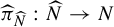
$\widehat {N}$
 to be the fiber bundle
$(\widehat {N}, \widehat {\pi }, N)$
 , where
$\widehat {\pi }_{\widehat {N}}: \widehat {N} \rightarrow N$
 is the natural projection
$\widehat {\pi }_{\widehat {N}}(x, E)=x$
 , and

Since
$\dim N = 2$
 , the manifold
$\widehat {N}$
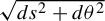
 is a smooth, compact three-dimensional manifold. We endow it with the Riemannian metric given by
$\sqrt {ds^2 + d\theta ^2}$
 , where
$ds$
 is the length element on N and
$d\theta $
 is the length element on
$\widehat {N}_x$
 . We call
$M\times \widehat {N}$
 the projective fiber bundle of
$M\times N$
 .
Definition 3.1. (Lift)
Given a skew product F on
$M\times N$
 , the canonical lift of F to
$M\times \widehat {N}$
 is defined as

where

Every
$\widehat {F}$
 -invariant probability measure
$\widehat {\mu }$
 on
$M\times \widehat {N}$
 projects to an F-invariant probability measure
$\mu $
 on
$M\times N$
 given by

where

We call
$\mu $
 the projection of
$\widehat {\mu }$
 . Analogously, given
$\mu $
 an F-invariant measure, we say that
$\widehat {\mu }$
 is a lift of
$\mu $
 if
$\widehat {\mu }$
 is
$\widehat {F}$
 -invariant and projects to
$\mu $
 .
It is not difficult to see that if the fiber Lyapunov exponents of an ergodic measure
$\mu $
 are distinct, then there are precisely two ergodic
$\widehat {F}$
 -invariant lifts of
$\mu $
 ,

Moreover, if
$\widehat {\varphi }(x,(y,E)) =\log \|D_yg_x|_E\|$
 , then

4 The discontinuity ratio of the fiber exponents
Following the definitions given in [Reference Buzzi, Crovisier and SarigBCS1], we introduce the notions of empirical measures and neutral blocks.
Definition 4.1. (Empirical measures)
Let T be a homeomorphism on a compact metric space X. Given
$\mathfrak {N} \subset \mathbb {N}$
 , let

The weak-* limit points of
$(\mu _{x, n}^{\mathfrak {N}})_{n \geq 1}$
 are called the
$\mathfrak {N}$
 -empirical measures of x.
Definition 4.2. (Neutral blocks)
Let
$\psi : X \rightarrow \mathbb {R}$
 be a continuous function, and let
$\alpha> 0$
 and
$L \geq 1$
 . An interval of integers
$(n_0, n_0 + 1, \ldots , n_1 - 1)$
 is called an
$(\alpha , L)$
 -neutral block of
$(x, T, \psi )$
 if it satisfies the following conditions:
-
(1) $n_1-n_0 \geq L$
; and -
(2) $\psi (T^{n_0}(x))+\psi (T^{n_0+1}(x))+\cdots +\psi (T^{n-1}(x)) \leq \alpha \cdot (n-n_0)$
for all
$n_0 < n \leq n_1$
.



Denote
$\mathfrak {N}_{\alpha , L}(x, T, \psi )$
 the collection of all
$(\alpha , L)$
 -neutral blocks of
$(x, T, \psi )$
 .
In [Reference Buzzi, Crovisier and SarigBCS1], the authors characterized the discontinuity ratio of the Lyapunov exponents as the proportion of time that typical orbits spend outside neutral blocks. More precisely, they proved the following proposition.
Proposition 4.3. [Reference Buzzi, Crovisier and SarigBCS1, Proposition 6.2]
Let
$T, T_1, T_2, \ldots $
 be homeomorphisms on a compact metric space X, and let
$\psi , \psi _1, \psi _2, \ldots $
 be continuous functions on X such that

For each k, let
$\vartheta _k$
 be an ergodic probability measure for
$T_k$
 with the property that
$\int \psi _k \, d\vartheta _k \geq 0$
 . Then, there exists a subsequence
$\{\vartheta _{k_i}\}$
 , and positive measures
$m_0$
 and
$m_1$
 such that the following hold.
-
(i) Both $m_0$
and
$m_1$
are invariant under T. -
(ii) The subsequence $\{\mu _{k_i}\}$
converges weak-* to
$m_0 + m_1$
. -
(iii) Let $V = (V_0, V_1)$
be neighborhoods of the measures
$m_0$
and
$m_1$
, respectively. Then, there exist constants
$\alpha _*(V)> 0$
and
$L_*(V) \in \mathbb {N}$
such that for every
$\alpha \in (0, \alpha _*(V))$
and every
$L \geq L_*(V)$
, there exists
$i_*(V, \alpha , L) \in \mathbb {N}$
such that the following holds. For every
$i \geq i_*(V, \alpha , L)$
, we have that for
$\vartheta _{k_i}$
-a.e.
$x \in X$
, the
$\mathfrak {N}_{\alpha , L}(x, T_{k_i}, \psi _{k_i})$
-empirical measures lie in
$V_0$
and the
$\mathbb {N} \setminus \mathfrak {N}_{\alpha , L}(x, T_{k_i}, \psi _{k_i})$
-empirical measures lie in
$V_1$
. -
(iv) We have $\int \psi \, dm_0 = 0$
. -
(v) For $m_1$
-a.e. point x, the limit
$\lim _{n \to \infty } ({1}/{n}) \sum _{j=0}^{n-1} \psi (T^j(x))$
is positive.











Proposition 4.4. Let
$F_k$
 be a skew product, and
$\vartheta _k\, F_{k}$
 -invariant and ergodic measures of saddle type. Suppose that:
-
(i) $\lim _{k\to \infty } \lambda _1^c(F_k, \vartheta _k)>0$
; -
(ii) $F_k$
converges to a skew product F; -
(iii) $\vartheta _k \xrightarrow {w^*} \mu $
for some F-invariant measure
$\mu $
.


Then, there exists
$\beta \in (0,1]$
 and two F-invariant measures
$\mu _0$
 and
$\mu _1$
 such that
$\mu =(1-\beta )\mu _0+\beta \mu _1$
 and some lift
$\widehat {\mu }_1$
 of
$\mu _1$
 such that

Moreover, if
$\lambda _2(F,x,y)\leq 0$
 for
$\mu _1$
 -a.e.
$(x,y)$
 , then

Proof. Recall that
$\widehat {\vartheta }^+_k$
 denotes the lift of
$\vartheta _k$
 , as defined in (4). Since
$M\times \widehat {N}$
 is compact, up to taking a subsequence, we can assume that
$\widehat {\vartheta }_k^{+} \xrightarrow {w*} \widehat {\mu }$
 for some measure
$\widehat {\mu }$
 . Apply Proposition 4.3 to
$\widehat {F}_k, \widehat {F}, \widehat {\vartheta }_k^+$
 and
$\widehat {\varphi }_k, \widehat {\varphi }: M\times \widehat {N}\to \mathbb {R}$
 defined by

and

where
$x\mapsto g_{k,x}$
 is the action on the fiber related to the skew product
$F_k$
 . By (5), we know that

Let
$\widehat {m}_0$
 and
$\widehat {m}_1$
 be the measures given by Proposition 4.3. Then, we have
$\widehat {\mu } = \widehat {m}_0 + \widehat {m}_1$
 . Define
$\beta =1-\widehat {m}_0(\widehat {M})=\widehat {m}_1(\widehat {M})$
 and
$\widehat {\mu }_i:=({1}/{\widehat {m}_i(\widehat {M})}) \widehat {m}_i$
 , or any invariant probability measure if
$\widehat {m}_i(\widehat {M})=0$
 .
By hypothesis,
$\beta \neq 0$
 . Otherwise,

Define
$\mu _i=(\operatorname {Id}, \pi _{\widehat {N}})_*\widehat {\mu }_i$
 . Since
$\widehat {\mu } = (1 - \beta ) \widehat {\mu }_0 + \beta \widehat {\mu }_1$
 and
$(\operatorname {Id}, \pi _{\widehat {N}})_*\widehat {\mu } = \mu $
 , it follows that
$\mu = (1 - \beta ) \mu _0 + \beta \mu _1 .$

Therefore, we conclude the first part. Now, let us assume that
$\lambda _2(F,x,y)\leq 0\, \mu _1$
 -a.e.
$(x,y)$
 . We claim that
$\widehat {\mu }_1=\widehat {\mu _1}^{+}$
 (the unstable lift of
$\mu _1$
 ). By Proposition 4.3 and the definition of
$\widehat {\varphi }$
 , we conclude that
$\lambda ^c_1(F,x,y)>0$
 for
$\mu _1$
 -a.e. point.
By Oseledets theorem, for
$\mu _1$
 -a.e.
$(x,y)\in M\times N$
 ,

where
$D g_x E_j(x,y)=E_j(f(x),g_x(y))(j=1,2)$
 . The measure
$\mu _1$
 has a unique lift
$\widehat {\mu _1}^{+}$
 to
$\operatorname {graph}({E}_1)$
 . Since

on
$\operatorname {graph}(E_2)$
 and any other lift of
$\mu _1$
 charge some part to
$E_2$
 , then, by Proposition 4.3, we have that
$\widehat {\mu }_1=\widehat {\mu }^{+}$
 .
Therefore,

Thus,

as required.
Remark 4.5. In contrast with [Reference Buzzi, Crovisier and SarigBCS1, Main Theorem], here, to conclude the last part of the theorem, we need the hypothesis of
$\lambda _2\leq 0$
 ,
$\mu _1$
 -almost everywhere. This was a consequence of their result. The main difference is that in the surface diffeomorphism case,
$\lambda _2>0$
 implies the existence of periodic repellers and this is not the case for skew products.
5 Entropy formulas
In this section, we present two different formulas for the fiber entropy of a skew product. The main result in §5.1 holds for ergodic saddle type measures and it is going to be applied to the sequence of measures
$\mu _k$
 in Theorem C. The formula in §5.2 is valid for any invariant measure and it will also be used in the proof of Theorem C, but now for the limit measure
$\mu $
 .
5.1 Ledrappier–Young type formulas
Let F be a skew product and let
$\mu $
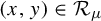
 be an F-invariant ergodic measure of saddle type. Let
$\mathcal {R}_{\mu }$
 denote the set of points where the Lyapunov exponents of
$\mu $
 are well defined.
Definition 5.1. (Fiber-wise unstable manifolds)
The set

is called the fiber-wise unstable manifold of F at
$(x, y)$
 , where
$(x, y)\in \mathcal {R}_{\mu }$
 .
Each
$ \widetilde {W}^u(x, y) $
 is a
$ C^{\infty } $
 immersed submanifold of
$ N $
 and
$\{x\}\times \widetilde {W}^u(x, y)$
 is tangent at
$ (x, y) $
 to
$E_1(x, y)$
 .
In this section, we define quantities referred to as local entropy along fiber-wise unstable manifolds. In the ergodic case, the concept of local entropy along the
$\widetilde {W}^u$
 -manifolds is represented by a number
$h^u$
 , which measures the degree of randomness along the leaves of the
$\widetilde {W}^u$
 -manifolds. This notion of entropy originates from Ledrappier and Young [Reference Ledrappier and YoungLY]. Here, we present a version for skew products as described in [Reference Liu and XieLX].
Definition 5.2. (Subordinated partitions)
A measurable partition
$\eta $
 of
$M\times N$
 is said to be subordinate to the
$\widetilde {W}^u$
 -manifolds if for
$\mu $
 -a.e.
$(x, y)$
 ,
$\eta _x(y):=\{z\in N :(x, z) \in \eta (x, y)\} \subset \widetilde {W}^u(x, y)$
 and
$\eta _x(y)$
 contains an open neighborhood of y in
$\widetilde {W}^u(x, y)$
 .
Let
$\eta $
 be a partition of
$M\times N$
 that is subordinate to the
$\widetilde {W}^u$
 -manifolds. For each
$x \in M$
 , we define
$\eta _x$
 as the partition
$\{\eta _x(y) : y \in N\}$
 of N. Recall that
$\{\mu _x\}_{x\in M}$
 is the disintegration of
$\mu $
 along the fibers
$\{x\}\times N$
 . For each
$x\in M$
 , consider

as the canonical family of conditional measures of
$\mu _x$
 associated with
$\eta _x$
 .
For
$\varepsilon> 0$
 ,
$(x, y) \in M\times N$
 , and
$n \in \mathbb {Z}^{+}$
 , define

In a manner similar to the approach taken by Ledrappier and Young [Reference Ledrappier and YoungLY], the following quantities are introduced:

These functions are clearly measurable. In addition, it is important to observe that the functions increase as
$\varepsilon \to 0$
 .
Finally, the concepts of lower and upper local entropy along the
$\widetilde {W}^u$
 -manifolds at
$(x, y)$
 , with respect to
$\eta $
 , can be defined. We remark that in [Reference Liu and XieLX], the authors use the intrinsic metric on the unstable sub-manifold to define these quantities. We remark that although we use the global metric, both definitions coincide because
$\varepsilon \to 0$
 .

We denote by
$\sigma $
 the partition
$\pi ^{-1}(\mathcal {E})$
 , where
$\mathcal {E}$
 represents the partition of M into points. Let
$\eta $
 be a partition subordinate to the
$\widetilde {W}^u$
 -manifolds such that
$\eta>\sigma $
 ,
$F^{-1} \eta> \eta $
 ,
$F^{-n}\eta $
 tends to the partition into single points, and
$h_\mu (F\mid \pi )=H_{\mu }(\eta \mid F(\eta ) \vee \sigma )$
 . Such a partition always exists (see [Reference Bahnmüller and LiuBL, Proposition 3.7]).
Proposition 5.3. [Reference Liu and XieLX, Proposition 8.6]
Let
$\eta $
 be a partition satisfying the properties above, then for
$\mu $
 -a.e.
$(x, y)$
 ,

Using this result, we conclude that the fiber entropy of a skew product F can be expressed for
$\mu $
 -a.e.
$(x,y)$
 as the local entropy along the
$\widetilde {W}^{u}$
 -manifolds, that is,

Observe that, in particular, the proposition implies that this limit does not depend on the partition
$\eta $
 .
Definition 5.4. We define the following quantity:

where

Proposition 5.5. Let F be a skew product and suppose that the measure
$\mu $
 is an F-invariant ergodic measure of saddle type. Then, for
$\mu $
 -a.e. point
$(x, y) \in M \times N$
 , we have

The proof is an adaptation of the arguments in [Reference ZangZ].
Proof. For brevity, we denote the fiber entropy
$h_{\mu }(F \mid \pi )$
 simply by
$h_F$
 throughout this proof.
Let
$\Gamma _\mu $
 denote the full measure set of points satisfying Proposition 5.3. Then, we can assume that, for every
$(x,y) \in \Gamma _\mu $
 , the local unstable entropy satisfies

Let us fix an arbitrary
$\tau> 0$
 . We define a family of sets
$\Lambda _\tau ^{\varepsilon }$
 for each
$\varepsilon> 0$
 as follows:

It follows that the union of these sets covers
$\Gamma _\mu $
 , that is,
$\bigcup _{\varepsilon>0} \Lambda _\tau ^{\varepsilon }\supset \Gamma _\mu $
 .
Now, fix
$\varepsilon>0$
 and a point
$p=(x_p, y_p) \in \Lambda _\tau ^{\varepsilon }$
 . Define

For any
$j \in \mathbb {N}$
 , we further refine this set by defining

By construction, these sets are nested,
$\Lambda _\tau ^{\varepsilon }(p, j) \subset \Lambda _\tau ^{\varepsilon }(p, j+1)$
 , and their union covers
$\Lambda _\tau ^{\varepsilon }(x_p)$
 in terms of the measure
$(\mu _{x_p})_{y_p}^{\eta _{x_p}}$
 :

Let
$\gamma> 0$
 and
$p=(x_p, y_p)\in \Gamma _\mu $
 be arbitrary. Consider

Since the union
$\bigcup _j \Lambda _\tau ^{\varepsilon }(p, j)$
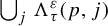 covers
$\Lambda _\tau ^{\varepsilon }(x_p)$
 in measure, and
$\bigcup _{\varepsilon>0} \Lambda _\tau ^{\varepsilon }(x_p)\supset \Gamma _\mu (x_p)$
 , we can choose
$\varepsilon> 0$
 sufficiently small and
$L \in \mathbb {N}$
 sufficiently large such that

For a given
$n \in \mathbb {N}$
 , let
$C_n \subset \Gamma _\mu (x_p)$
 be a set such that
$|C_n|$
 represents the minimum number of
$(n, \varepsilon )$
 -Bowen balls required to cover a subset of
$\Gamma _\mu (x_p)$
 with measure at least
$\gamma $
 under the measure
$(\mu _{x_p})_{y_p}^{\eta _{x_p}}$
 . Moreover, assume that
$U_n = \bigcup _{\bar {y} \in C_n} B^F_{x_p}(\bar {y}; n, \varepsilon )$
 satisfies
$(\mu _{x_p})_{y_p}^{\eta _{x_p}}(U_n) \geq \gamma $
 .
Therefore, we conclude

Let
$A_n$
 be the points
$\bar {y} \in C_n$
 for which the corresponding ball
$B^F_{x_p}(\bar {y}; n, \varepsilon )$
 has a non-empty intersection with
$\Lambda _\tau ^{\varepsilon }(p, n)$
 . That is,
$A_n = \{ \bar {y} \in C_n : B^F_{x_p}(\bar {y}; n, \varepsilon ) \cap \Lambda _\tau ^{\varepsilon }(p, n) \neq \emptyset \}$
 .
The union of balls centered in
$A_n$
 covers the intersection
$\Lambda _\tau ^{\varepsilon }(p, n) \cap U_n$
 . For each
$\bar {y} \in A_n$
 , choose an arbitrary point
$\widetilde {y} \in B^F_{x_p}(\bar {y}; n, \varepsilon ) \cap \Lambda _\tau ^{\varepsilon }(p, n)$
 . Then,

Hence, for
$n \geq L$
 ,

Therefore, for any
$\varepsilon = \varepsilon (\gamma )$
 small enough and n large enough,

Since
$\gamma>0$
 and
$\tau>0$
 were arbitrary, it follows that

The proof of the other inequality proceeds analogously using the identity with
$\limsup $
 .
5.2 Entropy formulas on the projective bundle
To analyze entropy in a way that is more compatible with the projective bundle structure, [Reference Buzzi, Crovisier and SarigBCS1] introduces a two-scale framework. First, let us recall some definitions.
Let F be a skew product and recall Definition 3.1 of the lift
$\widehat {F}$
 acting on
$M\times \widehat {N}$
 . That is,

where

Fix
$x\in M$
 and a point
$\widehat {y} = (y, E) \in \widehat {N}$
 . Given two positive scales
$\varepsilon , \widehat {\varepsilon }> 0$
 , for each
$n \in \mathbb {N}$
 , we define the x-fibered
$(n, \varepsilon , \widehat {\varepsilon })$
 -Bowen ball centered at
$\widehat {y} \in \widehat {N}$
 as the set

Given a subset
$\widehat {Z} \subset \widehat {N}$
 , we denote by

the
$(n, \varepsilon , \widehat {\varepsilon })$
 -covering number, which is the minimal number of x-fibered
$(n, \varepsilon , \widehat {\varepsilon })$
 -Bowen balls of order n needed to cover
$\widehat {Z}$
 .
Let
$\widehat {\mu }$
 be an
$\widehat {F}$
 -invariant measure and fix
$0 < \gamma < 1$
 . Consider the family
$\{\widehat {\mu }_x\}_{x \in M}$
 of conditional measures defined on the fibers
$\{x\} \times \widehat {N}$
 . We then define the
$(n, \varepsilon , \widehat {\varepsilon }, \gamma )$
 - covering number of
$\widehat {\mu }_x$
 as the minimal number of x-fibered
$(n, \varepsilon , \widehat {\varepsilon })$
 -Bowen balls needed to cover a set of
$\widehat {\mu }_x$
 -measure at least
$\gamma $
 . This quantity is denoted by

For an F-invariant measure
$\mu $
 , we can define, analogously,
$r^{F}_x(n, \varepsilon , \mu _x, \gamma ).$
 If
$\widehat {\mu }$
 is a lift of
$\mu $
 , [Reference Buzzi, Crovisier and SarigBCS1, Claim 4.4] extends to the present context to obtain the following claim.
Claim 5.6. Fix
$x\in M$
 . For any
$\widehat {\varepsilon },\alpha>0$
 , there exist
$C, \varepsilon _{*}>0$
 such that, for any
$0<\varepsilon \leq \varepsilon _{*}$
 and any
$\gamma>0$
 ,

Given an F-invariant measure
$\mu $
 , we define the essential fiber entropy by

where the supremum is taken over the ergodic components of
$\mu $
 .
Proposition 5.7. Let F be a skew product and
$\mu $
 an F-invariant measure such that
$\pi _*\mu =\nu $
 . Given
$\varepsilon>0$
 and
$\gamma>0$
 , for
$\nu $
 -a.e
$x\in M$
 ,

Proof. Let
$\mathcal {P}$
 be a partition of N. For
$x\in M$
 and
$n\in \mathbb {N}$
 , consider the partition
$\mathcal {P}^n_x$
 as in Theorem 2.4. Given
$y\in N$
 , denote
$\mathcal {P}^n_x(y)$
 the element of
$\mathcal {P}^n_x$
 that contains y.
When the measure
$\mu $
 is ergodic, Belinskaja [Reference BelinskajaB] established a fibered version of the Shannon–McMillan–Breiman theorem which states that for
$\mu $
 -a.e.
$(x,y)$
 ,

Therefore, in this case, the proposition follows analogously to the proof of the Katok entropy formula [Reference KatokKa].
For the general case, it is possible to obtain a non-ergodic version of Belinskaja’s theorem using the same reasoning than in [Reference Denker, Grillenberger and SigmundDGS] to prove the non-ergodic version of Shannon–McMillan–Breiman. Then, the conclusion follows again by Katok’s arguments.
Proposition 5.7 and Claim 5.6 imply the following result.
Corollary 5.8. Let F be a skew product,
$\mu $
 an F-invariant measure such that
$\pi _*\mu =\nu $
 , and
$\widehat {\mu }$
 is a lift of
$\mu $
 . Given
$\widehat {\varepsilon }>0$
 and
$\gamma>0$
 , for
$\nu $
 -a.e
$x\in M$
 ,

6 Reparameterizations and entropy
Reparameterizations and Yomdin theory play a key role in analyzing fiber entropy, as they enable us to bound it by controlling the number of reparameterizations. This approach works because fiber entropy can be characterized as the exponential growth rate of the iterations of a fiber-wise unstable manifold. Let us define the relevant objects.
Definition 6.1. (Lift of a curve)
Let
$r\geq 2$
 . For a fixed
$x \in M$
 , we define a
$C^{r}$
 regular fiber curve as the map

where
$\sigma : [0,1] \to N$
 is a
$C^{r}$
 regular curve, meaning that
$\sigma '(t) \neq 0$
 for all
$t \in [0,1]$
 . Under this assumption, there exists a natural lift given by

where
$\widehat {\sigma }(t) = (\sigma (t), \mathbb {R}\sigma '(t))$
 .
We define the
$C^{r}$
 norm of
$\sigma _x$
 as

Furthermore, we say that
$\|\sigma _x\|_{C^{r}}<(\varepsilon ,\widehat {\varepsilon })$
 if

Definition 6.2. Consider a
$C^{r}$
 curve
$\sigma _x : [0,1] \to M\times N$
 . A reparameterization of
$\sigma _x$
 is any affine map
$\psi : [0,1] \to [0,1]$
 that is not constant.
Given a subset
$J \subset [0,1]$
 , a family of reparameterizations of
$\sigma _x$
 over J is a collection
$\mathcal {R}$
 of such reparameterizations for which

We now explore how certain families of curve reparameterizations behave under repeated application of a skew product transformation. The central question is whether their geometric complexity, measured in the
$C^{r}$
 topology, stays controlled after several iterations. First, we choose a finite time scale L, a pair of small parameters
$\varepsilon $
 and
$\widehat {\varepsilon }$
 , and a reference set
$J \subset [0,1]$
 .
Definition 6.3. Let
$r\geq 2$
 . Consider a skew product
$F\colon M\times N \to M\times N$
 , a point
$x \in M$
 , and a
$C^{r}$
 curve
$\sigma _x$
 . A reparameterization
$\psi $
 of
$\sigma _x$
 is called
$(C^{r}, F, L, \varepsilon , \widehat {\varepsilon })$
 -admissible up to time n if there exists a finite, increasing sequence of times

such that the following two conditions are satisfied.
-
(1) Step size bound. For every $1 \leq j \leq \ell $
, the time increment satisfies $$ \begin{align*} n_j - n_{j-1} \leq L. \end{align*} $$
-
(2) Controlled image size. For each $0 \leq j \leq \ell $
, the image of the reparameterized curve under the dynamics, $$ \begin{align*} F^{n_j} \circ \sigma_x \circ \psi, \end{align*} $$has $C^{r}$
-size strictly bounded by
$(\varepsilon , \widehat {\varepsilon })$
.


We refer to the integers
$n_j$
 as admissible times.
Definition 6.4. A collection
$\mathcal {R}$
 of reparameterizations of
$\sigma _x$
 over the set J is said to be
$(C^{r}, F, L, \varepsilon , \widehat {\varepsilon })$
 -admissible up to time n if every map
$\psi \in \mathcal {R}$
 satisfies the
$(C^{r}, F, L, \varepsilon , \widehat {\varepsilon })$
 -admissibility condition up to time n.
Recall that given a subset
$\widehat {Z} \subset \widehat {N}$
 , we denote by

the
$(n, \varepsilon , \widehat {\varepsilon })$
 -covering number, which is the minimal number of x-fibered
$(n, \varepsilon , \widehat {\varepsilon })$
 -Bowen balls of order n needed to cover
$\widehat {Z}$
 .
It turns out that, given an admissible family of reparameterizations, the minimal number of Bowen balls needed to cover the associated curve can be bounded by the same order of magnitude of the reparameterizations; this is proved in the following lemma.
Let
$\|D \widehat {F}\|_{\mathrm {sup}}:=\sup _{x \in M} \sup _{\widehat {y} \in \widehat {N}} \|d_{\widehat {y}}\widehat {g}_x\|$
 .
Lemma 6.5. Let
$r\geq 2$
 , F be a skew product,
$\sigma _x$
 be a regular
$C^{r}$
 -curve for some
$x \in M$
 , and
$J \subset [0,1]$
 . Fix two positive parameters
$\varepsilon _*, \widehat {\varepsilon }_*> 0$
 , and an integer
$L \geq 1$
 . Suppose
$\mathcal {R}$
 is a family of reparameterizations of
$\sigma _x$
 over J which is
$(C^{r}, F, L, \varepsilon _*, \widehat {\varepsilon }_*)$
 -admissible up to time n.
Then, for any
$\varepsilon , \widehat {\varepsilon }> 0$
 , we conclude

Proof. The proof follows analogously to [Reference Buzzi, Crovisier and SarigBCS1, Lemma 4.12].
The connection between curves, reparameterizations, and entropy is established by the following theorem. As shown in §5, fiber entropy can be characterized by the exponential growth rate of the iterates of the fiber unstable manifold. Given that, in the present setting, the fiber unstable manifolds are curves, we obtain the following relation.
Theorem 6.6. Fix
$r\geq 2$
 . Let F be a skew product and let
$\mu $
 be an ergodic, saddle type invariant measure with a system of conditional measures
$\{ (\mu _x)_y^{\eta _x} \}$
 supported on local fiber unstable manifolds.
Then, for
$\mu $
 -a.e.
$(x,y)$
 , and for any choice of:
-
• a $C^{\infty }$
regular parameterized curve
$\sigma : [0,1] \to \widetilde {W}^u(x, y)$
; and -
• a subset $J \subset [0,1]$
such that
$(\mu _x)_{y}^{\eta _x}(\sigma (J))> 0$
,




we obtain the following entropy estimate.
Suppose
$\mathcal {R}_n$
 is a sequence of families of reparameterizations of the curve
$\sigma $
 over J, each of which is
$(C^{r}, F, L, \varepsilon _*, \widehat {\varepsilon }_*)$
 -admissible up to time n, for some (arbitrary but fixed) constants
$\varepsilon _*, \widehat {\varepsilon }_*> 0$
 and an integer
$L \geq 1$
 , independent of n. Then, the fiber entropy of
$\mu $
 satisfies

Proof. Fix constants
$\varepsilon _*, \widehat {\varepsilon }_*, L> 0$
 and let
$\mathcal {R}_n$
 be families of admissible reparameterizations as given in the statement. Let
$\widehat {\sigma } : [0,1] \to \widehat {N}$
 denote the canonical lift of the regular curve
$\sigma $
 . Fix arbitrarily small
$\varepsilon , \widehat {\varepsilon }> 0$
 . By Lemma 6.5, we know

Let us denote the constant on the right-hand side by

which is independent of n. By the definition of
$r_x^{\widehat {F}}(n, \varepsilon , \widehat {\varepsilon }, \widehat {\sigma }(J))$
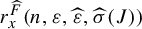 , there exist points
$\widehat {y}_1, \ldots , \widehat {y}_\ell \in \widehat {N}$
 , with
$\ell \leq C |\mathcal {R}_n|$
 , such that

Recall that
$\widehat {\pi }_{\widehat {N}}: \widehat {N} \to N$
 is given by
$\widehat {\pi }_{\widehat {N}}(y, E) = y$
 . Projecting to the base, it follows that

and, therefore,

Applying Proposition 5.5, we obtain

6.1 Reparameterization results
As in the work of [Reference Buzzi, Crovisier and SarigBCS1], one of the main tools we employ is the Yomdin theory. We present here the statement of a version that closely follows theirs. In particular, it is possible to prove the existence of admissible reparameterizations whose cardinality can be controlled by the minimal number of Bowen balls needed to cover the curve. The proof of the proposition below is an easy adaptation of [Reference Buzzi, Crovisier and SarigBCS1, Corollary 4.14].
Let
$r\geq 2$
 and consider the following quantities:

Recall that
$\|D \widehat {F}\|_{\mathrm {sup}}=\sup _{x \in M} \sup _{\widehat {y} \in \widehat {N}} \|d_{\widehat {y}}\widehat {g}_x\|$
 .
Proposition 6.7. Let F be a skew product. For every
$2\leq r<\infty $
 and
$Q> 0$
 , there exist constants
$\Upsilon =\Upsilon (r)> 0$
 and
$\varepsilon _Y = \varepsilon _Y(r,Q)> 0$
 with the following properties. Given
$x \in M$
 , suppose:
-
(1) $Q_{r, L}(F) < Q$
; -
(2) the curve $\sigma _x : [0,1] \to M \times N$
is regular and has
$C^{r}$
-size bounded by
$(\varepsilon , \widehat {\varepsilon })$
, where
$0 < \varepsilon , \widehat {\varepsilon } < \varepsilon _Y$
; -
(3) $L, n \geq 1$
,
$J \subset [0,1]$
.




Under these assumptions, there exists a collection
$\mathcal {R}$
 of reparameterizations of
$\sigma $
 over J, which is
$(C^{r}, F, L, \varepsilon , \widehat {\varepsilon })$
 -admissible up to time n, and whose cardinality satisfies the estimate

where

and
$\pi _2\colon M\times \widehat {N}\to \widehat {N}$
 is the projection onto the second coordinate.
Observe that the constant
$C(r,F)$
 depends on the regularity r that has been fixed. Although the map is acting
$C^{\infty }$
 in the fibers, since we do not know how the constant
$\Upsilon (r)$
 behaves with r, we are not able at this stage to simplify this quantity considering
$r\to \infty $
 .
In the following, we present a consequence of Proposition 6.7. The next result generalizes [Reference Buzzi, Crovisier and SarigBCS1, Proposition 5.1] to the present setting. We remark that the main difficulty appears when we apply Corollary 5.8 since now all the parameters depend on the point
$x\in M$
 .
Define
$\lambda (\widehat {F}):=\lim _{n\to \infty } ({1}/{n})\log \|D\widehat {F}^n\|_{\mathrm {sup}}$
 .
Proposition 6.8. Let F be a skew product,
$\mu $
 an F-invariant measure such that
$\pi _*\mu =\nu $
 , and
$\widehat {\mu }$
 is a lift of
$\mu $
 . Consider
$2\leq r <\infty $
 and real numbers
$Q, \rho , \gamma> 0$
 . Let
$\varepsilon _Y$
 be given by Proposition 6.7. Then, there exists
$L_1> 0$
 ,
$\varepsilon _1>0$
 , and
$n_1>0$
 such that for any
$L \geq L_1$
 ,
$0 < \varepsilon <\varepsilon _1$
 ,
$0<\widehat {\varepsilon } < \varepsilon _Y$
 , and
$n \geq n_1$
 , there exist:
-
(a) a neighborhood $\mathcal {U}_1$
of F; -
(b) an open set $\widehat {U}_{1} \subset M\times \widehat {N}$
with
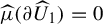
$\widehat {\mu }(\widehat {U}_{1})>1-\gamma ^2$
and
$\widehat {\mu }(\partial \widehat {U}_{1})=0$
, such that the following property holds.



For every skew product
$G \in \mathcal {U}_1$
 satisfying
$Q_{r,L}(G) < Q$
 and for every regular curve
$\sigma _x$
 with
$C^{r}$
 -size bounded by
$(\varepsilon , \widehat {\varepsilon })$
 , there exists a family
$\mathcal {R}$
 of reparameterizations over
$\widehat {\sigma }_x^{-1}(\widehat {U}_{1})$
 such that:
-
• $\mathcal {R}$
is
$(C^{r}, G, L, \varepsilon , \widehat {\varepsilon })$
-admissible up to time n; -
• $|\mathcal {R}| \leq \exp [n(\bar {h}_{\mu }(F\mid \pi )+{\lambda (\widehat {F})}/{(r-1)}+\rho )]$
.



Proof. We consider a compact set
$K_{\gamma }\subset M$
 such that the disintegration
$x\mapsto \widehat {\mu }_x$
 is continuous on
$K_{\gamma }$
 ,
$\nu (K_{\gamma })>1-\gamma ^2$
 , and Corollary 5.8 holds for every
$x\in K_{\gamma }$
 .
Let
$\Upsilon (r)$
 and
$\varepsilon _Y$
 be given by Proposition 6.7 and
$L_1>0$
 such that for every
$L\geq L_1$
 ,

and

Fix
$\widehat {\varepsilon }$
 in
$(0, \varepsilon _Y)$
 and
$L\geq L_1$
 .
By Corollary 5.8, for every
$x\in K_{\gamma }$
 , there exists
$0<\bar {\varepsilon }(x)<\varepsilon _Y$
 and
$\bar {n}(x)>L$
 such that for any
$\varepsilon < \bar {\varepsilon }(x)$
 and
$n \geq \bar {n}(x)$
 ,

Moreover, there exist
$0<\varepsilon _1<\varepsilon _Y$
 ,
$n_1> L$
 , and a compact set
$K^{\prime }_{\gamma }\subset K_{\gamma }$
 with
$\nu (K^{\prime }_{\gamma })>1-\gamma ^2$
 such that for every
$x\in K^{\prime }_{\gamma }$
 ,
$\bar {\varepsilon }(x)\geq \varepsilon _1$
 and
$\bar {n}_1(x)\leq n_1$
 . We can assume that
$n_1$
 was chosen such that for every
$n\geq n_1$
 ,

Fix
$\varepsilon <\varepsilon _1$
 and
$n\geq n_1$
 . By (9), for every
$x\in K^{\prime }_{\gamma }$
 , there exists a set
$\widehat {Z}_x \subset \widehat {N}$
 with
$\widehat {\mu }_x(\widehat {Z}_x)> 1 - \gamma ^2$
 such that

By the regularity of
$\widehat {\mu }_x$
 , there exists a compact set
$\widehat {K}_x\subset \widehat {Z}_x$
 such that
$\widehat {\mu }_x(\widehat {K}_x)> 1 - \gamma ^2$
 and
$\widehat {K}_x$
 also satisfies (11).
Therefore, for every
$x\in K^{\prime }_{\gamma }$
 , there is a neighborhood
$\widehat {U}_{1,x}$
 of
$\widehat {K}_x$
 such that
$\widehat {U}_{1,x}$
 is contained in the union of a collection
$\mathcal {C}_x$
 of x-fibered
$(n, {\varepsilon }/{4}, {\widehat {\varepsilon }}/{4})$
 -Bowen balls for
$\widehat {F}$
 with cardinality at
$\operatorname {most} \exp (n(\bar {h}(F\mid \pi )+{\rho }/{4}))$
 .
Since
$x\mapsto \widehat {\mu }_x$
 is continuous on
$K^{\prime }_{\gamma }$
 and
$K^{\prime }_{\gamma }$
 is compact, there exists
$x_1, \ldots , x_l\in K^{\prime }_{\gamma }$
 and
$\delta _i>0$
 such that
$K^{\prime }_{\gamma }\subset \bigcup _{i=1}^l B(x_i, \delta _i)$
 and if
$y\in B(x_i,\delta _i)$
 , then
$\widehat {\mu }_y(\widehat {U}_{1,x_i})> 1 - \gamma ^2$
 and
$\widehat {U}_{1,x_i}$
 is contained in the union of a collection
$\mathcal {C}_y$
 of y-fibered
$(n, {\varepsilon }/{2}, {\widehat {\varepsilon }}/{2})$
 -Bowen balls for
$\widehat {F}$
 with cardinality at
$\operatorname {most} \exp (n(\bar {h}(F\mid \pi )+{\rho }/{2}))$
 .
We define the following subset:

Observe that
$\widehat {U}_1$
 is an open subset of
$M\times \widehat {N}$
 , and we can suppose that
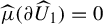
$\widehat {\mu }(\partial \widehat {U}_{1})=0$
 and
$\widehat {\mu }(\widehat {U}_1)>1-\gamma ^2$
 .
For every
$x\in M$
 and
$\sigma _x$
 regular curve, we know that

This implies that there exists
$\mathcal {U}_1$
 , a neighborhood of F in the space of skew products, such that for every
$G\in \mathcal {U}_1$
 ,
$\widehat {G}(\sigma _x([0,1])\cap \widehat {U}_1)$
 can be covered using fibered
$(n, \varepsilon ,\widehat {\varepsilon })$
 -Bowen balls for
$\widehat {G}$
 with cardinality at
$\operatorname {most} \exp (n(\bar {h}(F\mid \pi )+{\rho }/{4}))$
 .
Moreover, we suppose that for every
$G\in \mathcal {U}_1$
 ,

If
$G\in \mathcal {U}_1$
 , we conclude

Since
$\varepsilon , \widehat {\varepsilon }<\varepsilon _Y$
 , if
$Q_L(G)<Q$
 , we can apply Corollary 6.7 to obtain a family of reparameterizations which are admissible up to time n and satisfy

Using (8), (10), (12), and (13),

7 Proof of Theorem C
In this section, we conclude the proof of the main theorem.
7.1 Proof of Theorem C
Let
$(F_k, \vartheta _k)$
 and
$(F,\mu )$
 satisfy the hypotheses of the theorem. That is:
-
• the limits $\lim _k \lambda _1^c(F_k, \vartheta _k)$
and
$\lim _k h_{\vartheta _k}(F_k\mid \pi )$
exist and are positive; -
• $F_k$
converges to a skew product F; -
• $\vartheta _k \xrightarrow {w^*} {\mu }$
for some
${F}$
-invariant measure
${\mu }$
.




For k big enough,
$h_{\vartheta _k}(F_k\mid \pi )>0$
 , then applying Theorem 2.5, we can suppose that
$\vartheta _k$
 are of saddle type.
Recall that when the measure
$\vartheta _k$
 is of saddle type, we can consider a partition
$\eta ^k$
 subordinated to the fiber-wise unstable manifolds and a system of conditional measures
$(\vartheta _{k,x})_{y}^{\eta ^k_{x}}$
 as in §5.1. By Proposition 4.4, there exists
$\beta \in (0,1]$
 , and two F-invariant measures
$\mu _0$
 and
$\mu _1$
 such that
$\mu =(1-\beta )\mu _0+\beta \mu _1$
 .
Proposition 7.1. Let
$r\leq 2 <\infty $
 . For any
$\gamma> 0$
 ,
$\rho> 0$
 ,
$\varepsilon>0$
 , and
$\widehat {\varepsilon }>0$
 sufficiently small and L big enough, there exists
$k_*> 0$
 such that for all
$k \geq k_*$
 , there exist:
-
• a set $A_k\subset M\times N$
such that
$\vartheta _k(A_k)>0$
; and -
• an integer $N_k \in \mathbb {N}$
with the following property.



For every
$(x_k,y_k) \in A_k$
 , the set
$\widetilde {W}_k(x_k, y_k)$
 and the measure
$(\vartheta _{k,x_k})_{y_k}^{\eta ^k_{x_k}}$
 are well defined. Moreover, for any
$C^{\infty }$
 regular curve
$\sigma _k: [0,1] \to \widetilde {W}_k^u(x_k, y_k)$
 satisfying
$\|\sigma _k\|_{C^{\infty }} < (\varepsilon , \widehat {\varepsilon })$
 , any measurable set
$J_k \subset [0,1]$
 for which

and for all
$n \geq N_k$
 , there exists a family of reparameterizations
$\mathcal {R}_n^k$
 of
$\sigma _k$
 over
$J_k$
 which is
$(C^{r}, F_k, L, \varepsilon , \widehat {\varepsilon })$
 -admissible up to time n and whose cardinality satisfies

Proof. The proof follows the same arguments as [Reference Buzzi, Crovisier and SarigBCS1, §7.4]. The main results needed to conclude this proposition are Proposition 4.3(iii), Corollary 6.7, and Proposition 6.8. We also need to adapt [Reference Buzzi, Crovisier and SarigBCS1, Proposition 5.3], but it follows a reasoning analogous to Proposition 6.8.
For k big enough, let
$A_k$
 be given by Proposition 7.1. Then, there exists
$(x_k, y_k)\in A_k$
 such that:
-
• $(x_k,y_k)$
satisfies Theorem 6.6; -
• $y_k$
belongs to the support of the restriction of
$(\vartheta _{k,x_k})_{y_k}^{\eta ^k_{x_k}}$
to
$A_k$
.


Let
$\sigma _k\colon [0,1]\to \widetilde {W}_k(x_k, y_k)$
 be a
$C^{\infty }$
 regular curve that parameterizes a neighborhood of
$y_k$
 and has
$C^{\infty }$
 size smaller than
$(\varepsilon , \widehat {\varepsilon })$
 . Considering
$J_k=\sigma _k^{-1}(A_k)$
 , and applying Theorem 6.6 and Proposition 7.1, we conclude

Passing to the limits
$k\to \infty $
 , and then
$\gamma \to 0$
 and
$\rho \to 0$
 , we conclude

Observe that since the map F acts
$C^{\infty }$
 on the fibers, the inequality holds for arbitrary large r. Therefore, the second term goes to zero and the first part of the theorem follows.
Now, let us assume that
$\lambda _2(F,x,y)\leq 0$
 for
$\mu $
 -a.e.
$(x,y)$
 . As
$\beta>0$
 ,
$\mu _1$
 -a.e.
$(x,y)$
 has
$\lambda _2(F,x,y)\leq 0$
 , so by Proposition 4.4,

8 Proof of Theorems A and B
To conclude the theorems, we use a result from [Reference Buzzi, Crovisier and SarigBCS3] that relates SPR to a condition on the Lyapunov exponents. Recall Definition 1.4. Let
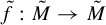
$\tilde {f}:\tilde {M}\to \tilde {M}$
 be a diffeomorphism on a compact d-dimensional manifold and
$\mu $
 be an invariant measure. Let
$\lambda _1(\tilde {f},x)\geq \lambda _2(\tilde {f},x)\geq \cdots \geq \lambda _d(\tilde {f}, x)$
 be the Lyapunov exponents of
$\tilde {f}$
 and
$\mu $
 . Define
$\Lambda ^+(\mu )=\int \sum _{\lambda _i>0} \lambda _i(\tilde {f},x)\,d\mu $
 .
We recall two conditions on
$\tilde {f}$
 .
-
(EH) Entropy hyperbolicity: there exists $\chi>0$
with the following property. For every sequence of ergodic measures
$\mu _k\to \mu $
, if
$h_{\mu _k}(\tilde {f})\to h_{\mathrm {top}}(\tilde {f})$
, then there exists i such that
$\lambda _i(x)>\chi >-\chi >\lambda _{i+1}(x)$
for
$\mu $
-a.e. x. -
(EC) Entropy continuity of $\Lambda ^+$
: for every sequence of ergodic measures
$\mu _k\to \mu $
such that
$h_{\mu _k}(\tilde {f})\to h_{\mathrm {top}}(\tilde {f})$
, then
$\Lambda ^+(\mu _k)\to \Lambda ^+(\mu )$
.




Theorem 8.1. [Reference Buzzi, Crovisier and SarigBCS3, Theorem 3.1]
If
$\tilde {f}$
 is entropy hyperbolic and
$\Lambda ^+$
 is entropy continuous, then
$\tilde {f}$
 is SPR.
Therefore, to conclude Theorems A and B, we need to prove that in both cases, F is entropy hyperbolic and
$\Lambda ^+$
 is entropy continuous.
We first prove the following proposition.
Proposition 8.2. Let F be a skew product over f such that
$h_{\mathrm {top}}(F)>h_{\mathrm {top}}(f)$
 and
$\nu \mapsto h_\nu (f)$
 is upper semi-continuous, then for every sequence of ergodic measures
$\vartheta _k$
 such that
$\vartheta _k\to \mu $
 and
$h_{\vartheta _k}(F)\to h_{\mathrm {top}}(F)$
 :
-
• $h_\mu (F)=h_{\mathrm {top}}(F)$
; -
• $\lambda ^c_1(F,\vartheta _k)\to \lambda ^c_1(F,\mu )>0$
; and -
• $\lim _{k\to \infty }h_{\pi _*\vartheta _k}(f)=h_{\pi _*\mu }(f)$
.



Proof. Since
$h_{\mathrm {top}}(F)>h_{\mathrm {top}}(f)$
 for every ergodic measure
$\upsilon $
 with large entropy
$h_{\upsilon }(F\mid \pi )>0$
 and then, by Theorem 2.5,
$\lambda ^c_1(F,\upsilon )>0$
 .
By Theorem 2.4, we know

Taking
$k\to \infty $
 , by Theorem C and the semi-continuity of the metric entropy of f, we conclude that there exists
$0<\beta \leq 1$
 ,
$\mu _0$
 and
$\mu _1$
 such that
$\mu =(1-\beta )\mu _0+\beta \mu _1$
 , and

Since
$\beta h_{\mu _1}(F\mid \pi )+(1-\beta ) h_{\mu _0}(F\mid \pi )=h_{\mu }(F\mid \pi )$
 , the equation above implies that
$\beta =1$
 . We conclude that
$h_\mu (F)=h_{\mathrm {top}}(F)$
 . In particular, every ergodic component of
$\mu $
 is an MME. Applying the observation at the beginning of the proof to the ergodic components of
$\mu $
 , we conclude that
$\lambda _2(F,x,y)\leq 0\, \mu $
 -almost everywhere. Therefore, again by Theorem C, the continuity of the Lyapunov exponents follows.
Now, assume by contradiction that
$\lim _{k\to \infty }h_{\pi _*\vartheta _k}(f)$
 is not
$h_{\pi _*\mu }(f)$
 , by the upper semi-continuity,
$\limsup _{k\to \infty }h_{\pi _*\vartheta _k}(f)\leq h_{\pi _*\mu }(f)$
 , then there exists a sub-sequence
$k_j$
 such that
$\lim _{j\to \infty }h_{\pi _*\vartheta _{k_j}}(f)$
 exists and is smaller than
$h_{\pi _* \mu }(f)$
 .
This implies that

which is a contradiction.
Let
$F\colon M\times N\to M\times N$
 be a skew product
$C^1$
 diffeomorphism over f. Suppose that M is a d-dimensional manifold.
Given an F invariant measure
$\mu $
 , we call
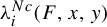
$\lambda ^{Nc}_i(F,x,y)$
 and
${E_i^{Nc}} (x,y)$
 ,
$i=1,\ldots ,d$
 the Lyapunov exponents counted with multiplicity and the corresponding Oseledets sub-spaces of F such that
${E_i^{Nc}} (x,y)\not \subset T_y N_x$
 .
In addition, we denote by
$\lambda _i(f,x)$
 and
${E_{f,i}} (x)$
 the Lyapunov exponents and corresponding Oseledets sub-spaces of f at
$x\in M$
 .
Lemma 8.3. Let F be a skew product
$C^1$
 diffeomorphism over f and
$\mu $
 an F invariant measure, then for every
$i=1,\ldots ,d$
 :
-
• $\lambda ^{Nc}_i(F,x,y)=\lambda _i(f,x)$
; and -
• $D\pi (x,y){E_i^{Nc}} (x,y)={E_{f,i}} (x)$
for
$\mu $
-a.e.
$(x,y)$
.


Proof. Recall that we denote by
$\lambda _1^c(F,x,y)\geq \lambda _2^c(F,x,y)$
 the Lyapunov exponents corresponding to the fiber. Take a
$\mu $
 total measure set of
$M\times N$
 such that the Oseledets theorem is valid for F and every
$(x,y)$
 , and also for every f and every x.
Take
$(x,y)$
 in this set, fix
$1\leq i\leq d$
 , and let
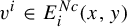
$v^i\in {E_i^{Nc}} (x,y)$
 . Observe that

so
$D\pi (x,y){E_i^{Nc}} (x,y)$
 is
$Df$
 invariant.
Now, let us assume that
$\lambda _i^{Nc}(F,x,y)\neq \lambda _j^c(F,x,y)$
 ,
$j=1,2$
 , then we know that
${E_i^{Nc}} (x,y)$
 does not intersect
$T_y N_x$
 . Observe that
$D\pi (x,y)$
 preserves the dimension of
${E_i^{Nc}} (x,y)$
 and
$\|D\pi (x,y)^{-1}\|$
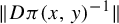 is proportional to the angle between
${E_i^{Nc}} (x,y)$
 and
$T_y N_x$
 , as
$T_y N_x=E_1(x,y)\oplus E_2(x,y)$
 , by Oseledets theorem, it decreases sub exponentially along the orbit of
$(x,y)$
 .
Then, we have

and also

Thus, we conclude that
$\lim\ ({1}/{n})\log \| Df^n(x)D\pi (x,y) v^i\|=\lambda _i^{Nc}(F,x,y)$
 .
Now, take the case that
$\lambda ^{Nc}_i(F,x,y)=\lambda ^c_1(F,x,y)$
 . This implies that
${E_i^{Nc}} (x,y)\supset E_1(x,y)$
 properly. As
$D\pi (x,y){E_i^{Nc}} (x,y)$
 is invariant, it has an Oseledets sub-decomposition. In particular, we can consider a vector
$v\in D\pi (x,y){E_i^{Nc}} (x,y)$
 with the property that
$\lim _{n\to \pm \infty }({1}/{n})\log \|Df^n(x)v\|= \lambda (f,x)$
 . Assume
$\lambda (f,x)>\lambda _1(F,x,y)$
 and take
$V\in {E_i^{Nc}} (x,y)$
 with
$D\pi (x,y)V=v$
 .
Then,
$D\pi DF^n(x,y)V=Df^n(x)v$
 grows exponentially with exponent
$\lambda (f,x)$
 , which is a contradiction. If
$\lambda (f,x)<\lambda _1(F,x,y)$
 , taking the inverse, we also get a contradiction. Therefore, we conclude that
$\lambda (f,x)=\lambda ^{Nc}_i(F,x,y)$
 . Analogously, if
$\lambda ^{Nc}_i(F,x,y)=\lambda ^c_2(F,x,y)$
 , by the uniqueness of the Oseledets decomposition, the result follows.
Proof of Theorem B.
Consider a sequence of ergodic measures
$\mu _k$
 such that
$\mu _k\to \mu $
 and
$h_{\mu _k}(F)\to h_{\mathrm {top}}(F)$
 . By the semi-continuity of the entropy for
$C^{\infty }$
 diffeomorphisms, we know that
$\mu $
 is an MME and the ergodic decomposition of
$\mu $
 is composed by MMEs
$\mu _e$
 . As
$h_{\mathrm {top}}(F)>h_{\mathrm {top}}(f)$
 , by Theorem 2.5,
$\lambda ^c_1(F,\mu _e)\geq h_{\mathrm { top}}(F)-h_{\mathrm {top}}(f)$
 and
$h_{\mathrm {top}}(f)-h_{\mathrm {top}}(F)\geq \lambda ^c_2(F,\mu _e)$
 for every
$\mu _e$
 , then for
$\mu $
 -a.e.
$(x,y)$
 , we conclude

By [Reference Ledrappier and WaltersLW],
$h_{\mu }(F\mid \pi )\leq h_{\mathrm {top}}(F\mid \pi )$
 . Therefore, since
$h_{\mathrm {top}}(F)>h_{\mathrm {top}}(F\mid \pi )$
 , for
$\pi _*\mu $
 -a.e. x,

Then, Lemma 8.3 implies that F is entropy hyperbolic.
By Proposition 8.2, we know that
$h_{\pi _*\mu _k}(f)\to h_{\pi _*\mu }(f)$
 . By [Reference Buzzi, Crovisier and SarigBCS1], this implies that there exist
$0<\beta \leq 1$
 ,
$\nu _0$
 , and
$\nu _1$
 such that
$\pi _{*}\mu =\beta \nu _1+(1-\beta )\nu _0$
 ,
$h_{\pi _*\mu }(f)\leq \beta h_{\nu _1}(f)$
 , and

Since
$h_{\mathrm {top}}(F)>h_{\mathrm {top}}(F\mid \pi )$
 , we conclude that
$h_{\nu _0}(f)>0$
 ; therefore,
$\beta =1$
 and

Observe that

By Proposition 8.2 and Lemma 8.3, we conclude that
$\Lambda ^+$
 is entropy continuous. Then, by Theorem 8.1, we obtain that F is SPR.
Proof of Theorem A.
Observe that as f is Anosov, by Lemma 8.3,
$|\lambda _i^{Nc}(F,x,y)|$
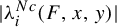 are bounded away from zero and the integral of the sum of the positive ones varies continuously with respect to the invariant measure. Moreover, by Proposition 8.2, there exists an MME.
As in the previous proof, we can conclude that F is entropy hyperbolic and
$\Lambda ^+$
 is entropy continuous. Then, again by Theorem 8.1, we can establish that F is SPR.
Acknowledgements
K.M. and F.V. are grateful for the hospitality of Universidade Federal do Ceará where the main part of this work was elaborated. The authors thank the referee suggestions that improved the quality of the text. K.M. was partially supported by FAPEMIG, CAPES-Finance Code 001, Instituto Serrapilheira grant number Serra-R-2211-41879. M.P. was partially supported by CAPES-Finance Code 001, Instituto Serrapilheira grant number Serra-R-2211-41879 and FUNCAP grant AJC 06/2022. F.V. was supported by CAPES.


