“Here, we are not talking about Laos,” President John F. Kennedy told Chairman Nikita Khrushchev in their 1961 meeting in Vienna.Footnote 1 Laos was a potential front line of conflict between the communist and capitalist worlds, and a place the United States had explicitly considered military action that would have lead to a conflict with Soviet Bloc forces. The two sides were still in negotiations over Laos and the eventual outcome there was uncertain and partly dependent on the credibility of each party.Footnote 2 But in Berlin, Kennedy wanted to convince Khrushchev the United States would not make concessions. Countries often admit that their resolve in one area is not high relative to their resolve in some other area.Footnote 3
This form of communication is common in international politics, but its implications have not been appreciated. In negotiations that could result in international conflict, more than one issue is often involved. In the context of negotiating peace settlements after major wars, so many issues are involved that some are always traded by one side in return for concessions on others. Such negotiations do more than produce agreements. They also give information to the sides about what the other is willing to fight for and what it considers less important. It is probably the experience of these negotiations, more than the documents they produce, that form the mutual expectations that are the basis of particular international orders and postwar settlements.Footnote 4
In order to understand the mechanism through which information is communicated, this article considers a bargaining model similar to many found in the literature. No information can be conveyed through costless diplomacy when only one issue is on the table. When two (or more) issues are on the table, this conclusion is reversed. States can sometimes costlessly communicate which issue is more important to them, and can even increase the other side's evaluation of the likelihood that the threatening state would fight for both issues.
States figure out information about other states' resolve by engaging in counterfactual reasoning, that is, by asking what another state would do if it were resolved to fight over one issue, another issue, both, or neither. If a state claimed a willingness to fight over two issues, for instance, other states can sometimes figure out whether this is true by asking what states of differing levels of resolve over the two issues would do in this context. The state willing to fight over only one of the issues may be able to increase its chances of getting its way on both issues by claiming a willingness to fight over both, but the state would also decrease its chances of getting its way on the issue it really cares about. On the other hand, for the state willing to fight over both issues, making such a claim involves no drawback and such a signal would always be sent.Footnote 5 Thus, both claims—that a state is willing to fight over only one of two issues and that a state is willing to fight over both—can convey information to an adversary. As I shall show, the particular dynamics of multi-issue negotiations depend critically on adversaries' beliefs, prior to negotiations, about how likely the other side is to make concessions on the different issues of the day.
Signaling in Multi-Issue Negotiations
Costly threats and actions are often thought to increase the credibility of threats because unresolved states might not be willing to incur the cost. In highly adversarial contexts, threats that do not carry direct costs to the threatener sometimes cannot affect the perceptions of the other side. Such threats are so much “cheap talk” in the colloquial sense of the term.Footnote 6
Recently, scholars have described several mechanisms through which diplomatic exchanges that do not carry direct costs, including those between adversaries behind closed doors, may affect states' perceptions of each others' intentions. Sartori describes how the need to maintain a bargaining reputation lends credibility to threats.Footnote 7 Kurizaki shows that states make private threats so as not to arouse public sentiment in threatened states.Footnote 8 Guisinger and Smith discuss how public and private mechanisms interact.Footnote 9 Trager describes communication mechanisms that exist when states have options to prepare for conflict, such as striking first, realigning alliance commitments, and draining the resources of the adversary.Footnote 10
This literature draws on the seminal paper by Crawford and Sobel, which characterized cheap talk equilibria in Sender-Receiver games and demonstrated that communication could be more precise when the interests of the players are more closely aligned.Footnote 11 More recent work in the economics literature looks at the implications of multiple issue dimensions for signaling in the Crawford-Sobel model.Footnote 12 Battaglini shows that in a multidimensional issue space, if there is more than one sender (for example, more than one expert will offer an opinion), full revelation of information is possible though this never occurs in the unidimensional case.Footnote 13 The model most related to the current work is Chakraborty and Harbaugh.Footnote 14 They show that multidimensional cheap talk can permit information transmission in cases where no information transmission would be possible in a single dimension. The results derived in these papers are suggestive, but since they employ a modified Crawford-Sobel framework, they are not directly relevant to international crisis bargaining. The model presented below was developed for this strategic context. In contrast to these models in the economics literature, uncertainty is two sided, both sides take actions that are relevant to each others' utilities, and the adversarial nature of the relationship is the specific sort produced when a side that can make threats must later decide whether or not to engage in costly conflict.Footnote 15
A largely separate literature addresses whether “issue linkage” can facilitate agreement. Some scholars have noted that linkage can sometimes expand the bargaining space—agreements that both sides prefer to conflict can exist when issues are linked even when no agreement would be preferred by all parties to conflict if issues were considered in isolation. These scholars emphasize the possibility of gains from trade when the sides differ on which policy dimensions are most important.Footnote 16 Morrow argues, however, that attempting to link issues may signal weakness, in addition to willingness to compromise, impeding states' ability to achieve compromise along these lines.Footnote 17
In the literature on costless diplomacy and issue linkage, states are thought of as explicitly or implicitly making decisions about how to partition the set of political issues into those they will commit to fighting for and those they will not. In the international relations context, information is communicated precisely because states sometimes find it in their interest to admit that some issues are not worth fighting for. This gives weight to states' statements that they are willing to fight.
In evaluating each others' intentions, states probably make use of all of these mechanisms of private diplomacy. This article presents another mechanism that is available when more than one issue is in contention simultaneously. It is related to the recent literature on multidimensional cheap talk but presents an underlying material strategic context that is significantly different from the sender-receiver games of that literature. The approach taken in this study is also related to the literature on issue linkage, but rather than emphasizing known gains from trade and expansion of the bargaining space as that literature does, this article focuses on the signaling benefits when more than one issue is on the table.
For purposes of the article, multiple issue dimensions are involved when it is possible for a threatened state to make a concession or not make one on each of a series of issues or dimensions. Stated differently, making a particular decision on one dimension cannot imply a particular decision on another dimension. Thus, if states negotiate over whether one state will cede territory and also over the timetable by which territory is ceded, this shall not count as multiple issues for our purposes because it is impossible to decide to cede territory in ten weeks and also decide not to cede territory.
The negotiating dynamics of such cases are important to explore theoretically because, in practice, there are always multiple areas where the behavior of one state affects the security and interests of another. Sartori discusses U.S. President Lyndon Johnson's drawing an explicit distinction between the level of U.S. interests in Berlin and Czechoslovakia in 1968. In dropping the United States' commitment to the latter, Johnson emphasized the abiding U.S. commitment to the former. Sartori explains that if an irresolute Johnson had made a threat over Czechoslovakia, the United States could have acquired a reputation for bluffing, making its stance over Berlin less credible.Footnote 18 Leaders sometimes think in terms of preserving bargaining reputation, but other dynamics are also at work.
When multiple issues are at stake, states may have common interests in communicating with each other so that they can avoid war—whether or not being caught in a bluff will affect their reputations later. Misrepresenting one's state's interests as highly engaged in an issue when they are not runs the risk of setting countries on a course toward conflicts that may not be necessary. By limiting demands, states make the demands they do make both more credible and more palatable. This allows information to be conveyed through simple, cheap-talk mechanisms when signaling is multidimensional. Such mechanisms of communication are available even when states are unconcerned about their reputations in future crises.
Many real-world negotiations involve more than one issue in the sense I have described or involve one only because the parties freely choose to moderate their demands. The Austrian demarche of 1914 contained ten demands, and the Serbians largely accepted all but the sixth. The Austrians demanded, for instance, both that the Serbians remove from service all officers and government officials found to have encouraged propaganda against Austria-Hungary and that Austria-Hungary be allowed to take part in the investigation of the Sarajevo assassinations. Before the Austrian demand, it was unclear whether Austria would fight for the first or second of these concerns, and a willingness to fight for one did not imply a willingness to fight for the other. As it happened, Austria-Hungary went to war after Serbia argued only that allowing Austria-Hungary to participate in the investigation would violate the Serbian constitution. When U.S. President James Madison considered war in 1812, he demanded both that Britain repeal its commercial Orders in Council and cease impressment of U.S. sailors. When the British acquiesced in one, he still went to war.Footnote 19 During the Cuban Missile Crisis, three key issues were negotiated: the removal of the missiles from Cuba, the Jupiter missiles in Turkey, and a public U.S. pledge not to invade Cuba. Before U.S. President George W. Bush declared war on the Taliban in 2001, he demanded the Afghan government both turn over the leaders of al-Qaida and permanently close terrorist-training camps.
In the negotiations at the close of major wars, the points of contention tend to be particularly varied and complex. The negotiations in Paris in 1919 were so complex that the delegation sent by Britain alone to address them numbered in the hundreds.Footnote 20 At the Yalta conference in 1945, Russia insisted on shifting Poland to the West; agreed to join the United Nations, but insisted it have a security council with veto power; and agreed to join the war with Japan. In the negotiations to end the Korean War, the territorial demarcation between North and South was one issue, but disagreement over the policy on repatriation of prisoners of war played a large role in preventing a settlement of the conflict for two years. The communist governments were concerned to prevent a voluntary repatriation in which many captured communist soldiers might choose to remain in South Korea or move to the West.Footnote 21
The model is a crisis bargaining model with two dimensions. It demonstrates that costless or private diplomacy can be effective in circumstances where scholars have previously argued that it could not be. The model does not indicate, however, that informative signals are possible in all multidimensional environments. This is so for two reasons. First, the model makes assumptions that may apply to some cases of multidimensional diplomacy and not to others. Among these are that the signaling player might be willing to fight if it is denied a concession on either of the two issues, that player utilities are additively separable across issue dimensions, and that the distributions representing the uncertainty related to countries' levels of resolve with respect to each issue are independent. The discussion section following the presentation of the model addresses implications of relaxing these assumptions. Second, even when these assumptions hold, signaling is possible only when certain additional conditions, described in the propositions, are met.
The Model
The stages of the game are represented in Figure 1, along with two interpretations consistent with the game's underlying structure. In the first interpretation, one state, hereafter the “Deterrer,” initially has the opportunity to make costless threats and assurances to the other state (the “Target”) by sending signals represented by m. Then the Target decides whether or not to comply with the Deterrer's demands, and finally the Deterrer decides whether or not to go to war (r ∈ R ≡ {0,1}).Footnote 22 Let f i be player i's utility for going to war, which is not affected by the issues being negotiated g i is player i's utility for peace when it gets everything it wants from the other player. In the second interpretation, the Deterrer's final choice of action is the option to accept offers made by the Target in the previous stage or to decline to enter into an agreement. Thus, the model can be applied to situations where bargaining failure means only that the sides do not agree rather than that they go to war. In order to most clearly relate the results derived from the model to previous literature, however, the presentation of the model below will use the terms of Interpretation 1.
Stages of game

If there is only one issue dividing the countries and the Target's choice is a binary one, nothing the Deterrer can say will increase the likelihood the Target decides to back down on the issue. I consider the case where two issues are involved. The game tree is shown in Figure 2. The two issues are indexed by z ∈ {1,2}, and the importance of the issue to each side, i ∈ {d,t}, is represented by εiz, which I assume can take on either a high or a low value. If the countries remain at peace, the players receive the payoffs for peace, g i, minus their values for whichever of the two issues do not go their way. Whether the sides have high or low values for the issues is private information of each side.Footnote 23 I use the notation εiz for the low value of issue z to player i and εiz for the high value. The probability that εiz = εiz is ℓiz ∈ (0,1), and is common knowledge. The εiz are independently distributed.
Game tree

In order to represent the strategic context of negotiating under the threat of violence (or nonagreement under Interpretation 2), I assume g d − εdz < f d < g d − εd1 − εd2, so that the Deterrer is willing to go to war if it is a high type with respect to either issue and does not get its way with respect to that issue, but unwilling to go to war if it is a low type with respect to both issues and gets its way in neither case. This implies that the Deterrer's most preferred outcome is peace when it gets its way with respect to both issues. I also assume the Target prefers peace when it gets its way: g t > f t. Thus the Deterrer is willing to go to war when it considers an issue important, and not otherwise. As I shall show, there are informative equilibria whether high Target types prefer war (f t > g t − εtz) or not.
The Target's action is a ∈ A ≡ {00,10,01,11}, where 10 represents concede on the first issue, but not on the second, and the notation for the three other possible actions follows similar logic. Let m ∈ M ≡ A represent the Deterrer's signal. It will sometimes be convenient to think of 11 as representing the statement, “both issues are important,” 10 the statement, “issue one is important, but issue two is not,” and so on. In game theory, however, signals have no inherent meanings. Let μ(y d|m) be the Target's updated beliefs about the Deterrer's type following signal m. In a particular equilibrium, let p a be the Target's evaluation that the Deterrer will go to war if the Target chooses action a before the crisis begins, and (p a|m) be the posterior probability the Target assigns to war given action a following signal m. Let q a be the probability the Target chooses action a and (q a|m) be the probability the Target chooses a given signal m.
I sometimes refer to a particular player i's type in a unified way as y i ∈ Y i ≡ {hh,ll,hl,lh}, where hh stands for εiz = εiz ∀z, hl for εi1 = εi1,εi2 = εi2, and so on. m(y d) is the signal sent by the Deterrer contingent on its type. r(a,m,y d) is the Deterrer's strategy at the final node, given the Target's action and the Deterrer's own signal and type. a(m,y t) is the Target's action contingent on the Deterrer's signal and the Target's type. A perfect Bayesian equilibrium of the game is a 4-tuple, (m*(y d),r*(a,m,y d),a*(m,y t),μ*(y d|m)).Footnote 24
First, I examine the logic of informative equilibria through an example. As I show below, in this example, the Deterrer is more likely to get whatever it asks for than it was before it asked (or than it would be in the absence of a communication mechanism). If the Deterrer says that issue one is important, but issue two is not, for instance, the Target is more likely to respond by backing down on issue one and holding firm on issue two than it otherwise would have been. Surprisingly, if the Deterrer says that both issues are important, the Target is also more likely to concede on both (1) than it would be if the Deterrer said anything else, (2) than it was before the Deterrer said anything at all, and (3) than it would have been in the absence of a communication mechanism.
Suppose g i = 50 and f i = 20. Let εiz = 5, εdz = 35 and εtz = 15. These assumptions imply that high type Deterrers will fight over an issue and low types will not, so that there is some probability the Deterrer will fight over one or the other of the issues, some probability it will fight unless it gets its way on both, and some probability it will not fight even if it gets no concession at all from the Target. The Target will generally prefer a settlement to war, but it also prefers not to back down on either issue. Target types that have a high value for both issues are indifferent between war and a double concession. (As subsequent analysis will demonstrate, none of these assumptions are necessary for the existence of informative equilibria.) To complete the parameterization, suppose there is a 40 percent chance that εiz = εiz. In other words, both players believe there is a 40 percent chance that the other player is a low type with respect to a particular issue (and a 16 percent chance that the other player is a low type with respect to both issues).
There is then an equilibrium in which: (1) the Deterrer says that issue one (two) is worth fighting for while two (one) is not if and only if that is the case, and the Target concedes the important issue but not the other; (2) the Deterrer says that both issues are worth fighting for when either both are or when neither is. Since the Deterrer only says that one is important and the other not when that is the case, the Target learns from the Deterrer's statements to this effect. When the Deterrer says that both are important, the Target knows that it is useless to make a concession on only one issue. Either it makes a concession on both or it makes one on neither.Footnote 25 When the Target is a high type on both issues, it makes no concession on either; otherwise, it concedes both. Therefore, 64 percent of the time the Target concedes both issues when the Deterrer says that both are important.
The Deterrer's statements have a dramatic effect on the Target's beliefs about what the Deterrer will do in response to the Target's actions. Before the Deterrer's signal, the Target believes there is a 60 percent chance the Deterrer will fight over the first issue. After the Deterrer's signal that it will fight for that issue, but not for the other, the Target knows for sure that the Deterrer is willing to fight for the first issue. Before the sides communicate, the Target believes there is a 36 percent chance the Deterrer will go to war unless it gets its way on both issues. When the Deterrer says that both issues are important, however, the Target believes there is a 69 percent chance the Deterrer will fight unless full concessions are made.
Because the Deterrer's statements have such a sizable effect on the Target's beliefs, they also have a sizable effect on the Target's actions. In the absence of a communication mechanism, the Target always makes a concession on one issue and not on the other unless it considers both issues unimportant, in which case it concedes both. If one issue is less important, it concedes the less important issue. If both issues are important, it still concedes one of them, but is indifferent about which one. Thus, the probability the Target backs down on issue one, but not on issue two is 42 percent in the absence of the communication mechanism and 100 percent following the Deterrer's signal that it will fight for issue one, but not for issue two.Footnote 26 In the absence of a communication mechanism, there is only a 16 percent chance the Target will make concessions on both issues. In the informative equilibrium, before the Deterrer signals its intentions, there is a 33 percentFootnote 27 chance the Target will back down on both issues; when the Deterrer signals it will fight for both, that probability rises to 64 percent. For convenience, the Target's beliefs and the probabilities of Target actions, before and after the Deterrer's statements, are summarized in Table 1.
Example of signaling over multiple issues

In this equilibrium, Deterrers that are unwilling to fight for either issue claim that they are, as do Deterrers that are willing to fight for both. This seems natural, but why do Deterrers that are willing to fight for only one issue signal this to the Target? Since Deterrers would prefer a concession on both issues even if they are unwilling to fight for one, how can such behavior be optimal? To understand the signaling logic, suppose a Deterrer willing to fight only for issue one were to deviate and claim a willingness to fight for both. It would then increase its chances of getting its way on both issues, but decrease its chances of getting its way on the issue it really cares about. Its expected value from deviating is its probability of getting its way on both (64 percent) times its payoff (50) plus its probability of getting neither (36 percent) times its expected payoff for war (20), which is 39.2. On the other hand, its expected value from its equilibrium strategy of admitting it will fight over only the first issue is the probability it gets its way on the first issue but not the second (100 percent) times its payoff from that outcome (50 − 5), which comes to 45. Thus, by deceiving the Target, the Deterrer would lose its opportunity to convince the Target of its seriousness about the first issue and risk having to go to war to secure what it deems to be truly essential—all for the sake of a chance to attain something it considers relatively unimportant.Footnote 28
I now turn to a more general analysis of the model. Propositions are stated informally in the text and formally above their proofs in the Appendix. For the general reader, the informal statements in the text and the surrounding discussion suffice to convey the essential logic of the argument.
The Deterrer's actions can often affect the Target's beliefs and the Target's actions, but how much information is conveyed by particular messages of the Deterrer depends on context. In no context, however, can the Deterrer convey precise information to the Target about its intentions. Proposition (1) states that it is impossible for Deterrers that consider neither issue important and some other Deterrer type to each send an honest signal such that the Target knows their types with certainty. At least one of these Deterrer types must pool with other types. A direct consequence is that, in any equilibrium, there is always a signal the Deterrer sends with positive probability that leaves the Target unsure as to the conditions under which the Deterrer would be willing to go to war.
Proposition 1. There is no perfect Bayesian equilibrium in which those unwilling to go to war over either issue send a unique signal and at least one other type (for example, those willing to go to war over issue one but not issue two) also sends a unique signal.
Proposition (1) implies that in any equilibrium, lies occur with positive probability. There is no equilibrium in which all four Deterrer types send different signals so that the Target will always know with certainty who is who after observing the signal. Nevertheless, as the preceding example illustrates, substantial information can often be conveyed.
Signaling dynamics in the model are somewhat different depending on whether Targets that value an issue highly prefer to fight for it rather than concede on that dimension or prefer to concede when they know the Deterrer is willing to fight. Informative signaling is possible under both conditions, although the signaling possibilities are somewhat reduced in the latter case. It is important to note that when Targets that value an issue highly are willing to fight for it, then if the Deterrer is also a high type with respect to that issue, there is no negotiated solution that both sides would prefer to war. This is true even if uncertainty about each others' preferences were removed. This may result when issues cannot be infinitely divided, when players have increasing returns over the goods in question, or when players lack a mechanism for committing to abide by settlements.Footnote 29
I first consider situations in which both players have uncertainty over whether the other side will fight if it doesn't get its way (and thus in which it is possible that no negotiated solution exists that both sides prefer to conflict). I refer to this as Condition 1 or C1. This assumption appears to fit many empirical cases.
Condition 1 (C1). g t − εtz < f t ∀z
To gain insight into the negotiating dynamics, I turn to the most informative equilibrium in the game. This is where the highest number of types reveal their true intentions for a given set of parameters. Proposition (2) demonstrates the unique most informative equilibrium of the game under C1 when ℓd1 and ℓd2 are not both so high that the Deterrer has trouble influencing even the least-resolved Targets, and when the Target is itself sufficiently likely to be willing to fight over the two issues.
Proposition 2. Under C1, if the probabilities the Deterrer and Target are not resolved over issue one (ℓi1) and issue two (ℓi2) are low enough, a unique maximally informative equilibrium (characterized in the Appendix and represented in Figure 3) exists.
Deterrer equilibrium signaling strategies

The dynamics implied by Proposition (2) are summarized in Figure 3.Footnote 30 The figure shows the key role played by the Deterrer's beliefs about how likely the Target is to be willing to fight for each issue (ℓt1 and ℓt2) in determining what the Deterrer will say and what sort of information is conveyed by the statement. ℓt1 is on the horizontal axis and ℓt2 is on the vertical axis. When ℓt2 is above the threshold  , the Deterrer can signal with certainty that “issue one is important and issue two is not” and prefers to do so when this is in fact true. When ℓt1 is above the threshold
 , the Deterrer can signal that “issue two is important and issue one is not.” When both ℓt1 and ℓt2 are above the thresholds, the Deterrer can signal with certainty that either “issue one is important and issue two is not” or that “issue two is important and issue one is not,” but not that both are important.Footnote 31 Thus, the credibility of the Deterrer's statement that only issue one is worth fighting for is facilitated by the increased likelihood that the Target is less resolved over the second issue. If the Target is thought likely to be unresolved over the first issue but highly resolved over the second, then it conveys less information to claim to be willing to fight for only what the Target is thought likely to be willing to give up and unwilling to fight for what the Target is relatively unlikely to give up. When either ℓt2 is below T1 or ℓt1 is below T2, the Deterrer can signal with certainty that “both are important.” Thus, the Deterrer's signal that both are worth fighting for is facilitated by the increased likelihood that both issues are important to the Target.
Proposition 3. Under C1, when the probabilities the Deterrer and Target are not resolved over issue one (ℓi1) and issue two (ℓi2) are low enough, an equilibrium exists in which, for any Deterrer demand, the Target is more likely to take the action demanded by the Deterrer than the Target was prior to the demand.
Proposition (3) reminds us that in the equilibrium described in Proposition (2) and in Figure 3, whatever statement the Deterrer makes increases the Target's belief that the content of the statement is the case. In other words, if the Deterrer says it will go to war over issue one, but not over issue two, the Target's updated belief following the statement that this is true is strictly higher than it's prior belief before the Deterrer's statement. Thus, when the Deterrer says in Region 3 that it will fight for issue one, but not for issue two, although the Target cannot be sure this is the case, the Target believes it more likely to be true than it did prior to the Deterrer's statement. In the example, the signaling strategy was that shown in Region 2 of Figure 3. There, when the Deterrer claims to be willing to fight for issue one, but not for issue two, the Target is sure that this is the case.
Corollary 1. Under C1, in Regions 1 and 3, an equilibrium exists in which the Target knows for sure that when the Deterrer demands a concession on both issues, the Deterrer will fight unless the Target concedes on both issues.
Surprisingly, even when the Deterrer claims it will fight unless the Target concedes both, the Target concludes this is more likely than it had previously thought. In fact, in Regions 1 and 3, an even stronger statement can be made, formalized in Corollary (1). As long as two issues are on the table, and as long as the Deterrer and Target are believed sufficiently likely to stand firm on both, if the Deterrer says it will fight for both, the Target can be sure the Deterrer is telling the truth. The reason is that Deterrers that are not so resolved on one issue or on either issue realize that they stand a relatively small chance of getting their way even if they claim they will fight for both. If only one is important and they claim that only that one is important, they stand a sufficiently greater chance of getting their way on that issue, making them prefer to signal that one issue is important if one is or that one issue is important even if neither is. For this reason, Targets know for sure that Deterrers that claim they are willing to fight for both really are.
In this model, as in other models in the international relations literature, signaling is effective because of the drawbacks of sending a misleading signal. With costless communication, however, the drawback to a state's misrepresenting itself as highly resolved can be more difficult to see. As in the example, the Deterrer would not want to lie when the lie—even if believed—stands a sufficiently small chance of achieving its end. The Deterrer would not then wish to miss the opportunity to convince the Target about its resolve on the issue it really would go to war over. Alternatively, if it really would go to war over both, it has every incentive to say so. The Deterrer therefore sometimes declines to risk having to go to war in cases where it would be satisfied with peace provided the Target concedes the issue the Deterrer considers most important.
Proposition 4. Under C1, if the probability the Target is not resolved on either issue is high, then at most two signals are sent in equilibrium.
When the probability the Target is not resolved on either issue is high, signaling is less informative. Proposition (2) demonstrates that when ℓt1 and ℓt2 are low (specifically, 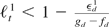 and
 ), an equilibrium can exist in which the four types of Deterrer send three signals with positive probability. This implies that two Deterrer types reveal themselves to the Target—when the Target sees the signal sent by these types, it knows under exactly what conditions the Deterrer will and will not go to war. Proposition (4) shows, however, that when ℓt1 or ℓt2 are high so that it is likely enough that the Target is unwilling to go to war on one issue or the other, then no equilibrium can exist in which such precise information is conveyed to the Target. Then, at most two signals are sent by the four types, which implies that at most one type reveals itself precisely to the Target, implying that signaling is less informative than it can be when the Target is thought likely enough to stand firm on both.
As Proposition (2) makes clear, under C1, the conditions on informative signaling are relatively weak. There must merely be sufficient probability that both the Deterrer and Target are in earnest. When both issues are likely to be important to the Target, signaling is particularly effective. This is not to say, however, that informative signaling is impossible outside of Regions 1 to 3. It is less informative on the whole, but some information can sometimes be conveyed. The parameter values where equally informative equilibria exist overlap, which will sometimes make it even more difficult to predict the signaling dynamics that will most likely occur in those regions. Figure 4 illustrates signaling ranges that are plausible in some cases.Footnote 32
Plausible signaling equilibrium

I now turn to the case where there is always a negotiated solution that both sides would prefer to war because the Target always prefers to make a concession rather than fight over an issue. This is stated formally as Condition 2 or C2. This condition does not imply that the Target will back down for certain. If the Target is not sufficiently convinced of the Deterrer's resolve on a particular dimension, the Target will find the risk of conflict acceptable and will not make a concession.Footnote 33
Condition 2 (C2). g t − εt1 − εt2 > f t ∀z
As shown in the numerical example, C2 does not eliminate the possibility of informative signaling.Footnote 34 The conditions under which different signaling equilibria obtain are altered, however, and in one sense the possibility of communication is restricted. Under C1, in Regions 1 and 3, when the Deterrer claims that it would fight for both issues, the Target can infer that this is true. Under C2, the Deterrer can never send a signal that causes the Target to be certain that the Deterrer would fight for both issues. The reason is simply that if the Target were so convinced, it would concede on both dimensions, which is the best outcome for all Deterrer types. This implies that all Deterrer types would send a signal that had such an effect, which means that some Deterrer types would send the signal even though they would not be willing to fight over the issues.
Thus, only one messaging strategy in which the Deterrer sends three distinct messages can be supported in a pure strategy equilibrium. This is the messaging strategy described above under C1 from Region 2: Deterrer types with a high value for one issue and a low value for the other demand the one and not the other; types with a low value for both or a high value for both demand concessions on both issues. Under C2, however, an equilibrium where the Deterrer employs this messaging scheme exists in a different area of the parameter space than under C1. Proposition (5) provides sufficient conditions for the existence of such an equilibrium: (1) the probabilities the Deterrer and Target have a low value for the issues must be in middle ranges, and (2) if the Deterrer has a low value for the issues, it must be sufficiently low. The second condition is necessary so that Deterrers that are willing to fight over one issue but not over the other are willing to admit this. That is, their value for the issue they are not willing to fight for is not so high that they would prefer to bluff in the hopes of getting their way. The proposition also makes clear that even under C2, equilibria exist in which the Target is more likely to concede to any particular demand of the Deterrer's than the Target was prior to the Deterrer's demand.
Proposition 5. Under C2, if the probabilities the Deterrer and Target are less resolved over issue one (ℓi1) and issue two (ℓi2) are in middle ranges and Deterrers that place a low value on both dimensions place a sufficiently low value on both dimensions, an equilibrium exists in which,
(1) Deterrers willing to fight for one and only one issue send signals such that the Target knows this with certainty following the signal; and,
(2) for any Deterrer demand, the Target is more likely to take the action demanded by the Deterrer than the Target was prior to the demand.
Proposition (5) provides an interesting contrast with the C1 case. While in that case, high likelihoods of resolve on both dimensions lead to more informative signals, under C2, high likelihoods of resolve mean less informative signals. The reason high likelihoods of Target resolve on both issues lead to less informative signaling is somewhat complex. If the Target is thought too highly resolved on both dimensions, then Deterrers who are unwilling to fight over either issue would deviate from the equilibrium strategy by claiming to be willing to fight for only one issue rather than willing to fight for both. But this means that only types that are willing to fight for both issues claim to be so, which cannot be an equilibrium under C2 for the reason I argued. Thus, in contrast to the C1 case, under C2, high likelihoods of Target resolve imply that the Deterrer sends at most two signals in a pure strategy equilibrium. On the other hand, if the likelihood of Deterrer resolve is too high on both dimensions, then all Target types would back down following the Deterrer's signal that it was willing to fight for both issues and the equilibrium would again break down as all Deterrer types would prefer to pool on claiming to be willing to fight for both issues.Footnote 35
When the parameters are such that three signals cannot be sent with positive probability in any pure strategy equilibrium, there may still be informative equilibria where two signals are sent. Proposition (6), included in an online Appendix, establishes a set of sufficient conditions for such an equilibrium.Footnote 36 Loosely speaking, if one issue (say issue one) is more important than the other to the Deterrer, the likelihood that the Deterrer is willing to fight for that issue is in a middle range and the likelihood that the Target places a high value on that issue (though even Targets that do are not willing to fight over it) is not too low, then such an equilibrium will exist. This set of sufficient conditions is not necessary, however.
Discussion
The results above demonstrate signaling benefits of talking about multiple issues at once. The mechanism does not depend on known gains from trade, as in the issue linkage literature, but rather on the information about resolve with respect to one issue that can be inferred from a state's potential willingness to sacrifice a second objective. States are able to communicate which issue is the more important, including—in some cases with certainty—whether or not they are willing to fight for that issue. Surprisingly, by claiming that they will fight for both issues, they are even able to increase a Target's evaluation of the likelihood that this is true.
The mechanism by which information is conveyed is very simple. A particular demand shows a willingness to give up either the possibility of a better deal or the greater chance of achieving a less favorable deal, and in both cases conveys information to the other side. If a state demands multiple concessions, it shows it is willing to give up an increased chance of achieving a settlement in the middle. If a state demands somewhat less, it shows it is willing to give up the chance of getting everything it wants in return for the increased chance of the midrange settlement. In either case, information is conveyed about what the state considers most important and therefore this information affects the other side's beliefs about what the state is willing to fight for.
As noted, the model makes simplifying assumptions that are not appropriate representations of all aspects of every case of multidimensional diplomacy. In the pure strategy equilibria that exist in the areas of the model's parameter space analyzed, for instance, the Deterrer never makes statements such as: “I need a concession on either this issue or on the other—we go to war if you're intent on humiliating me in every area,” or “why don't we compromise—you decide which issue is resolved in your favor and we'll resolve the other in my favor.” This never occurs in a pure strategy equilibrium because of the assumption about types. Since the Deterrer is either willing to fight for an issue or unwilling to fight for it (there are just two Deterrer types for each of the two issues), the Deterrer is never willing to settle for “either.” In a more complicated type space, however, we can imagine that such cases would arise.
I also assumed that the private information components of player utilities are independent. In the world, however, there are certainly cases where this is not the case, for instance when player uncertainty centers on the costs of conflict (which do not depend on which issue is fought over) more than on the value of the individual issues themselves.Footnote 37 If a willingness to fight for either issue implies a willingness to fight for both, then the two dimensions effectively reduce to one and no influential signaling is possible. On the other hand, if there is even a small chance that the Deterrer is willing to fight for one and not the other, the Deterrer's signals may still influence the Target.
To see this, consider the numerical example. Suppose the Deterrer is very likely to be willing to fight for both issues or for neither, so that there a 58 percent chance the Deterrer is a low type on both dimensions, a 40 percent chance the Deterrer is a high type on both, a 1 percent chance the Deterrer is willing to fight for the first and not the second, and a 1 percent chance the Deterrer is willing to fight for the second and not the first. There is then an informative equilibrium of the sort described earlier. Here, as before, when the Deterrer says it will fight for one issue but not the other, the Target knows with certainty that this is so. The difference from the earlier numerical example is merely that the Deterrer is much less likely to make such admissions (it does so only 2 percent of the time). As before, when the Deterrer says it is willing to fight unless the Target concedes both issues, the Target knows this is more likely to be true than it had previously thought. The difference from the earlier example is that here, the change in the Target's beliefs is much less: the probability the Target assigns to the Deterrer's being willing to fight for both issues rises from 40 to 41 percent following the Deterrer's signal. Thus, as we move from the independence assumption of the model toward the single-dimensional case, signals may become less informative or less used.
Similarly, one can examine the case where the independence assumption is violated in that a willingness to fight for the first issue indicates a likely willingness to fight for the second, but Deterrers willing to fight for the second may or may not be willing to fight for the first. Here, too, signaling is often possible. Turning again to the numerical example of the previous section, an equilibrium of the form described exists as long as the probability the Deterrer would fight for the second issue but not the first does not fall from 24 percent in the example to below 11 percent.Footnote 38 As long as this possibility is not below the cutpoint, the signaling dynamics are broadly similar to those described earlier. Thus, signaling is still possible in cases that diverge significantly from the independence assumption of the model.Footnote 39
As in all costless signaling models, there is also an uninformative equilibrium in which the Deterrer communicates no information to the Target. Here, this relates to Morrow's argument that offers to link issues may be interpreted as a sign of weakness, which will in turn often prevent states from offering compromises.Footnote 40 In the model described here, if the Target believes an offer to split the two issues derives from lack of resolve, and the Deterrer understands this, then no offer to compromise on one but not the other issue will ever be made by the Deterrer. The Target's belief about events that (then) never occur ensures that no information can be communicated through costless statements.
Interestingly, in such equilibria, the Target's belief about the meaning of compromise offers will never be disconfirmed by experience; no Deterrer will ever offer to compromise. The Deterrer's beliefs about what signals weakness have a self-fulfilling effect—negotiators who hold such views will never be proven wrong, at least not by direct experience, even though their views are not true in general. This illustrates the subtle sorts of common understandings between negotiators that can have decisive effects on whether they reach agreement. In particular, settlement of disputes will be facilitated if each believes the other does not equate compromise with weakness—at least not in every case.Footnote 41 And if the sides each believe this, it will in fact be true.
I turn now to one particularly interesting comparative static. One might naturally expect that as the likelihood that the Target is resolved over an issue increases, the probability of war would also increase. This seems particularly likely in a costless signaling model since there would appear to be no selection effect whereby Deterrers refrain from incurring the cost to threaten seemingly resolved Targets. In fact, in a world without communication the probability of conflict declines monotonically in the probability that the Target is unresolved. This is not true of a world with costless communication, however.
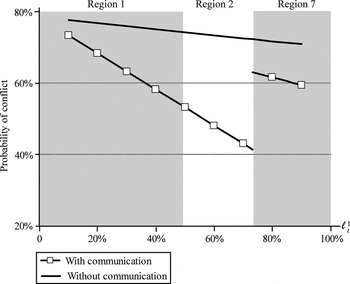
Figure 5 presents a particular parameterization of the model and illustrates the effect of ℓt1 on the probability of conflict. The top line shows what happens in a world without communication. As it becomes less likely that the Target will not fight for issue one, the probability of conflict declines as we would expect. Since in this parameterization the probability the Target will fight for the second issue is fixed at 60 percent, the overall probability of conflict remains relatively high. In a world with communication, increases in the likelihood that the Target will not fight over the first issue have a more dramatic impact on the likelihood of conflict within a particular signaling region. This can be seen in the decreased slope of the second line in Figure 5. When the probability the Target would not be willing to fight for the first issue increases from 10 to 70 percent, the probability of conflict decreases from 73 to 43 percent when the states employ the most informative communication mechanism available. Without communication, the probability of war decreases only from 78 to 73 percent.Footnote 42
Effect of likelihood of Target resolve on the likelihood of conflict

In the world with communication, however, the relationship is nonmonotonic. This can be seen in Figure 5 from the behavior of the lower line on the right-hand side of the figure. As it becomes more likely that the Target would be willing to make a concession over the first issue, the Deterrer loses the ability to signal as precisely. Rather than sending three different signals in equilibrium, depending on its intentions vis-a-vis the two issues, as it does in Regions 1 and 2, the Deterrer is eventually willing to use only two signals. In the most informative equilibrium, the Deterrer claims either that only the first issue is important or that both are. When the Target sees the first claim, it does not know for sure whether it is true. When it sees the second, the Target knows the Deterrer would fight for the second issue, but not whether it would really fight for the first. This reduced precision in the Deterrer's signal causes the probability of conflict to jump discontinuously from below 40 percent to above 60 percent, although it remains below the likelihood of conflict in a world without communication (71 percent). Therefore, quantitative empirical models of the probability of war that include factors thought to influence Target commitment on the right-hand side of the equation should not assume that these factors have a constant or even monotonic influence on the dependent variable.
Empirical Illustrations
In almost all cases where coercion is attempted in international politics, the complexity of the issues involved implies that states have a variety of options available to them. When states negotiate over one issue, others that are in the background for the time being may still influence negotiations. After the Iraqi invasion of Kuwait in 1990, however, the U.S. demand that Iraq leave Kuwait left the Iraqi regime with what was effectively a binary choice.Footnote 43
In the initial phases of the crisis, U.S. statements were not able to convince the Iraqi regime that the United States would actually use force.Footnote 44 Eventually, alongside a massive buildup of U.S. troops in the region, a security council resolution, and support from the Soviet Union and other powers, stronger statements of U.S. resolve convinced the Iraqi government that the United States would indeed go to war, but not that the U.S. administration had the will to prosecute a war through to a decisive end.Footnote 45 While many aspects of the situation contributed to the Iraqi judgment, one factor was the fact that only a single binary issue was negotiated. U.S. statements and troop movements certainly convinced the Iraqis that the United States wanted Iraq out of Kuwait, but try as it might, the United States could not convince Iraq that the United States was willing to fight a protracted conflict.Footnote 46
In multi-issue settings, as I have shown, there are expanded possibilities for informative signaling. The mechanism of inference described here is so simple and intuitive that the reasoning on which it is based is often left implicit. Nevertheless, because the issue environment of international politics is often complex, this mechanism is a common way that decision makers form evaluations of each others' intentions. In intuitive terms, international actors understand that when a state makes a particular demand, it could have made others. Suppose there is a possibility State A will fight rather than make either of two concessions, but that State A is least likely to be willing to make the first of the two concessions. Now suppose that State B demands that State A make the first concession, but not the second. State A will reason that if State B were willing to settle for a concession on the second issue, but not the first, then most likely it would have demanded just that. After all, a demand for the second but not the first is more likely to succeed. Thus, when State B demands the first but not the second, State A knows that State B has given up the opportunity to achieve the more likely concession for the sake of achieving a concession that is less likely to be forthcoming. Making such a choice conveys information to A.
To see how this logic operates in a less abstract setting, consider the following examples. After World War II, the Western powers eventually conceded that Eastern Europe would be in the Soviet sphere of influence. In other areas, however, the West insisted on concessions of its own. Greece was not to be in the Soviet sphere, for instance, and West Berlin was not to be incorporated into East Germany. Insisting on certain concessions in the context of giving up leverage over others conveyed information to the Soviets about the West's resolve vis-à-vis what it did insist on.
Consider, in particular, the Western demand that Berlin not be incorporated into East Germany, which was at the very center of the Cold War. Had the United States been willing to compromise, it might have gained concessions in other areas—in Laos and on a nuclear test ban agreement, for instance. By standing firm on the question of Berlin while offering to compromise in other areas, the United States demonstrated its willingness to give up the concessions it could have had, had the United States itself been willing make concessions over Berlin. The U.S. stance therefore conveyed information to the Soviets, and, as the model suggests, this was particularly true because the United States insisted on something it knew the Soviets were least likely to give up.Footnote 47
I have also shown that demanding concessions on all the issues of the moment can be a meaningful signal that increases an adversary's perception that the demanding state would go to war unless the adversary makes full concessions on all dimensions. To see this aspect of the equilibrium in practice, consider the demands made of the Taliban regime by the United States prior to the ongoing war in Afghanistan. The United States demanded that the Taliban regime both hand over bin Laden (and other terrorists) and close terrorist training camps within Afghanistan. Shortly afterward, the Taliban refused to hand over bin Laden unless the surrender were approved by the fifty-six member countries of the Organization of the Islamic Conference, and shortly after that, the war began.Footnote 48
Before the U.S. administration began to press the Taliban regime, there was substantial uncertainty about U.S. intentions. Many observers thought a U.S.-led war in Afghanistan would cost the United States dearly and argued against direct conflict.Footnote 49 Thus, there was uncertainty over what sort of settlement the United States would accept. Observers at the time would have wondered whether a settlement in which terrorist-training camps were dismantled, but bin Laden was not surrendered (perhaps he would have been allowed to leave the country) would have avoided a war. Alternatively, it was plausible that the United States would decline to prosecute a war if bin Laden were handed over but no significant effort to destroy terrorist bases were undertaken by the Taliban regime. Thus, the uncertainties associated with whether the United States would fight over each of the two principle issues were not perfectly correlated even if they were also not entirely independent. We should expect the essential logic of the model to apply.
When the United States demanded that it get its way on both questions, it risked that the Taliban regime would make a concession on neither issue, which is what happened. Had the prospect of destroying the training camps without capturing bin Laden himself been sufficiently palatable to the United States vis-a-vis war, the United States could have downplayed the importance of this single individual and instead insisted only that Afghanistan no longer be used as a terrorist base. The Taliban could therefore have concluded that the United States was more likely to fight for both issues than it had believed before the U.S. demand was made. Of course, since the U.S. demand was made publicly, the Taliban could also have concluded that U.S. President Bush would not back down for fear of suffering domestic repercussions of failing to following through on a commitment, known as “audience costs.” In this case, as in most international political situations, multiple signaling logics are available through which actors can draw conclusions about each others' likely intentions.
The model analyzed above also implies that when State A offers to make a concession on one issue if State B makes a concession on a second issue, State B's perception of State A's commitment to defend the first issue will be reduced.Footnote 50 This dynamic can be clearly seen in the Chamberlain government's negotiations with Germany prior to the German invasion of Poland on 1 September 1939. One issue at stake was the fate of Poland. In July, the Chamberlain government suggested that Germany and England form a “world political partnership” in which they would delineate their spheres of influence to avoid competition and conflict and also sign a nonaggression pact. According to the German ambassador's understanding of the British position in one such conversation, this would “enable Britain to rid herself of her commitments vis-à-vis Poland.”Footnote 51 Opening up discussions on this second set of issues and offering to trade away the British commitment to Poland in return for concessions in this other area diminished the German government's perception of the likelihood that Britain would go to war over Poland.Footnote 52 Chamberlain's overtures are part of the explanation for the shift in Adolph Hitler's thinking from May of 1939, when he thought Britain likely to defend Poland, to August, when he argued that Britain would not intervene.Footnote 53 When states offer to trade a concession on one issue for a concession in another area, other states will perceive them to be less committed to the first issue even when no agreement of the type proposed is reached.
Conclusion
In sender-receiver games in the economics literature, the opportunities for communication are significantly greater if player interaction is over more than a single dimension of conflict. I have shown that the same is true in interstate bargaining, even though the basic structure of the interaction is highly adversarial and even though information is two-sided and both sides take actions that directly affect each others' payoffs. This finding has theoretical and empirical implications. It constitutes another mechanism through which leaders can learn about each others' intentions and suggests that too much is left out of theories that do not account for the effect of diplomacy in shaping perceptions of intentions.
Signaling is sometimes informative in multiple dimensions because states lose an opportunity to convince the other side, gain what they consider most important, and avoid conflict when they insist on having their way in every dimension. States can sometimes reason that whereas a state that is resolved to fight for both issues would be willing to threaten to do so, states that care more about one than another will admit this. Thus, states can use counterfactual reasoning in asking questions like, “what statement would the adversary make in this context if it were resolved to fight over both issues, what would it say if it were resolved to fight over only one or the other of the issues, and what would it say if it were unwilling to fight for both?” to draw conclusions from diplomatic statements.
In the model presented here, when there is uncertainty over whether both the Target and Deterrer are willing to fight for both of the issues, signals tend to be more precise when the players believe each other likely to be of high resolve. If the Target is thought to be sufficiently likely to be willing to fight for an issue, the Deterrer can signal if it is willing to fight for that issue in such a way that the Target knows the truth with certainty. When the Target is thought sufficiently resolved over both issues, it knows the Deterrer is telling the truth when the Deterrer claims it will fight for both.
On the other hand, when the Target is certain not to be willing to fight for either issue (so that a negotiated settlement always exists that both sides prefer to war), signaling dynamics are somewhat different. While informative and influential signaling is still possible, sufficiently high initial likelihoods of player resolve over the issues lead instead to less informative signaling. Further, although Deterrers sometimes signal that they would fight for one issue but not the other in such a way that the Target knows this is true, the Deterrer can never send a signal such that the Target knows with certainty that the Deterrer would fight for both issues.
Signaling often is multidimensional. There are many examples of crisis bargaining contexts in which the parties explicitly considered multiple issues where the uncertainty over player preferences over one issue was probably not highly correlated with the uncertainty over player preferences over another issue. Many more cases could be added to those mentioned earlier. Even when only one issue area is addressed by the parties, negotiations may nevertheless have an implicit multidimensional character. Since we have seen that it is sometimes optimal for signaling states to make demands on only one issue, the exclusive focus of a negotiation may be the endogenous result of this strategic process rather an exogenous necessity. In some of these cases, even though signaling appears unidimensional and costless, it may nevertheless convey very significant information to the sides.
These findings have implications for how one evaluates theories of conflict. Fearon points out strategic selection effects that result in surprising implications when signals carry explicit costs.Footnote 54 The current study demonstrates that costless, diplomatic signaling in multiple dimensions also results in surprising comparative statics. One would expect that factors that make it less likely that one state is resolved to fight over an issue would also make conflict less likely. This is true when no communication mechanism exists, but not when states talk to each other and expect each others' signals to convey information. Then, the likelihood of Target resolve has implications for the nature and precision of signaling that create unexpected dynamics. In particular, decreases in the likelihood that a threatened state is resolved to fight over an issue can increase the probability of conflict.
More generally, this study demonstrates that discussions of state resolve can convey information, even when signals are costless to send, provided these discussions take place in the context of a number of potentially important issues. This suggests the beginnings of an understanding of how states come to understand each others' “red lines,” and form their expectations about each others' future behavior and intentions. Such understandings and expectations are the bases of international orders. Thus, these findings may help us to understand the processes through which particular international orders are constructed.
Appendix
Note on notation: If an argument is left out of a function describing a player's strategy, this will mean that the statement is true for all values of the missing argument, so that r(11) = 1 would mean r(11,m,y d) = 1 ∀m,y d. If an argument contains several terms in brackets, this will mean the relationship holds for all terms in brackets, so that a(10,{hh,ll}) = 10 would mean that types hh and ll choose action 10 in response to signal 10. It will sometimes be convenient to refer to player types using the same notation I use for Target actions and Deterrer signals. Therefore, let n i : Y i → A such that n i(hh) = 11,n i(ll) = 00,n i(hl) = 10, and n i(lh) = 01. Also, let m 1 ≠ m 2 ≠ m 3 ≠ m 4 ∈ M be arbitrary messages.
Proposition 1. There is no perfect Bayesian equilibrium in which m*(ll) ≠ m*(y d) ∀y d ≠ ll and ∃y d′ ≠ ll such that m*(y d′) ≠ m*(y d) ∀y d ≠ y d′.
Proof. Suppose not. Then EU d(m*(ll)|ll) = g d − εd1 − εd2, which is strictly less than EU d(m*(y d′)|ll). To see this, note that (p a|m*(y d′)) = 1 ∀a ≠ n d(y d′) ∨ 11. Therefore, a*(m*(y d′),ll) = n d(y d′), so that (q n d(y d′)|m*(y d′)) > 0. Since type ll Deterrers strictly prefer the outcome following an optimal response to a = n d(y′) to the outcome following its optimal response to a = 00, EU d(m*(ll)|ll) < EU d(m*(y d′)|ll), which implies that Deterrer type ll has a profitable deviation, which contradicts our supposition that such an equilibrium exists. ■
Regions. In order to state Proposition (2), I first define three regions of the parameter space. These correspond to the regions described in Figure 3 in the text. If  ,

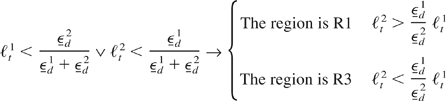
Definition 1. Let h(o) ∈ H(o) index the set of Deterrer strategies that can be supported by some pure strategy equilibrium given the vector of parameters o. (Note that H(o) is finite.) Let n(h(o)) be the number of signals sent with positive probability under h(o), given parameters o. A pure strategy equilibrium with Deterrer strategy h(o) is maximally informative at o if n(h(o)) ≥ n(h′(o)) ∀h′(o) ∈ H(o).
Assumption 1 (A1). If EU t(a′|y t′,m′) = EU t(00|y t′,m′), the Target chooses a(y t′,m′) = 00.Footnote 55
Proposition 2. Under C1 and A1, for  in
 in R2, and
 in R3, the following strategies and beliefs constitute a maximally informative pure strategy equilibrium of the game in regions R1 to R3. Further, this equilibrium is unique in the sense that no other maximally informative pure strategy equilibrium induces a different distribution over outcomes.
Deterrer's Strategy: The signaling component of the Deterrer's strategy is as follows. In R2, play m({ll,hh}) = m 3,m(lh) = m 2,m(hl) = m 1. In R1, play m({ll,lh}) = m 2,m(hl) = m 1,m(hh) = m 3. In R3, play m({ll,hl}) = m 1,m(lh) = m 2,m(hh) = m 3. Let the second component of the Deterrer's strategy be r(11) = 0, r(00) = 1 ∀y d ≠ ll, r(00,ll) = 0, r(01,{ll,lh}) = 0, r(01,{hh,hl}) = 1, r(10,{ll,hl}) = 0, r(10,{hh,lh}) = 1.
Target's Strategy: Let the Target's strategy be a(m 3,{lh,hl,hh}) = 00, a(m 3,ll) = 11, a(m 1,{hh,hl}) = 00, a(m 1,{ll,lh}) = 10, a(m 2,{hh,lh}) = 00, a(m 2,{ll,hl}) = 01, a(m 4) = 00.
Target's Beliefs: The Target's posterior beliefs given the Deterrer's signal are specified in terms of the likelihood that the Deterrer will go to war, but note that there is an immediate translation to updated beliefs defined over Deterrer types, μ(y d|m). (p 11|m) = 0 ∀m and (p a|m 4) = 0 ∀a. In R1, (p 10|m 3) = (p 01|m 3) = (p 01|m 1) = (p 00|m 1) = (p 00|m 3) = 1, (p 10|m 2) = (p 00|m 2) = 1 − ℓd2, (p 01|m 2) = (p 10|m 1) = 0. In R2, (p 00|m 1) = (p 00|m 2) = (p 01|m 1) = (p 10|m 2) = 1,  , (p 10|m 1) = (p 01|m 2) = 0. In R3, (p 10|m 3) = (p 01|m 3) = (p 10|m 2) = (p 00|m 2) = (p 00|m 11) = 1, (p 01|m 1) = (p 00|m 1) = 1 − ℓd1, (p 10|m 1) = (p 01|m 2) = 0.
Proof. First, note that by Proposition (1), the four types of Deterrer never send four signals in equilibrium, so that if three signals are sent for particular parameter values in a particular equilibrium, that equilibrium is at least as informative as any other over that parameter range. For four types, there are six ways to partition types into three groups that constitute possible signaling strategies. Of these, three are impossible by Proposition (2) because both Deterrer type ll and another Deterrer type send a signal that no other types send. That leaves three other possible equilibrium signaling strategies, namely those assigned to R1, R2, and R3.
For the Deterrer's signaling strategy to be optimal, twelve conditions must hold, which are represented as follows:

Note that in R1 to R3, given the Target's strategy, EU d(m*(y d)|y d) ≥ EU d(m 4|y d) ∀y d, which means that an equlibrium must satisfy only the remaining eight conditions represented in (3).
The Deterrer's utility can be expressed as follows.


The notation I y ta(m) = {x}, shall mean that I y ta(m) = 1 if condition x is satisfied and 0 otherwise. These shall be used as indicator variables that equal 1 when type t takes action a following message m in equilibrium.
In the R1 case, the Target plays 11 if the Target's type is ll and the Deterrer sends m 3. Therefore, Deterrer type hh's expected utility from m 3 is strictly higher than its utility from the other signals, which means six conditions remain from equation (3) that the Deterrer's strategy must be shown to satisfy. Note that (q 11|m 1) = (q 11|m 2) = 0 given the Deterrer's signaling strategy because the Target strictly prefers a(y t,m 1) = 10 to a(y t,m 1) = 11 and a(y t,m 2) = 01 to a(y t,m 2) = 11 ∀y t since (p 10|m 1) = (p 01|m 2) = 0. Further, using A1, (q 10|m 3) = (q 01|m 3) = (q 10|m 2) = (q 01|m 1) = 0. Taking these requirements into account, substituting into (3) and simplifying yields the following four equations.


Under the messaging strategy assigned to R1 and C1, and assuming the Target uses Bayes' rule to update its beliefs about the Deterrer's types, optimality of the Target's choice implies, I ll11(m 3) = {g t − εt1 − εt2 ≥ f t} = 1, I hh11(m 3) = {g t − εt1 − εt2 ≥ f t} = 0, I lh11(m 3) = 0, I hl11(m 3) = 0, I ll10(m 1) = 1, I hh10(m 1) = {g t − εt1 ≥ f t} = 0, I lh10(m 1) = 1, and I hl10(m 1) = {g t − εt1 ≥ f t} = 0. Further, for 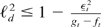 , I ll01(m 2) = {g t − εt2 ≥ (1 − ℓd2) f t + ℓd2g t} = 1, I hh01(m 2) = 0, I lh01(m 2) = 0, I hl01(m 2) = {g t − εt2 ≥ (1 − ℓd2) f t + ℓd2g t} = 1. Substituting into the above conditions yields the closure of R1. Thus, the closure of R1 is a necessary condition for this signaling strategy to be optimal for the Deterrer. Further, the Target's beliefs and optimal response have been derived from the Deterrer's strategy and Bayes' rule (and note that these correspond to the strategies and beliefs assigned to R1 in the proposition). This implies that, given the conditions specified in the proposition, R1 is sufficient for the existence of the R1 portion of the equilibrium.
Similarly, in R2, substituting into equation (3), simplifying and using A3, this again implies four conditions:


Using Bayes' rule to update the Target's beliefs, optimality implies the following for the Target's strategy in this region. For  ,
 , I y t11(m 3) = 0 ∀y t ≠ ll. Further, I ll10(m 1) = 1, I hh10(m 1) = {g t − εt1 ≥ f t} = 0, I lh10(m 1) = 1, I hl10(m 1) = {g t − εt1 ≥ f t} = 0, I ll01(m 2) = 1, I hh01(m 2) = {g t − εt2 ≥ f t} = 0, I lh01(m 2) = {g t − εt2 ≥ f t} = 0, I hl01(m 2) = 1. Substituting into the above conditions yields the closure of R2.
In R3, the four conditions are:


Using Bayes' rule to update the Target's beliefs, optimality implies the following for the Target's strategy in this region. I ll11(m 3) = {g t − εt1 − εt2 ≥ f t} = 1, I hh11(m 3) = {g t − εt1 − εt2 ≥ f t} = 0, I lh11(m 3) = 0, I hl11(m 3) = 0, I ll01(m 2) = 1, I hh01(m 2) = {g t − εt2 ≥ f t} = 0, I lh01(m 2) = {g t − εt2 ≥ f t} = 0, I hl01(m 2) = 1. For  , I ll10(m 1) = {g t − εt1 ≥ (1 − ℓd1) f t + ℓd1g t} = 1, I hh10(m 1) = {g t − εt1 ≥ (1 − ℓd1) f t + ℓd1g t} = 0, I lh10(m 1) = {g t − εt1 ≥ (1 − ℓd1) f t + ℓd1g t} = 1, I hl10(m 1) = {g t − εt1 ≥ (1 − ℓd1) f t + ℓd1g t} = 0. Substituting into the above conditions yields the closure of R2.
Note that the Target's beliefs specified in the proposition follow from Bayes' rule and the Deterrer's strategy. The equilibrium described in the proposition is unique in the sense that it induces a unique distribution over outcomes among maximally informative equilibria. We defined signaling strategies in terms of arbitrarily chosen signals (m 1 − m 4) and have shown that the strategies assigned to arbitrary signals in R1 to R3 are maximally informative. (Note that arbitrary signals m 1 − m 4 in one region need not be the same arbitrary signal in another region.) Although equally informative equilibria exist in which different specific signals are sent by different classes of types, the partition of Y d induced by m*(y d) is the one described here, and this clearly cannot induce a different distribution over outcomes. Therefore, since we have seen that the strategies assigned to the regions exist in the region assigned and not in any of the other regions, the equilibrium is unique in the sense described. ■
Condition 3 (C3).  and
 . In R1,
 ; in R2,
 ; and in R3,
 .
Proposition 3. Under C1 and C3, an equilibrium exists in which (q a|m) > q a ∀m = a.
Proof. Let player strategies and beliefs be as defined in Proposition (2), but set m 1 through m 4, to 10,01,11, and 00, respectively. Then the Target's strategy implies (q a|m ≠ a) = 0 ∀a ≠ 00, which implies q a = (q a|a)Pr(m = a) ∀a ≠ 00. Since q a > 0 and 0 < Pr(m = a) < 1 ∀a ≠ 00, and since q 00 = (1 − (q 11|11))Pr(m = 11) + (1 − (q 10|10))Pr(m = 10) + (1 − (q 01|01))Pr(m = 01) < 1 = (q 00|00), we have (q a|m) > q a ∀m = a. ■
Corollary 1. Under C1, in Regions 1 and 3, an equilibrium exists in which for some m played with positive probability in equilibrium, (p a|m) = 1 ∀a ≠ 11.
Proposition 4. Under C1 and A1, if o such that  then n(h(o)) < 3 ∀h(o) ∈ H(o).
Proof. n(h(o)) < 4 by Proposition (1). Proposition (2) demonstrated that there are only three possible messaging schemes that result in three signals being sent in equilibrium, namely, those assigned to R1 to R3. But this implies that either equations (4) to (7) must hold or equations (8) to (11) must hold or equations (12) to (15) must hold. First, note that if 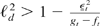 , then I y t01(m 2) = 0 ∀y t, which implies that equation (5) cannot hold. But if
 , (4) and (5) simplify to
 and
 . By similar logic, conditions (12) and (13) imply the same. If
 , then conditions (8) and (9) imply the same again. On the other hand, if
 , the numerator of the RHS of conditions (10) and (11) is zero and these conditions cannot be satisfied. ■
Proposition 5. Under C2, for  ,
 , the following strategies and beliefs constitute a perfect Bayesian equilibrium of the game: m({ll,hh}) = m 3,m(lh) = m 2,m(hl) = m 1, r(11) = 0, r(00) = 1 ∀y d ≠ ll, r(00,ll) = 0, r(01,{ll,lh}) = 0, r(01,{hh,hl}) = 1, r(10,{ll,hl}) = 0, and r(10,{hh,lh}) = 1; a(m 3,{ll,lh,hl}) = 11, a(m 3,hh) = 00, a(m 1) = 10, a(m 2) = 01, a(m 4) = 00; (p 11|m) = 0 ∀m, (p a|m 4) = 0 ∀a, (p 00|m 1) = (p 00|m 2) = (p 01|m 1) = (p 10|m 2) = 1,
 , (p 10|m 1) = (p 01|m 2) = 0.
Proof. The optimality of the Deterrer's strategy in the subgame where it chooses r(a,m,y d) follows directly from the assumptions of the model. Given the Target's strategy and the other components of the Deterrer's strategy, it is clear that m*(hh) = m 3, m*(lh) ≠ m 1, m*(hl) ≠ m 2, and m*(y d) ≠ m 4 ∀y d. Thus, the Deterrer's strategy must satisfy four conditions:




Given the Target's strategy, this simplifies to:


Thus, given the other components of the equilibrium, the Deterrer's strategy is optimal if  . Note that this condition can be satisfied as long as εd1 and εd2 are small relative to g d − f d.
The Target's beliefs following the Deterrer's signal follow directly from Bayes' rule. The optimality of a(m 1) = 10, a(m 2) = 01, a(m 4) = 00 follow directly from C2 and the other components of the equilibrium. Thus, it remains only to show the optimality of a(m 3,{ll,lh,hl}) = 11 and a(m 3,hh) = 00. Given the other components of the equilibrium,


Thus, following m 3 the Target chooses either 11 or 00, and in particular, 11 is optimal when

Thus, for  , a(m 3,{ll,lh,hl}) = 11 and a(m 3,hh) = 00 are optimal given the other components of the equilibrium. ■
 or
 , Region 2 will not exist.