INTRODUCTION
Environmental organizations in the United States have long been active in influencing the construction and implementation of environmental policies. Yet the nature of environmentalists' influence changed dramatically between World War II and the 1970s. Prior to World War II, in the decades spanning the Progressive Era to mid-century, conservation groups, like the National Audubon Society, the Wilderness Society, and the Izaak Walton League, established themselves as quintessential political insiders, with friends and allies occupying the top spots in the Forestry Service and in the agencies of the Department of Interior.Footnote 1 Beginning in the 1950s, as the idea of conservation yielded to more encompassing notions of environmentalism, the politics changed.Footnote 2 Rising hostilities between agency officials and group leaders led to a reorganization of influence: upstart organizations emerged as leaders of the new environmental movement, mobilizing new members by emphasizing conflict with entrenched government bureaucrats and private economic interests, while mainline conservation groups receded into the background. While today these insurgent groups—one of which, the Sierra Club, is the focus of this paper—are typically as deeply entrenched in insider circles as their conservation predecessors, the transformation of conservation politics in the 1950s laid the groundwork for the emergence of environmentalism in the 1960s and 1970s.Footnote 3
How do we explain the reorganization of conservation politics that occurred after World War II? How did conservationist insiders become environmental outsiders? What does this story tell us about the status of interest groups in American political development? Certainly, it is the case that newly affluent and increasingly mobile citizens began to demand improvements to National Parks and protections for air, water, and public health.Footnote 4 However, while changing values may have provided the energy for a new environmental politics, the solution to this puzzle lies in the development of new identities and capacities among organized interests and the creation of new political institutions.Footnote 5 It is in the relationship between interest organizations and institutions that I locate the causal mechanisms that provided modern environmentalism with its distinctive identity. Specifically, the environmental politics that began to emerge in the 1950s reflected a developmental process in which entrepreneurial interest group leaders pioneered new techniques of influence to reap the advantages of a changed political climate in which existing conservation institutions struggled to adapt to the postwar conflict between recreation and economic development.Footnote 6
The central empirical contribution of this article is in locating the era of critical transformation in the development of environmentalism in the 1950s.Footnote 7 However, I here also raise questions about three key tenets of path dependency as a theoretical description of the processes that drive political development. First, I challenge the oft-held notion that policy feedback is responsible for the capacities and goals of political organizations.Footnote 8 I show that the Sierra Club developed an organizational identity and established repertoires of action independent of, and sometimes in direct conflict with, state institutions and public policies. Second, I argue that if environmental groups were indeed catalysts of political change, this finding highlights our tenuous grasp on the sources of contingency in path-dependent sequences.Footnote 9 Most scholars have emphasized institutional contingency, but organized interests, as agents of change, also introduce considerable uncertainty to sequences of historical development. Third, I raise the question that, if the new politics of the 1950s led to the new policies of the 1960s and 1970s, how did organized interests reinforce particular trajectories of political development? In the absence of the types of benefits envisioned by models of policy feedback, what mechanisms existed to reproduce stable institutional arrangements?
Rethinking Policy Feedback
The political development of environmental groups indicates a reversal of the direction of policy feedback models that posit a causal relationship between new policies and supportive constituencies seeking to defend their benefits.Footnote 10 Although policy feedback models suggest that new state capacities shape the identities and goals of relevant social organizations as they pursue political opportunities, modern environmental groups developed in the absence of state capacity and, at least to some degree, developed identities and goals independently of nurturing state institutions. As I show in this essay, one of the first groups to emerge with a new set of organizing principles was the Sierra Club, a long-standing conservation organization that got caught up in one of the pivotal conservation battles of the early 1950s, and, in the process, transformed itself into a modern environmental group. As the following narrative reveals, it was as much the internal politics of the Sierra Club as it was institutional forces that galvanized a new identity for the group and established a new set of goals.
The emergence of the Sierra Club demonstrates that if environmental politics is different, it is because it embodies what Margaret Weir has termed “the organizational politics of change.”Footnote 11 As complex political actors in their own right, environmental organizations stood at the intersection of rising public consciousness and institutional intransigence in the postwar era. But rather than acting as passive vessels for institutional and social forces, some environmental groups sought to harness the political opportunities created by institutional and ideational frictions for their own benefit. As the first group to succeed in such an effort, the Sierra Club played a pivotal role in transforming environmental politics. The political dynamics that evolved within the organization, and the external ties that defined the relationship between the Sierra Club and other political actors, set in motion a sequence of events that ultimately created a new form of environmental politics.Footnote 12
Contingency
In departing from a traditional policy feedback model, this case raises questions about the role of political organizations in models of path dependency. Broadly conceived, path dependency describes a developmental sequence in which feedback effects follow initial moves, so that alternatives existing in one period of time become less available the farther along the sequence one travels.Footnote 13 A key feature of path-dependent sequences is their non-ergodicity, that is, that small, random fluctuations early in the sequence do not necessarily cancel each other out, but may generate feedback effects strong enough to impact the outcome.Footnote 14 Non-ergodicity is an important concept in institutional analysis because it introduces uncertainty and indeterminacy to historical development, without which the notion of path dependency would suggest inevitability in the historical process.Footnote 15 As institutions take shape, early decisions to allocate power in a particular way or apportion benefits another way constrain future choices by narrowing the range of politically viable options.Footnote 16
Applied to organized interests, non-ergodicity implies that small disturbances in the nascent stages of organizational development might feedback into subsequent developmental trajectories. If unshackled from the determinacy of policy feedback, we might find that interest groups are as much a cause of particular trajectories of political development as they are an effect. Such a perspective would escape what Robert Lieberman has identified as a reductionism common in historical institutional analysis.Footnote 17 Rather than just looking to institutions for the sources of political development, and conceding that the identities and goals of social organizations are primarily shaped by new policies, this perspective locates the origins of political development in a variety of sources, including interest groups, whose identities and goals are developed as much internally as they are in relation to other political actors.
Reinforcement
If the development of environmental politics suggests a rethinking of the relationship between politics and policy, what are the mechanisms of reproduction that drive the historical sequence? As Weir suggests, organizational politics are driven by two main factors: internal politics and external relationships.Footnote 18 Internally, actors within groups seek to define the identities and goals of the organization in terms most consistent with their own preferences and in ways that increase their stature.Footnote 19 Externally, groups rely on other political actors for support as coalition partners, for resources, and for access to policymaking circles.Footnote 20 As Elisabeth Clemens has noted, in forging organizational identities and establishing relationships with other political actors, groups can change fundamental political dynamics.Footnote 21
The case of the Sierra Club demonstrates the utility of thinking about feedback effects within organizations. These are the types of increasing returns that occur in response to specific types of organizational innovations, or what Kenneth Arrow has referred to as “learning by doing.”Footnote 22 As organizational actors become more proficient in their tasks, innovations are built around those core competencies.Footnote 23 As we shall see in the story that follows, one of the key advantages developed by the Sierra Club was the ability to pioneer new strategies and tactics and then to improve upon those innovations through repeated deployment in multiple policy disputes.
External relations will generate feedback effects through networks of strategic alliances built between organizations and other political actors.Footnote 24 Interest group scholars have observed that groups act as coalition brokers by developing informal communication networks, formal coalitions of associations, and alliances with actors affiliated with political parties.Footnote 25 In the 1950s, the Sierra Club emerged as the central node in a diverse network of conservationists, economic interests, and elected officials, each of whom had an ongoing interest in developing a favorable institutional environment. As more coalition partners appropriated the Sierra Club's repertoires of action and legitimated its claims of authority, the strategic alliance among conservationists gained strength.
As Paul Pierson has argued, coordination effects such as these are a powerful source of feedback in politics.Footnote 26 When organizational “software,” such as the Sierra Club's citizen mobilization strategy, is paired with institutional “hardware,” such as environmental policies that encourage citizen participation, the resulting “fit” reinforces the politics that have been generated by the initial organizational mobilization.Footnote 27 This dynamic emerges in the narrative that follows, as the Sierra Club came to define the new politics of environmentalism in the 1950s. I also show that had the Sierra Club not taken a position of leadership in conservation issues in the 1950s, or if the timing of the development of internal capacities in the Sierra Club had been altered, the politics of environmentalism might have emerged in the 1960s in a much different form.
METHODOLOGY
Informed by a nonfunctionalist perspective, I theorize that a convergence of different factors created a “critical juncture” for environmental policy in the 1950s.Footnote 28 First, the Eisenhower administration decided to abandon conservationist principles in favor of economic development, which created an opportunity for conservation groups to take a more publicly visible role in policy development. In response, the Sierra Club, with support from other existing conservation organizations, initiated a new pattern of interest group conflict that focused on mobilizing mass public opinion. Second, a new ecological philosophy emerged that reshaped the way conservationists saw their mission. Gradually the notion of environmentalism came to supplant conservationism, establishing a coherent alternative philosophy grounded in a separate set of principles. By the time of the first Earth Day and the subsequent institutionalization of environmental policy, the effects of these developments were widespread. Not only had the Sierra Club redefined the basis of policy conflict, but the ideology of environmentalism had taken root in the foundational statutes of environmental protection.Footnote 29
While I use a theory-guided narrative to identify the pivotal decisions central to the process of political change, I also employ counterfactual techniques to evaluate the impact of the different flex points in the historical process.Footnote 30 The process of counterfactual reasoning employs two specific criteria.Footnote 31 First, the counterfactual must be theoretically consistent. Given the alternatives available during a critical juncture, the selected counterfactual must be a plausible alternative for the theoretical model.Footnote 32 Second, the counterfactual must be historically consistent. For historical consistency, the counterfactual option must have been narrowly ruled out by the historical actor and it must have occurred in close enough temporal proximity to the outcome to preserve the condition that all other variables are kept equal.Footnote 33 Given these nontrivial constraints, I vary the causal elements along two dimensions when considering counterfactual alternatives. First, I evaluate the impact of particularly pivotal outcomes, following Fearon's definition of a counterfactual as, “If it had been the case that C (or not C), it would have been the case that E (or not E).”Footnote 34 Specifically, would the politics of environmentalism have changed if the Sierra Club had not emerged as the new leader of the movement? Second, following Pierson, I assess the importance of the timing of specific events.Footnote 35 I evaluate whether the Sierra Club would have emerged as the leader of the new environmental movement if its internal developments had occurred at a later date. The plausibility of the counterfactuals in this article rests on a theoretical argument that interest groups can affect changes in politics independent of the development of supportive state institutions and public policies.
INTEREST GROUP FORMATION AND THE ORIGINS OF THE SIERRA CLUB
Before we move to the 1950s, it is worth considering the context that defined the Sierra Club's entry into national politics. In particular, it is important to note the organizational features that defined the Sierra Club's political identity, as these features both enabled and constrained the group's actions in the 1950s. In considering the effects of organizational form and identity, I begin with the assertion that the organization of interest groups is, at root, entrepreneurial, motivated by the potential for benefits greater than that which could be achieved through individual effort alone.Footnote 36 As Robert Salisbury suggested, “the entrepreneur in any organizational situation is the initiator of the enterprise.”Footnote 37 Interest groups are not merely amalgams of individuals seeking to procure collective goods; rather, the group itself is an organizational manifestation of political opportunism.Footnote 38 Thus defined, we can identify how interest group organization constrains and enables certain types of activities. Entrepreneurial activity does not occur in a vacuum, but rather “capital formation processes must … come before the entrepreneur can begin to work.”Footnote 39 For interest groups, the type and amount of capital available will have a significant effect on the type of operation that can be organized. Moreover, the particular mix of capital employed in the creation of an organization will significantly impact the development of the organization, as feedback effects reinforce organizational structures.Footnote 40 To understand why particular groups engage in politics with certain organizational imperatives and not others, we need to pay attention to their founding moments and to the way in which they reinforce their original organizational attributes over time. The political capital that is necessary for starting an organization is linked to existing debates and politically engaged institutional actors. As organizational leaders solidify their affiliations, the benefits of these attachments make it increasingly difficult to seek out new ground.
When the Sierra Club stepped gingerly into national politics in the early 1950s, it did so with sixty years of organizational history behind it. While virtually unknown outside of a small community of hikers and mountaineers, the Sierra Club had long been influential on issues pertaining to National Parks and wilderness areas in and around California.Footnote 41 The Sierra Club was formed in San Francisco in 1892, when John Muir and a small group of fellow Bay Area professionals and academics who enjoyed exploring the mountains of the Sierra Nevada decided to formalize their hiking club. Discontented with rampant overgrazing in Yosemite National Park and dismayed by the lack of concern from California politicians, the Sierra Club founders sought to improve access to regional wilderness areas and pressure elected officials for greater conservation measures. In its early years, the Sierra Club fought unsuccessfully to block the construction of a dam within Yosemite National Park, an effort that was the Club's primary political legacy. So controversial was the Yosemite dam battle, however, that nearly half of the Sierra Club's members left the organization to protest the Club's opposition.Footnote 42
After John Muir's death in 1914, the remaining Sierra Club leaders inherited a broken organization, but seized the opportunity to recast the group as a sensible partner in the effort to protect scenic lands. Muir's dogmatic philosophy of preservation slowly gave way within the Sierra Club to a more pragmatic perspective, which held that if properly marketed, wilderness areas could be preserved on the principle that vast numbers of people could enjoy them. As an outdoors organization, the organizational capital available to the Sierra Club lay mostly in its ability to recruit members interested in hiking excursions. Merely alter Gifford Pinchot's cost-benefit analysis, so the argument would go, and one finds National Parks more “useful” for tourism than for mining, damming, grazing, or harvesting.Footnote 43 This approach, championed by Muir's successor William Colby, earned the Sierra Club the esteem of early National Park Service directors, the first three of whom were Sierra Club members, who found this a handy argument when defending National Parks against developers and resource extraction interests.Footnote 44 It also befit the exclusive, invitation-only character of the Club and its membership. To join the organization, prospective members had to be sponsored by two existing members, a requirement that kept the Club's membership small and relatively homogeneous for many years. Members were expected to participate in hiking endeavors and Club-sponsored “High Trips” through the mountains of the Sierras and other points of interest, while the organization's leaders tended to be those whose mountaineering skills were greatest.
The early organization of the Sierra Club reinforced several key commitments. First, group leaders considered the membership of the organization its primary strength. Early rules gave members significant opportunities for leadership in formal governance structures and in participatory activities like the High Trips.Footnote 45 Second, Sierra Club leaders established reputations of expertise, independent of partisan affiliation, which helped to establish close ties to government officials in the Forest Service and the National Park Service.Footnote 46 A shared vision of wilderness protection cemented an alliance between the Sierra Club and its agency allies. Finally, the Sierra Club held true to its origins as a “club.” For most of the middle-class professionals who joined, the value of the Sierra Club was primarily social. To the extent that the Sierra Club engaged in political activities, it was the actions of individual members that made the difference.Footnote 47
The Sierra Club's unique organizational structure and contentious history proved important to its emergence as a national organization, but also complicated its role as the potential leader of the conservationist coalition. To begin with, a strong democratic ethos permeated the governing structure of the Sierra Club, which gave members opportunities to expand the purview of the Club's conservation activities. The Club came to reflect the conservation impulses of its members—for better or worse—which forced the organization to reconcile a diversity of views on conservation. At the same time, the Sierra Club leadership was drawn from an elite group of well-connected professionals, many wary of reliving the trauma of the battle over the dam in Yosemite.Footnote 48 Consequently, the Club tended to embrace strategies that reduced the likelihood for overt conflict with political officials. As the Sierra Club pressed forward on conservation issues in the postwar era, rank-and-file pressures for greater activism clashed with an organizational repertoire of political action that favored negotiation and compromise.
EXERCISE OF INFLUENCE AND THE EMERGENCE OF THE SIERRA CLUB
The prewar history of the Sierra Club holds few clues that would foretell of its emergence in the 1950s as a leader of a national conservation movement. Yet the organizational structure of the Sierra Club, with its democratic character and its ongoing engagement with political elites at the state and national levels, poised the Club to catapult into a position of national prominence. The key element to the emergence of the Sierra Club as the leader of the new environmental movement was a confluence of institutional change and organizational development. The institutions that governed natural resource policy became hostile to the conservation aesthetic at precisely the time that the Sierra Club bolstered its internal capacity to become politically engaged. Factional disputes within the Sierra Club flared, but eventually those who sought greater activism saw their approach prevail over that of the more conservative faction. The self-reinforcing nature of political success led the Sierra Club to continue to develop its activist repertoire and led other groups to emulate its approach.
How does the Sierra Club case illustrate the effects of contingency and self-reinforcing processes on interest group development? In general, as interest group leaders search for ways to influence policymaking, assert control within their organizations, or find personal acclaim, they will experiment with new strategies and tactics, expand organizational repertoires, and deploy new argumentative frames.Footnote 49 Even small changes within an organization, like the creation of a new staff position, may initiate a sequence of self-reinforcing actions that end up causing significant changes, both in the organization itself and the way that it influences policymaking. As we will see, entrepreneurial innovations within the Sierra Club generated what Brian Arthur calls “learning effects,” which act as self-reinforcing mechanisms by “improv[ing] products or lower[ing] their cost as their prevalence increases.”Footnote 50 These learning effects also created expertise, which in turn created zones of autonomy for entrepreneurial Sierra Club leaders. As Daniel Carpenter has demonstrated with respect to bureaucratic agencies, autonomy occurs when, among other things, officials develop a reputation for expertise, forged in the battles routinely fought with organizational foes.Footnote 51 Having achieved autonomy, insurgent Sierra Club leaders were able to take control of substantial aspects of organizational development. The increasing returns associated with innovation ensconced particular repertoires by privileging the chosen course of action of the innovator.Footnote 52 Consequently, in the case of the Sierra Club, internal developments intersected with institutional opportunities and new politics resulted.Footnote 53
Creating a Political Organization
In early March 1950, Devereaux Butcher, the executive secretary of the National Parks Àssociation, wired a telegram to Sierra Club headquarters in San Francisco, warning of an imminent hearing being organized by Interior Secretary Oscar Chapman on the long-planned Colorado River Storage Project (CRSP), a mammoth federal appropriation for a sequence of dams that would simultaneously tame the Colorado and its tributaries, support widespread irrigation for croplands across the arid region, and provide hydroelectric power for its burgeoning cities.Footnote 54 The CRSP was supported by a coalition of western members of Congress; governors of the impacted states; officials within the Department of Interior, especially the Bureau of Reclamation; and a consortium of development interests who stood to benefit from the project. Key to the project, and what had alarmed Devereaux Butcher and the conservation community, were two dams slated for Dinosaur National Monument in Utah. Butcher's missive called on all conservation organizations to show up for the hearing to oppose dams within the National Park System—specifically Dinosaur National Monument. “Must and can save Dinosaur,” he implored.Footnote 55
Sierra Club leaders met with National Park Service director Newton Drury and representatives from the Wilderness Society and the Izaak Walton League to discuss options and decided to send former Club president Bestor Robinson, a prominent local attorney, to Washington, D.C., to attend the hearing and report back to the Board.Footnote 56 Although Robinson made several trips to the East Coast and met with a multitude of concerned allies, his inclination and that of the Sierra Club was to steer clear of the unfolding conflict. The long shadow of the Yosemite controversy and a distinctive parochialism quashed appeals to get involved, as Sierra Club leaders decided to give Drury sufficient latitude to work out whatever compromise might be necessary.Footnote 57 The Sierra Club's legacy of collegial relationships with executive branch officials, carefully cultivated over the years, kept the group on the sideline of the debate.
Consistent with its long-standing emphasis on “outings” as a way to increase awareness and support for parks and other scenic areas, the Club agreed to begin sponsoring rafting trips through the canyons of Dinosaur.Footnote 58 But conservation allies like Joe Penfold, the western director of the Izaak Walton League, insisted that this timid first step was missing a larger opportunity. The outings, he explained, would be more helpful if they were attached to a political project. Penfold pleaded with the Sierra Club to expand the “show-me” trip “to really get a crowd of key people, including if possible Justice [William O.] Douglas and key eastern Congressmen who would be sympathetic, and use the Dinosaur case as a means of making a substantial open issue in the battle of preserving Parks, Wilderness, fish, wildlife and recreation against commercial exploitation.”Footnote 59 Penfold saw the gathering controversy over Dinosaur as an opportunity to squarely address what had begun to look like an ugly battle between advocates of economic expansion and supporters of the National Park System (NPS). Eager developers were eyeing the NPS for its holdings of the few remaining high-yield lands for mining, damming, and timber harvesting.Footnote 60 If Dinosaur could be dammed, what limits would be left to enforce in other National Parks? Could the Grand Canyon be turned into a reservoir? Would any of the great California redwood trees remain?
But the Sierra Club was unconvinced that the benefits of entering into this conflict outweighed the costs. The editor of the Sierra Club Bulletin, David Brower, who later became the key figure in leading the fight to save Dinosaur, admitted that he was less than inspired to take part, confiding to a photographer that he had sent out to take photographs, “If I am still lukewarm on Dinosaur—and I must admit that I am a little—it is because I have seen so many pictures of this dull, rolling, unmitigated surrounding country of sagebrush—to verge on heresy. I have to argue with myself to persuade me that I wouldn't rather ride in the Western Pacific Vistadome through Glenwood Canyon than struggle out through the dusty roads and sage to see a canyon which has been portrayed to me as less spectacular.”Footnote 61
Initially, the Sierra Club seemed wise to stay out of the conflict. In early 1953, Secretary Chapman eliminated recommendations for the Dinosaur dams in the CRSP proposal that he sent to Congress. With little fanfare, and under the cover of a changing administration, Chapman acceded to the conservationists' wishes that the sanctity of the National Parks be protected. Private lobbying by conservationists and a decision by the Atomic Energy Commission (AEC) and the Department of Defense to locate a new AEC research installation in Ohio, rather than in Utah as planned, thereby eliminating the immediate need for hydroelectric power that the dams would have supplied, led to a bureaucratic victory.Footnote 62 More significantly, however, it reinforced the traditional conservationist approach to politics, which was to apply personal pressure to political leaders and generate public support and enthusiasm for preserving scenic areas by facilitating and encouraging outdoor experiences.
In the midst of the initial Dinosaur skirmish, but in a largely unrelated move, the Sierra Club Board of Directors decided to appoint David Brower as the Club's first executive director. Brower would take control of the management of the Club's finances and other administrative matters as well as organize whatever political advocacy the Board of Directors might sanction. Prior to Brower's appointment, the Sierra Club had parceled out these responsibilities to various members of the Board of Directors and other Club members whose expertise or enthusiasm earned them the job. With new conservation battles erupting and the volunteer leadership in a state of collective exhaustion, there was broad agreement that a full-time director would benefit the organization.
Brower's appointment turned out to be a pivotal moment in the history of the organization, one that both reinforced the historic identity of the group while also promising new leadership on conservation issues. As a link to the past, Brower embodied the important characteristics of a Sierra Club leader: he was an expert mountain climber, he had served on the Board of Directors, and he was widely respected within the organization. As an augur of the future, Brower quickly established himself as a political leader and the Sierra Club, albeit more slowly, as a political organization. With an executive director, the Sierra Club could afford to become more directly involved in the growing number of conservation issues. As Brower's counterpart in the Wilderness Society put it, “now as you are working full time in conservation you can do ANYTHING.”Footnote 63 Brower's appointment as executive director established a beachhead for a new identity for the Club as a political organization.
As we shall see, the timing of Brower's appointment and the changes to the internal organization of the Sierra Club that it elicited were critical to the way the Dinosaur dam issue was eventually resolved. From a theoretical perspective, Brower's appointment highlights the importance of contingency in historical sequences, a point that I will develop further at the end of the essay. For now it is worth noting that Brower's appointment coincided with other changes that began to allow the Sierra Club to assume a higher profile on conservation issues, specifically the emergence of a new way of thinking about the issue of conservation and a recasting of partisan institutional affiliations.
What Is Conservation?
At about the same time that the Sierra Club was deciding whether or not to become involved in the CRSP debate, new ideas about the relationship between humans and the environment were beginning to percolate. As conservationists came to realize the implications of natural resource development in a modern economy, an ideology of ecological preservation emerged to provide an alternative framework for a new, more aggressive agenda. While the Sierra Club's principle of pragmatic preservation held the integrity of the National Park System sacrosanct, pragmatic preservation also encouraged development that would aid access for tourists to enjoy the parks' scenery. For example, during the New Deal, Roosevelt's Civilian Conservation Corps (CCC) made extensive improvements to national and state parks that facilitated access for tourists. Park Service director Stephen Mather's penchant for urban amenities brought some unlikely scenes to National Parks, including jazz quartets, dancing, stunt performers, and other entertainers who enjoyed easy access to campgrounds via new roads and trails.Footnote 64 Some Muir acolytes found this disturbing, like the Sierra Club's Harold Bradley, who wrote of the “personal toil” necessary to truly enjoy the mountains, but others saw such improvements as necessary to ward off more destructive uses of the parkland.Footnote 65 Still, there was a broad consensus that wilderness areas were to be preserved so that people could enjoy them, even if there was some dispute over how far to go in that regard. As Robert Marshall, one of the founders of the Wilderness Society put it, the importance of wilderness areas rested first in the pursuit of recreational activities and “second, that it preserves as nearly as possible the primitive environment.”Footnote 66
The alternative to pragmatic preservation came from Aldo Leopold, another Wilderness Society founder, whose land ethic drew on the writings of John Muir for inspiration. A Sand County Almanac, Leopold's 1949 treatise on environmental ethics, secularized the philosophy of Muir and vested the earth with an interest in its own survival. “A thing is right,” suggested Leopold, “when it tends to preserve the integrity, stability, and beauty of the biotic community. It is wrong when it tends otherwise.”Footnote 67A Sand County Almanac revealed an alternative, ethical argument to be made in defense of places like Dinosaur National Monument, Glen Canyon, and Yosemite. Leopold encouraged planners to unshackle themselves from the arguments of “economic determinists,” urging that instead of considering the economic benefit from a particular piece of land, politicians should consider the consequences of economic development on a piece of land.
As environmental historians and others have noted, Leopold's radical new “land ethic” emerged in a hostile intellectual and cultural climate.Footnote 68 Publishers rejected his manuscript (the book was eventually published posthumously) and a New York Times reviewer appeared perplexed by “passages that disquietingly suggest your personal responsibility for the disappearance of the buffalo.”Footnote 69 In its first decade, the book sold less than twenty thousand copies, while mass audiences did not discover it until the 1960s.Footnote 70 But, among environmentalists, Leopold's book gained an immediate following. A glowing review appeared in the Sierra Club Bulletin in 1951. David Brower was particularly struck by Leopold's formulation after receiving a copy of the book in 1950 and later dated his own consciousness-raising to his acquaintance with Leopold's protégé, Howard Zahniser.Footnote 71 In 1951, the Sierra Club struck a clause from its mission statement in which it had endorsed the notion that wilderness areas should be “rendered accessible.”
Reclaiming Dinosaur
The Wilderness Society's Howard Zahniser was optimistic that Secretary Chapman's removal of the Dinosaur dams from the CRSP put a lid on that controversy for a while.Footnote 72 Yet, within a year of Eisenhower's inauguration, Interior Secretary Douglas McKay reinserted the dam provision and urged Congress to proceed with all deliberate speed in authorizing the entire project. Constructing dams in Dinosaur National Monument quickly became a point of policy leadership for McKay and his ideological allies in the Bureau of Reclamation. McKay sought to reassert authority over the National Parks and to potentially open them up to development to serve what he saw as a broader public interest.Footnote 73
With McKay establishing himself as an ally of development interests, the Sierra Club found itself torn between an increasingly antagonistic set of government officials and a growing cadre of increasingly outspoken conservationists. At the National Park Service, Conrad Wirth tried to broker the differences between the two sides, but his background in the Civilian Conservation Corps and his adherence to the premise that the parks should be “rendered accessible” alienated many in the conservation camp. As Wirth admitted to Harold Bradley of the Sierra Club, he was uncomfortable dealing with those activists whom he considered to be “borderline cases.”Footnote 74 Instead, Wirth preferred to work with such stalwarts as Ira Gabrielson, the former director of the Fish and Wildlife Service, now of the Wildlife Management Institute, or General Ulysses S. Grant III, who had served as president of the American Planning and Civic Association after he retired from the U.S. Army Corps of Engineers. This approach resonated with some of the more conservative members of the Sierra Club, like Bestor Robinson, who later tried to make a deal whereby only one of the two Dinosaur dams would get constructed. But many Sierra Club members were quickly becoming activists in their own right and implored their leaders to take a more aggressive stance on conservation matters. Martin Litton, a Los Angeles–based journalist, encouraged David Brower to be more forcible in his approach to dealing with bureaucratic officials. “We should not presuppose that there is a ‘problem’ current until we have clear, unbiased evidence of it. Not only from the standpoint of nature preservation, but as a patriotic service to the nation's taxpayers as well, we should insist on honest statistics—not from Reclamation—before acquiescing to any of the dammers' projects … Why any sites at all?”Footnote 75 Brower had amassed a cohort of “Young Turks” in the Sierra Club, but even this faction was slow to embrace the assertiveness of Litton's strategy.Footnote 76 Instead, Brower and Club president Richard Leonard tried to navigate a path between the two extremes. Leonard explained that,
It has been suggested by some on the other hand that the conservationists would be in a stronger position to oppose the entire Upper Colorado River Project as being uneconomic and contrary to the interests of conservationists “as taxpayers.” I have checked this with a number of conservation leaders and we seem to be agreed that it would not be practical nor politically sound to attempt to oppose the entire program. We certainly can and should insist that in addition to national Park values involved, the Echo Park and Split Mountain dams are uneconomic and that the Bridge canyon Project is unsound. I do not feel, however, that we should attempt to oppose the other features of the program. Most of us have felt that our soundest argument in this whole controversy is that “adequate alternatives” do exist which would enable the economic features to be carried out without harm to the national park system.Footnote 77
Pressure on the Executive
As the battle over Dinosaur began to unfold in late 1953, Brower followed the script that had served the Club well in the past. Still relatively green in his role as executive director, Brower drew up a strategy that reflected the embedded orthodoxies of the Sierra Club. Most importantly, it used the Club's extensive network of friends and supporters to try to move public officials. The Club's initial response to the beginning of legislative hearings consisted primarily of frantic letters trying to figure out who might have some influence in the Eisenhower administration.Footnote 78 Former director of the National Park Service Horace Albright wrote to the Sierra Club's Richard Leonard, “Of course I expect to do all I can with the contacts I have at the White House.”Footnote 79 Another Sierra Club ally, the former Democratic Senate candidate from California, John B. Elliott, wrote Brower advising, “May I suggest this: Those having influence with the present National Administration, and belonging to the same political group, are likely to have sufficient influence … Also, you have several men of national influence on the Sierra Club letterhead. They will doubtless get busy. Most of them helped put in office the present Administration, including Secretary McKay, and others, and they, particularly, can help. Isn't that so?”Footnote 80 For his part, Brower trawled the Sierra Club's extensive California contacts looking for someone who had Vice President Richard Nixon's ear. “Please comb the bushes,” he wrote to Sierra Club member Albert Gustus, “and find someone who does know Nixon and who cares about Dinosaur. It's very important—and we've yet to find out how.”Footnote 81 Not to be outdone, the publisher Alfred A. Knopf wrote in with an offer of help, “bearing in mind that I am Chairman of the Advisory Board on National Parks, Historic sites, buildings and Monuments.”Footnote 82 Yet the Eisenhower administration proved immovable and persisted in pushing the Dinosaur dams forward, forcing conservationists to fall back on their next-best strategy.
Conservationists in Congress
The second leg of the conservationists' strategy took the debate to Congress, where they would try to convince lawmakers to remove the Dinosaur dams from the CRSP. Some, like Martin Litton, were pushing for a wholesale rejection of the premise of the CRSP. But when the Sierra Club sent David Brower to testify before the House Interior and Insular Affairs Subcommittee on Irrigation and Reclamation, he followed the lead of the better-known conservation organizations, which insisted that opposition be limited to the dams within Dinosaur, rather than to the entire project.Footnote 83 In later testimony to the Hoover Commission Task Force on Water Resources and Power, Brower emphatically underscored the Sierra Club's moderate position that it did not oppose dam building in principle: “We started out in the Sierra Club with this position—and it is our position officially today—that we do not oppose an Upper Colorado River Storage Project which stays out of the National Park System.”Footnote 84 Brower's testimony echoed the official position adopted by the Sierra Club Board of Directors. Having taken up the issue of dams in National Parks in 1950, the Board resolved that, “[T]he Sierra Club fully recognizes the urgent need for efficient use of our water resources, but also believes that greater public values will be realized if these resources are developed outside of the outstanding scenic areas.”Footnote 85
Not only did Brower, who had become personally invested in the Dinosaur issue after taking a river trip through the canyons in the summer of 1953, face constraints on his opposition from coalition partners, but the Sierra Club itself was divided between those who advocated for a more aggressive approach and those more interested in reconciliation. As noted above, many older and organizationally powerful members were reluctant to fully engage the debate. Many Club members had backgrounds in resource extraction industries and were ambivalent about withdrawing public lands for preservation.Footnote 86 Concerns about being perceived as “elitist” and a desire to maintain credibility with government officials echoed through often-contentious Sierra Club Board meetings.Footnote 87 As one Board member explained, “At that time we were still trying to follow through on the kind of relationship that the Club had had with the Park and Forest Service in earlier years where people who were members of the Board of the Sierra Club were influential, but in their own right, and not because they were Board members.”Footnote 88 The faction of older, more conservative leaders of the Sierra Club insisted that the integrity of the Club would be upheld by adhering to a consistent message of preserving parks and demonstrating a willingness to work within the system.
Complicating matters further, as the Sierra Club grew more popular, members in far-flung areas began to clamor for their own chapters. The tight-knit group that had bonded around campfires in the Sierra Nevada Mountains was suddenly awash with new faces. By the early 1950s, Sierra Club chapters had been established in southern California and the Pacific Northwest, and in 1954 the Club accepted a new East Coast chapter. Many of the older Club leaders winced at this influx of new members. One pined for the days when “members of the Board were intimate friends and were able to reach others personally at any time,” and despaired that “there were hundreds of new members who never knew the pioneers of the Club and were having no personal contact with present-day leaders.”Footnote 89
Finally, the older generation was concerned about the political estrangement between the Sierra Club and the conservation agencies of the federal government. As noted, the Club had enjoyed a particularly hospitable relationship with the National Park Service, whose first three directors were Club members. Sierra Club leaders and Park Service officials labored together to preserve the sanctity of the National Park System after its inception in 1916, in the face of efforts by development interests to build tourist facilities and extract resources from underutilized portions of the Park System. Despite its growing unease with some of the marketing schemes of Park superintendents Newton Drury and his successor Conrad Wirth, the Sierra Club maintained a strong relationship with the Park Service, cemented by a mutual recognition of the importance of maintaining the integrity of the National Parks.Footnote 90
Constrained as he was, Brower still mounted an impressive lobbying campaign to try to convince Congress to modify the authorization of the CRSP so that it excluded the Dinosaur dams. Brower launched his first salvo in testimony before the House Subcommittee on Irrigation and Reclamation. In mid-January 1954, the subcommittee held nine days of hearings on the CRSP, the first six of which were allocated to supporters of the project. Unlike other conservationists, who, for example, presented pictures of the affected areas and read poetry, Brower astounded members of the committee in his testimony by demonstrating that the Bureau of Reclamation had made egregious errors in its evaporation estimates. Brower simply pointed out that a higher Glen Canyon dam would store more water and evaporate less than the dams proposed for Dinosaur, much to the astonishment of Bureau of Reclamation officials and their Congressional supporters.Footnote 91
Brower coupled his theatrics in the hearing room with an energetic lobbying campaign. He found congressional allies in John Saylor (R-PA) and Craig Hosmer (R-CA); Northcott Ely of the California Colorado River Board was sympathetic to the ends pursued by Brower, if not for the same reasons. “We would join anyone who could help us save Dinosaur,” explained Brower, whose allies included coal interests, tax foes, and organized labor.Footnote 92 As the cost of the CRSP became more evident, the conflict in Congress began to turn on a sectional axis. Eastern conservatives deplored the public expenditures; midwestern farmers feared that newly cultivated lands would drive down commodity prices even further; and far western representatives zealously defended their water allocation and groused about Eisenhower's rejection of similar dams on the Snake River.Footnote 93 Still, despite growing opposition, a congressional norm of committee deference meant that conservationists faced overwhelming odds against success in the Senate, and only marginally better chances of stopping the dams in the House. Brower, Howard Zahniser of the Wilderness Society, and Joe Penfold of the Izaak Walton League “went up and down the corridors … We all had the names of people we wanted to see. We'd have our periodic little re-assemblies at the Cosmos Club or elsewhere and see who had done what and what the general sense was—who needed to have a little work done on him.”Footnote 94 Zahniser even began toting around a portable movie projector with film footage from Dinosaur to show members of Congress what was at stake with their decision. Nonetheless, the face-to-face lobbying was not enough to swing pivotal votes in the House (although the bill was slowed) and the Senate approved the CRSP with little difficulty. Even a letter-writing campaign by members of the participating conservation organizations failed to convince key members of Congress. Wayne Aspinall's Interior Committee counted 4,731 letters, all but 53 opposed to the Dinosaur dams.Footnote 95 And yet, the House, with Aspinall taking the lead, showed no signs of relenting on the Dinosaur dams.
A New Approach and Old Constraints
Conservationists began to second-guess themselves and their strategies. Martin Litton, who had been one of the most forceful advocates for more direct confrontation, complained, “I think we are giving the enemy undue advantage by sticking strictly to our bird-watching and refusing to meet him on his own ground.”Footnote 96 But the photographer Ansel Adams, a close ally of Brower's on the Sierra Club Board of Directors, counseled a different alternative. The problem was not that the Sierra Club was not being aggressive enough in its position taking, nor was it that that the lobbying efforts had been too weak-kneed. The Sierra Club scored it right on both items, suggested Adams. Instead, the Club needed to begin to look beyond its allies and beyond its lobbying targets.
We have done beautifully in the Halls of Government, in Committee, and with letters to Congress, etc. But I do not think we have done so well in terms of the general audience; There is no need to create interest where interest already exists—our problem is to influence new individuals and groups, and we can only do this in terms of a simpler and more emotional presentations than are appropriate to conventional conservation fields … I strongly believe that a better understanding of wilderness values will be achieved if ALL conservation values are considered, and each value given its proper emphasis and essential importance to our civilization as a whole.Footnote 97
Adams wanted the Sierra Club to expand its outreach and expand the boundaries of conservation. He argued that the Sierra Club had been too intellectual in its conception of wilderness values; instead, a broader swath of the public could be mobilized through visual and emotional appeals, harnessed through images and descriptions of heroic wilderness vistas. David Brower would later refer to these as “cringe benefits,” or the value derived from contemplating the destruction of a particularly heart-rending site.Footnote 98
While Brower was besieged by suggestions for improving the Sierra Club's political strategy, he still had to accommodate members of his organization less willing to fight. The previous summer, the conservationist community gasped at the news that Bestor Robinson had taken it upon himself to meet privately with John Marr, an assistant to Douglas McKay in the Department of Interior, and propose a compromise in which the agency would agree to delete one of the dams slated for Dinosaur and let the two sides continue to haggle over the second dam.Footnote 99 Robinson, thinking pessimistically, considered the removal of one of the two offending dams from the park a better scenario than if the conservationists were unable to keep the dams out of the park and both were built. As he put it, “if we lose that battle, we still will have the better portion qualitatively and quantitatively of the Monument left for conversion into a National Park.”Footnote 100 As Robinson anticipated, some of his fellow conservationists were furious at what they saw as a betrayal of their efforts. An annoyed Sierra Club president Richard Leonard confided to his counterparts in the Wilderness Society, “So far, Bestor has recommended that the Sierra Club ‘compromise’ on nearly every major issue of the last ten years. In every single case so far he has been proven decisively wrong.”Footnote 101 But the unique, democratic character of the Sierra Club meant that conservative voices like Robinson's still carried considerable weight. If Brower began to innovate new strategies, then he had to be careful not to overreach.
If we pause briefly to consider the theoretical implications of this pattern of development, we can note the pull of the older style of conservation. For decades, conservationists had held influence with agency officials and other political elites and their strategies had been built around compromise and conciliation. Consequently, the internal politics of conservation organizations had to be sorted out as much as external relations did. If changes in strategies and tactics were to happen, an internal reorganization of influence would have to be accomplished first. Again we note the timing of this development. If the Sierra Club was not ready to embrace Ansel Adams' suggestion to rethink its tactics, that is, if conservative voices like Bestor Robinson's had more influence, the alternatives available suggest that the Sierra Club would not have emerged as the leader of a new environmental movement.
As we consider the relative importance of internal debates and relationships with external actors, it is also important to keep in perspective broader changes in the political environment. Since the end of World War II, Congress had been trying to tighten limits on federal lobbying. Just as the conservationist community was beginning to develop new strategies and tactics to influence political officials, new restrictions were enacted that threatened to scuttle the whole enterprise.
A More Complicated Institutional Environment
In the summer of 1954, the United States Supreme Court, in U.S. v. Harriss, upheld the 1946 Federal Regulation of Lobbying Act. In that decision, the Court affirmed the right of Congress to require disclosure of lobbying expenses when paid group representatives targeted members of Congress regarding specific pieces of legislation. Although the Act was poorly written and riddled with loopholes, it caused grave consternation among conservationists.Footnote 102 Congress had stipulated that persons or organizations could be held criminally liable for failing to register as a lobbyist. This specter caused not just the Sierra Club, but also the National Parks Association, the Wilderness Society, and the Natural Resources Council, to review “whether the organization or its executive representatives must or in wisdom should register as lobbyists and if so what the consequences would be.”Footnote 103
To make matters worse, at virtually the same time, Congress finished a major revision of the tax code that codified restrictions on the political activities of tax-exempt organizations. Like almost every conservation organization at the time, the Sierra Club depended heavily on bequests and other large contributions from supporters to fund its operations. Under the terms of the 1954 Internal Revenue Code, contributions to organizations like the Sierra Club would continue to be tax-deductible only under the condition that the group was “organized and operated exclusively for religious, charitable, scientific, testing for public safety, literary, or educational purposes” and that, “no substantial part of the activities of which is carrying on propaganda, or otherwise attempting, to influence legislation.”Footnote 104 If U.S. v. Harriss required the Sierra Club to register David Brower as a lobbyist, the Club might lose its 501(c)(3) status from the IRS. Moreover, “many of our Club members would object to identification of the Club with ‘lobbying work.’”Footnote 105
In the context of the Dinosaur battle, the Sierra Club faced a critical choice. It appeared that “any citizen, including the Exec[utive] Dir[ector] of the [Sierra Club], can appear before a Congressional Committee and that the President and officers of the [Sierra Club] and other organizations can write officially to legislators and to legislative committees without qualifying as lobbyists.” Yet the Club's political activities would be constrained by the fact that, “when advocates or agents concern themselves with creating artificial pressure on legislators by personally “buttonholing” or by artificially stimulating letter campaigns … they may begin to qualify as lobbyists.”Footnote 106 In short, the strategies and tactics that had been ineffective thus far were considered legal and appropriate, while the strategies and tactics that might prove to be more effective appeared to be out of bounds.
Unwilling to, as they put it, “quit the fight,” the Sierra Club embarked on a risky gambit, seizing on a key ambiguity in the IRS statute, the term “substantial.” If the Club could claim that its lobbying activities were an “unsubstantial” proportion of its overall activities, it might continue to use tax-deductible contributions for political purposes. But, if the IRS revoked its tax-deductible status, the Sierra Club would be forced to re-file as a social welfare organization and subsequent donations would no longer be deductible from the donor's taxes. The latter scenario would be deadly for any of the existing conservation organizations. Without tax deductibility, it would be next to impossible to raise money from wealthy benefactors.Footnote 107 Even memberships, which were relatively inexpensive, would be expected to decline.
To hedge against this catastrophic scenario, the Sierra Club, in conjunction with the other leading conservation organizations, began to create what might be described as “shell organizations” for the purposes of carrying on political activity. There were three such organizations that ended up working on the Dinosaur dam issue. The Citizens Committee on Natural Resources was headquartered in Washington, D.C., and shielded the Wilderness Society from Howard Zahniser's lobbying efforts; Trustees for Conservation was an offshoot of the Sierra Club, with Ansel Adams at the helm; and the Council of Conservationists served as a national umbrella group, headquartered in New York, and funded, in large part, by a wealthy midwestern industrialist named Edward Mallinckrodt, Jr.Footnote 108 This stopgap solution, while serving its ostensible purpose, ran contradictory to the emerging dynamic of the Dinosaur battle. With the conservationists unable to make headway with the Eisenhower administration, and Congress equally unsympathetic to preservationist appeals, the circumstances dictated an approach that emphasized public outreach—a task made significantly more difficult with pseudonymous organizations.
Creating Environmentalism through Publishing and Public Outreach
Thus far, we have seen the challenges presented to conservationists as they sought to protect Dinosaur National Monument from the Bureau of Reclamation. These challenges underscore the significance of the developmental sequence that defined the policy debate. Success required organizational reconfiguring, adaptation to institutional changes, and a new set of ideas about how to present the issue to citizens. In this next section, we see how Aldo Leopold's land ethic came to inform the Sierra Club's presentation of conservation issues to an increasingly attentive public and how the repercussions caused legislators to pull back from their efforts to build dams in Dinosaur National Monument.
When the Sierra Club recruited David Brower to be executive director, they lured him away from full-time employment at the University of California Press. Brower had edited the Sierra Club Bulletin prior to his appointment as executive director, and he maintained an abiding interest in book publishing, convinced that he could “sell conservation” to the broader public.Footnote 109 When Alfred Knopf offered his assistance in the early days of the Dinosaur battle, Brower followed up with a telephone call, and the two spent a long conversation hashing out the broad outline of a book profiling Dinosaur National Monument. Knopf and Brower agreed that such a book would have to grab the reader's attention and worked out a tentative title of “This is Dinosaur” to which Knopf added (temporarily), “God damn you and don't pretend it's anything else.”Footnote 110 Brower and Knopf wanted to dispel myths that the concern was over the flooding of dinosaur bones and convince skeptics that the Dinosaur canyons were worth saving because of their inherent natural beauty. They acknowledged the need to facilitate access and improve recreational opportunities, but insisted that this should be done in a way that minimized the human impact on the environment. More than a year passed before Brower and Knopf were able to work out the details, and it seemed like the conservationists would go down to defeat before This is Dinosaur went to press. But in the late spring of 1955, a copy of the book landed on the desk of every member of the United States Congress, complete with glossy full-color panoramic photographs on fold-out pages; essays by leading conservationists—including two by the editor, Wallace Stegner, and one by Knopf himself; and a sewn-in pamphlet explaining the implications of siting a dam within the National Park System. With Knopf willing to underwrite much of the cost, This is Dinosaur brought the salience of the debate into clear focus. In addition, copies were shipped to newspaper editors across the country and others who might be in a position to influence the outcome of the debate. Within a short while, the tenor of the debate substantially changed.
This is Dinosaur commenced the third leg of the conservationists' strategy to defend Dinosaur National Monument from the Bureau of Reclamation. If elected officials were unresponsive to conservationist appeals, conservationists would follow Ansel Adams's advice and spark the attention of the greater public. In a way, this strategy had been in the works from the very beginning of the Dinosaur controversy, but it had been unconnected to the political process. It was Bernard DeVoto's 1950 essay in the Saturday Evening Post, reprinted in Readers' Digest, that first brought national attention to the Dinosaur issue. DeVoto's essay, entitled “Shall We Let Them Ruin our National Parks?” described the implications of the proposed dams, and how the Green River, “the tempestuous, pulse-stirring river of John Wesley Powell, would become a mere millpond.”Footnote 111 But it was Knopf's book that served notice to members of Congress that an authorization of the CRSP that included the Dinosaur dams would come at a steep price.Footnote 112
The campaign to capture public opinion dovetailed with David Brower's emergence as the charismatic leader of the conservation movement. Where John Muir, a generation earlier, embodied a bit of the wild-eyed mountain man, Brower's short-cropped hair and Republican political leanings comforted political elites. Still, Brower grew more dogmatic as the battle for Dinosaur wore on. Later lionized as the “Archdruid” by New Yorker writer John McPhee, Brower consciously invoked Muir's legacy as he pressed his case. Part of his arsenal included “before” and “after” pictures of the Yosemite valley that had been flooded over Muir's protests. In his congressional testimony, Brower's ally, David Bradley, evoked the spirit of Muir, preaching, “We have had money changers in our temples before. We have thrown them out in the past, and with the help of this good committee we shall do it again.”Footnote 113 Reflecting a few years later, David Bradley's father, Harold Bradley, wrote of Brower, “He is indeed the conservationist of this era in the U.S. He is dedicated completely to the cause. He is—as you say—a creative genius, and growing in strength and stature all the time … [H]e gives the Sierra Club increasing power and prestige in our battles to preserve Parks and wild spots.”Footnote 114
The remarkable impact of This is Dinosaur and mounting constituent pressure reverberated through Congress throughout the summer of 1955. While the Senate had passed an authorization bill that included the Dinosaur dams, Wayne Aspinall was having a difficult time getting a final authorization bill out of the House, as conservationists were worried that merely removing the dams from the House bill would be insufficient. As the Izaak Walton League's William Voight noted,
If Echo Park Dam is knocked out of the bill in the House … the bill then will pass. The bill then goes to a Conference Committee of House and Senate members of the Interior and Insular affairs committee. Both these committees are heavily loaded in favor of Echo Park dam. We wouldn't have a prayer of keeping Echo Park Dam out of the Conference Committee report, and neither House of Congress is likely to vote down a Conference Committee Report.Footnote 115
Conservationists decided to try to block the bill entirely, worried that compromise with the House would only lead to subsequent defeat in the conference committee. This put pressure on western members of Congress, who were eager to see the CRSP authorized, and given the size of the project and the uncertainty of budgetary limitations in forthcoming years, it seemed like 1955 was the final year in which the project would be politically feasible. John Saylor, a Republican from Pennsylvania, kept the CRSP bottled up for most of the summer through a variety of parliamentary maneuvers, while the Council of Conservationists rallied public support for saving Dinosaur.Footnote 116 The Sierra Club kept its members abreast of the issue through its Bulletin while it waited for the impasse to be broken. Even with time on their side, however, conservationists debated various strategies for coming to a quick resolution. Joe Penfold of the Izaak Walton League, who had worked closely with Brower and Zahniser on the issue, suggested that the conservationists come out in support of a proposal to authorize Glen Canyon dam and earmark surplus revenues for local water development projects.Footnote 117 But Brower had begun thinking that Glen Canyon, which he had initially suggested as a better alternative to Dinosaur, might be worth preserving too. He certainly no longer wanted to prejudge the matter before taking a closer look at what was to be sacrificed and examining the potential for cheap, plentiful nuclear power.Footnote 118 The Council of Conservationists followed Brower's intuition and announced that it would not take sides on any particular proposal “because the ultimate engineering and economic virtues of any plan are beyond the legitimate scope of conservationists. However, if a new or revised project is developed and a new bill created which we are satisfied does not require or anticipate a dam or reservoir in a protected area or otherwise violate good conservation … [we will] drop all opposition.”Footnote 119
With time running short, Aspinall finally announced his intention to withdraw the Dinosaur dams from the House bill so that the entire CRSP would be allowed to pass. Wary conservationists were certain, however, that Aspinall planned to restore the dams when the bill went to conference. To head off this possibility, in mid-October 1955, Howard Zahniser traveled to meet up with Joe Penfold at his office in Denver, Colorado, the city where supporters of the CRSP had also convened to discuss strategy. Knowing that the dam proponents were desperate to get their bill authorized, Zahniser and Penfold purchased space for a full-page advertisement in the Denver Post on behalf of the Council of Conservationists. The ad, written as an open letter, threatened that if the Dinosaur dams were not permanently deleted from the bill, then conservationists would mount a challenge to the entire CRSP. The next day, Zahniser and Penfold made sure that the CRSP delegation had copies of the press release that accompanied the newspaper ad. Despite deep reservations about compromising with the conservationists felt among many of the dam's supporters, Aspinall finally relented, agreeing to permanently delete the Dinosaur dams from the project in return for assurances that the rest of the project would be allowed to proceed unopposed.Footnote 120
The remarkable reversal of fortune that resulted from the publication of This is Dinosaur and the full-page ad in the Denver Post contrasted sharply with the disappointing experience of the traditional lobbying approach. Though unorthodox at the time, the strategy of mobilizing public opinion clearly proved superior in the effort to protect Dinosaur National Monument than efforts to court sympathy with administration officials or members of Congress. The Sierra Club and its allies had, somewhat inadvertently, stumbled upon a recipe for success in the postwar era: bringing conservationism to new audiences and utilizing “cringe benefits” to mobilize popular support.
Still, the older faction within the Sierra Club continued to resist Brower's efforts. After successfully protecting Dinosaur National Monument, Brower attempted to convince the Sierra Club to keep up the pressure and oppose the Glen Canyon dam too. In the midst of the debate over Dinosaur, Brower and the conservationists were willing to accept a higher dam at Glen Canyon to compensate for the loss of the dams in Dinosaur. Because Glen Canyon was so remote, only a few adventurers had seen it. However, as the Dinosaur debate wore on, a handful of Sierra Club members took trips through Glen Canyon and reported back that it far surpassed Dinosaur in terms of natural beauty. Aldo Leopold and John Muir would have argued to save Glen Canyon too. Once Brower realized what he had compromised away, he tried to backtrack on his agreement with Wayne Aspinall. But a subsequent showdown between Brower and Bestor Robinson over the telephone resulted in “preemptory orders not to oppose Glen Canyon” issued by the Club's Board of Directors.Footnote 121 The old guard was not willing to countenance another affront to the good word of the Sierra Club. As the de facto leader of the anti-dam coalition, the Sierra Club effectively ended hope that Glen Canyon could be saved when it ordered Brower to back off.Footnote 122
REINFORCEMENT, CONTINGENCY, AND TIMING
After the Dinosaur dam battle concluded and environmentalists witnessed the destruction of Glen Canyon, Brower continued to push the Sierra Club closer to an embrace of Leopold's preservationism. The Sierra Club had begun co-sponsoring a series of Wilderness Conferences with the Wilderness Society beginning in 1949, searching for common ground on a suitable wilderness policy. The early conferences focused on recreational matters, deeply influenced by proponents of pragmatic preservation.Footnote 123 By the time of the 1957 Wilderness Conference, the Sierra Club had committed itself to supporting the types of wilderness protection consistent with Leopold's land ethic. Preservation now meant preserving land for its intrinsic value; it meant preserving whole ecosystems; it meant preserving all species. As the Sierra Club historian William Cohen put it, “In an age of ecology, the influence of Aldo Leopold would overshadow that of … even John Muir.”Footnote 124 Despite continuing friction between Brower and the Board of Directors, the fact that he had won in Dinosaur and that he had won doing it his way gave Brower tremendous credibility, both within the Sierra Club and among the broader community of environmentalists.
Feedback Effects
When Brower returned to San Francisco, he found an unexpected reward for his efforts to protect Dinosaur National Monument. New membership applications were pouring into Sierra Club headquarters at a record pace.Footnote 125 The heightened visibility of the Club's efforts had attracted the attention of sympathetic conservation-minded individuals across the country. As a membership-based group, organized around local chapters, the Sierra Club stood to profit handsomely from its increased name recognition. Suddenly, Brower had more resources to work with, and each subsequent project brought greater acclaim.
In short order, the strategy that proved successful in keeping the dams out of Dinosaur National Monument was redeployed as the Sierra Club moved to other issues of concern. Despite lingering skepticism from older members of the Club, Brower had won the internal battle. Even though the 1960s witnessed a return to more sympathetic Democratic administrations, the Sierra Club continued to spar with the Department of Interior and western representatives in Congress. Secretary of Interior to Presidents Kennedy and Johnson, Stewart Udall, crossed with the Sierra Club twice, first on the question of a Redwood National Park and then over whether a dam could be built in the Grand Canyon.Footnote 126 Another famous full-page advertisement, this one in the New York Times opposing dams in the Grand Canyon, led the IRS to finally revoke the Sierra Club's tax-exempt status. The joint venture with the Wilderness Society eventually culminated in the Wilderness Act of 1964. Even local endeavors, like establishing a National Seashore at Point Reyes, north of San Francisco, attracted significant attention.
Once construction of the Dinosaur dams had been prevented, the Sierra Club and David Brower bounded from issue to issue, conflict to conflict. At each step Brower would raise the issue for public scrutiny, offer caustic remarks about the ability of the government to protect the environment, rally the public behind his cause, and recruit additional members for the Club. While Brower further alienated the Sierra Club old guard and members of the political establishment, his ability to translate concern for the environment into political strength for the Sierra Club made him impossible to disregard. Moreover, other groups found Brower's strategy compelling as well. Soon, Sierra Club imitators began to follow the pattern: generate enthusiasm for an issue, blame government officials for not protecting the public, and reap the rewards of membership growth. As Erik Johnson and John D. McCarthy have shown, the number of new environmental organizations in the United States increased dramatically after 1963, from around five per year prior to 1963 to nearly thirty new groups per year by the end of the decade.Footnote 127 By the early to mid-1960s, when environmentalism reached the American mainstream, the essential contours of conflict were well established.
It is impossible to measure precisely the impact of the Sierra Club's efforts to stop the construction of dams in Dinosaur National Monument on public opinion, but we can look elsewhere for evidence that the impact was substantial. One illuminating source is the historical record provided by national newspapers. Not only do daily newspapers provide a window into the argumentative frames deployed by either side of the debate, but they preserve a record of how the conflict was communicated to the vast majority of citizens. A typical newspaper reader would understand the conflict over Dinosaur in terms of the voices captured by the newspaper reporter. To the extent that some organizations were featured more than others meant that citizens would come away from the conflict with a particular narrative in their heads about how the events transpired and whom they held responsible.
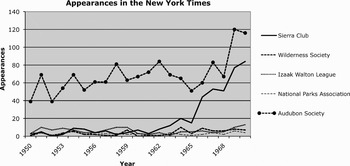
To be sure, the Sierra Club was but a bit player in the broader politics of conservation in the early postwar era. As Figure 1 shows, among the five leading conservation organizations in the 1950s, the Audubon Society received much broader coverage than the Sierra Club. Even though the Sierra Club closed the gap by 1970, the Audubon Society's deep connection to conservation issues meant that it received significantly more news coverage. Still, with respect to the Dinosaur dam controversy, the Sierra Club was mentioned more frequently than any other conservation organization. Table 1 reports the number of mentions of the five leading conservation groups in connection with Dinosaur in four leading national newspapers and shows that Americans who followed the controversy would have seen the Sierra Club as the most important conservation organization associated with the effort to protect the National Parks.
Mentions of organizations appearing in the New York Times, 1950–1970. Source: Proquest Historical Newspapers, the New York Times (1851–2004).

Newspaper Mentions in Conjunction with Dinosaur Dam, 1950–1970

Source: Proquest Historical Newspapers, the New York Times (1851–2004), the Washington Post (1877–1991), the Chicago Tribune (1849–1986), the Los Angeles Times (1881–1986).
Finally, the Dinosaur dam battle also reordered the Sierra Club's external relationships. As executive branch relations deteriorated, Brower forged ad hoc coalitions with whomever might be sympathetic. Over time, a pattern of support for environmental causes emerged in Congress. The increasing salience of environmental issues and the frequency of their recurrence led entrepreneurial members of Congress to take the initiative on environmental issues.Footnote 128 Brower's mobilization strategy impressed vulnerable incumbents (and their insurgent challengers) more so than entrenched bureaucrats in executive branch agencies. As lawmakers like Ed Muskie (D-ME) and Gaylord Nelson (D-WI) began to look for ways to extend federal protection over the environment, they saw environmental organizations as valuable allies, both for their mobilization abilities and for their unimpeachable character as advocates for the environment.Footnote 129 As new laws were written, members of Congress carved out opportunities for citizens to participate in the implementation and enforcement of new regulations.
Counterfactuals and Theory Testing
This essay argues that the rise of the Sierra Club in the early 1950s carved the contours of modern environmental politics. Prior to the 1950s, conservation groups relied on sympathetic federal agency officials to secure scenic areas for preservation and to limit development. Conservationists lacked the organizational capacity and the vision to contest policies any other way. But the success of the Sierra Club in stopping the Dinosaur dams revealed two important dynamics. First, political officials would respond to public outcries over conservation issues. Second, and more importantly, conservation groups could capitalize on public outrage and swell the ranks of their memberships by effectively mobilizing support. Based on this historical finding, I conclude that the centrality of interest groups in contemporary environmental policymaking is linked to the emergence of the Sierra Club as a pivotal actor in postwar conservation policy.
Counterfactual analysis offers a mechanism for evaluating claims of historical causation. If the Sierra Club had decided not to join the Dinosaur fight, would the modern politics of environmentalism look different? If the timing of the sequence of events that comprised the critical juncture had been different, would the Sierra Club not have emerged as the leader of the environmental movement? The first counterfactual question recalls the scenario raised by Fearon, whereby the presence or absence of a hypothesized cause can be linked to a particular outcome.Footnote 130 The absence of the Sierra Club from the Dinosaur debate would have left existing conservation organizations to contest the dams on their own. Certainly, there was no shortage of interested parties. The National Parks Association, the Wilderness Society, the Izaak Walton League, and other bodies represented conservationists. The eventual winning coalition consisted of many different types of interests, from California water rights advocates to budget balancing conservatives. Given the diverse and extensive roster of coalition partners, is it plausible to think that the Sierra Club's participation significantly altered the outcome?
The historical narrative establishes that the strategy pursued by dam opponents changed markedly once the Sierra Club became involved. Originally, opposition to the dam focused on pressuring executive branch officials who might be in a position to protect the site from development. Conservationists and their allies did not even consider alternate strategies, nor were they in much of a position to try to mobilize public opinion on the issue outside of their own members. Even though the Sierra Club was only one of a large number of participants in the Dinosaur coalition, it alone articulated an alternate vision of the conflict. David Brower and Ansel Adams had professional careers in publishing, so their inclination—once the insider strategy had failed—was to push for greater public outreach. The organization of the Sierra Club facilitated such a strategy, as members and chapters increased with greater Club visibility. Moreover, because the Sierra Club was less deeply entrenched in national conservation politics, it could more easily distance itself from the agencies and officials it opposed.
It would be impossible to say how the debate over Dinosaur would have gone if the Sierra Club had not become involved. But there is a reasonable case to be made that the critical choice to pursue a novel strategy of mobilizing public opinion by publishing books and purchasing full-page advertisements would not have been made in the Sierra Club's absence. Without having embarked on such a strategy, and given the constraints imposed by federal law on the types of lobbying activities that were permissible for tax-exempt organizations, it is highly likely that some alternate form of insider strategy would have been pursued. Not only might the Dinosaur dams have been built, but without a collective realization that public opinion could be galvanized on behalf of broader environmental issues, conservation groups might have, in the pungent words of Martin Litton, “stuck to their bird watching.”
The second counterfactual question points to the importance of contingency and timing for interest group politics. The Sierra Club's ascent depended on a particular sequence of apparently insignificant events that nonetheless had a significant long-term impact. First, it was important that the battle over the CRSP was fought under a hostile Eisenhower administration. Even for the Sierra Club, long-standing ties to officials in the Truman administration (and Roosevelt previously) would have made it extremely difficult to muster enough internal support for an insurgent campaign against the project. It was one thing to vilify “Giveaway” McKay, but another thing entirely to turn on one's own friends. Second, the Sierra Club needed to have appointed David Brower as executive director. Brower's appointment gave the Club the organizational capacity to engage in the long campaign to stop the Dinosaur dams and it provided Brower with the necessary latitude to act autonomously. Third, the Dinosaur dam conflict occurred at a pivotal moment in political time when the very strategies and tactics that environmentalists stumbled upon for this particular conflict turned out to be broadly relevant for a variety of issues, environmental and otherwise.
Each of these points of contingency were important in their own right, but the appointment of David Brower as executive director had the most far-reaching effect and depended the least on external actors. As such, it makes for an ideal counterfactual to investigate the importance of timing in historical processes. The Sierra Club had become involved in the Dinosaur issue prior to Brower's 1953 appointment, when the organization sent Bestor Robinson to Washington, D.C., to press Truman's interior secretary, Oscar Chapman, on the CRSP. If the Club had decided to defer Brower's appointment, it is conceivable that Robinson would have remained the point person on the Dinosaur issue. Given Robinson's proclivity to find opportunities to compromise, it is exceedingly unlikely that the Sierra Club would have staked out such a firm position on the dams. Robinson would not have been as invested in debunking the arguments of the Bureau of Reclamation. Consequently, if not for the internal reorganization of the Sierra Club in 1953, there is a good probability that the group would have remained on the periphery of the conflict, yielding to others the decision on how to arrange a suitable strategy.
These counterfactuals suggest that the Sierra Club's activities in contesting the construction of dams in Dinosaur National Monument in the 1950s were causally important for the emergence of environmental politics in subsequent decades. If the Sierra Club had not become involved or if it had not developed the internal capacity to challenge the Bureau of Reclamation and its allies in Congress, it is plausible that the immediate outcome would have been different and it is conceivable that environmental politics would have emerged out of a different organizational and institutional context.
DISCUSSION
The confluence of multiple historical forces during the 1950s constituted a critical juncture both for the Sierra Club and for environmental politics more generally. This research allows us to answer three important questions regarding the development of environmental politics and the central role played by the Sierra Club. First, how did the Sierra Club come to take the lead on protecting Dinosaur National Monument? Second, why were particular advocacy techniques adopted during this early period? Third, how did the success of the Sierra Club create a new environmental politics?
The emergence of the Sierra Club as a leader in efforts to protect Dinosaur National Monument could not have been foreordained. For decades, the Club had shied away from overt conflict: a strong parochial sentiment kept its advocacy efforts quite limited. Even the appointment of David Brower as executive director was a conservative move, intended to shore up the group's finances and streamline its administrative obligations. But Brower, not content to shuffle papers, soon carved out substantial autonomy for political action by utilizing the resources associated with his position. At first, Brower was willing to work within the parameters established over the decades—lobbying and calling in debts from old friends. But when that approach failed, Brower took it upon himself to remake the political identity of the Sierra Club. This required severing old ties and forging new alliances. In short order, and with tacit consent at best from his organizational superiors, Brower refashioned the Sierra Club into an insurgent political movement. In effect, he created a new political identity for the Sierra Club to suit new political challenges.
Success with the public mobilization strategy in the battle over the Dinosaur dams convinced Brower that he was right. As the Sierra Club attracted more members, Brower grew even more emboldened, pursuing a wide range of projects, while at the same time miring the Club deep in debt. By the end of the 1960s, despite widespread success and national acclaim, Brower was forced to resign by Club leaders over issues of fiscal mismanagement and failing to answer to the Club's Board of Directors. Despite driving the Club in debt and overreaching his authority, once Brower was able to commit the Sierra Club to engage in confrontational political activity, he was able to assert de facto control over the terms of political engagement. Once the initial hurdle had been overcome and preexisting alliances and commitments had been severed, the ongoing costs of continued insurgent political action were substantially reduced.
The Dinosaur dam battle was also significant in the effects that it had on the deployment of particular tactics. The two tactics that paid the greatest dividends were the publication of This is Dinosaur and the full-page advertisement taken out in the Denver Post. In the Dinosaur battle, few anticipated the public's response to threats to the National Park System. Indeed, the Sierra Club hardly considered the public a viable resource at the outset of efforts to block the dam. The Club pursued an inside lobbying strategy for want of other alternatives. Yet, in the end, public support proved decisive. Still, at the conclusion of the imbroglio, the Sierra Club capitulated on the construction of the Glen Canyon dam (still insisting that it only wanted to protect National Parks). In doing so, the Sierra Club's Board of Directors implied that the success of Brower's strategy of rousing public opinion was ephemeral at best. Brower took the rebuke from his Board of Directors and the disdain leveled at the Sierra Club by other conservationists as a personal challenge to prove his strategy right. A new line of pictorial books modeled after This is Dinosaur was subsequently published, each more extravagant than the last. More full-page ads were placed in newspapers, each more outlandish than the last. Members were solicited with no expectation that they would participate in Club expeditions. Brower's determination to prove himself right, and the multiple opportunities presented by the increasing salience of environmental issues, made it possible to hone the techniques of his broader strategy. With each new engagement, Brower's paradigm-shifting strategy became more firmly entrenched.
Finally, the success of the Sierra Club caused an alignment of organizational and institutional interests to occur. The great achievement of the environmental movement was the durability of the institutional arrangement that it occasioned, even after public interest in the issue had waned.Footnote 131 We take it for granted that environmental politics was long characterized by outpourings of citizen support for environmental causes. The image of Earth Day is ingrained in all our minds. Yet the celebration of Earth Day reflected the culmination of a long process, in which interest groups and members of Congress worked together to generate citizen enthusiasm for environmental causes.Footnote 132 Wisconsin senator Gaylord Nelson, who organized Earth Day, and Maine senator Ed Muskie, who became a chief legislative advocate for the environment, found great political currency in stoking the fears of environmental calamity. Of course, organizations like the Sierra Club had also been aiming at the same audience. In a sense, Earth Day was merely a replication of the successful strategy that David Brower had pioneered fifteen years earlier.
Brower's critique of government agencies also found its way into permanent institutional politics. Many of the new environmental laws of the 1970s included provisions for citizen input into the process. The “public interest,” which Brower had fought to incorporate into the Sierra Club's political identity, received official sanction and provided environmental groups with an opportunity to continue to press their cases, even as the political tide turned against them.
CONCLUSION
Though political associations have been central to the telling of many stories of political development, they have largely been viewed as effects of institutional conflict or institutional change rather than as causes of change in their own right. This article has demonstrated that historical development rests on a number of contingent factors including the organizational capacities of leading political associations. By examining both the internal development of the Sierra Club and changes in the external environment of conservation politics, I have highlighted the need to look beyond simple policy feedback formulations. Instead, the relevant causal forces are found in the interaction between actors within organizations and various sorts of institutions. Recent work by Daniel Carpenter and Gisela Sin reaches similar conclusions about agenda setting.Footnote 133 For a historical actor to turn an event into a political narrative requires engagement with the political process. It is not enough simply to note the potential for transformative action, but rather the causal mechanisms must be linked to specific political entrepreneurs.Footnote 134 This research suggests that further work is needed to elaborate on the instances in which policy feedback effects shape the organizational identities and capacities of political associations. What kinds of groups are subject to policy feedback effects and what kinds of groups develop independently of state institutions and public policies? What are the political implications of these alternate developmental processes and how does that affect our understanding of historical development?
Finally, it must be noted that in critiquing state-centered notions of policy feedback I am not counseling a return to a pluralist analytical framework in which state institutions are derivatives of interest group machinations. Indeed, if anything, the story of the Sierra Club should caution against any such temptations especially in light of the centrality of state actors to the development of environmental policy and the legacy of prior institutional arrangements. Rather, what this research suggests is that organized interests possess the capacity to act as causal agents in developmental sequences in their own right and ought to be considered alongside institutional actors. Moreover, just as we have come to see entrepreneurs within institutions as anchoring a nonfunctionalist perspective on institutional development, a similar perspective will illuminate important features of organizational development.Footnote 135 Together, institutional and organizational development promise a more robust synthesis of the central mechanisms that drive policy change and political development.