Significant outcomes
-
∙ No significant association exists between the brain-derived neurotrophic factor Val66Met polymorphism and obsessive–compulsive disorder susceptibility.
Limitations
-
∙ Only case–control studies were included in this meta-analysis.
Introduction
Obsessive–compulsive disorder (OCD) is a neuropsychiatric disorder characterised by repetitive, intrusive thoughts, images and impulses, and/or by compulsive behaviours. According to the World Health Organization, OCD is among the ten most disabling conditions (Reference Murray and Lopez1), and the lifetime prevalence of OCD is estimated to be 1–3% worldwide (Reference Sasson, Zohar, Chopra, Lustig, Iancu and Hendler2–Reference Ruscio, Stein, Chiu and Kessler4). Although the pathogenesis of OCD has not been well illuminated, pharmacologic, neuroimaging and genetic studies have suggested that several neurochemical systems are associated with its pathophysiology, mainly the serotonin, dopamine and glutamate systems (Reference Mundo, Richter and Zai5–Reference Billett, Richter, King, Heils, Lesch and Kennedy7).
Brain-derived neurotrophic factor (BDNF), a member of the neurotrophin family, has important effects on neuronal survival and the proliferation of neurotransmitter systems, especially the serotonin and dopamine systems (Reference Guillin, Diaz, Carroll, Griffon, Schwartz and Sokoloff8–Reference Mossner, Daniel and Albert10). Besides, BDNF is widely distributed in the central nervous system and key regions for the regulation of mood and behaviour, such as hippocampus, neocortex, amygdala, cerebellum and hypothalamus, and therefore is considered to be involved in the development of several psychiatric disorders including OCD (Reference Wozniak9,Reference Angelucci, Brene and Mathe11). Studies have found that patients with OCD, both drug-naïve and drug treated, exhibited significantly lower plasma levels of BDNF compared with normal controls (Reference Wang, Mathews, Li, Lin and Xiao12,Reference Maina, Rosso and Zanardini13), supporting that BDNF plays an important role in the pathophysiology of OCD.
A missense polymorphism of the BDNF gene at nucleotide 196, which results in a valine (Val) 66-to-methionine (Met) change (also known as rs6265 or G196A), is the only known functional polymorphism in the BDNF gene. Although this polymorphism does not affect the mature BDNF protein function, it has been reported to alter the intracellular trafficking and packaging of proBDNF and thus attenuate the activity-dependent form of BDNF secretion (Reference Egan, Kojima and Callicott14,Reference Chen, Patel and Sant15); and it has been reported that Val66Met is associated with the risk of several psychiatric disorders such as bipolar disorder and schizophrenia (Reference Gratacos, Gonzalez, Mercader, de Cid, Urretavizcaya and Estivill16). Thus far, a few studies (Reference Mossner, Walitza and Lesch17–Reference Liu, Liu, Kou and Zhang28) have investigated the relationship between the BDNF Val66Met polymorphism and OCD but have obtained inconsistent results. For instance, Hall et al. (Reference Hall, Dhilla, Charalambous, Gogos and Karayiorgou20) found that in a multi-single nucleotide polymorphism (SNP) haplotypes including the Val66Met polymorphism marked by an undertransmission of the Met66 allele was likely to confer a protective effect on OCD. Da Rocha et al. (Reference da Rocha, Malloy-Diniz, Lage and Correa25) also detected a positive association between the increased Met66 allele and OCD risk. However, more studies reported negative results (Reference Zai, Arnold and Strauss19,Reference Hemmings, Lochner, van der Merwe, Cath, Seedat and Stein23,Reference Tükel, Gurvit and Ozata24,Reference Wang, Xiao, Yu, Li and Wang27,Reference Liu, Liu, Kou and Zhang28). On the other hand, studies found different associations between the Val66Met polymorphism and gender. One study (Reference Hemmings, Kinnear and Van der Merwe29) found that the Met66 allele may confer risk to males with OCD, and another one (Reference Katerberg, Lochner and Cath26) found it may have a protective role in females with OCD, whereas other studies (Reference Wendland, Kruse, Cromer and Murphy21,Reference Marquez, Camarena, Hernandez, Loyzaga, Vargas and Nicolini22,Reference Liu, Liu, Kou and Zhang28) did not find such kind of association. The possible reasons for these discordances include relative small sample sizes, divergent ethnic backgrounds and so on. Meta-analysis, a statistical tool for combining results across studies, is a powerful method for resolving discrepancies in genetic association studies (Reference Munafo and Flint30). Hence, to derive a more precise estimation of the association between BDNF Val66Met polymorphism and OCD susceptibility, we performed the present meta-analysis with a hypothesis that there is no significant association between the BDNF Val66Met polymorphism and OCD susceptibility.
Materials and methods
Publication search
Selection of the studies was carried out by searching PubMed, Embase, PsycINFO and Chinese Biomedical Database (CBM) database from the inception up to December 2014 with the following keywords: ‘BDNF’ or ‘brain-derived neurotrophic factor’ or ‘Val66Met’ or ‘rs6265’ or ‘G196A’ or ‘196G/A’ or ‘V66M’ and ‘OCD’ or ‘obsessive–compulsive disorder’ or ‘obsessive–compulsive neurosis’. The reference lists in these studies were inspected to identify additional research not indexed by the databases. Published articles or grey literature such as conference abstracts written in English or Chinese were included.
Inclusion and exclusion criteria
Studies were included in the current meta-analysis if they met the following criteria: (a) the study evaluated the association between OCD and BDNF Val66Met polymorphism; (b) case–control studies; (c) sufficient data are available to calculate the odds ratio (OR), confidence interval (CI) and p-value; (d) the genotyping methods or appropriate references were provided. Authors were contacted when data were not reported in the article. Where appropriate the corresponding authors of the included studies were contacted for clarification or additional information or data. For studies with overlapping patient samples, only the study with larger number of OCD patients was included.
Data extraction
Information was extracted independently by two investigators by means of a standard protocol and the results were reviewed by a third investigator. The following characteristics were collected: first author’s last name, year of publication, country of origin, ethnicity of participants, the allele and the genotype frequency of the BDNF Val66Met polymorphism in cases and controls, diagnostic criteria, genotyping methods and funding sources. The Hardy–Weinberg equilibrium (HWE) of each study was retested by an online program (http://ihg.gsf.de/cgi-bin/hw/hwa1.pl).
Assessment of methodological quality
We assessed the methodological quality of included studies based on Newcastle–Ottawa Scale (NOS) for quality of case–control studies (Reference Wells, Shea and O’Connell31). A star system of the NOS (range from zero to nine stars) was used for the evaluation.
Statistical analyses
We performed the present meta-analyses using the software package RevMan 5.3 (http://tech.cochrane.org/revman) according to the recommendations of the Cochrane Collaboration; and the Egger’s test was performed using Stata (version11.0, Stata Corp LP, College Station, TX, USA). A p-value <0.05 was considered statistically significant. ORs with 95% CIs were calculated for four genetic models (allelic model: Met vs. Val; additive model: Met/Met vs. Val/Val; recessive model: Met/Met vs. Val/Val+Val/Met; dominant model: Val/Met+Met/Met vs. Val/Val) to assess the strength of the association between BDNF Val66Met polymorphism and OCD. Stratified analyses were performed by ethnicity and gender, respectively, when applicable. The significance of pooled OR was determined using the Z-test. Heterogeneity among the studies was checked by a χ 2-based Q-test. In case of no heterogeneity existing (Q-test, p>0.10), the fixed effects model (Mantel–Haenszel method) was used; otherwise, the random effects model (DerSimonian and Laird method) was used. We also quantified the effect of heterogeneity using another measure, I 2=100%×(Q−df)/Q (Reference Higgins and Thompson32). Where the data of a study were retested to be deviated from HWE, we included it in a sensitivity analysis. If there was no substantive difference within primary outcomes, when this study was added, then we included it in the final analysis. The potential publication bias was detected using the Begg’s funnel plot and the Egger’s test.
Results
Selection of the studies
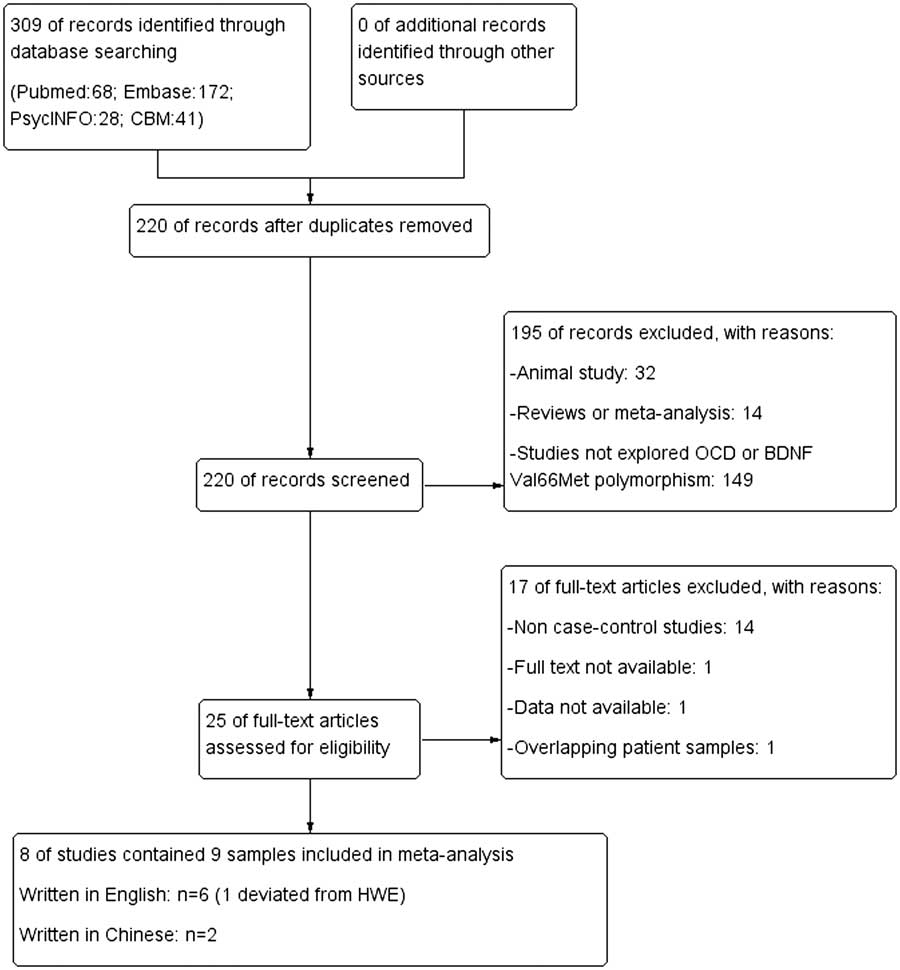
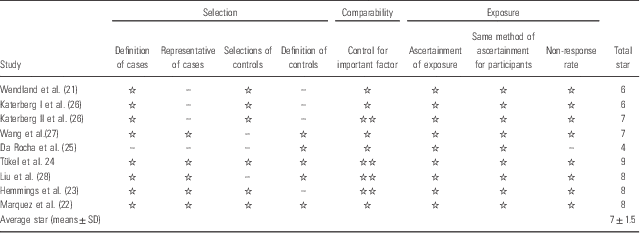
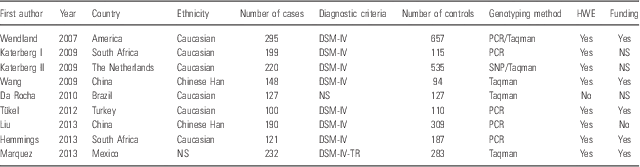
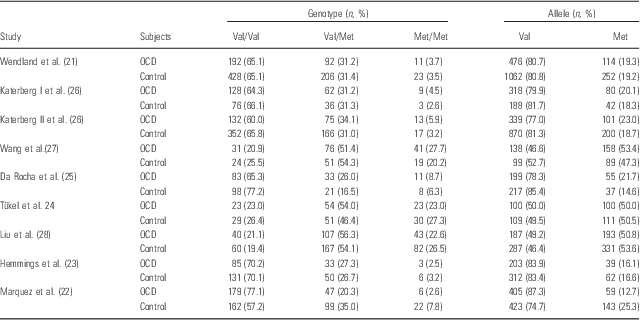
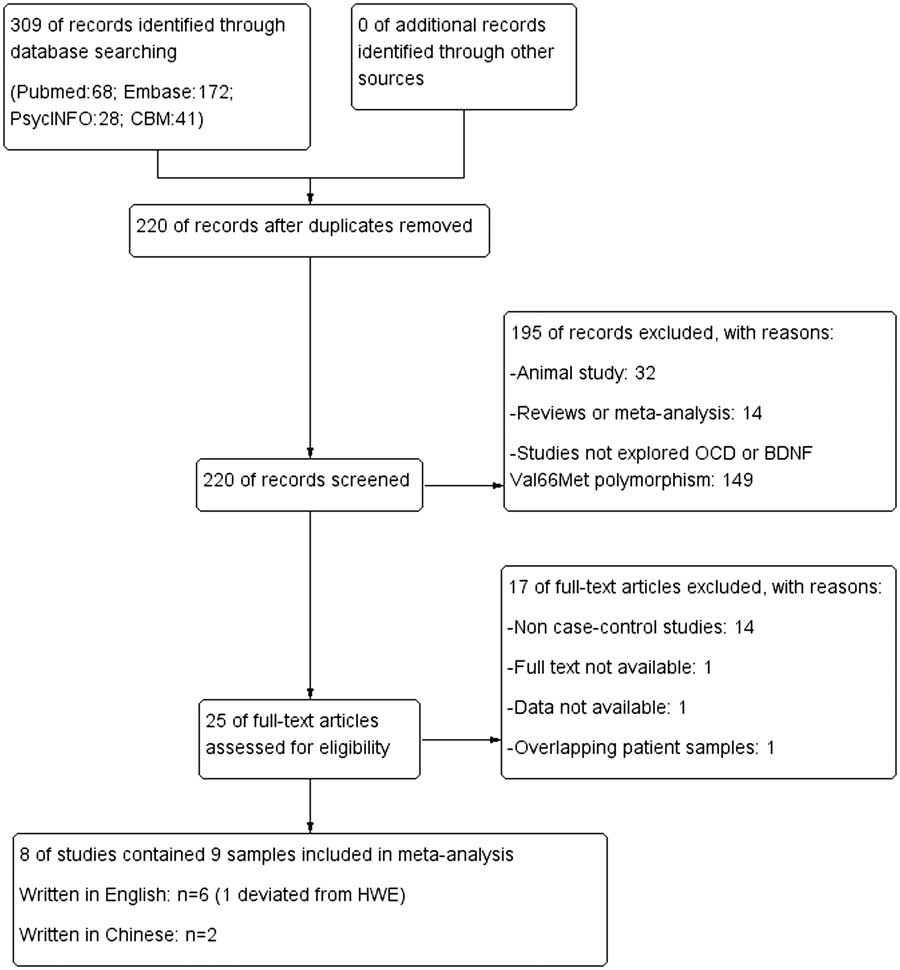
The literature search identified 309 potentially relevant studies (Pubmed: 68; Embase: 172; PsycINFO: 28; CBM: 41), of which 89 duplicates were removed. After the titles and abstracts were screened, 32 animal studies, 14 reviews or meta-analyses and 149 studies that did not explore OCD or BDNF Val66Met polymorphism were excluded. The remaining 25 articles were assessed through a careful full-text reading, except for one in which the full text was unavailable (Reference Zai33). Of these 25 studies 14 were ruled out for being a non-case–control study and one was excluded because of non-availability of data (Reference Alonso, Gratacos and Menchon18). As a part of the samples in one study (Reference Hemmings, Kinnear and Van der Merwe29) overlapped with another (Reference Katerberg, Lochner and Cath26), only the latter study (Reference Katerberg, Lochner and Cath26) with a larger sample of OCD patients was included. The allele frequency of one study (Reference da Rocha, Malloy-Diniz, Lage and Correa25) was found to be significantly deviated from the HWE (p<0.01), and its diagnostic criteria of OCD was not stated in the article, so we included it in a sensitivity analysis. Finally, eight studies (Reference Wendland, Kruse, Cromer and Murphy21–Reference Liu, Liu, Kou and Zhang28) with a total of 1632 OCD patients and 2417 controls were included in the meta-analysis, of whom six were written in English and two were written in Chinese. As one study (Reference Katerberg, Lochner and Cath26) contained separate data of two different groups of subjects, we treated them independently; therefore we obtained nine eligible samples. The overall quality of the included studies was adequate, with a range from four to nine stars and a mean value of 7±1.5 stars (Table 1). The flow diagram of the study selection is depicted in Fig. 1. The detailed characteristics of the studies included are presented in Table 2 and the genotype frequency of each study is shown in Table 3.
The flow diagram of the study selection. CBM, Chinese Biomedical Database; OCD, obsessive–compulsive disorder; BDNF, brain-derived neurotrophic factor; HWE, Hardy–Weinberg equilibrium.
Quality ratings for studies included on the basis of Newcastle–Ottawa quality assessment scale

Main characteristics of studies included
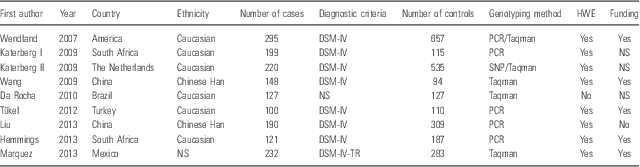
HWE, Hardy–Weinberg equilibrium; NS, not stated; PCR, polymerase chain reaction; SNP, single nucleotide polymorphism.
Genotype information of studies included

OCD, obsessive–compulsive disorder.
Meta-analysis
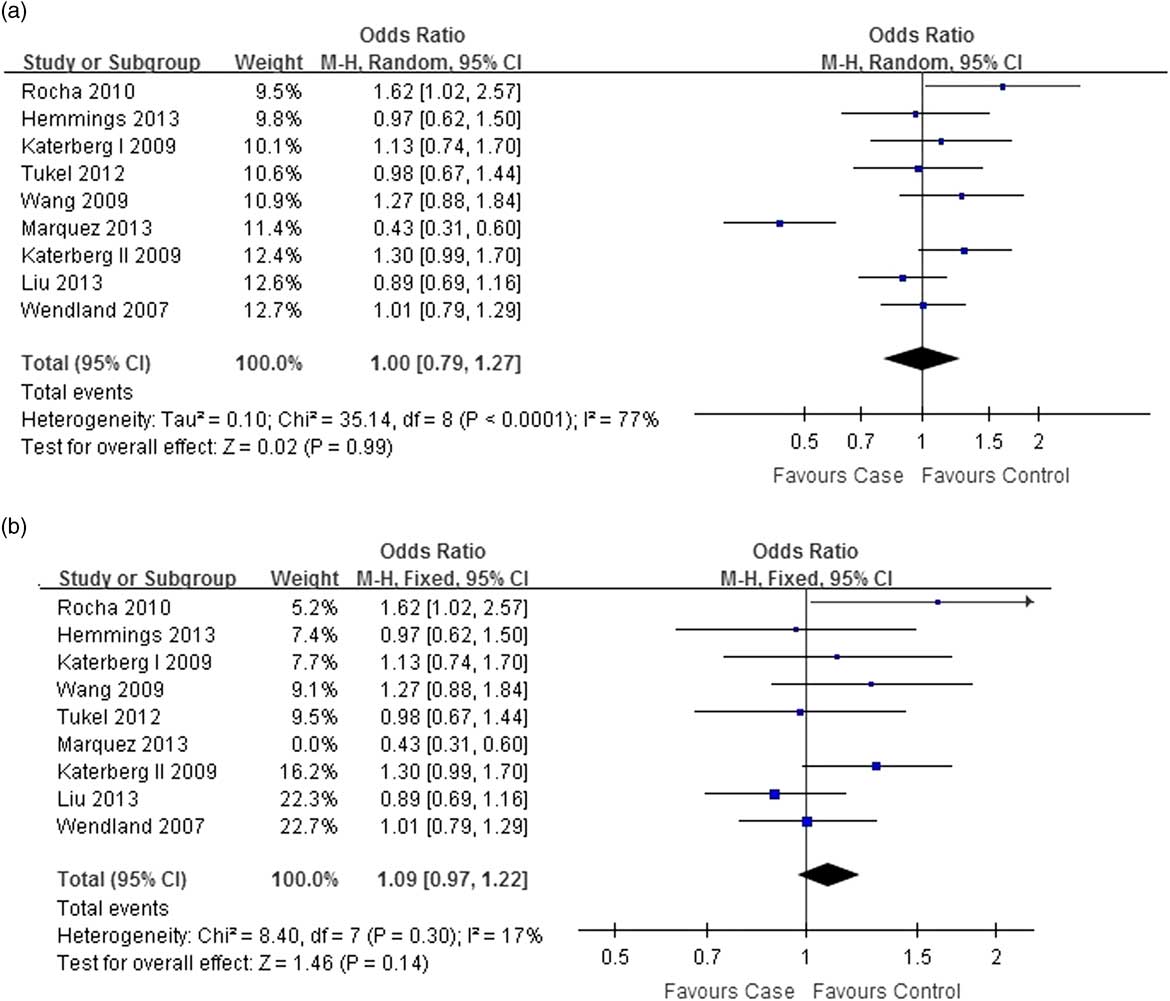
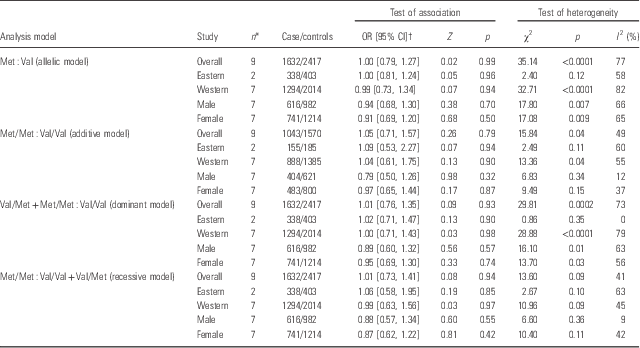
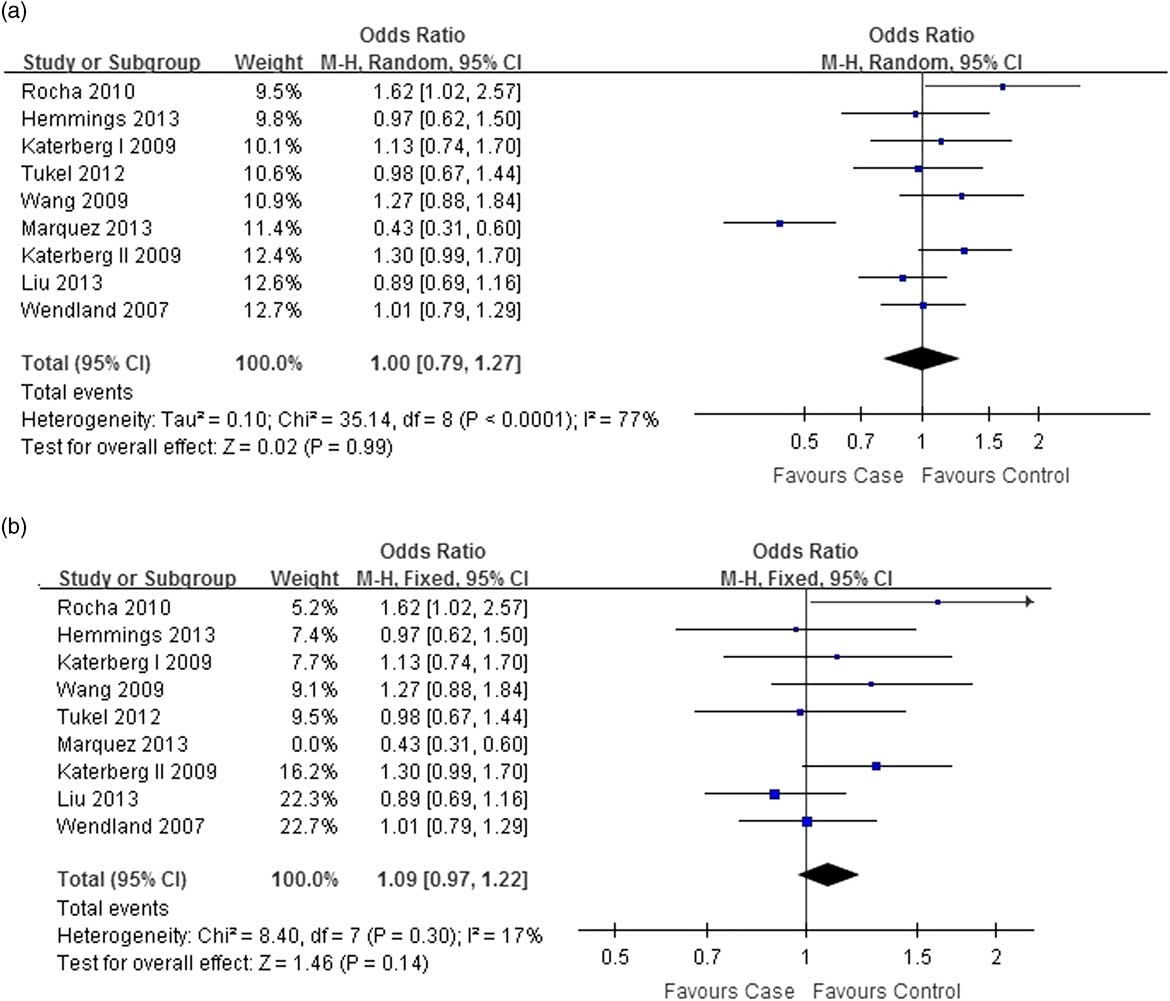
As the allele frequency of one study (Reference da Rocha, Malloy-Diniz, Lage and Correa25) significantly deviated from the HWE, we performed a sensitivity analysis and found there was no substantial difference within primary outcomes when this study was added, so we included it in the final analysis. When all data were pooled together (eight studies with a total of 1632 OCD patients and 2417 controls), significant differences in heterogeneity were observed in the allelic model (I 2=77%, p<0.001), the additive model (I 2=49%, p=0.04), the dominant model (I 2=73%, p=0.002) and the recessive model (I 2=41%, p=0.09). Therefore, the random effects model was chosen to calculate the pooled OR and 95% CI. Results indicated no significant association between BDNF Val66Met polymorphism and OCD in all four models above (p>0.05 for each comparison). The between-study heterogeneity in the pooled results was obvious and previous studies have found significant ethnic difference of the BDNF Val66Met polymorphism frequencies (Reference Shimizu, Hashimoto and Iyo34,Reference Petryshen, Sabeti and Aldinger35), moreover, its correlation with OCD might differ from male to female (Reference Katerberg, Lochner and Cath26,Reference Hemmings, Kinnear and Van der Merwe29), thus we performed subgroup analyses by ethnicity and gender. However, we failed to detect any significant association in all comparisons (all p>0.05), and the between-study heterogeneity persisted in some of the subgroups, suggesting the presence of other unknown confounding factors. Then we conducted a further sensitivity analysis and found that when the study of Marquez’s (Reference Marquez, Camarena, Hernandez, Loyzaga, Vargas and Nicolini22) was dropped, all the between-study heterogeneities were not significant, and no substantial difference was observed comparing with the primary outcomes.
The summary of the meta-analysis for the BDNF Val66Met polymorphisms and OCD risk of each comparison is shown in Table 4, and the forest plot of allelic model of overall and sensitivity analysis are presented in Fig. 2.
(a) Forest plot for Met versus Val (allelic model) in total. (b) Forest plot for (allelic model) in sensitivity analysis. CI, confidence interval; M–H, Mantel–Haenszel method.
Overall and stratified analyses of the BDNF Val66Met polymorphism on OCD risk

BDNF, brain-derived neurotrophic factor; CI, confidence interval; OCD, obsessive–compulsive disorder; OR, odds ratio.
* Number of study samples included.
† Random effects model was used when p-value for heterogeneity test <0.10.
Evaluation of publication bias
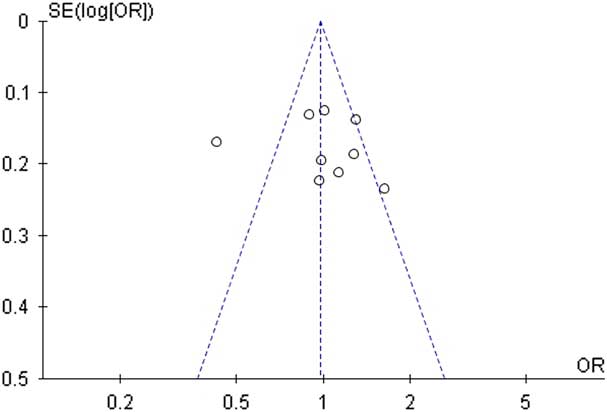
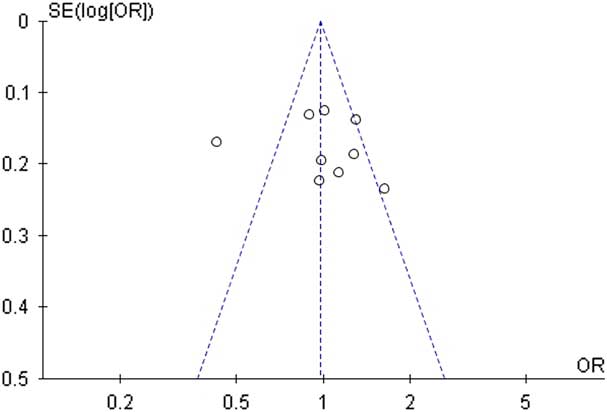
Begg’s funnel plot was performed to assess the potential publication bias. As seen in Fig. 3, the shape of the funnel plot was not so asymmetrical when comparing the Met allele with the Val allele, which indicated that a potential publication bias may be existed. We further evaluated it by Egger’s test, whereas it showed no publication bias (coefficient=−1.15; 95% CI: −9.00, 6.70; p=0.739>0.05).
Funnel plot of Met versus Val (allelic model) in total. OR, odds ratio.
Discussion
Studies have indicated that the Val66Met polymorphism of BDNF gene might play an important role in the pathophysiology of several psychotic disorders, and in year 2007, a meta-analysis of case–control studies has confirmed its association to substance-related disorders, eating disorders and schizophrenia (Reference Gratacos, Gonzalez, Mercader, de Cid, Urretavizcaya and Estivill16). As there were not enough studies available, the association of Val66Met with OCD was not analysed in that meta-analysis. The association between Val66Met and OCD susceptibility has been widely studied since then, although inconsistent results were obtained. Taylor (Reference Taylor36) previously performed a comprehensive meta-analysis of the genetic association studies of OCD susceptibility, and found there was no significant association between Val66Met and OCD (Met vs. Val, OR=1.013, p=0.904). However, studies written in Chinese were not included in this analysis; besides, a latest study (Reference Marquez, Camarena, Hernandez, Loyzaga, Vargas and Nicolini22) with 232 OCD patients and 283 control subjects replicated the positive association between this polymorphism and OCD. Hence, the present updated meta-analysis is warranted.
In the present meta-analysis, we retrieved a total of 1632 OCD cases and 2417 controls through a structured literature search and performed the analysis for four genetic models, but also failed to find an association between BDNF Val66Met polymorphism and OCD in any comparison (Met vs. Val, OR=1.00, p=0.99). This result is consistent with Taylor’s findings.
Previous studies (Reference Zai33,Reference Shimizu, Hashimoto and Iyo34) have found significant ethnic differences of the BDNF Val66Met polymorphism frequencies, with an approximate Met allele frequency 40% in Eastern and 20% in Western. In order to clarify whether OCD susceptibility is correlated with the ethnic differences of the Val66Met polymorphism, we performed subgroup analyses by ethnicity. However, we did not find significant association in both ethnicities (Met vs. Val, in Eastern, OR=1.00, p=0.99; in Western, OR=0.99, p=0.94). Hemmings et al. (Reference Hemmings, Kinnear and Van der Merwe29) identified that the Met66 allele might increase the risk for early-onset OCD in males, whereas Katerberg et al. (Reference Katerberg, Lochner and Cath26) found the women with Met66Met genotype showed association with later age at onset of OCD than women with other genotypes. These findings suggested that gender would be an important factor affecting the association between Val66Met polymorphism and OCD. Based on this reason, we further performed a stratified analysis by gender, but again failed to find any significant association in any genetic model (Met vs. Val, in male: OR=0.94, p=0.70; in female: OR=0.91, p=0.50). An unavoidable issue in our meta-analysis is the obvious heterogeneities of all four genetic models and some of the subgroups. When a study with positive results was dropped (Reference Marquez, Camarena, Hernandez, Loyzaga, Vargas and Nicolini22), all the between-study heterogeneities became unremarkable. We checked carefully and found that the sample size, diagnostic criteria for recruiting subjects and genotyping method of this study (Reference Marquez, Camarena, Hernandez, Loyzaga, Vargas and Nicolini22) did not obviously differ from the others, so the reason for the between-study heterogeneities remained unknown. One possible reason may be the potential different sample ethnicity involved, as Mexico is an ethnically diverse nation and the ethnicity of participants was not specified in their study (Reference Marquez, Camarena, Hernandez, Loyzaga, Vargas and Nicolini22). Meta-regression may be used for addressing heterogeneity; however, it is not implemented in RevMan software. When we dropped this study (Reference Marquez, Camarena, Hernandez, Loyzaga, Vargas and Nicolini22) in the sensitivity analysis, no substantial changes compared with the primary outcomes were observed. All results aforementioned further support that Val66Met polymorphism was not significantly associated with OCD predisposition.
The negative results in the present analysis may be owing to the complex pathogenesis of OCD, as risk for complex disease is thought to be controlled by multiple genetic risk factors, each with only small individual effects (Reference Pauls37). On the other hand, other factors such as environmental risk are likely to be involved in the aetiology of OCD (Reference Pauls, Abramovitch, Rauch and Geller38). In this respect, studies focus on a SNP may not be good way of exploring the aetiology of OCD. However, recent studies have suggested that BDNF Val66Met polymorphism may be associated with certain obsessive symptoms or with the treatment response (Reference da Rocha, Malloy-Diniz, Lage and Correa39–Reference Fullana, Alonso and Gratacos41); therefore, its relationship with OCD is still worth further study.
There are some limitations in the present meta-analysis. First, the number of available case–control studies on BDNF Val66Met polymorphism and OCD is relatively small. Besides, there may be genetic difference between early-onset and late-onset OCD (Reference Katerberg, Lochner and Cath26), but we did not perform a stratified analysis based upon the onset age owing to the unavailability of the necessary data. Moreover, despite that we strived to strict the inclusion and exclusion criteria when retrieving eligible studies, and the p-value was >0.05 in Egger’s test, a potential publication bias could be still existing owing to a relative small number of studies included; and it may threaten the validity of conclusions. Given these reasons, the interpretation of the results should be cautious, although the overall quality of the included studies was adequate.
Conclusion
Taken together, despite some limitations, our present meta-analysis indicates that the BDNF Val66Met polymorphism is not significantly associated with OCD susceptibility.
Acknowledgements
We thank Dr. Chunhui Jin for his valuable advice on an earlier version of this manuscript. Authors’ contributions: Z.H.Z. and J.W. planned and designed the study. Y.S.L. and Z.W.X. performed the publication searches and selected the eligible studies, respectively. J.W. and F.Q.Z. extracted the data and carried out the meta-analysis, respectively. Z.H.Z. evaluated the qualities of selected studies and ranked the Newcastle–Ottawa Scale. J.W. wrote the manuscript and prepared all tables and figures. All authors discussed the results and reviewed the manuscript.
Conflicts of Interest
The authors declare no conflicts of interest.