

A disaster is defined as an event that brings about the cessation or disruption of societal functioning, exceeding the capacity of the affected society to cope using its own resources, and resulting in widespread human, economic, and environmental losses.1, 2 There is evidence in the literature that shows that many disasters have occurred, although their sources vary.Reference Usta3–Reference Panwar and Sen6 Considering that disasters occur frequently in the world, it can be said that individual preparation is important in minimizing the effects of possible disasters.Reference Bullock, Haddow and Coppola7 For this reason, disaster literacy is thought to have an important place in individual and social preparedness for disasters.Reference Logayah, Maryani, Ruhimat and Wiyanarti8, Reference Karabey9 Disaster literacy is defined as the ability of individuals to follow, implement, access necessary information, understand, and interpret the activities, warnings, and instructions carried out in the phases of comprehensive disaster management, including preparation, mitigation, response, and recovery.Reference Brown, Haun and Peterson10 Disaster literacy training is important for improving individuals’ knowledge and understanding of disasters, as well as increasing their ability to prepare for and respond to disasters.Reference Chu, Chang and Tsai11 Disaster literacy can be improved through community-based disaster education programs and awareness training.Reference Triyanto and Syamsi12, Reference Kesumaningtyas, Hafida and Musiyam13 Because social and individual disaster literacy covers all activities in the integrated disaster management phases, they can be considered significant steps in reducing potential disaster damages and enhancing community resilience.Reference Kimura, Hayashi and Kobayashi14, Reference Çalışkan and Üner15 Disaster literacy can minimize or even eliminate the damages that may occur due to possible disasters and increase social resilience.Reference Kesumaningtyas, Hafida and Musiyam13 Determining the disaster literacy levels of individuals, improving weaknesses, and conducting disaster awareness studies can contribute to reducing social vulnerability.Reference Djoumessi and Eyike Mbongo L de16 Relevant literature reveals that disaster education supports the disaster preparedness culture and contributes to the construction of a disaster-resilient society by creating social awareness.Reference Izadkhah and Hosseini17–Reference Yusuf and Razali19 Therefore, it can be stated that social resilience is related to disaster literacy level.
Resilience is defined as a community’s sustainable ability to endure and recover from adversities. The adversities mentioned here can be pandemics, economic crises, and human or natural disasters.Reference Goode, Salmon and Spencer20 It is known that disaster resilience is affected by environmental and social factors as well as personal characteristics. Based on this information, it can be stated that individual resilience and disaster literacy have a significant role in disaster preparedness.Reference Varol and Kırıkkaya21 Disaster resilience includes many components,Reference Cutter, Ash and Emrich22, Reference Gajendran and Oloruntoba23, Reference Tierney24 and efforts to increase disaster resilience focus on strengthening multiple components (objective-subjective).Reference Norris, Stevens and Pfefferbaum25, Reference Obrist, Pfeiffer and Henley26 In this regard, disaster resilience includes an approach that takes into account the social, economic, historical, and cultural factors that determine the capacity of individuals and communities to survive and cope with disasters.Reference Norris, Stevens and Pfefferbaum25 Individual disaster resilience is defined as the degree to which an individual can acquire, process, and understand information related to disasters, make appropriate and rational decisions to cope with risky situations related to disasters, and identify and utilize relevant resources to take action.Reference Ditirro27 Resilience may also be described as the capacity to resume normalcy following calamities.Reference Gökalp Yilmaz28 As the resilience of society and individuals increases, the probability of an emergency caused by a possible danger turning into a disaster decreases.Reference Bodas, Peleg, Stolero and Adini29
Increasing social resilience prevents individuals from panicking and experiencing a sense of helplessness in case of disasters. In addition, it contributes to the formation of a conscious and educated social capital source in disaster situations.Reference Plough, Fielding and Chandra30 Therefore, it can be considered that social resilience and individual resilience affect each other and contribute positively to each other.Reference Kimhi31 What is important in minimizing the negative effects after disasters and creating rapid recovery processes is that disaster resilience and disaster preparedness are closely linked.Reference Tobin32 It has been emphasized that individuals resilient to disasters have an increased capacity to cope with stressful situations and an accelerated recovery process after stress.Reference Sherrieb, Norris and Galea33 In this regard, although studies have been conducted on disaster literacy Reference Kesumaningtyas, Hafida and Musiyam13, Reference Kanbara, Ozawa and Ishımıne34–Reference Suhardin40 and social resilience, Reference Norris, Stevens and Pfefferbaum25, Reference Obrist, Pfeiffer and Henley26, Reference Sherrieb, Norris and Galea33, Reference Pollock, Wennerstrom and True41, Reference Mayer42 there are no studies directly examining the effect of disaster preparedness literacy on individual resilience. This study is important research that evaluates the effect of disaster preparedness literacy on individual resilience in Turkey.
Method
Purpose
This study was planned to examine the effect of disaster preparedness literacy on individual disaster resilience and related factors (age, gender, marital status, socioeconomic status, disaster experience status, and type of disaster experienced).
Research Design
The study was designed in a cross-sectional descriptive design.
Universe and Sample
The universe of the study consisted of individuals aged 18–52 years. Because the number of individuals in the universe is unknown, the sample size was calculated using the formula for an infinite population.Reference Smith43
(t2*p*q)
n: ……………
d2
n: Sample size
t: Significance (t=1.96 for α=0.05)
p: The incidence of the examined event (taken as 50% for this study)
q: The frequency of non-occurrence of the examined event (because p:50%, the q value was taken as 50%)
d: Sampling error (taken as 0.05 for this study)
Based on the computation, it was concluded that a minimum of 384 samples (n=384.16) should be collected for this investigation. There were 401 participants in the study’s sample at the conclusion of the data gathering phase.
Data Collection Tools
The data of the study were collected by using “Personal Information Form”, “Individual Disaster Resilience Scale” and “Disaster Literacy Scale Preparedness Sub-Dimension”.
Personal Information Form
The form consists of 6 questions including age, gender, marital status, socioeconomic status, disaster experience status, and type of disaster experienced.
Disaster Literacy Scale (DLS)-Preparedness Sub-Dimension
The DLS is a self-report scale developed to evaluate the disaster literacy of individuals aged between 18-60 years.Reference Çalışkan and Üner44 The scale consists of 61 items. Each item in the scale is scored between 1 point (1 - very difficult) and 5 points (5 - very easy). There are no reverse items in the developed scale. The score that can be obtained from the scale is between 61-305. It is accepted that the higher the score obtained from the scale, the higher the disaster literacy level of the participants. For ease of calculation, the total score was standardised with a value between 0-50 using the formula below.
Formula=Index= (arithmetic mean-1) x (50/4)
Index = Calculated unique index
Arithmetic mean = Average of responses to each item
1= Lowest possible value of the mean (causes the index to be the lowest 0)
4= Range of the mean
50= The highest value selected for the new criterion
On the scale, 0 indicates the lowest disaster literacy and 50 indicate the highest disaster literacy.
The formula given above can be used separately within the mitigation, preparedness, response, and recovery dimensions of the DLS. Similarly, the cut of points defined over the overall DLS score can be realized within 4 sub-dimensions. Thus, categorization can be made separately for each of the 4 sub-dimensions.Reference Çalışkan and Üner15, Reference Çalışkan and Üner44
Individual Disaster Resilience Scale
DiTirro (2018)Reference Ditirro27 developed the Individual Disaster Resilience Scale, which he calls InDRA (Individual Disaster Resilience Assessment), to evaluate individual disaster resilience. The adaptation of the scale to Turkish culture was made by Şen (2022).Reference Şen45 The original scale consists of 20 items and its adaptation to Turkish culture consists of 19 items. While Cronbach’s Alpha coefficient obtained in the original study was 0.895, this value was calculated as 0.90 in the adaptation study. The scale was prepared in the form of a 5-point Likert. The scale consists of 4 sub-dimensions: Knowledge coping (items 1-7), information coping (items 8-11), communal coping (items 12-16), and affective coping (items 17-19). The items in the affective coping sub-dimension consist of negative statements and are reverse scored. The increase in the score obtained from the scale indicates a higher individual disaster resilience.Reference Şen45
Data Collection
The study data were collected through social media groups on October 10 and November 10, 2023, with the informed consent form prepared per the Declaration of Helsinki via Google Forms and the link to the questionnaires containing the purpose of the study.
Data Analysis
The study data were analyzed using SPSS 26 and AMOS 23. The obtained data were first checked in terms of lost data and extreme values, and then the normality test and homogeneity test were performed in SPSS 26 package software. Numbers, mean, and percentages were used for descriptive analysis. The Mann Whitney U test and Kruskal Wallis H test were used for non-parametric variables, whereas the T test and ANOVA were used for parametric variables. The associations between the variables were investigated using correlation analysis and basic linear regression analysis.
Ethical Dimension
Before starting the study, ethical approval was obtained from the Artvin Çoruh University Scientific Research and Publication Ethics Committee (Approval Number: E-18457941-050.99-108253- 06/10/2023). A written explanation was made at the beginning of the questionnaire and participants’ approval was obtained. Individuals who voluntarily agreed to participate in the study filled out the questionnaire online.
Findings
In terms of gender distribution, 69.6% of the participants were female, while 30.4% were male. When the socioeconomic status was examined, it was determined that 15.2% of the participants had a low level, 82.5% had a moderate level, and 9% had a high-level socioeconomic status. While 61.6% of the participants stated that they had experienced a disaster, 38.4% stated that they had not experienced any disaster. Among those who experienced a disaster, 46.6% were earthquake survivors, 12.2% were flood survivors, and 38.4% were fire survivors. The age of the participants ranged from 18 to 52 years, with a mean of 20.40 ± 3.98 years (Table 1).
Demographic characteristics of the participants

The mean individual disaster resilience scale score of the sample was 3.30 ± .57. The mean disaster literacy scale preparedness sub-dimension score was 33.44 ± 6.80. Kurtosis and skewness values were taken into consideration in the evaluation of normality distribution of the scales. As a rule of thumb for normal distribution, skewness, and kurtosis values are recommended to be in the range of 1.0 ± or 1.5 ±.Reference Bayram46 When the relevant values are examined, it is observed that the skewness and kurtosis values for the variables exhibit a normal or close-to-normal distribution. The individual disaster resilience scale and disaster literacy scale preparedness sub-dimension variables examined in the study were found to be correlated with each other. A moderate and positive correlation was found between individual disaster resilience scale and disaster literacy scale preparedness sub-dimension (r: .444; P < 0.001). According to this finding, individual disaster resilience increases as disaster literacy increases (Table 2).
Mean, distribution normality, correlation, and reliability findings of variables

* p<.001;
Cronbach’s α coefficient was used to evaluate the reliability level of the scales. According to the findings, Cronbach’s α reliability coefficients were calculated as .86 for individual disaster resilience scale and .88 for disaster literacy scale preparedness sub-dimension. These reliability coefficients indicate that both scales have a sufficient level of reliability. The simple linear regression model was used to examine the predictive effect of disaster literacy on individual disaster resilience. To test the simple linear regression model, it is first necessary to ensure that various assumptions of simple linear regression are met. The variables of disaster literacy and individual disaster resilience included in the model are continuous variables evaluated with a Likert-type scale. Distribution normality was tested for both variables and it was determined that they exhibited normal distribution. For the linearity requirement between variables, the scatter plot and correlations between variables were examined and it was determined that the linearity condition was met. For the check of outliers, standardized residuals, and Cook’s distance were examined. It was observed that the obtained standardized residual values were in the range of ± 3.29, and the maximum value of Cook’s distance was below 1, so there were no outliers. For the normal distribution of errors, the histogram graph and the distribution curve for standardized errors were examined and it was determined that the errors were normally distributed. The scatter plot was examined for the homoscedasticity check of the variables, and it was determined that the variables have homoscedasticity. To test the independence of the errors, the Durbin-Watson coefficient was examined, and it was observed that the coefficient was in the range of 0-4, so it was determined that the errors were independent of each other. In line with these findings, it was decided that the model was suitable for simple linear regression.
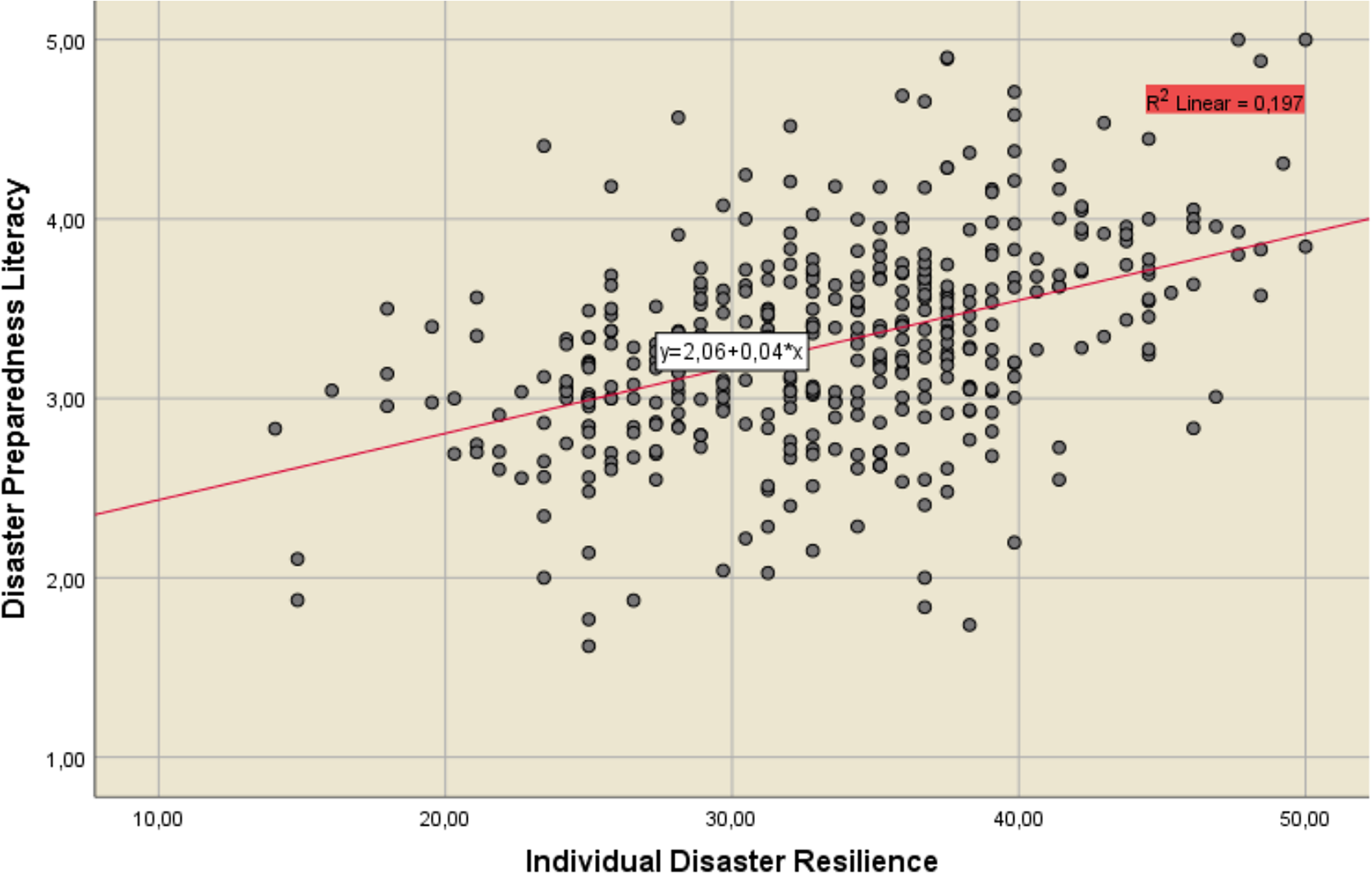
According to the regression model, the effect of disaster literacy on individual disaster resilience was found to be significant (F:97.95; P < 0.001) (Figure 1). According to the findings, as the disaster literacy levels of the participants increase, their individual disaster resilience levels also increase. According to the model, 20% of the variance in the variable “Individual disaster resilience” is explained by the variable “Disaster literacy” (R2: .197)
Regression results of the relationship between disaster literacy and individual disaster resilience.

According to the model established to determine the effect of disaster literacy on individual disaster resilience, a regression equation y = a + bx was created. According to the calculations, the equation “Individual disaster resilience” = 2.063 + 0.037 * “Disaster literacy” was obtained (Figure 2). According to the equation obtained, a 1-unit increase in the variable “Disaster literacy” causes an increase of 0.037 units in the variable “Individual disaster resilience.”
Regression chart of the relationship between disaster literacy and individual disaster resilience.
The mean individual disaster resilience scale score of female participants was 3.24 ± .5 and the mean individual disaster resilience scale score of male participants was 3.46 ± .6, and a statistically significant difference was found between the 2 groups (t: -3.645; P < 0.05). According to this finding, the individual disaster resilience levels of females were lower than males.
The mean individual disaster resilience scale score of married participants was 3.63 ± .6 and the mean individual disaster resilience scale score of single participants was 3.28 ± .6, and a statistically significant difference was found between the 2 groups (t: –2.920; P < 0.05). According to this finding, the level of individual disaster resilience of married individuals was higher than that of singles.
The mean score of the participants with low socioeconomic level was 3.22 ± .6, the mean score of those with moderate level was 3.32 ± .6, and the mean score of those with high level was 3.30 ± .9, and there was no statistically significant difference between the groups (KW: 2.453; P > 0.05). According to this finding, the level of individual disaster resilience does not differ according to socioeconomic status.
The mean score of those who experienced disasters before was 3.37 ± .6, and the mean score of those who did not experience disasters was 3.21 ± .5, and a statistically significant difference was found between the 2 groups (t: 2.736; P < 0.05). According to this finding, the individual disaster resilience level of those who have experienced disasters was higher than those who have not experienced disasters.
The mean score of those who experienced earthquake disasters was 3.39 ± .6, the mean score of those who experienced floods was 3.32 ± .6, and the mean score of those who experienced fire was 3.23 ± .5, and there was no statistically significant difference between the groups (KW: .620; P > 0.05) (Table 3). According to this finding, the level of individual disaster resilience does not differ according to the type of disaster experienced.
Individual disaster resilience scale differences according to demographic variables

The mean disaster literacy scale preparedness sub-dimension score of female participants was 32.98 ± .6.6, and the mean disaster literacy scale preparedness sub-dimension score of male participants was 34.50 ± .7.3, and a statistically significant difference was found between the 2 groups (t: –2.072; P < 0.05). According to this finding, the disaster literacy level of females was lower than males.
The meandisaster literacy scale preparedness sub-dimension score of married participants was 38.35 ± .7.3, and the mean disaster literacy scale preparedness sub-dimension score of single participants was 33.13 ± .6.7 and a statistically significant difference was found between the 2 groups (t: -3.699; P < 0.05). According to this finding, the disaster literacy levels of married individuals were higher than that of singles.
The meandisaster literacy scale preparedness sub-dimension score of the participants with low socioeconomic level was 31.18 ± .7.5, the mean score of those with moderate level was 33.82 ± .6.7, and the mean score of those with high level was 35.07 ± .7.2, and there was no statistically significant difference between the groups (KW: 6.516; P > 0.05). According to this finding, the level of disaster literacy does not differ according to socioeconomic status.
The meandisaster literacy scale preparedness sub-dimension score of those who experienced disasters before was 33.41 ± .7, and the mean score of those who did not experience disasters was 33.50 ± .6.5, and a statistically significant difference was found between the 2 groups (t: -.127; P > 0.05). The level of disaster literacy does not differ according to the disaster experience.
The meandisaster literacy scale preparedness sub-dimension score of those who experienced earthquake disasters was 33.66 ± .7.2, the mean score of those who experienced floods was 32.97 ± .6.2, and the mean score of those who experienced fire was 31.11 ± .7.5, and there was no statistically significant difference between the groups (KW: 1.409; P > 0.05) (Table 4). According to this finding, the level of disaster literacy does not differ according to the type of disaster experienced.
Disaster literacy scale preparedness sub-dimension differences according to demographic variables

A significant positive correlation was found between age and individual disaster resilience scale (r:.186; P < 0.05). According to this finding, the level of individual disaster resilience increases as age increases.
A significant positive correlation was found between age and disaster literacy scale preparedness sub-dimension (r:.160; P < 0.05) (Table 5). According to this finding, the level of disaster literacy increases as age increases.
The relationship between individual disaster resilience scale and disaster literacy scale preparedness sub-dimension scores with age

* p<.05;
Discussion
This study holds the distinction of examining the impact of disaster preparedness literacy on individual disaster resilience. Brown et al. (2014), Varol and Kırıkkaya (2017), and Ajar and Ronggowulan (2022) report that among the significant factors that increase individual resilience against disasters are disaster awareness and a sense of safety.Reference Brown, Haun and Peterson10, Reference Varol and Kırıkkaya21, Reference Ajar and Ronggowulan39 It is emphasized that disaster literacy, which forms the basis of individual disaster resilience, plays a significant role in the formation of disaster awareness and the development of individuals’ confidence in coping with disasters.Reference Brown, Haun and Peterson10, Reference Varol and Kırıkkaya21, Reference Ajar and Ronggowulan39 In this study, it was determined that individual disaster resilience increased as disaster literacy increased. Afrian and Islami (2019) and Logayah et al. (2024) found that increased disaster literacy can strengthen individual disaster resilience.Reference Logayah, Maryani and Ruhimat47, Reference Afrian and Islami48 It can be stated that individuals with a high level of disaster literacy will be able to understand and implement the actions that need to be taken before, during, and after the disaster more easily. Therefore, the fact that conscious and prepared individuals react without panicking in disaster situations indicates that the disaster resilience of individuals is increasing.
In this study, it was determined that the individual disaster resilience level of males was higher than that of females, the individual disaster resilience level of married individuals was higher than that of single individuals, and the individual disaster resilience level of those who had experienced disasters before was higher than those who had not experienced disasters. Akil and İnal Önal (2022) evaluated individual resilience to disasters and it was stated that the average individual resilience of women to disasters was significantly higher than that of men.Reference Akil and Inal Onal49 Bonanno et al. (2007) and Marshall (2004) reported that women experienced more negative effects and had lower resilience after disasters than men.Reference Bonanno, Galea and Bucciarelli50, Reference Marshall and Waxman YNP51 On the other hand, the level of individual disaster resilience does not differ according to socioeconomic status and the type of disaster experienced. The differences between individual disaster resilience levels of males and females can often vary depending on individual experiences. There is evidence in the literature that the gender factor affects disaster resilience.Reference Chisty, Rahman and Khan52–Reference Smyth and Sweetman54 It can be stated that the social physical resilience and leadership roles of males are effective in their high individual disaster resilience compared to females. Individual disaster resilience depends on many factors, such as a person’s experiences, the support systems they have, and their individual characteristics.
In this study, it was determined that the disaster preparedness literacy levels of males were higher than those of females. In contrast to our study, Vu et al. (2023) conducted in Vietnam found that women naturally had higher literacy scores than men.Reference Vu, Nguyen and Dinh55 In a study conducted by Bulut (2023) on individuals’ disaster literacy, it was stated that women’s disaster literacy levels were higher than men in terms of various variables.Reference Bulut56 In the research conducted by Sözcü and Aydınözü (2019) on teacher candidates, it was determined that female teacher candidates were relatively more knowledgeable about natural disasters than male teacher candidates, but there was no significant difference between them.Reference Sözcü and Aydınözü57 In the research conducted by Chung and Yen (2016) on school administrators and teachers, it was stated that no difference was found between genders in terms of disaster prevention literacy.Reference Chung and Yen37 While some studies examining the relationship between disaster literacy and gender mention that gender affects disaster literacy, Reference Vu, Nguyen and Dinh55, Reference Seyihoglu, Kartal and Tek Bıyık58 some studies argue the oppositeReference Akil and Inal Onal49–Reference Chisty, Rahman and Khan52, Reference Türker and Sözcü59–Reference Fadilah, Permanasari and Maryani60. According to these results, there is no consensus on the relationship between disaster literacy and gender. It is considered that risk perception, education level, and social roles are effective in the gender variability of disaster literacy. These gender-related variabilities can shape individuals’ different levels of awareness and preparedness for disasters.
In this study, it was determined that the disaster literacy levels of married individuals were higher than those of singles. Genç et al. (2023)Reference Genc, Yildiz, Kaya and Bilgili61 found that the DLS score differed according to marital status. It was stated that health literacy is more common in married individuals than in other groups.Reference Seyed, Gholamreza and Fatemeh Radjati62 It is considered that the instinct of family members to protect each other and their familial roles is effective in the high disaster literacy levels of married people.
In this study, the level of disaster preparedness literacy does not differ according to socioeconomic status, disaster experience, and type of disaster experienced. Jafari et al. (2020)Reference Jafari, Seyedin and Baba63 reported that there may be a relationship between economic level and disaster preparedness and disaster safety.Reference Jafari, Seyedin and Baba63 Zhang et al. (2021) Reference Zhang, Zhu and Zhou36 reported that those who experienced disasters or lived in disaster-prone areas had higher disaster preparedness literacy scores. It is considered that disaster experience and regional disaster risk affect the disaster literacy levels of individuals. A study conducted in China indicated that the majority of the participants prepared for disasters in various ways.Reference Chan, Yue, Lee and Wang64 In our study, among all participants, 61.6% had experienced a disaster before, and the disaster preparedness literacy levels of participants were insufficient (mean disaster literacy scale preparedness sub-dimension score was 33.44 ± 6.80). In order to increase the disaster awareness and disaster literacy levels of individuals in Turkey, it can be said that more attention should be paid to disaster awareness trainings. In Turkey, 2021 was designated as the “Disaster Education Year” and 2022 was defined as the “Disaster Implementation Year” and events were organized within this scope.65 It can be said that increasing educational efforts to increase social disaster awareness can be an effective strategy in transforming information into behaviour.
In this study, it was found that levels of individual disaster resilience and disaster literacy increased with age. As people get older, they can more easily cope with traumatic events, applying lessons learned from experience.Reference Adams, Kaufman and van Hattum66 On the contrary, Tuohy and Stephens (2016)Reference Tuohy and Stephens67 stated that advanced age is not a factor that increases resilience. Liddell and Ferreira (2019)Reference Liddell and Ferreira68 found that there was a negative correlation between age and resilience scores. Bonanno et al. (2007)Reference Bonanno, Galea and Bucciarelli50 stated that the age factor affects resilience. Chen et al. (2014)Reference Chen, Maki and Hayashi69 noted that the aging of the population makes different contributions to disaster resilience. It has been reported that increasing age decreases the disaster preparedness score.Reference Bulut56 Çelebi and Durmuş Sarıkahya (2022)Reference Çelebi and Durmuş Sarıkahya70 stated that individuals between the ages of 18-21 have high disaster literacy levels. Genc et al. (2022)Reference Genc, Yildiz, Kaya and Bilgili61 found that the level of disaster literacy increases as age increases. It was considered that the age factor affects individual resilience and disaster literacy, and in this regard, it can be stated that increasing age positively affects disaster literacy and therefore individual disaster resilience.
Limitations and Strengths
This study has some limitations. The data of the study were collected through an online Google survey. This may affect the bias of participant statements. In addition, it can be assumed that the possibility of participants perceiving the items in the scales according to their own interpretations may affect the social acceptance error. Despite these limitations, the study also has some strengths. It has been accepted that it is the first study in the literature to examine the effect of disaster preparedness literacy on individual disaster resilience and related factors. It is accepted that the proportion of individuals who have experienced disasters (61.6%), which constitutes the majority of the participants, represents a strong aspect of the study in terms of evaluating disaster literacy scores.
Conclusion
According to the findings, as disaster literacy increases, individual disaster resilience increases. In this regard, activities such as conferences, training, seminars, and exercises related to disasters should be organized for individuals. The individual disaster resilience level of males was higher than that of females, the individual disaster resilience level of married individuals was higher than that of single individuals, and those who have experienced a disaster before have a higher level of individual disaster resilience than those who haven’t experienced a disaster. On the other hand, the level of individual disaster resilience does not differ according to socioeconomic status and the type of disaster experienced. The disaster literacy levels of males are higher than those of females, and the disaster literacy levels of married individuals are higher than those of single individuals. On the other hand, the level of disaster literacy does not differ according to socioeconomic status, disaster experience, and type of disaster experienced. As the age increases, the level of individual disaster resilience and disaster literacy increases.
This study was conducted because there were no previous studies evaluating the effect of disaster preparedness literacy on individual disaster resilience in Turkey. This study, which was carried out to contribute to the literature and fill its gaps, will create an idea for those who want to study issues related to disaster literacy and individual disaster resilience. As a result of the joint evaluation of the data of our study and the literature data, it can be said that the disaster preparedness literacy levels of the participants are not sufficient in general. Therefore, it is recommended that more studies should be conducted to increase the disaster preparedness literacy levels of individuals, to transform the acquired knowledge into behaviour and to increase the disaster awareness levels of the society.



