Introduction
Rice is one of the main cereals cultivated worldwide, and the most consumed staple food for a large part of the world’s human population. Brazil produced an average of 11.6 million tons of rice between the 2015/2016 and 2017/2018 seasons, with an average of 10.3 million tons under flooded systems (Conab 2018). The Rio Grande do Sul (RS) State produced 73% of all rice grown in Brazil, with a mean grain yield of 7.9 tons ha−1 (Irga 2018). However, these results are below the yield potential for this region, and one of the main limitations is the negative effect caused by weed interference. In this region, rice is cultivated as a monoculture and results in extensive use of herbicides for weed control.
Weed interference has negative effects on crop growth and development due to competition for water, nutrients, and light. An example is weedy rice, considered the main weed in several rice growing areas worldwide because of its competition capacity and dispersal of seeds. Thus, weed occurrence depends mainly on the dispersal mechanism of propagules and their persistence in the soil. Weed management is mandatory to avoid yield losses in irrigated rice. A factor that affects infestation in this crop is the use of herbicide-resistant rice cultivars (Ziska et al. Reference Ziska, Gealy, Burgos, Caicedo, Gressel, Lawton-Rauh, Avila, Theisen, Norsworthy, Ferrero, Vidotto, Johnson, Ferreira, Marchesan, Menezes, Cohn, Linscombe, Carmona, Tang and Merotto2015).
In Brazil, weed control practice based on the use of imidazolinone herbicide-resistant Clearfield® (CL) rice cultivars led to an increase in grain yield and made it easier to control the weeds at several development stages. However, the occurrence of herbicide-resistant weeds was observed 3 to 4 yr after this control practice had been adopted (Merotto et al. Reference Merotto, Goulart, Nunes, Kalsing, Markus, Menezes and Wander2016). Herbicide-resistant weeds are one of the main challenges for rice cultivation in southern Brazil, and first occurred in arrowhead (Sagittaria montevidensis Cham. & Schlecht) in 1999 (Heap Reference Heap2019). Currently, there are 10 recorded cases of herbicide resistance, which means that a new case emerges every 2 yr in this crop, with recently confirmed multiple instances of resistance of barnyardgrass (Echinochloa crus-galli [L.] P.Beauv.) to acetolactate synthase, acetyl coenzyme-A carboxylase inhibitors, and synthetic auxins (Heap Reference Heap2019). This problem is associated with the consequences of practices such as monoculture and the repetitive use of chemical controls that have the same mechanism of action (Ulguim et al. Reference Ulguim, Agostinetto, Vargas, Silva, Silva and Westendorff2017).
Studies that evaluate production practices are important tools for monitoring weed populations and crop performance (Norsworthy et al. Reference Norsworthy, Bond and Scott2013). The main indicators of resistance used to understand the practices that trigger this problem are the occurrence of crop rotation, number and doses of herbicide used, and management field records (Givens et al. Reference Givens, Shaw, Johnson, Weller, Young, Wilson, Owen and Jordan2009). Consultants have information on the causes of problematic weed species and adequate control strategies to be applied to different situations (Riar et al. Reference Riar, Norsworthy, Steckel, Stephenson and Bond2013a), so better communication between consultants and farmers is needed to improve weed resistance management practices. Consultants in flooded rice areas in southern Brazil include those employed by public and private organizations. This study aimed to identify the patterns of weed management adopted by rice farmers and the perspectives of consultants who work in flooded rice production in RS State.
Material and Methods
The study was carried out in the 2017/2018 season. A survey was sent to consultants who work for public institutions (i.e., the Instituto Rio Grandense do Arroz, IRGA; and Emater/RS-Ascar), and to private consultants. A total of 103 surveys were returned, by 53 public and 50 private consultants from all rice-producing regions in RS State. The total area covered by those consultants was 862,080 ha, which represents approximately 80% of the flooded rice area in RS (Conab 2018).
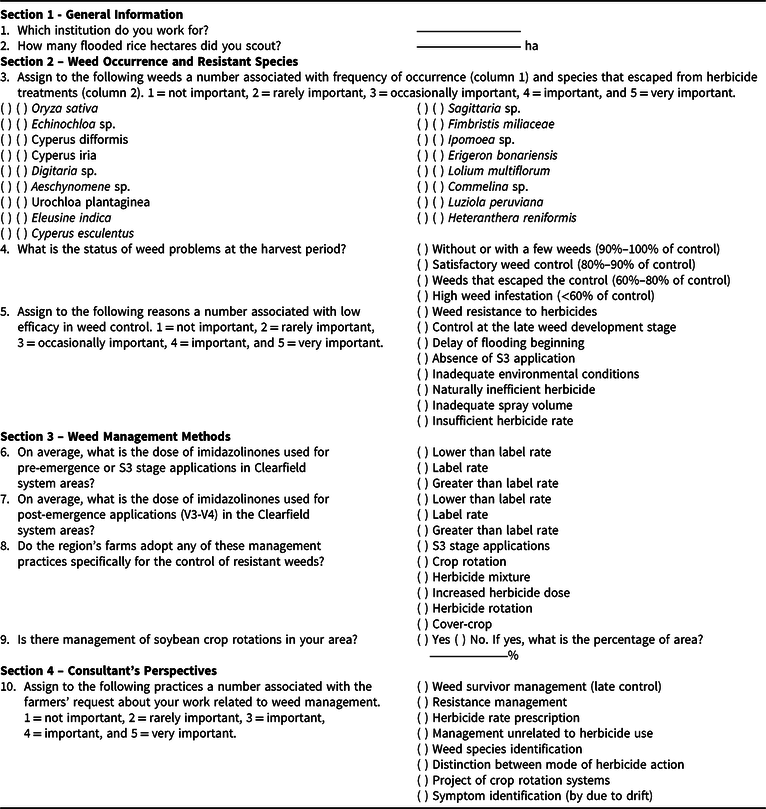
The survey was divided into four sections: 1) general information, 2) weed occurrence and resistant species, 3) weed management methods, and 4) consultant’s perspectives (Table 1). A list of predefined answers was used for some questions about the occurrence of weeds in areas that showed escapes from herbicide treatments, the respective causes of decreasing herbicide efficacy, and the reasons why consultants would be hired by farmers. In these questions, the respondents were asked to rate each answer on a scale of 1 to 5, with 1 = not important, 2 = rarely important, 3 = occasionally important, 4 = important, and 5 = very important (Riar et al. Reference Riar, Norsworthy, Steckel, Stephenson, Eubank and Scott2013b). The other questions were multiple choice, which required consultants to choose an applicable answer.
Rice weed management survey in southern Brazil.a

a The original survey was written and administered in Portuguese.
The resulting data were analyzed by descriptive statistics, and percentages were attributed to the answers. For question ratings, the values 5, 4, 3, 2, and 1 were summed to render the total number of points given to every alternative (Norsworthy et al. Reference Norsworthy, Burgos, Scott and Smith2007). Alternatives with the highest number of points were cited more often and considered more frequent than others. The importance of answers was calculated by a weighted average of all points (Equation 1), where Wi represents the individual weights and Xi represents the value indicated by each consultant. The standard error of the mean of the importance scale was calculated for every question.
 $${\rm{Importance}} = {{\sum\nolimits_{{\rm{i}}\, = \,1}^{\rm{n}} {{\rm{Wi}}\,.{\rm{Xi}}} } \over {\sum\nolimits_{{\rm{i}}\, = \,1}^{\rm{n}} {{\rm{Wi}}} }}$$
Results of multiple-choice questions were converted into a percentage, analyzed by descriptive statistics, and are shown in the figures.
Results and Discussion
Weed Occurrence and Resistant Species
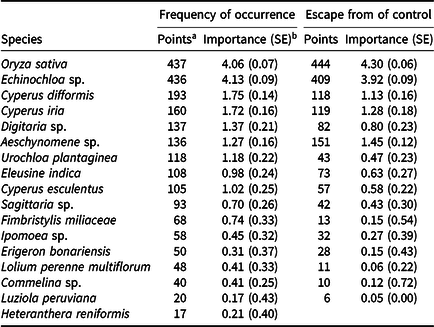
The most cited weeds, according with the classification question, were weedy rice and Echinochloa sp. (Table 2). Both had importance values greater than 4.0, indicating that they are the worst weeds in flooded rice areas in RS. Weedy rice was cited more often, but with a lower importance value for frequency of occurrence than Echinochloa sp. Weeds with importance values equal to or greater than 1.0 include those in the families Poaceae, 4; Cyperaceae, 3; and Fabaceae, 1 (Table 2). The family Poaceae has a high potential to compete with cultivated rice due to its similar characteristics, dispersive mechanisms (Baek and Chung Reference Baek and Chung2012), and gene flow, in the case of weedy rice (Burgos et al. Reference Burgos, Norsworthy, Scott and Smith2008).
Scores and importance values for frequency of weed occurrence at the beginning of crop development and survival after management methods (escapes) in flooded rice areas in southern Brazil.

a Calculation was based on points and values 5, 4, 3, 2, and 1 assigned to the first, second, third, fourth, and fifth most problematic weeds from each survey. Values were then summed to determine each ranking.
b Importance was based on the weighted average points assigned to each weed by consultants. Standard errors (SE) appear between parentheses.
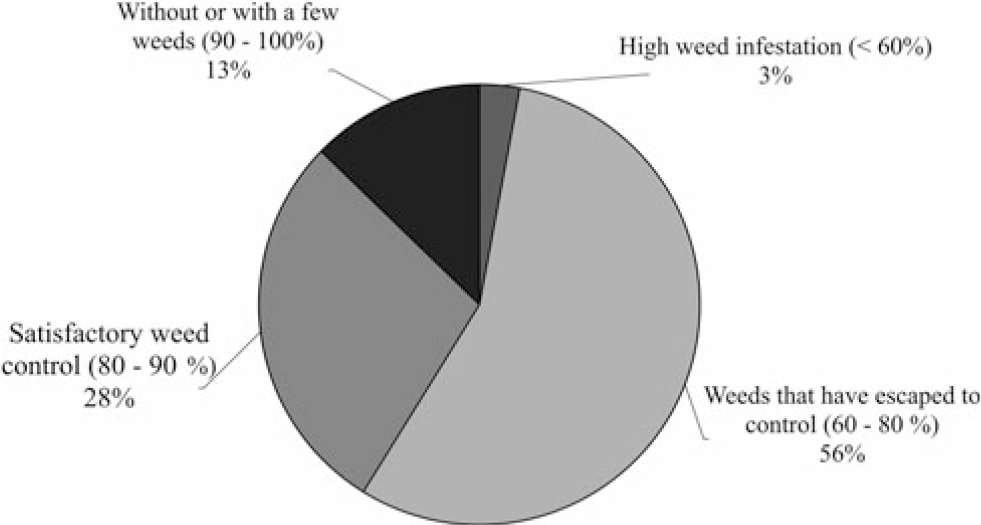
An analysis of the importance of weeds that remain in the field after implementation of management methods and considered to have escaped indicates that weedy rice had the highest value (4.30), followed by Echinochloa sp. (3.92; Table 2). These scores may result from the difficulty of controlling weedy rice because it belongs to the same species as cultivated rice. Weedy rice and Echinochloa sp. have evolved to become resistant to herbicides in Brazil (Eberhardt et al. Reference Eberhardt, Oliveira Neto, Noldin and Vanti2016; Roso et al. Reference Roso, Merotto, Delatorre and Menezes2010). Of all weed species considered to be escapees with scores greater than 1.0, only Aeschynomene sp. did not demonstrate herbicide resistance in Brazil (Heap Reference Heap2019). Overall, 12 (70%) of 17 species listed in Table 2 have shown to be resistant to herbicides. The presence of weed escapes at harvest was cited by 56% of consultants, 3% of whom indicated a high infestation of weeds (Figure 1). In addition, only 13% of cultivated areas received adequate weed management (i.e., above 90% of control [Figure 1]). Therefore, herbicide resistance is an important problem in growing flooded rice in RS because of its negative effect on rice productivity due to competition with weeds that survive control efforts (Fleck et al. Reference Fleck, Agostinetto, Galon and Schaedler2008). An understanding of the factors that restrict the efficacy of weed control measures in rice production is important to improve the methods being used.
Consultants’ perception of weed problems at harvest time in rice areas in southern Brazil.

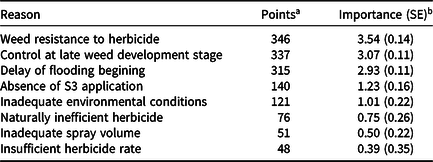
Consultants indicated the main reasons that herbicides have reduced activity are resistance to herbicides, late herbicide application when weeds are in advanced developmental stages, and delay in the beginning of flooding (Table 3). Most rice in southern Brazil is drill-seeded, and flooding is recommended to start at the 3- to 4-leaf stage. Based on the importance scale, the advanced stage of weed development was considered as very important, with a score greater than 3.0. Weed control at early growth stages is more effective and minimizes production of viable seeds that could return to the seed bank (Norsworthy et al. Reference Norsworthy, Ward, Shaw, Llewellyn, Nichols, Webster, Bradley, Frisvold, Powles, Burgos, Witt and Barrett2012). However, as identified in the present survey, most farmers find it difficult to correctly time their weed control practices. This shows that in addition to herbicide resistance, many failures in control are also related to inadequate crop management practices. Insufficient rates of herbicides were a factor with low importance for failures in weed control, since its value was close to zero.
Scores and importance values given by consultants of reasons for low efficacy of weed control in flooded rice fields in southern Brazil.

a Calculation was based on points and values 5, 4, 3, 2, and 1 assigned to the first, second, third, fourth, and fifth most problematic weeds from each survey. Values were then summed to determine each ranking.
b Importance was based on the weighted average points assigned to each weed by consultants. Standard errors (SE) appear between parentheses.
Results show that weedy rice and Echinochloa sp. are the most problematic weeds in terms of occurrence and control. These species are often poorly managed in flooded rice fields in RS, which leads to many areas with high infestation at harvest time. In the consultants’ perception, the occurrence of weed resistance to herbicides, late management, and delay in flooding are factors that justify low efficacy in the control of these species (Table 3).
Weed Management Methods
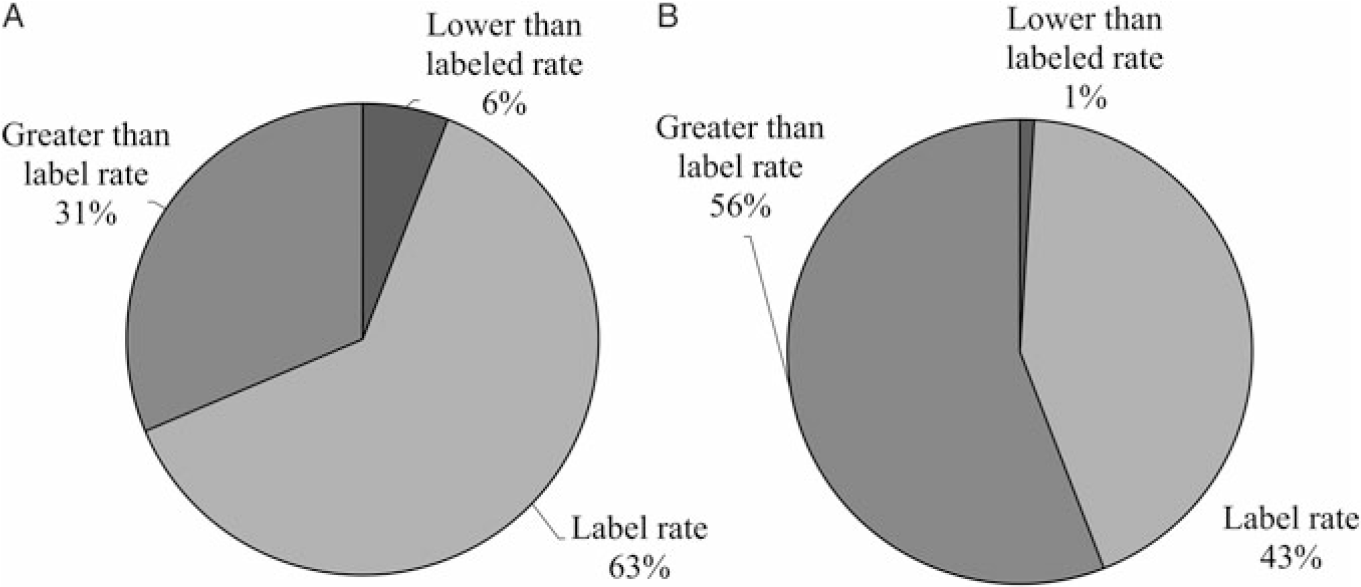
One of the main reasons for the low adoption of management practices to avoid herbicide resistance is the lack of information about the risks of continuously using chemical controls. In another study, farmers stated that selection pressure for weeds resistant to glyphosate in their areas was low (Prince et al. Reference Prince, Shaw, Givens, Owen, Weller, Young, Wilson and Jordan2012), and that even when growing crops resistant to this herbicide for 5 yr or more, they did not consider selection pressure to be high (Kruger et al. Reference Kruger, Johnson, Weller, Owen, Shaw, Wilcut, Jordan, Wilson, Bernards and Young2009). In addition, selection pressure can be increased through above-label herbicide rates. In the present survey, 63% of the PRE or S3 stage (Counce et al. Reference Counce, Keisling and Mitchell2000) applications of imidazolinones herbicides in the CL cultivars of rice were reported as using the label rates (Figure 2A). However, when imidazolinones were applied POST (V3–V4 stage), most farmers (56%) used them at rates that were greater than those indicated on the label (Figure 2B).
Application rates of the chemical group of imidazolinone herbicides in PRE (A) and POST (B) applications.

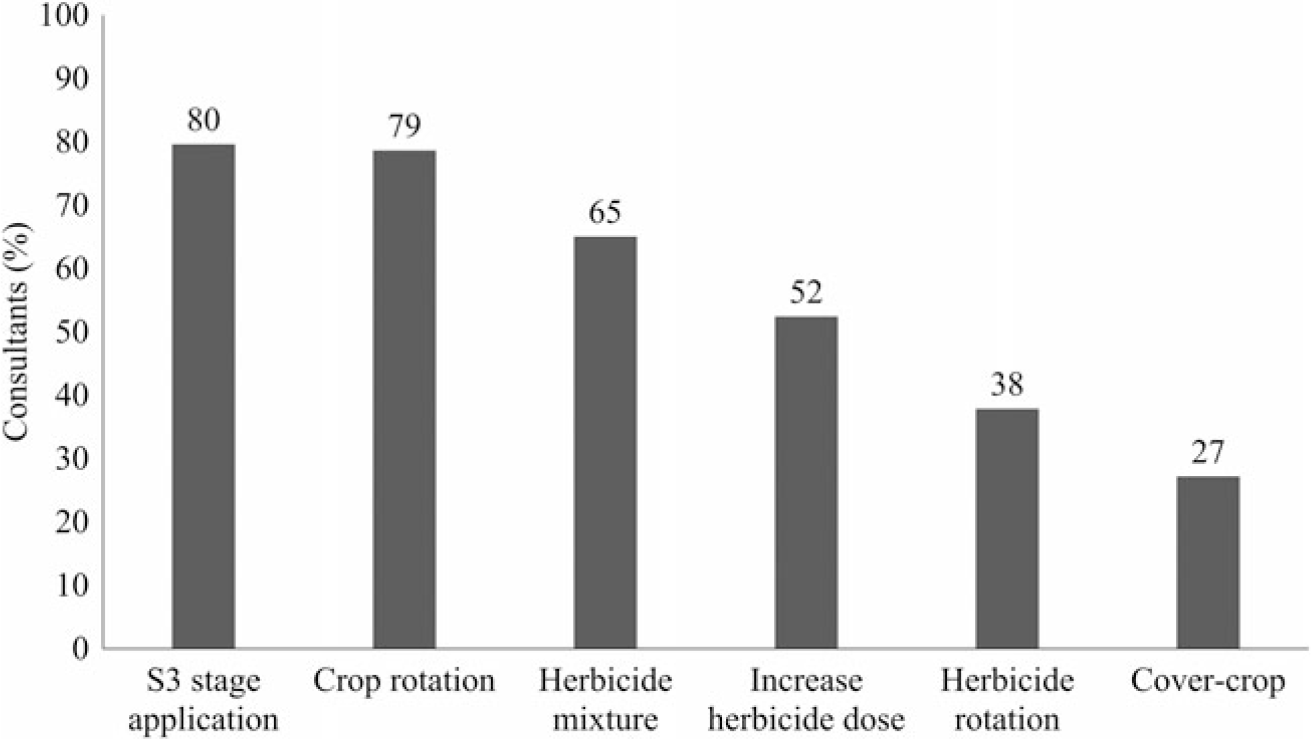
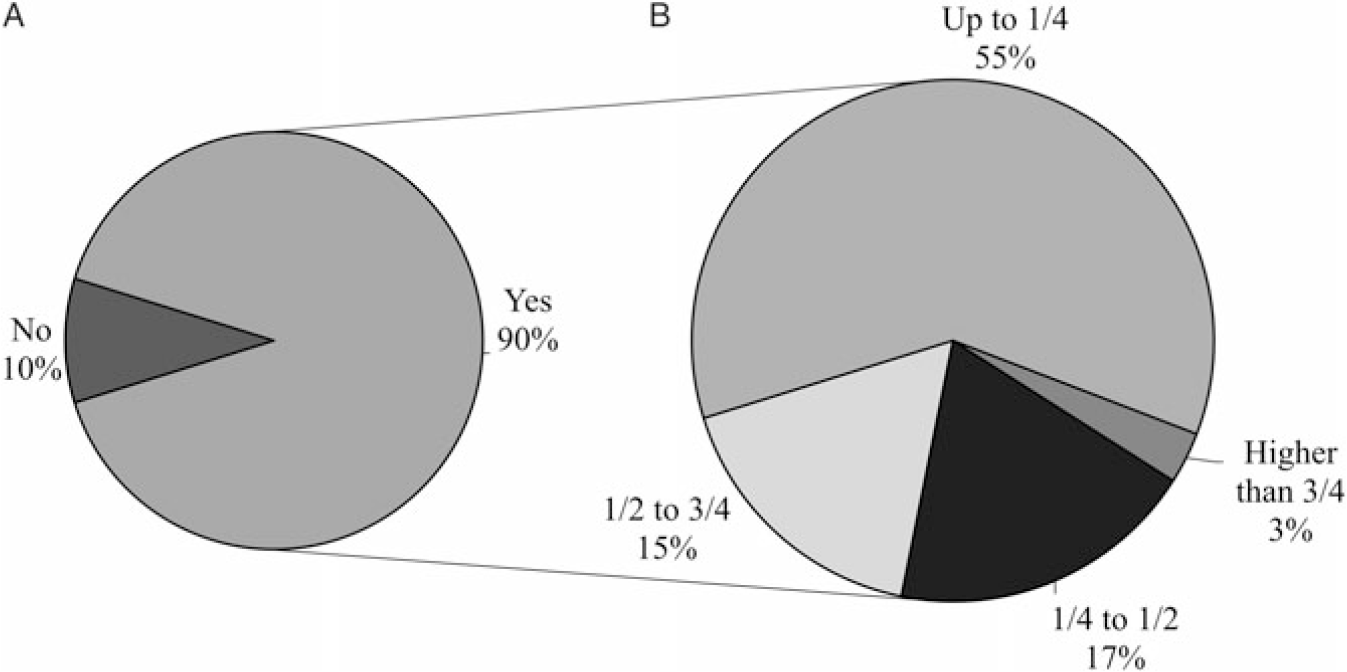
The survey asked consultants about management practices used by farmers specifically to control herbicide-resistant weeds. Respondents indicated that 80%, 79%, 65%, and 52% of farmers carry out S3 application, crop rotation, tank-mix of herbicides, and increase in herbicide rates, respectively (Figure 3). On the other hand, only 27% of farmers used cover crops during fall and winter. Two items regarding application to rice at stage S3 and crop rotation stand out in consultants’ survey responses. Application of herbicide at the S3 stage (Counce et al. Reference Counce, Keisling and Mitchell2000) is considered to be more important in managing weedy rice because other methods of chemical control are not available. Crop rotation provides several benefits for managing weed resistance to herbicides, such as herbicide mode of action rotation, which decreases selection pressure on resistant plants (Roso et al. Reference Roso, Merotto, Delatorre and Menezes2010). The survey indicated that 90% of responses mentioned the use of soybean in crop rotation in flooded rice areas in RS, and that crop rotation is practiced in 25% of the area (Figure 4).
Specific management practices used by farmers for controlling resistant weeds in farms attended by surveyed consultants. Note: The sum of variables is not 100% because more than one option could be chosen.

Frequency of crop rotation used with soybean (A) and part of land use (B) in flooded rice areas in Rio Grande do Sul State.

Consultants’ Perspectives on Rice Fields
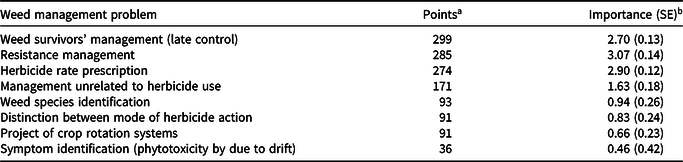
Understanding the role of consultants in weed management is fundamental to implementing adequate crop and weed management practices. Consultants indicated that the most important tasks in weed management are weed survivors after chemical control, control of resistant weeds, and prescription of herbicide rates. All response values were greater than 2.5 on the importance scale (Table 4). Late control received the highest score, even though it was given lower importance than resistance management and herbicide rate, which were cited fewer times, but obtained a higher score in the ordination of most important issues.
Scores and importance values of consultants’ primary problems in managing weeds in rice fields in southern Brazil.

a Calculation was based on points and values 5, 4, 3, 2, and 1 assigned to the first, second, third, fourth, and fifth most problematic weeds from each survey. Values were then summed to determine each ranking.
b Importance was based on the weighted average points assigned to each weed by consultants. Standard errors (SE) appear between parentheses.
Farmers seek a consultant’s help to solve problems such as controlling resistant plants and managing weeds that escape control. These problems are related to the low importance given by farmers to adopting best management practices to ensure herbicide efficacy, evolution of herbicide resistance, and continuous repository of seed bank in the soil (Norsworthy et al. Reference Norsworthy, Ward, Shaw, Llewellyn, Nichols, Webster, Bradley, Frisvold, Powles, Burgos, Witt and Barrett2012). In the present study, the importance of planning for crop rotation received a small score (Table 4), a fact that justifies reaction as the main measure related to resistance management, even though proactive measures should be adopted by farmers (Bajwa et al. Reference Bajwa, Mahajan and Chauhan2015).
Strategies carried out by rice farmers in the short term have not been enough to control weeds. Integrated management measures are needed to change the practices that are leading to weed resistance to herbicides in flooded rice production in RS State, and farmers must be made aware of the need to adopt new practices. In addition, the government should consider adopting legislation regarding crop rotation or use of cover crops in areas where monoculture is a frequent farming practice.
Acknowledgments
We thank Fundação de Amparo à Pesquisa do Estado do RS (FAPERGS), Edital 01/2017, for financial support. No conflicts of interest have been declared. We are also grateful to the consultants who took the time to complete the survey.