Analyzing student-publishing practices is important because it not only provides a preview of where political science research may be headed but also unpacks pedagogical and learning experiences that are ongoing within the discipline. Students are charged to implement disciplinary writing practices and conventions within their majors; therefore, we expect instruction and practice to have facilitated mastery of those approaches by graduation. Indeed, subject expertise and quality of scholarship produced by faculty in the profession arguably can be traced to their undergraduate and graduate experiences—a time, some contend, when intellectual habits are shaped (Beyer, Gillmore, and Fisher Reference Beyer, Gillmore and Fisher2007; Boyer Reference Boyer1990). We were interested in what is being produced by the political science scholar-in-training. Peer-reviewed student-driven journals offer a glimpse into that body of work. Whereas there is substantial pedagogical scholarship assessing the merits of student journal publishing, and an equally sizable amount of how-to advice for students in higher education interested in publication, there is little empirical research exploring the content of student publications. By all accounts, there has been a steady increase in the number of student political science journals. There is no comprehensive catalog or final count, but today we can turn to a list of about 15 such publications on the American Political Science Association (APSA) website and an eclectic mix of more than 50 in the social sciences from the Council on Undergraduate Research. Other directories of student journals are far flung: for instance, the University of Washington lists more than a dozen focusing on politics and area studies. Thus, although publishing in top-tier professional journals is a tremendously competitive enterprise, students are not bereft of opportunities to find suitable alternatives. This article first summarizes the literature that weighs advantages and disadvantages of student publishing and then reports results of surveys that we conducted to assess what student authors say about their publishing experiences and how graduate directors in political science programs view these efforts. Finally, an evaluation of three political science student publications, The Pi Sigma Alpha Undergraduate Journal of Politics (PSAJ), Critique, and Politikon, allows us to mark research trends during the past decade by subfield, methodology, and topic and to compare those with developments in professional disciplinary journals.
WHY PUBLISH IN STUDENT JOURNALS?
A student academic journal is more than an instrument to enhance visibility of a department and university, and it is more than simply a repository of research papers on a variety of topics. It is, as one political science journal states on its website, a forum to “express and exchange diverse ideas and to imagine new possibilities for democracy and justice” (Critique). The student journal is arguably another mode of service learning in which students take as much as they give back to the learning community through scholarly production. This latter benefit of student publishing—learning by doing—is underscored in the pedagogical literature. For example, several studies about student political journals already note the benefits inside and outside of the classroom that students gain when participating in publishing activities (Bauer et al. Reference Bauer, Ogas, Shakir, Oxley and Clawson2009; Clark Reference Clark1997; Hutchins Reference Hutchins2013; Ishiyama Reference Ishiyama2001). In this way, student publishing supplements classroom teaching and learning, and it offers a site for collaboration and support from faculty or practitioners immersed in the discipline.
Most students generally approach the field of political science as passive consumers, drawing on existing scholarship for writing a class paper that may or may not include original research. Yet, Ishiyama (Reference Ishiyama2002, 14) pointed out that actively engaging in the research process means students in the discipline are more capable and productive upon graduation. Participating in a scholarly community to produce original contributions propels student learning in new and challenging directions. Certainly, acquiring early credentials as a published author can enhance a résumé and prospects for advanced studies as well as encourage subsequent publishing (Ishiyama Reference Ishiyama2002; Mervis Reference Mervis2001). For graduate students embarking on academic careers, the pressure to publish before graduation may be tremendous. Having one or more peer-review journal publications can be a prerequisite on the job market in most political science subfields (Rich Reference Rich2013, 376).
However, the process of preparing and submitting manuscripts—and receiving editorial feedback on those submissions—also promises gains in deeper understanding about a subject matter such as key theoretical frameworks, critical concepts, and relevant empirical examples.
However, the process of preparing and submitting manuscripts—and receiving editorial feedback on those submissions—also promises gains in deeper understanding about a subject matter such as key theoretical frameworks, critical concepts, and relevant empirical examples. Writing for publication facilitates experimentation with research methodologies, interdisciplinary fields of study, refinement of analytic and communication skills, and development of interpersonal and professional skills (Barrios and Weber Reference Barrios and Weber2006; Thies and Hogan Reference Thies and Hogan2005). Student publishing builds confidence and fosters creativity to approach challenges outside of the classroom with competence. Students also can experience “accomplishment, satisfaction, and enthusiasm for writing that goes well beyond the pleasure of receiving a good grade or praise from an instructor” (Barrios and Weber Reference Barrios and Weber2006, 107). Indeed, student authorship can provide the groundwork for careers in the political science discipline, potentially inspiring students to pursue work in research and academia.
Much like conference participation, publication connects student researchers to their peers in the academic community. The process of communicating with fellow student researchers and receiving peer-to-peer feedback is explored through social-network theory by Ghosh and Githens (Reference Ghosh and Githens2009). They noted that academic conferences create space for collaborative learning in the exchange of ideas and resources. Student conferences also can provide an “intermediate step” for students in the publication process. Being able to share research in its pre-published form at a conference helps students to improve their work for future publication.
The student journal also offers the benefit of peer review. In its first issue, the Journal of Purdue Undergraduate Research (JPUR) underlined the value of editing because students can “learn about the publishing process from behind the scenes, better preparing them to be the academic authors of the future” (Weiner and Watkinson Reference Weiner and Watkinson2014, 5). A questionnaire administered to PSAJ student editorial-board members revealed that they also support the general benefits of editorial service. The editing process helps students to strengthen diplomacy skills because they must articulate shortcomings and possible improvements for student authors (Barrios and Weber Reference Barrios and Weber2006). Likewise, student authors gain valuable advice in networking with editors through the peer-review process.
Clearly, there are many benefits to publishing in student research journals; however, publishing in them is not without criticism. Gilbert (Reference Gilbert2004, 23) pointed out that student publishing puts undue pressure on students and faculty who are already bombarded with heavy workloads. He contended that the time it takes for students to publish in student journals would be better spent on “real” journal publications because they are more rigorous and esteemed within academia. Rejection in the submission process is also a real concern for students because it can create a fear of failure and inhibit future research publication (Weeks Reference Weeks2006). Nevertheless, rejection is part of the academic process and should not be internalized. Researchers can submit to a number of alternative publications and eventually achieve success (Weeks Reference Weeks2006).
We contend that the benefits of publishing in student research journals generally outweigh the costs. These benefits cannot be overstated because they ultimately foster a more well-rounded academic experience, supplement classroom learning, and encourage student–faculty collaboration. It also is worth noting that student authors may contribute to the larger academic community, offering fresh insight in their respective fields. It thus comes as no surprise that some university professors recommend journal publication to students. Pedagogical practices tend to take an active approach in involving students in the research process. As studies point out, students generally first become aware of the journal process through their academic mentors. Surveys of students who have published in journals reflect both the benefits and the pedagogical practices of publication.
WHAT DO STUDENT AUTHORS AND GRADUATE DIRECTORS SAY?
Surveys of student authors indicate that they take away a great deal from the publication process. Nearly all respondents in our survey of Critique authors stated that their submissions initially were class assignments. Whereas some submitted work after encouragement from their professors, others did so independently. One undergraduate captured a common motivation for submission: “I put a lot of effort into my research papers and like that effort to be recognized (intrinsic satisfaction) and I knew that having a publication record on my CV signals good written communication, research, and analysis skills to graduate school selection committees and employers.” When asked which perceived benefits followed from submitting their papers to the journal, most students cited positive outcomes. They noted the likely influence of a publication on later admission into graduate programs and internship programs, the boost in confidence they had from seeing their work in print, and the motivation to write again. One respondent who subsequently became a professor in the discipline stated, “The initial publication was a big deal for me in terms of seeing my work as important and feeling I belonged in academia.” Such reflections indicate the value of early publishing experiences in fueling scholarship in the profession. These results are not unique to the Critique survey. Weiner and Watkinson (Reference Weiner and Watkinson2014) found that student authors from JPUR encountered similar benefits. Benefits in the JPUR survey centered on technical aspects of the publication process, including a strengthened ability to cite sources, synthesize information, and contribute to the research community. Nearly all respondents in the JPUR survey gained a more thorough understanding of how the publication process generally works. These surveys resonate well with the benefits of publishing discussed in current literature.
Benefits in the JPUR survey centered on technical aspects of the publication process, including a strengthened ability to cite sources, synthesize information, and contribute to the research community.
In general, political science graduate directors also see benefits of publishing in student journals, although their perspectives are nuanced. The 10 program directors that we surveyed agreed that an applicant’s admission to a graduate program could be helped, even if only marginally, by being published in a peer-reviewed political science student journal. The institutions represented by the directors included R1 doctoral-granting universities and master’s colleges and universities. One director stated, “We look favorably on any attempt to create and to disseminate original research. So, comparing two students alike in all other respects, the one with a publication in a student journal would be viewed more favorably.” Not every school looks specifically at journal publication for graduate program acceptance; one director noted the weight given to GPA and GRE scores as well as recommendation letters and the quality of the writing sample. When asked if admissions committees would prefer an applicant with a publication in a peer-reviewed political science student journal or one that had presented a paper at a national disciplinary conference, responses were mixed. Several declared preferences for a national-conference presentation, whereas others said either would be impressive if appearing on an undergraduate CV. Only a few graduate-program directors unequivocally stated that coauthoring an article with a professor for a traditional journal, especially for graduate students, was better than a sole-authored article in a peer-reviewed student journal. Most found it to be a “tough call” to make. As one director explained, “Coauthoring with a professor probably gives students a higher level of experience and preparation, but having an article selected in a competitive peer review may show more initiative, independence, and promise for the future.”
Finally, we were interested to know if graduate-program directors believed peer-reviewed student journals in the discipline offer significant scholarly contributions to department curricula or pedagogy. A few directors noted that they were unaware of instances in their units in which articles from student journals were read or assigned. The general consensus was that these journals mainly provide an apprenticeship role and offer public recognition for student work. The task of the educator in this mission was not lost on one of the graduate directors, who reminded us that professors should help students find appropriate outlets for their research.
WHAT ARE STUDENTS PUBLISHING?
We might presume that the APSA list of student journals is one of the first referenced for manuscript submissions because of the tremendous visibility of the profession’s website as a resource for scholars in the discipline. A review of those journals produced only three that met our criteria for study about the type of articles political science students have published. We sought journals that were primarily student-driven, published only peer-reviewed student articles, and—to facilitate our study—had an online archive. The PSAJ, the flagship publication of the American National Political Science Honor Society, is published twice annually. Published four times a year, Politikon is an undergraduate and graduate journal supported by the International Association for Political Science Students and is affiliated with several academic and professional partners (e.g., the International Studies Association). Critique is an undergraduate and graduate journal published by the politics and government department of Illinois State University. It is published twice annually but, because its Spring issues publish only the best of the department’s student conference papers—papers that do not go through the usual journal review process—only its Fall issues are assessed here. Hence, to glean what students are publishing, we examined international-, national-, and university-level student publications. All three electronic journals are indexed with EBSCO.
We limited our study to articles published between 2005 and 2015. During this 10-year period, PSAJ published 91 articles, Politikon published 125, and Critique published 57. All totaled, we coded 273 articles by subfield, methods, and topics. Subfields included political theory, US politics, public administration, international relations, and comparative politics. Some cases were difficult to distinguish clearly between overlapping subfields (e.g., international relations and comparative politics), but these instances were too few to have a noticeable effect on frequencies. If an article was a comparative study of countries, we noted the regions involved. Topics focusing on economic development, peace and conflict issues, human rights and social welfare, democracy and governance, and “other” were coded as such. Articles also were coded by methodology. If studies employed regression analyses or surveys using statistical methods, they were coded as quantitative. A few articles used only descriptive statistics and were coded as one of the categories of qualitative methodologies best matching its approach (i.e., case-study, historical, or theoretical studies).
ANALYSIS AND DISCUSSION
After coding articles by subfield, region of study, methodology and topic, we report frequencies below for those categories by each student journal and the sample as a whole. We then discuss implications for student publishing and for trends in political science scholarship.
The Articles
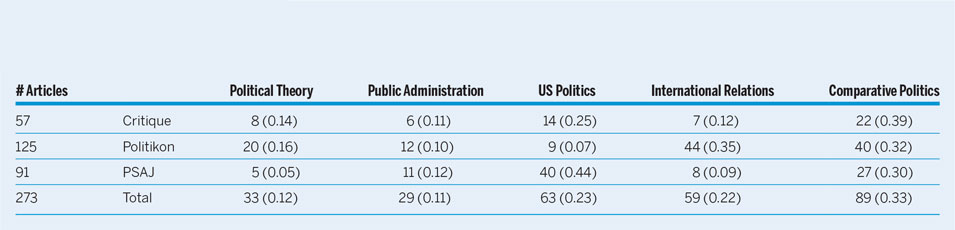
We reviewed percentages to determine what it is that political science student journals are publishing. Frequency tables provide a snapshot of the subfields, regions, topics, and methodologies covered. Table 1 reports the percentages of articles published in the three student journals by subfield. Overall, comparative studies was the predominant subfield with a fairly equal distribution of about one third of the studies in each journal. As a whole, those least represented were political theory and public administration with slightly more than 10% in each subfield. When articles in the subfield of American politics were further categorized into domestic or foreign politics, we found that the proportion of total articles about domestic issues was more than three times that of foreign matters. There also was stark contrast in the percentages of US politics covered by individual journals; nearly 45% of PSAJ and 25% of Critique articles were in this subfield, whereas only 7% of articles in Politikon dealt with US politics. We might speculate that Politikon included fewer articles on US politics because, as the only non-American journal of the three, its student authors come from a far more diverse set of countries. Conversely, it is noteworthy that those student authors appear to have a stronger interest in global politics because more than a third of the articles in Politikon focused on international relations, whereas only a small share in the American-based journals fell within that subfield.
Articles by Subfield
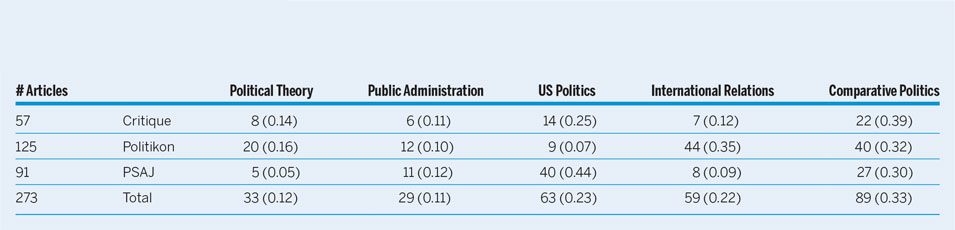
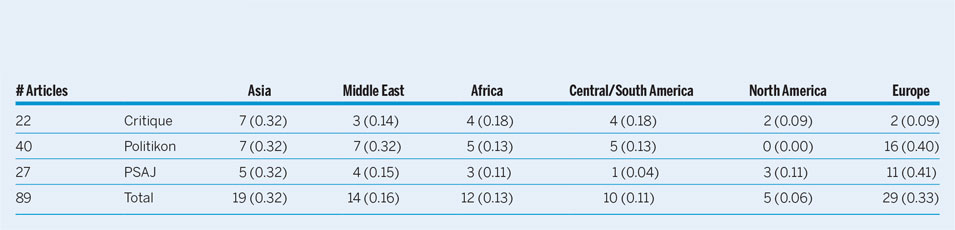
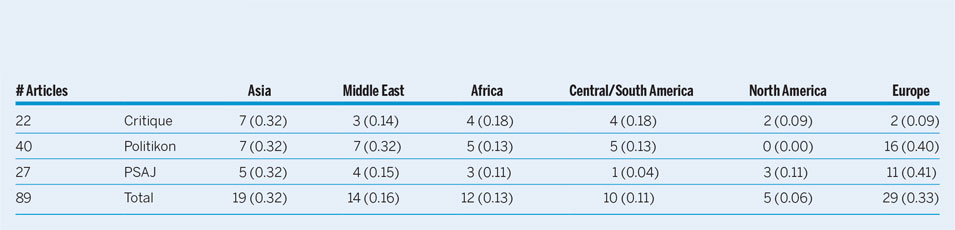
Because all three journals included a significant share of comparative studies, we were interested to see if there were any patterns by region. Table 2 reports that of the 89 total comparative-politics articles focusing on particular geographic areas, nearly two thirds were about Asia or Europe. A closer look at European studies showed an even split between articles about Eastern and Western Europe. The least-studied region was North America. Recall that articles focusing exclusively on US politics were not included in the comparative-politics category. The absence of any comparative studies published in Politikon about North America, however, parallels the near lack of interest shown by its authors in US politics.
Articles by Region
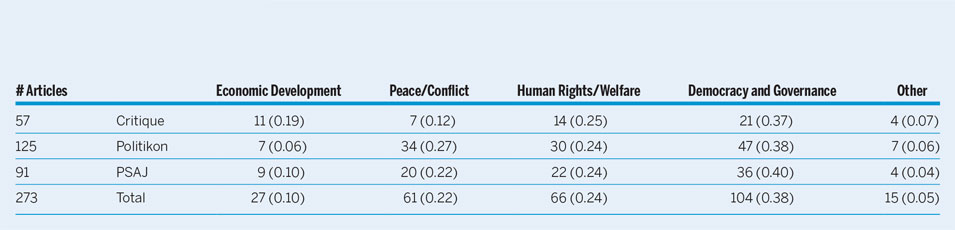
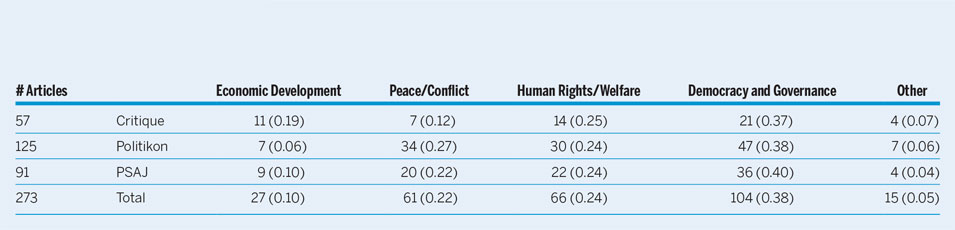
The most-discussed subject matter, as shown in table 3, touches on issues of democracy and governance, with about 40% of articles on that topic published in each of the three journals. Each journal also included a strong share of studies about human rights and welfare. The least-popular topic overall was economic development. Sporadic appearances of other topics emerged from our examination: culture and technology in Critique; climate change, education, methodology, and space in Politikon; and health, drugs, environment, and human nature in PSAJ.
Articles by Topic
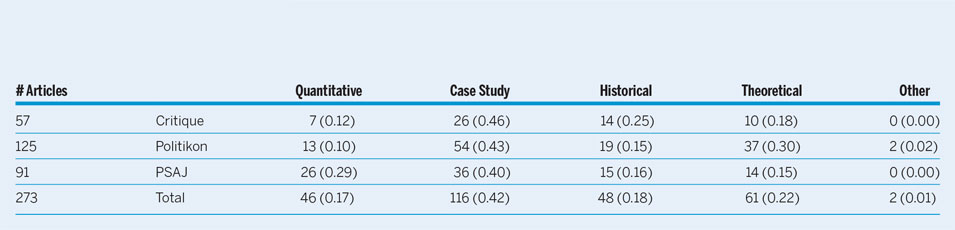
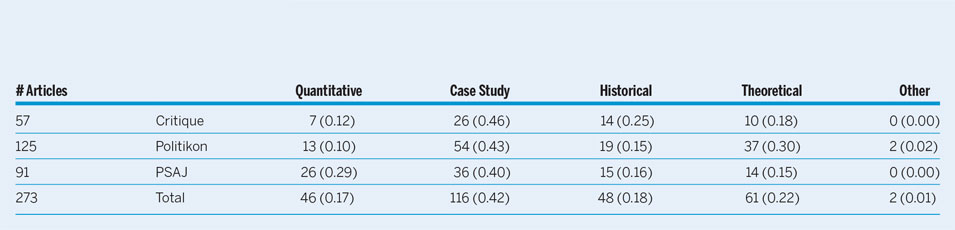
In addition to learning what students are publishing, we were interested in how they conduct their studies. Regarding methodology, PSAJ stood out from the other two journals with its relatively heavier proportion of quantitative work. Table 4 illustrates that across the board, however, more than 80% of all articles rested on non-quantitative approaches, with about half of that proportion using the case-study approach.
Articles by Methodology
In summary, our sense of the student research agenda emerged after reviewing almost 300 articles published between 2005 and 2015. An overview of features found in each journal revealed more similarities than differences. In some cases, there was only a slight difference in percentage points between two categories. The major difference was the subfield within which journal authors most frequently work; at least two of the three journals shared other features. We found that a third of all articles fell within the subfield of comparative politics, almost half were case studies with an equal focus on Europe and Asia, and a third addressed democracy and governance issues.
The Journals
It is important, of course, to note that these trends do not represent the corpus of manuscript submissions. Without access to copies of rejected submissions, we cannot reliably ascertain what students were actually researching and writing for publication. None of the three journals stated a focus on any particular topic, subfield, or empirical approach. The journals reported acceptance rates that hover between 20% and 25%; therefore, published articles may have reflected distinct editorial preferences or perhaps simply represented the best written of any one lot of submissions. It is possible as well that a program’s curricular emphasis may have been a factor in an author’s subject choice. Recall that most students surveyed said they submitted manuscripts that were originally written as a class assignment; therefore, a program dominated by courses in global politics, for example, may generate more submissions in that subfield. Nevertheless, we can glean from the data that what has been published in student journals also reflects student interest and knowledge of a subject matter and methodology.
Review of the institutions attended by students publishing in PSAJ, Critique, and Politikon revealed a wide variety by geographical location and classification. As expected, the international journal Politikon attracted more submissions from around the globe—colleges and universities throughout Europe and the United States and from countries including India, Brazil, South Africa, Philippines, Cameroon, Turkey, and Iran. The institutions represented in the three student journals reflected nearly equal numbers of Carnegie Classifications: doctoral-granting universities, master’s colleges and universities, and baccalaureate colleges. For instance, authors emerged from Emery, Harvard, Rice, and Stanford among other R1 institutions, as well as from small undergraduate liberal arts colleges including Oberlin and Eureka. The only pattern that we witnessed was that most authors were from public institutions. Contrary to what we might assume, there was no indication that students from research-intensive universities were more or less likely than their counterparts to pursue publication in student journals. We also might suppose that graduate students would be more motivated to seek publication than undergraduates—or at least the quality of their research and writing would garner greater chance for publication—and this indeed may be the case. PSAJ accepts submissions only from undergraduate students. The other two journals do not maintain records of the status of authors who submit manuscripts; however, editors tentatively estimate that although undergraduate papers are regularly published, the greater proportion of accepted articles are generally written by graduate students.
Contrary to what we might assume, there was no indication that students from research-intensive universities were more or less likely than their counterparts to pursue publication in student journals.
The question naturally arises as to whether the work published in these student journals is widely read and incorporated into the larger body of disciplinary scholarship. Recall that some graduate-program directors stated that they were unaware of any such impact. Citation tracking would provide a better idea about the influence of these articles. Despite their own limitations, various databases (e.g., Google Scholar, Web of Science, and Scopus by Elsevier) are popular resources for citation analysis in the social sciences. Tracking citations for the almost 300 published student journal articles is beyond the scope of this study, but we might soon find such assessment from the journals themselves. Among the three journals evaluated here, tracking readership of articles is currently conducted by Politikon. The journal can track the number of unique accesses to articles published after 2016 through the DOI system provided by Crossref. Critique hopes to soon embed analytics in its website to track access to the journal.
Beyond records administration such as this, certainly there are several challenges in running a student academic journal. The journals incur relatively little expense because they do not print and mail volumes and do not maintain paid staff. However, monetary costs might include hosting the online journal website, DOI registration and online indexing, and/or allocating graduate assistantships to work on the journal. The most significant challenge rests in the review and editing process, which relies on faculty academic service, volunteerism, and/or student time and commitment. Editors remark, however, that the benefits reaped from maintaining a political science student journal are significant. Two journal editors summarized gains from the enterprise as follows:
…it shows how a team of dedicated individuals can ensure quality publishing of scholarship reaching and exceeding the quality standards of many journals with minimum financial resources involved. In addition, the inclusive process but with established rules and procedures allows everyone, from authors through editors to reviewers and the publisher, to gain valuable experience with this type of academic work, while upholding the necessary quality standards.
Authors are able to publish their original research in a highly visible and prominent Journal in Political Science. The student Editorial Board members are able to apply what they have learned in the classroom as they peer-review manuscripts. It further enriches their knowledge of the Political Science discipline, exposing them to content and methods that they may not have fully explored in the classroom. It gives them review experience—it’s difficult to peer review someone’s work and advocate for it (or against it) in a group setting. I’ve watched many of my Editorial Board members become leaders in this setting.
CONCLUSION
Our goal was to explore the benefits of student publishing and what is being published by political science students. Content analysis of three political science journals suggests much about the nature of published student work. The examination reveals which topics, regions, and methodologies students generally tend to focus on and the degree of variability among the publications. We were curious about how these findings compare with non-student journals in the field. A few studies looked at trends in professional disciplinary publications and, as might be expected, different samples presented different pictures. One of the most systematic investigations explores trends in 10 US political science journals. Bennett, Barth, and Rutherford (Reference Bennett, Barth and Rutherford2003) examined more than 2,200 articles spanning a period from 1965 to 2000. They found a dearth of international relations articles, especially in the American Political Science Review (APSR), which they considered the discipline’s flagship publication. Regarding methodology, they observed that use of formal modeling has decreased significantly since the late 1980s. We found no articles using formal modeling in the three student journals. Bennett, Barth, and Rutherford (Reference Bennett, Barth and Rutherford2003) also noted that overall use of statistics and case-study methods has remained fairly stable, although articles on US politics continue to use statistical methods far more frequently than in other subfields. With its high proportion of American politics studies and quantitative methods, PSAJ comes closest to paralleling APSR, which heavily features statistical articles in studying American politics.
Understanding what students have published may inform pedagogical practices because interest in a subject matter provides the first step toward reaping benefits of research. Because many article manuscripts originate as class research assignments, educators have a significant role in preparing and encouraging their students to publish. In this way, we can view political science student journals as a potentially valuable teaching tool—one that enhances learning about domestic and international affairs as well as one that builds a skillset and portfolio for advanced study and career readiness. Graduate students in most disciplines have long been socialized in the norms of research and publication. Now the trend in higher education is to more fully engage undergraduate students in that process, with many institutions already offering support by way of funding, mentorship, and systematic outcome assessments. Regarding the latter, for example, the Association of American Colleges & Universities reports findings from surveys constructed to measure learning gains and career choice following undergraduate research experiences. The surveys reveal strong positive effects on intellectual and disciplinary skills, as well as personal development including self-confidence (Lopato Reference Lopato2010). Similarly, examining political science student publications in the context of undergraduate and graduate pedagogy can provide one measure of learning, or at least raise questions about that learning. For instance, we found that an overwhelming number of articles in those journals employed qualitative methods, particularly the case-study approach. Does this reflect deficiencies in quantitative skills? At the same time, review of student articles raises questions about the research experiences that students may have with certain subfields or topics that appear less frequently in publication. Are students simply less interested in devoting time and effort to producing publishable work in public administration or economic development than in other areas, for instance? Do they receive less encouragement to publish in those related courses? These pedagogical puzzles still need to be examined. Meanwhile, this study greatly satisfied us about the perceived benefits of student publications and the nature of what has been published in the past 10 years by our scholars-in-training. We remain intrigued to see if what is published in student journals will shed light on where disciplinary scholarship may be headed.