Over the past 10 years, there has been a significant increase in research and theory on anomalous self-experiences in schizophrenia, their phenomenology, and potential physiological causes (Mishara, Lysaker, & Schwartz, Reference Mishara, Lysaker and Schwartz2014; Nelson, Whitford, Lavoie, & Sass, Reference Nelson, Whitford, Lavoie and Sass2014; Northoff, Reference Northoff2014; Parnas, Handest, Jansson, & Saebye, Reference Parnas, Handest, Jansson and Saebye2005). Parnas et al. (Reference Parnas, Handest, Jansson and Saebye2005) have noted higher rates of anomalous self-experiences in individuals with schizophrenia in comparison to individuals with other disorders and these anomalous self-experiences have been shown to be present during the prodrome and first episode of illness (Morcillo et al., Reference Morcillo, Stochl, Russo, Zambrana, Ratnayake, Jones and Perez2015; Parnas, Carter, & Nordgaard, Reference Parnas, Carter and Nordgaard2016; Parnas et al., Reference Parnas, Handest, Jansson and Saebye2005; Ramperti et al., Reference Ramperti, Anwar, Renwick, Jackson, Foley, McWilliams and O'Callaghan2010). Anomalous self-experiences include atypical experiences in a variety of dimensions, including disturbances in the stream of consciousness, changes in one's self-awareness, and unusual physical and emotional experiences (Parnas et al., Reference Parnas, Handest, Jansson and Saebye2005). Some of these unusual experiences are captured in Schneider's First Rank Symptoms (FRS) or passivity symptoms of schizophrenia, particularly the first rank delusions of thought insertion, thought blocking, thought broadcasting, made emotions, made impulses, and made actions. Despite a significant increase in research in this area, longitudinal assessments that could support the assessment of the frequency, persistence, correlates, and functional implications over time are limited in duration – yet these issues are essential for our development of accurate psychological and physiological models for these symptoms.
The vast majority of research assessing the prevalence of passivity symptoms has included them as part of Schneider's FRS, which includes both the passivity symptoms described above as well as several First Rank Hallucinations (voices commenting, voices conversing) so there are little data available on the incidence of passivity symptoms alone. Research reporting on FRS in inpatient samples has reported rates of 24% (Deister & Marneros, Reference Deister and Marneros1993), 25.4% (Chandrasena & Rodrigo, Reference Chandrasena and Rodrigo1979), 65.2% (Gonzalez-Pinto et al., Reference Gonzalez-Pinto, van Os, Peralta, Perez de Heredia, Mosquera, Aldama and Mico2004), 72% (Mellor, Reference Mellor1970), and around 80% (Shepherd, Watt, Falloon, & Smeeton, Reference Shepherd, Watt, Falloon and Smeeton1989). In a large World Health Organization study, Jablensky (Reference Jablensky1992) reported ranges between 16% and 82% in samples from different countries – but also noted differences in recruitment of research participants in different countries which may have influenced reported rates. One study reported prevalence solely of passivity symptoms, and found a prevalence of 36% in a combined sample of in- and outpatients (Basavaraj, Mehta, Thirthalli, & Gangadhar, Reference Basavaraj, Mehta, Thirthalli and Gangadhar2015). Studies initially recruiting inpatients, but also assessing FRS rates at outpatient follow-ups have generally reported lower rates of FRS symptoms as outpatients, with Shepherd et al. (Reference Shepherd, Watt, Falloon and Smeeton1989) reporting around 40%, and Deister and Marneros (Reference Deister and Marneros1993) reporting rates varying between 9% and 24% over multiple assessments. Overall, there appears to be significant variation in the prevalence of these symptoms, although methodological differences (strict v. broad definitions of symptoms, recruitment strategies) may contribute to this inconsistency.
Parnas and Henriksen (Reference Parnas and Henriksen2013) note that little is known about the temporal stability of anomalous self-experiences, and the need for longitudinal research to address these issues. Data on the persistence of passivity and FRS symptoms over time is limited. Jablensky (Reference Jablensky1992) assessed FRS at an initial baseline, a 1-year follow-up and a 2-year follow-up. Out of a sample of 634 individuals with schizophrenia and data available at all three time points, they found that 5% reported FRS at all three assessments, 10% reported FRS at two assessments, 47% reported FRS at one assessment, and 38% did not report FRS at any assessment. Deister and Marneros (Reference Deister and Marneros1993) assessed the presence of FRS based on hospital records at each psychiatric hospitalization, along with interviews with subjects and their family members for a sample of 100 individuals. Given that data collection was dependent on rehospitalization, participants varied in the number of times they were assessed, as well as the time periods between assessments. Individuals included in the study had data ranging from 10 to 50 years, with a median of 25 years. Deister and Marneros reported that from 9% to 24% of their sample reported FRS at timepoints after the baseline inpatient assessment, with 3% of their participants reporting FRS at each assessment. They also reported that 72.4% of their sample that did not have FRS at baseline did not report FRS at any following assessment. Svendsen et al. (Reference Svendsen, Oie, Moller, Nelson, Melle and Haug2018) noted that FRS symptoms appear to decrease after periods of acute psychosis. Overall these studies suggest that there may be a small group of individuals with schizophrenia who report a persistent course of FRS, but much larger groups who report either intermittent FRS, or do not ever experience FRS. Further, these data focus on the full FRS constellation, not just passivity symptoms. Notably, Heering, van Haren, and Derks (Reference Heering, van Haren and Derks2013) did separate FRS Auditory Hallucinations (auditory hallucinations, conversational voices, and voices commenting on one's actions) and FRS Delusions (FRD) based on their factor analysis of symptoms in a large sample, and also calculated Spearman rank correlations between assessments at baseline and 3 years later to assess the stability of the symptoms. The correlation for the stability of FRD was 0.38, and statistically significant at p < 0.001, suggesting relatively high stability.
Past studies have noted significantly higher levels of additional psychotic symptoms in individuals with schizophrenia who experience FRS in comparison to those who do not experience FRS (Jablensky, Reference Jablensky1992; Tikka, Nizamie, Das, Agarwal, & Goyal, Reference Tikka, Nizamie, Das, Agarwal and Goyal2016; van Rooijen et al., Reference van Rooijen, Isvoranu, Meijer, van Borkulo, Ruhe and de Haan2017). However, past research has not addressed whether passivity symptoms (in contrast to FRS auditory hallucinations) are particularly associated with other types of psychotic symptoms, nor whether passivity symptoms might be particularly strongly associated with specific types of psychotic symptoms.
Relatively little is known about the relationship between passivity symptoms and instrumental functioning. Haug et al. (Reference Haug, Oie, Andreassen, Bratlien, Raballo, Nelson and Melle2014) assessed the relationship between Anomalous Self-Experiences as assessed using the Examination of Anomalous Self-Experience (EASE) Interview and performance on the Social Functioning Scale (SFS) (Birchwood, Smith, Cochrane, Wetton, & Copestake, Reference Birchwood, Smith, Cochrane, Wetton and Copestake1990) early in the course of illness in a sample with schizophrenia or bipolar disorder. The SFS assesses seven domains of functioning, including social withdrawal, comfort engaging with others, independent task performance and competence, engagement in recreation, engagement in social activities, and engagement in work. They found that higher numbers of anomalous self-experiences were significantly associated with poorer social functioning as measured by the SFS, and that this effect was seen in both groups. Heering and van Haren (Reference Heering and van Haren2016) assessed the relationship between the presence of FRD and social functioning, also using the SFS. Given that significant past research has indicated functional deficits particularly in relation to negative symptoms of schizophrenia (Fervaha, Foussias, Agid, & Remington, Reference Fervaha, Foussias, Agid and Remington2015; Herbener & Harrow, Reference Herbener and Harrow2004; Llerena, Reddy, & Kern, Reference Llerena, Reddy and Kern2018; Rocca et al., Reference Rocca, Montemagni, Zappia, Pitera, Sigaudo and Bogetto2014), they assessed whether present or lifetime FRD would contribute to explaining variance in SFS after entering negative symptoms in their regression model. They found that lifetime FRD significantly contributed to the prediction of SFS particularly for the interpersonal subscale, and suggested that the effect might be seen particularly in interpersonal behavior because difficulties with self-other distinctions might make interpersonal interactions particularly challenging. These two studies clearly suggest a relationship between anomalous self-experiences and impairments in social functioning, but do not indicate whether this relationship is maintained over time, nor whether this relationship would be found using a different social functioning measure.
The current study is designed to assess the prevalence, temporal course, and symptom and functioning correlates of passivity symptoms using longitudinal data collected at six timepoints over an 18-year period. As noted above, most studies of passivity symptoms have been within the context of FRS, and it is unclear whether passivity or FRS hallucinations might differentially account for prevalence estimates. Similarly, analyses of stability of symptoms over time have primarily focused on relatively short time periods, and it is unclear whether stability changes over the course of illness. Further, although it is clear that FRS symptoms are associated with a higher frequency of other psychotic symptoms, it is not clear whether this is due to passivity v. FRS auditory hallucination symptoms, and whether this relationship is seen consistently over the course of illness. Finally, only a few studies have assessed whether the presence of anomalous self-experiences is associated with impairments in functioning (Haug et al., Reference Haug, Oie, Andreassen, Bratlien, Raballo, Nelson and Melle2014; Heering & van Haren, Reference Heering and van Haren2016), and neither of these studies has explored this relationship over time. It becomes increasingly important to have good longitudinal data about the prevalence, course, and clinical and functional correlates of symptoms as this information is necessary to inform theory and research on underlying mechanisms, and to rule out theories that cannot account for longitudinal data.
Methods
The study utilized data from the Chicago Follow-up Study, a longitudinal study which recruited individuals with a variety of diagnoses (schizophrenia, schizoaffective disorder, bipolar disorder, major depression, etc.) during a psychiatric hospitalization early in their course of illness (Goghari & Harrow, Reference Goghari and Harrow2016; Herbener & Harrow, Reference Herbener and Harrow2004; Harrow & Jobe, Reference Harrow and Jobe2013). The participants received a baseline evaluation during their hospitalization, and then were re-assessed 2, 4.5, 7.5, 10, 15, and 20 years later. The current study utilizes data from the six follow-up assessments.
Diagnoses utilizing the Diagnostic and Statistical Manual III criteria (American Psychiatric Association, 1980) were made based on a combination of structured interviews, admission interviews, and detailed inpatient observations for all participants. The current analyses focus on 86 participants who received baseline diagnoses of schizophrenia (n = 75) or schizoaffective (n = 11) disorder, and completed follow-up evaluations during at least three of the six follow-up assessments.
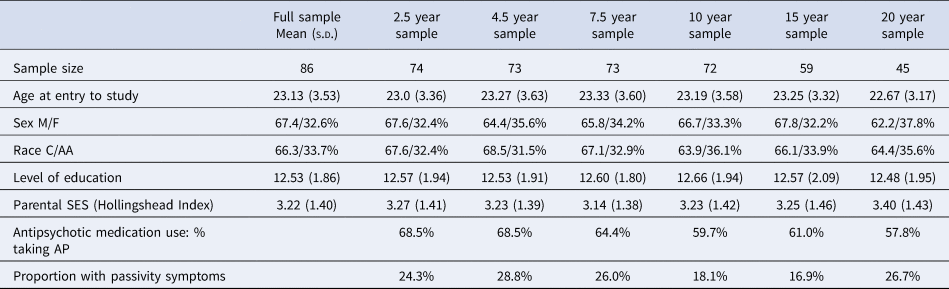
Table 1 provides demographic information on the full sample, as well as the subsamples at each assessment. Age, sex, race, education level, and parental socioeconomic status were quite similar in the full sample and the subset assessed at each follow-up. In addition, the rate of medication use and passivity symptoms is provided for each follow-up assessment. It is important to note that this study did not require clinic involvement for research participation, so antipsychotic medication use was lower than that found in many clinic-based samples.
Demographic, medication, and passivity symptom information on the full sample and at each assessment

Measures
Passivity symptoms
Passivity symptoms were operationalized as symptoms indicating loss of a sense of control over thoughts, feelings, or actions as assessed in The Schedule for Affective Disorders and Schizophrenia (SADS) interview (Endicott & Spitzer, Reference Endicott and Spitzer1978). Specific experiences and associated questions used were: (1) thought withdrawal: Do you feel your thoughts are taken away so your mind is completely a blank?; (2) thought insertion: Are thoughts put into your mind which you know aren't your own thoughts?; (3) thought broadcasting: Do you feel your thoughts are broadcast so everyone knows what you're thinking?; (4) ‘made’ feelings: Do you have feelings which are not your own?; (5) ‘made’ impulses: Do you have impulses which are not your own?; and (6) ‘made’ volitional acts: Is someone else or something making your movements without your intention? The presence and severity of each symptom were rated on a three-point scale with 1 indicating the absence of the symptoms, 2 uncertainty about the presence of the symptom, and 3 indicating the definite presence of the symptom.
The reliability of this cluster of symptoms at each follow-up was assessed using Cronbach's α. The reliability coefficients were 0.91, 0.91, 0.94, 0.87, 0.94, at the 2, 4.5, 7.5, 10, 15, and 20 years assessments, respectively. Categorical scales were created indicating either absence or presence of passivity symptoms at each assessment, with presence defined as the definite presence of at least one passivity symptom. Given that a large proportion of the participants (55%) never experienced passivity symptoms, which would inflate the reliability coefficients, we also calculated Cronbach's α for the subset of individuals who presented with passivity symptoms at least once across the six assessments. The reliability coefficients for this subsample were 0.71 at the 2-year assessment (n = 21), 0.65 at the 4.5-year assessment (n = 23), 0.83 at the 7.5-year assessment (n = 20), 0.65 at the 10-year assessment (n = 15), 0.43 at the 15-year assessment (n = 11), and 0.34 at the 20-year assessment (n = 13). It is likely that both the reduced sample size and the elimination of subjects who showed little variance in symptoms contribute to these reduced reliability coefficients. It will be important to look for larger samples that could help to address this issue.
Other positive symptoms
Additional psychotic (hallucinations, delusions) symptoms were also assessed at each follow-up using the SADS interview (Endicott & Spitzer, Reference Endicott and Spitzer1978) and rated as described above.
Negative symptoms
Our negative symptom measure (cf. Herbener & Harrow, Reference Herbener and Harrow2001, Reference Herbener and Harrow2004; Pogue-Geile & Harrow, Reference Pogue-Geile and Harrow1984, Reference Pogue-Geile and Harrow1985) focused on behavioral indicators of negative symptoms (flat affect, poverty of speech and psychomotor retardation) and was evaluated using the Behavior Rating Scale of the Psychiatric Assessment Interview (Carpenter, Sacks, Strauss, Bartko, & Rayner, Reference Carpenter, Sacks, Strauss, Bartko and Rayner1976) at the end of the 3–4 h interviews. Intraclass correlations for raters using the Behavior Rating Scale was 0.85 or higher for each behavior contributing to the negative symptom measure. A categorical measure was used such that participants who demonstrated the definite presence of at least one of these behaviors were considered to have negative symptoms
Functioning
Social and work functioning were assessed at each follow-up with the Strauss–Carpenter Functioning Scale (Strauss & Carpenter, Reference Strauss and Carpenter1972). Social functioning was rated on a scale from 0 to 4 indicating the frequency with which individuals spent time with others over the past month, with higher scores reflecting more social engagement. Work functioning was rated on a scale from 0 to 4 indicating how much time in the past year the subject had been employed, with higher scores reflecting a greater amount of time working.
Results
Prevalence of passivity symptoms
Around 17–30% of participants assessed at each follow-up over the 18-year period reported currently experiencing passivity symptoms, as shown in Table 1. The majority of participants (55%) did not report having passivity symptoms at any follow-up; 16% of participants reported having passivity symptoms at one assessment, 10% reported having passivity symptoms at two assessments, 8% reported having passivity symptoms at three assessments, 6% reported having passivity symptoms at four assessments, 5% reported having passivity symptoms at five assessments, and no individuals reported passivity symptoms at all six assessments.
Stability of passivity symptoms
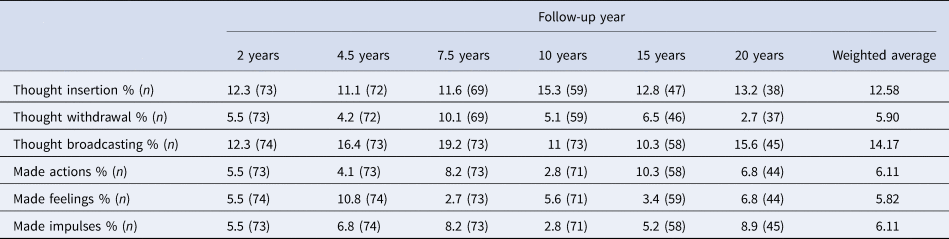
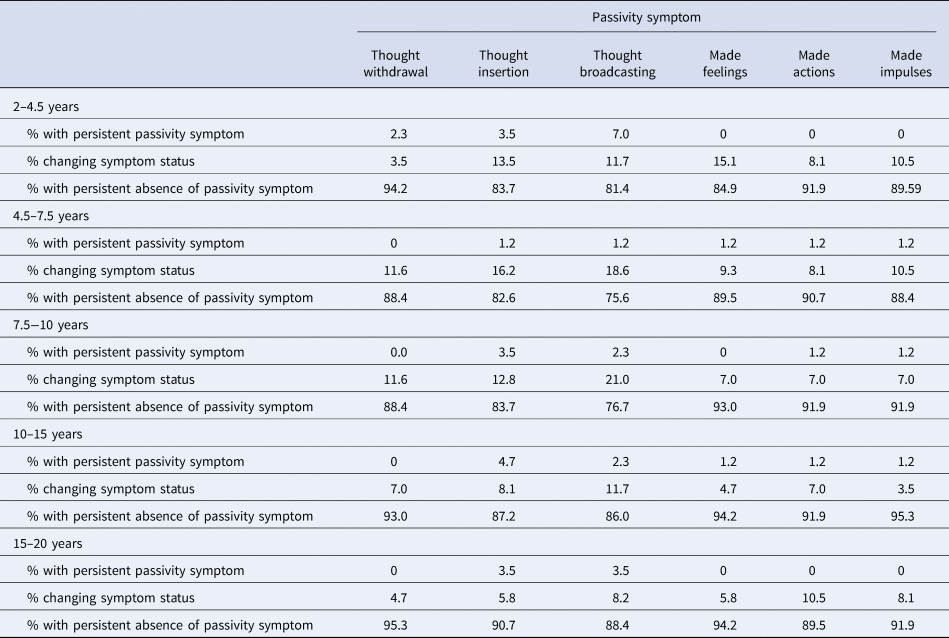
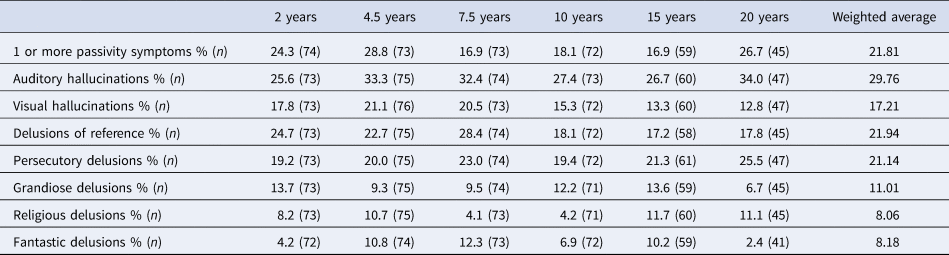
Stability was first assessed in terms of whether there was consistency in the presence of passivity symptoms over adjacent assessment periods. Of the 39 individuals who reported passivity symptoms at least once, 21 (54%) did not report passivity symptoms across any consecutive assessments, 6 (15%) reported passivity symptoms at two consecutive assessments, 9 (23%) reported passivity symptoms at three consecutive assessments, and 3 (8%) reported passivity symptoms at four consecutive assessments. Table 2 shows the percentage of individuals at each assessment period who experienced each of the six passivity symptoms, as well as the weighted average for the prevalence of the symptoms across the six follow-ups. Notable here is that thought insertion and thought broadcasting present at rates that are about twice that of thought withdrawal, made actions, made feelings, and made impulses. Table 3 provides data on the stability of each type of passivity symptom across adjacent follow-ups. Most notable here is that the vast majority of participants are stable without passivity symptoms (76.7–95.3%), and that the rates of maintaining the same symptom over consecutive assessments are lower than the rates of changing symptom status for all types of passivity symptoms across all consecutive assessments. At the same time, Spearman ρ coefficients indexing cross-time stability between consecutive assessments for this sample are quite high: 2–4.5 years follow-up, ρ = 0.39, p = 0.002, n = 63; 4.5–7.5 years follow-up, ρ = 0.44, p < 0.001, n = 62; 7.5–10 years follow-up, ρ = 0.44, p = 0.001, n = 61; 10–15 years follow-up, ρ = 0.63, p < 0.001, n = 53; 15–20 years follow-up, ρ = 0.61, p < 0.001, n = 38. As is clear from the data presented above, the stability coefficients are strongly influenced by the cross-time persistence of the absence of passivity symptoms in the majority of the sample. At the same time, as shown in Table 4, passivity symptom prevalence was relatively frequent, with levels similar to that for delusions of reference or persecution.
Percentage of participants experiencing the six types of passivity symptoms at each assessment

Stability of specific passivity symptoms across follow-up assessments

Prevalence of passivity in comparison to other psychotic symptoms over six assessments

Association between passivity symptoms and total number of psychotic symptoms
To test whether the presence of a greater number of passivity symptoms was associated with a greater number of other psychotic symptoms, we calculated Pearson correlations between these two variables at each assessment, and also graphed the relationships to assess whether the relationships were strongly influenced by the co-occurrence of the absence of both types of symptoms. For these analyses, the sample was limited to include only those participants who had at least one psychotic symptom in order to avoid the impact of many subjects scoring 0 on both measures. Pearson correlations between the total number of psychotic symptoms experienced (excluding passivity symptoms) and the severity of passivity symptoms alone were 0.75 (n = 32) at the 2-year assessment, 0.49 (n = 28) at the 4.5-year assessment; 0.62 (n = 28) at the 7.5-year assessment; 0.67 (n = 27) at the 10-year assessment, 0.31 (n = 16) at the 15-year assessment, and 0.70 (n = 17, p < 0.001) at the 20-year assessment.
Relationship between passivity symptoms and social and work functioning
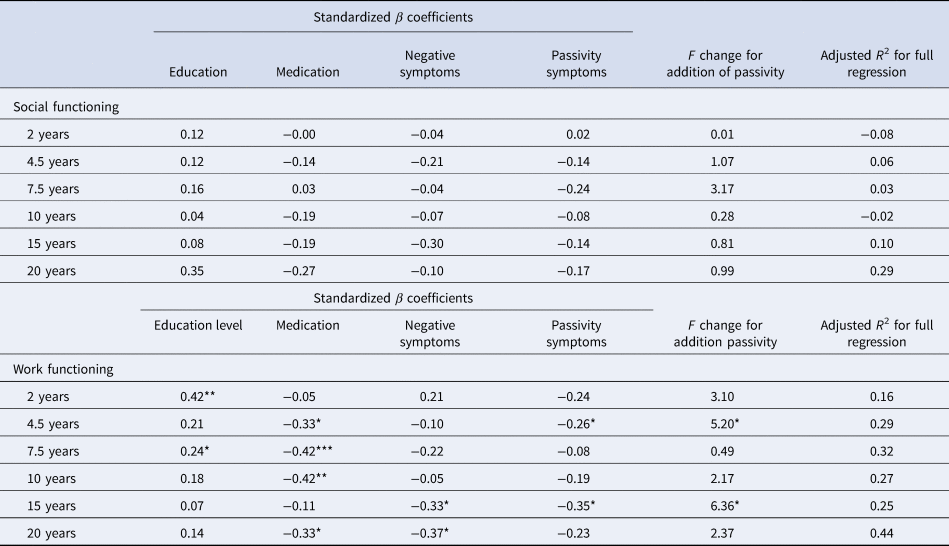
Hierarchical linear regressions were used to assess the potential contribution of passivity symptoms to social and work functioning. In these analyses, the correlation between demographic factors (age, education, and sex) and social and work functioning were assessed first to see which of these factors should be included in analyses. Education level at the time of the baseline assessment was strongly correlated with work performance at all assessments, and social performance at one assessment, and thus was retained for additional analyses. The stepwise hierarchical regression included the educational level in the first step, antipsychotic medication use and the presence of behavioral negative symptoms in the second step, and the presence of passivity symptoms in the third step. The standardized β coefficients for the full model, F-changes when adding the passivity symptoms, and adjusted R 2 for the full regressions predicting social and work functioning at each of the six assessments are shown in Table 5. Sample sizes for these analyses were a bit smaller than those for some other analyses due to some missing data for behavioral measures of negative symptoms. Results indicated that very little of the variation in social functioning was explained by these models. For the linear regressions predicting work performance, education level appeared to be particularly strongly related to work at the 2 and 7.5 years assessment, but showed a diminished effect in later years. Taking antipsychotic medication was significantly negatively associated with work performance at the 4.5, 7.5, 10, and 20 years assessments. Negative symptoms were significantly related to poorer work functioning at the 15 and 20 years assessments. Passivity symptoms significantly contributed to the prediction of poorer work functioning at the 4.5 and 15 years assessments.
Relationship between passivity symptoms and functioning

F1 n = 46, F2 n = 58, F3 n = 58, F4 = 53, F5 = 42, F6 = 30.
*p < .05; **p < .01; ***p < .001.
Discussion
The main findings from this study are that (1) only a minority of individuals with schizophrenia report experiencing passivity symptoms; (2) stability of passivity symptoms within individuals over time is relatively low for most individuals with schizophrenia; (3) when people experience passivity symptoms, they are likely to experience more additional psychotic symptoms, and (4) the presence of passivity symptoms is related to poorer work functioning.
This is the first study addressing the prevalence of passivity symptoms assessed at regular intervals over an 18-year period. These analyses indicate that a minority of participants (16.9–28.8%) reported passivity symptoms at each assessment. The prevalence of passivity symptoms is similar to that reported by some other studies (Chandrasena & Rodrigo, Reference Chandrasena and Rodrigo1979; Deister & Marneros, Reference Deister and Marneros1993; Jablensky, Reference Jablensky1992), particularly those using outpatient samples, but lower than some other studies have reported (Gonzalez-Pinto et al., Reference Gonzalez-Pinto, van Os, Peralta, Perez de Heredia, Mosquera, Aldama and Mico2004; Mellor, Reference Mellor1970; Shepherd et al., Reference Shepherd, Watt, Falloon and Smeeton1989). However, past studies of prevalence have generally focused on the prevalence of FRS, rather than just passivity symptoms, which may contribute to this discrepancy in findings.
The strong co-occurrence of passivity and other positive symptoms raises the question of whether passivity symptoms may increase the risk of experiencing other symptoms, and/or share underlying mechanisms with other psychotic symptoms. Passivity symptoms reflect a change in experience of oneself as being in control of one's thoughts, emotions, and actions, and could be associated with changes in other psychotic symptoms in a number of ways. Psychologically, the experience of loss of control over one's thoughts, emotions, and actions could lead to concern about why one's experience has changed, and what external factors might explain this change, which could contribute to delusional explanations (Maher, Reference Maher2006).
Research on passivity symptoms has suggested that abnormalities in internal timing (Graham, Martin-Iverson, Holmes, Jablensky, & Waters, Reference Graham, Martin-Iverson, Holmes, Jablensky and Waters2014; Waters & Jablensky, Reference Waters and Jablensky2009), predictive coding (Sterzer, Mishara, Voss, & Heinz, Reference Sterzer, Mishara, Voss and Heinz2016), and sensory prediction deficits (Shergill, Samson, Bays, Frith, & Wolpert, Reference Shergill, Samson, Bays, Frith and Wolpert2005) may contribute to this sense of loss of control over actions, thoughts, and emotions. Similar models involving timing disruption have been proposed for auditory hallucinations (Whitford, Ford, Mathalon, Kubicki, & Shenton, Reference Whitford, Ford, Mathalon, Kubicki and Shenton2012). Notably, in their EMA study, Ben-Zeev, Morris, Swendsen, and Granholm (Reference Ben-Zeev, Morris, Swendsen and Granholm2012) noted that the occurrence of auditory hallucinations increased the likelihood of experiencing delusions of control or reference during succeeding time periods within a day. This could suggest that there may be periods of greater disturbances of timing and prediction mechanisms that could contribute to multiple types of symptoms.
In this study, we found that the prevalence of one or more passivity symptoms was similar to that of delusions of reference and persecutory delusions, and higher than the prevalence of several other types of delusions (grandiose, religious, fantastic). This suggests that passivity symptoms should be considered one of the core types of delusions to be addressed in treatment. Yet, some of our most frequently used measures of psychotic symptoms (PANSS, BPRS) do not specifically address the presence of passivity symptoms, nor have recent intervention studies targeted passivity symptoms. Given that the presence of these symptoms tends to co-occur with multiple other psychotic symptoms, it is possible that interventions to address passivity symptoms may also impact other psychotic symptoms.
Analyses of the relationship between the presence of passivity symptoms and social and work functioning utilized step-wise linear regression in order to first include the impact of demographic characteristics, then medication use and negative symptoms, and finally passivity symptoms. These factors accounted for very little of the variance in the social functioning measure at any of the six assessments. This result is different from past studies assessing the relationship between passivity symptoms and social functioning (Heering & van Haren, Reference Heering and van Haren2016) or anomalous self-experiences and social functioning (Haug et al., Reference Haug, Oie, Andreassen, Bratlien, Raballo, Nelson and Melle2014). Notably the SFS differs significantly from the Strauss–Carpenter scales used in the current analyses. Specifically, the Strauss–Carpenter SFSs assess frequency but not the quality of interpersonal engagement, which could contribute to the discrepant results.
In the current sample, more of the variance for work functioning than social functioning was associated with symptoms, with adjusted R 2 for the regressions ranging from 0.16 to 0.44. It was notable that educational level was more strongly associated with work performance at the early assessments, but showed less of a contribution by the 10-year assessment, suggesting that the advantage of more education declines over time.
There was also a clear negative relationship between medication use and work performance at four assessment periods. This negative relationship is likely to exist in this sample because people with stronger and/or more distressing symptoms are more likely to be prescribed antipsychotic medication than people who are experiencing fewer psychotic symptoms. As noted earlier, the proportion of participants taking anti-psychotic medication ranges between 57.8% and 68.5% at each assessment. As has been documented in other work with this sample (Harrow & Jobe, Reference Harrow and Jobe2013; Harrow, Jobe, Faull, & Yang, Reference Harrow, Jobe, Faull and Yang2017), although some of the research participants who stop taking antipsychotic medication are quite ill, there is also a significant group who are performing well without medication. There have generally been little data available on individuals in this high-functioning unmedicated group, as they are less likely to be seen at psychiatric facilities where recruitment into studies typically occurs.
Given the known relationship between negative symptoms and functioning, it was notable that the addition of passivity symptoms could significantly influence the regressions predicting work functioning in our sample, particularly given that positive symptoms have not been shown to consistently influence instrumental functioning, with deficits more strongly associated with negative symptoms, and particularly motivational deficits (Fulford et al., Reference Fulford, Piskulic, Addington, Kane, Schooler and Mueser2018; Llerena et al., Reference Llerena, Reddy and Kern2018) and cognitive functioning (cf. Green, Kern, Braff, & Mintz, Reference Green, Kern, Braff and Mintz2000; Kaneda, Jayathilak, & Meltzer, Reference Kaneda, Jayathilak and Meltzer2009). It was thus notable that, even after considering the impact of education, medications, and negative symptoms, the presence of passivity symptoms still contributed to the prediction of impaired work functioning in the current study. Notably, a prior study from our group also documented an impact of psychotic symptoms on functioning beyond the effect of diagnosis alone (Racenstein et al., Reference Racenstein, Harrow, Reed, Martin, Herbener and Penn2002). At the same time, the current results need to be interpreted in light of the strong association between the presence of passivity symptoms and other psychotic symptoms. Particularly, given that most people who experience passivity symptoms also experience multiple additional psychotic symptoms, it is not possible to disentangle the specific impact of passivity symptoms from other co-occurring symptoms or general severity of illness.
Conclusion
The current study provides information about the prevalence, persistence, and clinical correlates of the experience of passivity symptoms in a sample of individuals with schizophrenia spectrum disorders assessed repeatedly over an 18-year period. The data demonstrate the episodic nature of these symptoms for most individuals, as well as the extremely strong co-occurrence of passivity symptoms and other psychotic symptoms. The presence of passivity symptoms is associated with poorer work performance at times, although it is not clear whether this is specifically due to the presence of passivity symptoms, or the likelihood of having a greater number of additional psychotic symptoms if one experiences passivity symptoms. Finally, the data suggest the importance of developing interventions that address passivity symptoms, given their strong relationship with multiple other psychotic symptoms.
Financial support
This research was supported, in part, by US Public Health Service Grants MH-26341 and MH-068688 from the National Institute of Mental Health (Dr Harrow).
Conflict of interest
There are no conflicts of interest for either author.
Ethical standards
The authors assert that all procedures contributing to this work comply with the ethical standards of the relevant national and institutional committees on human experimentation and with the Helsinki Declaration of 1975, as revised in 2008.