Introduction
Over the past few decades, the practice of pro bono has increasingly become institutionalized across elite, large law firms in the United States (Cummings Reference Cummings2004). Although the legal profession has professed a historic tradition of helping those who cannot afford access to the legal system, only recently has it become organizationally rationalized, diffusing across large law firms, albeit unevenly (Boutcher Reference Boutcher, Granfield and Mather2009). What accounts for the rise in pro bono activity, and more importantly, what accounts for the variation in rates of participation across this particular field of firms? Existing legal scholarship tends to individualize the pro bono system—imagining an organic, bottom-up process where committed lawyers are oriented to public service based on individual characteristics or values. This imagery is reinforced by the existence of an aggressive labor market in which large firms increasingly attempt to outcompete one another for elite law students from a narrow set of schools (Sherer and Lee Reference Sherer and Lee2002), and pro bono is seen as an important mechanism to attract the brightest recruits. Subsequent discussions of pro bono within the legal profession take this bottom-up imagery for granted, reifying the role of individual personal biographies or values in relation to the system of pro bono delivery.
Departing from these individualized accounts, I focus on the role of organizational and institutional factors that influence pro bono behavior. I find that contemporary pro bono practice is shaped not only by the organizational resources available to the firm, but also by the institutional environment in which these firms are embedded, indicating that many large firms may rationalize pro bono as an important signal of their professional status and legitimacy within the profession rather than as oriented toward internal organizational goals (M. W. Meyer Reference Meyer1979). However, I also find important variation in how different actors within this particular field respond to their institutional and organizational environments, supporting the notion that fields should be conceived as sites of heterogeneous organizational action (Wooten and Hoffman Reference Wooten, Hoffman, Greenwood, Oliver, Sahlin and Suddaby2008). I find that organizational status mediates how firms respond to their environments; more specifically, higher ranked firms appear more responsive to the coexistence of multiple pressures than their lower ranked peers, suggesting that higher status firms are more successful at integrating the various competing rationales (e.g., professional and market) surrounding pro bono service.
This article analyzes the pro bono participation of a field of elite corporate firms. Drawing from a variety of scholarship, including legal studies, organizational and institutional sociology, and corporate social responsibility, I develop and test several hypotheses focused on the relationship between firm organization and pro bono participation. I argue that a firm's overall level of pro bono participation is more than simply the aggregation of individual predispositions found within the firm. Instead, the broader institutional environment provides its own set of legitimizing scripts and logics for firm actors to draw from in their decisions to provide pro bono services. To demonstrate this, I conduct a panel analysis of the largest and most profitable firms in the United States between 1994 and 2005.
Background: The Institutionalization of Pro Bono
The practice of pro bono has recently and dramatically expanded across elite large law firms in the United States. Although the concept of pro bono has historic roots in American and English law, until recently the practice was organized as an individualized project, dispensed as professional charity by committed lawyers and most often done outside of, and in addition to, fee-generating work (Lochner Reference Lochner1975). The American Bar Association (ABA) has enshrined this individualized logic in Model Rule 6.1, which states: “Every lawyer has a professional responsibility to provide legal services to those unable to pay. A lawyer should aspire to render at least fifty (50) hours of pro bono publico legal services per year” (American Bar Association n.d.). Although considered an important ethical component of the American legal profession, it has historically been up to the individual lawyer to fulfill his or her professional responsibility without much accountability, leading some critics to argue that many lawyers end up doing very little (Rhode Reference Rhode2005).
For attorneys working in large, corporate law firms, the practice of pro bono has become increasingly rationalized as a collective enterprise, much like the parallel institution of corporate social responsibility (Hwang and Powell Reference Hwang and Powell2009). For instance, firms have increasingly hired pro bono managers to organize and administer their programs (Boutcher Reference Boutcher2010; Cummings and Rhode Reference Cummings and Rhode2010). These developments have led some scholars to argue that pro bono has become an institutionalized practice across the field of large firms (Cummings Reference Cummings2004; Boutcher Reference Boutcher2013).
However, there remains wide variation in the actual participation rates across the field. Not all firms structure their pro bono programs alike, which can have important implications for attorney participation (Boutcher Reference Boutcher2010). Similarly, research on the individual motives and rationales for doing pro bono show that not all lawyers approach pro bono with the same predispositions (Granfield Reference Granfield2007; Dinovitzer and Garth Reference Dinovitzer, Garth, Granfield and Mather2009). What accounts for this variation? Studies of individual attorneys have suggested that these differences can, in part, be accounted for by demographic factors, such as gender, race, and class, and by the professional status of the lawyer, such as where the lawyer practices or the law school attended (Granfield Reference Granfield2007; Dinovitzer and Garth Reference Dinovitzer, Garth, Granfield and Mather2009). However, these studies do not account for variation within any particular practice site; nor do they account for different factors at the level of the practice site. As Granfield (Reference Granfield2007, 135) notes, “When it comes to the meaning of pro bono, the institutional effects of the workplace appear to outweigh the socialization effects of law school.” To date, however, any attempts to capture the factors of the workplace on pro bono outcomes have tended to rely on individual-level survey data with controls for the practice site, effectively treating the workplace as a black box. Although this is not the first study to argue the importance of extra-individual factors on pro bono (Sandefur Reference Sandefur2007; Epstein Reference Epstein, Granfield and Mather2009), it is among the first to systematically model the role of both organizational and institutional factors on large firm pro bono participation over time.
Departing from previous scholarship, I focus on the firm as the primary unit of analysis in order to understand variation in pro bono participation. It is in the organizational context of the firm that decisions about how much time to devote to pro bono are made. Although individual lawyers may make choices about whether to donate their time or not, they make those choices embedded within an organizational and institutional environment that strongly influences their orientations toward public service. Thus, as Boon and Whyte (Reference Boon and Whyte1999, 190) argue, “to individualize [pro bono] … would be to misunderstand the social, political and organizational context within which it operates.”
The Determinants of Law Firm Pro Bono Participation
Existing scholarship on pro bono is overwhelmingly normative, discussed in relation to the professional responsibility of individual lawyers (White Reference White2000; Russell Reference Russell2003), or focused on increasing pro bono participation and arguing a business case for pro bono participation (Strossen Reference Strossen1993; Lardent Reference Lardent2000; Justus Reference Justus2003). In the few surveys and empirical studies that exist, there is a large focus on individual lawyers, akin to the larger literature on volunteering (Wilson and Musick Reference Wilson and Musick1997; Thoits and Hewitt Reference Thoits and Hewitt2001; Einolf Reference Einolf2011). This research often consists of surveys of individual attorneys that explore the motivations and constraints of pro bono participation.
For example, two recent surveys of the legal profession, Supporting Justice (American Bar Association 2005,2009) and After the JD (Dinovitzer et al. Reference Dinovitzer, Garth, Sander, Sterling and Wilder2004), both report on the pro bono attitudes and behavior of individual attorneys across the profession. Similarly, in social scientific accounts of pro bono behavior, the research reflects the same approach of focusing on individual-level survey data (Granfield Reference Granfield2007; Lempert, Chambers, and Adams Reference Lempert, Chambers and Adams2000; Rhode Reference Rhode2005; Wilkins et al. Reference Wilkins, Chambliss, Jones and Adamson2002). Although some scholars explicitly acknowledge that the workplace context matters (Granfield Reference Granfield2007), the data and analytical focus remains oriented on the individual characteristics of lawyers. Thus, these studies implicitly suggest that firm-level participation is simply the aggregate of individual-level motivations and that any variance between firms can be attributed to the composition of those working within the firm.
Focusing on the organizational and environmental context has important implications for scholarship on pro bono participation. First, this approach implies that lawyers might perceive their professional obligations to provide pro bono work as within a specific workplace context that mediates any individual attributes that might make a lawyer more likely to donate his or her time to public service. This is not to suggest that some lawyers do not come to the job with an initial set of values that make them more oriented toward pro bono, but that those values are amenable to organizational and institutional norms, or through secondary, professional socialization by their colleagues in the workplace. I argue that it is this process that shapes the actual likelihood of volunteering their time toward public service. Second, not all lawyers across the profession are equally likely, or structurally available, to donate their time to pro bono. Some workplaces are more likely to facilitate higher levels of pro bono through the implementation of specific workplace policies that incentivize attorney participation (Boutcher Reference Boutcher2010). Third, within organizational fields of similarly situated firms, there is likely to be variation in the levels of pro bono participation. Survey data often show differences in pro bono participation between different legal actors within the profession, but they do not account for variation within any particular sector. Ignoring variation within a particular group of firms has glossed over important factors that might account for variation within a particular site of the legal profession. Finally, any analysis of workplace effects on pro bono participation must take into account variation at the firm level of analysis. Thus, individual decisions to donate time to pro bono are structured through the organizational and institutional environment in which lawyers are embedded. I orient my discussion of these two sources for pro bono and draw from a variety of literatures to develop several hypotheses that facilitate firm participation.
Organizational Determinants
Organizational Slack
Realists often like to talk about the connection between law firm behavior and the economic bottom line of the firm (Daniels and Martin Reference Daniels and Martin2009; Rhode Reference Rhode2009). In terms of pro bono participation, the argument is that when firms are doing well financially, then there is more willingness to direct resources to pro bono. The broader scholarship on corporate social responsibility makes similar arguments, highlighting the relationship between the level of organizational giving and firm-level economic performance (Galaskiewicz Reference Galaskiewicz1997; Margolis and Walsh Reference Margolis and Walsh2003; Orlitzky, Schmidt, and Rynes Reference Orlitzky, Schmidt and Rynes2003; Campbell Reference Campbell2007). These scholars stress that a firm's profitability is one of the strongest predictors of its willingness to devote organizational resources to corporate social responsibility activities (Margolis and Walsh Reference Margolis and Walsh2003). A firm's financial performance can be conceptualized as an important source of organizational slack that enables organizations to react positively to an institutional environment that increasingly expects firms to be socially responsible (McGuire, Sundgren, and Schneeweis Reference McGuire, Sundgren and Schneeweis1988; Waddock and Graves Reference Waddock and Graves1997). Hence, I hypothesize the following:
Hypothesis 1: Firm profitability will correspond with higher rates of pro bono participation.
Pro bono hours are in direct competition with a firm's billable hours. All things being equal, more hours spent on pro bono means fewer hours available to be billed to corporate clients. Thus, during times of increased demand from paying clients, we could expect fewer available hours for pro bono work. However, when firms experience a lull in billable work, a firm has an important choice to make: lay off associates or produce other types of work to keep associates busy until more billable hours are generated. This tension became apparent during the recession of 2008 and 2009, when large firms began offering young associates incentives to work in the public sector doing pro bono and legal services work at decreased salary rates (Chen Reference Chen2009). Transitioning a lawyer's time to pro bono work is one way that a firm can ride out a lull in fee-generating work. This may be ineffective as a long-term strategy, but it can provide opportunities to develop human capital among individual lawyers (Epstein Reference Epstein2002). Although firms can always lay off large numbers of associates during periods of downtime, doing so would handicap the firm when fee-generating work suddenly increases.Footnote 1 Hence, I propose the following:
Hypothesis 2: Pro bono participation is inversely related to changing firm revenues.
The Law Firm Pro Bono Challenge
In an effort to provide a level of accountability for large firms, the ABA's Standing Committee on Pro Bono and Public Service initiated the Law Firm's Pro Bono Challenge in 1993. Now housed within the Pro Bono Institute, firm signatories to the challenge agree to devote either three percent or five percent of their billable hours toward pro bono work. Each year, all firm signatories are expected to report their actual hours to the Pro Bono Institute. As of early 2012, close to 140 firms had signed on to the challenge.Footnote 2
When the challenge was initiated, there was substantial variation in how firms engaged in pro bono work. However, several firms signed onto the challenge before it became widespread. I would expect that charter firms should have a higher commitment to doing pro bono work. First, firm signatories may have forecasted that pro bono was an emerging institution and were signaling their commitment to the growing pro bono movement. Second, these firms may have already had a strong organizational culture and institutional commitment to doing pro bono work and sought increased legitimacy among clients, peer firms, and law students. Moreover, the public declaration to pro bono opens the firm to demands from both internal and external actors to live up to its promise to commit time and resources. Once a firm has signed onto this very public challenge, it may become increasingly difficult to decouple behavior from its expressed commitment to do pro bono. Thus, I hypothesize the following:
Hypothesis 3: Initial signatories to the Law Firm Pro Bono Challenge will have higher rates of pro bono participation than peer firms that did not initially commit to the challenge.
Institutional Determinants
Institutional Rankings
Recent scholarship has focused on the consequences of external ranking systems as a source of organizational change (Espeland and Sauder Reference Espeland and Sauder2007; Sauder and Espeland Reference Sauder and Espeland2009). This research has shown how external rankings, such as those in U.S. News & World Report, have a powerful disciplining effect on organizational fields (Bastedo and Bowman Reference Bastedo and Bowman2010). Ranking systems alter how external actors perceive organizations as well as how internal actors react to rankings, attempting to mediate potential fallout from performing poorly or gaming the system to increase their social position within their organizational field.
Large law firms are routinely ranked on profitability, diversity, attorney satisfaction, and pro bono work. Although large firms are ranked on isolated dimensions, in 2002 American Lawyer started its A-List rankings of the top 20 large law firms.Footnote 3 These rankings have not only expanded firms' organizational transparency, but have also shaped the way that internal and external stakeholders construct meaning around corporate legal practice. For instance, as one pro bono coordinator at a large firm expressed about the relationship between the A-List and corporate clients:
The decision of which firm to award business to is usually made by the general counsel … [and] the decision is not made just on a cool numbers basis. Now that there's sort of a cool factor to pro bono, or there's sort of a currency to it, you want to, and you're going to have to report who you chose. Well if you can say, “I chose this firm because I worked there,” or “I chose it because I had a case against them and they're good.” Are they hugely better? Are there rates incredibly lower? No. But they're top-ten, they're on the A-List, they're on the AmLaw A-List. It just gives credibility to a decision that in some ways is completely subjective. (Personal communication with a pro bono coordinator in Washington DC)
Hence, I hypothesize the following:
Hypothesis 4a: The advent of the A-List rankings will have a positive relationship on pro bono participation.
The A-list ranking only includes twenty firms in any given year based on the composite score described above. However, American Lawyer also annually ranks all firms by gross revenues. Similar to university rankings, the broader AmLaw ranking system has become a signal of prestige across the field, acting as an important mechanism for attracting top law students and powerful clients. Thus, ranking systems are an important institutional resource for law firms, signaling a firm's social status relative to its peers within the broader field. Hence, I hypothesize the following:
Hypothesis 4b: The more prestigious a firm's AmLaw ranking, the more time it will devote to pro bono work.
The Competing Institutional Meanings of Doing Good
Law firms sit at the intersection of two competing institutional logics (Friedland and Alford Reference Friedland, Alford, Powell and DiMaggio1991; Marquis and Lounsbury Reference Marquis and Lounsbury2007; Almandoz Reference Almandoz2014). Law firms represent an elite segment of the legal profession and pro bono is regarded as an important element of a professional logic. Indeed, as ABA Model Rule 6.1 states, all lawyers, regardless of where they practice, have a professional responsibility to provide pro bono legal services. However, unlike other actors across the profession, large firms also straddle the corporate sector. These particular legal actors may draw from an alternative, corporate logic to make sense of pro bono. Within the corporate sector, the logic of corporate social responsibility shapes how corporate actors make sense of doing good. Thus, through strong ties to their corporate clients, large firms may redefine their professional obligation to do pro bono through the logic of corporate social responsibility rather than through dominant conceptions of legal professionalism.
One way to capture the presence of a particular logic is the availability of different discourses that circulate in the institutional environment, which can shape how firm actors make sense of pro bono within their particular context (Suddaby and Greenwood Reference Suddaby and Greenwood2005). An increase in the discourse of pro bono reflects the growing importance of the topic within the legal profession. However, the concept of corporate social responsibility has emerged and increasingly become institutionalized across the sector during the second half of the twentieth century (Carroll Reference Carroll1999). The former reflects a narrow discourse present within the legal profession, whereas the latter reflects a broader discourse within the corporate world that may have spilled over to corporate law firms. Thus, I propose the following:
Hypothesis 5: As pro bono discourse increases, so will pro bono participation; and
Hypothesis 6: As corporate social responsibility discourse increases, so will pro bono participation.
I evaluate these hypotheses through an examination of pro bono participation across the field of large, elite law firms commonly referred to as the AmLaw firms. These firms represent the largest and most profitable firms across the country, and they have increasingly institutionalized their pro bono practices.
Data and Methods
To test my hypotheses, I conducted a panel analysis of firm-level pro bono participation rates between 1994 and 2005, a period marked by dramatic institutional changes surrounding pro bono.Footnote 4 My data comprised a total of 189 law firms across the time period. I used a variety of data to capture the organizational and environmental context of large firm pro bono. Much of the organizational data were originally collected and published by American Lawyer, a legal publication that focuses on large firm practice. Each year, American Lawyer publishes its AmLaw 100 survey of the 100 largest firms, which includes a variety of organizational characteristics. In 1998, the survey expanded to include the next 100 largest firms. Because American Lawyer ranks each firm according to its gross revenues, the sample of firms changes annually, creating an unbalanced panel over the period.
Dependent Variable
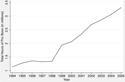
The dependent variable is the annual hours of pro bono per lawyer in the firm. This variable is measured by dividing the total hours of pro bono for each firm as reported by American Lawyer by the total number of lawyers in the firm. I measure pro bono participation as the average hours per lawyer as opposed to the firm's total hours in order to normalize participation across the firms, which vary in their overall size—that is, all things being equal, larger firms have more lawyers and can generate more hours of pro bono work. Figure 1 shows the growth in total hours of pro bono across and the average hours per lawyer for the field over the time period. The growth in total hours is, in part, a function of more firms reporting their pro bono data over time, and the inclusion of the AmLaw 200 firms in 1998.
The Growth of Pro Bono across American Law Firms, 1994–2005.
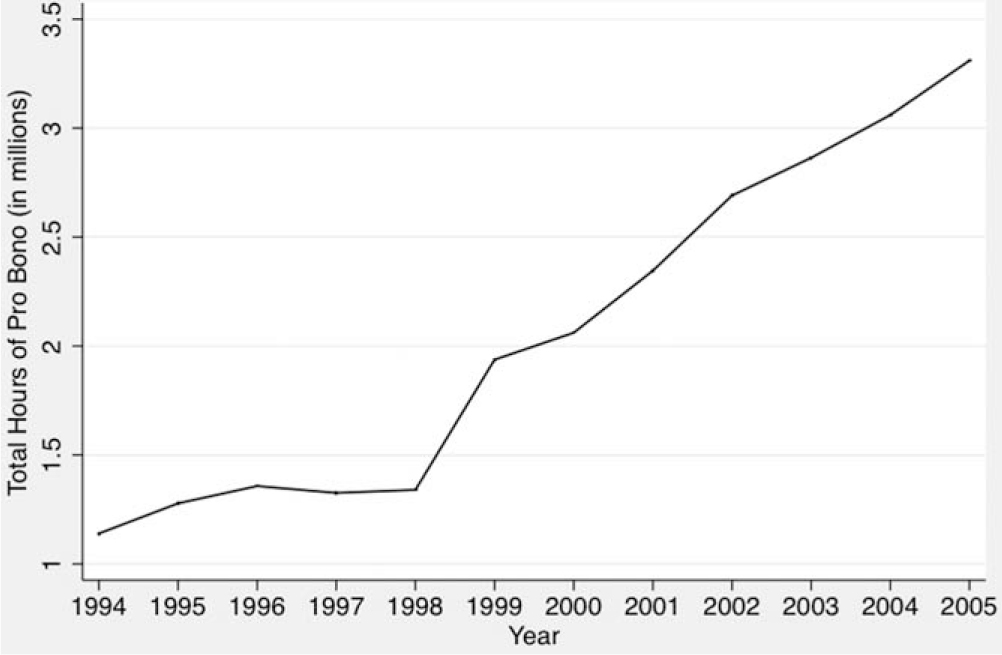
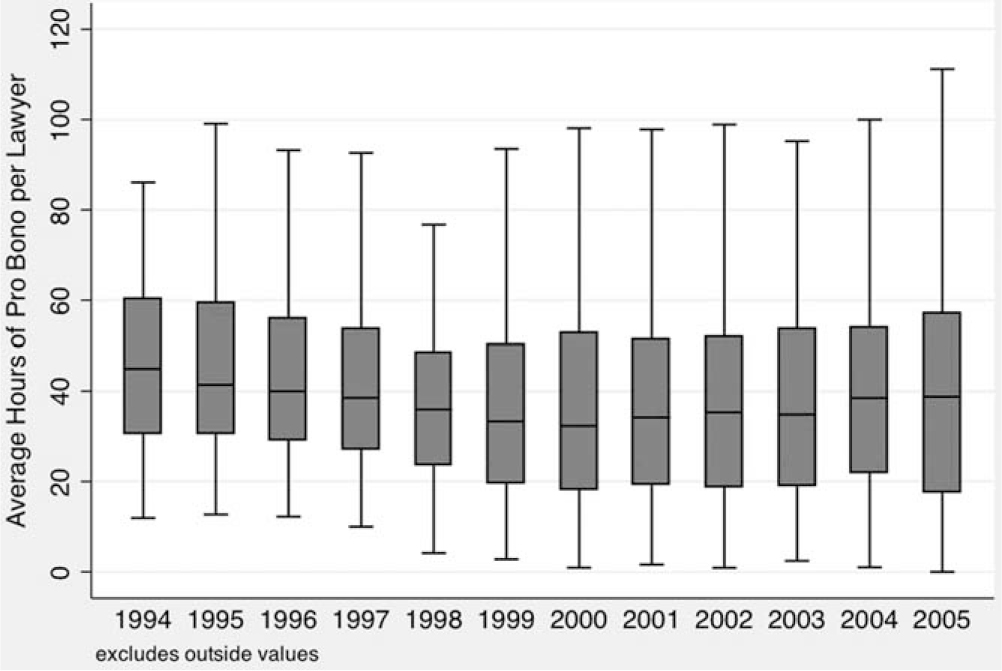
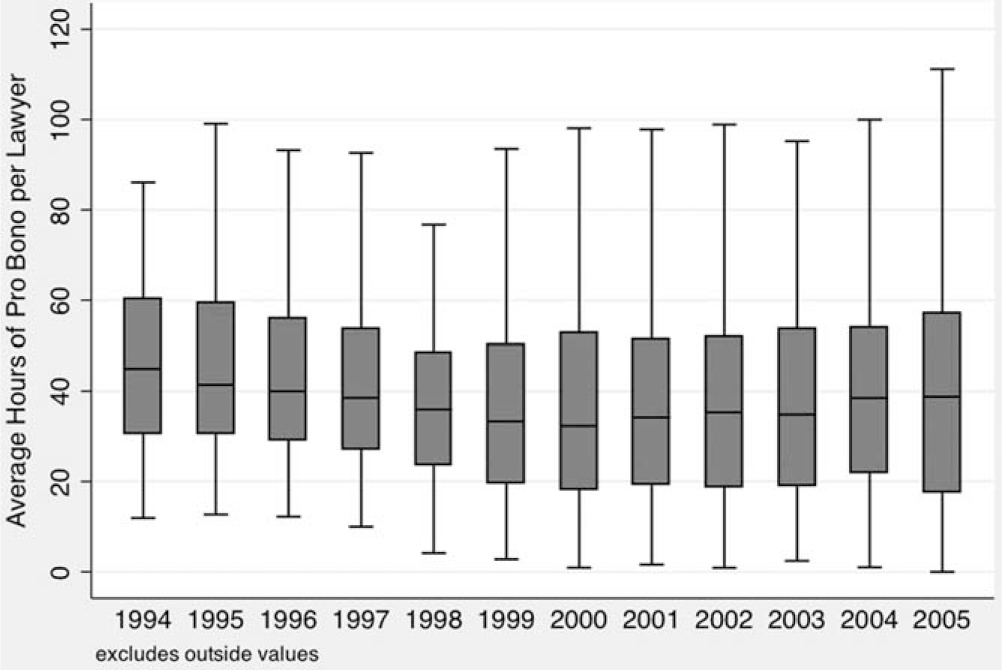
However, there is wide variation across the field. Figure 2 presents a box and whisker plot of the dependent variable across the included firms for each year in the analysis. Although the total hours of pro bono have gone up over time, Figure 2 shows that there is considerable variation in participation rates across the field.
Distribution of Pro Bono Participation across the AmLaw 200, 1994–2005.
Independent Variables
I included two variables of firm-level financial performance. First, I included the overall profits (logged) as a measure of organizational slack. I also included the percentage change in revenues in order to capture the potential trade-off between fee-generating work and pro bono work. Here, I used the percentage change in revenues because it better captures the trade-off that might occur when there is surplus labor available for pro bono work during times of decreased billable hours. Both measures come from the AmLaw 100 and AmLaw 200 surveys published by American Lawyer.
In order to capture a firm's organizational culture around pro bono, I collected information on which firms were signatories to the Pro Bono Challenge. Currently, over 150 firms are signatories to the challenge (not all included in American Lawyer's list of firms). This list is maintained through the Pro Bono Institute.Footnote 5 The data source does not give the year that each firm signed on to the challenge, only indicating those firms that were initial signatories to the challenge. Because I am interested in which firms may have an organizational predisposition to pro bono, I captured the effect of charter signatories. This measure is dummy-coded and is time-invariant (1 = initial signatory).Footnote 6
I included several measures to test for environmental effects on firm-level pro bono participation. In order to capture the rise of the A-List rankings, I constructed a period effect for the years 2002–2005, capturing the initial year of the rankings through the end of the analysis. Using a period effect constrains my ability to use yearly dummies in the model, which is a common approach in panel analysis. However, in light of a strong theoretical rationale, a period effect should be prioritized over annual dummies. I also included the American Lawyer rankings, which range from 1 (highest ranked firm) to 200 (lowest ranked firm).
In order to capture the effect of the competing logics between professionalism and corporate social responsibility, I included two measures of discourse surrounding the concept of doing good. First, I collected a measure of pro bono discourse using LexisNexis. This measure includes an annual count of all law review articles published in the United States that included the terms pro bono publico or pro bono within the text of the article. The second discourse measure captures the broader institutional discourse of corporate social responsibility. I constructed this measure using the Social Science Citation Index. I looked for any article published in management journals containing the search terms corporate social responsibility, CSR, or corporate philanthropy. These measures merely serve as proxies of each type of discourse in the institutional environment and are not meant to suggest that firm actors are paying attention to the specific scholarly journals included in the measure.
Control Variables
I included several control variables in the analysis. First, I included firm age. Scholars have argued that an organization's founding can have long-lasting imprinting effects on that firm's subsequent trajectories (Stinchcombe Reference Stinchcombe and March1965; Johnson Reference Johnson2007). In the context of pro bono, some have argued that the founding partners can endow a firm with a particular cultural vision of public service that carries forward with the firm long after their departure (Baron, Hannan, and Burton Reference Baron, Hannan and Burton1999; Epstein Reference Epstein, Granfield and Mather2009). These charismatic partners draw vital cultural resources from the broader environment into the firm, which shape subsequent practices as time goes on (Stinchcombe Reference Stinchcombe and March1965). Because institutionalized pro bono is a recent feature of the legal profession, we might expect that newer firms would be more inclined to participate than older, more established firms. Conversely, older firms may have higher rates of participation than their modern peers, which were founded under a period of increasing commercialization of legal practice. Firm age is measured annually as the number of years since founding.
I also included a control for geographical location of a firm's headquarters. Because institutionalized pro bono is, in part, predicated on the rise of large firms (Cummings Reference Cummings2004) we might expect that firms headquartered in the Northeast will have had the opportunity to institutionalize their pro bono programs early and instill a robust culture of doing pro bono compared to firms headquartered in other regions. This control is measured as a dummy variable for firms headquartered in the Northeast.
I included a control for the level of poverty in the local environment. To the extent that the supply of pro bono is driven by demand for services, I would expect to see a positive relationship between firm-level pro bono participation and the level of poverty in the local environment. Data on poverty are at the state level and were collected from the Current Population Survey from the Census Bureau. Firms are matched to a state by the locations of their headquarters. This measure varies annually.
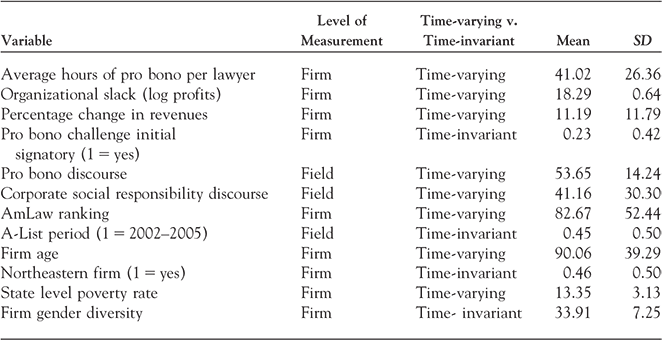
Finally, I included a control for the percentage of women attorneys in the firm as a proxy for firm diversity. This was collected from the National Law Journal Survey of the top 250 firms between 2002 and 2005. Due to multiple years of missing data, I created a cross-sectional measure by averaging the available years for each firm. I expect that firms that value greater diversity also commit more time to pro bono. Table 1 presents the summary statistics of these measures.
Modeling Pro Bono Participation
My data consist of an unbalanced set of firms, meaning that each firm has a different set of observations across the relevant period. There are two main reasons for the unbalanced nature of the data set. First, like corporations listed in the Fortune 500, the inclusion of a firm is a function of its growth and decline over time. Second, American Lawyer expanded the number of firms included in its pro bono survey in 1998, creating the unbalanced set of observations across firms. That is, due to survey design, firms included in the AmLaw 200 survey in 1998 were not necessarily included in prior years.
Descriptive Statistics of Variables in Analysis

| Variable | Level of Measurement | Time-varying v. Time-invariant | Mean | SD |
|---|---|---|---|---|
| Average hours of pro bono per lawyer | Firm | Time-varying | 41.02 | 26.36 |
| Organizational slack (log profits) | Firm | Time-varying | 18.29 | 0.64 |
| Percentage change in revenues | Firm | Time-varying | 11.19 | 11.79 |
| Pro bono challenge initial signatory (1 = yes) | Firm | Time-invariant | 0.23 | 0.42 |
| Pro bono discourse | Field | Time-varying | 53.65 | 14.24 |
| Corporate social responsibility discourse | Field | Time-varying | 41.16 | 30.30 |
| AmLaw ranking | Firm | Time-varying | 82.67 | 52.44 |
| A-List period (1 = 2002–2005) | Field | Time-invariant | 0.45 | 0.50 |
| Firm age | Firm | Time-varying | 90.06 | 39.29 |
| Northeastern firm (1 = yes) | Firm | Time-invariant | 0.46 | 0.50 |
| State level poverty rate | Firm | Time-varying | 13.35 | 3.13 |
| Firm gender diversity | Firm | Time- invariant | 33.91 | 7.25 |
Although the advantages of panel data include a significant increase in the number of observations as opposed to a cross-sectional sample of firms at only one point, panel data also present several issues associated with model specification. Specifically, panel data can be plagued by different types of error, making ordinary least squares regression an inconsistent and inefficient method due to the underestimation of the standard errors (Hsiao Reference Hsiao1986; Greene Reference Greene2003). Two common approaches are often used to analyze the heterogeneity bias inherent in panel data: the fixed-effects model and the random-effects model. For theoretical and substantive reasons, I used the random-effects model, because the fixed-effects model removes any time-invariant explanatory factors from the analysis, favoring the variation within firms over the variation between firms. Several of my key variables of theoretical interest do not vary over time, and therefore they would ultimately be dropped from any fixed-effects model analysis. Furthermore, I am theoretically interested in the variation between firms across this particular field, and not over time, making the fixed-effects model inappropriate because it would remove many of my time-invariant variables.
There also exists the potential for the correlation of panel-level errors. A common approach is to include fixed effects for every year in the analysis. However, because I include a theoretical period effect (A-List ranking period for 2002–2005), the inclusion of yearly fixed effects would present issues of multicollinearity. For theoretical reasons, I use the period effect instead of fixed years.Footnote 7 Finally, I observed evidence of serial autocorrelation in preliminary analysis. I corrected for this by incorporating a first-order, autoregressive parameter, or AR(1) term in the analysis by using the xtregar command in STATA 10, which implements the methods derived by Baltagi and Wu (Reference Baltagi and Wu1999). This method is also appropriate for unbalanced data (StataCorp 2007).
Results
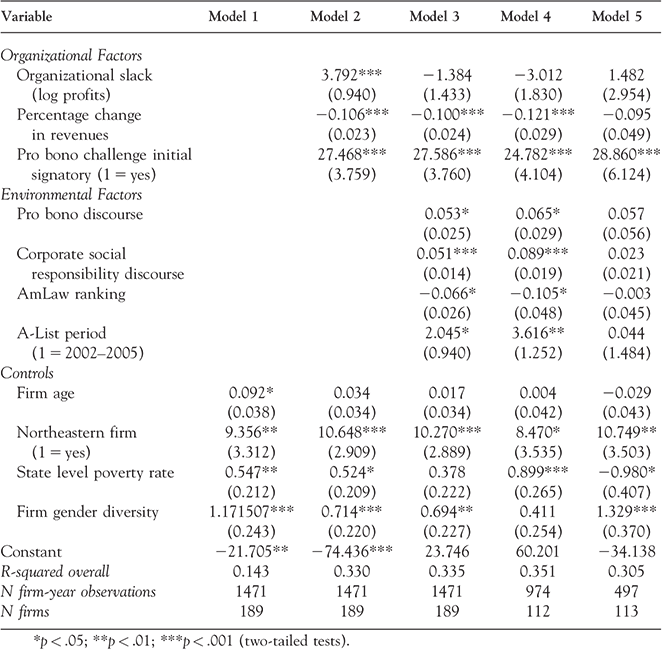
Table 2 presents the results of my analyses. Model 1 includes only the control variables. Each control variable has a positive and significant effect on pro bono participation. This model indicates that firms contribute more pro bono on average for each additional year of age. This model also shows that firms with headquarters in the Northeast contribute more hours of pro bono per lawyer on average than firms located in other geographic regions. The poverty rate within the local environment is positively associated with firm level pro bono participation, indicating that demand in legal services appears to correspond with pro bono participation. Finally, firms with higher rates of gender diversity contribute more pro bono on average.
Model 2 finds some support that organizational dynamics correspond with increased pro bono participation. Supporting Hypothesis 1, I find a positive and significant relationship between firm profits and pro bono, indicating that greater levels of organizational slack correspond with participation. I also find an inverse relationship between changes in firm revenue and pro bono. As suggested by Hypothesis 2, this finding implies that pro bono is related to the availability of attorney labor for volunteer work net of profits. Finally, I find support for Hypothesis 3, showing that initial signatories to the Pro Bono Challenge have higher rates of pro bono participation. Initial signatories to the challenge contribute over 27 more hours of pro bono per lawyer than their peers who did not initially sign on. These firms might be thought of as organizational entrepreneurs within this organizational field. By signing onto the challenge, these firms differentiated themselves from their peers in the broader field by tapping into the emergent pro bono movement. Similar to Model 1, the control variables remain positive and significant with the exception of firm age, which is no longer significant in the model net of other organizational factors.
Model 3 includes the effects of environmental factors on pro bono participation net of organizational factors and controls. I find support that increasing attention in the institutional environment focused on pro bono and corporate social responsibility both facilitate increases in pro bono participation. Elite law firms are embedded in two distinct, but overlapping organizational fields, each organized through distinct institutional logics (Thornton, Ocasio, and Lounsbury Reference Thornton, Ocasio and Lounsbury2012).
Panel Analyses of Law Firm Pro Bono Participation, 1994–2005

| Variable | Model 1 | Model 2 | Model 3 | Model 4 | Model 5 |
|---|---|---|---|---|---|
| Organizational Factors | |||||
| Organizational slack (log profits) | 3.792 *** | −1.384 | −3.012 | 1.482 | |
| (0.940) | (1.433) | (1.830) | (2.954) | ||
| Percentage change in revenues | −0.106 *** | −0.100 *** | −0.121 *** | −0.095 | |
| (0.023) | (0.024) | (0.029) | (0.049) | ||
| Pro bono challenge initial signatory (1 = yes) | 27.468 *** | 27.586 *** | 24.782 *** | 28.860 *** | |
| (3.759) | (3.760) | (4.104) | (6.124) | ||
| Environmental Factors | |||||
| Pro bono discourse | 0.053 * | 0.065 * | 0.057 | ||
| (0.025) | (0.029) | (0.056) | |||
| Corporate social responsibility discourse | 0.051 *** | 0.089 *** | 0.023 | ||
| (0.014) | (0.019) | (0.021) | |||
| AmLaw ranking | −0.066 * | −0.105 * | −0.003 | ||
| (0.026) | (0.048) | (0.045) | |||
| A-List period (1 = 2002–2005) | 2.045 * | 3.616 ** | 0.044 | ||
| (0.940) | (1.252) | (1.484) | |||
| Controls | |||||
| Firm age | 0.092 * | 0.034 | 0.017 | 0.004 | −0.029 |
| (0.038) | (0.034) | (0.034) | (0.042) | (0.043) | |
| Northeastern firm (1 = yes) | 9.356 ** | 10.648 *** | 10.270 *** | 8.470 * | 10.749 ** |
| (3.312) | (2.909) | (2.889) | (3.535) | (3.503) | |
| State level poverty rate | 0.547 ** | 0.524 * | 0.378 | 0.899 *** | −0.980 * |
| (0.212) | (0.209) | (0.222) | (0.265) | (0.407) | |
| Firm gender diversity | 1.171507 *** | 0.714 *** | 0.694 ** | 0.411 | 1.329 *** |
| (0.243) | (0.220) | (0.227) | (0.254) | (0.370) | |
| Constant | −21.705 ** | −74.436 *** | 23.746 | 60.201 | −34.138 |
| R-squared overall | 0.143 | 0.330 | 0.335 | 0.351 | 0.305 |
| N firm-year observations | 1471 | 1471 | 1471 | 974 | 497 |
| N firms | 189 | 189 | 189 | 112 | 113 |
* p<.05;
** p<.01;
*** p<.001 (two-tailed tests).
As legal organizations, firms must appear responsive to the logic of professionalism that circulates across the legal profession, which includes pro bono and public service as important components of attorney ethics. These firms are simultaneously embedded in a corporate field through their clients, which makes them conscious of the logic of corporate social responsibility. Thus, it appears that the growth of pro bono across elite firms rests, in part, on the unique, interstitial space they inhabit between these two distinct fields.
I also find an inverse relationship between a firm's AmLaw rank and pro bono participation. The inverse relationship supports the hypothesis that the more prestigious a firm's rank is, the more it is associated with pro bono participation. I include a period effect for the years after American Lawyer started compiling its elite A-List rankings. The A-List only includes the top 20 firms that have the highest composite score among four different dimensions. The advent of this ranking system has had a positive and significant effect on pro bono, increasing a firm's participation by 2.045 hours per lawyer. Moreover, the inclusion of environmental factors mediates the role of organizational slack (firm profits).
Models 4 and 5 split the sample of firms into two groups based on their overall ranking (AmLaw 100 vs. AmLaw 200) to test whether a firm's social location, based on status, within its organizational field shapes how organizational and institutional factors affect pro bono participation. Taking these two models together, there are important differences between these two sets of firms. Although both groups appear to be oriented toward pro bono due to organizational factors, only the AmLaw 100 firms appear to be affected by factors in the institutional environment. These findings suggest that similarly situated firms within the same organizational field are oriented to do pro bono for different reasons. More importantly, however, the AmLaw 100 firms appear oriented toward pro bono through the coexistence of competing logics operating at the same time (Friedland and Alford Reference Friedland, Alford, Powell and DiMaggio1991; Marquis and Lounsbury Reference Marquis and Lounsbury2007).
Discussion and Conclusions
Scholarly orientations toward pro bono are largely focused on individual lawyers. Although individual attorneys have some autonomy in choosing to devote time to pro bono work, those choices do not occur in a vacuum. Attorneys are embedded in organizational and institutional contexts that shape and constrain the ability to do public service. Thus, it is perplexing that much of the scholarly attention to pro bono continues to reify the individual attorney as the core unit of analysis, effectively treating the workplace as a black box. Although this analysis attends to the organizational and institutional dynamics that shape pro bono participation, future work should aim to control for both individual and organizational factors in a multilevel framework.
Due to data limitations, I am unable to test the two levels here, but understanding how these different levels of analysis interact will further our understanding of voluntary action within organizational settings. That is, do individual biographies independently affect voluntary trajectories, or do organizational and institutional norms loom larger? Answering this question can have important implications for pro bono policy. An important implication of this study is that lawyers enact professionalism—in this case, pro bono participation—in part through organizational and institutional factors. Thus, professional policies that continue to hold all lawyers to a universal, “one shoe fits all” ethical standard may be ineffective at mobilizing attorneys to donate their time toward providing pro bono services (Levin Reference Levin, Granfield and Mather2009).
Professional entrepreneurs have begun to take note of this and have started initiatives targeted toward specific subsets of the profession. Indeed, this was largely the motivation behind the Pro Bono Institute's Pro Bono Challenge, which directly targeted large firms by attempting to connect an abstract professional ideal to the norms and practices of their particular practice sites. The hope is that translating abstract professional values to the local context will facilitate increased pro bono participation. However, as this study demonstrates, even this approach may not be entirely effective. The field of large law firms is not a homogenous group of actors and there is still much variation within even this subset of the profession. Thus, this analysis provides support to the emerging body of literature that conceptualizes professionalism and professional work from a constructionist perspective, which argues that professionals come to understand how to practice within their local environments rather than based on abstract sets of rules and regulations defined by larger professional bodies (Nelson and Trubek Reference Nelson, Trubek, Nelson, Trubek and Solomon1992; Mather, McEwen, and Maiman Reference Mather, McEwen and Maiman2001; Granfield Reference Granfield2007; Levin and Mather Reference Levin and Mather2012).
My findings challenge the strong, popularized narrative of self-interest that relates pro bono to a firm's bottom line (Daniels and Martin Reference Daniels and Martin2009; Rhode Reference Rhode2009). This account is so pervasive in part because it is connected to the long-standing historical critique about the commercialization of legal practice (Stone Reference Stone1934; Kronman Reference Kronman1993; Linowitz Reference Linowitz1994). The increasing connection to business was thought to be antithetical to the professional obligation to serve the public good. As Adolphe Berle argued over seventy-five years ago, “The complete commercialization of the American bar has stripped it of any social functions it might have performed for individuals without wealth” (quoted in Galanter and Palay Reference Galanter and Palay1991, 17). This critique still exists today, resulting in renewed calls for reforms to redefine professionalism (Solomon Reference Solomon, Nelson, Trubek and Solomon1992, 148–49). In this sense, it is an irony that the increasing embeddedness of large firms to their corporate clients has facilitated rather than dampened pro bono participation. The unique interstitial space that large firms inhabit, that is, the overlapping fields of the legal profession on one hand and the corporate world on the other, has redefined the institutional logic underpinning pro bono activities in large firms. However, a key contribution of this research is that the field of large firms has not responded uniformly—how firms respond to the professional pro bono movement is shaped by a variety of organizational and institutional factors.
Organizationally, my results challenge the persistent argument that pro bono is simply a function of the financial bottom line. Instead, my analysis presents a nuanced account of the relationship between market dynamics and pro bono participation. I find that pro bono is inversely related to the growth in revenues over time, suggesting that firm leaders channel lawyers into pro bono during lulls in fee-generating work. This is not the simple retelling of a “doing well by doing good” narrative. From a human capital perspective, firms appear interested in keeping lawyers active by doing free legal work for pro bono clients until fee-generating work returns to the firm.
I also found strong evidence that the Pro Bono Challenge has had a positive influence on pro bono participation. Charter firm signatories to the challenge were at the forefront of the emergent pro bono movement, indicating that something at the organizational level strongly predicts why some firms are more oriented toward public service relative to the rest of the field. This finding is suggestive that organizational cultures may play an important role in mediating a commitment to institutionalized pro bono. However, future research should focus on the ways that these different organizational cultures operate at the level of the firm.
For instance, Epstein (Reference Epstein, Granfield and Mather2009) argues that influential firm partners may have inspired a sense of public service during the early formation of their firms. However, it is not clear how these initial values are sustained over long periods of time following their departure from the firm. Moreover, that there has been such dramatic growth in pro bono across large firms over the past two decades indicates that other factors, net of distinct, organizational cultures, are facilitating the rise in participation (Boutcher Reference Boutcher2011). Finally, I found very limited support that organizational slack facilitated pro bono participation when institutional factors were not included in the model. This suggests that pro bono is not driven by strong material concerns, but rather that these concerns are mediated by factors in the institutional environment.
My analysis demonstrates that the institutional environment plays an especially important role in affecting firm pro bono participation. The rise of ranking systems and accountability structures provides an environmental incentive for law firm participation. The Pro Bono Challenge, which was initiated as a tool to recruit firms to meet a threshold of pro bono hours, sparked a wave of law firms to sign on with the hope of signaling their commitment to public service. By signing on to the challenge, firms not only are held accountable by external stakeholders, who monitor and record the pro bono activities of signatory firms, but they also attempt to gain increased status and professional legitimacy by tapping into the institutional movement around pro bono.
In terms of ranking systems and pro bono participation, I find that the period after the A-List rankings were initiated has had a positive effect on pro bono participation compared to the earlier period. Similarly, I find that the broader AmLaw rankings are connected to a firm's level of participation—firms ranked higher (i.e., more prestigious ranking) donate more hours to pro bono on average. Both the challenge and the rankings are efforts to hold firms accountable to different stakeholders, internal and external, of the firm. This finding supports recent research showing that ranking systems can have powerful effects on organizations, disciplining actors to orient their activities toward newly established institutional criteria (Espeland and Sauder Reference Espeland and Sauder2007; Sauder and Espeland Reference Sauder and Espeland2009). Similar to the effect of the U.S. News & World Report rankings on the field of higher education, the creation of public accountability systems has radically altered firm behavior; firm leaders see these rankings as legitimate and want to be part of a growing professional movement.
Large firms are also driven by institutional logics oriented around doing good, and sit at the intersection of two different organizational fields. Large firms are strongly connected to the legal profession through their connection to the bar, but are equally connected to the corporate market through their ties to clients. As professional service firms, these actors may best be conceived as hybrid organizations (Battilana and Dorado Reference Battilana and Dorado2010; Pache and Santos Reference Pache and Santos2013), making sense of pro bono in ways that span multiple logics. Although we might expect these firms to pay attention to professional logics within their particular fields, the fact that these firms tap into the broader discourse of corporate social responsibility has important implications for how sociolegal scholars think about this elite segment of the legal profession. Paradoxically, this is further support that the increasing commercialization of legal practice may have actually provided a stronger foundation for increased commitment to the public good, rather than dampening professionalism as critics have warned. Through their close ties to corporate clients, the cultural institution of corporate social responsibility became a resource that firms could tap into for their own purposes. Moreover, this implies that these firms have very different rationales structuring their decisions to do pro bono than the larger profession. Subsequent research should continue to understand the varying rationales and motives for public service among lawyers across the professional bar.
Interestingly, however, not all firms appear equally likely to tap into these different logics. My findings show that higher ranked firms within this particular organizational field successfully leverage both the pro bono and corporate social responsibility meaning systems, but that lower ranked firms do not tap into either. At the same time, higher ranked firms are also more likely to connect pro bono to resource flows as well as to professional ranking systems. That higher ranked firms appear oriented toward pro bono through financial, professional, and status logics simultaneously might indicate that these firms are more successful at navigating the competing demands of various stakeholders within the firm as well as the contradictory institutional pressures that exist in the environment. By doing so, these firms successfully reduce much of the uncertainty that would exist if only one logic prevailed.
In addition to the theorized effects, I also find important relationships between my control variables and pro bono participation, which may provide fruitful avenues for future research. I find that firms with more gender diversity also do more pro bono, although this finding washes out for higher ranked firms. Although my analysis is unable to isolate the exact mechanism through which this effect operates, it suggests an interesting relationship between two important components of contemporary legal practice—diversity and public service. Future scholarship should tease out the mechanisms underlying this relationship. I also find that firms located in the Northeast donate more hours to pro bono on average than firms headquartered elsewhere, suggesting that the cultural home of the large firm facilitates pro bono independent of other organizational effects. Northeastern firms might do more because this region is home to the large firm as a unique practice site within the legal profession.
Furthermore, this effect could also imply that the Northeast is home to more robust pro bono activity due to the density of large firms in that market, suggesting that dense legal markets might drive more status competition between peer firms to outdo each other in order to reap any benefits that might come with increased public service. It is also possible that there are distinct pro bono cultures that exist across legal markets, which shapes how lawyers and firms decide to devote time toward public service. Much of the scholarship on the legal profession has been influenced by studies of lawyers in particular markets (Powell Reference Powell1988; Heinz and Laumann Reference Heinz and Laumann1994; Mather, McEwen, and Maiman Reference Mather, McEwen and Maiman2001; Heinz et al. Reference Heinz, Nelson, Sandefur and Laumann2005). Analyzing pro bono across different markets would further theory about how professionalism is fragmented and shaped by particular cultural contexts.
I find mixed support that a firm's propensity to provide pro bono is connected to the demand for legal services in the local environment. Firms located in states with higher poverty rates contribute more hours of pro bono service on average. Future research should continue to analyze the relationship between law firm pro bono programs within the context of local markets that may shape the aggregate level of demand for legal services.
Rather than thinking about the process of institutionalization as a homogenizing force acting upon organizational fields (DiMaggio and Powell Reference DiMaggio and Powell1983), this study demonstrates that organizational actors still retain important differences in how they respond to institutional pressures. Organizational fields are heterogeneous entities and similarly situated actors will respond to institutional pressures in highly varied ways depending on their social locations within the field, and their relationships to others outside of the field. Relatedly, my study challenges the conception of institutional change as merely about window dressing (J. W. Meyer and Rowan Reference Meyer and Rowan1977). In the case of large firms, the professional project of pro bono appears to have led firms to respond in many positive ways. However, as my analysis shows, this process is differentiated through a variety of factors and is far from a universalizing process across all firms within this particular field. That firms vary widely in their pro bono participation may have less to do with decoupling from institutionalized practices and more to do with the presence of different logics guiding organizational action.
Finally, my results have implications for the professional hope that large firms will become key actors that can viably fill the gap in legal services, one that is only increasing as the state continues to retreat from providing adequate resources for marginalized Americans to gain access to the legal system. As this study demonstrates, large firm pro bono activity is filtered through a variety of factors that the larger profession cannot control. Any expectation that large firms will provide the much-needed legal services to the poor and other marginalized groups must take account of not only the organizational realities that law firms face, but also the broader institutional environment that shapes public service. To ignore this reality may only accelerate the growing inequality in the delivery of contemporary legal services to the poor.