


Marked social differences and inequalities in health care continue to affect children's nutritional status in post-apartheid South Africa. Three nationwide surveys have shown marked deficiencies in the dietary intake of energy and micronutrients(Reference Labadarios1–Reference Labadarios, Swart and Maunder3). The prevalence of stunting, reflecting chronic malnutrition, and underweight is high, particularly within the black and coloured populations. Moreover, hunger and food insecurity affected about 50 % and 25 % of households, respectively, in 1999(Reference Labadarios, Steyn and Maunder2). Similar findings have been reported in smaller studies conducted in various regions of the country(Reference Mamabolo, Alberts and Mbenyane4, Reference Zere and McIntyre5).
To combat vitamin A deficiency, a curative vitamin A supplementation protocol was implemented in the Western Cape Province targeting high-risk mothers and children. From 2002, this strategy has been combined with a preventive component.
In 1994, the Integrated Nutrition Programme (INP) was established to replace previous fragmented nutrition programmes with a more integrated approach, also supported by the fact that sound nutrition is considered a basic human right according to the South African Constitution. The Nutrition Supplementation Programme (NSP) was later incorporated into the INP, and aims to correct undernutrition by providing nutrition supplements/products (e.g. breast milk substitutes, cereals and energy drinks), as well as nutrition education and counselling.
The main providers of the vitamin A programme and the NSP are the primary health clinics (PHC), usually localised adjacent to or within suburbs, townships and informal settlements. Both Hendricks et al.(Reference Hendricks, Beardsley and Bourne6) and Du Plessis et al.(Reference Du Plessis, Najaar and Koornhof7) have identified several shortcomings in the administration of the vitamin A programme. However, a concomitant evaluation of the vitamin A programme and the NSP from the perspective of mothers and PHC staff members has not been performed.
Given the lack of improvement during the last decade in several growth indicators among disadvantaged South African children, the PHC may still face large challenges regarding issues with vitamin A supplementation and the NSP. Therefore, the aim of the present study was to evaluate vitamin A supplementation and the nutrition supplementation components of the NSP for children aged <5 years and their mothers in PHC located in a rural and an urban region of the Western Cape Province. Specifically, we studied the anthropometric status of the children and their mothers in addition to the maternal knowledge and experience with the two programmes.
Among the PHC staff, we aimed at identifying their specific responsibilities and duties with regard to the goals of the two programmes, as well as their potential to achieve these goals.
Subjects and methods
The present study was approved by the Committee for Human Research at Stellenbosch University and by the Research Committee of the Department of Health, Western Cape Province. Data were collected from December 2007 to March 2008.
Selection of primary health clinics and study subjects
The rural Overberg District Municipality and the urban Cape Town Metropolitan Municipality were chosen as study regions. Among the twenty-six rural and ninety-eight urban public PHC, we randomly selected ten PHC from each area. Each PHC was visited once or twice, and within the available timeframe we aimed to include ten mother–child dyads and five staff members.
Children aged 2–59 months and their mothers attending the PHC on the day of the study visit were eligible for our evaluation of the vitamin A programme if either the child or the mother should have received preventive vitamin A supplementation. Our target groups for the nutrition supplementation component of the NSP were infants aged 0–6 months (not breast-fed), children aged 6–12 months (not breast-fed), children aged 12–60 months and breast-feeding mothers with growth-faltering (defined by a growth curve that flattens or drops over two consecutive months) infants aged 0–12 months. As the mothers attended the PHC without pre-determined appointments, their inclusion into the study was not randomised; however, they were consecutively invited to participate.
PHC staff involved in either one or both supplementation programmes were eligible for inclusion. Since the staff numbers could vary considerably between PHC, randomisation was not feasible.
Collection of data from children and their mothers
We used an interpreter in the languages Afrikaans and Xhosa. Clinical and demographic data were obtained from medical files including The Road to Health Chart and from interviewing the mothers.
Anthropometry
Trained fieldworkers took anthropometric measurements in duplicate using standardised procedures. They weighed (to the nearest 10 g) children aged <2 years naked and older children without heavy clothes and shoes and with either a dry or no diaper. The software ‘WHO Anthro’ based on WHO(8) growth curves was used to estimate Z-scores for different anthropometric conditions, and the children's age, weight and height/length were plotted manually. Weight of the mothers without heavy clothes and shoes was measured to the nearest 100 g. Recumbent length was measured in children aged <2 years using a measuring board with a stationary headboard and moveable footboard. The height of children aged >2 years and that of their mothers was measured using a stadiometer. Height, length, waist and hip circumference were measured to the nearest 0·5 cm. BMI and waist-to-hip ratio were calculated from these measurements.
Questionnaires
All questionnaires were administered by fieldworkers. To determine hunger and food security we used a validated questionnaire(Reference Labadarios, Steyn and Maunder2). A score was calculated and households were classified into three categories: food secure, at risk of hunger and hungry.
A questionnaire was designed to collect information from mothers about their socio-economic status and knowledge of and compliance/experience with defined aspects of the vitamin A programme and the NSP. The questionnaire was piloted on five randomly selected mothers, and its content was validated by two independent and experienced South African researchers within this field. Guidelines were provided to avoid subjective influence of the answers and differences in the interview routines.
Collection of data from the primary health clinic staff members
Questionnaire
Data were collected using structured interviews guided by a questionnaire specifically designed for the present study. The questionnaire consisted of one section with questions on sociodemographics and another section on the vitamin A programme and the NSP. It was piloted on seven randomly selected staff members. Content validity was established by the same two independent South African researchers who scrutinised the maternal questionnaire. A scoring system was developed to determine the associations between responses made by the PHC manager and the rest of the staff. We also included a special section of questions directed towards PHC managers only.
Statistics
Proportions, means and medians were determined as appropriate. The χ 2 test was used to compare frequencies between different groups of participants; if the number of participants in each group was less than five, Fischer's exact P value was calculated. Parametric (independent or paired t tests) methods were used to compare means if the continuous data were normally distributed; otherwise non-parametric tests (Mann–Whitney U test, Wilcoxon signed-rank test) were used. Differences were considered significant for P <0·05.
Results
Inclusion process
Of the 214 eligible mothers with 217 children, thirty-eight mothers were excluded (refused to participate, had to go directly to hospital, missing data), leaving 176 mothers with their 179 children for analysis, of whom eighty-five mothers came from rural and ninety-one from urban PHC.
We initially included twenty managers, thirty-one professional nurses and fourteen nursing staff. Since only eight were eligible for inclusion into the study from among other staff members (one pharmacist, one dietitian, two students, two clerks, one health advisor and one nutrition advisor), this group was excluded from further analysis as they were so few in number. Among the remaining sixty-five participants, only two were male; hence, separate gender-specific analyses were not performed. The number of staff members was thirty-six in urban and twenty-nine in rural regions.
Characteristics of the two study groups
Mothers and children
Maternal characteristics are presented in Table 1. Fourteen mothers spent <101 ZAR (1 ZAR = ∼0·1 EUR) on food per week, whereas fifty-five spent more than 400 ZAR. Fifteen mothers had no income, fifty-two earned <501 ZAR/month, whereas only thirteen had a monthly income exceeding 5000 ZAR. There was no significant difference between rural and urban mothers in the amount of money that was spent on food. When the mothers were grouped into two education levels, from none to grade 8–10 and from grade 11–13 to the tertiary level (e.g. university), only eighteen rural women were in the tertiary level compared with sixty-one urban (P < 0·001). With regard to family relations, fifty-six mothers answered that they lived without a partner in the household whereas fifty-four were married, and sixty-six lived with a partner but were not married. About twice as many mothers from the urban area compared with the rural area were living alone (P < 0·01).
Characteristics and anthropometric data of the mothers

†Two mothers were pregnant and excluded from anthropometric measurements. The median values for all anthropometric measures were different (P < 0·001) between urban and rural samples.
Primary health clinic staff
The mean age of the included sixty-five staff members was 44 (range: 25–68) years. Among these sixty-five, we recruited twenty coloured, fourteen black and four white staff members from urban PHC, whereas the corresponding numbers from rural PHC were fifteen coloured and twelve blacks. Among managers, ten were white, eight were coloured and two were black. The median for years employed at the PHC was 3 (range: 0–30), with about 50 % having been employed between 1·2 and 9 years at their present workplace. Only 12 % answered that they worked temporarily and even fewer (3 %) answered that they were working part-time.
Anthropometry
Mothers
Table 1 shows maternal anthropometric values. The median values of weight, height, BMI and waist-to-hip ratio were all different, being larger among urban compared with rural mothers (all P <0·001). Figure 1 shows the distribution of maternal weight classifications. Among the 176 mothers, 118 (67 %) were either overweight or obese, whereas sixteen (9 %) were underweight.
Weight classification of the mothers. The number of mothers in each weight class is shown above the individual columns. Underweight was defined as BMI < 18·5 kg/m2, whereas a BMI between 25·0 and 29·9 kg/m2 defines overweight and a BMI value ⩾30·0 kg/m2 defines obesity (▪, urban (n 90);  , rural (n 84))

Children
Of the 179 children, three were excluded from most of the anthropometric analyses because of sampling errors. Thirty-four (19 %) children were born prematurely, i.e. before gestational week 37.
Among the remaining 176 children, 5·1 % were wasted, 8·5 % were underweight and 6·3 % were overweight/obese (Table 2). Seven children (4 %) were both underweight and stunted, four (2·3 %) were both wasted and underweight, three (1·7 %) were wasted, underweight and stunted, whereas one child (0·6 %) was both stunted and obese. There were no significant differences between rural and urban children in terms of under- or overnutrition.
Anthropometric data of the children
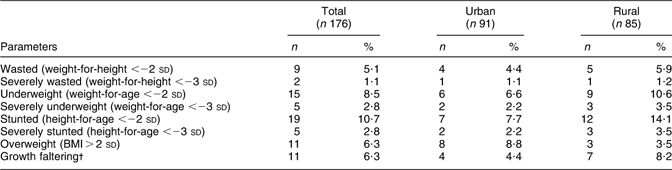
†Growth faltering was defined as when the growth curve flattens or drops over two consecutive months.
Hunger
Among the 176 mothers, 56 % lived in a household that experienced or was at risk of hunger. A score of 0 indicates food secure, a score from 1 to 3 indicates at risk of hunger and a score ≥4 indicates hunger. Urban mothers had a median hunger score of 1 compared with a median score of 2 among rural mothers (P = 0·012). Significantly more rural (61 %) than urban (56 %) households were characterised as hungry. Generally, children from ‘hungry’ households had lower (P < 0·05) mean Z-scores for weight-for-height and weight-for-age (<0·1 and −0·3, respectively) compared with children from households classified as food secure (0·2 and −0·2, respectively).
Vitamin A supplementation
Mothers and children
In total, 157 (89 %) women had either heard about the vitamin A programme and/or seen a vitamin A capsule (Table 3). Thirty-eight (22 %) of the 176 mothers were not eligible for vitamin A supplementation according to the criteria. Among the remaining 138, only sixteen of the seventy-one (23 %) urban mothers and five of the sixty-seven (7 %) rural mothers (P = 0·04) confirmed that they had received vitamin A. In contrast, forty-two (59 %) urban mothers received the capsule compared with fifty-three (79 %) rural mothers (P = 0·02), according to the information provided in the medical files. Nine of the twenty-one (43 %) mothers who claimed they had received vitamin A said that they knew the reason why, with seven (33 %) stating that ‘the vitamin goes into the breast milk’, and two (10 %) mentioned its importance for eyesight and for building strength. None of the mothers experienced any side effects associated with the capsules. Only nine of the twenty-one (43 %) said that someone from the PHC staff talked to them about the vitamin. Eight (38 %) said the information had been helpful, whereas one (5 %) found it to be confusing. Only three (14 %) had received written information about the vitamin A programme.
Experience and perceptions among mothers about the two programmes

NSP, Nutrition Supplementation Programme.
n denotes number of mothers who responded. No significant differences were detected between urban and rural mothers.
Among the 140 mothers with an eligible child, 126 (90 %) stated that their child had received one or more vitamin A capsules (Table 3). In contrast, 120 (86 %) children had received at least one vitamin A capsule, according to their medical files. Only twenty-six of the 126 (21 %) mothers remembered the reason why the child was given the supplement (protection, weight gain, eyesight). Only thirty-seven of the 126 mothers (30 %) had been informed by someone from the PHC staff about why their children received vitamin A, with twelve of them receiving written information, which they all thought was helpful. According to the mothers, none of their children experienced any side effects associated with the vitamin A capsules. According to their medical files, thirty-six (51 %) of urban and forty-eight (71 %) of rural children (P < 0·05) did not take the capsules as advised.
Primary health clinic staff
According to the Department of Health, the responsibility for ordering, storage and statistics of supplements lies with the manager who is free to delegate these three tasks to other staff members. When asked who the staff thought was responsible for the ordering and storage of vitamin A, the most common answer was the manager (Table 4). For the remaining three tasks (inclusion criteria, handing out and recording statistics), most respondents indicated the professional nurse. Furthermore, in both urban and rural PHC, more than 80 % of staff members answered the questions on ordering, storage and handing out of vitamin A capsules correctly (data not shown).
Responsibility regarding administration of the vitamin A programme

In total, sixty-five members of staff were included: thirty-eight from urban PHC and twenty-seven from rural PHC.
n denotes the number of staff members who responded; several answers could be given per staff member.
*P < 0·05.
Lacking vitamin A capsules was not a common problem, with fifteen of the sixty-five (23 %) staff members indicating that it seldom occurred. The two most common reasons for lack of vitamin A capsules stated by these fifteen were a lack of stock by suppliers and a lack of stock in the PHC. There were no significant differences in the reasons given for lack of vitamin A between urban and rural clinics.
When asked whether the PHC had evaluations of their routines in implementing the vitamin A programme, forty-two of the sixty-five (65 %) staff members answered yes, seventeen (26 %) answered no and six (9 %) did not know.
As for the question on whether the staff members experienced any problems with the vitamin A programme, ten of the sixty-five (15 %) said that they did. No significant differences were found for localisation (urban v. rural) of PHC or staff member group. When asked what they perceived to be the main problems, four (6 %) answered bad maternal compliance (e.g. do not come at the right time, not attending regularly), one answered that the vitamin A supplementation was not always recorded and one thought that the staff must explain better the importance of the supplementation to the mother. Other problems mentioned were that the dates for immunisations (measles) interfere with the supplementation schedule and that the clinic was too under-staffed to administer the vitamin A programme.
Among the fifty-six staff members who stated that they had been educated or trained in the vitamin A programme, thirty-eight (68 %) had received written information, twenty-four (43 %) had taken part in practical training and forty-six (82 %) had attended oral lectures. There were no significant differences between staff working in urban and rural PHC for any of these three modes of training. Moreover, thirty-one (55 %) had received training only once whereas twenty-five (45 %) had been trained regularly, most often once per year. When asked who was responsible for the training, thirty-four (61 %) of respondents answered the Training Department, whereas twenty-four (43 %) thought it was the dietitian, both being correct.
When asked what their perception was of mothers receiving the vitamin A supplementation, eighteen of the sixty (30 %) respondents answered that they were grateful, thirty-two (53 %) said that they were interested and fourteen (23 %) answered ignorant. There were no significant differences between urban and rural PHC for any of these alternatives. None of the respondents thought that the mothers seemed disappointed or angry with the programme.
To the question about maternal compliance with the vitamin A programme, among the staff members responsible for handing out supplements, nine of the sixty-one (15 %) respondents answered always, forty-eight (80 %) answered mostly, whereas only four (6 %) answered seldom, and none of the respondents answered never. There was no significant difference between urban and rural PHC regarding this question.
Nutrition supplementation
Mothers and children
Among the 176 mothers, eighty-one (46 %) had heard about the NSP products, whereas ninety-five (54 %) had not. After showing the mothers the actual NSP products, twenty-one of the ninety-five (22 %) recognised them, thus 102 (56 %) were in some way familiar with the NSP (Table 3).
None of the mothers were eligible for the NSP, even though we recorded that fourteen had a BMI < 18·5 kg/m2 and were therefore classified as underweight. These fourteen mothers had children who were either older than 12 months or not growth faltering. Seven (4 %) of the 176 mothers said that they had previously received NSP products. When specifying the reasons for receiving the products, three mentioned gaining weight, two said building strength, one was recovering from tuberculosis and one said she received products to produce more breast milk. Only one mother had shared the products with her child. Five mothers said that a professional nurse had given the products to them, one said it was a staff nurse and one said it was one of the staff members. Six mothers said that a staff member had talked with them about the products, of whom all said that they had used the products according to the information given by the staff member. Only one mother got written information about the products. No side effects were reported.
Of the 176 children whose weight was recorded, eleven (6 %) were growth faltering and five (3 %) were previously growth faltering. Moreover, we found during the PHC visits that eight children were undernourished in one or several ways, even though they were not eligible for the NSP according to the criteria. The median birth weights and current BMI were 2570 g and 14·8 kg/m2, respectively, among children on the NSP, whereas the corresponding values were 3050 g and 16·6 kg/m2, respectively, among those who were not on the NSP (P < 0·001). Thirteen (81 %) of the sixteen mothers who received products for their children were aware of the reason why (weight gain, diarrhoea; Table 3). Four of the sixteen (25 %) mothers said that they received advice about food habits before they obtained the products. Only one mother received written information about the products. All sixteen mothers said that a professional nurse had talked to them about the products (Table 3). None of the mothers said that they had sold the products. Only four of the NSP-receiving children were recorded in the mandatory Malnutrition Register in the PHC.
Primary health clinic staff
Similar to the vitamin A programme, most staff members thought that the manager was the person responsible for ordering and storing NSP products (Table 5).
Responsibility regarding administration of the NSP

NSP, Nutrition Supplementation Programme.
In total, sixty-five members of staff were included: thirty-eight from urban PHC and twenty-seven from rural PHC.
n denotes the number of staff members who responded; several answers could be given per staff member.
*P < 0·05.
With regard to the NSP products, nineteen of fifty-four (35 %) staff members said that they had experienced a shortage. There was no significant difference between urban and rural PHC. The main reasons stated for the lack of products included lack of stock by suppliers and lack of stock in the PHC. When asked whether their PHC had routine evaluations of the implementation of the NSP, thirty-eight (70 %) said yes, eleven (20 %) said no, whereas the remaining five (9 %) did not know. When asked what they perceived to be problems with the NSP, no particular pattern emerged.
Among the forty-five staff members who said that they had taken part in education or training in the NSP, thirty-three (73 %) had received written material, twenty-two (49 %) had witnessed a practical demonstration and thirty-seven (82 %) had attended an oral lecture. There were no significant differences for either type of training between urban and rural PHC or between different staff groups. Twenty-one (47 %) had received the education or training only once, whereas the rest had received it regularly, most often annually. When asked about who they thought was responsible for the training, thirty-five (78 %) said the Training Department and twenty-three (51 %) thought it was the dietitian, both being correct. Forty-two (93 %) felt that the training was helpful.
Twenty-two of the forty-seven (47 %) staff members gave the mothers written information about the NSP, whereas twenty-five (53 %) did not. When asked whether they always recorded distribution of NSP products in the Malnutrition Register, forty-one (87 %) said yes and three (6 %) said no.
With regard to how the mothers appreciated the NSP products, forty-two (89 %) said that the mothers were grateful, ten (21 %) that the mothers were interested and three (6 %) that the mothers were angry or disappointed. There were no significant differences between staff working in rural and urban PHC. Furthermore, when asked whether they felt that the mothers were compliant with the NSP, only five (11 %) of the forty-seven answered always and five (11 %) answered seldom, whereas thirty-seven (79 %) answered mostly.
Responses of managers compared with those of other staff groups
We compared the answers given by managers with those of other staff members regarding issues related to ordering, storage and distribution of vitamin A capsules and NSP products, as well as issues with regard to inclusion into these programmes and evaluation and training among the staff. Mean score for the ten urban PHC was 77 %, whereas that of the rural PHC was 71 % (P > 0·05). Although the urban and rural PHC with the highest level of agreement between manager and staff had a score of 90 % and 88 % (P >0·05), respectively, the rural and urban PHC with the lowest level of agreement scored 66 % and 52 % (P < 0·05), respectively.
Discussion
Knowledge about the vitamin A programme and NSP was low among the mothers and few could remember that a staff member had talked to them about the vitamin A capsules or NSP products. Information, both written and oral, was considered helpful among the few mothers who remembered to have received this. A discrepancy was observed between the number of eligible children and the number who actually participated in the programmes. Some children were on the NSP even though they were not eligible, whereas other children were suffering from undernutrition without being eligible. The most important finding among PHC staff members was that they felt they handled both programmes well and problems with implementation were for the most part attributed to mothers. There were few differences between urban and rural PHC regarding the administration of the two programmes. Managers and other staff member groups generally agreed well in their responses to questions about the administration of the two programmes.
One of the strengths of the present study is that the maternal and child study groups most likely reflected the population groups in the Western Cape Province who use public PHC. Moreover, the anthropometric data of the mothers and children were consistent with previous findings(Reference Labadarios, Steyn and Maunder2, Reference Labadarios, Swart and Maunder3). Furthermore, the previously observed inequalities between urban and rural areas were confirmed in terms of education, income and hunger, with the rural mothers and children being worst off(Reference Labadarios, Steyn and Maunder2, Reference Labadarios, Swart and Maunder3).
In addition to the lack of randomised study groups, another possible limitation is the small sample size, both in terms of participating subjects and the number of included PHC. Our data are also limited to the Western Cape Province and it is uncertain whether they can be extrapolated nationwide. We did not report breast-feeding habits or HIV/AIDS and tuberculosis status. Moreover, the nutritional quality of the NSP products was not assessed, and our study did not focus on the general education and counselling part of the NSP.
With regard to both mothers and children, there was a discrepancy between information provided by the mothers and that contained in medical files in terms of vitamin A supplementation. Only a minority of the mothers knew why vitamin A was given and few were provided information at the PHC. In a recent qualitative study, we found that many mothers had experienced poor communication with staff members, as well as unfavourable comments and lack of respect(Reference Andresen, Wandel and Eide9). Moreover, not all eligible mothers and children had actually received vitamin A. The staff members, on the other hand, were generally satisfied with how they handled the programme, and the major complaints were attributed to the mothers. Hendricks et al.(Reference Hendricks, Beardsley and Bourne6) found in 2003–2004 that the vitamin A supplementation did not work optimally in urban and rural parts of the Western Cape Province. The main problems identified by the staff were lack of vitamin A capsules, budgetary difficulties, inadequate training of staff and low awareness among mothers of the benefits of vitamin A. That study only considered the curative vitamin A supplementation and did not include the NSP. In 2005, Du Plessis et al.(Reference Du Plessis, Najaar and Koornhof7) reported similar problems regarding the preventive part of the vitamin A programme in a rural area of the Western Cape Province. That study did not include urban PHC or the NSP.
Schoeman et al.(Reference Schoeman, Hendricks and Hattingh10) examined the targeting of nutritionally at-risk children in a peri-urban area in the Western Cape Province, and found that clinic staff identified far fewer clients than did the researchers conducting the study. Poor targeting in that study was caused by failing to plot the weight in the curves and poor use of the medical file-related Road to Health Charts. In a survey from 2004, it was shown that all the Western Cape PHC had infant scales; hence, the conditions for standardised weight monitoring were met(11). However, the percentage of children weighed at PHC decreased from seventy-four in 2004 to sixty-eight in 2006(12). This development is disturbing, since the weight on the growth curve is the only objective measure by which the eligibility for nutrition products can be decided. Alternatively, staff members will need to identify malnutrition by clinical examination, a time-consuming task for the busy PHC.
Another potential problem in the NSP is that, although nutrition and growth monitoring was available in 97 % of clinics in the Western Cape in 2006(12), only 60 % offered these services on a daily basis. With one of the most commonly mentioned reasons for poor compliance being low clinic attendance and the mother having to work, limiting the number of days in which the clients can be helped with nutritional problems is disadvantageous.
Dissemination of written guidelines is often ineffective, whereas supervisions and audits with feedback are better approaches to learning(Reference Rowe, de Savigny and Lanata13). In our study, about 80 % of staff had received training in each programme, whereas five staff members had had only written information as training in both programmes. A large number of staff members answered that they had received training only once. Hendricks et al.(Reference Hendricks, Beardsley and Bourne6) found that 81 % of managers thought that the staff was trained to implement the vitamin A programme, and Du Plessis et al.(Reference Du Plessis, Najaar and Koornhof7) found that 93 % of nurses received training in this programme. On the basis of these data and our present findings, it seems unreasonable to claim that lack of training is a major problem in the implementation of the vitamin A programme and the NSP.
Few staff members in the present study had ever experienced a lack of NSP products, and among the managers all but one answered that the budget was always or mostly adequate. In contrast, in clinics visited by Hendricks et al.(Reference Hendricks, Roux and Fernandes14), budgets were made on the basis of cost of products without considering the extra time needed for growth monitoring, promotion, training and evaluations, despite estimations showing that the main bulk of district health expenditure is staff costs(Reference Daviaud and Chopra15, Reference Gillam16). Moreover, the number of managers in our study who said that they did not know whether the budget was adequate and the many different answers to whom they thought was responsible show an inadequate distribution of roles.
The number of patients seen per nurse per day nationally in 2006–2007 was twenty-seven, whereas the corresponding numbers were fifty-one in Cape Town and thirty-four in the Overberg district(12). Not surprisingly, staff performance, heavily influenced by the time available for each patient, has been shown to be correlated with patient satisfaction(12).
In summary, continued effort to improve coordination, high-level interest, human resources and capacity, as well as funding and nutrition counselling, is needed to advance the quality of the services delivered by PHC and thereby the nutritional health of mothers and their small children.
Acknowledgements
Financial support was provided by the Throne Holst Foundation and Harry Crossley Research Fellowships. The authors have no conflict of interest to declare. P.O.I. designed the study, analysed the data and wrote the manuscript. E.A.H. and M.M. collected and analysed the data and wrote the manuscript. M.H. designed the study and was responsible for the management of the study. All authors read and approved the final version of the manuscript. The authors thank all participants for their valuable contribution to the present study, Nora Janties for help with data collection and Demetre Labadarios and Hilary Goeiman for inputs into the design of the study.



