SYNTACTIC AND MORPHOLOGICAL DEVELOPMENT IN ARABIC DIGLOSSIA
Diglossia in Arabic-speaking communities is manifested through the use of two distinct language varieties, which are not mutually comprehensible. These include Al-lugha Alfusha – Modern Standard Arabic – and Al-lugha Al-ammiya – referred to as ‘colloquial’ Arabic (Ferguson, Reference Ferguson1959). Classical Arabic represents the ‘High’ language variety, and was the basis for what is now commonly referred to as Modern Standard Arabic (MSA). MSA is a literary and formal language, which displays a high degree of uniformity across linguistic communities, and functions as the official standard language in all Arab countries (Altoma, Reference Altoma1969). In addition to being used in literary contexts, it is also spoken at official functions and in formal situations, including television programming. Colloquial, or spoken, Arabic, on the other hand, consists of a large number of spoken dialects, and functions as the communication vehicle for daily life and folk literature. The dialects of spoken Arabic vary widely along geographical, religious and socioeconomic lines from one Arabic-speaking community to another (Holes, Reference Holes1995). For example, there are (at least) three major Palestinian dialects within Israel: the North, South and Central dialects, amongst others. The situation is so complex that several researchers have argued for a characterization of triglossia (Suleiman, Reference Suleiman1986) or multiglossia (Badawi, Reference Badawi1973), such that the different varieties function as part of a linguistic continuum rather than a bipolar system (Bakalla, Reference Bakalla2002; Eid, Reference Eid and Eid1990). For the purposes of the current study, we focused on linguistic similarities and differences between MSA and the Galilee Palestinian Colloquial Arabic (one of the North Palestinian dialects – hereafter referred to as PCA), which can be viewed as extreme ends of the continuum between the High and Low varieties of Arabic.
There is a general consensus in the Arabic literature that differences between Modern Standard Arabic and the various spoken dialects of Arabic are manifest in every linguistic domain (morphosyntactic, phonological, semantic), and there are additional differences in sociolinguistic and pragmatic aspects of the two language varieties (Ibrahim, Reference Ibrahim1986; Rosenhouse, Reference Rosenhouse1997; Mansouri, Reference Mansouri2000; Abu-Rabia, Share & Mansour, Reference Abu-Rabia, Share and Mansour2003; Stevens, Reference Stevens, Wahba, Taha and England2006). For example, Ibrahim (Reference Ibrahim1986) has shown that there is no version of spoken Arabic whose phonemic inventory or phonological system is similar to that of Modern Standard Arabic. The lexicons of spoken and standard Arabic are also widely divergent (Suleiman, Reference Suleiman1986): the majority of spoken Arabic lexemes have standard Arabic origins (excluding foreign loan words; Farghal, Reference Farghal1986), but spoken Arabic cognates of standard Arabic lexical items are typically divergent from their MSA congeners in terms of their morphophonological properties, and many MSA terms have no direct cognates in the spoken varieties (Altoma, Reference Altoma1969). In the pragmatic domain, the standard and spoken varieties differ in their contexts of use, and in the fact that MSA is supposedly uniform across Arabic-speaking cultures (Ferguson, Reference Ferguson1959). Morphosyntactically, an extensive process of morphosyntactic simplification is apparent in spoken Arabic, particularly the abandonment of the complex case-marking system, which is maintained in MSA (Suleiman, Reference Suleiman1986; Holes, Reference Holes1995; Mansouri, Reference Mansouri2000; Stevens, Reference Stevens, Wahba, Taha and England2006). The unmarked word order in spoken Arabic is SVO, while in Modern Standard Arabic it is VSO (Shlonsky, Reference Shlonsky1997).
The present study examines children's grammatical knowledge of ten constructions in each of the two diglossic varieties in the Palestinian speech community. A forced-choice grammaticality judgment task was administered to children at five different grade levels. The ten structures described here are all specifically targeted for listening, reading, speaking and writing in the elementary school curriculum for teaching Arabic in Arab schools in Israel, except for the passive construction, which is never explicitly taught in schools (Israeli Ministry of Education, 2009)Footnote 1. This means that we could reasonably expect the children who participated in the study to have some exposure to these constructions during their time in school. In addition, they are exposed to varied constructions of MSA from TV, radio and literacy events such as book reading and playing games. Undoubtedly, each of the constructions tested here would be among the thousands of utterances encountered in everyday life in texts and in the media. In a later section of this article, we examine whether children's performance on the constructions is predictable from the educational variables of the MSA curriculum. In the following section, we have added in parentheses the grade level at which the school curriculum adds special focus to the construction in question.
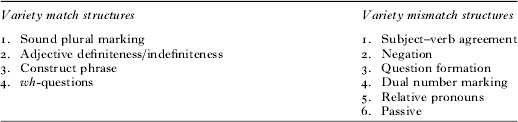
Of the ten constructions selected, six represent a mismatch between spoken and standard Arabic, in that the construction is realized differently in each language variety (subject–verb agreement, negation, yes/no questions, dual number marking, relative pronouns and passive). The other four constructions (sound plural, adjective definiteness agreement, construct phrases and wh-questions) represent a match between the two varieties, because they are realized in very similar ways in spoken and standard Arabic. A detailed description of each of the MSA and PCA constructions examined in the study is provided below.
1. Subject–verb agreement (Grade 3)
Both MSA and PCA have unmarked or preferred word orders, which interact with subject–verb agreement and are different for the two languages. For MSA, subject–verb agreement for plural number is not allowed in VSO sentences – the strongly preferred and unmarked word order. Instead, the verb appears in the unmarked singular form, regardless of the number features of the subject NP. Subject−verb agreement for all features is obligatory in all PCA word orders. For example, the grammatical MSA structure in (1a) incorporates the default singular form of the verb, and the ungrammatical structure in (1b) shows that plural number agreement on the verb is disallowed for the plural subject NP (the boys).
(1) MSA sentence pair for subject–verb agreement:

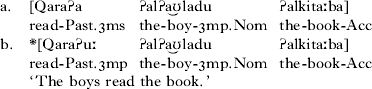
On the other hand, the PCA ungrammatical sentence in (2b) results from the singular number marking on the verb, which fails to agree in number with the plural subject NP (the boys).
(2) PCA sentence pair for subject–verb agreement:
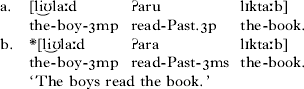
In the present study, we presented sentences containing subject–verb agreement only in the unmarked word order for the relevant language variety. Hence, MSA sentence pairs were all VSO, and PCA pairs were all SVO.
2. Negation (Grade 4)
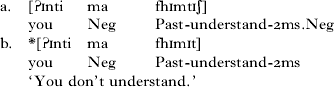
The negation systems of MSA and PCA differ in the use of negative particles, and the manifestation of optional redundancy (Holes, Reference Holes1995). PCA negative particles include the affix [-ʃ], and the preverbal free morphemes [miʃ] (negates Adjective+Noun) and [maː] (negates Verb). In PCA past tense, it is obligatory to use two negation elements; one preceding the negated verb ([maː]), and the postverbal negation marker ([-ʃ]). For example, in a pair of sentences such as (4) for PCA, the correct negation structure utilizes both preverbal [maː] and postverbal [-ʃ]; in the ungrammatical version (4b), negation is incorrectly marked using only the preverbal negation marker.
In MSA, there is no postverbal negative particle. MSA negation markers are free morphemes (written alphabetically as lam, lan, ma, la and laysa) which precede the negated item. Which morpheme must be used in a particular sentential context is determined by tense (e.g. lam for past imperfect, lan for future) and by the grammatical class of the negated item (e.g. laysa negates Adjective+Noun, lam and lan are verbal negation markers) as in (3a). There is no equivalent in MSA to the PCA postverbal marker [-ʃ]. Example (3b) MSA negation structure utilizes both preverbal ma and postverbal [-ʃ] that does not exist in MSA. In the PCA negation item in (4), the violation in (4b) results from the use of only the preverbal negation marker and not using the two negation elements, in pre- and postverbal positions.
(3) MSA sentence pair for negation:
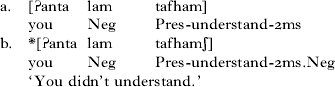
(4) PCA sentence pair for negation:
3. Yes/No questions (Grade 1)
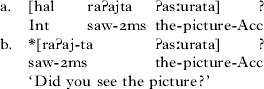
In MSA, the interrogative morphemes written as hal and ʔa are used in questions. PCA, however, has no interrogative marker or derivatives (Holes, Reference Holes1995). For example, in a pair of sentences such as (5) for MSA, the grammatical structure in (5a) was formed by inserting the particle hal in the beginning of the sentence, whereas the ungrammatical counterpart (5b) lacks the particle hal.
(5) MSA sentence pair for subject–verb agreement:
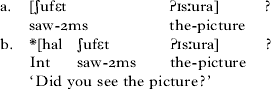
In the PCA yes/no question item in (6), the violation in (6b) results from the occurrence of the question particle hal, which is not permitted in PCA. Instead, PCA uses only rising intonation to mark questions.
(6) PCA sentence pair for yes/no questions:
4. Dual number marking (Grade 2)
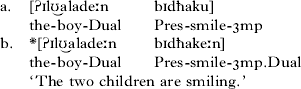
The grammatical number feature can have three values in Arabic: singular, dual and plural. Dual is marked with a suffix [-æːn]. In all dialects of spoken Arabic, verbs and adjectives following a dual noun are marked with plural suffixes (not the dual). Only nouns carry the dual suffix (Holes, Reference Holes1995). In MSA, however, verbs and adjectives agree with dual-marked nouns by affixation of the dual ending [-æːn] in SVO sentences (but not in VSO).
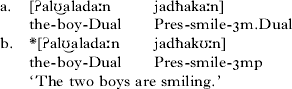
The grammatical MSA dual constructions used in the present study contain dual-marked nouns with an agreeing verb or adjective, as shown in (7a). The ungrammatical items, exemplified in (7b), result from plural (not dual) noun–verb agreement – as one would find in spoken Arabic forms.
(7) MSA sentence pair for dual number marking:
As noted above, in PCA sentences, dual agreement marking is absent on verbs and adjectives, which instead show plural agreement, as in (8a). For the present study, ungrammatical sentences in the PCA dual-marking condition were generated by incorrectly marking the verb with dual agreement (8b)), as would be found in MSA.
(8) PCA sentence pair for dual number marking:
5. Relative pronouns (Grade 2)
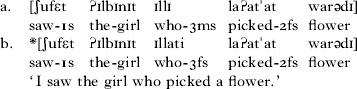
The relative pronoun system in MSA consists of twelve distinct relative pronoun forms, encoding features for number, gender and case. For example, in MSA, [allaði] is a masculine singular relative, [allaðaːn] or [allað n] are masculine dual relatives in nominative or genitive/accusative case respectively, and [allaðiːn] is a masculine plural relative (Altoma, Reference Altoma1969). On the other hand, all relative pronouns in PCA are realized as [illi], making no distinction for number, gender or case.
Grammatical MSA sentences use the appropriate number-/gender-/case-marked form of the relative pronoun, as in (9a). For the PCA items in this condition, relative pronoun constructions as in (9b) were employed as ungrammatical examples, whereby gender agreement (masculine) is incorrectly applied to the verb or adjective.
(9) MSA sentence pair for relative pronouns

Gender-marked MSA relative pronoun such as [allati] (feminine plural), instead of the grammatical PCA form [illi], is ungrammatical, as shown in (10b):
(10) PCA sentence pair for relative pronouns
6. Passive
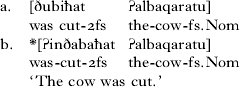
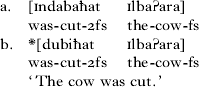
In MSA, passive voice is signified by internal vocalic changes to the verb. The differing vowel patterns signifying passive voice are not present in PCA, and instead passive is signified by a verbal prefix, either in- (attached to stems with the structure CaCaC) or it- (attached to stems with the structure CaCCaC) (Blau, Reference Blau1965; Holes, Reference Holes1995).
Passive formation by prefixation of it- or in- to the verb stem is not possible in MSA, as shown in (11b). Similarly, signaling passive via internal vocalic changes in the verb, following the MSA pattern of passive formation, is disallowed in PCA (12b).
(11) MSA sentence pair for passives:
(12) PCA sentence pair for relative passives:
Ten constructions were examined in this study. The six constructions described above represent forms that differ between MSA and PCA. These six constructions were used to generate sentence pairs for the variety mismatch condition in the grammaticality judgment task that was presented to the study participants. In addition to the mismatch items, four structures that did not differ between MSA and PCA were selected for a variety match condition for our experiment.
7. Sound plural marking (Grade 1)
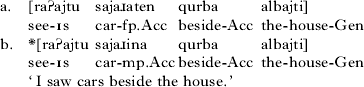
Regular plural marking for nouns and adjectives in PCA and MSA is referred to as ‘sound plural marking’, and involves suffixation of -at (feminine) or -in (masculine).Footnote 2 Ungrammatical items for this condition were generated by violating gender agreement in both MSA and PCA language varieties. For example, in the MSA grammatical sentences (13a), the feminine suffix -at was used to pluralize the feminine noun [sajara], and in the ungrammatical MSA sentences the inappropriate masculine suffix -in was used (13b).
(13) MSA sentence pair for plural marking:
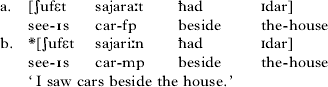
Similarly, in the PCA sound plural items in (14), the violation in (14b) results from using the masculine plural suffix -in on the feminine noun [sajara]:
(14) PCA sentence pair for sound plural marking:
8. Adjective definiteness/indefiniteness (Grade 2)
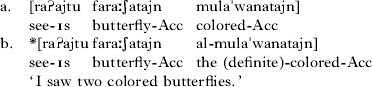
In Arabic, definiteness can be indicated in a number of different ways, including use of a proper noun, possessive particles or, most commonly, using the prefix al- or any of its allophones (Holes, Reference Holes1995; Mansouri, Reference Mansouri2000). In both MSA and PCA, adjectives always agree with the modified noun for definiteness. Omitting definiteness agreement is ungrammatical in both language varieties. For example, in the grammatical MSA item, (15a), the noun and the adjective are in agreement with regard to definiteness, among other features (i.e. number, case and gender). In the ungrammatical item, (15b), the adjective agrees with the noun for all features (i.e. number, case and gender) except definiteness (the noun [faraːʃatajn] is indefinite and its adjective [almulaˈwanatajn] is definite):
(15) MSA sentence pair for adjective definiteness/indefiniteness:
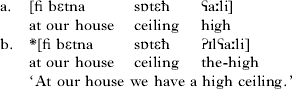
Similarly, in the PCA definiteness agreement items in (16), the violation in (16b) results from a lack of definiteness agreement between the noun ([sɒtɛħ]) and the adjective ([ʔil-ʕaːli]):
(16) PCA sentence pair for adjective definiteness/indefiniteness:
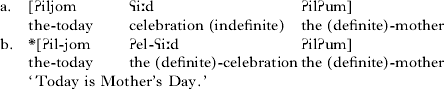
9. Construct phrase (Grade 1)
Construct phrases involve the juxtaposition of two or more nouns in a particular semantic relationship, such as possession (Altoma, Reference Altoma1969; Holes, Reference Holes1995). In both MSA and PCA, construct phrases must have an indefinite nominal first. For example, in a pair of sentences such as (17) for MSA, the first noun in the construct phrase ([taʕaːmu]) is indefinite in the grammatical condition, and definite ([ʔal-taʕaːmu]) for the ungrammatical variant:
(17) MSA sentence pair for construct phrase:

In the same way, in the PCA construct phrase formation, the violation in (18b) stems from using a definite first noun ([ʔel-ʕiːd]).
(18) PCA sentence pair for construct phrase:
10. wh-questions (Grade 1)
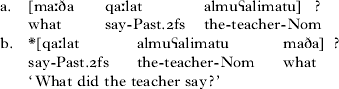
In both MSA and PCA, wh-items must be raised for wh-question formation (wh- in situ is ungrammatical). For example, for the ungrammatical MSA item (19b), the wh-element [maːða] is not raised, violating the wh-raising requirement.
(19) MSA sentence pair for wh-questions:
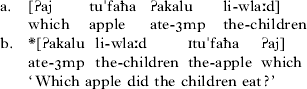
Similarly, in PCA wh-questions, the violation in (20b) results from not raising the wh-item:
(20) PCA sentence pair for wh-questions:
As noted previously, outside school, native speakers of Arabic come into contact with Modern Standard Arabic when they read and write and hear language used in radio and television programs – especially the news, cartoons, radio shows, some songs and stories. However, MSA is never used in casual conversation in everyday life. Children growing up in Arabic-speaking cultures are therefore faced with a situation in which they must learn both a spoken language and the standard language variety of written texts and other formal contexts. Palestinian Arabic-speaking children in Israel generally have less exposure to MSA than do children in other Arabic-speaking communities because Hebrew and English receive more prominence and status than Arabic in Israel. Of the three official languages of Israel – Hebrew, English and Arabic – Arabic is used least in official contexts (Spolsky, Reference Spolsky and Suleiman1994).
Due to the manifest linguistic differences between PCA and MSA, some researchers suggest that MSA can be viewed almost as a second language (e.g. Ayari, Reference Ayari1996; Eviatar & Ibrahim, Reference Eviatar and Ibrahim2000), and Khamis-Dakwar and Froud (Reference Khamis-Dakwar, Froud and Mughazy2007) have shown that electrophysiological responses to language variety switching are similar to those found in bilingual switching. Moreover, it has been proposed that such diglossic situations pose special challenges for the child in navigating the instructional contexts of schooling. In particular, problems encountered in learning two language varieties for distinct functions may be confounded in the identification of developmental language and reading impairments (Abu-Rabia, Reference Abu-Rabia2000; Feitelson, Goldstein, Iraqi & Share, Reference Feitelson, Goldstein, Iraqi and Share1993; Wagner, Reference Wagner1993; Saiegh-Haddad, Reference Saiegh-Haddad2003; Reference Saiegh-Haddad2004; Reference Saiegh-Haddad2005; Khamis-Dakwar, Reference Khamis-Dakwar2005).
In studying language development in Arabic-speaking children in relation to literacy development, researchers have focused on topics such as the effects of early exposure to literary Arabic texts on reading comprehension abilities in preschoolers (Feitelson et al., Reference Feitelson, Goldstein, Iraqi and Share1993; Abu-Rabia, Reference Abu-Rabia2000); the development of meta-linguistic awareness in normally developing children and children with reading or learning disabilities (Abu-Rabia et al., Reference Abu-Rabia, Share and Mansour2003; Eviatar & Ibrahim Reference Eviatar and Ibrahim2000; Saiegh-Haddad, Reference Saiegh-Haddad2003; Reference Saiegh-Haddad2004; Reference Saiegh-Haddad2005; Reference Saiegh-Haddad2007); developmental profiles of reading and spelling (Abu-Rabia & Taha, Reference Abu-Rabia and Taha2004); and teaching Arabic as a foreign language within the existent diglossic situation (Al-Batal, Reference Al-Batal and Rouchdy1992; Brosh, Reference Brosh1995; Rababa, Reference Rababa2005; Eisele, Reference Eisele, Wahba, Taha and England2006; Ryding, Reference Ryding, Wahba, Taha and England2006; Wahba, Reference Wahba, Wahba, Taha and England2006). In addition, there has been a rapid growth in studies of Arabic language development examining the acquisition of specific structures at different levels of language representation (morphology, syntax, lexicon and phonology). Most of these studies have examined colloquial language varieties only, without investigating potential interactions between spoken and standard Arabic – largely because these are studies of preschool-age children (e.g. Omar, Reference Omar1973; Amayreh & Dyson, Reference Amayreh and Dyson1998; Ravid & Farah, Reference Ravid and Farah1999; Elgibali, Reference Elgibali2003; Ravid & Hayek, Reference Ravid and Hayek2003; Badry, Reference Badry, Alhawary and Benmamoun2005; Costa & Friedmann, Reference Costa, Friedmann, Aboh, Van der Linden, Quer and Sleeman2009; Khamis-Dakwar,Reference Khamis-Dakwar, Ouali and Broselowin press). Few of the structures examined in our study have been previously investigated (but see Ravid & Farah, Reference Ravid and Farah1999, who investigated acquisition of the plural in Palestinian spoken Arabic; and Costa & Friedmann, Reference Costa, Friedmann, Aboh, Van der Linden, Quer and Sleeman2009, and Khamis-Dakwar, in press, who investigated the acquisition of word order, also in Palestinian spoken Arabic). However, none of these previous studies considered the interaction between spoken and standard language varieties in language acquisition. Only in the phonological domain have there been studies investigating the effects of the diglossic context on language acquisition (e.g. Saiegh-Haddad, Reference Saiegh-Haddad2003; Reference Saiegh-Haddad2004; Reference Saiegh-Haddad2005; Reference Saiegh-Haddad2007). We describe these studies further below.
Saiegh-Haddad (Reference Saiegh-Haddad2003) tested kindergarten and first-grade Palestinian children on their phonemic awareness and decoding abilities using phonological variables that differ between the two language varieties. She employed tasks requiring the isolation of initial and final phonemes in pseudo-words. Syllabic structure was either CVCC, which occurs only in MSA, or CVCVC, which occurs in both MSA and PCA. Some items in the study contained phonemes unique to MSA, which resulted in poorer performance on phonemic awareness and decoding tasks. In a further examination of this topic, Saiegh-Haddad (Reference Saiegh-Haddad2004) examined the effect of lexical and phonemic distance between MSA and PCA on Palestinian children's performance on a phoneme isolation task. There was no effect of lexical status (real word vs. pseudo-word) on children's performance when PCA phonemes were targeted. However, when MSA phonemes were targeted, children performed less well on pseudo-words, suggesting that MSA phonemes were more difficult for the children to isolate than PCA phonemes. Saiegh-Haddad (Reference Saiegh-Haddad2007) compared the phoneme isolation of four phonemes in two groups of child speakers of two different dialects; the Northern Palestinian and the Central Palestinian dialects. The four examined phonemes were absent from the Northern Palestinian dialect but are apparent in the Central Palestinian dialect. The findings of the study revealed that MSA phoneme isolation was negatively affected by the absence of the tested phoneme in the children's dialect. These findings suggest that the phonological properties of lexical items are represented or processed differently for the two language varieties, and that they may interfere with each other in acquisition.
In general, there are very few studies on language development in the Arabic diglossic situation and the development of morphosyntax within this context has not been addressed at all in children. The current study aims to begin to fill this void, by examining children's competence in both standard and spoken Arabic. In particular, we asked whether children across five grades of elementary school reflected variability in their relative competence in standard and spoken Arabic, depending on the particular grammatical construction being tested and whether it is differently or similarly realized in the two language varieties.
METHOD
Participants
One hundred and twenty native Palestinian-Arabic-speaking children were recruited from a Christian church-run school in Nazareth (Nazareth dialect speakers), an Arab city in the Northern part of Israel. There were sixty girls and sixty boys, ranging in age from 6 ; 4 to 12 ; 4, all of whom had been exposed to MSA through formal instruction at school. The students were divided into five grade groups of twenty-four children each: first-, second-, third-, fourth- and fifth-graders. Table 1 provides means and standard deviations of ages by each grade level. All children were from homes of moderate to high socioeconomic status and, based on teacher and parental reports, none had hearing, health, behavioral, developmental or reading problems.
Mean and SD for age by grade groups

Participating students were all being taught to read and write formal Arabic using the Al-Ra'id (The Pioneer) reader for elementary school. At the elementary school level through sixth grade (i.e. students who are six to twelve years old) there is no explicit teaching of MSA syntax (Amara, Reference Amara, Whaba, Taha and England2006; Israeli Ministry of Education, 2009; confirmed by teachers’ report at the participating school). The focus of the first grade for the six- to seven-year-old students is to enhance children's ability to acquire phoneme−grapheme relationships in Arabic using a holistic approach, which includes group activities, individualized work and classroom projects. Continuing in the second through sixth grade levels, students aged seven to twelve years focus primarily on reading and writing in MSA, with specific focus on structures at the particular grade levels noted in the previous sections. Although the curriculum also specifies speaking and listening comprehension in MSA, such modes of instruction are quite rare and were never observed during visits to the school. Instead, spoken interactions in the classroom were all in PCA.
Materials
Parental questionnaire
A parental questionnaire was developed to gather information regarding literacy routines at home. It asked whether parents read stories to children in MSA or in PCA, and it asked about parental attitudes toward MSA and about the amount of children's exposure to MSA through television and radio broadcasts. The amount of informal exposure to MSA received at home was estimated using the questionnaire. This questionnaire did not inquire about parents' educational and literacy attainment.
Grammaticality judgment task
Two grammaticality judgment lists, each containing forty items, were prepared: one in MSA, and the other in PCA (the Galilee dialect). Items consisted of pairs of sentences for the forced-choice task. Ten structures were presented in PCA and MSA, respectively, with each structure being tested over four different test items. Accordingly, the MSA and PCA lists each included forty ungrammatical and forty grammatical counterparts. For the sentence pairs, both grammatical and ungrammatical sentences were similar except for the rule violation contained in the ungrammatical sentences and the minimal phonological and lexical adaptations to the different language variety. The meanings of individual lexical items were not changed. The two lists were matched in terms of the meanings and the numbers of words in each sentence.
To informally evaluate the content validity of the grammaticality judgment lists, two Arabic-speaking speech–language pathologists examined the appropriateness of each item, as well as that of the list as a whole. Items that were deemed non-appropriate developmentally or poorly designed to assess the linguistic knowledge on the tested feature were excluded from the list. After these changes, the face validity of the lists was assessed by another special educator and an Arab linguist, who confirmed that the lists were suited to the task of evaluating children's grammatical competence and the effects of diglossia. We also evaluated the validity of the grammaticality judgment task by trialing it on ten Palestinian-Arabic-speaking adults, ranging in age from twenty-three to thirty-nine years. They all scored 40/40 ‘correct’ on the grammaticality judgment tasks for both MSA and PCA lists. A list of sentence stimuli examples is provided in the Appendix.
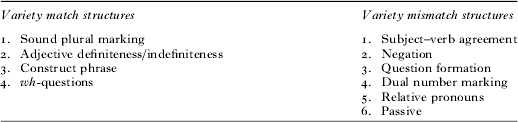
Ten constructions were examined in this study. Six differed in the two language varieties (variety mismatch structures), and four were similar between language varieties (variety match structures). Table 2 lists the structures investigated in the present study, and a list used in the grammaticality judgment task is provided in the Appendix.
Structures represented in the grammaticality judgment task
Procedure
Prior to conducting the experiment, the school was visited three times so that the researcher was familiar to the children. Informed consent for participation was obtained from the children's parents, following procedures approved by the local institutional review board. Twenty-four children in each class (grades 1 through 5) were randomly chosen from amongst those who had their parents’ consent to participate. The parents were asked to complete the parental questionnaire at home, and the children were tested in person at the school. The experimenter tested each child individually in a separate quiet room, and obtained each child's oral assent at the time of participation. Each student participated in two grammaticality judgment tasks during the session: one involving MSA judgments and the other involving PCA judgments. These were counterbalanced across participants for order of presentation.
To introduce the experiment, the tester spoke with the children explicitly about different varieties of Arabic used by two characters depicted in pictures: a falafel seller (who is more likely to use PCA), and a television announcer (who is more likely to use MSA). The children all agreed that they knew that there are two varieties of Arabic, and that these two characters would speak differently from each other. For each test list, one of the pictures was presented, and the experimenter read aloud the grammatical and ungrammatical sentences (the order of list presentation was counterbalanced). Children were asked to choose which item of each pair ‘sounds better’ for the depicted speaker. For example, for a child counterbalanced to the PCA-first condition, when administering the PCA judgment task, the falafel seller picture would be presented; the examiner would read the first sentence pair while showing the falafel seller picture. This was intended to ensure that the child's response related to the spoken variety, by directing his/her attention to a situation where PCA would be more appropriate. The child would tell the examiner whether the first or the second sentence heard was the more acceptable of the pair. After the forty PCA sentence pairs were presented, the experimenter switched to the picture of the television broadcaster, to remind the students they were now being asked to make MSA judgments. The examiner would read a pair of sentences in MSA and the student would tell the examiner which sentence of the two sounded ‘better’. Children were allowed to request repetitions of the sentences at any time, and there was no time constraint on their responses.
Prior to testing, each child was given two training trials for each of the MSA and PCA conditions. The training items did not contrast the relevant structures tested for in the main test trials, instead using attributive adjectives and adjectives in head position. For example:
(21)

The sessions were tape-recorded and children's responses were noted by the examiner. Encouragement was given to the child by the experimenter irrespective of the accuracy of judgment. No feedback on performance was given to the children.
The children's responses were later coded and analyzed into response categories, either PCA or MSA judgments, for each linguistic structure (for the mismatch condition: word order/agreement, negation, yes/no questions, dual-number marking, relative pronouns and passive structures; for the match condition: sound plural marking, adjective definiteness/indefiniteness, construct phrases and wh-questions). Responses were coded as correct if the child correctly chose the grammatical structure from the presented sentence pair, and as incorrect if the child chose the ungrammatical sentence of a pair.
RESULTS
Parental questionnaire
On average, parents reported that their children watched 12·9 weekly hours of TV programs in MSA (SD=12·7) during the summer break, and 9·2 weekly hours during the school time (SD=8·7). Parents reported reading a mean of twelve books in Arabic to their children during school semesters (SD=11·28) and ten books during the summer break (SD=11·6). Eighty-nine (89) out of the 120 participating children were read to in MSA; the other children were presented with simultaneously translated PCA versions of the written materials by their parents. Correlational analyses were conducted to establish whether any of the variables examined via the questionnaire (hours of TV watched, numbers of books read in MSA) were related to performance on the grammaticality judgment tasks. However, no significant correlations between responses to these questionnaire items and accuracy in the grammaticality judgment task were found (correlation between grammaticality judgment scores and hours of MSA exposure through television: r=0·13, p=0·17; correlation between grammaticality judgment scores and MSA exposure through books: r=0·07, p=0·42).
Grammaticality judgment
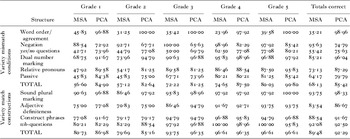
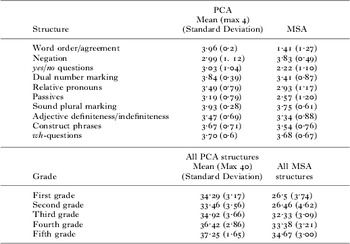
Four tokens of each construction were presented to each of twenty-four children in each of five grade levels, for a total of ninety-six possible correct responses per construction in each grade level. Results of the grammaticality judgment task are reported in Table 3 as percentages correct for each construction and each grade level. Mean correct responses for each construction, and in total, for both PCA and MSA, are given in Table 4.
Percentage of correct responses for each construction and each grade level

Mean correct grammaticality judgments of MSA and PCA sentences by structure and grade level

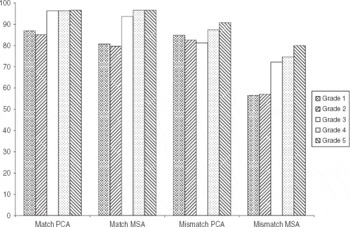
In every grade level, children performed worse on MSA mismatch constructions than on any other stimulus type. MSA constructions resulted in more errors than PCA constructions overall. The children performed best on PCA constructions which did not differ structurally between the two language varieties. This is graphically represented in Figure 1.
Percentage of correct responses by dialect and match/mismatch.

A 2 (language variety: MSA vs. PCA)×5 (grade levels, 1 through 5)×10 (grammatical constructions) ANOVA was used to examine the results of the grammaticality judgment task. The ANOVA on the grammaticality judgment results revealed a main effect of language variety, confirming significance of the overall superior performance on PCA items (F(1, 115)=187·36, p<0·001, η2=0·54). In addition, there were significant interactions between grade and language variety (F(4, 115)=11·74, p<0·001, η2=0·14), and language variety and construction (F(9, 107)=47·03, p<0·001, η2=0·36), as well as language variety, grade and grammatical construction (F(36, 440)=2·11, p<0·001, η2=0·54). An additional ANOVA was conducted with a factor of Gender (male vs. female) but this revealed no statistically significant effect of gender on any examined structure (F(1, 118)=0·42, p=0·52, η2=0·004) and so was dropped from further analysis.
Match versus mismatch
Paired- and independent-sample t-tests were used to further examine the observed interactions between language variety and grammatical construction, within and across grade levels. These investigations revealed no significant differences between children's responses to the MSA and PCA presentations in the variety match condition, except for the plural marking structure, to which children responded significantly more accurately in PCA than in MSA (t(119)=3·16, p<0·001). Further examination of the responses to plural marking items within each grade level showed that the differences were marginal for the first graders (t(23)=2·02, p=0·06), significant for second graders (t(23)=2·11, p=0·046), but not significant for any of the other grade levels.
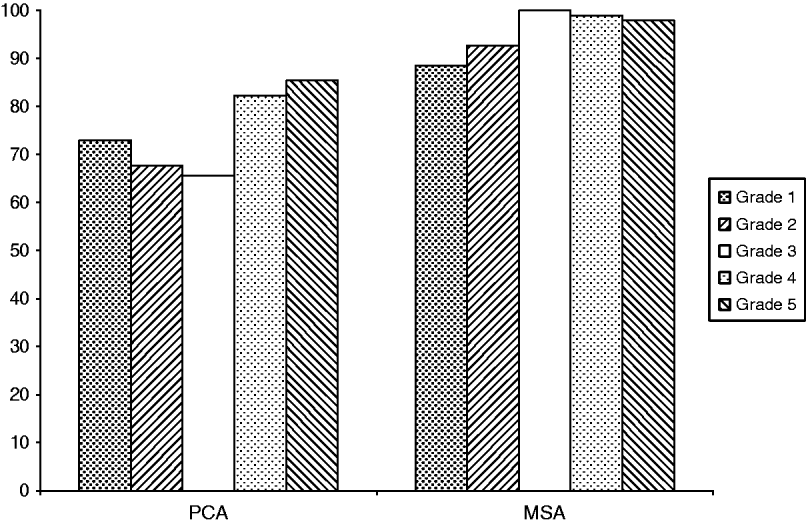
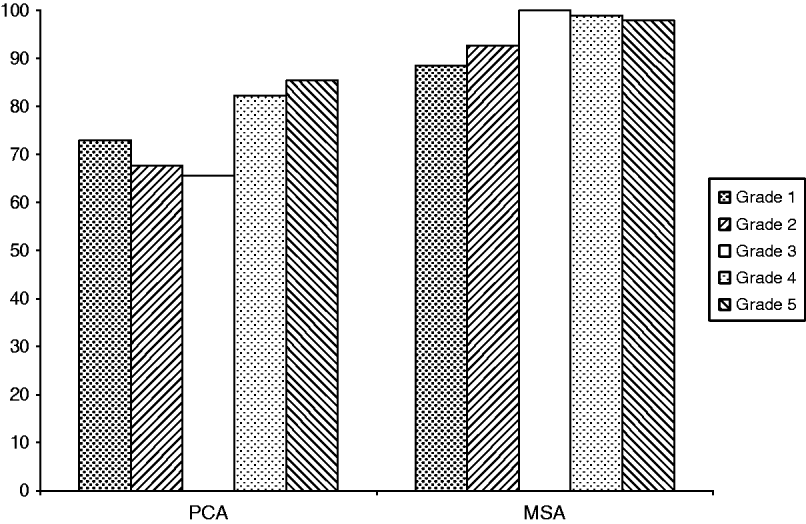
Investigations of children's responses to the variety mismatch condition showed significant differences between PCA and MSA responses. In general, PCA responses were superior to MSA responses, except for negation, where performances were superior for MSA (t(119)=7·86, p<0·001). Overall, the cross-sectional data provided by this study illustrate age-related changes that interact with the match/mismatch between grammatical constructions in the two language varieties. Broadly speaking, performance on MSA constructions that do not entail a cross-variety mismatch is not significantly worse than performance on the PCA counterparts, and by third grade there is no appreciable difference between the two. Performance on MSA mismatch constructions, by contrast, remains poorer than on PCA constructions until after fifth grade. Interestingly, PCA mismatch constructions appear to show a developmental drop-off, in that children's performance on these got steadily poorer until third grade. The improvement after third grade was not great enough to bring performance on these constructions up to the same level as the PCA match condition.
A 2 (match/mismatch)×5 (grade)×2 (language variety) ANOVA was used to further examine the effect of variety match vs. mismatch between MSA and PCA. The effect of match/mismatch was significant, with mismatch between the language varieties having a detrimental effect on children's ability to judge grammaticality (F(1, 23)=39·95, p<0·001, η2=0·44). The interaction between grade and match/mismatch was marginal (F(4, 115)=2·27, p=0·07, η2=0·02) and there were significant interactions between language variety and match/mismatch (F(1, 115)=72·65, p<0·001, η2=0·16), and between grade, language variety and match/mismatch (F(4, 115)=2·93, p=0·02, η2=0·08). Planned comparisons within each level of the language variety factor revealed that the match/mismatch interacted with grade level only for PCA items (PCA match/mismatch and grade interaction: F(4, 115)=4·18, p=0·003, η2=0·09; MSA match/mismatch and grade interaction: F(4, 115)=1·13, p=0·35, η2=0·01). Detailed examination of this interaction using one-way ANOVA within each grade level revealed that match/mismatch effects were found within MSA structures along all grade levels (first grade: F(1, 23)=52·76, p<0·001, η2=0·70; second grade: F(1, 23)=36·49, p<0·001, η2=0·61; third grade: F(1, 23)=134·77, p<0·001, η2=0·65; fourth grade: F(1, 23)=127·28, p<0·001, η2=0·85; fifth grade: F(1, 23)=76·88, p<0·001, η2=0·77). On the other hand, effects of match/mismatch within PCA were significant at third and fourth grade levels only, and were marginal in fifth grade (first grade: F(1, 23)=0·53, p=0·47, η2=0·02; second grade: F(1, 23)=0·58, p=0·46, η2=0·25; third grade: F(1, 23)=31·18, p<0·001, η2=0·58; fourth grade: F(1, 23)=17·18, p<0·001, η2=0·43; fifth grade: F(1, 23)=9·91, p=0·005, η2=0·30). This reflects the change which is apparent from first to fifth grade in the accuracy of grammaticality judgments in response to MSA constructions. For PCA, the effects on older children of match/mismatch may reflect a kind of reverse interference from MSA acquisition.
Generally speaking, the constructions we tested did not deviate from the general course of development as described in previous studies (e.g. Saiegh-Haddad, Reference Saiegh-Haddad2007), in that PCA judgments were more accurate than MSA judgments, and match constructions were more accurately judged than mismatch constructions (see Figure 1 above). One construction yielded anomalous results, however. Children performed significantly worse on negation items in PCA than in MSA (t(119)=7·86, p<0·001). The findings for the negation items are illustrated in Figure 2.
Percentage of correct judgments by grade level for negation constructions.
The role of curriculum on grammaticality test performance
As noted previously, the structures examined in this study (except the passive) are the subject of specific emphasis in the curriculum of the schools participating in this study. One question that arises is whether such instruction has an effect on performance on this task, which involves the ability to distinguish between the grammatical and ungrammatical structures of MSA and PCA. Effects of specific instruction should be revealed in the form of enhanced performance for the transition from the target grade level and the following grade level performance on MSA rather than PCA. In other words, we should see a ‘bump’ in performance for the year following the period during which there is extensive emphasis on the relevant structure. No such transitions should be found for a particular grade level for the passive, which is not subject to targeted instruction.
To test for effects of targeted instruction, we compared relative differences in performance at the target grade and its successor for each of the constructions and compared these differences to differences for all other grade transitions. T-tests revealed no significant transitional performance difference for target grades versus non-target grades (t(34)=0·737, p=0·466). Although some constructions did show non-monotonic improvement at relevant grade levels (e.g. relative clauses, adjectives), this also occurred for the passive that receives no targeted instruction. In addition, such improvement coincidence with instruction was the exception rather than the rule. In addition, such changes were also found in development for PCA constructions, which are not targeted in the curriculum. It is also possible that some MSA constructions are targeted in the curriculum for particular ages precisely because those are the ages at which such constructions tend to be mastered in the normal course of development.
To summarize, our findings reveal a morphosyntactic interference effect of the diglossic situation on children's morphosyntactic development in standard and spoken Arabic. Constructions that incorporate a variety mismatch in structure between MSA and PCA compared to structures that are not different between the two language varieties elicited significantly poorer responses along all grade levels. Further analyses revealed that these match vs. mismatch differences were significant in MSA for all grade levels. Differences between performance on match and mismatch structures in PCA were not significant at the first and second grade levels, but children made significantly more errors to mismatch items at the third, fourth and fifth grade levels. In attempting to examine the effects of exposure in the home to MSA in everyday activities such as reading and watching TV, analysis showed no significant correlation between reported amount of exposure to home-based materials and performance on the grammaticality judgment tasks. Developmental changes in performance on MSA constructions were not found to be significantly associated with the timing of specific curriculum-based instruction.
DISCUSSION
The objective of this study was to examine Arabic-speaking children's morphosyntactic development in a diglossic situation. We examined differences between competencies in judging the grammaticality of structures in Modern Standard Arabic and Palestinian Colloquial Arabic, in particular comparing judgments for structures that are realized differently between the two language varieties with those that are similar. In addition, the study provided preliminary data on the effects of home-based exposure to MSA on children's correct judgments of structures from both language varieties.
Two factors were assumed to affect children's performance on grammaticality judgment tasks in our study: familiarity with the language variety (based on differences in amount of exposure and use), and the linguistic structures themselves. Since PCA is more familiar to children and therefore encountered more frequently in everyday interactions, we postulated that differences between PCA and MSA are one index of the effect of familiarity on children's morphosyntactic development. On the other hand, the manipulations of match versus mismatch, and properties of the linguistic constructions themselves, permitted us to test children's competence with respect to specific linguistic structures in the two language varieties. Our results suggest an interaction between these factors, and raise the possibility that cross-variety interference could be a significant factor in children's morphosyntactic development in Arabic. Findings reveal that the accuracy of children's grammaticality judgments was predicted by the particular language variety (PCA vs. MSA) and the structural properties (match versus mismatch). However, no significant effect of MSA home exposure on children's morphosyntactic development was found.
Interference effect
The differences between performance on MSA match and mismatch structures suggest that native speakers of Arabic learning MSA are constrained by cross-/inter-variety rules, which regulate their correct judgments for MSA structures at all examined grade levels. The surprising result here is not that the inter-variety rules seem to change to accommodate MSA grammar as children get older, but that these rules then appear to be used by the children to constrain PCA structures. This results in a drop-off in performance on PCA mismatch structures in later stages (third through fifth grade level), a pattern of responding that suggests a reverse interference effect going along with children's increasing proficiency in MSA. The present findings show that children's performance was affected by language-specific characteristics, and are in line with previous findings from phonological tasks (Saiegh-Haddad, Reference Saiegh-Haddad2003), where discrepancies between MSA and PCA affected children's ability to perform phonological awareness tasks. Future research should evaluate this hypothesis using production and comprehension tasks.
Another possible interference effect was not controlled for in the present study, and involves the possible influence of an emerging variety of Arabic referred to as Educated Spoken Arabic (ESA). ESA shows features of both spoken and standard Arabic (Mitchell, Reference Mitchell1986), thus raising the possibility that children exposed to this variety may judge sentences containing a mix of spoken and standard Arabic as acceptable.Footnote 3 The systematicity in the data does not support a view of children's grammaticality judgments being guided by such a strategy. However, the influence of ESA on children's grammaticality judgments will need to be independently evaluated for future work.
Structural properties
The present study provides some evidence of various patterns of development for the different structures across grade levels. In general, structures known to be acquired early in other languages – such as plural marking and word-order agreement – were also found to be acquired early in this study; and structures found to be acquired late cross-linguistically – such as passive structures and relative pronouns – were similarly found to be acquired late (Wexler, Reference Wexler, Lightfoot and Hornstein1994; Meisel, Reference Meisel, Fletcher and MacWhinney1995).
In contrast to the superior performance on PCA over MSA for most structures, children performed better in MSA negation structures. Negation in MSA requires only a free morpheme, realized either as ma or la, which inflects for tense, and the verb has to be in the imperfective. In contrast, the PCA negative construction requires two markers of negation – a free morpheme ma, and a bound morpheme – ʃ – which do not inflect for tense. Hence, negation in PCA involves different syntactic operations and can therefore be considered to be structurally more complex than in MSA. On the other hand, distractor items in the MSA list were constructed to resemble the negation construction for PCA by utilizing the affix -ʃ, which is PCA-specific.Footnote 4 Hence the superior performance on MSA negation judgments could be attributed to a reliance on lexical knowledge: if the children recognize that -ʃ is a PCA-specific affix, they can reject its appearance in double negation constructions. This would be akin to the child making a lexicality judgment rather than a grammaticality judgment: the presence of -ʃ in an MSA sentence creates a pseudo-word, and is therefore disallowed.
However, children's performance was not dependent on the presence or absence of a pseudo-word to guide their judgments, but rather seems related to the match versus mismatch manipulation. In the match condition, PCA and MSA were judged equally accurately in all age groups, and for all constructions; whereas in the mismatch condition, smaller differences in accuracy were found between the language varieties for the older children, regardless of the presence or absence of a pseudo-word in the ungrammatical conditions. Differing patterns of performance across the age groups suggest a pattern of maturation which is difficult to account for in terms of lexical knowledge alone.
Home-based exposure to MSA
Our study showed no significant effect of MSA home exposure on children's morphosyntactic development. A few studies have focused on the importance of early exposure to literary Arabic texts on the reading comprehension of Arab preschool children (Abu-Rabia, Reference Abu-Rabia2000; Feitelson et al., Reference Feitelson, Goldstein, Iraqi and Share1993), examining the effects of structured, school-based exposure which was adapted to children's developmental levels. Based on such investigations, there were calls for increased exposure to MSA to improve reading and writing development. The amount of reported MSA home-based exposure varied a great deal in our study, but there was no significant correlation between reported amounts of home-based exposure and the accuracy of children's judgments. This indicates that effects of random MSA exposure are likely minimal, at least on the development of children's morphosyntactic awareness, though more studies should be conducted to address this issue. We suggest that the recent focus on increasing MSA exposure with a view to facilitating literacy development should take into account the fact that random exposure is not sufficient for the successful learning of a language variety (e.g. White, Reference White1987) and the development of emerging literacy skills.
Implications of the present study for language acquisition in a diglossic situation
Our study results emphasize the need for new clinical practices in educational and speech–language assessment and intervention, to more accurately distinguish between language impairment and typical developmental effects of acquiring language in a diglossic situation. Currently, speech and language assessment for Arabic-speaking children with specific learning and/or language impairments is conducted exclusively in spoken dialects (Khamis-Dakwar & Crowley, Reference Khamis-Dakwar and Crowley2005), whereas educational testing and assessments are conducted solely in MSA. New trends in the educational assessment of reading readiness in children have adopted Western models of a single language variety carrying both formal and informal aspects of communication. These new examinations are carried out either exclusively in MSA or by presenting oral tasks in spoken Arabic and written tasks in MSA (Abu-Rabia, Reference Abu-Rabia2002). Such an approach misses several important factors in providing a comprehensive understanding of the child's abilities and possible disabilities. The interference effects found in our study and the significant effect of both language variety and construction on children's grammaticality judgment reveals that it is not enough to assess children's ability in one language variety, since we may be unable to extrapolate from children's responses in one variety how they would perform in another. There are also additional factors related to the diglossic situation that should be taken into account during the assessment of children's linguistic skills. Hence, it would be necessary to assess children's language development and emerging literacy in the two language varieties of Arabic while controlling and/or assessing effects of cross-variety match and mismatch on children's development. Further research should examine the performance of children with learning disabilities and/or language impairments on grammaticality judgments, particularly on specific structures as presented here, to assess whether qualitative differences (or a quantifiable delay) are exhibited in their performances on these tasks. This understanding would be essential for setting effective intervention goals later in treatment. Our results, then, highlight the need to consider both language varieties when assessing language abilities, in both typically developing children and children with learning disabilities.
In the case of the diglossic Arabic situation, skilful readers are those who can effectively shift between the skills and knowledge gained in their oral language to reading and writing in MSA. The current practice in Arabic schools is to teach Arabic grammar at the secondary school level without reference to spoken Arabic. Our findings suggest that referencing children's knowledge of spoken Arabic in language instruction would likely enhance acquisition of the standard variety, especially for the acquisition of structures which have a distinct syntactic realization in the two varieties. There is therefore a need to assess the effectiveness of alternative teaching methods of Arabic, in order to take account of possible interference effects between standard and spoken varieties. For example, teaching MSA with reference to spoken Arabic, and linking the two varieties during the teaching of reading and writing in Arabic, should be evaluated in future research.
Children acquiring a diglossic language system are also acquiring sociolinguistic competence in code-switching, the highly constrained alternation between two language varieties in communicative interactions (Boussofara-Omar, Reference Boussofara-Omar2003). Although our judgment task was designed to evaluate children's competence in the two distinct Arabic varieties, it is likely that we also required them to tap into knowledge of acceptable and unacceptable code-switches. For example, on some items we used morphemes from the other language variety in order to generate ungrammatical exemplars. In other words, some children may have accepted stimuli which we intended to be unacceptable, because they could have recognized that use of morphemes from the other language variety would be available in a sociolinguistically appropriate code-switch. In our opinion, the task itself precluded such responses by using a forced-choice paradigm, which meant that children were really choosing between two utterances, one of which was extremely unlikely to be used by the relevant speaker (the falafel seller or the television presenter). However, further analysis of the influence of code-switching on children's responses in a cross-variety judgment task may be warranted.
To summarize, this is the first detailed analysis of morphosyntactic development in both ‘High’ and ‘Low’ varieties of Arabic, and our results suggest future directions for research and for the development of clinical and educational assessments. Additional tasks may enhance the effectiveness of this bi-dialectal approach; for instance, more directly literacy-related tasks such as oral reading, sentence repetition or translation tasks. Current research on Arabic diglossia lacks any detailed examination of children's awareness of the morphosyntactic properties of the two language varieties at different ages. This is a first step towards gaining clearer insight into the demands of language acquisition in a diglossic situation, in comparison to language acquisition in monolingual or bilingual situations.
APPENDIX
GRAMMATICALITY JUDGMENT TASK – EXAMPLE STIMULUS PAIRS FOR EACH CONSTRUCTION IN EACH LANGUAGE VARIETY