Sethoxydim is a cyclohexanedione herbicide used throughout the southeastern United States for grassy weed control in centipedegrass [Eremochloa ophiuroides (Munro) Hack.]. It inhibits acetyl-CoA carboxylase (ACCase) enzymes, which catalyze the carboxylation of acetyl-CoA to malonyl Co-A in fatty acid biosynthesis (Cronan and Waldrop Reference Cronan and Waldrop2002). Turfgrass managers use sethoxydim for grassy weed control in centipedegrass lawns, roadsides, and sod farms. Other ACCase-inhibitors used in turfgrass include the aryloxyphenoxypropionates (AOPP), fenoxaprop, and fluazifop. These herbicides are used for grassy weed control in cool-season turfgrasses and zoysiagrass (Zoysia japonica Steud.) (Dernoeden Reference Dernoeden1989; Johnson and Carrow Reference Johnson and Carrow1993; McElroy and Breeden Reference McElroy and Breeden2006).
There have been 47 reports of weed resistance to ACCase-inhibitors worldwide (Heap Reference Heap2016). However, only two cases of ACCase-resistance have been reported in turfgrass systems. Derr (Reference Derr2002) found a smooth crabgrass [Digitaria ischaemum (Schreb.) Schreb. ex Muhl.] biotype with resistance to fenoxaprop on a golf course in New Jersey. It was determined that the ACCase of the resistant (R) biotype was 50-fold less susceptible to inhibition by AOPP herbicides than that of a susceptible (S) biotype (Kuk et al. Reference Kuk, Wu, Derr and Hatzios1999). In Georgia, a goosegrass [Eleusine indica (L.) Gaertn.] biotype was identified in centipedegrass that was cross-resistant to all ACCase-inhibitors labeled in turfgrass (McCullough et al. Reference McCullough, Yu, Raymer and Chen2016). A mutant isoform of ACCase was the basis for resistance of this biotype. Target-site resistance to ACCase inhibitors has also been found in blackgrass (Alopecurus myosuroides Huds.), ryegrass (Lolium spp.), and other grassy weeds (Petit et al. Reference Petit, Pernin and Délye2010; Shergill et al. Reference Shergill, Malone, Boutsalis, Preston and Gill2015). Enhanced degradation of AOPP herbicides in R biotypes of blackgrass, ryegrasses, and wild oat (Avena fatua L.) has been reported, but this trait has not conferred resistance to cyclohexanediones in the absence of mutant ACCase (Campbell and Penner Reference Campbell and Penner1985; Cocker et al. Reference Cocker, Northcroft, Coleman and Moss2001; De Prado et al. Reference De Prado, Osuna, Heredia and De Prado2005; Preston and Powles Reference Preston and Powles1998).
Two populations of southern crabgrass with suspected resistance to sethoxydim were collected in centipedegrass in Georgia. The managers had noted limited control in 2010 after using sethoxydim exclusively for over two decades. There have been no previous reports of ACCase-resistant southern crabgrass. The confirmation of an R biotype could have important implications for POST weed control in centipedegrass and other turfgrass species. The objectives of this research were to evaluate (1) the resistance levels of these biotypes to ACCase inhibitors, (2) cross- and multiple resistance of these biotypes to other herbicides, and (3) control of these populations in the field.
Materials and Methods
Plant Materials
Twenty plants of southern crabgrass were collected from two fields of ‘TifBlair’ centipedegrass on May 22, 2015 and July 7, 2015. The fields were approximately 160 km apart in central Georgia, mowed weekly at a 5-cm height during active growth, and maintained by different managers. The location coordinates will not be disclosed to protect the privacy of the landowners. A biotype of southern crabgrass was collected from bermudagrass [Cynodon dactylon (L.) Pers.] turf in Griffin, Georgia on June 5, 2015 with no previous history of ACCase inhibitor use.
Southern crabgrass plants were at a three- to five-tiller growth stage when collected in the field. Plants were placed in plastic flats filled with sand:peat moss soil (85:15 by volume) in a greenhouse set for 32/25 C (day/night) at the University of Georgia Griffin Campus. The plants were irrigated to prevent moisture deficiencies and allowed to develop lateral stems for one month in the flats. Clones were then removed from stems with shears and transplanted to pots with 3.8-cm diameter and 20-cm depth filled with sand:peat moss.
Seedheads were harvested from plants originally collected from the three biotype locations. Seed was removed by hand using a sieve, and dried at 35 C in a growth chamber for 72 h. The seed was then stored in a freezer at −20 C for 8 months. The three biotypes were then seeded in separate greenhouse flats and irrigated to promote establishment. Single seedlings were transplanted individually to the aforementioned pots. The seeded and clonally propagated plants were irrigated daily, fertigated (MacroN 28-7-14 Sprayable Fertilizer, LESCO Inc., Cleveland, OH) weekly, and allowed to reach a one- to two-tiller growth stage before treatments.
Dose-Response Experiments
The response of the three crabgrass biotypes was evaluated from a rate titration of sethoxydim. Clonally propagated plants and seeded plants were used for experiments 1 and 2, respectively. Both experiments had two experimental runs. Treatments were applied in a spray chamber calibrated to deliver 187 L ha−1 with a flat-fan nozzle (8002E, TeeJet Spraying Systems Co., Roswell, GA 30075). Sethoxydim (Segment 1EC, BASF Corp., Research Triangle Park, NC 27709) was applied at 25, 50, 100, 200, 400, 800, 1600, 3200, or 6400 g ai ha−1. In centipedegrass, the recommended label use rate of sethoxydim ranged from 210 to 315 g ai ha−1. Nontreated checks of the three biotypes were included. Plants were returned to the greenhouse at 1 h after treatment, and irrigation was withheld for 24 h. Shoots were harvested at 14 d after treatment with shears. In experiment 1, biomass was oven-dried for 72 h at 60 C and then weighed. Fresh biomass was measured in experiment 2 by immediately recording shoot weights after harvest.
Cross and Multiple-Resistance Experiments
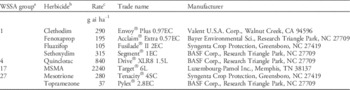
The two biotypes were treated with clethodim, fenoxaprop, fluazifop, monosodium methylarsenate (MSMA), quinclorac, sethoxydim, or topramezone. A nontreated check was included. Product information and rates evaluated are presented in Table 1. Application rates were chosen to correspond with label recommendations for use in tolerant turfgrasses. Clethodim, fluazifop, and topramezone were applied with a nonionic surfactant at 0.25% (v/v), and quinclorac was treated with methylated seed oil at 1% (v/v) (Table 1). Shoots were harvested at 14 d after treatment with shears, oven-dried for 72 h at 60 C, and then weighed.
Product information for herbicides used in greenhouse and field experiments

a WSSA group numbers listed represent (1) acetyl-CoA carboxylase inhibitors, (4) synthetic auxins, (17) cell division inhibitors, and (27) 4-hydroxyphenylpyruvate dioxygenase inhibitors.
b Clethodim, fluazifop, MSMA, and topramezone were applied with a non-ionic surfactant at 0.25% (v/v) in greenhouse experiments. The surfactant used was Chem Nut 80-20, mixture of alkyl and arlkylaryl polyoxyethylene glycol, 80%, Chem Nut Inc., PO Box 3706, Albany, GA 31706. Quinclorac was treated with a methylated seed oil, MES-100, 100% methylated seed oil, alkylphenol ethoxylate, Drexel Chemical Company, Memphis, TN, at 1% (v/v).
c Topramezone rate is listed as g ae ha−1.
Field experiments
Four experiments were conducted to evaluate control of the two southern crabgrass populations with herbicides in the field. Soils at locations 1 and 2 were sandy loam with 2.8% organic matter and 5.7 pH, and clay with 2.8% organic matter and 7.0 pH, respectively. The centipedegrass at both locations was mowed at 5 cm with a rotary mower, and clippings were returned. Irrigation was applied as needed to prevent turfgrass wilt. Field experiments 1, 2, and 3 were conducted at location 1. Treatments for experiments 1 and 2 were applied on September 10, 2015, and treatments for experiment 3 were applied on June 6, 2016. The plots for experiment 1 were adjacent to the plots used for experiment 2. Treatments for experiment 4 were applied on September 17, 2015 at location 2. Southern crabgrass was at a multi-tiller stage and exhibited lateral growth on the day of treatment in all experiments. The experiment was not repeated at location 2 in 2016 because the managers used alternative herbicides to sethoxydim for control across the entire field. The initial ground cover of southern crabgrass was visually evaluated and averaged 49% (±5.2 SE), 15% (±2 SE), 13% (±2 SE), and 45% (±1.9 SE) in experiments 1, 2, 3, and 4, respectively.
Treatments included clethodim at 290 g ai ha−1, sethoxydim at 315 or 945 g ai ha−1, mesotrione at 280 g ai ha−1, and topramezone at 37 gae ha−1gaeha−1. Clethodim and mesotrione treatments included a nonionic surfactant at 0.25 % (v/v). The topramezone treatments included methylated seed oil at 1% (v/v). Product information for herbicides and adjuvants used is presented in Table 1. A nontreated check was included. Applications were made with a CO2-pressured sprayer calibrated at 222 L ha−1 with three flat-fan nozzles (8004, TeeJet Spraying Systems Co., Roswell, GA 30075) at 145 kPa operating pressure. Control was assessed visually at 2 and 4 wk after treatment (WAT) on a percent scale in which 0% equals no control and 100% equals complete desiccation. Only results from 4 WAT are presented; at 2 WAT, similar trends were observed among all treatments.
Experimental Design and Data Analysis
The design in the greenhouse experiments was a randomized complete block with five replications. A block design was used to reduce the potential effect of greenhouse location on plant responses to herbicides. The greenhouse experiments were conducted twice. The design in the field experiments was a randomized compete block with four replications, using 1.5 by 4.5 m plots.
Data were subjected to analysis of variance with the General Linear Model Procedure in SAS (version 9.3, SAS Institute, Cary, NC) to test for treatment by experimental run interaction. For dose-response experiments, shoot biomass data were regressed using the Nonlinear Regression Procedure in SAS. The application rates required to reduce shoot biomass by 50% (SR50) were determined with the following linear regression and three-parameter growth function model:
 $$y\, {\equals}\, \beta _{\it 0} {\plus}\beta _{\it 1} {\rm {^\asterisk}}x ,\,{\rm and}$$
 $$y{\rm \, {\equals}\, }\beta _{\it 0} {\rm {\plus}}\beta _{\it 1} {\rm {^\asterisk}exp(\!}{\minus}\beta _{\it 2} {\rm {^\asterisk}}x{\rm )}$$
In Equation 1, y is the shoot biomass, β 0 is the intercept, β 1 is the slope, and x is the herbicide rate. In Equation 2, β 0 is the lower asymptote, β 1 is the maximum predicted response, β 2 is the slope, and x is herbicide rate. Models were chosen that characterized the relationship of the response curves with herbicide rate after plotting treatment means. Standard errors and 95% confidence intervals for the estimates were determined. Separation of SR50 values was made using 95% confidence limits calculated in SigmaPlot (version 11.2, Systat Software, Inc., San Jose, CA). Means from cross-resistance and field experiments were separated with Fisher’s LSD test atα=0.05. Treatment by experimental run interactions were not detected, and thus results were pooled over runs for presentation.
Results and Discussion
Dose Response Experiments
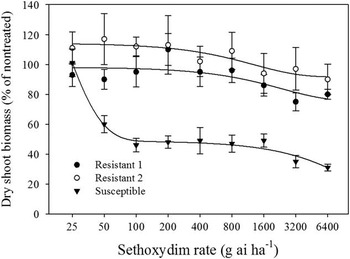
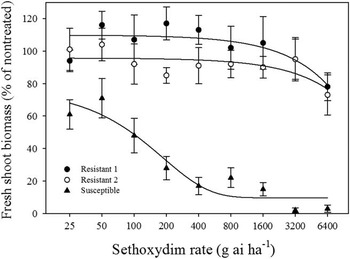
A rate by biotype interaction was detected, and thus results are presented across all combinations. Shoot biomass of the nontreated plants, with standard errors of the means, is presented in figure captions. In experiment 1, GR50 was 65 g ha−1 for the S biotype and >6400 g ha−1 for both R biotypes (Figure 1). In experiment 2, the GR50 was 100 g ha−1 for the S biotype and >6400 g ha−1 for both R biotypes (Figure 2). The highest labeled use rate of sethoxydim in turfgrass is 315 g ha−1 (Anonymous 2012), and results support the supposition that the two R biotypes are resistant to sethoxydim with a >64-fold resistance factor.
Dry shoot biomass of three southern crabgrass biotypes treated with sethoxydim in two greenhouse experiments. Results were pooled over experimental runs. Vertical bars represent the standard errors of the means (n=10). Resistant 1, r 2=0.06, y=93.54 – 0.004x; Resistant 2, r 2=0.14, y=106.95–0.006x; Susceptible, r 2=0.49, y=45.43+229.8*exp(−0.06*x). Biomass of the nontreated averaged 0.39 (±0.02), 0.48 (±0.04), and 0.18 (±0.02) grams per plant for Resistant 1, Resistant 2, and Susceptible biotypes, respectively.

Fresh shoot biomass of three southern crabgrass biotypes treated with sethoxydim in two greenhouse experiments. Results were pooled over experimental runs. Vertical bars represent the standard errors of the means (n=10). Resistant 1, r 2=0.06, y=108.59–0.005x; Resistant 2, r 2=0.03, y=94.67–0.003x; Susceptible, r 2=0.57, y=9.64+66.47*exp(−0.005*x). Biomass of the nontreated averaged 0.31 (±0.02), 0.36 (±0.03), and 0.51 (±0.04) grams per plant for Resistant 1, Resistant 2, and Susceptible biotypes, respectively.

Resistance to ACCase inhibitors was previously reported in large crabgrass [Digitaria sanguinalis (L.) Scop.] and smooth crabgrass (Heap Reference Heap2016). Wiederholt and Stoltenberg (Reference Wiederholt and Stoltenberg1995) found a large crabgrass population in Wisconsin that was 59 times less susceptible to growth inhibition from fluazifop than was an S biotype. Derr (Reference Derr2002) noted that fenoxaprop at 280 g ha−1 injured a smooth crabgrass S biotype 92%, but did not injure an R biotype. The levels of sethoxydim resistance in these southern crabgrass populations are comparable to those seen in previous reports of ACCase resistance in other crabgrass species. All of these crabgrass populations were identified in areas that received exclusive use of ACCase inhibitors over five years. Therefore, incorporating other herbicides with alternative mechanisms of action will be critical for long-term control of ACCase-resistant crabgrass.
Cross- and Multiple Resistance Experiments
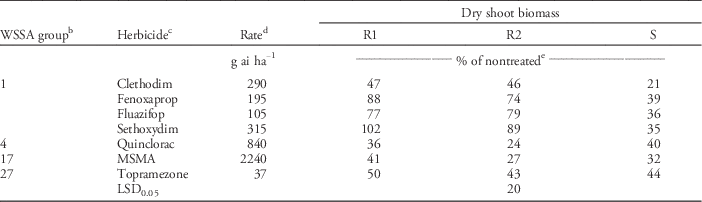
The ACCase inhibitors evaluated, on average, reduced shoot biomass of the S biotype to 33% (±4 SE) that of the nontreated plants at 14 d after treatment (Table 2). Shoot biomass of the R biotypes averaged 85% (±7 SE) that of the nontreated plants following treatments of fenoxaprop, fluazifop, and sethoxydim. Clethodim reduced R biotypes’ shoot biomass (47% of nontreated) more than did other evaluated ACCase inhibitors (74% to 102% of nontreated). However, the R biotypes had about two-fold less growth inhibition from clethodim than did the S biotype. Clethodim reduced the biomass of the S biotype by 79%, suggesting that the R biotype has a degree of resistance to clethodim.
Dry shoot biomass of three southern crabgrass biotypes at 14 d after treatment in greenhouse experiments in Griffin, GA.Footnote a

a Results were pooled over experiments.
b WSSA group numbers listed represent (1) acetyl-CoA carboxylasease inhibitors, (4) synthetic auxins, (17) cell division inhibitors, and (27) 4-hydroxyphenylpyruvate dioxygenase inhibitors.
c Clethodim, fluazifop, MSMA, and topramezone were applied with a non-ionic surfactant at 0.25% (v/v). Quinclorac was applied with a methylated seed oil at 1% (v/v).
d Topramezone rate is listed as g ae ha−1.
e Biomass of the nontreated averaged 0.41 (±0.05), 0.36 (±0.03), and 0.19 (±0.02) grams per plant for the R1, R2, and S biotypes respectively.
Shoot biomass of the two R biotypes was reduced more by clethodim than it was by fenoxaprop, fluazifop, or sethoxydim. Differential tolerance levels to clethodim have been previously reported in ACCase-resistant plants. For example, Cui et al. (Reference Cui, Wang, Han, Chen and Li2015) found that an R biotype of Japanese foxtail (Alopecurus japonicus Steud.) was more susceptible to clethodim than it was to clodinafop, fenoxaprop, and pinoxaden. Kaundun et al. (Reference Kaundun, Hutchings, Dale and McIndoe2012) reported that an ACCase-resistant Italian ryegrass [Lolium perenne L. ssp. multiflorum (Lam.) Husnot] had a lower resistance factor to clethodim than it had to the other ACCase inhibitors, including five AOPP herbicides, three cyclohexanediones, and pinoxaden. Wiederholt and Stoltenberg (Reference Wiederholt and Stoltenberg1995) found large crabgrass with a 377-fold resistance to sethoxydim that had only a 7-fold resistance to clethodim. Similarly, Yu et al. (Reference Yu, Cairns and Powles2007) reported the first case of a rigid ryegrass (Lolium rigidum Gaudin) biotype with multiple resistance to glyphosate, paraquat, and ACCase inhibitors. The authors noted that the R biotype was resistant to sethoxydim and tralkoxydim, but remained susceptible to clethodim.
MSMA, quinclorac, and topramezone reduced biomass to 24% to 50% that of the nontreated for both biotype, and reduced shoot biomass similarly for both the R biotypes (37% of nontreated) and the S biotype (39% of nontreated). The R and S biotypes of southern crabgrass were equally susceptible each of the non-ACCase inhibitors evaluated. It is possible that multiple resistance was not detected in the R biotypes due to the history of exclusive sethoxydim use in the fields where plants were collected. Therefore, practitioners have selective POST herbicides that can be used to control these ACCase-resistant biotypes in most major turfgrass species. In previous research, herbicides with other mechanisms of action controlled ACCase-resistant large and smooth crabgrass at levels similar to those seen with S biotypes (Derr Reference Derr2002; Wiederholt and Stoltenberg Reference Wiederholt and Stoltenberg1995). Multiple resistance was also not identified in ACCase-resistant goosegrass found in Georgia with a similar history of selection pressure from sethoxydim (McCullough et al. Reference McCullough, Yu, Raymer and Chen2016).
Field Experiments
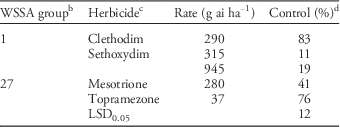
Experiment by treatment interactions were not detected, and thus results were pooled over experiments. Southern crabgrass cover in the nontreated plots averaged 28% (±4 SE) at 4 WAT (Table 3). Sethoxydim at 315 and 945 g ha−1 provided <20% control of southern crabgrass at 4 WAT, while clethodim at 290 g ha−1 provided 83% control. The hydroxyphenylpyruvate dioxygenase (HPPD) inhibitors exhibited differential levels of control at the evaluated rates. Mesotrione and topramezone controlled southern crabgrass 41% and 76% at 4 WAT, respectively.
Southern crabgrass control in ‘TifBlair’ centipedegrass at four weeks after herbicide treatments in four field experiments, 2015 and 2016.Footnote a

a Results were pooled over experiments.
b WSSA group numbers listed represent (1) acetyl-CoA carboxylase inhibitors and (27) 4-hydroxyphenylpyruvate dioxygenase inhibitors.
c Clethodim and mesotrione were applied with a non-ionic surfactant at 0.25% (v/v). Topramezone was applied with a methylated seed oil at 1% (v/v). Application dates were September 10, 2015 for experiments 1 and 2, September 17, 2015 for experiment 3, and June 6, 2016 for experiment 4. Experiments 1, 2, and 4 were conducted on separate fields at the same location. Experiment 3 was conducted on a field approximately 160 km from fields used in experiments 1, 2, and 4.
d Southern crabgrass control was measured visually on a percent scale where 0% equals no control and 100% equals complete desiccation. The initial ground cover of southern crabgrass averaged 49% (±5.2 SE), 15% (±2 SE), and 45% (±1.9 SE) in experiments 1, 2, and 4, respectively.
The control of sethoxydim-resistant southern crabgrass by clethodim agrees with results from cross-resistance greenhouse experiments. Currently, clethodim is not labeled for use in centipedegrass lawns, but has been previously labeled for sod farms. These label restrictions would limit the ability of end users to control sethoxydim-resistant southern crabgrass in many turfgrass areas. Clethodim susceptibility in grassy weeds with resistance to sethoxydim has been previously reported in numerous species (Cui et al. Reference Cui, Wang, Han, Chen and Li2015; Kaundun et al. Reference Kaundun, Hutchings, Dale and McIndoe2012; Wiederholt and Stoltenberg Reference Wiederholt and Stoltenberg1995; Yu et al. Reference Yu, Cairns and Powles2007). Perhaps a mutation in the ACCase enzyme of these biotypes prevents the binding of AOPP herbicides and sethoxydim, but does not prevent the binding of clethodim. Further research is needed to evaluate the genetic basis for the differential levels of susceptibility to ACCase inhibitors in southern crabgrass.
The HPPD inhibitors mesotrione and topramezone offer centipedegrass managers an alternative mechanism of action for controlling southern crabgrass with resistance to sethoxydim at labeled rates. Mesotrione at labeled use rates controls seedling crabgrass in turfgrass, but may require sequential applications to control multi-tiller plants (McCurdy et al. Reference McCurdy, McElroy, Kopsell and Sams2009; Yu and McCullough 2016a, 2016b). The susceptibility of large crabgrass to mesotrione injury was reported to be 7-fold greater at 18 C than it was at 32 C (Johnson and Young Reference Johnson and Young2002). Large crabgrass was also more susceptible to mesotrione at 82% relative humidity than it was at 30% relative humidity. At 4 WAT, topramezone provided control of southern crabgrass comparable to that seen with clethodim. These results suggest that topramezone may require fewer applications than does mesotrione to control mature southern crabgrass with resistance to sethoxydim.
Foliar bleaching of susceptible weeds caused by HPPD inhibitors can persist for approximately 2 wk after applications, which could be objectionable for intensively managed turfgrass (Brosnan et al. Reference Brosnan, Breeden, Patton and Weisenberger2013; Goddard et al. Reference Goddard, Willis and Askew2010; Yu and McCullough 2016b). Results showed that topramezone was more efficacious than mesotrione for the control of southern crabgrass with a single treatment. Sequential applications may be required for complete control of multi-tillered southern crabgrass, but could extend the duration of foliar bleaching. Researchers have noted that triclopyr tank-mixed with HPPD inhibitors can reduce foliar bleaching of crabgrass species (Brosnan et al. Reference Brosnan, Breeden, Patton and Weisenberger2013; Yu and McCullough 2016b). However, other tank-mix partners may be required with HPPD inhibitors to mitigate foliar bleaching of centipedegrass due to injury potential from triclopyr (Anonymous 2008). Tank-mixtures of sethoxydim with HPPD inhibitors could also be incorporated for resistance management in centipedegrass. Further research is needed to evaluate the efficacy of these combinations for southern crabgrass control and centipedegrass tolerance.
The use of PRE herbicides and cultural practices will also be needed to enhance the control of sethoxydim-resistant southern crabgrass in centipedegrass turf. Indaziflam and dinitroaniline herbicides, such as dithiopyr, prevent the establishment of southern crabgrass in centipedegrass. The successful incorporation of these herbicides in centipedegrass management could reduce POST herbicide use for sethoxydim-resistant southern crabgrass control. Hand pulling or digging crabgrass plants could reduce the spread of populations by seed as an alternative to herbicide use. Promoting turfgrass competition by balancing fertility and reducing stress from disease, traffic, or other pests may also reduce the establishment of plants in spring and summer.
The identification of ACCase-resistance in southern crabgrass has important implications for herbicide resistance management in turfgrass. The rotation of herbicides and modification of cultural practices will be critical for delaying the development of ACCase-resistant weeds in centipedegrass turf. The confirmation of southern crabgrass and other grassy weeds with resistance to ACCase inhibitors should be emphasized when educating practitioners on herbicide selection in turfgrass systems.
Acknowledgements
The authors would like to thank Seth Williams, Bill Nutt, VJ Mantripigada, and Tyler Wells for technical assistance with this research.