ECONOMIC HISTORY AND THE MODERN ECONOMIST IN THE 1980S
My advisor's advisor William Parker organized a session at the 1984 annual meetings of the American Economic Association (AEA) in Dallas, to discuss the role of economic history in economics. Participants included Nobel Laureates and prominent economic historians. The session was critical of economics for not giving economic history the attention and respect it deserved. Presentations were published in the 1985 AEA Papers and Proceedings and later in Bill Parker's book entitled Economic History and the Modern Economist (1986).
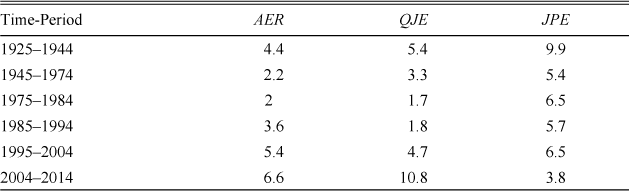
This sense that economists “believe history to be of small and diminishing interest” was made clear a few years earlier, in 1976 when Deirdre N. McCloskey wrote in defense of economic history a paper entitled “Does the past have useful economics?” McCloskey concluded that the average American economist answers “no.” McCloskey showed a sharp decline in the publication of economic history papers in the top economic journals (AER, QJE, JPE). It was clear that “…this older generation of American economists did not persuade many of the younger that history is essential to economics.”
My goal here is to revisit this topic of the role of economic history in economics, but with a twist. I will take demand by the economics profession for economic history as given.Footnote 1 I will share my perspective (partially based on examining history papers published with the top journals over the last 45 years) on how modern economic historians have appealed to the broader economic audience.Footnote 2
ECONOMIC HISTORY AND THE MODERN ECONOMIST TODAY
Today, thirty years later, economic history is far from being marginalized and overlooked by economists. To be sure, economic history remains a small field within economics, but the average economist today would answer a “yes” to the question of whether the past has useful economics. Economists increasingly recognize that historical events shape current economic development, and that current modern economies were once upon a time developing and their experience might be relevant for current developing countries. Recent debates in the United States and Europe about immigration policies renewed interest in historical migration episodes. Most notably, the Great Recession of 2007–2008 reminded economists of the Great Depression and other historic financial crises. Macroeconomic historian Christina Romer, a Great Depression expert, became the chief advisor of president Obama.Footnote 3 Indeed, Barry Eichengreen, an expert on financial crises in history started his 2011 presidential address by saying that “this has been a good crisis for economic history.”
That economic history today is more respected and appreciated by the average economist is also reflected by an increase in economic history publications in the top five economic journals. The decline in economic history in the top three journals that McCloskey documented has been reversed, and the percentage of economic history publications in the top three journals has gone back up to its heydays of the 1920s and 1930s, although QJE has replaced the JPE as the most historical journal (Table 1).Footnote 4 Similarly, the percentage of economic history papers published in the top five economic journals (AER, QJE, JPE, Econometrica, Restud) has doubled over the last 20 years (Figure 1), in part, reflecting a broader trend in economics away from theory and into empirical work.Footnote 5 , Footnote 6
PERCENTAGE OF ECONOMIC HISTORY PUBLICATIONS IN THE TOP FIVE ECONOMICS JOURNALS

PERCENTAGE OF THE TOP THREE ECONOMICS JOURNALS DEVOTED TO ECONOMIC HISTORY

Notes:
Articles are classified as economic history based on their JEL codes in the EconLit database (041-048 from 1970 to 1990 and N from 1991 onwards). This method is not perfect, because it misses a few economic history papers (for instance, for some reason the papers by Boustan (2009), Aimone, Iannaccone, Makowsky, and Rubin (2013), and Dippel (2014) were not classified by EconLit as economic history) and might include papers that are not primarily in economic history. Another limitation of this measure is that it excludes books and economic historians often publish important contributions in this format. I include short papers published at the AER as well as shorter papers published in Econometrica in the “notes and comments” section. I exclude the papers and proceedings of the AER, as well as comments, replies, and errata. Percentages in McCloskey (1976) correspond to number of pages devoted to economic history whereas percentages for more recent decades correspond to number of published articles. Finally, note that a small part of the documented increase in the share of economic history publications likely occurs because there has been a 25 percent increase over this period in the number of JEL codes recorded for each paper, as documented by Card and Dellavigna (2013).
Sources:
For the years 1925–1944 and 1945–1974 it is McCloskey (1976). Own calculation for remaining decades based on data downloaded from the EconLit database.
The job market also seems to treat economic historians quite well, although many are still willing to invent new subfields of economics just to avoid labeling themselves as economic historians. (When I was on the job market someone even recommended to me to replace “economic history” with “kibbutz economics.”) I traced 66 Ph.D. students who graduated between 2010 and 2014 in economic history from the top eight economics departments and from other departments that typically produce economic historians and their 1,032 peers.Footnote 7 Recent graduates in economic history appear to have roughly similar prospects to their peers in the economics job market. About two-thirds start Assistant Professorships (tenure-track positions) and the rest are split evenly between post docs and visiting positions, and other jobs such as in government or the private sector (see Figure 2 in the NBER working paper version of this paper, available at http://www.nber.org/papers/w21636).
HOW MODERN ECONOMISTS VIEW THE PAST
To be sure, the modern economist does not like the past as much as economic historians do. We economic historians often care about understanding past societies for their own sake, as Joel Mokyr (2003) put it: “there has always been a tacit assumption that every economy and every society has an interesting story to tell.” Everywhere people lived, worked, produced, consumed, married, had children, wrote contracts, organized in groups, polluted the air, paid taxes, and died is interesting for us. We believe that understanding the past, which contributes to our knowledge of history and shapes our minds, is an important intellectual activity for its own sake even if, like pure math, physics, philosophy, and the arts, it does not have immediate practical use or policy implications for today.
The typical modern economist does not share this view that history is interesting for its own sake. Most economists care about the past only to the extent that it sheds light on the present. This is unfortunate and we can (and should) keep arguing that this is a narrow view of social science and that economics misses out on many important contributions in this way, but here I will stick to my goal of taking the economics profession as a given.
The fact that the typical modern economist does not care about the past per se does not mean that there is no room for economic history in modern economics. Most economic historians believe that to understand the present and future we need to understand the past and how we got here to begin with. In fact, the most celebrated paper presented in that 1984 AEA session was by Paul David, who showed how because of historical circumstances we all use the QWERTY keyboard today even though it was never the best or most convenient keyboard. David argued that a similar process of path dependence often takes place and calls for a deep look at history to understand the modern world. This idea that the past influences the present, that is, history matters, is widespread in economic history. As Claudia Goldin (1990) said: “I began this study more as an economist but have ended with a fuller appreciation of how the distant past affects the present, how norms and expectations impede change, how discrimination can survive even in highly competitive markets, and how slow genuine change can be.”
Moreover, this idea that understanding the past is necessary to understand the present is neither new nor should it be controversial among modern economists. In fact important economists such as Adam Smith, John Stuart Mill, Alfred Marshall, Ken Arrow, and Robert Solow have all viewed economic history as important to economics. In the same 1984 AEA session Solow wrote that economic history “can offer the economist a sense of the variety and flexibility of social arrangements and thus, in particular, a shot at understanding a little better the interaction of economic behavior and other social institutions.” Sir John Hicks, who shared the Nobel with Arrow, once commented that he would like to be known for his Theory of Economic History (1969) more than for anything he has done (see Klamer 1989). More recently, in 2009 Nobel Laureate Paul Samuelson was asked in an interview what he would say to someone starting graduate studies in economics, his answer was: “Well, I'd say, and this is probably a change from what I would have said when I was younger: Have a very healthy respect for the study of economic history, because that's the raw material out of which any of your conjectures or testings will come. And I think the recent period has illustrated that.”Footnote 8
COMMUNICATING WITH THE MODERN ECONOMIST
An economic history paper appears more likely to be published in a top five economics journal, relative to an economic history journal, when it studies the United States, when it has an identification strategy to get at a causal question, and when it uses economic theory to guide the analysis (see Figures 3–5 in the working paper version of this essay).Footnote 9
This of course does not imply that economic historians should write only such papers. There is no reason to believe economists know better than economic historians what is an interesting paper in economic history. Gavin Wright recalled that when he was the editor of the JEH, he once received a referee report that said: “This paper might be acceptable in the AER, but it does not meet the standards of the JEH.”Footnote 10
But economic historians engaging with the general economist should be aware of the way economists think about the past and “speak the same language” when communicating with economists. Even a friendly economist who listens to the economic historian often is thinking: “What is the hypothesis that you want to test?,” “How did you address the endogeneity problem?,” “What is your identification strategy?,” and “How is your historical research relevant for today?”
To be sure, the endogeneity problem and identification of a causal effect are a main challenge for all applied research. But arguably applied economics over the last two decades has started to take causal identification more seriously, using less lightly words that imply causality like “effect,” “impact,” and “influence” and only claiming causality when a random or quasi-random variation is established (Angrist and Pischke 2010 called this “the credibility revolution in empirical economics”). Of course many great papers do not have random variation and are not cleanly identified, but an empirical economist typically explicitly addresses the issue of endogeneity and identification, clearly explains what the identifying variation is, qualify the interpretations of the empirical findings accordingly, and clearly communicates how to interpret regression coefficients.
Similarly, the generalizability and relevance of a piece of research are potential concerns for economic history, but not more than they are a concern for other applied fields in economics such as labor, development, public, and experimental economics (see Falk and Heckman 2009 for such argument in the context of experimental economics).
In other words, we should of course not limit ourselves to only write perfectly-identified causal papers, and we should not apologize for caring about the historical setting for its own sake. My point here is simply that we would benefit from explicitly engaging with other economists (but without being defensive) on these issues of identification and generalizability.
WHAT DO ECONOMISTS LIKE ABOUT ECONOMIC HISTORY?
History to Test Economic Theory
The past is a useful source to test and inform economic theory, often more useful than the present both because there is more of it and because it sometimes offers theoretically plausible situations that no longer exist today. This use of economic history is well articulated by McCloskey (1976) and Kenneth J. Arrow (1985). Economic history has been used extensively to motivate economic theory (a classic early example is Stiglitz 1974 on incentives and risk taking in sharecropping) and to test economic theory, for example, the theory of matching (Ackerberg and Botticini, 2002), the Tiebout model in public economics (Rhode and Strumpf 2003), theories of non-firm economic institutions in explaining development (Banerjee, Besley, and Guinnane 1994). The person who is most associated with explicitly linking economic theory and economic history is Avner Greif.
More recently, episodes in history have been used as a source of exogenous variation, or as “a natural experiment,” to test economic theory and shed light on parameters of interest. Recent examples include using the dismissal of scientists by the Nazi government as a source of exogenous variation in the peer group of scientists staying in Germany to test for peer effects (Waldinger 2012), the Great Mississippi Flood of 1927 to study the effects of decreased agricultural labor availability on agricultural development (Hornbeck and Naidu 2014), the division and reunification of Germany as a natural experiment to test the role of market access in economic development (Redding and Sturm 2008), the delay due to adverse weather conditions of sailing boats in the eighteenth century as a natural experiment to test the role of news in stock price fluctuations (Koudijs 2015), and the reduction of supplies of cotton from Southern United States following the U.S. Civil War to test the impact of supply shocks on the development of new technologies (Hanlon 2015).
History to Improve Economic Policy
Sometimes the historical setting itself is directly relevant to the present because the historical setting allows a window to a counterfactual world (e.g., open borders for immigrants as in the age of mass migration) or because history might repeat itself (e.g., financial crises, discrimination against blacks). History in such cases could lead to better policies, or as Paul Samuelson said in that interview: “The governor of the Bank of England seems to have forgotten or not known that there was no bank insurance in England, so when Northern Rock got a run, he was surprised. Well, he shouldn't have been.”
One example is historical studies of financial crises. As economists, we are limited in our ability to run experiments. As Raj Chetty (2013) put it: “Surely we don't want to create more financial crises just to understand how they work.” We also (fortunately) do not have enough observations of deep financial crises in the present, so we need to carefully learn about past financial crises when it comes to understanding current financial crises.Footnote 11 Another example is economic history and economic development.Footnote 12 Historical studies of developing countries and the study of currently rich countries in a past period when they were poorer provide a window to learn about developing countries today and possible strategies that might lead to development. A third example is historical studies of current issues and problems that have a historical root, and so understanding the root helps us understand the current manifestation.Footnote 13
History to Learn about the Mechanism
Even when a causal relationship is established, there are often a variety of different mechanisms that might explain this causal relationship. Economists in labor, development, and public typically try to get at the mechanism indirectly, for instance by interacting the explanatory variable of interest with other variables or examining the heterogeneity of the effect across different subgroups. By having a deep knowledge of the historical setting, economic historians are in good position to shed light on the mechanism underlying the statistics. Direct qualitative evidence from historians of the period or other primary or secondary historical sources is, in my opinion, more convincing evidence for the underlying mechanism than an interaction term in a regression.Footnote 14 Deep knowledge of the historical setting also often guides us what to look for in the data.
In any case the quantitative and qualitative analyses are complementary. Paul Samuelson continued his advice to graduate students: “But history doesn't tell its own story. You've got to bring to it all the statistical testings that are possible. And we have a lot more information now than we used to.”
History to Answer the Big Questions
“Big Think” Economic History
Finally, economists have always been interested in the big questions that economic historians address, such as why are some countries rich and others poor? Why did the Western world grow richer and the rest of the world did not? Why did the Industrial Revolution happen in Europe and not elsewhere? Why in the eighteenth century and not some other time? What factors caused the demographic transition? What are the historical origins of development and of modern economic growth? What are the mechanisms of persistence of historical events? How did income inequality evolve over the long run and why? These are “big think” questions that a number of prominent economic historians have been studying, as well as economists such as Oded Galor and Thomas Piketty and scholars outside of economics such as Jared Diamond.
These questions are too big to nail completely (see the criticism on “big think” by Margo 2008), but because they are so important, any real progress on them is highly appreciated by both general economists and economic historians. This is despite the fact that the economics profession has shifted away from speculating on bigger questions and towards addressing smaller questions that can be answered more definitively. This shift happened around the early 1990s in labor economics and in the late 1990s in development economics.
This shift towards choosing smaller but more answerable questions is also taking place in economic history, but with an important difference.Footnote 15 Economic history more than labor and development still appreciates research on bigger questions even if it is inherently more speculative. Economic history seems to collectively agree to not limit ourselves to answer only those questions with random variation, of which there are not as many in history. We collectively agree that providing solid suggestive evidence or asking a more “descriptive” but important research question is also very useful. The bigger the research question economic historians ask, the more tolerance economists and economic historians have for more “descriptive” and “suggestive” evidence.
“Natural Experiments” to Study the Long Term Impact of the Past
One direction that “big think” economic history has taken is using more quantitative data and modern econometric techniques to study more quantitatively tractable versions of the big questions. The first paper in this genre I can think of is Daron Acemoglu, Simon Johnson, and James Robinson (2001) “the colonial origin of comparative development,” followed by a series of other influential papers by these authors on how historical events impact current economic development, illustrating how history matters. Their papers were also the first to bring modern labor-economics methods to test empirically the role of “institutions,” a concept so important in economic history ever since Douglass North popularized it. These papers greatly increased the interest in economic history among economists and generated a large body of research that uses economic history as a source of natural experiments (their colonial origin paper has more than 8,000 citations in Google scholar).Footnote 16
QUASI-RANDOM THOUGHTS ON THE FUTURE OF ECONOMIC HISTORY WITHIN ECONOMICS
How Big Data Is Affecting Economic History
Historical data used to have the reputation of being sparse, but recently there has been a huge surge in availability of high quality micro level historical data. Full count historical censuses of population, birth records, death records, military enlistment records, and marriage certificates are being digitized. Computing technology enables economic historians to construct new data sets by linking individuals across these data sources, tracing people over time and across space from birth, through marriage and work, through death and then follow their children. A data collection effort that once required an industrious Joe Ferrie can now be done by the rest of us. The cost of constructing such linked data will likely continue to decline (see, for example, the new automated linking methods suggested by Mill 2012 and Feigenbaum 2015). These developments put history in a unique position to address questions that require both micro data and a long-term perspective, such as the determinants and consequences of intergenerational mobility and the long-term consequences of historical events and policies.
How Turning Books into Data May Affect Economic History
Unlike the average economist, economic historians still read and write books. We use qualitative evidence found in books, moments from meetings, contemporary newspapers, and diaries to learn about the historical setting, to rule out theoretically-possible but historically-implausible conjectures and hypothesis, and to learn about the underlying mechanisms.
One recent development that has the potential to transform economic history is the use of computationally intensive methods to convert large-scale qualitative information into quantitative data. We can now use computers to learn about the content of a document; such text analysis procedure is prohibitively expensive to do manually. Here the leading light is a series of papers by Matt Gentzkow and Jesse Shapiro (e.g., Gentzkow, Shapiro, Sinkinson 2014), which inferred the content and ideological affiliation of newspapers by using machine learning techniques based on the relative frequencies in these newspapers of certain words that are more likely to be used by democrats or republicans.Footnote 17 Economic history has only very recently started to adopt this method. Jeremiah Dittmar and Skipper Seabold (2015), for example, has recently used similar techniques to study the role of competition in the diffusion of radical ideas and institutional change during the Protestant Reformation.
Creating structured data from unstructured text documents (DeepDive data inference system developed by Computer Scientist and recent McArthur Fellow Christopher Re) is potentially very promising for economic history. Similarly, converting qualitative text into quantitative information, the so-called “digitizing humanity,” is another exciting new trend in the humanities. Through a combination of traditional humanity methodologies and computing tools like data mining, data visualization, statistics, and digital geographic information systems (GIS) mapping, new digital datasets are being created. For example, Dan Edelstein of Stanford, together with the Electronic Enlightenment Project at Oxford, are in the process of digitizing the “Republic of Letters,” tracking the social network of European scholars in the eighteenth century, and studying how the network changed over time. (See Edelstein 2015 for a review on digital humanities.) The mass digitization of old books and the creation of large-scale databases by Google and others have opened new and exciting possibilities for humanities and the social sciences, and these may well change the way economic history is done in the years to come.
FINAL THOUGHTS
Economic history will likely continue to thrive, even if it will remain a small field within economics. With the increase ease of data collection and digitization, general economists will increasingly use the past as a natural experiment to learn about economics. Economic history has a lot to gain and not much to lose from staying integrated with economics, even if economists are not as interested in the past for its own sake as we are. Mokyr (2003) compares economic history to a small open economy, and concludes that “Economic history has never been and should never be anything like a closed field in which practitioners converse mostly with one another. Instead, it stands at a busy intersection of history and the social sciences, where economists, political scientists, sociologists, anthropologists, demographers, and historians come and go.” The bottom-line is similar to what it was 30 years ago when Arrow wrote that “it will always be true that practical understanding of the present will require knowledge of the past.”