Introduction
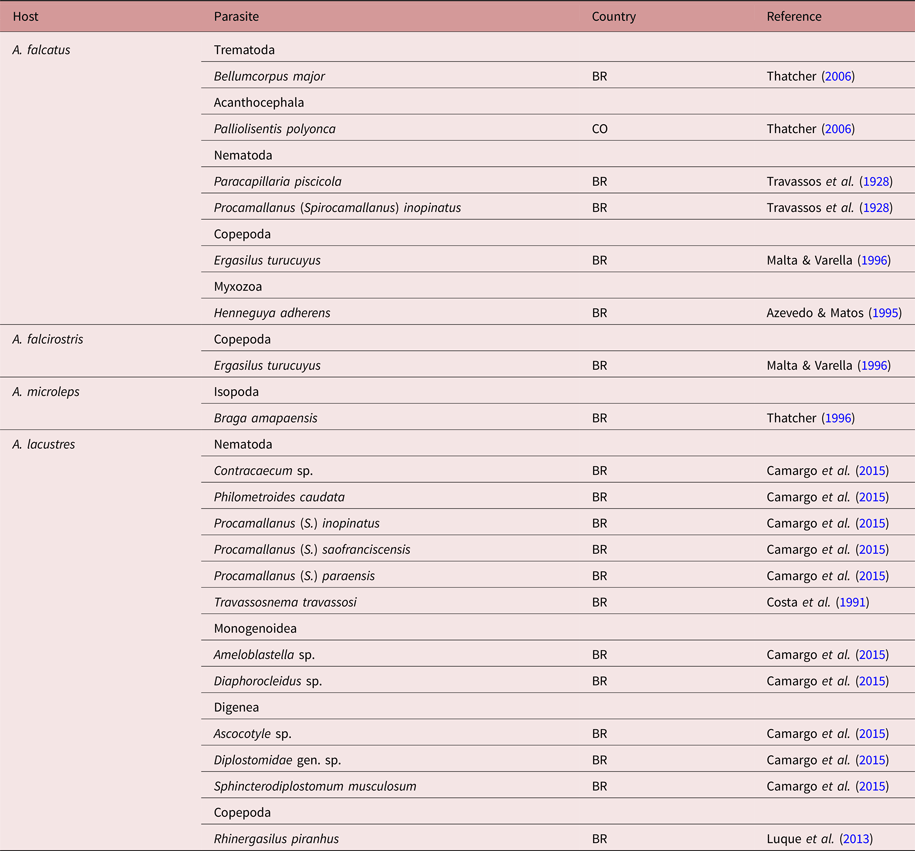
Members of the Acestrorhynchidae (Characiformes) are endemic and widely distributed in South American rivers. The greatest diversity of acestrorhynchids occurs in the Amazon and Orinoco basins (Menezes, Reference Menezes, Reis, Kullander and Ferraris2003). The family was proposed by Lucena & Menezes (Reference Lucena, Menezes, Malabarba, Reis, Vari, Lucena and Lucena1998) to accommodate Acestrorhynchus Eigenmann & Kennedy, 1903. Oliveira et al. (Reference Oliveira, Avelino, Abe, Mariguela, Benine, Ortí, Vari and Corrêa e Castro2011) also proposed that the family should be amplified and divided into three subfamilies: Acestrorhynchinae, Roestinae and Heterocharacinae (sensu Mirande, 2009) in order to accommodate six other genera of characiforms. Under this revised classification Acestrorhynchidae comprises 26 species from seven genera (Oliveira et al., Reference Oliveira, Avelino, Abe, Mariguela, Benine, Ortí, Vari and Corrêa e Castro2011; Nelson et al., Reference Nelson, Grand and Wilson2016), where Acestrorhynchus is the most diverse group, containing more than 19 nominal species of which 14 are considered valid (Menezes, Reference Menezes, Reis, Kullander and Ferraris2003; Toledo-Piza, Reference Toledo-Piza2007). Historically, only three species of Acestrorhynchus have been investigated for metazoan parasites, namely Acestrorhynchus falcatus (Bloch), A. falcirostris (Cuvier) and A. microlepis (Jardine). Together, these species are host to 20 metazoan parasite species, including a single acanthocephalan, isopod and myxozoan, 2 monogenoid, 3 copepod, 4 trematode and 8 nematode species (table 1). Although unidentified specimens belonging to Ameloblastella and Diaphorocleidus have been reported from acestrorhynchids, these reports are from fish from rivers in south-east Brazil (Camargo et al., Reference Camargo, Pedro, Pelegrini, Azevedo, Silva and Abdallah2015), and no monogenoids have previously been reported from acestrorhynchids in rivers of the Amazon Basin.
List of species of parasites from Acestrorhynchus spp.

Countries: BR, Brazil, CO, Colombia.
We investigated the monogenoidean parasites infecting A. falcatus that inhabit the streams and rivers of the coastal drainage ecosystem of the Amazon Basin in the State of Pará, Brazil. Two new species of Diaphorocleidus (Dactylogyridae) and one new species of a new genus of Dactylogyridae are described herein.
Materials and methods
Three specimens of A. falcatus were captured with the aid of a trammel net; two specimens along the Açaiteua River (North/North-east Atlantic Basin; Gurupi, Turiaçu Sub-basin), Vila Fátima, Municipality of Tracuateua, Pará, Brasil (1°07′45.00″S, 47°00′26.9″W) in August of 2014; and one specimen from the Cururutuia stream, Caeté River (North/North-east Atlantic Basin; Gurupi, Turiaçu Sub-basin), Municipality of Bragança, Pará, Brazil (1°4′44.55″S, 46°44′18.54″W) in December of 2014.
Gill arches were removed and placed in vials containing heated water (~65°C). Each vial was shaken vigorously and formalin was added to obtain a 5% solution. In the laboratory, the content of each vial was examined using a dissecting microscope (Leica S6D; Leica Microsystems, Wetzlar, Germany), and helminths were removed from the gills or sediment using dissection needles. Some specimens were stained with Gomori's trichrome (Humason, Reference Humason1979; Boeger & Vianna, Reference Boeger, Vianna and Thatcher2006) and mounted in Dammar gum to determine internal soft structures, and others were mounted in Hoyer's medium or Gray & Wess for the study of sclerotized structures (Humason, Reference Humason1979; Boeger & Vianna, Reference Boeger, Vianna and Thatcher2006).
The measurements, all given in micrometres, were obtained according to the procedures of Mizelle & Klucka (Reference Mizelle and Klucka1953). Dimensions of organs and other structures represent the greatest measurement in dorso-ventral view; lengths of curved or bent structures (anchors, bars and accessory piece) represent the straight-line distances between extreme ends; length of the male copulatory organ (MCO) was measured on drawing-tube images; total lengths were taken using FIJI/ImageJ 1.51d image analysis software (Rasband, Reference Rasband1997–2016), together with the plug-in WormBox (Vellutini & Marques, Reference Vellutini and Marques2011–2014). Each average measurement is followed by the range and the number (n) of specimens measured, in parentheses. Illustrations were prepared with the aid of a drawing tube on a Leica DM 2500 microscope with differential interference contrast and phase-contrast optics. Calculations of prevalence and mean intensity followed Bush et al. (Reference Bush, Lafferty, Lotz and Shostak1997). Type specimens and vouchers were deposited in the following collections: Helminthological Collection of the Instituto Oswaldo Cruz (CHIOC), Rio de Janeiro, RJ, Brazil; Invertebrate Collection of the Instituto de Pesquisas da Amazônia (INPA), Manaus, AM, Brazil; Invertebrate Collection of the Museu Paraense Emílio Goeldi (MPEG), Belém, PA, Brazil.
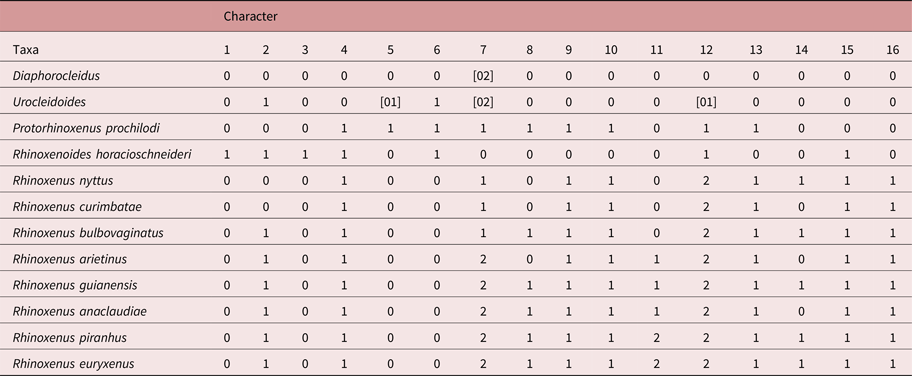
Sixteen characters were used for the phylogenetic analysis of ten terminals, which included Protorhinoxenus prochilodi Domingues & Boeger, 2002, Rhinoxenoides horacioschneideri n. gen. n. sp., and species of Rhinoxenus Kritsky, Thatcher & Boeger, 1988. Urocleidoides sensu stricto (s.s.) Mizelle & Price, 1964 and Diaphorocleidus Jogunoori, Kritsky & Venkatanarasaiah, 2004 were used as outgroups to root the cladogram. Characters in which the respective derived character represents an autapomorphy of a single ingroup taxon were included for definition of the generic diagnosis. The data matrix was constructed using the program Winclada (version 1.00.08; Nixon, Reference Nixon1999–2002). The phylogenetic analysis was performed with the program TNT (Goloboff et al., Reference Goloboff, Farris and Nixon2008), using implicit enumeration, as the tree search algorithm, and collapsing unsupported branches after search. Rooting and character optimization were verified using Winclada (version 1.00.08; Nixon, Reference Nixon1999–2002). Bremer support for the respective nodes was determined using the program TNT, using suboptimal trees with five additional steps (SUB 1, SUB2 , …, SUB5), increasing the number of suboptimal trees in each additional step (HOLD 1000, HOLD 2000, …, HOLD 5000). All characters were considered unordered and equally weighted.
Results
Systematics
Class: Monogenoidea Bychoswky, 1937
Subclass: Polyonchoinea Bychoswky, 1937
Order: Dactylogyroidea Bychoswky, 1937
Dactylogyridae Bychowsky, 1933
Diaphorocleidus Jogunoori, Kritsky & Venkatanarasaiah, 2004
Diaphorocleidus jaymedeloyolai n. sp.
Description
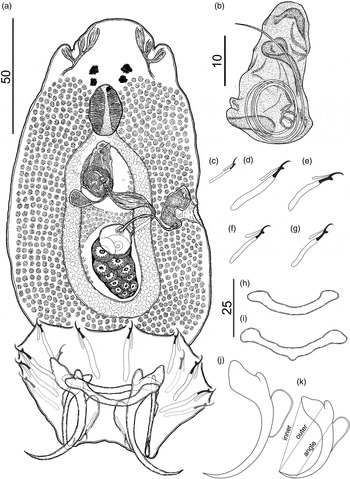
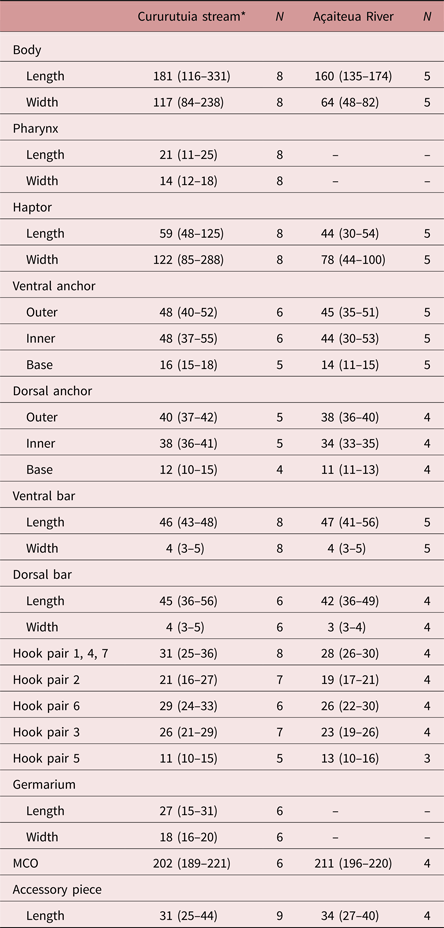
Based on 14 specimens, nine stained with Gomori's trichrome and five mounted in Hoyer's medium. Body 181 (116–331; n = 8) long, 117 (84–238; n = 8) wide at level of vagina, elongate, foliform, comprising cephalic region, trunk and haptor (fig. 1a). Tegument smooth. Anterior region with two lateral and one terminal cephalic lobes, moderately developed; three pairs of head organs; cephalic glands not observed. Two pairs of eyespots, equidistant; anterior pair longer than posterior pair; accessory granules present, ovate, dispersed in the cephalic region (fig. 1a). Mouth subterminal, midventral; pharynx muscular, ovate or subspherical 21 (11–25; n = 8) long, 14 (12–18; n = 8) wide; oesophagus short (fig. 1a). Two intestinal caeca, confluent posteriorly to gonads, lacking diverticula (fig. 1a). Common genital-pore opening mid-ventral, near level of caecal bifurcation (fig. 1a). Genital atrium muscular. Intercaecal gonads, overlapping; germarium ventral to testis (fig. 1a). Vas deferens looping left intestinal caecum; seminal vesicle sigmoid, short. Single prostatic reservoir, saccate, posterior to copulatory complex (fig. 1a). Copulatory complex comprising male copulatory organ (MCO), accessory piece (fig. 1b). MCO sclerotized, tubular, coiled counterclockwise, with approximately three coils, 202 (189–221; n = 6) long; base with sclerotized cap; circular sclerotized tandem brim associated with the base of the MCO (fig. 1b). Accessory piece sclerotized, non-articulated with the MCO, subtriangular, sheath-shaped 31 (25–44; n = 9) long (fig. 1b). Germarium pyriform, 27 (15–31; n = 6) long, 18 (16–20; n = 6) wide. Vagina opening ventrally at the left body margin, near body mid-length, comprising vaginal vestibule with slight sclerotization at proximal portion, heavily sclerotized at distal portion, cup-shape, vaginal canal sclerotized, elongated, straight (fig. 1a). Seminal receptacle spherical, at level of anterior margin of germarium, ventral (fig. 1a). Mehlis’ glands, ootype, egg not observed. Vitellarium dense throughout trunk, except in region of other reproductive organs (fig. 1a). Peduncle short. Haptor subhexagonal, 59 (48–125; n = 8) long, 122 (85–288; n = 8) wide (fig. 1a). Anchors similar with well-developed superficial root, subtriangular; poorly developed deep root; evenly curved shaft and point; point extending well past level of tip of inner base; anchor filament extending from the base to middle of shaft. Ventral anchor with angle of approximately 115°, outer 48 (40–52; n = 6) long, inner 48 (37–55; n = 6) long, base 16 (15–18; n = 5) (fig. 1j). Dorsal anchor with angle of approximately 95°, outer 40 (37–42; n = 5) long, inner 38 (36–41; n = 5) long, base 12 (10–15; n = 4) (fig. 1k). Ventral bar 46 (43–48; n = 8) long, broadly V-shaped with terminal enlargements, small postero-medial projection (fig. 1i). Dorsal bar 45 (36–56; n = 6) long, narrow, broadly U-shaped, with terminal enlargements (fig. 1h). Hooks similar in shape, shank divided into two subunits, proximal third of shank inflated; filamentous hook loop extending to near beginning of shank dilation, each with slightly erect thumb, lightly curved shaft, delicate point. Hook pairs 1, 4 and 7, 31 (25–36; n = 8) (fig. 1d); pair 2, 21 (16–27; n = 7) (fig. 1f); pair 6, 29 (24–33; n = 6) (fig. 1e); pair 3, 26 (21–29; n = 7) (fig. 1g); hook pair 5 smaller than other hooks, 11 (10–15; n = 5) long (fig. 1c).
Diaphorocleidus jaymedeloyolai n. sp. (a) Holotype, whole-mount (ventral view); (b) copulatory complex (ventral view); (c) hook pair 5; (d) hook pairs 1, 4 and 7; (e) hook pair 6; (f) hook pair 2; (g) hook pair 3; (h) dorsal bar; (i) ventral bar; (j) ventral anchor; (k) dorsal anchor. Scale bars: (a) 50 μm; (b) 10 μm; (c–k) 25 μm.

Taxonomic summary
Type host. Acestrorhynchus falcatus (Bloch, 1794).
Site of infection. Gills.
Type locality. Caeté River Basin, Municipality of Bragança, Pará, Brazil (1°4′44.55″S, 46°44′18.54″W) collected in December of 2014.
Other localities. Açaiteua River, Vila Fátima, Municipality of Tracuateua, Pará, Brazil (1°07′45.00″S, 47°00′26.9″W) collected in August of 2014.
Prevalence. 100% of the three hosts examined.
Mean intensity. 10.5 parasites per infected host.
Specimens deposited. Holotype: CHIOC 39021a. Twelve paratypes: CHIOC 39021b–g, INPA 754, MPEG 0127–0129. Four vouchers: CHIOC 39022–39023, INPA 755, MPEG 0130.
Etymology. The species is named in honour of the late Prof. Jayme de Loyola-Silva (1927–2017) in recognition and admiration of his dedication to research and the teaching of zoology to many generations of Brazilian zoologists.
Comparative measurements. See table 2.
Comparative measurements (in μm) of specimens of Diaphorocleidus jaymedeloyolai n. sp. from two localities.

*Type locality. MCO, male copulatory organ.
Remarks
Diaphorocleidus jaymedeloyolai n. sp. differs from its congeners by possessing an MCO with three counterclockwise coils, hook pairs 1, 4 and 7 approximately three times longer than hook pair 5; similar anchors with subtriangular superficial roots, and ventral bar with posteromedial projection.
Diaphorocleidus sclerocolpus n. sp.
Description
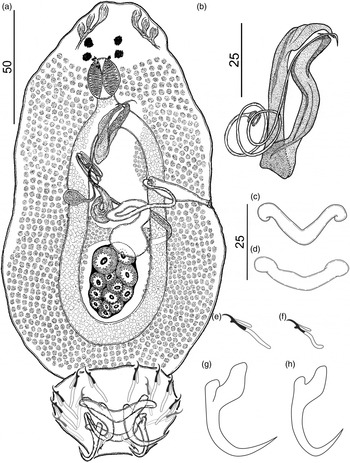
Based on 11 specimens, three mounted in Gomori's trichrome, three mounted in Hoyer's medium, five mounted in Gray & Wess. Body 160 (133–186; n = 10) long, 99 (70–120; n = 10) wide at anterior portion of germarium, elongate, foliform, comprising cephalic region, trunk and haptor (fig. 2a). Tegument smooth. Cephalic region broad; cephalic lobes inconspicuous; three pairs of head organs; cephalic glands not observed. Two pairs of eyespots, equidistant; anterior and posterior pairs similar in size; accessory granules present, ovate, slightly scattered in the cephalic region (fig. 2a). Mouth subterminal, midventral; pharynx muscular, ovate or subspherical 16 (13–19; n = 10) long, 14 (11–15; n = 10) wide; oesophagus short (fig. 2a). Two intestinal caeca, confluent posteriorly to gonads, lacking diverticula (fig. 2a). Common genital pore opening mid-ventral near level of caecal bifurcation. Genital atrium muscular. Intercaecal gonads overlapping; germarium ventral to testis (fig. 2a). Vas deferens looping left intestinal caecum; seminal vesicle sigmoid, short; distal portion looping anteriorly before entering base of MCO. Single prostatic reservoir, saccate, posterior to copulatory complex. Copulatory complex comprising MCO, accessory piece. MCO sclerotized, tubular, coiled counterclockwise, with approximately three coils, 158 (135–193; n = 8) long, base with sclerotized cap; circular sclerotized tandem brim associated with the base of the MCO (fig. 2b). Accessory piece sclerotized, non-articulated with the MCO, bifurcate, pincer-shaped, 47 (36–55; n = 8) long (fig. 2b). Germarium ovate to pyriform, 30 (28–34; n = 4) long, 21 (16–28; n = 4) wide. Vagina opening ventrally at the left body margin, near body mid-length, comprising vaginal vestibule heavily sclerotized, bottle-shape, vaginal canal sclerotized, elongate with proximal portion sigmoid, distal portion looping posteriorly before entering seminal receptacle (fig. 2a). Seminal receptacle subspherical, at level of anterior margin of germarium, ventral (fig. 2a). Mehlis’ glands, ootype, egg not observed. Vitellarium dense throughout trunk, except in region of other reproductive organs (fig. 2a). Peduncle short. Haptor hexagonal 14 (11–15; n = 10) long, 61 (58–67; n = 10) wide (fig. 2a). Anchors similar with well-developed superficial root, subtriangular; poorly developed deep root. Ventral anchor with curved shaft, elongate point extending past level of tip of superficial root, forming angle of approximately 98°, outer 28 (27–29; n = 8) long, inner 27 (26–29; n = 8) long, base 12 (10–14; n = 8) (fig. 2g). Dorsal anchor with arched shaft, point extending slightly past level of tip of superficial root, forming angle of approximately 65°, outer 26 (24–28; n = 6) long, inner 27 (24–29; n = 6) long, base 9 (8–11; n = 4) (fig. 2h). Ventral bar, 32 (29–35; n = 9) long, broadly V-shaped, with terminal enlargements (fig. 2c). Dorsal bar 31 (36–27; n = 9) long, U-shaped, with terminal enlargements (fig. 2d). Hooks similar in shape with shank divided into two subunits, delicate point, blade gently curved, thumb slightly erect; filamentous hook loop extending to near beginning of shank dilation. Hook pairs 1–4, 6–7, 18 (16–20; n = 17) long, with proximal half of shank inflated (fig. 2e); hook pair 5 smaller than other hooks, 10 (9–11; n = 2) long with proximal three-quarters of shank inflated (fig. 2f).
Diaphorocleidus sclerocolpus n. sp. (a) Holotype, whole-mount (ventral view); (b) copulatory complex (ventral view); (c) ventral bar; (d) dorsal bar; (e) hook pairs 1, 2, 3, 4, 6 and 7; (f) hook pair 5; (g) ventral anchor; (h) dorsal anchor. Scale bars: (a) 50 μm; (b) 25 μm; (c–h) 25 μm.

Taxonomic summary
Type host. Acestrorhynchus falcatus (Bloch, 1794).
Type locality. Cururutuia stream, Caeté River, Municipality of Bragança, Pará, Brazil (1°4′44.55″S, 46°44′18.54″W) collected in December 2014.
Specimens deposited. Holotype: CHIOC 39024a. Ten paratypes: CHIOC 39024b–f, INPA 756, MPEG 0131–0132.
Etymology. The specific name reflects the sclerotized nature of the vagina.
Remarks
Diaphorocleidus sclerocolpus n. sp. is morphologically similar in the structure of the copulatory complex to Diaphorocleidus petrosusi Mendoza-Franco, Aquirre-Macedo & Vidal-Martínez, 2007, but the new species differs by having an MCO with approximately three coils, whereas D. petrosusi has only one coil. The new species also differs from D. petrosusi by possessing both ventral and dorsal bars with blunt ends, while those of D. petrosusi have rounded ends.
Rhinoxenoides n. gen.
Diagnosis
Body comprising cephalic region, trunk and haptor. Tegument thin, smooth. Cephalic region with terminal cephalic lobe poorly developed. Bilateral pairs of head organs opening subterminal to tip of cephalic lobes; cephalic glands lateral or postero-lateral to pharynx. Eyes present (two pairs); accessory granules present. Mouth subterminal, midventral; pharynx muscular, glandular; oesophagus short. Two intestinal caeca, confluent posteriorly to gonads, lacking diverticula. Genital pore mid-ventral near level of caecal bifurcation. Genital atrium muscular. Gonads tandem, testis dorsal to germarium. Vas deferens looping left intestinal caecum before entering the male copulatory organ; seminal vesicle sigmoid, representing a dilation in the vas deferens. Copulatory complex comprising male copulatory organ, accessory piece; MCO sclerotized, spiral, clockwise; accessory piece sclerotized, articulated with the male copulatory organ. One prostatic reservoir, saccate. Germarium elongate. Vagina single; vaginal aperture sinistro-ventral, marginal opening at level of vitelline commissure; vaginal vestibule slightly sclerotized; vaginal canal sclerotized, sigmoid. Seminal receptacle present, anterior to germarium. Vitellaria well developed, coextensive with intestinal caeca. Haptor armed with 14 hooks (seven pairs) with ancyrocephaline distribution (Mizelle, Reference Mizelle1936). Pair of ventral and dorsal anchors; ventral anchors with well-defined roots. Dorsal anchor with superficial root twice as big as deep root. Ventral bar present; dorsal bar absent. Parasites of gills of Neotropical characiform fish.
Taxonomic summary
Type species. Rhinoxenoides horacioschneideri n. sp.
Etymology. The generic name reflects similarity of the new genus to Rhinoxenus Kritsky, Boeger & Thatcher, Reference Kritsky, Boeger and Thatcher1988.
Remarks
Rhinoxenoides n. gen. is characterized by the following: (1) MCO a coiled tube with clockwise rings articulated to the accessory piece by copulatory ligament; (2) dorsal anchor with superficial root twice as long as the deep root; straight shaft, curved point; and (3) dorsal bar absent. Rhinoxenoides n. gen. is similar to Rhinoxenus Kritsky, Boeger & Thatcher, Reference Kritsky, Boeger and Thatcher1988 and Protorhinoxenus Domingues & Boeger, 2002, mainly by sharing the general morphology of the copulatory complex and the shape of dorsal anchors. However, Rhinoxenoides n. gen. is different from members of both genera by the following: (1) anchors with conspicuous roots, without sclerotized cap in the base (inconspicuous roots and base with sclerotized cap in Protorhinoxenus and Rhinoxenus); (2) MCO with clockwise rings (counterclockwise rings in Protorhinoxenus and Rhinoxenus); and (3) base of the MCO conical surrounded by simple sclerotized ring (two circular sclerotized rings in tandem in Protorhinoxenus and Rhinoxenus).
Rhinoxenoides horacioschneideri n. sp.
Description
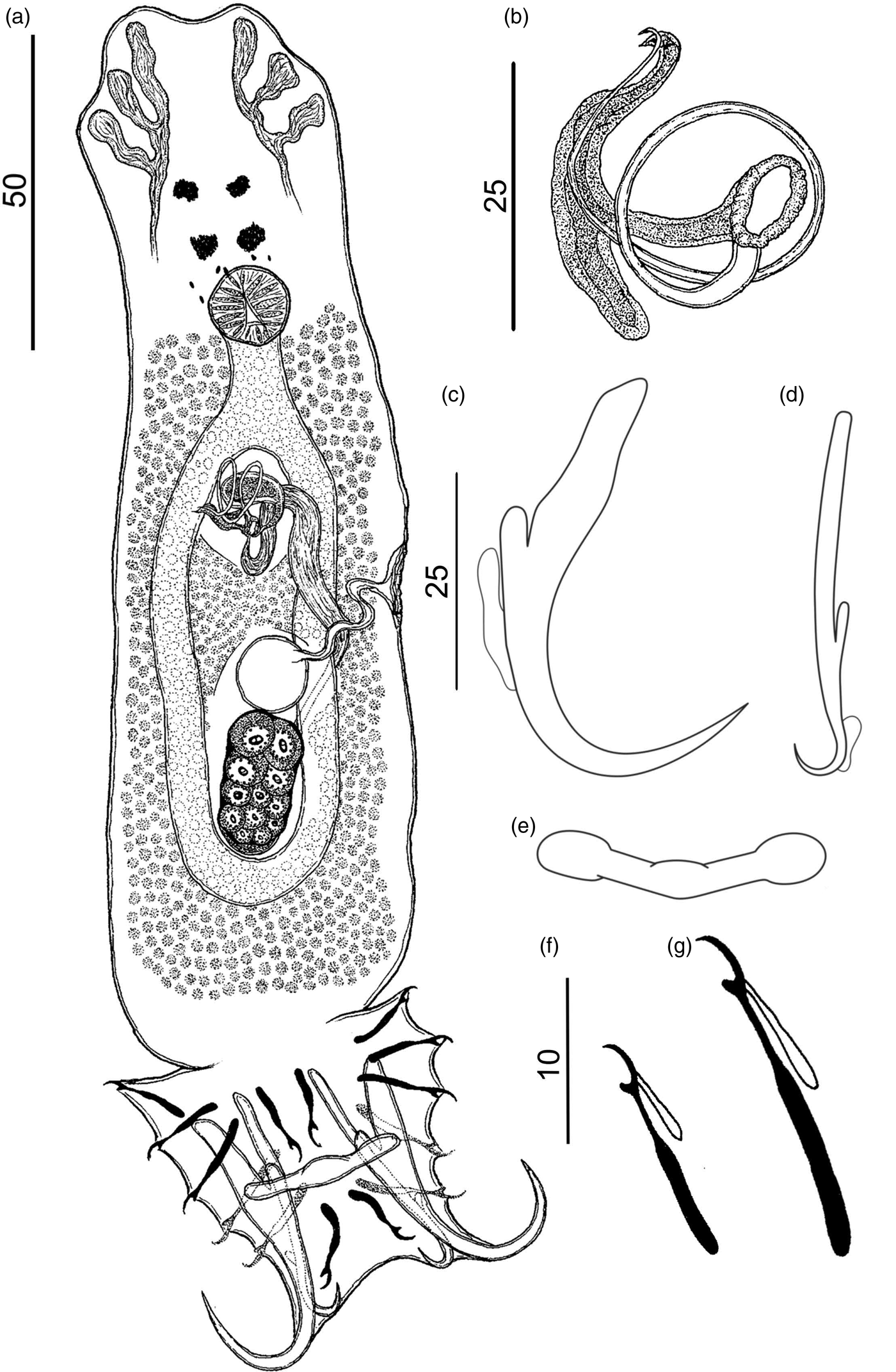
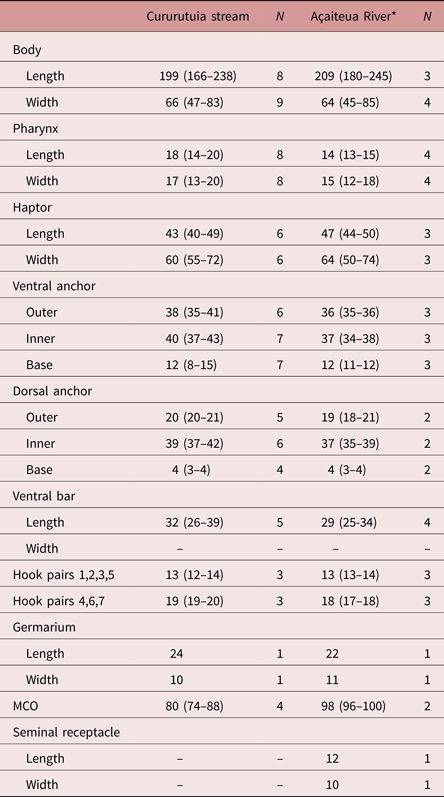
Based on four specimens, two mounted in Gomori's trichrome and two mounted in Gray & Wess. Body 209 (180–245; n = 3) long, 64 (45–85; n = 4) wide at level of germarium, elongate, fusiform. Anterior region with four cephalic lobes moderately developed, two terminals, two bilateral; three pair of head organs; cephalic glands not observed (fig. 3a). Two pairs of eyespots, equidistant, posterior pair longer than anterior pair; accessory granules present, elongated, slightly scattered in the cephalic region (fig. 3a). Pharynx subspherical 14 (13–15; n = 4) long, 15 (12–18; n = 4) wide. MCO with 2½ coils, 98 (96–100; n = 2) long; accessory piece comprising variable distal sheath with articulation process extending within coils to the base of MCO (fig. 3b). Prostatic reservoir pyriform, anterior to MCO (fig. 3a). Oviduct, Mehlis’ glands, uterus, eggs not observed. Germarium pyriform, 22 (n = 1) long, 11 (n = 1) wide. Vaginal vestibule cup-shaped, vaginal canal sigmoid; seminal receptacle spherical 12 (n = 1) long, 10 (n = 1) wide (fig. 3a). Haptor subrectangular to trapezoidal, 47 (44–50; n = 3) long, 64 (50–74; n = 3) wide (fig. 3a). Ventral anchor truncated with superficial root well developed, root deep, short, rounded; evenly curved shaft, point; forming angle of approximately 90°; point acute, extending well past level of tip of inner base; anchor filament extending from the base to middle of shaft, outer 36 (35–36; n = 3) long, inner 37 (34–38; n = 3) long, base 12 (11–12; n = 2) (fig. 3c). Dorsal anchor with superficial root twice as long as deep root; straight shaft; point short, forming an angle of approximately 60°; point hook-shaped; outer 19 (18–21; n = 2) long, inner 37 (35–39; n = 2) long, base 4 (3–4; n = 2) (fig. 3d). Ventral bar 29 (25–34; n = 4) long, V-shaped with terminal enlargements (fig. 3e). Hooks similar in shape, shank divided into two subunits, proximal one-third of shank inflated; filamentous hook loop extending to near beginning of shank dilation, each with erect thumb, curved long shaft, delicate point. Hook pairs 1–3 and 5, 13 (13–14; n = 3) long (fig. 3f); hook pairs 4, 6 and 7, 18 (17–18; n = 3) long (fig. 3g).
Rhinoxenoides horacioschneideri n. sp. (a) Holotype, whole-mount (ventral view); (b) copulatory complex (ventral view); (c) ventral anchor; (d) dorsal anchor; (e) ventral bar; (f) hook pairs 1, 2, 3 and 5; (g) hook pairs 4, 6 and 7. Scale bars: (a) 50 μm; (b–e) 25 μm; (f, g) 10 μm.

Taxonomic summary
Type host. Acestrorhynchus falcatus (Bloch, 1794).
Site of infestation. Gills.
Type locality. Açaiteua River, Municipality of Tracuateua, Pará, Brazil (1°07′45.00″S, 47°00′26.9″W), collected in August 2014.
Additional locality. Cururutuia stream, Caeté River), Municipality of Bragança, Pará, Brazil (1°4′44.55″S, 46°44′18.54″W), collected in December 2014.
Prevalence. 67% of three hosts examined.
Mean intensity. 6.5 parasites per infested host.
Specimens deposited. Holotype: CHIOC 39025a. Three paratypes: CHIOC 39025b–c, 39026. Nine vouchers: CHIOC 39027a–d, INPA 757, MPEG 0133–0134.
Etymology. The specific name is in honour of Dr Horácio Schneider of the Federal University of Pará, Brazil, in recognition of his valuable work on Amazonian biodiversity and also for being responsible for stimulating research in the eastern Amazon over the past three decades.
Comparative measurements. See table 3.
Comparative measurements (in μm) of specimens of Rhinoxenoides horacioschneideri n. sp. from two localities.

*Type locality. MCO, male copulatory organ.
Remarks
The new species is characterized by the following: (1) ventral anchor with superficial truncated root, which is well developed; (2) prostate reservoir is not divided into zones; (3) vagina sinistral–ventral, not sclerotized; (4) dorsal anchor with well-developed superficial root comprising more than 50% of total length; and (5) dorsal bar with enlarged ends.
Phylogeny
Character analysis
Characters used in the analysis are described as follows: character definition, consistency indices (CI; Kluge & Farris, Reference Kluge and Farris1969) and retention indices (RI; Farris, Reference Farris1989) between square brackets, and assigned character states (codes within parentheses). The character matrix used for this analysis is presented in table 4. In the following, ‘figs’ indicates figures in the present paper and ‘Figs’, figures in cited references.
Character matrix to reconstruct evolutionary relationships of Protorhinoxenus, Rhinoxenoides and species of Rhinoxenus. For definitions of character numbers 1–16, refer to Character analysis in the Results section; numbers in square brackets refer to polymorphic characters.

Character 1. MCO coil [CI 100; RI 0]. (0) Counterclockwise (figs 1b, 2b; Kritsky et al. (Reference Kritsky, Thatcher and Boeger1986), Figs 3, 12; Kritsky et al. (Reference Kritsky, Boeger and Thatcher1988), Figs 3, 11–12, 21; Domingues & Boeger (Reference Domingues and Boeger2002), Fig. 2; Domingues & Boeger (Reference Domingues and Boeger2005), Figs 1C, D, F, 2B, 3A; Ferreira et al. (Reference Ferreira, Rodrigues, Cunha and Domingues2017), Figs 1b, 2a, 3a, 4a); (1) clockwise (fig. 3b). A clockwise MCO is autapomorphic for Rhinoxenoides n. gen.
Character 2. MCO rings [CI 33; RI 33]. (0) MCO with more than three rings (figs 1b, 2b; Kritsky et al. (Reference Kritsky, Boeger and Thatcher1988), Fig. 21; Domingues & Boeger (Reference Domingues and Boeger2002), Fig. 2; Domingues & Boeger (Reference Domingues and Boeger2005), Figs 1C, 3A); (1) MCO with fewer than three rings (fig. 3b; Kritsky et al. (Reference Kritsky, Thatcher and Boeger1986), Figs 3, 12; Kritsky et al. (Reference Kritsky, Boeger and Thatcher1988), Figs 3, 11–12; Boeger et al. (Reference Boeger, Domingues and Pavanelli1995), Fig. 2; Domingues & Boeger (Reference Domingues and Boeger2005), Figs 1D, 1F, 2B, 3G, 4C; Ferreira et al. (Reference Ferreira, Rodrigues, Cunha and Domingues2017), Figs 1b, 2a, 3a, 4a).
Character 3. Circular, tandem, sclerotized brims of MCO [CI 100; RI 0]. (0) Present (figs 1b, 2b; Domingues & Boeger (Reference Domingues and Boeger2002), Fig. 2; Domingues & Boeger (Reference Domingues and Boeger2005), Figs 1A, C, D, F, 2B, 3 A, G, 4C; Ferreira et al. (Reference Ferreira, Rodrigues, Cunha and Domingues2017), Figs 1b, 2a, 3a, 4a); (1) absent (fig. 3b). The absence of circular, tandem, sclerotized brims is autapomorphic for Rhinoxenoides n. gen.
Character 4. MCO/accessory piece articulation process [CI 100; RI 100]. (0) Absent (figs 1b, 2b; Ferreira et al. (Reference Ferreira, Rodrigues, Cunha and Domingues2017), Figs 1b, 2a, 3a, 4a); (1) present (fig. 3b; Kritsky et al. (Reference Kritsky, Boeger and Thatcher1988), Figs 3, 11–12, 21; Domingues & Boeger (Reference Domingues and Boeger2002), Fig. 2; Domingues & Boeger (Reference Domingues and Boeger2005), Figs 1A, C, D, F, 2B, 3A, G, 4C).
Character 5. Vagina [CI 100; RI 0]. (0) Sinistral (figs 1a, 2a, 3a; Kritsky et al. (Reference Kritsky, Thatcher and Boeger1986), Fig. 1; Kritsky et al. (Reference Kritsky, Boeger and Thatcher1988), Figs 1–2, 9, 18; Domingues & Boeger (Reference Domingues and Boeger2005), Figs 2F, 4A; Ferreira et al. (Reference Ferreira, Rodrigues, Cunha and Domingues2017), Figs 2b, 3b, 4b); (1) dextral (Kritsky et al. (Reference Kritsky, Thatcher and Boeger1986), Fig. 10; Domingues & Boeger (Reference Domingues and Boeger2002), Fig. 1). This character seems to be polymorphic for the Urocleidoides. Kritsky et al. (Reference Kritsky, Thatcher and Boeger1986) observed that Urocleidoides paradoxus (s.s.) Kritsky, Thatcher & Boeger, Reference Kritsky, Thatcher and Boeger1986 presents a dextral vaginal opening different from those observed in the other species of the genus. A dextral vaginal opening in the ingroup represents an automorphic feature for Protorhinoxenus.
Character 6. Vaginal vestibule [CI 50; RI 50]. (0) Heavily sclerotized (figs 1a, 2a; Kritsky et al. (Reference Kritsky, Boeger and Thatcher1988), Figs 1–2, 9, 18; Boeger et al. (Reference Boeger, Domingues and Pavanelli1995), Fig. 3; Domingues & Boeger (Reference Domingues and Boeger2005), Figs 1B, 2E, 3B, H, 4B); (1) soft to slightly sclerotized (fig. 3a; Domingues & Boeger (Reference Domingues and Boeger2002), Fig. 3; Ferreira et al. (Reference Ferreira, Rodrigues, Cunha and Domingues2017), Fig. 2b, 3b).
Character 7. Vaginal canal [CI 100; RI 100]. (0) Sinuous without looping (fig. 1a, 3a; Kritsky et al. (Reference Kritsky, Thatcher and Boeger1986), Fig. 10); (1) sinuous with more than one loop (Kritsky et al. (Reference Kritsky, Thatcher and Boeger1986), Fig. 1; Kritsky et al. (Reference Kritsky, Boeger and Thatcher1988), Fig. 18; Domingues & Boeger (Reference Domingues and Boeger2002), Fig. 3; Domingues & Boeger (Reference Domingues and Boeger2005), Fig. 3B); (2) sinuous with only one loop (fig. 2a; Kritsky et al. (Reference Kritsky, Thatcher and Boeger1986), Fig. 1; Kritsky et al. (Reference Kritsky, Boeger and Thatcher1988), Figs 1–2, 9; Boeger et al. (Reference Boeger, Domingues and Pavanelli1995), Figs 1, 3; Domingues & Boeger (Reference Domingues and Boeger2005), Figs 1B, 2E, 3H, 4B; Ferreira et al. (Reference Ferreira, Rodrigues, Cunha and Domingues2017), Figs 2a, 3b, 4b). This character seems to be polymorphic for Diaphorocleidus and Urocleidoides (s.s.).
Character 8. Shape of ventral anchor [CI 33; RI 60]. (0) Shaft and point similar (fig. 1j, 2g, 3c; Kritsky et al. (Reference Kritsky, Thatcher and Boeger1986), Figs 8, 17; Kritsky et al. (Reference Kritsky, Boeger and Thatcher1988), Figs 17, 24; Domingues & Boeger (Reference Domingues and Boeger2005), Figs 1E, 3C); (1) shaft longer than point (Domingues & Boeger (Reference Domingues and Boeger2002), Fig. 9; Boeger et al. (Reference Boeger, Domingues and Pavanelli1995), Fig. 5; Kritsky et al. (Reference Kritsky, Boeger and Thatcher1988), Fig. 8; Domingues & Boeger (Reference Domingues and Boeger2005), Figs 2H, 3L, 4G).
Character 9. Sclerotized cap in the anchors with projection for articulation to ventral bar [CI 100; RI 100]. (0) Absent (figs 1j, 2g, 3c; Ferreira et al. (Reference Ferreira, Rodrigues, Cunha and Domingues2017), Figs 1G, 2H, 3G, 4G); (1) present (Kritsky et al. (Reference Kritsky, Boeger and Thatcher1988), Figs 8, 17, 24; Domingues & Boeger (Reference Domingues and Boeger2002), Fig. 3; Domingues & Boeger (Reference Domingues and Boeger2005), Figs 1E, 2H, 3C, L, 4G).
Character 10. Roots of ventral anchors [CI 100; RI 100]. (0) Present (figs 1j, 2g, 3c; Kritsky et al. (Reference Kritsky, Boeger and Thatcher1988), Fig. 17; Ferreira et al. (Reference Ferreira, Rodrigues, Cunha and Domingues2017), Figs 1g, 2h, 3g, 4g); (1) absent (Kritsky et al. (Reference Kritsky, Boeger and Thatcher1988), Fig. 8; Domingues & Boeger (Reference Domingues and Boeger2002), Fig. 3; Domingues & Boeger (Reference Domingues and Boeger2005), Figs 1E, 2H, 3C, L, 4G).
Character 11. Point of ventral anchor [CI 100; RI 100]. (0) Acute (figs 1j, 2g, 3c; Kritsky et al. (Reference Kritsky, Thatcher and Boeger1986), Figs 8, 17; Kritsky et al. (Reference Kritsky, Boeger and Thatcher1988), Fig. 24; Boeger et al. (Reference Boeger, Domingues and Pavanelli1995), Fig. 5; Domingues & Boeger (Reference Domingues and Boeger2002) Fig. 9; Domingues & Boeger (Reference Domingues and Boeger2005), Figs 1E, 3C); (1) blunt (Kritsky et al. (Reference Kritsky, Boeger and Thatcher1988), Fig. 17; Domingues & Boeger (Reference Domingues and Boeger2005), Figs 3L, 2H); (2) flattened (Kritsky et al. (Reference Kritsky, Boeger and Thatcher1988), Fig. 8, Domingues & Boeger (Reference Domingues and Boeger2005), Fig. 4G).
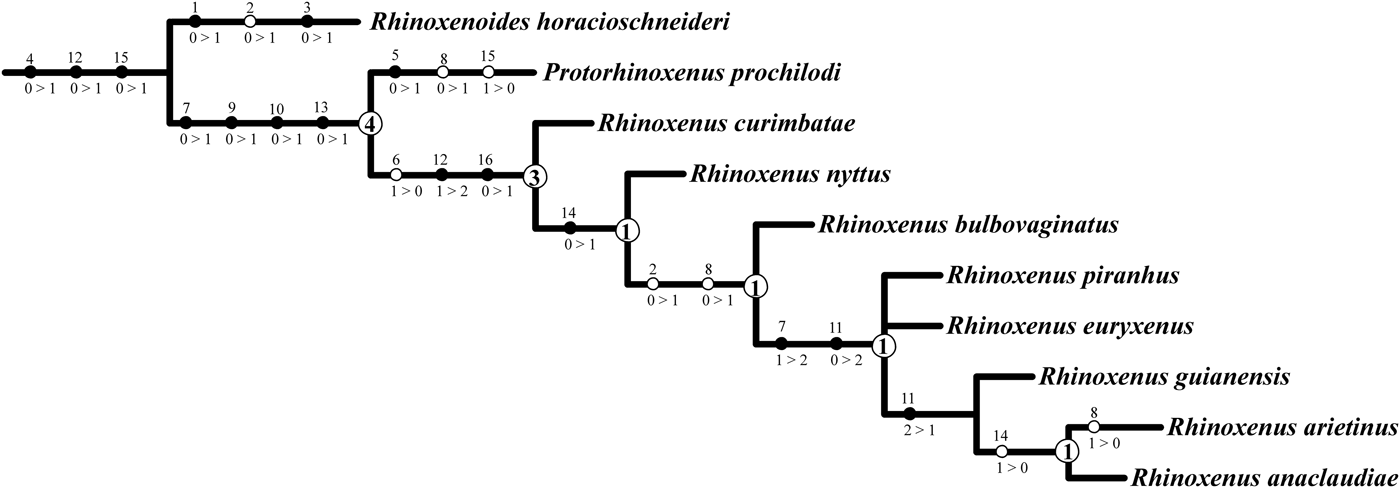
Phylogenetic hypothesis for members of three genera of Dactylogyridae, including one new genus proposed, based on 16 morphological characters. Tree length = 24; consistency index = 73; retention index = 79. Numbers above the branches indicate the respective characters. Numbers below the branches refer to postulated evolutionary changes. Filled circles on the branches indicate a synapomorphic or autapomorphic character state, open circles on the branches indicate a homoplastic character state. Open circles with a number on the nodes of the ingroup indicate Bremer support.

Character 12. Shape of dorsal anchors [CI 100; RI 100]. (0) Evenly curved shaft and point (figs 1k, 2h; Ferreira et al. (Reference Ferreira, Rodrigues, Cunha and Domingues2017), Figs 1f, 2g, 3g, 4g); (1) shaft straight/slightly curved, longer than point (fig. 3d; Kritsky et al. (Reference Kritsky, Thatcher and Boeger1986), Figs 9, 18; Domingues & Boeger (Reference Domingues and Boeger2002), Fig. 8); (2) spike-like (Kritsky et al. (Reference Kritsky, Boeger and Thatcher1988), Figs 5, 16, 22; Boeger et al. (Reference Boeger, Domingues and Pavanelli1995), Fig. 8; Domingues & Boeger (Reference Domingues and Boeger2005), Figs 2G, 3H, M, 4H). This character seems to be polymorphic for Urocleidoides (s.s.).
Character 13. Root of dorsal anchors [CI 100; RI 100]. (0) Present (fig. 1k, 2h, 3d; Ferreira et al. (Reference Ferreira, Rodrigues, Cunha and Domingues2017), Figs 1h, 2i, 3h, 4h); (1) absent (Kritsky et al. (Reference Kritsky, Boeger and Thatcher1988), Figs 5, 16, 22; Boeger et al. (Reference Boeger, Domingues and Pavanelli1995), Fig. 8; Domingues & Boeger (Reference Domingues and Boeger2002), Fig. 8; Domingues & Boeger (Reference Domingues and Boeger2005), Figs 2G, 3D, M, 4H).
Character 14. Ventral bar [CI 50; RI 75]. (0) Bar with extremities lightly expanded (figs 1i, 2c, 3e; Kritsky et al. (Reference Kritsky, Thatcher and Boeger1986), Figs 6, 15; Kritsky et al. (Reference Kritsky, Boeger and Thatcher1988), Fig. 13; Domingues & Boeger (Reference Domingues and Boeger2002), Fig. 4; Domingues & Boeger (Reference Domingues and Boeger2005), Figs 2F, 3C, 3K; Ferreira et al. (Reference Ferreira, Rodrigues, Cunha and Domingues2017), Figs 1c, 2d, 3e, 4c); (1) bar with projections for articulation with ventral anchor (Kritsky et al. (Reference Kritsky, Boeger and Thatcher1988), Figs 4, 23; Boeger et al. (Reference Boeger, Domingues and Pavanelli1995), Fig. 4; Domingues & Boeger (Reference Domingues and Boeger2005), Figs 3K, 4F).
Character 15. Dorsal bar [CI 50; RI 50]. (0) Present (figs 1a, 2a; Domingues & Boeger (Reference Domingues and Boeger2002), Fig. 1); (1) absent (fig. 3a, Kritsky et al. (Reference Kritsky, Boeger and Thatcher1988), Figs 1, 9, 18; Domingues & Boeger (Reference Domingues and Boeger2002), Fig. 1; Domingues & Boeger (Reference Domingues and Boeger2005), Figs 2A, 4A). This character has ambiguous distribution for the clade composed of Protorhinoxenus, Rhinoxenoides and Rhinoxenus. The state ‘absence of dorsal bar’ sometimes appears as a synapomorphy for the three taxa (ACCTRAN optimization) with a reversion in Protorhinoxenus, or the dorsal bar seems to have been lost independently in Rhinoxenoides and Rhinoxenus (DELTRAN optimization).
Character 16. Hook pair 2 [CI 100; RI 100]. (0) Located within haptor (fig. 1a, 2a, 3a; Kritsky et al. (Reference Kritsky, Thatcher and Boeger1986), Figs 1, 10; Domingues & Boeger (Reference Domingues and Boeger2002), Fig. 1); (1) located in two bilateral lobes in trunk (Kritsky et al. (Reference Kritsky, Boeger and Thatcher1988), Figs 1, 9, 18; Domingues & Boeger (Reference Domingues and Boeger2005), Figs 2A, 4A, 3B–H, 4B).
The phylogenetic hypothesis depicted in fig. 4 is one of two most parsimonious trees produced through the program TNT 1.0 using 16 morphological characters (table 4) (length = 24; CI = 73; RI = 79). According to the hypothesis, Rhinoxenoides horacioschneideri is sister taxon to the clade that includes all other species. Protorhinoxenus and species of Rhinoxenus are sister taxa, based on: (1) vaginal canal without loops (character 7); (2) the presence of sclerotized cap on the base of anchors (character 9); and the absence of roots on the dorsal anchors (character 13).
All species of Rhinoxenus form a clade, supported by the sharing the presence of (1) a heavily sclerotized vaginal vestibule; (2) spike-like dorsal anchors; and (3) hook pair 2 located in two bilateral lobes in the trunk. The sister group relationships within species of Rhinoxenus presented in fig. 4 differ from the relationships of the other equally parsimonious tree by the relative position of R. guianensis Domingues & Boeger, 2005, R. piranhus Kritsky Boeger & Thatcher, Reference Kritsky, Boeger and Thatcher1988, R. euryxenus Domingues & Boeger, 2005, and the clade R. arietinus Kritsky Boeger & Thatcher, Reference Kritsky, Boeger and Thatcher1988 + R. anaclaudiae Domingues & Boeger, 2005. This variation is apparently related to the multi-state character ‘point of ventral anchor’. The tree presented in fig. 4 suggests that the point of ventral anchor evolved from the plesiomorphic character state ‘acute’ into ‘flattened’ and to ‘blunt’. The last character state appears as synapomorphy uniting R. guianensis and the clade ‘R. arietinus + R. anaclaudiae’. In the other tree, the plesiomorphic character state evolved into ‘blunt’ and to ‘flattened’, where the presence of a flattened point of the ventral anchor arises as synapomorphy for R. piranhus and R. euryxenus.
Our hypothesis differs significantly from that proposed by Domingues & Boeger (Reference Domingues and Boeger2005) on the sister-group relationship within species of Rhinoxenus. The previous hypothesis (Domingues & Boeger, Reference Domingues and Boeger2005) suggests that the clade composed by Rhinoxenus nyttus and R. curimbatae appears as the sister group of all other congeneric species. In the present hypothesis, R. curimbatae appears as the sister group of the clade D (fig. 4). Domingues & Boeger (Reference Domingues and Boeger2005) suggest that R. arietinus is sister group of R. guianensis, R. anaclaudiae, R. piranhus and R. euryxenus. However, in our hypothesis, R. arietinus is sister taxon of R. anaclaudiae in the clade H, while R. guianensis appears as sister taxon of clade H, R. piranhus and R. euryxenus, or in a polytomy with clade H and the clade composed by R. piranhus + R. euryxenus (see comments above).
Discussion
Diaphorocleidus Jogunoori, Kritsky & Venkatanarasaiah, 2004 was proposed by Jogunoori et al. (Reference Jogunoori, Kritsky and Venkatanarasaiah2004) to accommodate their new species, Diaphorocleidus armillatus Jogunoori, Kritsky & Venkatanarasaiah, 2004, and three other species previously referred as members of Urocleidoides sensu lato (s.l.): Diaphorocleidus affinis (Mizelle, Kritsky & Crane, Reference Mizelle, Kritsky and Crane1968), D. kabatai (Molnar, Hanek & Fernando, 1974) and D. microstomus (Mizelle, Kritsky & Crane, Reference Mizelle, Kritsky and Crane1968) (see Jogunoori et al., Reference Jogunoori, Kritsky and Venkatanarasaiah2004).
Except for D. kabatai, D. orthodusus Mendoza-Franco, Reina & Torchin, 2009, D. petrosusi Mendoza-Franco, Aguirre-Macedo & Vidal-Martínez, 2007, described from characid fish from Central America and/or south-east Mexico, and D. armillatus introduced to India, via the aquarium trade (Mizelle et al., Reference Mizelle, Kritsky and Crane1968; Molnar et al., Reference Molnar, Hanek and Fernando1974; Jogunoori et al., Reference Jogunoori, Kritsky and Venkatanarasaiah2004; Mendoza-Franco et al., Reference Mendoza-Franco, Aguirre-Macedo and Vidal-Martínez2007, Reference Mendoza-Franco, Reina and Torchin2009), only three species of this genus have been described for characiform fish from South America: D. affinis from Bryconops affinis (Günther) (Characidae), D. altamirensis Moreira, Scholz & Luque, 2016 from Argonectes robertsi Langeani (Hemiodontidae) and D. microstomus from Hemigrammus microstomus Durbin (Characidae). Camargo et al. (Reference Camargo, Pedro, Pelegrini, Azevedo, Silva and Abdallah2015) reported some specimens of Diaphorocleidus parasitizing the gills of Acestrorhynchus lacustris (Lütken) collected from the Peixe River, São Paulo. However, since these materials were not available for comparative study, we cannot make any suggestions about the real taxonomic status of these specimens. The two new species described herein, D. jaymedeloyolai and D. sclerocolpus, represent the first described species of monogenoids from acestrorhynchids and increase our knowledge of this parasite genus for the eastern Amazon Basin, together with the species D. altamirensis already described from the Xingu River.
Domingues & Boeger (Reference Domingues and Boeger2002) proposed Protorhinoxenus, and indicated that it could be closely related to Rhinoxenus. Members of the two genera share the presence of a coiled MCO with counterclockwise coils, absence of superficial and deep roots in both pairs of anchors, and dorsal anchors with elongate and straight shaft. Rhinoxenus also resembles Rhinoxenoides proposed herein, mainly by sharing the absence of dorsal bar, which is present in Protorhinoxenus.
In our cladistic hypothesis, Protorhinoxenus, Rhinoxenoides and species of Rhinoxenus share the presence of a copulatory ligament and dorsal anchors with a straight long shaft. Protorhinoxenus and species of Rhinoxenus are closely related, based on the presence of a sclerotized cap on the base of ventral anchors and the absence of roots on the dorsal anchors. Also, in the present hypothesis, the presence/absence of a dorsal bar in Rhinoxenoides, Protorhinoxenus and Rhinoxenus is ambiguous and could be interpreted as an independent secondary loss in Rhinoxenoides and Rhinoxenus, or its absence could be shared by the three genera as a synapomorphy with secondary acquisition in Protorhinoxenus.
According to the present knowledge on the diversity of monogenoids from the Neotropics, species of Protorhinoxenus, Rhinoxenoides and Rhinoxenus seem to be exclusively found infecting characiform fishes from South America. Unlike Rhinoxenoides, members of the two other genera are not restricted to members of one host genus, as reported for other monogenoidean genera occurring in characiforms (i.e. Anacanthoroides Kritsky & Thatcher, 1976; Ancistrohaptor Agarwal & Kritsky, 1998; Apedunculata Cuglianna, Cordeiro & Luque, 2009; Characithecium Mendoza-Franco, Reina & Torchin, 2009; Curvianchoratus Hanek, Molnar & Fernando, 1974; Linguadactyloides Thatcher & Kritsky, 1983; Monocleithrium Price & McMahon, 1966; Notothecioides Kritsky, Boeger & Jégu, 1997; Odothecium Kritsky, Boeger & Jégu, 1997; Palombitrema Price & Bussing, 1968), or to one host family (i.e. Amphithecium Boeger & Kritsky, 1988; Cacatuocotyle Boeger, Domingues & Kritsky, 1997; Calpidothecioides Kritsky, Boeger & Jégu, 1997; Calpidothecium Kritsky, Boeger & Jégu, 1997; Enallothecium Kritsky, Boeger & Jégu, 1998; Heterothecium Kritsky, Boeger & Jégu, 1997; Mymarothecium Kritsky, Boeger & Jégu, 1996; Notothecium Boeger & Kritsky, 1988; Pithanothecium Kritsky, Boeger & Jégu, 1997). The monotypic, Protorhinoxenus prochilodi Domingues & Boeger, 2002 is reported from the gills of fishes from the families Erythrinidae and Prochilodontidae (Domingues & Boeger, Reference Domingues and Boeger2002), whereas species of Rhinoxenus are found parasitizing the nasal cavities of Anostomidae, Characidae, Curimatidae, Prochilodontidae and Serrasalmidae (Domingues & Boeger, Reference Domingues and Boeger2005). Furthermore, several undescribed species of Rhinoxenus are reported from Cynodontidae and Erythrinidae (Domingues & Boeger, Reference Domingues and Boeger2005; Santos Neto et al., Reference Santos-Neto, Rodrigues and Domingues2015).
Domingues & Boeger (Reference Domingues and Boeger2005) suggested that the origins of some lineages of Rhinoxenus were associated with events of co-speciation with the ancestors of their respective characiform host families. However, the co-evolutionary analysis suggested that events of duplication, dispersion and extinction were also required to explain the observed host–parasite association. The occurrence of Protorhinoxenus into two phylogenetically distant characiform host families also supports the hypothesis that co-speciation is not the only event associated with these associations. Concerning the relevance of these host–parasite associations, we believe that a more extensive study, based on denser sampling for monogenoidean parasites of members of all characiform families and cladistics studies, is required.
Acknowledgements
We would like to thank Laís Araújo, Derlan José, Matheus Watanabe and Renan Reis for assistance during the collecting trips; and David Vaughan (James Cook University, Townsville, Australia) for a review of the manuscript before submission.
Financial support
This work was supported partially by an M.Sc. Scholarship and collecting trip grant from Programa de Pós-Graduação em Biologia Ambiental da Universidade Federal do Pará to J.F.S.-N.; and research grants from the Conselho Nacional de Desenvolvimento Científico e Tecnológico (CNPq) (PROTAX no. 001/2015–440526/2015-9) to M.V.D.
Conflict of interest
None.
Ethical standards
Specimens were collected under the license for collection of biological material (43381) granted by the Instituto Chico Mendes de Conservação da Biodiversidade (ICMBio).