I. INTRODUCTION
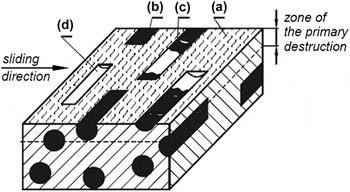
Current scenario pertaining to the depletion and high cost of the metal supply had spurred scientists globally to seek and search for other green and innovative substitute over the nonconventional raw materials.Reference El-Sayed, El-Sherbiny, Abo-El-Ezz and Aggag1 Polymeric matrices reinforced with glass and carbon fibers were developed for numerous mechanical and tribological purposes, such as seals, gears, bearings, and camsReference Zhou, Zhang, Wu and Huang2–Reference Friedrich, Zhang and Schlarb5 to replace metallic materials owning to their attractive combination of lightweight, economic fabrication, good chemical resistance, and low friction coefficient. The feature that makes polymer composites so promising in industrial applications is the possibility of tailoring their properties with functional fillers.Reference Zhou, Zhang, Wu and Huang2 Fillers, in the form of particulates and fibers, are often added to polymeric materials to improve their stiffness and strength. This second phase filler material will influence the wear resistance of the composite material. The interactions of fiber fillers in polymer compositesReference Tanaka and Kawakami3 are a separate problem. In these materials, four processes of product removal dominate; (i) wear of the polymer matrix, (ii) abrasive wear of fibers, (iii) cracking and (iv) spalling of fibers and separation of fibers from the matrix. The removal of fibers from the matrix causes an increase in the matrix wear due to the weakening of the material at this place. Additionally, particles of the removed fiber get to the friction zone and start abrasion wear. The model of this mechanism is shown in Fig. 1.Reference Wieleba4 When the direction of fiber orientation is parallel to the line of loading in the friction mode, the fibers participate in the transfer of load from the friction zone. Usually, the polymer matrix has lesser value of the modulus of longitudinal stiffness. That is why, when assuming equal strains, a difference in the longitudinal stresses in the matrix and in the fibers occurs. It shall be noted that the higher the ratio length/radius (longer fibers), the more effective the composite strengthening. The above considerations witness to a significant role of fibers in this process.Reference Tanaka and Kawakami3
Model of the wear mechanism of thermoplastic composites containing short cut fibersReference Wieleba4 (a) polymer matrix (b) fiber (c) fiber ruptures (d) cavities after the removed fiber.

Carbon fiber reinforcement dominates high performance applications due to its outstanding mechanical properties combined with lightweight characteristic. The reinforcements play a major role in maintaining strength, stiffness, thermal stability, and frictional properties of a composite material.Reference Li and Xia6,Reference Khun, Zhang, Lim, Yue, Hu and Yang7 There are many references that illustrate the influence of fillers and fiber reinforcement on the abrasive wear resistance of polymeric composites.Reference Zhou, Zhang, Wu and Huang2–Reference Li and Xia6 Fiber reinforcements, e.g., carbon, glass, and aramid fibers, are the main candidates and have been widely used. The incorporation of fiber reinforcement proved to improve the wear resistance and coefficient of friction (COF).Reference Khun, Zhang, Lim, Yue, Hu and Yang7–Reference Briscoe and Sinha13 Many investigations were carried out to further understand its modifications in the tribological behavior of the polymers with the addition of fillers or fiber reinforcements.Reference Zhou, Zhang, Wu and Huang2,Reference Li and Xia6 However, most of the present studies were only focusedReference Li and Xia6,Reference Khun, Zhang, Lim, Yue, Hu and Yang7 on mechanical or tribological properties of virgin fiber reinforced polymer composites yet very few deal with recycled carbon fiber reinforced polymeric matrix. Thus, in this research, the potential of recycled carbon fiber reinforced thermoplastic based composites in tribology was studied. Moreover, the effect of extracting the recycled carbon fibers from its impregnated resins was emphasized.
II. METHODOLOGY
A. Materials
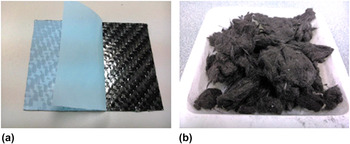
The polypropylene (PP) used in this research is PP homopolymer (TITANPRO 6531, isotactic type; Lotte Chemical Titan Holding Sdn. Bhd., Johor Bahru, Malaysia) with a specified melt flow index of 6 g/min. Recycled carbon fiber prepreg (rCFP) was supplied by local aerocomposites company [Fig. 2(a)]. The rCFP were cut into 5–10 mm in sizes using scissors. For category-A, the rCFP was crushed using pulverizer to produce finer particles and sieved using sieve shaker without precleaning. However, for category-B samples, the rCFP was immersed in acetone for 1 h to remove any residual, impurities and resin entrapped in the fiber prepregs [Fig. 2(b)]. Then, the rCFP was washed with distilled water and dried in an oven at 60 °C for 24 h to remove moisture before undergoing crushing process to produce finer particles.
(a) Waste of carbon fiber prepreg (rCFP) and (b) crushed rCFP after cleaning with acetone for category-B composites.

B. Sample preparation for tribological testing
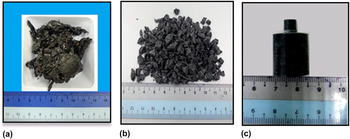
The preparation of PP reinforced with rCFP composites was performed using an internal mixer (Thermo Fisher Scientific [Waltham, Massachusetts], Haake Rheomix OS) at 180 °C and a rotor speed of 50 rpm for 10 min. The compound of PP/rCFP [Fig. 3(a)] was left to cool down to room temperature before being crushed into pellets [Fig. 3(b)] using a crusher. Subsequently, the mixture was compression molded using a hot compression machine at 200 °C for 15 min to produce cylindrical shape for tribological testing in accordance with ASTM G99. The sample for tribology testing via pin-on-disc is shown in Fig. 3(c). Five different compositions of category-A and -B composites were produced i.e., 3, 5,10, 13, and 15 wt% of rCFP including of 100% PP as a control sample.
(a) Compounding of PP/rCFP composite. (b) Pellet of PP/rCFP composites. (c) Cylindrical shape of tribology sample PP/rCFP composites.

C. Testing and analysis
The hardness of the composites was tested using a Teclock Durometer GS-702 G tester from Nagano, Japan equipped with the Shore D Type indenter in accordance with ASTM D 2240. The operating conditions were at 30 ± 2 °C with 50% of the humidity 40 h after sample preparation prior to the testing.
Wear test was performed via dry sliding using a TR-20LE pin-on-disc tester machine from Bangalore, India. The wear test was conducted based on ASTM G99 to study the dry sliding wear of the fabricated composites. The geometry of the samples is 6 mm × 28 mm. Prior to the testing, the samples were polished with 2000-grade SiC emery paper to obtain a surface roughness of Ra < 0.6 μm for a close contact with the counter surface. The testing was carried out at a sliding velocity of 200 rpm, at a constant load of 16 N, and a constant sliding distance of 2.261 km. Wear behavior as the function of wear rates, Ws and COF was determined. Equation (1) (Ref. Reference Ameen, Hassan and Mubarak14) was used to compute the wear rates of the specimen.
 $${W_{\rm{s}}} = {{\Delta m} \over {{F_{\rm{N}}} \cdot L}}\;\left[ {{{\rm{g}} \mathord{\left/ {\vphantom {{\rm{g}} {\left( {{\rm{N}}\;{\rm{m}}} \right)}}} \right. \kern-\nulldelimiterspace} {\left( {{\rm{N}}\;{\rm{m}}} \right)}}} \right]\quad ,$$
where, W s = specific wear rate, g/(N m), Δm = loss of mass, g, F N = normal applied load, N, and L = sliding distance, m. After the test, the worn surface was observed under an EVO 50 scanning electron microscopy (SEM) from Carl Zeiss SMT (Oberkochen, Germany), UK at magnifications of 200x, 500x, 1000x, and 2500x to view the microstructures. However, only the micrographs of magnifications of 500x and 2500x are included in this paper.
III. RESULTS AND DISCUSSION
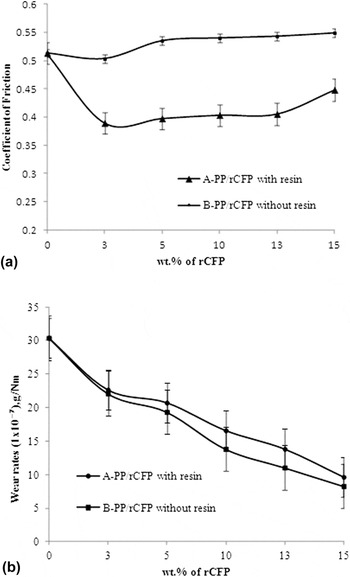
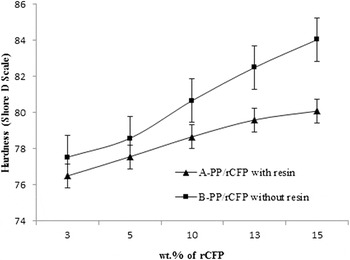
In Fig. 4(a), both PP composites exhibit similar pattern where COF increases with rCFP content. The sliding resistances for category-A were observed to be lower than that for category-B at any loading of rCFP content. The rCFP with resins were found to reduce the friction of PP matrices against counterpart during dry sliding. This indicates the increasing tendency to improve lubricating performance of polypropylene. This behavior resulted from interaction between uncured thermoset resins on rCFP surfaces with PP matrices. The uncured resins on rCFP surfaces were melted and they interact with PP matrices during melt compounding process to form continuous matrix materials with softer surface. As the process completed, the composite performed alike the thermosetting plastic composite rather than a thermoplastic composite. The presence of uncured resins increased the viscous component of the whole composites and resulted in the reduction of its hardness. The softer composite surfaces were supported by the hardness value of the composites (Fig. 5). This had assisted lubrication characteristics of the composites which are indicated by the reduced value of COF for category-A samples over virgin PP. The lubrication effect decreases as the rCFP content increases due to the reduction in matrix fraction which is essential to significant polymer-reinforcement interaction in the composites. However, it is interesting to note that COF for these composites are lower than that for virgin PP even at the loading of 15 wt% rCFP.
(a) COF and (b) wear rates of category-A and category-B composites.

Hardness of category-A and category-B composites.

In the case of laminated composites, according to Suresha et al.,Reference Suresha, Chandramohan, Samapthkumaran, Seetharamu and Vynatheya15 there is a strong interdependence on the friction coefficient and wear loss with respect to the applied loads for steel-composites contact. It is in good agreement with the discussion given by Skare and StahlReference Skare and Stahl16 where the friction is depending on sliding pairs and operating parameters as well as the weight percentages of filler loading. Meanwhile, Myshkin et al.Reference Myshkin, Kovalev, Spaltman and Woydt17 claimed that there are three important factors affecting friction in polymer composites: (i) deformation affecting the real area of contact of surfaces, (ii) adhesion of surfaces in contact, and also (iii) shear resulting in film transfer and debris formation. According to them,Reference Myshkin, Kovalev, Spaltman and Woydt17 the adhesion component of friction for polymers is believed to exceed by far the deformation and the key factor which determines the tribological behavior of polymers and polymer composites is transfer films.
Figure 4(b) shows that the wear resistance of the PP composites increases with the increase of rCFP content. In the range of 5–15 wt%, a slight difference was observed where category-B showed lower wear rates than category-A. It is in agreement with hardness value where category-A composites showed lower hardness than category-B composites (Fig. 5). The addition of carbon fibers in both physical conditions was observed to improve the wear resistance of the PP composites at every loading when compared with virgin PP. The rCFP may support a great portion of the applied load and reduce the direct interaction between polymer and counterface. Higher COF observed for PP composites without resin had negligible effect in reducing the wear resistance of the composites although in most cases, wear rates increases as the COF increases. This situation is an indicator of complex tribological properties observed in polymer based materials due to the existence of multiple domains and sub domains.Reference Brostow, Hagg Lobland and Narkis18 According to Pirso et al.,Reference Pirso, Letunovitis and Niljus19 no correlation is found between the wear rates and the respective mean friction coefficient. Commonly in the initial stage of wear testing, a burnishing wear process established a smooth wear track surface by plowing away the surface asperities or roughness. As the wear proceeded further, the wear track became smoother and the COF fixed on a steady level. Meanwhile, some of the researchers reported that the COF could generally be reduced and the wear resistance improved when the polymers are reinforced with glass, carbon and aramid fibers. In fact, the tribological behavior of polymers is affected by environmental and operating conditions such as the type, size, amount, shape, and orientation of the fibers.Reference Shalwan and Yousif20
The addition of fibers into polymer matrices may have two influences either (i) reducing the heat in the interface by reducing the interaction between asperities at which the film transfer will not be adhered well and detachments may occur or (ii) another possibility is the strong film transfer made of polymer and debris of fiber may be formed on the metal surface. According to previous research by Chang and Friedrich,Reference Chang and Friedrich21 the friction reduction is associated with the process of collection and distribution of fiber on counterpart surfaces whereas the increase in friction coefficient is reasonably explained by gradual removal process of the trapped fiber in the transfer film. In this study, the reducing of wear rate was also attributed to the improved dispersion of recycled carbon fiber content in matrix. In previous research, Shakuntala et al.Reference Shakuntala, Raghavendra and Kumar22 claimed that filler materials could achieve good dispersion in matrices and provide good interfacial adhesion between fillers and polymer matrices. Furthermore, the reduction of wear rates in this study showed the good interaction between polypropylene with recycled carbon fibers regardless of its physical condition.
Category-A and category-B were tested using Durometer to determine the hardness of the fabricated composite. Figure 5 shows that the hardness increases with the addition of rCFP content for both samples. This result is in good agreement with Khedkar et al.Reference Khedkar, Negulescu and Meletis12 where fillers were found to increase the hardness and wear resistance of composites. The rCFP efficiently played a role as reinforcing agent in the composites and acted as crack bridging when fiber was plowed out during frictional sliding.
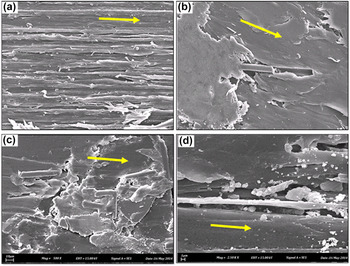
The pins on disk test on the composite are correlated with the morphological observation where they provide a direct evidence to study wear and tear mechanism of the composites. The good properties of a composite are governed by the nature of interfacial bonding between fiber and matrix. Figure 6 depicts the worn surface micrographs of different samples at magnifications of 500x and 2500x. As shown in Fig. 6(a), the pure PP showed generally ductile failure since the surface of contact appears rougher after the test was conducted. It was the effect of plastic deformation that occurs under the shear stress and stress compression during the sliding contact.
SEM micrographs of (a) sample of virgin PP without fiber (b) category-A composites for 3% rCFP with resin (c) category-B composites for 15% rCFP without resin (500x) and (d) category-B composites for 15% rCFP without resin (2500x). Arrow indicates sliding direction.

Other than that, it is found in Fig. 6(a) an adherence of wear debris formed on the worn surface. Adhesive wear occurs due to materials adhering or sticking with each other under loading which results in material transfer between the two surfaces or the loss of material from either surface.
SEM micrographs of the worn surface of the category-A composites for rCFP with resin are shown in Fig. 6(b), carbon fibers were seen to protrude out of the rubbing surface indicating the fact that primarily, the normal load was supported by the fibers, which benefits the reduction of wear rate.Reference Khun, Zhang, Lim, Yue, Hu and Yang7 However, many shearing microcracks were observed at the surface either at the fiber-matrix boundary or at weak spots in the rCFP/PP matrix. The microcracks, formed by the detachment of carbon fiber and shearing of polymer matrix under the external mechanical forces, can eventually lead to generation of wear. Carbon fiber can be detached from the matrix under hard microplowing and microcutting attacks by the steel asperities. The increase in viscous component in category-A composites increases the adhesive wear if compared to category-B. More polymer matrices were transferred and peeled off from the composites after more weak spots open from the protruding carbon fiber.
While for category-B composites for rCFP without resin in Figs. 6(c) and 6(d), the worn surfaces were relatively smooth and the peeling off matrix and carbon fibers are constrained due to the fact that carbon fibers effectively support the load from the counterface which is indicated by good adherence between the carbon fibers and matrix. This result also in an agreement of Li and XiaReference Li and Xia6 shows that the good combination of carbon fiber and matrix will reduce the wear rate.
IV. CONCLUSION
As the conclusion, the rCFP reinforced PP was successfully produced via melt compounding method. It was found that different physical structure rCFPs (with/without resins) lead to polymer composites with unique tribological behaviors. Both categories have potential to increase wear resistance with increment in lubrication effect for category-A (with resins) and better wear resistance was exhibited by category-B (without resins). Furthermore, the rCFP content played major role in tribological properties for both categories. The wear resistance increases with the increase of rCFP loading in the composites with lower sliding resistance were observed at 3 wt% for both categories.
ACKNOWLEDGMENTS
The authors acknowledge the Ministry of Education Malaysia for funding this research through the Research Acculturation Grant Scheme with the Project No. RAGS/2013/FKP/TK04/02/B00029. We wish to sincerely thank the Universiti Teknikal Malaysia Melaka (UTeM) which provided the equipments and facilities to conduct the experiments.