Implications
Rice straw is a huge, inexpensive source of dietary energy for ruminants. The proportions and chemical characteristics of morphological fractions differ markedly and can potentially determine the nutritive value of the whole straw. Few basic investigations are available on the nature of silica, phenolic materials, and structural carbohydrates; hence, little is known about the consequences of the qualitative and quantitative changes in straw fractions. The present study is designed to investigate the chemical characterization of the morphological fractions in both untreated and alkali-treated rice straw.
Introduction
For every kg of rice grain obtained from the field, 1 to 2 kg of straw is produced. The straw is composed mostly of cell walls (>60%), with cellulose, hemicellulose, lignin and residual ash accounting for the main components. Extensive studies have so far been dedicated to investigate the chemical composition and the physical structure of the cell wall of different plants responsible for limiting its digestibility. In rice, silica and lignin are the major barriers to straw utilization by ruminants (Van Soest, Reference Van Soest2006; Agbagla-Dohnani et al., Reference Agbagla-Dohnani, Cornu and Broudiscou2012). Competition with more photosynthetically efficient C4 plants may have promoted an evolution towards a greater silica accumulation in C3-plants (e.g. rice) cultivated in tropical environments at the expense of lignin, because of the higher cost for the synthesis of an equal amount of lignin (27 ATP; Van Soest, Reference Van Soest2006). This extra amount of silica, however, is associated with an increase in ash content and a decrease in the degradability of rice straw. Lignin also plays a vital role in plant growth and health (Pedersen et al., Reference Pedersen, Vogel and Funnell2005). Results relating silica and lignin content to degradability of morphological fractions are equivocal. European rice straw leaves have been found to be more digestible than stems (Agbagla-Dohnani et al., Reference Agbagla-Dohnani, Noziere, Clement and Doreau2001), whereas leaves reportedly tend to be less digestible than stems in Asian straws (Vadiveloo, Reference Vadiveloo2000). Silica and lignin contents may be possible contributors to such variation in response (Van Soest, Reference Van Soest2006) but no relationship has been found between microbial degradation and silica content in the European varieties (Agbagla-Dohnani et al., Reference Agbagla-Dohnani, Noziere, Clement and Doreau2001 and Reference Agbagla-Dohnani, Noziere, Gaillard-Martinie, Puard and Doreau2003). In addition, the intrinsic properties of cell wall carbohydrates such as crystallinity, polymerization, esterification and substitution of acetyl and arabinose on xylan backbone as well as particle and pore sizes (Chesson, Reference Chesson1981; Taherzadeh and Karimi, Reference Taherzadeh and Karimi2008) may be involved in substrate degradability. However, these traits have not received adequate attention by researchers. Phenolic acid-ester cross-links in grass cell walls act as nucleation sites for lignin deposition (Ralph et al., Reference Ralph, Grabber and Hatfield1995) and it is believed (Beauchemin et al., Reference Beauchemin, Colombatto and Morgavi2003) that the crystallized region of cellulose is less hydrolyzed than its non-crystallized counterpart because of its low surface area and its inaccessibility for endocellulase.
A variety of chemical and biological treatments have been employed to improve straw quality (Van Soest, Reference Van Soest2006). Van Soest (Reference Van Soest1981) extracted rice straw using a neutral detergent solution to achieve an increased NDF degradability of organic matter per unit of silica removed. Silica in rice straw in opal form is rendered soluble at pH > 10 (Inglesby et al., Reference Inglesby, Gray, Wood, Gregorski, Robertson and Sabellano2005), and the majority of phenolic acids esterified to cell wall components are also alkali-labile (Sun et al., Reference Sun, Sun, Wang, Zhu and Wang2002). Obviously, the chemical characteristics of rice straw and its degradability also depend on the plant fraction considered. In this work, the chemical composition and degradability of the morphological fractions in three rice straw varieties grown under identical agronomic conditions were evaluated. Moreover, an alkaline treatment was used in one of the three varieties to evaluate changes in the intrinsic properties and histology of cell wall components.
Material and methods
Rice straw collection and morphological fractions
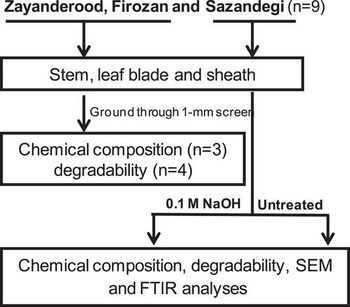
Three genetically modified varieties of mature rice plants including Zayanderood, Sazandegi (both conventional rice varieties) and Firoozan (a non-native variety) were collected 3 to 4 days before harvesting from Lenjan fields in September 2008 (Isfahan, Iran). The varieties had been cultivated and grown under identical agronomic (sowing, flooding and fertilization) conditions in adjacent rice fields (ca. 3 ha). After cutting the plants about 10 cm above the ground, the leaves were removed from stem internodes and divided into LB (leaf blade) and LS (leaf sheath) to obtain a total of nine aliquots per variety (Figure 1). The relative contribution by weight was determined after oven drying at 105°C for 16 h.
The outline of the characterization and analysis of the rice straw varieties

Chemical composition
Samples of each straw fraction were pooled per variety, milled through a 1 mm screen, and stored at −10 °C until they were subjected to chemical analyses, degradability measurements and alkali treatment. Chemical analyses were performed in triplicates. Ash (600°C for 2 h) and CP contents were analysed according to the Association of Official Analytical Chemists (AOAC, 2000). The sequential fibre analyses included residual ash performed according to the method proposed by Van Soest et al. (Reference Van Soest, Robertson and Lewis1991). NDF (using a heat-stable α amylase; Sigma A-3306) and ADF were measured using an Ankom200/220 fibre analyzer (Ankom Technology Corp., Fairport, NY, USA). The ADL content of the residues was determined using sulphuric acid (72%) in a Daisy incubator (Ankom Technology Corp.) for 3 h at room temperature. Cellulose and hemicellulose contents were estimated as ADF minus ADL and as NDF minus ADF, respectively. To determine the concentrations of the free phenolic compounds (g/kg) in the straw fractions (250 mg), 45 ml of a Na-K buffer (containing KH2PO4, 7.92 g; Na2HPO4·7H20, 10.87 g; EDTA, 10 g; dissolved in 1 l of distilled water) was used in polyethylene tubes (Lau and Van Soest, Reference Lau and Van Soest1981). The tubes were then capped and placed in an incubator shaker (20 r.p.m.) at 39°C for 24 h. After centrifuging the tubes (10 000 × g, 20 min), 1 ml of the aliquots was diluted to 20 ml with deionized water. The optical density was measured at 280 nm using a UV-Photometer (GeneRay, Biometra, Germany) using tannic acid as standard. For the determination of silica, a sample of straw weighing 250 mg was burned to ash at 600°C for 2 h. After cooling, the sample was transferred into a 50 ml polyethylene tube and digested with 2.5 ml of 35% H2O2 and 5 ml of 50% NaOH in an autoclave at 150 kPa for 40 min (Elliott and Snyder, Reference Elliott and Snyder1991). The mixture was subsequently diluted with deionized water up to 250 ml and silica content in the diluted sample was determined colorimetrically (method 965.07, AOAC, 2000). The optical density was measured at 650 nm (UV 2100-VIS Spectrophotometer Shimadzu, Kyoto, Japan).
Dry matter (DM) and fibre degradability
To measure DM, NDF and ADF degradability, straw samples (500 mg) were weighed into Ankom F57 filter bags (25 μm pore size; ANKOM Technology Corp.). Thirty six bags thus filled were then put into two larger loose mesh cloth sacks (50 × 50 cm; 2 mm pore size) and incubated in the rumen of two fistulated non-lactating Holstein cows for 48 h (four replicates including two replicates/straw fraction per cow). The cows were individually housed in 4 × 4 m covered pens where they received a dry cow total mixed ration consisting of 38% maize silage, 25% lucerne hay, 15% barley straw and 22% concentrate (barley grain, canola meal, wheat bran and a mineral/vitamin mix). After incubation, the bags were removed from the rumen, hand-washed with cold water until the rinsing water was clear, and dried at 60°C for 48 h in a forced-air oven.
Alkaline treatment of morphological fractions
The morphological fractions of the Sazandegi variety were treated with sodium hydroxide to be used for the chemical, Fourier Transform Infrared Spectroscopy (FTIR) and Scanning Electron Microscopy (SEM) analyses. The F57 bags (500 mg of the straw sample) were soaked in 0.1 M NaOH (50 ml/bag) in a Daisy incubator jar and incubated at 39°C for 24 h. Ruminal degradability (48 h) of the samples was measured using the method described above. To determine solubilization of silica and phenolic compounds by alkali treatment, the treatment described above was conducted. Five hundred milligrams of the untreated sample (the control) was mixed and stirred with 45 ml of 0.1 M NaOH into a 50 ml polyethylene tube in a shaker incubator at 39°C for 24 h. Some of the samples were subsequently filtered through a filter paper (Whatman No. 41) for silica determination, whereas others were centrifuged (10 000 × g, 20 min) for phenolic compound analysis. The IR absorbance band of the cell wall constituents, that is, cellulose, hemicelluloses and lignin in the morphological fractions (LB, LS and stem) was measured using a FTIR system (Bruker Tensor 27, Bruker Optics Inc., Billerica, MA, USA) coupled with a universal attenuated total reflectance accessory. Cell contents were removed by extracting the straw samples using a neutral detergent solution (Van Soest et al., Reference Van Soest, Robertson and Lewis1991). The samples were then finely ground and pressed uniformly against the diamond surface using a spring-loaded anvil, and the mid-IR spectra were recorded from a resolution of 4000 to 600 cm−1 at 2 cm−1.
Morphological fractions (untreated and NaOH-treated) were incubated in the rumen of fistulated cows for 24 h. After incubation, the bags were removed, rinsed and stored in distilled water in a refrigerator for a few days. The straw samples were then fixed with 3% glutaraldehyde in 0.2 M cacodylate buffer (pH 7.4) for 24 h at room temperature (Agbagla-Dohnani et al., Reference Agbagla-Dohnani, Noziere, Clement and Doreau2001). Afterwards, the samples were dehydrated for 5 min in 50%, 10 min in 75% and twice for 15 min in 95% ethanol (v/v) to be later affixed and sputter-coated with gold (BAL-TEC SCD 005) and, finally, subjected to SEM (PHILIPS XL30, Philips, Eindhoven, The Netherlands) observation at 10 kV.
Statistical analysis
Data from the morphological fraction proportions were analysed using the GLM procedure of SAS (SAS Institute, 2001) according to the following model:
 $$Y{\pre}_{{ij}}\, = \,\mu \, + \,V_i}\, + \,{{e}_{ij}}$$
where μ is the overall mean; Vi is the ith variety effect; eij is the random residual effects with mean 0 and the variance homogeneity, σ 2. Data obtained on the chemical composition and degradability of the morphological fractions of each variety were analysed using the MIXED procedure as a split-plot design with variety and morphological fraction as the main plot and the subplot, respectively. The following model was used:
 $${{Y}_{ijk}}\, = \,\mu \, + \,{{V}_i}\, + \,{{\delta }_{ik}}\, + \,{{F}_j}\, + \,{{(V\,\times \,F)}_{ij}}\, + \,{{e}_{ijk}}$$
where μ is the overall mean; Vi is the effect of level i of factor V, variety; Fj is the effect of level j of factor F, morphological fraction; (V × F)ij is the effect of the ijth interaction of V × F; δik is the main plot error (the main plots within factor V) with mean 0 and variance σ 2δ; eijk is the split-plot error with mean 0 and the variance σ 2. Data from the alkaline treatment were analysed based on a 3 × 2 factorial arrangement using the GLM procedure according to the following model:
 $${{Y}_{ij}}\, = \,\mu \, + \,{{F}_i}\, + \,{{T}_j}\, + \,{{(F\,\times \,T)}_{ij}}\, + \,{{e}_{ij}}$$
where μ, F, T, F × T and e are overall mean, morphological fraction, treatment, interaction between F and T and residual effect, respectively.
Results
Morphological fractions, chemical composition and degradability
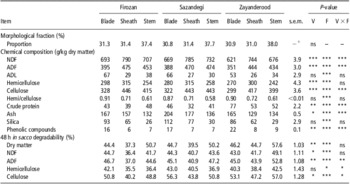
Similar overall average proportions were obtained for LB (31%), LS (31%) and stem (38%) among the varieties investigated (Table 1). However, they exhibited differences in their chemical compositions (fibre and non-fibre contents). The highest values of non-fibre (CP, ash, silica and phenolic compounds) as well as ADL contents were detected for LB, whereas LS recorded the highest levels of NDF, ADF, hemicelluloses and cellulose (P < 0.01). Stems showed intermediate values for all parameters except for their hemicellulose and silica. LB was found to have three times more soluble phenolic compounds than LS and stem fractions. A significant interaction was found to exist between variety and morphological fraction with respect to NDF, ADF, CP, ash and phenolic contents (P < 0.01). Although LS and stem exhibited virtually identical ash quantities, the silica content of stems was extremely lower than that of LS (P < 0.01). The contributions of silica to ash content were recorded as 54%, 44% and 21% for LB, LS and stems, respectively. Average values of DM degradability, hemicelluloses and cellulose in rice straw varieties were 47%, 40% and 50%, respectively (Table 1). DM degradability was substantially higher in stems than it was in leaf fractions (P < 0.01). The lowest values for DM and fibre degradability were observed in LS. However, the interaction of variety by fraction was significant in the case of fibre component degradability (P < 0.05).
Morphological fractions, fibre and non-fibre compositions and degradability of three rice straw varieties

s.e.m. = standard error of mean; V = variety; F = fraction; ns = not significant.
*P < 0.05; **P < 0.01; ***P < 0.001.
+s.e.m. values of the varieties were 0.11, 2.04 and 2.10 for leaf blade, leaf sheath and stem, respectively.
Alkaline treatment of morphological fractions
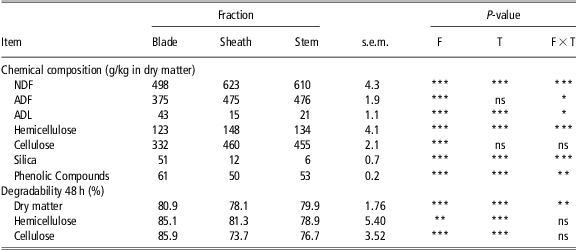
The Sazandegi variety was subjected to alkali treatment because of its higher silica content. Chemical composition and degradability of treated morphological fractions are summarized in Table 2 and the same data for the untreated fractions are presented in Table 1. Treatment of straw fractions with 0.1 M NaOH reduced (P < 0.01) NDF, ADL, hemicelluloses and silica, but it did not change ADF or cellulose (P > 0.05) and increased both the release of phenolic compounds as well as DM and fibre degradability (P < 0.01). An interaction effect was established between treatment and morphological fractions for chemical composition and DM degradability (P < 0.05). Compared with leaf fractions, stems were found to be less affected by alkali treatment with respect to their NDF, ADL and hemicellulose contents or DM degradability but more affected in terms of their silica content. The increments observed in ruminal degradability levels were 98%, 81% and 59% in LS, LB and stem, respectively.
Fibre and non-fibre compositions and degradability (48 h) of Sazandegi after treatment with 0.1 M NaOH
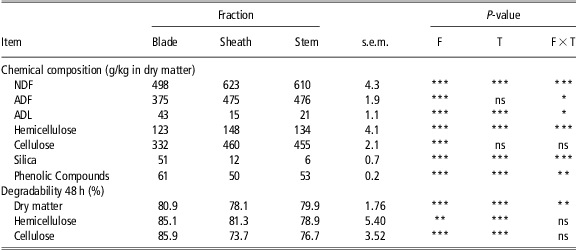
s.e.m. = standard error of mean; F = fraction; T = alkali treatment; ns = not significant.
*P < 0.05; **P < 0.01; ***P < 0.001.
Data of untreated straw were presented in Table 1.
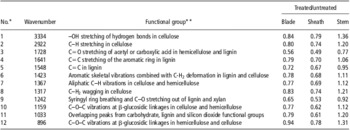
Supplementary Figure S1 shows the FTIR spectra and Table 3 presents the positions and assignments of IR absorbance bands and the absorbance band ratios of treated/untreated morphological fractions (treatment results). An intense band at 3336 cm−1 due to both inter- and intramolecular hydrogen bond stretching within the cell wall components was the highest for LS but the lowest for stem. A similar intensity for the band at 1423 cm−1 assigned to crystalline cellulose I (the form abundantly occurring in nature) was observed for the morphological fractions. With the alkali treatment, these bands reduced for the leaf fractions but an inverse effect was observed in the stem fraction. Degrees of esterification (ester-linked acetyl, feruloyl and p-coumaroyl groups) as indicated by the absorbance band at 1728 cm–1 were similar in leaf fractions but higher than those of stems. Exposure to the alkaline condition caused a decline in the corresponding band in all morphological fractions, whereas the difference was greatest for LS (Table 3).
Position of FTIR absorbance bands of morphological fractions, their assignment and the ratios of absorbance bands of treated to untreated morphological fractions

*Peak number as indicated in Supplementary Figure S1.
**Inglesby et al. (Reference Inglesby, Gray, Wood, Gregorski, Robertson and Sabellano2005), Kumar et al. (Reference Kumar, Mago, Balan and Wyman2009), Kobayashi et al. (Reference Kobayashi, Okada, Hirakawa, Sato, Kobayashi, Hatano, Itaya and Mori2009) and Nieves et al. (Reference Nieves, Karimi and Horváth2011).
SEM images of untreated and NaOH-treated LBs are shown in Supplementary Figure S2. A similar change was observed in the case of LS and stem (data not shown). The silicified surface layer in the untreated straw remained completely intact even after 24 h rumen incubation (Supplementary Figure S2a), whereas it was crimped but still observable in the NaOH-treated one (Supplementary Figure S2c). In the untreated LB, the underlying tissues were not released from the surface layer (Supplementary Figure S2b), with the cells having a rectangular structure and completely adherent to one another. In the NaOH-treated straw, no systematic ultrastructure or attachments were observed in the cells lying under the epidermis because of the disappearance of cemented material between cells (Supplementary Figure S2d).
Discussion
Morphology, physicochemical characteristics and degradability
Compared with other varieties, greater proportions of stems or lower leaf/stem ratios (1.63) were observed for the varieties used in the present study (Vadiveloo, Reference Vadiveloo2000; Agbagla-Dohnani et al., Reference Agbagla-Dohnani, Noziere, Clement and Doreau2001); however, differences in variety did not cause any differences in leaf to stem ratio. A higher ratio of stem to whole plant is preferred, particularly in varieties with high silica content (Asian and United States). In these varieties, the epidermis of leaves is more silicified, resulting in a lower degradability of the leaf fractions as compared with the stems. Unlike the silica content or its contribution to ash that were much higher in the current varieties, the ash contents were similar to the values reported elsewhere (Vadiveloo and Fadel, Reference Vadiveloo and Fadel2009). The differences may be related to the differences between the methods used for measuring silica as acid detergent insoluble ash had been used in most previous studies for the determination of silica. Degradability levels of morphological fractions decreased in the following order: stem >LB>LS. This finding is consistent with that reported by Agbagla-Dohnani et al. (Reference Agbagla-Dohnani, Noziere, Gaillard-Martinie, Puard and Doreau2003). The difference between the degradability levels of stem and LB might be related to the higher silica and lignin contents in LB, which might not explain the lower degradability of LS compared with that of LB. The higher cell wall and, hence, the lower cell content of LS v. LB might be the reason for its reduced degradability. Hemicellulose/cellulose ratio decreased from stem to LB, but LS had the greatest hemicelluloses content. Ruminal microorganisms in this study seemed to exhibit a lower capability for degrading hemicellulose as compared with cellulose or whole DM, with the difference being particularly larger in the case of stems. This might be somewhat unexpected as cellulose has an insoluble and crystalline structure but hemicellulose has a random, amorphous and branched one with little resistance to hydrolysis (Taherzadeh and Karimi, Reference Taherzadeh and Karimi2008). However, hemicellulose is directly bound to lignin (Van Soest, Reference Van Soest2006) and, perhaps, to silica, which might reduce its potential for hydrolysis. The lower degradability in LS v. LB and LB v. stem in rice straw fractions could be attributed to the hemicellulose content together with such inherent factors as crystallinity, esterification and hydrogen bonding as evidenced by the FTIR analysis, which showed the highest and lowest values for LS and stem, respectively.
Alkaline treatment
The stem's NDF content was less affected by the NaOH treatment compared with that of leaf fractions. This is probably a reflection of the lower hemicellulose/cellulose ratio of the stem as cellulose (and also ADF) was not reduced by the alkaline treatment. In the case of hemicellulose, it has been shown that ester and some glycoside (1−3) bonds in the branching region are hydrolyzed by alkaline treatments (Van Soest, Reference Van Soest1994). In contrast, the release of silica occurred to a greater extent in LS (84%) and stem (81%) than in LB (54%) by applying 0.1 M NaOH. This may confirm a two-phase silica extraction in rice straw (Van Soest and Lovelace, Reference Van Soest and Lovelace1969), and further indicate the higher solubility of silica in LS and stem fractions (or possibly a difference in the location of silica, for example, less silica in the cell wall and cuticle layer but more in the cell content). Additionally, FTIR and chemical analyses revealed that LS contained more linkages in the cellulose, hemicelluloses or lignin structure, which might be susceptible to alkaline treatment (e.g. hydrogen bonds, crystallization, acetylation, esterified phenolic acids). As a result, degradability was improved to a larger extent in LS than in LB or stem. Although cellulose and ADF contents were unaffected by the alkaline treatment, their degradability was significantly increased. This may be due to the reduction of certain factors limiting hydrolysis such as silica, lignin and hemicellulose or due to changes in the internal structure such as crystallinity or hydrogen bonds. A breakdown in the structure and a reduction in crystallinity have been observed in response to alkaline treatment (Nieves et al., Reference Nieves, Karimi and Horváth2011). This might be responsible for the improved attachment of microbial cellulosome (Fontes and Gilbert, Reference Fontes and Gilbert2010), which results in a better digestion after alkaline treatment. SEM analysis indicated that the silicified layer was entirely intact and that the cell wall had a distinct structure in the untreated straw samples. This layer, however, was crimped but not completely dissolved, while the cell configuration under the surface layer was extensively destroyed by silica solubilization and de-esterification as a result of the NaOH treatment. As a structural element, silica complements lignin and strengthens and rigidifies cell walls (Van Soest, Reference Van Soest1994). The negative effect of silica may be due to the physical barrier formed by the external layer or an inhibitory action on hydrolyzing enzymes (Herbers et al., Reference Herbers, Raiten and Paulsen1981). Moreover, it may be claimed that the rigid silicified epidermal layer in rice straw is probably a barrier against the external environmental or pathogenic factors in the rice plant but that it has no limiting effect on ruminal degradation (LB v. LS). Agbagla-Dohnani et al. (Reference Agbagla-Dohnani, Noziere, Gaillard-Martinie, Puard and Doreau2003) reported that epidermal silica did not hinder degradation from the interval cavity of rice straw.
Acknowledgements
The authors would like to acknowledge Iran National Science Foundation and Isfahan Jihad-e-Agriculture for their financial support of this study. We are grateful to Mr Salimian for assistance in preparing the rice straw varieties used in our experiments. The authors also thank Dr Ezzatollah Roustazadeh, from ELC of IUT, for having edited the final version of this manuscript.
Supplementary material
For supplementary material referred to in this article, please visit http://dx.doi.org/10.1017/S1751731113000256.