Introduction
Utopia, fantasy, reverie, dreams; positive, other-worldly states such as these have long been associated with Schubert's use of the ♭VI harmony.Footnote 1 As Richard Kramer put it, ‘Having come to signify the remote in the close at hand, the region of the flat submediant is further endowed in Schubert's music: poetic distance, fantasy, dream, the romance of the “other”, all are part of its mystique.’Footnote 2 Similar sentiments are expressed by Richard Taruskin in a chapter of The Oxford History of Western Music entitled ‘The Music Trance’, which is largely devoted to Schubert's instrumental works.Footnote 3 Taruskin, moreover, also points to the harmony's broader historical significance:
Modulation to the flat submediant became a convention signalling that the music that followed it was [a direct ‘heart-to-heart’] communication. It marked a kind of boundary between inner and outer experience and its sounding came to signify the crossing of that edge, endowing the music on the other side with an uncanny aura. […] The effect of these modulations on the music's temporality, that is the audience's experience of time, is comparable to the effect of an operatic scene in which static ‘aria time’ supervenes on the action-time of recitative. To evoke such an introspective effect in instrumental music, as we have long since observed, is precisely the act whereby instrumental music becomes romantic.Footnote 4
Thus, according to Taruskin, the evocative use of harmonies such as ♭VI to promote introspection lies at the very heart of musical Romanticism. And although Taruskin focuses on instrumental repertory in ‘The Music Trance’, in the subsequent chapter he extends his argument to song. Many more scholars, including J. H. Thomas, Susan McClary, Thomas Nelson, Christopher Wintle and Brian Black, have particularly associated Schubert's use of ♭VI in both instrumental and vocal contexts with transcendent or dreamlike states.Footnote 5 Let us call the phenomenon that they have observed Schubert's ‘Other-worldly ♭VI’, for want of a suitable umbrella term.
♭VI and other mediant harmonies have also featured prominently in neo-Riemannian theory, a field that emerged in the 1980s in response to the analytical challenges posed by chromatic harmony in music from roughly Schubert's time onwards. Significant in this regard is Richard Cohn's work on the four hexatonic cycles that are formed by the alternation of the maximally smooth voice-leading transformations P and L.Footnote 6 Example 1 shows a hexatonic cycle starting on the chord of C major (enharmonic equivalence is assumed); the other three cycles can be similarly generated by starting on the chords of C♯/D♭ major, D major and D♯/E♭ major, after which the content of the cycles begins to overlap. Note that in the abstract presentation found in Example 1, the cycle employs so-called ‘idealized voice-leading’,Footnote 7 meaning that chords are presented in ‘close harmony’ and that pitch classes are arranged to create the smoothest possible voice-leading. Although neo-Riemannian theory's transformations are independent of tonal centre, for the sake of comprehension the generic hexatonic cycle can be ascribed Roman numerals: I–i–♭VI–♭vi/♯v–III–iii–I. The extent to which Schubert was aware of the hexatonic cycle is debatable; in his songs – a genre in which he frequently explored tonal space – I know of no complete hexatonic cycle,Footnote 8 although an apparent emphasis on the ‘I–i–♭VI’ segment can be observed in several of those that are examined in this article.
Hexatonic cycle from C.

Whether from a historical or a theoretical perspective, the scholarly consensus appears to be that the use of increasingly chromatic harmonies – championed by Schubert, with his use of ♭VI – played a significant role in the emergence of musical Romanticism. Yet in my view the musico-poetics of Schubert's use of ♭VI in particular have not been fully understood: the notion that ♭VI's presence is enough in itself to evoke other-worldliness is a reductionism, and Schubert's treatment of the harmony is far more sophisticated than has generally been recognized. This article will substantiate this view by re-examining instances of the Other-worldly ♭VI in selected Schubert songs. Song, I submit, is the ideal genre for such a study, because in song the harmony's supposed extramusical associations can potentially be confirmed, problematized or refuted by the attendant text.
Indeed, as I will demonstrate, while ♭VI is often associated with positive other-worldliness in Schubert's songs, there are nevertheless rare cases where it is associated with darker sentiments; the example I examine below is the song ‘Der stürmische Morgen’ (no. 18 from Winterreise, D.911), in which modulation to ♭VI helps to depict a raging storm and the protagonist's extreme anger. Following Nelson, I use the term ‘Rogue ♭VI’ to describe such negative uses of the harmony, but whereas he dismisses the need for their further scrutiny,Footnote 9 I beg to differ. Schubert's use of the Rogue ♭VI demonstrates that it is not the presence of ♭VI per se that evokes other-worldliness, but rather that technical details of the harmony's presentation are in fact responsible.Footnote 10 That such details have gone largely unnoticed by analysts is, I believe, because of practices that have become deeply ingrained within prevailing harmonic theories, particularly Schenkerian theory and neo-Riemannian theory. I will return to this point in my conclusion.
My aim in this article, then, is to further our understanding of Schubert's harmonic language by examining in detail various musico-poetic uses of ♭VI in his songs. First, I will consider two well-known and quintessential examples – ‘Nacht und Träume’ (D.827b) and ‘Ihr Bild’ (D.957, no. 9) – so as to identify the principal characteristics of Schubert's Other-worldly ♭VI. Second, I will illustrate with further Schubert songs how attention to these characteristics and an awareness of musical context not only clarifies the musico-poetics of other corroborative examples of the Other-worldly ♭VI, but can also help us to account for songs such as ‘Der stürmische Morgen’, in which the Other-worldly ♭VI stereotype is questioned or actively contested. Through close scrutiny of Schubert's Other-worldly ♭VI, a better picture of his Romantic compositional practice will emerge.
I. ‘Nacht und Träume’, ‘Ihr Bild’ and the Other-worldly ♭VI
Schubert's quintessentially Romantic song ‘Nacht und Träume’ sets a poem by Matthäus von Collin, in which sleep and dreams provide sanctuary from the busy and stressful affairs of everyday life; men take refuge in dreams that descend from heaven, and when they wake they beg for the dreams to return. The poem consists of a single eight-line stanza, which Schubert sets as an ABA′ form: bars 1–14 are set in B major and constitute section A, section B begins in bar 15 with a turn to G major, before the harmony modulates back to B major for a reprise of the opening music from bar 8 onwards at bar 21 (see Table 1 and Example 2). The song comprises three stages: pre-dream, dream and post-dream; it is, of course, the section in G major (♭VI) that provides the musico-poetic basis for the dream.
Schubert, ‘Nacht und Träume’ (D.827b), annotated.

| Bar | Text | Translation | Key | Form |
|---|---|---|---|---|
| 1 | B major | A | ||
| 5 | Heil'ge Nacht, du sinkest nieder; | Holy night, you sink down; | ||
| Nieder wallen auch die Träume, | Dreams, too, float down, | |||
| Wie dein Mondlicht durch die Räume, | Like your moonlight through space, | |||
| Durch der Menschen stille Brust. | Through the quiet hearts of men. | |||
| 15 | Die belauschen sie mit Lust; | They listen with delight, | G major | B |
| 20 | Rufen, wenn der Tag erwacht: | Crying out when day awakens: | ↓ | |
| 21 | Kehre wieder, holde Nacht! | Return, fair night! | B major | A′ |
| Holde Träume, kehret wieder! | Fair dreams, return! |
With the move to G major (♭VI) at the start of section B, the characteristic measured piano tremolos and sustained vocal phrases of section A continue, while the dynamic marking remains unchanged from the pianissimo given at the start of the song. In other words, the song remains texturally and gesturally unchanged. So, putting aside the argument that ♭VI may have acted as a signifier, what is it about the G major passage in particular that evokes dreams? To address this question, we first need to consider how the key of G major is established. After all, during bars 15–19 there is no perfect cadence to confirm the tonicization of G major, and neither the local dominant chord (D major) nor the new leading note (F♯) is used. Thus G major is not confirmed by standard functional means; instead, two full bars of G major tremolo in bars 15–16 imply that G is the tonic simply through sustained repetition. This suggestion is then explicitly confirmed by the ‘question’ and ‘answer’ vocal phrases in bars 16–17 and 18–19: the first phrase presents I–IV (in G major) and the second responds IV–I. This clear harmonic logic establishes G as the new tonic, but such ‘question–answer’ phrase pairs would usually involve the dominant (that is, I–V followed by V–I), rather than the subdominant. If the dominant creates a dramatic polarity with the tonic, replacing it with the subdominant produces a much more relaxed feeling – all the better to represent dreaming.
To understand fully how these bars represent dreaming, however, we need to examine carefully the move from the home tonic of B major to G major and back again. Richard Capell writes:
Schubert has avoided monotony in his almost motionless music by what is not a modulation but a simple drop from key to key (B to G) half-way through the song. It is as though the dreamer, still sleeping, unconsciously changed his attitude for still greater ease.Footnote 11
So, while Capell notes the move to G major, its simplicity seems to preclude his interpreting it as an extreme change in the condition of his dreamer. For Capell the move from B major to G major instead suggests that the dreamer's sleep becomes still easier (deeper?). Its primary musical function is apparently to avoid the scourge of monotony. Susan Youens interprets the key change somewhat differently:
Only genius can produce great effects by minimal means. Schubert simply ‘melts' from B major – the tonal realm of day and waking consciousness – to G major chords in m. 15 via the one common tone those two harmonies share, the tonic pitch B. Instantly, we are in another world, purified of sharps, of seventh chords, of chromaticism (within its own tonal bounds), of appoggiaturas, indeed, of any kind of dissonance.Footnote 12
Like Capell, Youens draws attention to the key change, but she relies more heavily on harmony to establish its meaning. She emphasizes the differences that the move to G major ushers in and thus infers a greater degree of programmatic contrast between the two key areas: she describes B major as the ‘realm of day and waking consciousness’, while G major represents ‘another world’, by which she means the world of dreams.
Both Capell and Youens describe the technical features of the key change. Capell characterizes it as a ‘drop’ from B to G, and if we look in the score (see Example 2) this drop can be observed in the bass line (bars 14–15). Meanwhile, Youens points to the singer's emphasis on the common-tone B. But I would argue that the most important feature of this move from B major to G major is the way in which common tones and changing tones are distributed among the various contrapuntal lines. The bass line moves from keynote B′ in bar 14 to keynote G′ in bar 15; meanwhile, the upper line of the piano accompaniment moves from d♯′ to d♮′. Above this the vocal line remains on the common-tone b′,Footnote 13 a pitch class that is first shared with the bass, before it becomes the (triple compound) third above the bass's G′. Thus, the singer's b′ is initially presented as  in B major, before being reinterpreted as
 in G major; the pitch remains constant while all around it things move and the harmonic context is changed completely. Linking this to the text, it is as if we leave the reality of a moonlit landscape, where the singer is grounded by the bass, to be enveloped by an ethereal dreamscape, where the singer now floats above the bass in thirds. The bridge between these two states is the singer's common tone.
To some this interpretation might seem fanciful. After all, it could be argued that the key change does not actually occur around the pitch b′ in the manner I describe, as the singer is silent while the piano carries the modulation. I might counter that even though b′ is not sung during the modulation, b is sounded by the piano throughout, and so the singer and audience have this pitch class at the forefront of their minds and can appreciate its change of harmonic context. However, although this counterargument has its merits, I need not rely on it alone because the common-tone link in the vocal line is far more explicit in an alternative version of the song. This alternative version (D.827a) probably predates the one that Schubert published as op. 43 in 1825 (D.827b), and there are only a few small differences between the two.Footnote 14 With respect to the move to ♭VI, one of these differences is telling: the earlier version (D.827a) is missing the bar that occurs as bar 15 (the piano-only first bar of the G major passage) in the op. 43 version (D.827b), as is illustrated in Example 3. Quite literally, the voice here remains stationary, while around it the harmonic landscape changes.
Modulation to G major (♭VI) in the (a) D.827a and (b) D.827b versions of Schubert's ‘Nacht und Träume’.

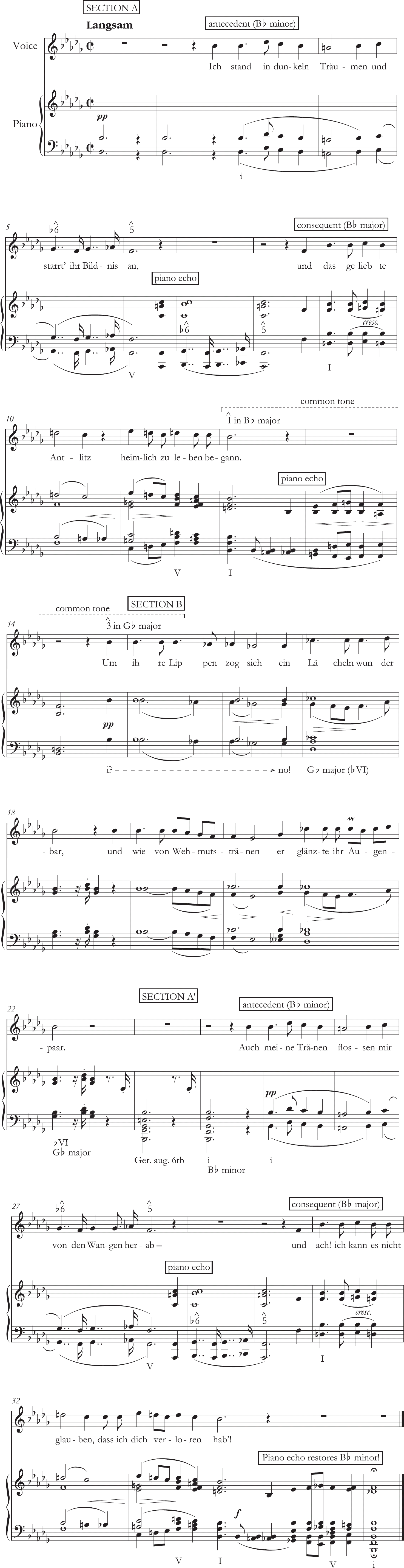
The move to ♭VI in ‘Nacht und Träume’ is strikingly similar to one found in Schubert's ‘Ihr Bild’. ‘Ihr Bild’ sets a poem by Heinrich Heine as an ABA′ form in the key of B♭ minor, as outlined in Table 2. An annotated score is given in Example 4. The song opens with a simple piano introduction that consists of bare dotted-minim octave B♭s, which Schenker suggested represent the protagonist staring at the portrait of his lost lover.Footnote 15 An antecedent phrase outlining i–V in B♭ minor continues the bleak octave-unison texture and features a mournful ♭ melodic gesture (bars 5–6), thus emphasizing the protagonist's solitude and sorrow, before ending with a piano echo of the singer's imperfect cadence (bars 7–8). In Heine's text the portrait then miraculously appears to come to life, which Schubert reflects by switching to the tonic major in bar 9 for the consequent phrase. This consequent outlines a perfect cadence in the key of B♭ major and ends with a piano echo of the singer's cadence (bars 13–14). Section B is set in the contrasting key of G♭ major (♭VI), which, according to Martin Chusid, reflects the ‘intensification of the illusion’ in Heine's second stanza.Footnote 16 The section consists of two phrases: in the first (bars 15–18), a wondrous smile plays around the lips of the woman in the portrait, and in the second (bars 19–22), which is a varied repetition of the first, tears glisten in her eyes (an allusion to the weeping Madonna?). The music returns to a sorrowful B♭ minor at the start of section A′ (bar 23), and the protagonist realizes that it is his own eyes that are filled with tears. In bar 31 the reprised consequent phrase again turns to the tonic major, even despite the anguished content of the final two lines of the poem that it sets (‘And ah, I cannot believe / That I have lost you!’). Thus, the harmonic design of the reprise seems to diverge from the sentiment of Heine's final stanza; until, that is, the piano's echo of the singer's cadence dramatically restores B♭ minor (bars 35–6).
Schubert's ‘Ihr Bild’ (D.957, no. 9), annotated.

| Bar | Text | Translation | Key | Form |
|---|---|---|---|---|
| 1 | B♭ minor | A | ||
| 3 | Ich stand in dunkeln Träumen | I stood in dark daydreams | ||
| Und starrt’ ihr Bildnis an, | And stared at her portrait, | |||
| 9 | Und das geliebte Antlitz | And that beloved face | B♭ major | |
| Heimlich zu leben begann. | Secretly began to come to life. | |||
| 15 | Um ihre Lippen zog sich | Around her lips there played | ↓ | B |
| Ein Lächeln wunderbar, | A wondrous smile, | G♭ major | ||
| Und wie von Wehmutstränen | And melancholy teardrops | |||
| Erglänzte ihr Augenpaar. | Glistened in her eyes. | |||
| 23 | B♭ minor | A′ | ||
| 25 | Auch meine Tränen flossen | My tears also flowed | ||
| Mir von den Wangen herab – | Down my cheeks. | |||
| 31 | Und ach, ich kann es nicht glauben, | And ah, I cannot believe | B♭ major | |
| Dass ich dich verloren hab’! | That I have lost you! | |||
| 35 | B♭ minor |
Not surprisingly, the focus of the majority of readings of ‘Ihr Bild’ has been the apparent disparity between words and music created by the presentation of the modal mixture in section A′, with David Lewin's analysis of 2006 being a case in point.Footnote 17 (Lewin discusses whether the piano's coda represents the inner thoughts and emotions of a single ‘composer-protagonist’ or an external ‘authorial voice’, grappling with the question of whether or not the protagonist realizes the reality of his loss.) Meanwhile, the use of ♭VI in the song's central section has received comparatively little close analytical attention, although Wintle is an exception:
[At the start of section B] the line sinks from the unison B♭s to G♭, which then serves as local tonic (in the major). As in Schubert's Nacht und Träume, the sinking through a major third, from tonic to (flat) submediant, itself releases the lover from the harsh reality of everyday life into the transfigured, timeless dreamscape of the inner world.Footnote 18
It is perhaps no surprise that Wintle cites ‘Nacht und Träume’ to support his claim that ♭VI represents an inner dreamscape in ‘Ihr Bild’, but the two songs' similarities go deeper than he acknowledges. Not only does the harmony ‘sink’ or ‘drop’ to ♭VI in both, but they also both use a common-tone link in the vocal line during the key change, in which in the tonic (major) is reinterpreted as in ♭VI. And in ‘Ihr Bild’, as in ‘Nacht und Träume’, this common-tone link is central to the special effect created by the arrival of ♭VI: again, the singer, fixed on a common tone, emerges into a completely different harmonic world.
The relationship between the two modulations is closer than one might expect, given that ‘Nacht and Träume’ is in the major and ‘Ihr Bild’ is notionally in the minor; in both songs ♭VI is approached from the tonic major, effecting a PL transformation (I–♭VI), even though the minor home key of ‘Ihr Bild’ would have more readily led to an L transformation (i–♭VI). The way in which Schubert treats the arrival of ♭VI in the two songs is, however, not identical: in ‘Ihr Bild’ there is no clean juxtaposition of keys like that in ‘Nacht und Träume’, but rather its ♭VI emerges in an almost subliminal way during the deepening of the protagonist's hallucination. Section B of ‘Ihr Bild’ opens in bar 15 with a return to bare octave B♭s that are reminiscent of the opening of the song, and so at first there is no hint that the tonic has changed to G♭. Indeed, this reference to the song's opening may lead the listener to suspect that the key has reverted to B♭ minor. It is not until a full bar has passed that the singer's line and the piano's bass and alto lines descend through A♭ and onto G♭ (strengthening the sense of a reversion to B♭ minor, or perhaps suggesting instead a change of key to E♭ minor?), and it is only after this that G♭ major is confirmed by a perfect cadence in bars 17–18. Turning to the song's musico-poetic events, one might conclude that the reason why the protagonist professes he is unable to believe that he has lost his lover at the end of the song is precisely that the hallucination of the central strophe is so vivid; he is completely beguiled by the way in which G♭ major quietly usurps the tonic.
The way in which Schubert moves to ♭VI in ‘Nacht und Träume’ and ‘Ihr Bild’ calls to mind the metaphor of wandering in Adorno's 1928 essay on Schubert:
Schubert's themes wander just like the miller does, or he whose beloved abandoned him to the winter. Those themes know of no history, but only shifts in perspective: the only way they change is through a change of light […].Footnote 19
Adorno proposes that Schubert's themes ‘know of no history’ because his compositional style is not ‘organic’ in the way that Beethoven's is; instead, Schubert's music is based on ‘crystalline’ repetition. Thus, Adorno argues, meaning in Schubert's music stems not from the development of themes and motifs, but from themes and motifs being placed in different ‘lights’. Harmony plays an all-important role:
It is not for nothing that the moods in Schubert, which not only revolve, but can also collapse, are bound up with harmonic shifts, with modulation, which sheds light, at whatever level of profundity, on things that are always the same.Footnote 20
In the move to ♭VI in ‘Ihr Bild’ there is no theme as such, but the singer's emphasis on the common-tone b♭′ does seem to act in the way that Adorno describes. By gradually casting this b♭′ in a new harmonic light, the modulation evokes the depth of the protagonist's hallucination and sheds light on his state of mind. Similarly, in the move to ♭VI in ‘Nacht und Träume’ the singer's common-tone b′ acts as a ‘motif’ around which the harmonic context changes, this time evoking the way in which the men in Collin's poem pass willingly into their dreams.
If we pass willingly into our dreams, we are reluctant to leave them. In ‘Nacht und Träume’ the people call out, ‘Return, fair night! / Fair dreams, return!’ when dawn breaks. Schubert seizes on this return to wakefulness for a return to the home tonic, but because we do not leave the refuge of our dreams willingly, there is no ‘melting’ from one key to another here, no common-tone bridge. Instead, it is a diminished-seventh chord (A♯, C♯, E, G) in bar 20, harmonizing the words ‘Crying out when day awakens’, that instigates the modulation back to B major (see Example 2 above). Adorno suggests that in Schubert's harmonic language, ‘The switch to the demonic way of the deep happens through the diminished chord’;Footnote 21 in ‘Nacht und Träume’ this diminished-seventh chord steals the men away from the safety of their heaven-sent dreams and returns them to the toil of their everyday existence. The chord resolves in bar 21 onto a reprise of material from bar 8 of the song's opening (although the harmonization of bars 21–2 is that of bars 10–11). By excluding bars 1–7 from this reprise, the music that we ‘wake up to’ in bar 21 is consequently more starkly contrasted with that of the G major passage: while the G major music lacks any energizing dominant, the chord roots of the reprised material propel us around the circle of fifths, first as far as the dominant of B (bar 22), and then eventually back to the tonic (bar 25). To be sure, fifth-based root motion can be found where this material first occurs in section A, but in the reprise its new context demands musico-poetic interpretation: the wakeful world's fast-moving fifth-based harmonic language contrasts with the soft subdominant focus of the ♭VI dream world. Carl Schachter writes that once G major has dispersed it returns briefly in the piano coda as an ‘indistinct memory’.Footnote 22 Indeed, the Gs in the coda are not presented as part of a G major triad, but are instead harmonized by a diminished-seventh chord – the very same one that heralded the modulation out of G major and back to B major. Thus the piano coda does not recall the elusive dreams themselves, just the reluctance with which we wake up from them.
In ‘Ihr Bild’, too, the departure from the Other-worldly ♭VI is more dramatic and painful than its arrival, although the procedure employed is quite different. There are three stages in the modulation back to B♭ minor (see Example 4 above): (1) section B closes in bar 22 with a G♭ major chord, at which point the voice drops out; (2) E♮ is added in bar 23 so as to create a German augmented-sixth chord (G♭, B♭, D♭, E♮), with B♭ placed (unusually) in the bass; (3) finally, in bar 24, this German augmented-sixth chord resolves (again unusually) directly to the home tonic chord, B♭ minor.Footnote 23 This modulation involves a reinterpretation of earlier thematic material: the octave dotted-minim B♭s in bars 1–2, which set the sombre, lonely mood at the start of the song, return, now fleshed out harmonically to effect the distressing modulation back to B♭ minor (this framing of the augmented-sixth chord and its resolution within the octave B♭s accounts for the unusual presentation observed above). Note, too, that these chords expand the register of the opening bare octaves downwards, so that it is now markedly deeper than that of the dreamy G♭ major section. The chords at the opening of section A′ end the hallucination by overwhelming G♭ major and restoring B♭ minor, as well as recalling the lover's solitude at the start of the song.
Three characteristics of the Other-worldly ♭VI emerge from the above analyses of ‘Nacht und Träume’ and ‘Ihr Bild’. The first is that the arrival of the Other-worldly ♭VI is enchanting. If a particular ♭VI passage is to evoke other-worldliness convincingly, then its arrival should be a welcome, magical event, one that brings about an Adornian ‘change of light’, not a disruptive shock; hence the employment of common tones and the preference for voice-leading efficacy. While efficient voice-leading is a powerful means to evoke other-worldliness, note that the two other-worldly modulations discussed above do not use maximally smooth transformations requiring just a semitone of voice-leading work; instead, both use a combined PL transformation (I–♭VI), and thus the underlying idealized voice-leading involves two semitones of work. Certainly, some of Schubert's songs, such as ‘Mignon I’ (D.726) and ‘Lied der Mignon’ (D.877, no. 2) (both of which are discussed below), do employ the maximally smooth L transformation (i–♭VI), but this is by no means essential to the effect of the Other-worldly ♭VI. Rather, it is the use of common-tone retention during the modulation – and smooth voice-leading more broadly – that is key. We might surmise, then, that details of the actual voice-leading of the music itself are more significant than the degree of voice-leading efficacy in the harmony's idealized voice-leading.
For a song's protagonist, the Other-worldly ♭VI provides a preferable escape from the everyday reality of life in the tonic, and it is for this reason that its arrival is enchanting and welcome. It follows that the departure from the Other-worldly ♭VI, which Nelson calls the ‘dis-illusionment of the fantasy’,Footnote 24 is often distressing and unwelcome; this constitutes the second characteristic of the Other-worldly ♭VI. In ‘Nacht und Träume’ it will be recalled that Schubert used a diminished-seventh chord to reflect the reluctance with which the men awoke from their dreams, while in ‘Ihr Bild’ the piano, deep in its register, returns to the tonic minor via an augmented-sixth chord, at which point the protagonist realizes that he himself is crying. Typically, the exit from ♭VI to a major tonic has an overall effect of wistful optimism (this certainly seems to be the case in ‘Nacht und Träume’), whereas ‘dis-illusionment’ to a minor tonic results in desolation (as in the reprise of ‘Ihr Bild’).
The third characteristic of the Other-worldly ♭VI is what I call ‘melodic floating’. This entails the use of a melodic line during the ♭VI residency in which the local tonic pitch class, , is largely or entirely avoided, in favour of the local or  , so that it ‘floats' above the bass line (which itself may feature, often prominently, the local ). In the ♭VI passage of ‘Nacht und Träume’ (see Example 2), the voice floats above the harmony, only briefly touching the local (G) and avoiding as far as possible the roots of any chord during bars 15–19. In the ♭VI passage of ‘Ihr Bild’ (see Example 4), the fact that the vocal phrases use b♭′ as a point of departure and return means that this pitch, the local , receives greater emphasis than the local , G♭; even in the G♭ major cadences the vocal line closes on b♭′ (bars 18 and 22). The reluctance of the floating melodic lines in the Other-worldly ♭VI passages of these songs to cadence onto the local means that directed linear motion (in the Schenkerian sense) is absent, or at least fails to reach a conclusion, making for a particularly apt musical metaphor for dreaming and hallucination.
I suggest that the way in which these three characteristics – ‘enchanting arrival’, ‘disillusioned departure’ and ‘melodic floating’ – are deployed, and indeed whether or not they are deployed at all, holds the key to interpreting the musico-poetic meaning of ♭VI in Schubert's songs. All three characteristics need not necessarily be present for us to attempt an interpretation using the model of the Other-worldly ♭VI constructed from our exemplars (‘Nacht und Träume’ and ‘Ihr Bild’); rather, I propose that the extent to which the three characteristics are present can assist with interpreting the musico-poetics of other specific instances of ♭VI. In the next section I will consider further Schubert songs featuring ♭VI, several of which are more troublesome for the harmony's positive, other-worldly stereotype, before then turning to the Rogue ♭VI proper.
II. Further examples
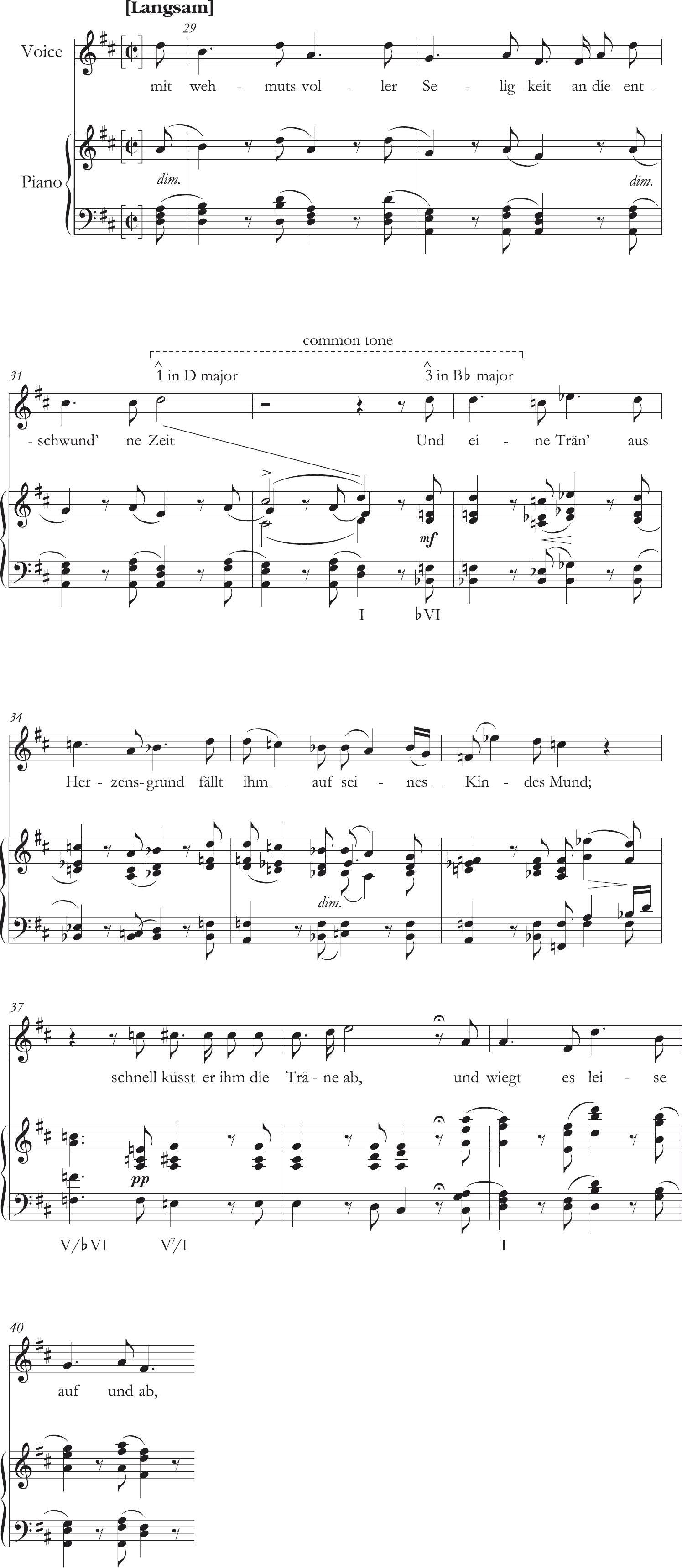
In Schubert's little-known song ‘Der Vater mit dem Kind’ (D.906), which sets a text by Eduard von Bauernfeld, a father cradles his sleeping child. The song, an excerpt of which is given in Example 5, features a modulation to the Other-worldly ♭VI that has several similarities to those in ‘Nacht und Träume’ and ‘Ihr Bild’. The song's first two strophes are in D major; then, at the start of the third strophe (bar 33), Schubert switches directly to B♭ major (♭VI) for the lines ‘And a tear from deep in his heart / Falls on his child's mouth’ (‘Und eine Trän’ aus Herzensgrund / Fällt ihm auf seines Kindes Mund’). In neo-Riemannian terms, this constitutes another PL transformation; moreover, once again a single melodic pitch, d″, acts as a common-tone link, being transformed from in D major to in B♭ major, creating a typically enchanting arrival for the Other-worldly ♭VI. There is only partial melodic floating (although the phrase neither starts nor ends on the local , B♭, b♭′ is employed in the middle of the phrase in bars 34–5), suggesting perhaps that rather than an ‘unreal’ dream or hallucination, this Other-worldly ♭VI passage represents an emotional epiphany, whereby the father realizes his deep love for the child. The passage closes on the local dominant chord in bar 37 and, in a touching return to the home key of D major, this V/♭VI chord is juxtaposed with V7/I as the father ‘quickly kisses the tear away’ (‘Schnell küsst er ihm die Träne ab’); the part-writing during this modulation is smooth, with the voice rising from c′′ to c♯″ – a ‘disillusioned departure’ would have been inappropriate. The key change back towards D major features a caesura in bar 38, where one imagines the father holding his breath, pausing on V7, while waiting to see if he has disturbed the sleeping child.
Schubert's ‘Der Vater mit dem Kind’ (D.906), bars 29–40, annotated.

Schubert's two settings of Goethe's lyric ‘Heiss mich nicht reden’ (from the novel Wilhelm Meisters Lehrjahre, 1795–6) both feature the Other-worldly ♭VI; overviews of ‘Mignon I’ (D.726) and ‘Lied der Mignon’ (D.877, no. 2), along with the text, can be found in Tables 3 and 4 respectively. The settings' protagonist, Mignon, was born of an incestuous relationship and suffers a deeply unhappy childhood, before vowing to the Divine Mother to conceal her past in return for protection. In the lyric's first stanza Mignon speaks of her duty to keep her secret and her opposing desire to reveal her true self. In the second stanza she recounts two metaphors: ‘At the right time the sun's course drives away / The dark night, and it must brighten’; and ‘The hard rock opens up its bosom, / And does not begrudge the earth its deep-hidden springs’. It is natural, the metaphors suggest, for difficult times to pass and for one to be able to unburden oneself. Alas, in the third and final stanza, Mignon bemoans that while men can confide in their friends, she is constrained by her vow of secrecy.
| Bar | Text | Translation | Key | Form |
|---|---|---|---|---|
| 1 | B minor | A | ||
| 5 | Heiss mich nicht reden, heiss mich schweigen, | Do not ask me to speak; ask me to be silent, | ||
| 9 | Denn mein Geheimnis ist mir Pflicht; | For my duty is to keep my secret; | B major | |
| 12 | Ich möchte dir mein ganzes Innre zeigen, | I long to reveal my true self to you, | B minor | |
| 16 | Allein das Schicksal will es nicht. | But fate does not allow it. | B major | |
| 19 | Zur rechten Zeit vertreibt der Sonne Lauf | At the right time the sun's course drives away | B minor | B |
| 23 | Die finstre Nacht, und sie muss sich erhellen; | The dark night, and it must brighten; | ↓G major | |
| 28 | Der harte Fels schliesst seinen Busen auf, | The hard rock opens up its bosom, | ||
| 32 | Missgönnt der Erde nicht die tiefverborgnen Quellen. | And does not begrudge the earth its deep-hidden springs. | ||
| 36 | ↓ | |||
| 38 | Ein jeder sucht im Arm des Freundes Ruh, | A man seeks peace in the arms of a friend, | B minor | A′ |
| 42 | Dort kann die Brust in Klagen sich ergiessen; | There the heart can pour out its laments; | B major | |
| 46 | Allein ein Schwur drückt mir die Lippen zu, | But a vow seals my lips, | B minor | |
| 50 | Und nur ein Gott vermag sie aufzuschliessen. | And only a god has the power to open them. | B major |
| Bar | Text | Translation | Key | Form |
|---|---|---|---|---|
| 1 | E minor | A | ||
| 5 | Heiss mich nicht reden, heiss mich schweigen, | Do not ask me to speak; ask me to be silent, | ||
| 7 | Denn mein Geheimnis ist mir Pflicht; | For my duty is to keep my secret; | ↓ | |
| 9 | Ich möchte dir mein ganzes Innre zeigen, | I long to reveal my true self to you, | G major | |
| 11 | Allein das Schicksal will es nicht. | But fate does not allow it. | E minor | |
| 14 | Zur rechten Zeit vertreibt der Sonne Lauf | At the right time the sun's course drives away | C major | B |
| Die finstre Nacht, und sie muss sich erhellen; | The dark night, and it must brighten; | |||
| 19 | Der harte Fels schliesst seinen Busen auf, | The hard rock opens up its bosom, | ||
| Missgönnt der Erde nicht die tiefverborgnen Quellen. | And does not begrudge the earth its deep-hidden springs. | |||
| 23 | ↓ | |||
| 26 | Ein jeder sucht im Arm des Freundes Ruh, | A man seeks peace in the arms of a friend, | E major | A′ |
| Dort kann die Brust in Klagen sich ergiessen; | There the heart can pour out its laments; | |||
| 31 | Allein ein Schwur drückt mir die Lippen zu, | But a vow seals my lips, | E minor | |
| Und nur ein Gott vermag sie aufzuschliessen. | And only a god has the power to open them. |
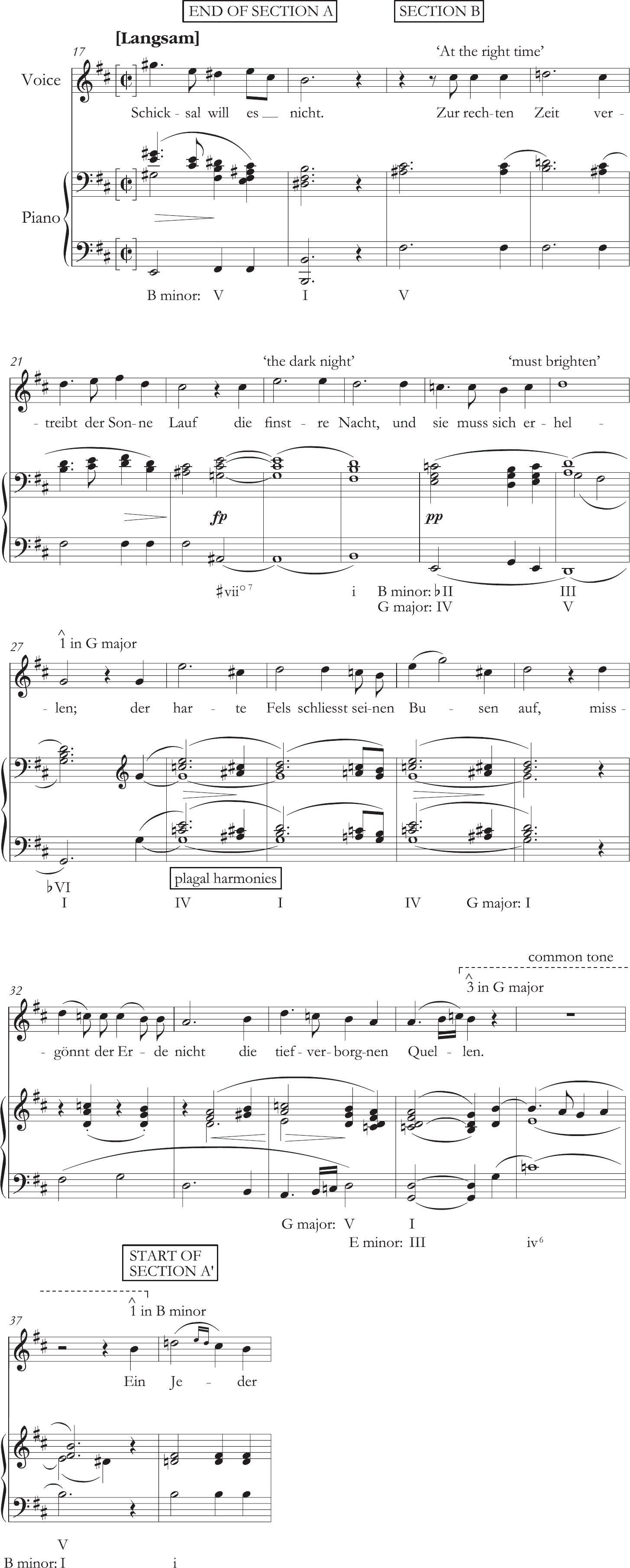
Schubert's ‘Mignon I’ and ‘Lied der Mignon’ date from April 1821 and January 1826 respectively, and respond somewhat differently to Goethe's text. Yet Schubert is consistent in his use of the Other-worldly ♭VI to evoke the natural metaphors of the lyric's second stanza, which are set in both versions as the central section of an ABA′ form. In ‘Mignon I’ (see Example 6), rather than employing a simple juxtaposition of old and new tonic chords (as in many of the examples in this article), the modulation from the home key of B minor to G major (♭VI) takes place gradually, even though a direct and maximally smooth L transformation (i–♭VI) would have been a viable option here. Following a perfect cadence in the tonic major (B major) at the end of section A (bar 18), section B opens with an F♯ major chord in the piano (bar 19), but there is a pause before the voice enters with the words ‘At the right time’ (an example of Schubert's typically deft word-painting). As this phrase progresses, it becomes clear that F♯ major is the dominant of a reinstated but weak B minor, which is underpinned by an f♯ pedal. The music again comes to rest on the dominant, F♯ major, at the start of bar 22, then – just before the voice enters on the upbeat to bar 23 – the piano suddenly intrudes with a diminished-seventh chord, accented fortepiano, in time to paint the words ‘the dark night’. This diminished seventh seems to last for an eternity before it resolves to B minor in bar 24 (the tonic in root position at last), but the harmony sits there only briefly before moving to a Neapolitan (C major) chord in bar 25. Rather than being treated as a pre-dominant ♭II in B minor, Schubert instead treats it as a pre-dominant IV in G major, in which key we then cadence (bar 27). G major (♭VI) thus emerges radiantly from an unstable B minor, in the same way that sunlight breaks through a gloomy night. Section B continues in G major and utilizes a number of the features observed in ‘Nacht und Träume’, including the use of the local IV (rather than the local V) in bars 28–31, and ‘melodic floating’, whereby the local (G) is largely avoided in the voice in bars 28–35, including in the vocal line at the cadence at the end of section B (bar 35). In this cadence the voice outlines a motion a′–b′  , rather than the more normative a′–g′
 , before the piano interlude recasts G major as III in the key of E minor and provides a Phrygian imperfect cadence in this new key, coming to rest on B major (V of E minor) at bar 37. The voice then begins the final strophe with an upbeat b′, creating a common-tone link with the end of the previous strophe, but when the piano enters in bar 38 with B minor, the half-hearted optimism of the B major chord of the earlier Phrygian cadence is deflated. The ‘disillusioned departure’ from the Other-worldly ♭VI here is gentle, by virtue of the vocal common-tone link, but Mignon is nevertheless resigned to her fate.
Schubert's ‘Mignon I’ (D.726), bars 17–38, annotated.

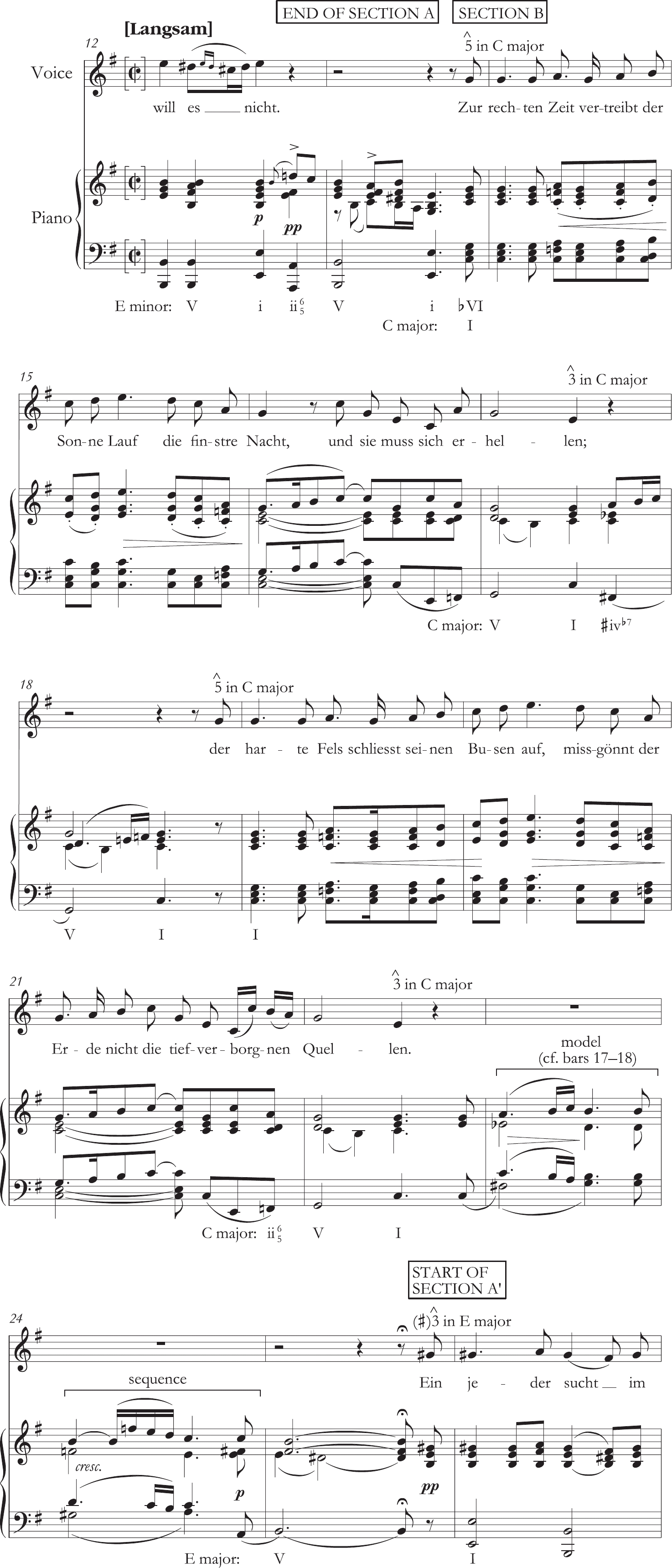
The move to ♭VI in the second setting, ‘Lied der Mignon’ (see Example 7), is of the simpler ‘juxtaposition-of-tonic-chords' type, with section B opening immediately in C major (♭VI), following a perfect cadence in E minor (i) at the end of section A (bar 13). Moreover, unlike ‘Nacht und Träume’, ‘Ihr Bild’ and ‘Der Vater mit dem Kind’, which all involved vocal common-tone links and PL transformations (I–♭VI), and ‘Mignon I’, which composed out its L transformation (i–♭VI) with a gradual modulation, the key change in ‘Lied der Mignon’ employs a direct L transformation (i–♭VI) with only moderately smooth voice-leading. Following the move to ♭VI, the lyric's two metaphors are both set to a ‘rising–falling’ gesture that accords with their subject of natural release. And, although C (local ) is occasionally used in the vocal line, the vocal phrases both begin on G (local ) and close on E (local ), so that melodic floating is again employed. The reprise of ‘Lied der Mignon’ presents a rather different scenario from that of ‘Mignon I’, in that it heavily reworks the material of section A. Initially, section A′ opens (bar 26) in a bright tonic E major, suggesting an optimistic future for Mignon. However, by bar 31 (not shown in Example 7) the mood turns towards pessimism owing to the restoration of E minor at the lines ‘But a vow seals my lips, / And only a god has the power to open them.’ The music at this point becomes recitative-like, with declamatory vocal phrases being sung above a slow-moving, chromatic accompaniment, all of which point to Mignon's emotional turmoil.
Schubert's ‘Lied der Mignon’ (D.877, no. 2), bars 12–26, annotated.

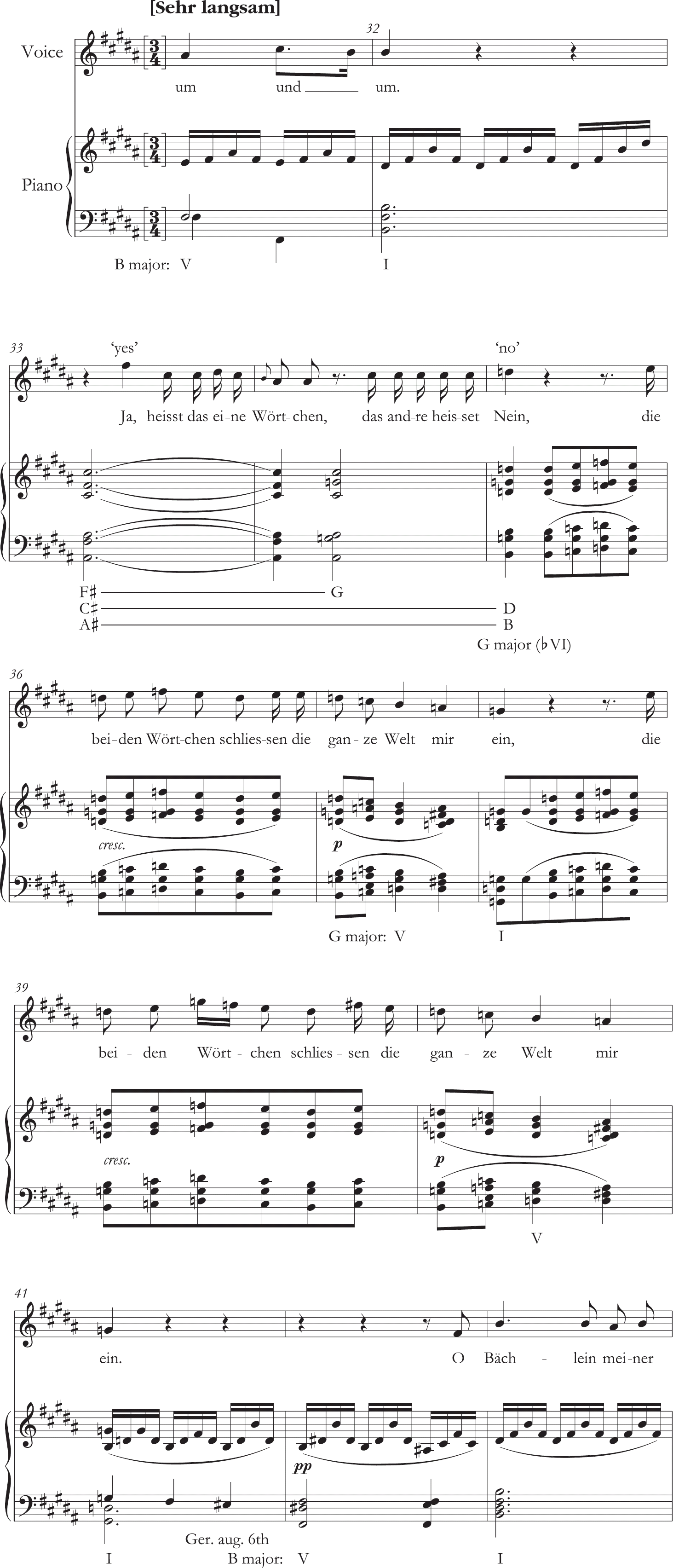
Let us now consider a more problematic example of Schubert's ♭VI, in ‘Der Neugierige’ (no. 6 from Die schöne Müllerin, D.795). At this song's point in the cycle, the youth asks the stream a question about the miller-maid's feelings towards him. The song is in B major and includes modal mixture in the form of brief B minor inflections and a modulation to ♭VI. During a slower opening section in 2/4 and in B major, the protagonist states that he cannot ask the flowers and stars his question, only the stream. This is followed by a more flowing 3/4 section (beginning at bar 23), still in B major, but now pianissimo, with semiquavers representing the stream. Here the youth asks why the stream is so quiet, accompanied by a brief touch of the tonic minor (that is, the D♮, ♭, in bar 25), before requesting just a one-word answer; he says that ‘“yes” is one word’ (‘Ja, heisst das eine Wörtchen’), at which point recitative briefly intrudes (bars 33–4; see Example 8) with an F♯ major 6–3 chord, before F♯ rises by semitone to G (bar 34) on the words ‘the other is' (‘das andre heisset’), and then A♯ and C♯ rise by semitone to B and D, arriving at a G major 6–3 chord on ‘no’ (‘Nein’) (bar 35). Seven bars in G major (♭VI) follow, during which the piano accompaniment uses slowly rising and falling quaver block chords, before the stream's semiquaver motion starts again in bar 41, and bar 43 begins a reprise of music that first opened the 3/4 section at bar 23.
Schubert's ‘Der Neugierige’ (D.795, no. 6), bars 312–43, annotated.

Does the song's modulation to G major represent a positive, other-worldly moment, an Other-worldly ♭VI? Some think not, believing instead that it represents the youth's fear of rejection by the miller-maid. Deborah Stein and Robert Spillman write:
Schubert's ‘Der Neugierige’ (from Die schöne Müllerin) describes the young miller summoning up courage to ask his companion, the brook, whether or not his heart speaks the truth, whether or not the maiden loves him. It is a moment of great anxiety, as the youth realizes the implications of the answer, ‘yes' or ‘no’, to his questions […] In dramatic contrast to the B major tonic, Schubert dramatizes the poet's fear of a negative response by setting this text in G major (♭VI).Footnote 25
In support of Stein and Spillman's reading, one might consider ♭VI to be a dark harmony ‘borrowed’ from the tonic minor, thus associating it with the earlier use of the tonic minor in bar 25, but this all goes against ♭VI's positive, other-worldly stereotype. Moreover, the song's modulation to G major hints at a number of the characteristics that we have come to associate closely with Schubert's Other-worldly ♭VI: there is a relatively smooth modulation into ♭VI (all of the lines move by semitone, even if they all do move), and there is also a degree of melodic floating in the vocal line (excepting the cadences in bars 37–8 and 40–1, where the melody does descend by step to the local ). Unravelling the meaning of ♭VI in this song first requires us to address the meaning of – and Schubert's possible reading of – Wilhelm Müller's text.
With respect to Stein and Spillman, who note in the quotation above that the song features two questions, the youth does not in fact ask the stream ‘whether or not his heart speaks the truth’; rather, his stated intention is to ask it whether his heart has lied to him (‘Mein Bächlein will ich fragen, / Ob mich mein Herz belog’). From this perspective, the answer the youth craves is not ‘yes [your heart has lied]’ but rather ‘no [your heart has not lied]’. At the end of the poem the protagonist does then ask, ‘Does she love me?’ (‘Liebt sie mich?’), to which ‘yes' would be the desired answer;Footnote 26 this late reversal of the implications of a ‘yes' or a ‘no’ answer introduces some ambiguity and suggests that the deluded protagonist will change his question so that any ‘answer’ the stream might give will always align with his desires. As for Schubert's setting, we should remember that the ‘yes' in bar 33 coincides with an interruption by recitative to the ‘normal’ mode of song, which perhaps points to the cataclysmic answer, ‘Your heart has lied,’ while his treatment of the G major passage (with its magical arrival, restoration of conventional ‘music’, undulating accompaniment and gently curved vocal line) suggests that Schubert understood the ‘no’ here to imply the positive response, ‘Your heart has not lied.’ In which case, this would be a positive, Other-worldly ♭VI after all. Both interpretations of this song's ♭VI passage seem plausible, particularly as the Other-worldly ♭VI characteristics are only partially in evidence; Schubert perhaps appreciated the ambiguity in Müller's text.
III. The Rogue ♭VI
As the antithesis of the Other-worldly ♭VI, the Rogue ♭VI inverts or omits the characteristics identified in ‘Nacht und Träume’ and ‘Ihr Bild’. Where the arrival of the Other-worldly ♭VI is enchanting and welcoming, smoothed over with common-tone emphasis and semitonal motion, the arrival of the Rogue ♭VI is disruptive, emphasizing tonal distance for dramatic effect. Similarly, while departure from the Other-worldly ♭VI is unwelcome and disillusioning for a song's protagonist, departure from the Rogue ♭VI might signal relief, or represent a calming of heated emotions. Indeed, we might expect the smooth motion that characterizes the move into the Other-worldly ♭VI to characterize the move out of the Rogue ♭VI.
‘Der stürmische Morgen’ provides a suitable exemplar, but in order to understand fully how ♭VI works in this song we first need to examine ‘Im Dorfe’, the song which precedes it in the Winterreise cycle. The text of ‘Im Dorfe’ is given in Table 5, and an annotated score of the opening and closing sections of Schubert's setting can be found in Example 9. Müller's first stanza is eight lines long; Schubert sets the stanza's first five lines as section A of an ABA′ form and the remaining three lines as a contrasting section B. Müller's second stanza is four lines long and is set as section A′ (a musical reprise). ♭VI features in section A′, where it is twice briefly interpolated into the prevailing D major tonality, but it is absent from section A. Thus, the reprise of ‘Im Dorfe’ does not return us to where we were musico-poetically at the song's opening.
Opening and closing sections of Schubert's ‘Im Dorfe’ (D.911, no. 17), annotated.

| Bar | Text | Translation | Key | Form |
|---|---|---|---|---|
| 1 | D major | A | ||
| 6 | Es bellen die Hunde, es rasseln die Ketten; | The dogs are barking, their chains are rattling; | ||
| Es schlafen die Menschen in ihren Betten, | Men are asleep in their beds, | |||
| 11 | Träumen sich Manches, was sie nicht haben, | Dreaming of the many things they do not have, | ||
| Tun sich im Guten und Argen erlaben; | Consoling themselves with the good and the bad; | |||
| Und morgen früh ist alles zerflossen. – | And tomorrow morning it will all have vanished. | |||
| 20 | Je nun, sie haben ihr Teil genossen, | Oh well, they have enjoyed their share, | G major | B |
| Und hoffen, was sie noch übrig liessen, | And hope that what they have remaining, | |||
| Doch wieder zu finden auf ihren Kissen. | Might be found again on their pillows. | ↓D major | ||
| 29 | A′ | |||
| 30 | Bellt mich nur fort, ihr wachen Hunde, | Drive me away, you barking, watchful dogs, | ||
| Lasst mich nicht ruhn in der Schlummerstunde! | Allow me no rest in this hour of slumber! | |||
| 35 | Ich bin zu Ende mit allen Träumen – | I am finished with all dreaming – | (♭VI) | |
| Was will ich unter den Schläfern säumen? | Why should I linger among sleepers? |
The opening of ‘Im Dorfe’ is often said to be unusual because of the way in which the piano introduction ‘fails' to introduce the singer properly. In the words of Arnold Feil, ‘Schubert brings in the voice where the listener neither expects it nor finds it natural; it enters not as the “prelude” implies.’Footnote 27 This strategy distances the singer – the wanderer – from the events that are depicted by the piano. In the literature, the piano's characteristic figuration is widely interpreted as a musical representation of the opening line of the song, ‘The dogs are barking, their chains are rattling’; the repeated right-hand chords represent the anxious barking of the dogs, and the measured left-hand trills represent their rattling chains. The dog-barking, chain-rattling figuration emphasizes the downbeat of each bar, and for the second half of the bar the dogs and chains fall silent; for Youens, it is as if the dogs momentarily fall silent and listen ‘to determine whether the intruder in their midst has gone away’.Footnote 28 As Feil points out, when the voice finally enters, it does so not on the downbeat, but with a protracted upbeat, so that the wanderer sings through the silence of the piano figuration. Thus, in section A, the wanderer stands apart from the sleeping villagers and their barking dogs. And, moreover, he disparages them, if like Youens you hear the leaps of the vocal line as a derisive imitation of the villagers' snoring.Footnote 29
While the villagers enjoy their dreams, the wanderer cynically comments that dreams never last and are soon gone (this was certainly the case with his own dreams, the last hope of which deserted him in the previous song, ‘Letzte Hoffnung’). The shock with which dreams disappear is mirrored by the suddenness of the a tempo in bar 18 and the bass line's arrival on D on the word ‘zerflossen’ (‘vanished’) at the end of section A. It is from this point, and not before, that the voice and piano begin to work together. Flowing from this unity, the wanderer empathizes with the villagers in the dance-like section B in G major. Here he sings of the villagers' hope that their dreams will stay with them when they awaken, but there is also a hint of jealousy: the villagers have had their share of dreams, while the wanderer has not. Note that the modulation into the dancing reverie of section B employs a common tone in the voice and the upper line of the piano, so that D is transformed from in D major (I) to in G major (IV rather than ♭VI), which illustrates that it is the presentation of the voice-leading during the modulation, rather than the actual destination of the modulation, that is most important for creating a dreamlike effect.
The real crux of this song, however, is the way in which Schubert constructs the reprise that begins in bar 29. It starts in a manner similar to the opening: ‘Drive me away, you barking, watchful dogs’, sings the wanderer, who is again rhythmically distinct from the piano. But Schubert then begins to modify the reprised material; his setting of the question posed in the final two lines of the poem – ‘I am finished with all dreaming – / Why should I linger among sleepers?’ – is crucial to understanding these modifications and, indeed, the song as a whole. Youens's interpretation is as follows:
Whether or not the question at the end is rhetorical, that is, an angry verbal goad with which to impel the wanderer's flight from humankind, is itself a question. The ending can certainly be read in that way, but Schubert seems to have understood it as genuine self-inquiry, more thoughtful than contemptuous in tone. His wanderer seems truly to wonder why he lingers in a village peopled by those he professes to find contemptible […] For the duration of the question, the wanderer speaks with such solemn intensity that he blocks out the sounds of the external world. The rattling trills and barking repeated chords cease and are replaced by the neutrality of block-chordal accompaniment.Footnote 30
A few pages on in her discussion, it becomes clear that Youens sees the wanderer as rejecting both sleep and dreams, and also the villagers and humanity. At the end of ‘Im Dorfe’, Youens's wanderer confronts his desire to be like those in the village, to be able to sleep; however, his alienation is already such that there is no going back. After twice asking why he should stay among the sleepers, he concludes that he should not, and summons the resolve to leave the village and all dreaming behind.
Feil's analysis of the reprise reaches a similar conclusion. He observes that the block-chordal passages starting in bars 38 and 43 abandon the established rhythmic separation of voice and piano, and posits that by now working together, the voice and piano represent the wanderer's new-found unity of purpose, a unity of purpose confirmed by the repetition of the question.Footnote 31 Feil concludes:
The wanderer, at once fettered to and ostracized from the village, finds his way out of the conflict by tearing himself away. Schubert's song is constructed from this viewpoint; it culminates in the moment of tearing away, that is, in an actual event.Footnote 32
Both Feil and Youens thus see the wanderer leaving the sleeping village with renewed vigour; their interpretations rely on a similar reading of the text and on the idea that the interpolated chordal passages express intensity and resolve. Additionally, for Youens the energy of the following song, ‘Der stürmische Morgen’, reflects the wanderer's renewed determination to abandon humanity and to reject sleeping and dreaming.
Although Feil and Youens do not do so, it is possible to interpret Schubert's use of ♭VI in the reprise of ‘Im Dorfe’ in such a way that supports their interpretations: by accompanying the words ‘I am finished with all dreaming’ in bars 36–7 and 41–2, ♭VI might be said to represent the wanderer's transcendent realization of the need for him to leave the rest of humanity behind, rather than being a straightforward representation of dreaming. But do such readings ring true? Do we really hear the wanderer ‘tearing’ himself away from the village at the end of ‘Im Dorfe’, as Feil suggests? The alternative interpretation that I set out in the following paragraphs is inspired by Peter Pears and Benjamin Britten's 1963 recording of the song,Footnote 33 and reflects the observations made earlier in this article about the characteristics of Schubert's Other-worldly ♭VI.
Youens has noted that B♭ (♭ ) occurs as a pitch well before the appearance of the B♭ major (♭VI) chords in the reprise, arguing that the former ‘foreshadows' the latter (several occurrences of B♭s are labelled ‘♭’ in Example 9 above).Footnote 34 Although this does not constitute functional harmonic preparation, B♭ does seem to play a role in the song's musico-poetics. During section A, the pitch class B♭ is not particularly prominent, for when it occurs in the right-hand chords in bars 3 and 9–10 it is quickly superseded by B♮, and in the trill figure of bar 17 it is metrically weak. At the opening of the reprise in bar 29, however, B♭ becomes suddenly more prominent because of its metrically strong position. And, of course, B♭ becomes stronger still when it acts as a chord root in bars 37 and 41–2. If B♭ represents sleep and dreams in this song, then during its course the wanderer's exhaustion gradually increases.
Even though the wanderer claims to have finished with all dreaming, the music might be said to tell a different story. In bar 11 of section A, the word ‘träumen’ refers to the dreams of others and is set to a pre-dominant harmony (ii7) in D major, yet when this word returns in bars 37 and 42, now in reference to the wanderer's own dreams, it is accompanied by ♭VI. These moves into ♭VI are relatively efficient in terms of voice-leading: the vocal line first slides from e′ up to f♮′ (bars 35–6), before f♮′ acts as a common tone when the harmony moves to ♭VI; the second time, the vocal line slips from f♯′ to f♮′ (bars 40–1). The block-chordal accompaniment in bars 38–9 might still represent internal questioning (‘Why should I linger among sleepers?’), but the wanderer cannot hear the barking dogs and rattling chains at this point because he is on the verge of losing consciousness. He rouses momentarily at bar 40 to protest once more that he has ‘finished with all dreaming’, but even as he sings these words he quickly falls back into ♭VI stupor, and the ‘yawning’ quality of Schubert's setting of the words ‘all dreaming’ (bars 41–2) – which is brought out vividly in the Britten and Pears recording – gainsays his protestations. (The wanderer's ‘yawn’ here makes an ironic complement to his derisive imitation of the villagers' snoring at the start of sections A and A′.) The pianist then has to fill in for a little longer in bar 45 while he waits for the dozing wanderer to finish the phrase (compare bars 38–9 with 43–5).
When the wanderer does finish the phrase, he ends on the third, f♯′, not the tonic d′: this is not a decisive cadence like the one that ended section A in bar 18. Indeed, the voicing of this and the other cadences towards the end of ‘Im Dorfe’ demands musico-poetic interpretation. In both bars 37 and 42, where the phrases end with the word ‘Träumen’, the singer closes on D (first time d′, second time d″). But here D is not presented as tonic, but as in B♭ major (♭VI), so that the vocal line ‘floats' above the chord root (we might consider this a very concise form of ‘melodic floating’). Furthermore, during the perfect cadences in D major that culminate on the downbeats of bars 40 and 46, the voice ends on f♯′, again floating on above the tonic. The closing cadences of the song are thus notable for the way in which the singer (the wanderer) either presents the home keynote, D, in an ‘other-worldly’ context (that is, as in ♭VI), or avoids it, preferring instead to end on F♯ ( of I) in the perfect cadences in D major. Schubert's treatment of the cadences in the reprise might thus be taken to suggest that the wanderer is either distant from reality, or unconscious. I do not suggest that the wanderer wishes to fall asleep at the end of ‘Im Dorfe’; rather, at this point in the cycle, the wanderer's exhaustion is such that he is powerless to prevent himself from drifting into unconsciousness.
The following song, ‘Der stürmische Morgen’, with its high-energy and frequent explosive outbursts, creates a strong contrast with the restful ending of ‘Im Dorfe’, illustrating the extreme changes of mood to which Müller's protagonist is prone. The text of ‘Der stürmische Morgen’ consists of three four-line stanzas, which are set by Schubert as an ABA′ form (see Table 6).
| Bar | Text | Translation | Key | Form |
|---|---|---|---|---|
| 1 | D major | A | ||
| ↓ | ||||
| 3 | D minor | |||
| 4 | Wie hat der Sturm zerrissen | See how the storm has torn apart | ||
| Des Himmels graues Kleid! | Heaven's grey cloak! | |||
| Die Wolkenfetzen flattern | Tattered clouds dart about | |||
| Umher in mattem Streit. | In weary conflict. | |||
| 10 | Und rote Feuerflammen | And fiery red flames | B♭ major | B |
| Ziehn zwischen ihnen hin. | Flash between them. | |||
| Das nenn’ ich einen Morgen | This is what I call a morning | |||
| So recht nach meinem Sinn! | After my own mind! | |||
| 14 | Mein Herz sieht an dem Himmel | My heart sees its own image | D minor | A′ |
| Gemalt sein eignes Bild – | Painted in the sky – | |||
| Es ist nichts als der Winter, | It is nothing but winter, | |||
| Der Winter kalt und wild! | Winter, cold and wild! |
In the first stanza the wanderer sings of clouds in the stormy sky. In the second, fiery lightning flashes between those clouds and the wanderer professes it to be a morning exactly to his liking. In the final stanza, the wanderer, in typically Romantic fashion, sees these weather events as a metaphor for his own feelings: ‘My heart sees its own image / Painted in the sky – / It is nothing but winter, / Winter, cold and wild!’
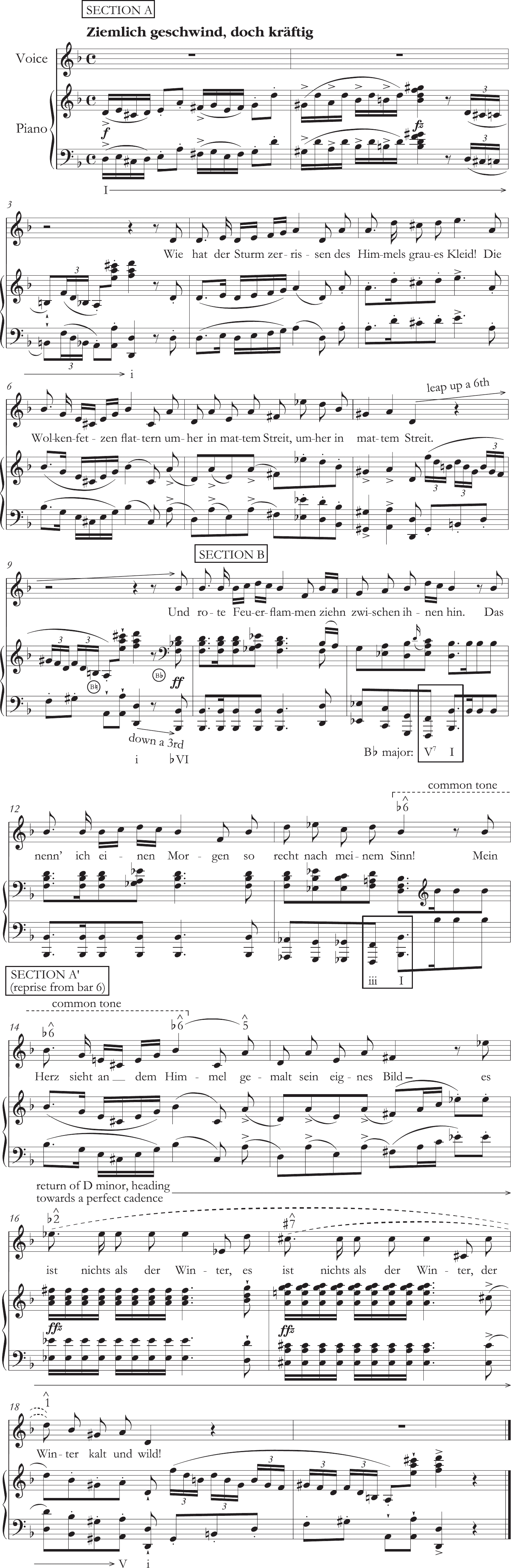
In Schubert's setting, an annotated score of which is provided in Example 10, the piano introduction takes the D major of the end of ‘Im Dorfe’ and (by bar 3) transforms it into a dark D minor that then becomes the home key of ‘Der stürmische Morgen’. The tempo is brisk, and section A uses diminished-seventh chords to evoke the ‘weary conflict’ of the stormy sky. Whereas the piano and voice were distanced from each other in section A of ‘Im Dorfe’, section A of ‘Der stürmische Morgen’ employs an octave-unison texture, as if to reflect the solitude and stridency of the wanderer; he has left the village and humanity behind, and he sees his own monstrous mood reflected in the heavens. The piano interlude at bars 8–9 includes a diminished-seventh harmony (G♯, B, D, F) and uses contrary motion between the hands. The hands both resolve onto the dominant note, A, before a crashing perfect cadence in D minor. Youens has likened the effect of this passage to the clouds in the sky colliding together;Footnote 35 these collisions produce the lightning the wanderer observes in the second stanza.
Schubert's ‘Der stürmische Morgen’ (D.911, no. 18), annotated.

Section B opens unceremoniously in B♭ major (♭VI), changing key without any preparation and increasing the dynamic to fortissimo. The shift in key from D minor to B♭ major (an L transformation) could easily have been smoothed over by emphasizing the notes D and F (common tones shared by the two triads), but instead Schubert contrives to do everything possible to create a jarring effect: the vocal line ends section A on the home tonic d′, before leaping up a sixth to begin section B on the new tonic b♭′; the bass line is also disjunct, with D/d octaves dropping down a third to B♭′/B♭, shifting the piano into a lower register; finally, the new keynote (B♭) clashes with the B♮s used in the diminished-seventh harmony of the piano interlude. In comparison to the smooth, enchanting modulations to ♭VI that we considered above, the modulation in ‘Der stürmische Morgen’ is considerably more disruptive. There is no change of lighting around a common tone, as we observed in ‘Nacht und Träume’ or ‘Ihr Bild’, nor the semitonal motions in the vocal line that marked the wanderer's slips into unconsciousness in ‘Im Dorfe’. There is nothing dreamlike at all about the move to ♭VI in ‘Der stürmische Morgen’; the abrupt key change and the music that follows it shouts of the intense rage of a troubled soul.
In section B, with march-like determination, the wanderer observes fiery lightning bursting from the clouds, before proclaiming, ‘This is what I call a morning / After my own mind!’ The two couplets of this stanza are set to two comparable phrases (bars 10–11 and 12–13) that are separated by a fanfare of repeated B♭s in the piano (end of bar 11). The simple perfect cadence at the end of the first phrase (bar 11) is altered at the end of the second (bar 13) by a somewhat unusual dominant-parallel substitution: the dominant-seventh chord, F7, is replaced by a D minor chord. By placing D minor and B♭ major in direct juxtaposition, this altered version of the cadence summarizes the tonal motion of the first and second vocal strophes (the L transformation of i into ♭VI) and perhaps offers some preparation for a return to D minor in section A′. The second cadence of section B is again followed by fanfare B♭s in the piano (end of bar 13) and, because only material from bar 6 of section A is reprised, B♭ is carried over to become the seventh of a diminished-seventh chord (C♯, E, G, B♭) at the start of section A′ (bar 14). Thus, even though this B♭ resolves to A at the end of bar 14 (♭ moving to ), it nevertheless provides a brief common-tone bridge between the two sections – a musical link between the fiery sky and the wanderer's heart, to accompany the poetic link the wanderer himself makes between these two things. The smoothness of the modulation back to D minor also carries a little of the anger of section B into section A′.
Perhaps in part to make the length of section A′ comparable to that of section A, Schubert repeats the third line of the last stanza (‘It is nothing but winter’); however, this also permits some effective word-painting, with the chill of winter being reflected by the shivering, teeth-chattering semiquaver chords in the piano in bars 16–17. These chords also make the ending of the song more emphatic, as the vocal and bass lines (moving in parallel octaves) now each approach the tonic (D) from upper (E♭) and lower (C♯) leading notes, strengthening the arrival on at the start of bar 18. The duration of the two penultimate notes of the voice's final cadence in this bar is now compressed, in relation to those in the cadence at the end of section A, so that the singer angrily spits out the percussive consonants of the song's last line. To end the song, the cloud-colliding interlude from bars 8–9 returns as a coda.
Quite unlike the other songs considered in this article, ‘Der stürmische Morgen’ is clearly steeped in rage. When B♭ major (♭VI) is introduced in ‘Der stürmische Morgen’, there is no attempt to bridge its tonal distance from the home tonic, D; in fact, the distance – which, as a maximally smooth L transformation, is as short as possible from the perspective of idealized voice-leading – is greatly exaggerated by Schubert's treatment. The abruptness of the key change and the march-like nature of the material that follows mean that it is nonsensical to read the B♭ major section as an other-worldly trance or moment of transcendence; the manner in which Schubert changes key here can only be interpreted as indicative of the wanderer's this-worldly rage.
Yet Schubert could have chosen to change abruptly to any key and still have achieved a similar effect; indeed, one might have supposed that the ‘i–♮III–i’ key scheme of ‘Der Atlas' (no. 8 from Schwanengesang, D.957) would have been a more natural fit. So why did Schubert choose to modulate to B♭ major? We can find one possible answer to this question by considering the song cycle's broader arc; more specifically, by interpreting the wanderer's energy and anger in ‘Der stürmische Morgen’ as the result of his failure to meet his stated aim of staying awake at the end of ‘Im Dorfe’. It will be recalled that I proposed that the gentle interpolation of B♭ major (♭VI) into the prevailing D major tonality in the reprise of ‘Im Dorfe’ suggests that the wanderer surrenders to unconsciousness at the end of that song. Of course, the tonal structure of ‘Der stürmische Morgen’ also involves the – this time abrupt – interpolation of B♭ major (♭VI), albeit within a prevailing tonality of D minor rather than D major. Thus the tonal structure of ‘Der stürmische Morgen’ can be regarded as a direct reference to the tonal structure of the reprise of ‘Im Dorfe’, and the fact that the introduction of ‘Der stürmische Morgen’ moves from D major to D minor only strengthens the tonal associations between the two songs. It is as if the wanderer's choice of keys in ‘Der stürmische Morgen’ mocks those used in the reprise of ‘Im Dorfe’: after allowing B♭ major to entice him to sleep in ‘Im Dorfe’, the wanderer moves to B♭ major in ‘Der stürmische Morgen’ as a mark of defiance; he will not surrender to unconsciousness again.
Conclusion
I have argued above that in Schubert's songs it is not the presence per se of ♭VI, but the nature of its presentation that determines its musico-poetic effect. I have also identified three Other-worldly ♭VI characteristics – gleaned from close analyses of the songs ‘Nacht und Träume’ and ‘Ihr Bild’ – that I propose are helpful for distinguishing between Schubert's various musico-poetic uses of ♭VI: (1) enchanting arrival, whereby the modulation to ♭VI employs smooth voice-leading; (2) disillusioned departure, whereby the modulation out of ♭VI employs disjunct, disruptive voice-leading and disquieting harmonies (for example, diminished sevenths, augmented sixths, etc.); and (3) melodic floating, whereby the vocal line avoids the local tonic during the ♭VI residency. Where these characteristics are strongly articulated, the musico-poetic effect is that of the positive, Other-worldly ♭VI; where these characteristics are inverted, the effect is that of the negative, Rogue ♭VI; and where these characteristics are only partly used or weakly articulated, the effect is somewhere between these two poles and further close reading is necessary to interpret Schubert's possible intent.
So, while extramusical associations might affix to characteristic (chromatic) harmonies such as ♭VI more readily than they would to conventional (diatonic) ones, in Schubert's songs it is the presentation of the harmony (that is, its harmonic and voice-leading context) that generates the particular effect. This is evidenced by cases in which ♭VI either is missing in the evocation of an other-worldly effect, or is used without the evocation of any such effect. With regard to the former, consider the common-tone modulation to the subdominant (IV) for section B of ‘Im Dorfe’ (discussed above); with regard to the latter, consider ‘Glaube, Hoffnung und Liebe’ (D.954), in which ♭VI is robbed of any other-worldliness by its gradual and logical derivation from the home key.Footnote 36 Further, we would be mistaken if we were to require that Schubert's treatment of ♭VI be uniform across his song oeuvre: the examples I have considered in this article are all ‘mature’ songs dating from 1821 onwards; before this, his approach to ♭VI appears to be much less consistent, even if there are some interesting embryonic examples of the Other-worldly ♭VI in earlier songs (for example, ‘Als ich sie erröten sah’, D.153, and ‘Der Flug der Zeit’, D.515).
Clearly Roman-numeral harmonic analysis, although a useful first step towards understanding harmonies such as ♭VI, is not enough on its own to account properly for Schubert's Romantic harmonic practice. Equally, identifying the underlying neo-Riemannian transformations between triads is insufficient; the notion of idealized voice-leading that forms the basis of many neo-Riemannian conceptions of tonal space might identify two harmonies as being transformationally very close to each other, but in practice the actual voice-leading that a composer uses might still constitute a highly disjunctive presentation of the two harmonies (as was seen to be the case in ‘Der stürmische Morgen’, whose L transformation of D minor into B♭ major is theoretically maximally smooth, but nevertheless is given a presentation that is anything but smooth in the music itself). In Schubert's songs the presentation of harmony at the surface of the music is crucial, and meaningful harmonic analysis should pay great attention to a work's foreground voice-leading.Footnote 37
Given the significance of foreground voice-leading in Schubert's music, one might imagine that a Schenkerian approach would be ideal for highlighting his evocative use of manoeuvres like common-tone modulations, and indeed there is evidence to suggest that Schenker himself may have been attuned to such things. For example, Schenker's early Urlinie of Schubert's ‘Ihr Bild’ suggests that he was aware of B♭'s role as a common tone during the song's modulation to ♭VI,Footnote 38 while the chapter on form in Free Composition considers cases in which a primary tone essentially acts as a structural common tone during a tonicization that gives rise to the middle part of a three-part form.Footnote 39 Yet, despite these nuggets, common-tone modulations are usually considered foreground events in Schenkerian analysis as it is commonly practised, and they are thus eclipsed by the attention afforded to descending lines and especially to the Urlinie itself, which are by contrast allowed to permeate the music's deeper levels.Footnote 40 Similarly, ♭VI and chromaticisms of all sorts are generally treated as foreground features, to be subsumed at deeper levels by the diatony of the fundamental structure. The ideas about Schubert's use of ♭VI that I have put forward in this article are not therefore intrinsically Schenkerian.
I do not dismiss the notion that the ♭VI harmony itself might have come to act as an other-worldly signifier, as Taruskin suggests in the passage quoted at the start of this article. I do propose, however, that in Schubert's songs at least, the situation is far more complex. ♭VI presented Schubert with many harmonic, contrapuntal and thematic possibilities, and so his compositional choices in this respect are highly significant; indeed, they are crucial for understanding his musico-poetic intentions. Schubert's Other-worldly ♭VI may have a dreamy effect, but this is achieved by meticulous craftsmanship. Ultimately, if Romantic music attained a greater emotional expressivity, this was because of skilfully wrought harmony and counterpoint.