Introduction
Fasciolosis, a widespread foodborne zoonotic disease that affects a wide range of mammals – particularly grazing animals – is caused by infection with Fasciola hepatica. Over 180 million people are at risk of infection globally. Furthermore, approximately 2.4 to 17 million individuals are thought to be infected with liver fluke, and this number is likely increasing (Sabourin et al., Reference Sabourin, Alda, Vázquez, Hurtrez-Boussès and Vittecoq2018). Economic losses in the livestock industry exceed USD 3 billion worldwide, including USD 119 million per year in the Mexican cattle industry (Mehmood et al., Reference Mehmood, Zhang and Sabir2017; Villa-Mancera & Reynoso-Palomar, Reference Villa-Mancera and Reynoso-Palomar2019b). Infected animals show reduced weight gain, fertility and meat and milk production, as well as liver condemnation in abattoirs, although this condition rarely causes mortality in cattle (Torgerson & Claxton, Reference Torgerson and Claxton1999; Sanchez-Vazquez & Lewis, Reference Sanchez-Vazquez and Lewis2013; Qin et al., Reference Qin, Gao, Wang and Xiao2016). In Mexico, several recent studies using bulk-tank milk enzyme-linked immune sorbent assay (ELISA) in cattle herds have indicated that the F. hepatica prevalence in three climate regions ranged from 62.76% to 63.56% (Villa-Mancera & Reynoso-Palomar, Reference Villa-Mancera and Reynoso-Palomar2019a, Reference Villa-Mancera and Reynoso-Palomarb). A high prevalence of parasite infection in cattle has been found in north-west Mexico using the indirect ELISA test (24.4%) and sedimentation faecal examination (11.4%) (Munguía-Xóchihua et al., Reference Munguía-Xóchihua, Ibarra-Velarde, Ducoing-Watty, Montenegro-Cristino and Quiroz-Romero2007). In addition, dairy cattle herds in the tropical climate had milk production losses of 1.50 kg per day, while dairy cow herds in the temperate climate showed losses of 1.29 kg per day (Villa-Mancera & Reynoso-Palomar, Reference Villa-Mancera and Reynoso-Palomar2019b).
Geographic information systems (GIS) and remote sensing technologies have been useful for extracting data on environmental features to investigate their relationships with disease at known sites, as well as to areas where disease does not exist (Dutra et al., Reference Dutra, Molento, Naumann, Biondo, Fortes, Savio and Malone2010; Charlier et al., Reference Charlier, Vercruysse, Morgan, van Dijk and Williams2014). The susceptibility of cattle to the effects of climate change is not restricted to tropical, arid or temperate zones, and recent environmental and climate changes due to global warming may alter the epidemiology, seasonality and geographical distribution of the free-living stages of this parasite, thereby increasing the risk of livestock populations to the disease (Villa-Mancera et al., Reference Villa-Mancera, Reynoso-Palomar, Olivares-Perez, Ortega-Vargas, Cruz-Mendoza and Quiroz-Romero2015; Charlier et al., Reference Charlier, Ghebretinsae, Levecke, Ducheyne, Claerebout and Vercruysse2016; Villa-Mancera & Reynoso-Palomar, Reference Villa-Mancera and Reynoso-Palomar2019b).
Although the existing data on liver condemnation in cattle slaughterhouses are not representative of the true infection status, they are useful for enabling herd tracking of regional parasite control programs. The aim of this study is to determine the seasonal prevalence of F. hepatica among slaughtered cattle in two climate regions in Mexico, using data collected by the inspection of livers. We also investigate the relationship between climatic and environmental factors and parasite status.
Materials and methods
Study area and geographic information systems
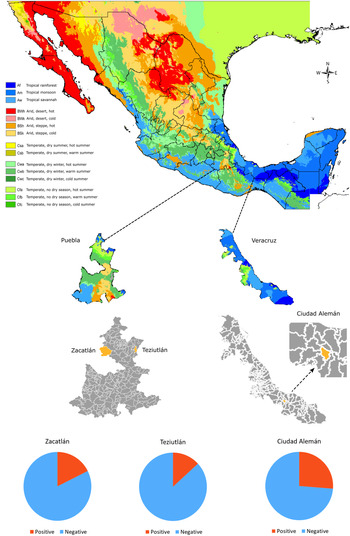
The study was conducted at three abattoir sites in the states of Puebla (Zacatlán and Teziutlán districts, east-central Mexico) and Veracruz (Ciudad Alemán district, eastern Mexico) from January through December of 2017. The states of Puebla and Veracruz cover areas of 33,919 km2 and 71,826 km2, respectively. After slaughter, with the presence of veterinary inspectors, the livers of 6834 cattle were inspected by visual examination, palpation and incision. The latitude and longitude of each abattoir were identified using a global positioning system (GPS, Garmin eTrex Vista, Olathe, KS, USA), and the coordinates were georeferenced using ArcGIS 10.1 (ESRI, Redlands, California, USA) and Köppen climate classification maps modified by García (Reference García1988) (fig. 1). In addition, we obtained information on elevation data provided by the Shuttle Radar Topography Mission, with a resolution of 1 km (http://srtm.csi.cgiar.org/). This study was approved by the local Animal Care and Ethics Committee of the Meritorious Autonomous University of Puebla, and all procedures complied with the National Legislation Pertaining to Animal Health Research.
Map of Mexico in the Köppen climate classification system showing the slaughterhouse locations in the districts of Zacatlán, Teziutlán and Ciudad Alemán.

Remotely sensed climatic data
Satellite-based precipitation data were averaged to obtain a mean monthly rainfall dataset for January through December, covering a radius of about 50 km around each abattoir site; these data were extracted from the Tropical Rainfall Measuring Mission (TRMM) 3B42 version 7 and TRMM 3B43 (http://disc2.gesdisc.eosdis.nasa.gov). Furthermore, we obtained monthly land surface temperatures (LSTs) and the normalized difference vegetation index (NDVI) from the Moderate Resolution Imaging Spectroradiometer sensor aboard the Terra satellite (https://lpdaac.usgs.gov/) – products MOD11C3 and MOD13C2.005 – with 0.05° spatial resolution. LST data were used as a proxy for day and night temperature, while the NDVI was used as a proxy for soil moisture (Sandholt et al., Reference Sandholt, Rasmussen and Andersen2002). Finally, LST and NDVI values were log-transformed to improve normality and to stabilize the variance (Sokal & Rohlf, Reference Sokal and Rohlf1995).
Fasciola hepatica risk index
The calculation of fluke infection risk was carried out using the index developed by Malone et al. (Reference Malone, Gommes, Hansen, Yilma, Slingenberg, Snijders, Nachtergaele and Ataman1998), based on growing degree-day (GDD) and using climatic factors that impact the F. hepatica life cycle:

where GDD is the average monthly mean temperature – 10°C (MOD11C3); R is the total monthly rainfall (mm/month, TRMM 3B43); PET is the potential evapotranspiration as calculated by the Penman method (mm/month); and RD is the number of rain days per month with more than 1 mm of rainfall (GPM_3IMERG-Day 0.1° × 0.1°). Four risk categories were described by Yilma & Malone (Reference Yilma and Malone1998) to classify the calculated risk index values: (1) no-risk: ≤600; (2) low risk: 601–1500; (3) moderate risk: 1501–3000; and (4) high risk: >3000.
Statistical analysis
Data were analysed using the software IBM SPSS 25 for Windows (SPSS Inc., Chicago, IL, USA). To complete the most comprehensive study of the variability in exposure to F. hepatica over time, we compiled datasets for both wet/dry seasons and temperate-climate seasons (spring, summer, autumn and winter). A chi-square test was used for comparison of the prevalence between seasons, and a univariable generalized estimating equation (GEE) analysis was used to identify variables with significant associations between seasonal prevalence of positive cattle for F. hepatica. Abattoir data on liver inspection as a repeated measure, a binomial distribution and logit as the link function was specified. Furthermore, a multivariable GEE model was constructed using parasite infection as a dependent variable and monthly rainfall (wet/dry), LST day, LST night, NDVI, season (spring, summer, autumn and winter) and climate region (temperate/tropical) data as independent variables. The results are expressed as odds ratios (ORs), with 95% confidence intervals (95% CIs).
Results
Prevalence of condemned livers
In total, we inspected the livers of 6834 cattle – 1861 from Zacatlán district, 1735 from Teziutlán district and 3238 from Ciudad Alemán district (table 1). The overall prevalence of F. hepatica infection was 20.6% (n = 1407); the highest rate of condemnations was found in animals from Ciudad Alemán (26.0%; CI: 24.09–27.86), followed by Zacatlán (17.5%; CI: 14.78–20.29) and Teziutlán (13.2%; CI: 12.27–14.07).
Monthly prevalence of Fasciola in the livers of slaughtered cattle during the year 2017 in three abattoirs in the states of Puebla and Veracruz.

Climate and environmental data
The elevation above sea level, Köppen climate classification and the risk index of the abattoir for each site were as follows: Zacatlán district: 2028 m, temperate climate and 632; Teziutlán district: 1890 m, temperate climate and 440; and Ciudad Alemán district: 24 m, tropical climate and 1082. A graphical representation of the prevalence of F. hepatica in slaughtered cattle compared to climate and environmental factors is shown in supplementary fig. S1.
Seasonal prevalence of F. hepatica
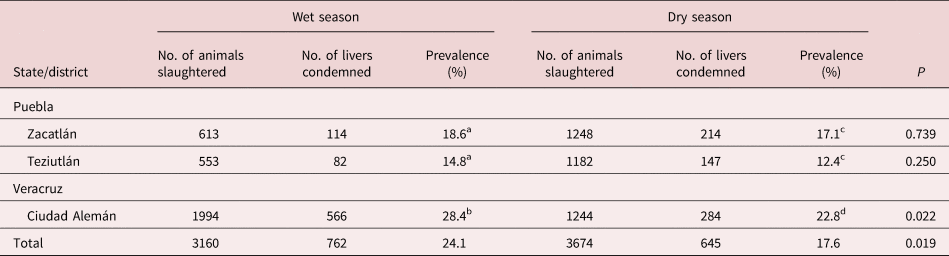
To investigate the seasonality of F. hepatica during the wet and dry seasons for each slaughterhouse, we tabulated the percentage of condemned livers (table 2). The highest average prevalence for all abattoirs was detected in the wet season (24.1%), whereas the lowest prevalence was observed in the dry season (17.6%). Overall, there was a significant difference between the wet and dry seasons (P = 0.019). The wet season in Zacatlán and Teziutlán is the four-month period from June through September, while the dry season lasts from October through May. For the tropical climate in the Ciudad Alemán district, the wet season extends from May to November and the dry season stretches from December to April. The highest percentages of prevalence during the study period were found in the wet (28.4%) and dry (22.8%, P = 0.022) seasons from Ciudad Alemán district, with a tropical climate, low altitude and low risk category. The lowest estimated prevalence of condemned livers was observed in Teziutlán district, which has a temperate climate, high altitude and a no-risk classification.
Significant differences between the wet and dry seasons in the number and prevalence of condemned livers due to F. hepatica infections at three Mexican abattoirs.

Rainy season: aJune–September, bMay–November; dry season: cOctober–May, dDecember–April.
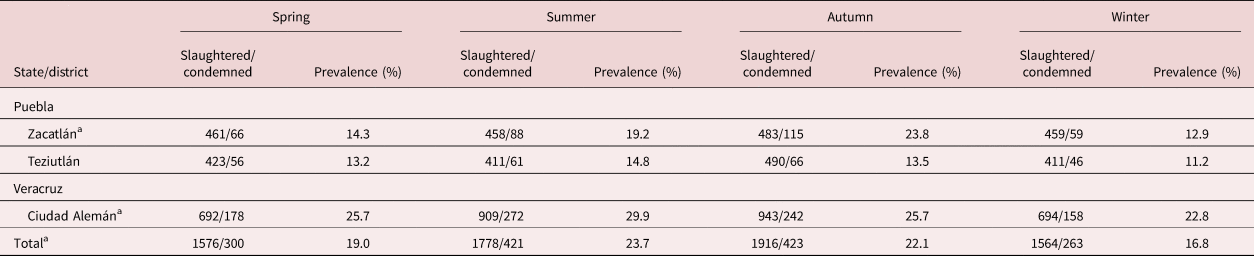
The lowest percentage of livers condemned for liver flukes occurred in winter (16.8%), while the highest percentage was found in summer (23.7%, table 3). A significant difference between seasons and districts was also observed (P < 0.05). The greatest numbers of condemned livers were reported from Ciudad Alemán district, which showed the highest prevalence (29.9%) in the study. Statistically significant differences were found in Zacatlán and Ciudad Alemán districts between seasons (P < 0.05).
Seasonal prevalence of bovine fasciolosis in three slaughterhouses in the states of Puebla and Veracruz.

a Prevalence of F. hepatica is significantly different (P < 0.05, chi-square test).
GEEs
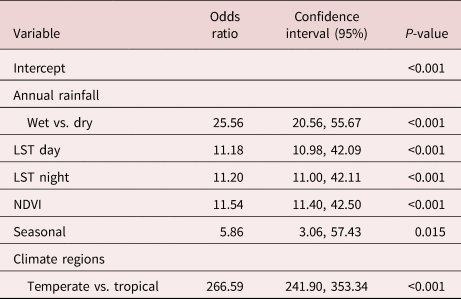
The univariable GEE analysis of condemned livers at slaughter over time is outlined in supplementary table S1. Supplementary table S2 presents the significant differences between seasons (spring, summer, autumn and winter) and between the wet and dry seasons. The results of the multivariable GEE analyses are presented in table 4. Among confirmed fasciolosis cases in the abattoirs, temperate vs. tropical climate regions (OR 266.59; 95% CI: 241.90–353.34) and wet vs. dry season (OR 25.56; 95% CI: 20.56–55.67) were all strongly associated with increased odds of condemned livers.
Significant associations between prevalence of condemned livers at three Mexican slaughter and seasonal, climate and environmental variables, using multivariable GEE analysis.

Discussion
The present study is the first to determine the seasonal prevalence of bovine fasciolosis with different climate regions, elevations and risk factors in Mexico through the inspection of livers, as well as the first study to link the presence of this disease to climate and environmental factors. The percentages of prevalence of condemned livers in Zacatlán and Teziutlán districts with temperate climate ranged from 13.2% to 17.5%, similar to the range in prevalence reported in Brazil (10.14–18.66%) (Dutra et al., Reference Dutra, Molento, Naumann, Biondo, Fortes, Savio and Malone2010) but higher than those observed in Portugal (2.2%) (Barbosa et al., Reference Barbosa, Pinto, Garcia and Rodrigues2019) and lower than those reported in Brazil (37.6%), Algeria (26.7%), Portugal and Spain (28%), Uruguay (33.9%) and Peru (55.72%) (Arias et al., Reference Arias, Lomba and Dacal2011; Ouchene-Khelifi et al., Reference Ouchene-Khelifi, Ouchene, Dahmani, Dahmani, Sadi and Douifi2018; Quevedo et al., Reference Quevedo, Bruhn, Teixeira, Alberti, Scheid, Raffi, Sallis and Schild2018; da Costa et al., Reference da Costa, Corbellini, Castro-Janer and Riet-Correa2019; Arias-Pacheco et al., Reference Arias-Pacheco, Lucas, Rodriguez, Cordoba and Lux-Hoppe2020). This study shows that the prevalence of F. hepatica in the tropical climate was 26.0%, which is consistent with the prevalence (25.8%) reported in cross-sectional surveys in tropical climates in Mexico (Ojeda-Robertos et al., Reference Ojeda-Robertos, González-Garduño and Cornelio-Cruz2020), although it is higher than the prevalence found in Costa Rica (1.83%) (Rojas & Cartín, Reference Rojas and Cartín2016). Therefore, climate and environmental variables, the livestock system and general management factors – such as the length of the grazing season and the proportion of grazed grass in the diet – are important considerations in the prevalence of condemned livers and for comparing results across studies and countries. For instance, in Switzerland, Rapsch et al. (Reference Rapsch, Schweizer, Grimm, Kohler, Bauer, Deplazes, Braun and Torgerson2006) estimate the true prevalence of F. hepatica in slaughtered cattle at 18.0%; the high diagnostic sensitivity was found using coproscopy, bile examination and antibody ELISA rather than condemned livers, resulting in a lower prevalence. One of the limitations of the present study was the failure to obtain faeces and serum samples due to financial, technical and political reasons.
This study shows that the prevalence of F. hepatica at altitudes higher than 1800 m above sea level in Puebla (which has a temperate climate) ranges from 13.2% to 17.5%, which is lower than the prevalence in Peru (55.4% and 55.72% at 3300 m and 3350 m above sea level, respectively) (Arias-Pacheco et al., Reference Arias-Pacheco, Lucas, Rodriguez, Cordoba and Lux-Hoppe2020; Caravedo et al., Reference Caravedo, White and Morales2021). Our survey also shows that the prevalence of this parasite in the tropical climate (24 m above sea level) was 26.0% – higher than that reported in Cuba (18.27%) – with an altitude of 122 m above sea level (Palacio Collado et al., Reference Palacio Collado, Bertot Valdés, Beltrao Molento, Vázquez Gil, Izquierdo Pérez, Arenal Cruz and Arteaga Campbell2017). In addition, Malone et al. (Reference Malone, Gommes, Hansen, Yilma, Slingenberg, Snijders, Nachtergaele and Ataman1998) report that the optimum thermal conditions in tropical sites for the development of F. hepatica are found in lower-elevation areas, providing an example of previous studies that have reported a significant relationship between elevation and parasite infection risk (Dutra et al., Reference Dutra, Molento, Naumann, Biondo, Fortes, Savio and Malone2010; Martins et al., Reference Martins, de Avelar, Pereira and da Fonseca2012; Villa-Mancera & Reynoso-Palomar, Reference Villa-Mancera and Reynoso-Palomar2019a, Reference Villa-Mancera and Reynoso-Palomarb).
In this study, the wet and dry seasons had a significant influence on the bovine fasciolosis occurrence in the tropical climate (in Veracruz); the prevalence rate was greater during the wet season (28.4%) than in the dry season (22.8%). These results align with those of a study by Bernardo et al. (Reference Bernardo, Carneiro, Avelar, Donatele, Martins and Pereira2011), who report a higher rate of fasciolosis cases in cattle slaughtered during the dry season (25.79%) and a lower rate in the wet season (23.87%) in Brazil. Again, this is consistent with previous reports from Tabasco, Mexico indicating a prevalence of between 9.36% and 8.34% during the wet and dry seasons, respectively (Ojeda-Robertos et al., Reference Ojeda-Robertos, González-Garduño and Cornelio-Cruz2020). A high condemnation rate in the wet season is likely due to increased populations of infected snails in grazing pastures and humid microhabitats that enhance the survival of the infective metacercariae, as well as the lack of metacercariae exposure during the dry season. Villa-Mancera et al. (Reference Villa-Mancera and Reynoso-Palomar2019b) propose seven specific factors that serve as significant predictors of parasite infection, based on the detection of F. hepatica-specific antibody levels in bulk-tank milk samples: rainfall, elevation, the proportion of grazed grass in the diet, contact with other herds, herd size, parasite control use and education levels.
No significant difference in the prevalence of condemned livers was found between the wet and dry seasons in a temperate climate at altitudes of 1890 m and 2028 m. Consequently, the findings in this study are similar to those of another study conducted in Peru, in which prevalence rates of 56.3% and 53.9% in the wet and dry seasons were found, at 3300 m above sea level (Arias-Pacheco et al., Reference Arias-Pacheco, Lucas, Rodriguez, Cordoba and Lux-Hoppe2020). Persistent infection throughout the year may result from continued exposure of the cattle to encysted metacercariae in grazing pastures.
In our study, the highest seasonal prevalence of Fasciola infection in the tropical climate was observed in summer (29.9%), followed by autumn (25.7%), spring (25.7%) and winter (22.8%). These results are similar to those reported in Brazil (Bernardo et al., Reference Bernardo, Carneiro, Avelar, Donatele, Martins and Pereira2011) and show significant seasonal pattern for fasciolosis infection in livers in Zacatlán district, which have temperate climates. Furthermore, these results are similar to those reported in Algeria, where the prevalence was significantly different for all seasons (Ouchene-Khelifi et al., Reference Ouchene-Khelifi, Ouchene, Dahmani, Dahmani, Sadi and Douifi2018). However, this finding contrasts with that of a study in Greece reporting that infection prevalence was not significantly different for all seasons (Theodoropoulos et al., Reference Theodoropoulos, Theodoropoulou, Petrakos, Kantzoura and Kostopoulos2002).
We used a GEE approach to construct a multivariable model, showing that six variables were significantly associated with parasite infection: rainfall (wet/dry), LST day, LST night, NDVI, season and climate region (temperate/tropical) (table 4). Climate region was clearly one of the most significant factors in F. hepatica infection in cattle; tropical climates present a 266.59-times higher risk of infection in slaughtered animals than a temperate climate (95% CI: 241.90–353.34). Similar odds were observed with LST day (OR 11.18; 95% CI: 10.98–42.09) and LST night (OR 11.20; 95% CI: 11.00–42.11). Our results are reinforced by the fact that several researchers have found that temperature is a positive predictor of infection in Ireland, England and Wales, and Mexico (McCann et al., Reference McCann, Baylis and Williams2010; Selemetas & de Waal, Reference Selemetas and de Waal2015; Villa-Mancera & Reynoso-Palomar, Reference Villa-Mancera and Reynoso-Palomar2019b). However, this finding contrasts with previous studies in Brazil that have reported no significant differences in prevalence based on temperature (Dutra et al., Reference Dutra, Molento, Naumann, Biondo, Fortes, Savio and Malone2010). Cattle slaughtered in the wet season had 25.56-times higher liver fluke infection rates than those slaughtered in the dry season (95% CI: 20.56–55.67). Furthermore, rainfall has been found to have a consistent relationship with prevalence based on data on fasciolosis in Belgium, England and Wales, and Mexico (McCann et al., Reference McCann, Baylis and Williams2010; Bennema et al., Reference Bennema, Ducheyne, Vercruysse, Claerebout, Hendrickx and Charlier2011; Villa-Mancera & Reynoso-Palomar, Reference Villa-Mancera and Reynoso-Palomar2019a). In China, temperature, rainfall and elevation have been associated with F. hepatica infestation (Qin et al., Reference Qin, Gao, Wang and Xiao2016). Temperatures greater than 10°C are required for the development of the free-living larval stages and intra-snail stages of the trematode, as well as the development of the parasite's intermediate molluscan (Andrews et al., Reference Andrews, Graczyk, Fried, Fairweather, Threadgold, Torgerson and Dalton1999; Torgerson & Claxton, Reference Torgerson and Claxton1999). In Mexico, for the life cycle to be complete, Lymnaea humilis and Lymnaea bulimoides must be frequently present, appearing during or immediately after rainfall peaks (Cruz-Mendoza et al., Reference Cruz-Mendoza, Quiroz-Romero, Correa and Gomez-Espinoza2011). The NDVI includes several factors (land cover, temperature, rainfall and vapour pressure) that have been identified as positive predictors of disease in Australia (Durr et al., Reference Durr, Tait and Lawson2005). However, there are also negative aspects to our approach. For example, our study is limited to using data from one or two slaughterhouses for each climatic region. While our study reports ranges in prevalence similar to those in other studies, more accurate and robust outputs may be obtained by using existing data on liver condemnation in slaughterhouses throughout all of Mexico.
In conclusion, this is the first study to provide epidemiological data on the seasonal prevalence of fasciolosis in cattle slaughterhouses from different climate regions in two states of Mexico, demonstrating that the overall prevalence of F. hepatica was 20.6%. Moreover, our study examines and compares seasonal data with regards to climate and environmental factors, and it highlights the importance of continuous monitoring programmes for liver fluke infection. Lastly, we identify some of the factors associated with the prevalence of condemned livers, including rainfall, LST, NDVI, season and climate region. Further studies are necessary to generate more knowledge on shifts in levels of exposure between years and climatic regions.
Supplementary material
To view supplementary material for this article, please visit https://doi.org/10.1017/S0022149X21000444
Financial support
This study was supported by Benemérita Universidad Autónoma de Puebla (VIEP-VIMA-NAT-18-I) and PRODEP (Programa para el Desarrollo Profesional Docente para el Tipo Superior), Folio UIEP-CA-6-ID-31483.
Conflicts of interest
None.
Ethical standards
This study was approved by the local Animal Care and Ethics Committee of the Meritorious Autonomous University of Puebla, and all procedures complied with the National Legislation Pertaining to Animal Health Research.
Author contributions
Conceptualization, methodology, funding acquisition, project administration, supervision, writing – review and editing: K.H. and P.M. Investigation, supervision, formal analysis: J.O. Conceptualization, methodology, writing – review and editing: Y.A. Supervision, data analysis, writing – original draft: A.O. and A.C. Analysis tools, writing – review and editing: A.V. All authors read and approved the final manuscript.