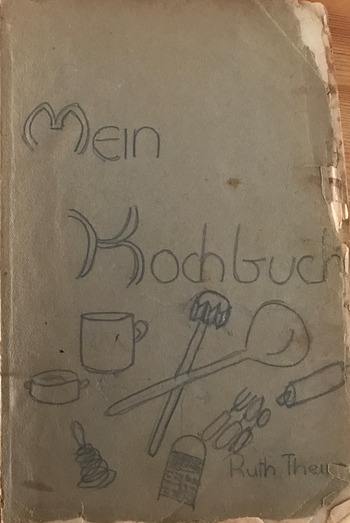
The subject of this article is a cookbook. It belonged to my late mother-in-law, Ruth Bratu (1923–2000), née Theiner, who had it in her suitcase in the summer of 1939, when she along with her nine-year-old sister Esther escaped from Prague to England on a Kindertransport. She was fifteen at the time, turning sixteen, a Jewish-German-Czech teenager, who was born in Tel Aviv.Footnote 2 In 1945, she departed England for Germany—Offenbach to be exact—in US uniform as a postal examiner with the Censorship Division of the US Office of Military Government. There, on a blind date, she met Artur Bratu (1910–1993), a political exile from Offenbach, who had come back to his hometown as a company sergeant major in British Military Intelligence. Ruth was married at the time, but the two fell in love, Ruth divorced in London, and they married in 1947 in Offenbach. In 1950, they settled in Darmstadt, where Artur became a school inspector (and ended his career as head of the Hessian Landeszentrale für Politische Bildung) while Ruth became a housewife. They had two children, Micha and Miriam. I married Miriam in Chicago in 1991. Hence, the connection. All four Bratus have since passed away and are buried in Prague's New Jewish Cemetery.
The cookbook is part of a large trove of documents and mementos, which all four Bratus have left behind.Footnote 3 Its preservation is not least owed to the fact that Ruth was one of those people who cling to things. She did so, even when objects did not have any discernible value, sentimental or otherwise. This cookbook, however, did have special meaning, though its significance for her is not self-evidently what one might presume; that is, it was a working cookbook and not a mere memento of the Prague of her childhood or an indication of her self-professed love for Bohemian cuisine. But Ruth was not the last to decide. Sorting through Ruth's papers and mementos—who else but the historian in the family should do it—it took some work to convince her two children, Micha and Miriam, to keep the much-worn thing. For Miriam, the cookbook was a reminder of less than palatable meals (and the three-course dinners her father expected from her when she took over for her mother for a few weeks). For Micha, a resourceful and inventive home chef, the book's recipes were not even worth considering. I agreed with Micha on that count after a brief inspection, but it was an object that was important to Ruth and, hence, worth keeping as part of her estate.
Archival reasoning was, however, the least of it. Even though the cookbook was not really a memento (for Ruth), nor were its recipes memorable cuisine, it exuded an unmistakable aura even for her skeptical children, which at the time I was hard-pressed to understand. “Aura” here is surely not to be confused with the sensation of an exciting document that you know would make a good article. Everyday history is not my métier, though it is close to my heart. While I recognized the cookbook's potential utility as a material object, thanks to the influence of my colleague Leora Auslander,Footnote 4 I also sensed a distinctive quality that made it precious in my mind. If it had been quasi-sacred, let's say as an everyday object that recollects past suffering and survival, I would have been less hard-pressed to wrap my mind around it. Steeped in the omnipresent German memory culture and the just emerging Holocaust museum scene, it would have been hard to miss. Also, I grew up in a time and place when and where the culture of saintly relics was still part of (my) life. The identification of even a minor object or a tiny bit of bone as venerable is not alien to me, and I have noted for some time secular versions of this kind of cult. And apart from all that, Walter Benjamin's notion of “aura” was not just an object of study for historians of a certain generation; I was intimately familiar with it thanks to Miriam.Footnote 5 Aura was both affect and intellect. But neither Miriam's intellect nor “affect-theory,” such as Kathleen Stewart's superb Ordinary Affects, prepared me for the object as medium of feeling the past.Footnote 6 It was as if, in dealing with the cookbook while sorting through Ruth's papers, the past was chasing after me rather than me chasing down the past. The past reaching out to the historian—that was one strange experience.
If we come to think of it, though, the past has a variety of ways to catch up with you. Thus, my parents prior to my leaving for the United States had given me the then latest (twenty-seventh) edition of the well-known Wundt-Stahmer cookbook.Footnote 7 The family's original edition remained with my parents in Germany and was passed on to my brother. Here, too, is a migration story, though by no means comparable to that of Ruth and her cookbook. The Wundt-Stahmer cookbook dates back to a pre–World War I cookbook, prepared by Emma Wundt's Cooking and Housekeeping School in Karlsruhe for the Women's Association of Baden. By the 1920s, it had added nutritional and nursery instructions. Following World War II, it adopted a new typeface, and multiple new editions appeared in print. In 2011, a variant came out as Badische Küche—all taken together, a small cultural history in and of its own.Footnote 8 I loved this cookbook more than I actually used it because ultimately others were more practical in the United States—first Rombauer's Joy of Cooking (Mollie Katzen's hippy bestseller The Moosewood Cookbook was never really my thing), followed simultaneously by Lukins and Rosso's Silver Palate Cookbook and Alice Waters's Chez Panisse series. I then shifted to the Italians and finally, by way of China, India, and the Middle East, to Yotam Ottolenghi in London.Footnote 9 A fairly typical American evolution for an academic household, or so it seems, with the Wundt-Stahmer relegated to the status of memorabilia despite occasional use.
Memorabilia are objects you keep, keepsakes. You possess them; they do not possess you, or so one would hope. I would even include among such memorabilia a few recipes for Gutseli,Footnote 10 as my father called them, which also can be found in Wundt-Stahmer. These recipes are memories of Christmas past, however, and my father neatly wrote them out by hand as dictated by my mother. They gave them to me at about the time when it became evident that I would emigrate for good. The handwritten recipes are true memorabilia also in the sense that I haven't made Springerle for ages and likely won't make them ever again; they are memories of childhood in a different time and place.
At this point, we know nothing yet about the Prague cookbook, except that Ruth took it with her from Prague to London on a Kindertransport. In explaining why it still exists, however, we may also get a sense of why things like a cookbook are kept, even if it is now stashed away among the personal papers of the late Micha Bratu (1957–2011), Ruth's son. What is left of the physical remains fits into a cardboard box and, like many similar collections, is stored in an attic. Micha's collection, however, is part of a much larger family archive of letters and documents of Artur and Ruth Bratu, as well as a deposit under the name of Micha Bratu that is stored at the Archive of Social Democracy in Bonn-Bad Godesberg, to which we might add the academic papers of Miriam Hansen (1949–2011) at the University of Chicago, as well as her private papers and photo collection.Footnote 11 Ruth Bratu's papers are not exactly part of the archive's core collection. But Ruth, apart from being a member of the Social Democratic Party of Germany (SPD) after 1947, had been an active participant in a Red Falcon group in Prague, which was led by her mother, Thea Theiner (née Sophar), who had converted from Zionism to social democracy and German-Czech social democracy, in particular. I was surprised to learn that there was a Darmstadt Seliger Gemeinde (which organized Czech-German social-democratic expellees) and that Ruth remained a member of this group until its dissolution for lack of members in the 1990s. I would not have counted her among the expellees, even of the social democratic variety, and yet there she was and said as much in an interview.Footnote 12 The Czechoslovak Secret Service also did not hesitate to see her in this role (rather than as a Jewish child fleeing in a Kindertransport) and attempted to recruit her in the 1960s.Footnote 13 Ruth refused to become an informer, but she surely knew the leadership of the former Czech-German social democrats in person. So there are some good reasons why she was asked to deposit her papers in a public, party-political archive.
Then again, although the cookbook incontestably dates back to Prague and as such is a document of flight and exile, Ruth chose not to deposit it with other papers from the 1930s and 1940s. These include most prominently the letters sent by Ruth's mother, Thea, and her husband, Hugo, first directly and later circuitously via Belgium and Switzerland to her daughter in England before being deported to Theresienstadt in 1942 and on to Auschwitz in 1943. These are documents of a distinctly Jewish history that have repeatedly been used as part of the culture of remembrance in Darmstadt and beyond.Footnote 14 There are quite a few other dossiers of letters, neatly collected, from girlfriends and (would be) boyfriends. Ruth was not at all concerned with distinguishing public and private, and the letters do not necessarily show her in the most flattering light. But even though she parted with the letters, which would appear to be her most intimate documents, she held on to the cookbook until the end of her life. Its place was in the kitchen, even if it was no longer used. It was important for her to have it, although she never explained why—and one could easily be led to assume that it was nothing but memorabilia. It makes far better sense as a slice of Ruth's everyday life that she would not (and could not?) part with it and also did not care to explain why. We might see in this unspoken presence a trace of trauma, but if so, we would have to explain why she parted with the letters of her murdered parents, but not with the cookbook.Footnote 15
Notwithstanding its shabby appearance, Ruth's cookbook does catch the eye as a material object. It is handmade with a sturdy red linen cover, and it is handwritten. Its once carefully glued binding has at some point been replaced by black electrical tape—a longstanding do-it-yourself fix for all types of broken book bindings. The fact that it is handwritten is less unusual than it may appear. Soon after I circulated an earlier version of this article, I received scans of their mothers’ handwritten cookbooks from two colleagues of different generations, Thomas Lange (Darmstadt) and Jan Plamper (Berlin/London). There are plenty more available in the rare-book market, and they are typically put together by young women, often after attending cooking school or while in service as maids. It is somewhat unusual that Ruth's book appears to be handmade. It looks like it started out as a stack of lined exercise books. It is, in any case, not your thick notebook with a black, sturdy carton cover and its firm high-grade paper that was used for these kinds of books because they are meant for life. There is a ready reason for this. Ruth's father had been unemployed since 1938; his delicatessen business had gone bankrupt earlier and he owed back taxes. The family relied on Jewish welfare and lived in a tiny flat at the far end of Vinohrady, the Royal Vineyards, not far from the final resting place of the Bratus today in the Jewish cemetery in Prague Žižkov. Given their quite dire circumstances, they were in no position to live it up. The cookbook was made with care, however, with a neat and sturdy linen cover. It was not made for casual use or scribbling. It exuded maternal authority, the same authority that you can find in the letters of Ruth's mother from Prague.
The sentimental assumption would be that this cookbook was compiled by Ruth's mother and given to Ruth, the elder daughter, before Ruth and her younger sister Esther departed for England in 1939. Such gestures have been documented in other Kindertransport stories, although they rarely involved cookbooks because the children were typically younger. Most every child received some such testimony of the life they left behind and of the families they came from, hence the value attached to these memorabilia, even if they were not invested with the aura of the Holocaust. They were a reminder of family and home—a symbol of the two girls’ separation from their parents, which at first was believed to be provisional and only much later recognized as definitive. Like her mother's letters, one might contend that Ruth's Prague cookbook, through its association with the Holocaust, acquired an aura that reaches far beyond the everyday of its owner and touches potentially everyone. It becomes more than a fond, perhaps nostalgic memory of home (like the Wundt cookbook for me); it becomes a symbol of a ravaged home and a destroyed life. Except that Ruth did not treat it that way.
The only hope of figuring out the history attached to this everyday object is to read its physical appearance and its handwritten text as palimpsest. We are on our own in deciphering this underlying text because there are no signifiers that we could use as interpretative cues. It is not one of the hundred objects that everyone could possibly agree on as representing German history (because they think they know what German history is).Footnote 16 This everyday object is an everyday object. Hence, some basic questions are in order, such as who made the book and who wrote it? When and for what purpose? Nobody ever asked them when there was still time—Micha and Miriam were too familiar with it; the historian did not ask, an indication of his very own déformation professionnelle because oral history was flourishing. Therefore we've got to piece together an answer in a back and forth between evidence and presuppositions.
The first cue is the cookbook's quaint title page (Figure 1), which claims ownership: it spells out “Mein Kochbuch” with basic double-outlined lettering used to emphasize the first letter of each word in the title, and in plain, if somewhat shaky handwriting, names the owner, Ruth Theiner, which is Ruth's maiden name.
Fig. 1

In between the title and Ruth's name, cooking utensils are drawn in by hand: a wooden spoon, a whisk, a rolling pin, a knife and fork, a grater, a potato masher, a bowl, and a cup. It appears doubtful that a fifteen-year-old girl should have drawn them. It would seem likely that mother and daughter started the cookbook long before their forced separation in 1939, perhaps in childhood or very early adolescence as a variation on playing house with dolls as another preparation for good housekeeping. The cookbook would have served as gender-play, as an introduction to the future responsibilities of a womanhood that was yet far off. Based on the cover, Ruth's cookbook appears to be a girl's primer for fulfilling her future role as housewife.
The table of contents is written by a firmer, more adult hand. It divides the cookbook into eight sections, with each assigning an ample number of pages to be filled with recipes. It is difficult to ascertain whether the table of contents was inserted after the fact or right from the start. The first entries in each section are written in a firm, legible script, which I associate with Ruth's mother Thea—the handwriting matching the one that appears in Thea's letters to her daughters in London. These entries are few, the conclusion being that Thea intended them as starters to be completed by her daughter, who would grow into cooking and into continuing the cookbook. We may thus surmise that the cookbook was laid out with an open future in mind, though clearly a future that made Ruth into a housewife.
Many of these pages remain unfilled, and it would appear that Ruth did not show much interest in filling them. This is somewhat of a conjecture because we have few samples of her early handwriting. There are certainly no identifiable, preadolescent entries in the handwriting of the title page. On the other hand, we do know that she enjoyed dressmaking and had wanted to become a fashion designer. In 1938, at the age of fourteen, she began an apprenticeship as a seamstress, but circumstances did not allow her to complete her training.Footnote 17
But then there are plenty of recipes, and they appear to have been written all at once. The puzzle of these entries begins with the table of contents, in which the original entries for “Pudinge” and “Gebäck” (puddings and pastries) have been crossed out and replaced with “Kompote” and “Salate” (compotes and salads). These new entries are not written in Thea's hand, and like several of the subentries contain minor spelling errors and crossed-out words. Ruth's mother did not make such mistakes, but Ruth, growing up in a bilingual Czech-German environment, did. Like the table of contents, most of the recipes appear to have been written in some haste with additions and corrections. Also, these hastily penned recipes suggest neither dreams of a young girl nor a recognizable culinary touch. In fact, the label “recipe” hardly seems applicable, even if, verifiably, soup will be the outcome:
Potato Soup
Place finely chopped vegetables in approx. 1 liter water (4 persons); parsley is not boiled, but added directly to the soup bowl. Add salt and a little bit of thyme; let cook for 3/4 1 hour and roux. Also good are dried mushrooms.
Fish Soup
In the fish soup, boil some greens and the fish roe. (Peas are good.) In a second pot, fish heads, stomach, and fins are cooked with onion. Put everything into the first pot and add a brown roux.Footnote 18
This minimalist shorthand continues for the faux barley soup,Footnote 19 the semolina soup, the caraway soup, as well as for meat dishes, compotes, and more. These are not so much recipes as, well, quite desperate cooking instructions for dishes made from ingredients readily on hand. The recipes reflect the types of preparation a daughter learns while helping her mother with daily meal preparation in a simple household. Because one learns them by watching and then doing, these hands-on, roundabout recipes are seldom recorded. The conclusion is that only when hands-on learning is not (or no longer) possible are such recipes committed to paper where they act as impromptu instructions. You could say that as far as the recipes are concerned, there is more everyday-ness in this cookbook than is wished for in everyday life history.
By the same token, there is more drama hidden in the text than we would expect in a cookbook. The hurried handwriting, the correction of careless mistakes, and the minimalist, hands-on “recipes” all indicate that this was not the carefully laid-out culinary guide that a mother bequeaths to her daughter. It was surely not child- and gender-play. Instead, this cookbook appears to be an urgent transcript, possibly dictated on the fly by mother to daughter. We do not know for certain. But the layout and the type of recipes suggest that mother and daughter had seized the weeks prior to the Kindertransport to record these recipes. Right away, Ruth's Prague cookbook points to a future that was radically different from what had been expected when the cookbook had been put together. This was not because Ruth chose to become a dressmaker and fashion designer, but because the future of the maiden cookbook and the adolescent apprentice was foreclosed by Nazi occupation and flight. The plainly instructional quality of Ruth's cookbook—do this, do that, but not that—also gave voice to a mother's worry that her two children would have to fend without her. No more growing up to be done here. The children had to be grown-ups without their parents. (That this was quite the opposite of what the British thought is another matter.) We read in its pages the haste in which they were put together, a mother's anxiety about impending separation and her care for her children.
This latter interpretation would be a stretch, if we did not have the stream of letters that Thea sent to her children. When I first wrote about them, I thought of her as overly disciplinarian, putting the fear of God—or rather, of the good reputation of Jewish children in the eyes of the English—especially into Ruth's younger sister, the nine-year-old Esther, who had terrible difficulties with the separation from her parents and home.Footnote 20 The letters did not do any good. But there is now a more inquiring and more deeply felt spotlight (in academic literature and film) on the parents of children who stayed behind.Footnote 21 Parallels are drawn to present discussions on the fate of Near Eastern and Central American children and their parents.Footnote 22 I still would maintain that the fusion of virtue, care, and love is what made them such extraordinary documents. Love and care for her children permeated these letters as for example in the eagerness to hear the tiniest detail about their lives, but also in the careful circumlocutions of existence in Prague, which were entirely truthful, but also uncanny in their description of life ever more reduced. Love and care also led to the demand for all-around impeccable behavior (Haltung)—and Ruth took it on, expecting the same not just from her kids, but from her parents as well, even in extremis.Footnote 23 Some of this attitude can be read in(to) the cooking instructions, although all we really have is a handwritten cookbook that started out with good intentions by mother and daughter and was completed, so we conclude, in great haste in the form of do-it-yourself cooking instructions.
Picking up on the unanimous internet opinions on the awfulness of barley soup, one could describe the cookbook as a guide for “poor man's food” (arme Leute Essen), but it would seem to me that would rather overestimate the eating standards of the poor. Poor people, even those who were not undernourished, lived sparser lives and neither partook in regular meals nor had the neat categories for labeling their food. This was what Ruth's mother Thea and her husband Hugo were reduced to in 1941–1942. They had no need for recipes, and surely not for instructional guides. The idea of recipes, and by extension of a cookbook and of cooking instructions, assumes consistent, if indeed sparse and simply prepared meals for morning, midday, afternoon-coffee, and evening. It also implies a distinct model of socialization and of domesticity. Ruth's Prague cookbook is the cookbook of an orderly, if plain bourgeois household.
The instructions in Ruth's cookbook harbor no culinary secrets. It is, perhaps, more surprising for a progressive household that the cuisine is untouched by any dietetic or culinary reform movement.Footnote 24 This is thoroughly traditional cooking. The recipes give us an idea of the cooking practices confronted by reformers, including the experts of the Third Reich, as they developed their ideas of a healthy and nutritious as well as autarkic diet.Footnote 25 On the one hand, you find a lot of “natural,” noncommercial ingredients such as mushrooms picked on hikes in the countryside. On the other hand, everything was exhaustively boiled, and flour was an indispensable item in the preparation of hot meals, which were overwhelmingly brown in color. Thus, if anything, the cuisine in Ruth's cookbook was too “authentically German,” which was why in the 1990s Ruth rather came to like Micha's new German cuisine (grilled fish and meat, lots of fresh vegetables) over her own. Yet, when she cooked for herself, she continued to cook the old way.
The cookbook's location in the landscape of German foodways is more difficult to pinpoint. Names for foods and dishes provide some clues. Paradeiser (tomatoes) did not exist in this kitchen, but Schwämme/Schwamerln (mushrooms) did. Fisolen (green beans) are Bohnen, but Karbonateln (meatballs), Peuschel (heart, lung, spleen, and liver of a slaughtered animal, including fish) and gefüllte Karpfen (stuffed carp) reveal a distinctly Austrian influence. Kapusta (a cabbage dish) is Polish, Czech, or Slovak, though the use of Maggi's seasoning suggests a German accent and, moreover, a connection to “my” world, Singen am Hohentwiel: “It [cabbage; possibly mushrooms] is boiled in salted water with caraway seed. Next a roux with caramelized onion, some Maggi and cream (milk).”Footnote 26 Again, Polish and Czechoslovak cooking knows far more elaborate Kapusta recipes; this is very basic cuisine, indeed. Maggi is a different matter. It is mass produced, the primary seasoning in all possible and some impossible recipes. It would appear to be a universal rule that what flour thickens is seasoned by Maggi (or its competitor Knorr).
Of course, goose must make an appearance in Prague cuisine, even if in Ruth's cookbook it is present only as goose giblets. Königsberger Klopse (meatballs with capers) point to an East Prussian influence, though the dish is now quite common. Back in the 1920s and 1930s, the recipe still reflected a geography of migration, with Ruth's mother Thea, née Sophar, having been born in Berlin (though the family was originally from the West, Wiesbaden, and the Rhineland) and growing up with relatives in Königsberg. The geography of the cookbook is also subtly gendered. If the way to a man's heart is through his stomach, it is the stomach of the husband, and Thea's husband came from Votice (Wotitz) in Bohemia. Once married, Thea adapted her cooking to her husband's tastes, incorporating not only some much scaled-down meat, fish, and vegetable dishes of his homeland and some of the regionally specific names for them, but also the typical sweet dishes, such as Palatschinken (pancakes), Marillenknödeln (apricot dumplings), and Marmeladentascherln (a small triangular pastry filled with jam). Although there is no evidence for it, one can easily imagine Thea's Viennese-educated mother-in-law hovering over this assembly of dishes.
Entirely absent is the cuisine of Palestine, where Ruth's parents, who got to know each other as committed Zionists, moved for several years in 1920. It had been a disastrously failing venture. Absent also is the kosher cuisine of Thea's childhood in Königsberg. True, the pork was missing from the Kapusta, which made the dish oxymoronically lean. Although fish recipes are limited to those with fins and scales and pork is altogether absent from the meat section, anyone looking for traditional Jewish cuisine would be hard-pressed to find it. The exception is a recipe for Schalet (Cholent or Tscholent), the dish that Heinrich Heine described as “The one and only God's/kosher ambrosia.”Footnote 27 Yet, the paltry version of this traditional Shabbat stew found in Ruth's cookbook (made with goose giblets and goose backbone with rice) bears little resemblance to the traditional rich, flavorful, slow-cooked stews. If anything, Ruth's version is more akin to the (gentile) Hessian poor man's dish of the same name (minus sausage or pork belly). Certainly, her version could not possibly have led to Heine's paean: “Schalet is the food of heaven/ and the recipe was given/ by the Lord himself to Moses/ One fine day upon Mount Sinai.”Footnote 28
In short, then, the recipes in Ruth's cookbook reflected in the most general terms the richness of Bohemian cooking and Jewish dietary rules only in their most elementary form. The cookbook was indeed “authentic” in the sense that it represented the unpretentious, plain cuisine of ordinary people and that it picked up references from most everywhere in a life that was turbulent long before the Nazis occupied Prague. This is an impression that came as a surprise, and it is not the only one. The simplicity of the recipes contradicted the opinion of older friends of the family in Darmstadt, who had repeatedly praised Ruth's Bohemian and Austrian cooking. They suggested a decidedly more upscale, not only more Habsburg-inflected, but also grander and more bourgeois, cuisine. This postwar praise points to a life that Ruth did not have in Prague. It also makes clear the significant social downward mobility of the Theiner family in Prague. Suffice it therefore to simply state that Ruth's cookbook is the cookbook of a much-downscaled social existence at the edge of poverty before the Nazis occupied Prague. It was a life that was quite incommensurate with the upwardly mobile existence of the Bratus in postwar Germany. It would therefore not be entirely unreasonable to assume that Ruth was aware of the discrepancy and kept the cookbook for herself. The argument cannot be rejected out of hand, but it is not the answer to the question of why Ruth held on to the cookbook. If anything, it reveals—apart from Ruth's improved, postwar cooking skills, one might presume—the good will of her German friends and acquaintances, who wished Ruth all the imaginable goodness and richness of a Prague Jewish life that their compatriots had so brutally destroyed (and that she never had). But there are better objects than soups and desserts to make this point, which is why we put this conjecture aside.
The title of my article, “The Prague Cookbook of Ruth Bratu,” plays with this misperception, partly because I was one of those Germans who got it wrong, and partly because the article is also about expectations—in this case not about the future, but about the past. We wish for a certain past because we desire a certain future. This is not exactly what Reinhart Koselleck had in mind, but this is one way the past happens.Footnote 29 The past is loaded with expectations of generations yet to come—and it is loaded with such expectations, especially when the experienced past is intolerable. Ruth's cookbook undercuts this wished for past, but also sets it free, and this is the principal reason why the past could catch up with this historian. It is the kind of experience (Erlebnis) that Reinhart Koselleck had when he ended up in Auschwitz as a German prisoner of war. He recognized the reality of his lived past—that he ended up as a POW in the site of Jewish mass-extermination—only when he broke through his accumulated experience as a postwar German.Footnote 30 Jan Eike Dunkhase, who has studied the matter, says this happened right after the war, but as a reader of Koselleck, I still prefer the idea that it happened later, in the seventies. It's not that he hadn't probably known or ever forgotten. For one thing, there are times to be silent and times to speak, and, for another, there are times to remember one's own and times to remember other people's pasts, even though German (and that is also his own) action had intrinsically linked the two in place and time. It was the fatal mistake of my Doktorvater Andreas Hillgruber, in the early 1980s, to remember one and to forget the other—temps perdus in reverse because two decades earlier, in the 1960s, he was not only one of the few high school teachers who taught the Third Reich in his curriculum, but also gave a talk to the Darmstadt Gesellschaft für christlich-jüdische Zusammenarbeit, which had Ruth as one of its founding members.Footnote 31
Ruth's cookbook will lead us back to this point, but in order to get there we first have to move away from it. The Prague cookbook begins in Prague but does not end there; it ended in Darmstadt. It thus accompanied Ruth throughout her life. In England and later in Germany, Ruth continued to revise and expand the cookbook in often curious and suggestive ways. Thus, she discovered German noodle dough only in England, and accordingly replaced the Austrian measure “dkg.” (dekagram) found throughout the cookbook with the appropriate English measurements: “1/2 pint of flour on the board, 1 egg, salt, a little water, thinly roll, cut, dry.” Later on, she also added recipes for some typical Jewish fare, such as Gefilte Fish and Matzo Balls. Their inclusion can be traced to Ruth's younger sister Esther, who had married into an Eastern European Jewish household in East London. The notation for Esther's Matzo recipe reads: “1 lrg. glass of matzo flour, salt, pepper, pour over 1 lrg. glass of boiling water. Allow to cool, then add three tablespoons of oil and three eggs. Add a little oil to the boiling water.”Footnote 32 Interesting procedure, the historian of foodways might say. More interesting, however, is the fact that Jewish cuisine was a postwar addition to Ruth's cookbook, though Ruth did not pursue this strand with any noticeable dedication. The cookbook contains no references to holiday meal preparations for occasions such as Passover. The Bratu household was a German household with certain Austrian flourishes and an occasional Jewish dish, even as Ruth (and Artur, but that's another story) came to live an “exemplary Jewish life” in German eyes.Footnote 33
By the 1950s, the cookbook had expanded to include more recipes for entertaining guests, but initially none were too fancy or time consuming. For example, a colorful plate of appetizers could be made by mixing one kilogram of margarine with three-quarters of a jar of mustard; then mixing half of this with hard-boiled eggs and the other half with sardines. Later postwar additions included a helter-skelter list of cold cucumber soup with kefir, escargot, spiced pumpkin, Pischinger Torte, flapjacks, smoked salmon mousse, scones, plum pudding, and quiche Lorraine. Even attempts at Bohemian cuisine finally showed up. Ruth's version of paprika chicken, dusted with flour and quickly braised in a bit of cold water (?), was a Prague-style concoction. Her introduction of Klopse (meatballs), Knödeln (dumplings), and Nockerln (Austrian dumplings) added to the variety. Artur's French gourmandise—he had become a fluent French speaker in Belgian exile between 1933 and 1940—was also noted in a provincial town, whose elite desperately stretched to become cosmopolitan. French and Alsatian cuisine, Artur's favorite, were absent from Ruth's cookbook, though she diligently cooked for Artur day after day. Inasmuch as she adopted French or local cuisine—grüne Sauce was inescapable—it was not in her cookbook. Then again, not everything is written down; Miriam, Ruth's daughter who grew up in Darmstadt, loved to make it, but there is no written recipe.
The main conclusion to be drawn from this medley of recipes was that at last, in Darmstadt, Ruth had become a housewife, she was cooking, and the Bratus were entertaining. Their hospitality was widely praised, and the parties they hosted achieved legendary status, not least because of the prodigious amounts of alcohol everyone consumed. The 1950s Fresswelle is typically depicted by a housewife looking at a full refrigerator, but it was in large measure a drinking binge.Footnote 34 Ruth's cookbook did grow and change because Ruth grew and changed. Ruth's cookbook is not a single text, “the” Prague cookbook. Rather, it is a palimpsest of a lived life. Ruth kept it, not as keepsake or lieu de mémoire, but as a collection of recipes to which she added new ones as she moved on. The cookbook is well worn and stained, a testament to a life lived, not a museum piece. It is averse to any kind of aura, and yet it had a powerful effect on its historian and a hold on Ruth Bratu.
Professional training would suggest that to make sense of this effect we need a keen eye for change. But locating change in time and place is a twisted affair, which leads the historian to one outcome only to spiral down into another. Indeed, a first approach is all too simple. If, in 1939, one of the original recipes was semolina pudding, forty years later it is gooseberry cake with meringue topping. Yet a generation later, at Micha's house, grilled fish seasoned with thyme and sage along with fresh side dishes and a large mixed green salad with herbs—borage leaves, garden cress, dill, parsley, lemon balm, coriander, nettles, arugula—from the garden were served. Ruth enjoyed such meals but saw no reason to retire the cookbook that her mother had started. Her husband Artur supported Ruth in this choice. He was a progressive man, who had the reputation of a raconteur and adventurer, but when it came to food preparation, he wanted more of the same. Affect as a deep need for certitude after terrifying life-changes? The cookbook as materialized aspect of an emotion? That sounds right, though it may not be the whole truth.
Literary education instantly conjures up Marcel Proust's Madeleine, the involuntary memory generated by a moist little sponge cake with its sensuous shell-like shape.Footnote 35 Well, Ruth's cookbook was not quite a petite madeleine; it was a growing and changing guide for how and what to cook. Pasts once lived—smelled, tasted, touched—became palpable all the same. The cookbook held as its palimpsest a vivid memory of things past, and for all the differences in taste, regional cuisine, and changing foodways, Ruth's Prague cookbook did generate involuntary memories, some wanted and others not so much, for this historian as well. This is a matter of taste and taste memory, bodily knowledge, which may or may not translate into affect (if I understand this theory right). Still, this would be a good explanation, except that Ruth's Madeleines—the KuK Café in Darmstadt; the ascriptions of her friends—recalled a past she may have wished to have had, but never had. If food is an “embodied knowledge,” it is in Ruth's case the knowledge of embodied fiction. She liked her Prague past and the cooking associated with it but could not possibly afford it at the time and never really cooked it. In any case, it is not a past that you can find in her cookbook.Footnote 36 The Prague knowledge of cooking is not “embodied”; it is borrowed, but no less precious for that. It's the memory of a past she might have wished to have lived, but only now, in the 1970s and 1980s could live it. In this sense it is a past catching up with the present.
But again, this is not the whole story, not least because it does not explain how the past crept up on the historian—and like any historian, this one was sheltered from the past by a wall of historiography or more specifically narrative and genre. It is historians’ favorite task to continuously repair and rebuild such walls. In this case, I have already done that without reference. As we have seen, Ruth held on to the cookbook for dear life (much as her husband Artur held on to her cooking). She expanded it, diversified it, made it richer, in some ways more palatable and in other ways less so. I interpreted the cookbook as a palimpsest of lived life. Ruth unfolded the cookbook's inherent potential quite the way it was conceived by her mother and first articulated in its title page in the 1930s. In its accumulation of recipes, the cookbook is Ruth's Bildungsroman, which includes her recovery of a past she did not quite have. Because it is the Bildungsroman of a Kindertransport child, it is quite the opposite of its German equivalents, which Konrad Jarausch has studied.Footnote 37 His German memoirists look back to the mistakes they made as young men and women, their early enthusiasm for the Nazi movement and their later deep disillusionment. This is a history that did happen, except that the memoirists discovered they had been in the wrong past and had to find a way out of it, which they eventually did (or, maybe, only thought or wished or faked it). It's like “peeling the onion” without crying.Footnote 38 Above all, it is the crudest form of a virtuous nineteenth-century Bildungs narrative. We redeem ourselves by learning from our mistakes. We find none of this in Ruth's cookbook, and not just because she had a different life, but because it is a made-to-use cookbook and as such it is so much more modern with its discordant “voices,” Maggi and margarine, and its collage-style assembly.
Reinhart Koselleck, not unlike Ruth Bratu, also wanted to keep the past alive by thinking beyond experience. “Expectation” proved to be the great liberator, a way to overcome the past without denying it—a construct that fits the liberatory 1970s far better than the existentialist 1950s. What never made sense to me, though, is why he thought that “experience” and “expectation” are general categories that lack the sensory dimension of, say, War and Peace.Footnote 39 For Ruth, experience was a sensory category and expectation affected her deeply. Maybe, it takes the denial of both to make this plain. Ruth's experience of pasts that slipped away (in Prague, in London and more remotely, Tel Aviv and Königsberg)Footnote 40 and her expectations that remained unfulfilled (her wish to become a dressmaker) were overwritten time and again by a new script of lived life, leaving behind palimpsests that created the most powerful sensations. None was more powerful than the urge to keep the traces of these lived lives—and, so we may interpret, this plain material object, the cookbook with its motley assembly of recipes, which contained them all. It was the material “embodiment” of Koselleck's “experience” that was always open to “expectation,” and when Ruth ran out of yet another life “expectation” and no longer added recipes, her son Micha provided the future's new horizon. Of course, as far as Ruth and Micha are concerned, this is more fiction than interpretation and resembles a bit of a fusion cuisine, which neither Koselleck nor Ruth Bratu liked very much.Footnote 41 On the other hand, it picks up Bee Wilson's summary of oral history testimony, in which people talk about “resurrecting or keeping alive old family recipes. At root [she concludes] our dislocation with food is also a dislocation from the past.”Footnote 42
The history of German historiography in the crucial decades of the 1970s and 1980s has yet to catch up with these sensations of the future's past, which in my opinion was the source for the extreme turbulences in German (academic) life.Footnote 43 But typically historians are mired in historiography.Footnote 44 Perhaps, because I was dealing with a cookbook, Ruth's cookbook, rather than with the Kosellecks, Wehlers, or Hillgrubers, these futures’ pasts crept up on me as sensations or, as I have learned to say, affect (even if I am still somewhat worried about this new toy). In any case, there was no historiography that could protect me. The sensations appeared in the form of Ruth's strangely split reality that embraced the new (Micha's cooking) and held on to the old (which itself was made over into a fiction of a past she never had). But above all I noticed them in Micha's and Miriam's rejection of Ruth's cooking and the cookbook they associated with it. But long before any analytics that would explain this temper came the sensation; it emerged from the frisson between the accumulated experience in Ruth's cookbook and the sensory revolution that happened around Ruth, which she both accepted and resisted. It so happened that this is the experience with which I left Germany. What I experienced, to pick up Bee Wilson's observation once more, is the remaking of what she calls the “modern food system.” I relived this experience—the past that caught up with me—in exploring a quite different dislocation, the experience of flight and exile, in Ruth's cookbook.Footnote 45
This sensory revolution was articulated in the unhappiness, even disdain, aroused by the life-world of their parents in her children, who therefore would rather have thrown the cookbook out. This parental life-world, the taste, smell, and texture of food included, began to recede irretrievably—not in the 1940s, but thirty or forty years later. In culinary terms, the divide between generations became glaring in the 1970s and 1980s, and it was by no means limited to the Bratu family. The mass culinary flight of younger generations away from the cuisine of their parents is a much-neglected phenomenon of the “value change” of these two decades. This shift in culinary tastes has been understood, not wrongly although perhaps too one-sidedly, as an extension of the dramatic transnationalization of food practices in central Europe and less as culinary self-transformation.Footnote 46 In any case, it was a remarkable transformation of the way younger Germans lived and ate. Even the sausages were no longer the same. Curry Wurst suggests that not all things were new, and Döner Kebab reminds us that this food was not necessarily better or healthier and that not everything was “slow food.” But it exuded a different sensation.
In such things, some grassroots historians such as Alfred Frei would want us to taste history, whereas the more academic everyday-life historian might want to trace a long wave in revolutionizing food preparation, eating habits and living conditions.Footnote 47 Alfred Frei moved from the Maggi bouillon in Singen am Hohentwihl, as the sensory object encapsulating the transition from a peasant to an industrial town at the Swiss border, to an exploration of the food history of his new home near Merseburg in Saxony-Anhalt, as an exploration of postindustrial (and some would say postapocalyptic), ecological history.Footnote 48 For me, the past caught up as tastes of a future's past, the sensory world of German future(s), which had just barely begun to emerge. I had left this future and henceforth became an observer and guest in it as it unfolded among other things in Micha's garden. This is an undramatic story, but it is a migrant story of memory and loss all the same. It is not the loss of a past that you outgrow, but the loss of a future that you could have had but did not have.
Alltagsgeschichte emerged at this intersection of life-worlds. The generational change—in this case, from Ruth to Micha—represented a change in the world of lived experience, a re-encoding of the sensory world. Could it be that the sensations and sensibilities of this past were already disappearing, when historians of everyday life first sought to understand them in the late 1970s? Change in values is one thing; change in tastes is another. For some historians, this shift prompted a somewhat nostalgic approach to Alltagsgeschichte; others opted for a more anthropological one; and still others, such as Alfred Frei, wanted to understand why the visual, tactile, and olfactory experiences of this past were disappearing at a point in time when the “historical” past did not want to vanish.Footnote 49 This kind of history traces the sensations and sensibilities of the past and in so doing occasionally makes the historian feel it. It is a history that passes not least through the stomach, which is why cookbooks and recipes are a good trace. It is the “simple form” that captures the great changes of life- and sensory worlds.Footnote 50
This was the time and place of grassroots history like the Geschichtswerkstatt movement. Like Gert Zang, Alfred Frei was both a localist and, more atypically in a world of academics, a proponent and practitioner of “public history” before there was a name for it.Footnote 51 His history of the company Maggi GmbH in Singen, known worldwide for its soup bouillons, was critical local history.Footnote 52 This was right at the beginning of the Geschichtswerkstatt movement. Alfred Frei sided with the more fundamentalist, “grassroots” wing of history-activists and ended up on the losing side of the debate.Footnote 53 If little is known about this debate, it is because the winning side in this little Historikerstreit, historians like the late Alf Lüdtke, Thomas Lindenberger, or Michael Wildt, in turn were initially on the losing end of the battle over social history as Gesellschaftsgeschichte—although a decade later they would be vindicated.Footnote 54 Besides, grassroots history in the countryside, much as alternative living in small towns or the rural drug scene along the borders to Switzerland and France, is not really on the mind of many historians.Footnote 55
This would have been my entry into Alltagsgeschichte if I had stayed in Germany. My professional career made me into a military historian, but the critical Volkskunde of Hermann Bausinger would have been the more “organic” path to follow.Footnote 56 Alfred Frei's exhibitions on the Nazi era and the persecution and destruction of the Jews as well their flight and flightpaths across the nearby Swiss border were up close, tangible, and daring.Footnote 57 His idea of liberating historicizing parades, carnival plays, and reenactments from their völkisch trappings and of giving them a democratic face—the 1848 revolution and its local hero, the revolutionary Friedrich Hecker (1811–1881)—was an attempt to popularize and dramatize history. It was “affective history,” if we think of it as creating an affect in re-remembering—“cathecting,” that is, investing with social and emotional energy, was the word of the day—a past that had been suppressed and erased.Footnote 58 It is interesting to reflect on this curious motion. If affect theory assumes, in the simplest terms, that some (inter)action touches individuals (or more rarely groups) and can be studied as such, the thrust of the Geschichtswerkstatt movement was to generate affect by a confrontation with the past. The Wehrmacht exhibition was one of the high points of this movement (and promptly was caught misrepresenting the past to achieve the affect).Footnote 59 No one thought of it at the time, but for all intents and purposes this was posttraumatic history.
And it was dreamtime—time in which utopian and dystopian fantasy ran riot—for Germany.Footnote 60 As a young historian in the Bundesrepublik, you did catch up on your Karl Marx and Rosa Luxemburg and surely Gramsci.Footnote 61 And why not? You had studied your catechism, and the Kapital I–III drill was not that different. The Grundrisse were for the elect. Interestingly, despite the difficulty of the actual texts, critical theory became the common mode of thinking. The main battle lines were quickly drawn between those who argued for violence and those who wanted dispute, Streitkultur. A new investigative history about the Wehrmacht and the Third Reich took shape and would come to define German historiography. But then there were initiatives everywhere; there were spaces to occupy, new lifestyles to explore, new visions to talk and try out. “History” was one of these lifestyles. It was history by association—poaching, stretching, virtue signaling, but always also recovering some worlds, decontaminating others. Liberating the past from its fathers, its falsehoods, indeed its historians—this all eventually became the German memory culture. Less well known, it was also the Bundschuh of the peasant wars, much like the poetics of antinuclear protest with its echoes of the old Volkslied: “Er hängt an keinem Baume, / Er hängt an keinem Strick, / Sondern an dem Traume / Der Roten Republik.”Footnote 62 You knew your Marx (more or less), but Friedrich Hecker, the Badish revolutionary, was pure performance. Alfred Frei pleaded for performative history.Footnote 63 His idea was to recollect spaces and images of emancipation to affect the present.Footnote 64 His dream was the revolution of 1848–1849 in Baden, the “dream of liberty” as a German dream, and he thought that recovering this lost past was the key for the future.Footnote 65 Hecker's history was not only a past that had to be reconstructed, but it was the dream of a future yet to be built. It was the future's past, creating an Erfahrungshorizont and Erwartungsraum and reversing Reinhart Koselleck's existentialist formula.
Ruth's cookbook had its own, entirely unsuspected “dreamtime.” It is the dreamtime of a life that she lived in England. It survived only as a faint trace in her lived life in Germany, though it was picked up by the Czechoslovak Secret Service. It is a past life that completely flummoxed her children when I pointed it out to them. It literally turns the cookbook and all its projected and projectable futures on its head. When you read the cookbook from the back to the front, from right to left as it were, the young Ruth Theiner appears as political activist in the lost cause of Sudeten-German, social democratic exiles in London. If you read the book against the grain, you find another reality in the form of handwritten Sprechchöre und Lieder, in addition to lecture notes.Footnote 66 Ruth, it turns out, gave no thought to cooking during the war, at least none that we could recognize. Instead she used the empty pages of her cookbook to record the festivals and political training that the exiled community of Czech-German social democrats utilized to affirm their identity and political commitments.
Read from right to left, the cookbook also presents a mirror image of the sexes. In Darmstadt, Ruth was introduced as the Jewish wife of Artur Bratu, the first prosecutor in the local denazification court and later a school inspector. The cookbook fits neatly with this identity, and whatever it lacked in terms of authentic cuisine could be learned. Much later in life, she took on a more public persona as a member of the executive board of the Jewish community and as the official Jewish representative in the Society for Christian-Jewish Cooperation. This seemingly abrupt departure from the private sphere was in fact a return to her earlier political persona. The cookbook, read backward, bears witness to the political and personal resistance of a sixteen-year-old German-Czech-Jewish social democratic woman. Her friends from the Prague Falcon group had always known this persona.Footnote 67 Like her mother, Ruth was quintessentially political—but this was not something that the West-German Social Democratic Party, or most likely her future husband, found easy to accept.
Ruth had been a Red Falcon “teenager” before becoming a Kindertransport child. Fifteen years old going on sixteen when she boarded the train for England, Ruth was keenly aware of her political surroundings. She had friends among German refugee children and overheard adult conversations about Nazis in Germany and in the Sudetenland, both at Falcon summer camps and at home.Footnote 68 As a twenty-two-year-old in 1945, before going to Germany in American uniform, she would be recognized in a resolution of the exiled executive committee for her outstanding dedication to the cause of German-Czech social democracy.Footnote 69 Ruth was politically aware and politically active. For all intents and purposes, she was far better connected in social democratic exile circles than her husband, who had a political career in the SPD after the war when Ruth became a housewife and mother and, for the time being, wanted to be nothing but that.
From left to right, she recorded recipes, and from right to left, she recorded her political life, under the somewhat grandiose, but accurate heading “chants and songs.”Footnote 70 The latter recall festivals, socialist Christmas plays, political and satirical skits, processions, parades, games, and dances that a few decades later Alfred Frei tried to revitalize through his historical-political plays about Hecker.Footnote 71 Ruth's notes are a reminder that political education was once a concept integrally linked with the parties—parties whose insistence on resisting national socialism was felt as well as understood. And so, it is a history of emotions, but the question is, who feels the affect(s) and who tracks them?Footnote 72
Emotions, so it would seem, have a short half-life in the twentieth century. If for example, we place monopoly capitalism and imperialism alongside the folk songs, poems, processions, plays, and speeches that gave voice to the emotional content of national and political party identity and stirred the passions of freedom fighters and the anti-Nazi resisters during the darkest days, it is the former that history most often records. Yet, it is the emotions captured in Lieder, such as Kapruner-Tal Lied (“Song of Kaprun Valley”) and Am Brunnen vor dem Tore (“By the Well Near the Gate”), and in the dramatically staged history lessons and rousing salutatory addresses of party youth leaders such as “Manni” Gabert that allow us to begin to grasp socialist populism. As without these emotions the affect of the past is lost to us, we cease to feel the past.
For Ruth and the Czech-German social democratic community to which she had attached herself in London, this emotionally charged political education began in Prague and continued in exile. Lectures on British history were provided by “Reverend Sorenson,” that is, Reginald Baron Sorensen, a Unitarian minister, Labor Party politician, MP for Leyton West, and outspoken critic of the British Empire and Churchill. After a brief account of the Anglo-Saxons who had immigrated from what is now northern Germany to England, Sorenson turned to the twentieth century. With much dramatic flair, he discussed “Financial Imperialism—Churchill—an Imperialist” and “class consciousness” and concluded his history with the question “Can inferiority be inherited?” and the answer “Education!” In a series of lectures, Karl Czernetz introduced historical materialism and the fundamentals of Marx's Kapital. Czernetz was a member of Auslandvertretung der öesterreichischen Sozialisten (Foreign Agency of Austrian Socialists); after the war, he served as a socialist member of the postwar Austrian National Council and as president of the Council of Europe. According to Czernetz, only “Marxist scientific doctrine” could get “to the bottom of things”—meaning that as in the nineteenth century, it boiled down to the “mass struggles of oppressed peoples,” who took as their model the Paris Commune. This framework for revolutions also informed his interpretation of World War II.
Teaching and play, theory and history went hand in hand. The 1941 Christmas play—perhaps organized by Ruth, if not, then eloquently documented by her—provides the micro-history of the event. The evening began with the speaker declaiming, “Christmas Thoughts in 1941.” His words are followed by a short skit: “In the distance, the sun already has risen. A blood red sky in the East. Peace! Freedom for all people!” Speaker: “We greet you, you time of pride that will come, you rise from the night and out of hardship.” The skit is followed by the socialist anthem Brüder zur Sonne zur Freiheit and a proletarian Christmas carol: “Silent night, holy night / the executioner's servant keeps watch / … Silent night, holy night / working folk, you keep watch!” The celebration ended with the New Year's greeting for 1942: “That no power compels us any longer into misery, that the mass graves and dungeons are gone, and our day of freedom draws near.” Socialism as resistance poem—that was a powerful language of feeling.
In its fusions and juxtapositions of genres and identities, it also becomes near-incomprehensible. Who would have thought that in the same event for the year 1942, Stille Nacht, heilige Nacht, in the original, rather than the proletarian version, is brought together with two folk songs (Kapruner Tal-Lied and Am Brunnen vor dem Tore) expressing quite different sentimentalities, a folk dance, and a political skit, to be concluded with everyone singing Avanti Popolo in German, Italian, and English, followed by merriment and a dance! This was the experiential world of a sliver of an exile community in 1941–1942. It was, so to speak, their soundtrack, and whoever can hear it can also begin to comprehend the long journey of Ruth's generation into the postwar era. So too can they begin to grasp the paroxysms of the sons and daughters of this generation as they rebelled against this world (not just that of the national socialists) as well as their later efforts to revive this world of struggle and resistance—this time in service of the battle against Konsumterror (consumer terror) and the destruction of the natural environment.Footnote 73 Ruth had lived her resistance against Nazism (much as her husband did) and had helped stage plays that made life in exile bearable and “in dark times” kept hope alive for the future. Hidden between political poetry and educated socialist high culture, she also provided the key for the entire cookbook, read with and against the grain. She had jotted down: “Hardship, Perseverance, Strength, Action.” (Not, Zeit, Kraft, Tat.) This is how she tried to live her life.