The selenized Saccharomyces cerevisiae yeast (Se-yeast) is rich in the organic form of Se, due to transformation of its inorganic form to selenomethionine (Se-Met) or selenocysteine (Se-Cys); 54–90% of Se is integrated in methionine (Suhajda et al., Reference Suhajda, Hegóczki, Janzsó, Pais and Vareczkey2000; Krzyżewski et al., Reference Krzyżewski, Bagnicka and Horbańczuk2014). Compared to inorganic Se (sodium selenite), selenized yeast has been shown to have a positive influence on the milk production traits of dairy cattle and goats and on the health status of the goat mammary gland (Krzyżewski et al., Reference Krzyżewski, Bagnicka and Horbańczuk2014; Mehdi and Dufrasne, Reference Mehdi and Dufrasne2016; Lad et al., Reference Lad, Aparnathi, Mehta and Velpula2017). Moreover, the Se level in the milk of dairy animals supplemented with Se-yeast was observed to be higher (Silvestre et al., Reference Silvestre, Rutigliano, Thatcher, Santos and Staples2007; Krzyżewski et al., Reference Krzyżewski, Bagnicka and Horbańczuk2014; Bagnicka et al., Reference Bagnicka, Jarczak, Kaba, Kościuczuk, Czopowicz, Krzyżewski and Kukovics2016, Reference Bagnicka, Kościuczuk, Jarczak, Jóźwik, Strzałkowska, Słoniewska and Krzyżewski2017). However, contradictory results have also been reported, showing no effect of any selenium supplementation (organic and inorganic) in dairy goat and cattle (Petrera et al., Reference Petrera, Calmari and Bertin2009; Oltramari et al., Reference Oltramari, Pinheiro, de Miranda, Arcaro, Castelni, Toledo, Ambrόsio, Leme, Manella and Jứnior2014). In the study on dairy cows, in addition to increased selenium content, the elevated concentration of strontium (Sr), as well as the very strong correlations between Sr and cadmium (Cd) and nickel (Ni) concentrations in milk of Se-yeast administrated cows were found (Bagnicka et al., Reference Bagnicka, Kościuczuk, Jarczak, Jóźwik, Strzałkowska, Słoniewska and Krzyżewski2017).
Nutrigenomic studies regarding the influence of Se supplementation on gene expression have been conducted in humans, mice and poultry (Hesketh, Reference Hesketh2008; Barger et al., Reference Barger, Kayo, Pugh, Vann, Power, Dawson, Weindruch and Prolla2011; Brennan et al., Reference Brennan, Crowdus, Cantor, Pescatore, Barger, Horgan, Xiao, Power and Dawson2011; Poławska et al., Reference Poławska, Zdanowska-Sąsiadek, Horbańczuk, Pomianowski, Jóźwik, Tolik, Raes and De Smet2016), but there have been few studies in goats (Ren et al., Reference Ren, Wang, Shi, Yue, Zhang and Lei2011). Therefore, we decided to study various aspects of the dairy goat's response to dietary administration of different forms of Se. Since almost 50% of goat MSC are exfoliated but still alive epithelial cells of secretory tissue of mammary gland (Bagnicka et al., Reference Bagnicka, Winnicka, Jóźwik, Rzewuska, Strzałkowska, Kościuczuk, Prusak, Kaba, Horbańczuk and Krzyżewski2011), we choose these cells as an excellent material to non-invasive study of gene expressions in mammary gland without the need of slaughter of the animals or performing the mammary gland biopsy. Their mRNA levels reflect changes in the expression of specific genes in the mammary gland itself (Boutinaud et al., Reference Boutinaud, Herve and Lollivier2015).
We hypothesized that supplementation of Se in its organic form could affect the expression of genes related to health status of mammary gland and milk productivity of dairy goats more strongly than its inorganic form. Therefore, the aim of this study was to determine the effect of a diet for dairy goats supplemented with Se-yeast on expression of casein genes and genes involved in the mammary gland immune system (antimicrobial peptides, acute phase proteins and cytokine genes) in milk somatic cells (MSC). Moreover, the influence of organic vs. inorganic selenium was studied on lactation performance (lactation milk, fat and protein yields and fat, protein and lactose contents), blood biochemical parameters and Se content in milk and blood serum.
Material and methods
All procedures involving animals were performed in accordance with the Guiding Principles for the Care and Use of Research Animals and were approved by the III Local Ethics Commission (Warsaw University of Life Science; Permission No. 27/2009).
Animals
Twenty-four dairy goats, in their second, third and fourth lactation, maintained at the Experimental Farm belonging to the Institute of Genetics and Animal Breeding of the Polish Academy of Sciences in Jastrzębiec, Poland, were enrolled in the experiment. The goats, weighing about 50 kg, were kept in groups of 12 animals per pen and fed in groups according to a system developed by the Institut National de la Recherche Agronomique (INRA) of France and adopted by the Research Institute of Animal Production (IZ PIB), Poland (IZ PIB-INRA, Reference Polish2009). The basal diet consisted of maize silage and concentrates administered once a day. The concentrates were put on the top of the forage and mixed manually. Fresh hay was administrated each afternoon. Water and salt-lick were available ad libitum. The feed samples were analysed for the content of basic components using standard methods (AOAC, 2006). The data on the ingredients and nutrient composition of basal diet are shown in online Supplementary Table S1.
Experimental design
All animals used in the experiment were healthy and in particular were free from small ruminant lentivirus (SRLV) infection, since it influences the expression levels of immune system genes (Bagnicka et al., Reference Bagnicka, Reczyńska, Czopowicz, Jarczak, Mickiewicz, Słoniewska and Kaba2018, Reczyńska et al., Reference Reczyńska, Zalewska, Czopowicz, Kaba, Zwierzchowski and Bagnicka2018). The animals were divided into two analogous groups (according to breed and parity) – the control and experimental – each containing six animals of two breeds: Polish White Improved (PWI) and Polish Fawn Improved (PFI). The experiment was conducted during the lactation period (February to September 2014) and started three weeks after kidding. No adaptation period was necessary, because all goats were fed routinely and similarly till the start of the experiment. Morning milk and blood samples were collected on the same day four times during lactation: on the 21st (early lactation, first day of treatment), 70th (peak of lactation), 120th (mid lactation) and 180th (end of lactation) days. In order to check the microbiological status of the mammary gland, foremilk samples were collected just before the morning milking and examined for the presence of bacteria. To identify the pathogens Columbia agar supplemented with 5% sheep blood and MacConkey agar (BioMérieux, France) were used. The plates were incubated at 37 °C for 24–36 h. Vitek2 equipment was used to identify the bacteria strains (BioMérieux, France).
The productivity of goats was similar in both groups at the beginning of experiment: neither milk yield nor fat and protein contents differed between groups. The average daily milk yield was approx. 1.90 and 2.00 kg/goat/d for control and experimental goats, respectively, with 2.98 and 2.90% of total protein, and 4.30 and 4.21% of fat in the control and experimental groups, respectively. All adult goats in the herd receive routinely 15 g of commercial mixture of mineral-vitamin Vitamix C (Polmass, Bydgoszcz, Poland) per day, containing 45 mg/kg of inorganic selenium (sodium selenite) (approx. 0.7 mg Se/goat/d). During the experiment, the control group continued to be fed exactly the same diet, including mineral-vitamin mixture. The only difference between groups was that the experimental group was fed the mineral-vitamin mixture without inorganic selenium additives, specially prepared for this experiment by Polmass (Bydgoszcz, Poland). In the diet of this group Se was included in the form of selenized yeast (Se-yeast, Sel-Plex 1000, Alltech, Warsaw, Poland) at 0.6 g/d/goat = 0.6 mg Se/goat/d, thus the dose of selenium was almost the same in both groups. The appropriate dose of Se-yeast in starch capsules was put into separate troughs together with oat grain during the evening milking. The animals were observed by the serving staff to make sure that all the capsules had been consumed.
Lactation records of milk, fat, and protein yields as well as fat, protein and lactose percentages, and somatic cell count were obtained from official milk recording system.
In addition to selenium, nickel (Ni), strontium (Sr) and cadmium (Cd) as the heavy metals were determined in milk and blood serum at the beginning and the end of the experiment by Inductively Coupled Plasma Mass Spectrometry (ICP-MS) (Enamorado-Báez et al., Reference Enamorado-Báez, Abril and Gómez-Guzmán2013).
The following biochemical parameters were examined in blood serum using an INTEGRA system (Roche, Basel, Switzerland) according to the manufacturer's protocol, at the beginning and end of the experiment: glucose, aspartate aminotransferase, alanine aminotransferase, alkaline phosphatase, gamma-glutamyltransferase, lactate dehydrogenase, albumins, total cholesterol, low density lipoprotein cholesterol, high density lipoprotein cholesterol, bilirubin, triacylglycerols, creatinine, urea, total protein, creatine kinase, globulin, calcium, phosphorus, magnesium, sodium, potassium and chlorides.
RNA isolation from milk somatic cells
One litre of milk was centrifuged at 1500 rpm for 30 min and skimmed milk and fat phases were removed. The pellet of somatic cells was transferred to Falcon™ 50-ml conical centrifuge tubes (Corning Life Sciences, Lowell, Massachusetts, USA) and washed with phosphate buffered saline; tubes were then centrifuged at 1100 rpm for 15 min. This operation was performed twice. The somatic cells were suspended with 1 ml TRIzol reagent (Invitrogen, Carlsbad, USA).
RNA was isolated using a PureLink RNA Mini Kit (Ambion, Austin, USA) according to the manufacturer's protocol. Qualitative and quantitative analysis of RNA was performed using a NanoDrop 2000 spectrophotometer (NanoDrop, Wilmington, USA) and a 2100 BioAnalyzer (Agilent Technologies, Massy, France). Samples with RNA integrity number (RIN) values of more than 7 were selected. Reverse transcription reactions were performed using the Transcriptor First Strand cDNA Synthesis Kit (Roche, Basel, Switzerland) according to the protocol of the manufacturer. The cDNA samples were diluted to 50 ng/μl on a 96-well plate.
Real-time PCR
The expression (mRNA levels) of the following genes: αS1-casein (CSN1S1), αS2-casein (CSN1S2), κ-casein (CSN3), interleukin 8 (IL-8), serum amyloid A3 (SAA3), interleukin-1β (IL-1β), bactenecin7.5 (BAC7.5), bactenecin 5 (BAC5), β2-defensin (GBD2), hepcidin (HAMP), chemokine 4 (CCL4), tumour necrosis factor α (TNFα), toll-like receptor 2 (TLR2), cathelicidin-7 (MAP34) and cathelicidin-6 (MAP28) was measured in milk somatic cells. Real-Time PCR was performed using the LightCycler 480 System (Roche, Switzerland). The values of relative gene expression were calculated according to the formula of Pfaffl (Reference Pfaffl2001). The sequences of primers used in the analysis are shown in online Supplementary Table S2. To each sample, 2 µl of the diluted cDNA was added and 11 µl of a mixture containing 3 µl of water, 6.6 µl of SYBR Green Master Mix, 0.7 µl of primer F and 0.7 µl of primer R. The reactions were performed in 384-well plates. The LightCycler 480 software program was set as follow: pre-incubation at 95 °C for 5 min, melting curve at 95 °C for 5 s and then at 65 °C for 1 min. Information on the primer annealing temperatures and cycle numbers are shown in online Supplementary Table S3. Cyclophilin A gene was used as a reference (Jarczak et al., Reference Jarczak, Kaba and Bagnicka2014a).
Statistical analysis
To search for differences in gene expression levels, analysis of variance with post-hoc Student's t (two classes of the effect) or Tukey–Kramer (multiple comparison) tests were performed using GLM procedure of SAS/STAT package v. 9.4 (2002–2012, SAS Institute Inc., Cary, NC, USA), taking into account the fixed effects of the interaction between selenium form and stage of lactation, breed, and number of lactation:
 $$y_{ijklm} = {\rm \mu} + ({\rm SF} \times {\rm S}{\rm L})_{ij} + B_{\rm k} + P_{\rm l} + e_{ijklm}$$
where:
y ijklm – trait value (gene expressions, microelement contents and biochemical parameters);
μ – overall mean;
(SF × SL)ij – fixed effect of interaction of i-th selenium form and j-th stage of lactation (ij = 1, …, 8);
B k – fixed effect of j-th goat breed (j = 1, 2);
P l – fixed effect of k-th number of lactation (k = 2, 3, 4);
e ijklm – residual error.
The final model did not contain the and lack/presence of bacteria because in prior preliminary analysis their impact was not reported.
To analyse the lactation milk yield and its components and the average nutrient contents in milk, the following model was used:
 $$y_{ijkl} = {\rm \mu} + {\rm S}{\rm F}_i + B_j + P_k + e_{ijkl}$$
where:
y ijkl – trait value (milk, fat and protein yield during lactation, average fat, protein and lactose contents, natural logarithm of SCC);
μ – overall mean;
SFi – fixed effect of i-th selenium form (i = 1, 2);
B j – fixed effect of j-th goat breed (j = 1, 2);
P k – fixed effect of k-th number of lactation (k = 2, 3, 4);
e ijkl – residual error.
Significance was declared at P ≤ 0.05.
Results and discussion
Microbiological analysis
At the beginning of the experiment all milk samples were free from any bacteria. At the next stages of lactation 75 and 50% of samples, respectively, were free from pathogenic bacteria. In the rest of samples, environmental bacteria such as Staphylococcus caprae, Staphylococcus xylosus and Staphylococcus lentus were identified in both groups of animals at similar levels. These results are consistent with our earlier study conducted in the same herd (Jarczak et al., Reference Jarczak, Kościuczuk, Ostrowska, Lisowski, Strzałkowska, Jóźwik, Krzyżewski, Zwierzchowski, Słoniewska and Bagnicka2014b).
Dairy traits
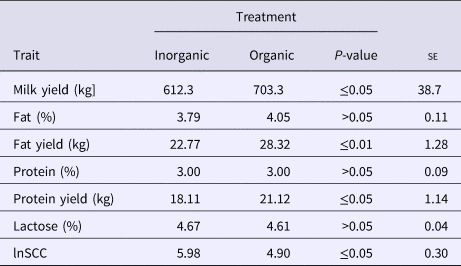
We have previously shown that organic selenium (Se-yeast) supplementation has considerable influence on the production traits of dairy goats, expressed as an average daily performance (Bagnicka et al., Reference Bagnicka, Jarczak, Kaba, Kościuczuk, Czopowicz, Krzyżewski and Kukovics2016). Briefly, in that study, daily milk, fat, protein, casein, lactose, total solids and non-fat solid yields increased significantly by approx. 11, 10, 5, 43, 8, 9 and 7% with organic Se supplementation, respectively, while somatic cell count expressed as lnSCC (somatic cell count transformed into natural logarithm scale) decreased by almost 20%. In the present study, lactation yields of milk, fat and protein were analysed to emphasize the benefits of supplementation of goats with Se-yeast (Table 1). Milk yield and fat and protein yields were higher in goats with organic Se treatment by almost 100 kg (an increase of ~15%), 6 kg (+24%) and 3 kg (+17%), respectively, during the entire lactation period. Typically, higher milk yield is connected with lower content of milk components. However, in our experiment, this was not the case. Moreover, we observed lower content of somatic cells (approx. by 22%) in the Se-yeast treatment group of goats, indicating better health status of their mammary glands. Thus, supplementing dairy goat diets with Se in its organic form could have a significant economic impact, considering the goats’ increased lactation performance we observed in the present study. These results were consistent with those reported previously by Zhang et al. (Reference Zhang, Liu, Liu, An, Zhou, Cao and Song2018) in experiment on Chinese dairy goats as well as Smith et al. (Reference Smith, Hogan and Weiss1997) and Oltramari et al. (Reference Oltramari, Pinheiro, de Miranda, Arcaro, Castelni, Toledo, Ambrόsio, Leme, Manella and Jứnior2014) in experiments on dairy cows. In our previous study on dairy cows, whose diets were supplemented by 6 g of Se-yeast per d per cow, milk yield was higher in the organic Se treatment group vs. the inorganic one by ~450 kg per cow during the 90 d of the experiment (Bagnicka et al., Reference Bagnicka, Kościuczuk, Jarczak, Jóźwik, Strzałkowska, Słoniewska and Krzyżewski2017). However, contradictory results have also been obtained. Our results are at odds with those of Phipps et al. (Reference Phipps, Grandison, Jones, Juniper, Ramos-Morales and Bertin2008), Gong et al. (Reference Gong, Ni, Wang, Shi and Yan2014) and Oltramari et al. (Reference Oltramari, Pinheiro, de Miranda, Arcaro, Castelni, Toledo, Ambrόsio, Leme, Manella and Jứnior2014). They supplemented the cows’ diet with Se-yeast or sodium selenite and showed no difference in milk yield and milk composition. However, those experiments were carried out for shorter time periods than ours, and it is possible that the daily dose of Se had met requirements of all animals for bioavailable Se before the beginning of the experiment. In our study all animals received the recommended dose of the commercial mixture of minerals (so including the inorganic selenium) before the start of the experiment. The Se concentration in milk was essentially the same in both groups at the beginning of the experiment (11.1 and 11.8 µg/l in organic and inorganic Se-groups, respectively; P > 0.05), while its content was twice as high in the organic vs. inorganic treatment groups at the end of the experiment (31.8 vs. 16.1 µg/l; P ≤ 0.05). The Se content in blood serum was also higher in the organic Se-treated goats at the end of experiment (108 vs. 84 µg/l; P ≤ 0.05) whereas at the beginning of experiment the Se content in serum was on the same level in both groups of animal (93.5 vs. 89.8 µg/l; P > 0.05). As Kruzhel et al. (Reference Kruzhel, Bakowska, Vovk, Nowakowska and Sergei2014) summarized, the Se concentration in goat blood ranged between 0.010 and 0.076 µg/ml (10–76 µg/l) depending on the country and the region, but even as high as 0.499 µg/ml (499 µg/l) of Se in the blood was found in USA. Thus, as previously shown by Pechová et al. (Reference Pechová, Janštová, Mišurová, Dračková, Vorlová and Pavlata2008) and Petrera et al. (Reference Petrera, Calmari and Bertin2009), the addition of Se-yeast contributed to the considerable increase of Se concentration in milk and blood serum in dairy goats, and by Knowles et al. (Reference Knowles, Grace, Wurms and Lee1999) and Bagnicka et al. (Reference Bagnicka, Kościuczuk, Jarczak, Jóźwik, Strzałkowska, Słoniewska and Krzyżewski2017) in dairy cows. According to Ceballos et al. (Reference Ceballos, Sánchez, Stryhn, Sánchez, Montgomery, Barkema and Wichtel2009) cows supplemented with organic form of Se had more (approx. 0.37 µmol/l) selenium in milk than cows fed inorganic Se. However, the results obtained by Kachuee et al. (Reference Kachuee, Moeini and Souri2013) indicated a lack of difference in Se concentration in colostrum and blood of Merghoz goats after four weeks supplementation with organic (selenized yeast) and inorganic Se (sodium selenite).
Lactation yield and gross composition of milk from organic and inorganic Se-treated goats

Inorganic Se, sodium selenite; Organic Se, Se-yeast from Saccharomyces cerevisiae; lnSCC, somatic cell count transformed into natural logarithm scale; se, standard error of mean.
In addition to Se, concentrations of heavy metals – Sr, Ni, and Cd were also measured in milk and blood serum of inorganic and organic Se-treated goats in the present study. No differences in the concentrations of Sr (50 vs. 80 µg/l), Ni (1.1 vs. 1.8 µg/l) or Cd (0.02 vs. 0.06 µg/l) (P > 0.05) were observed between groups.
Biochemical parameters
There were no differences in the biochemical parameters between Se treatment groups and among stages of lactation in blood serum of the goats, except for creatine kinase activity and content of triacylglycerols (online Supplementary Table S4). In inorganic Se-treated goats, the activity of creatine kinase was lower while the content of triacylglycerols was higher at the end of experiment. However, all biochemical parameters were within reference values, which indicates a lack of any health disturbances connected with the supplementation of Se in organic form. Thus, our findings confirm results obtained by Ziaei (Reference Ziaei2015) in a study on goats and by Juniper et al. (Reference Juniper, Phipps, Jones and Bertin2006) in a study on dairy cows.
Gene expression
No expression of GBD2, CCL4, TNFα, TLR2, HAMP, BAC5, MAP28, or MAP34 genes was detected in somatic cells from goats’ milk in this study. This finding contradicts our earlier studies, in which we found expression of GBD2, HAMP and BAC5 genes in goat milk somatic cells (Jarczak et al., Reference Jarczak, Kościuczuk, Ostrowska, Lisowski, Strzałkowska, Jóźwik, Krzyżewski, Zwierzchowski, Słoniewska and Bagnicka2014b). These differences are difficult to explain, especially since both studies were conducted in the same herd, though in different years. It is possible that some unidentified environmental factors caused disturbances in homoeostasis of organisms and may have affected the expression of some genes. Notwithstanding, the differences were not connected with bacteria presence.
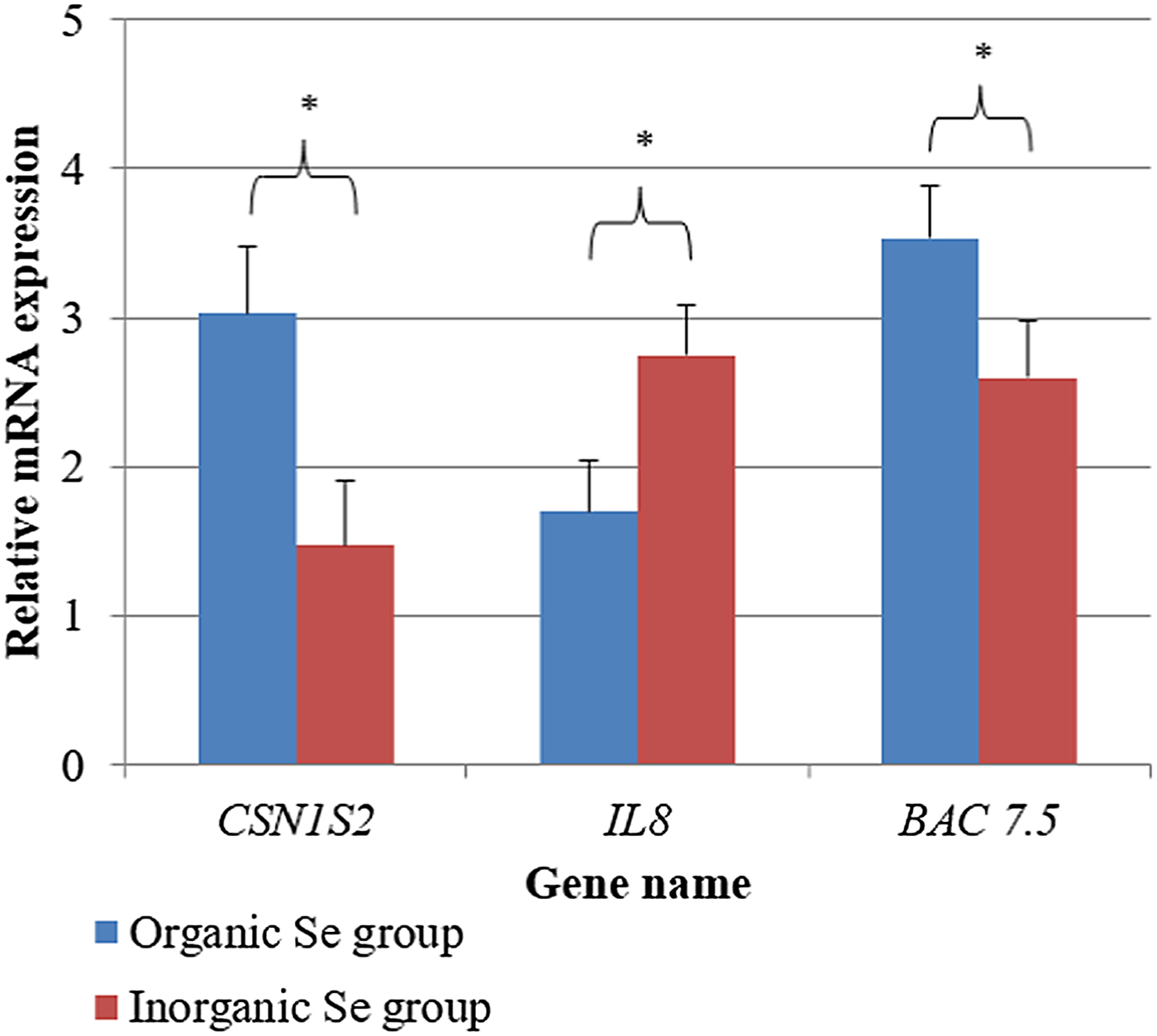
Milk somatic cells are, at least partially, representing the mammary gland secretory epithelia, therefore their mRNA levels may reflect changes in the expression of specific genes in the mammary gland itself (Boutinaud et al., Reference Boutinaud, Herve and Lollivier2015). Among investigated casein genes, only transcripts of αS2-casein were higher in milk somatic cells derived from goats in the organic Se treatment group than in the inorganic one (Fig. 1). Caseins are the most important of all milk proteins and they influence milk sensory, nutritional and production properties. Thus, they have a positive impact on cheese yield, but they may have a negative impact on the allergenicity of the milk (Bellioni-Businco et al., Reference Bellioni-Businco, Paganelli, Lucenti, Giampietro, Perborn and Businco1999).
Relative mRNA expressions with their standards errors (se) of the CSN1S2, IL-8 and BAC7.5 genes in milk somatic cells from inorganic (sodium selenite) vs. organic (Se-yeast from Saccharomyces cerevisiae) Se treated goats. * – differences at P ≤ 0.05.

Only two out of 12 investigated genes involved in the innate immune system responded to different forms of Se supplementation (Fig. 1). Reduced expression of IL-8 and elevated expression of BAC7.5 were found in milk somatic cells of the organic Se treated goats. In our previous study (Jarczak et al., Reference Jarczak, Kościuczuk, Ostrowska, Lisowski, Strzałkowska, Jóźwik, Krzyżewski, Zwierzchowski, Słoniewska and Bagnicka2014b), we showed that BAC7.5 gene expression was higher in goats supplemented with active dry yeast (10 g/d/goat) compared to goats given a diet without yeast supplementation. In the present study, the daily dose of dry Se-yeast was only 0.6 g/d/goat, which proves that it is not only yeast that influenced the level of BAC7.5 expression, but also the selenium supplementation. Montgomery et al. (Reference Montgomery, Wichtel, Wichtel, McNiven, McClure, Markham and Horohov2012) showed lower expression of IL-8 in the blood neutrophils of horses supplemented with an organic form of selenium as compared to sodium selenite supplementation. The main function of this interleukin, also called ‘neutrophil chemotactic factor,’ is to induce the migration of neutrophils and other granulocytes to the site of infection. Decreased expression of this pro-inflammatory cytokine and elevated expression of a cathelicidin, i.e. BAC7.5, which can act in healthy tissues at physiological salt concentrations (Kościuczuk et al., Reference Kościuczuk, Lisowski, Jarczak, Strzałkowska, Jóźwik, Horbańczuk, Krzyżewski, Zwierzchowski and Bagnicka2012) may indicate better health status of mammary glands of goats treated with organic Se. It is likely that the low expression of Il-8 is connected with the inhibition of chemotaxis of neutrophils and other granulocytes to the mammary glands in the organic Se treated goats and that this may have resulted in a lower content of somatic cells in the goats’ milk. This fact supports the notion that supplementation with the organic form of selenium has a positive impact on animal health.
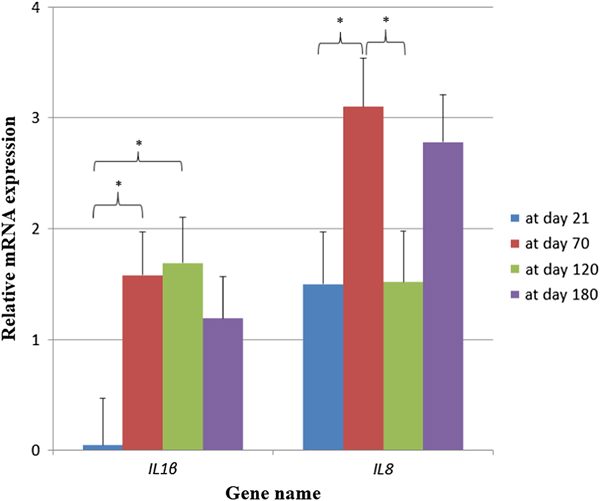
Differences in the IL-1β and IL-8 transcript levels were also noted between the stages of lactation (Fig. 2), namely: between the 21st compared to the 70th and 120th days of lactation for IL-1β and between the 21st and 120th compared to the 70th day for IL-8. The goats may have increased susceptibility to inflammation at the peak of lactation due to the increased metabolic burden of the organism at this critical stage.
Relative mRNA expressions with their standard errors (se) of the IL1β an Il-8 genes in milk somatic cells at different stages of lactation: at day 21 (early lactation), at day 70 (peak of lactation), at day 120 (mid lactation), and at day 180 (end of lactation). * – differences at P ≤ 0.05.

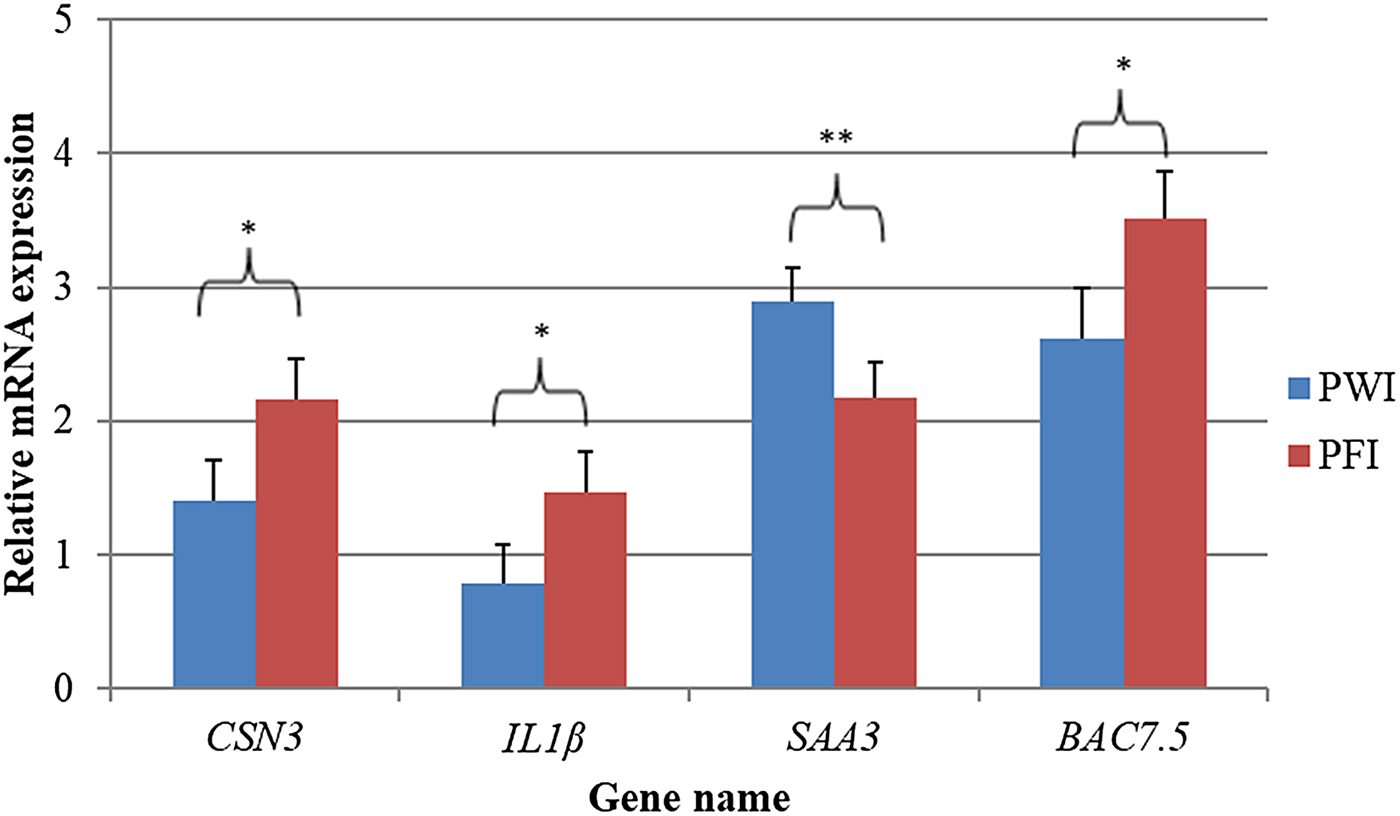
In addition to the effect of Se supplementation form, in this study, we also explored differences in gene expression levels between two Polish breeds of goats. We observed higher expression of the κ-casein (CSN3) gene in the milk cells of PFI goats, compared to PWI goats (Fig. 3). This suggests that milk from PFI goats could be more suitable for the cheese industry, since kappa-casein participates in the coagulation of milk casein micelles (Bonfatti et al., Reference Bonfatti, Di Martino, Cecchinato, Degano and Carnier2010). Moreover, lower expression of the SAA3 gene, which is produced in response to inflammatory stimuli and higher expression of the BAC7.5 gene in milk somatic cells derived from PFI goats may indicate a higher resistance of this breed to infection. Winter et al. (2005) found that goats infected with Staphylococcus aureus have much higher expression levels of SAA than healthy goats. On the other hand, the higher expression of Il-1β would contradict the statement that the PFI breed is more resistant to infection. However, this pro-inflammatory cytokine is also involved in a variety of cellular activities including the proliferation of B-lymphocytes (Jarczak et al., Reference Jarczak, Kaba, Reczyńska and Bagnicka2016), which might indicate the higher readiness of the gland to protect against pathogens.
Relative mRNA expressions with their standards errors (se) of the CSN3, IL1β and BAC7.5 genes in milk somatic cells of the Polish White Improved (PWI) and the Polish Fawn Improved (PFI) goat breeds. ** – differences at P ≤ 0.05, * – differences at P ≤ 0.01.

In conclusion, supplementation of organic selenium bound by the yeast Saccharomyces cerevisiae beneficially influenced milk, fat and protein yields (increased), as well as somatic cell count (decreased) in dairy goats. Moreover, the Se contents in milk and blood were significantly higher in the group of goats given the organic Se treatment. Se-yeast influenced the expression of two genes of the immune system (lower levels of the pro-inflammatory cytokine IL-8 gene and higher levels of the antimicrobial peptide BAC7.5 gene). Se-yeast also increased the expression of α-S2-casein gene (CSN1S2). The highest expression levels of genes involved in the immune system (IL-1β and IL-8) in the peak of lactation may indicate the metabolic burden connected with high milk yield in this stage of lactation. Se-yeast supplementation did not influence the biochemical parameters in blood serum, thus it had no negative impact on homoeostasis of the organism. Se-yeast positively influenced the expression of genes of the immune system, thus possibly having a beneficial impact on goat's immune system. Se supplementation in its organic form may have significant economic impact by improving the productivity of animals.
Supplementary material
The supplementary material for this article can be found at https://doi.org/10.1017/S0022029919000037.
Acknowledgement
This study was part of a project called ‘BIOFOOD – innovative, functional products of animal origin’ no. POIG.01.01.02-014-090/09, co-financed by the European Union from the European Regional Development Fund within the Innovative Economy Operational Programme 2007–2013. The publication was supported by the KNOW Leading National Research Centre – Scientific Consortium ‘Healthy Animal – Safe Food’.