Introduction
The spirituality dimension of older adults has recently been integrated in the field of successful aging because of its links with health and well-being outcomes (Tomás et al., Reference Tomás, Sancho, Galiana and Oliver2016). Spirituality has long been associated with religion. Hill and Pargament (Reference Hill and Pargament2008) defined religiosity as a reference to external, institutionalized, formal, and doctrinal aspects of religious life, whereas spirituality refers to a personal subjective experience. Spirituality is a search for meaning, involving the questioning of life and the relationship with the sacred or transcendent, which may or may not stem from the development of religious rituals and the formation of a community (Koenig et al., Reference Koenig, McCullough and Larson2001). From a theoretical perspective, Erikson's (Reference Erikson and Schlein1987) psychosocial theory of development and Tornstam's (Reference Tornstam2005) gerotranscendance theory argue that as age increases, many people perceive themselves as having increasingly transcendent attitudes. They take more delight in their inner world, are less fearful of death, and feel a greater connection to the entire universe. In a review of spiritual change with aging, Dalby (Reference Dalby2006) indicated an increase in spirituality or aspects of gerotranscendence with age. In a longitudinal study across a life span of over 60 years, Wink and Dillon (Reference Wink and Dillon2002) suggested that levels of spirituality increased significantly especially from middle to late adulthood, with women evidencing a higher level of spirituality than men. Although some experimental studies have explored changes in levels of spirituality over the course of people's lives (i.e. across the life span), surprisingly a few studies have investigated trajectories of spirituality among older adults. However, spirituality may offer a purpose and meaning toward the end of life and provides a framework for managing concerns and decisions at this time. Thus, the first objective of the present study was to examine the trajectory of spirituality among older adults. Based on previous results, we assumed that there would be an increase in spirituality over time. We also examined the roles of gender and religion on the trajectory of spirituality. We expected higher scores of spirituality for women and for those who report having religious beliefs than for men and for those reporting no religion.
Several mechanisms to explain relationships between spirituality and health or well-being outcomes have been reported (Zimmer et al., Reference Zimmer, Jagger, Chiu, Ofstedal, Rojo and Saito2016). Among them, social support has been raised as a main contributing factor that could be explored further. Social support is an essential element of well-being, especially among older adults (Seeman, Reference Seeman2000). The needs to belong, to trust others, and to rely on each other are fundamental human motivations, which give meaning of life. In particular, perceived social support, which has consistently been associated with various positive outcomes, appears to be more important than received social support (Cohen et al., Reference Cohen, Underwood and Gottlieb2000). On this basis, we can expect a relationship between spirituality and satisfaction with social support.
The importance of maintaining a sense of control over personal development for better psychological well-being has largely been acknowledged as a primordial factor among a wide range of developmental regulation theories. The role of goal adjustment among aging processes has been developed in the dual process model of Brandtstädter (Brandtstädter and Rothermund, Reference Brandtstädter and Rothermund2002). This model highlights that there is an age-related shift toward flexibility over tenacity. According to Brandtstädter, flexibility enhances the disengagement from instrumental striving and the reorientation toward intrinsic, self-transcending goals under declining life-time reserves. By undermining future-related goals, a growing awareness of life's finitude should also strengthen an orientation toward values and sources of meaning that transcend the horizon of personal lifetime (Brandtstädter et al., Reference Brandtstädter, Rothermund, Kranz and Kühn2010). On this basis, we can expect a relationship between spirituality and flexibility.
In sum, based on a longitudinal study, the first objective of the present study was to examine the developmental trajectory of spirituality among older adults. We expected an increase in spirituality over time. In addition, we investigated the roles of gender and religion on the developmental trajectory of spirituality among older adults. We expected that older women as well as religious individuals would have higher scores of spirituality. The second objective was to explore the within-person synergies of spirituality, social support, and flexibility. We hypothesized that trajectories of spirituality were accelerated at time points at which older adults reported high scores of social support and flexibility.
Methods
Participants and procedure
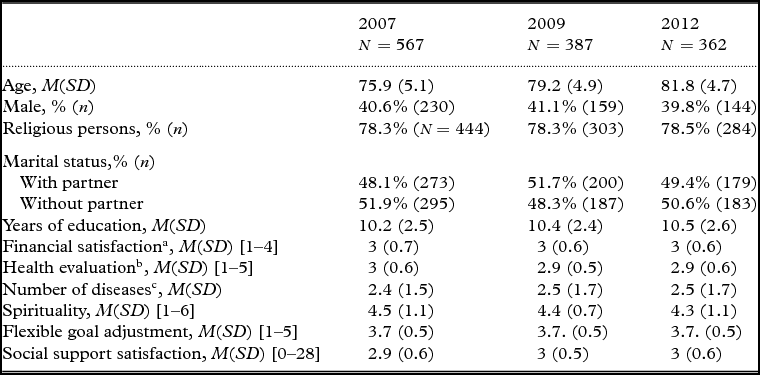
This research used data from an ongoing longitudinal study initiated in 2001 (for more details, see Alaphilippe et al., Reference Alaphilippe, Bailly, Gana and Martin2005) by a team of researchers at the University of Tours (France), and which follows a non-institutionalized older adults cohort of residents from France (recruited through an advertisement in a specialized journal). The survey was mailed and participants returned the completed questionnaire in a prepaid envelop. Anonymity was ensured by attributing an identification number to each participant. Data were collected every two years between 2001 and 2012. On the first assessment in 2001, the sample of this cohort comprised 906 participants with a mean age of 72.5 years (SD = 5.89, range = 62–95). In 2001, 2003, and 2005, spirituality was not assessed. Thus, the data used in this paper were collected at three time points, with participants participating in up to three waves of measurement (T1: 2007; T2: 2009; T3: 2012). Data for spirituality were available in 2007 (T1) for 567 participants (48.15% married or had a partner; 59.44% female; M age = 75.90, SD = 5.12), in 2009 (T2) for 387 participants (51.68% married or had a partner; 58.91% female; M age = 79.23, SD = 4.96), and in 2012 (T3) for 362 participants (49.45% married or had a partner; 60.22% female; M age = 81.80, SD = 4.65). The sample included a large proportion of participants (i.e. 78.3%) who reported having a religion with older women reporting more religious beliefs than older men (χ 2(1) = 6.87, p < 0.001). Among those with a religion, there were 92.74% Catholics, 6.18% Protestants, 0.81% Buddhists, and 0.27% Jews. (Religion was assessed by the question: “Which is your religious affiliation? For further analyses, religion was coded as a dummy variable with religious persons (1) or not religious persons (2).)
Across the three waves, the participants were satisfied with their financial situation and considered their health as “good.” They had a few diseases. The most frequent diseases encountered over the five years were arthritis (57%), hypertension (27.5%), gastrointestinal diseases (22.3%), and cardiovascular diseases (18%). The main sample characteristics are presented in Table 1.
Sample characteristics and descriptive statistics

M = Mean, SD (standard deviation), [min–max].
aFinancial satisfaction was assessed with the question: “How would you describe your present financial situations: Very dissatisfied (1), Dissatisfied (2), Satisfied (3), Very satisfied (4).”
bHealth evaluation was assessed by the question: “In general, would you say your health is very poor (1), poor (2), good (3), very good (4), or excellent (5)?.”
cThe number of diseases was evaluated with the Multidimensional Functional Assessment Questionnaire. This scale uses a list of 26 common diseases in older persons (such as diabetes, chronic bronchitis, hypertension, arthritis, gastrointestinal diseases, cardiovascular diseases, and cancer). The number of illnesses was measured by the total number of diseases reported by each participant.
Refusal, low cognitive performance, and death are the common reasons for attrition in prospective studies of older adults. In the present study, retention rates were 68% between the first and second waves and 93% between the second and third waves. To investigate the potential impact of attrition, differences in age, spirituality, social support, and flexibility were tested between participants who completed the measures during the three waves and those who dropped out of the study before Time 3. Although their scores of spirituality and flexibility did not differ, participants who dropped out were older (p < 0.001) and reported lower levels social support at T1 (p = 0.004) than those who completed the three waves.
Measures
Spirituality was assessed using a French version of Underwood and Teresi's (Reference Underwood and Teresi2002) daily spiritual experience scale (DSES; Bailly and Roussiau, Reference Bailly and Roussiau2010). This short scale has been validated in an older population and contains six items. It is intended to assess a person's perception of the transcendent (God, the divine) in daily life. The six items are rated using a Likert scale, in which the response categories are “many times a day,” (6) “every day,” (5) “most days,” (4) “some days,” (3) “once in a while,” (2) and “never or almost never” (1). High scores on DSES indicate high spirituality. In the present sample, Cronbach's α’s of the DSES were 0.90 at T1, 0.92 at T2, and 0.91 at T3.
Social support was assessed using the subscale satisfaction with social support of the Duke social support index (Koenig et al., Reference Koenig, Westlund, George, Hughes, Blazer and Hybels1993). This scale contains seven items. Items are rated on a 5-point Likert scale, ranging from “never” to “most of time.” Higher scores indicate more satisfaction with social support. In the present sample, Cronbach's α’s of the social support were 0.81 at T1, 0.82 at T2, and 0.83 at T3.
Flexible goal adjustment (FGA) was assessed using a French version of Brandtstädter and Renner's (Reference Brandtstädter and Renner1990) FGA scale. FGA contains ten items. Items are rated on a 5-point Likert scale, ranging from 1 “strongly disagree” to 5 “strongly agree.” High scores on the FGA scale indicate high accommodative flexibility. In the present sample, Cronbach's α’s of the FGA were 0.68 at T1, 0.74 at T2, and 0.74 at T3.
Data analysis
Multilevel growth curve analyses (MGCA) were used to examine the trajectory of spirituality in older adults (Singer and Willett, Reference Singer and Willett2003). Considering that MGCA allows the number of available measurement waves to differ across individuals, all participants that completed the questionnaire of spirituality at least once during the study could be incorporated in the model (Singer and Willett, Reference Singer and Willett2003). All analyses were conducted using the R package labeled lme4 (using linear function with p-values estimated based on Satterthwate's approximations) using the restricted maximum likelihood algorithm for handling missing data (Bates et al., Reference Bates, Maechler, Bolker and Walker2015).
First, a two-level model estimated both the average growth and the individual differences in growth in order to examine the slope of spirituality over time. At Level 1, age (linear trajectory) was entered as a continuous predictor to estimate the average intercept (β0) and the average linear growth (β1) of the continuous outcome variable of interest (spirituality). We also tested a model in which age (linear trajectory) and squared age (quadratic trajectory) were entered as continuous predictors to estimate the average intercept (β0), the average linear growth (β1), and the average quadratic growth (β2). However, the quadratic slope did not improve the model fit and was not included in further analyses. The age variable was centered at the initial age of the participants. Thus, the intercept should be interpreted as the level of spirituality experienced at 66 years. The random effect of both the intercept and the linear slope was included in each of the models.
Second, a MGCA model estimated the effect of gender and religion (Level 2 ordinal predictors) on the initial level of the continuous outcome variable spirituality (intercept as outcome model) as well as the cross-level moderating roles of gender and religion in the linear developmental trajectory of the continuous outcome variable spirituality (i.e. slope as outcome model). In all analyses, gender and religion were dummy coded (1 = male or no religion; 2 = female or religion). Third, a MGCA model was designed to test, in addition to the aforementioned effects of gender and religion, whether the linear growth of spirituality accelerated or decelerated at time points at which the scores of the participants on social support and flexibility were higher than their own average (within-person interactions between age and the other variables). Therefore, this model estimated (in addition to the sex and religion effects previously specified in the second model) the within-person (as Level 1 continuous predictors (flexibility level 1 and social support level 1) with group mean centering) and the between-person (as Level 2 continuous predictors (flexibility level 2 and social support level 2) with grand mean centering) main effects of both social support and flexibility on the continuous outcome variable (i.e. spirituality). Moreover, the within-level moderating effects of social support and flexibility (Level 1 continuous predictors social support × age and flexibility × age) in the developmental trajectory of the continuous outcome variable of spirituality were also included into the third model.
Results
Development of spirituality in older adults (Model 1)
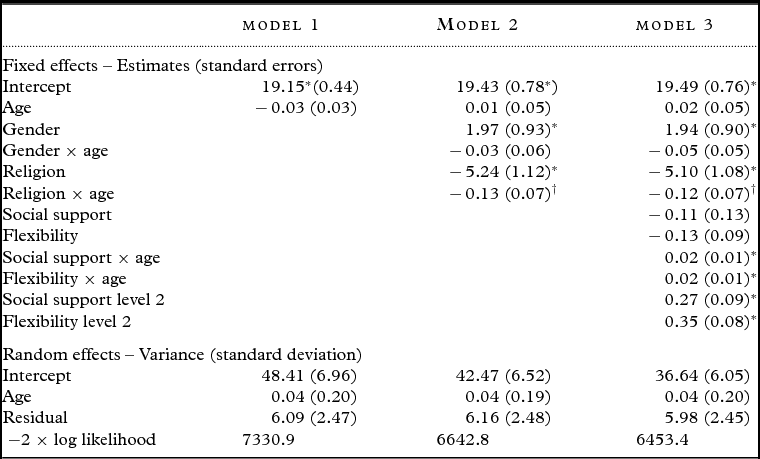
The results of the MGCA model revealed a non-significant linear effect of age (b = −0.03, p > 0.10) on spirituality (see Model 1 in Table 2).
Unstandardized parameter estimates of the spirituality growth curve models

*p < 0.05.
†p ≤ 0.08.
Effect of gender and religion on spirituality in older adults (Model 2)
Gender and religion were significantly associated with spirituality (b = 1.97 and 5.24, p < 0.05). In other words, older women reported a higher level of spirituality (i.e. intercept) than older men. Similarly, older adults who had religious beliefs reported a higher level of spirituality than those who had no religion. Moreover, gender did not significantly moderate the developmental trajectory of spirituality over time (b = −0.03, p > 0.10). This result means that spirituality was significantly higher for older women than older men and that there is no evidence for a differential effect of gender across age. Religion does not significantly moderated the linear developmental trajectory of spirituality over time (b = 0.13, p = 0.07) (see Model 2 in Table 2).
Within-person synergies of spirituality, social support, and flexibility (Model 3)
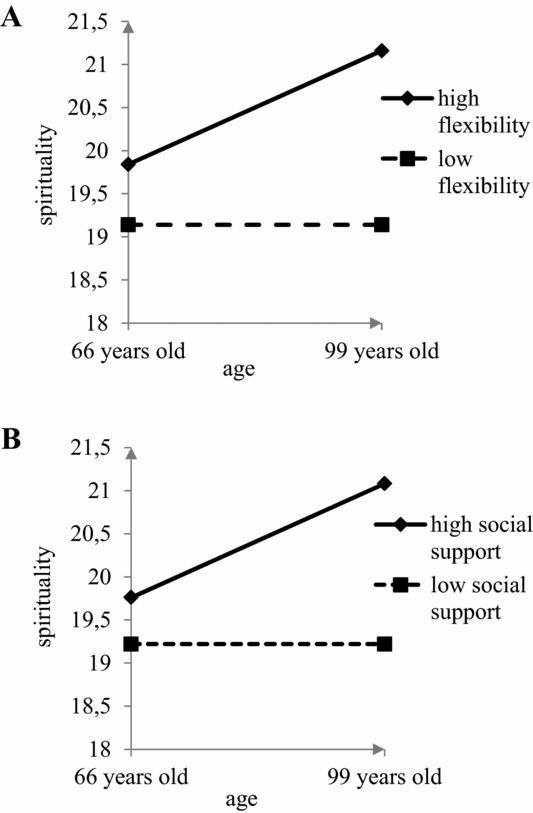
At Level 2 (between-person main effects of social support and flexibility on spirituality), social support (b = 0.27, p < 0.05) and flexibility (b = 0.35, p < 0.05) were significantly associated with spirituality (see Model 3 in Table 2). In other words, older adults who reported higher levels of social support and flexibility also reported higher levels of spirituality (intercept). Otherwise, the within-person interactions (i.e. Level 1 predictors) of age with social support (b = 0.02, p < 0.05) and flexibility (b = 0.02, p < 0.05) reached significance. Therefore, the linear increase in spirituality seems to have accelerated at time points at which participants also had higher (b = 0.04) rather than lower (b = 0.00) levels of social support and flexibility (see Figure 1 for a visual depiction of these effects). Alternatively, the significant within-person interactions can be taken as evidence to indicate that the strength of the association of spirituality with social support and flexibility increased over time among older adults.
Depiction of the interaction terms of flexibility × age (panel A) and social support × age (panel B).

Discussion
The aim of the present study was to explore the trajectory of spirituality among older adults over a five-year follow-up. We hypothesized that there would be an increase in spirituality over time, but the results from the MGCA revealed a non-significant effect of age on spirituality. In our study, the mean rating score was relatively high (4.4/6). We can assume that our participants had found meaning in their lives and had thus reached a higher level of spirituality. The question remains as to when spirituality begins to increase. One of the rare longitudinal studies conducted on spiritual development (Wink and Dillon, Reference Wink and Dillon2002) indicates an increase in spirituality between late middle adulthood (50–60) and older adulthood (60–70). Other studies that highlighted a rise in spirituality over time used a cross-sectional design comparing younger and older adults (Tornstam, Reference Tornstam2005; Brown et al., Reference Brown, Chen, Gehlert and Piedmont2013) and the age range of our participants (66–95 years), and also the follow-up period (five years) may have been insufficient to investigate the change in spirituality throughout the life-span. In a cross-sectional analysis, Brown et al. (Reference Brown, Chen, Gehlert and Piedmont2013) indicated a non-linear age effect on the spiritual transcendence scale with spirituality rising over late adolescence and the adult life course and with lower scores for older adulthood than those for middle age. More than age per se, it may be the way age-related changes in health functioning, social losses, and approaching death are dealt with that could be important for the development of spirituality among older adults. Spiritual development is undoubtedly a lengthy maturational process that occurs over the course of adult life when individuals experience the ambiguity and the relativity of human life (Moberg, Reference Moberg2001).
Our results also confirm that older women would have higher scores of spirituality than older men (Wink and Dillon, Reference Wink and Dillon2002; Maselko and Kubzansky, Reference Maselko and Kubzansky2006; Brown et al., Reference Brown, Chen, Gehlert and Piedmont2013). It is noteworthy that the effect of sex on spirituality scores is strong and clinically meaningful, as indicated by the unstandardized estimate of sex effect and the raw standard deviation of the spirituality measure. Moreover, not only did the older women have higher levels of spirituality than older men, but this upward trend also continued over time. In many studies, gender differences in spirituality have been assumed to exist based on the gender differences rather than sex differences (Bryant, Reference Bryant2007). The main reasons for this difference would be the tendency for women to be more emotionally expressive and they also use more emotion-focused coping styles than men (Goldshmidt and Weller, Reference Goldshmidt and Weller2000). Concerning the role of religion in spirituality our result indicates that older adults who had a religion reported higher levels of spirituality than those who had no religion. Based on the unstandardized estimate of religion and the raw standard deviation of spirituality, it can be deducted that the religion effect is strong and meaningful. The relationship between spirituality and religion is not surprising and has already been demonstrated. Although all humans may have a spiritual dimension, religious people could be more predisposed and more aware of this spirituality.
Our second objective was to explore the within-person synergies of spirituality, satisfaction with social support, and flexibility. We hypothesized that trajectories of spirituality were related to satisfaction with social support and flexibility. Our results indicate that older adults who reported higher levels of social support and flexibility also reported higher levels of spirituality. In addition, the increase in spirituality seems to have accelerated at time points at which participants also had higher rather than lower levels of social support and flexibility. Based on the unstandardized estimates and the raw standard deviation of spirituality, it is noteworthy that these effects are rather small but of theoretical interest. Among dimensions of spirituality, it has been assumed that connection to others and a sense of belonging give meaning to life. In addition, in the framework of aging theory, being in a relationship is an essential dimension of well-being in aging processes (Carstensen et al., Reference Carstensen, Fung and Charles2003; Tornstam, Reference Tornstam2005). For example, in the socioemotional selectivity theory (SST, Carstensen et al., Reference Carstensen, Fung and Charles2003), even if there is an age-associated reduction in social networks, older adults prioritize the emotional significance of their relationships to give meaning in life. This explains why when satisfaction in social support increases the sense of life, spirituality also increases. In accordance with Erikson's (Reference Erikson and Schlein1987) theory, old age is defined as the generativity stage. This stage is revealed by a growing concern for well-being of the next generation or society as a whole, expressing a shift away from purely personal interests to more enduring sources of meaning. This suggests that giving support (i.e. an adult's ability to care for another person) may be as important as receiving support. In a longitudinal study, Dillon et al. (Reference Dillon, Wink and Fay2003) found a relationship between spirituality and generativity in late adulthood, confirming the link between spirituality and connection to others. A new finding has been revealed in the present study concerning the relationship between flexibility and spirituality. Older adults who reported higher levels of flexibility also reported higher levels of spirituality. Moreover, the linear increase in spirituality seems to have accelerated at time points at which participants also had higher levels of flexibility. An important aspect of adjustment to aging is the ability to realize the positive values of life and its meaningfulness. Flexible adjustment helps to regain an overall sense of efficacy by finding more positive meaning in losses and by reinterpreting the biographical past in self-enhancing ways (Brandtstädter et al., Reference Brandtstädter, Rothermund, Kranz and Kühn2010; Bailly et al., Reference Bailly, Gana, Hervé, Joulain and Alaphilippe2014). Therefore, to be adaptive in old age, people need to embrace flexibility and to accept change. Our results highlight that spirituality and flexibility undoubtedly play key roles in well-being and adaptive processes to the challenges of aging.
Although this study provides additional information on aging processes, some methodological limitations should be mentioned. First, although analysis of the potential impact of attrition revealed no major significant differences between participants, some data are missing due to death and differential-losses-to-follow-up that could have biased the results. The second limitation is the degree to which these results can be generalized. Our sample was similar to French national averages (INSEE, 2005) in terms of gender, marital status, and religious affiliations, but respondents had generally completed more years of education than expected for people in this age bracket. In addition, our participants lived at home independently with a, good self-health evaluation, few diseases and a high evaluation of financial satisfaction. These characteristics lead us to assume that they did not have severe functional disabilities. A more representative sampling (with more clinical data, such as functional capacity, medication, or cognitive impairment) should be considered to improve understanding of the change in spirituality over time. In addition, our study concerned only a French aging population. France is a secular country and a cross-cultural perspective is necessary. The third limitation concerns the measure of spirituality. Like other instruments used to measure spirituality, DSES might be contaminated with items assessing well-being. As a consequence, it may be more relevant to view DSES as a spiritual well-being measure rather than a spiritual measure. In addition, DSES is a short measure of spirituality. A multidimensional instrument of spirituality (e.g. spiritual attitudes and involvement list) could offer news insights in how social support and flexibility are related with distinct aspects of spirituality. Finally, although DSES can be applied to religious as well as non-religious populations, some items refer to God. Spirituality is a personal and subjective experience and is not easy to measure, and the integration of qualitative approaches will provide complementary understanding of spirituality. The fourth limitation concerns the use of MGCA. Even if our results highlighted relationships between spirituality and social support and flexibility, MGCA do not specify causal relationships among studied variables. It is difficult to say whether individuals are flexible (or satisfied with their social support) because they are spiritual persons or whether they are spiritual persons because they are flexible (or satisfied with their social support). In our view, flexibility and social support would impact on spiritual development, which in turn would impact on flexibility and social support. Finally, given the close relationship between spirituality and well-being quality of life (Koenig et al., Reference Koenig, McCullough and Larson2001; Hill and Pargament, Reference Hill and Pargament2008; Ballew et al., Reference Ballew, Hannum, Gaines, Marx and Parrish2012; Ali et al., Reference Ali, Marhemat, Sara and Hamid2015), further investigations need to incorporate well-being outcomes.
In the current demographic aging context, most studies point to a very steep increase in the dependency ratio between 2020 and 2030, implying the need for a better understanding of how people can maintain a positive outlook on their life when resources and control decrease. From this perspective, the results of the present study help to enhance the understanding of the potential benefit of encouraging the spiritual aspects of life, and we hope this will be used in other health-related research.
Conflict of interest
None.
Description of authors’ roles
N. Bailly supervised the data collection and drafted the paper. G. Martinent was responsible for the statistical analyses. C. Ferrand and G. Martinent assisted with writing the paper. C. Giraudeau and O. Agli contributed in formulating the research question and to interpreting the results. N. Roussiau and K. Gana had critically revisited the paper and approved it. All authors have read and approved the final version of the paper.