IntroductionFootnote 1
With more and more importance being attached to English since China's economic reform and opening up to the outside world in the late 1970s, the entire Chinese society has placed such high importance to the learning of English that at times it even plays a vital role for a person who plans to pursue further education and seek a better career (China Daily, 5 August, 2010). However, the end of 2013 saw an ‘unanticipated’ reform of policy on the National Matriculation English Test (henceforth, NMET) instituted by the Chinese Ministry of Education (henceforth, MOE). It was ‘unanticipated’ because in the past few years the Chinese government has invested heavily in English language teaching. As reported by ABC News (15 November, 2010), ‘China is pushing its people to learn English’, and English has thus occupied a prominent place in the life of the Chinese people because it is the ‘key’ to success (Chen, Reference Chen2008: 16-37). According to this new policy, the once favorite ‘son’, i.e. English, may lose its predominance in the Chinese foreign language landscape and its importance may be diminished in exams. These changes are likely to cause a series of chain reactions since the dominant position of English largely lies in its weight in various levels of exams, with the NMET having the greatest impact. Given the determining factor of the NMET in Chinese people's attitudes towards English, NMET reform would almost undoubtedly change the current situation of English in China and it would be no exaggeration to say that it will have a foreseeable impact on various aspects of Chinese social life as well. In this article, I briefly review the causes for the ‘focus shift’ and attempt an analysis of the impact of the role of English in China in the future.
The reform
On October 21, 2013,the Xinhua News Agency, the state medium, reported that the equilibrium between English and Chinese may eventually be broken in scholastic admission tests as Beijing redistributes subject scores. Currently, the two subjects (i.e. Chinese and English), along with maths, share the same weighting of 150 points in gaokao.Footnote 2 Reportedly, the Beijing Municipal Commission of Education plans to raise the value of the Chinese language by shifting points from English to Chinese in college and senior high school entrance exams from 2017. When this plan takes effect, English as a scholastic subject will lose 50 weighting points. The new scoring system is illustrated vividly in Figure 1 which indicates that English (the hamburger) will give up 50 points to the subject Chinese (the bowl of rice).
English will lose 50 points in the NMET from 2017 onwards (chncomic.com, 2013)

The total English score will be added to the score for traditional Chinese culture in the subject of the Chinese language. Senior middle school students will be allowed to take English exams more than once to obtain the best score for college admission when the reform is implemented. Beijing's reform is responding to the new foreign language policy of the MOE. Jiangsu and Shandong provinces as well as Shanghai are also drawing up similar schemes to lessen the weight of English in gaokao. Earlier in 2013, a group of top Chinese universities, including Peking University and Tsinghua University, removed the English test requirement from their independent entrance exams for study in certain fields.
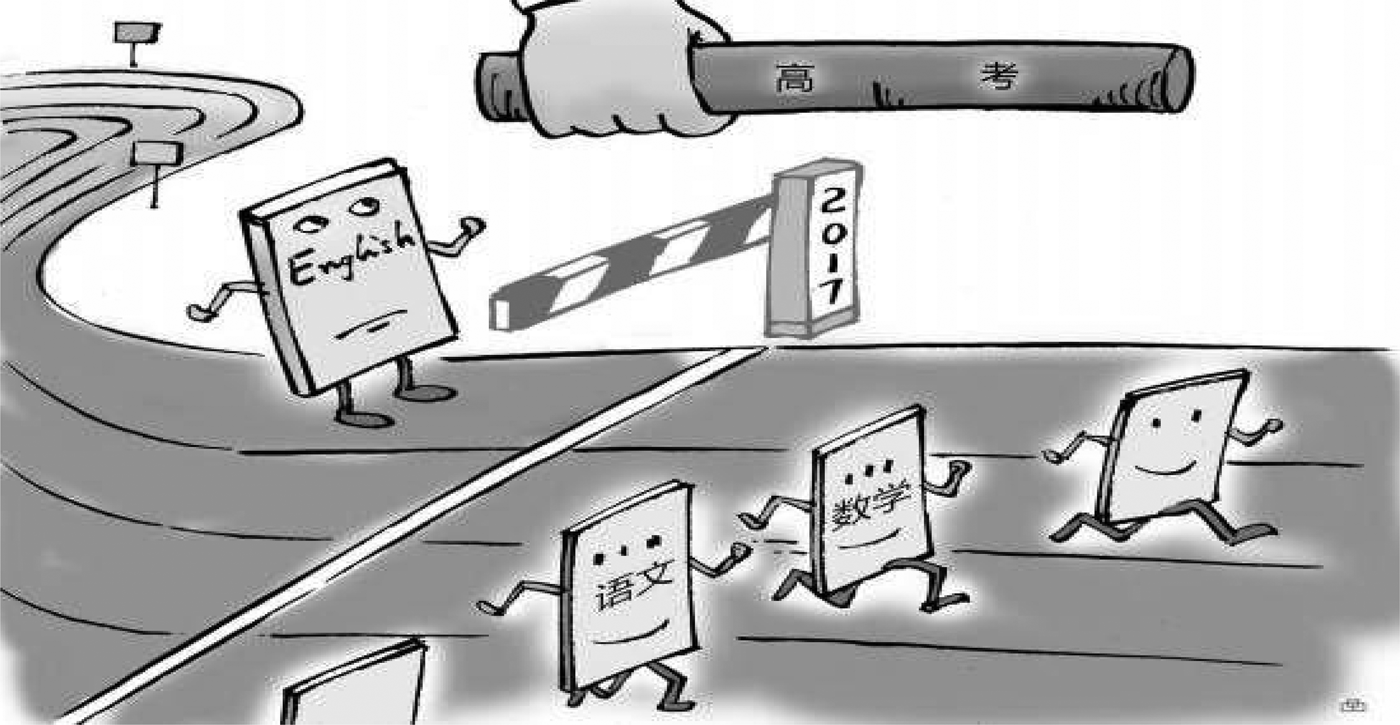
Wang Xuming, an authority on Chinese education and a former spokesman for China's MOE and currently a Chinese People's Political Consultative Conference (CPPCC) member, is one of the strong proponents of the move to de-emphasize English in Chinese schools. He proposed to put an end to teaching English to very young children, suggesting that more time should be given to the study of Chinese (scmp.com, 2013). Today, more and more people hold that the time has come for China to ‘cool down’ its ‘English mania’ and put due emphasis on the study of the Chinese language and culture. They attribute Chinese students' rapidly deteriorating knowledge of their mother tongue, particularly Chinese characters (hanzi), to the nationwide spread of English. A survey conducted soon after the gaokao of 2014 by the China Youth newspaper showed that 74.7 per cent of the respondents held that the NMET should be reformed (see Figure 2). As Figure 2 shows, gaokao (see the Chinese characters 高考 on the stick) is the baton of the present day China's secondary education and English will not have the equal status in the subjects races from 2017.
English as a subject in gaokao is not as important as Chinese and maths (people.com, 2014)
Is English the real cause of students' worsening knowledge of Chinese or is it only a scapegoat for the situation? To fully account for this situation, extensive investigations need to be conducted. Nevertheless, it is clear that in recent years an increasing number of Chinese people have begun to reflect critically on the spread of English in China, especially the over-emphasis of English in the country. To better understand the English language situation in China, it is necessary to look briefly at the history of English in this country.
English in China: A brief review
According to Bolton (Reference Bolton2002: 182), the first contact between Chinese people and English speakers occurred in 1637 (for a more detailed history of the spread of English in China, see Bolton, Reference Bolton2002, Reference Bolton2003; Adamson, Reference Adamson2004). However, for a long time English was not the leading foreign language and the Russian language held a dominant role in ancient and contemporary China. The intensive teaching and learning of Russian lasted for 154 years (1708—1862) and after that several other foreign languages like Japanese and English alternately took the leading position (Hu, Reference Hu1999: 55-7). The officially recognized English teaching began in 1862 when the Tongwen Guan (School of Combined Learning) was established to translate English science and technology documents into Chinese since the Qing government officials realized the importance of learning foreign techniques because China had been defeated in the Opium Wars. The Qing government was awakened by the defeat and came to the conclusion that ‘backwardness is vulnerable to attack’. Later, the Qing government enacted the ‘Authorized School Regulation’ in 1903, which regulated English as the major foreign language in school education. Since then, English was a formal subject in Chinese middle school curricula until 1966 when the Great Cultural Revolution broke out. Hu (Reference Hu1999: 55) summarized the characteristics of middle school English teaching and learning objectives of various periods of time, indicating that the objectives of English teaching before 2000 were relatively narrow and practical. One can hardly see from them the exam-related objectives. And it should be noted that there was a 10-year interruption of nationwide English teaching and learning from 1966 to 1976 due to the Revolution. During those ten years, English teaching and learning was officially banned and terminated and Russian was resumed since the Soviet Union was the ‘big old brother’ of China. The resumption of gaokao in 1978 ushered in the new era of English education in China and at the same time marked the end of the dominance of Russian in the country. Since its inception, gaokao has increasingly been regarded as the key propellant for the popularity of English in China since English is one of the three major examinable subjects.
Apart from gaokao, various other exams also play an important role in the spread of English in China, taking into consideration their ubiquitous influences on every aspect of Chinese people's lives. As an international language, English empowers individuals with a linguistic qualification for the pursuit of college education, as well as career development and job promotion. The key to unlock the door to these opportunities cannot be obtained unless one passes English exams of certain types. Besides, speaking English projects a very positive image to the public as being well-groomed, well-informed, open-minded and pro-Western (Wang, Reference Wang2008: 321–4). Even some Chinese top leaders sometimes take great pride in speaking English in public activities or at international events. Former Chinese president Jiang Zemin was said to showcase the Gettysburg Address and to croon Elvis Presley songs (The Wall Street Journal, 18 August, 2011).
English learning and testing is a lifelong companion for most Chinese students. For those who have successfully passed gaokao and secured a place in a university, there is still a long way to go with English. The MOE regulates that Chinese university students are required to learn English during the first two years because an important test is waiting for them, i.e. College English Test Band Four and Band Six (CET4 and CET6). Before the year 2000, if students could not pass CET4 in universities, they would be disqualified from their BA or BSc degrees. Another meaning is that employers set a threshold of CET4 or CET6 for recruiting new employees even though English is not really needed in their daily work. Apart from the NMET in gaokao and CETs, there are several other important exams which contain an English test component. The most prestigious ones are the Chinese GRE (the entrance examination for graduate program which is equal to the GRE of the U.S.) and the Test for Doctorate Candidates.
Causes for the shift to the new landscape
With China opening wider to the outside world, the Chinese people, particularly senior government officials, increasingly realized the importance and exigency of improving people's English proficiency. A case in point is that Chinese officials and the masses compared the computer software development in China with that of India and found that China fell behind the latter. They contributed this to the lower English proficiency of the Chinese people since the most current technological literature is written in English, which requires that software developers have a high level of English proficiency to be sufficiently competent for the job. In 1996, the former Vice Premier Li Lanqing expressed his concern about the efficiency of China's English education (Ceng, Reference Ceng1998). Mr. Li Lanqing suggested that English lessons be given at the very beginning of primary schooling. Accordingly, the MOE issued an official document in 2001 requiring that English be taught in primary school, thus forming ‘the earlier, the better’ policy.
Such a practice triggered hot dispute. Linguists and English teachers called for down-to-earth research to corroborate its effectiveness. Dong (Reference Dong2003) and Lin (Reference Lin2013) conducted several experimental studies in Canton, the capital city of Guangdong Province and Fuchow, the capital city of Fujian Province, both of which are port cities that were opened to the outside world in the Qing Dynasty. These are among the most developed cities in China, which may be able to provide comparatively better conditions for implementing English education from primary school. Nevertheless, the studies found that those who started learning English from primary school did not outperform those who started learning English from junior middle school after one semester.
More importantly, as the aforementioned studies (Dong, Reference Dong2003; Lin, Reference Lin2013) have shown, starting English teaching in primary school does not seem to have elevated the overall English proficiency level of English learners in China. This may have sown the seeds of the NMET reform. In addition, the foreign language education policy makers seem to hold the view that the craze for English has not only failed to improve Chinese learners' English proficiency, but has also wasted a large amount of financial and human resources. For example, English education has been labeled as ‘time-consuming and low efficiency’ (Hu, Reference Hu2002; Liu, Reference Liu2004) in China. The upcoming NMET reform may also be directly attributable to several other considerations, two of which are the most outstanding and deserve a mention here. One is related to the critical reflection on the dominant role of English in China and the other is concerned with the imbalance between the input (time and money invested) and output (the outcome of English study) in English language education. First and foremost, people believe that the prevalence of English in China has had a detrimental effect on the native language and other foreign languages. It is estimated that there are about 400 million learners/users of English in China today (China Daily, 10 August, 2010), which accounts for about one third of the total Chinese population. Some opponents, like Wang Xuming, hold that English learning has not only cost the learners considerable money and time but has also deteriorated the learners’ native language proficiency. Whether the worsening of Chinese students' native language proficiency is caused by the over-emphasis on English or not needs more scientific evidence, but as a compulsory subject from primary school to university, Chinese students have to spend a considerable amount of money and time learning English to obtain a competitive score.
Even worse is the fact that university students have to prepare for their CET4 or CET6, which significantly consumes most of their time and energy and hence distracts their attention from the subjects they major in. In order to pass the tests, students have to attend various costly test-prep schools and English training programs. Those test-prep schools and training programs have become the most profitable investment in China. According to the MOE, there are 50,000 companies specializing in English training, with the market value estimated at 30 billion yuan (nearly 5 billion U.S. dollars). Among these English training companies is the New Oriental Education and Technology Group, China's largest education service provider. The company went public on the New York Stock Exchange in 2006, and has a current market capitalization of 4.15 billion U.S. dollars (Xinhua News, 21 October, 2013).
The test-oriented English education in China has trained millions of excellent test-takers yet failed to equip them with good speaking and listening abilities. Even those who have passed the CET4 or CET6 tests find it hard to effectively apply their English to real use. It is therefore widely held in China that what our universities have produced are mostly ‘deaf and dumb English learners’ (a catchphrase commonly used to criticize Chinese college English teaching and learning). It is ironic that the prosperity of English learning in China has not only failed to bring about improved English proficiency among English learners but has also put English education under fierce criticism. A study by an international education company EF (Education First) released on November 1, 2013 showed that the scores obtained by test-takers in China are ranked among the ‘low efficiency countries’ (The Wall Street Journal, 22 October, 2013).
With English as the dominant foreign language, other foreign languages become appendages to it. As mentioned above, many employers set a language threshold when recruiting new employees and English is the only criterion for selection. Let's take Yunnan Province as an example. Being a multinational border province in southwest China, Yunnan is adjacent to several Southeast Asian countries such as Thailand, Vietnam, Myanmar and Laos. It is self-evident that the languages of the Southeast Asian countries are more accessible and useful for the local people since they need to interact with the people from those countries. However, English is still a compulsory subject from primary school to college in Yunnan where students' English proficiency is among the lowest in China. Such a situation may change in the near future because the Department of Education of Yunnan Province recently issued an official document to enhance the education of the languages of Southeast Asian countries. This would have a far-reaching influence on the status of English in Yunnan and in the meantime threaten the employment of a large number of English teachers from the faculty, which is often the biggest in each university. If the aforementioned Southeast Asian languages were chosen instead of English, it would be likely that college English education would lose its limelight and the teachers of English will have to reconsider their careers.
Landscape reshaped?
The NMET reform will undoubtedly become a catalyst for other changes of English teaching and learning in China. As the old Chinese saying goes, ‘A slight move in one part may affect the situation as a whole’. The NMET reform will bring about several significant changes.
According to the reform scheme of the MOE, English as a subject is definitely to be removed from gaokao. The Beijing Municipal Commission of Education plans to make the English test an institutionalized test like TOEFL or IELTS, which allow students to take the tests more than one time until they get the score that they are most satisfied with. It is predicted that other parts of the country will follow suit since the reform has long been on the agenda. Such a plan, when implemented, will not only relieve the burden of both teachers and students, but also change the examination-oriented English education in China. Teaching English for examination purposes has been a symbol of China's English education, which can only produce good test-takers but poor English language users. So the reform will make English education return to a more reasonable level. In fact, we can find the motivation for English teaching and learning in all the syllabi in China's English curriculum plans. In the syllabi, English is to be taught to achieve a good command of communication with English-speaking people and to enlarge students' knowledge of the world. But the examination-oriented English education teaches students the techniques of passing all forms of tests, which put teachers, students and their parents under great pressure. Now that the English test will not be directly bonded with everyday teaching, English teachers may really begin to do their work in accordance with curriculum plans.
The institutionalized English test is designed to test students' abilities in real language use so it gives heavier weight to listening and speaking. College English teaching will also change as a result of the NMET reform. According to the Statistical Yearbook of China, there were 25,370,000 undergraduate students in China in 2012. As English is a compulsory subject for college students in their first two years of study, we may reasonably estimate that half of the students are learning English. But not all college students are motivated to learn English since they have their own majors to worry about. In recent years, more and more people have called for a reform of CET4 and CET6 due to their poor backwash effect on English teaching. Another extreme voice even called for cancellation of these two tests. A survey by the Beijing Times shows that among the participants being interviewed, more than half of them dislike learning English. Before 2000, English teaching and learning tied in with students' diploma. If students could pass CET4 or CET6, they would be awarded Bachelor's degrees. Otherwise, they would lose their degrees despite having working hard on their majors for four years. Under such circumstances, students were forced to learn English. The recent disconnection of CETs results from students' qualification for being awarded diplomas and degrees diminished the importance of English teaching in universities.
Undoubtedly, there will be some downsides to the NMET reform. It will have an emotional influence on students who learn English and teachers who teach it. In their mind, English will no longer be as important as before. Such an emotion would devalue the importance of English learning and consequently English teachers may be faced with the risk of losing their jobs. In addition, the NMET reform will substantially, if not completely, affect the English testing industry in China. As mentioned earlier in this article, the examination-oriented English education has developed a booming market for test training programs which is illustrated in Figure 3. As the figure shows, the examination-oriented English training programs covered all levels of learning from pre-school children to adults who are preparing for their TOEFL or IELTS. At the present time there are more than 50,000 companies specializing in English training and mostly in test preparation. Among them is the New Oriental Education and Technology Group. The New Oriental Education and Technology Group has covered all levels of English training programs from primary school to university, with test preparation as its main priority. It has helped millions of Chinese students pass various exams, including TOEFL and GRE. In a recent conference call with investors, the New Oriental president Louis Hsieh said the reallocation of gaokao points to Chinese away from English is ‘obviously not a positive development for New Oriental’ (The Wall Street Journal, 22 October, 2013). English training and test preparation is a huge ‘cake’ which has ‘fed’ an equally large population of employees. Another entrepreneur in English training is Liyang, who is famous for his ‘Crazy English’. He has profited enormously from trumpeting English learning shortcuts. In sum, test-intensive English teaching and learning has not only defamed English as an important language but has also exerted a detrimental effect on school instruction.
The boom of English training programs of various levels in China (cankaoxiaoxi.com, 2013)
It is obvious that the goal of the NMET reform is to make English learning less test-oriented. If the goal is achieved, the test-prep schools and training programs may lose their market. However, there is another worry which deserves attention. Since gaokao is the only legal access to a higher level of learning for Chinese students, even though they are given more than one opportunity to take the NMET, the pursuit of better scores to have a more competitive position in gaokao would be the ultimate goal of most Chinese senior middle school students. Under the burden of gaokao, school-based English learning would give way to test preparation programs as well. So a deeper and more thorough reform of gaokao is needed.
Concluding remarks
Graddol (cited from The Wall Street Journal, 7 November, 2013) describes the moves to change the English component of gaokao as ‘tweaking rather than a U-turn’. The NMET reform will change the landscape of English in China and in the meantime make English education return to a more rational path which conforms with the goal of English teaching and learning. As Graddol (Reference Graddol2013: 44) puts it, ‘In the past, the main driver of English has been the need to pass national exams. In the future this may decline - but the need to be able to communicate in English may increase’. In this sense, the reform will benefit the learners and bring about the overall improvement of English proficiency in China. The return to a rational path of English education in China may engender some profound impacts on the status of English, but English as an international language (or lingua franca) will retain its power in the long run.
JUNHAI ZHAO is currently an associate professor at Yunnan Minzu University, China, where he teaches general linguistics and systemic functional grammar. He obtained his PhD in English linguistics from the Southwest University of China in 2012 and MA from Yunnan Normal University in 2008. He has published a monograph on clinical discourse analysis and more than twenty journal articles on educational linguistics, systemic functional grammar and discourse analysis. His research interests include English as a lingua franca, world Englishes, clinical discourse analysis, and educational linguistics. Email: zhaojunhai@hotmail.com.