INTRODUCTION
As mastering a second/foreign language (L2) is a long process, L2 learners certainly will encounter failures and discouragements during this process. However, L2 learners’ reactions to these failures can be different. Some learners might consider failure as a sign of lack of intelligence and ability and might not put more effort into learning L2. Others might see failure as an essential part of language learning and put more effort into learning L2. Therefore, L2 learners’ perceptions of their L2 learning ability are linked to their effort in L2 learning. The relationship between these perceptions of L2 learning ability and effort in L2 learning can be explained by two constructs of language mindset and grit, respectively. Grit refers to "perseverance and passion for long-term goals" (Duckworth et al., Reference Duckworth, Peterson, Matthews and Kelly2007, p. 1087) and language mindset refers to individuals’ perceptions of their language learning ability (Lou & Noels, Reference Lou and Noels2017a; Mercer & Ryan, Reference Mercer and Ryan2009; Ryan & Mercer, Reference Ryan, Mercer, Mercer, Ryan and Williams2012a).
These two noncognitive factors have recently attracted the attention of L2 researchers (Banse & Palacios, Reference Banse and Palacios2018; Ebadi et al., Reference Ebadi, Weisi and Khaksar2018; Feng & Papi, Reference Feng and Papi2020; Lou & Noels, Reference Lou and Noels2017a; Mercer & Ryan, Reference Mercer and Ryan2009; Sudina & Plonsky, Reference Sudina and Plonsky2020; Teimouri et al., Reference Teimouri, Plonsky and Tabandeh2020; Wei et al., Reference Wei, Gao and Wang2019), though the number of studies is scant and further research is required to deepen our understanding of the role of these two factors in L2 learning context. Several studies have indicated that people with different language mindsets have different goals for language learning and experience different levels of anxiety (Lou & Noels, Reference Lou and Noels2016, Reference Lou and Noels2017a). However, previous research has not examined whether students who endorse different language mindsets might differ in their grit levels. A fixed mindset, with its emphasis on fixed attributes, might not be conducive to showing grit in the face of language difficulties. Therefore, we hypothesize that growth mindset would be positively related to grit, while fixed mindset would be negatively related to grit. Moreover, previous research has shown that both grit (Akos & Kretchmar, Reference Akos and Kretchmar2017) and mindset (Mouratidis et al., Reference Mouratidis, Michou and Vassiou2017) might be related to academic achievement. In the same line, a few studies have reported a positive relation between grit and L2 achievement (Sudina & Plonsky, Reference Sudina and Plonsky2020; Teimouri et al., Reference Teimouri, Plonsky and Tabandeh2020; Wei et al., Reference Wei, Gao and Wang2019), though the relation between language mindset and L2 achievement has not been investigated. Therefore, to clarify more the role of grit and language mindset in L2 achievement, we examine how these two concepts can predict L2 achievement. Finally, as researchers have recently started examining whether grit has a stronger role in academic achievement relative to other relevant predictors (Steinmayr et al., Reference Steinmayr, Weidinger and Wigfield2018; Usher et al., Reference Usher, Li, Butz and Rojas2019), we tested the predictive power of grit and language mindset in L2 achievement. In what follows, we briefly review the concepts of grit and language mindset and report the relevant empirical studies about them.
GRIT
The concept of grit was introduced by Duckworth and her colleagues (Duckworth et al., Reference Duckworth, Peterson, Matthews and Kelly2007; Duckworth & Quinn, Reference Duckworth and Quinn2009). They considered grit as a higher-order construct including two facets of perseverance of effort (POE) and consistency of interest (COI). POE refers to tendency to work hard and sustain effort even when one faces challenges. COI means maintaining interest over time even when one faces setbacks and failures (Duckworth et al., Reference Duckworth, Peterson, Matthews and Kelly2007). The concept of grit is closely related to the concept of conscientiousness as one of the big five personality aspects, though grit focuses on long-term goals or as Duckworth says, “long-term stamina,” and this is not the case about conscientiousness (Duckworth et al., Reference Duckworth, Peterson, Matthews and Kelly2007, p. 1089). Grit is also similar to other psychological variables such as persistence and industriousness (Credé et al., Reference Credé, Tynan and Harms2017), though grit has the additional component of COI.
A salient characteristic of grit is its malleability (Clark & Malecki, Reference Clark and Malecki2019; West et al., Reference West, Kraft, Finn, Martin, Duckworth, Gabrieli and Gabrieli2016). This means grit can be improved by intervention in the classrooms. For example, the U.S. Department of Education (2013) has emphasized promoting grit at schools as a way of improving academic success. At the SLA context, the malleability of grit can provide L2 teachers with a strong tool to prepare their students for the possible challenges and failures they might encounter during L2 learning.
CONTROVERSIES IN GRIT RESEARCH
Even though it is a rather new concept, there are three major controversies in grit research that have affected its development in the literature: (a) its definition and measurement, (b) its relationship to academic and nonacademic outcomes, and (c) gender differences in grit. Each of these controversies is reviewed here.
Definition and Measurement of Grit
There are controversies concerning the factor structure of grit measures that are intertwined with core definitional issues. For example, Duckworth et al. (Reference Duckworth, Peterson, Matthews and Kelly2007) found a two-correlated factor of grit with 12 items, but they combined the two factors to form a single grit score for their analyses. Duckworth and Quinn (Reference Duckworth and Quinn2009) developed a shorter version of the grit scale with eight items and found a second-order factor of grit with two first-order factors (POE and COI). However, this approach has proven to be problematic (Credé et al., Reference Credé, Tynan and Harms2017; Muenks et al., Reference Muenks, Wigfield, Yang and O’Neal2017). Credé et al. (Reference Credé, Tynan and Harms2017) state that a second-order grit model with two first-order factors is not mathematically identified as its fit indices would be similar to those of a two-correlated factor of grit. They suggest that a more useful approach is to examine the correlation between the two factors and, if a high correlation was obtained, it implies the existence of a higher-order construct. Moreover, in their meta-analysis, Credé et al. (Reference Credé, Tynan and Harms2017) found that the best representation of grit factor structure is obtained when the two facets are examined separately, and combining the two facets as a higher-order or single-grit construct would lose useful information. Given the findings of previous studies on the factor structure of grit, we propose that a two-factor model of grit would fit the data better than a single-factor model.
Considering the measurement of grit, some studies used an overall grit score (Duckworth & Quinn, Reference Duckworth and Quinn2009; Luthans et al., Reference Luthans, Luthans and Chaffin2018; Park et al., Reference Park, Yu, Baelen, Tsukayama and Duckworth2018), while other studies examined the two components separately (Steinmayr et al., Reference Steinmayr, Weidinger and Wigfield2018; Wolters & Hussain, Reference Wolters and Hussain2015). According to the results of Credé et al.’s (Reference Credé, Tynan and Harms2017) meta-analysis, the relation between overall grit and academic achievement was modest at best (r = .18). However, POE had a higher relationship with academic achievement (r = .26) than did COI (r = .10) or overall grit. Consistent with this meta-analysis, many studies have found that only POE was a significant predictor of academic achievement (Akos & Kretchmar, Reference Akos and Kretchmar2017; Bowman et al., Reference Bowman, Hill, Denson and Bronkema2015; Muenks et al., Reference Muenks, Wigfield, Yang and O’Neal2017), or POE was a stronger predictor of academic achievement in comparison with COI (Steinmayr et al., Reference Steinmayr, Weidinger and Wigfield2018). Given the weaker or nonsignificant role of COI in academic achievement, Credé et al. (Reference Credé, Tynan and Harms2017) suggested that researchers should change their focus on POE “as the most promising avenue of future research” (p. 503). This can be seen in Usher et al.’s (Reference Usher, Li, Butz and Rojas2019) study that only POE was examined and COI was discarded.
The Relation between Grit and Academic and Nonacademic Outcomes
Many studies have tried to find how grit is related to academic and nonacademic outcomes. These studies have found that grit is positively related to nonacademic outcomes such as retention in military programs and performance in the National Spelling Bee competition (e.g., Duckworth et al., Reference Duckworth, Peterson, Matthews and Kelly2007; Duckworth & Quinn, Reference Duckworth and Quinn2009; Eskreis-Winkler et al., Reference Eskreis-Winkler, Duckworth, Shulman and Beal2014), and retention in a job and marriage (Eskreis-Winkler et al., Reference Eskreis-Winkler, Duckworth, Shulman and Beal2014). Moreover, grit has been found to be positively related to academic outcomes and constructs such as academic achievement (e.g., Akos & Kretchmar, Reference Akos and Kretchmar2017), self-efficacy (Usher et al., Reference Usher, Li, Butz and Rojas2019), engagement (Fosnacht et al., Reference Fosnacht, McCormick and Lerma2018; Hodge et al., Reference Hodge, Wright and Bennett2018), academic motivation (Piña‐Watson et al., Reference Piña‐Watson, López, Ojeda and Rodriguez2015), and achievement goals (Chen et al., Reference Chen, Ye and Hangen2018).
However, there are also studies that did not find any significant relations between grit and achievement (Bazelais et al., Reference Bazelais, Lemay and Doleck2016; Ivcevic & Brackett, Reference Ivcevic and Brackett2014; Usher et al., Reference Usher, Li, Butz and Rojas2019; West et al., Reference West, Kraft, Finn, Martin, Duckworth, Gabrieli and Gabrieli2016). For example, Usher et al. (Reference Usher, Li, Butz and Rojas2019) tested different models based on POE and self-efficacy and found that POE had nonsignificant, low, or even negative relationship with achievement, while self-efficacy had stronger positive relation with academic achievement. They concluded that “grit (i.e., perseverance of effort) and achievement in reading and math are unrelated or inversely related when self-efficacy is simultaneously examined” (p. 890). These inconclusive findings might be due to the role of different moderators (Credé et al., Reference Credé, Tynan and Harms2017). These moderators include, first, the nature of the domain as well-defined and difficult tasks require more grit. This means grit does not necessarily influence performance on easy tasks. Second, other individual differences such as ability and metacognition might affect this relation. This suggests that in case of not having minimum ability and self-regulation, high levels of grit are not effective. Finally, in some cases, high levels of grit might be maladaptive because of reduced help-seeking behaviors that have been found to be effective in facilitating achievement.
Gender Differences in Grit
Gender differences in grit and its subscales have been also examined in several studies. These studies have found mixed findings. For example, some studies found that females were grittier than males (e.g., Christensen & Gerald, Reference Christensen and Gerald2014; Usher et al., Reference Usher, Li, Butz and Rojas2019), while other studies did not report any significant differences between them (e.g. Akos & Kretchmar, Reference Akos and Kretchmar2017; Hodge et al., Reference Hodge, Wright and Bennett2018). Hodge et al. (Reference Hodge, Wright and Bennett2018) explain that gender differences have small effect size and are reported in school contexts, while these differences have not been observed in university contexts. They explain it is possible that gender differences in grit stop before university enrollment.
GRIT IN SECOND LANGUAGE ACQUISITION RESEARCH
In the field of second language acquisition (SLA), Kramer et al. (Reference Kramer, McLean and Shepherd Martin2018) examined the relation between grit and two L2-related outcomes (i.e., vocabulary test and reading test). Findings showed that none of the grit subscales were related to vocabulary reading test, however, a positive relation was found between COI and vocabulary test.
Ebadi et al. (Reference Ebadi, Weisi and Khaksar2018) developed an L2-specific grit scale with 26 items. After running exploratory factor analysis and confirmatory factor analysis, researchers came up with a four-factor model of L2 grit with 15 items. The four-factor structure includes (a) trying hard to learn English, (b) having interest in learning English, (c) practicing a great deal to learn English, and (d) having a goal for learning English.
In another study, Teimouri et al. (Reference Teimouri, Plonsky and Tabandeh2020) developed a domain-specific grit scale to assess students’ passion and perseverance for second language learning. Results of exploratory factor analysis showed a two-factor solution similar to that of Duckworth et al.’s (Reference Duckworth, Peterson, Matthews and Kelly2007) original grit structure. Moreover, they examined how the general grit scale and L2-specific grit scale were related to different emotional, motivational, and language outcomes. Their findings showed that L2-specific grit was positively related to enjoyment, intended effort, attention, willingness to communicate, growth mindset, and different language achievement measures, and negatively related to language anxiety. The relations between L2-specific grit and L2 achievement variables were small in this study. In addition, only POE was correlated to L2 outcome measures for both L2 general and L2-specific grit.
Similar to Teimouri et al.’s (Reference Teimouri, Plonsky and Tabandeh2020) findings, Sudina and Plonsky (Reference Sudina and Plonsky2020), in their multiple regression models, found that L2/L3-specific POE was a positive predictor of L2/L3 achievement and self-perceived language proficiency. However, L2/L3-specific COI did not significantly predict these variables. In addition, L2/L3-specific POE had stronger relationships with L2/L3 achievement and self-perceived language proficiency than did general POE. They further explain that their findings support the domain-specificity of grit in SLA context.
In addition to these studies, Wei et al. (Reference Wei, Gao and Wang2019) found that grit is related to foreign language performance both directly and indirectly through foreign language enjoyment. Lee (Reference Lee2020) investigated the role of grit and enjoyment in willingness to communicate among primary school, high school, and university students and found that only POE was a significant positive predictor of willingness to communicate among all three groups. Finally, Feng and Papi (Reference Feng and Papi2020) found that POE, but not COI, was a positive predictor of L2 persistence and motivational intensity.
It can be inferred from the previously mentioned studies that more research is still needed to broaden our understanding of this construct especially to assess its applicability for language learning, which is a lengthy process within which making errors and other difficulties are expected. Some learners will deal with such difficulties better than others, and one influence on the reaction can be the learners’ mindset.
LANGUAGE MINDSET
Dweck and colleagues (Dweck, Reference Dweck1999; Dweck & Leggett, Reference Dweck and Leggett1988) proposed a social-cognitive model of achievement motivation in which beliefs are in the core of the theory. According to this theory, learners hold an implicit theory of intelligence focused on one of two different beliefs or mindsets. The fixed mindset, which is the belief that intelligence is fixed and cannot be improved, while the latter called growth mindset refers to the belief that intelligence is malleable and can be improved by effort (Dweck, Reference Dweck1999).
Mindsets can be directly related to academic achievement (Blackwell et al., Reference Blackwell, Trzesniewski and Dweck2007; Mouratidis et al., Reference Mouratidis, Michou and Vassiou2017; Tarbetsky et al., Reference Tarbetsky, Collie and Martin2016). In addition, two recent meta-analyses reported a positive relationship between growth mindset and achievement (Burnette et al., Reference Burnette, O’Boyle, VanEpps, Pollack and Finkel2013; Sisk et al., Reference Sisk, Burgoyne, Sun, Butler and Macnamara2018). However, both of these meta-analyses reported a weak relation between growth mindset and achievement (r = .09 and r = .10, respectively).
Research has indicated that mindsets can be domain specific, which means it might be possible for a student to have a growth mindset about one domain (e.g., mathematics) and a fixed mindset about another domain (e.g., English). Therefore, several studies have been conducted on mindset to extend it to different academic and nonacademic domains (see Burnette et al., Reference Burnette, O’Boyle, VanEpps, Pollack and Finkel2013). Considering the domain-specificity of mindset, several researchers have recently extended mindset theory to L2 learning domain and explained that language mindsets are distinct from other academic mindsets (Lou & Noels, Reference Lou and Noels2017a; Mercer & Ryan, Reference Mercer and Ryan2009; Ryan & Mercer, Reference Ryan, Mercer, Mercer, Ryan and Williams2012a). Language mindset is conceptualized as individuals’ beliefs about language learning. Consistent with Dweck’s (Reference Dweck1999) operationalization of mindset, two different theories about language mindset have been proposed (Lou & Noels, Reference Lou and Noels2017a; Mercer & Ryan, Reference Mercer and Ryan2009; Ryan & Mercer, Reference Ryan, Mercer, Mercer, Ryan and Williams2012a). Language learners with a fixed language mindset believe that language learning is a fixed and innate ability and to be a successful second language learner, one requires having the necessary “gift” and “natural talent” for it (Mercer & Ryan, Reference Mercer and Ryan2009; Ryan & Mercer, Reference Ryan, Mercer, Mercer, Ryan and Williams2012a). However, language learners with a growth language mindset believe that language learning intelligence is malleable and can be improved by effort and hard work (Mercer & Ryan, Reference Mercer and Ryan2009; Ryan & Mercer, Reference Ryan, Mercer, Mercer, Ryan and Williams2012a). With a fixed mindset, failure is indicative that one doesn’t have what it takes to be a good language learner but with a growth mindset, failure is indicative of the need for more effort directed toward learning.
Mercer and Ryan (Reference Mercer and Ryan2009) conducted a qualitative study on foreign language learners’ mindset. They found that language learning mindset is a distinct type of mindset and it can be further divided into subskills such as speaking mindset or reading mindset. They also reported that language mindsets might be crucial in goal setting, strategy use, and language learning success. Ryan and Mercer (Reference Ryan, Mercer, Mercer, Ryan and Williams2012a, Reference Ryan and Mercer2012b) also found that language mindset is domain specific, which includes fixed and growth aspects. They further reported that language mindsets might be affected by different factors such as age and context.
In addition, Lou and Noels (Reference Lou and Noels2016, Reference Lou and Noels2017a, Reference Lou and Noels2017b) conducted several empirical studies on language mindsets. Lou and Noels (Reference Lou and Noels2017a) developed a scale to measure language-specific mindsets and called it language mindset inventory. They operationalized growth and fixed language mindsets based on three aspects of language learning: general language intelligence beliefs, second language aptitude beliefs, and age sensitivity beliefs about language learning. They also found that L2 growth mindset was related to learning goals that, in turn, affected more mastery responses and less helpless responses, while L2 fixed mindset was related to performance-approach goals that, in turn, affected more helpless responses. Similar findings were reported in an experimental study by Lou and Noels (Reference Lou and Noels2016) who primed language learners a growth or fixed language mindset. In another study, Lou and Noels (Reference Lou and Noels2017b) examined how language mindsets affect migrants’ intercultural experiences. They reported that those migrants who supported more fixed beliefs had more anxious expectation that native speakers would reject them, which led to more anxious intergroup communications and lower sense of belonging and cultural adjustment.
Waller and Papi (Reference Waller and Papi2017) also made language mindset more specific by focusing on implicit theories of writing intelligence and examined their relations to writing motivation and orientations toward written corrective feedback. They found that growth mindset of writing intelligence was related to feedback seeking orientation and writing motivation, while fixed mindset of writing intelligence was related to feedback avoiding orientation and uncorrelated to writing motivation.
Another point is about the conceptualization of mindset. Mercer and Ryan (Reference Mercer and Ryan2009) found that the nature of language mindset was more complex than a simple dichotomy of fixed and growth mindsets. This means that learners did not have only a fixed or a growth mindset, but a combination of both could exist within an individual. This finding can be explained with regard to the controversy about the nature of mindsets in general. While Dweck and colleagues (e.g., Blackwell et al., Reference Blackwell, Trzesniewski and Dweck2007; Dweck & Leggett, Reference Dweck and Leggett1988) treated fixed and growth mindsets as opposite ends of a continuum, there are several studies that have criticized this operationalization (e.g., Bodill & Roberts, Reference Bodill and Roberts2013; Lüftenegger & Chen, Reference Lüftenegger and Chen2017). Consistent with the qualitative study by Mercer and Ryan (Reference Mercer and Ryan2009), some researchers have treated fixed and growth mindsets as separate factors not as two ends of a continuum (e.g., Bodill & Roberts, Reference Bodill and Roberts2013; Bråten & Strømsø, Reference Bråten and Strømsø2004, Reference Bråten and Strømsø2005; Chen & Pajares, Reference Chen and Pajares2010; Dai & Cromley, Reference Dai and Cromley2014). Lüftenegger and Chen (Reference Lüftenegger and Chen2017) suggest that it would be better to model the two mindsets separately, especially when the two constructs are not strongly and inversely related to each other. Therefore, in the present study, we first check the relation between fixed and growth mindsets and, in case of a strong negative relation, only one of them would be used, otherwise, both of them would be used as separate constructs.
Finally, regarding the role of gender in mindsets, studies have found mixed findings. Several studies have found that females endorse more growth beliefs (e.g., Spinath et al., Reference Spinath, Spinath, Riemann and Angleitner2003), while other studies have found females endorse more fixed beliefs (e.g., Diseth et al., Reference Diseth, Meland and Breidablik2014). However, most studies have reported no differences between males and females with regard to mindset (e.g., Bodill & Roberts, Reference Bodill and Roberts2013; Cury et al., Reference Cury, Elliot, Da Fonseca and Moller2006, Reference Cury, Da Fonseca, Zahn and Elliot2008; Tarbetsky et al., Reference Tarbetsky, Collie and Martin2016). Moreover, regarding language mindset, Lou and Noels (Reference Lou and Noels2017b) did not find any gender differences.
GRIT AND LANGUAGE MINDSET
Grit and language mindset can also be related to each other. From a theoretical view, people with a growth mindset see attributes as more malleable and developable through hard work and effort (Dweck & Leggett, Reference Dweck and Leggett1988). Moreover, these individuals have more mastery-oriented goals that provide them with the impetus to persist against setbacks and sustain their interest even if they face challenges and failures (Tang et al., Reference Tang, Wang, Guo and Salmela-Aro2019). Hence, a growth mindset is characterized by perseverance and interest in achieving the goals. Accordingly, Dweck et al. (Reference Dweck, Walton and Cohen2014, p. 13) state that “students who have a growth mindset about intelligence … may well show more grit in their academic work.” It seems what connects grit and language mindset is the meaning of failure. With a fixed mindset, failure shows that one lacks intelligence or aptitude and that a student does not have what it takes to be a good language learner. On the other hand, an individual with a growth mindset sees failure as a necessary part of language learning and a possibly welcome opportunity to learn and grow. Therefore, the role of these two attributions may be the key to understanding how grit connects to mindsets in language learning. In addition to these theoretical assumptions, some empirical studies have examined the role of growth mindset in grit and found that growth mindset is a positive predictor of total grit (Ingebrigtsen, Reference Ingebrigtsen2018; Lan et al., Reference Lan, Ma and Radin2019; Teimouri et al., Reference Teimouri, Plonsky and Tabandeh2020; West et al., Reference West, Kraft, Finn, Martin, Duckworth, Gabrieli and Gabrieli2016;), only POE (Tang et al., Reference Tang, Wang, Guo and Salmela-Aro2019; Teimouri et al., Reference Teimouri, Plonsky and Tabandeh2020), and both POE and COI (Karlen et al., Reference Karlen, Suter, Hirt and Merki2019). The relation between growth mindset and grit has been also confirmed in brain imaging studies. Using functional magnetic resonance imaging (fMRI), Myers et al. (Reference Myers, Wang, Black, Bugescu and Hoeft2016) found that while growth mindset and grit were related to functional connectivity between ventral striatal and bilateral prefrontal networks, there were differences between the neural correlates of these two variables.
THE PRESENT STUDY
The purpose of the present study was to examine the relations between grit, language mindset, and L2 achievement. For this purpose, first, we investigated the factor structure of the scales. More specifically, we examined whether grit is a single-factor or a two-factor construct (see Credé et al., Reference Credé, Tynan and Harms2017), and whether language mindset has a single factor (what Dweck considers in her operationalization of mindset) or two separate factors (i.e., growth and fixed). We also investigated whether there are gender differences with regard to grit and language mindset. Finally, the relation between grit and language mindset and their single and joint contributions to L2 achievement was examined in a structural equation modeling (SEM) model.
RESEARCH QUESTIONS
-
1. What is the best-fitting factor structure for grit and language mindset: a one-factor model or a two-correlated factor model?
-
2. What are the differences between males and females with regard to their grit and language mindset?
-
3. What is the relationship between language mindset and grit?
-
4. How do grit and language mindset predict L2 achievement?
METHOD
PARTICIPANTS
The target population of the present study was Iranian university students who were taking general English as a mandatory three-credit course. The sampling frame included students who were taking general English course in two different universities in North East of Iran. Convenience sampling procedure was used in this study based on the researchers’ access to the participants in these two universities. Questionnaires were distributed among 1,224 university students and 1,178 (39.9% male, 58.5% female, and 1.6% unknown) returned the questionnaires (response rate = 96.2%). Participants’ age ranged from 17 to 38 (M = 19.11, SD = 1.33). Data were gathered from 43 classes with a range of 6 to 43 students per class (M = 27.39, SD = 8.55). Students self-assessed their language proficiencies (M = 2.61 out of 5, SD = .98) as beginner (15.6%), lower-intermediate (25.6%), intermediate (41.9%), upper-intermediate (15.1%), and advanced (1.7%). All participants spoke Persian as their mother tongue.
INSTRUMENTATION
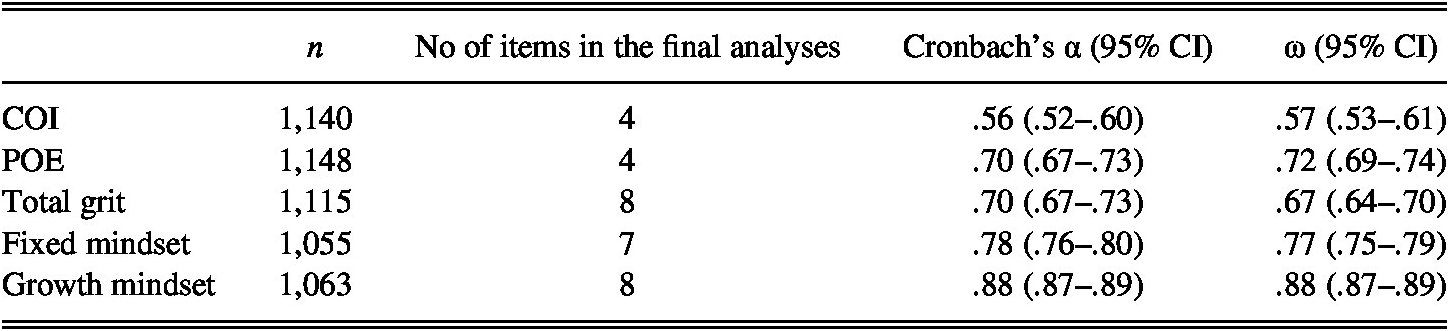
Data were gathered using a paper-based questionnaire measuring language mindset and grit. All items were assessed on a six-point Likert type scale ranging from 1 (strongly disagree) to 6 (strongly agree). Students were asked to write their student ID numbers so that we could access their final grades at the end of the semester. They were informed that both participation and writing their ID numbers were voluntary. Their final grades were considered as measure of L2 achievement. As the original scales were in English, we translated them into Persian. Then the Persian items were back-translated into English by an expert in translation. After that, the original English items and the back-translated items were compared and examined and the final Persian translation was prepared. Subsequently, the Persian scales with items in a random order were piloted with 15 university students who were taking a general English course. They were asked to read the items and to comment on the ambiguous ones. Based on this, some modifications were applied on wording (all items can be seen in online supplementary materials, Part A). Finally, the questionnaire was administered during regular classroom hours and took about 15 minutes to be completed. For all scales, we used Cronbach’s α to assess internal consistency and omega (ω) to assess composite reliability (Geldhof et al., Reference Geldhof, Preacher and Zyphur2014). Omega can be used as a measure of reliability when assumptions of essential tau-equivalence are not met. Reliability of the scales can be seen in Table 1.
Reliability estimates of the variables

Note. COI = consistency of interest, POE = perseverance of effort, CI = confidence interval.
Language Mindset
For language mindset, we used Lou and Noels’s (Reference Lou and Noels2017a) language mindset inventory. This scale includes 18 items in a way that nine items measure growth language mindset (e.g., “You can always substantially change your language intelligence”), and nine items measure fixed language mindset (e.g., “It is difficult to change how good you are at foreign languages”).
Grit
We used short grit scale (Grit-S) developed by Duckworth and Quinn (Reference Duckworth and Quinn2009). It includes eight items as four items measure POE (e.g., “Setbacks don’t discourage me”) and four items measure COI (e.g., “New ideas and projects sometimes distract me from previous one”). The four items of COI were reverse-coded so that a larger value shows higher COI.
L2 Achievement
To assess students’ L2 achievement, their final grades at the end of the semester were obtained. They had to take a test that included different measures of reading comprehension, grammar, vocabulary, and pronunciation. In the Iranian educational system, grades range from 0 to 20, with 20 being the maximum possible score. To pass a course, they should get the minimum grade of 10. The reason we selected course grades as measure of L2 achievement was that course grades have been reported to be more closely related to motivational and personality factors than standardized tests (Arens et al., Reference Arens, Morin and Watermann2015), and it is common to use them in L2 research (see Brown et al., Reference Brown, Plonsky and Teimouri2018 for a review).
DATA ANALYSIS
We analyzed the data with Mplus 7.4 using robust maximum likelihood estimator (MLR). First, assumptions of conducting confirmatory factor analysis (CFA), SEM, and independent-samples t-tests were checked (see online supplementary materials Part B). Missing data were handled using full information maximum likelihood (FIML). As data were gathered from 43 different classes, we checked intraclass correlation (ICC) values to examine clustering effect. ICC indicates to what extent students within a class are similar to each other, and ICC values close to or more than .10 (Hox, Reference Hox2010) show dependency in the data, which violates the assumption of independence of observation (see Khajavy et al., Reference Khajavy, MacIntyre and Barabadi2018). In this study, the ICC values ranged from .01 to .028, showing little between class variance in the variables. Therefore, we decided not to use multilevel modeling due to little-between class variance. However, as even very little ICC values might affect standard errors and lead to Type I error, we used “type = complex” option in Mplus to control for possible effect of nestedness in CFA and SEM models. To test the model fit, we used goodness-of-fit indices including comparative fit index (CFI), Tucker–Lewis index (TLI), root mean square error of approximation (RMSEA), and standardized root mean square residual (SRMR). For a fit model, CFI and TLI ≥ .90 and ≥ .95, and RMSEA and SRMR ≤ .08 and ≤ .05, represent adequate and excellent fit indices, respectively (Hu & Bentler, Reference Hu and Bentler1999; Marsh et al., Reference Marsh, Hau and Wen2004). Effect sizes were also calculated and reported for (a) correlations r = .25, r = .40, r = .60; (b) t-tests Cohen’s d = .40, Cohen’s d = .70, Cohen’s d = 1.00; and (c) SEM Cohen’s f 2 = .02, Cohen’s f 2 = .15, Cohen’s f 2 = .35, representing small, medium, and large effect sizes, respectively (Cohen, Reference Cohen1992; Plonsky & Oswald, Reference Plonsky and Oswald2014). Finally, as we were interested in comparing males and females regarding their grit and language mindset, we had to check whether males and females had the same perceptions of the items and underlying factors using measurement invariance testing. Results of measurement invariance testing indicated that males and females interpreted the items and constructs in the same way (see online supplementary materials, Part B).
RESULTS
FACTOR STRUCTURE OF THE SCALES
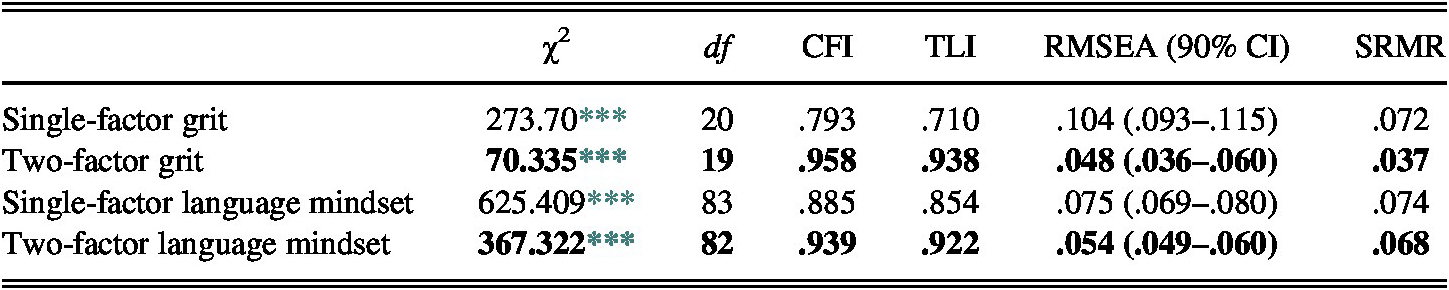
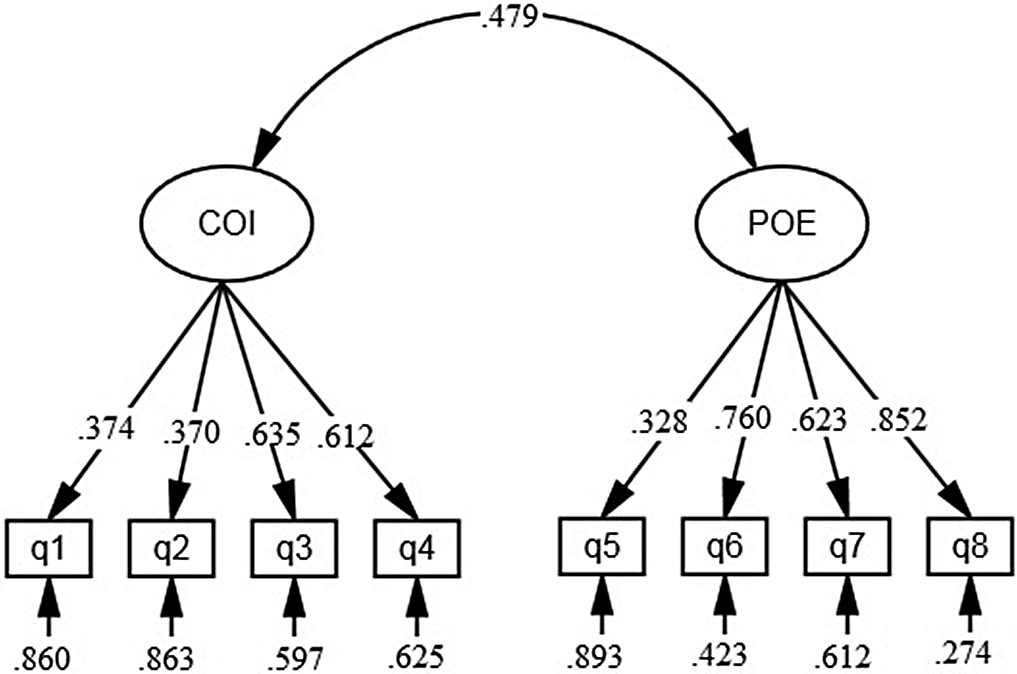
To examine the factor structure of the constructs, CFA was run. First, we tested two different models of grit, a single-factor model and a two-correlated factor model based on COI and POE. As Table 2 indicates, all goodness-of-fit indices showed better fit for the two-factor model. Moreover, a Satorra–Bentler chi-squared difference test (∆χ2/∆df) was run to compare the two models. Results of the test was significant (p < .001) confirming the superiority of two-factor model over single-factor model. Factor loadings can be seen in Figure 1.
Goodness-of-fit indices for the CFA models

*** p < .001.
Two-correlated factor model of grit with standardized coefficients (n = 1,115).
Note. COI = consistency of interest, POE = perseverance of effort.

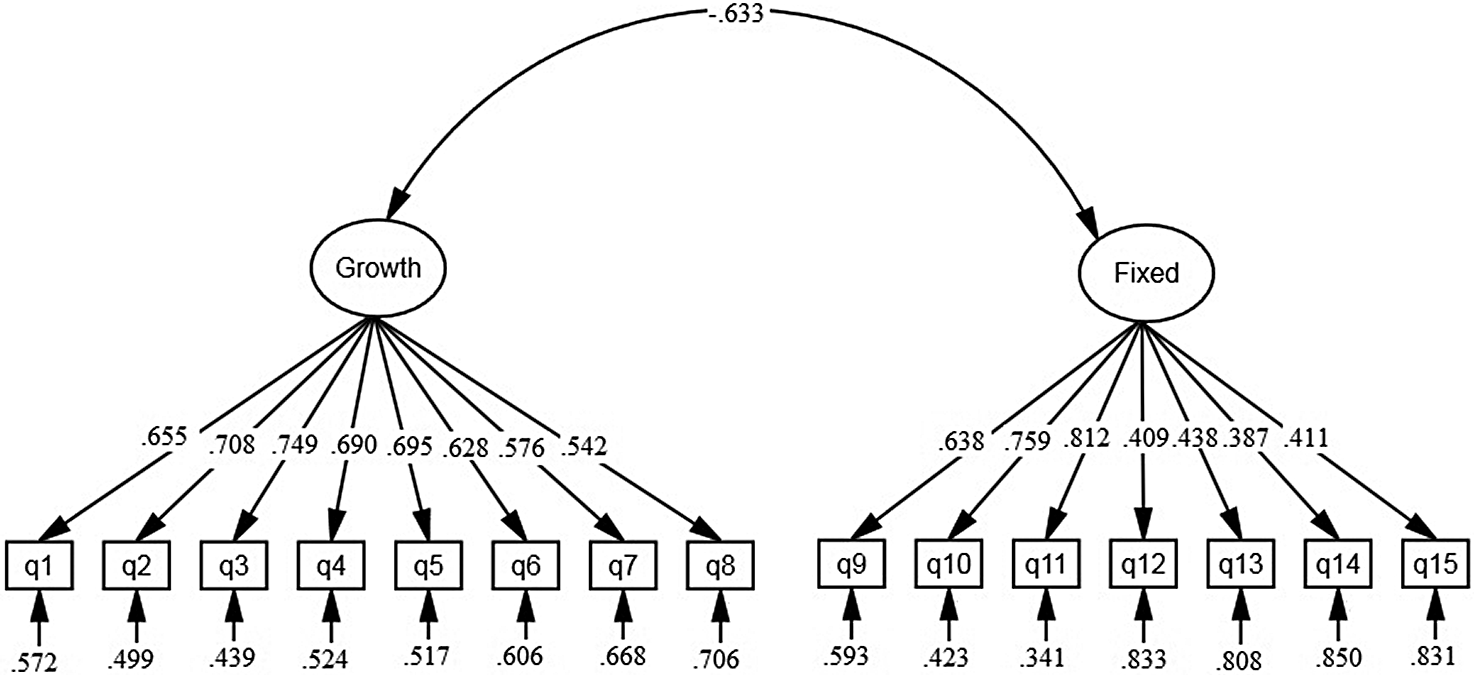
Furthermore, a single-factor model and a two-factor model of language mindset based on fixed and growth mindsets were tested. Three items showed very low factor loadings (two items of fixed subscale = .072 and .154, and one item of growth subscale = .099) and were removed from further analyses. Goodness-of-fit indices indicated a better fit for the two-factor model of language mindset. Moreover, results of Satorra–Bentler chi-squared difference test was significant (p < .001) confirming the superiority of two-factor model over single-factor model of language mindset. Factor loadings can be seen in Figure 2.
Two-correlated factor model of language mindset with standardized coefficients (n = 1,025).

DESCRIPTIVE STATISTICS AND CORRELATIONS
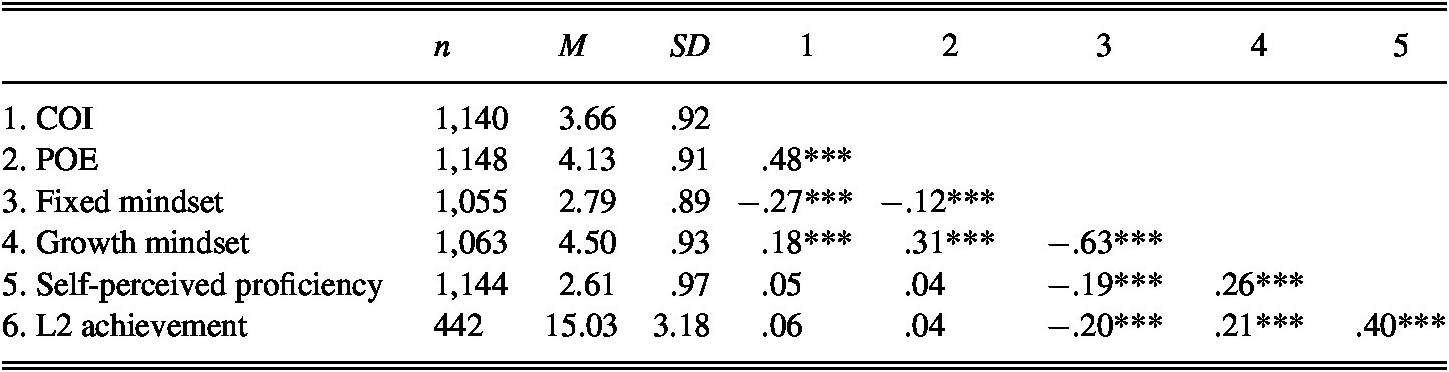
Descriptive statistics and latent correlations can be seen in Table 3. Students’ perceptions of grit showed that POE was rated higher than COI t (1114) = 15.10, p < .001, Cohen’s d = .45. Concerning students’ perceptions of language mindset, they rated growth mindset higher than fixed mindset t(1032) = 34.64, p < .001, Cohen’s d = 1.07.
Descriptive statistics and latent correlations among variables

Note. COI = consistency of interest, POE = perseverance of effort.
*** p < .001.
Both COI and POE were positively correlated with growth (r COI = .18, p < .001; r POE = .31, p < .001) and negatively correlated with fixed mindsets (r COI = −.27, p < .001; r POE = −.12, p < .001). Moreover, none of the grit factors were significantly correlated with L2 achievement and self-perceived language proficiency. For language mindset, growth mindset was positively correlated with L2 achievement (r = .21, p < .001) and self-perceived language proficiency (r = .26, p < .001), while fixed mindset was negatively correlated with L2 achievement (r = −.20, p < .001) and self-perceived language proficiency (r = −.19, p < .001).
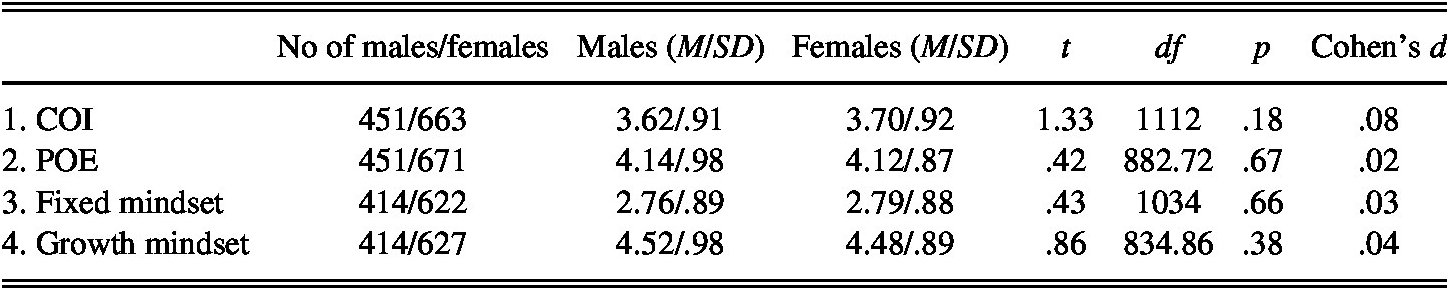
Then, the role of gender in grit and language mindset was examined. Results of independent-samples t-test indicated there was no statistically significant difference between males and females regarding their grit and language mindset (see Table 4).
Results of independent-samples t-test for males and females

Note. COI = consistency of interest, POE = perseverance of effort.
SEM MODELS
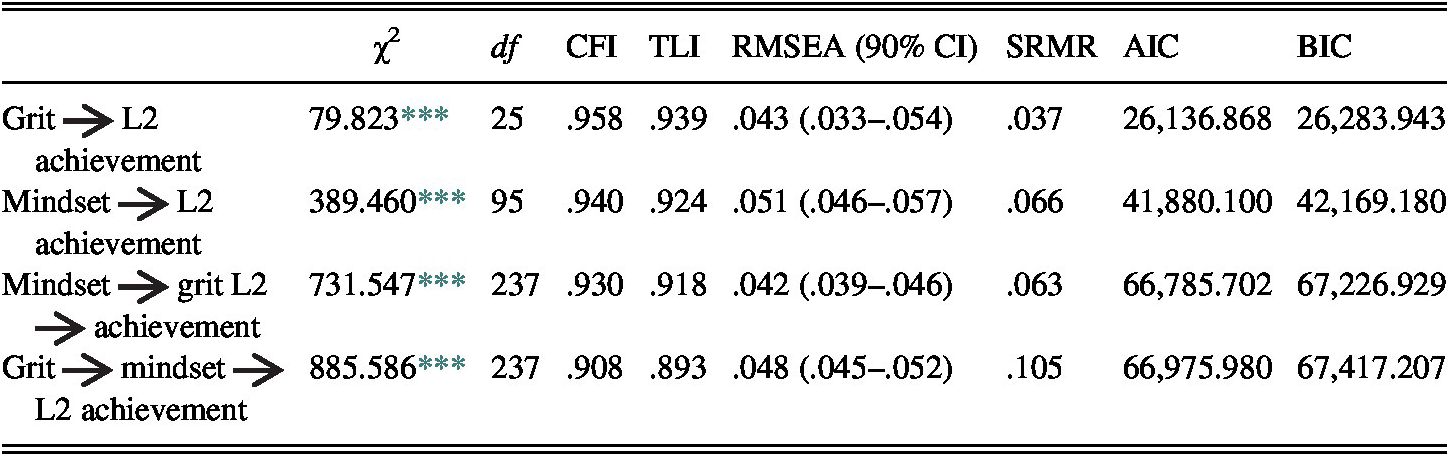
To examine the relations among language mindset, grit, and L2 achievement, we tested four different SEM models. In the first and second models, the unique role of grit and language mindset in L2 achievement was examined, respectively. To examine the joint contribution of grit and language mindset in L2 achievement, we tested two competing models (see Hiver & Al-Hoorie, Reference Hiver and Al‐Hoorie2020).
Grit as a Predictor of L2 Achievement
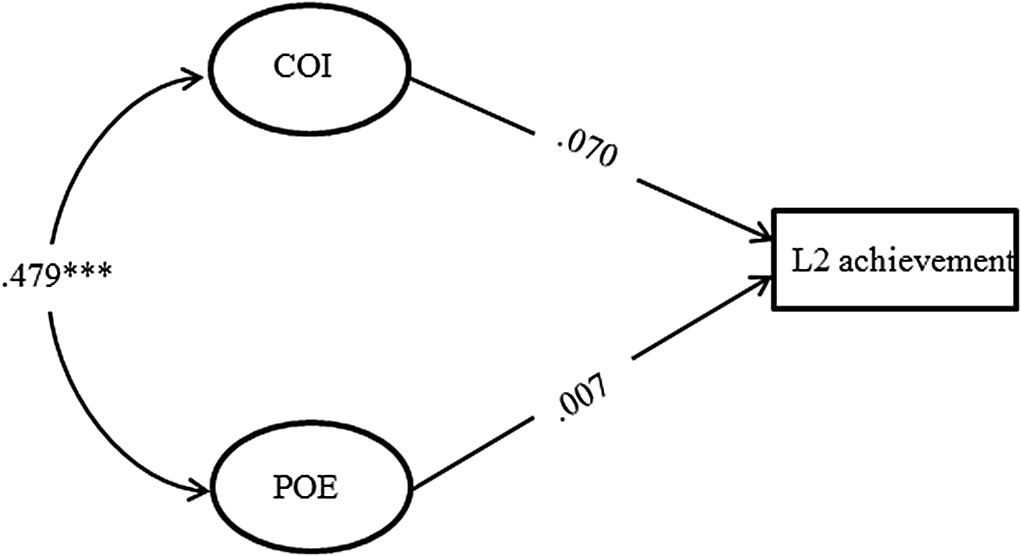
The first model examined the unique role of grit as a predictor of L2 achievement (Figure 3). Goodness-of-fit indices indicated that the model fitted the data adequately (see Table 5). As Figure 3 shows, neither POE (β = .007, p = .925, Cohen’s f 2 = .000) nor COI (β = .070, p = .349, Cohen’s f 2 = .000) could significantly predict L2 achievement. A positive correlation was found between POE and COI (r = .479, p < .001).
Grit subscales as predictors of L2 achievement with standardized coefficients (n = 411).
Note. COI = consistency of interest, POE = perseverance of effort.
*** p < .001.

Goodness-of-fit indices for the SEM models

*** p < .001.
Language Mindset as a Predictor of L2 Achievement
The second model examined the unique role of language mindset as a predictor of L2 achievement (Figure 4). Goodness-of-fit indices indicated that the model fitted the data adequately (see Table 5). As Figure 4 shows, growth mindset was a significant positive predictor of L2 achievement (β = .138, p = .021, Cohen’s f 2 = .156), while fixed mindset could not predict L2 achievement (β = −.111, p = .211, Cohen’s f 2 = .012). A negative correlation was found between fixed and growth mindsets (r = −.633, p < .001).
Language mindsets as predictors of L2 achievement with standardized coefficients (n = 386).
* p < .05, *** p < .001.

Competing Models: Language Mindset and Grit as Predictors of L2 Achievement
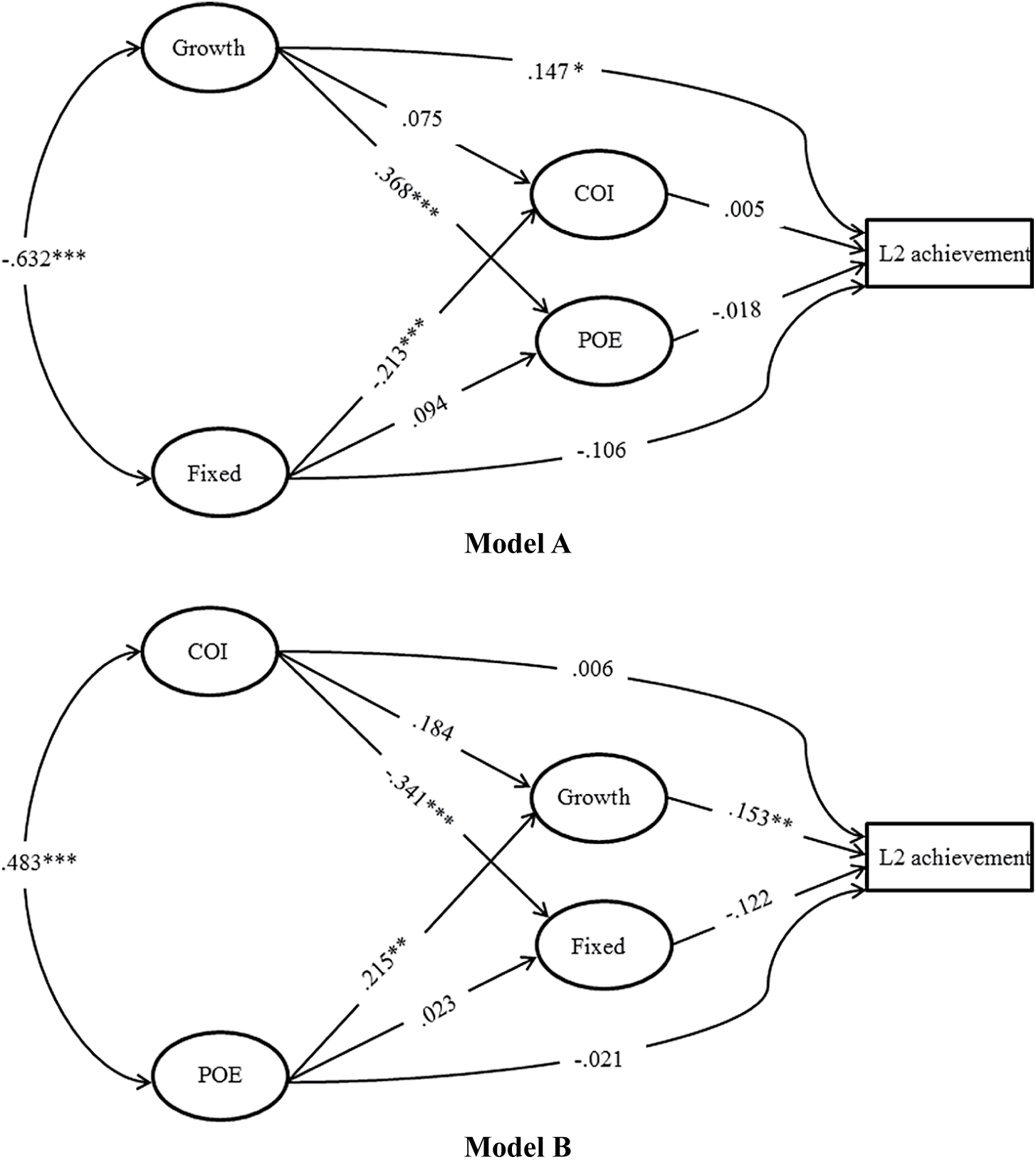
Two competing models were tested in which the simultaneous role of language mindset and grit in predicting L2 achievement was examined. In Model A, language mindsets predicted grit components and L2 achievement, while in Model B, grit components predicted language mindsets and L2 achievement. As Table 5 indicates, goodness-of-fit indices indicated better fit for Model A. In addition, we checked the Akaike information criterion (AIC) and the Bayesian information criterion (BIC), which are used for model comparison in SEM. Smaller values of AIC and BIC show a more optimal model. As can be seen in Table 5, smaller values of AIC and BIC are reported for Model A. Both goodness-of-fit indices and AIC and BIC values suggest that Model A is a more optimal model. Therefore, this model is reported to examine the relations between mindset, grit, and L2 achievement.
As Model A in Figure 5 indicates, growth mindset was positively related to POE (β = .368, p < .001, Cohen’s f 2 = .156) and fixed was negatively related to COI (β = −.213, p < .001, Cohen’s f 2 = .047). The paths from growth to COI (β = .075, p = .207, Cohen’s f 2 = .005) and fixed to POE (β = .094, p = .121, Cohen’s f 2 = .008) were not statistically significant. Moreover, neither POE (β = −.018, p = .796, Cohen’s f 2 = .000) nor COI (β = .005, p = .932, Cohen’s f 2 = .000) was significantly related to L2 achievement. Among the two aspects of the language mindset, growth language mindset was a positive predictor of L2 achievement (β = .147, p = .027, Cohen’s f 2 = .022), while fixed language mindset was not a significant predictor (β = −.106, p = .228, Cohen’s f 2 = .011).
Competing models of grit and language mindset as predictors of L2 achievement with standardized coefficients (n = 367).
Note. COI = consistency of interest, POE = perseverance of effort.
* p < .05, ** p < .01, *** p < .001.

DISCUSSION
The present study aimed at exploring two underresearched concepts in the field of SLA, namely grit and language mindset. There have been mixed findings regarding the role of grit in academic success and it has been found to have a modest relation with academic success (Credé et al., Reference Credé, Tynan and Harms2017). Moreover, based on some governmental agencies (e.g., the U.S. Department of Education, 2013), enhancing grit at schools as a way of improving academic success has been recommended. Consistent with grit, mindsets have modest relations with academic achievement (Burnette et al., Reference Burnette, O’Boyle, VanEpps, Pollack and Finkel2013). Given the attention that has been given to these constructs in education, they have not been much investigated in the field of SLA. Therefore, this study reported some preliminary findings about the contribution of these two factors within the domain of L2 learning.
Concerning the factor structure of grit, we tested two models including a single-factor model and a two-factor model based on POE and COI. Consistent with previous research (Muenks et al., Reference Muenks, Wigfield, Yang and O’Neal2017; Steinmayr et al., Reference Steinmayr, Weidinger and Wigfield2018), a two-factor model indicated a better fit. Furthermore, the correlation between POE and COI was moderate. These findings imply that the two factors of grit should be examined separately and a total grit score would not be appropriate for analyses, as we would lose important information that can be obtained from the subscales. Teimouri et al. (Reference Teimouri, Plonsky and Tabandeh2020) also found a two-factor solution for L2 grit scale, which further supports the multidimensionality of grit.
Furthermore, for language mindset, we compared a single-factor model and a two-factor model based on fixed and growth mindsets, and the two-factor model fitted the data better than the single-factor model. Although some researchers use just one aspect (either fixed or growth) to examine mindset both in education (e.g., Blackwell et al., Reference Blackwell, Trzesniewski and Dweck2007) and SLA studies (e.g., Lou & Noels, Reference Lou and Noels2017a), we believe that they should be examined separately as people can have both beliefs simultaneously and they are not two ends of a continuum (see Bodill & Roberts, Reference Bodill and Roberts2013; Lüftenegger & Chen, Reference Lüftenegger and Chen2017; Mercer & Ryan, Reference Mercer and Ryan2009). This can also be confirmed based on the moderate correlation obtained between growth and fixed language mindsets in previous research and in this study. This finding is also in line with Mercer and Ryan’s (Reference Mercer and Ryan2009) qualitative study where they found that individuals’ language mindset cannot be easily categorized as either growth or fixed, but a combination of both could exist within an individual. They state that:
Even within one domain such as FLL [foreign language learning], mindsets may be best considered as lying on a continuum. At either extreme would be learners who hold either a strong fixed or strong growth mindset, but most individuals are likely to fall somewhere in between. (Mercer & Ryan, Reference Mercer and Ryan2009, p. 438)
In our study, POE had higher mean than COI, consistent with previous research in education (Muenks et al., Reference Muenks, Wigfield, Yang and O’Neal2017; Wolters & Hussain, Reference Wolters and Hussain2015) and SLA research (Feng & Papi, Reference Feng and Papi2020). Moreover, students’ endorsement of growth mindset was higher than fixed mindset meaning that most students believed that language learning intelligence is not fixed and can be improved. This finding also confirmed previous research (e.g., Diseth et al., Reference Diseth, Meland and Breidablik2014; Molden & Dweck, Reference Molden and Dweck2006) and can be linked to social desirability of growth items as ideas that support positive concepts such as effort are more endorsed by participants (Abd-El-Fattah & Yates, Reference Abd-El-Fattah and Yates2006). It is interesting that Teimouri et al. (Reference Teimouri, Plonsky and Tabandeh2020) reported higher mean for POE in general grit scale, but higher mean for COI in L2-specific grit scale. This could imply that the nature of general and L2-specific grit constructs is different.
Gender differences were not found for either of grit subscales in this study. Findings of the previous studies regarding gender differences in grit are not conclusive. Although some of the previous studies have reported that females are grittier than males (Christensen & Gerald, Reference Christensen and Gerald2014; Usher et al., Reference Usher, Li, Butz and Rojas2019), other studies, similar to our study, found no significant differences between them (e.g., Akos & Kretchmar, Reference Akos and Kretchmar2017; Hodge et al., Reference Hodge, Wright and Bennett2018). Hodge et al. (Reference Hodge, Wright and Bennett2018) explain that gender differences in grit were found in studies that had school participants, while these differences were not observed in studies with university students. Therefore, it is possible that gender differences might not be prevalent at the university level. Furthermore, no gender differences were found for growth and fixed language mindsets. Although previous research has reported mixed findings, many studies have reported no differences between males and females’ general mindsets (e.g., Bodill & Roberts, Reference Bodill and Roberts2013; Cury et al., Reference Cury, Elliot, Da Fonseca and Moller2006, Reference Cury, Da Fonseca, Zahn and Elliot2008; Tarbetsky et al., Reference Tarbetsky, Collie and Martin2016) and language mindsets (Lou & Noels, Reference Lou and Noels2017b). Moreover, as language mindset is a newly developed concept in the field of language learning, more systematic research in different contexts is needed to answer this question.
Results of SEM analysis indicated that growth mindset was positively and moderately related to POE, which was consistent with previous research (e.g., Karlen et al., Reference Karlen, Suter, Hirt and Merki2019; Tang et al., Reference Tang, Wang, Guo and Salmela-Aro2019; Teimouri et al., Reference Teimouri, Plonsky and Tabandeh2020; West et al., Reference West, Kraft, Finn, Martin, Duckworth, Gabrieli and Gabrieli2016). Belief in malleable and changeable nature of language learning ability was related to higher effort among the students. One of the characteristics of the individuals with a growth mindset in general is that they attribute their failure to their own lack of effort. Therefore, they might be inspired to work harder to improve their skills and to achieve their goals (Butler, Reference Butler2000; Rattan et al., Reference Rattan, Savani, Chugh and Dweck2015). The same implication can be inferred in the L2 context as individuals who hold growth views of language learning work harder and are resilient to setbacks to improve their language ability. This finding is consistent with Dweck et al.’s (Reference Dweck, Walton and Cohen2014) claim that students with a growth mindset might be grittier in their academic work.
Results also indicated that fixed mindset is negatively and weakly related to COI. Students who believed that they could not improve their language learning skills did not remain interested in achieving their goals. This finding is consistent with very few previous studies that reported a negative relation between fixed mindset and grit in education (Ingebrigtsen, Reference Ingebrigtsen2018) and SLA (Teimouri et al., Reference Teimouri, Plonsky and Tabandeh2020) contexts. Moreover, no significant relation was found between fixed mindset and POE in SEM analysis. This implies that when fixed and growth mindsets are simultaneously entered into a model predicting POE, the predictive power of growth mindset is stronger than that of the fixed mindset.
In our SEM models, we also examined the predictability of L2 achievement based on unique and joint contribution of language mindset and grit factors. Results of SEM for examining both the unique and joint role of language mindset in L2 achievement indicated that among fixed and growth mindsets, only growth mindset was a weak positive predictor of L2 achievement. The data showed that students who believed that language learning ability can be improved by effort gained higher scores in their final exam. Prior research found that individuals with a growth mindset have a better achievement due to endorsement of challenging tasks (Dweck & Leggett, Reference Dweck and Leggett1988), their focus on mastery goals, and using mastery-oriented strategies (Blackwell et al., Reference Blackwell, Trzesniewski and Dweck2007; Lou & Noels, Reference Lou and Noels2017a). Individuals who have growth and fixed language mindsets might have different reactions to failure and lack of success, and this can be a reason for altering their resulting performance in L2 learning. Individuals with a growth mindset can manage their L2 learning and believe that mistakes are part of L2 learning, and make more effort while facing failure. Individuals with a fixed language mindset, however, avoid challenges as they believe they cannot control setbacks, experience more anxiety and depression, and consider failure as a threat to their identity. Findings of the current study are consistent with those of the previous studies that found that growth mindset is a significant predictor of achievement. This positive relation has been found both in correlational (Cury et al., Reference Cury, Elliot, Da Fonseca and Moller2006, Reference Cury, Da Fonseca, Zahn and Elliot2008; Tarbetsky et al., Reference Tarbetsky, Collie and Martin2016) and intervention studies (Blackwell et al., Reference Blackwell, Trzesniewski and Dweck2007; Lou & Noels, Reference Lou and Noels2016). Moreover, the magnitude of the relationship found between growth mindset and L2 achievement in this study is the same as two meta-analytic studies that reported a small effect of growth mindset on academic achievement (Burnette et al., Reference Burnette, O’Boyle, VanEpps, Pollack and Finkel2013; Sisk et al., Reference Sisk, Burgoyne, Sun, Butler and Macnamara2018). One point that is worth mentioning is that most of the previous studies used either fixed or growth mindset when examining their relation with achievement (e.g., Blackwell et al., Reference Blackwell, Trzesniewski and Dweck2007; Dweck & Leggett, Reference Dweck and Leggett1988; Mouratidis et al., Reference Mouratidis, Michou and Vassiou2017; Tarbetsky et al., Reference Tarbetsky, Collie and Martin2016). One exception is Cury et al. (Reference Cury, Elliot, Da Fonseca and Moller2006), who investigated the two factors separately and found that growth mindset was a positive and fixed mindset a negative predictor of achievement. Therefore, the relative contribution of each factor to achievement has not been examined thoroughly and more research is needed to investigate the unique contribution of each theory in L2 achievement for future research.
Concerning the relation between grit components and L2 achievement, we found no significant relation either in correlations or in SEM analyses. Previous research has also found mixed findings regarding the relation between grit and academic achievement. While several studies have found a significant positive relation between grit (especially the POE subscale) and achievement in education (e.g., Duckworth & Quinn, Reference Duckworth and Quinn2009; Luthans et al., Reference Luthans, Luthans and Chaffin2018; Park et al., Reference Park, Yu, Baelen, Tsukayama and Duckworth2018) and in SLA studies (Teimouri et al., Reference Teimouri, Plonsky and Tabandeh2020; Wei et al., Reference Wei, Gao and Wang2019), there are other studies that failed to find such a significant positive relationship (Bazelais et al., Reference Bazelais, Lemay and Doleck2016; Ivcevic & Brackett, Reference Ivcevic and Brackett2014; West et al., Reference West, Kraft, Finn, Martin, Duckworth, Gabrieli and Gabrieli2016) or reported low, negative, and nonsignificant relations (Usher et al., Reference Usher, Li, Butz and Rojas2019). Moreover, based on the results of a recent meta-analysis by Credé et al. (Reference Credé, Tynan and Harms2017), the relation between overall grit and academic achievement was found to be modest (r = .18).
Considering the findings of our study, there are at least three reasons for finding no significant relation between grit and L2 achievement. First, based on Credé et al. (Reference Credé, Tynan and Harms2017), the relation between grit-performance might be moderated by the nature of performance domain. This means being gritty would be effective when the task is difficult and well defined. Therefore, grit does not function well for easy and ill-defined tasks. Considering this, a measure of perceived task difficulty could be used to control its effect on grit-performance relationship. Second, the lack of grit-performance significant relation might be due to the general-domain measurement of grit in this study. It is very probable that grit varies among different goals. For example, a student might be more interested in a specific subject in university and put more effort to learn it than other subjects. Therefore, general domain constructs might not accurately measure and predict specific behaviors (Schmidt et al., Reference Schmidt, Fleckenstein, Retelsdorf, Eskreis-Winkler and Möller2019; Wigfield, Reference Wigfield1997). For this reason, Schmidt et al. (Reference Schmidt, Fleckenstein, Retelsdorf, Eskreis-Winkler and Möller2019) developed a domain-specific grit scale in the educational context and found that the school-specific scale was more closely related to academic achievement than domain-general grit. Applied in the SLA context, Teimouri et al. (Reference Teimouri, Plonsky and Tabandeh2020) developed an L2-specific grit scale and, consistent with Schmidt et al. (Reference Schmidt, Fleckenstein, Retelsdorf, Eskreis-Winkler and Möller2019), found that while domain-general grit was uncorrelated or had weak correlations with L2 achievement measures, the relations between L2-specific grit scale and L2 achievement measures were all significant and higher than general grit scale. Similar findings were reported in Sudina and Plonsky’s (Reference Sudina and Plonsky2020) study. Third, lack of grit-performance relation in this study might be due to the short-term duration of a general English course during a semester. As the definition of grit explicitly states, it refers to effort and interest for “long-term goals.” Therefore, grit should work better for long-term goals, not a goal that takes only for a semester. It might be possible that grit works for those language learners who want to master English language professionally and speak English like a native speaker not for passing a course during one semester in university.
Pedagogical Implications and Suggestions for Future Research
Results of this study provide some pedagogical implications for L2 teachers. Regarding the positive effect of growth mindset on L2 achievement, we believe that interventions and programs that are designed to increase growth mindset can be used in the language classrooms. Previous studies have shown the effective role of interventions in increasing growth mindset (e.g., Aronson et al., Reference Aronson, Fried and Good2002; Blackwell et al., Reference Blackwell, Trzesniewski and Dweck2007; Yeager et al., Reference Yeager, Trzesniewski and Dweck2013). Without taking too much time of the classroom, teachers can use some techniques and strategies to improve growth mindset. First, teachers can praise effort rather than ability when students successfully perform a task in the language classroom. For example, a sentence such as “you are very intelligent in learning English” would more likely foster fixed mindset, while this sentence “your English speaking is very good because you have tried very hard to learn English” would tend to foster growth mindset. Second, teachers could provide examples of successful language learners whose success in language learning was due to their hard work for mastery of L2 (Mouratidis et al., Reference Mouratidis, Michou and Vassiou2017). However, it should be kept in mind that this cannot be implemented in the language classrooms unless teachers believe that language aptitude is a malleable process and not a fixed one, and therefore, it can be improved by practice and effort (see Lou & Noels, Reference Lou and Noels2016). Third, growth mindset could be improved by conducting more formal workshops and interventions (Blackwell et al., Reference Blackwell, Trzesniewski and Dweck2007). Applying Blackwell et al.’s (Reference Blackwell, Trzesniewski and Dweck2007) intervention in language learning context, trainers can talk about the structure of brain and how it works when one is learning a second language, reading materials that emphasize the role of language learning and its effect on brain, antistereotyping strategies such as demystifying the negative role of age or even L1 background in language learning, and holding discussions to talk and discuss in groups or whole class about the fact that language learning can make brain bigger and stronger like a muscle. Finally, growth mindset can also be taught through online programs such as Brainology, which is a blended learning curriculum designed to promote growth mindset.
Before concluding, several limitations of this study should be noted and suggestions for further research are provided. First, we relied on just final-term grades to measure students’ L2 achievement. Although using course grades as a measure of L2 achievement is a very common practice in SLA research, it has been criticized for validity issues (see Brown et al., Reference Brown, Plonsky and Teimouri2018 for a review). Therefore, using standardized tests of foreign language achievement can give us a more consistent measure of students’ L2 achievement. Second, as mentioned in the preceding text, grit has been mostly assessed on a general-domain level (see exceptions such as Schmidt et al., Reference Schmidt, Fleckenstein, Retelsdorf, Eskreis-Winkler and Möller2019; Teimouri et al., Reference Teimouri, Plonsky and Tabandeh2020). Therefore, future research can use both specific- and general-domain grit scales in a single study to clarify the nature of grit. Like self-efficacy and self-concept, grit might be best measured with regard to a specific academic subject, or even skills within a subject (e.g., speaking, reading, writing, and listening). Third, the internal consistency of the COI subscale of grit was found to be low and this can affect the inferences made for this variable. One reason for this might be due to the fact that although we piloted the scales before the main data gathering, we did not calculate the reliability for the pilot data. In addition, we found a moderate correlation between students’ final grades and their self-perceived proficiency (r = .40). We believe that the reason for this moderate correlation might be that the nature of students’ final grades is different from that of their self-perceived proficiency (see Brown et al., Reference Brown, Plonsky and Teimouri2018). Students’ final grades are based on their performance in the classroom during a semester as well as in the final exam. Moreover, the L2 achievement test included just some aspects of L2 proficiency not all of them (e.g., listening and speaking were not included in the final exam). Fourth, we used only self-report questionnaires to assess grit and language mindset. Future research can benefit from qualitative methods such as interviews to explore these concepts. Finally, the results of this research are only generalizable to the participants of this study and further research is needed to confirm the findings of this research.
CONCLUSION
The purpose of the present study was to shed more light on the role of grit and language mindset in the second/foreign language learning. Results of the study showed that growth language mindset was related to higher POE, and fixed language mindset was associated with lower COI. Moreover, our findings indicated that language learners with a growth mindset who believed that learning a language can become more successful by more effort had a better L2 achievement at the end of the semester. Finally, we found no relation between grit subscales and L2 achievement. This implies that grit might be effective for long-term goals such as mastering a second/foreign language not just passing an L2 course during a semester. It seems for grit to be effective in language classrooms, it should be defined specifically for this context and any interventions that might be applied to improve grit should consider its L2 domain-specific nature.
Supplementary Materials
To view supplementary material for this article, please visit http://dx.doi.org/10.1017/S0272263120000480.