Introduction
Having an affected first-degree relative is the strongest determinant of risk for severe psychiatric disorders – including individuals with an affected family member with bipolar disorder (BD), who are estimated to be 5–10% more likely to develop this condition (Craddock & Sklar, Reference Craddock and Sklar2013). The study of young, genetically at-risk (AR) samples is therefore relevant to the validation of candidate intermediate (endo-) phenotypes, for which similar deficits should be present in a higher proportion of unaffected relatives than in the general population, although expected to be of lesser severity than those found in affected patients (Gottesman & Gould, Reference Gottesman and Gould2003).
Neuropsychological deficits have been implicated as candidate endophenotypes for BD following substantial evidence for impairments in working memory, executive functioning and attention (e.g. Martinez et al. Reference Martinez-Aran, Vieta, Reinares, Colom, Torrent, Sanchez-Moreno, Benabarre, Goikolea, Comes and Salamero2004; Frangou et al. Reference Frangou, Haldane, Roddy and Kumari2005; Langenecker et al. Reference Langenecker, Saunders, Kade, Ransom and McInnis2010; Levy & Weiss, Reference Levy and Weiss2010); these deficits are evident in the euthymic phases of illness, and in unaffected family members (e.g. Ferrier et al. Reference Ferrier, Chowdhury, Thompson, Watson and Young2004; Clark et al. Reference Clark, Kempton, Scarna, Grasby and Goodwin2005; Arts et al. Reference Arts, Jabben, Krabbendam and Van Os2008; Balanza-Martinez et al. Reference Balanza-Martinez, Rubio, Selva-Vera, Martinez-Aran, Sanchez-Moreno, Salazar-Fraile, Vieta and Tabares-Seisdedos2008), in partial fulfilment of criteria for endophenotype status (Gottesman & Gould, Reference Gottesman and Gould2003). However, evidence from both prospective longitudinal and cross-sectional studies of unaffected relatives of subjects with BD provides mixed evidence for cognitive deficits prior to the onset of illness. While a series of studies of unaffected relatives of BD patients has suggested that verbal learning, memory and working memory are among the most likely candidate cognitive endophenotypes for BD (Glahn et al. Reference Glahn, Bearden, Barguil, Barrett, Reichenberg, Bowden, Soares and Velligan2007; Arts et al. Reference Arts, Jabben, Krabbendam and Van Os2008; Balanza-Martinez et al. Reference Balanza-Martinez, Rubio, Selva-Vera, Martinez-Aran, Sanchez-Moreno, Salazar-Fraile, Vieta and Tabares-Seisdedos2008; Olvet et al. Reference Olvet, Burdick and Cornblatt2013), more general estimates of pre-morbid intellectual functioning typically are not impaired (Olvet et al. Reference Olvet, Burdick and Cornblatt2013; Trotta et al. Reference Trotta, Murray and MacCabe2014); notably, if only prospective studies are examined, no deficit in intelligence quotient (IQ) is evident (Trotta et al. Reference Trotta, Murray and MacCabe2014).
In addition to neuropsychological functioning, emotion processing and higher-order social cognitive impairments (such as face processing and theory of mind deficits) have been identified in BD irrespective of mood state (Olley et al. Reference Olley, Malhi, Bachelor, Cahill, Mitchell and Berk2005; Montag et al. Reference Montag, Elrich, Neuhaus, Dziobek, Heekeren, Heinz and Gallinat2010; Schenkel et al. Reference Schenkel, Chamberlain and Towne2014) and in a few studies of unaffected relatives of bipolar-I disorder (BD-I) patients (McClure et al. Reference McClure, Treland, Snow, Schmajuk, Dickstein, Towbin, Charney, Pine and Leibenluft2005; Brotman et al. Reference Brotman, Guyer, Lawson, Horsey, Rich, Dickstein, Pine and Leibenluft2008). There is also some evidence that social cognitive performance may be worse in BD-I relative to bipolar-II disorder (BD-II) (Schenkel et al. Reference Schenkel, Chamberlain and Towne2014). With regard to emotional inhibitory deficits, these have been reported as commonly mood-congruent in BD (e.g. Elliott et al. Reference Elliott, Ogilvie, Rubinsztein, Calderon, Dolan and Sahakian2004; Gopin et al. Reference Gopin, Burdick, DeRosse, Goldberg and Malhotra2011) and are also evident in unaffected relatives (Brand et al. Reference Brand, Goldberg, Gunawardane, Gopin, Powers, Malhotra and Burdick2012). Aberrant brain function during this process has also been demonstrated in BD (Wessa et al. Reference Wessa, Houenou, Paillere-Martinot, Berthoz, Artiges, Leboyer and Martinot2007) as well as in a subsample of the AR group being investigated in this current paper (Roberts et al. Reference Roberts, Green, Breakspear, McCormack, Frankland, Wright, Levy, Lenroot, Chan and Mitchell2013). However, the potential for emotional and social cognitive deficits to be endophenotypic markers of BD has not been extensively examined, and current evidence remains equivocal.
The aim of the present study was therefore to examine neuropsychological functioning in a sample of young people at high genetic risk for BD (i.e. those with at least one affected first-degree relative but who have not yet developed BD themselves), compared with healthy controls (HCs), and a group of participants with established BD. It was hypothesized that neurocognitive and social cognitive functioning would be impaired in BD patients (in particular, those with BD-I) and, to a lesser extent (in terms of domains affected and severity), young unaffected relatives of BD patients, compared with HCs.
Method
Participants
Participants included young people (aged 16–30 years) at high genetic risk for developing BD who had not yet developed BD themselves (AR, n = 99), young adults already diagnosed with BD (n = 52) and age-matched controls with no history of severe psychiatric illness (i.e. never diagnosed, hospitalized, or treated for a mood or psychotic disorder) during their own lifetime, or in a first-degree family member (HCs, n = 78). There were a total of 188 unique family groups represented in the sample. There were 87 participants from 73 families in the AR cohort, and 32 of the AR participants had at least one other sibling also in the AR cohort. The AR and established BD participants were recruited from an existing BD genetic family study (see Mitchell et al. Reference Mitchell, Frankland, Hadzi-Pavlovic, Roberts, Corry, Wright, Loo and Breakspear2011), a specialized BD research clinic (see Mitchell et al. Reference Mitchell, Johnston, Corry, Ball and Malhi2009), contact with clinicians of local area health services, mental health consumer organizations, and from the community via print and electronic media and noticeboards in universities and local communities. HC participants were recruited from the community using print and electronic media and noticeboards in universities and local communities. Exclusion criteria included not having spoken English as their first language, and history of neurological illness or significant head injury. Further details of this sample have been reported elsewhere (Perich et al. Reference Perich, Lau, Hadzi-Pavlovic, Roberts, Frankland, Wright, Green, Breakspear, Corry, Radlinska, McCormack, Joslyn, Levy, Lenroot, Nurnberger and Mitchell2015).
Materials
Clinical interviews
The Family Interview for Genetic Studies (FIGS) (Maxwell, Reference Maxwell1992) was administered to all participants at baseline entry to determine any family history of affective disorders, and was thus used here both as a screening tool for exclusion of potential control participants and to ascertain family history of psychiatric conditions (Maxwell, Reference Maxwell1992). Participants aged between 16 and 21 years were administered an adapted version of the Kiddie Schedule for Affective Disorders and Schizophrenia for School-Aged Children – Bipolar Disorder version (K-SADS-BP). The K-SADS-BP was developed specifically for use in the US–Australian collaborative study of young people at genetic risk for BD. It combines items from the K-SADS – Present and Lifetime version (K-SADS-PL; Kaufman et al. Reference Kaufman, Birmaher, Brent, Rao, Flynn, Moreci, Williamson and Ryan1997), and extends sections on depression, mania and attention-deficit/hyperactivity disorder (ADHD) derived from the Washington University in St Louis K-SADS (WASH-U-KSADS) to elicit detailed information on the presence of prepubertal mania, rapid cycling and ADHD (Geller et al. Reference Geller, Zimerman, Williams, Bolhofner, Craney, DelBello and Soutullo2001). It differs from the K-SADS-PL in that it identifies specific episodes and duration of each symptom assessed. For participants aged between 22 and 30 years and for parents or adult siblings of AR participants, the Diagnostic Interview for Genetic Studies (DIGS) version 4 (Nurnberger et al. Reference Nurnberger, Blehar, Kaufmann, York-Cooler, Simpson, Harkavy-Friedman, Severe, Malaspina and Reich1994) was administered. Similarly, parents of the HC participants completed the DIGS to confirm eligibility into the study. Consent forms to release medical records were posted to BD participants and BD probands.
Using the best estimate methodology (Leckman et al. Reference Leckman, Sholomskas, Thompson, Belanger and Weissman1982), lifetime diagnoses and age of onset were determined by the consensus of two independent raters (psychiatrists) who were blind to the family status of participants. This approach combined information from the DIGS version 4 (Nurnberger et al. Reference Nurnberger, Blehar, Kaufmann, York-Cooler, Simpson, Harkavy-Friedman, Severe, Malaspina and Reich1994) or the K-SADS-BP (Kaufman et al. Reference Kaufman, Birmaher, Brent, Rao, Flynn, Moreci, Williamson and Ryan1997; Nurnberger et al. Reference Nurnberger, McInnis, Reich, Kastelic, Wilcox, Glowinski, Mitchell, Fisher, Erpe, Gershon, Berrettini, Laite, Schweitzer, Rhoadarmer, Coleman, Cai, Azzouz, Liu, Kamali, Brucksch and Monahan2011), the FIGS (Maxwell, Reference Maxwell1992) and medical records (where available) in order to determine whether the participant met diagnostic criteria for a lifetime Diagnostic and Statistical Manual of Mental Disorders, 4th edition, text revision (DSM-IV-TR; American Psychiatric Association, 2000) diagnosis and its age of onset. For each diagnosis, the independent rater rated their diagnostic confidence based on a four-point scale [1 = diagnosis asserted without supporting symptoms; two possible; some criteria met (both informants) or all criteria met (one informant) with some supporting information; 3 = probably; all criteria met, no supporting documentation; 4 = definite; meets criteria and has supporting documentation]. For this paper, only diagnoses achieving a confidence level of 3 or 4 were considered.
Clinical symptom assessments
Current mood state was assessed by the researcher-administered Montgomery–Åsberg Depression Rating Scale (MADRS), Bipolar Depression Rating Scale (BDRS) and the Young Mania Rating Scale (YMRS). The Children's Depression Inventory (CDI) was administered to 16- to 18-year-old participants (Kovacs, Reference Kovacs1992).
Neuropsychological test battery
A comprehensive neuropsychological battery including the following domains of function was administered to all participants. Age-adjusted, normative Z-scores were used for between-groups analyses for each measure, unless otherwise stated.
General intellectual ability
General intellectual ability was assessed using the Wechsler Abbreviated Scale of Intelligence – two subtest version [WASI: including the vocabulary and matrix reasoning subtests of the Wechsler Adult Intelligence Scale (WAIS)] (Wechsler, Reference Wechsler1999).
Working memory
Working memory was assessed using two memory subtests (immediate and delayed) from the Repeatable Battery for the Assessment of Neuropsychological Status (RBANS; Randolph et al. Reference Randolph, Tierney, Mohr and Chase1998), as well as the digit span task and letter–number sequencing tasks from WAIS-III (Wechsler, Reference Wechsler1999). There were no age-appropriate norms available for the RBANS measures.
Visuospatial ability, attention and language
Visuospatial ability, attention and language were assessed using subscales from the RBANS (Randolph et al. Reference Randolph, Tierney, Mohr and Chase1998).
Executive functioning
Executive functioning was measured using two tests from the Cambridge Neuropsychological Test Automated Battery (CANTAB): the Intradimensional/Extradimensional (IED) Set Shift Task which measures attentional set-shifting; and the Stockings of Cambridge (SOC) task which measures planning ability, and is based on the Tower of London task.
Inhibition of emotional material
Inhibition of emotional material was assessed using the Affective Go-No-Go (AGN) task from the CANTAB, where errors of omission reflect a failure to respond to target words and more errors of commission reflect worse response inhibition. Individual trials alternate between using target words with a negative, positive or neutral valence. Trials are either ‘shift’ trials, in which the target valence is different to the previous trial, or ‘non-shift’, where the target valence is the same as in the previous trial. Shift trials are considered to be more difficult as they require participants’ attention to shift from one emotional valence to another. No age-appropriate normative data were available for the AGN task; raw scores were thus used for analysis of performance on this task.
Social cognition
Social cognition was assessed using the Ekman 60-Faces emotion recognition test from the ‘Facial Expressions of Emotion: Stimuli and Tests’ (FEEST; Young et al. Reference Young, Perrett, Calder, Sprengelmeyer and Ekman2002), and version A of The Awareness of Social Inference Test (TASIT; McDonald et al. Reference McDonald, Flanagan, Martin and Saunders2004). The Ekman 60-Faces task is a computerized task in which participants are presented with photographic images of faces displaying six basic emotions – happiness, sadness, surprise, fear, disgust or anger – and are required to identify the emotion being displayed. TASIT is a more complex measure of social cognition. Similar to the Ekman 60-Faces task, part one requires participants to identify the same six basic emotions; however, short video vignettes are presented rather than static images. Part two of TASIT presents 15 vignettes of interactions, and requires participants to interpret social cues beyond dialogue text to determine whether characters are sincere or insincere. The enriched subtest (TASIT part three) contains 16 vignettes, half of which feature a character that is lying to the main protagonist. In these cases, evidence the character is lying is presented through either subtle paralinguistic cues, or straightforward visual cues embedded in the scene.
Procedure
Participants completed the neuropsychological test battery individually in a laboratory setting. The battery took approximately 2 h to administer. Testing occurred as part of one full day of assessment for a longitudinal study, for which sample details have been reported previously (Perich et al. Reference Perich, Lau, Hadzi-Pavlovic, Roberts, Frankland, Wright, Green, Breakspear, Corry, Radlinska, McCormack, Joslyn, Levy, Lenroot, Nurnberger and Mitchell2015).
Statistical analyses
All statistical analyses were implemented in SPSS v21; the α level was set at p = 0.01 with consideration of the number of tests conducted. We used the generalized estimating equation method to test for difference between groups on neurocognitive and social cognitive measures, owing to the relatedness of some cases among the AR and BD groups; this procedure controls for clustering of outcomes that may occur when data points may not be independent, as is the case when several members (children or siblings of a BD proband) of a family are included. Seven participants in the AR group had a sibling proband in the BD group, and 46 participants in the AR group had at least one other AR sibling in the study. Two participants in the BD group were also related, as well as two HCs.
Ethical standards
The study was conducted with the approval of the University of New South Wales Human Research Ethics Committee (HREC protocol 09/104) and the South Eastern Sydney Illawarra Health Service HREC (protocol 09/097) in Sydney, Australia. Written informed consent from all participants was obtained for involvement in an ongoing longitudinal study; additional parental consent was obtained for participants under the age of 16 years. All procedures contributing to this work comply with the ethical standards of the relevant national and institutional committees on human experimentation and with the Helsinki Declaration of 1975, as revised in 2008.
Results
Participant characteristics
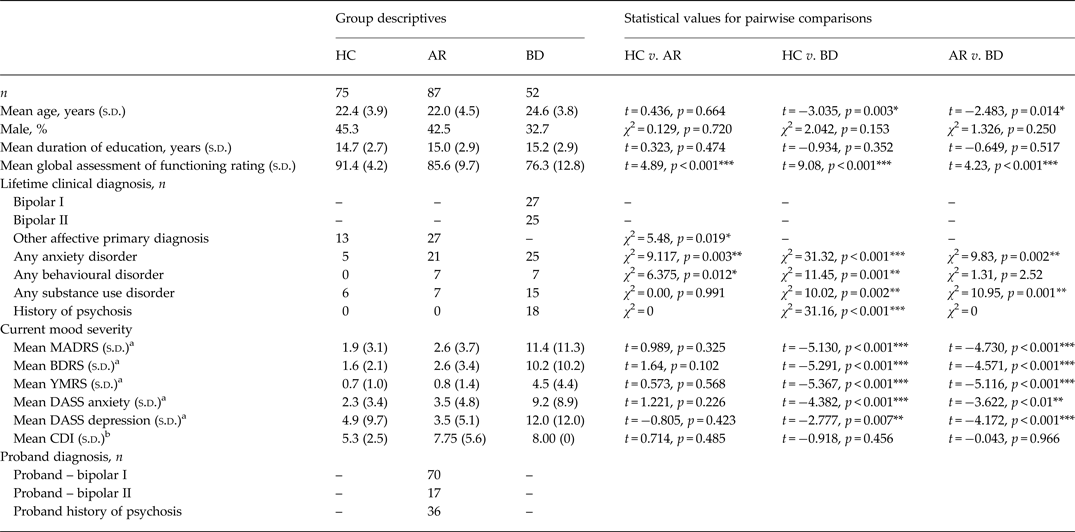
Demographic and clinical information for each group is provided in Table 1. The groups differed significantly in age (F 2,213 = 7.123, p = 0.001), with the BD group being older than both the AR (p = 0.003) and HC (p = 0.014) groups; age was thus entered as a covariate in any pairwise comparisons with the BD group. There were no group differences in sex distribution or education levels. Because the overarching inclusion/exclusion criteria for participants in the AR and HC groups were based on a family history of BD (or lack thereof), some participants met lifetime criteria for a major depressive disorder (34 AR and 16 HC; further details of the clinical status of these participants are described in Perich et al. Reference Perich, Lau, Hadzi-Pavlovic, Roberts, Frankland, Wright, Green, Breakspear, Corry, Radlinska, McCormack, Joslyn, Levy, Lenroot, Nurnberger and Mitchell2015). Three HC and 11 AR participants were removed from the analyses because they were taking prescribed psychoactive medications, and one AR participant experiencing a current major depressive episode was removed. Most of the AR participants had a proband with a BD-I diagnosis (n = 70, 80.5%), and 36 of these BD-I probands (51%) reported a definite lifetime history of psychosis.
Demographic characteristics and clinical diagnoses

HC, Healthy control; AR, at-risk; BD, bipolar disorder; s.d., standard deviation; MADRS, Montgomery–Åsberg Depression Rating Scale; BDRS, Bipolar Depression Rating Scale; YMRS, Young Mania Rating Scale; DASS, Depression Anxiety Stress Scale; CDI, Children's Depression Inventory.
a Participants aged 18 years and older.
b Participants aged under 18 years.
* p < 0.05, ** p < 0.01, *** p < 0.001.
Participants in the BD group were found to have significantly higher depressive, hypomanic and anxiety symptom severity scores than both HC and AR groups, as shown in Table 1. HC and AR groups did not differ from each other in terms of current mood severity on the MADRS, BDRS and/or YMRS; also there were no differences in depressive severity among AR and HC participants aged younger than 18 years, as measured with the CDI.
Psychiatric co-morbidities for each participant group are reported in Table 1. The BD group had higher rates of anxiety disorders and substance use disorders than both HC and AR groups, as well as higher rates of behavioural disorders compared with the HC but not the AR group. The AR group had higher rates of anxiety and behavioural disorders than the HC group. While 18 of the BD patients had experienced psychotic symptoms on at least one occasion, there was no history of psychotic symptoms in the HC or AR groups.
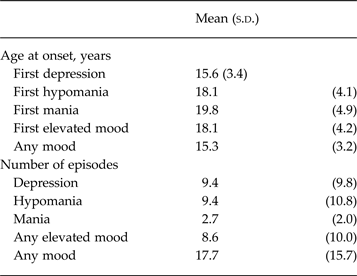
Of the BD participants, 27 were diagnosed with BD-I and 25 with BD-II; the majority were medicated (n = 35). Table 2 presents the mean age of onset, as well as the number of mood episodes for the BD group. The mean age of onset for any mood episode in the BD sample was 15.3 (s.d. = 3.2) years, and the mean total number of lifetime mood episodes of any type experienced by this group was 17.7 (s.d. = 15.7). Global assessment of functioning ratings were also significantly lower in BD relative to AR (t = 4.23, p < 0.001) and HC (t = 9.08, p < 0.001) groups, and AR participants had lower ratings than HCs (t = −4.89, p < 0.001).
History of mood episodes in the bipolar disorder group

s.d., Standard deviation.
Neurocognition
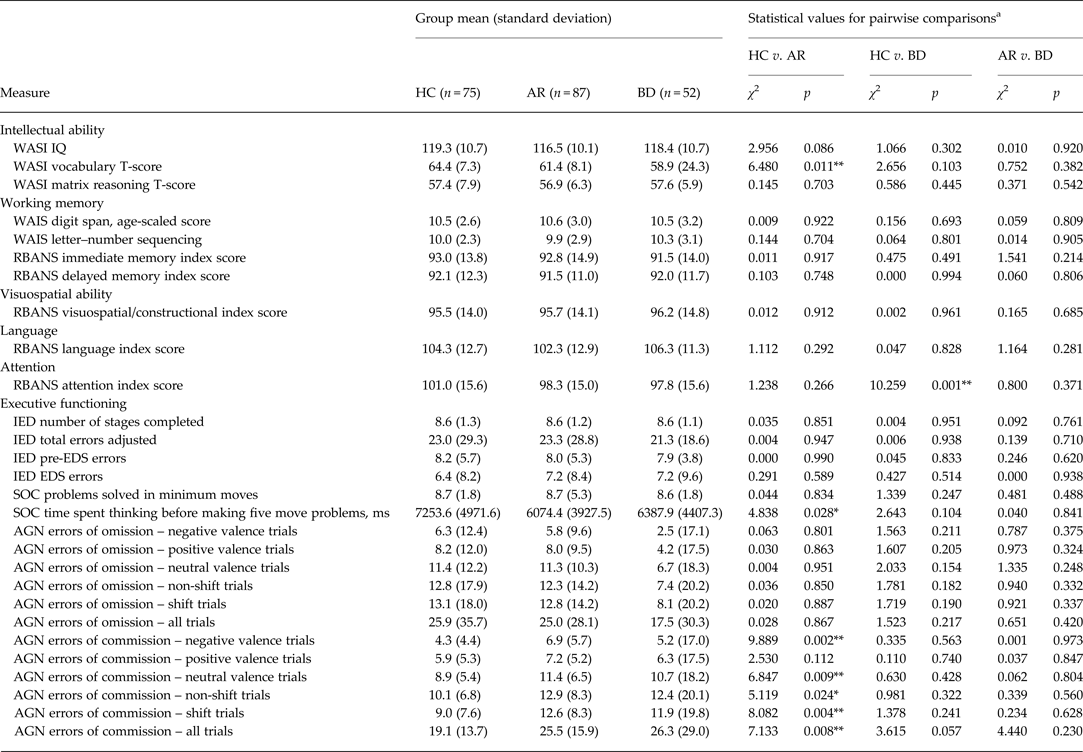
Group means and statistics for each neurocognitive domain are reported in Table 3.
Neuropsychological variables and pairwise comparisons for the HC, AR and BD groups

HC, Healthy control; AR, at-risk; BD, bipolar disorder; WASI, Wechsler Abbreviated Scale of Intelligence; IQ, intelligence quotient; WAIS, Wechsler Adult Intelligence Scale; RBANS, Repeated Battery for the Assessment of Neuropsychological Status; IED, Intradimensional/Extradimensional Set Shift Task; EDS, Extradimensional Shift; SOC, Stockings of Cambridge; AGN, Affective Go/No-Go Task.
a Pairwise comparisons used Z-scores as the dependent variable where available.
* p < 0.05, ** p < 0.01 (Wald χ 2 from generalized linear model).
Comparison of AR v. HC
The AR participants performed significantly worse than the HC group (p = 0.011) on the WASI vocabulary subtest and exhibited more errors of commission than HCs during all trials of the CANTAB AGN task when the stimuli were of negative or neutral target valence (p values ranging from 0.002 to 0.024); however, there were no differences between these groups in the capacity to inhibit stimuli of a positive target valence.
Comparison of BD v. AR and HC
The BD group was significantly impaired on the attention domain of the RBANS, relative to the HC group (p = 0.001). However, the BD patients showed no significant deficits in general intellectual functioning, working memory, visuospatial ability, language domains or executive function measures of planning (SOC) or attentional set-shifting (IED Set Shift Task), in comparison with the HC or AR participant groups.
Comparison of BD-I v. BD-II
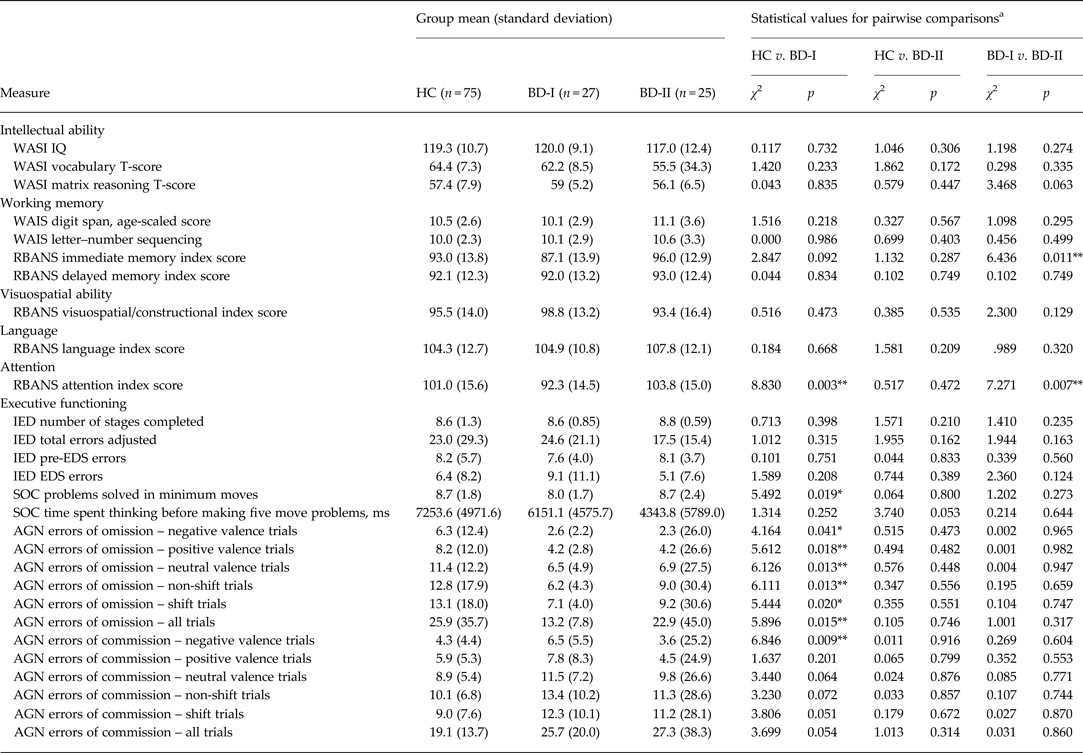
Post-hoc analyses were conducted to explore the possibility that cognitive deficits may be evident in BD-I participants, following the lack of deficits in the entire BD group. Mean scores on neurocognitive and social cognitive measures are presented separately for BD-I and BD-II participants in Table 4. The BD-I participants showed significantly impaired attention, relative to both BD-II (p = 0.007) and HC (p = 0.003) participants, and also showed significant deficits in immediate memory (p = 0.011), relative to HC subjects.
Neuropsychological variables and pairwise comparisons for the HC, BD-I and BD-II groups

HC, Healthy control; BD, bipolar disorder; WASI, Wechsler Abbreviated Scale of Intelligence; IQ, intelligence quotient; WAIS, Wechsler Adult Intelligence Scale; RBANS, Repeated Battery for the Assessment of Neuropsychological Status; IED, Intradimensional/Extradimensional Set Shift Task; EDS, Extradimensional Shift; SOC, Stockings of Cambridge; AGN, Affective Go/No-Go Task.
a Pairwise comparisons used Z-scores as the dependent variable where available.
* p < 0.05, ** p < 0.01 (Wald χ 2 from generalized linear model).
Cognitive functioning and psychosis history
We also examined the relevance of history of psychosis for cognitive performance of BD participants, and, in the case of AR participants, whether the affected proband had a history of psychosis, via comparison of cases with and without such psychosis history. There were no significant differences in cognitive function between BD participants with and without psychosis history, or between AR participants who had probands with a history of psychosis and those who did not.
Social cognition
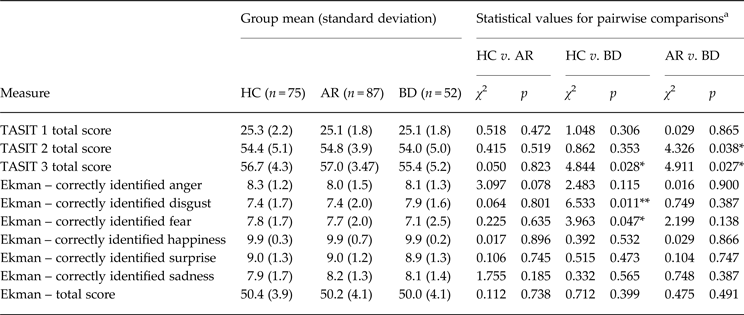
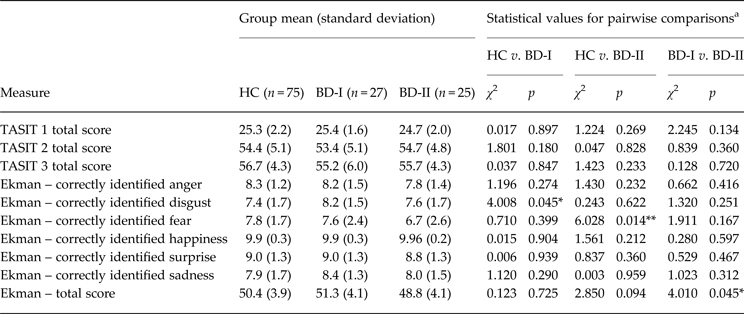
Group means and statistics for performance on the social cognition measures are reported in Table 5. The BD group demonstrated higher accuracy for recognition of disgust facial expressions on the Ekman task (p = 0.011), relative to HC participants. After correction for multiple testing, no other significant differences were found for BD patients compared with HCs on the Ekman or TASIT measures of social cognition; however, there was a trend toward a deficit in the recognition of fear faces in BD-II patients relative to HCs (p = 0.014; summarized in Table 6). BD participants with history of psychosis showed significantly greater deficits in the recognition of ‘sadness’ expressions on the Ekman task (mean = 7.89), relative to BD participants without psychosis history (mean = 9.37; χ 2 = 20.288, p < 0.001).
Social cognitive variables and pairwise comparisons for the HC, AR and BD groups

HC, Healthy control; AR, at-risk; BD, bipolar disorder; TASIT, The Awareness of Social Inference Test; Ekman, Ekman 60-Faces Task.
a Pairwise comparisons used Z-scores as the dependent variable where available.
* p < 0.05, ** p < 0.01 (Wald χ 2 from generalized linear model).
Social cognitive variables and pairwise comparisons for the HC, BD-I and BD-II groups

HC, Healthy control; BD, bipolar disorder; TASIT, The Awareness of Social Inference Test; Ekman, Ekman 60-Faces Task.
a Pairwise comparisons used Z-scores as the dependent variable where available.
* p < 0.05, ** p < 0.01 (Wald χ 2 from generalized linear model).
Illness features and neuropsychological functioning
There were no significant associations between illness duration, or the number of mood episodes, with any neuropsychological outcomes that were found to be impaired within the BD group (including the RBANS attention, TASIT mental state reasoning, or the number of correctly identified fearful or disgust facial expressions on the Ekman task). However, the total number of mood episodes was negatively associated with the number of correctly identified fearful facial expressions (r = −0.157, p = 0.025). While WASI vocabulary Z-scores did not differ between participant groups, there was a moderate negative correlation between WASI vocabulary Z-scores and the total number of mood episodes experienced (r = −0.347, p = 0.000), but not illness duration (r = −0.065, p = 0.456).
Discussion
This study examined neuropsychological and social cognitive functioning in young people (<30 years of age) at genetic risk for BD (i.e. with a first-degree relative with BD) compared with HC and established BD groups. Those at increased genetic risk for BD exhibited deficits in verbal ability and the inhibition of emotional material – particularly of negative valence, while the BD participants showed selective impairments on cognitive domains of attention and immediate memory.
While these results of selective cognitive impairments in our relatively young sample of BD patients are consistent with previous reports of deficits in attention and memory in BD and their unaffected relatives (e.g. Clark et al. Reference Clark, Kempton, Scarna, Grasby and Goodwin2005; Glahn et al. Reference Glahn, Bearden, Barguil, Barrett, Reichenberg, Bowden, Soares and Velligan2007; Arts et al. Reference Arts, Jabben, Krabbendam and Van Os2008; Balanza-Martinez et al. Reference Balanza-Martinez, Rubio, Selva-Vera, Martinez-Aran, Sanchez-Moreno, Salazar-Fraile, Vieta and Tabares-Seisdedos2008; Bora et al. Reference Bora, Vahip, Akdeniz, İlerisoy, Aldemir and Alkan2008; Levy & Weiss, Reference Levy and Weiss2010; Olvet et al. Reference Olvet, Burdick and Cornblatt2013), they differ with respect to the extent to which neuropsychological abilities are impaired; notably, we did not find evidence of these same cognitive impairments in the AR participant group. Instead, the AR participants showed deficits in verbal ability and affective inhibition. The notable exclusion of executive function and working memory deficits, emerging in recent literature as the most promising candidates for endophenotypic status in BD (Bora et al. Reference Bora, Yucel and Pantelis2009; Glahn et al. Reference Glahn, Bearden, Barguil, Barrett, Reichenberg, Bowden, Soares and Velligan2007; Arts et al. Reference Arts, Jabben, Krabbendam and Van Os2008; Balanza-Martinez et al. Reference Balanza-Martinez, Rubio, Selva-Vera, Martinez-Aran, Sanchez-Moreno, Salazar-Fraile, Vieta and Tabares-Seisdedos2008; Olvet et al. Reference Olvet, Burdick and Cornblatt2013), may be due to the younger age of the sample.
The present findings are largely consistent with a recent review (Olvet et al. Reference Olvet, Burdick and Cornblatt2013) which highlights little evidence of global intellectual impairment in people at familial risk of BD. There was neither strong support for the status of social cognitive abilities as endophenotypes for BD, despite some evidence for more severe impairments in the recognition of negative (sad) expressions in BD-I participants with a history of psychosis. This was found in the context of other, erroneous findings in the whole BD sample (enhanced recognition of disgust expressions).
Perhaps most interestingly, the finding of impaired inhibition in the context of an emotional go/no-go task in the AR group, in the negative and neutral, but not positive, valence conditions, is consistent with previous evidence of mood-congruent biases in the inhibition of emotional material in established BD (e.g. Elliott et al. Reference Elliott, Ogilvie, Rubinsztein, Calderon, Dolan and Sahakian2004; Gopin et al. Reference Gopin, Burdick, DeRosse, Goldberg and Malhotra2011) and AR samples (Brand et al. Reference Brand, Goldberg, Gunawardane, Gopin, Powers, Malhotra and Burdick2012). We note also that a subsample of the present AR group showed abnormal activation of the inferior frontal cortex during the inhibition of negative (fearful) stimuli during a facial emotion go/no-go task (Roberts et al. Reference Roberts, Green, Breakspear, McCormack, Frankland, Wright, Levy, Lenroot, Chan and Mitchell2013). The accumulating evidence thus suggests that emotion-related cognitive disturbances may be intermediate processes in the development of BD. Longitudinal follow-up of this sample is required to determine whether these deficits predict later development of disorder. It remains curious as to why the present BD sample showed no evidence of similar inhibitory deficits for negative (or neutral) stimuli on this task, and it is possible that the use of medication in this group may be assisting in the correction of any such affective-inhibitory bias.
In considering the implications of the present findings it is important to note the substantial variability in the severity of cognitive deficits among cases with established BD in the broader literature (Burdick et al. Reference Burdick, Russo, Frangou, Mahon, Braga, Shanahan and Malhotra2014) in relation to their potential utility as intermediate phenotypes. Recent cluster-analytic studies of cognitive deficits in large groups of BD subjects have revealed the existence of subgroups (approximately 30% of BD cases) who show severe impairments in all neurocognitive domains, relative to a group of patients who show relatively spared cognitive functioning (Hall et al. Reference Hall, Smoller, Cook, Shulze, Hyon Lee, Taylor, Bramon, Coleman, Murray, Salisbury and Levy2012; Burdick et al. Reference Burdick, Russo, Frangou, Mahon, Braga, Shanahan and Malhotra2014; Lewandowski et al. Reference Lewandowski, Sperry, Cohen and Öngür2014). It is thus possible that these cognitive profiles will be found to run in families – with only the unaffected offspring of BD cases with severe cognitive deficits demonstrating (less severe) cognitive impairments in similar cognitive domains. However, the low number of sibling pairs in the present study was not sufficient to provide reliable estimates of concordance of cognitive deficits. It is also possible that more homogeneous samples enriched for severe cognitive deficit, such as probands with a family history of BD and schizophrenia, may yield greater cognitive deficits in offspring, given that cognitive deficits in the unaffected relatives of schizophrenia patients appear to be more robust than those reported for the unaffected relatives of BD (Sitskoorn et al. Reference Sitskoorn, Aleman, Ebisch, Appels and Kahn2004).
This study provides additional evidence to the small number of existing studies of cognitive function in young adults (mean age < 30 years) with BD (Fleck et al. Reference Fleck, Shear, Zimmerman, Getz, Corey, Jak, Lebowitz and Strakowski2003; Strakowski et al. Reference Strakowski, Adler, Holland, Mills and DelBello2004; Larson et al. Reference Larson, Shear, Krikorian, Welge and Strakowski2005; Nehra et al. Reference Nehra, Chakrabarti, Pradhan and Khehra2006). It is notable that the cognitive deficits in this young BD sample are not as extensive as those reported previously for older BD cases (Bora et al. Reference Bora, Yücel and Pantelis2010), consistent with a recent meta-analysis which showed that the magnitude of post-illness-onset decline in intellectual functioning was greater in chronic BD than in first-episode patients (Trotta et al. Reference Trotta, Murray and MacCabe2014). Taken together, these findings suggest that cognitive decline may increase with the progression of illness, or could reflect the early onset of age-related cognitive decline (Schneider et al. Reference Schneider, DelBello, McNamara, Strakowski and Adler2012). Neurocognitive deficits frequently observed in BD may thus increase with illness progression, possibly as a function of repeated mood episodes (Post et al. Reference Post, Fleming and Kapczinski2012), or age. It is also possible that severe cognitive deficits are more apparent in BD patients with a history of psychosis (Glahn et al. Reference Glahn, Bearden, Niendam and Escamilla2004), though we found no evidence of this in our study. While we found no association between illness duration or the number of mood episodes and cognitive function for the BD patients in this study, this is perhaps not surprising as this relatively young group had a shorter illness duration and fewer mood episodes than participants in most other studies; notably, the meta-analysis of cognitive deficits in studies of BD (Arts et al. Reference Arts, Jabben, Krabbendam and Van Os2008) included mostly middle-aged adult relatives of BD probands (Kremen et al. Reference Kremen, Faraone, Seidman, Pepple and Tsuang1998; Gourovitch et al. Reference Gourovitch, Torrey, Gold, Randolph, Weinberger and Goldberg1999; Keri et al. Reference Keri, Kelemen, Benedek and Janka2001; Ferrier et al. Reference Ferrier, Chowdhury, Thompson, Watson and Young2004; Zalla et al. Reference Zalla, Joyce, Szoke, Schurhoff, Pillon, Komano, Perez-Diaz, Bellivier, Alter, Dubois, Rouillon, Houde and Leboyer2004; McIntosh et al. Reference McIntosh, Harrison, Forrester, Lawrie and Johnstone2005), with 37 of the 41 BD patient groups having a mean age >30 years. It should be noted that the AR group was shown to be impaired relative to HCs in some measures, yet did not differ from the BD group. This could be a function of medication, as many participants in the BD group were taking prescribed psychoactive medications yet participants in the AR group were not. It could also again be indicative of the relatively high-functioning BD sample in this study, who have experienced a low number of lifetime mood episodes compared with other studies (for a review, see Bora et al. Reference Bora, Yücel and Pantelis2010).
The present results should be considered in light of a number of limitations. First, this report is limited to a cross-sectional comparison of participants at genetic risk for BD, for which it is impossible to predict who will go on to develop BD; longitudinal follow-up of this sample will be necessary to determine the predictive capacity of neuropsychological function in relation to the later onset of BD. Second, it is possible that the presence of other lifetime psychiatric diagnoses in some subjects in the AR group (such as major depressive disorder, and anxiety, behavioural and substance use disorders) may be driving the cognitive deficits reported here, rather than being related to their genetic risk for BD. However, the exclusion of AR participants with current mood episodes somewhat mitigates this possibility. Third, the RBANS is a relatively brief measure designed to detect neuropsychological impairment that may not be as sensitive to subtle differences expected to be observed in the unaffected relatives of BD patients. Finally, although some of the participants in our unaffected relative and BD proband groups were biologically related, the recruitment procedures did not invite ‘families’ to participate; as such, there were not enough related sets of participants to examine cognitive deficits which may have been specifically inherited within families. Future studies of cognitive deficits shared among affected and unaffected family members would be valuable in this regard. Similarly, comparisons of concordance between related v. unrelated pairs of AR participants may be informative in testing the heritability of patterns of cognitive deficits.
In summary, we have demonstrated evidence for impaired general verbal ability and inhibition of emotional cues in young people at genetic risk for BD, as well as evidence for selective impairments in attention and immediate memory in young individuals with BD (particularly those with BD-I). These results are consistent with other evidence that supports selective deficits in verbal and emotional processing as intermediate phenotypes for BD, though is at odds with the considerable evidence for executive functioning deficits as endophenotypes for BD. While it remains difficult to delineate the influences of age or illness progression on cognitive functioning in BD, our findings of selective deficits in a young adult group of BD participants may be seen as consistent with recent clinical staging models of BD (Berk et al. Reference Berk, Hallam and McGorry2007) which propose increasing cognitive impairment and associated structural and functional changes to the brain, in conjunction and function with greater illness duration (Fries et al. Reference Fries, Pfaffenseller, Stertz, Paz, Dargél, Kunz and Kapczinski2012). However, not all findings of this study support this model of cognitive decline with illness progression. Specifically, the fact that impairments in different cognitive domains were seen in the AR group that were not observed in the BD group, and vice versa, suggests distinct patterns of functioning between groups that are not entirely consistent with the hypothesis of progressive decline from BD risk to illness. Future study of cognitive and social cognitive deficits across clinical stages of BD is warranted.
Acknowledgements
This study was funded by the Australian National Health and Medical Research Council (NHMRC) (program grant 1037196) and the Landsdowne Foundation. M.J.G. was supported by the R.D. Wright Biomedical Career Development Fellowship from the NHMRC (1061875) and a grant to the Netherlands Institute for Advanced Studies from the National Academy of Science, the Netherlands. The funding agencies played no role in the design, analyses or interpretation of this study.
We acknowledge the contribution of research assistants from the University of New South Wales School of Psychiatry in data collection, and thank the participants for their time participating in this research.
Declaration of Interest
None.