On his deathbed Berlioz is believed to have said: ‘they are finally going to play my music’.Footnote 1 If the words have all the irony accumulated over a lifetime of perceived indifference, they are also prescient in their suggestion that Berlioz's works would find an enduring audience in the years after his death. Berlioz was famously described as ‘a musician of the future’ in a rather different sense during his lifetime when he became implicated in the debate over the Wagnerian aesthetics of Zukunftsmusik. Nevertheless, there is a third, more literal, sense in which Berlioz could be seen to be a musician of the future. In several of his critical works, including most famously in the novella Euphonia, Berlioz speculates about what form society might take in years – or centuries – to come. The futuristic worlds of Berlioz's writings present both a satirical critique of his own musical environment and an opportunity to express fantasies or fears about how the activities and art of musicians might eventually be transformed by new technologies.
While Berlioz made plans for an oratorio set in a futuristic dystopia – the apocalyptic Dernier jour du monde – the project was abandoned, leaving us with no musical works by Berlioz that employ a literally futuristic setting (unless we consider the similarly apocalyptic Dies irae of the Requiem). We are thus denied an aural representation of Berlioz's conception of the future. However, when examined primarily from the perspective of technology, Berlioz's futuristic writings can provide, if not a crystal ball, then a lens that offers new perspectives on musical works conceived contemporaneously and set in the past. Futuristic narratives such as Berlioz's Euphonia illustrate three technological tropes that pertain also to Berlioz's music: the transformation of perceptions of time and space that resulted from the emerging technologies of Berlioz's world; the gendered discourse that positions men as technology and women as voice or body; and the questions that arise around agency – or who controls the machine. Berlioz's La damnation de Faust in particular benefits from being re-examined from this perspective. Completed in 1846, less than two years after the publication of Euphonia, La damnation de Faust was conceived some years before Wagnerian discourse began to overrun Berlioz's reception, but that same discourse has proved inescapable in the subsequent interpretation and reception of Berlioz's work. Attempts to stage the work as an opera only compound the problem, for, paradoxically, these visually stimulating interpretations ultimately obscure the powerful ways in which Berlioz employs operatic idioms and conventions on a meta-diegetic level. Viewing La damnation de Faust afresh through the lens of Euphonia enables us to uncover an aesthetics of technology, both visual and aural, that, after the fashion of futuristic fiction itself, both anticipates the (Wagnerian) future, but also offers an alternative operatic vision that is no less persuasive for not having subsequently been realised in all its details.
Berlioz and the technological future
In The Urbanization of Opera Anselm Gerhard comments how Meyerbeer liked to compose on trains – something that was anathema to Rossini. Gerhard outlines thereby a new kind of modernity that infused Meyerbeer's music.Footnote 2 Cormack Newark similarly explores how metaphors of modernity framed the reception of Meyerbeer's operas in Berlioz's Paris, pointing in particular to the display in these works of instrumental technology, and connecting this to the interest in evolving technological innovation evidenced by the increasingly popular industrial exhibitions.Footnote 3 Berlioz, like Meyerbeer, would compose on trains, and while for Berlioz this practice may have been primarily a matter of necessity rather than a creative choice, his correspondence and criticism (including his own reception of Meyerbeer's music) reveal a mind attuned to the developing technologies of urbanisation. Indeed, Berlioz's upbringing, education and employment all primed him to interact with the technological metaphors Newark identifies in Meyerbeer's music, sometimes in quite literal ways.
The son of a doctor, Berlioz initially studied medicine. He recoiled from the grisly realities of the dissection room and never saw medicine as a viable career, but he attended enough of Joseph Gay-Lussac's courses in experimental electricity to develop a fascination for that science, and electrical metaphors recur in his writings and correspondence.Footnote 4 The performances of massive forces that Berlioz conducted at industrial exhibitions and other civic events helped to build him a reputation for embracing the musical implications of industrialisation. At one such event, a ceremony for the opening of the new railway line to Lille, Berlioz anticipated the confirmation of his reputation for excess when the local organisers pressed him to incorporate live canons – though in the event the plan literally failed to ignite.Footnote 5 Berlioz's association with the industrial dimension of music was less sensationally supported by his role as a judge of musical instruments in the great exhibitions of London (1851) and Paris (1855). Although fine arts were exhibited and judged quite separately to industrial products, music was represented in the exhibitions not through compositions but through instruments, and these were displayed in the industrial section – indeed, at the London exhibition the musical instruments were grouped with clockwork and surgical tools, to the chagrin of at least one commentator.Footnote 6 Berlioz and the other judges were called upon not only to assess musical instruments but also to ratify decisions in other categories, and Berlioz commented wryly on the fact that lives could be lost if the latest surgical tools for which he approved the first placing turned out to have been unworthy of his vote.Footnote 7 Berlioz's orchestration treatise, conceived contemporaneously with Euphonia and La damnation de Faust, repeatedly reveals his appreciation for the mechanics of the orchestra, as we shall see.
Berlioz retained a general curiosity in technology throughout his life, writing in 1864 (five years before his death) how he admired modern civilisation, with its ‘telegraphs, its steam, its electricity, slaves to human will, which allow thoughts to be transmitted so rapidly’.Footnote 8 His penultimate review, published the previous year, speculates upon where such innovations might lead. Berlioz imagines a world of the future where dirigible aircraft transport virtuosi around the world, and where geography is no barrier for the professional musician – though for Berlioz, in the ideal future (unlike the real one) the musical traffic is all in one direction:
What concerts we will organise! I can see myself giving orders to my orchestral assistant in the build-up to a big music festival: ‘Where is Vieux-Temps? Where is Becker?’ – ‘Sir, they are in Sydney.’ – ‘Run and fetch them for me. And Sivori, and Bottesini and Piatti, where are they? I need them.’ – ‘Sir, they are in Canton, in Timor, and in Mindanao.’ – ‘Well then! Invite them while you're at it, it's on your way. Start up the locomotive, get to it, and don't spare the coal; I need these virtuosi in five days.’
And then we will go to Asia and give concerts in Isfahan, in Tehran, in Nanking, in Nagasaki, to give a musical initiation to the Orientals who have never had any idea what music is, and at the final bar of Beethoven's Choral Symphony we will have speakers who turn towards the public, saying: ‘This is what it is, savages!’Footnote 9
The imagined expansion of individual possibilities through the effective shrinking of the globe builds on the tendencies of Berlioz's own time. Berlioz travelled by steam train as far as Russia, but other musicians voyaged much further afield. In feuilletons of 1854 and 1855 Berlioz remarked wryly on the financial success of Rosine Stoltz (in Brazil) and Henriette Sontag (in Mexico): ‘we can forgive you your millions and even praise you for having taken so much effort to earn them as to have sought them in Mexico, Rio, San Francisco, Sydney, Calcutta, and Nagasaki’.Footnote 10
The futuristic fantasy of Berlioz's penultimate review suggests a bridging of cultural as well as geographical distance: everyone speaks a common language – ‘European (which is to say enriched French)’ – and different cultures are experienced as exotic commodities readily available to the traveller.Footnote 11 The idea of a Francophone future is one of several elements of Berlioz's futuristic writings that may have originated in a science fiction novel of the period. In Le roman de l'avenir, Félix Bodin imagines that, in the salons of the late twentieth century, ‘it is French that dominates; French, once the language of diplomacy in Europe, is today the language of intellectualism and industry for the universe’.Footnote 12
The ostensible subject of this section of Berlioz's column – though he takes a long time coming to it – is the performance at the Opéra-Comique of Saint-Georges's Les amours du diable (with music by Albert Grisar). As Berlioz's plot summary reveals, the opera had little discernible connection to the futuristic scenario discussed earlier in the review.Footnote 13 However, digressing on topics of no obvious relevance to the work at hand was a fairly typical ploy in Berlioz's columns. When confronted with an opera he did not respect, Berlioz frequently damned the work with faint praise – or with no praise at all – by escaping into fantasies of worlds far removed from the opera house of contemporary Paris. Typically these other worlds were geographically determined. Tahiti, China, India or New Zealand presented a sanctuary for the imagination of the jaded opera critic, attractive precisely because of their distance from the banalities of yet another evening at the Opéra-Comique. In 1863, with the increasing ease of travel to previously remote countries, geography no longer always offered quite the same haven from the familiar. In his penultimate column Berlioz defines ‘Otherness’ temporally, but the intention is doubtless very similar: the future is another exotic locale. And if the familiar is ultimately inescapable, an exotic or futuristic setting has additional compensations, for it presents a convenient mask for satirical critique. While he does not tell us much about Les amours du diable, Berlioz's review nevertheless makes pointed comments about the tendencies of his own musical world.
Euphonia, or the Musical City
Euphonia could be seen to occupy a similar position to Berlioz's penultimate review. First published in instalments in the Revue et gazette musicale in 1844, Euphonia was subsequently republished, with minor alterations, as the twenty-fifth ‘evening’ in Berlioz's Soirées de l'orchestre (Evenings with the Orchestra) in 1852. Again the story functions as a diversion from music Berlioz considered trivial. Like the critic who delays addressing the opera he has been assigned to review, the players of the imaginary orchestra listen to the story to avoid having to engage with the opera they are meant to be performing. However, Euphonia is both more famous and much more complex than the fantasy of Berlioz's later column, and it is in Euphonia that we find all three of our technological tropes articulated in a way that enhances our understanding of Berlioz's own musical practice. The story is set in the year 2344 – exactly 500 years into the future for its initial readers. The selection of a remote future date chosen for its numerical connection to the time of publication alerts us to the fact that we are being offered Berlioz's satirical perspective on the musical scene in the Europe of his and his readers' present, as well as his hopes – and fears – for where such tendencies might lead.Footnote 14 The story is rich in detail germane to the argument at hand, and while nothing substitutes for reading the full novella in Berlioz's own words, I offer a summary of these details below.
Berlioz opens his narrative as an epistolary novel with an exchange of letters between Xilef and Shetland, two musicians from the fictional German city Euphonia.Footnote 15 Xilef has been posted to Italy to seek out good singers, but the Italy of 2344 is anathema to Xilef's conception of art, much as the Italy of 1831–2 had been anathema to Berlioz's musical sensibilities. Italian society is dominated by commerce, and music is completely debased. New operas are constructed out of rehashed bits of old ones and inspiration comes not from the music, or even from the libretto, but from the singers' choice of costumes. The audience pays the operas no regard in any case, for during the performances they eat, talk, play billiards and even dance to the simultaneous music of a separate band. In such a place Xilef does not find any singers worthy of being taken to Euphonia. Xilef's frustration at being in Italy is intensified because it has forced him to leave behind in Paris his fiancée, Mina – a singer whom he loves desperately. Mina is not without her faults, however. Xilef confesses to Shetland that she ‘prefers the florid style’ and, worse still, ‘thinks Beethoven's adagios are too long’. ‘Oh, female of Homo sapiens!’ Xilef writes in exasperation, seemingly attributing this grave deficiency to her gender.Footnote 16
After two letters from Xilef to Shetland, Berlioz switches abruptly to a dramatic form, complete with stage directions. Now we encounter Mina herself in her drawing room in Paris. The fickle woman decides to abandon Xilef and travel to Euphonia. Mina's arrival is recounted by Shetland in a letter to Xilef. Out flying in his balloon, Shetland hears a woman singing the theme of his own First Symphony, which she ornaments extravagantly. When Mina, now going by the name Nadira, approaches Shetland the next day to seek a place in the Gluck festival, the composer dismisses her on account of the florid nature of her singing. At the festival itself, however, Nadira is humbled by the music. She removes the ornaments from her hair, ‘flings them to the ground, tramples them underfoot (as a symbol of recantation)’, and sings an aria from Alceste, winning over the audience and Shetland himself.Footnote 17 The two become lovers.
For some time Xilef and Shetland remain unaware that Xilef's Mina and Shetland's Nadira are one and the same. When Xilef finally discovers Mina in Euphonia he realises that not only has she betrayed him but she is also betraying Shetland with other men. Xilef plots a vicious revenge. He persuades Shetland to purchase a massive keyboard, the so-called ‘piano-orchestre’, and an ornamental steel pavilion by the same ‘celebrated mechanical genius’.Footnote 18 These contraptions provide the venue and the music for a ball in celebration of Nadira's (Mina's) birthday. Shetland, still ignorant of Nadira's deception, improvises dance music on the new instrument while, some distance away, couples waltz in the pavilion. Unbeknownst to all, Xilef has commissioned a distinctive feature in the pavilion. At the press of a button, it begins to contract, gradually crushing Nadira and her friends and lovers to a pulp in what is described in vivid detail by Berlioz as a ‘smoking charnel-house in which human forms are no longer to be discerned’.Footnote 19 Shetland plays on, oblivious, but goes insane when he discovers what has happened. He dies a few days after Xilef, who has committed suicide upon the completion of his plan. Euphonia – the ‘musical city’ – is plunged into six months of mourning. Aghast at the fates of the two men, and ‘the rest of the drama’, the Euphonians take a vow of silence, broken only by the ‘wail of horrified grief’ from the town organ.Footnote 20
What is missing from this account of the story Euphonia is the account of the city of Euphonia itself, which Berlioz provides, at the centre of his novella, in the form of a document Xilef supplies for the edification of the Italians. If the Italy of the future resembles, in exaggerated form, the Italy of Berlioz's own travels in that country, Euphonia is built on the foundations of Berlioz's experiences during his tour of Germany in 1842–3. Berlioz would describe himself as ‘three-quarters German’,Footnote 21 and he felt great sympathy with the veneration he saw for music in the German states, so different to the situation as he experienced it in Paris. Not surprisingly, then, it is in Euphonia that we see the fullest realisation of both the social and technological features of Berlioz's futuristic fantasy. His Euphonia is part of a Germany ruled by a single emperor – a prophecy that, while not realised in Berlioz's lifetime, would not have to wait until the third millennium to be fulfilled. But Berlioz is not concerned with political systems except insofar as they relate to music. The autocracy of Germany is echoed in microcosm within Euphonia itself, which Berlioz describes as being ‘governed in military fashion and subjected to a despotic regime’.Footnote 22 When Mina expresses her intention to appeal to a higher authority for admission to the Gluck festival, Shetland reveals the extent of the composer's rule: ‘the Minister of the Gluck Festival is my humble self; the Emperor of the Gluck Festival is likewise myself; the management of the ceremony is in my hands. I am absolute master, my word is law without appeal’.Footnote 23
Euphonia acts as a kind of conservatory for Germany, and as the site of the production of music for the nation. And just as Euphonia implies the division of labour within the empire, within Euphonia itself musical labour is further compartmentalised. Citizens live in streets according to their primary instrument or voice type. Instrumental instruction is itself broken down still further into its component parts, with separate teachers for every aspect of technique such as pizzicato, harmonics and staccato. The whole city is devoted to music, which dominates the education of the citizens and determines every aspect of their lives. The days are organised by signals from a giant steam organ which communicates to the citizens in what is described as a sort of ‘aural telegraphy’.
Several aspects of Euphonia evoke the theories of Saint-Simonianism – a socialist movement that attracted a number of musicians in the early 1830s. Central to Saint-Simonian ideology was the concept of a strongly hierarchical meritocracy where society's leaders were taken from those who excelled in certain fields. In particular, the Saint-Simonians put their faith in industry and technology, for they saw these as the means of advancing society to a new productivity. In 1832 Charles Duveyrier, a prominent figure in Saint-Simonianism, published an article titled ‘La ville nouvelle; ou, le Paris des Saint-Simoniens’ (‘The new city: or, the Paris of the Saint-Simonians’). The year before ‘La ville nouvelle’ was published Berlioz had written to Duveyrier from Italy and revealed how he was taking an interest in the social philosophies of Saint-Simonianism. Although Berlioz had strong reservations about their notions of religion and spirituality, he did not see why this should prevent him from ‘uniting my hopes and efforts with your own’, and he asked Duveyrier to consider how the Saint-Simonians might make use of him musically.Footnote 24 Berlioz's interest in the movement subsequently waned; nevertheless, when constructing his own utopia Berlioz may have been influenced by ‘the new city’ Duveyrier had envisaged, for in addition to the inevitable references to balloon travel, Duveyrier's futuristic vision shares a number of elements with that of Berlioz.Footnote 25 In contrast with the Paris familiar to Duveyrier's readers, where, Duveyrier complains, different peoples and activities exist in a chaotic mixture within each district, in ‘La ville nouvelle’ Duveyrier imagined the ideal city laid out like a body, its limbs symbolising the different functions of the various districts, which are now physically separated – much like Berlioz's Euphonia (with its ‘Soprano Street’). Thus in Duveyrier's city, musicians assemble in a particular district and make music together every evening with ‘a single voice’,Footnote 26 a model of communal music-making perhaps recalled by Berlioz in Euphonia, where ‘ten thousand voices burst out spontaneously on the chord of the diminished seventh followed by a magnificent cadence in C major’, to express their approbation at the Gluck festival.Footnote 27 A more striking parallel between the two futuristic cities can be seen in the powerful organ Duveyrier places at the throat of his musical body, which unites the citizens in a similar manner to Berlioz's steam organ;Footnote 28 Berlioz's ‘visual telegraph’, which helps his musicians to realise their parts, may also be anticipated by Duveyrier, though the ‘immense machines which mark the time in space’ in the Paris of the future do so for a music that is more blatantly industrial: ‘sparks gush forth, and clouds of steam rise in the sky, which rings with the blows of the hammers and axes, the screeching of screws and saws, the whirling of mills, the rhythmic beat of the pumps and the songs of the workers’.Footnote 29
Aesthetics of technology in Euphonia: Space and time, gender, agency
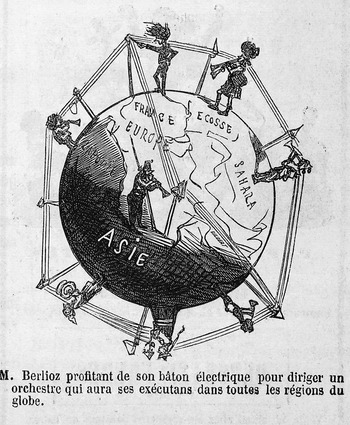
If Berlioz drew on Duveryier's narrative in constructing Euphonia, he also incorporated technological innovations of his own world into his conception of the future: the idea for the steam organ is attributed to Adolphe Sax; and the aural telegraph uses a musical language developed by Jean-François Sudre and employed in Berlioz's time for military communication. On the other hand, the ‘visual telegraph’ that conveys to each player how to perform his or her part may have been primarily Berlioz's own invention. Though the general concept is anticipated by Duveyrier, Duveyrier does not treat it as a device specifically for directing musicians. Bodin's Roman de l'avenir describes a similar type of technology that is used for coordinating large musical forces in his futuristic city; however, Berlioz was either unaware of Bodin's work or unconscious of the similarity, for when an ‘electric metronome’ was developed a decade after Euphonia was published, Berlioz claimed the credit for having anticipated the concept.Footnote 30 In 1855 Berlioz commissioned one of the new devices from a Belgian manufacturer to help him control 1,200 performers at that year's industrial exhibition. By tapping the finger of his left hand, while conducting with his right, Berlioz could communicate the beat to five sub-conductors by means of an electrical current.Footnote 31 The potential of the ‘electric metronome’ to enable Berlioz to transform physical space was satirised in a cartoon in Charivari in 1855 (Fig. 1). Berlioz uses his electric metronome literally to conduct a musical work instantaneously to remote lands. As with the global virtuosi of Berlioz's penultimate review, the cartoon implies that the only barrier to the creation of universal music is a physical one – one which the technology of the future will surmount.
‘Mr Berlioz takes advantage of his “electric baton” to conduct an orchestra which will have members in every region of the globe.’ Illustration by ‘Cham’ for Charivari, 2 December 1855

The technological innovations of Berlioz's futuristic narratives – the aural and visual telegraphs, the electric metronome and the all-pervasive dirigible aircraft – are all examples of what Wolfgang Schivelbusch has termed ‘the industrialisation of time and space’ that was experienced by Berlioz's generation.Footnote 32 Schivelbusch's expression applies to many of the innovations of the nineteenth century, including the telegraph and telephone; and the process had actually begun well before the nineteenth century, as the increasing uptake of mechanised time pieces transformed perceptions of time in the home and in the factory.Footnote 33 Berlioz's image of the steam organ regulating the lives of the citizens of Euphonia, whose labour is divided like those of the modern factory worker, certainly owes something to this model of the industrial time-keeping of the factory whistle.Footnote 34 However, Schivelbusch's slightly different technological focus is equally interesting for our purposes here, for he employs the concept of the ‘industrialisation of time and space’ with particular reference to one of the technological developments most emblematic of the experience of urbanisation of Berlioz's own era: the steam train.Footnote 35 To summarise Schivelbusch's argument, before the railway, overland travel meant a close contact with organic life. Every aspect of the journey was determined by the contours of the land and the bodies of the animals that powered the vehicle. The railway, however, cut through the landscape, propelling passengers ‘like a bullet’, to use the metaphor frequently adopted by the travellers themselves. For many passengers the train almost seemed to defy space, plunging through mountains rather than following their contours. The railway also defied time, for no longer was travel regulated by the cycles of the animals, such as the need to stop to change or feed horses. Passengers frequently felt quite disconnected from the landscape and from humanity, for the new train stations were typically built on the outskirts of a city, not in the centre of the community like the old coach stations.Footnote 36 The speed of travel, isolation and separation from the land experienced by early train travellers may have left a mark on futuristic fantasies of air travel from the period, including Berlioz's Euphonia. In his desperate search for Mina, Xilef ‘ate up space’ in his balloon, driving it to ‘the borderline of life’ where ‘the cold and dryness are such that the objects made of wood in the ship warped and cracked’.Footnote 37
The depiction in the opening of Euphonia of Etna as a crater-lake created by massive volcanic upheaval evokes a natural rather than a technological transformation; nevertheless, it contributes to the alteration in perceptions of time and space felt in the modern world. Berlioz followed the geological and paleontological discoveries of his contemporaries with interest. In 1866 he remarked upon the discovery of fossils in the Badlands area of Mississippi. This evidence of the erasure of entire species many years earlier put the pettiness of human existence into perspective – and Berlioz expressed the wish that humanity might now be similarly wiped out.Footnote 38 The pace of modern life seemed all the more frantic, the lifespan of man so much shorter, and the concerns of the masses so much more trivial, when confronted with the evidence of the gradual physical transformation of the planet.
In Berlioz's world, one thing might withstand both the rapid change brought about by industrialisation and the gradual change of the natural world: the musical masterwork. Etna may cave in, Germany may become an empire, and man may conquer the air, but Gluck's operas will still be the centrepiece of civilised society, capable of being transmitted across centuries of time just as they could be transmitted through space by the electric metronome. It is particularly significant that Berlioz should choose Gluck as his symbol of musical transcendence, for Berlioz's writings on Gluck's operas, and on the preface to Alceste, illustrate the extent to which Gluck symbolised for him an operatic model that privileged the authority of the composer, and in this familiar framework it is the degree of fixity enabled by a conception of the work that vests authority in the composer and his score that permits it to attain longevity, by contrast with the ephemeral transience of a tradition that locates authority in the performer. Berlioz describes how Gluck felt he needed to be present at the performances of his works; while Berlioz suggests this would not have been necessary had Gluck given more precise directions in the score, he nevertheless promotes a model for performance that situates supreme authority in a central figure who stands in for the composer; in writing of performances of Gluck's music in the 1850s, Berlioz goes so far as to plead for ‘despotism in the theatre’, in language even more extreme than the ‘despotic regime’ of Euphonia, where Shetland is ‘Minister’, ‘Emperor’ and ‘absolute master’ of the Gluck festival: ‘Despotism is required; let it be supremely intelligent, by all means, but despotism it must be, military despotism, the despotism of the commander-in-chief, the admiral of the fleet in time of war’.Footnote 39 In Berlioz's conception of the very different musical practices of the Italians, the singers in opera dictate their demands to the so-called operatore who cobble together the music; the orchestra struggles to accommodate the singers' whims or forsakes ensemble altogether – opera is created by and for the singer's voice. Berlioz here positions himself in sympathy with Gluck who, he writes elsewhere, expressed strong dissatisfaction with the predominant Italian operatic models of his own time: ‘According to this method, an opera was mainly a pretext for showing off singers who came on stage to play their layrnx’.Footnote 40 By contrast, in Euphonia, in accordance with the model Berlioz derived from Gluck, everything is secondary to the composer's work: ‘there are no leading singers, no property rights in title roles’. If a suitable singer cannot be found to do justice to Gluck's work, the entire festival will be cancelled altogether for that year.Footnote 41 The work thus outlasts any individual performance of it – as witnessed by the performance of Gluck's operas in Euphonia, some 600 years after their composition.Footnote 42
The position of technology in relation to this conception of musical transcendence is complex. On the one hand, Berlioz implied that great music outlasts the innovations of technology: referring to his commission for a work to celebrate the opening of the new railway line from Paris to Lille in June 1846, Berlioz quipped that ‘in pressing and unexpected circumstances like the inauguration of a railway, an artist shouldn't concern himself about whether forty centuries more or less will be familiar with his work’; the artist will instead content himself with ‘a short-lived celebrity of a mere four or five thousand years’, because ‘at such times one's country has the right to demand absolute devotion from each of its children’.Footnote 43 Unlike the industrial future of the railway, Berlioz implies, the great art work is autonomous and will project much further into the future by transcending time altogether.
On the other hand, however, Berlioz was forced to grapple with the inevitable dependence of music on (instrumental) technology, itself in a situation of great flux during Berlioz's lifetime, raising ontological questions about the work itself. When the score is also transmitted across the centuries (as in the case of Gluck's works), are the specific instruments themselves to be considered essential to the work? We know Berlioz detested what he described as the ‘trombonising’ and ‘ophicleiding’ of eighteenth-century works; he commented on a performance of Le nozze di Figaro in London (home of the industrial revolution, as Berlioz was very aware), that it was ‘copper-bottomed like a ship of the line’.Footnote 44 In staging a revival of Gluck's Orphée et Euridice in 1859, Berlioz carefully removed the trombones that had been added to Gluck's score; he substituted brass cornets for the wooden cornetto specified by Gluck only because players of the latter were by that time too difficult to find in Paris.Footnote 45 Indeed, Berlioz was generally ambivalent about the use of new instruments. He writes favourably in Euphonia of the giant steam organ inspired by Adolphe Sax, ‘harmonic cymbals’ and a ‘piano-orchestre’ (‘a huge piano whose variegated sound was so powerful that under the fingers of a single virtuoso it could hold its own with an orchestra of a hundred players’).Footnote 46 But Berlioz does not suggest that such instruments are to be employed in performances of masterworks of the past, and he made only sparing use in his own music of the new instruments he cautiously described in his orchestration treatise as being potentially ‘fatal to the art of music’.Footnote 47 The staves he allocated to saxophones in the Epilogue of La damnation de Faust remained blank.Footnote 48 In Euphonia Berlioz seems to vilify certain developments in instruments since Gluck's time. When describing the abominable Italian opera orchestra of the future Berlioz refers specifically to keyed bugles, piston trumpets and valve trombones, which, when presented in the company of (among other things) three ophicleides (instruments Berlioz saw as ‘monstrous’ if their limitations were not respected),Footnote 49 would seem to frame the new technologies of chromatic brass as vulgar and antithetical to great art. In practice, however, Berlioz's attitude was inevitably more nuanced, and where he was persuaded that the advantages of the new technology did not come at the expense of beauty of sound, he would adopt them in his own music.Footnote 50
If the temporal transmission of the musical work into the future establishes a potential tension between art and (instrumental) technology, the spatial transmission of the work of the future fuses art and technology by seeming to industrialise the players themselves, and here Berlioz would appear to embrace the technological metaphor. The electric metronome conveys essential elements of the work directly from the conductor (who in Euphonia is typically also the composer) to the players. The conductor becomes ‘the absolute master of [the] huge intelligent instrument’ of the orchestra itself, which is imagined as a keyboard with each player responding ‘as do the hammers of a piano under the hand pressing the keys’.Footnote 51 In his orchestration treatise Berlioz describes the conductor himself as providing the current: ‘his electricity will charge [the players], his drive will propel them. He will radiate the vital spark of music’.Footnote 52 The suggestion that the orchestra is like a machine is similarly borne out in other writings, such as when Berlioz quantifies the strength of particular orchestras in terms of horsepower – the unit that was now being used to measure the power of steam engines.Footnote 53 The work is thus transmitted to the players rather than created by them, reinforcing the ‘despotic’ model of Euphonia that contrasts so strikingly with the Italian opera idiom.
Similarly, Euphonia and Italy are contrasted in terms of the position of the human body in performance, again reflecting fundamentally opposing conceptions of the musical work. Whereas in the Italy of the future, the audience may spontaneously begin to dance during operatic performances, in Euphonia the orchestra and choral singers alike are trained to suppress their own bodily responses, and to disguise the very breath that animates them:
[A]ll the breathing-places are decided on, and so arranged that never more than one-fourth of the singers take a breath at the same time. In this way the vocal output of the entire mass never suffers any appreciable interruption.
The first rehearsals aim at literal exactitude; then come the broad nuances; lastly style and expression. Any marking of the rhythm by bodily movements during the singing is strictly forbidden to the choristers. They are also trained to silence, a silence so absolute and profound that if three thousand Euphonian choristers were assembled in the amphitheatre or in any other resonant place, one could still hear the buzzing of an insect, and a blind man in their midst might think he was quite alone.Footnote 54
Individual bodies are sacrificed to the body of Euphonia itself, which is dedicated to transmitting the masterwork. As Joël-Marie Fauquet and Katharine Kolb have both remarked, Berlioz's suppression of individual physicality is vaguely sinister.Footnote 55 The stillness of Berlioz's city is one way in which it differs markedly from its possible Saint-Simonian model. In Duveyrier's Paris of the future the body of the individual is celebrated – it is the microcosm of the city itself, and the city is alive with dance and song:
Come! Here the ground swells with man's desire for life; here the land gives to man, like a woman to her lover. The city the people inhabit is alive, adorned, resounding; she thinks, she works, she loves, she laughs, she dances. And the people will rush to the city, and they will know that they carry within themselves the forms and the map of my city; they will recognize her.Footnote 56
The euphoric feminisation of the body of the city in this passage (and, elsewhere, of the temple at its centre – ‘And the temple is a woman!’, Duveyrier proclaims),Footnote 57 is significant, and is another element that signals Berlioz's departure from the Saint-Simonian model, for in Euphonia's world of almost disembodied music, a marked tension arises around gender, particularly as embodied by Mina. However, before we consider the gendered implications of Berlioz's technological future, it is necessary to clarify the autobiographical context of Euphonia.
When Berlioz first published Euphonia in 1844, Shetland was named Rotceh – or ‘Hector’ spelled backwards – and Mina was named Ellimac, referring to Camille Moke (subsequently Camille Pleyel). The vivacious virtuoso pianist had been engaged to Berlioz, but she betrayed him shortly after his departure for Italy, and married the piano manufacturer Pleyel instead. Berlioz was devastated. When his suspicions were first aroused he vented his anguish in terms suggestive of the manic balloon flight undertaken by Xilef: ‘I am like a lost balloon, which must burst in the air, be engulfed in the waves, or come to a halt like Noah's ark’.Footnote 58 After Camille's betrayal had been confirmed, Berlioz plotted an elaborate revenge whereby, disguised as a maid, he would assassinate Camille, her lover and her mother, before committing suicide himself.Footnote 59 In this context, Euphonia reads as an even more exaggerated and dramatic revenge fantasy.
The fact that Berlioz should transform the pianist Camille into the singer Ellimac/Mina is significant, for it positions Mina at one extreme of a familiar dialectical framework. As we have already seen, Euphonia juxtaposes a composer-centred art music based in Germany against sensational florid and improvised vocal display originating in an Italian tradition. The juxtaposition coincides in Berlioz's narrative with an opposition based on gender. Gender dichotomies that extend an opposition between male and female to one between mind/body, or culture/nature (to name only two of the many oppositional pairings associated with gender), have an ancient pedigree in Western thought, but the advent of the Industrial Revolution saw the dichotomy harden in particular ways: conceptions of a passive, female nature (in both senses) reflected and sustained the interests of a capitalist, bourgeois society whose advances were often dependent on the fruits of rational scientific enquiry and exploration (or exploitation) of nature's resources.Footnote 60 In this context, technology was typically configured as masculine – as the product of rational enquiry, as the implement of industrial control over nature or, on a symbolic level, as either an extension of the phallus or as a particularly male (rational, enduring) creation that contrasts with the female creation of fragile human life.Footnote 61
In musical terms, the gendered dichotomy can be manifested in two slightly different ways. The mind/body pairing can be extended to the contrast between a composer-centred tradition and one centred in performance, as famously articulated by Dahlhaus in his explication of the ‘twin styles’.Footnote 62 But the mind/body gender dichotomy can also be manifested around the issue of technology, in the contrast between the technology of musical instruments (created and controlled by the intellect) and ‘embodied’ vocal performance.Footnote 63
By making Mina a singer rather than a pianist, Berlioz enables these two variants of the gender dichotomy to merge. On the one side is the male-authored composition, which is both mind-based and involves a mastery of technology to realise its vision. Although the Euphonians certainly sing, the only music we hear of them composing is instrumental music. In Euphonia the (male) composer is also the conductor, controlling the orchestral technology and the lives of the citizens, and the keyboard is presented, literally or metaphorically, as the instrument through which this control is exerted: it is a steam organ that regulates the working day, the conductor controls the orchestra like a pianist at the keyboard, and Shetland's performance on the ‘piano-orchestre’ sends Mina and her friends dancing to their deaths.
On the other side of this gendered bifurcation is the female-authored composition that derives from the physicality of vocal performance originating inside the body, as represented in Euphonia by Mina. When Shetland first encounters Mina she is appropriating his own symphony to her quite different practice, ornamenting it at whim. Her body is literally ornamented, like her music. Here we see not ‘woman as nature’, but ‘woman (and especially woman's voice) as artifice’ – a particular manifestation of the gender dichotomy that Felicia Miller Frank has traced in nineteenth-century French literature, where it reveals ‘an emerging anxiety about the implications of an inhuman modernity’.Footnote 64 Mina initially appears to cast off the superficial adornment or artifice of her body and voice; but rather than becoming a voice of ‘nature’ (in the more comfortable manifestation of femininity of the idealised gender dichotomy),Footnote 65 Mina's body and gender are both rendered more ambiguous. Both men fall prey to her charms when seeing her as disembodied – as air. Xilef nicknames her ‘Ariel’ after the ethereal spirit of The Tempest, thus simultaneously also jeopardising Mina's gender, for Ariel is a male character, though typically played as a trouser role at this time.Footnote 66 ‘There is no Nadira any more; it is I; no Shetland: it is she’, Shetland proclaims rapturously after declaring his love.Footnote 67 However, this promise of the ultimate union of performer and composer is illusory. When Shetland proposes to his Nadira that they commit suicide together, to free their souls from their bodies and take their relationship beyond the physical world, Mina politely declines, to which Shetland responds ‘Oh, Nadira, you are a mere woman after all!’Footnote 68
The one time Mina does seem to speak through an external instrument, the incident is marked as uncanny. When Shetland's first encounter with Mina and her music threatens to seduce him from his tranquillity, the composer exposes his Aeolian harp to the wind, perhaps hoping to hear music free of human agency that will erase Mina's voice from his consciousness. Instead, the harp produces the opening bars of his own symphony which Mina had sung to him in the balloon, and when he opens his eyes he finds the woman herself standing before him, as if her seductive spirit has possessed the harp, whose music in turn summons her body.Footnote 69
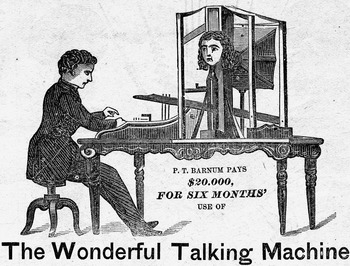
Mina's voice is indeed hard to contain. The musical automata that were so popular in the late eighteenth century and in the first decades of the nineteenth century demonstrated how resistant the human voice was, in an age before sound recording, to being reproduced, imitated or controlled by technology. While there were a number of popular keyboard automata, there were few automata that successfully captured the human voice.Footnote 70 A rare exception was Joseph Faber's speaking automaton, exhibited in New York in 1844 – the same year Berlioz conceived Euphonia. The automaton went through several incarnations. One of these was a disembodied female head that appeared to speak when operated by a keyboard (Fig. 2).Footnote 71 Faber's automaton captures some of the same ideal of Berlioz's Euphonia: the woman's body is erased, her voice produced and controlled by the ‘composer’ (male in this picture at least) operating the technology of the keyboard. When he took Faber's creation to London in 1846, P. T. Barnum actually named the automaton ‘Euphonia’ – a striking, if probably coincidental, token of the ideological resemblance the automaton shares with Berlioz's story.Footnote 72
Faber's ‘Euphonia’ automaton

The ‘Euphonia’ automaton represents an ideal for Berlioz's futuristic city of the same name, but it is an ideal that Mina resists. Whereas the orchestra players of Euphonia are members of a machine controlled by the composer/conductor, Mina does not cede control of her body to anyone. Mina ultimately refuses to allow others to speak or sing through her, driving Xilef to stifle her voice and absorb her body into the machine by force just when she is at her most physical in a dance with her lovers. The horrific excess of Berlioz's description of Mina's demise warns of the dangers that attend the Euphonians' suppression of individual agency and the sacrifice of human physicality.
Another story published in Evenings with the Orchestra enforces the sense of anxiety around loss of agency. In ‘The piano possessed’ thirty-one competitors in a piano competition play the same concerto (Mendelssohn's Concerto no. 1 in G minor Op. 25) on the same piano, one after the other. The piano's mechanism gradually loosens as pianist after pianist beats out the same music, until it is realised that the piano is actually playing the work unaided. Its keys have become so accustomed to the patterns of the concerto that they depress themselves, like those of an automaton. The human performer is erased, for the instrument has learnt ‘the work’, not one individual's interpretation of it. Again, there is something fearful in Berlioz's account of what might have seemed to be a composer's ideal:
M. Erard arrives; but try as he will, the piano, which is out of its mind, has no intention of minding him either. He sends for holy water and sprinkles the keyboard with it – in vain: proof that it wasn't witchcraft, but the natural result of thirty performances of one concerto. They take the instrument and remove the keyboard, still moving up and down, and throw it into the middle of the courtyard next to the Warehouse. There M. Erard in a fury has it chopped up with an axe. You think that did it? It made matters worse: each piece danced, jumped, frisked about separately – on the paving stones, between our legs, against the wall, in all directions, until the locksmith of the Warehouse picked up this bedeviled mechanism in one armful and flung it into the fire of his forge to put an end to it. Poor M. Erard! Such a fine instrument! We were heartbroken, but what could we do? There was no other way to loosen its grip. But after all, how can a piano hear a concerto thirty times in the same hall on the same day without contracting the habit of it? M. Mendelssohn won't be able to complain that his music isn't being played. But think of the damage!Footnote 73
Berlioz's narrative conveys the unease that was increasingly felt around mechanical automatisation, musical automata and other sound-producing machines, in an age where admiration of the order and control brought about by the ‘horological revolution’, and symbolised by the image of God-as-watchmaker, was typically replaced by a resistance to or fear of automatisation that was now frequently associated with the devil.Footnote 74 As Carolyn Abbate points out, from the late eighteenth century onwards, the wonderment incited by musical automata became infused with anxiety around the question of human agency. While a machine might simulate human performance, the human performer could also appear machine-like, possessed by the composer's work; and in mechanisms like the player piano (which Berlioz's story seems to anticipate),Footnote 75 the erasure of the human body and the fact that the work was somehow part of the mechanism itself were often felt to be uncanny.Footnote 76 Berlioz's Euphonia and his story of the piano possessed are similar in tone to those tales of E. T. A. Hoffmann which treat the subject of automata and musical performance. The measures taken to silence the demonic piano are also reminiscent of the apprentice's attempt to control his broom in Goethe's Zauberlehrling. In turning now to La damnation de Faust, it is another work by Goethe that concerns us, but here the machine is not found in the text but is the creation of Berlioz's music itself.
La damnation de Faust
As Hugh Macdonald writes, Berlioz conceived La damnation de Faust to the ‘rattling of iron wheels on iron rails’.Footnote 77 Berlioz himself tells us that he composed Faust ‘where and when I could, in carriages, in trains, on steamboats’; moreover, the composition of the work was interrupted so that Berlioz could fulfil the commission for the ‘Chant des chemins de fer’ written to celebrate the opening of the new train line to Lille. While the setting of La damnation de Faust can be assumed to be the sixteenth century of the story's origins, and thus far removed from the explicitly futuristic world of Euphonia, the ‘rattle’ of modernity that sounded around the conception of Berlioz's Faust resounds in this work also.
One movement known to have been at least partially noted down on a train is the ‘Chœur d'étudiants et de soldats’, the account of whose conception echoes several themes from Euphonia as well as anticipating those of La damnation de Faust as a whole. Suffering from ennui one Sunday in Paris, Berlioz decides to visit Heinrich Heine to shake his hand for his ‘devil of a work’, Atta Troll, though Berlioz fears thereby ‘receiving an electric shock and injuring myself with his iron grip’.Footnote 78 En route to Heine's residence, Berlioz encounters a military platoon, followed by a group of friars. Mentally substituting the friars with students, he finds his thoughts redirected to the ‘espèce d'opéra’ on Faust that he has been working on, and so preoccupied is he with pursuing the musical ideas that are now coming to him that he follows the crowd to the Gare du Nord and boards a train to Enghien. After arriving in Enghien, his music safely committed to paper, Berlioz witnesses an extravagant elopement by balloon – an ‘enormous balloon of the power of thirty-seven horses’ that flies away ‘at a speed of fifteen leagues an hour’.Footnote 79 This and other less dramatic events fulfil all the elements of a prophecy for the year 1846 that had appeared in the popular Mathieu Laensberg almanac of predictions, thus supposedly instilling in Berlioz a new faith in this irrational art.
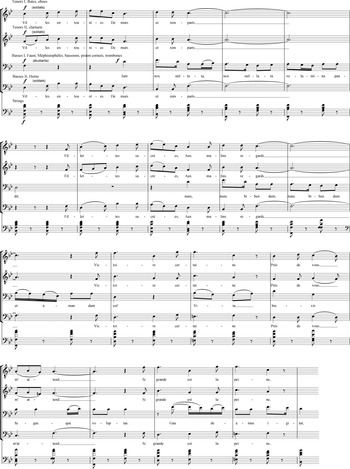
The potent mixture in this one article of balloon travel and train travel, predictions of the future, devilish poems and Faust suggests a nebulous sympathy between the concerns of Euphonia and La damnation de Faust. The chorus that was the most direct musical outcome of the events Berlioz describes itself supports a reading of La damnation that is at least sensitive to the technology of urbanisation. The soldiers enter first, singing in B-flat major, 6/8 time; they are followed by a Latin chorus from the students in an archaic monodic D minor in 2/4. As the two groups approach each other their musics similarly merge, resulting in a bitonal and bimetric though wholly consonant polyphony (Ex. 1).Footnote 80 Was Berlioz partly inspired by the railway that had witnessed the birth of the students' song? The simultaneous presentation of two quite different tonal and metrical worlds suggests something of the dual consciousness of the train journey (the worlds inside and outside the carriage), as well as the technology of the telegraph that enabled space to be erased and for two remote spatial worlds to be experienced simultaneously. Stephen Kern has suggested that the experience of simultaneity, enabled by technology and characteristic of modernity, is reflected in bitonal or biometric music of the turn of the twentieth century; but Berlioz's music may enable us to trace this association between technology and simultaneity back several decades earlier.Footnote 81 Although Berlioz was by no means the only composer of his era to present simultaneous contrasting idioms in this way (a famous example can be found in Meyerbeer's Huguenots), he made a more extensive and more drastic use of this technique than perhaps any other composer of his time.Footnote 82 And while similar examples can be found in other works by Berlioz, such as Harold en Italie, in La damnation de Faust Berlioz himself, in his account of the work's conception, gives us grounds to connect the experience of simultaneity directly to the erasure of time and space characteristic of the railway – here the train to Enghien that witnessed this music's birth:
Still mumbling my gaudeamus I got into the train and it left. But as the movement of the locomotive beat out a rhythm quite different from the one that had been battering my brain a few minutes before, I could see that I was going to forget my song. I quickly wrote it down in my notebook, and after a difficult confinement I fell asleep.Footnote 83
‘Chœur d'étudiants et de soldats’

La damnation de Faust as a whole suggests the ‘industrialisation of time and space’ characteristic both of early train travel as well as of the balloon travel and visual telegraph of Euphonia. Berlioz places his Faust in Hungary at the opening of the work to give himself an excuse to incorporate his setting of the ‘Rákóczy March’ of that country. At least one German critic objected to this addition, which Berlioz justified on the grounds that ‘the most eccentric travels may be attributed to such a personage as Faust without transgressing the bounds of possibility’.Footnote 84 Between the first and second parts Berlioz returns Faust to Germany at an anachronistically rapid speed – anachronistic, that is, for the historical Faust, but not necessarily for Berlioz, as the spreading tracks of the steam train facilitated rapid travel across increasing stretches of Europe.
Berlioz's apparent disregard for geographical authenticity is made easier by his choice of genre, for Berlioz's Faust is not bound to the operatic stage, with its attendant concerns for scenic realism and the practical difficulties arising from copious set changes.Footnote 85 Although eight numbers of La damnation de Faust originated in the late 1820s as a sort of independent incidental music, the completed work was never intended to be staged.Footnote 86La damnation de Faust was written for concert performance. ‘[I]t is a grand opera without action, costumes or scenery’, Berlioz wrote to Baron Taylor; elsewhere he explained: ‘it is not a symphony but a légende dramatique – a concert opera’.Footnote 87 The genre is ultimately ambiguous, freely mixing elements of opera with writing more suggestive of a dramatic symphony. While Berlioz's ‘dramatic symphonies’ themselves mix elements that could be loosely described as operatic with those more traditionally ascribed to a symphony, Berlioz's employment of the operatic dimension in La damnation de Faust is more extensive. He at one time described the work as an ‘espèce d'opéra’, but he never referred to it as an ‘espèce de symphonie’, nor did he include it in his symphonic sequence; and it is significant that out of all of Berlioz's works written for concert performance, it is La damnation de Faust that has most frequently lent itself to visual realisation, through stagings that inevitably evoke opera. In La damnation de Faust, more perhaps than in any other non-operatic work, Berlioz sets up operatic expectations; but while these expectations are crucial to La damnation, it is partly through the way Berlioz challenges these expectations that the drama is realised, and it is here that a comparison with Euphonia is particularly illuminating.
The generic ambiguity of La damnation de Faust is strongly reminiscent of Euphonia, with its mixture of epistolary form, dramatic script, treatise and novel. Moreover, the way in which Berlioz employs the different idioms in La damnation de Faust raises some of the same questions around gender and body. Just as Euphonia builds towards the sacrifice of the female body and its excessive vocal display, Faust, as originally conceived, seems to erase the physical dimension of opera. There is dance music but no dancing, no costumes – in other words, all the things Berlioz describes as distracting the Italians from the music are removed from La damnation de Faust. This much is also true of Roméo et Juliette, for example, but in La damnation de Faust to a much greater extent than in the dramatic symphony, the central female character is set up as an operatic body, only to be erased. Marguerite, the only female character in Berlioz's pared-down text, is absent from two-thirds of La damnation de Faust, but when she does arrive she brings with her the most ‘operatic’ music in Berlioz's score.
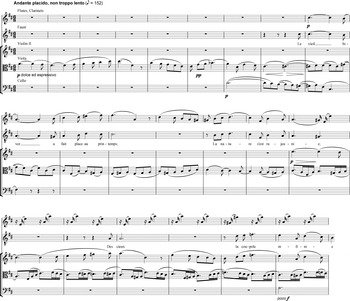
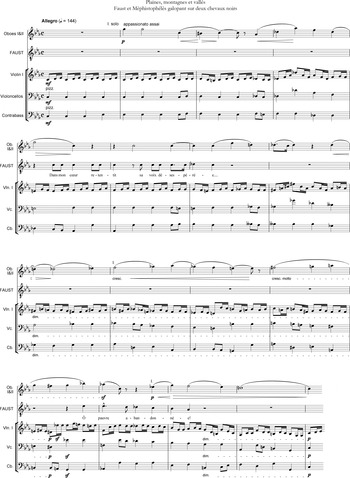
The operatic nature of Marguerite's idiom needs to be seen in relation to the quite different idiom of Faust. Berlioz commented in his Foreword to Roméo et Juliette that he was trusting the parts of the eponymous lovers to the orchestra rather than singers because the work was a symphony and not an opera, because operatic lovers were numerous and he wished to be original, and because instrumental music allowed the greater freedom necessary to express this sublime love.Footnote 88 Faust, by contrast, is given a voice and text; however, his music is in many respects similarly ‘symphonic’. Shunning the familiar forms of operatic set pieces, Faust's music unfolds in sections that are through-composed and lacking in the display of the typical tenor hero (ridiculed elsewhere by Berlioz in his account of ‘How a tenor revolves around the public’).Footnote 89 Faust is introduced to us as a voice within the orchestral polyphony (Ex. 2). He enters after just a few bars of introduction, effectively stating his place in what would usually be the orchestral prelude, and indeed, the orchestra takes over again shortly in a free-flowing development of the opening theme.Footnote 90
Opening of La damnation de Faust

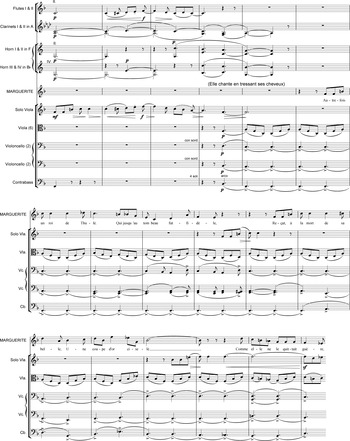
By contrast with Faust, Marguerite's idiom is more easily reconciled with opera, as has been noted by Rushton and Kolb, among others.Footnote 91 Marguerite's main numbers, inherited from the earlier Huit scènes de Faust, are closed forms. Moreover, she is introduced by that most operatic of idioms, a stage song: Marguerite's ‘Le roi de Thulé’ is framed as a diegetic song by Goethe. In placing it in La damnation de Faust, Berlioz further enhances the number's diegetic, dramatic or performed nature by giving Marguerite an on-stage audience, albeit one to whose existence she is oblivious. Whereas in Goethe's work both Faust and Mephistopheles leave the stage before Gretchen sings, Berlioz's stage directions have Faust conceal himself and listen to Marguerite's performance. Berlioz also marks the language of the song as performance by infusing it with altered scale degrees to suggest the foreignness of this ‘Chanson gothique’ to the prevalent musical idiom (Ex. 3). Interestingly, the distinctive melody of ‘Le roi de Thulé’ is anticipated not only by the solo viola within the number itself, but also before Marguerite's appearance, in one of several instances in La damnation de Faust where Berlioz features recurring melodies. ‘Je l'entends’ (‘I hear her’), Méphistophélès tells Faust in Scène X, as the melody of ‘Le roi de Thulé’ sounds in the clarinet. Marguerite may be the most operatic of the characters, but in this way she, too, emerges from the orchestra as sound rather than sight; the fact that the distinctive augmented fourth of ‘Le roi de Thulé’ is the tritone that characterises Méphistophélès, and that he here seems to conjure her forth, is also an ominous sign of things to come.
‘Le roi de Thulé: Chanson gothique’

As Faust moves closer to consummating his relationship with Marguerite, he is drawn in to her more operatic idiom in what Rushton calls the ‘Italian formal solidity’ of the duet and trio.Footnote 92 The dialectic of genre is then resumed with Marguerite's final solo number, the ‘Romance’; but the stylistic interplay is complicated and intensified. Though often set as a song, Goethe's ‘Meine Ruh' ist hin’ is, in the context of his play, more ambiguous as to whether it is a performed stage song or spoken reflection.Footnote 93 Berlioz leaves the question open. There is no on-stage audience – the number is specifically designated ‘Marguerite seule’ – and Marguerite's impassioned expression shuns any question of conscious spectacle or performance. But even if not stage song, the relatively operatic nature of Marguerite's ‘Romance’ is apparent. The form is again a closed one, with several returns of the opening music forming a refrain separating three couplets.Footnote 94 In the third of these couplets, Berlioz makes us fully aware of Marguerite's physical body – an element of operatic spectacle – when he has the singer literally panting with her unfulfilled desire (Ex. 4). Marguerite's more operatic quality is again highlighted by comparison with Faust: his ‘Nature immense’, which immediately follows, is another free-flowing form and his line is once more part of the orchestral polyphony.Footnote 95
Marguerite's ‘Romance’

Through his manipulation of form and idiom, Berlioz thus establishes pronounced differences between Marguerite and Faust. These differences are strongly suggestive of the play of genres in Euphonia. Where Xilef and Shetland are introduced in epistolary mode, communicating directly to each other (and to us), Mina is presented in a dramatic idiom, like a character in a play whom we watch from the audience. Mina's physicality, like that of Marguerite, is something to which Berlioz draws our attention – and something for which she will ultimately be punished.
To say that Marguerite's operatic idiom creates an analogy with Mina is certainly not to imply that Berlioz saw opera per se as antithetical to his ideals. His own stage works testify powerfully to the contrary, as does Euphonia itself, for the crowning event in the calendar of the ‘musical city’ is, lest we forget, a festival that stages Gluck's operatic works. While Berlioz may have seen in Gluck a model for a composer-centred conception of opera, he nevertheless embraced the physical and visual aspects of the staging through which these works were realised, as demonstrated in one of his earliest accounts of hearing – and seeing – Gluck performed in Paris: ‘The illusion is perfect’, he wrote to his sister Nanci of the visual realisation of the storm, later adding ‘you have to see it to believe it’.Footnote 96 Moreover, in identifying the qualities that constitute the ideal singer for Gluck's music, Berlioz repeatedly referred to the importance of physical gesture and expression.Footnote 97
It might also be objected that Marguerite is altogether a far more sympathetic character than Mina, and our sympathy is none the weaker for the fact that she is ultimately viewed by us through Faust's eyes. In fact, the operatic nature of Marguerite's idiom facilitates this sympathy. La damnation de Faust draws on Euphonia's dichotomy between opera and symphony – a kind of ‘rhetoric of meta-genre’, to adapt Kallberg's expression – as an integral part of its narrative.Footnote 98 This narrative has other resemblances to Euphonia, but to understand this we must first examine the position of the third character, Méphistophélès, in the operatic-symphonic spectrum of Berlioz's légende dramatique.
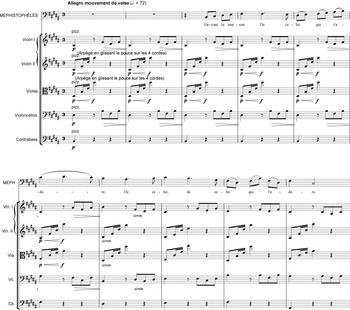
Like Marguerite, Méphistophélès is characterised through prominent use of stage song; but whereas Marguerite's diegetic song frames her as a powerfully emotive operatic spectacle for Faust (and for us), Méphistophélès's diegetic idioms have almost the opposite effect. Granted, his idiom, like that of Marguerite, could be described as ‘operatic’, and we might thus interpret the fundamental opposition of the work to be not one of gender but, rather, of a contrast between Faust, on the one hand, and Marguerite and Méphistophélès on the other. However, while Marguerite and Méphistophélès share an operatic idiom, their positions within the diegesis are also distinctly contrasted. Where Marguerite typically receives ‘the gaze’, Méphistophélès directs it.Footnote 99 Aware of his music as music, Méphistophélès at times seems almost to step out of the diegesis and take on the role of conductor. For example, in the bars before Méphistophélès's ‘Sérénade’, Berlioz leaves stage directions suggesting that the singer should make the gesture of playing a hurdy-gurdy as he tells the will-o'-the-wisps and fiddlers to accompany him in a song to damn Marguerite. Many of Berlioz's stage directions appear to be for the benefit of the reader alone; but even if the singer does not follow Berlioz's instructions here, the orchestra embodies the same message. In the ‘Sérénade’ itself we see how Méphistophélès controls the strings, which are transformed, aurally and perhaps also visually, into guitars: Berlioz specifies that they should be strummed with the thumb. The extremely awkward arpeggios assigned to the second violins and violas force the strings – described by Berlioz as the ‘faithful servants’ of the orchestra, and often associated elsewhere in the score with Faust – into cruel distortions to do Méphistophélès's will (Ex. 5).Footnote 100
‘Sérénade de Méphistophélès’

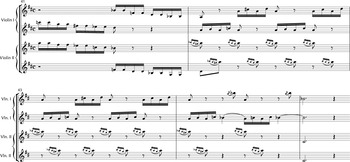
Méphistophélès's control over the orchestral forces might also be seen in the earlier ‘Évocation’, where the devil first summons the will-o'-the-wisps and calls on them to perform a dance around Marguerite's house. Here (in Ex. 6) the first- and second-violin sections are at one point each divided so as to enable them to render a single line between them. In his preface to Berlioz's orchestration treatise, Hugh Macdonald points out that such divisions show Berlioz writing for the players as ‘parts in a great machine, not as voices in a choir’.Footnote 101 The individual players of neither sub-section can perceive the effect of the whole line. Like the citizens of Euphonia, their labour is divided, and like the orchestral players of Euphonia they can thus be compared to individual keys on the keyboard manipulated by the composer/conductor, who is the only one who can appreciate and control the whole.
‘Evocation’: divided violins

‘Évocation’ is also interesting for its treatment of the brass, which characterise Méphistophélès throughout the work. The opening has been much remarked upon for its suggestions of atonality, but equally indicative of Méphistophélès's unnatural powers are the rough stopped d's of the natural horn (marked ‘son bouché’); this was a note Berlioz suggested should only be used when a ‘harsh, muffled, savage’ sound was required.Footnote 102 Berlioz's employment of the stopped notes characteristic of the natural horn, at a time when the increasingly prevalent chromatic horns were rendering stopped notes unnecessary, could seem to indicate resistance of technology rather than mastery of it, and we might recall that in Euphonia it is the crass Italian orchestra that embraces chromatic brass. However, Berlioz's use in ‘Évocation’ of this most unpleasant note is doubtless wholly intentional, and the suggestion of a ‘natural’ instrument being forced to strain against its own limitations is entirely appropriate to the effect Méphistophélès has on those around him. An even greater distortion is demanded in the uncanny hunting horn calls that underpin Faust's and Méphistophélès's ‘Récitatif et chasse’, as Méphistophélès closes in on Faust's soul. In a rehearsal one of the horn players supposedly told Berlioz he had written a note ‘which does not exist’, describing it as ‘a sort of sneeze like nothing on earth, an impossible din’, to which Berlioz replied ‘that is exactly what I wanted’.Footnote 103
‘La course à l'abîme’, which follows the recitative just mentioned, brings together the three strands of technology, driving them forward to a conclusion every bit as disturbing as the end of Euphonia. To save Marguerite from execution, Faust signs away his soul, promising to serve Méphistophélès tomorrow because, as he says, ‘que me fait demain quand je souffre à cette heure?’ (‘What is tomorrow to me when I am suffering right now?’). Méphistophélès summons two demonic horses to hurtle them across time and space – for it is not to Marguerite's prison cell that they ride, but straight to hell, ‘tomorrow’ seeming to arrive almost instantly. Gerhard invokes the industrialisation of space characteristic of the telegraph in discussing the end of Berlioz's Les Troyens, where the setting leaps from Dido's Carthage to Virgil's Rome:
While this effect owes some of its inspiration to the arrival of an old-style deus ex machina at the end of a tragédie lyrique, the combination of two scenes separated by several hundred years in historical reality as well as several hundred miles in distance has a breathtaking modernity about it which it is almost impossible to overstate. Like the only recently invented electric telegraph, it transports the audience ‘into a world of simultaneity and instancy that went beyond human experience.Footnote 104
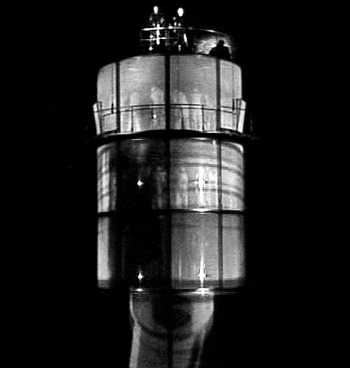
In La damnation de Faust the transportation is not instantaneous; if technology is evoked here it is not the telegraph, but the steam train. We are aware of the journey, but the pace feels frantic, perilous both to passengers and to those who stray across their tracks, as the travellers plough at a constant pace across (or through?) the ‘mountains’ specified in the scenic directions in Berlioz's score. In Berlioz's time train passengers were locked into their cabins as they were propelled at speeds that were initially considered dangerous to the human body, and occasionally they, too, were consigned to a fiery death. In 1842 France experienced a horrific train accident where more than fifty people lost their lives in a conflagration after a train traveling from Versailles to Paris left the tracks and caught fire. Berlioz was among those shaken by the news of the accident, and, in 1846, when writing ‘La course à l'abîme’, Berlioz's writings reveal that derailment was still a persistent fear.Footnote 105 Did he draw on this fear in ‘La course à l'abîme’ itself? The relentless string ostinato that persists through most of the movement obviously suggests the pounding of the horses' hooves, but there is a mechanical aspect to its manically driving repetition as well. The bizarre growls from the brass instruments and screeches from the wind clearly evoke the hideous monsters and nighthawks of Berlioz's text; but might they also suggest the sounds of a steam train? Such an interpretation is doubtless too literal, but the scene does appear to carry a certain ‘industrial’ quality for at least some listeners. The directors of the 1999 Salzburg Festspiel production interpret the motion of ‘La course à l'abîme’ with technological allusions, projecting onto a massive cylinder images of automaton horses, multiplying like the dissected Erard piano of Berlioz's story, as well as images of a giant piston – a component not only of the developing technology of the orchestral brass, but also of the steam train (Fig. 3).
Scene from ‘Course à l'abîme’, Salzburg Festspiel 1999, dir. Alex Olle and Carlos Padrissa

A staging of this scene almost demands an imaginative use of technology, as Berlioz himself acknowledged. In 1847 he sought to adapt La damnation de Faust as an opera for London. Aware that the spectacle of ‘La course à l'abîme’ would appear particularly difficult to realise literally, he assured Scribe, his intended librettist: ‘The scene with the horses … won't scare the London stage hands [machinistes] and I believe they will be able to represent it in a very ingenious and dramatic fashion.’Footnote 106 But even without visual aids, if encountering the work in concert performance, an audience may still experience the fascinations and fears of technology. To obtain the wind and brass effects Berlioz adopted recent developments in the manufacture of these instruments to push the bassoon, trombone and ophicleide to the very bottom of their respective registers and produce colours that would have sounded unexpected or ‘unworldly’.Footnote 107
Seeing the future: Genre and staging
In arguing that metaphors for modernity underpin Meyerbeer's operas, Newark points to the prominent visual display of instrumental technology: much like the objects (including, indeed, musical instruments) displayed in the industrial exhibitions, the on-stage presence of eighteen saxhorns in Le Prophète (specifically requested in the livret de mise-en-scène) speaks to a characteristically urban valorisation of ‘craftsmanship rather than illusion’.Footnote 108 Berlioz's use of on-stage instruments in his own operas could profitably be examined in this same light. In particular, the on-stage saxhorn band in the Act I Finale of Les Troyens,Footnote 109 especially when contrasted with the parading elsewhere in the opera of ‘exotic’ or ‘ancient’ instruments (whose sounds are rendered by the modern Western orchestra in the pit),Footnote 110 seems to evoke the mentality of the expositions universelles: in the exhibitions, as in Berlioz's opera, a close association between technology and empire was evidenced in the rigorous separation of European instruments – displayed in the industrial section – and instruments of various colonies – displayed separately according to the region of origin. Moreover, in his score, Berlioz specifically directs the conductor to use a three-wired electric metronome to coordinate the three saxhorn bands (who are initially heard from offstage), highlighting again the industrial innovation upon which the execution of his music was dependent.
In La damnation de Faust, by contrast, all instruments are effectively on-stage instruments. In this context, instrumental technology could be foregrounded to such an extent that it might, paradoxically, become invisible, taken for granted or sublimated into the abstractions of the symphonic ideal. Nevertheless, rather than eschewing the visual dimension of opera and its instrumental technology, I would argue that Berlioz, in La damnation de Faust, reworks that visual dimension into the experience of the work, and the fact that La damnation de Faust is not an opera intensifies rather than weakens the impact of the technological display.
When we watch a concert performance of Berlioz's work, as Berlioz intended, we are encouraged to see a mechanical quality to Berlioz's nightmarish vision. The galloping string figure of ‘La course à l'abîme’ forces the bows into a piston-like motion. Berlioz was certainly capable of thinking in such terms, and some years earlier had written of Liszt's staccato that it sounds as if it is produced ‘at the nut of the bow on a fine double bass by a steam engine – because I can imagine no human arm … that would be capable of such incredible agility’.Footnote 111 The guitar hold for the strings in Méphistophélès's ‘Sérénade’ may be as much for visual effect as practical benefit, enabling an audience to see how Méphistophélès challenges the boundary between the diegetic and non-diegetic dimensions.
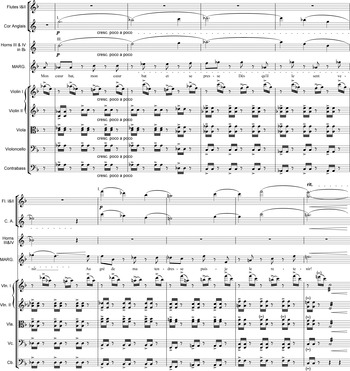
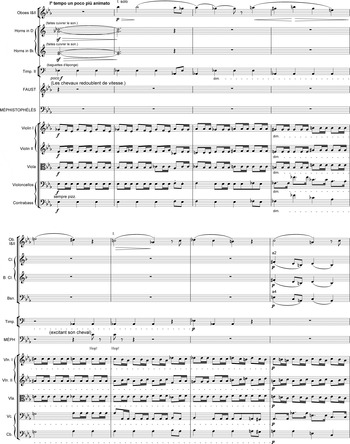
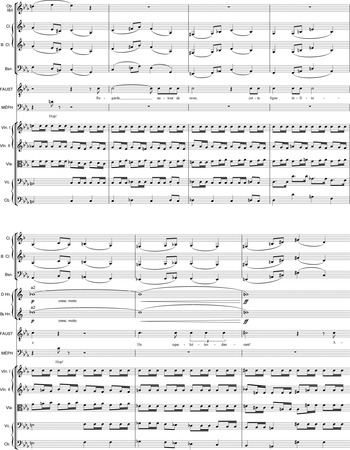
In watching a concert performance today we are also particularly conscious of the suppression of Marguerite's physical voice, for the singer remains seated silently on the stage for more than twenty minutes after her final number.Footnote 112 There is no church or prison scene, as audiences familiar with Goethe's work might have expected, and as Gounod would later provide in his quintessentially operatic treatment. By the beginning of ‘La course à l'abîme’, Marguerite's actual voice has long since fallen silent; now it is replaced with a plaintive oboe melody (Ex. 7). Just as Mina's dramatic idiom in Euphonia gives way to the narrative of an omniscient narrator, Marguerite has thus moved from an independent operatic voice (albeit one that is itself anticipated by the orchestra when the clarinet sounds her ‘Le roi de Thulé’ melody), to one that emanates from within the orchestra. Of course, there is nothing inherently sinister or gendered in the notion of a character whose voice is embodied by the orchestra, as Berlioz's treatment of Roméo et Juliette attests. What distinguishes La damnation de Faust from that work, however, is the fact that Berlioz's Marguerite, unlike his Juliette (or Roméo), does have a physical body, and her eventual instrumental idiom comes at the expense of the sacrifice both of that body, and of the operatic idiom with which it has been associated. In the final scene, in heaven, Marguerite is no more than a name intoned by an unspecified ‘voice’ as the chorus of ‘celestial spirits’ tells her to leave behind the earthly love that led her astray and put on again the ‘pristine beauty’ which has been ‘marred’ by her error (‘âme naïve que l'amour égara; Viens revêtir ta beauté primitive qu'une erreur altéra’). As Katharine Kolb points out, there is something uncomfortable about this conclusion which, like the ending of Euphonia, positions women's physicality and sensuality as a problem, and offers instead the disembodied ‘eternal feminine’ as the ideal.Footnote 113 Marguerite, rather than Mina, seems to represent the erasure of body of Faber's Euphonia automaton: she is denied the physicality of opera and instead reduced to voice, confined to the orchestra, then silenced altogether. Interestingly, the oboe melody that has been taken to represent Marguerite's voice fades away precisely when Méphistophélès starts spurring on the horses with a vigorous ‘hop hop’ that seems also to drive the orchestra itself (Ex. 8).
‘La course à l'abîme’: opening

‘La course à l'abîme’ : Méphistophélès encourages the horses


A notice appearing in L'Illustration before the first performance of La damnation de Faust, and thought to have been penned by Berlioz himself, suggests that the title – here given as ‘opéra-légende’ – ‘indicates a work destined to be read rather than performed’. Among other scenes, ‘La course à l'abîme’, with its ‘frenetic gallop of two horses pursued by monstrous apparitions’, is identified as one that it would be ‘impossible to put on convincingly in the theatre’. La damnation de Faust, we are told, is addressed to ‘the imagination rather than the eyes’.Footnote 114 Katharine Kolb suggests that the numerous stage directions in the score confirm the notion that the work is to be read, and she argues persuasively on this basis for a closer examination of the text.Footnote 115 Berlioz is known often to have attended operas with score in hand, and it is perhaps for just such a listener that he includes stage directions that would not actually be realised upon the stage. But we should not overlook the visual impact of a concert performance. Indeed, it is in the visual dimension of the concert performance that the originality of Berlioz's vision of the music of the future might be seen to be located. Berlioz did not request that the orchestra be hidden behind a curtain, as he had earlier done for much of Lélio – another work with a metaphorical on-stage conductor. In his orchestration treatise Berlioz describes a layout for the orchestra that uses steeply tiered risers, with the chorus placed in front of the orchestra on a temporary rigging slightly below the level of the main stage. While designed to provide the optimal acoustic conditions for performance, this arrangement also has the effect of displaying every instrument (and singer) to the audience.Footnote 116 The vocal soloists are placed close to the conductor, and, although Berlioz directs the conductor to face his orchestra, many conductors still faced the audience at this time. Méphistophélès's status as a kind of stand-in for the conductor may thus have been enhanced visually for Berlioz's contemporary audience.
This layout, Berlioz tells us, is what he demands for his concerts in ‘Paris, London, Berlin, Prague, Vienna and St Petersburg, whatever the dimensions of the stage’.Footnote 117 When mounting Faust in Dresden, however, Berlioz suggested that since the vocal part was so significant for this work (and for the other works to be performed in the same concert series, including Roméo et Juliette), the orchestra should be ‘left below, in its usual position’ – presumably in front of and below the stage, as for an opera.Footnote 118 Such an arrangement would have restricted the audience's visual connection with the orchestra, but by strengthening the allusion to operatic performance would perhaps have heightened their awareness of the very ways in which Berlioz both draws on and subverts this idiom.
In performances that place the orchestra literally centre stage, we are encouraged to watch the technology of the orchestra in action as, driven forward by Méphistophélès, it threatens to usurp the position traditionally occupied by the body of the heroine in an operatic spectacle. Marguerite's body is not visibly crushed like that of Mina; it is not violently erased at the conclusion like those of the heroines of some of Berlioz's most familiar operatic contemporaries, such as Rachel, ‘la juive’, who leaps into the boiling cauldron, or Fenella, ‘la muette’, who throws herself into an active volcano. It is Faust who plunges into the flames in Berlioz's scenario, in a departure from Goethe's Part I. Berlioz's title – ‘the damnation of Faust’ – blatantly signals his intent; from the outset an audience is looking forward to Faust's future in a very literal sense. But Marguerite's fate is no less frightening for the fact that her body is spared the flames. Berlioz takes the familiar elements of opera – the spectacle of the female, the sensual enticement and threat to rationality that the heroine presents, and the containment of this threat by her death – and transports them from the narrative to the meta-narrative level. Paradoxically, it is only in a concert performance that we can be aware of this operatic meta-narrative, as our gaze moves from Marguerite's silenced body to the orchestra, and as we hear her voice consumed by the powerful orchestral machine.
Performance as staged opera thus erases a vital dimension of the originality of Berlioz's La damnation de Faust. Indeed, when Berlioz thought he was going to have his Faust music staged in London he undertook substantial revisions of the work. Méphistophélès would no longer appear as a diabolical conductor of an on-stage orchestra, but as a sort of frustrated lover – an intriguing character, but an operatic type none the less. Now Méphistophélès would sing a two-part aria in the conventional operatic plan, commencing with an Andante where he expresses his envy of Faust's mortal love (‘Si je pouvais aimer! – Si je pouvais pleurer – Si je pouvais mourir!’) and followed by an Allegro where Méphistophélès resolves instead to pursue his natural propensity for immortal rage and destruction.Footnote 119 As if in confirmation that fully fledged opera required greater concession to singers, and evoking – if only very faintly – the Italian operatore in Euphonia, Berlioz acknowledges that this new aria was primarily designed to provide an opportunity to display to full effect the vocal qualities of Pischek, the singer who would take the role of Méphistophélès.Footnote 120
In adapting Faust for the stage, Berlioz had less concern for his mezzo-soprano (and still less for his Faust, who would acquire no new numbers); but now Marguerite would at least receive either her church scene or her garden scene. Concluding Marguerite's role with the church scene would potentially have enhanced the sense that she was trapped in a Euphonia-like torment. Goethe's Gretchen (‘Marguerite’ in the French translation by Nerval that was used by Berlioz) physically collapses as the organ, accompanying the choir who intone the Dies irae, ‘stifles her breath’: ‘il me semble que cet orgue m'étouffe’. The cathedral itself seems to cave in upon Marguerite, just like the steel pavilion that crushes Mina to the tunes of the orchestra piano – indeed, we must wonder if Berlioz had this passage in mind when he conceived Euphonia: ‘Dans quelle angoisse je suis! Ces piliers me pressent, cette voûte m'écrase. – De l'air!’ (‘What anguish I feel! These pillars are pressing upon me, this vault is crushing me. – Air!’).Footnote 121
Whereas Goethe has Gretchen return to the stage in the concluding prison scene, in Berlioz's operatic treatment the church scene would have marked Marguerite's final appearance, for there is no indication in his letters to Scribe that Berlioz wished to reinstate the prison scene. His comments about the conclusion relate primarily to the potential visual effects of the staging. Whether these visual effects would have incorporated a walk-on appearance from Marguerite (perhaps coinciding with the oboe part taken to represent her voice) we do not know. By withholding the prison scene, Berlioz resists a potent opportunity firmly to relocate Marguerite within the operatic diegesis at her demise – an opportunity fully realised by Gounod. However, the truly radical nature of Berlioz's treatment of the Faust story, infused with the same concerns around the industrialisation of space, the gender dichotomy, and the fear of loss of agency already seen in Euphonia, are best appreciated in the concert form of his original conception; only when the orchestral machine is foregrounded can we see how Berlioz has dramatised the story through music.
Back to the ‘music of the future’
Some fifteen years after La damnation de Faust and Euphonia, as Wagner prepared Paris for Tannhäuser with a series of concerts featuring orchestral and choral extracts from his operas, Berlioz published a response to ‘the Richard Wagner concerts’, which he subtitled ‘The music of the future’. In referring here not to Euphonian utopias but to the increasingly heated debate around Wagner's theories, Berlioz ostensibly treats the future in a rather different sense. Euphonia employs a futuristic setting to comment on the tendencies of Berlioz's own time, including the supposed disregard of the Italians for great music, and the German respect for Gluck and the symphonic tradition. By contrast, in ‘The music of the future’ Berlioz discusses the aesthetics of new music which ‘is deemed to be diametrically opposed to the musical taste of the present day, and certain to find itself perfectly in harmony with the taste of a future time’.Footnote 122 In fact, upon closer inspection the conceptions of the music of the future presented by Euphonia and ‘The Richard Wagner concerts’ are revealed to share a number of similar concerns.
While Berlioz elsewhere expresses his estrangement from Parisian audiences and his hope (if increasingly merely ironic) that his music will endure to be appreciated by a future age, he did not see his own music as falling unambiguously into the school of ‘the music of the future’, as many of his contemporaries presumed. After discussing in some detail individual items performed in the Wagner concerts, Berlioz lays out two alternative ways of interpreting the so-called ‘music of the future’, one to which he is happy to subscribe, and one from which he feels wholly alienated. It is in this section of his article that concerns familiar from Euphonia resurface.
Berlioz is sympathetic to ‘the music of the future’ if the following conditions are met:
Operas should not be composed for singers; on the contrary, the singers should be trained for the operas.
Works composed for the sole purpose of showing off the talents of virtuosi can only be works of a secondary order, usually of little value.
Performers are merely more or less intelligent instruments whose task is to bring out the form and inner meaning of the work; their despotic rule is over.
The composer must remain the master; it is for him to command.
Beauty of sound ranks below the idea; the idea ranks below feeling and passion.
Lengthy and rapid vocal flourishes, ornaments and trills, and many kinds of rhythms are all incompatible with the expression of most serious, noble and deep feelings…Footnote 123
Here we might recognise the ‘despotic regime’ of Euphonia, where the singer serves the work of the composer and Mina's ornamentation is antithetical to genuine feeling. Well might a Gluck festival be the centrepiece of a musical city of the future for, as Berlioz goes on to write, ‘Gluck himself in one sense belonged to the school of the future’, as he had already espoused these ideals.Footnote 124 Indeed, Berlioz's checklist here echoes that of the Preface to Alceste, discussed directly elsewhere in A travers chant. Footnote 125
Berlioz next describes those potential attributes of the ‘music of the future’ with which he does not wish to be identified, concluding ‘If this is the new religion – very new indeed – I am very far from professing it; I never have joined it, I do not join it now, and never shall. I raise my hand and swear: Non credo’.Footnote 126
We must concentrate only on the idea and ignore the senses altogether …
Nor is the art of singing to be shown any consideration, nor should attention be paid to its nature or requirements.
In opera we must do no more than set notes for declamation, to the point of using, if necessary, ugly, unsingable, outlandish intervals.
No distinction need be made between music that is read by a musician sitting quietly in front of his stand and that which has to be sung from memory, on stage, by a performer who must also attend to his acting and that of others.
We need not concern ourselves over what is possible or impossible in performance…Footnote 127
While the composer should be master, Berlioz is concerned that the singer's voice must nevertheless be respected. The music must reflect the physical realities of the stage and performance. The same tensions are anticipated in Berlioz's Euphonia and La damnation de Faust, where Mina and Marguerite are sacrificed to the technology of the orchestra (or to the ‘piano-orchestre’). While Berlioz may write for Faust as a voice in the orchestral polyphony, he does not thereby sacrifice vocally idiomatic writing, and, in any case, his singers are less obviously required ‘to attend to [their] acting’. Similarly, while Berlioz's use of anticipatory motifs invites comparison with Wagner's leitmotifs, such a comparison only serves to highlight the differences in their practice. When Berlioz anticipates the melody of ‘Le roi de Thulé’ before Marguerite's appearance, he creates not the union of orchestra and drama of the ideal Gesamtkunstwerk, where ultimately the orchestra's goal is ‘of not being heard at all’ in its ‘mechanical' capacity’;Footnote 128 rather, Berlioz creates a palpable tension between symphony and opera, between the machinery of the orchestra and embodied performance that is central to Marguerite's plight. Two variants of the gender dichotomy here merge: Marguerite, as woman and as body, is set up against a masculine paradigm that combines both mind (or compositional authority) and technology (or instrumental materiality); the combination proves too powerful for Marguerite, who is ‘synthesised’ into the composer's orchestral machinery.
‘The Richard Wagner concerts’ was published in Berlioz's final authorised collection of essays, À travers chant, which Kolb suggests functions as a kind of treatise that outlines Berlioz's answer to Wagner's own theoretical works.Footnote 129 One of those works is Oper und Drama, and here Wagner directly criticises Berlioz's music. Wagner employs terms by now familiar to us from Euphonia and La damnation de Faust, but he turns them against the composer, for while Wagner blatantly promoted the primacy of the authority of the composer, he forcibly separated this from conspicuous mastery of the orchestral technology. Whereas Berlioz uses mechanical imagery to suggest the precision of the orchestra and sacrifice of individual egos that enables it most effectively to realise the composer's vision, Wagner writes that Berlioz makes of the orchestra ‘a huge array of the most complicated machines’, reaching a point at which ‘his needs must sink as artist into mechanism’. Berlioz is thus likened to ‘the inventors of our present industrial machinery’; the composer is ultimately ‘buried hopelessly beneath the desert waste of his machines’.Footnote 130 The work to which Wagner specifically refers is Symphonie fantastique rather than La damnation de Faust, but Symphonie fantastique was closely connected to the Faust story. Nerval's French translation introduced Berlioz to Goethe's play in 1828, feeding his initial ideas for a ‘dramatic symphony’ and perhaps leaving traces in the fifth movement: the Dies irae recalls Marguerite's church scene, while the witches' Sabbath of the same movement evokes the Walpurgisnacht of Goethe's text. The sinister quality of the orchestral machine which Wagner detects in Symphonie fantastique might equally be seen in La damnation de Faust; but if in the latter work the artist is buried by the machine, the battle between embodied music and the technology of the orchestra is part of a larger narrative that Wagner's comments would seem to ignore.
It has been suggested that where Wagner built Bayreuth to encapsulate his musical ideal, Berlioz constructed Euphonia.Footnote 131 But we have already seen many indications that Euphonia is not entirely ideal, and Berlioz's response to Wagner's music similarly intimates fears of the negative implications of his own utopian construction. Mina ironically denies the eager Shetland the opportunity to enact a kind of ‘Liebestod’ when she refuses to leap from the balloon with him at the height of their love. Mina's superficiality and sexual excess may warrant retribution, but the complete erasure of her body comes at a cost that is unreasonable on Berlioz's own terms when her death renders Euphonia, ‘the musical city’, silent.Footnote 132 Creating the music of the future can be a dangerous enterprise if the potential and risks of technology are not negotiated with the utmost care. Though it is Jules Verne's more optimistic works that achieved lasting popularity, the majority of nineteenth-century French science fiction was characterised by an increasing technophobia, reflecting fears that the utopian world initially promised by industrial innovations was threatened by the negative ends to which such technology might be employed.Footnote 133 While Berlioz generally followed the technological developments of his age with admiration and awe, some of this technophobia is translated into musical terms in a world where pianos play themselves and singers are crushed, where physical space is erased altogether, and everything is sacrificed to the composer's work.
To say that Berlioz was sometimes fearful of the future is not to say that his own music is regressive, as his description of Gluck as musician of future, or his refusal to follow the Wagnerian path might have encouraged some to believe. La damnation de Faust is a forward-looking work. Fauquet suggests that in Euphonia Berlioz shows us that ‘how one listens is what in a way creates the musical space – a notion over which the twentieth century's avant-garde has spilt a great deal of ink’.Footnote 134 The same can be said of La damnation de Faust. But in order fully to appreciate the innovative aspects of La damnation de Faust we need to reconsider just how Berlioz creates this musical space in his own works. Today Berlioz's légende dramatique is performed around the globe, in Tel Aviv, Mexico, Buenos Aires, Melbourne and Shanghai, simultaneously fulfilling two of the composer's prophecies.Footnote 135 Ever since Raoul Gunsbourg staged the work for the first time in Monte Carlo in 1893 (perhaps not coincidentally at the height of Wagnerism), it has often been staged performances that attract the most attention. Productions such as that at the Salzburg Festspiel, and the recent spectacular staging by Robert Lepage have employed all the technological resources of their day and ours to bring Berlioz's work into the future in ways even he may not have been able to imagine when forecasting from his deathbed that his music would now be played. But by transforming Berlioz's work into a kind of Wagnerian Gesamtkunstwerk we literally lose sight of some of the ways in which Berlioz was most innovative.Footnote 136 Berlioz did not conceive La damnation de Faust as we know it for the hidden pit of Bayreuth. His orchestra is not separated from his singers by a ‘mystical abyss’, but is displayed as an integral element of the visual dimension of the work. This is not opera, or Wagnerian ‘music drama’, but opéra de concert, to use Berlioz's own expression. The sacrifice of Marguerite's body to Faust's restless striving beyond the physically attainable is enacted in the dialectic between opera and symphony. Opera and concert are fused, the orchestra becoming spectacle just as the singers become part of the orchestra. The attendant anxieties of such a fusion are germane to the narrative of the work, and also to its place within a wider discourse about music's path into the future. It is when we watch that great orchestral machine in action that we become most acutely aware of how Berlioz dramatised through music the opportunities and anxieties of the technology of the emerging modern age. In this way, reading La damnation de Faust afresh through the lens of Euphonia helps us to appreciate Berlioz as a musician of the future on his own terms.