Introduction
Molecular studies with 28S rRNA (C1-D2 partition) reallocated the group ‘lithistid’ demosponges to the subclass Heteroscleromorpha Cárdenas, Pérez & Boury-Esnault, Reference Cárdenas, Pérez and Boury-Esnault2012 (Morrow & Cárdenas, Reference Morrow and Cárdenas2015; Schuster et al., Reference Schuster, Erpenbeck, Pisera, Hooper, Bryce, Fromont and Wörheide2015). The order Tetractinellida Marshall, Reference Marshall1876 was resurrected after strong support with 18S, 28S and COI. Tetractinellida includes most of the desma-bearing demosponge families, and families lacking desmas (Morrow & Cárdenas, Reference Morrow and Cárdenas2015; Schuster et al., Reference Schuster, Erpenbeck, Pisera, Hooper, Bryce, Fromont and Wörheide2015) (Figure 2 and Table 1). Owing to systematic challenges, it is currently useful to name these taxa as ‘lithistid’ followed by the accepted order (Schuster et al., Reference Schuster, Erpenbeck, Pisera, Hooper, Bryce, Fromont and Wörheide2015). The families previously denoted lithistid Scleritodermidae Sollas, Reference Sollas1888, Azoricidae Sollas, Reference Sollas1888 and Siphonidiidae von Lendenfeld, Reference von Lendenfeld and Schulze1903 are currently included within the order Tetractinellida; however, the phylogenetic position of lithistids that bear rhizoclone desmas is still to be resolved (Schuster et al., Reference Schuster, Erpenbeck, Pisera, Hooper, Bryce, Fromont and Wörheide2015).
Lithistid tetractinellids are usually deep-sea species with a worldwide distribution. The need for remotely operated vehicles to collect them limits their study (Pomponi et al., Reference Pomponi, Diaz, Van Soest, Bell, Busutil, Gochfeld, Kelly, Slattery, Loya, Puglise and Bridge2019). Records of all the ‘lithistids’ in the Tropical Western Atlantic (TWA) (Schmidt, Reference Schmidt1870, Reference Schmidt1880; Van Soest & Zea, Reference Van Soest and Zea1986; Van Soest & Stentoft, Reference Van Soest and Stentoft1988; Pisera, Reference Pisera1999; Van Soest & Hajdu, Reference Van Soest and Hajdu2000; Pomponi et al., Reference Pomponi, Kelly, Reed and Wright2001, Reference Pomponi, Diaz, Van Soest, Bell, Busutil, Gochfeld, Kelly, Slattery, Loya, Puglise and Bridge2019; Hajdu & Lopes, Reference Hajdu, Lopes, Custódio, Lobo-Hajdu, Hajdu and Muricy2007; Rützler et al., Reference Rützler, Piantoni, Van Soest and Díaz2014; Van Soest, Reference Van Soest2017; Gómez & Calderón-Gutiérrez, Reference Gómez and Calderón-Gutiérrez2020), and in the Gulf of Mexico (Schmidt, Reference Schmidt1879; Sollas, Reference Sollas1888; Topsent, Reference Topsent1889; Alcolado, Reference Alcolado2002; Pisera & Pomponi, Reference Pisera and Pomponi2015), yielded a total of 33 nominal species settled in a vertical distribution of 10‒700 m depth, with most records at more than 100 m depth.
Shallow-water (<50 m) records of ‘lithistid’ demosponges in the TWA are limited to cave environments (i.e. reef framework caves, anchialine caves) at less than 20 m depth, except for one record of Amphibleptula madrepora Schmidt, Reference Schmidt1879 at 15 m depth in the coral reef in St Vincent, and one record of Discodermia dissoluta Schmidt, Reference Schmidt1880 in the Colombian reef (Zea, Reference Zea1987; Pomponi et al., Reference Pomponi, Kelly, Reed and Wright2001). Most shallow-water records in the TWA are in marine caves of the Greater Caribbean: A. madrepora, Desmanthus incrustans (Topsent, Reference Topsent1889), Discodermia dissoluta, Gastrophanella cavernicola Muricy & Minervino, Reference Muricy and Minervino2000, and G. implexa Schmidt, Reference Schmidt1879 (Macintyre et al., Reference Macintyre, Rützler, Norris, Fauchald, Rützler and Macintyre1982; Kobluk & Van Soest, Reference Kobluk and Van Soest1989; Pomponi et al., Reference Pomponi, Kelly, Reed and Wright2001; Rützler et al., Reference Rützler, Piantoni, Van Soest and Díaz2014); and in anchialine caves at Cozumel, Mexico: Aciculites higginsii Schmidt, Reference Schmidt1879, Amphibleptula sp. (as Microscleroderma sp.), Discodermia adhaerens Van Soest, Meesters & Becking, Reference Van Soest, Meesters and Becking2014, Gastrophanella sp., Leiodermatium sp., Lithobactrum sp., Neosiphonia microtriaeneae Gómez & Calderón-Gutiérrez, Reference Gómez and Calderón-Gutiérrez2020, Siphonidium ramosum (Schmidt, Reference Schmidt1870) and Pleroma sp. (Calderón-Gutiérrez et al., Reference Calderón-Gutiérrez, Sánchez-Ortiz and Huato-Soberanis2018; Gómez & Calderón-Gutiérrez, Reference Gómez and Calderón-Gutiérrez2020). Cave environments share some similarities with the deep-sea, such as limited or absence of light and food (Moldovan et al., Reference Moldovan, Kováč and Halse2018).
The genus Microscleroderma has seven valid species (Van Soest et al., Reference Van Soest, Boury-Esnault, Hooper, Rützler, de Voogd, Alvarez, Hajdu, Pisera, Manconi, Schöenberg, Klautau, Kelly, Vacelet, Dohrmann, Díaz, Cárdenas, Carballo, Ríos, Downey and Morrow2020, accessed online 9 July 2020): M. chonelleides (Döderlein, Reference Döderlein1884 as Seliscothon) from Japan reallocated to Microscleroderma by Pisera & Lévi (Reference Pisera, Lévi, Hooper and Van Soest2002), rather than the fossil genus Seliscothon; M. hirsutum Kirkpatrick, Reference Kirkpatrick1903 from South Africa occurring at 164 m depth; M. herdmani (Dendy, Reference Dendy1905 as Taprobane) from Sri Lanka and the Indian Ocean, also found off New Caledonia by Lévi & Lévi (Reference Lévi and Lévi1983), occurring at 400 m depth; M. spirophora (Lévi, Reference Lévi1960 as Taprobane) from Senegal, at 18–32 m depth; M. lamina Pérez, Vacelet, Bitar & Zibrowius, Reference Perez, Vacelet, Bitar and Zibrowius2004 from Lebanon at 2 m depth; M. novaezelandiae Kelly, Reference Kelly2007 from New Zealand, at an unknown depth; and M. stoneae Lévi & Lévi, Reference Lévi and Lévi1983 from New Caledonia at 400 m depth. The only records of the genus Microscleroderma in the Western Atlantic are Microscleroderma sp. 1 in Martinique and Microscleroderma sp. 2 in Bocas del Toro, Panama (Schuster et al., Reference Schuster, Lopez, Becking, Kelly, Pomponi, Wörheide, Erpenbeck and Cárdenas2017).
The genus Amphibleptula Schmidt, Reference Schmidt1879 is a monospecific taxon. Amphibleptula madrepora is known from Barbados and Cuba (Schmidt, Reference Schmidt1879, Sollas, Reference Sollas1888; Van Soest & Stentoft, Reference Van Soest and Stentoft1988; Alcolado, Reference Alcolado2002) at more than 100 m depth, whereas at St Vincent, Lesser Antilles, it has been recorded at 15 m depth (Pomponi et al., Reference Pomponi, Kelly, Reed and Wright2001). Two unpublished records of the genus Amphibleptula exist from Jamaica (453 m depth) and Turks and Caicos (520 m depth), exemplified by pictures of organisms and SEM images, but with no description available (Sponge Barcoding Project, accessed online 9 October 2020, records #1802, #1803). An Amphibleptula was reported from the anchialine cave El Aerolito, Cozumel, Mexico as Microscleroderma sp. (Calderón-Gutiérrez et al., Reference Calderón-Gutiérrez, Sánchez-Ortiz and Huato-Soberanis2018), here described as a new species.
Materials and methods
Sponges from the family Scleritodermidae were collected from two contrasting environments (coral reef and an anchialine cave) in the Gulf of Mexico and the Mexican Caribbean.
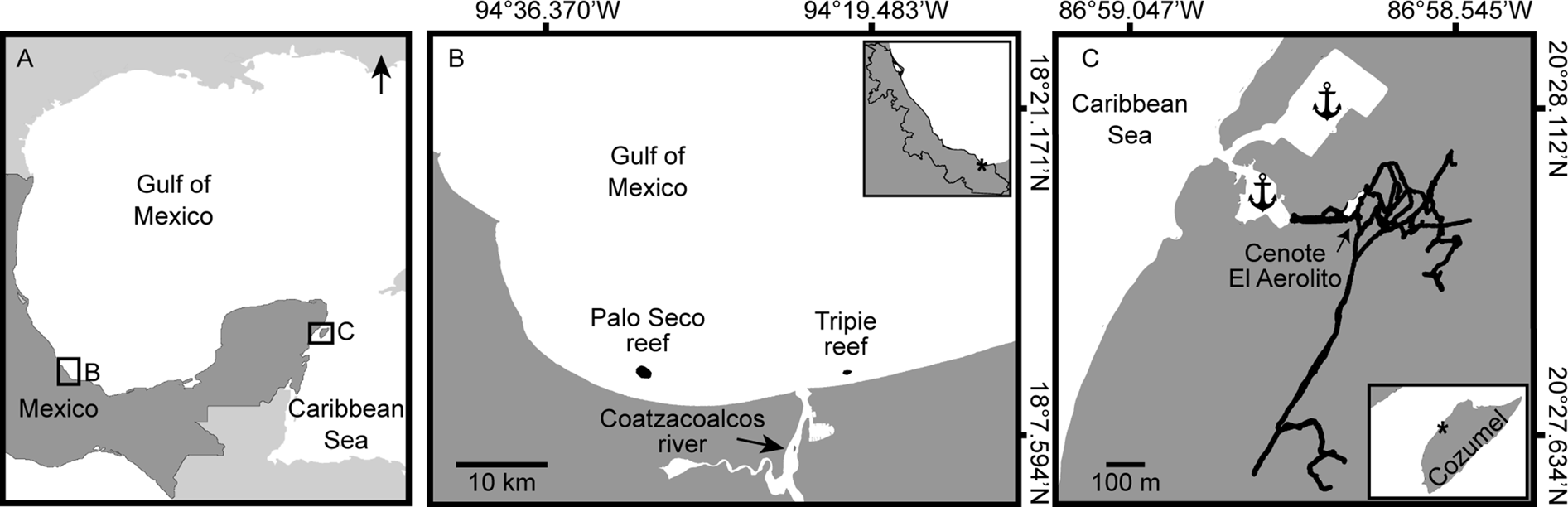
Samples of Microscleroderma were collected by hand using scuba diving techniques from Palo Seco reef (18°10.502′N 94°31.455′W) and Tripie reef (18°10.560′N 94°22.050′W), Veracruz, Mexico in June and August 2013 (Figure 1). These locations are submerged banks impacted by polluted water of the Coatzacoalcos River. The substratum consists of solid rocks covered with algae, sponges and corals. Palo Seco reef is about 400 m long and 300 m wide, with depths between 11 and 22 m. The average surface temperature is 25.4°C and the mean chlorophyll a concentration is ~8.74 mg m−3 (González-Gándara et al., Reference González-Gándara, Solís-Marín, De La Cruz-Francisco, Granados-Barba, Salas-Pérez, Argüelles-Jiménez and Escárcega-Quiroga2015; Salas-Pérez et al., Reference Salas-Pérez, Ocaña Valencia, González-Gándara, Granados-Barba, Ortiz-Lozano, Salas-Monreal and González-Gándara2015). The coral cover is 6.48% and is represented by Siderastrea siderea (Ellis & Solander, Reference Ellis and Solander1786) and Agaricia agaricites (Linnaeus, Reference Linnaeus1758) (González-Gándara, Reference González-Gándara, Pérez-Morales, Ake-Castillo, Álvarez-González and Poot-Delgado2020). Tripie reef is about 350 m long and 300 m wide and its depth varies between 6 and 15 m. The mean surface temperature is 25.9°C and the chlorophyll a concentration is ~13.08 mg m−3 (González-Gándara et al., Reference González-Gándara, Solís-Marín, De La Cruz-Francisco, Granados-Barba, Salas-Pérez, Argüelles-Jiménez and Escárcega-Quiroga2015; Salas-Pérez et al., Reference Salas-Pérez, Ocaña Valencia, González-Gándara, Granados-Barba, Ortiz-Lozano, Salas-Monreal and González-Gándara2015). The scleractinian community is represented by Oculina sp. and Pseudodiploria clivosa (Ellis & Solander, Reference Ellis and Solander1786) covering about 1% of the total benthic cover. Dense cover of sponges was observed in both reefs, in which Palo Seco sponges reached 19.6% of the total benthic cover (Gonzalez-Gándara, Reference González-Gándara, Pérez-Morales, Ake-Castillo, Álvarez-González and Poot-Delgado2020). The samples studied here were found within cavities in the reef framework, in the twilight zone, which is defined as the cave section with reduced light between the limit of plants and the region of complete darkness (Moldovan et al., Reference Moldovan, Kováč and Halse2018).
(A) Study area. (B) Coral reefs Palo Seco and Tripie in Veracruz, Mexico where Microscleroderma mexica sp. nov. was collected. (C) Anchialine cave El Aerolito (in black) on Cozumel Island, Mexico where Amphibleptula aaktun sp. nov. was collected. The cenote entrance to the cave in white (arrow); and two small craft harbours (anchors) (A, B. modified from González-Gándara et al., Reference González-Gándara, Solís-Marín, De La Cruz-Francisco, Granados-Barba, Salas-Pérez, Argüelles-Jiménez and Escárcega-Quiroga2015; C. modified from Calderón-Gutiérrez et al., Reference Calderón-Gutiérrez, Solís-Marín, Gómez, Sánchez, Hernández-Alcántara, Álvarez-Noguera and Yáñez-Mendoza2017).

Samples of Amphibleptula were collected at the dark zone, or true cave section (Moldovan et al., Reference Moldovan, Kováč and Halse2018), of the anchialine cave El Aerolito (20°27.967′N 86°58.683′W), Cozumel Island, Quintana Roo, Mexico, at >100 m away from the main entrance in July 2011 and October 2015 (Figure 1). Samples were collected by hand using cave diving techniques. A limited number of specimens were collected to avoid damage to the population (Calderón-Gutiérrez et al., Reference Calderón-Gutiérrez, Solís-Marín, Gómez, Sánchez, Hernández-Alcántara, Álvarez-Noguera and Yáñez-Mendoza2017). The El Aerolito anchialine cave is 18 km long, completely submerged, directly connected to the Caribbean Sea, and has a single sinkhole as an inlet (locally called ‘cenote’); cenote El Aerolito is the main entrance to the cave, at 240 m from the coastline. The maximum depth is 27 m, with the halocline (the vertical division between brackish and marine water) at 7 m depth. The marine groundwater mass has an average temperature of 28°C and an interannual variation of 5.5°C (Calderón-Gutiérrez et al., Reference Calderón-Gutiérrez, Sánchez-Ortiz and Huato-Soberanis2018).
Samples were preserved in 70% ethanol. Macro- and micromorphological structures were examined on permanent slides of ectosomal and choanosomal tissue and spicule types following Gómez (Reference Gómez1998). Scanning electron microscopy (SEM) used a JEOL JSM6360LV microscope for spicule preparations on stubs as well as for tissue cuts following Gómez (Reference Gómez2002) processing. Light microscopy (LM) photographs were taken with an AM SCOPE MT300 camera and edited with focus assembling techniques in Helicon Focus 5. Measurements of megascleres and microscleres were determined from 20 spicules of each type. The length of rhizoclone desmas was considered as the greatest longitude of the shaft. Type specimens and slides were deposited in the Colección Nacional del Phylum Porifera Gerardo Green (CNPGG), Instituto de Ciencias del Mar y Limnología (ICMyL), Universidad Nacional Autónoma de México (UNAM).
Results
Systematics
Class DEMOSPONGIAE Sollas, Reference Sollas1885
Order TETRACTINELLIDA Marshall, Reference Marshall1876
Suborder SPIROPHORINA Bergquist & Hogg, Reference Bergquist and Hogg1969
Family SCLERITODERMIDAE Sollas, Reference Sollas1888
Genus Microscleroderma Kirkpatrick, Reference Kirkpatrick1903
Definition
Microscleroderma Kirkpatrick, Reference Kirkpatrick1903 species are cup-, ear-shaped or tubular members of Scleritodermidae Sollas, Reference Sollas1888 with a hirsute, smooth or tuberculated concave surface; rhizoclone desmas are thorny; choanosome also may contain long oxea diactines; ectosomal megascleres absent; microscleres are sigmaspires (Kelly, Reference Kelly2007).
Type species: Microscleroderma hirsutum Kirkpatrick, Reference Kirkpatrick1903
Microscleroderma mexica sp. nov.
(Figures 2‒4, Table 1)
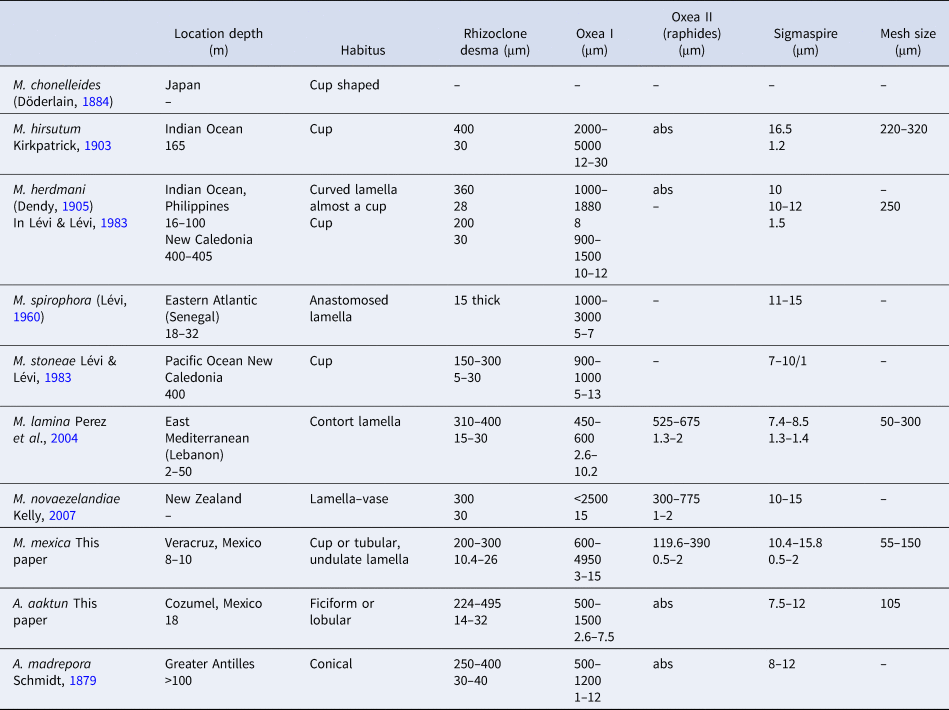
Distribution, bathymetric range, spicule (length/width) and mesh size measurements of the species belonging to Microscleroderma and Amphibleptula worldwide (according to original descriptions)

Abbreviations: (–), not recorded; abs, absent.
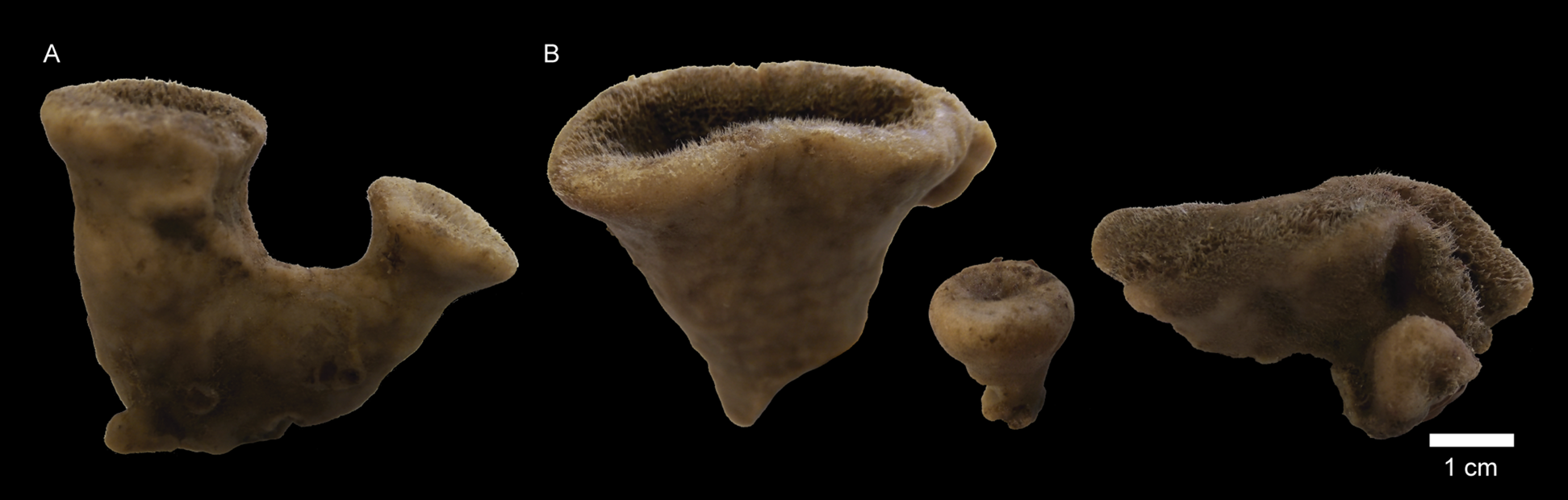
Microscleroderma mexica sp. nov.: (A) holotype CNPGG–2302 tubular habitus; (B) paratypes CNPGG–2187, CNPGG–2180, CNPGG–2181 two forms of growth, cup shaped and lamellate, respectively. All preserved in ethanol.

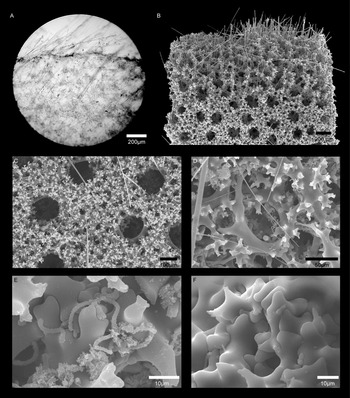
Microscleroderma mexica sp. nov. skeletal structure: (A) cross section of skeleton traversed by bundles of long oxeas, LM; (B) skeletal pattern of the laminae border, SEM; (C) even pattern of ectosomal pores, SEM; (D) detail of rhizoclone desmas with sigmaspires and oxeas; (E) detail of the clusters of sigmaspires on the desmas, SEM; (F) detail of zygosis of desmas, SEM.

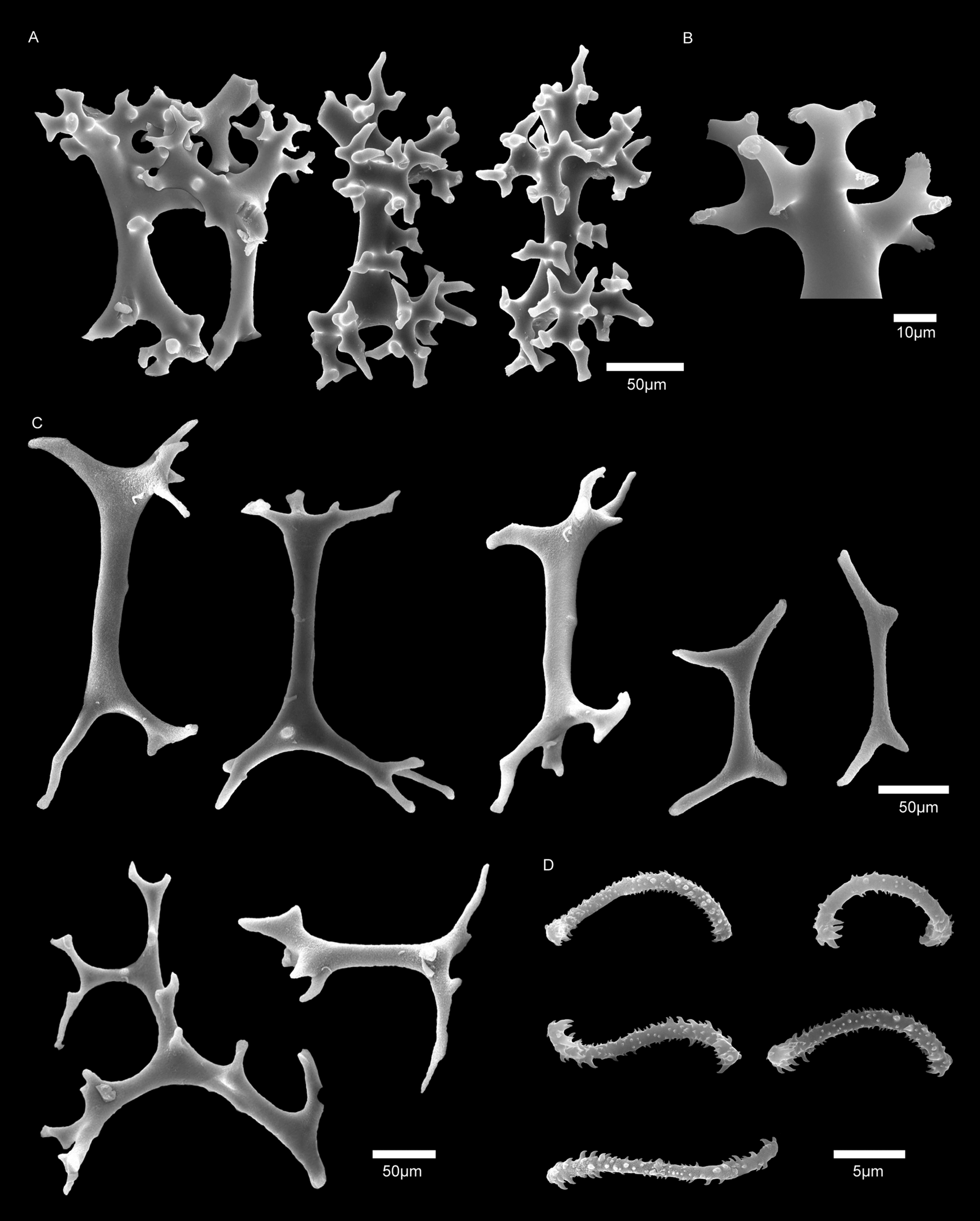
Microscleroderma mexica sp. nov. spicules: (A) rhizoclone desmas, strongly tuberculated, SEM; (B) detail of digitiform ornamentation at the tips of desmas; (C) smooth young desmas, SEM; (D) sigmaspires ‘C’ and ‘S’ shaped, SEM.

Type material
Holotype: Tubular specimen 4.5 cm in height, 5.3 cm wide, diameter of tubes 1.7‒2.2 cm; preserved in 70% ethanol. Tissue dissected and skeletal traits (skeleton and spicules) mounted on slides and SEM stubs. (Palo Seco reef, Veracruz, Mexico; coordinates: 18°10.502′N 94°31.455′W; water depth: 21 m) (CNPGG‒2302); coll. Jimmy Argüelles, 15 June 2013.
Paratypes: Cup-shaped specimen 2 cm in height, 1.8 cm upper diameter; preserved in 70% ethanol, tissue dissected and skeletal traits (skeleton and spicules) mounted on slides. (Tripie reef, Veracruz, Mexico; coordinates: 18°10.560′N 94°22.050′W; water depth: 15 m) (CNPGG‒2180); coll. Vicencio de la Cruz, 13 August 2013. Lamellate specimen 2 cm in height, 5.2 cm in length, preserved in 70% ethanol. (Palo Seco reef, Veracruz, Mexico; coordinates: 18°10.502′N 94°31.455′W; water depth: 21 m) (CNPGG‒2181); coll. Vicencio de la Cruz, 12 August 2013. Cup-shaped specimen 4.4 cm in height, 4.5 cm upper diameter, preserved in 70% ethanol. (Palo Seco reef, Veracruz, Mexico; coordinates: 18°10.502′N 94°31.455′W; water depth: 21 m) (CNPGG‒2187); coll. Jimmy Argüelles, 15 June 2013. Tubular specimen 4.2 cm in height, 2.5 cm maximum diameter, preserved in 70% ethanol. (Palo Seco reef, Veracruz, Mexico; coordinates: 18°10.502′N 94°31.455′W; water depth: 21 m) (CNPGG‒2195); coll. Jimmy Argüelles, 15 June 2013.
Description
Tubular and cup-shaped to wavy laminar shape, sometimes rolled inwards at one end resembling a tube, vertically settled or flat on the substratum. Size range of samples 2–4.5 cm in height, 4.5–5.2 cm wide, tubular processes 1.7–2.5 cm in diameter at the upper margin (Figure 2). The wall thickness in all specimens is about 4 mm. The upper margin of the tube or lamellar wall has a rounded margin and is strongly hispid owing to the oxeas that protrude up to 5 mm outside the surface. Both surfaces have small pores, 200–400 μm diameter, only observed on live organisms. Colour whitish in vivo with brownish yellow in the upper margin; preserved organisms in ethanol are brown with dark brownish areas. Consistency hard, but easy to cut.
Skeleton
The choanosomal skeleton consists of a reticulation of arched rhizoclone desmas with numerous spines in the outer curve, strongly thorny epirhabds, and joined by strong zygosis. Round skeletal meshes range from 55–150 μm. Abundant sigmaspires form clusters within concave areas of the desmas, and are also dispersed in the choanosome. Bundles of abundant oxeas diactines (20–60 μm thick) cross the ectosomal region only at the upper margins in any body shape. The ectosomal region is also characterized by the spines of the rhizoclone desmas pointing towards the surface (Figure 3).
Spicules
Rhizoclone desmas are arched and strongly spined, monocrepid, total length 200–350 μm, epirhabds 10.4–26.0 μm in diameter, provided with digitiform ornamentation at the tips, as bifid, trifid or conical processes. Young desmas, smooth, total length 117–208 μm. Oxea diactines: oxea diactines I slender and fusiform, most broken, confined to the upper margin of the lamella, 600–4950 × 3–15 μm; oxea diactines II very thin, 119–390 × 0.5–2 μm in diameter, scattered in the choanosome. Microscleres: sigmaspires, strongly spined, ‘C’ and ‘S’ shaped 10–15.8 × 0.5–2 μm (Figure 4, Table 1).
Etymology
The species name ‘mexica’ corresponds to the name of the ancient Mesoamerican people Mexica, founders of Mexico-Tenochtitlan, one of the largest states known in Mesoamerica.
Ecology and distribution
Microscleroderma mexica sp. nov. is found inside crevices at the base of reef ridges, in the twilight zone, at 15–21 m depth. Known only at the reefs of Veracruz, Mexico.
Remarks
This is the first new nominal species of Microscleroderma reported in the Western Atlantic, here reported at the western side of the Gulf of Mexico. Unknown specimens assigned as Microscleroderma sp. 1 and sp. 2 were previously listed for the region (Schuster et al., Reference Schuster, Lopez, Becking, Kelly, Pomponi, Wörheide, Erpenbeck and Cárdenas2017). The species most similar to M. mexica sp. nov. is M. novaezelandiae, known only from New Zealand, which has a curved, folded lamellae, each joined to form a tubular flared vase-like structure (Kelly, Reference Kelly2007), and thereby differs from the cup, flat or tubular shape of M. mexica sp. nov. Both lamellae surfaces of M. novaezelandiae are smooth and velvety, unlike the hirsute surface of the new species. The two species coincide in having two size categories of oxea diactines, although M. novaezelandiae has smaller oxea diactine I (<2500 μm), and larger oxea diactine II (532–775 μm) than M. mexica sp. nov. The new species is also comparable to M. hirsutum, known only from the Indian Ocean, which has a cup shape and short supporting pedicel, an inner surface covered with raised oscules, an outer surface pilose and corrugated, and a regular skeleton that is honeycomb-like. Microscleroderma hirsutum has a similar oxea diactine I (2000–5000 × 12–30 μm), but lacks the oxea diactine II, and has longer and thicker desmas (400 × 30 μm) and sigmaspires (16.5 μm) than M. mexica sp. nov. (Kirkpatrick, Reference Kirkpatrick1903). The lamellate shape of M. mexica sp. nov. is also similar to M. lamina Perez, Vacelet, Bitar & Zibrowius, Reference Perez, Vacelet, Bitar and Zibrowius2004. However, M. lamina has contorted lamellae, larger growth size (up to 55 cm), and surface with protuberances on both sides of the lamellae, which differ from the new species. Microscleroderma lamina also differ in the size of the spicules: oxea diactine I is smaller (450–600 × 2.6–10.2 μm), oxea diactine II is larger (525–675 × 1.3–2 μm) and sigmaspires are smaller (7.4–8.5 μm) than M. mexica sp. nov. Additionally, the disjunctive environmental and geographic ranges separate M. mexica sp. nov. Comparisons with the new species of Amphibleptula are provided below.
Genus Amphibleptula Schmidt, Reference Schmidt1879
Definition
The genus Amphibleptula Schmidt, Reference Schmidt1879 is a massive conical to lobular member of the Scleritodermidae, having rhizoclone desmas highly tuberculated with long oxeas, and having sigmaspires as microscleres. Ectosomal megascleres absent. The body surface shows one or several exhalant areas formed by groups of oscules, each exhalant area resembling the vertical septa found in corals. The inhalant area consists of warts uniformly arranged or dispersed on the surface, each provided with pores. Some of the warts are surrounded by oxeas that protrude beyond their margin.
Remarks
We propose the redefinition of the genus Amphibleptula by comparing the morphological characteristics from the literature (Schmidt, Reference Schmidt1879, Sollas, Reference Sollas1888; Van Soest & Stentoft, Reference Van Soest and Stentoft1988; Pisera & Lévi, Reference Pisera, Lévi, Hooper and Van Soest2002) and those observed in Microscleroderma mexica sp. nov. and Amphibleptula aaktun sp. nov. A defined pattern of characteristics from each genus (see above) helped to compare and distinguish the records cited in the literature with those of the new species. However, molecular studies are needed to demonstrate the status of these two genera.
Type species: Amphibleptula madrepora Schmidt, Reference Schmidt1879
Amphibleptula aaktun sp. nov.
(Figures 5 and 6, Table 1)
Microscleroderma sp.: Calderón-Gutiérrez et al., Reference Calderón-Gutiérrez, Solís-Marín, Gómez, Sánchez, Hernández-Alcántara, Álvarez-Noguera and Yáñez-Mendoza2017; Calderón-Gutiérrez et al., Reference Calderón-Gutiérrez, Sánchez-Ortiz and Huato-Soberanis2018.
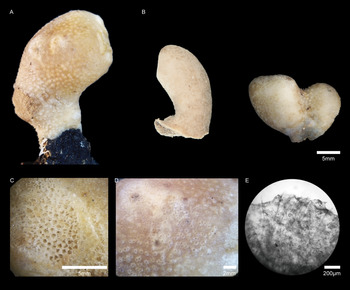
Amphibleptula aaktun sp. nov.: (A) holotype CNPGG‒1534 ficiform habitus; (B) paratypes CNPGG‒1524 ficiform and CNPGG‒1536 lobular, preserved in ethanol; (C) exhalant area with numerous open vertical canals, divided by septa, LM; (D) warty surface with open pores (inhalant area), LM; (E) cross section of skeleton traversed by bundles of oxeas, LM.

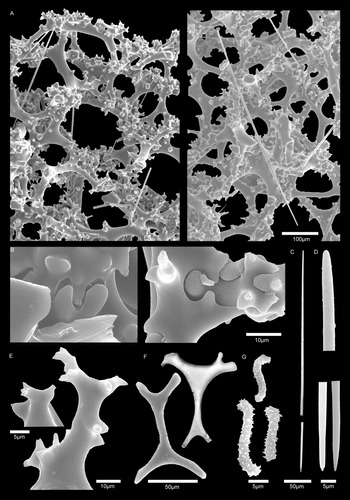
Amphibleptula aaktun sp. nov. skeleton and spicules: (A) skeletal structure with detail of rhizoclone desmas, tuberculated epirhabd and oxeas, SEM; (B) detail of zygosis of desmas, SEM; (C) oxeas, LM; (D) detail of oxea tips, SEM; (E) detail of digitiform ornamentation of desma zygosis; (F) smooth young desmas, SEM; (G) sigmaspires, SEM.

Type material
Holotype: Ficiform specimen, 3 cm in height, 1.7 cm at the widest diameter; preserved in 70% ethanol. Tissue dissected and skeletal traits (skeleton and spicules) mounted on slides and SEM stubs. (El Aerolito anchialine cave, Cozumel Island, Quintana Roo, Mexico; coordinates: 20°27.967′N 86°58.683′W; water depth: 17.6 m, water temperature: 26.3°C) (CNPGG‒1534); coll. German Yañez Mendoza and Fernando Calderón-Gutiérrez, 21 October 2015.
Paratypes: Lobular elongated specimen 2.6 cm long, 1.0 cm in height, preserved in 70% ethanol. (El Aerolito anchialine cave, Cozumel Island, Quintana Roo, Mexico; coordinates 20°27.967′N 86°58.683′W; water depth: 18 m, water temperature: 27.5°C) (CNPGG‒1523); coll. German Yañez Mendoza and Fernando Calderón-Gutiérrez, 9 July 2011. Ficiform specimen 2 cm in height, 10 mm widest diameter; preserved in 70% ethanol. Tissue and skeletal traits (skeleton and spicules) mounted on slides. (El Aerolito anchialine cave, Cozumel Island, Quintana Roo, Mexico; coordinates 20°27.967′N 86°58.683′W; water depth: 18 m, water temperature: 17.6°C) (CNPGG‒1524); coll. Fernando Calderón-Gutiérrez and German Yañez Mendoza, 9 July 2011. Two specimens ficiform and lobular; preserved in 70% ethanol. (El Aerolito anchialine cave, Cozumel Island, Quintana Roo, Mexico; coordinates 20°27.967′N 86°58.683′W; water depth: 17.6 m, water temperature: 26.3°C) (CNPGG‒1535, CNPGG‒1536); coll. German Yañez Mendoza and Fernando Calderón-Gutiérrez, 21 October 2015.
Description
Ficiform or lobular sponge with a flat top. Size range 1.7‒3 cm in height, 1.0‒1.9 cm widest diameter (Figure 5A, B). Surface tuberculated with small warts evenly distributed, 400‒500 μm diameter, containing 1–2 pores each 100‒200 μm diameter, corresponding to the inhalant area. The basal and concave pores are provided with protruding oxeas around them. According to the body size, it has 1–4 circular exhalant areas 7.5 mm diameter, slightly elevated or flush to the surface: one on the flat top of the sponge, and the others are scattered on the side walls. These areas are divided into numerous vertical septa-like structures, that correspond to the exhalant canals 200‒350 μm diameter, articulated by desmas forming a grid. Colour pale beige in vivo, preserved organisms in ethanol are light brown. Consistency hard, incompressible.
Skeleton
Ectosomal skeleton consisting of rhizoclone desmas, traversed by a series of thin bundles of diactines 15–21 μm thick, perpendicular to the surface. Scattered sigmaspires displayed all over the ectosomal skeleton and choanosome. Choanosomal skeleton formed by rhizoclone desmas, joined by strong articulation; few young desmas, without a specific distribution pattern; in a well-defined but tightly close circular mesh ~105 μm diameter (Figure 6).
Spicules
Rhizoclone desmas arched, strongly spined and blunt (tuberculated), total length 224.3–495 μm, epirhabds 14.4–32 μm in diameter, endings distally in tiny digitiform protuberances. Young desmas, smooth. Diactines, styles/oxeas smooth and straight, 500–1500 × 2.6–7.5 μm, most broken; the acute tips can be stepped and conical. Sigmaspires with blunt spines, barely in ‘S’ or ‘C’ shapes, sometimes almost straight, 7.5–12 × 1.4–2.0 μm (Figure 6, Table 1).
Etymology
The word ‘aaktun’ means cave in the Mayan language, in reference to the habitat of the new species.
Ecology and distribution
This species, restricted to aquatic cave environments, is classified as stygobite; this is in accordance with the Racovitza classification for cave fauna but with the prefix ‘troglo-’ replaced by the prefix ‘stygo-’ as used for aquatic cave fauna (Moldovan et al., Reference Moldovan, Kováč and Halse2018). A previous quantitative study inside the cave found that the population of A. aaktun is small and the extinction risk needs to be assessed (Calderón-Gutiérrez et al., Reference Calderón-Gutiérrez, Sánchez-Ortiz and Huato-Soberanis2018). It is known only at the anchialine cave El Aerolito in Cozumel, at 18 m depth.
Remarks
The genus Amphibleptula has hitherto been a monospecific taxon. Amphibleptula has been confused with Microscleroderma; however, Amphibleptula has (1) a structure moulded by vertical special septa resembling those on corals, (2) exhalant areas provided with cluster of oscules, (3) inhalant areas formed by warts that contain the pores, evenly displayed or scattered on the surface, and (4) oxea diactines protruding only on pore areas.
Amphibleptula aaktun sp. nov. is distinguished from A. madrepora by smaller and evenly warty pores (100–200 μm diameter) in A. aaktun sp. nov., while A. madrepora has scattered or evenly distributed pores (200–500 μm diameter) on warts. In A. aaktun sp. nov. only the basal and concave pores have protruding oxeas (extending ≤1500 μm beyond the surface), not recorded in A. madrepora. Amphibleptula aaktun sp. nov. has thinner desma epirhabds (diameter 14.4–32 μm vs 30–40 μm in A. madrepora) and oxea diactine (2.6–6.7 μm vs 1–12 μm in A. madrepora). In addition, their habitats differ: A. aaktun sp. nov. in an anchialine cave at a depth of 18 m; and A. madrepora in the deep-sea at 100–534 m, with one record at 15 m (Schmidt, Reference Schmidt1879; Sollas, Reference Sollas1888; Van Soest & Stentoft, Reference Van Soest and Stentoft1988; Pomponi et al., Reference Pomponi, Kelly, Reed and Wright2001).
The Sponge Barcoding Project has two records of Amphibleptula sp. (#1802, #1803): from Jamaica (453 m depth) and from Turks and Caicos (520 m depth). Those records include only pictures of the organisms and skeletal arrangement, record #1802 also including spicule images (Sponge Barcoding Project, accessed online 9 October 2020). However, those records correspond to deep-sea specimens that differ from A. aaktun sp. nov. in their external morphology and skeletal arrangement, and therefore cannot be considered as conspecific.
The external morphology of Pomelia schmidti Zittel, Reference Zittel1878, from Florida (shown in Zittel, Reference Zittel1878: 126, table 1, fig. 4) is similar to A. aaktun sp. nov. However, the skeleton of P. schmidti has neither oxeas, nor sigmaspires. It is difficult to assess the morphological detail on the drawings of the rhizoclone desmas, which are depicted as highly verrucose. It is not possible to compare the spicule sizes, since Zittel (Reference Zittel1878) did not record them. The depth of P. schmidti is unknown; however, it was probably from the deep-sea since it was collected by Professor O. Schmidt who usually studied deep-sea organisms. Furthermore, P. schmidti is considered a taxon inquirendum, and the type is a ‘deciduous’ specimen, whose name is considered a senior synonym of Amphibleptula (Pisera & Lévi, Reference Pisera, Lévi, Hooper and Van Soest2002; Van Soest et al., Reference Van Soest, Boury-Esnault, Hooper, Rützler, de Voogd, Alvarez, Hajdu, Pisera, Manconi, Schöenberg, Klautau, Kelly, Vacelet, Dohrmann, Díaz, Cárdenas, Carballo, Ríos, Downey and Morrow2020).
Discussion
Species of Microscleroderma have been described from the Pacific Ocean, the Indian Ocean, Eastern Atlantic and Mediterranean (Kirkpatrick, Reference Kirkpatrick1903; Lévi, Reference Lévi1960; Lévi & Lévi, Reference Lévi and Lévi1983; Perez et al., Reference Perez, Vacelet, Bitar and Zibrowius2004; Kelly, Reference Kelly2007), and specimens have been listed to genus level in the Western Atlantic (Schuster et al., Reference Schuster, Lopez, Becking, Kelly, Pomponi, Wörheide, Erpenbeck and Cárdenas2017). This is the first record of a nominal Microscleroderma species in the Western Atlantic, with M. mexica sp. nov. in the crevices of two reefs on the south-western Gulf of Mexico. The genus Amphibleptula was previously known only from Cuba, Barbados and St Vincent (Schmidt, Reference Schmidt1879; Sollas, Reference Sollas1888; Van Soest & Stentoft, Reference Van Soest and Stentoft1988; Pomponi et al., Reference Pomponi, Kelly, Reed and Wright2001). Amphibleptula aaktun sp. nov. is the second species of the genus, and the first record of Amphibleptula in Mexico, inhabiting an anchialine cave on Cozumel Island.
The species described here clearly concur with the skeletal and morphological concepts of Microscleroderma and Amphibleptula as described by Pisera & Lévi (Reference Pisera, Lévi, Hooper and Van Soest2002). However, we redefine the genus Amphibleptula to include the lobular shape and to describe the exhalant and inhalant areas. The morphological differences and the disjunctive environmental distributions justify this consideration of the material as two new species (Table 1).
Previous molecular work on phylogenies has established strong support for the family Scleritodermidae (Morrow et al., Reference Morrow, Redmond, Picton, Thacker, Collins, Maggs, Sigwart and Allcock2013; Hill et al., Reference Hill, Hill, Lopez, Peterson, Pomponi, Diaz, Thacker, Adamska, Boury-Esnault, Cárdenas, Chaves-Fonnegra, Danka, De Laine, Formica, Hajdu, Lobo-Hajdu, Klontz, Morrow, Patel, Picton, Pisani, Pohlmann, Redmond, Reed, Richey, Riesgo, Rubin, Russell, Rützler, Sperling, di Stefano, Tarver and Collin2013; Schuster et al., Reference Schuster, Erpenbeck, Pisera, Hooper, Bryce, Fromont and Wörheide2015, Reference Schuster, Lopez, Becking, Kelly, Pomponi, Wörheide, Erpenbeck and Cárdenas2017; Kelly & Cárdenas, Reference Kelly and Cárdenas2016). However, the position of Amphibleptula within the family Scleritodermidae needs to be resolved, since it has not been included in molecular studies (Van Soest & Stentoft, Reference Van Soest and Stentoft1988; Cárdenas et al., Reference Cárdenas, Pérez and Boury-Esnault2012; Schuster et al., Reference Schuster, Erpenbeck, Pisera, Hooper, Bryce, Fromont and Wörheide2015, Reference Schuster, Lopez, Becking, Kelly, Pomponi, Wörheide, Erpenbeck and Cárdenas2017).
Despite the increased number of studies on sponges around the reef structures of the southern Gulf of Mexico, no ‘lithistid’ sponges have been reported (Green, Reference Green1977; Green et al., Reference Green, Fuentes and Gómez1986; Gómez, Reference Gómez2002, Reference Gómez, Granados-Barba, Abarca-Arenas and Vargas-Hernández2007; González-Gándara et al., Reference González-Gándara, Patiño-García, Asís-Anastasio, Serrano and Gómez2009; De la Cruz-Francisco & González-González, Reference De la Cruz-Francisco and González-González2016; Schuster et al., Reference Schuster, Lopez, Becking, Kelly, Pomponi, Wörheide, Erpenbeck and Cárdenas2017; Carmona-Islas et al., Reference Carmona-Islas, Morales-García, Hernández-Mendiola, Gama-Villasana and Colmenares-Campos2019; De la Cruz-Francisco et al., Reference De la Cruz-Francisco, Argüelles, Rodríguez-Muñoz, León-Méndez and Duran-López2019). Desmanthus incrustans (as Aciculites incrustans) is the only ‘lithistid’ sponge reported at the south-eastern Gulf of Mexico (Topsent, Reference Topsent1889), even though some inventories on sponge diversity have been conducted there (Hartman, Reference Hartman1955; Gómez, Reference Gómez2002; Ugalde et al., Reference Ugalde, Gómez and Simoes2015). The lack of ‘lithistid’ records in that region is probably because most studies are from shallow environments, whereas ‘lithistids’ are usually distributed deeper than 100 m (Pomponi et al., Reference Pomponi, Kelly, Reed and Wright2001). In contrast, shallow anchialine caves on Cozumel Island (<20 m depth) have yielded records of nine ‘lithistid’ species (Calderón-Gutiérrez et al., Reference Calderón-Gutiérrez, Solís-Marín, Gómez, Sánchez, Hernández-Alcántara, Álvarez-Noguera and Yáñez-Mendoza2017; Gómez & Calderón-Gutiérrez, Reference Gómez and Calderón-Gutiérrez2020). Several taxa with a tendency to inhabit the deep-sea have also been identified in the dark zone of shallow caves with characteristics similar to those of the deep-sea, such as lack of light, limited food and low oxygen availability (Hart et al., Reference Hart, Manning and Iliffe1985; Vacelet, Reference Vacelet1996; Iliffe et al., Reference Iliffe, Kvitek, Blasco, Blasco and Covill2011; Gonzalez et al., Reference Gonzalez, Martínez, Borda, Iliffe, Fontaneto and Worsaae2017; Gómez & Calderón-Gutiérrez, Reference Gómez and Calderón-Gutiérrez2020). Consequently, the high species richness of ‘lithistid’ demosponges (nine species) in the shallow anchialine caves from Cozumel is not unexpected, despite the paucity of shallow records of ‘lithistid’ fauna in the TWA (Schmidt, Reference Schmidt1870, Reference Schmidt1879, Reference Schmidt1880; Van Soest & Zea, Reference Van Soest and Zea1986; Van Soest & Stentoft, Reference Van Soest and Stentoft1988; Pisera, Reference Pisera1999; Van Soest & Hajdu, Reference Van Soest and Hajdu2000; Pomponi et al., Reference Pomponi, Kelly, Reed and Wright2001; Hajdu & Lopes, Reference Hajdu, Lopes, Custódio, Lobo-Hajdu, Hajdu and Muricy2007; Rützler et al., Reference Rützler, Piantoni, Van Soest and Díaz2014; Van Soest, Reference Van Soest2017; Pomponi et al., Reference Pomponi, Diaz, Van Soest, Bell, Busutil, Gochfeld, Kelly, Slattery, Loya, Puglise and Bridge2019; Gómez & Calderón-Gutiérrez, Reference Gómez and Calderón-Gutiérrez2020).
Amphibleptula aaktun sp. nov. is here considered endemic to the anchialine cave El Aerolito since it has not been observed from other shallow, deep-sea and cave environments of Cozumel Island, the Greater Caribbean and the Western Atlantic (e.g. Gómez & Green, Reference Gómez and Green1984; Maas-Vargas, Reference Maas-Vargas1994; Gómez, Reference Gómez2002; Rützler et al., Reference Rützler, Piantoni, Van Soest and Díaz2014; Van Soest et al., Reference Van Soest, Meesters and Becking2014; Van Soest, Reference Van Soest2017; Pomponi et al., Reference Pomponi, Diaz, Van Soest, Bell, Busutil, Gochfeld, Kelly, Slattery, Loya, Puglise and Bridge2019; Gómez & Calderón-Gutiérrez, Reference Gómez and Calderón-Gutiérrez2020). Hence, there are now seven endemic sponge species in the anchialine caves of Cozumel Island, six in La Quebrada (Gómez & Calderón-Gutiérrez, Reference Gómez and Calderón-Gutiérrez2020) and one in El Aerolito. Conversely, we consider that Microscleroderma mexica sp. nov. might have a wider distribution range since there have been only a few studies in the area (e.g. Green, Reference Green1977; Green et al., Reference Green, Fuentes and Gómez1986; Gómez, Reference Gómez2002, Reference Gómez, Granados-Barba, Abarca-Arenas and Vargas-Hernández2007; González-Gándara et al., Reference González-Gándara, Patiño-García, Asís-Anastasio, Serrano and Gómez2009; De la Cruz-Francisco & González-González, Reference De la Cruz-Francisco and González-González2016; Carmona-Islas et al., Reference Carmona-Islas, Morales-García, Hernández-Mendiola, Gama-Villasana and Colmenares-Campos2019; De la Cruz-Francisco et al., Reference De la Cruz-Francisco, Argüelles, Rodríguez-Muñoz, León-Méndez and Duran-López2019), and open-water ecosystems have a greater connectivity.
Unfortunately, the habitats of the two species described here are already subject to anthropogenic impacts. Tripie and Palo Seco reefs, Veracruz, are highly contaminated by the sewage from the Coatzacoalcos River (Wong-Chang & Barrera Escorcia, Reference Wong-Chang, Barrera-Escorcia, Botello, Rendón-von Osten, Gold-Bouchot and Agraz-Hernández2005; Salas-Pérez et al., Reference Salas-Pérez, Ocaña Valencia, González-Gándara, Granados-Barba, Ortiz-Lozano, Salas-Monreal and González-Gándara2015). El Aerolito anchialine cave, Cozumel Island, has two small harbours at its entrance and urban development at the surface above the cave (Gómez & Calderón-Gutiérrez, Reference Gómez and Calderón-Gutiérrez2020). Thus, it is necessary to further investigate the distribution of each species and evaluate the risk of extinction.
Acknowledgements
We thank the following: Instituto de Ciencias del Mar y Limnología, Universidad Nacional Autónoma de México. German Yañez and Círculo Espeleológico del Mayab A. C. for their support during the fieldwork in Cozumel; Yolanda Hornelas Orozco for the SEM micrographs. We thank Ann Grant and T. M. Iliffe for the English proofreading; and anonymous reviewers whose valuable comments improved the present manuscript.
Financial support
This work was supported by the Consejo Nacional de Ciencia y Tecnología (F.C.G., grant numbers 334824, 472273); and Comisión Nacional para el Conocimiento y Uso de la Biodiversidad (C.G.G., grant numbers FB1628/JF124/12).