Introduction
Hoarding is a common but under-recognized social behavior that when severe is quite maladaptive and results in significant morbidity and mortality (Frost et al. Reference Frost, Steketee and Williams2000a , Reference Frost, Steketee, Williams and Warren b ; Tolin et al. Reference Tolin, Frost, Steketee and Fitch2008). Pathological hoarding is defined as the excessive acquisition of and/or inability or unwillingness to discard seemingly useless items, causing significant distress or functional impairment, and resulting in living and/or work spaces that are unusable for their intended purposes (Frost & Gross, Reference Frost and Gross1993; Steketee & Frost, Reference Steketee and Frost2003). The population prevalence of clinically significant pathological hoarding is between 2 and 4%, and increases substantially over the age of 55 years, where the prevalence is over 6% (Frost & Gross, Reference Frost and Gross1993; Best-Lavigniac, Reference Best-Lavigniac2006; Grisham et al. Reference Grisham, Frost, Steketee, Kim and Hood2006; Iervolino et al. Reference Iervolino, Perroud, Fullana, Guipponi, Cherkas, Collier and Mataix-Cols2009; Timpano et al. Reference Timpano, Exner, Glaesmer, Rief, Keshaviah, Brähler and Wilhelm2011). Pathological hoarding is a chronic problem, and is associated with high levels of distress, functional impairment, social disruption and maladjustment (low marriage rates, high social anxiety, work loss, and withdrawal) (Frost et al. Reference Frost, Steketee and Williams2000a , Reference Frost, Steketee, Williams and Warren b ; Kim et al. Reference Kim, Steketee and Frost2001, Tolin et al. Reference Tolin, Frost and Steketee2007; Ayers et al. Reference Ayers, Saxena, Golshan and Wetherell2010).
Although previously classified as a subtype of obsessive–compulsive disorder (OCD), multiple lines of evidence suggest that pathological hoarding is etiologically distinct, and, for this reason, hoarding disorder (HD) appears in the Diagnostic and Statistical Manual of Mental Disorders, fifth edition (DSM-5) as a new diagnosis (Pertusa et al. Reference Pertusa, Fullana, Singh, Alonso, Menchón and Mataix-Cols2008, Reference Pertusa, Frost, Fullana, Samuels, Steketee, Tolin, Saxena, Leckman and Mataix-Cols2010; Mataix-Cols et al. Reference Mataix-Cols, Frost, Pertusa, Clark, Saxena, Leckman, Stein, Matsunaga and Wilhelm2010; APA, 2013). Hoarding symptoms commonly co-occur with OCD, however, and there is evidence of genetic overlap between these disorders from family studies (Lochner et al. Reference Lochner, Kinnear, Hemmings, Seller, Niehaus, Knowles, Daniels, Moolman-Smook, Seedat and Stein2005; Samuels et al. Reference Samuels, Bienvenu, Pinto, Fyer, McCracken, Rauch, Murphy, Grados, Greenberg, Knowles, Piacentini, Cannistraro, Cullen, Riddle, Rasmussen, Pauls, Willour, Shugart, Liang, Hoehn-Saric and Nestadt2007; Saxena, Reference Saxena2007; Mathews et al. Reference Mathews, Nievergelt, Azzam, Garrido, Chavira, Wessel, Bagnarello, Reus and Schork2007; Pertusa et al. Reference Pertusa, Fullana, Singh, Alonso, Menchón and Mataix-Cols2008; Katerberg et al. Reference Katerberg, Delucchi, Stewart, Lochner, Denys, Stack, Andresen, Grant, Kim, Williams, den Boer, van Balkom, Smit, van Oppen, Polman, Jenike, Stein, Mathews and Cath2010; Mataix-Cols et al. Reference Mataix-Cols, Frost, Pertusa, Clark, Saxena, Leckman, Stein, Matsunaga and Wilhelm2010). The etiological relationships between HD and OCD are complex, and additional information on the heritabilities and genetic relationships between these phenotypes is needed to inform future genetic and other etiological studies.
To date, only a few twin studies have been published examining the heritability of hoarding symptoms (Iervolino et al. Reference Iervolino, Perroud, Fullana, Guipponi, Cherkas, Collier and Mataix-Cols2009, Reference Iervolino, Rijsdijk, Cherkas, Fullana and Mataix-Cols2011; Taylor et al. Reference Taylor, Jang and Asmundson2010; Ivanov et al. Reference Ivanov, Mataix-Cols, Serlachius, Lichtenstein, Anckarsäter, Chang, Gumpert, Lundström, Långström and Rück2013; Nordsletten et al. Reference Nordsletten, Monzani, Fernández de la Cruz, Iervolino, Fullana, Harris, Rijsdijk and Mataix-Cols2013). The earliest found that 42% of the phenotypic variance of hoarding was attributable to genetic factors in 167 monozygotic (MZ) and 140 dizygotic (DZ) male and female twin pairs from Canada; sex differences in heritability were not examined (Taylor et al. Reference Taylor, Jang and Asmundson2010). Two subsequent studies used different assessment tools to examine the heritability of hoarding in the same sample of female twin pairs (4355 twins in 2053 twin pairs) aged 16 years and older (mean age 55 years) from the TwinsUK twin registry. The genetic contribution to hoarding symptoms was about 50%, with 45% of the genetic variance shared with other OCS dimensions, and 55% of the variance specific to hoarding (Iervolino et al. Reference Iervolino, Perroud, Fullana, Guipponi, Cherkas, Collier and Mataix-Cols2009, Reference Iervolino, Rijsdijk, Cherkas, Fullana and Mataix-Cols2011). A study in 15-year-old male and female twins from the Swedish Twin Register (3974 twins in 1555 twin pairs) found a substantial genetic component to hoarding for males only, with 35% of the phenotypic variance explained by genes. There was also a familial resemblance in females (32%), but this was ascribed to shared environment (Ivanov et al. Reference Ivanov, Mataix-Cols, Serlachius, Lichtenstein, Anckarsäter, Chang, Gumpert, Lundström, Långström and Rück2013). Thus, there appears to be some evidence for a genotype × sex interaction in the etiology of hoarding, at least in young twins (Ivanov et al. Reference Ivanov, Mataix-Cols, Serlachius, Lichtenstein, Anckarsäter, Chang, Gumpert, Lundström, Långström and Rück2013). However, this sample also included 444 opposite-sex twin pairs, whose significant correlation of 0.16 for hoarding cannot be explained if familial resemblance is genetic in men and environmental in women.
The relationship between the three core characteristics of hoarding behavior, i.e. excessive acquisition, difficulty discarding, and excessive clutter, is not yet fully understood. It has been suggested that difficulty discarding may be the primary determinant of pathological hoarding, and that excessive acquisition is a secondary behavior that occurs in some, but not all, cases, while cluttering is thought of as a non-specific symptom that occurs across a variety of disorders (Mataix-Cols et al. Reference Mataix-Cols, Frost, Pertusa, Clark, Saxena, Leckman, Stein, Matsunaga and Wilhelm2010). The only previous study to assess the genetic contributions to specific hoarding symptoms found heritabilities of 0.45 for difficulty discarding and 0.49 for excessive acquisition, as well as a significant genetic correlation between the two in the UK twin sample (0.77) (Nordsletten et al. Reference Nordsletten, Monzani, Fernández de la Cruz, Iervolino, Fullana, Harris, Rijsdijk and Mataix-Cols2013). However, the role of genetics and environment in the development of cluttering has not yet been examined. As cluttering is a very common symptom in pathological hoarding, developing a better understanding of the etiology of this behavior is important.
Therefore, the primary aims of our study were to replicate and expand upon previous results by examining the genetic and environmental contributions to hoarding and obsessive–compulsive symptoms (OCS) in an independent population-based twin sample that includes both male, female and opposite-sex twin pairs. Specifically, we aimed to: (1) quantify the shared and independent genetic contributions to hoarding and OCS; (2) examine whether sex differences play a role in the etiology of hoarding; and (3) examine the genetic and environmental contributions to the three main symptom types that make up hoarding behaviors – problematic cluttering, excessive acquiring, and difficulty discarding.
Method
Participants
Participants were adults registered with the Netherlands Twin Register (NTR), which includes twin pairs and their extended family members (for details, see online Supplementary material). A total of 15 914 participants completed one or both of the OCS and hoarding scales. The final twin sample included 7567 individuals from 5064 twin pairs. A total of 2503 twin pairs were complete, while 2561 had data available for only one of the two twins. All data from pairs where at least one twin had available data were included in the analyses (online Supplementary Table S1). Ethical approval for the study was obtained from the Medical Ethical Committee of the VU University Medical Center.
Assessment instruments
The assessment instruments consisted of the Hoarding Rating Scale-Self-Report (HRS-SR) and the Padua Inventory Abbreviated Revised (PI-ABBR) (see online Supplementary material). The HRS-SR contains five items that assess cluttering, difficulty discarding, problems with excessive acquiring or collecting, functional impairment, and distress from hoarding symptoms, each on a 0–8 scale (Tolin et al. Reference Tolin, Frost and Steketee2010). Due to restrictions in the number of items approved for inclusion in the larger participant questionnaire, the impairment item of the HRS-SR (item 4) was eliminated for this study. The PI-ABBR is a 12-item questionnaire derived from the larger 41-item Padua Inventory that contains two to three items from each of five OCS dimensions, including checking, impulses, precision, rumination, and washing (Cath et al. Reference Cath, van Grootheest, Willemsen, van Oppen and Boomsma2008). Each item is scored on a 0–4 scale. Because the data were not normally distributed, but rather exhibited a right skew (online Supplementary Fig. S1), a liability threshold model was used, and a categorical variable was generated for each measure using several cut points across the entire distribution of scores (Cath et al. Reference Cath, van Grootheest, Willemsen, van Oppen and Boomsma2008; van Grootheest et al. Reference van Grootheest, Bartels, van Beijsterveldt, Cath, Beekman, Hudziak and Boomsma2008; Iervolino et al. Reference Iervolino, Perroud, Fullana, Guipponi, Cherkas, Collier and Mataix-Cols2009). The liability threshold model assumes that the risk, or liability, for a given trait (i.e. hoarding or OCS) is normally distributed in the population, but is not directly measured. In this model, categorical data, such as presence or absence of a diagnosis or multiple categorical cut-offs in a questionnaire aimed at measuring the trait, are considered to be a measure (although imprecise) of this underlying liability to disease; the presence of disease, for example, represents the extreme end of the underlying liability distribution. The HRS-SR was divided into four categories (total scores of 0, 1–4, 5–9, and ⩾10), with roughly equal numbers of individuals in each category (Iervolino et al. Reference Iervolino, Perroud, Fullana, Guipponi, Cherkas, Collier and Mataix-Cols2009). Symptom-specific questions (excessive clutter, difficulty discarding and excessive acquiring) and the distress question were each divided into four categories, with scores of 0, 1, 2–3, and 4 and above. We also examined the heritability of the hoarding phenotype using cut-offs (scores of 0, 1–5, 6–16, and ⩾17) that more closely approximate clinical patterns (no hoarding, mild symptoms, subclinical hoarding, and clinically significant hoarding), but had unequal distributions of individuals within each group, to determine the stability of the heritability estimates. The PI-ABBR was divided into four categories based on the previous literature (scores of 0, 1–6, 7–15, and ⩾16) (Cath et al. Reference Cath, van Grootheest, Willemsen, van Oppen and Boomsma2008).
Analysis
In order to assess the population prevalence and characteristics of hoarding symptoms, means, standard deviations and distributions were calculated for both measures along with rates of clinically significant symptoms in the entire sample of 15 914 individuals. Conducting these analyses takes full advantage of the entire age range available, thus increasing the generalizability of the results. Phenotypic correlations within the sample were calculated using Kendall's tau, as the measures are not normally distributed. Polychoric twin correlations, i.e. correlations on the underlying liability scale, were calculated using Mplus (http://www.statmodel.com/) for both the HRS-SR and the PI-ABBR in MZ and DZ twin pairs by sex, and in the total MZ and DZ samples (including all twin pairs of both sexes). All twin data were analysed, i.e. from complete and incomplete pairs.
Genetic model fitting
Genetic model fitting was conducted in Mplus using the weighted least squares mean and variance adjusted (WLSMV) estimation option (Prescott, Reference Prescott2004). Genetic and environmental influences on hoarding and OCS were calculated using the liability thresholds described above. Univariate analyses were conducted to identify the relative contributions of additive genetic (A), common environmental (C) factors shared by family members, and non-shared or unique environmental (E) factors, along with the standard errors and associated significance values, to each phenotype. Univariate genetic models were examined for OCS, hoarding, and the three specific hoarding symptoms (cluttering, discarding and acquiring), in addition to the distress item. To partition the covariance between hoarding and OCS into genetic and environmental components, bivariate genetic models were examined. Bivariate models were fitted to the OCS and hoarding data.
The effects of the sex × genotype interaction were examined in a five-group model (MZ male, MZ female, DZ male, DZ female, and DZ opposite-sex twin pairs) for all phenotypes. A potential role for differing contributions of genes and the environment in males and females was examined for each trait by freeing up the genetic correlations in opposite-sex twin pairs rather than constraining them to 0.5 in the model-fitting analyses. By using WLSMV for estimation, all data were included in the analysis. The full genetic model, where sex differences were allowed, was then compared with a constrained model, where genetic contributions for males and females were set to equal, using the Wald test of parameter constraints.
Results
Means and distribution of hoarding and OCS
Table 1 shows the demographic characteristics of the sample. The mean age of the entire sample was 41.3 years (s.d. = 16.0 years). The mean age of the twin sample was 33.2 years (s.d. = 14.5 years), and the mean age of the family members was 49.2 years (s.d. = 13.1 years). The mean total HRS-SR score was 6.2 (s.d. = 5.8, range = 0–32) for the entire sample and 5.7 (s.d. = 5.6, range 0–32) for the twin sample only. Males had significantly higher HRS-SR scores than did females (mean for males = 6.7, mean for females = 6.0, t = 7.90, p < 0.0001). The mean total PI-ABBR score was 6.7 (s.d. = 4.9, range 0–48) for the entire sample and 6.9 (s.d. = 5.2, range 0–48) for the twin sample only. There were no significant differences in mean score by sex for the PI-ABBR (t = 0.79, p = 0.43). The distributions of the scales are shown in online Supplementary Fig. S1.
Demographic and clinical characteristics of the NTR sample, for the twin sample and for relatives of twins a

NTR, Netherlands Twin Register; s.d., standard deviation; HRS-SR, Hoarding Rating Scale-Self-Report; PI-ABBR, Padua Inventory Abbreviated Revised.
a Individuals who were missing data for both the HRS-SR and PI-ABBR were excluded (n = 906). Participants with available HRS-SR data, n= 15 429. Participants with available PI-ABBR data, n = 15 258. Participants with both HRS-SR and PI-ABBR data, n = 14 773.
Prevalence of hoarding symptoms
The highest possible total score on the original HRS-SR is 40, while the highest possible total score on the current modified version is 32. Using the original scale, Tolin et al. (Reference Tolin, Frost and Steketee2010) proposed a cut-off of ⩾14 for clinically significant hoarding, while Iervolino et al. (Reference Iervolino, Perroud, Fullana, Guipponi, Cherkas, Collier and Mataix-Cols2009) used a cut-off of ⩾17 to determine hoarding ‘caseness’. We examined the prevalence of hoarding symptoms using each of these cut-offs, which are conservative in our sample (the equivalent cut-offs for the four-item scale would be 11 and 14, respectively). Of the entire sample, 12.6% had HRS-SR scores of ⩾14, while 6.8% of the entire sample had HRS-SR scores of ⩾17. As a cut-off of 17 is the most conservative, and the prevalence of hoarding caseness in our sample using this cut-off most closely approximates the previously reported population prevalence of HD (Best-Lavigniac, Reference Best-Lavigniac2006; Iervolino et al. Reference Iervolino, Perroud, Fullana, Guipponi, Cherkas, Collier and Mataix-Cols2009; Timpano et al. Reference Timpano, Exner, Glaesmer, Rief, Keshaviah, Brähler and Wilhelm2011), we used a score of ⩾17 to indicate clinically significant hoarding (termed hoarding) in the NTR sample. Males were more likely to have hoarding than were females (7.0% v. 6.3%, χ2 = 8.3, p = 0.004). Individuals with hoarding were older than those without (48.0 v. 40.7 years, z = 14.5, p < 0.0001). Also, 81% of those with hoarding reported difficulties with clutter (score of ⩾4), while 79% reported problematic acquiring, and 93% reported difficulty discarding (score of ⩾4). These three items were all significantly correlated with one another, and with total HRS-SR and total PI-ABBR scores (see online Supplementary Table S2). The correlation between total HRS-SR and total PI-ABBR scores was 0.20 (p < 0.0001) (online Supplementary Table S2).
Prevalence of OCS
Of the entire sample, 5.7% had PI-ABBR scores of ⩾16, corresponding to clinically significant OCS (termed OCS). There were no statistically significant differences in rates of OCS between males and females (6.0% v. 5.5%, χ2 = 1.78, p = 0.18). Individuals with OCS were 4 years younger than those without, on average (37.7 v. 41.6 years, z = –3.5, p = 0.0005).
Relationship between hoarding and OCS
Of the individuals with clinically significant hoarding, 16.5% also had clinically significant OCS. Of those with OCS, 19.4% had hoarding. When the sample was divided into those with hoarding only, those with OCS only, or those with both, there were statistically significant differences in the sex ratios, ages, and types of hoarding symptoms endorsed between the groups (online Supplementary Table S3). All three groups endorsed problems with discarding, acquiring and cluttering at fairly high levels. As expected, individuals with hoarding (with or without OCS) endorsed these symptoms the most frequently (77–93%); however, 18–36% of those with OCS only also endorsed these symptoms. Symptom endorsement rates were the lowest for all hoarding symptoms among individuals with neither hoarding nor OCS (online Supplementary Table S3). Although individuals with both hoarding and OCS were younger on average than those with hoarding only and more likely to be male, none of the specific hoarding symptoms differentiated the hoarding-only from the hoarding + OCS groups.
Twin correlations
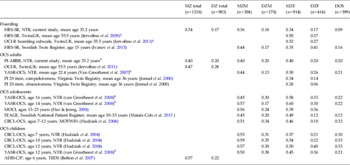
Polychoric correlations for the HRS-SR and for the PI-ABBR are presented in Table 2. As a comparison, previously reported twin correlations for these or similar measures are also presented. Twin correlations were very similar to previously reported figures for the OCS phenotype. Twin correlations for hoarding were at the low end of the range of previously reported heritabilities. The overall MZ twin correlations for both hoarding and OCS were approximately twice the DZ twin correlations, suggesting a genetic component to both traits. The dizygotic opposite-sex twin correlations for hoarding were significantly lower in our sample than the correlations in DZ same-sex twins, suggesting sex differences in hoarding symptoms.
Twin correlations for hoarding and OCS

OCS, Obsessive–compulsive symptoms; MZ, monozygotic; DZ, dizygotic; MZM, monozygotic male; DZM, dizygotic male; MZF, monozygotic female; DZF, dizygotic female; DOS, dizygotic opposite sex; HRS-SR, Hoarding Rating Scale-Self Report; NTR, Netherlands Twin Register; OCI-R, Obsessive–Compulsive Inventory, Revised; PI-ABBR, Padua Inventory Abbreviated Revised; YASR-OCS, Young Adult Self Report Obsessive Compulsive Scale; PI, Padua Inventory; MOCI, Maudsley Obsessive Compulsive Inventory; STAGE, Screening Twin Adults: Genes and Environment Study Scale; CBCL-OCS, Child Behavior CheckList, Obsessive Compulsive Scale; MOTWIN, Missouri Twin Registry; ADIS-C/P, Anxiety Disorders Interview Schedule for Children and Parents; TEDS, Twins Early Development Study.
a Samples for these studies are the same.
b Samples for these studies overlap.
Genetic model fitting
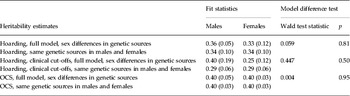
The total estimated heritability for the hoarding phenotype using the equally distributed cut-offs was 0.36 (s.e. = 0.05, p < 0.0001), and the estimated non-shared environment was 0.64 (s.e. = 0.05, p < 0.0001). As expected from the pattern of twin correlations, there was no evidence for the effects of common environment. The total estimated heritability for hoarding using the clinical cut-offs was 0.33 (s.e. = 0.02), and the estimated non-shared environment was 0.67 (s.e. = 0.03). The total estimated heritability for OCS was 0.40 (s.e. = 0.03, p < 0.0001), and the estimated non-shared environment was 0.60 (s.e. = 0.03, p < 0.0001).
Genotype × sex interaction
Examination of the concordance ratios between MZ twins, DZ same-sex twins and DZ opposite-sex twins suggested differences in genetic contributions to hoarding symptoms by sex (Table 2), as the MZ correlations were higher than the DZ same-sex correlations, which were higher than the DZ opposite-sex correlations. This difference was not seen for OCS. Males and females had similar heritability estimates for both hoarding and OCS, however, and the model comparison between the full model and the model where genetic influences for males and females were constrained to be equal suggested that there were no different genetic contributions to hoarding or OCS by sex (Table 3). To test the stability of the analyses for hoarding, we then calculated the twin correlations and heritability estimates for hoarding using cut-offs that more closely approximated clinical patterns. In this analysis, males had a larger genetic contribution to hoarding than did females, although the model comparisons again showed no differences between the full and constrained models (Table 3).
Heritability estimates and fit statistics for ACE models examining the role of sex in hoarding and OCS a

Data are given as estimate (standard error).
A, Additive genetic factors; C, common environmental factors; E, non-shared or unique environmental factors; OCS, obsessive–compulsive symptoms.
a The genetic contribution to the phenotype (hoarding or OCS) is allowed to vary by sex in the full model.
Bivariate analyses
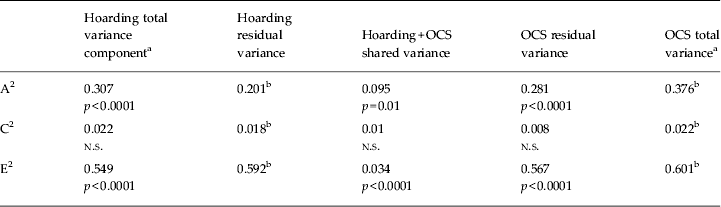
We next examined the shared genetic and environmental contributions to OCS and hoarding using bivariate genetic model fitting. The cross-twin cross-trait correlations were 0.16 (hoarding twin 1 and OCS twin 2) and 0.15 (hoarding twin 2 and OCS twin 1) for MZ twins and 0.07 (hoarding twin 1 and OCS twin 2) and 0.06 (hoarding twin 2 and OCS twin 1) for DZ twins, and the genetic correlation between hoarding and OCS was 0.10. In comparison, the within-person cross-trait correlations were 0.28 and 0.26 for MZ twins and 0.35 and 0.30 for DZ twins. These results suggested that there is little genetic covariance between traits. As shown in Table 4, approximately 31% of the total additive genetic variance for hoarding and 25% of the total additive genetic variance for OCS in this sample is due to genetic factors shared between the two phenotypes. As was also seen in the univariate analyses, the remaining variance for both traits is due to non-shared environmental factors; there is little to no evidence for a role for common environmental factors.
Bivariate genetic model for hoarding and OCS

OCS, Obsessive–compulsive symptoms; residual, amount of variance that is not shared between hoarding and OCS phenotypes; A2, proportion of variance due to additive genetic factors; C2, proportion of variance due to common or shared environmental factors; n.s., non-significant; E2, proportion of variance due to unshared (unique) environmental factors.
a Values in column sum to 1.
b Derived value.
Genetic model fitting – specific hoarding symptoms
We then examined the heritability for the three specific hoarding symptoms: excessive clutter, excessive acquiring and difficulty discarding items (see online Supplementary Table S4 for twin correlations). For clutter, 0.20 of the total variance was due to additive genetic factors (s.e. = 0.12, p = 0.105), while 0.11 was due to common environmental factors (s.e. = 0.16, p = 0.041) and 0.69 was due to the non-shared environment (s.e. = 0.03, p < 0.0001). For acquiring, 0.22 (s.e. = 0.05, p < 0.0001) of the total variance was due to additive genetic factors, while 0.78 (s.e. = 0.03, p < 0.0001) was due to non-shared environmental factors. For difficulty discarding, 0.37 (s.e. = 0.13, p = 0.001) of the total variance was due to additive genetic factors, while 0.63 (s.e. = 0.03, p < 0 .0001) was due to non-shared environmental factors; there was essentially no contribution from shared environmental factors. As a comparison, 0.31 (s.e. = 0.03, p < 0.0001) of the total variance for the distress item was due to additive genetic factors, and 0.69 (s.e. = 0.03, p < 0.0001) was due to the non-shared environment. The estimates for the role of additive genetics to excessive acquiring and difficulty discarding were lower than previously reported (0.45 and 0.49, respectively) (Nordsletten et al. Reference Nordsletten, Monzani, Fernández de la Cruz, Iervolino, Fullana, Harris, Rijsdijk and Mataix-Cols2013); the role of additive genetics in difficulty with clutter has not been previously reported.
Discussion
Using the largest sample of twin pairs available to date, the results of this study confirm the previous findings suggesting that independent genetic factors contribute to the etiology of both hoarding and OCS. In our sample, which overlaps to some degree with the studies on OCD by van Grootheest et al. (Reference van Grootheest, Cath, Beekman and Boomsma2005, Reference van Grootheest, Cath, Beekman and Boomsma2007, Reference van Grootheest, Bartels, van Beijsterveldt, Cath, Beekman, Hudziak and Boomsma2008), the overall heritability estimates were 0.36 for hoarding and 0.40 for OCS, which are within the range of what has been previously found, although the heritability estimate for hoarding was at the lower end of the previously reported estimates (40–50% for OCS, and 35–50% for hoarding) (van Grootheest et al. Reference van Grootheest, Cath, Beekman and Boomsma2005, Reference van Grootheest, Cath, Beekman and Boomsma2007, Reference van Grootheest, Bartels, van Beijsterveldt, Cath, Beekman, Hudziak and Boomsma2008; Iervolino et al. Reference Iervolino, Perroud, Fullana, Guipponi, Cherkas, Collier and Mataix-Cols2009, Reference Iervolino, Rijsdijk, Cherkas, Fullana and Mataix-Cols2011; Taylor et al. Reference Taylor, Jang and Asmundson2010). There was little evidence for sex differences in the genetic etiology of either hoarding or OCS. These results are consistent with previous studies of OCS, including those that examined OCS in the NTR using different scales (e.g. van Grootheest et al. Reference van Grootheest, Cath, Beekman and Boomsma2005, Reference van Grootheest, Cath, Beekman and Boomsma2007, Reference van Grootheest, Bartels, van Beijsterveldt, Cath, Beekman, Hudziak and Boomsma2008), and those that examined OCS in other samples (see Table 2) (Hudziak et al. Reference Hudziak, Van Beijsterveldt, Althoff, Stanger, Rettew, Nelson, Todd, Bartels and Boomsma2004; Bolton et al. Reference Bolton, Rijsdijk, O'Connor, Perrin and Eley2007, van Grootheest et al. Reference van Grootheest, Cath, Beekman and Boomsma2007, Reference van Grootheest, Bartels, van Beijsterveldt, Cath, Beekman, Hudziak and Boomsma2008; Iervolino et al. Reference Iervolino, Rijsdijk, Cherkas, Fullana and Mataix-Cols2011). Previous studies of the genetic contribution to hoarding by sex have been inconsistent, as studies of female twins ages 16 years and up suggest strong genetic influences on hoarding, while a study of 15-year-old twins showed genetic influences for boys but not girls (Iervolino et al. Reference Iervolino, Perroud, Fullana, Guipponi, Cherkas, Collier and Mataix-Cols2009, Reference Iervolino, Rijsdijk, Cherkas, Fullana and Mataix-Cols2011; Ivanov et al. Reference Ivanov, Mataix-Cols, Serlachius, Lichtenstein, Anckarsäter, Chang, Gumpert, Lundström, Långström and Rück2013). The results of our study confirm a genetic contribution to hoarding for both sexes, and do not provide strong evidence for differences in genetic contributions to hoarding by sex.
Although there was evidence of shared genetic variance between hoarding and OCS, the genetic correlation between these phenotypes was substantially lower in our sample than has been previously reported (about 0.10 compared with 0.45) (Iervolino et al. Reference Iervolino, Perroud, Fullana, Guipponi, Cherkas, Collier and Mataix-Cols2009, Reference Iervolino, Rijsdijk, Cherkas, Fullana and Mataix-Cols2011). Although there are several possible reasons for this, we suspect that the modifications that we made to the HRS-SR may have contributed to both the lower heritability estimate for hoarding and the lower genetic correlation between hoarding and OCS. Due to practical limitations in this study, the impairment question of the HRS-SR was eliminated, although the question on distress was kept. This may have resulted in a problem of phenocopies, wherein our assessment captures not only true hoarding behaviors, but also non-specific cluttering behaviors arising from a variety of factors, that may or may not be impairing, but are nonetheless distressing. This hypothesis is supported by the unexpectedly high rates of clinically significant hoarding (about 7%), despite the stringent cut-off used and the relatively young age of the sample.
Another possibility is that we have truly captured a hoarding phenotype with the modified HRS-SR, but that this phenotype is more heterogeneous than in other studies, such that fewer individuals with hoarding within the sample are also at risk for OCS. Hoarding is etiologically as well as phenotypically heterogeneous, and the genetic relationship between hoarding and OCD is complex. Previous studies suggest that rates of hoarding in relatives differ based on the primary diagnosis of the probands; hoarding symptoms are prevalent in families identified through probands with OCD or probands with hoarding + OCD, but OCD does not appear to be common in relatives of probands with hoarding only (Samuels et al. Reference Samuels, Bienvenu, Riddle, Cullen, Grados, Liang, Hoehn-Saric and Nestadt2002, Reference Samuels, Bienvenu, Pinto, Fyer, McCracken, Rauch, Murphy, Grados, Greenberg, Knowles, Piacentini, Cannistraro, Cullen, Riddle, Rasmussen, Pauls, Willour, Shugart, Liang, Hoehn-Saric and Nestadt2007; Mathews et al. Reference Mathews, Nievergelt, Azzam, Garrido, Chavira, Wessel, Bagnarello, Reus and Schork2007; Pertusa et al. Reference Pertusa, Fullana, Singh, Alonso, Menchón and Mataix-Cols2008).
Finally, although the majority of variance for each of the three specific hoarding behaviors was due to environmental rather than genetic factors, all three showed some evidence of a genetic contribution. There has been some suggestion in the literature that difficulty discarding is the most fundamental feature of HD, and that excessive acquiring is most likely a subtype rather than a core feature of HD, while cluttering is a non-specific symptom that may also occur in many other contexts or disorders (e.g. due to physical limitations, or to lack of motivation in individuals with depression). Unfortunately, we cannot directly answer the question about which symptoms are core to HD in our sample. All three symptoms occurred at high rates in individuals with clinically significant hoarding (⩾79%), were highly correlated with one another in the overall sample, and had a genetic component, suggesting that all three symptoms are likely to be relevant to a larger hoarding phenotype.
These findings clearly have implications for genetic studies. The complex relationship between hoarding and OCS, and perhaps the heritability estimates for the specific symptom subtypes, should be considered when designing studies aimed at identifying genetic susceptibility variants for hoarding. One way to increase power for genome-wide association studies, for example, is to include individuals with related phenotypes, with the hope that the gains realized by the increase in sample size will outweigh the losses associated with increased heterogeneity. Our data suggest that this approach would not be appropriate for hoarding and OCD, at least as defined here, as the genetic correlation between them is quite low. Similarly, in designing genetic studies of hoarding, investigators would probably benefit from focusing on individuals with prominent difficulty in discarding symptoms rather than those with primary problems with acquisition or clutter, as this was the most highly heritable hoarding symptom in our sample, with a heritability estimate as high as that of the global hoarding phenotype.
In addition to genetics, there is also clearly a role for the environment in the development of hoarding behaviors and OCS, as has been demonstrated by all of the twin studies conducted to date. The specific types of environmental factors that influence the development of these phenotypes are unknown. Although trauma, including both abuse and neglect, has been suggested to be a risk factor for OCS and hoarding, the data are somewhat inconsistent (Hartl et al. Reference Hartl, Duffany, Allen, Steketee and Frost2005; Cromer et al. Reference Cromer, Schmidt and Murphy2007; Fontenelle et al. Reference Fontenelle, Domingues, Souza, Mendlowicz, de Menezes, Figueira and Versiani2007; Mathews et al. Reference Mathews, Kaur and Stein2008; Landau et al. Reference Landau, Iervolino, Pertusa, Santo, Singh and Mataix-Cols2011). The identification of genetic variants and/or environmental risk factors at the various developmental stages through adulthood predisposing to HD and/or OCD is clearly a crucial next step in furthering our understanding of the etiology of these impairing conditions.
Limitations
The primary limitations of this work relate to the phenotypes. Because this is a population-based twin study, the phenotypes are derived from self-report symptom-based data rather than structured interviews. We cannot make diagnoses of HD or OCD, but must rely on somewhat arbitrary cut-offs to determine symptom thresholds with potential clinical significance. The choice of cut-offs can affect the point estimates for genetic and environmental effects, as seen for the hoarding phenotype. In addition, the HRS-SR was modified for use in this sample, and we do not have validity data on the modified instrument. Although a measure of distress is built into the scale, impairment is also required to meet diagnostic criteria for HD. As noted above, this change may have resulted in an increased heterogeneity of the hoarding phenotype, leading to an over-estimate of the population prevalence of hoarding in this sample and an under-estimate of the heritability. Nevertheless, while the threshold cut-offs do not correspond to clinical diagnoses of HD or OCD, they do probably represent clinically significant symptoms. Validation of the modified HRS-SR is a needed next step to clarify the utility of this measure as a screening tool. The advantages of the study design compensate to some degree for these potential problems, in that we are able to sample a very large number of individuals and twin pairs, as would not be possible in a clinical sample, therefore obtaining more accurate estimates of both prevalence of symptoms and of the genetic and environmental contributions to the traits (including specific hoarding symptoms).
Supplementary material
For supplementary material accompanying this paper visit http://dx.doi.org/10.1017/S0033291714000269
Acknowledgements
The authors have no conflicts of interest. Data collection was supported by the Addiction program of ZonMW (31160008): Genetic determinants of risk behavior in relation to alcohol use and alcohol use disorder; the European Research Council (ERC-230374): Genetics of Mental Illness; and the Netherlands Organization for Scientific Research (NWO 463-06-001) and from a grant from the Tourette Syndrome Association (TSA) in the United States (2008).
Declaration of Interest
None.