

Introduction
For adults who sustain an acquired brain injury (ABI), including traumatic brain injuries (TBI), the motivation and goal to return to employment is high (Libeson, Downing, Ross, & Ponsford, Reference Libeson, Downing, Ross and Ponsford2018; Oppermann, Reference Oppermann2004; van Velzen, van Bennekom, van Dormolen, Sluiter, & Frings-Dresen, Reference van Velzen, van Bennekom, van Dormolen, Sluiter and Frings-Dresen2011). Benefits of returning to work post-ABI include increased wellbeing (Libeson et al., Reference Libeson, Downing, Ross and Ponsford2018; Shames, Treger, Ring, & Giaquinto, Reference Shames, Treger, Ring and Giaquinto2007) and quality of life (Libeson et al., Reference Libeson, Downing, Ross and Ponsford2018) as well as financial and other psychosocial benefits (Shames et al., Reference Shames, Treger, Ring and Giaquinto2007). However, the rate of return to work (RTW) post-injury remains low globally (Libeson et al., Reference Libeson, Downing, Ross and Ponsford2018), reported as 32–46% two years post-injury (Ponsford, Olver, Curran, & Ng, Reference Ponsford, Olver, Curran and Ng1995; van Velzen, van Bennekom, Edelaar, Sluiter, & Frings-Dresen, Reference van Velzen, van Bennekom, Edelaar, Sluiter and Frings-Dresen2009). Individuals who are not able to RTW following ABI may experience negative social, personal and economic outcomes (Nagele, Reference Nagele1999), including an altered sense of self, loss of work identity and changed future occupational goals and earning ability (Hooson, Coetzer, Stew, & Moore, Reference Hooson, Coetzer, Stew and Moore2013). Those who do RTW face additional difficulties in maintaining work long-term (Hart et al., Reference Hart, Dijkers, Fraser, Cicerone, Bogner, Whyte and Waldron2006; Oppermann, Reference Oppermann2004). ABI is the leading cause of disability in Australians aged under 65 years (Australian Institute of Health and Welfare, 2007). When injury occurs during the most economically productive years, the impact of an ABI on RTW is substantial.
Productive work requires social, physical, linguistic and cognitive skills, including attention, memory, processing speed and verbal skills (Shames et al., Reference Shames, Treger, Ring and Giaquinto2007). Changes to these skills following ABI impacts work performance (van Velzen et al., Reference van Velzen, van Bennekom, van Dormolen, Sluiter and Frings-Dresen2011) and readiness for RTW (Libeson et al., Reference Libeson, Downing, Ross and Ponsford2018). Specific injury-related factors associated with returning to employment include level of independence with activities of daily living (Donker-Cools, Wind, & Frings-Dresen, Reference Donker-Cools, Wind and Frings-Dresen2016), fatigue (Donker-Cools, Schouten, Wind, & Frings-Dresen, Reference Donker-Cools, Schouten, Wind and Frings-Dresen2018), cognitive communication and social communication skills (Meulenbroek, Bowers, & Turkstra, Reference Meulenbroek, Bowers and Turkstra2016), cognition, mood and pain (Libeson et al., Reference Libeson, Downing, Ross and Ponsford2018) and changes to personality (Rubenson, Svensson, Linddahl, & Björklund, Reference Rubenson, Svensson, Linddahl and Björklund2007; van Velzen et al., Reference van Velzen, van Bennekom, van Dormolen, Sluiter and Frings-Dresen2011). Not surprisingly, RTW can be challenging for clients who present with changes to the core employment skills post-ABI.
A range of individual factors influence RTW, including the personal attributes of motivation, drive and/or willingness to work (Donker-Cools et al., Reference Donker-Cools, Schouten, Wind and Frings-Dresen2018; Libeson et al., Reference Libeson, Downing, Ross and Ponsford2018; Macaden, Chandler, Chandler, & Berry, Reference Macaden, Chandler, Chandler and Berry2010) and coping skills (Macaden et al., Reference Macaden, Chandler, Chandler and Berry2010). RTW is also impacted by ethnicity, level of education (Donker-Cools et al., Reference Donker-Cools, Wind and Frings-Dresen2016), employment status (Shames et al., Reference Shames, Treger, Ring and Giaquinto2007), pre-injury job performance (Donker-Cools et al., Reference Donker-Cools, Schouten, Wind and Frings-Dresen2018), prior interests and engagement in meaningful activities (Macaden et al., Reference Macaden, Chandler, Chandler and Berry2010), and a history of psychiatric illness and drug/alcohol abuse (Shames et al., Reference Shames, Treger, Ring and Giaquinto2007).
Workplace specific factors that facilitate RTW include: supportive employers and colleagues (Donker-Cools et al., Reference Donker-Cools, Schouten, Wind and Frings-Dresen2018; Macaden et al., Reference Macaden, Chandler, Chandler and Berry2010; van Velzen et al., Reference van Velzen, van Bennekom, van Dormolen, Sluiter and Frings-Dresen2011); flexible work options (Rubenson et al., Reference Rubenson, Svensson, Linddahl and Björklund2007) including adaptation and modification of workplaces and tasks (Libeson et al., Reference Libeson, Downing, Ross and Ponsford2018; van Velzen et al., Reference van Velzen, van Bennekom, van Dormolen, Sluiter and Frings-Dresen2011); knowledge of ABI within the workplace (van Velzen et al., Reference van Velzen, van Bennekom, van Dormolen, Sluiter and Frings-Dresen2011); the nature of the job (Libeson et al., Reference Libeson, Downing, Ross and Ponsford2018); employment stability (Macaden et al., Reference Macaden, Chandler, Chandler and Berry2010); and access to the workplace including transport (van Velzen et al., Reference van Velzen, van Bennekom, van Dormolen, Sluiter and Frings-Dresen2011). Having a supportive partner (Donker-Cools et al., Reference Donker-Cools, Schouten, Wind and Frings-Dresen2018), family and social supports (Libeson et al., Reference Libeson, Downing, Ross and Ponsford2018) are environmental factors that positively influence RTW for adults with ABI.
Lastly, service and system level factors that affect RTW include availability and access to consistent specialised services (Libeson et al., Reference Libeson, Downing, Ross and Ponsford2018; Shames et al., Reference Shames, Treger, Ring and Giaquinto2007; van Velzen et al., Reference van Velzen, van Bennekom, van Dormolen, Sluiter and Frings-Dresen2011) and the provision of longer-term vocational supports (Rubenson et al., Reference Rubenson, Svensson, Linddahl and Björklund2007; van Velzen et al., Reference van Velzen, van Bennekom, van Dormolen, Sluiter and Frings-Dresen2011) – i.e., specialised ABI vocational rehabilitation (VR). VR is a process which enables people with injury and/or disability to overcome barriers to access, maintain or return to employment or other chosen occupations (Vocational Rehabilitation Association UK, 2013) and involves the delivery of a program of specific rehabilitation activities targeting skills for RTW (Baldwin & Brusco, Reference Baldwin and Brusco2011). ABI VR may commence early post-injury (Radford et al., Reference Radford, Sutton, Sach, Holmes, Watkins, Forshaw and Phillips2018) and continue until later in recovery, including following work placement (Hart et al., Reference Hart, Dijkers, Whyte, Braden, Trott and Fraser2010; Kendall, Muenchberger, & Gee, Reference Kendall, Muenchberger and Gee2006; Ownsworth, Reference Ownsworth2010). ABI VR may also involve other professionals and services including job coaches (Donker-Cools et al., Reference Donker-Cools, Schouten, Wind and Frings-Dresen2018), professional tutors (Hart et al., Reference Hart, Dijkers, Fraser, Cicerone, Bogner, Whyte and Waldron2006) and employment support services (McRae, Hallab, & Simpson, Reference McRae, Hallab and Simpson2016). As such, ABI VR may be viewed as a complex, multi-step process involving a range of teams and professionals, that occurs across long-term timeframes and involves rehabilitation targeting goals for RTW.
Specific features of ABI VR services and programs associated with successful return to employment include: provision of education, information and specific guidance regarding RTW (Gilworth et al., Reference Gilworth, Carey, Eyres, Sloan, Rainford, Bodenham and Tennant2006; Gilworth, Eyres, Carey, Bhakta, & Tennant, Reference Gilworth, Eyres, Carey, Bhakta and Tennant2008); rehabilitation involving work preparation skills (Libeson et al., Reference Libeson, Downing, Ross and Ponsford2018; McRae et al., Reference McRae, Hallab and Simpson2016); pre-vocational training (McRae et al., Reference McRae, Hallab and Simpson2016); access to professional assistance for coaching, support and guidance (Donker-Cools et al., Reference Donker-Cools, Schouten, Wind and Frings-Dresen2018) and support groups (Libeson et al., Reference Libeson, Downing, Ross and Ponsford2018). Access to transportation (Macaden et al., Reference Macaden, Chandler, Chandler and Berry2010; van Velzen et al., Reference van Velzen, van Bennekom, van Dormolen, Sluiter and Frings-Dresen2011) and financial incentives for employers (Libeson et al., Reference Libeson, Downing, Ross and Ponsford2018) also support successful RTW.
Engaging in VR is a critical factor for successful RTW after ABI (Libeson et al., Reference Libeson, Downing, Ross and Ponsford2018; Shames et al., Reference Shames, Treger, Ring and Giaquinto2007; van Velzen et al., Reference van Velzen, van Bennekom, van Dormolen, Sluiter and Frings-Dresen2011). However, the policies, systems and service context that underpin access to and provision of VR influence the type of interventions and services provided to adults with ABI (Donker-Cools et al., Reference Donker-Cools, Wind and Frings-Dresen2016; Shames et al., Reference Shames, Treger, Ring and Giaquinto2007) and can either discourage or promote RTW (Shames et al., Reference Shames, Treger, Ring and Giaquinto2007). Consequently, there is variation in how ABI VR is provided, RTW outcomes post-ABI, and consumer experiences with ABI VR and RTW. Research targeted at a service or system level may assist in identifying contextual factors that lead to service improvements in the delivery of ABI VR and influence RTW outcomes for consumers.
Identifying and responding to consumer views and needs are core components of client-centred, best-practice service provision, including evidence-based practice (Hoffman, Bennett, & Del Mar, Reference Hoffman, Bennett and Del Mar2017) and models of healthcare delivery (Planetree International, 2018). Incorporating consumer experiences within ABI VR and RTW research is critical to developing services and practice frameworks that are responsive to service-user needs. A range of consumer factors have been recommended for ABI VR research, including investigating individuals’ perspectives and experiences in engaging in VR (Hooson et al., Reference Hooson, Coetzer, Stew and Moore2013), RTW and vocational outcomes (Donker-Cools et al., Reference Donker-Cools, Wind and Frings-Dresen2016), and investigating experiences of unsuccessful RTW (Libeson et al., Reference Libeson, Downing, Ross and Ponsford2018). Research has begun to investigate consumers’ experiences with participation in specialist TBI VR (Hooson et al., Reference Hooson, Coetzer, Stew and Moore2013) and RTW following specialist TBI VR (Libeson et al., Reference Libeson, Downing, Ross and Ponsford2018); and ABI consumers’ experiences of VR and RTW (McRae et al., Reference McRae, Hallab and Simpson2016). Currently, how rehabilitation services address clients’ vocational goals and perceived provision of ABI VR has not been investigated, and research into the experiences of Queensland adults with ABI regarding VR and RTW has not been undertaken.
Local context
Brain injury rehabilitation in Australia is governed by national rehabilitation guidelines (Australasian Faculty of Rehabilitation Medicine, 2011, 2014) and the World Health Organisations’ International Classification of Functioning, Disability and Health (ICF) framework (World Health Organisation, 2001). Clients with ABI and RTW goals access rehabilitation-based services through publicly and/or privately funded services (e.g., via insurance compensation schemes). However, access to publicly-funded dedicated ABI VR services is limited across Australia, with a lack of specialist ABI skill and knowledge in the broader VR sector (McRae et al., Reference McRae, Hallab and Simpson2016).
In Queensland, adults with ABI typically access rehabilitation for RTW goals (i.e., VR) through public services (e.g., inpatient, outpatient and/or community rehabilitation), with a cohort also accessing private services (funded via insurance schemes or private health cover). Longer-term ABI RTW goals are often addressed through other services and systems, including other publicly funded services (e.g., GP, employment support services), privately funded options (e.g., funders, vocational coordinators) and through employers and workplace services (e.g., human resources). Access to private VR providers is increasing through the introduction of two new funded insurance schemes, the National Injury Insurance Scheme Queensland (introduced July 2016) and the National Disability Insurance Scheme (implemented July 2016–June 2019 in Queensland); however, the number of experienced ABI VR providers is limited. These services usually commence following a period of public rehabilitation.
Within Queensland, there are no publicly funded dedicated VR services for people with ABI. ABI VR service provision is varied and ad-hoc, with differences in service access, scope and individual and team processes. Currently, there are no specific vocational frameworks or models in place to guide the provision of ABI VR in Queensland and the extent of VR service provision as a component of ABI rehabilitation is unknown. Consequently, consumers’ experiences of how ABI rehabilitation addresses vocational goals in Queensland is unknown.
Objectives
This study aimed to investigate the experiences of people with ABI regarding their: (i) VR (including rehabilitation for RTW goals) and RTW experiences; and (ii) recommendations for ‘ideal’ ABI VR services in early rehabilitation (i.e., up to 3 months post hospital discharge); within the context of Queensland-based services. This will provide consumer-driven information that is contextually relevant (Hoffman et al., Reference Hoffman, Bennett and Del Mar2017) to inform clinical practice and future service design in this area. While this study is context specific, it is envisaged that findings may inform and translate to services outside of Queensland and Australian rehabilitation contexts.
Methods
This study occurred with ethical clearance from the Metro South Health and Griffith University Human Research Ethics Committees (HREC/18/QPAH/497; GU Ref: 2018/998) and is part of a larger project that is developing an evidence-based framework for delivering ABI VR in early community rehabilitation in Queensland.
Participants
Participants were adults with ABI living in the community in Queensland. Purposive sampling of participants occurred, with recruitment invitations circulated by the Queensland-based ABI peer community network ‘STEPS’ (Skills To Enable People and communitieS), which is coordinated through the publicly-funded statewide brain injury rehabilitation service. Interested participants either contacted the research team directly or contacted the STEPS coordinator who passed their details onto the research team. Study inclusion criteria included adults (aged over 16) with ABI who: were living in the community in Queensland; had undertaken ABI rehabilitation in Queensland; possessed functional communication in English; and were interested in discussing their rehabilitation experiences, including RTW goals and rehabilitation, and experiences in RTW (regardless of outcome and timeframe). Exclusion criteria included participants with an active health issue (including mental health condition), cognitive or behavioral changes that prevented participation in the study; or were unable to provide consent due to cognitive, communication or behavioral changes. A sample of 15 individuals was sought; however, eight individuals consented and participated in the study.
Procedure
Three focus groups were planned; due to emergent changes to participant availability two focus groups (with two and four participants respectively) and two individual interviews (one face-to-face and one via phone) were conducted. Sessions lasted between 60 and 90 min. Each interview and focus group was conducted by up to two members of the research team. The focus groups and face-to-face interview occurred at the STEPS office in Brisbane, Queensland, which was familiar to participants. To maximize participation, all participants were provided with: the discussion questions prior to the focus group or interview; opportunities to clarify information and discuss questions prior to data collection; and the opportunity to bring a support person to the session. All clients attended independently. Participants were reimbursed for travel costs and participation time, in accordance with Health Consumers Queensland guidelines (Health Consumers Queensland, 2015). Demographic data was collected from participants via discussion and a short questionnaire.
Participants were asked six questions relating to their rehabilitation experiences, VR, RTW goals and experiences, and their views on ‘ideal’ services for ABI VR (see Appendix A). The questions were determined by the research team, comprising experienced ABI rehabilitation clinicians and ABI and VR researchers. Questions aimed to explore consumers’ experiences with Queensland rehabilitation services including VR, contribute to future service development, and were based on findings from the literature, clinician experience and contextual knowledge of services. Participants answered and discussed questions in a semi-structured focus group or interview format. 10–15 min per question was allocated for discussion, and facilitators allowed a broad discussion between participants to fully explore the topics.
All focus groups and the face-to-face interview were recorded on a video recorder (Sony handycam DHR-XR160E), and on two digital audio recorders (Olympus DS-30 and Olympus DM-7); with audio-only recording for the phone interview. Data were transcribed verbatim for analysis.
Data analysis
An inductive thematic analysis was performed on the transcribed data from the four data sets (two focus groups, two interviews) following the procedure outlined by Braun and Clarke (Reference Braun and Clarke2006). This involved reading and re-reading transcripts for data familiarization, coding responses, identifying codes into themes and sub-themes, and reviewing the data, resulting in the identification of the main themes and sub-themes of participants’ experiences. All data was evaluated by the primary author; consensus coding of 50% of the data was conducted by author AK, involving consensus coding and organizing codes into themes and sub-themes, with consensus reached for each stage. Additional data checking was undertaken by author VM, who reviewed all participant data (transcripts, coding, consensus coding, final code set), and by the focus group facilitators who reviewed the identified themes and sub-themes; full consensus was reached. Data saturation was reached for both information obtained within each interview/focus group, and across themes from the whole data set (Saunders et al., Reference Saunders, Sim, Kingstone, Baker, Waterfield, Bartlam and Jinks2018).
Results
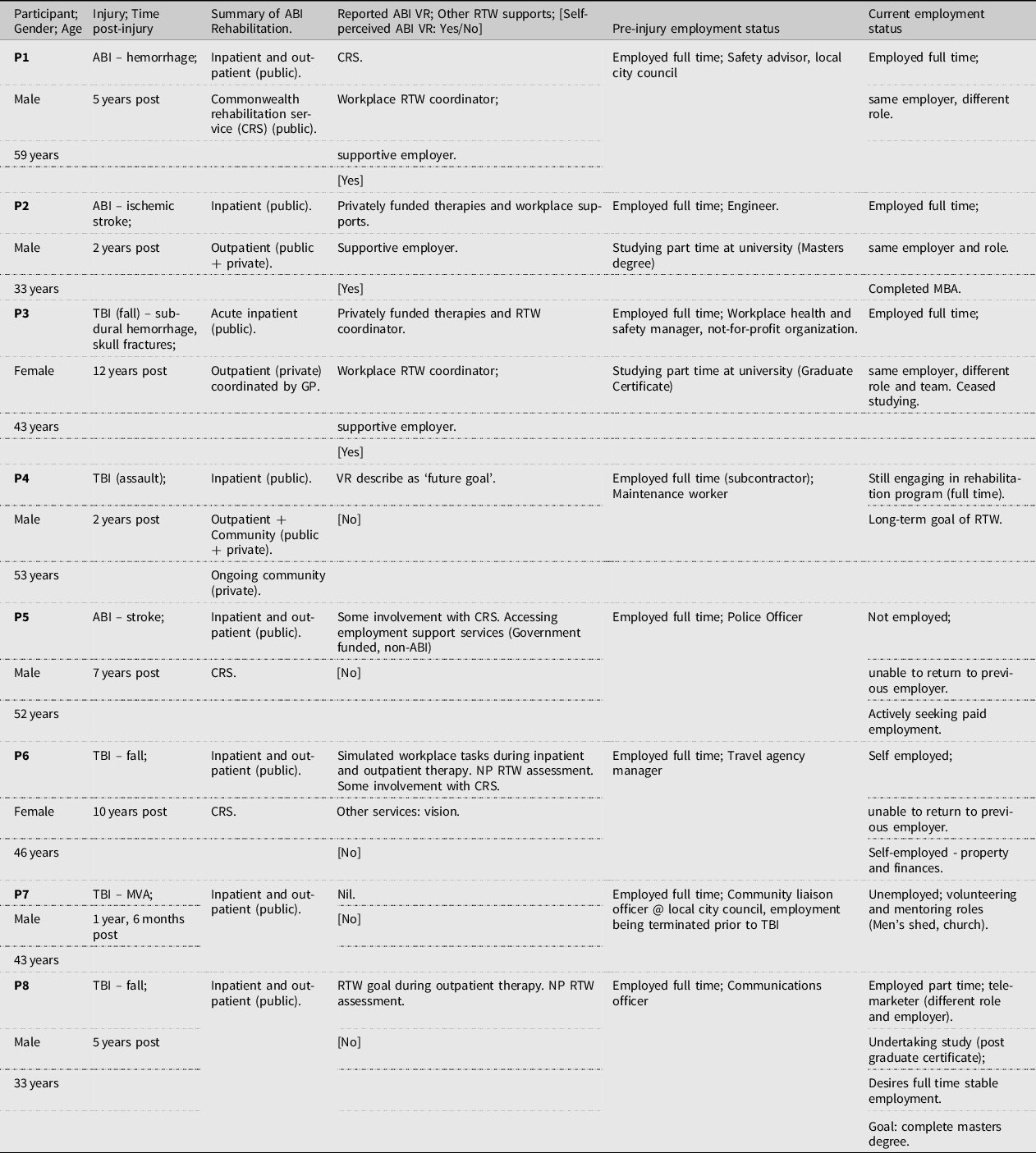
Participants (P) included six males and two females, with a mean age of 45 years (range: 33–59 years). Cause of injury included ABI (n = 3) and TBI (n = 5), with a mean time post-injury of 5.5 years (range: 18 months–12 years). At the time of data collection, four participants were in paid employment (one of these was also studying part-time), one was self-employed, two were participating in meaningful (non-paid) activities including volunteering, and one was continuing to undertake rehabilitation. Only the three participants who returned to their prior employer reported satisfaction with their current employment. Table 1 presents participants’ demographic and employment data.
Participant demographics

ABI, acquired brain injury; MBA, masters of business administration; Grad Cert, graduate certificate; TBI, traumatic brain injury; MVA, motor vehicle accident; GP, general practitioner; RTW, return to work; VR, vocational rehabilitation; NP, neuropsychology.
Thematic analysis
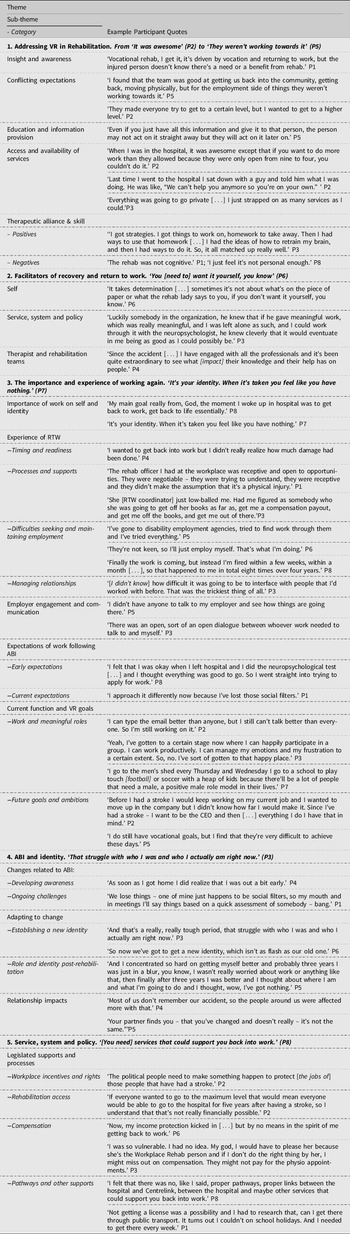
Across the focus groups and interviews, participants reported varied VR and RTW experiences and outcomes, with both positive and negative experiences reported. From this data, five main themes emerged (including sub-themes and categories); these are reported below and summarised with exemplar participant quotes in Table 2.
Participant experiences with vocational rehabilitation in South East Queensland

Theme 1. Addressing VR in Rehabilitation: From “It was awesome” (P2) to “They weren’t working towards it” (P5).
Within the first theme, five sub-themes were identified regarding participants’ experiences of rehabilitation for vocational goals: insight and awareness; conflicting expectations; education and information; access and availability; and therapeutic alliance and skill. Participants described changes to their insight and awareness regarding their abilities following their ABI, and the subsequent impact of this on their participation in rehabilitation and VR early in recovery: “…the injured person doesn’t know there’s a need or a benefit from rehab” (P1). Participants identified a strong desire to leave hospital and resume/return to work early in recovery, alongside therapists’ encouragement to participate in rehabilitation.
Participants further described the presence of conflicting expectations between themselves (as clients/patients) and their therapists/rehabilitation teams, during both inpatient and outpatient/community rehabilitation (including VR). This occurred regarding the level of readiness for return to work, and for the skills/areas being targeted in therapy: “They made everyone try to get to a certain level, but I wanted to get to a higher level.” (P2). While participants acknowledged the work of their rehabilitation team, the therapy provided across all timeframes did not always meet participants’ expectations or RTW goals: “I found that the team was good at getting us back into the community, getting back, moving physically, but for the employment side of things they weren’t working towards it.” (P5).
The importance of education and information provision was highlighted, with participants wanting more education about rehabilitation, VR, services and transitions, their injury, the features of their ABI and its impact on home and work life. Some participants identified they received information but did not act on it, and valued this information later in recovery: “Even if you just have all this information and give it to that person, the person may not act on it straight away but they will act on it later on.” (P5). Study participants also detailed their experiences with access and availability of services , both positive and challenging experiences were reported. Challenges included delays for public services, reduced frequency and duration of services, wanting more services, and reduced access to ongoing services, as reported by P2: “Last time I went to the hospital I sat down with a guy and told him what I was doing. He was like, “We can’t help you anymore so you’re on your own.” Reported facilitators of VR services included access to funding for multiple private rehabilitation services and supplementing public services with private providers.
The final ‘Addressing VR in Rehabilitation’ sub-theme was therapeutic alliance and skill , with both positive and negative experiences reported by participants. Participants valued clinician expertise, having their goals addressed via personalized and contextual therapy, learning new skills, and the therapeutic alliance. They identified poor satisfaction when therapy was perceived as generic, not individualized, non-contextual and not addressing their needs. A lack of communication processes between hospital services, government support services, workplaces and clients were also identified.
Theme 2. Facilitators of recovery and return to work: “You [need to] want it yourself, you know” (P6)
In the second ‘theme’, three sub-themes were identified: self; service/systems/policy; and therapists/rehabilitation team. In the sub-theme of self, the participants identified a range of personal qualities that facilitated self-drive for recovery and RTW: “It takes determination […] You [need to] want it yourself, you know.” (P6). These included motivation (P1), a positive mindset and having a goal (P6), a positive attitude, patience and a forward focus (P4), grit, hard work and practice (P3, P6). Participants detailed how they facilitated their own rehabilitation and VR, including independently seeking information and supports from other services (P4, P6), implementing strategies at home and developing new strategies (P4), identifying opportunities for the rehabilitation team to follow up on (P1), engaging in meaningful activities early in rehabilitation and upon return to home (P3, P6), and commencing further study (P8). Service, system and policy facilitators included workplace supports (e.g., RTW coordinators, supportive employers), and access to funding for different services (including private VR, funded days off work for volunteering). Identified therapist and rehabilitation team facilitators included specialized skills and experience, providing individualized therapy with a strong therapeutic alliance and a collaborative rehabilitation approach. As P4 identified: “it’s been quite extraordinary to see what [impact] their knowledge and their help has on people.”
Theme 3. The importance and experience of working again: “It’s your identity. When it’s taken you feel like you have nothing” (P7)
The third theme revolved around ‘work’, with 5 sub-themes identified: the importance of work on self and identity; experience of returning to work; employer engagement and communication; expectations of work following ABI; and current function and VR goals. The first sub-theme involved the importance of work on self and identity . The early goal and drive to RTW was identified by 7 of 8 participants, as described by P8: “My main goal really from, God, the moment I woke up in hospital was to get back to work, get back to life essentially.”(P8). One participant who had sustained a catastrophic TBI reflected he was “just happy to be alive” (P7) early in recovery. All participants were working before their injury, with work identified as a key component of participants’ identities, providing structure (P4) and purpose (P6). The subsequent loss of work was described as “devastating” (P6); “you lose part of your identity” (P5).
Participants reported their experiences of returning to work , across four categories. This included reflections on timing and readiness for RTW, and developing awareness of this over time, as noted by (P4): “I wanted to get back into work but I didn’t really realise how much damage had been done.” Experiences with processes and supports when returning to work varied. Participants reported variable job-retention post-ABI (only three of eight participants returned to work with their pre-injury employer) and varied access to workplace supports and processes (including dedicated VR, RTW plans and coordinators, employment supports). Of the five participants who did not return to their previous employer, one identified his employment was in the process of being terminated just prior to his injury, four identified that they did not have the option to return to their previous job with one of these still undertaking active rehabilitation with RTW a future goal (see Table 1).
When dedicated RTW coordinators were utilized in the workplace, positive and negative experiences were reported. Positive experiences included coordinators who were receptive, had awareness of ABI and worked towards RTW; negative experiences included officers pursuing compensation payouts instead of desired RTW. Difficulties seeking and maintaining employment were identified by participants who did not return to their previous employer, with outcomes including unemployment, “I’ve gone to disability employment agencies, tried to find work through them and I’ve tried everything.”(P5), unstable employment (gaining employment but frequent job losses), and self-employment, “They’re not keen, so I’ll just employ myself” (P6). Challenges in managing relationships within the workplace were identified by two of three participants who returned to their prior workplace, which were not addressed during VR.
Varied experiences with employer engagement and communication were reported. Positive experiences involved clear and open communication between the rehabilitation team, the client and the employer; negative experiences included poor awareness of communication occurring and communication channels, lack of support for communication with employers, and clients not receiving information regarding availability of their prior role.
Participants identified changes in their expectations of work following ABI over time, impacted by their lived experience and development of insight and awareness, across two categories. Typical early expectations involved quickly returning to previous life roles, including employment: “I felt that I was okay when I left hospital and I did the neuropsychological test […] and I thought everything was good to go. So I went straight into trying to apply for work”(P8). Participants described the reality of this journey as requiring more time and more rehabilitation, and the need for formal supports to facilitate successful RTW, including when medically “cleared” for RTW. Current expectations included the impact of the ABI on work: “I approach it differently now because I’ve lost those social filters.” (P1).
The last sub-theme involved the impact of ABI on participants’ current function and VR goals , across the categories of work and meaningful roles, and future goals and ambitions. Participants who had returned to work reported satisfaction with their work performance including ongoing improvements. For individuals who had not returned to work, the importance of engaging in meaningful activities was identified: “I go to the men’s shed every Thursday and Wednesday I go to a school to play touch [football] or soccer with a heap of kids because there’ll be a lot of people that need a male, a positive male role model in their lives.” (P7). However, RTW remained an ongoing but difficult goal: “I do still have vocational goals, but I find that they’re very difficult to achieve these days.” (P5). Goals and ambitions were identified by all participants, these related to skills for work, future career progression and/or gaining employment. Those currently working identified ongoing work goals and ambitions, alongside recognition of their continuing challenges. One participant (P3) reported she had ceased her goal of resuming tertiary study in favor of maintaining her current work performance, as she felt she would struggle to meet the demands of both work and study given levels of cognitive fatigue.
Theme 4. ABI and identity: “That struggle with who I was and who I actually am right now” (P3)
The fourth theme centered around ‘ABI and identity’ and covered experiences over a time period of several years post injury; three sub-themes were identified. Within the sub-theme of changes related to ABI , participants identified their lack of awareness early in recovery (regarding their brain injury, level of function, and future activities) and experiences in developing awareness. They also identified their current and ongoing challenges with changes to skills and function related to their ABI, including challenges with social skills (P1, P4), communication skills (P2, P4, P7), fatigue (P3), physical skills (P2) cognitive and executive skills (P3, P8), and the impact of these on function, productivity and work. Adapting to change involved a changing sense of self and experiences in establishing a new identity, including establishing roles and identity following the cessation of rehabilitation services. Participants also identified the impact of their ABI on their family and the relationship impacts that occurred throughout their recovery. Difficulties maintaining previous relationships and marriages were reported: “Your partner finds you – that you’ve changed and doesn’t really – it’s not the same.” (P5), with only two participants maintaining relationships with their pre-injury partner.
Theme 5. Service, system and policy: “[You need] services that could support you back into work” (P8)
The fifth and final identified theme was ‘Service, system and policy’, which involved discussion of legislation , policy and access, and other processes and supports . Participants identified a need for improved workplace incentives and rights, policies for improved employment post-ABI, and increased access to and duration of rehabilitation services (i.e., rehabilitation access). They also identified prohibitive features including the costs of these services to governments and employers. Here, being able to access compensation (e.g., for a workplace injury) was reported as a negative experience, with vulnerability and fear accompanying compensation-related decisions post-injury: “I was so vulnerable. I had no idea. My god, I would have to please her because she’s the Workplace Rehab person and if I don’t do the right thing by her, I might miss out on compensation. They might not pay for the physio appointments.” (P3).
Participants reported a lack of rehabilitation pathways, plus poor links between rehabilitation and employment services: “I felt that there was no, like I said, proper pathways, proper links between the hospital and Centrelink, between the hospital and maybe other services that could support you back into work.” (P8). Barriers in returning to driving and utilizing other personal supports post-injury were also identified.
Views on ‘ideal’ early ABI VR services
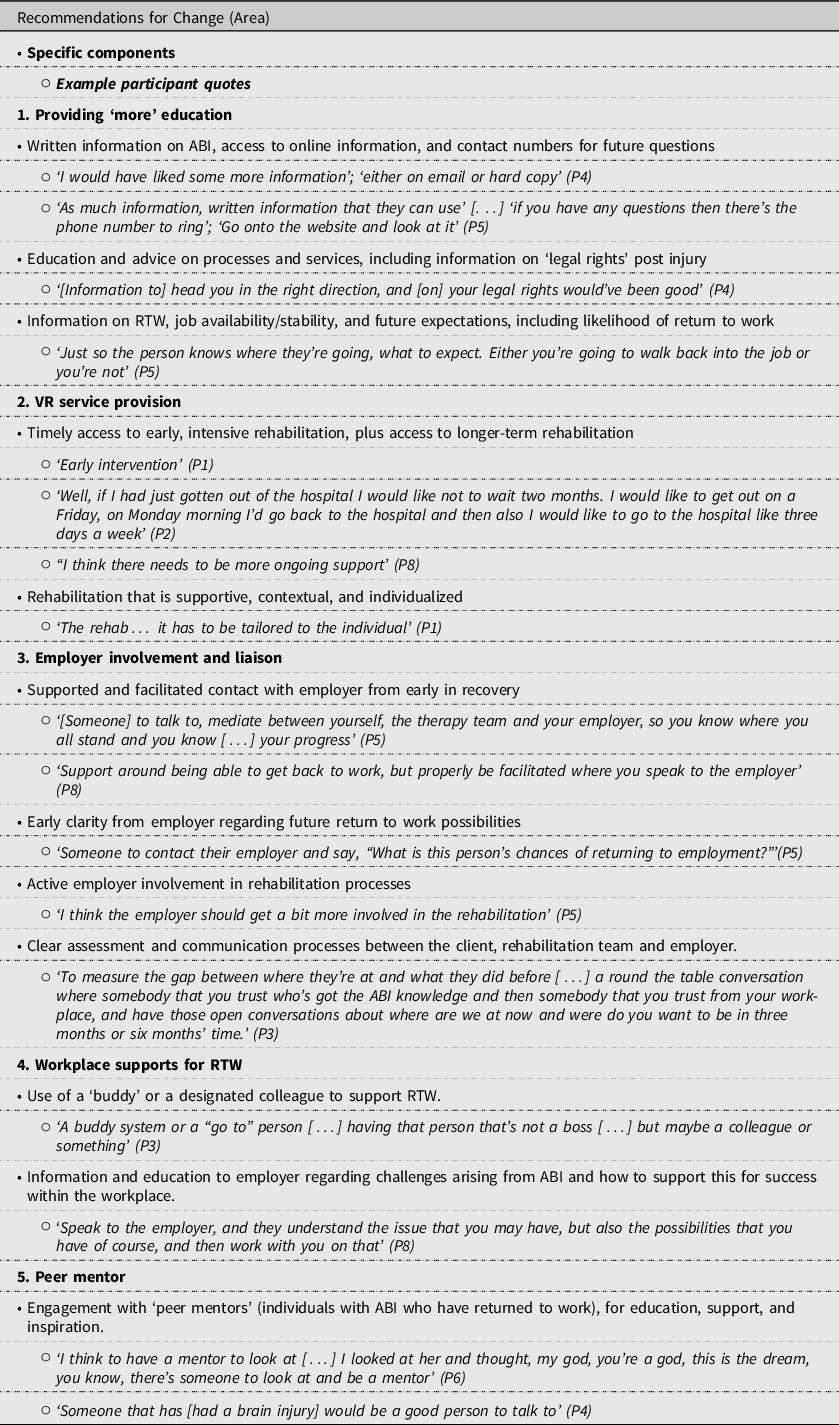
Participants were also explicitly asked to provide their views on what an ‘ideal’ early ABI VR service (i.e., first 3 months post hospital discharge) should involve. Five key areas were identified: education; service provision; employer involvement and liaison; workplace supports; and the use of peer mentors. These areas are detailed in Table 3.
Consumer views of an ‘Ideal’ early ABI VR service

Discussion
This study has identified Queensland consumers’ (i) experiences with VR and RTW following ABI, across five themes; and (ii) views of ‘ideal’ early ABI VR services, with five areas identified. The findings support previous research regarding VR services and RTW experiences for adults with ABI, and correspond with identified factors related to successful RTW (i.e., ‘the ABI’, the ‘individual’, the ‘workplace’, the ‘environment’, and the ‘service or system’). New areas of experience have also been identified. How these findings can influence future service provision and clinical practice to improve consumer-focused ABI VR services is discussed below.
Experiences with VR and RTW
Participants’ experiences with VR and RTW varied, regardless of the funding system accessed. In the absence of dedicated, specialized public VR services for adults with ABI it is not surprising that mixed experiences were reported. Participant experiences identified in Theme 1: Addressing VR in Rehabilitation aligned with ‘service or system’ factors and factors related to ‘the ABI’; reported experiences in Theme 2: Facilitators of recovery and RTW related to ‘individual’ and ‘service or system’ factors for RTW.
Participants’ negative and positive experiences regarding access and availability of ABI VR in Queensland reflect previously identified service recommendations for ABI VR, including access to: early specialized rehabilitation to aid RTW preparation/readiness (McRae et al., Reference McRae, Hallab and Simpson2016); ongoing rehabilitation and ABI VR (McRae et al., Reference McRae, Hallab and Simpson2016; Shames et al., Reference Shames, Treger, Ring and Giaquinto2007); and longer-term services and follow-up (Macaden et al., Reference Macaden, Chandler, Chandler and Berry2010; McRae et al., Reference McRae, Hallab and Simpson2016). These findings demonstrate consumer awareness of the importance of ABI VR for future vocational success and highlight service and system level successes and challenges for ABI VR service provision in Queensland.
Reported experiences regarding the content and delivery of VR varied, with areas identified by participants (Theme 1: education and information provision, conflicting expectations, therapeutic alliance and skills; Theme 2 (facilitator): therapists and rehabilitation teams) aligning with findings from the literature, including the importance of education and information provision to support VR and RTW (Gilworth et al., Reference Gilworth, Carey, Eyres, Sloan, Rainford, Bodenham and Tennant2006, Reference Gilworth, Eyres, Carey, Bhakta and Tennant2008), and the impact of positive therapeutic relationships, working alliances and ‘faith’ in clinicians to support VR and RTW (Hooson et al., Reference Hooson, Coetzer, Stew and Moore2013; Shames et al., Reference Shames, Treger, Ring and Giaquinto2007). Results also highlight key areas for ongoing service delivery and/or potential clinical change, including providing education, individualizing rehabilitation, developing the therapeutic alliance and actively addressing vocational skills during all phases of recovery to better meet clients’ needs and goals. This may be particularly relevant during early rehabilitation, as RTW outcomes for adults with ABI improve with access to specialized, early ABI VR (Kendall et al., Reference Kendall, Muenchberger and Gee2006). In line with other study findings (Libeson et al., Reference Libeson, Downing, Ross and Ponsford2018), clients also reported their experiences in developing insight post-ABI, including readiness for RTW. As this occurred concurrently with rehabilitation, insight may have impacted participants’ expectations of therapy, level of participation, and satisfaction and perceptions of VR, potentially influencing the experiences reported and study results.
Two areas discussed above were identified by participants as components of ‘ideal’ early ABI VR services, including the provision of education and information, and access to timely and long-term rehabilitation that is individualized and contextual, supporting previous recommendations and facilitators of VR and RTW from the literature (Gilworth et al., Reference Gilworth, Carey, Eyres, Sloan, Rainford, Bodenham and Tennant2006, Reference Gilworth, Eyres, Carey, Bhakta and Tennant2008; Hooson et al., Reference Hooson, Coetzer, Stew and Moore2013; Libeson et al., Reference Libeson, Downing, Ross and Ponsford2018; Macaden et al., Reference Macaden, Chandler, Chandler and Berry2010; Rubenson et al., Reference Rubenson, Svensson, Linddahl and Björklund2007; Shames et al., Reference Shames, Treger, Ring and Giaquinto2007; van Velzen et al., Reference van Velzen, van Bennekom, van Dormolen, Sluiter and Frings-Dresen2011).
Other findings from Theme 2 related to identification of ‘self’ as a Facilitator of recovery and RTW, aligning with the importance of individual determination for the RTW process regardless of outcome (McRae et al., Reference McRae, Hallab and Simpson2016), the concept of individuals ‘taking charge’ of their rehabilitation and RTW (Levack, McPherson, & McNaughton, Reference Levack, McPherson and McNaughton2004), and client drive/motivation influencing RTW success (Libeson et al., Reference Libeson, Downing, Ross and Ponsford2018). Assisting clients to utilize their self-drive and take more active roles during rehabilitation facilitates the delivery of patient-centered care and rehabilitation (Planetree International, 2018), promotes self-efficacy, and may be useful for clinicians to target when providing ABI VR.
Reported experiences in Theme 3: The importance and experience of working again aligned with the RTW factors related to ‘the ABI’, the ‘individual’, the ‘workplace’ and ‘service or system’. All participants identified work as a major component of identity, and in line with other studies (Libeson et al., Reference Libeson, Downing, Ross and Ponsford2018; van Velzen et al., Reference van Velzen, van Bennekom, van Dormolen, Sluiter and Frings-Dresen2011) the majority of participants identified early goals of RTW, with a strong desire to resume their pre-injury work role and identity. Participants identified the sense of loss regarding their occupational role and identity when faced with the possibility or reality of not returning to work; this was independent to loss of earnings or financial stressors. These findings vary to those of Hooson and colleagues (Hooson et al., Reference Hooson, Coetzer, Stew and Moore2013) who identified loss associated with identity based on earning ability, and align more with McRae et al.’s (Reference McRae, Hallab and Simpson2016) findings of the impact of work on self-identity and pride post-ABI.
Participants’ reported experiences of returning, and attempting to RTW are also consistent with findings from the literature, including participants’ reduced insight into readiness for work and resultant difficulties when this was attempted too early (Hooson et al., Reference Hooson, Coetzer, Stew and Moore2013; Libeson et al., Reference Libeson, Downing, Ross and Ponsford2018), difficulties in both seeking employment and in maintaining employment (Oppermann, Reference Oppermann2004), and participants’ changing expectations of work following ABI over time (Libeson et al., Reference Libeson, Downing, Ross and Ponsford2018). Similar to findings by McRae et al. (Reference McRae, Hallab and Simpson2016), access to supports and processes for RTW was reported to be poorer for non-compensable clients and for clients who did not have an employer to return to. For participants who were unemployed long-term post-ABI, their expectations of RTW reduced while the goal of RTW remained high. This again highlights the need for access to specialized ABI VR and RTW services with longer-term timeframes for people with ABI in Queensland. Taken more broadly, findings align with the notion of viewing RTW as a component of rehabilitation, not as an ‘outcome measure’ (Shames et al., Reference Shames, Treger, Ring and Giaquinto2007), and viewing ‘success’ as the ability to attempt RTW, not necessarily engaging in full time paid employment (Levack et al., Reference Levack, McPherson and McNaughton2004).
Positive RTW experiences were reported by those who RTW with their former employer and involved supportive colleagues/managers and modifiable roles/workplaces, in line with workplace-specific factors known to enable RTW (Libeson et al., Reference Libeson, Downing, Ross and Ponsford2018; Macaden et al., Reference Macaden, Chandler, Chandler and Berry2010; van Velzen et al., Reference van Velzen, van Bennekom, van Dormolen, Sluiter and Frings-Dresen2011). However, challenges arose in managing relationships with former work colleagues. This may reflect changes to the social and cognitive-communication skills required for workplaces (Meulenbroek et al., Reference Meulenbroek, Bowers and Turkstra2016; Meulenbroek & Turkstra, Reference Meulenbroek and Turkstra2016), ongoing psychosocial adjustment post-injury, and/or the need for education and awareness training in workplaces. Individuals may benefit from clinical support in these areas as a component of their VR and RTW supports, alongside additional supports for employers and co-workers to facilitate successful RTW.
Reported employer engagement and communication processes between the person with ABI, the rehabilitation team and employers were varied; this was highlighted as an important component of VR by participants who were both successful and unsuccessful in returning to work. Employer communication is required for many of the processes of ABI VR (e.g., identifying duties and tasks, liaison re: job availability, worksite visits) and underpins many of the factors for successful RTW. While the processes that underlie successful employer communication and liaison are less researched, RTW is facilitated by VR services that provide support and guidance during RTW (Donker-Cools et al., Reference Donker-Cools, Wind and Frings-Dresen2016) and supportive employers with knowledge of ABI (Donker-Cools et al., Reference Donker-Cools, Schouten, Wind and Frings-Dresen2018; Macaden et al., Reference Macaden, Chandler, Chandler and Berry2010; van Velzen et al., Reference van Velzen, van Bennekom, van Dormolen, Sluiter and Frings-Dresen2011). Improving communication processes between the consumer, employer and the rehabilitation team is an identified future clinical and service direction and was also identified as a future recommendation for ‘ideal’ early ABI VR services.
Regardless of RTW outcome, participants identified involvement in meaningful activities as important; engagement in meaningful activity is also recognized as a contributing factor for RTW (Macaden et al., Reference Macaden, Chandler, Chandler and Berry2010). Assisting clients to identify and engage in meaningful activities and productive roles is a core component of ABI rehabilitation and may be beneficial as a component of ABI VR, particularly for those with a longer RTW trajectory. This may also assist clients in their psychosocial adjustment post-injury and in managing changes to self and identity, which is discussed below.
Participant experiences in Theme 4 (ABI and Identity) related to RTW factors involving ‘the ABI’, the ‘individual’, the ‘environment’ and the ‘service or system’; this included changes to their sense of self and identity post-injury. The ABI literature reports the impact of loss of work on the individual, and the use of ‘self’ and ‘drive’ for RTW, however supporting identity change in the context of RTW is less researched. Assisting clients to address identity changes following ABI, including facilitating post-traumatic growth is often a core component of psychosocial and psychological support during ABI rehabilitation (Ownsworth, Reference Ownsworth2014). Addressing this area as a component of VR will support clients in their adjustment to injury and may facilitate RTW by assisting clients to harness self-drive for recovery. In Theme 4, participants also identified the negative impact of ABI on family and relationships (including relationship breakdown). As family support has been identified as a positive influencing factor for RTW (Hooson et al., Reference Hooson, Coetzer, Stew and Moore2013; Libeson et al., Reference Libeson, Downing, Ross and Ponsford2018), actively working with clients and families to maintain relationships during ABI VR is an identified future direction for ABI VR services, and may improve stability of long-term supports for people post-injury and success in RTW.
In the final theme (Theme 5: Service, system, policy) participants identified that RTW for individuals with ABI could be supported by a range of changes to services, systems and policies (e.g., access to long-term, specialized ABI VR; supporting complex decisions; job security and employer incentives; service pathways). Participant views related to ‘service and system’ factors that support RTW, and align with previous recommendations regarding service change to improve employment outcomes post-ABI (Libeson et al., Reference Libeson, Downing, Ross and Ponsford2018; Rubenson et al., Reference Rubenson, Svensson, Linddahl and Björklund2007; Shames et al., Reference Shames, Treger, Ring and Giaquinto2007; van Velzen et al., Reference van Velzen, van Bennekom, van Dormolen, Sluiter and Frings-Dresen2011). At a local level, supporting access to ABI VR services including delivery of VR in rehabilitation services, and improving links and transitions with other service providers is a long-term recommendation.
Views on ‘ideal’ early ABI VR services
The five identified areas align with known facilitators of RTW, and factors that support RTW (in the areas of ‘service and system’ and ‘workplace’); three of the five areas were reported within the thematic analysis and have been discussed above. These include the provision of education, access to timely and long-term rehabilitation that is individualized and contextual, and improved involvement and liaison with employers from early in recovery.
Participants also identified two additional service areas for change - implementing additional workplace supports (including the use of a designated colleague or ‘buddy’) and involving a peer mentor early in recovery. Participants valued meeting someone who could share their lived experience of returning to work after ABI and provide hope, education and support early in recovery. The use of peer contact and peer support in ABI VR has been previously recommended (Donker-Cools et al., Reference Donker-Cools, Schouten, Wind and Frings-Dresen2018). Addressing or incorporating these identified areas into VR and RTW service processes at a system, service and clinician level should help to address identified consumer needs and improve the delivery of consumer-focused VR services.
Clinical implications
This study has identified a number of recommendations to inform future clinical service provision for ABI VR to meet identified client needs, across areas known to facilitate RTW and new areas of support. While service and system level change can be difficult to influence, a range of findings can be implemented in individual and/or team clinical practice. These include: how clinicians acknowledge and address RTW goals early in recovery; providing contextual, individualized rehabilitation that addresses vocational goals; fostering a strong therapeutic relationship; providing increased education; assisting individuals to engage in meaningful activities; supporting clients and families regarding changes to identity/sense of self and to maintain relationships; addressing skills to support social interactions and relationships within the workplace; facilitating peer supports; and establishing clear employer communication processes. This may also require changes to processes at a team-based level. Implementing these changes consistently within a service may require the designation of a VR coordinator within the team, and the development of processes or frameworks to facilitate delivery of consistent ABI VR for clients, including transitions between services. This is an identified future research direction. Service and system level recommendations include the development of local ABI VR pathways, advocating for extended timeframes and improved client access to current services, and recommendations for regulations or incentives to support employment options post-ABI.
Strengths and limitations
This study has several limitations, including a small sample size and a varied participant group (regarding type of injury, time post injury, and service availability post-injury), with potential recall bias of participants who are years post-injury. Participants self-reported information and experiences may have been influenced by the impact of their ABI, potentially impacting qualitative findings. While these are common limitations within this type of rehabilitation research, future research may consider using larger population groups, clients from a wider geographical area and cross-referencing self-reported information with medical records. As access to ABI rehabilitation and specialized ABI VR has varied in Queensland over the past 10 years, changes to services and potential interventions may have also influenced participants’ experiences.
Strengths of this study include the focus on examining consumers’ lived experience within a specific clinical context, and the investigation into a broad range of experiences related to ABI VR and RTW. The heterogeneity of the group investigated, including variations in type of injury and time post injury, employment status and access to compensation/funding has assisted in identifying a range of lived experiences that can contribute to service-level change at a local level and beyond.
Conclusions
This study has examined the VR and RTW experiences of adults with ABI in Queensland, and has identified similarities with the literature, new areas to consider during ABI VR, and future directions for ABI VR provision at a clinical, service and system level. These findings will support clinicians and services providing ABI VR (including rehabilitation to address RTW goals) to better meet identified client needs. To provide these components consistently, a broader framework may be required to guide future ABI VR service development and delivery, alongside current service models including the ICF (World Health Organisation, 2001) and evidence-based practice models (Hoffman et al., Reference Hoffman, Bennett and Del Mar2017). A socio-ecological framework may be useful in providing consumer-focused ABI VR and RTW services and is a recommended future research direction.
While the recommendations identified are contextually relevant, the similarities with the existing literature suggest that they may translate to other services and settings outside of Queensland and Australia, and to broader rehabilitation contexts. Additionally, as the rehabilitation landscape within Australia is changing with the implementation of a national insurance-based support scheme, people’s access to VR should improve and their experiences positively impacted by services and clinicians adopting these findings.
Acknowledgements
We would like to thank the community participants who gave their time to participate in this study; Suzanne Wright (STEPS Coordinator) for her assistance in participant recruitment and facilitating resources; staff from the ABI Transitional Rehabilitation Service (ABITRS) and the ABI Outreach Service (ABIOS) at the Division of Rehabilitation, PA Hospital, Metro South Health for their support and practical assistance.
Funding statement
This research was supported by a seed grant from The Hopkins Centre (2018). ABITRS is a pilot rehabilitation service funded by the Motor Accident Insurance Commission, Queensland Treasury, Queensland Government (2016–2021).
Conflicts of interest
None.
Ethical standards
The authors assert that all procedures contributing to this work comply with the ethical standards of the relevant national and institutional committees on human experimentation and with the Helsinki Declaration of 1975, as revised in 2008.
Appendix A. Semi-structured interview questions (focus groups and interviews)
Definition of vocation = work, study, volunteer, meaningful role
-
1. When you left hospital, did you have vocational goals? What were they?
-
2. Let’s talk about your rehab and your vocational rehab.
-
• Your ABI rehab – where and when?
-
• Did you have vocation/return to work goals when you had your rehab?
-
• Did you rehab work on these goals?
-
-
3. Let’s talk about your experience with your vocational goals and rehab.
-
• Were your vocational goals addressed? How? Who? When?
-
• How important is/was that goal to you?
-
• Did anyone talk to your employer? Or help you talk to them?
-
-
4. How satisfied were you with this rehab? With your outcomes?
-
• Positives
-
• Missing/challenges
-
• Areas for more help
-
• Other ways to address your goals
-
-
5. Let’s talk about how you are going today.
-
• Are you working now?
-
• Involved in other activities?
-
• Do you still have vocational goals?
-
• What are barriers to achieving these?
-
-
6. Let’s get some advice and information for the future.
-
7. (a) Early in your recovery….
-
• What should you have been told about return to work?
-
• What advice would you have liked to get?
-
-
(b) In an early ABI rehab service (i.e., just getting home from hospital) ….
-
• What should be provided for adults with vocational goals?
-
• How?