In 1988, the Soviet Union was in the midst of a crisis. Perestroika, the reform process which had been started by Mikhail Gorbachev when he became general secretary of the Communist Party in 1985, had reached a critical point. In the Kremlin, hard-line communists were intensifying their opposition to the reforms. In the Caucasus, armed conflict had broken out between Armenians and Azerbaijanis. The Supreme Soviet of the Estonian Socialist Republic declared sovereignty on 16 November.
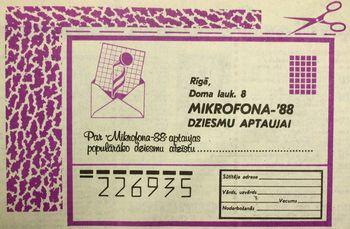
“I admit that the most popular song in the “Mikrofons-88” poll is ...” (it's direct translation of central statement in the ballot) Voting ballot from the radio program magazine Rīgas Viļņi. In addition to their names, occupations and addresses, the participants were also asked to state their ages. Note the ornamental flag attached to the microphone. According to the programme's producer Kārlis Vahšteins, it was intentionally modelled after the still forbidden national flag of Latvia (2018).

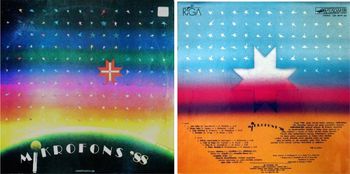
Compilation album featuring songs from the 1988 competition (front and back). According to the sleeve notes, it was dedicated to ‘the awakening’. The citation of leader of Popular Front Dainis Īvāns is used. The morning star on the cover has the red and white colours of the Latvian flag (in the right proportions, not like in earlier version of the Mikrofons’88 logo). The usage of the morning star (Auseklis) was itself not welcomed in Soviet times, because of its frequent display on badges and coats of arms of national institutions during pre-war Republic of Latvia.

In December, in neighbouring Latvia, radio listeners voted the rock group Igo & Remix the winners of the national song competition with a song that was a literal declaration of independence:
Brīvību, brīvību Tēvzemei
Nelūdzam, pieprasām!
(‘Freedom to the Fatherland
We do not ask, we demand!’)
(‘Pie laika’ (‘Now is the Time’), by Uldis Marhilēvičs and Rodrigo (Igo) Fomins)Footnote 1
The Mikrofona aptauja song competition (‘Microphone poll’, 1968–1994) was one of the most popular radio and television programmes in Latvia, and many of the winning songs have become evergreens. ‘Pie laika’, the winner of 1988, became one of the iconic songs of the ‘singing revolution’, the Baltic independence movement. As Igo later recalled, ‘It was absolutely the mirror of its times’ (Guļevska and Jākobsons Reference Guļevska and Jākobsons2017, p. 190).
The contest was originally a venue for new Latvian pop music. Several of the winning songs also became hits in Russian translation, including ‘Million roz’ (‘A Million “Roses'/ Latvian origin version - ‘Dāvāja Māriņa meitenei mūžiņu’”) by Raimonds Pauls, number one in 1981 and one of the top Soviet songs of the 1980s. However, after 1985, the competition became a forum for the independence movement, often known as ‘the singing revolution’, which led to the dissolution of the Soviet Union and the independence of the Baltic countries 1991.Footnote 2 According to the poet Leons Briedis, it was important for ‘the consolidation of our people’ (Guļevska and Jākobsons Reference Guļevska and Jākobsons2017, p. 213).
Accounts of the ‘singing revolution’ usually emphasise the role of political movements and mass singing at protest meetings (Šmidchens Reference Šmidchens2014). Our research suggests that a parallel development was taking place in the mass media, radio, television and recording industry. In this paper, we attempt to show how a regional song contest in the Soviet Union became a forum for nationalist feelings already at a time when such sentiments could not be openly expressed in public. With the political reforms of the perestroika era and the end of censorship, it turned into an open demonstration for independence.
Our principal sources are the songs that participated in the contest and the annual gala concerts, which are available at the archives of Latvian television. In particular, we have analysed the top 10 songs from 1980–1989, 90 songs altogether. We have also drawn on previous writings on Latvian popular music, including biographies of participants, the radio programme magazine Rīgas Viļņi and interviews with journalists and editors. The programme's long-time producers Lia Guļevska and Gunārs Jākobsons have published their recollections of the competition up to 1987 (Reference Guļevska and Jākobsons2017). Several other journalists who were working at Latvian radio during the relevant period have kindly granted us interviews. The academic research on the subject is still limited (see Procevska Reference Procevska2007a, Reference Procevskab, Reference Procevska and Proskurova2010, Reference Procevska2015). One of the authors (JD) has personal recollections of the contest: as a child in 1981 he voted for the song ‘Meitene ar kallu ziediem’, by Credo.
Popular music in the USSR
The Union of Soviet Socialist Republics ceased to exist in 1991, but many aspects of its legacy are still little studied. The Soviet Union had a rich musical life. It was one of the largest record producers in the world, with an annual production comparable with that of the UK. The Union of Soviet Composers had 2156 members in 1980, and 138 national and regional concert organisers (‘Filharmonias’) had the task of providing audiences with live music. Popular music was regularly heard on radio, television and films, and blared from loudspeakers in sports halls and on public beaches (MacFadyen Reference MacFadyen2001; Stites Reference Stites1992; Keldysh Reference Keldysh1973–1982).
In the present context, it is not possible to present a detailed history of Soviet popular music. More detailed research on original documents is still needed. For the purposes of this paper, we shall just emphasise that all music production in the USSR took place within the planned economy. In contrast to the West, there was no commercial competition. All media and entertainment venues, including the record company Melodiya, were owned by the state. Songwriters and performers were employed by public authorities and paid according to scales set by the Ministry of Culture. The possibility of a previously unknown artist springing to fame by making a ‘gold record’ simply did not exist. To perform in public, a performer had to pass an audition and become licensed by the authorities (for a description of the situation in Estonia, see Garšnek Reference Garšnek, Riisalu, Koha, Tüür and Lepik2011; Rinne Reference Rinne2008). To make a record, he or she had to be included in the annual production plan, and the number of records pressed was also determined centrally. The state record company did not publish figures of the sales of individual records, and there were no ‘top 10’ lists to gauge the relative popularity of artists (Gronow and Saunio Reference Gronow and Saunio1999, pp. 179–81).
Nevertheless, there was an element of competitiveness in Soviet popular music. This function was provided by radio and television shows, song festivals, competitions and prizes. Broadcast appearances were a path to popularity, and with awards came more publicity, a better pay class, more jobs, paid vacations in desirable locations and perhaps even the possibility to travel abroad.
As all institutions and media were owned by the state, it also had the ability to control the repertoire. Theoretically, the arts in the USSR were supposed to follow the policy of ‘socialist realism’. In the field of music, it was hardly defined in detail, and mostly implemented in negative terms. Music by Soviet composers and composers from other Communist countries was preferred above foreign music, unless it had reached classical status. Rock music and avant-garde concert music were mostly considered unsuitable, but the lines were flexible. In the USSR in the 1980s, control usually took the form of self-censorship by the editors, but the final decision was left to the state censorship office, GLAVLIT, and other government bodies such as repertoire committees, which had to approve everything presented to the public, from printed materials to concert programmes (studies of Soviet censorship include Garrard and Garrard Reference Garrard and Garrard1990 on literature; Paasilinna Reference Paasilinna1995 on television; Löhmus Reference Löhmus2002 on radio; and Strods Reference Strods2010 on Latvia in general).
To work within the Soviet system, composers and performers had to comply with the official cultural policy and its requirements for professional qualifications, repertoire and performance style. Failure to do so resulted in sanctions, although there was often the possibility to resume work later on. Of the lyricists discussed in this paper, Leons Briedis had been expelled from the university in 1961 for his political views, and Vizma Belševica was forbidden to publish her work because of ‘bourgeois nationalism’ from 1971 to 1974 (Ekmanis Reference Ekmanis1998, pp. 287–96). The only way for artists to work outside the system was as amateurs, but even then, they could not perform in public without permission. Many rock groups and songwriter-poets (‘bards’) in the Soviet Union survived in the 1970s as amateurs, often thanks to the cooperation of sympathising student clubs or youth centres. Their home institutions or hometowns were the only locations where they were allowed to perform, except for occasional festivals outside this area (Rasa Reference Rasa2008).
However, there existed a large unofficial grey market for imported foreign music in the private sphere. Although it was not available through official channels, it was not forbidden, and foreign records circulated widely and were copied and re-copied on tape – by the 1980s, the Soviet Union was a major producer of tape recorders. In many parts of the Soviet Union it was also possible to listen to foreign broadcasts, and even official Soviet radio channels occasionally aired foreign popular music. In this way Soviet musicians and audiences were aware of international trends in popular music, although usually with some delay.
The Mikrofons competition and Soviet media policy
Another aspect that needs to be noted is the multinational character of Soviet culture. The country was a union of 15 Soviet republics, each with its national language and a certain degree of autonomy. Although Russian was the dominant language and the role of the national languages varied, the republics and some smaller regions had their own traditions of popular music, radio and television channels in national languages, and quotas for record production. The status of the national languages was often a source of tension. Several high officials of the Latvian Communist Party had lost their jobs in 1959–1962 because they had opposed the increasing immigration from Russia and the declining status of the Latvian language (Loader Reference Loader2017; Smith Reference Smith1996).
In the 1960s, the role of popular music in the Soviet media increased. Like in the West, radio had to find a new role after the introduction of television and the rapid increase of portable radio sets and tape recorders. In the Soviet Union, there was also the challenge of creating alternatives to Western radio stations, which broadcast in the national languages of the USSR and played a lot of popular music. In 1964, a new Soviet All-Union radio channel was started, devoted to news and popular music. The Russian-language channel was called Mayak (‘The Beacon’). Similar programmes were introduced in other languages. In Latvia, the new programme was called Mikrofons (‘The Microphone’, 1965). It was aired at the same time as the Latvian-language programmes of the ‘Voice of America’, and the original intention of creating this show was counterpropaganda (Daugavietis Reference Daugavietis2008, p. 55; Høyer et al. Reference Høyer, Lauk and Vihalemm1993, p. 206; Procevska Reference Procevska and Proskurova2007a, p. 155). To attract listeners, it featured a large proportion of new Latvian and international popular music, and short and catchy storylines. Direct propaganda was kept to a minimum.
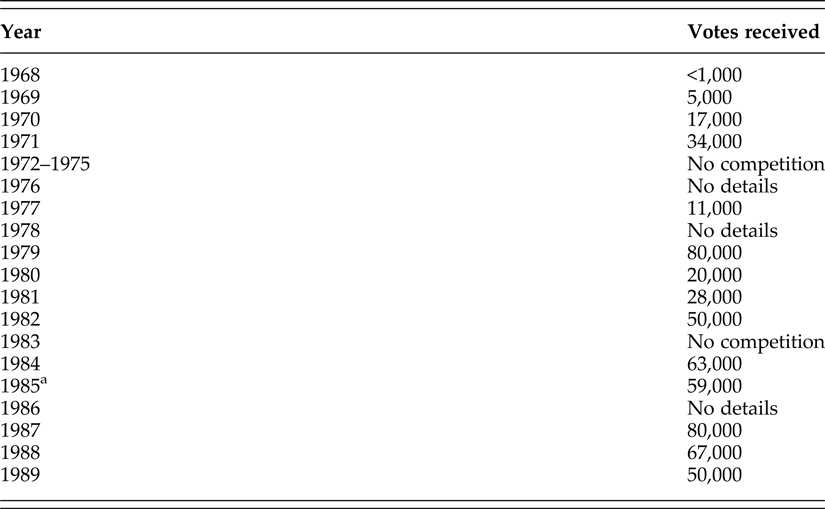
At that time, relatively few new Latvian popular records were issued annually. The principal producer of new music was radio, which employed a large staff of studio musicians on a regular basis. In 1968, the producers of Mikrofons, hoping to increase the listener figures, introduced a song competition as part of the programme (Jākobsons Reference Jākobsons, Jākobsons and Guļevska2017; Latvian Television 2018a). Full details of the first competition have not survived. In recent interviews, Gunārs Jākobsons, radio journalist and founder of the Mikrofons competition, has at various times recalled figures starting with just a few dozen votes and ending with a few hundred (Jākobsons Reference Jākobsons, Jākobsons and Guļevska2017, p. 21; Latvian Television 2018a; ‘“Mikrofons” cauri laikiem’ 2017). However, the popularity of the contest increased gradually, and by 1971, the number of votes had already reached 34,000 (Jākobsons Reference Jākobsons, Jākobsons and Guļevska2017, p. 34).
By 1980, the contest had become established as a major cultural event in Latvia. The final show was also broadcast on TV, and for Latvian radio and television, it was one of the top programmes of the year. For songwriters and performers, it was an important venue for introducing new songs to the public, and sometimes also a stepping stone to wider fame. The most popular songs were issued in annual compilations by the state record company Melodiya, and songs from the competition represented the Soviet Union at song festivals in other communist countries. Tickets for the annual Mikrofons gala concert, usually around New Year, were almost impossible to get, as 120 seats were reserved for the Central Committee of the Communist Party of Latvia, and a large part of the remaining seats to other government bodies. The general public watched the event on television and participated by mail in the selection of the best songs. The number of votes cast typically exceeded 50,000 (see Appendix 1 on competition rules and Table 1 on votes received).Footnote 3
Audience participation in Mikrofons competitions, 1968–1989

a The rules changed over the years. Until 1984 several listeners could sign the same letter (voting for one song), and the votes were counted separately. From 1985 on, only one vote per standardised ballot was allowed. The figures are rounded to the nearest 1000.
Lyric, civic and national songs
In the Soviet Union, popular music was conventionally known as estrada (literally, ‘stage’). Conceptually, it is related to the English terms ‘variety’, ‘show’ and ‘entertainment’. Record catalogues usually had separate sections for ‘classical’, ‘folk’ and ‘estrada’. In Russian and other languages of the USSR, it referred to a broad range of light music performed by professionals, typically by ‘estrada orchestras’ employed by state concert agencies and radio and television stations.
Like other cultural expressions, estrada had to follow the tenets of social realism. Musically, Soviet theoreticians did not have much to say about it, as long as the repertoire consisted mainly of the works of Soviet composers. Stylistically it drew from the common traditions of European and American popular music before rock, including jazz. If the USSR had chosen to participate in the Eurovision Song Contest, many estrada songs would easily have fitted there. Even the visual imagery was similar: solo singers in gala dress, accompanied by a large dance orchestra with strings, winds and a rhythm section.
Where song lyrics were concerned, more attention was paid to political correctness, and the history of Soviet estrada is full of cases where editors or censors demanded minute changes to song texts (Garrard and Garrard Reference Garrard and Garrard1990, pp. 166–91). Soviet theoreticians distinguished between two categories of song texts, ‘lyric’ and ‘civic’. Lyric songs continued the tradition of romantic expression that is also prominent in Western popular song. Civic songs expressed the goals of the Soviet society and the Communist Party, the Soviet fatherland, the Great Patriotic War and the constant improvement of society (MacFadyen Reference MacFadyen2001, pp. 33–61).
For the first decade, the Mikrofons competition was dominated by estrada songs, and the contest helped to establish the modern Latvian popular song. In the early years of the competition, all of the winning songs represented the category ‘lyric songs’, as defined by Soviet aesthetics. ‘Mežrozīte’ (Sweet briar), the 1968 winner, for example, tells the story of the wild rose which blooms faithfully from year to year. The next winner, ‘Dziesma nenosalst’ (‘The Song Does Not Freeze’, 1969) is about motherly love, and ‘Baltā saule’ (‘Bright Sun’, 1970) about two lovers in a sailboat.
Soviet-style ‘civic’ songs are conspicuously absent from the competition. Instead, we see the rise of a new type of popular song with Latvian national themes in the Mikrofons competition. The winning song of 1971, ‘Teic, kur zeme tā’ (‘Look at the Country’, by Pauls and Peters), celebrates the rugged beauty of the ‘land of birth’, where the path of the fathers opens in the mist. The country is not named, but the physical description leaves no doubt that it is Latvia. The number two song by the same authors, ‘Zilā’ (‘Blue’), continues the national theme. It pays homage to the poet Aleksandrs Čaks (1901–1950), whose work had been suppressed in the Stalin era.
Several authors have commented on the development of a ‘national’ song tradition in Europe during the 19th century in connection with the creation of modern national states. Bohlman (Reference Bohlman2008, p. 60) lists typical traits such as ‘stress on the origins of the national, particularly in nature’ and ‘the distinctiveness of the language’. Latvia, too, had developed a body of ‘national’ music during the independence movement and the First Republic, but much of it had been suppressed during the Soviet occupation.
‘Teic, kur zeme tā’ started a series of new Latvian popular songs which dominated the Mikrofons competitions in the 1970s. The composer Raimonds Pauls succeeded in creating a new type of ‘national’ song that expressed the feelings of the Latvian audience and yet was acceptable to the Communist Party – at least to some extent. The gala concert of the 1971 Mikrofons competition had created a minor scandal, as the programme was considered unacceptably nationalistic, and the director of Latvian radio and the chairman of the radio and television committee pointedly did not attend the concert (Jākobsons Reference Jākobsons, Jākobsons and Guļevska2017, pp. 37–8). The contest was discontinued for several years.
It is a tribute to the musical and social talent of Raimonds Pauls that he won every Mikrofons competition from 1968 to 1982. He was an exceptionally gifted pianist, composer and bandleader with more than a thousand works to his credit. Although his songs were occasionally censored, this does not seem to have harmed his career. For his songs, he used the texts of prominent poets such as Leons Briedis, Vizma Belševica and Jānis Peters. After 1982, when Pauls became the music director of Latvian radio and television, he no longer participated in the Mikrofons contest. Later on, he focused more on writing songs for popular Russian performers such as Alla Pugacheva and Valeri Leontyev (Mazvērsīte Reference Mazvērsīte2006; Remess and Peters Reference Remess and Peters2010, pp. 213–4). In 1985, he received the prestigious title ‘People's artist of the USSR’.
Meanwhile, the Mikrofons competition was resumed in 1976. The winners were again Pauls and Peters, with ‘Tava balss (mēmā dziesma)’ (‘Your Voice (Voiceless Song)’), a philosophical song about the need to find one's own voice. The song also represented USSR in the Sopot song contest in Poland. The next year's winner by the same authors was a romantic song about autumn leaves, ‘Par pēdējo lapu’, which also became a big hit in Russian translation (‘Listya zoltiye’) (Stites Reference Stites1992, p. 156)
The winning Mikrofons songs of 1978–1980 were all in a lyric mood, but in 1981 the national question rose again. Writing songs about ‘homeland’ was problematic. The Communist Party was worried about anything that could be interpreted as presenting the pre-war bourgeois republics in a favourable light or putting the interests of Latvia ahead of those of the Soviet Union. The censors were sensitive about the use of words such as tauta (people, nation), Latvija (Latvia) and svēts (holy). According to our informants, journalists were encouraged to use the words ‘Soviet Latvia’ in place of ‘Latvia’ (Guļevska 2018; Latkovskis 2018; Vahšteins 2018).
Experienced journalists and authors developed an understanding of topics which were best avoided. However, over the years there had been several cases when popular songs with sensitive topics passed the first threshold of editorial committees and censors, but later on caught the attention of the Party when the public response to the songs began to resemble a protest against the Party's policies. The case of the song ‘Tik un tā’ (‘Anyway’, 1981) illustrates how songwriters and journalists had a certain space to manoeuvre within the rules of Soviet censorship. The singer-songwriter Uldis Stabulnieks worked as pianist in Latvian radio's estrada orchestra. In November 1981, he had gone into an empty studio to tape his new song, based on a poem that Māra Zālīte had published in a recent issue of the literary magazine Karogs. The annual Mikrofons competition was already closing, but programme producer Lia Guļevska liked the song so much that she decided to start broadcasting it along with the other competing songs (Guļevska 2018; Mazvērsīte Reference Mazvērsīte2015; ‘“Mikrofonam” 50’ 2015). It is worth noting that on the official recording he is accompanied by a full orchestra, which was hardly present on an improvised demo recording.
From today's perspective, the song seems completely innocent. It praises the colours of autumn leaves, and asks nature not to hurry, as ‘Latvia is the most beautiful, anyway’. But in Latvia in 1981, this raised the nationalist spirits of listeners. The response was immediate, and listeners started sending cakes and other tokens of appreciation to the radio station. Guļevska received a warning from the Communist Party not to extend the counting of ballots beyond the announced deadline, but the song came second anyway (Guļevska 2018; Guļevska and Jākobsons Reference Guļevska and Jākobsons2017). After some diplomatic manoeuvring, it was included in the gala concert. The winner that year was a Raimonds Pauls song, ‘Dāvāja Māriņa meitenei mūžiņu’ (‘Marina Gave the Girl her Life’), which later became one of the most popular Soviet songs of the 1980s in Russian translation, ‘A Million Roses’ (‘Million roz’), after it was stripped of all references to Latvian mythology.
The incident raises several points. The lyrics of ‘Tik un tā’ had been published in a literary magazine and already approved by the censors, but the Communist Party did not like the enthusiasm it raised in the audience. The poet was chastised for ‘bourgeois nationalism’; the song should have mentioned ‘Soviet Latvia’. Latvian radio was instructed not to play the song too often, and others – artists, choirs – were not allowed to do cover versions (Mazvērsīte Reference Mazvērsīte2015, pp. 128–30). However, it was issued in the annual LP compilation of Mikrofons winners.
Another similar song which had not participated in the song contest was not so lucky. A year earlier, the pianist and composer Zigmars Liepiņš had written the song ‘Vēl ir laiks’ (‘There is Still Time’). The song praises the Latvian summer: there is still time to travel through the country. It was scheduled for a Melodiya album, but the publication was stopped when the Communist Party became concerned with the popularity of the refrain, which consisted of the repeated word ‘Latvia’. The tapes were smuggled abroad and issued in West Germany by an exile publishing company under the ironic name ‘KGB Records’ (Bērtiņš Reference Bērtiņš and Mazvērsīte2017, p. 281).
The Mikrofons winner in 1982 was ‘Cielaviņa’, a romantic song by Raimonds Pauls and Leons Briedis about the wagtail, which sings beautifully in all the regions of Latvia. The song lists the regions one by one, but carefully avoids the word ‘Latvia’. Even these guarded expressions of nationalism may be one of the reasons why there was no competition in 1983. No explanation was given to the producers, but Brezhnev had just died and the new general secretary of the Communist Party of the Soviet Union, Yuri Andropov, had started his job in November 1982 with a campaign against poor labour discipline. Several top Soviet officials lost their jobs. The campaign included a ‘clean-up’ of the music industry.
In 1984, the competition was back, and radio listeners voted ‘Lūgums’ (‘A Prayer’) number one. The estrada-style song praised the beauty of a Latvian nature reserve, with lyrics by the recently deceased Ārija Elksne. The following year's winner was again a song in national spirit. ‘Zibsnī zvaigznes aiz Daugavas’ (‘Stars across the Daugava’), by Zigmars Liepiņš, was based on an old folk song about soldiers going away to war. The composer later suggested that the song was directed against the Afghanistan war, but the reference is so elusive that the song passed the censors without problems (Guļevska and Jākobsons Reference Guļevska and Jākobsons2017, pp. 83–8). However, 1985 was the only year when no compilation album of the winning songs was published.
Kad dēliņ tu atnāksi
No kariņa atpakaļ?
Tad māmiņa es atnākšu
kad zaļos sētas mieti.
(‘When will you, son
Come back from the war?
My mom, I will come back
When the fence posts turn green’)
‘Zibsnī zvaigznes aiz Daugavas’ (Stars across the Daugava), by Zigmars Liepiņš, lyrics traditional
The series of number one songs with national topics continued in 1986. ‘Dzimtā valoda’ (‘Mother Tongue’), by Līvi, was a powerful demand for respect for the mother tongue. The Communist Party of Latvia afterwards issued a statement criticising the song, but it was allowed to win. There were mitigating circumstances: the lyrics were from a recently published translation of the work of a Moldovan poet which had been approved by the censors. Everything was allegorical and deniable, but some of our informants recall this as the most controversial song of the era (Guļevska 2018; Guļevska and Jākobsons Reference Guļevska and Jākobsons2017; Latvian Television 2018a; Mazvērsīte Reference Mazvērsīte2014; Venens 2018).
Vienā valodā raud visi ļaudis
vienā valodā tie smej
tikai dzimtā valodā […]
(‘In one tongue cry all people
In one tongue they laugh
Only in the mother tongue’)
‘Dzimtā valoda’, Ainars Virga, Grigore Vieru, transl. Imants Ziedonis
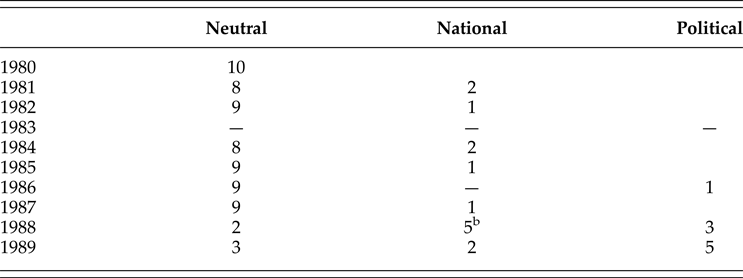
The poem does not mention any specific language, but Latvian audiences understood the song as a protest against the increasing influence of the Russian language. Today, the song is listed as one of the key songs of the nationalist movement,Footnote 4 and from this point on, the proportion of ‘national’ songs on the competition steadily increased. (see Table 3. Mikrofons top 10 songs, 1980–1989. Topics of lyrics).
From estrada to rock
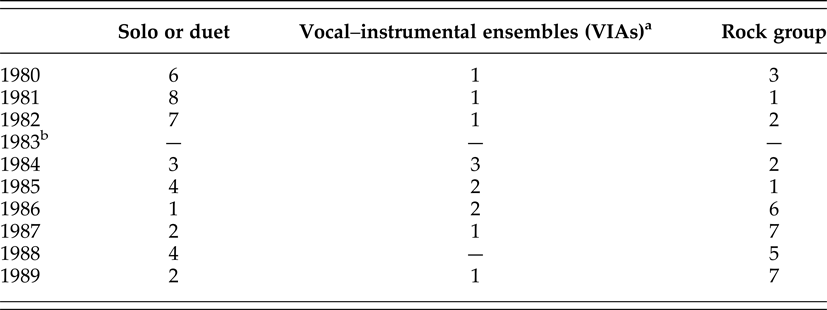
Līvi was the first rock group to win the Mikrofons competition, but a survey of all the songs in the competition shows that the estrada style was “losing ground (see changing types of performers of Mikrofons top 10 songs in 1980–1989, Table 2).” In the West, ABBA had set a precedent in 1974 by winning the Eurovision Song Contest. Although the word ‘rock’ was still taboo for ideological reasons, the first major Soviet rock festival was held in Tbilisi in 1980. The Soviet state record company slowly started issuing rock records, and rock music was discussed regularly in the publications of the Communist Youth League. At first, the Soviet establishment tried to appease younger audiences by favouring ‘vocal–instrumental ensembles’ (Russian: VIAs), with several vocalists and their own backing group, but rock groups with electronic instruments soon took over. The formal dresses of estrada singers were replaced on the television screen by more colourful leisure wear. By the mid-1980s, the ideological war against rock in the Soviet Union had been lost (Troitsky Reference Troitsky1987).
Mikrofons top 10 songs, 1980–1989. Performing artists

a The line between vocal–instrumental ensembles and rock groups is fluid, but VIAs have several singers and more traditional instrumentation (Modo, Eolika). Rock groups (Līvi, Pērkons, Turaidas Roze) emphasise electric instruments, especially guitars. We have also taken into account the background of the groups: rock groups tended to be ‘outsiders’.
b No competition in 1983. The sums can be less than 10 because one band could have several songs in the top 10
In Latvia, established vocal–instrumental groups such as Eolika and Modo had already appeared in the competition in the 1970s. Modo was actually Latvian Radio's new studio band formed by Raimonds Pauls in 1972. In 1979, rock was included for the first time when the art-rock group Menuets had two songs in the top four. One of the songs, ‘Dziesma ar ko tu sācies’ (‘Song, where do you Start From’) actually caused a political scandal when it was interpreted as a protest against censorship, and the show's producers had to fight to get it included in the final concert (Guļevska 2018; Guļevska and Jākobsons Reference Guļevska and Jākobsons2017, p. 64; Vahšteins 2018).
In 1980 and 1981, rock was represented by the Raimonds Pauls protégée Credo, who also had Pauls songs in their repertoire. In 1982 there were already three rock groups in the top 10, Credo, Līvi and Sīpoli. Līvi's song ‘Ziņģe par bailēm’ (‘Song about Fear’), performed by Credo, had been third in 1980. Their ‘Zīlīte’ (‘Titmouse’) came third in 1982 (Vāvere and Neimane Reference Vāvere and Neimane1997, pp. 43–7). In 1983, there was an attempt in the Soviet Union to curb the growing popularity of rock (Troitsky Reference Troitsky1987). In Latvia, two bands (Menuets and Pērkons) with a history of critical songs lost their performance licences (Pabērza Reference Pabērza1998; Rasa Reference Rasa2008; Ruks Reference Ruks2015). However, most of the songs performed by rock groups on the competition in 1980–1985 were romantic songs which easily passed the test of social realism. It was only after the introduction of the reforms in 1985, when the media were encouraged to become more critical and bands were allowed to organise themselves on a commercial basis, that rock bands took over the role of presenting ‘national’, and soon also more openly critical political songs on the Mikrofons contest.
Mikrofons and perestroika
The Soviet Union was now changing rapidly. Mikhail Gorbachev became the general secretary of the Communist Party in March 1985. Under his leadership, the Soviet Union embarked on a period of economic and political reforms, generally known as perestroika (restructuring) and glasnost (openness). It took a while for his plans to take effect, as there was strong opposition from the conservative wing of the Party, but in 1987 he introduced new economic legislation which encouraged more competition and private enterprise. Previously repressed books appeared in print. Censorship was toned down, and for the first time, Soviet television started showing critical programmes where the country's problems were openly discussed. A well-known example was Vzglyad (‘Look’), which started in October 1987. It was followed by similar programmes in other Soviet Republics, such as Labvakar (‘Good Evening’) in Latvia (Brikše Reference Brikše2005; Høyer et al. Reference Høyer, Lauk and Vihalemm1993; Kruk and Chakars Reference Kruk and Chakars2010; Paasilinna Reference Paasilinna1995; Šein Reference Šein2005).
The reforms were mirrored in the Soviet music industry. Melodiya started pressing licensed records by international pop and rock artists on a large scale and also intensively issued recordings by local rock groups. Bands which had previously had to work for pay scales set by the state agencies could reorganise as cooperative businesses. With these developments, the state had fewer possibilities, and less motive, to control the content of popular music. In 1988, the Communist Party actually issued a statement where it condemned the practice of publishing new records ‘without any control’ (Melodiya 1988, p. 2), but it no longer had the power to prevent this.
The changes are also reflected in the 1987 Mikrofons competition. The winners were a folk duo, the Ziemeļu Brothers, but the competition also saw the return of the banned rock band Pērkons. On the compilation album, the band still appears under a different name (‘Juris Kulakovs and his group’), but on stage Olga Rajecka, soloist of the preceding group, clearly announces the band as Pērkons.Footnote 5 Third place was taken by Turaidas Roze, the band of the controversial composer Imants Kalniņš, whose projects had often been victims of censorship. The winning song ‘Uzsniga sniedziņš balts’ (‘White Snow was Falling’) was a romantic ballad without political connotations, but there were other songs with allegorical messages. Number four, ‘Sena kalpu dziesma’ (‘The Old Servant's Song’) predicts that the rulers will change and Latvia will wake up from centuries of foreign occupation. ‘Vējš’ (‘The Wind’), by Janis Lūsēns, claims that the windows are already open and asks the winds to throw the doors wide open. ‘Likteņlīnijas’ (‘Palm Lines’) is dedicated to the rivers of Latvia. ‘Svētīga zeme’ (‘Sacred Land) and ‘Dzimtenei’ (‘To our Land of Birth’) continue the national theme.
At the beginning of the broadcast, the announcers mention that 59 songs participated in the competition, and over 77,000 votes had been received. They also add that according to a survey conducted by researchers from the University of Latvia, most of the voters were under 24 years old. Guest soloists at the gala concert included the Estonian hard rock band Mahavok and Pits Andersons, a veteran of Latvian rock (one of the first rock artists in the USSR, banned for a decade) (Troitsky Reference Troitsky1987), whose group performed ‘On the Road Again’, exceptionally in English. The overall feeling was festive and relaxed, but censorship still existed. On stage, the popular actor Edgars Liepiņš wished the audience ‘Happy Christmas holidays’, but the word ‘Christmas’ was erased from the transmitted tape (Guļevska 2018).
Mikrofons top 10 songs, 1980–1989. Topics of lyrics

aTable 3 shows how the number of songs with national subjects increased among the top 10 songs on the competition during the 1980s, and eventually paved way to clearly political songs. The classification of songs is based on a content analysis of the lyrics. ‘Neutral’ – typical ‘schlagers’, love songs (‘Muļķe sirds’), romantic and philosophical texts (‘Kamolā tinēja’), songs about nature without reference to specific regions (‘Zīlīte’, ‘Vālodzīte’), etc. See also Procevska's content analysis of early Mikrofons songs (Procevska Reference Procevska2007b). ‘National’ – with reference to Latvian geography, history, folklore or culture, following the definition of Bohlman (Reference Bohlman2008, p. 60). ‘Political’ – with specific political demands.
b The Rozenštrauhs songs (1988) are classified as ‘national’ rather than ‘neutral’, as the context is historically sensitive although the texts are basically romantic.
The year 1988 became a turning point in the Soviet Union. Gorbachev's advisers now called for elections based on the choice between several candidates and encouraged the emergence of new ‘movements, organizations and foundations’ (Aganbegyan and Timofeev Reference Aganbegyan and Timofeev1988, p. 56). At the same time, the conservative opposition in the Party hardened. At the June Party conference, Gorbachev introduced new reforms. In August 1988, he sent his representative to the Baltic capitals to ensure that the reforms would be put into practice. The old leaders of the local Communist parties were replaced by Gorbachev's men.
Events now followed each other in rapid succession. Although no formal decisions were announced, censorship of the media was considerably relaxed in 1988. In Latvia, perestroika set into motion a process described as Singing Revolution or Trešā atmoda (‘Third awakening’), and activists set out to test the new rules. In this process, popular music played an important role. The pre-war Latvian flag was shown in public for the first time at the Baltic Folk Music Festival ‘Baltica’ in June. In July, the Latvian Independence Party was founded. At the Liepājas Dzintars festival in August, the red and white flag of the pre-war republic was again shown in public in a live television broadcast. On 23 August, there were mass demonstrations on the day of the Molotov–Ribbentrop pact of 1939 which had led to the Soviet occupation of the Baltic States. On the same day, the composer Zigmars Liepiņš opened in the Riga sports hall his rock opera Lāčplēsis, ‘The Bear Slayer’. It was based on the national epic of a medieval hero who fights against foreign invaders. It had been originally directed against German landowners when first published in 1888, but was now widely interpreted as a protest against the Soviet occupation (Latvian Television 2018b; ‘Rokopera ‘Lāčplēsis’ 1988; Fomins Reference Fomins2016). It ran for 43 performances and was attended by 180,000 spectators. Several popular rock groups participated, and the leading role was sung by Igo.
On 6 October the new government of the Socialist Republic of Latvia, ‘Gorbachev's men’, began its work. The composer Raimonds Pauls held the portfolio of the minister of culture. The following day the Latvian Popular Front (Latvijas Tautas Fronte, LTF) was founded. It consisted of various environmental, religious and reformist groups, including the recently founded Independence Party. The leadership of the LTF included the poet Jānis Peters, a member of the central committee of the Latvian Communist Party and the first secretary of the Latvian society of authors since 1985, whose song lyrics included several previous Mikrofons winners. In a short time, it had 200,000 members out of 1.3 million ethnic Latvians, and in the following year won the local elections. The new government adopted Latvian (rather than Russian) as the official language and removed the bans on old national symbols and holidays (including Christmas).
As the liberalisation of television programmes spread from Moscow into the national republics (Høyer et al. Reference Høyer, Lauk and Vihalemm1993; Šein Reference Šein2005), the role of popular songs increased. Programmes such as Videoritmi featured music videos by Latvian and international groups (Bērziņš Reference Bērziņš and Proskurova2010). In her memoirs, the singer Ieva Akuratere (Akuratere et al. Reference Akuratere, Aizpuriete and Mazvērsīte2007, p. 176) recalls how she had sung the forbidden song ‘Manai tautai’ (‘To my People’) on a live transmission from the Liepājas Dzintars festival in August 1988 at the encouragement of the producers of the television programme Labvakar.
The developments on radio have not yet been studied in detail, but on the basis of our interviews, it seems that most junior journalists joined the LTF as soon as it was possible, and a chapter was organised within Latvian Radio. Those higher up, members of the local nomenklatura, retained a position of neutrality but avoided taking direct action. Kārlis Vahšteins, who was responsible for producing the Mikrofons programme in 1988, remembers: ‘Editor-in-chief Jānis Ozols replaced the older broadcasters with new recruits, including me. (…) I was responsible for putting together the Mikrofons programme and during 1988 received two reprimands (for programmes that focused on deportations and that introduced a patriotic song written by western Latvians). However, because of the changing times and our own naivete, we went ahead with changing the concept of the song contest. Interestingly, we did not meet with any opposition from the KGB’ (Vahšteins 2018).
The song competition turns into a demonstration
This was the climate in which the 1988 song competition opened in September. The announcement in the radio magazine Rīgas Viļņi makes it clear that the reformists were now in control: ‘This year, the most important goals of the Mikrofons competition are the awakening of the people and our self-respect, which will be expressed in many rhythms and styles. For a long time, we have suppressed many of the values of our past or held them back. Also, songs. For this reason, we shall this year include in the competition songs from previous years which have helped our people to endure for several decades’ (‘Mikrofons’88 1988, p. 5).
As an additional signal, the logo of the competition had been modified to show the national flag of independent Latvia which would be legalised soon (see Figure 2 with compilation album featuring songs from the competition released in December with more national symbols). Altogether 31 song took part, performed by more than 20 artists. Among the participants were the most popular groups in Latvia, but also several less-known regional bands. The organisers obviously had some freedom in presenting them, as Turaidas Roze was given three slots, Jumprava, Līvi and Pērkons two each, and Ieva Akuratere, the vocalist of Pērkons, an additional slot. The list includes two founding members of the Independence Party (Imants Kalniņš of Turaidas Roze and Ieva Akuratere). As promised, there were also songs by the veteran songwriter Eduards Rozenštrauhs.
The songs were presented to listeners in the regular Mikrofons broadcasts over a longer period of time. Transcripts of the programmes at the Latvian State archive show that the programme's presenters frequently quoted letters from listeners, such as this one from a student: ‘This year I decided to give my vote to the Igo Fomins song ‘Pie laika’. This song is really ‘in time’ with this moment. If we are patriots of our republic, we have to vote for this song, so it could reach the very top. In this song, Igo has proved that he is like Lāčplēsis [main protagonist of the poem]’ (‘LVA-1184-10-7566’ 1988b, p. 73). Another listener writes that her ‘mother cried with joy, listening on the radio to this song. She had been deported to Siberia’ (‘LVA-1184-10-7566’ 1988a, p. 11).
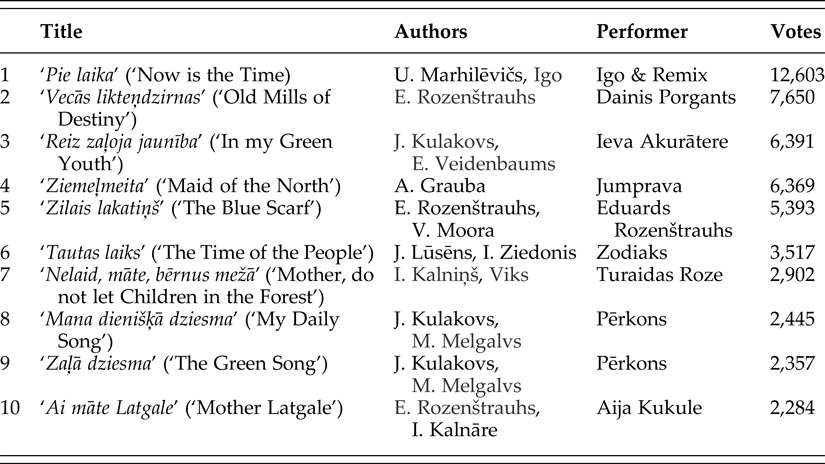
The Rozenštrauhs songs also incited a large amount of correspondence, pro and con. While many listeners welcomed hearing again the songs from their youth, others felt that they were old-fashioned. More than 50,000 votes were cast in the competition. The top 10 songs are listed in Table A1 in the Appendix. The songs of Eduards Rozenštrauhs won second, fifth, tenth, twelfth and twenty-fifth places. The revival of the Rozenštrauhs songs, which was contrary to the competition's original goal of presenting new songs, had been specifically requested by Raimonds Pauls, the new minister of culture. The songs were basically romantic. ‘Vecās likteņdzirnas’ (‘Old Mills of Destiny’) uses water flowing through a watermill as a symbol of ageing. ‘Zilais lakatiņš’ (‘The Blue Scarf’) tells the story of a girl with a blue scarf on a summer meadow. Rozenštrauhs (1918–1992) was the only songwriter from the bourgeois republic still living in Latvia, but his songs had been forbidden in the Soviet era. ‘Zilais lakatiņš’ was known as the favourite song of the Latvian legions which had fought against the Red Army, and the songs were popular among emigres. The revival was part of the rehabilitation of pre-war Latvian culture (Bērtiņš Reference Bērtiņš and Mazvērsīte2017, pp. 155–60).
The televised gala concert on 28 December became a demonstration for the ‘awakening’. According to the opening announcement, this was ‘the time of awakening of the people’ (tautas atmodas laiks). The opening song, ‘Reiz zaļoja jaunība’ (‘In my Green Youth’), sung by Ieva Akuratere, came third in the competition. It was based on a classic poem by the 19th-century national poet Eduards Veidenbaums (1867–1992). As an extra number, Ieva then sang a religious song ‘Palīdzi, Dievs’ (‘Help, God’). The song received a standing ovation and many members of the audience joined in the singing. Afterwards, Ieva received a bouquet of flowers from a small girl in Latvian national costume.
The next guest, outside the competition, was the exiled folklorist Austris Grasis. Before singing a traditional folk song, he gave a long speech saying that he had been waiting 44 years for this moment. The participation of several exile singers was a special feature of the concert. Kārlis Vahšteins recalls:
Previously, the contest had been financed by the government. Starting in 1988, in line with Gorbachev's economic reforms, we received permission to obtain a general sponsor for the concerts, which was RRR or Rīgas Radio Rupnīca (a top technology company). This company donated several thousand rubles to the concert. That allowed us to rent hotel rooms and make travel arrangements on our own, without permission from above, to invite artists from the West, people of our own choice. We could not afford to invite guests from America or Australia, but we could invite Latvian exile singers, such as Austris Grasis and his son's band, Ludvigs Dzird, from Germany and Pāvils Johansons from Stockholm (travelling through Helsinki and Tallinn). Austris and Pāvils became symbols of the unification of Latvians across international borders. Although they were told not to speak onstage, they did so, and spoke their conscience. The live broadcast was watched by hundreds of thousands of people across Latvia. The television audience rivalled the viewership of the Latvian Popular Front inaugural conference. (Vahšteins 2018)
The rest of the concert was a jubilant demonstration for the Popular Front, with patriotic speeches and songs following each other. Practically all of the top songs had nationalist connotations. The winners, with 12,603 votes, were Igo & Remix with ‘Pie laika’, a song demanding ‘freedom to the fatherland’. It opens on a triumphant note – we have been forced to keep our mouths shut, but now the times have changed:
Klusē akmens lūpas
Kas pārvērtis mūs?
Asinis dzīslās atmiņas plūst
(‘Closed stony lips,
what made us so?
Memories pulse in our veins’)
The chorus is a repeated call for independence:
Brīvību, brīvību Tēvzemei
Nelūdzam, pieprasam!
(‘Freedom to the Fatherland
We do not ask, we demand!’)
‘Pie laika’ (Now is the time), by Uldis Marhilēvičs and Rodrigo (Igo) Fomins
The concert gave television viewers a strong signal that the times had changed. It ended with the artists and the audience singing the pre-war national anthem ‘God bless Latvia’, forbidden until August that year (Grinberga Reference Grinberga1989, p. 3). Ieva Akuratere was prominently visible in the centre of the stage, and her voice was heard above the others. However, there was also another sign of change: the programme was occasionally interrupted by commercials, advertising the products of the sponsors.
The participants: Soviet stars and dissidents
Almost all of the top songs in the 1988 song competition expressed anti-Soviet feelings in some way: Latvian nationalism, a rehabilitation of songs from the pre-war period or direct demands for a change. Yet how broadly did the participating artists represent contemporary Latvian songwriters and performers?
Procevska (Reference Procevska2007a, p. 71) has studied the space devoted to popular performers in the youth press in 1988–1989, when the Soviet press was already discussing rock music extensively. On the basis of her calculations, the four most popular bands at the time were Pērkons, Līvi, Remix and Jumprava (see also Rotgalvis Reference Rotgalvis2017). Out of the 10 top bands, eight participated in the song contest. It seems safe to say that the 1988 competition was representative of the most popular artists in Latvia at the time.
However, the participants came from very different backgrounds. Igo had won the All-Union song contest at Jūrmala in 1986, and Igo posters had appeared in major Soviet journals. The bilingual singer had made albums in Russian and Latvian for Melodiya. Remix had started as Latvian radio's studio band and become cooperative in 1987, which gave them many new economic possibilities (Papēdis Reference Papēdis2015; Savchenko Reference Savchenko1998). Yet they had also been captured by the mood of the ‘awakening’. ‘Likteņlīnijas’ (‘Palm Lines’) in 1987 already had a nationalist tone. ‘Pie laika’ was an open political declaration.
Igo Fomins later recalled that the song ‘reflected the spirit of 1988’. In an interview on the Mikrofons programme in 1988, he said that he felt the song was so serious that he was afraid it could be devalued by a ‘fun event’ like the Mikrofons competition (‘LVA-1184-10-7566’ 1988c, p. 98). The composer Uldis Marhiļēvičs says that he had doubts about presenting the song to the public, but at the Jūrmala song contest in July they had performed it as an unscheduled extra number in a live broadcast on Moscow central television. The event confirmed that it could now be performed without sanctions (Guļevska and Jākobsons Reference Guļevska and Jākobsons2017, pp. 188–91).
Zodiaks (Zodiac) was another band with an established reputation in the Soviet Union (Auziņa et al. Reference Auziņa, Mazvērsīte and Landorfa2000, p. 265). Their first album, the instrumental Disco Alliance (1980), had been one of the first rock records issued by Melodiya and reputedly sold over 20 million copies. However, the group's leader Jānis Lūsēns had now reorganised it and started writing songs on political topics.
Pērkons (Thunder), on the other hand, were well known dissidents who had already had their work permits cancelled twice (Akuratere et al. Reference Akuratere, Aizpuriete and Mazvērsīte2007; Auziņa et al. Reference Auziņa, Mazvērsīte and Landorfa2000; Rasa Reference Rasa2008; Ruks Reference Ruks2015). Their career had been limited to Latvia. Their recordings so far consisted only of self-produced underground tapes, but they had a growing reputation among the younger Latvian audience. With the glasnost, they had been able to perform again in public, and in 1987 they had already participated in the Mikrofons contest under another name.
Another controversial group was Turaidas Roze, founded by the composer Imants Kalniņš (Auziņa et al. Reference Auziņa, Mazvērsīte and Landorfa2000; Čaklais Reference Čaklais1998). Kalniņš had a history of censored or banned projects, but as a conservatory-trained classical composer and a member of the composers’ union whose previous works included an oratorio for the October Revolution, he had a certain amount of immunity. His status is indicated by the fact that he had been asked to enter three songs in the 1988 competition. The songs were actually quite innocent politically. ‘Buramdziesmiņa’ was a love song; ‘Nelaid māte’ ironically warned mothers against rebellious youth. Despite his reputation, the art-rock of Turaidas Roze did not attract a mass audience, and their highest place in the competition was seventh.
The list of the winners of the 1988 song contest shows how the ‘awakening’ attracted a wide range of Latvian artists. While groups like Pērkons and Turaidas Roze had a reputation as dissidents, some of the most nationalist songs were written by artists who were established Soviet stars and also had a large following in Russia. However, interestingly, Raimonds Pauls and Jānis Peters, who had played an important role in the creation of ‘national’ popular music in the 1970s, now preferred to focus on politics, and no longer wrote political songs.
The 1989 and further
The political turbulence continued in 1989. As the Baltic Popular Fronts gained support, they gradually turned into independence movements. One by one, Soviet republics declared ‘sovereignty’. Everyone still had their own interpretation of this term, ranging from full restitution of the pre-1940s republics to more economic freedom within Soviet Union. Many sectors of administration were in Moscow's hands, and there were large Soviet garrisons in the countries. Nevertheless, the movement seemed irrevocable. On 23 August, the day of the Molotov–Ribbentrop pact, an estimated half a million Balts formed the ‘Baltic way’, a human chain of protest between the Baltic capitals. The Berlin wall fell on 9 November, and its effects were also felt in the Soviet Union.
Amid these events, a song competition may have seemed less significant, but the 1989 Mikrofons contest again became a forum for the independence movement. This time 40 songs participated. The winner was an apolitical, philosophical song, ‘Mēs pārtiekam viens no otra’ (‘We Need Each Other’), but the performers were well-known dissidents, the Pērkons. Taken as a whole, an even larger percentage of the songs were political, including the campaign song from the Popular Front (‘Veltījums LTF’), sung by the composer Imants Kalniņš himself, which came number seven. Number two was ‘Taisnība’ (‘The Truth’), by Zodiaks, asking for the truth to come out of its metal coffin. Number three was ‘Atmostas Baltija’, the song of the ‘Baltic Way’:
Trīs māsas no miega modušās,
Par sevi pastāvēt nāk.
Atmostas Baltija, atmostas Baltija,
Lietuva, Latvija, Igaunija!
(‘Three sisters are awakening from sleep
And coming to defend themselves.
The Baltic countries are waking up, the Baltic countries are waking up,
Lithuania, Latvia, Estonia!’)
‘Atmostas Baltija’, Boriss Rezņiks & Valdis Pavlovskis
Several émigré bands also took part in the contest. Some had just sent demo tapes to the radio station, but several came to the final concert. Their members were mostly children of post-war refugees who had retained their native languages and identities. Pāvils Johansons from Sweden, son of the exiled poetess Veronika Strēlerte, drew many votes with an impressive performance of ‘Kā gulbji balti padebeši iet’ (‘When the Clouds Pass like White Swans’), with lyrics by Eduards Veidenbaums. Alis P (Sweden), Ludvigs Dzird (Germany), Akacis (USA), Skandāls and Elektriskie Burkāni (Canada) ended at the bottom of the list because they were unknown to Latvian audiences, but their participation was seen as a sign of international support.
Pāvils Johansons had already been presented as an invited guest in 1988. He was a well-known émigré musician who had been a member of the Latvian–Swedish rock group Dundurs. The Soviet Union had an uncomfortable relationship with the émigrés, and Latvian books and records published abroad had mostly been banned. After travel restrictions were eased in 1987, Latvians and émigrés alike were eager to establish closer contact.
Radio listeners again voted in large numbers, but the televised gala concert on 6 January 1990 was a curiously low-key event. The tapes suggest that it was produced on a small budget with little rehearsal time. At the interval, there was a fashion show with ultramodern designs. This time there were no revivals of older songs. All the top 10 songs were presented, except for ‘Veltījums LTF’, the campaign song by Imants Kalniņš. The hosts mention that Latvia, homeland, freedom and Baltia are the most frequently repeated words, but complain that concert halls are empty and politicians are more popular than musicians. Dzintris Kolāts, one of the presenters adds: ‘I would like to say that these songs, at least most of them, have been written a year ago or even earlier. And therefore, these sacred concepts (…) are becoming a bit speculative: speculative in politics, speculative in trading, and speculative, unfortunately, in music. And these words have also gotten such an irony or skepticism, and so we have decided to look at it a bit more “mephistophelean” than ever before’. After this Imants Vanzovičs, the other host, came on stage with a live black crow which he sent flying over the audience.
In spring 1990, Latvia declared its independence, but in January 1991, radio and television stations in Riga and Vilnius were occupied by paratroopers from Moscow. Pērkons and other bands played for the demonstrators at the barricades, but songwriters had already moved on to other topics. The final concert of the 1990 song contest, which was held just before the arrival of the paratroopers, was arranged on a commercial basis by a private concert agency. The competition was now divided into two series. The rock competition featured modern bands, while Vecais ratiņš (‘The Old Spinning Wheel’, named after a 1930s pop song) presented songs in an older idiom (Danilāns and Jegorova Reference Danilāns and Jegorova1990).
In August 1991, there was a coup in Moscow, and in December 1991 the Union of Soviet Socialist Republics was dissolved. The last Mikrofons competition was held in 1994. New commercial radio and television stations had now begun broadcasting, and there were competing record companies. The biggest was MICREC, established by the former Mikrofons radio staff. Actually, some of them still worked at the radio, promoting their business projects. As the musical tastes of the audience became more splintered, the interest in a national song competition was fading. In 2000, Latvia participated for the first time in the Eurovision Song Contest, and in 2004, the country became a member of the European Union.
Conclusions
The Mikrofons programme was started in 1965 as one of the new radio shows in the Soviet Union, with more attractive content to increase its efficiency as counterpropaganda. The new mass media policy in Moscow, as exemplified by Radio Mayak, had set freer borders for such programmes. This policy challenged the ideology of social realism based on a depiction of an imagined reality using sometimes utopian socialist slogans. Such programmes included a lot of light music, even foreign songs, and the amount of political agitation was limited. The content was dominated by short news items and stories on interesting topics appealing to a public. This was rational choice. In the occupied Baltic republics, there was no other way to attract domestic listeners to the Soviet mass media. The USSR had to compete for their attention with the ‘enemy voices’ on the radio waves and the growing influence of Western pop culture. Radio jamming did not help enough and the fight against the grey market without harder sanctions did not work in the relatively human late socialism. Unwillingly, the state's mass media had entered into competition with the global pop market.
In Latvia, the programme had to take into account the special concerns of its audience. Latvians were worried about the growing influence of the Russian language and increasing migration from the Slavic republics. In the Mikrofons competition, started in 1968 as a special attraction of the programme, no song was sung in Russian or contained open Soviet propaganda. Romantic estrada-type songs dominated, but already in the first years there appeared songs with a more or less hidden nationalistic agenda. This was something opposite to the official Soviet ideology which praised internationalism and social realism. Mikrofons became the most popular radio show in Latvia, but the interpretation of its influence is ambivalent. One can say it was a success of Soviet cultural policy, as national sentiments were channelled without violent disruptions. It can also be seen as an instrument for Latvians to nurture and preserve their national identity, through language, songs and lyrics.
In 1980s, the number of rock groups increased at the expense of estrada-type singers, and after 1986 all of the winning songs were performed by groups. A parallel change was also taking place elsewhere in the Soviet Union, showing that the country was not isolated from global trends. In 1987–1989, the Mikrofons competition became a forum for the independence movement and the rehabilitation of pre-war culture. As Latvian nationalists urged a separation from the Soviet Union and the recreation of a national state, the competition became dominated by songs about the beauty of Latvia and the need to correct historical wrongs.
The radicalisation of the competition could not have taken place without significant changes in Latvian media and politics in summer 1988. This was the period when the leadership of the Latvian Communist Party was changed and preparations for the founding of the Popular Front were already underway. Although political censorship did not end formally until 1990 (Graf Reference Graf2008, p. 289), programmes such as Labvakar had proven that journalists no longer had to worry about it. The opening announcement of the 1988 song competition, published in September, was a declaration of the new policy. Parallel developments, which we have not studied in detail, were taking place at the record company Melodiya and the state concert agency, which was responsible for staging the hugely successful nationalist rock opera Lāčplēsis.
As media policy changed, the journalists found that practically all popular bands in Latvia were ready. They did not need to be encouraged to write nationalist songs. In summer 1988, song festivals had already become forums for musical manifestos. The 1988 Mikrofons gala concert became a celebration of the ‘awakening’ and the end of censorship, and the winning song summarised the demands of the independence movement in its chorus: ‘freedom to the fatherland’. At the same time the contest became a forum for the rehabilitation of pre-war popular music and a new relationship with the exiles, who came to play an important role in the politics of independent Latvia.
In a modest way, the song competition can also be seen as a citizen-based initiative. In elections in the Soviet Union, voters were normally presented with one candidate only. Mikrofons had been one of the few occasions where the public could freely choose among several different candidates, even if only popular songs. In the past, they had already used this opportunity to vote for the most national songs.
In the 1989 competition, several of the songs were again connected with current political events. ‘Brīvību Baltijai’ was the song of the Baltic Way, the demonstration on 23 August 1989. At the same time, a weariness in political songs was already apparent. Commercial interests were taking over popular music, and the last Mikrofons song contest was organised in 1994. The idea of an annual ‘national’ song competition lost its impact with the disappearance of the public broadcasting monopoly.
The events in Latvia had parallels in the other Baltic republics, and perhaps other parts of the former Soviet Union. As Šmidchens (Reference Šmidchens2014) has noted, folk groups and song and dance celebrations also played their part in ‘the singing revolution’. Melodiya issued politically oriented rock records in all the Baltic countries, and Lithuanian television had a competition for rock groups, Jaunimo estrada (‘The Young Stage’), which also became a forum for the independence movement in 1988 (Martinelli Reference Martinelli2017, pp. 89–120). However, as far as we have been able to determine, the Mikrofons song competition was unique in its popularity and political influence, a true mirror of its time.
Appendix: competition rules
Songs for the Mikrofons competition were selected from recent music productions by Latvian radio. Originally, they were performed by the radio estrada orchestra and its soloists, but later on, the variety of performing groups increased.
Top 10 Mikrofons songs of 1988 and votes received

Every year, an editorial team selected a number of new songs from the tape library. The songs were played repeatedly on the Mikrofons programme over a period of time, and listeners were asked to vote by mail for their favourites. Since 1985, they used a ballot printed in Rīgas Viļņi, the radio and TV programme magazine available in most Latvian homes (see Figure 1). Over the years the rules changed slightly, but the winning songs were always selected by audience vote. The songs which had received most votes (usually around 10) were presented in a gala concert at the end of the year. Beginning in 1979, the concerts were also shown on television. At first, only selected songs appeared in various record albums, but from 1980, the top songs were issued in compilation albums by Melodiya (except 1985).
The competition rules for 1979, approved by the Latvian state radio and television committee, are preserved at the state archives. The rules are brief and state that the aim of the contest is to select ‘the most popular and best estrada song of the year by a Soviet Latvian composer’ (‘LVA-1184-11-26’ 1979, p. 106). An interesting aspect of the decision was that Raimonds Pauls, who had won all the previous competitions, was appointed to the organising committee in his role as the ‘head editor of music’ at radio. The state radio committee saw no conflict of interest. In 1980, after some controversy about the previous year's contest, more detailed rules were issued, but while they stressed the importance of control in the selection of participating songs, the procedure was left to the discretion of the organising committee (‘LVA-1184-11-47’ 1980). There were also new provisions about the distribution of free tickets to the gala concert.
The original aim of the competition was to create a popular programme for Latvian radio and television. The formal rules of the competition were minimal, and the practical details left to the programme's editors. At the same time, they had to conform to the written and unwritten rules of all Soviet media, which meant that a phone call from the Communist Party could override editorial decisions. Although the competition rules did not change in 1988, the changes in Soviet politics gave the editors freer hands than before.
Acknowledgements
This article was written with the support of the Finnish Cultural Foundation (FCF). The authors also thank all the interviewees, especially Daiga Mazvērsīte, Māra Zālīte and Lia Guļevska. We also grateful to the anonymous reviewers whose comments we found very useful.