Introduction
The resource-based view has been considered among the most important management theories, where its application can reveal the antecedents of the process of environmental management (Hamdoun, Reference Hamdoun2020). Resources refer to the organizational assets, processes, information, attributes, and knowledge that enable strategy implementation to enhance organizational efficiency and effectiveness. This definition stresses the importance of organizational assets rather than activities (Miller, Reference Miller2019).
Organizations have witnessed a remarkable paradigm in their ways of handling and responding to environmental change. This included intrinsic motivations to employees that are considered the resources that could be developed to achieve competitive advantage. Contemporary organizations strive to retain the best employees who contribute to the best fit and human resource (HR) practices. Therefore, the linkage between the resource-based view and strategic management of HR is very obvious. Competitors can't imitate the superior HR quality of a specific workforce within an organization that provides it with the know-how, planned routines, and other strategic factors. Accordingly, human resource management (HRM) should manage to enhance the organization's competitive profile by influencing its HR toward achieving organizational goals. Moreover, capabilities contribute to the best HRM practices of deploying resources; they can combine the skills of individual employees or teams to achieve the desired outcomes. Despite this, the resource-based view is specific for every organization (Acharya & Jena, Reference Acharya and Jena2016). HRM practice refers to the policy, philosophy, and system that can influence employees' attitudes, behavior, and performance. Moreover, human resource practices (HRP) represent the process by which the organization manages the human capital (Aktar & Pangil, Reference Aktar and Pangil2018).
The HRM practices on the macro level are related to organizational performance through both employees' outcomes and organizational outcomes, like motivation, attitude, and behaviors, and organizational operational outcomes, like productivity and innovation. This relationship has rooted the knowledge that HR can be developed to become a source of competitive advantage by preparing the organizational climate, including providing training hiring appropriate employees, and motivating them by adopting HRM practices (Chowhan, Reference Chowhan2016). Moreover, previous studies have provided both theoretical and empirical support for positive links between generic HRM practices and employees' service performance (Hong, Jiang, Liao, & Sturman, Reference Hong, Jiang, Liao and Sturman2017). The HR practices signal the strategic focus on excellence in providing customer services. Despite this, the supervisors play a significant role in motivating employees to respond to customer needs and support their positive attitude toward customers (Jo, Aryee, Hsiung, & Guest, Reference Jo, Aryee, Hsiung and Guest2021). HRM practices could have different impacts on the behavior of the employees. The matter that supports developing effective HRM practices bundle that provides HRM practitioners with a comprehensive knowledge of best practices (Aktar & Pangil, Reference Aktar and Pangil2017).
Scholars have recently extended this research stream, shifting the focus of research from those generic practices to service-oriented human resource practices (SO-HRP)–a bundle of HRM practices oriented that intended to enhance employee abilities, promote their motivation, and provide appropriate opportunities to contribute to high-quality service performance (Jiang, Chuang, & Chiao, Reference Jiang, Chuang and Chiao2015)–and it has been shown that they have greater influence compared to that of generic HRM practice influence of SO-HRP on service performance. By treating SO-HRP human capital as central to establishing excellent service performance, an intensification and synergistic interplay between these HRP practices are brought about, enhancing the capabilities, motivation, and performance of frontline employees as they serve external customers. Employee's engagement is more critical in the service organization for the crucial role they play in developing HRM practices, where the relationship between HRM practices and employees' outcomes is not straightforward. This relationship is termed the black box (Aktar & Pangil, Reference Aktar and Pangil2018).
In addition to relationship mediators underlying the linkage between SO-HRP and employee service performance, like service-focused employee competency (Chao & Shih, Reference Chao and Shih2018) or service skill, motivation, and opportunity (Wang & Xu, Reference Wang and Xu2017), recent inquiries have drawn attention to the role of affective–motivational mediators of the effects of SO-HRP (Gürlek & Uygur, Reference Gürlek and Uygur2021). Recently, some research has shown that the organization's human resources management practices (HRMP) is directly and positively related to employee work engagement (Ahmed, Kura, Umrani, & Pahi, Reference Ahmed, Kura, Umrani and Pahi2020; Kotzé & Mostert, Reference Kotzé and Mostert2021; Memon et al., Reference Memon, Salleh, Mirza, Cheah, Ting, Ahmad and Tariq2020). In addition, research has demonstrated that engaged employees display engrossed effort and show more energy and enthusiasm at work, thereby achieving higher levels of job and better service (Peng & Chen, Reference Peng and Chen2021; Zheng, Graham, Epitropaki, & Snape, Reference Zheng, Graham, Epitropaki and Snape2020). Compared with other variables of job-related attitude, work engagement is essentially more activating in nature and more accurate and effective in predicting employee behavior and performance (Mackay, Allen, & Landis, Reference Mackay, Allen and Landis2016).
The ability, motivation, and opportunity (AMO) model is a structured framework that enables understanding the relationship between SO-HRP and employee service performance. It acts as a mediator between this relationship. Ability indicates the proficiencies and skills possessed by an individual that enables in carrying out the job duties. Motivation indicates the degree to which an individual chooses to adapt to specific behaviors. Opportunity refers to the specific configuration of the forces that surround the individual employee and enabling or constraining tasks that are beyond the individual direct control (Morales-Sánchez & Pasamar, Reference Morales-Sánchez and Pasamar2019). This research operationalizes both abilities and motivation. It tends to turn the abstract concepts into measurable observations that enable testing the research hypotheses. Accordingly, abilities are used in measuring the P–J fit demand–abilities to ensure compatibility of employee's knowledge, abilities, and skills with the job requirements (Uppal, Reference Uppal2020). In addition, the research concerns with work engagement that represents a motivational factor to enhance performance (Ünal & Turgut, Reference Ünal and Turgut2015). Accordingly, SO-HRP can enhance employee service performance.
The research problem is rooted in the accelerated development of the service industry that has pushed global economic development to new heights. Yet, this has resulted in a state of cutthroat competition within the service market. To avoid eventually being drawn into the vortex of the ‘price competition/or price war?’ the service organizations have adopted promoting or reinvigorating human capital strategies to improve service, customer loyalty, growth, and service performance of its frontline employees, and this is widely regarded as a very viable approach. Since frontline employees hold a pivotal position that links operations with customer communications, the quality of their customer interactions will positively affect customer satisfaction (Sumaneeva, Eluwole, & Turgay, Reference Sumaneeva, Eluwole and Turgay2019) and significantly affect the service performance of themselves and the firms (Chen & Peng, Reference Chen and Peng2021; Gürlek & Uygur, Reference Gürlek and Uygur2021; Zheng et al., Reference Zheng, Graham, Epitropaki and Snape2020). Based on these arguments, this research aims to develop a crosslevel serial mediation model of branch-level predictors (P–E and work engagement) of frontline employees' service performance. This study bases its arguments on the conservation of resources (COR) and signaling theories (Chen, Westman, & Hobfoll, Reference Chen, Westman and Hobfoll2015; Ostroff & Bowen, Reference Ostroff and Bowen2016), and proceeds from the insight that the resources provided by the SO-HRP bundle exist to free employees from the fear of making mistakes, and to give them an in-depth understanding of the meaning and value of their work.
Theoretical background and hypotheses
Research delving into the relationship between P–E fit and the organizational bundle's antecedent (Harris & Pattie, Reference Harris and Pattie2020) remains scant. Harris and Pattie (Reference Harris and Pattie2020) recently quoted signaling theory to argue that HRP plays an important role in the fit among employees, their organizations, and their work, and to pay attention to the connection between HRP and P–E fit (Harris & Pattie, Reference Harris and Pattie2020). Signaling theory (Ostroff & Bowen, Reference Ostroff and Bowen2016) holds that the basis of fit can be the information sent by the organization's HRP system conveying information to employees about the organization's strategies, standards, goals, values, and expectations it has of the individuals within it (i.e., signal observability).
The signaling theory offers a framework for communication between individuals. It identifies the effective signals by describing the characteristics of the signaler, signal, and receivers. To achieve this aim, the signaling theory includes feedback loops and considers the context of communication. For example, it considers information asymmetry, frequency of sharing information, reliability of the signal, clarity of information, and intensity. In addition, it considers the receiver's attention and interpretation of the signal (Guest, Sanders, Rodrigues, & Oliveira, Reference Guest, Sanders, Rodrigues and Oliveira2021). The employees then use the information passed on by HRP to evaluate and interpret the degree of consistency between the overall values and goals of the individual and the organization (i.e., signal reliability), while simultaneously evaluating and interpreting the degree to which their knowledge, skills, and abilities match the job requirements (Harris & Pattie, Reference Harris and Pattie2020).
The COR theory explains and predicts the work-related stress and translates stress and resilience that take place within the work environment and culture. It has become a major theory in the field of organizational stress. The COR theory identifies the critical role of resource possession, lack, and loss and gain; the matter that enables in predicting the positive and negative impacts of stress and resilience. It is considered a motivational theory that predicts employees' behaviors and motivation. The theory assumes that in case individuals are not stressed, they are motivated to keep their resources and protect them. COR theory has three main principles (Hobfoll, Halbesleben, Neveu, & Westman, Reference Hobfoll, Halbesleben, Neveu and Westman2018); the first principle is that resource loss is more silent than resource gain. The theory identifies resources to be object resources, like vehicles and houses, condition resources, like employment, personal resources, like personal skills and talents, and energy resources, like knowledge and money. The second principle assumes that people should invest in their resources to protect them from loss and to gain more resources. The third principle is a paradoxical principle that assumes that when resource loss is high, resource gain increases in salience (Chen, Westman, & Hobfoll, Reference Chen, Westman and Hobfoll2015).
Based on the prior research mentioned above, we combine signaling theory with COR theory to present the foundation for the current empirical study. The COR principles assume that individuals have the motive to protect the available resources and obtain new resources. Moreover, employees like frontline employees in the service sector can avoid stress by engaging in certain behaviors to keep their existing resources, like health resources. This could be done by avoiding stress and reducing efforts in case they face a heavy load of work that could be considered a deviant attitude against work norms (Junaedi & Wulani, Reference Junaedi and Wulani2021). While, the signaling theory is utilized to look at the individual's perception process of the signal transmitted by the SO-HRP bundle from the individual's perspective (i.e., signal observability and signal reliability), whether it affects the fit degrees between itself and organization and job, and in turn sequentially influences work engagement and service performance.
Service-oriented human resource practice bundles and work engagement
Job resources involve that support of the supervisors and employee empowerment are expected to encourage job experiences that enhance employee engagement in the workplace and compliance to its expectations, hence, achieve the organizational goals (Walsh, Yang, Dose, & Hille, Reference Walsh, Yang, Dose and Hille2015). HRM practices that contribute to higher organizational performance are called ‘high-performance work systems’ (HPWS). They are considered the main practices to improve employees' productivity and job performance through enhancing their skills, motivation, and providing them opportunities to work effectively (Kloutsiniotis & Mihail, Reference Kloutsiniotis and Mihail2020). Therefore, with service competencies and empowerment for service-related decision-making that service-oriented HPWSs cultivate (Jiang, Chuang, & Chiao, Reference Jiang, Chuang and Chiao2015), frontline service employees can gain job resources and personal resources, with which they develop vigor and energy to engage in their service activities.
In a highly competitive business climate, organizations are faced with human capital challenges and uncertain economic conditions, making employee work engagement a prime concern for them (Aybas & Acar, Reference Aybas and Acar2017). Organizational engagement refers to the sense of attachment of the employee to the organization regardless of his professional role (Ünal & Turgut, Reference Ünal and Turgut2015). Work engagement influences employees to achieve major organizational outcomes, including creativity, innovation, customer satisfaction, and reduced absenteeism. Contemporary organizations that seek to stay competitive in the market should enhance employees' engagement, especially those who are characterized by energy, dedication, and absorption. Engaged employees have a large number of resources that they can invest in their work. Regarding energy, organizations are required to use practices for new employees to reduce their uncertainty level and provide them with the required information. This is likely to create positive energy and excitement for the new employees and engage them in their new jobs and workplace. Capitalizing on new employees' talents and strengths optimizes their environmental fit through selection, socialization, and job redesign (Bakker & Leiter, Reference Bakker and Leiter2017).
Adopting the learning and development and structural approach to performance management could be implemented through setting monthly goals and using new technology to facilitate providing feedback. Supervisors should provide the employees with training opportunities and education, create trust, and empower employees by signaling to them the importance of work engagement. Energy can be demonstrated through voice tone and speed of accomplishing activities. Therefore, energy could be used to evaluate the level of employees' engagement. Dedication is an indicator that an individual is strongly involved in work and has a sense of enthusiasm, meaningfulness, and inspiration. Finally, absorption refers to an individual who is fully concentrated in work, performs happily, and the work time passes quickly. Accordingly, dedication indicates that the individual is strongly involved in work, while absorption indicates that the individual is fully concentrated in work (Costa, Passos, & Bakker, Reference Costa, Passos and Bakker2016). Recent studies have regarded work engagement as an important result of employees' perceptions of their organizations' respective HRPs (Ahmed et al., Reference Ahmed, Kura, Umrani and Pahi2020; Memon et al., Reference Memon, Salleh, Mirza, Cheah, Ting, Ahmad and Tariq2020).
In recent studies, organizations have positively linked employee work engagement to the deployment of organizational resources aimed at improving service performance (e.g., service-oriented high-performance work practices) and have received initial support for this approach from Kotzé and Mostert (Reference Kotzé and Mostert2021) study on a multistore South African retailer of home improvement products. Based on this, it is reasonable to expect that frontline service employees' work engagement will be greater when their organization's SO-HRP bundle provides them with ample work resources and personal knowledge, skills, and capabilities. Under these conditions, during the process of recruitment and employee selection at branches, the emphasis will be on hiring employees with service values, and who have the disposition and potential to provide superior-quality service. After being onboarded, the frontline employees should be provided with an official service training program, thereby establishing and developing their service-related professional knowledge and skills, as a means of providing effective service to customers. Moreover, in the continued pursuit of service excellence, coupled with positive energy, customer service goals are set as the benchmark for employee performance evaluation; and, through remuneration and incentive mechanisms based on their service performance (Chao & Shih, Reference Chao and Shih2018).
Frontline employees can participate in department-related service decisions, which not only help them to better understand their organizations' and branches' service strategies and goals, but also require that they provide suggestions for improving customer service during the decision-making process, thereby promoting knowledge sharing (Chao & Shih, Reference Chao and Shih2018).
Therefore, in light of what has been discussed thus far, this study proposes the following hypothesis:
H1. The SO-HRP bundle will be positively related to employee work engagement.
Mediating roles of person–environment fit and work engagement
The interactionist approach defines person–environment fit (P–E) fit to be the compatibility between an individual and the work environment that takes place when both of their characteristics can be well matched or individual characteristics are compatible with multiple aspects of the environment. The most common fits include the person–organization (P–O) fit and the person–job (P–J) fit. High fit results in positive outcomes for the employee and the organization (Uppal, Reference Uppal2020; Verma & Sharma, Reference Verma and Sharma2015). P–O fit indicates compatibility between employees and the organization. P–O fit occurs when one entity succeeds in fulfilling the needs of the other, share common characteristics. According to the theory of value congruence, P–O fit occurs in case employees' behaviors, attitudes, and judgments congruent with their organization, are shared within it, and being respected by it. Organizations seek to hire individuals who possess values similar to those held by the organization. P–O fit is important to organizations for reducing turnover rate, increasing work engagement, organizational citizenship behavior, and enhancing performance (Uppal, Reference Uppal2020; Verma & Sharma, Reference Verma and Sharma2015). Therefore, the SO-HRP is important for P–O fit for linking the value congruence process with firm attributes. P–O fit is expected to mediate the relationship between the SO-HRP bundle and work engagement. This could be done through the process of employees' selection and socialization.
P–O fit indicates that individuals tend to work in organizations that are congruent with their values. Moreover, employees who perceive their work to be consistent with their values are more likely to be engaged to work. This leads to the emergence of a positive psychological context within the organizational environment. In addition, engagement is considered to be a motivational factor, and employees who value congruence are more likely to act according to their internalized values. Hence, the organizational environment is likely to motivate their abilities to implement their work in an engaging way (Ünal & Turgut, Reference Ünal and Turgut2015). Employees' engagement can be considered a mediator between the SO-HRP bundle and frontline employee service performance when engagement is associated with a high motivational state. This implies that engaged employees are not just passionate, rather than this they are highly motivated to accomplish the organization's mission and goals. They seek to make a difference in the organization's quest for business sustainability. Engaged employees work toward improving their performance (Acharya & Jena, Reference Acharya and Jena2016).
Additionally, recent studies have stated that frontline service employees who feel engaged in their work are motivated to deliver a higher level of service performance (Chen & Peng, Reference Chen and Peng2021; Zheng et al., Reference Zheng, Graham, Epitropaki and Snape2020). Moreover, highly engaged employees tend to be flexible and persistent in their perceptions of service (Luu, Reference Luu2019). Therefore, this study proposes that:
H2a. Perceived employee P–O fit mediates the positive relationship between the SO-HRP bundle and work engagement.
H2b. The positive relationship between the SO-HRP bundle and frontline employee service performance is serially mediated by perceived P–O fit and work engagement.
P–J fit refers to the compatibility between an individual and job characteristics (Verma & Sharma, Reference Verma and Sharma2015). P–J fit consists of two components; P–J fit demand–abilities and P–J fit need–desire. P–J fit demand–abilities take place when the employee's knowledge, abilities, and skills are compatible with the job requirements. P–J fit need–desire occurs when the desire, needs, and preferences are fulfilled by the performed job.
SO-HRP bundle can use job analysis to fulfill the requirements of P–J fit by enabling SO-HRP to design and implement proper methods of selection, training, reward, feedback, and development. This is more likely to match the employees' knowledge, abilities, and skills with the job requirements to carry out the designated job. Job crafting, design, and analysis are important components of the SO-HRP bundle for aligning individual preferences and job characteristics that leads to enhanced employee engagement. Moreover, P–J fit is generally considered to be positively related to job performance. Accordingly, the SO-HRP bundle that focuses on job analysis to ensure P–J fit ensures that employees possess the knowledge, technical skills, and abilities required to implement the job requirements and enhance job performance (Uppal, Reference Uppal2020). Moreover, the signaling theory indicates that HRP sends signals that can have a positive link with the P–J fit (Guest et al., Reference Guest, Sanders, Rodrigues and Oliveira2021). Accordingly, the present study suggests that when frontline service employees gain a complete understanding of their job requirements (P–J fit need–desire) through SO-HRP, and when they perceive the required knowledge, skills, and capabilities to meet job demand (P–J fit demand–abilities), this will give them complete confidence in their job roles, thereby leading them to be even more engaged in their work. Therefore:
H3a. Employee-perceived P–J fit mediates the positive relationship between the SO-HRP bundle and work engagement.
H3b. The positive relationship between the SO-HRP bundle and frontline employees' service performance is serially mediated by perceived P–J fit and work engagement.
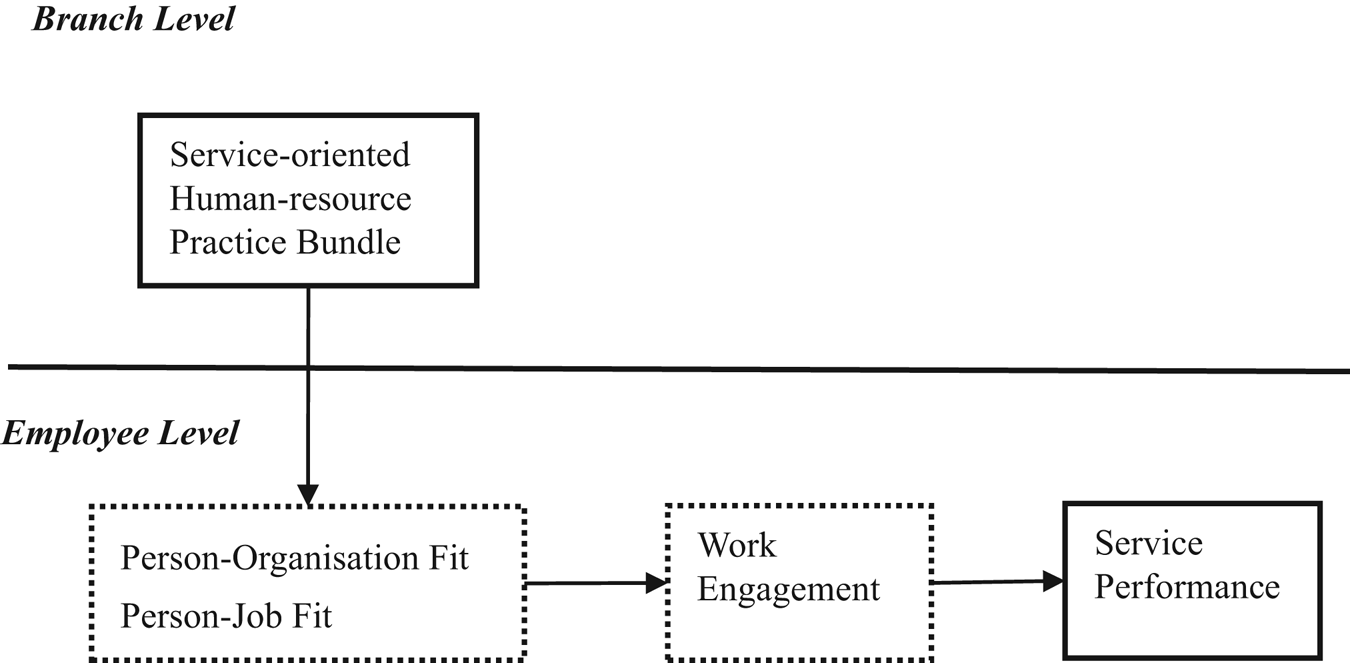
Figure 1 illustrates the relationships among the variables in our crosslevel mediation research model.
Cross-level mediation model.
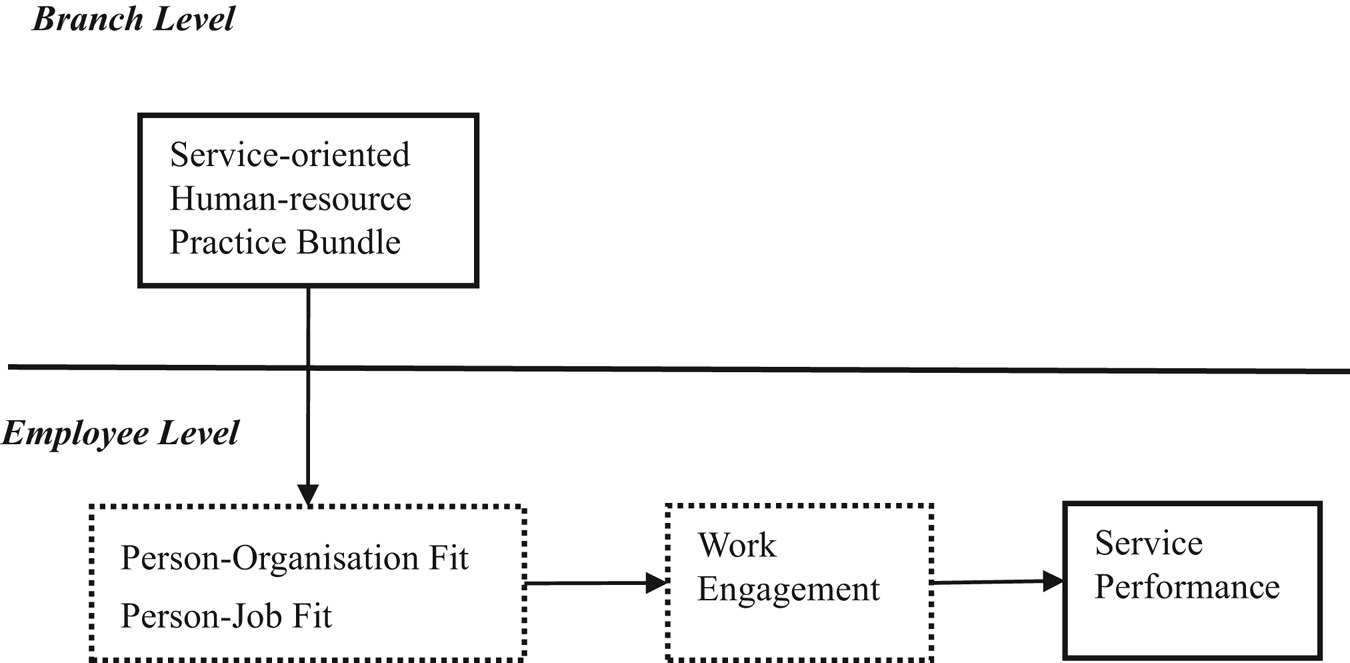
This study extends the growing but still limited body of branch-level SO-HRP research. In particular, its focus on cross-level mediating processes should help it to avoid the ecological or atomistic fallacies that are common to single-level models. This is more likely to provide a complete understanding of teams through the analysis of cross-level relationships between lower-level constructs and higher-level constructs. For example, individual behaviors can be influenced at the group level, where the individuals within teams are influenced by the group context. Accordingly, measuring the mediation effect of P–E fit should be implemented on both the individual-level and the supervision level. Moreover, without investigating the supervisory level, the utility of measuring service performance considering P–O fit could be problematic. It is believed that the examination of cross-level mediating is likely to contribute to the theoretical understanding of service performance across various levels of analysis. The matter that provides new insight to the black box that reflects the relationship between SO-HRP and service performance (Xu, Le, He, & Yao, Reference Xu, Le, He and Yao2020). Moreover, the study aims to investigate the sequence of mediating effects of P–E fit and work engagement, not to compare them through parallel mediation or measure their moderator impact. It is expected that the causal relationship between the two mediators is high, where P–E fit influences work engagement. Therefore, the serial mediation relationship is considered in the analysis in this research (Demming, Jahn, & Boztuğ, Reference Demming, Jahn and Boztuğ2017).
Methodology
Participants and procedures
The research subjects of this study were full-time frontline service employees and branch supervisors of two service companies, one in the financial insurance industry and the other, a hypermarket chain. A supervisor-subordinate matching method was adopted for its questionnaire surveys. This meant that the branch supervisor answered questions about his/her organization's SO-HRP bundle and the service performance of frontline service personnel, while those personnel filled out questionnaires covering the three proposed mediator variables, i.e., P–O fit, P–J fit, and work engagement. This dual-questionnaire design method can reduce a form of bias known as common-method variance (CMV; Podsakoff, MacKenzie, Lee, and Podsakoff, Reference Podsakoff, MacKenzie, Lee and Podsakoff2003). However, because the mediator variables were based on frontline employees' self-assessment, CMV might still have posed a problem. Therefore, the researchers used Harman's one-factor analysis to examine the impact of CMV. The results of principal component factor analysis, using varimax rotation, showed that the largest factor only explained 34.35% of the total variance, far lower than the 50% standard proposed by Hair, Black, Babin, Anderson, and Tatham (Reference Hair, Black, Babin, Anderson and Tatham2006), indicating that CMV was not a significant risk in the current study.
The sampling procedure was as follows. One of the researchers went personally to each branch to explain the purpose of the research project to the subjects, along with their right to participate freely, filled out anonymously, and withdraw from it at any time, and its policies on data confidentiality and scope of use. Participants were also informed that they did not need to provide any personal information confidentiality policy, and asked them to seal the completed questionnaire in an envelope. The above procedures for administering the sampling will help reduce social desirability. A matching-code technique was used to classify each employee and his or her corresponding branch supervisor's response. After being sealed in envelopes, the questionnaires were likewise collected in person from the branch supervisors and frontline service personnel who participated in the survey. In all, 70 valid questionnaires were collected from branch supervisors, and 327 from frontline employees. These figures represented an employee response rate of 81%, and the number of employees participating per branch ranged from three to six. Among the frontline employees, 63.2% were female, and 76.6% educated to college level. The ratio of 21- to 30-year-old was 30%; 31- to 40-year-old, 33.3%; and 41- to 50-year-old, 24.5%. Their average job tenure was 9.45 years (SD = 8.06).
The average age of supervisors was 37 years (SD = 2.55), and their average relevant job tenure was 7.23 years (SD = 2.15). Eight of them were female.
Measures
Service-oriented human resource practices bundle
This study followed Chao and Shih (Reference Chao and Shih2018) method of selecting measurement items when evaluating customer service-focused HRM systems. We selected a 20-item scale to measure the SO-HRP bundle. Respondents who were branch supervisors stated their level of agreement that the SO-HRP was useful for the frontline employees in their branch, on a scale ranging from 1 = strongly disagree to 6 = strongly agree. There were five subfacets of this measure: job description (e.g., ‘The description for this job contains all the duties of customer service’), recruitment (e.g., ‘Recruitment emphasizes traits and abilities required for providing a high quality of legal service for customers’), training (e.g., ‘Customers receiving a high quality of legal service is emphasized in training’), performance appraisal (e.g., ‘Satisfying customers in service encounters is the most important work guideline’), and performance compensation system (e.g., ‘Differences in pay among my subordinates represent differences in their customer service performance levels’). Second-order confirmatory factor analysis (CFA) showed an adequate fit to the data (χ2 [165] = 270.90, CFI = .91, IFI = .91, PNFI = .69, and RMSEA = .091). The Cronbach's alpha for the SO-HRP scale was.90.
Perceived person–organization fit
Non-supervisor respondents were asked to indicate their fit with their organization, according to three items derived from Cable and DeRue (Reference Cable and DeRue2002). An example item is: ‘The things that I value in life are very similar to those that my organization values.’ The rating was on the same Likert scale mentioned above, and the Cronbach's alpha for the P–O fit scale was.83.
Perceived person–job fit
Perceived P–J fit was also adapted from Cable and DeRue (Reference Cable and DeRue2002) (sample item: ‘The match between the demands of my job and my personal skills is very good’). The Likert scale was the same as for P–O fit, and the Cronbach's alpha for the P–J fit scale was.86.
Work engagement
Measures of our three-work engagement sub-facets–vigor, dedication and absorption–were adopted from the nine-item version of the Utrecht work engagement scale, as recommended by Schaufeli, Salanova, González-Romá, and Bakker (Reference Schaufeli, Salanova, González-Romá and Bakker2002). These subscales each comprised three items. An example item for vigor is, ‘At my job I feel strong and vigorous’; for dedication, ‘I am enthusiastic about my job’; and for absorption, ‘I am immersed in my work.’ All work engagement items were measured using a six-point Likert scale ranging from 1 = never to 6 = always. Second-order CFA showed that the model fit the data well (χ2 [24] = 54.36, CFI = .98, IFI = .98, PNFI = .65, and RMSEA = .062). The Cronbach's alpha for the work engagement scale was.92.
Employee service performance
To capture the construct of service performance and ensure the appropriateness of the items in our chosen research setting, we adopted an integrated service performance scale, comprising an empathy scale (Salanova, Agut, & Peiró, Reference Salanova, Agut and Peiró2005) and a service-provider performance scale (Liao & Chuang, Reference Liao and Chuang2004). Empathy was measured via three items, one of which is, ‘This employee is able to ‘tune in’ to each specific customer.’ Service-provider performance was measured using four items, including ‘This employee asks good questions and listens to determine what a customer wants.’ Supervisors were asked to evaluate the individual service performance of their subordinates on a seven-point Likert scale, ranging from 1 = highly disagree to 7 = highly agree. We computed the global Cronbach's alpha of the composite of both subscales of employee service performance as.91.
Control variables
Employees' ages, genders, lengths of job tenure, and educational levels were included as control variables to minimize potential confounding effects.
Analysis strategy
The collected data have a nested structure, as employees are nested in branch supervisors. Based on multilevel path analysis, level 1 variance was deemed to be within-group variance and between-group variance (Muthén & Asparouhov, Reference Muthén, Asparouhov, Fitzmaurice, Davidian, Verbeke and Molenberghs2009); and the correlation between these variance components can be modeled on every level through the specifications of structural relations. Specifically, multilevel path models can avoid the potential problem of conflating between-group and within-group relationships; directly estimate the indirect effects and the multiple paths that are components of such effects; and provide fit indices for the overall model. Hence, we tested our model by conducting multilevel path analysis using Mplus 8.2 with maximum likelihood estimation.
Confirmatory factor analysis results
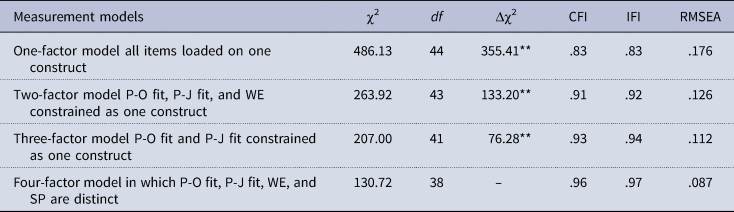
We performed CFA to test the discriminant validity of the individual-level measures included in our hypothesis framework, namely, P–O fit, P–J fit, work engagement, and service performance. The results (Table 1) indicate that the four-factor model achieved the best model fit among all the models we examined, (χ2 = 130.72, df = 38, RMSEA = .087, CFI = .96, IFI = .97, PNFI = .66). In addition, the results of χ2 difference tests shown in Table 1 also indicate that the four-factor model was superior to the three alternative models. These results demonstrated the distinctiveness of these four factors.
Results of confirmatory factor analyses
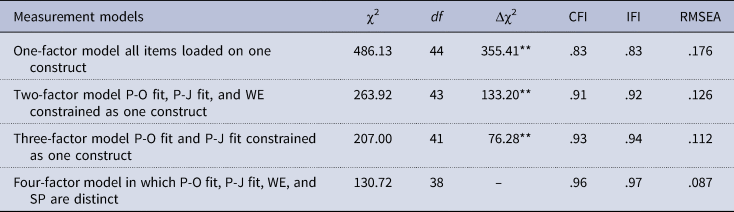
CFI, comparative fix index; IFI, incremental fit index; RMSEA, root mean square error of approximation; P-O fit, person-organization fit; P-J fit, person-job fit; WE, work engagement; SP, service performance.
N = 327; ** p < .01.
Note. χ2 difference was computed based on the value of the four-factor model.
Results
Descriptive statistics
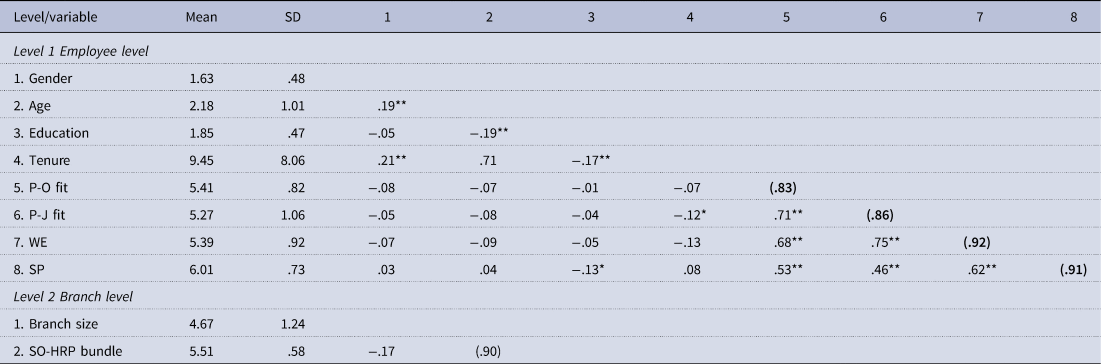
Descriptive statistics and correlations for all study variables are provided in Table 2.
Means, standard deviations, and intercorrelations of study variables
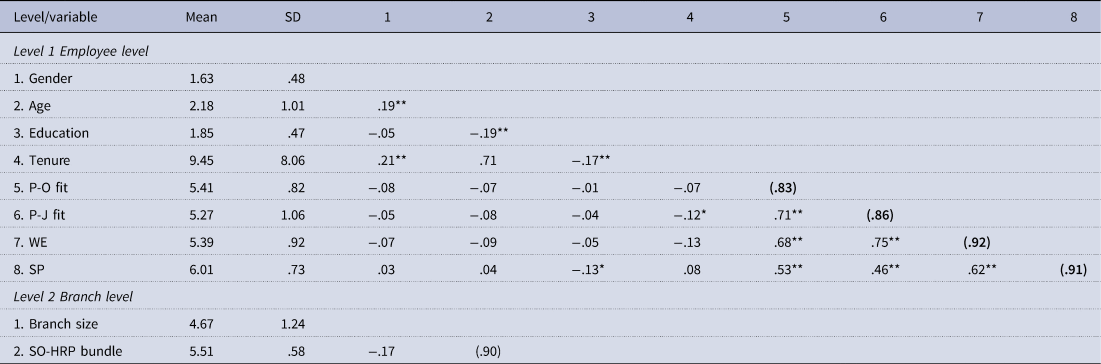
SD, standard deviation; P-O fit, person-organization fit; P-J fit, person-job fit; WE, work engagement; SP, service performance; Branch size, participate numbers of team; SO-HRP, service-oriented human-resource practices. *p < .05; **p < .01 (two-tailed test).
Note. N = 327 (for level 1); N = 70 (for level 2). Numbers in parentheses are the Cronbach's α.
Hypothesis testing
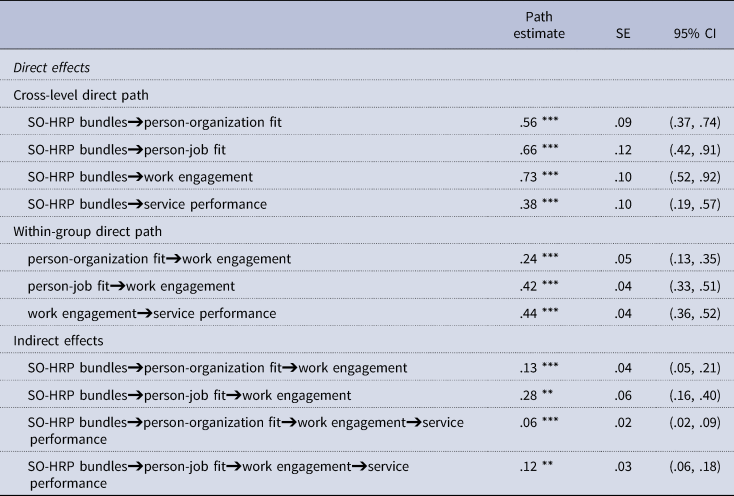
Before testing our hypotheses, we examined the model fit of our hypothesized model. Because the crosslevel mediation model fit the data adequately (χ2 [16] = 58.16, p < .01, CFI = .90, RMSEA = .081), we continued to test the hypotheses. The results of Mplus software analyses, presented in Table 3, show the proposed cross-level mediation model's direct paths and indirect effects. The standard error and 95% confidence interval (CI) for each direct and indirect effect are also reported.
Tests of direct and indirect effects based on the hypothesized model
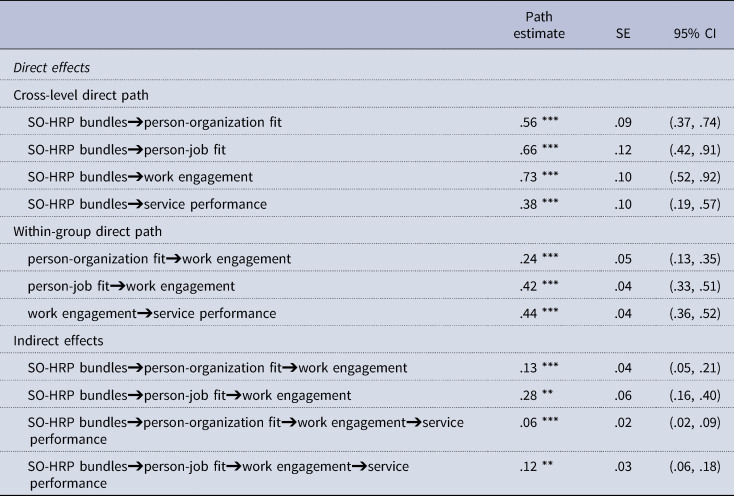
Note. Unstandardized estimates are reported. SE, standard error; CI, confidence interval; SO-HRP, service-oriented human-resource practices. * p < .05; ** p < .01; *** p < .001 (two-tailed).
The direct path for H1, that the branch-level SO-HRP bundle was positively related to employee work engagement, was significant (b = .73, p < .001, 95% CI = .52,.92). Thus, H1 was supported.
H2a suggested that employee-perceived P–O fit would mediate the positive relationship between the SO-HRP bundle and work engagement. As shown in Table 3, the indirect effect via P–O fit was significant (b = .13, p < .01, 95% CI = .05,.21). From this, coupled with the finding of a direct path from the SO-HRP bundle to work engagement (H1), it can be concluded that P–O fit served as a partial mediator in the relationship between the SO-HRP bundle and work engagement. Thus, H2a was supported.
H2b held that we would find a serial indirect effect whereby employee-perceived P–O fit and work engagement would sequentially mediate the positive relationship between the SO-HRP bundle and service performance. As Table 3 shows, the indirect effect for this chain-mediation effect was significant (b = .06, p < .01, 95% CI = .02,.09). Because this hypothesis specified that the indirect effect would be positive, we applied a two-tailed significance test, the results of which confirmed that the indirect effect was significant, thus supporting H2b.
H3a suggested that employee-perceived P–J fit would mediate the positive relationship between the SO-HRP bundle and work engagement. As shown in Table 3, the indirect effect via P–J fit was significant (b = .28, p < .001, 95% CI = .16,.40), and in light of the fact that the SO-HRP bundle had a direct path to work engagement (H1), it can be concluded that P–J fit served as a partial mediator of the relationship between the SO-HRP bundle and work engagement. Thus, H3a was supported.
H3b held that there would be a serial indirect effect whereby employee-perceived P–J fit and work engagement sequentially mediated the positive relationship between the SO-HRP bundle and service performance. As Table 3 shows, the indirect effect for this chain-mediation effect was significant (b = .12, p < .001, 95% CI = .07,.18). Because this hypothesis specified that the indirect effect would be positive, we again applied a two-tailed significance test, and concluded that the indirect effect was significant, thus supporting H3b.
Post-hoc analysis
Given the cross-sectional nature of our data and to strengthen the support for the directions of the relationships in our hypothesized model, we tested an alternative model in which work engagement mediates the relationship between employee perceptions of SO-HRP bundle and P–E fit. This model was tested since the COR theory's ‘gain spiral’ principle proposes that employees reinvest high-level work engagement coming from SO-HRP bundle by proactively changing job resources and/or job demands. That is to say, the current study is to convert work engagement into job resources and consider it is as a motivator that could hence P–E fit. In support of this idea, research has shown that work engagement can reciprocally influence P–E fit (Lu, Wang, Lu, Du, & Bakker, Reference Lu, Wang, Lu, Du and Bakker2014). Alternative model (SO-HRP bundles➔work engagement➔P–O fit and P–J fit➔service performance) (χ2 [1] = − 63.71; p < .001) incorporated these ideas but was found to have a significantly poorer fit to the data in comparison to our hypothesis model. Therefore, we can be confident that relying on our proposed model was appropriate for testing our hypotheses.
Discussion
The primary goal of this study was to test how the branch-level SO-HRP bundle might stimulate or otherwise contribute to frontline employees' adoption of behavior beneficial to the organization/branch they serve. We extended the literature by integrating an organization-level antecedent (i.e., the SO-HRP bundle) and an individual-level antecedent (i.e., P–E fit) of job engagement into our research framework. Drawing on COR theory, signaling theory and the latest research on the SO-HRP (Gürlek & Uygur, Reference Gürlek and Uygur2021; Kotzé & Mostert, Reference Kotzé and Mostert2021), we proposed that employees' work engagement is influenced by the SO-HRP bundle not only directly, but also indirectly, through P–O fit and P–J fit simultaneously. Moreover, our expectation that P–O fit and work engagement would serially mediate the positive relationship between the SO-HRP bundle and service performance were borne out. These research findings have the following important implications for the theory and practice of management.
Theoretical implications
First, our COR-based cross-level serial mediation modeling results show that frontline employees' work engagement can be aroused by SO-HRP bundles. This means that such employees' ability to display customer-centered work engagement is closely related to the effectiveness of their employers' SO-HRP bundles in providing work resources. In the service industry, frontline employees must pay close attention to customer needs if they are to adopt service-oriented behaviors and take timely action to meet those needs. Importantly, these kinds of behaviors are often beyond the scope of their standard job responsibilities. Moreover, the service context is diverse and complex, and frontline employees need to consume a variety of physical and psychological resources to cope with the stress caused by the process of addressing its everchanging array of situations and problems. This, as per the COR theory, causes stress when an employee experiences a loss of existing resources and a failure to acquire new ones (Chen, Westman, & Hobfoll, Reference Chen, Westman and Hobfoll2015). Choo (Reference Choo2016) has argued that if an organization cannot provide practices or resources with a variety of specific types of support over the long term, it will be impossible for its employees to maintain their work engagement. A COR-based study by Chen (Reference Chen2018) also find that team-level high-commitment work systems act as a contextual job resource, and has a motivating and facilitating role in boosting employees' work engagement. The results of the current study show that SO-HRP bundles can play an important role in providing work resources for the organization. In other words, with the assistance of the SO-HRP bundles, frontline employees can both access resources critical for responding to the stressful scenarios in their environments, and also engage in sustained investment in resources, such that they can obtain new resources while preventing the loss of existing ones (Hobfoll et al., Reference Hobfoll, Halbesleben, Neveu and Westman2018). In short, frontline employees can build and preserve a resource pool of individual expertise and skills through SO-HRP bundles, and use it to cope with stressful scenarios in the future. And when employees' resources are lost, SO-HRP bundles provide supplementary resources to compensate them for such loss, and thus reduce the stress induced by a spiral of increasing loss. Moreover, when frontline employees perceive those sufficient individual resources, such as service expertise, skills, and competencies can be continuously gained from SO-HRP bundles, based on the accumulation of resources, they will be able to reinvest in and develop their personal resources. This process can be expected to generate a gain spiral that counteracts potential future resource depletion, and to underpin effective responses to stressful scenarios by encouraging employees to commit their individual energies to service work. This chimes with the COR theory's argument that people with more resources suffer fewer resource losses and are more able to gain resources (Hobfoll et al., Reference Hobfoll, Halbesleben, Neveu and Westman2018). Thus, the results of this study extend the COR theory, and provide a theoretical basis for the observed positive relationship between branch-level SO-HRP bundles and frontline service employees' work engagement.
Second, the current study, using signaling theory, successfully incorporated both P–O fit and P–J fit into its research model, as mediators of the relationship between SO-HRP bundles and work engagement. This constitutes an important extension of the literature on HRMP and P–E fit. Our results show that the organization-related and work-related information sent by SO-HRP bundles have a positive impact on frontline employees' perceptions of the degree of consistency between their own values and goals, on the one hand, and those of their organizations, on the other. Such information will also enhance their work engagement, by impacting their perceptions of the degree of consistency between, on the one hand, their knowledge, skills and competencies, and on the other, their job requirements. According to signaling theory, whether an organization's dispersal of information to its employees generates useful outcomes depends on the signal reliability of the information; that is, the greater the consensus between organizations and employees in their pursuit of signal quality, the more they agree with each other regarding the signals (Guest et al., Reference Guest, Sanders, Rodrigues and Oliveira2021). Therefore, when the signals sent by an organization's SO-HRP bundle regarding its requirements and expectations are highly consistent with its employees' individual work values and goals, then both P–O fit and P–J fit is higher, thereby helping to enhance work engagement. In addition, organizations can enhance signaling effectiveness by increasing signal frequency. When an organization's SO-HRP bundles can communicate clear, strong, and consistent information to its employees, information asymmetries between the organization/branch and employees are reduced (Guest et al., Reference Guest, Sanders, Rodrigues and Oliveira2021). Pulling these threads together, it can be said that employees tend to better understand, support, and identify with information from SO-HRP bundles when they perceive a high level of signal fit, and are thus prompted to take the initiative to show more work engagement. Therefore, signaling theory provides a sound theoretical basis for the positive effects of SO-HRP bundles on work engagement through P–O and P–J fit.
Third, although many previous studies have verified the relationship between HRP and service performance, the process by which these two structures impact each other remains an underexplored ‘black box.’ Moreover, most of the models used in these previous studies have been parallel mediation or simple (single) mediation ones, with very few using serial mediation models to analyze the process (Gürlek & Uygur, Reference Gürlek and Uygur2021). We used the serial mediation approach to analyze our research model which can help researchers more insight into the causal relationship between both mediators and their respective mediation effects. Also, importantly, Meijerink, Beijer, and Bos-Nehles (Reference Meijerink, Beijer and Bos-Nehles2021) found that such perceptions may be strong, regardless of whether such practices actually exist. P–E fit level involves an individual's subjective evaluation of their organization and their own work within it (Xu et al., Reference Xu, Le, He and Yao2020), and previous studies have shown that when employees shape work engagement, they can be proactive participants in their job responsibilities (Ünal & Turgut, Reference Ünal and Turgut2015). Accordingly, to better understand the mechanism linking perceived HRP to service performance, as well as how employees are actively involved in shaping attitudes, this study has proposed a cross-level serial mediation model that uses P–E fit and work engagement as mediators of the relationship between SO-HRP bundles and service performance. Our data revealed that SO-HRP bundles' relation to service performance through P–E fit (i.e., P–J fit and P–O fit) and work engagement was significant. This leads us to conclude that when employees endorse their organizations' SO-HRP bundles, they can promote their own service knowledge and skills; their abilities tend to become a better fit the requirements of their work (i.e., P–J fit); when employees' norms, goals, values and desired behaviors are congruence with their organizations (i.e., P–O fit), and they develop an affective–motivational drive (i.e., work engagement). All of this is likely to result in better service performance. These empirical findings also closely echo both fit theory and positive organizational behavior.
Managerial/Practical implications
The managerial implications of this research are represented in, first, the direct and indirect effect of the SO-HRP bundle on frontline service employees' performance suggests that service organizations must ensure having a suitable infrastructure to be able to use the SO-HRP bundle effectively. Accordingly, based on signal theory, service organizations should be committed to improving their management channels, processes, tools, and formal and informal communication systems. Both the top management and supervisors levels should be aware of the developed model and respond to it appropriately. This is likely to enhance effective communication, influence employees to complain, provide feedback to clarify any ambiguous issues, solve problems, reduce conflicts, and information asymmetry among signals (Jo et al., Reference Jo, Aryee, Hsiung and Guest2021).
Secondly, service organizations should invest in service-oriented motivations, opportunities, and skills to enhance their SO-HRP. Hence, service organizations should consider not only the SO-HRP bundle but also their implementation. This is likely to achieve a strong consensus between employees and the organizational environment and, hence the SO-HRP bundle achieves its desirable effects (Wang & Xu, Reference Wang and Xu2017). Accordingly, aligning the HRM strategies with the organizational strategy guarantees the achievement of the desired results. Finally, On the other hand, alignment between the SO-HRP bundle and individual behaviors that are expected to be developed is important. This could be achieved by organizational support and making employees feel that their efforts are valued. This is likely to motivate employees to engage in the workplace (Morales-Sánchez & Pasamar, Reference Morales-Sánchez and Pasamar2019).
Limitations and directions for future research
Despite the enormous literature that uses the resource-based view theories in research, little research with a concrete theoretical foundation is implemented in the service industry context (Kim, Song, & Triche, Reference Kim, Song and Triche2015). This study utilized a cross-sectional survey to verify the strength of causality between various latent variables. It examined how the macro-level processes of SO-HRP affect the microlevel service performance of employees. The tested SO-HRP is limited to five sub-facets of job description, recruitment, training, performance appraisal, and performance compensation system. Two mediating factors were considered represented in P–E fit, measured by P–O fit and P–J fit and work engagement. In addition, this study is limited to measuring the opinion of frontline employees and their supervisors in two service organizations. Therefore, examining the impact of SO-HRP bundle on customer satisfaction and its impact on the financial performance in services organizations is expected to add value (Jo et al., Reference Jo, Aryee, Hsiung and Guest2021).
Moreover, the study findings cannot be generalized. Therefore, this research is expected to be accumulated by future research that focuses on measuring the overall effectiveness of practices in different services sectors. Different practices with the ability of generalization of results will be more significant in measuring the impact of the SO-HRP bundle on frontline employees' service performance (Chowhan, Reference Chowhan2016). Other fit models could be considered in future research, including person–team fit, person–supervisor fit, and person–vocation fit (Uppal, Reference Uppal2020; Verma & Sharma, Reference Verma and Sharma2015). Finally, the inclusion of service innovation as a dependent variable in the proposed model is likely to accumulate this research by linking the resource-based view with service innovation (Kim, Song, & Triche, Reference Kim, Song and Triche2015).
Conclusions
Although this study has its limitations, it has also made certain real contributions. It has added crucial value to the research on the ‘black box’ interaction between HRPs and personal performance. This research introduced P–O fit, P–J fit, and work engagement as potential mediators in its hypothetical model to fully capture the impact of the SO-HRP bundle on service performance, and this approach revealed how SO-HRP bundles might stimulate frontline employees, as well as shed light on the process and results of SO-HRP bundles on high-quality service behaviors.
More specifically, this study has established that most of the relationship between SO-HRP and service performance is indirect, operating through P–O fit, P–J fit, and work engagement. In particular, the SO-HRP bundle first impacts P–O fit and P–J fit, and they, in turn, affect work engagement, and ultimately, service performance. Future research could usefully adopt multilevel research designs to further analyze HRP, different levels of P–E fit, employees' various personal attitudes toward work, and different levels of performance (i.e., organizational, branch/departmental, and individual). It is hoped that such research will further clarify the mechanism(s) of influence between HRP and performance outcomes.