


Introduction
The notion of cluster algebras was introduced by Fomin and Zelevinsky [Reference Fomin and ZelevinskyFZ02]. A cluster algebra is a
 $\mathbb{Z}$
-subalgebra of a rational function field generated by a special set of generators called the cluster variables, which are grouped into overlapping subsets, called clusters [Reference Fomin and ZelevinskyFZ02]. A seed is a pair of a cluster and an exchange matrix which encodes how one can produce a new seed from an old one. This procedure is called mutation. The celebrated Laurent phenomenon [Reference Fomin and ZelevinskyFZ02] asserts that every cluster variable can be written as a Laurent polynomial of cluster variables in any other cluster.
A monoidal categorification of a cluster algebra
 $A$
is an abelian monoidal category
 ${\mathcal{C}}$
such that its Grothendieck ring
 $K({\mathcal{C}})$
is isomorphic to
 $A$
as a ring and
 ${\mathcal{C}}$
is required to satisfy several additional properties reflecting the cluster algebra structure of
 $A$
[Reference Hernandez and LeclercHL10]. One such requirement is that the cluster monomials (products of cluster variables in a cluster) belong to the set of the classes of simple objects of the category
 ${\mathcal{C}}$
. As observed in [Reference Hernandez and LeclercHL10], this condition, together with the Laurent phenomenon, immediately implies that the Laurent polynomial expansion in a cluster of the class of an object of
 ${\mathcal{C}}$
has non-negative coefficients. In particular, every cluster variable has a non-negative Laurent expansion in cluster variables of another cluster, which was one of the central conjectures at the beginning of cluster algebra theory. (Even this non-negativity turned out to be true in general [Reference Lee and SchifflerLS15], but the method in [Reference Lee and SchifflerLS15] is totally different from the above.) It is an example of the synergy between monoidal categorification and the Laurent phenomenon.
In [Reference Berenstein and ZelevinskyBZ05], Berenstein and Zelevinsky introduced the notion of quantum cluster algebras which is a
 $q$
-analogue of cluster algebras. The unipotent quantum coordinate ring
 $A_{q}(\mathfrak{n}(w))$
associated with a Weyl group element
 $w$
has a structure of quantum cluster algebra [Reference Geiß, Leclerc and SchröerGLS13b]. It turns out that the quantum cluster monomials of
 $A_{q}(\mathfrak{n}(w))$
belong to the upper global basis [Reference Kang, Kashiwara, Kim and OhKKKO18]. This result is accomplished by showing that the cluster monomials in
 $A_{q}(\mathfrak{n}(w))$
are the class of simple modules in the category
 ${\mathcal{C}}_{w}$
, where
 ${\mathcal{C}}_{w}$
is a certain monoidal category of finite-dimensional graded modules over a symmetric quiver Hecke algebra [Reference Kang, Kashiwara, Kim and OhKKKO18]. Recall that the quiver Hecke algebras (or Khovanov–Lauda–Rouquier algebras) categorify half of a quantum group [Reference Khovanov and LaudaKL09, Reference RouquierRou08], and when they are symmetric and the base field is of characteristic
 $0$
, the upper global basis corresponds to the set of isomorphism classes of self-dual simple modules [Reference Varagnolo and VasserotVV11, Reference RouquierRou12]. Thus the main result in [Reference Kang, Kashiwara, Kim and OhKKKO18] is that the category
 ${\mathcal{C}}_{w}$
is a monoidal categorification of the quantum cluster algebras
 $A_{q}(\mathfrak{n}(w))$
. In the course of the proof of this result, the
 $R$
-matrices between modules over symmetric quiver Hecke algebras played a crucial role. Note that these
 $R$
-matrices are not invertible in general (for more details, see [Reference Kang, Kashiwara, Kim and OhKKKO18, § 2.2]).
The purpose of this paper is to study consequences of the monoidal categorification of
 $A_{q}(\mathfrak{n}(w))$
and the Laurent phenomenon of cluster algebras.
We start the application of the Laurent phenomenon by proving that if a simple module
 $S$
in
 ${\mathcal{C}}_{w}$
strongly commutes with all the cluster variables in a given monoidal cluster
 $\{{M_{j}\}}_{j}$
(i.e. the modules
 $S\circ M_{j}$
are simple), then the class
 $[S]$
is a cluster monomial in the cluster up to a power of
 $q$
(Theorem 2.4). It follows that if an upper global basis element
 $b$
of
 $A_{q}(\mathfrak{n}(w))$
 $q$
-commutes with the cluster variables
 $\{[M_{j}]\}$
in a cluster, then
 $b$
is a cluster monomial in the cluster up to a power of
 $q$
. We can say that this seemingly non-trivial result is an immediate consequence of the monoidal categorification in [Reference Kang, Kashiwara, Kim and OhKKKO18] and the Laurent phenomenon. Along a similar line of thought, we show in the last section that if a simple object
 $X$
strongly commutes with all the cluster variables in a cluster
 $[\mathscr{C}]$
except for exactly one cluster variable
 $M_{k}$
, then
 $[X]$
is either a cluster monomial in the cluster
 $[\mathscr{C}]$
or a cluster monomial in the mutation
 $\unicode[STIX]{x1D707}_{k}([\mathscr{C}])$
of
 $[\mathscr{C}]$
(Theorem 4.10).
We investigate further properties on the quantum cluster algebra
 $\widetilde{A_{q}}(\mathfrak{n}(w))$
in § 3, where
 $\widetilde{A_{q}}(\mathfrak{n}(w))$
is the localization of
 $A_{q}(\mathfrak{n}(w))$
by the set of frozen variables. By the localization of a monoidal category via a real commuting family of central objects, which is a procedure developed in [Reference Kashiwara, Kim, Oh and ParkKKOP19], one can identify the Grothendieck ring
 $K(\widetilde{{\mathcal{C}}}_{w})$
of the localization
 $\widetilde{{\mathcal{C}}}_{w}$
of
 ${\mathcal{C}}_{w}$
with the quantum cluster algebra
 $\widetilde{A_{q}}(\mathfrak{n}(w))$
(§ 3.1). We show that the homogeneous degrees of the
 $R$
-matrices between a cluster monomial and cluster variables give a natural order
 $\prec _{\mathscr{S}}$
on the set
 $\mathbb{Z}^{J}$
, the set of exponents of Laurent cluster monomials in each monoidal seed
 $\mathscr{S}$
. It turns out that, for a simple module
 $S$
of
 ${\mathcal{C}}_{w}$
, the Laurent cluster monomial expansion of
 $[S]$
in a quantum seed
 $[\mathscr{S}]$
has a unique maximal term and a unique minimal term with respect to
 $\prec _{\mathscr{S}}$
. Indeed, these maximal and minimal terms correspond to the head and the socle, respectively, when we multiply a cluster monomial to
 $S$
from the right such that all its composition factors are again cluster monomials in
 $\mathscr{S}$
(Lemma 3.6). By taking the degrees, we obtain natural maps
 $\mathbf{g}_{\mathscr{S}}^{R}$
and
 $\mathbf{g}_{\mathscr{S}}^{L}$
, both from the set of the classes of self-dual simple objects in
 $\widetilde{{\mathcal{C}}}_{w}$
into
 $\mathbb{Z}^{J}$
. We show that the maps
 $\mathbf{g}_{\mathscr{S}}^{R}$
and
 $\mathbf{g}_{\mathscr{S}}^{L}$
are bijective (Corollary 3.17). This result is established in several steps. First, we show that
 $\mathbf{g}_{\mathscr{S}}^{R}$
are bijective for a family of special initial seeds. Then we calculate the transition map
 $\unicode[STIX]{x1D719}_{\unicode[STIX]{x1D707}_{k}(\mathscr{S}),\mathscr{S}}^{R}$
between
 $\mathbf{g}_{\unicode[STIX]{x1D707}_{k}(\mathscr{S})}^{R}$
and
 $\mathbf{g}_{\mathscr{S}}^{R}$
which turns out to be bijective, so that
 $\mathbf{g}_{\mathscr{S}}^{R}$
is bijective for any seed
 $\mathscr{S}$
. Note that the map
 $\unicode[STIX]{x1D719}_{\unicode[STIX]{x1D707}_{k}(\mathscr{S}),\mathscr{S}}^{R}$
is called the tropical transformation (see [Reference Fomin and ZelevinskyFZ07, Reference Fock and GoncharovFG09, Reference QinQin17]) and we recover its formula using the results in [Reference Kang, Kashiwara, Kim and OhKKKO18]. Now the bijectivity of
 $\mathbf{g}_{\mathscr{S}}^{L}$
follows from the fact that every simple object has a right dual and a left dual in the category
 $\widetilde{{\mathcal{C}}}_{w}$
, which is proved in [Reference Kashiwara, Kim, Oh and ParkKKOP19], and the equality
 $\mathbf{g}_{\mathscr{S}}^{R}(L)+\mathbf{g}_{\mathscr{S}}^{L}(R)=0$
, which holds for any dual pair
 $(L,R)$
of simples in
 $\widetilde{{\mathcal{C}}}_{w}$
(Lemma 3.13). We emphasize that the maps
 $\mathbf{g}_{\mathscr{S}}^{L}$
and
 $\unicode[STIX]{x1D719}_{\unicode[STIX]{x1D707}_{k}(\mathscr{S}),\mathscr{S}}^{L}$
, which seem new, are as important as
 $\mathbf{g}_{\mathscr{S}}^{R}$
and
 $\unicode[STIX]{x1D719}_{\unicode[STIX]{x1D707}_{k}(\mathscr{S}),\mathscr{S}}^{R}$
.
These properties are strongly related to the notion of common triangular bases introduced by Qin [Reference QinQin17]. For example, the order
 $\prec _{\mathscr{S}}$
is the same as the dominance order given in [Reference QinQin17] and the bijectivity of
 $\mathbf{g}_{\mathscr{S}}^{R}$
is one of the four conditions presented in [Reference QinQin17] for the upper global basis to be a common triangular basis. Recently, Casbi [Reference CasbiCas18] studied a relationship between the dominance order and the order given by cuspidal decompositions of simples in
 $R\text{-}\text{gmod}$
, when
 $R$
is of type
 $A_{n}$
.
In § 3.6 we give a new proof that the upper global basis of
 $\widetilde{A_{q}}(\mathfrak{n}(w))$
is a common triangular basis of the cluster algebra
 $\widetilde{A_{q}}(\mathfrak{n}(w))$
(Proposition 3.19). Although this is not a new result (because it can be obtained from [Reference Kang, Kashiwara, Kim and OhKKKO18] together with [Reference QinQin17, Theorem 6.1.6] as explained at the end of [Reference QinQin17, § 1.2]), our approach here is more direct and enlightening.
In the last section we show that if the class of a simple module
 $X$
is divisible by the class of a real simple module
 $M$
in the Grothendieck ring, then
 $X$
is indeed isomorphic to a convolution product
 $Y\circ M$
for some simple module
 $Y$
(Theorem 4.1). Together with the Laurent phenomenon, this result helps us to rewrite the condition that a simple module
 $X$
in
 ${\mathcal{C}}_{w}$
strongly commutes with a cluster variable in
 $[\mathscr{C}]$
, in terms of the denominator vector
 $\mathbf{d}(X)$
of
 $[X]$
with respect to the cluster
 $[\mathscr{C}]$
. Note that the denominator vector
 $\mathbf{d}(X)$
, which is introduced in [Reference Fomin and ZelevinskyFZ02], can be read easily from the Laurent polynomial expansion of
 $[X]$
in the cluster
 $[\mathscr{C}]$
. The characterization enables us to provide new proofs of some conjectures in [Reference Fomin and ZelevinskyFZ07] on the denominator vectors in the case of the cluster algebra
 $\widetilde{A_{q}}(\mathfrak{n}(w))|_{q=1}$
.
This paper is organized as follows. In § 1 we review quantum unipotent coordinate rings, quantum cluster algebras, quiver Hecke algebras and their properties. In § 2 we recall the main result in [Reference Kang, Kashiwara, Kim and OhKKKO18] and prove a consequence of it together with the Laurent phenomenon. We also prove that the convolution products of the cuspidal modules and the cluster variables in the initial cluster in a suitable order have simple heads. In § 3 we collect the results on the parameterizations of simple objects in
 $\widetilde{{\mathcal{C}}}_{w}$
emphasizing relevance with the notion of common triangular basis. In § 4 we study the relation between the commutativity of a simple module with cluster variables in a monoidal cluster and the denominator vectors of the simple module.
1 Preliminaries
In this paper we restrict ourselves to the case of symmetric generalized Cartan matrices and symmetric quiver Hecke algebras.
1.1 Quantum groups and unipotent quantum coordinate rings
Let
 $I$
be an index set (for simple roots) and let
 $(A,\mathsf{P},\unicode[STIX]{x1D6F1},\mathsf{P}^{\vee },\unicode[STIX]{x1D6F1}^{\vee })$
be a symmetric Cartan datum. It consists of a symmetric generalized Cartan matrix
 $A=(a_{i,j})_{i,j\in I}$
, a free abelian group
 $\mathsf{P}$
called the weight lattice, a set
 $\unicode[STIX]{x1D6F1}=\{\unicode[STIX]{x1D6FC}_{i}\in \mathsf{P}\mid i\in I\}$
of linearly independent elements called simple roots, the group
 $\mathsf{P}^{\vee }:=\operatorname{Hom}_{\mathbb{Z}}(\mathsf{P},\mathbb{Z})$
called the coweight lattice, and a set
 $\unicode[STIX]{x1D6F1}^{\vee }=\{h_{i}\mid i\in I\}\subset \mathsf{P}^{\vee }$
of simple coroots. We assume that
 $\langle h_{i},\unicode[STIX]{x1D6FC}_{j}\rangle =a_{ij}$
for all
 $i,j\in I$
, and for each
 $i\in I$
there exists
 $\unicode[STIX]{x1D71B}_{i}\in \mathsf{P}$
such that
 $\langle h_{j},\unicode[STIX]{x1D71B}_{i}\rangle =\unicode[STIX]{x1D6FF}_{ij}$
for all
 $j\in I$
. The elements
 $\unicode[STIX]{x1D71B}_{i}$
are called the fundamental weights. The free abelian group
 $\mathsf{Q}:=\bigoplus _{i\in I}\mathbb{Z}\unicode[STIX]{x1D6FC}_{i}$
is called the root lattice. Set
 $\mathsf{Q}^{+}=\sum _{i\in I}\mathbb{Z}_{{\geqslant}0}\unicode[STIX]{x1D6FC}_{i}\subset \mathsf{Q}$
and
 $\mathsf{Q}^{-}=\sum _{i\in I}\mathbb{Z}_{{\leqslant}0}\unicode[STIX]{x1D6FC}_{i}\subset \mathsf{Q}$
. For
 $\unicode[STIX]{x1D6FD}=\sum _{i\in I}m_{i}\unicode[STIX]{x1D6FC}_{i}\in \mathsf{Q}$
, we set
 $|\unicode[STIX]{x1D6FD}|=\sum _{i\in I}|m_{i}|$
. For
 $\unicode[STIX]{x1D6FD}\in \mathsf{Q}^{+}$
with
 $n=|\unicode[STIX]{x1D6FD}|$
, we set
 $I^{\unicode[STIX]{x1D6FD}}:=\{\unicode[STIX]{x1D708}=(\unicode[STIX]{x1D708}_{1},\ldots ,\unicode[STIX]{x1D708}_{n})\in I^{n}\mid \unicode[STIX]{x1D6FC}_{\unicode[STIX]{x1D708}_{1}}+\cdots +\unicode[STIX]{x1D6FC}_{\unicode[STIX]{x1D708}_{n}}=\unicode[STIX]{x1D6FD}\}.$
Note that the symmetric group
 $\mathfrak{S}_{n}=\langle s_{1},\ldots ,s_{n-1}\rangle$
acts on
 $I^{\unicode[STIX]{x1D6FD}}$
by place permutations. Set
 $\mathfrak{h}=\mathbb{Q}\otimes _{\mathbb{Z}}\mathsf{P}^{\vee }$
. Then there exists a non-degenerate symmetric bilinear form
 $(\,,\,)$
on
 $\mathfrak{h}^{\ast }$
satisfying
 $\langle h_{i},\unicode[STIX]{x1D706}\rangle =(\unicode[STIX]{x1D6FC}_{i},\unicode[STIX]{x1D706})$
for any
 $\unicode[STIX]{x1D706}\in \mathfrak{h}^{\ast }$
and
 $i\in I$
. The Weyl group
 $W$
of
 $\mathfrak{g}$
is the subgroup
 $\langle r_{i};~i\in I\rangle \leqslant \operatorname{GL}(\mathfrak{h}^{\ast })$
, where
 $r_{i}(\unicode[STIX]{x1D706}):=\unicode[STIX]{x1D706}-\langle h_{i},\unicode[STIX]{x1D706}\rangle \unicode[STIX]{x1D6FC}_{i}$
for
 $\unicode[STIX]{x1D706}\in \mathfrak{h}^{\ast },i\in I$
. An element
 $\unicode[STIX]{x1D707}\in \mathsf{P}$
is called a dominant integral weight if
 $\langle h_{i},\unicode[STIX]{x1D707}\rangle \geqslant 0$
for all
 $i\in I$
. Let us denote the set of dominant integral weights by
 $\mathsf{P}^{+}$
.
Let
 $q$
be an indeterminate. The quantum group associated with
 $(A,\mathsf{P},\unicode[STIX]{x1D6F1},\mathsf{P}^{\vee },\unicode[STIX]{x1D6F1}^{\vee })$
is the associative algebra
 $U_{q}(\mathfrak{g})$
over
 $\mathbb{Q}(q)$
generated by
 $e_{i},f_{i}$
 $(i\in I)$
and
 $q^{h}$
 $(h\in \mathsf{P}^{\vee })$
with the defining relations
 $$\begin{eqnarray}\displaystyle & \displaystyle q^{0}=1,\quad q^{h}q^{h^{\prime }}=q^{h+h^{\prime }}\quad \text{for }h,h^{\prime }\in \mathsf{P}^{\vee }, & \displaystyle \nonumber\\ \displaystyle & \displaystyle q^{h}e_{i}q^{-h}=q^{\langle h,\unicode[STIX]{x1D6FC}_{i}\rangle }e_{i},\quad q^{h}f_{i}q^{-h}=q^{-\langle h,\unicode[STIX]{x1D6FC}_{i}\rangle }f_{i}\quad \text{for }h\in \mathsf{P}^{\vee },i\in I, & \displaystyle \nonumber\\ \displaystyle & \displaystyle e_{i}f_{j}-f_{j}e_{i}=\unicode[STIX]{x1D6FF}_{ij}{\displaystyle \frac{q^{h_{i}}-q^{-h_{i}}}{q-q^{-1}}}\quad \text{for }i,j\in I, & \displaystyle \nonumber\\ \displaystyle & \displaystyle \mathop{\sum }_{r=0}^{1-a_{ij}}(-1)^{r}\left[\begin{array}{@{}c@{}}1-a_{ij}\\ r\\ \end{array}\right]e_{i}^{1-a_{ij}-r}e_{j}e_{i}^{r}=0\quad \text{if }i\neq j, & \displaystyle \nonumber\\ \displaystyle & \displaystyle \mathop{\sum }_{r=0}^{1-a_{ij}}(-1)^{r}\left[\begin{array}{@{}c@{}}1-a_{ij}\\ r\\ \end{array}\right]f_{i}^{1-a_{ij}-r}f_{j}f_{i}^{r}=0\quad \text{if }i\neq j, & \displaystyle \nonumber\end{eqnarray}$$
where
 $[k]=(q^{k}-q^{-k})/(q-q^{-1})$
for
 $k\in \mathbb{Z}_{{\geqslant}0}$
,
 $[k]!=[1]\cdots [k]$
and
 $\big[\!\begin{smallmatrix}n\\ m\\ \end{smallmatrix}\!\big]=[n]!/([m]![n-m]!)$
.
Note that
 $U_{q}(\mathfrak{g})=\bigoplus _{\unicode[STIX]{x1D6FD}\in \mathsf{Q}}U_{q}(\mathfrak{g})_{\unicode[STIX]{x1D6FD}}$
, where
 $$\begin{eqnarray}U_{q}(\mathfrak{g})_{\unicode[STIX]{x1D6FD}}:=\{x\in U_{q}(\mathfrak{g})\mid q^{h}xq^{-h}=q^{\langle h,\unicode[STIX]{x1D6FD}\rangle }x\text{ for any }h\in \mathsf{P}\}.\end{eqnarray}$$
Let
 $U_{q}^{+}(\mathfrak{g})$
be the
 $\mathbb{Q}(q)$
-subalgebra of
 $U_{q}(\mathfrak{g})$
generated by
 $\{e_{i}\mid i\in I\}$
. Let
 $U_{q}^{+}(\mathfrak{g})_{\mathbb{Z}[q^{\pm 1}]}$
be the
 $\mathbb{Z}[q^{\pm 1}]$
-subalgebra of
 $U_{q}^{+}(\mathfrak{g})$
generated by
 $e_{i}^{(n)}:=e_{i}^{n}/[n]!$
(
 $i\in I$
,
 $n\in \mathbb{Z}_{{>}0}$
).
Let
 $\unicode[STIX]{x1D6E5}_{\mathfrak{n}}$
be the algebra homomorphism
 $U_{q}^{+}(\mathfrak{g})\rightarrow U_{q}^{+}(\mathfrak{g})\otimes U_{q}^{+}(\mathfrak{g})$
given by
 $\unicode[STIX]{x1D6E5}_{\mathfrak{n}}(e_{i})=e_{i}\otimes 1+1\otimes e_{i}$
, where the algebra structure on
 $U_{q}^{+}(\mathfrak{g})\otimes U_{q}^{+}(\mathfrak{g})$
is defined by
 $(x_{1}\otimes x_{2})\cdot (y_{1}\otimes y_{2})=q^{-(\operatorname{wt}(x_{2}),\operatorname{wt}(y_{1}))}(x_{1}y_{1}\otimes x_{2}y_{2}).$
Set
 $$\begin{eqnarray}A_{q}(\mathfrak{n})=\bigoplus _{\unicode[STIX]{x1D6FD}\in \mathsf{Q}^{-}}A_{q}(\mathfrak{n})_{\unicode[STIX]{x1D6FD}}\quad \text{where }A_{q}(\mathfrak{n})_{\unicode[STIX]{x1D6FD}}:=\operatorname{Hom}_{\mathbb{Q}(q)}(U_{q}^{+}(\mathfrak{g})_{-\unicode[STIX]{x1D6FD}},\mathbb{Q}(q)).\end{eqnarray}$$
Then
 $A_{q}(\mathfrak{n})$
is an algebra with multiplication given by
 $(\unicode[STIX]{x1D713}\cdot \unicode[STIX]{x1D703})(x)=\unicode[STIX]{x1D703}(x_{(1)})\unicode[STIX]{x1D713}(x_{(2)})$
, when
 $\unicode[STIX]{x1D6E5}_{\mathfrak{n}}(x)=x_{(1)}\otimes x_{(2)}$
in Sweedler’s notation.
Let us denote by
 $A_{q}(\mathfrak{n})_{\mathbb{Z}[q^{\pm 1}]}$
the
 $\mathbb{Z}[q^{\pm 1}]$
-submodule of
 $A_{q}(\mathfrak{n})$
consisting of
 $\unicode[STIX]{x1D713}\in A_{q}(\mathfrak{n})$
such that
 $\unicode[STIX]{x1D713}(U_{q}^{+}(\mathfrak{g})_{\mathbb{Z}[q^{\pm 1}]})\subset \mathbb{Z}[q^{\pm 1}]$
. Then it is a
 $\mathbb{Z}[q^{\pm 1}]$
-subalgebra of
 $A_{q}(\mathfrak{n})$
. Moreover, the upper global basis
 $\mathbf{B}^{\operatorname{up}}$
is a
 $\mathbb{Z}[q^{\pm 1}]$
-module basis of
 $A_{q}(\mathfrak{n})_{\mathbb{Z}[q^{\pm 1}]}$
. For details of the upper global basis, see [Reference Kang, Kashiwara, Kim and OhKKKO18, § 1.3]. For
 $w\in W$
, let
 $A_{q}(\mathfrak{n}(w))_{\mathbb{Z}[q^{\pm 1}]}$
be the
 $\mathbb{Z}[q^{\pm 1}]$
-submodule of
 $A_{q}(\mathfrak{n})_{\mathbb{Z}[q^{\pm 1}]}$
consisting of the elements
 $\unicode[STIX]{x1D713}\in A_{q}(\mathfrak{n})_{\mathbb{Z}[q^{\pm 1}]}$
such that
 $e_{i_{1}}\cdots e_{i_{n}}\unicode[STIX]{x1D713}=0$
for any
 $\unicode[STIX]{x1D6FD}\in (\mathsf{Q}^{+}\cap w\mathsf{Q}^{+})\setminus \{0\}$
and any sequence
 $(i_{1},\ldots ,i_{n})\in I^{\unicode[STIX]{x1D6FD}}$
. Then
 $A_{q}(\mathfrak{n}(w))_{\mathbb{Z}[q^{\pm 1}]}$
is a
 $\mathbb{Z}[q^{\pm 1}]$
-subalgebra of
 $A_{q}(\mathfrak{n})_{\mathbb{Z}[q^{\pm 1}]}$
[Reference Kashiwara, Kim, Oh and ParkKKOP18, Theorem 2.20]. We call this algebra the quantum unipotent coordinate ring associated with
 $w$
. The set
 $\mathbf{B}^{\operatorname{up}}(w):=\mathbf{B}^{\operatorname{up}}\cap A_{q}(\mathfrak{n}(w))$
forms a
 $\mathbb{Z}[q^{\pm 1}]$
-basis of
 $A_{q}(\mathfrak{n}(w))_{\mathbb{Z}[q^{\pm 1}]}$
[Reference KimuraKim12].
For a dominant weight
 $\unicode[STIX]{x1D706}\in \mathsf{P}^{+}$
, let
 $V(\unicode[STIX]{x1D706})$
be the irreducible highest weight
 $U_{q}(\mathfrak{g})$
-module with highest weight vector
 $u_{\unicode[STIX]{x1D706}}$
of weight
 $\unicode[STIX]{x1D706}$
. Let
 $(~,~)_{\unicode[STIX]{x1D706}}$
be the non-degenerate symmetric bilinear form on
 $V(\unicode[STIX]{x1D706})$
such that
 $(u_{\unicode[STIX]{x1D706}},u_{\unicode[STIX]{x1D706}})_{\unicode[STIX]{x1D706}}=1$
and
 $(xu,v)_{\unicode[STIX]{x1D706}}=(u,\unicode[STIX]{x1D711}(x)v)_{\unicode[STIX]{x1D706}}$
for
 $u,v\in V(\unicode[STIX]{x1D706})$
and
 $x\in U_{q}(\mathfrak{g})$
, where
 $\unicode[STIX]{x1D711}$
is the algebra antiautomorphism on
 $U_{q}(\mathfrak{g})$
defined by
 $\unicode[STIX]{x1D711}(e_{i})=f_{i}$
,
 $\unicode[STIX]{x1D711}(f_{i})=e_{i}$
and
 $\unicode[STIX]{x1D711}(q^{h})=q^{h}$
. For each
 $\unicode[STIX]{x1D707},\unicode[STIX]{x1D701}\in W\unicode[STIX]{x1D706}$
, the unipotent quantum minor
 $D(\unicode[STIX]{x1D707},\unicode[STIX]{x1D701})$
is an element in
 $A_{q}(\mathfrak{n})$
given by
 $D(\unicode[STIX]{x1D707},\unicode[STIX]{x1D701})(x)=(xu_{\unicode[STIX]{x1D707}},u_{\unicode[STIX]{x1D701}})_{\unicode[STIX]{x1D706}}$
for
 $x\in U_{q}^{+}(\mathfrak{g})$
, where
 $u_{\unicode[STIX]{x1D707}}$
and
 $u_{\unicode[STIX]{x1D701}}$
are unique members of the upper global basis
 $\mathbf{B}^{\operatorname{up}}(\unicode[STIX]{x1D706})$
of
 $V(\unicode[STIX]{x1D706})$
of weight
 $\unicode[STIX]{x1D707}$
and
 $\unicode[STIX]{x1D701}$
, respectively (see [Reference Kang, Kashiwara, Kim and OhKKKO18, § 1.3] for the definition of
 $\mathbf{B}^{\operatorname{up}}(\unicode[STIX]{x1D706})$
). For each reduced expression
 $\text{}\underline{w}=s_{i_{1}}s_{i_{2}}\cdots s_{i_{l}}$
of
 $w\in W$
, define
 $w_{{\leqslant}k}:=s_{i_{1}}\cdots s_{i_{k}}$
and
 $w_{{<}k}:=s_{i_{1}}\cdots s_{i_{k-1}}$
for
 $1\leqslant k\leqslant l$
. Then the set
 $\{D(w_{{\leqslant}k}\unicode[STIX]{x1D71B}_{i_{k}},w_{{<}k}\unicode[STIX]{x1D71B}_{i_{k}})\mid 1\leqslant k\leqslant l\}$
of unipotent quantum minors generates
 $A_{q}(\mathfrak{n}(w))_{\mathbb{Z}[q^{\pm }1]}$
as a
 $\mathbb{Z}[q^{\pm 1}]$
-algebra.
1.2 Quantum cluster algebras
Fix finite index sets
 $J_{\text{ex}}$
and
 $J_{\text{fr}}$
and we call the elements in
 $J_{\text{ex}}$
and
 $J_{\text{fr}}$
exchangeable indices and frozen indices, respectively. Set
 $J:=J_{\text{ex}}\sqcup J_{\text{fr}}$
. For a given skew-symmetric integer-valued
 $J\times J$
matrix
 $L=(\unicode[STIX]{x1D706}_{ij})_{i,j\in J}$
, we define
 $\mathscr{P}(L)$
as the
 $\mathbb{Z}[q^{\pm 1/2}]$
-algebra generated by a family of elements
 $\{{X_{i}\}}_{i\in J}$
with the defining relations
 $X_{i}X_{j}=q^{\unicode[STIX]{x1D706}_{ij}}X_{j}X_{i}\;(i,j\in J)$
. For
 $\mathbf{a}=(a_{i})_{i\in J}\in \mathbb{Z}^{J}$
, set

where
 $\mathscr{F}(L)$
is the skew field of fractions of
 $\mathscr{P}(L)$
, and
 with
 $i_{1}<\cdots <i_{r}$
in a fixed total order on
 $J$
. Note that
 $X^{\mathbf{a}}$
does not depend on the choice of a total order. Then we have
 $$\begin{eqnarray}X^{\mathbf{a}}X^{\mathbf{b}}=q^{1/2\mathop{\sum }_{i,j\in J}a_{i}b_{j}\unicode[STIX]{x1D706}_{ij}}X^{\mathbf{a}+\mathbf{b}}\end{eqnarray}$$
and
 $\{X^{\mathbf{a}}\}_{\mathbf{a}\in \mathbb{Z}_{{\geqslant}0}^{J}}$
is a basis of
 $\mathscr{P}(L)$
as a
 $\mathbb{Z}[q^{\pm 1/2}]$
-module. The subalgebra
 $\mathbb{Z}[q^{\pm 1/2}][X_{i}^{\pm 1}\mid i\in J]$
of
 $\mathscr{F}(L)$
is called a quantum torus.
Let
 $\widetilde{B}=(b_{ij})_{(i,j)\in J\times J_{\text{ex}}}$
be an integer-valued
 $J\times J_{\text{ex}}$
matrix whose principal part
 $B:=(b_{ij})_{i,j\in J_{\text{ex}}}$
is skew-symmetric. The matrix
 $\widetilde{B}$
is called an exchange matrix. A pair
 $(L,\widetilde{B})$
of skew-symmetric integer-valued
 $J\times J$
matrix
 $L$
and an exchange matrix
 $\widetilde{B}$
is called compatible if there exists a positive integer
 $d$
such that
 $\sum _{k\in J}\unicode[STIX]{x1D706}_{ik}b_{kj}=\unicode[STIX]{x1D6FF}_{ij}d$
for all
 $i\in J$
and
 $j\in J_{\text{ex}}$
[Reference Berenstein and ZelevinskyBZ05, § 3]. In this paper we treat only the case
 $d=2$
. Let
 $(L,\widetilde{B})$
be a compatible pair and
 $A$
a
 $\mathbb{Z}[q^{\pm 1/2}]$
-algebra.
We say that
 ${\mathcal{S}}=(\{{x_{i}\}}_{i\in J},L,\widetilde{B})$
is a quantum seed in
 $A$
if
 $\{{x_{i}\}}_{i\in J}$
satisfies
 $x_{i}x_{j}=q^{\unicode[STIX]{x1D706}_{ij}}x_{j}x_{i}$
for any
 $i,j\in J$
and the algebra map
 $\mathscr{P}(L)\rightarrow A$
given by
 $X_{i}\mapsto x_{i}$
is injective. In that case, we call the set
 $\{{x_{i}\}}_{i\in J}$
the cluster of
 ${\mathcal{S}}$
and its elements the cluster variables. The elements
 $x^{\mathbf{a}}$
(
 $\mathbf{a}\in \mathbb{Z}_{{\geqslant}0}^{J}$
) are called the quantum cluster monomials.
Let
 ${\mathcal{S}}=(\{{x_{i}\}}_{i\in J},L,\widetilde{B})$
be a quantum seed in a
 $\mathbb{Z}[q^{\pm 1/2}]$
-algebra
 $A$
which is contained in a skew field
 $K$
. For each
 $k\in J_{\text{ex}}$
, we define
 $$\begin{eqnarray}\displaystyle \unicode[STIX]{x1D707}_{k}(\widetilde{B})_{ij} & := & \displaystyle \left\{\begin{array}{@{}ll@{}}-b_{ij}\quad & \text{if }i=k\text{ or }j=k,\\ b_{ij}+(-1)^{\unicode[STIX]{x1D6FF}(b_{ik}<0)}\max (b_{ik}b_{kj},0)\quad & \text{otherwise,}\end{array}\right.\nonumber\\ \displaystyle \unicode[STIX]{x1D707}_{k}(L)_{ij} & := & \displaystyle \left\{\begin{array}{@{}ll@{}}0\quad & \text{if }i=j\\ \displaystyle -\unicode[STIX]{x1D706}_{kj}+\mathop{\sum }_{t\in J}\max (0,-b_{tk})\unicode[STIX]{x1D706}_{tj}\quad & \text{if }i=k,j\neq k,\\ \displaystyle -\unicode[STIX]{x1D706}_{ik}+\mathop{\sum }_{t\in J}\max (0,-b_{tk})\unicode[STIX]{x1D706}_{it}\quad & \text{if }i\neq k,j=k,\\ \unicode[STIX]{x1D706}_{ij}\quad & \text{otherwise,}\end{array}\right.\nonumber\end{eqnarray}$$
and
 $$\begin{eqnarray}\unicode[STIX]{x1D707}_{k}(x)_{i}:=\left\{\begin{array}{@{}ll@{}}x^{\mathbf{a}^{\prime }}+x^{\mathbf{a}^{\prime \prime }}\quad & \text{if }i=k,\\ x_{i}\quad & \text{if }i\neq k,\end{array}\right.\end{eqnarray}$$
where
 $\mathbf{a}^{\prime }=(a_{i}^{\prime })_{i\in J}$
and
 $\mathbf{a}^{\prime \prime }=(a_{i}^{\prime \prime })_{i\in J}$
are given by
 $$\begin{eqnarray}a_{i}^{\prime }=\left\{\begin{array}{@{}ll@{}}-1\quad & \text{if }i=k,\\ \max (0,b_{ik})\quad & \text{if }i\neq k,\end{array}\right.\quad a_{i}^{\prime \prime }=\left\{\begin{array}{@{}ll@{}}-1\quad & \text{if }i=k,\\ \max (0,-b_{ik})\quad & \text{if }i\neq k.\end{array}\right.\end{eqnarray}$$
Then the triple
 $$\begin{eqnarray}\unicode[STIX]{x1D707}_{k}({\mathcal{S}}):=(\{\unicode[STIX]{x1D707}_{k}{(x)_{i}\}}_{i\in J},\unicode[STIX]{x1D707}_{k}(L),\unicode[STIX]{x1D707}_{k}(\widetilde{B}))\end{eqnarray}$$
becomes a new quantum seed in
 $K$
and we call it the mutation of
 ${\mathcal{S}}$
at
 $k$
.
The quantum cluster algebra
 $\mathscr{A}_{q^{1/2}}({\mathcal{S}})$
associated to the quantum seed
 ${\mathcal{S}}$
is the
 $\mathbb{Z}[q^{\pm 1/2}]$
-subalgebra of the skew field
 $K$
generated by all the cluster variables in the quantum seeds obtained from
 ${\mathcal{S}}$
by any sequence of mutations.
A quantum cluster algebra structure on a
 $\mathbb{Z}[q^{\pm 1/2}]$
-algebra
 $A$
is a family
 $\mathscr{F}$
of quantum seeds in
 $A$
such that:
(a) for any quantum seed
 ${\mathcal{S}}$
in
$\mathscr{F}$
,
$\mathscr{A}_{q^{1/2}}({\mathcal{S}})$
is isomorphic to
$A$
;
(b) for any pair
${\mathcal{S}},{\mathcal{S}}^{\prime }$
of quantum seeds in
$\mathscr{F}$
,
${\mathcal{S}}^{\prime }$
is obtained from
${\mathcal{S}}$
by a sequence of mutations;(c) any mutation of a quantum seed in
$\mathscr{F}$
is in
$\mathscr{F}$
.


We call a quantum seed in
 $\mathscr{F}$
a quantum seed of the quantum cluster algebra
 $A$
.
The quantum Laurent phenomenon [Reference Berenstein and ZelevinskyBZ05, Corollary 5.2] asserts that for any quantum seed
 ${\mathcal{S}}$
, every element
 $x\in \mathscr{A}_{q^{1/2}}({\mathcal{S}})$
can be expressed as
 $$\begin{eqnarray}x=\mathop{\sum }_{\boldsymbol{ a}\in \mathbb{Z}^{J_{\text{ex}}}\times \mathbb{Z}_{{\geqslant}0}^{J_{\text{fr}}}}c_{\mathbf{a}}x^{\mathbf{a}}\end{eqnarray}$$
in
 $K$
, where
 $X=(x_{i})_{i\in J}$
is the cluster in
 ${\mathcal{S}}$
, and
 $c_{\mathbf{a}}\in \mathbb{Z}[q^{\pm 1/2}]$
.
Remark that in [Reference Berenstein and ZelevinskyBZ05] the quantum cluster algebra associated with
 ${\mathcal{S}}$
is defined as the subalgebra of
 $K$
generated by all the cluster variables together with the inverses of the frozen variables. Then it is the (right) ring of quotients of
 $\mathscr{A}_{q^{1/2}}({\mathcal{S}})$
with respect to the multiplicative subset consisting of monomials in the frozen variables.
Geiß, Leclerc and Schröer showed that the algebra
 $\mathbb{Z}[q^{\pm 1/2}]\otimes _{\mathbb{Z}[q^{\pm 1}]}A_{q}(\mathfrak{n}(w))_{\mathbb{Z}[q^{\pm 1}]}$
has a quantum cluster algebra structure [Reference Geiß, Leclerc and SchröerGLS13b]. In particular, for each choice of reduced expression
 $\text{}\underline{w}=s_{i_{1}}s_{i_{2}}\cdots s_{i_{l}}$
, they gave a distinguished quantum seed whose cluster consists of
 $D(w_{{\leqslant}k}\unicode[STIX]{x1D71B}_{i_{k}},\unicode[STIX]{x1D71B}_{i_{k}})$
for
 $1\leqslant k\leqslant l$
up to a power of
 $q^{1/2}$
. For a detailed description, see § 2.3 below.
1.3 Quiver Hecke algebras
Let
 $\mathbf{k}$
be a base field. Take a family of polynomials
 $(Q_{ij})_{i,j\in I}$
in
 $\mathbf{k}[u,v]$
which are of the form
 $$\begin{eqnarray}Q_{ij}(u,v)=\left\{\begin{array}{@{}ll@{}}0\quad & \text{if }i=j,\\ \pm (u-v)^{-(\unicode[STIX]{x1D6FC}_{i},\unicode[STIX]{x1D6FC}_{j})}\quad & \text{if }i\neq j,\end{array}\right.\end{eqnarray}$$
such that
 $Q_{i,j}(u,v)=Q_{j,i}(v,u)$
.
The (symmetric) quiver Hecke algebra (also called the Khovanov–Lauda–Rouquier algebra)
 $R(\unicode[STIX]{x1D6FD})$
at
 $\unicode[STIX]{x1D6FD}\in \mathsf{Q}^{+}$
associated with
 $(A,\mathsf{P},\unicode[STIX]{x1D6F1},\mathsf{P}^{\vee },\unicode[STIX]{x1D6F1}^{\vee })$
and
 $(Q_{ij})_{i,j\in I}$
is the algebra over
 $\mathbf{k}$
generated by the elements
 $\{e(\unicode[STIX]{x1D708})\}_{\unicode[STIX]{x1D708}\in I^{\unicode[STIX]{x1D6FD}}}$
,
 $\{{x_{k}\}}_{1\leqslant k\leqslant n}$
,
 $\{{\unicode[STIX]{x1D70F}_{m}\}}_{1\leqslant m\leqslant n-1}$
satisfying the following defining relations:
 $$\begin{eqnarray}\displaystyle & \displaystyle e(\unicode[STIX]{x1D708})e(\unicode[STIX]{x1D708}^{\prime })=\unicode[STIX]{x1D6FF}_{\unicode[STIX]{x1D708},\unicode[STIX]{x1D708}^{\prime }}e(\unicode[STIX]{x1D708}),\quad \mathop{\sum }_{\unicode[STIX]{x1D708}\in I^{\unicode[STIX]{x1D6FD}}}e(\unicode[STIX]{x1D708})=1, & \displaystyle \nonumber\\ \displaystyle & \displaystyle x_{k}x_{m}=x_{m}x_{k},\quad x_{k}e(\unicode[STIX]{x1D708})=e(\unicode[STIX]{x1D708})x_{k}, & \displaystyle \nonumber\\ \displaystyle & \displaystyle \unicode[STIX]{x1D70F}_{m}e(\unicode[STIX]{x1D708})=e(s_{m}(\unicode[STIX]{x1D708}))\unicode[STIX]{x1D70F}_{m},\quad \unicode[STIX]{x1D70F}_{k}\unicode[STIX]{x1D70F}_{m}=\unicode[STIX]{x1D70F}_{m}\unicode[STIX]{x1D70F}_{k}\quad \text{if }|k-m|>1, & \displaystyle \nonumber\\ \displaystyle & \displaystyle \unicode[STIX]{x1D70F}_{k}^{2}e(\unicode[STIX]{x1D708})=Q_{\unicode[STIX]{x1D708}_{k},\unicode[STIX]{x1D708}_{k+1}}(x_{k},x_{k+1})e(\unicode[STIX]{x1D708}), & \displaystyle \nonumber\\ \displaystyle & \displaystyle (\unicode[STIX]{x1D70F}_{k}x_{m}-x_{s_{k}(m)}\unicode[STIX]{x1D70F}_{k})e(\unicode[STIX]{x1D708})=\left\{\begin{array}{@{}ll@{}}-e(\unicode[STIX]{x1D708})\quad & \text{if }m=k,\unicode[STIX]{x1D708}_{k}=\unicode[STIX]{x1D708}_{k+1},\\ e(\unicode[STIX]{x1D708})\quad & \text{if }m=k+1,\unicode[STIX]{x1D708}_{k}=\unicode[STIX]{x1D708}_{k+1},\\ 0\quad & \text{otherwise},\end{array}\right. & \displaystyle \nonumber\end{eqnarray}$$
 $$\begin{eqnarray}\displaystyle & & \displaystyle (\unicode[STIX]{x1D70F}_{k+1}\unicode[STIX]{x1D70F}_{k}\unicode[STIX]{x1D70F}_{k+1}-\unicode[STIX]{x1D70F}_{k}\unicode[STIX]{x1D70F}_{k+1}\unicode[STIX]{x1D70F}_{k})e(\unicode[STIX]{x1D708})\nonumber\\ \displaystyle & & \displaystyle \quad =\left\{\begin{array}{@{}ll@{}}\displaystyle {\displaystyle \frac{Q_{\unicode[STIX]{x1D708}_{k},\unicode[STIX]{x1D708}_{k+1}}(x_{k},x_{k+1})-Q_{\unicode[STIX]{x1D708}_{k},\unicode[STIX]{x1D708}_{k+1}}(x_{k+2},x_{k+1})}{x_{k}-x_{k+2}}}e(\unicode[STIX]{x1D708})\quad & \text{if }\unicode[STIX]{x1D708}_{k}=\unicode[STIX]{x1D708}_{k+2},\\ 0\quad & \text{otherwise}.\end{array}\right.\nonumber\end{eqnarray}$$
The algebra
 $R(\unicode[STIX]{x1D6FD})$
is
 $\mathbb{Z}$
-graded with
 $\deg e(\unicode[STIX]{x1D708})=0$
,
 $\deg x_{k}e(\unicode[STIX]{x1D708})=2$
, and
 $\deg \unicode[STIX]{x1D70F}_{m}e(\unicode[STIX]{x1D708})=-(\unicode[STIX]{x1D6FC}_{\unicode[STIX]{x1D708}_{m}},\unicode[STIX]{x1D6FC}_{\unicode[STIX]{x1D708}_{m+1}})$
.
Note that the choice of
 $\pm$
in (1.1) is irrelevant. That is to say, the isomorphism class of the quiver Hecke algebra
 $R(\unicode[STIX]{x1D6FD})$
does not depend on the choice of
 $\pm$
.
Let us denote by
 $R(\unicode[STIX]{x1D6FD})\text{-}\text{gmod}$
the category of finite-dimensional graded
 $R(\unicode[STIX]{x1D6FD})$
-modules with homomorphisms of degree
 $0$
. For an
 $R(\unicode[STIX]{x1D6FD})$
-module
 $M$
, we set
 $\operatorname{wt}(M):=-\unicode[STIX]{x1D6FD}\in \mathsf{Q}^{-}$
. For the sake of simplicity, we say that
 $M$
is an
 $R$
-module instead of saying that
 $M$
is a graded
 $R(\unicode[STIX]{x1D6FD})$
-module for
 $\unicode[STIX]{x1D6FD}\in \mathsf{Q}^{+}$
. Let us denote by
 $q$
the grading shift functor: for
 $M\in R\text{-}\text{gmod}$
, we have
 $(qM)_{n}=M_{n-1}$
by definition.
We also sometimes ignore grading shifts if there is no danger of confusion. Hence, for
 $R$
-modules
 $M$
and
 $N$
, we sometimes say that
 $f:M\rightarrow N$
is a homomorphism if
 $f:q^{a}M\rightarrow N$
is a morphism in
 $R\text{-}\text{gmod}$
for some
 $a\in \mathbb{Z}$
. If we want to emphasize that
 $f:q^{a}M\rightarrow N$
is a morphism in
 $R\text{-}\text{gmod}$
, we say so. We set
 $$\begin{eqnarray}\operatorname{Hom}_{R(\unicode[STIX]{x1D6FD})}(M,N):=\bigoplus _{a\in \mathbb{Z}}\operatorname{Hom}_{R(\unicode[STIX]{x1D6FD})\text{-}\text{gmod}}(q^{a}M,N).\end{eqnarray}$$
For
 $M\in R(\unicode[STIX]{x1D6FD})\text{-}\text{gmod}$
, the space
 $M^{\ast }:=\operatorname{Hom}_{\mathbf{k}}(M,\mathbf{k})$
admits an
 $R(\unicode[STIX]{x1D6FD})$
-module structure induced by the
 $\mathbf{k}$
-algebra antiautomorphism
 $\unicode[STIX]{x1D713}$
on
 $R(\unicode[STIX]{x1D6FD})$
which fixes the generators
 $e(\unicode[STIX]{x1D708})$
,
 $x_{k}$
, and
 $\unicode[STIX]{x1D70F}_{m}$
. Hence we have a contravariant auto-equivalence
 $^{\ast }$
on
 $R\text{-}\text{gmod}$
. We say that a simple
 $R(\unicode[STIX]{x1D6FD})$
-module
 $M$
is self-dual if
 $M\simeq M^{\ast }$
in
 $R\text{-}\text{gmod}$
.
For
 $\unicode[STIX]{x1D6FD},\unicode[STIX]{x1D6FE}\in \mathsf{Q}^{+}$
, set
 $e(\unicode[STIX]{x1D6FD},\unicode[STIX]{x1D6FE}):=\sum _{\unicode[STIX]{x1D708}\in I^{\unicode[STIX]{x1D6FD}},\unicode[STIX]{x1D708}^{\prime }\in I^{\unicode[STIX]{x1D6FE}}}e(\unicode[STIX]{x1D708}\ast \unicode[STIX]{x1D708}^{\prime })\in R(\unicode[STIX]{x1D6FD}+\unicode[STIX]{x1D6FE})$
, where
 $\unicode[STIX]{x1D708}\ast \unicode[STIX]{x1D708}^{\prime }$
denotes the concatenation of
 $\unicode[STIX]{x1D708}$
and
 $\unicode[STIX]{x1D708}^{\prime }$
. Then there is a
 $\mathbf{k}$
-algebra homomorphism
 $R(\unicode[STIX]{x1D6FD})\otimes R(\unicode[STIX]{x1D6FE})\rightarrow e(\unicode[STIX]{x1D6FD},\unicode[STIX]{x1D6FE})R(\unicode[STIX]{x1D6FD}+\unicode[STIX]{x1D6FE})e(\unicode[STIX]{x1D6FD},\unicode[STIX]{x1D6FE})$
. The convolution product
 $$\begin{eqnarray}-\circ -:R(\unicode[STIX]{x1D6FD})\text{-}\text{gmod}\times R(\unicode[STIX]{x1D6FE})\text{-}\text{gmod}\rightarrow R(\unicode[STIX]{x1D6FD}+\unicode[STIX]{x1D6FE})\text{-}\text{gmod}\end{eqnarray}$$
is a bifunctor given by
 $$\begin{eqnarray}M\circ N:=R(\unicode[STIX]{x1D6FD}+\unicode[STIX]{x1D6FE})e(\unicode[STIX]{x1D6FD},\unicode[STIX]{x1D6FE})\otimes _{R(\unicode[STIX]{x1D6FD})\otimes R(\unicode[STIX]{x1D6FE})}(M\otimes N).\end{eqnarray}$$
Set
 $R\text{-}\text{gmod}:=\bigoplus _{\unicode[STIX]{x1D6FD}\in \mathsf{Q}_{+}}R(\unicode[STIX]{x1D6FD})\text{-}\text{gmod}$
. Then the category
 $R\text{-}\text{gmod}$
is a monoidal category with the tensor product
 $\circ$
and the unit object
 $\mathbf{1}:=\mathbf{k}\in R(0)\text{-}\text{gmod}$
.
For
 $M\in R(\unicode[STIX]{x1D6FD})\text{-}\text{gmod}$
and
 $N\in R(\unicode[STIX]{x1D6FE})\text{-}\text{gmod}$
, we have
 $(M\circ N)^{\ast }\simeq q^{(\unicode[STIX]{x1D6FD},\unicode[STIX]{x1D6FE})}(N^{\ast }\circ M^{\ast })$
.
1.4
$R$
-matrices and real simple modules

For
 $1\leqslant a<|\unicode[STIX]{x1D6FD}|$
, we define the intertwiner
 $\unicode[STIX]{x1D711}_{a}\in R(\unicode[STIX]{x1D6FD})$
by
 $$\begin{eqnarray}\unicode[STIX]{x1D711}_{a}e(\unicode[STIX]{x1D708})=\left\{\begin{array}{@{}ll@{}}(\unicode[STIX]{x1D70F}_{a}x_{a}-x_{a}\unicode[STIX]{x1D70F}_{a})e(\unicode[STIX]{x1D708})\quad & \text{if }\unicode[STIX]{x1D708}_{a}=\unicode[STIX]{x1D708}_{a+1},\\ \unicode[STIX]{x1D70F}_{a}e(\unicode[STIX]{x1D708})\quad & \text{otherwise}.\end{array}\right.\end{eqnarray}$$
For
 $m,n\in \mathbb{Z}_{{\geqslant}0}$
, let us denote by
 $w[m,n]$
the element of
 $\mathfrak{S}_{m+n}$
defined by
 $$\begin{eqnarray}w[m,n](k)=\left\{\begin{array}{@{}ll@{}}k+n\quad & \text{if }1\leqslant k\leqslant m,\\ k-m\quad & \text{if }m<k\leqslant m+n,\end{array}\right.\end{eqnarray}$$
and set
 $\unicode[STIX]{x1D711}_{[m,n]}:=\unicode[STIX]{x1D711}_{i_{1}}\cdots \unicode[STIX]{x1D711}_{i_{\ell }}$
, where
 $s_{i_{1}}\cdots s_{i_{t}}$
is a reduced expression of
 $w[m,n]$
. It does not depend on the choice of a reduced expression, since
 $\{\unicode[STIX]{x1D711}_{a}\}$
satisfies the braid relation [Reference Kang, Kashiwara and KimKKK18, § 1.3.2].
Let
 $M$
be an
 $R(\unicode[STIX]{x1D6FD})$
-module and
 $N$
an
 $R(\unicode[STIX]{x1D6FE})$
-module. Then the map
 $M\otimes N\rightarrow N\circ M$
given by
 $u\otimes v\longmapsto \unicode[STIX]{x1D711}_{[|\unicode[STIX]{x1D6FE}|,|\unicode[STIX]{x1D6FD}|]}(v\otimes u)$
induces an
 $R(\unicode[STIX]{x1D6FD}+\unicode[STIX]{x1D6FE})$
-module homomorphism
 $$\begin{eqnarray}R_{M,N}:M\circ N\xrightarrow[{}]{\,\hspace{8.61108pt}\,}N\circ M.\end{eqnarray}$$
Let
 $z$
be an indeterminate which is homogeneous of degree
 $2$
, and let
 $\unicode[STIX]{x1D713}_{z}$
be the graded algebra homomorphism
 $$\begin{eqnarray}\unicode[STIX]{x1D713}_{z}:R(\unicode[STIX]{x1D6FD})\rightarrow \mathbf{k}[z]\otimes R(\unicode[STIX]{x1D6FD})\end{eqnarray}$$
given by
 $$\begin{eqnarray}\unicode[STIX]{x1D713}_{z}(x_{k})=x_{k}+z,\quad \unicode[STIX]{x1D713}_{z}(\unicode[STIX]{x1D70F}_{k})=\unicode[STIX]{x1D70F}_{k},\quad \unicode[STIX]{x1D713}_{z}(e(\unicode[STIX]{x1D708}))=e(\unicode[STIX]{x1D708}).\end{eqnarray}$$
For an
 $R(\unicode[STIX]{x1D6FD})$
-module
 $M$
, we denote by
 $M_{z}$
the
 $(\mathbf{k}[z]\otimes R(\unicode[STIX]{x1D6FD}))$
-module
 $\mathbf{k}[z]\otimes M$
with the action of
 $R(\unicode[STIX]{x1D6FD})$
twisted by
 $\unicode[STIX]{x1D713}_{z}$
.
For a non-zero
 $R(\unicode[STIX]{x1D6FD})$
-module
 $M$
and a non-zero
 $R(\unicode[STIX]{x1D6FE})$
-module
 $N$
, let
 $s$
be the largest non-negative integer such that the image of
 $R_{M_{z},N}$
is contained in
 $z^{s}(N\circ M_{z})$
. We denote by
 $R_{M_{z},N}^{\text{ren}}$
the
 $R(\unicode[STIX]{x1D6FD})$
-module homomorphism
 $z^{-s}R_{M_{z},N}$
and call it the renormalized
 $R$
-matrix. We denote
 $\mathbf{r}_{M,N}:=R_{M_{z},N}^{\text{ren}}|_{z=0}:M\circ N\rightarrow N\circ M$
and call
 $\mathbf{r}_{M,N}$
the
 $R$
-matrix. By the definition,
 $\mathbf{r}_{M,N}$
never vanishes. We denote by
 $\unicode[STIX]{x1D6EC}(M,N)$
the homogeneous degree of
 $\mathbf{r}_{M,N}$
and set
 $$\begin{eqnarray}\widetilde{\unicode[STIX]{x1D6EC}}(M,N):={\textstyle \frac{1}{2}}(\unicode[STIX]{x1D6EC}(M,N)+(\operatorname{wt}(M),\operatorname{wt}(N))),\quad \mathfrak{d}(M,N):={\textstyle \frac{1}{2}}(\unicode[STIX]{x1D6EC}(M,N)+\unicode[STIX]{x1D6EC}(N,M)).\end{eqnarray}$$
Then we have
 $$\begin{eqnarray}\widetilde{\unicode[STIX]{x1D6EC}}(M,N),\quad \mathfrak{d}(M,N)\in \mathbb{Z}_{{\geqslant}0}\end{eqnarray}$$
by [Reference Kang, Kashiwara and KimKKK18, Proposition 1.10(iii)] and [Reference Kang, Kashiwara, Kim and OhKKKO18, Lemma 3.2.1] for any simple modules
 $M$
and
 $N$
. For more properties of
 $\widetilde{\unicode[STIX]{x1D6EC}}(M,N)$
and
 $\mathfrak{d}(M,N)$
, see [Reference Kang, Kashiwara, Kim and OhKKKO18, § 3.2].
Definition 1.1. We say that two simple
 $R$
-modules
 $M$
and
 $N$
strongly commute if
 $M\circ N$
is simple.
In such a case,
 $\mathbf{r}_{M,N}:q^{\unicode[STIX]{x1D6EC}(M,N)}M\circ N\rightarrow N\circ M$
is an isomorphism. If a simple module
 $M$
strongly commutes with itself, then
 $M$
is called real. Assume that
 $M$
and
 $N$
are simple modules and one of them is real. Then
 $M$
and
 $N$
strongly commute if and only if
 $M\circ N$
is isomorphic to
 $N\circ M$
up to a grading shift, which is equivalent to the condition
 $\mathfrak{d}(M,N)=0$
(see [Reference Kang, Kashiwara, Kim and OhKKKO18, Lemma 3.2.3]).
For simple
 $R$
-modules
 $M$
and
 $N$
, we denote by
 $M\,\unicode[STIX]{x1D6FB}\,N$
the head of
 $M\circ N$
and by
 $M\unicode[STIX]{x1D6E5}N$
the socle of
 $M\circ N$
.
Assume that
 $M$
and
 $N$
are self-dual simple modules and one of them is real. Then
 $q^{\widetilde{\unicode[STIX]{x1D6EC}}(M,N)}M\,\unicode[STIX]{x1D6FB}\,N$
is a self-dual simple module.
Let
 $\{{M_{i}\}}_{i\in J}$
be a mutually strongly commuting family of self-dual real simple modules. For an element
 $\mathbf{a}=(\mathbf{a}_{i})_{i\in J}\in \mathbb{Z}_{{\geqslant}0}^{J}$
, there exists a unique self-dual simple module which is a convolution product of modules
 $M_{i}$
with multiplicities
 $\mathbf{a}_{i}$
. We will denote it by
 $M(\mathbf{a})$
for short. For any sequence
 $(k_{1},\ldots ,k_{m})$
in which each
 $i\in J$
appears
 $\mathbf{a}_{i}$
times, we have
 $$\begin{eqnarray}M(\mathbf{a})\simeq q^{\mathop{\sum }_{1\leqslant p<q\leqslant m}\widetilde{\unicode[STIX]{x1D6EC}}(M_{k_{p}},M_{k_{q}})}M_{k_{1}}\circ \cdots \circ M_{k_{m}}\end{eqnarray}$$
in
 $R\text{-}\text{gmod}$
, since the latter is a self-dual simple module.
Note that we have
 $$\begin{eqnarray}M(\mathbf{a})\circ M(\mathbf{b})\simeq q^{-\!\mathop{\sum }_{i,j\in J}\mathbf{a}_{i}\mathbf{b}_{j}\widetilde{\unicode[STIX]{x1D6EC}}(M_{i},M_{j})}M(\mathbf{a}+\mathbf{b})\quad \text{for any }\mathbf{a},\mathbf{b}\in \mathbb{Z}_{{\geqslant}0}^{J}.\end{eqnarray}$$
2 Monoidal categorification and Laurent phenomenon
2.1 Monoidal categorification of
$A_{q}(\mathfrak{n}(w))$

The Grothendieck group
 $K(R\text{-}\text{gmod})$
has a
 $\mathbb{Z}[q^{\pm 1}]$
-algebra structure. The multiplication structure on
 $K(R\text{-}\text{gmod})$
is induced by the convolution product and the action of
 $q$
is induced by the grading shift functor
 $q$
. Moreover, the isomorphism classes of self-dual simple modules form a
 $\mathbb{Z}[q^{\pm 1}]$
-module basis of
 $K(R\text{-}\text{gmod})$
.
There is a
 $\mathbb{Z}[q^{\pm 1}]$
-algebra isomorphism between the Grothendieck ring
 $K(R\text{-}\text{gmod})$
and
 $A_{q}(\mathfrak{n})_{\mathbb{Z}[q^{\pm 1}]}$
[Reference Khovanov and LaudaKL09].
If we assume further that
 $\mathbf{k}$
is of characteristic
 $0$
, then the basis consisting of the classes of self-dual simple modules in
 $R\text{-}\text{gmod}$
corresponds to the upper global basis
 $\mathbf{B}^{\operatorname{up}}$
under the isomorphism [Reference Varagnolo and VasserotVV11, Reference RouquierRou12]. We have
 $[M^{\ast }]=\overline{[M]}$
for
 $M\in R\text{-}\text{gmod}$
, where ‘
 $-$
’ denotes the bar involution which is the
 $\mathbb{Z}$
-linear involution on
 $K(R\text{-}\text{gmod})$
sending
 $q\mapsto q^{-1}$
and fixing the classes of self-dual simple modules.
In particular, the quantum unipotent minors
 $D(\unicode[STIX]{x1D706},\unicode[STIX]{x1D707})$
belong to
 $\mathbf{B}^{\operatorname{up}}$
and we denote the corresponding self-dual simple modules
 $M(\unicode[STIX]{x1D706},\unicode[STIX]{x1D707})$
and call them determinantial modules. Even if
 $\operatorname{char}(\mathbf{k})\neq 0$
, there exists a unique simple module
 $M(\unicode[STIX]{x1D706},\unicode[STIX]{x1D707})$
such that
 $[M(\unicode[STIX]{x1D706},\unicode[STIX]{x1D707})]=D(\unicode[STIX]{x1D706},\unicode[STIX]{x1D707})$
[Reference Kashiwara, Kim, Oh and ParkKKOP18, Proposition 4.1].
For an
 $R(\unicode[STIX]{x1D6FD})$
-module
 $M$
, define
 $$\begin{eqnarray}\displaystyle \displaystyle \text{W}(M) & := & \displaystyle \{\unicode[STIX]{x1D6FE}\in \mathsf{Q}^{+}\cap (\unicode[STIX]{x1D6FD}-\mathsf{Q}^{+})\mid e(\unicode[STIX]{x1D6FE},\unicode[STIX]{x1D6FD}-\unicode[STIX]{x1D6FE})M\neq 0\},\nonumber\\ \displaystyle \displaystyle \text{W}^{\ast }(M) & := & \displaystyle \{\unicode[STIX]{x1D6FE}\in \mathsf{Q}^{+}\cap (\unicode[STIX]{x1D6FD}-\mathsf{Q}^{+})\mid e(\unicode[STIX]{x1D6FD}-\unicode[STIX]{x1D6FE},\unicode[STIX]{x1D6FE})M\neq 0\}.\nonumber\end{eqnarray}$$
For
 $w\in W$
, we denote by
 ${\mathcal{C}}_{w}$
the full subcategory of
 $R\text{-}\text{gmod}$
whose objects
 $M$
satisfy
 $\text{W}(M)\subset \mathsf{Q}^{+}\cap w\mathsf{Q}^{-}$
. Then the category
 ${\mathcal{C}}_{w}$
is the smallest monoidal abelian full subcategory of
 $R\text{-}\text{gmod}$
which is stable under taking subquotients, extensions and grading shifts, and contains the self-dual simple modules
 $\{M(w_{{\leqslant}k}\unicode[STIX]{x1D71B}_{i_{k}},w_{{<}k}\unicode[STIX]{x1D71B}_{i_{k}})\mid 1\leqslant k\leqslant l\}$
, where
 $\text{}\underline{w}=s_{i_{1}}s_{i_{2}}\cdots s_{i_{l}}$
is a reduced expression of
 $w$
[Reference Kashiwara, Kim, Oh and ParkKKOP18, Theorem 2.20]. The Grothendieck ring
 $K({\mathcal{C}}_{w})$
is isomorphic to
 $A_{q}(\mathfrak{n}(w))_{\mathbb{Z}[q^{\pm 1}]}$
. Moreover, the set of the classes of self-dual simple modules coincides with the upper global basis, whenever
 $\mathbf{k}$
is of characteristic
 $0$
.
We set
 $$\begin{eqnarray}\displaystyle \displaystyle K(R\text{-}\text{gmod})|_{q=1} & := & \displaystyle K(R\text{-}\text{gmod})/(q-1)K(R\text{-}\text{gmod}),\nonumber\\ \displaystyle \displaystyle K({\mathcal{C}}_{w})|_{q=1} & := & \displaystyle K({\mathcal{C}}_{w})/(q-1)K({\mathcal{C}}_{w}).\nonumber\end{eqnarray}$$
These are commutative rings.
In [Reference Kang, Kashiwara, Kim and OhKKKO18], it is shown that the category
 ${\mathcal{C}}_{w}$
gives a monoidal categorification of the cluster algebra
 $A_{q}(\mathfrak{n}(w))$
. The following theorem is one of the main results in [Reference Kang, Kashiwara, Kim and OhKKKO18].
Theorem 2.1. Let
 ${\mathcal{S}}=(\{{X_{i}\}}_{i\in J},L,\widetilde{B})$
be a quantum seed of the quantum cluster algebra
 $\mathbb{Z}[q^{\pm 1/2}]\otimes _{\mathbb{Z}[q^{\pm 1}]}A_{q}(\mathfrak{n}(w))$
. Here
 $J=J_{\text{ex}}\sqcup J_{\text{fr}}$
is the index set of cluster variables,
 $J_{\text{ex}}$
is the index set of exchangeable cluster variables, and
 $J_{\text{fr}}$
is the index set of frozen cluster variables, and
 $\widetilde{B}=(b_{i,j})_{i\in J,j\in J_{\text{ex}}}$
is an exchange matrix (see § 1.2).
(i) The quantum seed
${\mathcal{S}}$
has the form (2.1)where$$\begin{eqnarray}[\mathscr{S}]:=(\{q^{-(1/4)(\operatorname{wt}(M_{i}),\operatorname{wt}(M_{i}))}[M_{i}]\}_{i\in J},-\unicode[STIX]{x1D6EC},\widetilde{B}),\end{eqnarray}$$
$\mathscr{C}:=\{{M_{i}\}}_{i\in J}$
is a mutually strongly commuting family of real simple modules in
${\mathcal{C}}_{w}$
and
$\unicode[STIX]{x1D6EC}=(\unicode[STIX]{x1D6EC}(M_{i},M_{j}))_{i,j\in J}$
.(ii) For each
$k\in J_{\text{ex}}$
, there exists a self-dual simple module
$M_{k}^{\prime }$
in
${\mathcal{C}}_{w}$
such that there exists an exact sequence in
${\mathcal{C}}_{w}$
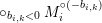
,Hence, the modules$\circ _{b_{i,k}>0}M_{i}^{\circ b_{i,k}}$
and
$\circ _{b_{i,k}<0}M_{i}^{\circ (-b_{i,k})}$
are the kernel and the image of the
$R$
-matrix
$\mathbf{r}_{M_{k},M_{k}^{\prime }}$
, respectively. We call the module
$M_{k}^{\prime }$
the mutation of
$M_{k}$
at
$k$
.







Remark 2.2. Recall that the above theorem is proved in [Reference Kang, Kashiwara, Kim and OhKKKO18] under the assumption
 $\operatorname{char}(\mathbf{k})=0$
. But this assumption can be dropped in the above theorem, since [Reference Kashiwara, Kim, Oh and ParkKKOP18, Proposition 4.6] replaces [Reference Kang, Kashiwara, Kim and OhKKKO18, Theorem 4.2.1], which is the only place using the assumption in the course of the proof.
If
 $[\mathscr{S}]$
in (2.1) is a quantum seed and satisfies Theorem 2.1(ii), then we call the triple
 $\mathscr{S}=(\{{M_{i}\}}_{i\in J},-\unicode[STIX]{x1D6EC},\widetilde{B})$
a monoidal seed in
 ${\mathcal{C}}_{w}$
, and
 $\mathscr{C}=\{{M_{i}\}}_{i\in J}$
a monoidal cluster in
 ${\mathcal{C}}_{w}$
. By Lemma 3.2 below, the monoidal seed
 $\mathscr{S}$
is completely determined by the monoidal cluster
 $\mathscr{C}$
.
We call
 $\unicode[STIX]{x1D707}_{k}(\mathscr{C}):=\{M_{i}^{\prime }\}_{i\in J}$
the mutation of
 $\mathscr{C}$
at
 $k$
, where
 $M_{i}^{\prime }=M_{i}$
 $(i\neq k)$
and
 $M_{k}^{\prime }$
is as in Theorem 2.1(ii).
2.2 Laurent phenomenon
Let
 $\mathscr{C}=\{{M_{i}\}}_{i\in J}$
be a monoidal cluster in
 ${\mathcal{C}}_{w}$
. For
 $\mathbf{a}\in \mathbb{Z}_{{\geqslant}0}^{J}$
, we denote by
 $M_{\mathscr{C}}(\mathbf{a})$
the module
 $M(\mathbf{a})$
defined in (1.3) starting from
 $\mathscr{C}=\{{M_{i}\}}_{i\in J}$
. If there is no risk of confusion, we simply write
 $M(\mathbf{a})$
instead of
 $M_{\mathscr{C}}(\mathbf{a})$
.
The subalgebra
 $\mathbb{Z}[q^{\pm 1}][[M_{i}];i\in J]$
of
 $A_{q}(\mathfrak{n}(w))$
is isomorphic to the polynomial ring with the
 $[M_{i}]$
as variables. The quantum Laurent phenomenon claims that
 $K({\mathcal{C}}_{w})$
is contained in the quantum Laurent polynomial ring
 $\mathbb{Z}[q^{\pm 1}][[M_{i}];i\in J_{\text{fr}}][[M_{i}]^{\pm 1};i\in J_{\text{ex}}]$
in the skew field of fractions of
 $A_{q}(\mathfrak{n}(w))$
.
Hence, for a module
 $X$
in
 ${\mathcal{C}}_{w}$
, there exists
 $\mathbf{a}\in \mathbb{Z}_{{\geqslant}0}^{J}$
with
 $a_{j}=0$
for
 $j\in J_{\text{fr}}$
such that
 $$\begin{eqnarray}[X\circ M(\mathbf{a})]=[X]\cdot [M(\mathbf{a})]=\mathop{\sum }_{1\leqslant s\leqslant r}c(\mathbf{b}(s))[M(\mathbf{b}(s))]\end{eqnarray}$$
for some
 $r\geqslant 0$
,
 $\mathbf{b}(s)\in \mathbb{Z}_{{\geqslant}0}^{J}$
and
 $c(\mathbf{b}(s))\in \mathbb{Z}[q^{\pm 1/2}]$
. Since
 $[X\circ M(\mathbf{a})]$
is the class of a module in
 ${\mathcal{C}}_{w}$
and each
 $[M(\mathbf{b}(s))]$
is the class of a real simple module, the coefficient
 $c(\mathbf{b}(s))$
lies in
 $\mathbb{Z}_{{\geqslant}0}[q^{\pm 1}]$
for all
 $1\leqslant s\leqslant r$
.
Summing up, the following lemma is an immediate consequence of the quantum Laurent phenomenon.
Lemma 2.3. For a module
 $X$
in
 ${\mathcal{C}}_{w}$
, there exist
 $\mathbf{a}\in \mathbb{Z}_{{\geqslant}0}^{J}$
with
 $\mathbf{a}_{j}=0$
for
 $j\in J_{\text{fr}}$
,
 $r\in \mathbb{Z}_{{\geqslant}0}$
,
 $\mathbf{b}(s)\in \mathbb{Z}_{{\geqslant}0}^{J}$
and
 $c_{s}\in \mathbb{Z}$
 $(1\leqslant s\leqslant r)$
such that
 $$\begin{eqnarray}[X\circ M(\mathbf{a})]=[X]\cdot [M(\mathbf{a})]=\mathop{\sum }_{1\leqslant s\leqslant r}q^{c_{s}}[M(\mathbf{b}(s))].\end{eqnarray}$$
In the sequel, we write
 $$\begin{eqnarray}K({\mathcal{C}}_{w})[\mathscr{C}^{-1}]:=\mathbb{Z}[q^{\pm 1}][[M_{i}]^{\pm 1};i\in J]\end{eqnarray}$$
for a monoidal cluster
 $\mathscr{C}=\{{M_{i}\}}_{i\in J}$
.
The following theorem is an immediate consequence of the lemma above.
Theorem 2.4 (Cf. Theorem 4.10).
Let
 $X$
be a simple module in
 ${\mathcal{C}}_{w}$
and let
 $\mathscr{C}=\{M_{i}\mid i\in J\}$
be a monoidal cluster in
 ${\mathcal{C}}_{w}$
. If
 $X$
strongly commutes with
 $M_{i}$
for all
 $i\in J$
, then
 $[X]$
is a cluster monomial in the cluster
 $[\mathscr{C}]$
up to a power of
 $q$
. In particular,
 $X$
is a real simple module.
Proof. We have (2.3) for some
 $\mathbf{a}\in \mathbb{Z}_{{\geqslant}0}^{J}$
. Since
 $X$
strongly commutes with
 $M_{i}$
for all
 $i\in J$
, the convolution
 $X\circ M(\mathbf{a})$
is simple [Reference Kang, Kashiwara, Kim and OhKKKO18, Lemma 3.2.3]. Since the self-dual simple modules form a
 $\mathbb{Z}[q^{\pm 1}]$
-basis of
 $K({\mathcal{C}}_{w})$
, we conclude that
 $X\circ M(\mathbf{a})\simeq q^{c}M(\mathbf{b})$
for some
 $c\in \mathbb{Z}$
and
 $\mathbf{b}\in \mathbb{Z}_{{\geqslant}0}^{J}$
. Recall that for every
 $k\in J_{\text{ex}}$
and
 $i\in J$
, we have
 $\mathfrak{d}(M_{k}^{\prime },M_{i})=\unicode[STIX]{x1D6FF}_{ki}$
, where
 $M_{k}^{\prime }$
is the mutation of
 $M_{k}$
[Reference Kang, Kashiwara, Kim and OhKKKO18, Proposition 7.1.2(d)]. It follows that
 $b_{k}=\mathfrak{d}(M_{k}^{\prime },M(\mathbf{b}))=\mathfrak{d}(M_{k}^{\prime },X)+a_{k}$
so that
 $b_{k}-a_{k}\geqslant 0$
for all
 $k\in J_{\text{ex}}$
. Thus we conclude that
 $$\begin{eqnarray}X\simeq M(\mathbf{b}-\mathbf{a})\end{eqnarray}$$
up to a grading shift by [Reference Kang, Kashiwara, Kim and OhKKKO15, Corollary 3.7], as desired.
2.3 Initial seeds and dual PBW basis
Let
 $\text{}\underline{w}=s_{i_{1}}\cdots s_{i_{l}}$
be a reduced expression of
 $w\in W$
, and set
 $\mathbf{i}=(i_{1},\ldots ,i_{l})$
. Recalling that
 $w_{{\leqslant}k}:=s_{i_{1}}\cdots s_{i_{k}}$
,
 $w_{{<}k}:=s_{i_{1}}\cdots s_{i_{k-1}}$
, we set
 $\unicode[STIX]{x1D6FD}_{k}:=w_{{<}k}(\unicode[STIX]{x1D6FC}_{i_{k}})$
for
 $1\leqslant k\leqslant l$
. Then
 $\unicode[STIX]{x1D6E5}_{+}\cap w\unicode[STIX]{x1D6E5}_{-}=\{\unicode[STIX]{x1D6FD}_{k}\mid 1\leqslant k\leqslant l\}$
, where
 $\unicode[STIX]{x1D6E5}_{+}$
and
 $\unicode[STIX]{x1D6E5}_{-}$
denote the set of positive roots and the set of negative roots, respectively. Let
 $\preccurlyeq$
be a convex order on the set
 $\unicode[STIX]{x1D6E5}_{+}$
satisfying
 $$\begin{eqnarray}\unicode[STIX]{x1D6FD}_{1}\prec \unicode[STIX]{x1D6FD}_{2}\prec \cdots \prec \unicode[STIX]{x1D6FD}_{l}\prec \unicode[STIX]{x1D6FE}\quad \text{for any }\unicode[STIX]{x1D6FE}\in \unicode[STIX]{x1D6E5}_{+}\cap w\unicode[STIX]{x1D6E5}_{+}.\end{eqnarray}$$
See [Reference Tingley and WebsterTW16, Reference Kashiwara, Kim, Oh and ParkKKOP18] for details of convex orders on
 $\unicode[STIX]{x1D6E5}_{+}$
.
Define
 $$\begin{eqnarray}S_{k}:=M(w_{{\leqslant}k}\unicode[STIX]{x1D71B}_{i_{k}},w_{{<}k}\unicode[STIX]{x1D71B}_{i_{k}})\quad \text{and}\quad M_{k}:=M(w_{{\leqslant}k}\unicode[STIX]{x1D71B}_{i_{k}},\unicode[STIX]{x1D71B}_{i_{k}})\quad \text{for }1\leqslant k\leqslant l.\end{eqnarray}$$
Then
 $S_{k}$
is a self-dual
 $R(\unicode[STIX]{x1D6FD}_{k})$
-module such that
 $\text{W}(S_{k})\subset \operatorname{Span}_{\mathbb{R}_{{\geqslant}0}}\{\unicode[STIX]{x1D6FE}\in \unicode[STIX]{x1D6E5}_{+}\mid \unicode[STIX]{x1D6FE}\preccurlyeq \unicode[STIX]{x1D6FD}_{k}\}$
(i.e.
 $S_{k}$
is a
 $\preccurlyeq$
-cuspidal module). For any sequence
 $\mathbf{a}=(\mathbf{a}_{i})_{1\leqslant i\leqslant l}\in \mathbb{Z}_{{\geqslant}0}^{l}$
, the convolution product
 $$\begin{eqnarray}P_{\mathbf{i}}(\mathbf{a}):=q^{(1/2)\mathop{\sum }_{k=1}^{l}\mathbf{a}_{k}(\mathbf{a}_{k}-1)}S_{l}^{\circ \mathbf{a}_{l}}\circ \cdots \circ S_{1}^{\circ \mathbf{a}_{1}}\end{eqnarray}$$
has a self-dual simple head. Moreover, every self-dual simple module in
 ${\mathcal{C}}_{w}$
is isomorphic to
 $\operatorname{hd}(P_{\mathbf{i}}(\mathbf{a}))$
for some
 $\mathbf{a}\in \mathbb{Z}_{{\geqslant}0}^{l}$
. Moreover, such an
 $\mathbf{a}$
is unique.
Hence,
 $\{[P_{\mathbf{i}}(\mathbf{a})]\}_{\mathbf{a}\in \mathbb{Z}_{{\geqslant}0}^{l}}$
is a
 $\mathbb{Z}[q^{\pm 1}]$
-basis of
 $K({\mathcal{C}}_{w})$
. It is called the dual Poincaré–Birkhoff–Witt (PBW) basis.
It is shown in [Reference Geiß, Leclerc and SchröerGLS13b] that the triple
 $(\{q^{-(d_{k},d_{k})/4}[M_{k}]\},-\unicode[STIX]{x1D6EC},\widetilde{B})$
is an initial quantum seed for the quantum cluster algebra
 $\mathbb{Z}[q^{\pm 1/2}]\otimes _{\mathbb{Z}[q^{\pm 1}]}A_{q}(\mathfrak{n}(w))_{\mathbb{Z}[q^{\pm 1}]}$
, where
 $d_{k}:=\operatorname{wt}(M_{k})=w_{{\leqslant}k}\unicode[STIX]{x1D71B}_{i_{k}}-\unicode[STIX]{x1D71B}_{i_{k}}$
,
 $\unicode[STIX]{x1D6EC}=(\unicode[STIX]{x1D6EC}(M_{i},M_{j}))_{1\leqslant i,j\leqslant l}$
, and
 $\widetilde{B}$
is the
 $l\times (l-n)$
matrix given in [Reference Kang, Kashiwara, Kim and OhKKKO18, Definition 11.1.1]. In this case, the index set of cluster variables are
 $J=\{1,2,\ldots ,l\}$
,
 $J_{\text{fr}}=\{k\in J\mid k_{+}=l+1\}$
, where
 $k_{+}:=\min (\{s\mid k<s\leqslant l,i_{k}=i_{s}\}\sqcup \{l+1\})$
, and
 $J_{\text{ex}}=J\setminus J_{\text{fr}}$
,
 $n=\sharp \{i_{1},\ldots ,i_{\ell }\}=\sharp J_{\text{fr}}$
. On the other hand, the family
 $\{[S_{k}]\mid k\in J\}$
forms a generating set of the algebra
 $A_{q}(\mathfrak{n}(w))_{\mathbb{Z}[q^{\pm 1}]}$
, and hence it is called the set of dual PBW generators.
We introduce the following notion in order to describe a property of the modules
 $S_{k}$
and
 $M_{k}$
.
Definition 2.5. A sequence
 $(L_{1},\ldots ,L_{r})$
of real simple modules in
 $R\text{-}\text{gmod}$
is called a normal sequence if the composition of the
 $R$
-matrices
 $$\begin{eqnarray}\displaystyle \mathbf{r}_{L_{1},\ldots ,L_{r}}:=\mathop{\prod }_{1\leqslant i<k\leqslant r}\mathbf{r}_{L_{i},L_{k}} & = & \displaystyle (\mathbf{r}_{L_{r-1},L_{r}})\circ \cdots \circ (\mathbf{r}_{L_{2},L_{r}}\circ \cdots \circ \mathbf{r}_{L_{2},L_{3}})\circ (\mathbf{r}_{L_{1},L_{r}}\circ \cdots \circ \mathbf{r}_{L_{1},L_{2}})\nonumber\\ \displaystyle & & \displaystyle :q^{\mathop{\sum }_{1\leqslant i<k\leqslant r}\unicode[STIX]{x1D6EC}(L_{i},L_{k})}L_{1}\circ \cdots \circ L_{r}\longrightarrow L_{r}\circ \cdots \circ L_{1}\nonumber\end{eqnarray}$$
does not vanish.
By applying [Reference Kang, Kashiwara, Kim and OhKKKO18, Proposition 3.2.8] inductively, we obtain the following lemma.
Lemma 2.6. If
 $(L_{1},\ldots ,L_{r})$
is a normal sequence of real simple modules, then the image of
 $\mathbf{r}_{L_{1},\ldots ,L_{r}}$
is simple and coincides with the head of
 $L_{1}\circ \cdots \circ L_{r}$
and also with the socle of
 $L_{r}\circ \cdots \circ L_{1}$
, up to grading shifts.
Lemma 2.7. A sequence
 $(L_{1},\ldots ,L_{r})$
of real simple modules in
 $R\text{-}\text{gmod}$
is a normal sequence if and only if
 $(L_{2},\ldots ,L_{r})$
is a normal sequence and
 $$\begin{eqnarray}\unicode[STIX]{x1D6EC}(L_{1},\operatorname{hd}(L_{2}\circ \cdots \circ L_{r}))=\mathop{\sum }_{2\leqslant j\leqslant r}\unicode[STIX]{x1D6EC}(L_{1},L_{j}).\end{eqnarray}$$
Proof. Set
 $\mathbf{r}_{}^{\prime }=\mathbf{r}_{L_{2},\ldots ,L_{r}}:L_{2}\circ \cdots \circ L_{r}\longrightarrow L_{r}\circ \cdots \circ L_{2}$
. In the diagram below, the outer rectangle is commutative, because the both compositions of horizontal and vertical homomorphisms are equal to
 $\mathbf{r}_{L_{1},\ldots ,L_{r}}$
. Note that the vertical homomorphisms are non-zero and are equal to
 $\mathbf{r}_{L_{1},L_{2}\circ \cdots \circ L_{r}}$
and
 $\mathbf{r}_{L_{1},L_{r}\circ \cdots \circ L_{2}}$
, respectively, by [Reference Kang, Kashiwara, Kim and OhKKKO18, Lemma 3.1.5(ii)]. Let us denote by
 $\unicode[STIX]{x1D719}$
the induced homomorphism between the images of horizontal homomorphisms.

Since
 $\operatorname{Im}(\mathbf{r}_{L_{1},\ldots ,L_{r}})=\unicode[STIX]{x1D719}(L_{1}\circ \operatorname{Im}\mathbf{r}_{}^{\prime })$
, we have that
 $\mathbf{r}_{L_{1},\ldots ,L_{r}}\neq 0$
if and only if
 $\mathbf{r}_{}^{\prime }\neq 0$
and
 $\unicode[STIX]{x1D719}\neq 0$
. Under the condition that
 $\mathbf{r}_{}^{\prime }\neq 0$
(and hence
 $\operatorname{Im}\mathbf{r}_{}^{\prime }=\operatorname{hd}(L_{2}\circ \cdots \circ L_{r})$
is simple), we have that
 $\unicode[STIX]{x1D719}\neq 0$
if and only if
 $\unicode[STIX]{x1D719}=\mathbf{r}_{L_{1},\operatorname{Im}\mathbf{r}_{}^{\prime }}$
, which is equivalent to the condition that
 $\unicode[STIX]{x1D6EC}(L_{1},L_{2}\circ \cdots \circ L_{r})=\unicode[STIX]{x1D6EC}(L_{1},\operatorname{hd}(L_{2}\circ \cdots \circ L_{r}))$
by [Reference Kang, Kashiwara, Kim and OhKKKO18, Proposition 3.2.8]. This completes the proof.◻
In a similar way, we have the following lemma.
Lemma 2.8. A sequence
 $(L_{1},\ldots ,L_{r})$
of real simple modules in
 $R\text{-}\text{gmod}$
is a normal sequence if and only if
 $(L_{1},\ldots ,L_{r-1})$
is a normal sequence and
 $$\begin{eqnarray}\unicode[STIX]{x1D6EC}(\operatorname{hd}(L_{1}\circ \cdots \circ L_{r-1}),L_{r})=\mathop{\sum }_{1\leqslant j\leqslant r-1}\unicode[STIX]{x1D6EC}(L_{j},L_{r}).\end{eqnarray}$$
Corollary 2.9. Let
 $(L_{1},\ldots ,L_{r})$
be a sequence of real simple modules in
 $R\text{-}\text{gmod}$
. If
 $(L_{1},\ldots ,L_{r-1})$
is a normal sequence, then the following statements hold.
(i) If
$\widetilde{\unicode[STIX]{x1D6EC}}(L_{k},L_{r})=0$
for
$1\leqslant k\leqslant r-1$
, then
$(L_{1},\ldots ,L_{r})$
is a normal sequence.(ii) If
$W^{\ast }(L_{k})\cap W(L_{r})\subset \{0\}$
for
$1\leqslant k\leqslant r-1$
, then
$(L_{1},\ldots ,L_{r})$
is a normal sequence.(iii) If
$L_{k}$
and
$L_{r}$
strongly commute for
$1\leqslant k\leqslant r-1$
, then
$(L_{1},\ldots ,L_{r})$
is a normal sequence.





Similarly, if
 $(L_{2},\ldots ,L_{r})$
is a normal sequence, then the following statements hold.
(i) If
$\widetilde{\unicode[STIX]{x1D6EC}}(L_{1},L_{k})=0$
for
$2\leqslant k\leqslant r$
, then
$(L_{1},\ldots ,L_{r})$
is a normal sequence.(ii) If
$W^{\ast }(L_{1})\cap W(L_{k})\subset \{0\}$
for
$2\leqslant k\leqslant r$
, then
$(L_{1},\ldots ,L_{r})$
is a normal sequence.(iii) If
$L_{1}$
and
$L_{k}$
strongly commute for
$2\leqslant k\leqslant r$
, then
$(L_{1},\ldots ,L_{r})$
is a normal sequence.





Proof. We shall prove only the first set of statements.
(i) We have
 $$\begin{eqnarray}\unicode[STIX]{x1D6EC}(\operatorname{hd}(L_{1}\circ \cdots \circ L_{r-1}),L_{r})\leqslant \mathop{\sum }_{k=1}^{r-1}\unicode[STIX]{x1D6EC}(L_{k},L_{r})\end{eqnarray}$$
by [Reference Kang, Kashiwara, Kim and OhKKKO18, Proposition 3.2.8]. This implies
 $$\begin{eqnarray}0\leqslant \widetilde{\unicode[STIX]{x1D6EC}}(\operatorname{hd}(L_{1}\circ \cdots \circ L_{r-1}),L_{r})\leqslant \mathop{\sum }_{k=1}^{r-1}\widetilde{\unicode[STIX]{x1D6EC}}(L_{k},L_{r})=0,\end{eqnarray}$$
where the first inequality follows from (1.2). Hence we obtain
 $\widetilde{\unicode[STIX]{x1D6EC}}(\operatorname{hd}(L_{1}\circ \cdots \circ L_{r-1}),L_{r})=\sum _{k=1}^{r-1}\widetilde{\unicode[STIX]{x1D6EC}}(L_{k},L_{r})$
, which implies
 $\unicode[STIX]{x1D6EC}(\operatorname{hd}(L_{1}\circ \cdots \circ L_{r-1}),L_{r})=\sum _{k=1}^{r-1}\unicode[STIX]{x1D6EC}(L_{k},L_{r})$
.
(ii) We have
 $\widetilde{\unicode[STIX]{x1D6EC}}(L_{k},L_{r})=0$
for
 $1\leqslant k<r$
by [Reference Kashiwara, Kim, Oh and ParkKKOP18, Proposition 2.12]. Hence (ii) follows from (i).
(iii) This follows from [Reference Kang, Kashiwara, Kim and OhKKKO18, Proposition 3.2.13]. ◻
Corollary 2.10. A sequence
 $(L_{1},\ldots ,L_{r})$
of real simple modules in
 $R\text{-}\text{gmod}$
is a normal sequence if
 $\widetilde{\unicode[STIX]{x1D6EC}}(L_{i},L_{j})=0$
for any
 $i,j$
such that
 $1\leqslant i<j\leqslant r$
.
The following proposition is a consequence of Corollary 2.9.
Proposition 2.11. For any
 $\mathbf{a}=(\mathbf{a}_{i})_{1\leqslant i\leqslant l},\mathbf{b}=(\mathbf{b}_{i})_{1\leqslant i\leqslant l}\in \mathbb{Z}_{{\geqslant}0}^{l}$
, the sequence
 $$\begin{eqnarray}(S_{l}^{\circ \mathbf{a}_{l}},S_{l-1}^{\circ \mathbf{a}_{l-1}},\ldots ,S_{1}^{\circ \mathbf{a}_{1}},M_{1}^{\circ \mathbf{b}_{1}},M_{2}^{\circ \mathbf{b}_{2}},\ldots ,M_{l}^{\circ \mathbf{b}_{l}})\end{eqnarray}$$
is a normal sequence.
Proof. Note that the case
 $l=1$
is obvious. Hence we assume
 $l>1$
and proceed by induction on
 $l$
. Then we may assume that
 $(S_{l-1}^{\circ \mathbf{a}_{l-1}},\ldots ,S_{1}^{\circ \mathbf{a}_{1}},M_{1}^{\circ \mathbf{b}_{1}},\ldots ,M_{l-1}^{\circ \mathbf{b}_{l-1}})$
is a normal sequence.
Since
 $S_{k}$
is a
 $\preccurlyeq$
-cuspidal
 $R(\unicode[STIX]{x1D6FD}_{k})$
-module for
 $1\leqslant k\leqslant l$
, we have, in particular,

On the other hand, since
 $M_{k}$
is a quotient of a convolution product of the
 $S_{j}$
with
 $j\leqslant k$
, we have
 $$\begin{eqnarray}\text{W}(S_{k}),~\text{W}(M_{k})\subset \text{span}_{\mathbb{R}_{{\geqslant}0}}\{\unicode[STIX]{x1D6FE}\in \unicode[STIX]{x1D6E5}_{+}\mid \unicode[STIX]{x1D6FE}\preccurlyeq \unicode[STIX]{x1D6FD}_{k}\prec \unicode[STIX]{x1D6FD}_{l}\}\quad \text{for }1\leqslant k\leqslant l-1.\end{eqnarray}$$
Hence,
 $$\begin{eqnarray}W^{\ast }(S_{l}^{\circ \mathbf{a}_{l}})\cap W(S_{k}^{\circ \mathbf{a}_{k}})=\{0\}\quad \text{and}\quad W^{\ast }(S_{l}^{\circ \mathbf{a}_{l}})\cap W(M_{k}^{\circ \mathbf{b}_{k}})=\{0\},\end{eqnarray}$$
for
 $1\leqslant k\leqslant l-1$
. Thus Corollary 2.9 implies that
 $$\begin{eqnarray}(S_{l}^{\circ \mathbf{a}_{l}},S_{l-1}^{\circ \mathbf{a}_{l-1}},\ldots ,S_{1}^{\circ \mathbf{a}_{1}},M_{1}^{\circ \mathbf{b}_{1}},M_{2}^{\circ \mathbf{b}_{2}},\ldots ,M_{l-1}^{\circ \mathbf{b}_{l-1}})\end{eqnarray}$$
is a normal sequence.
Finally, since
 $M_{l}$
strongly commutes with
 $S_{k}^{\circ \mathbf{a}_{k}}$
and
 $M_{k}^{\circ \mathbf{b}_{k}}$
for
 $1\leqslant k\leqslant l$
by [Reference KimuraKim12, Theorem 6.25], the assertion follows again from Corollary 2.9.◻
The following proposition is a direct consequence of Proposition 2.11 and Lemma 2.8.
Proposition 2.12. For
 $1\leqslant k\leqslant l$
and
 $\mathbf{a}\in \mathbb{Z}_{{\geqslant}0}^{J}$
, we have
 $$\begin{eqnarray}\unicode[STIX]{x1D6EC}(\operatorname{hd}(S_{l}^{\circ \mathbf{a}_{l}}\circ \cdots \circ S_{1}^{\circ \mathbf{a}_{1}}),M_{k})=\mathop{\sum }_{1\leqslant j\leqslant l}\mathbf{a}_{j}\unicode[STIX]{x1D6EC}(S_{j},M_{k}).\end{eqnarray}$$
3 Triangular basis
3.1 Localization and duals of simple objects
Let
 $w$
be an element of the Weyl group
 $W$
. In this subsection we recall the localization of the monoidal category
 ${\mathcal{C}}_{w}$
via a real commuting family of central objects following [Reference Kashiwara, Kim, Oh and ParkKKOP19]. Set
 $C_{i}:=M(w\unicode[STIX]{x1D71B}_{i},\unicode[STIX]{x1D71B}_{i})$
. Then
 $\{[C_{i}]\mid i\in I,C_{i}\not \simeq \mathbf{1}\}$
is the set of frozen variables of
 $A_{q}(\mathfrak{n}(w))$
up to a power of
 $q$
. For each
 $\unicode[STIX]{x1D707}=\sum \unicode[STIX]{x1D707}_{i}\unicode[STIX]{x1D71B}_{i}\in \mathsf{P}^{+}$
, we denote by
 $C_{\unicode[STIX]{x1D707}}$
the self-dual convolution product
 $q^{c}\,\circ _{i\in I}\,C_{i}^{\circ \unicode[STIX]{x1D707}_{i}}$
for some
 $c\in \mathbb{Z}$
. Then we have
 $C_{\unicode[STIX]{x1D707}}\simeq M(w\unicode[STIX]{x1D707},\unicode[STIX]{x1D707})$
. Note that
 $$\begin{eqnarray}C_{\unicode[STIX]{x1D707}}\circ C_{\unicode[STIX]{x1D707}^{\prime }}\simeq q^{\unicode[STIX]{x1D706}(\unicode[STIX]{x1D707},\unicode[STIX]{x1D707}^{\prime })}C_{\unicode[STIX]{x1D707}+\unicode[STIX]{x1D707}^{\prime }}\end{eqnarray}$$
holds for any
 $\unicode[STIX]{x1D707},\unicode[STIX]{x1D707}^{\prime }\in \mathsf{P}^{+}$
. Here
 $\unicode[STIX]{x1D706}$
is the bilinear form on
 $\mathsf{P}$
defined by
 $\unicode[STIX]{x1D706}(\unicode[STIX]{x1D707},\unicode[STIX]{x1D707}^{\prime })=(\unicode[STIX]{x1D707},w\unicode[STIX]{x1D707}^{\prime }-\unicode[STIX]{x1D707}^{\prime })$
.
In [Reference Kashiwara, Kim, Oh and ParkKKOP19] it is proved that there exist a monoidal category
 $\widetilde{{\mathcal{C}}}_{w}={\mathcal{C}}_{w}[C_{i}^{\circ -1};i\in I]$
and a monoidal functor
 $\unicode[STIX]{x1D6F7}:{\mathcal{C}}_{w}\rightarrow \widetilde{{\mathcal{C}}}_{w}$
satisfying the following conditions.
(1) The objects
$\unicode[STIX]{x1D6F7}(C_{i})$
are invertible in
$\widetilde{{\mathcal{C}}}_{w}$
; that is, there exists an object
$\unicode[STIX]{x1D6F7}(C_{i})^{-1}$
in
$\widetilde{{\mathcal{C}}}_{w}$
such that
$\unicode[STIX]{x1D6F7}(C_{i})\circ \unicode[STIX]{x1D6F7}(C_{i})^{-1}\simeq \mathbf{1}$
and
$\unicode[STIX]{x1D6F7}(C_{i})^{-1}\circ \unicode[STIX]{x1D6F7}(C_{i})\simeq \mathbf{1}$
.(2) For any monoidal functor
$\unicode[STIX]{x1D6F9}:{\mathcal{C}}_{w}\rightarrow {\mathcal{T}}$
to another monoidal category
${\mathcal{T}}$
in which
$\unicode[STIX]{x1D6F9}(C_{i})$
is invertible for every
$i$
, there exists a monoidal functor
$\unicode[STIX]{x1D6F9}^{\prime }:\widetilde{{\mathcal{C}}}_{w}\rightarrow {\mathcal{T}}$
such that
$\unicode[STIX]{x1D6F9}\simeq \unicode[STIX]{x1D6F9}^{\prime }\circ \unicode[STIX]{x1D6F7}$
. Moreover,
$\unicode[STIX]{x1D6F9}^{\prime }$
is unique up to an isomorphism.






Then there exists a real commuting family
 $\{{\widetilde{C}_{\unicode[STIX]{x1D707}}\}}_{\unicode[STIX]{x1D707}\in \mathsf{P}}$
in
 $\widetilde{{\mathcal{C}}}_{w}$
such that
 $\widetilde{C}_{\unicode[STIX]{x1D707}}=\unicode[STIX]{x1D6F7}(C_{\unicode[STIX]{x1D707}})$
for every
 $\unicode[STIX]{x1D707}\in \mathsf{P}^{+}$
and
 $\widetilde{C}_{\unicode[STIX]{x1D707}}\circ \widetilde{C}_{\unicode[STIX]{x1D707}^{\prime }}\simeq q^{\unicode[STIX]{x1D706}(\unicode[STIX]{x1D707},\unicode[STIX]{x1D707}^{\prime })}\widetilde{C}_{\unicode[STIX]{x1D707}+\unicode[STIX]{x1D707}^{\prime }}$
for every
 $\unicode[STIX]{x1D707},\unicode[STIX]{x1D707}^{\prime }\in \mathsf{P}$
.
The localization
 $\widetilde{{\mathcal{C}}}_{w}$
also satisfies the following properties.
- (3)
Every simple object of
$\widetilde{{\mathcal{C}}}_{w}$
is isomorphic to
$\unicode[STIX]{x1D6F7}(S)\circ \widetilde{C}_{\unicode[STIX]{x1D707}}$
for some simple object
$S$
of
${\mathcal{C}}_{w}$
and
$\unicode[STIX]{x1D707}\in \mathsf{P}$
.- (4)
For two simple objects
$S$
and
$S^{\prime }$
in
${\mathcal{C}}_{w}$
,
$\unicode[STIX]{x1D6F7}(S)\circ \widetilde{C}_{\unicode[STIX]{x1D707}}\simeq \unicode[STIX]{x1D6F7}(S^{\prime })\circ \widetilde{C}_{\unicode[STIX]{x1D707}^{\prime }}$
in
$\widetilde{{\mathcal{C}}}_{w}$
if and only if
$S\circ C_{\unicode[STIX]{x1D707}+\unicode[STIX]{x1D706}}\simeq S^{\prime }\circ C_{\unicode[STIX]{x1D707}^{\prime }+\unicode[STIX]{x1D706}}$
in
${\mathcal{C}}_{w}$
for some
$\unicode[STIX]{x1D706}\in \mathsf{P}$
such that
$\unicode[STIX]{x1D707}+\unicode[STIX]{x1D706}$
,
$\unicode[STIX]{x1D707}^{\prime }+\unicode[STIX]{x1D706}\in \mathsf{P}^{+}$
. Here we ignore grading shifts.







Note that the category
 $\widetilde{{\mathcal{C}}}_{w}$
is abelian and every object has finite length. Moreover,
 $\unicode[STIX]{x1D6F7}:{\mathcal{C}}_{w}\rightarrow \widetilde{{\mathcal{C}}}_{w}$
is exact. The grading shift functor
 $q$
and the contravariant functor
 $M\mapsto M^{\ast }$
on
 ${\mathcal{C}}_{w}$
are extended to
 $\widetilde{{\mathcal{C}}}_{w}$
. Moreover, they satisfy
 $$\begin{eqnarray}(M\circ N)^{\ast }\simeq q^{(\operatorname{wt}(M),\operatorname{wt}(N))}N^{\ast }\circ M^{\ast }\end{eqnarray}$$
for
 $M,N\in \widetilde{{\mathcal{C}}}_{w}$
. Here, for
 $M\simeq \unicode[STIX]{x1D6F7}(L)\circ \widetilde{C}_{\unicode[STIX]{x1D706}}\in \widetilde{{\mathcal{C}}}_{w}$
with
 $L\in {\mathcal{C}}_{w}$
and
 $\unicode[STIX]{x1D706}\in \mathsf{P}$
, we set
 $\operatorname{wt}(M)=\operatorname{wt}(L)+(w\unicode[STIX]{x1D706}-\unicode[STIX]{x1D706})$
.
For any simple object
 $M\in \widetilde{{\mathcal{C}}}_{w}$
, there exists a unique
 $n\in \mathbb{Z}$
such that
 $(q^{n}M)^{\ast }\simeq q^{n}M$
. We say that
 $q^{n}M$
is self-dual in this case.
We denote by
 ${\mathcal{I}}rr_{\text{sd}}(\widetilde{{\mathcal{C}}}_{w})$
the set of the isomorphism classes of self-dual simple objects of
 $\widetilde{{\mathcal{C}}}_{w}$
.
The Grothendieck ring
 $K(\widetilde{{\mathcal{C}}}_{w})$
of
 $\widetilde{{\mathcal{C}}}_{w}$
is a
 $\mathbb{Z}[q^{\pm 1}]$
-algebra with a basis consisting of the class of self-dual simple objects. Moreover, it is isomorphic to the localization of the ring
 $K({\mathcal{C}}_{w})$
by the set
 $$\begin{eqnarray}S:=\bigg\{q^{k}\mathop{\prod }_{i\in I}[C_{i}]^{a_{i}}\mid k\in \mathbb{Z},(a_{i})_{i\in I}\in \mathbb{Z}_{{\geqslant}0}^{I}\bigg\}.\end{eqnarray}$$
We refer to [Reference Berenstein and ZelevinskyBZ05, Appendix A] for the definition of the localization of a ring
 $R$
by a multiplicative subset
 $S$
under the condition that
 $aR\cap Rb\neq \{0\}$
for any non-zero
 $a,b\in R$
and
 $sR=Rs$
for all
 $s\in S$
.
Hence the ring
 $\mathbb{Z}[q^{\pm 1/2}]\otimes _{\mathbb{Z}[q^{\pm 1}]}K(\widetilde{{\mathcal{C}}}_{w})$
, which is a localization of
 $\mathbb{Z}[q^{\pm 1/2}]\otimes _{\mathbb{Z}[q^{\pm 1}]}K({\mathcal{C}}_{w})$
, is the
 $\mathbb{Z}[q^{\pm 1/2}]$
-subalgebra of the skew field of fractions
 $K$
of an initial quantum torus
 $\mathbb{Z}[q^{\pm 1/2}][X_{i}^{\pm 1}\mid i\in J]$
generated by all the exchangeable cluster variables, the frozen variables, and the inverses of the frozen variables. Thus it is the quantum cluster algebra in the sense of [Reference Berenstein and ZelevinskyBZ05].
Recall that a pair
 $(\unicode[STIX]{x1D700}:X\otimes Y\rightarrow \mathbf{1},\unicode[STIX]{x1D702}:\mathbf{1}\rightarrow Y\otimes X)$
of morphisms in a monoidal category with a unit object
 $\mathbf{1}$
is called an adjunction if:
(a)
is the identity of
$X$
; and(b)
is the identity of
$Y$
.
 is the identity of

 is the identity of

In this case, the pair
 $(X,Y)$
is called a dual pair. When
 $(\unicode[STIX]{x1D700},\unicode[STIX]{x1D702})$
is an adjunction, we say that
 $X$
is a left dual of
 $Y$
and
 $Y$
is a right dual of
 $X$
. Note that a left dual (respectively, right dual) of an object is unique up to a unique isomorphism if it exists.
The following theorem plays an important role in this paper.
Theorem 3.1 [Reference Kashiwara, Kim, Oh and ParkKKOP19].
Every simple object
 $M$
in
 $\widetilde{{\mathcal{C}}}_{w}$
has a right dual and a left dual.
Note that any object of
 ${\mathcal{C}}_{w}$
with a non-zero weight cannot have a dual in
 ${\mathcal{C}}_{w}$
, because the sum of the weights of a dual pair is equal to zero.
We denote by
 $\mathscr{D}(M)$
the right dual of a simple object
 $M$
in
 $\widetilde{{\mathcal{C}}}_{w}$
and by
 $\mathscr{D}^{-1}(M)$
the left dual of
 $M$
.
3.2 Cluster variables and exchange matrices
Set
 $$\begin{eqnarray}I^{\prime }:=\{i_{k}\mid k_{+}=l+1\}=\{i_{k}\mid k\in J_{\text{fr}}\}\subset I,\end{eqnarray}$$
where
 $k_{+}:=\min (\{j\mid k<j\leqslant l,\;i_{j}=i_{k}\}\cup \{l+1\})$
. Let
 $\{M_{j}\mid j\in J\}$
be a monoidal cluster in
 ${\mathcal{C}}_{w}$
. Recall that
 $l=\sharp J$
and
 $n=\sharp J_{\text{fr}}=\sharp I^{\prime }$
. Taking a total order on
 $J$
such that
 $j<j^{\prime }$
for all
 $j\in J_{\text{ex}}$
and
 $j^{\prime }\in J_{\text{fr}}$
, we shall identify
 $J$
,
 $J_{\text{ex}}$
and
 $J_{\text{fr}}$
with
 $\{1,\ldots ,l\}$
,
 $\{1,\ldots ,l-n\}$
and
 $\{l-n+1,\ldots ,l\}$
, respectively.
Then the matrices
 $\unicode[STIX]{x1D6EC}=(\unicode[STIX]{x1D6EC}(M_{i},M_{j}))_{1\leqslant i,j\leqslant l}$
and the exchange matrix
 $\widetilde{B}$
satisfy the following relation (see [Reference Berenstein and ZelevinskyBZ05]):
 $$\begin{eqnarray}\unicode[STIX]{x1D6EC}\widetilde{B}=\left[\begin{array}{@{}c@{}}-2\operatorname{id}_{(l-n)\times (l-n)}\\ 0\end{array}\right].\end{eqnarray}$$
Let
 $D=(d_{t,j})_{t\in I^{\prime },j\in J}$
be an
 $n\times l$
matrix defined by
 $$\begin{eqnarray}\mathop{\sum }_{t\in I^{\prime }}d_{t,j}\unicode[STIX]{x1D6FC}_{t}=\operatorname{wt}(M_{j})\quad \text{for all }j\in J,\end{eqnarray}$$
so that
 $\sum _{t\in I^{\prime }}(D\mathbf{b})_{t}\unicode[STIX]{x1D6FC}_{t}=\operatorname{wt}(M(\mathbf{b}))$
for
 $\mathbf{b}\in \mathbb{Z}_{{\geqslant}0}^{J}$
. Then we have
 $$\begin{eqnarray}D\widetilde{B}=0.\end{eqnarray}$$
Now let
 $\unicode[STIX]{x1D6EC}^{\prime }$
be the
 $(l-n)\times l$
matrix obtained by taking the first
 $l-n$
rows of
 $\unicode[STIX]{x1D6EC}$
. Then we have
 $$\begin{eqnarray}\left[\begin{array}{@{}c@{}}\unicode[STIX]{x1D6EC}^{\prime }\\ D\end{array}\right]\widetilde{B}=\left[\begin{array}{@{}c@{}}-2\operatorname{id}_{(l-n)\times (l-n)}\\ 0\end{array}\right].\end{eqnarray}$$
Lemma 3.2. The matrix
 $[\!\begin{smallmatrix}\unicode[STIX]{x1D6EC}^{\prime }\\ D\end{smallmatrix}\!]$
is an invertible, and hence
 $$\begin{eqnarray}\widetilde{B}=\left[\begin{array}{@{}c@{}}\unicode[STIX]{x1D6EC}^{\prime }\\ D\end{array}\right]^{-1}\left[\begin{array}{@{}c@{}}-2\operatorname{id}_{(l-n)\times (l-n)}\\ 0\end{array}\right].\end{eqnarray}$$
Proof. Set
 $\operatorname{Ker}\widetilde{B}:=\{v\in \mathbb{Q}^{l}\mid v\widetilde{B}=0\}$
. Then the row vectors of
 $\unicode[STIX]{x1D6EC}^{\prime }$
form a
 $\mathbb{Q}$
-linearly independent set of cardinality
 $l-n$
, and the
 $\mathbb{Q}$
-vector subspace of
 $\mathbb{Q}^{l}$
spanned by them meets
 $\operatorname{Ker}\widetilde{B}$
trivially. Since the row vectors of
 $D$
belong to
 $\operatorname{Ker}\widetilde{B}$
, it is enough to show that the column rank of
 $D$
is equal to
 $n$
. By the definition of
 $D$
, this is equivalent to saying that the set
 $\{\operatorname{wt}(M_{j})\mid j\in J\}$
generates the space
 $\bigoplus _{i\in I^{\prime }}\mathbb{Q}\unicode[STIX]{x1D6FC}_{i}$
. It can be checked easily in the case of the initial seed attached to a reduced expression of
 $w$
. Note that
 $\operatorname{wt}(M_{k})+\operatorname{wt}(M_{k}^{\prime })=\sum _{b_{i,k}>0}b_{i,k}\operatorname{wt}(M_{i})$
if
 $M_{k}^{\prime }$
is the mutation of
 $M_{k}$
at
 $k$
. It follows that the subspace
 $$\begin{eqnarray}\operatorname{Span}_{\mathbb{Q}}\{\operatorname{wt}(M_{j})\mid j\in J\}\subset \bigoplus _{i\in I^{\prime }}\mathbb{Q}\unicode[STIX]{x1D6FC}_{i}\end{eqnarray}$$
is invariant under any mutation, and hence we conclude that
 $\{\operatorname{wt}(M_{j})\mid j\in J\}$
generates
 $\bigoplus _{i\in I^{\prime }}\mathbb{Q}\unicode[STIX]{x1D6FC}_{i}$
for any seed.
3.3 Dominance order
Let
 $\mathscr{C}=\{M_{j}\mid j\in J\}$
be a monoidal cluster in
 ${\mathcal{C}}_{w}$
and
 $\mathscr{S}$
the monoidal seed determined by
 $\mathscr{C}$
. We define the order
 $\succcurlyeq _{\mathscr{S}}$
on
 $\mathbb{Z}_{{\geqslant}0}^{J}$
by
 $$\begin{eqnarray}\mathbf{b}\succcurlyeq _{\mathscr{S}}\mathbf{b}^{\prime }\end{eqnarray}$$
if and only if
(1)
$\operatorname{wt}(M(\mathbf{b}))=\operatorname{wt}(M(\mathbf{b}^{\prime }))$
,(2)
$\unicode[STIX]{x1D6EC}(M(\mathbf{b}),M_{k})\geqslant \unicode[STIX]{x1D6EC}(M(\mathbf{b}^{\prime }),M_{k})$
for all
$k\in J_{\text{ex}}$
.



Note that condition (1) implies that
 $\unicode[STIX]{x1D6EC}(M(\mathbf{b}),M_{k})=\unicode[STIX]{x1D6EC}(M(\mathbf{b}^{\prime }),M_{k})$
for all
 $k\in J_{\text{fr}}$
, because
 $\unicode[STIX]{x1D6EC}(M(\mathbf{b}),M_{k})=(w\unicode[STIX]{x1D71B}_{i_{k}}+\unicode[STIX]{x1D71B}_{i_{k}},\operatorname{wt}(M(\mathbf{b})))$
depends only on
 $\operatorname{wt}(M(\mathbf{b}))$
(see [Reference Kashiwara, Kim, Oh and ParkKKOP18, Theorem 4.12]).
Note that
 $\mathbf{b}+\mathbf{a}\succcurlyeq _{\mathscr{S}}\mathbf{b}^{\prime }+\mathbf{a}$
for any
 $\mathbf{b},\mathbf{b}^{\prime },\mathbf{a}\in \mathbb{Z}_{{\geqslant}0}^{J}$
with
 $\mathbf{b}\succcurlyeq _{\mathscr{S}}\mathbf{b}^{\prime }$
. Hence we can extend the relation to the one on
 $\mathbb{Z}^{J}$
by
 $$\begin{eqnarray}\mathbf{b}\succcurlyeq _{\mathscr{S}}\mathbf{b}^{\prime }\quad \text{if }\mathbf{b}+\mathbf{a}\succcurlyeq _{\mathscr{ S}}\mathbf{b}^{\prime }+\mathbf{a}\text{ for some }\mathbf{a}\in \mathbb{Z}_{{\geqslant}0}^{J}\text{ such that }\mathbf{b}+\mathbf{a},\mathbf{b}^{\prime }+\mathbf{a}\in \mathbb{Z}_{{\geqslant}0}^{J}.\end{eqnarray}$$
Recall that
 $\widetilde{\unicode[STIX]{x1D6EC}}(X,Y)=\frac{1}{2}(\unicode[STIX]{x1D6EC}(X,Y)+(\operatorname{wt}(X),\operatorname{wt}(Y)))\in \mathbb{Z}$
for
 $X,Y\in R\text{-}\text{gmod}$
. Hence
 $\mathbf{b}\succcurlyeq _{\mathscr{S}}\mathbf{b}^{\prime }$
implies that
 $\unicode[STIX]{x1D6EC}(M(\mathbf{b}),M_{k})-\unicode[STIX]{x1D6EC}(M(\mathbf{b}^{\prime }),M_{k})\in 2\mathbb{Z}_{{\geqslant}0}$
for all
 $k\in J_{\text{ex}}$
.
Thus we have
 $$\begin{eqnarray}\mathbf{b}\succcurlyeq _{\mathscr{S}}\mathbf{b}^{\prime }\quad \text{if and only if }D(\mathbf{b}-\mathbf{b}^{\prime })=0~\text{and}~-\!\unicode[STIX]{x1D6EC}^{\prime }(\mathbf{b}-\mathbf{b}^{\prime })\in 2\mathbb{Z}_{{\geqslant}0}^{J_{\text{ex}}},\end{eqnarray}$$
where
 $D$
and
 $\unicode[STIX]{x1D6EC}^{\prime }$
are the matrices given in § 3.2.
Proposition 3.3. We have
 $$\begin{eqnarray}\mathbf{b}\succcurlyeq _{\mathscr{S}}\mathbf{b}^{\prime }\quad \text{if and only if }\mathbf{b}-\mathbf{b}^{\prime }=\widetilde{B}v\text{ for some }v\in \mathbb{Z}_{{\geqslant}0}^{J_{\text{ex}}}.\end{eqnarray}$$
In particular, the relation
 $\succcurlyeq _{\mathscr{S}}$
is a (partial) order on
 $\mathbb{Z}^{J}$
.
Proof. We have
 $$\begin{eqnarray}\mathbf{b}\succcurlyeq _{\mathscr{S}}\boldsymbol{ b}^{\prime }\quad \text{if and only if}\quad \left[\begin{array}{@{}c@{}}\unicode[STIX]{x1D6EC}^{\prime }\\ D\end{array}\right](\mathbf{b}-\mathbf{b}^{\prime })=\left[\begin{array}{@{}c@{}}-2v\\ 0\end{array}\right]\text{for some }v\in \mathbb{Z}_{{\geqslant}0}^{J_{\text{ex}}}.\end{eqnarray}$$
By Lemma 3.2, this is equivalent to saying that
 $$\begin{eqnarray}\mathbf{b}-\mathbf{b}^{\prime }=\widetilde{B}v\quad \text{for some }v\in \mathbb{Z}_{{\geqslant}0}^{J_{\text{ex}}},\end{eqnarray}$$
as desired. ◻
Remark 3.4. (1) The order
 $\succcurlyeq _{\mathscr{S}}$
is the same as that in [Reference QinQin17, Definition 3.1.1]. Indeed, Qin defined the order as in Proposition 3.3 for a more general class of quantum cluster algebras in order to formulate the notion of triangular basis. Our definition can be understood as an interpretation of the order for the quantum cluster algebra
 $K({\mathcal{C}}_{w})$
in terms of the degree of
 $R$
-matrices.
(2) Casbi [Reference CasbiCas18] also considered the order
 $\succcurlyeq _{\mathscr{S}}$
for the case
 $K({\mathcal{C}}_{w})$
with
 $\mathfrak{g}=A_{n}$
. Let
 $\mathbf{i}=(1,2,1,3,2,1,\ldots ,n,n-1,\ldots ,1)$
be the sequence of length
 $l=n(n+1)/2$
. Casbi compared
 $\succcurlyeq _{\mathscr{S}_{\mathbf{i}}}$
with the lexicographical order on the set
 $\mathbb{Z}_{{\geqslant}0}^{l}$
, in which an element
 $\mathbf{a}$
corresponds to a self-dual simple module in
 $R\text{-}\text{gmod}$
via
 $S\simeq \operatorname{hd}(S_{l}^{\circ \mathbf{a}_{l}}\circ \cdots \circ S_{1}^{\circ \mathbf{a}_{1}})$
[Reference CasbiCas18, Theorem 6.2].
3.4 Heads and socles
Let
 $\mathscr{C}=\{M_{j}\mid j\in J\}$
be a monoidal cluster in
 ${\mathcal{C}}_{w}$
,
 $\mathscr{S}$
the monoidal seed determined by
 $\mathscr{C}$
. Then any simple module
 $X\in {\mathcal{C}}_{w}$
satisfies the following relation in the Grothendieck ring
 $K({\mathcal{C}}_{w})$
by Lemma 2.3:
 $$\begin{eqnarray}[X\circ M(\mathbf{a})]=\mathop{\sum }_{k\in K}q^{c_{k}}[M(\mathbf{b}(k))]\end{eqnarray}$$
for a family
 $\{\mathbf{b}(k)\}_{k\in K}$
in
 $\mathbb{Z}_{{\geqslant}0}^{J}$
, a family
 $\{{c_{k}\}}_{k\in K}$
of integers and
 $\mathbf{a}\in \mathbb{Z}_{{\geqslant}0}^{J}$
such that
 $\mathbf{a}_{j}=0$
for
 $j\in J_{\text{fr}}$
.
Lemma 3.5. Let
 $X$
be a simple module in
 ${\mathcal{C}}_{w}$
, and assume relation (3.2). Then we have
 $$\begin{eqnarray}[M(\mathbf{a})\circ X]=\mathop{\sum }_{k\in K}q^{c_{k}^{\prime }}[M(\mathbf{b}(k))],\end{eqnarray}$$
where
 $c_{k}^{\prime }=c_{k}+\unicode[STIX]{x1D6EC}(M(\mathbf{b}(k)),M(\mathbf{a}))$
.
Proof. We have
 $$\begin{eqnarray}\displaystyle [M(\mathbf{a})]\cdot [X]\cdot [M(\mathbf{a})] & = & \displaystyle \mathop{\sum }_{k\in K}q^{c_{k}}[M(\mathbf{a})]\cdot [M(\mathbf{b}(k))]\nonumber\\ \displaystyle & = & \displaystyle \mathop{\sum }_{k\in K}q^{c_{k}}q^{\unicode[STIX]{x1D6EC}(M(\mathbf{b}(k)),M(\mathbf{a}))}[M(\mathbf{b}(k))]\cdot [M(\mathbf{a})].\nonumber\end{eqnarray}$$
Hence we obtain the desired result. ◻
Recall that
 $X\circ M(\mathbf{a})$
has a simple head
 $X\,\unicode[STIX]{x1D6FB}\,M(\mathbf{a})$
and a simple socle
 $X\unicode[STIX]{x1D6E5}M(\mathbf{a})$
, since
 $M(\mathbf{a})$
is a real simple module.
Lemma 3.6. Let
 $X$
be a simple module in
 ${\mathcal{C}}_{w}$
, and assume relation (3.2). Then we have the following properties.
(i) There exists a unique
$k_{0}\in K$
such that
$X\,\unicode[STIX]{x1D6FB}\,M(\mathbf{a})\simeq q^{c_{k_{0}}}M(\mathbf{b}(k_{0}))$
. Moreover, we have
$\mathbf{b}(k_{0})\succ _{\mathscr{S}}\mathbf{b}(k)$
for any
$k\in K\setminus \{k_{0}\}$
.(ii) There exists a unique
$k_{1}\in K$
such that
$X\unicode[STIX]{x1D6E5}M(\mathbf{a})\simeq q^{c_{k_{1}}}M(\mathbf{b}(k_{1}))$
. Moreover, we have
$\mathbf{b}(k)\succ _{\mathscr{S}}\mathbf{b}(k_{1})$
for any
$k\in K\setminus \{k_{1}\}$
.(iii) If
$k_{0}=k_{1}$
, then
$K=\{k_{0}\}$
.(iv) If
$\operatorname{char}(\mathbf{k})=0$
, then
$c_{k_{0}}<c_{k}$
for any
$k\in K\setminus \{k_{0}\}$
and
$c_{k}<c_{k_{1}}$
for any
$k\in K\setminus \{k_{1}\}$
.







Proof. The existence of
 $k_{0}$
and
 $k_{1}$
is obvious.
For an arbitrary
 $\mathbf{c}\in \mathbb{Z}_{{\geqslant}0}^{J}$
, multiplying (3.2) by
 $M(\mathbf{c})$
on the right, we obtain that
 $$\begin{eqnarray}q^{-\widetilde{\unicode[STIX]{x1D6EC}}(M(\mathbf{a}),M(\mathbf{c}))}[X\circ M(\mathbf{a}+\mathbf{c})]=\mathop{\sum }_{k\in K}q^{c_{k}-\widetilde{\unicode[STIX]{x1D6EC}}(M(\mathbf{b}_{j}),M(\mathbf{c}))}[M(\mathbf{b}(k)+\mathbf{c})].\end{eqnarray}$$
Since
 $M(\mathbf{a}+\mathbf{c})$
is a real simple module,
 $X\circ M(\mathbf{a}+\mathbf{c})$
has a simple head and a simple socle. Because the functor
 $-\circ M(\mathbf{c})$
is exact, the module
 $q^{c_{k_{0}}-\widetilde{\unicode[STIX]{x1D6EC}}(M(\mathbf{b}(k_{0})),M(\mathbf{c}))}M(\mathbf{b}(k_{0})+\mathbf{c})$
is a quotient of
 $q^{-\widetilde{\unicode[STIX]{x1D6EC}}(M(\mathbf{a}),M(\mathbf{c}))}X\circ M(\mathbf{a}+\mathbf{c})$
and hence is equal to the head of
 $q^{-\widetilde{\unicode[STIX]{x1D6EC}}(M(\mathbf{a}),M(\mathbf{c}))}X\circ M(\mathbf{a}+\mathbf{c})$
.
Then it follows by [Reference Kang, Kashiwara, Kim and OhKKKO18, Theorem 4.1.1] that
 $$\begin{eqnarray}\unicode[STIX]{x1D6EC}(M(\mathbf{b}(k_{0})+\mathbf{c}),M(\mathbf{a}+\mathbf{c}))\geqslant \unicode[STIX]{x1D6EC}(M(\mathbf{b}(k)+\mathbf{c}),M(\mathbf{a}+\mathbf{c}))\quad \text{for any }k\in K,\end{eqnarray}$$
and hence
 $$\begin{eqnarray}\unicode[STIX]{x1D6EC}(M(\mathbf{b}(k_{0})),M(\mathbf{c}))-\unicode[STIX]{x1D6EC}(M(\mathbf{b}(k)),M(\mathbf{c}))\geqslant \unicode[STIX]{x1D6EC}(M(\mathbf{b}(k),M(\mathbf{a}))-\unicode[STIX]{x1D6EC}(M(\mathbf{b}(k_{0})),M(\mathbf{a}))).\end{eqnarray}$$
Because
 $\mathbf{c}$
is arbitrary, we may replace
 $\mathbf{c}$
by
 $t\mathbf{c}$
to obtain
 $$\begin{eqnarray}t(\unicode[STIX]{x1D6EC}(M(\mathbf{b}(k_{0})),M(\mathbf{c}))-\unicode[STIX]{x1D6EC}(M(\mathbf{b}(k)),M(\mathbf{c})))\geqslant \unicode[STIX]{x1D6EC}(M(\mathbf{b}(k),M(\mathbf{a}))-\unicode[STIX]{x1D6EC}(M(\mathbf{b}(k_{0})),M(\mathbf{a})))\end{eqnarray}$$
for any
 $\mathbf{c}\in \mathbb{Z}_{{\geqslant}0}^{J},t\in \mathbb{Z}_{{\geqslant}1}$
. It follows that
 $$\begin{eqnarray}\unicode[STIX]{x1D6EC}(M(\mathbf{b}(k_{0})),M(\mathbf{c}))\geqslant \unicode[STIX]{x1D6EC}(M(\mathbf{b}(k)),M(\mathbf{c}))\quad \text{for any }\mathbf{c}\in \mathbb{Z}_{{\geqslant}0}^{J}.\end{eqnarray}$$
On the other hand, we know that
 $\unicode[STIX]{x1D6EC}(M(\mathbf{b}(k_{0})),M(\mathbf{a}))>\unicode[STIX]{x1D6EC}(M(\mathbf{b}(k)),M(\mathbf{a}))$
for any
 $k\in K\setminus \{k_{0}\}$
by [Reference Kang, Kashiwara, Kim and OhKKKO18, Corollary 4.1.2]. Hence we obtain
 $\mathbf{b}(k_{0})\succ _{\mathscr{S}}\mathbf{b}(k)$
for
 $k\in K\setminus \{k_{0}\}$
.
(ii) This can be proved similarly.
(iii) This follows from (i) and (ii).
(iv) This is [Reference Kang, Kashiwara, Kim and OhKKKO18, Theorem 4.2.1 and Corollary 4.2.2]. ◻
Lemma 3.7. Let
 $X$
be a simple module in
 ${\mathcal{C}}_{w}$
. Then we have the following statements.
(i) There exists
$\mathbf{a}$
,
$\mathbf{b}\in \mathbb{Z}_{{\geqslant}0}^{J}$
such that
$\mathbf{a}_{k}=0$
for
$k\in J_{\text{fr}}$
and
$X\,\unicode[STIX]{x1D6FB}\,M(\mathbf{a})\simeq M(\mathbf{b})$
up to a grading shift.(ii) If
$\mathbf{a}$
,
$\mathbf{a}^{\prime }$
,
$\mathbf{b}$
,
$\mathbf{b}^{\prime }\in \mathbb{Z}_{{\geqslant}0}^{J}$
satisfy
$X\,\unicode[STIX]{x1D6FB}\,M(\mathbf{a})\simeq M(\mathbf{b})$
and
$X\,\unicode[STIX]{x1D6FB}\,M(\mathbf{a}^{\prime })\simeq M(\mathbf{b}^{\prime })$
up to grading shifts, then one has
$\mathbf{b}-\mathbf{a}=\mathbf{b}^{\prime }-\mathbf{a}^{\prime }$
.








Similar statements hold for
 $\unicode[STIX]{x1D6E5}$
.
Proof. Since the statements for
 $\unicode[STIX]{x1D6E5}$
can be proved similarly to those for
 $\unicode[STIX]{x1D6FB}$
, we only prove the statements on
 $\unicode[STIX]{x1D6FB}$
.
(i) This follows from Lemma 3.6.
(ii) We have
 $$\begin{eqnarray}\displaystyle M(\mathbf{a}^{\prime }+\mathbf{b})\simeq M(\mathbf{b})\,\unicode[STIX]{x1D6FB}\,M(\mathbf{a}^{\prime }) & \simeq & \displaystyle (X\,\unicode[STIX]{x1D6FB}\,M(\mathbf{a}))\,\unicode[STIX]{x1D6FB}\,M(\mathbf{a}^{\prime })\nonumber\\ \displaystyle & \simeq & \displaystyle \operatorname{hd}(X\circ M(\mathbf{a}^{\prime })\circ M(\mathbf{a}))\simeq M(\mathbf{b}^{\prime }+\mathbf{a}),\nonumber\end{eqnarray}$$
so that we have
 $\mathbf{a}^{\prime }+\mathbf{b}=\mathbf{b}^{\prime }+\mathbf{a}$
, as desired.◻
Definition 3.8. For any simple
 $X$
in
 ${\mathcal{C}}_{w}$
and any monoidal seed
 $\mathscr{S}$
associated with a monoidal cluster
 $\mathscr{C}=\{M_{j}\mid j\in J\}$
, take
 $\mathbf{a}$
,
 $\mathbf{a}^{\prime }$
,
 $\mathbf{b}$
,
 $\mathbf{b}^{\prime }\in \mathbb{Z}_{{\geqslant}0}^{J}$
such that
 $X\,\unicode[STIX]{x1D6FB}\,M(\mathbf{a})\simeq M(\mathbf{b})$
and
 $X\unicode[STIX]{x1D6E5}M(\mathbf{a}^{\prime })\simeq M(\mathbf{b}^{\prime })$
up to a grading shift. Then we set
 $$\begin{eqnarray}\mathbf{g}_{\mathscr{S}}^{R}(X):=\mathbf{b}-\mathbf{a}\quad \text{and}\quad \mathbf{g}_{\mathscr{ S}}^{L}(X):=\mathbf{b}^{\prime }-\mathbf{a}^{\prime }.\end{eqnarray}$$
These can be extended to
 $\mathbf{g}_{\mathscr{S}}^{R}$
and
 $\mathbf{g}_{\mathscr{S}}^{L}$
from the set
 ${\mathcal{I}}rr_{\text{sd}}(\widetilde{{\mathcal{C}}}_{w})$
of the isomorphism classes of self-dual simples in
 $\widetilde{{\mathcal{C}}}_{w}$
to the set
 $\mathbb{Z}^{J}$
by
 $$\begin{eqnarray}\mathbf{g}_{\mathscr{S}}^{R}(X\circ M(\mathbf{c})):=\mathbf{g}_{\mathscr{ S}}^{R}(X)+\mathbf{c}\quad \text{and}\quad \mathbf{g}_{\mathscr{ S}}^{L}(X\circ M(\mathbf{c})):=\mathbf{g}_{\mathscr{ S}}^{L}(X)+\mathbf{c}\end{eqnarray}$$
for any
 $\mathbf{c}\in \mathbb{Z}^{J}$
with
 $\mathbf{c}_{j}=0$
for
 $j\in J_{\text{ex}}$
.
Note that
 $\mathbf{g}_{\mathscr{S}}^{R}$
and
 $\mathbf{g}_{\mathscr{S}}^{L}$
are well defined by Lemma 3.7.
Remark 3.9. (i) The map
 $\mathbf{deg}$
in [Reference QinQin17, Definition 3.1.4] corresponds to the map
 $\mathbf{g}_{\mathscr{S}}^{R}$
.
(ii) Since
 $X\unicode[STIX]{x1D6E5}M(\mathbf{a}^{\prime })\simeq M(\mathbf{a}^{\prime })\,\unicode[STIX]{x1D6FB}\,X$
up to a grading shift,
 $\mathbf{g}_{\mathscr{S}}^{L}$
is as important as
 $\mathbf{g}_{\mathscr{S}}^{R}$
.
Lemma 3.10. Let
 $X$
be a simple module in
 ${\mathcal{C}}_{w}$
. If
 $\mathbf{a},\mathbf{b}\in \mathbb{Z}_{{\geqslant}0}^{J}$
satisfy
 $\mathbf{b}-\mathbf{a}=\mathbf{g}_{\mathscr{S}}^{R}(X)$
(respectively,
 $\mathbf{b}-\mathbf{a}=\mathbf{g}_{\mathscr{S}}^{L}(X)$
), then we have
 $$\begin{eqnarray}X\,\unicode[STIX]{x1D6FB}\,M(\mathbf{a})\simeq M(\mathbf{b})\quad \text{(}\text{respectively},M(\mathbf{a})\,\unicode[STIX]{x1D6FB}\,X\simeq M(\mathbf{b})\text{)}\end{eqnarray}$$
up to a grading shift.
Proof. Let us take
 $\mathbf{a}^{\prime }$
and
 $\mathbf{b}^{\prime }$
, such that
 $X\,\unicode[STIX]{x1D6FB}\,M(\mathbf{a}^{\prime })\simeq M(\mathbf{b}^{\prime })$
. (We omit the grading shifts.) Then we have
 $\mathbf{b}-\mathbf{a}=\mathbf{g}_{\mathscr{S}}^{R}(X)=\mathbf{b}^{\prime }-\mathbf{a}^{\prime }$
. Hence we have a sequence of morphisms whose composition is an epimorphism:
 $$\begin{eqnarray}\displaystyle X\circ M(\mathbf{a})\circ M(\mathbf{b}^{\prime })\simeq X\circ M(\mathbf{a}+\mathbf{b}^{\prime }) & = & \displaystyle X\circ M(\mathbf{a}^{\prime }+\mathbf{b})\simeq X\circ M(\mathbf{a}^{\prime })\circ M(\mathbf{b})\nonumber\\ \displaystyle & {\twoheadrightarrow} & \displaystyle (X\,\unicode[STIX]{x1D6FB}\,M(\mathbf{a}^{\prime }))\circ M(\mathbf{b})\simeq M(\mathbf{b}^{\prime })\circ M(\mathbf{b}).\nonumber\end{eqnarray}$$
On the other hand,
 $X\circ M(\mathbf{a})\circ M(\mathbf{b}^{\prime })$
has a simple head. Hence we obtain
 $$\begin{eqnarray}(X\,\unicode[STIX]{x1D6FB}\,M(\mathbf{a}))\,\unicode[STIX]{x1D6FB}\,M(\mathbf{b}^{\prime })\simeq M(\mathbf{b}^{\prime })\circ M(\mathbf{b})\simeq M(\mathbf{b})\,\unicode[STIX]{x1D6FB}\,M(\mathbf{b}^{\prime }).\end{eqnarray}$$
Then [Reference Kang, Kashiwara, Kim and OhKKKO15, Corollary 3.7] implies
 $X\,\unicode[STIX]{x1D6FB}\,M(\mathbf{a})\simeq M(\mathbf{b})$
. The proof for
 $\mathbf{g}_{}^{L}$
is similar.◻
The following lemma is obvious.
Lemma 3.11. For any simple module
 $X$
in
 ${\mathcal{C}}_{w}$
and any
 $\mathbf{a}\in \mathbb{Z}_{{\geqslant}0}^{J}$
, we have
 $$\begin{eqnarray}\mathbf{g}_{\mathscr{S}}^{R}(X\,\unicode[STIX]{x1D6FB}\,M(\mathbf{a}))=\mathbf{g}_{\mathscr{ S}}^{R}(X)+\mathbf{a},\quad \mathbf{g}_{\mathscr{ S}}^{L}(M(\mathbf{a})\,\unicode[STIX]{x1D6FB}\,X)=\mathbf{a}+\mathbf{g}_{\mathscr{ S}}^{L}(X).\end{eqnarray}$$
Lemma 3.12. The maps
 $\mathbf{g}_{\mathscr{S}}^{R}$
and
 $\mathbf{g}_{\mathscr{S}}^{L}$
are injective.
Proof. Let
 $X,Y$
be self-dual simples in
 ${\mathcal{C}}_{w}$
such that
 $\mathbf{g}_{\mathscr{S}}^{R}(X)=\mathbf{g}_{\mathscr{S}}^{R}(Y)$
. Take
 $\mathbf{a},\mathbf{b}\in \mathbb{Z}_{{\geqslant}0}^{J}$
such that
 $\mathbf{g}_{\mathscr{S}}^{R}(X)=\mathbf{b}-\mathbf{a}$
. Then we have
 $X\,\unicode[STIX]{x1D6FB}\,M(\mathbf{a})\simeq M(\mathbf{b})$
and
 $Y\,\unicode[STIX]{x1D6FB}\,M(\mathbf{a})\simeq M(\mathbf{b})$
up to a grading shift. We conclude that
 $X\simeq Y$
by [Reference Kang, Kashiwara, Kim and OhKKKO15, Corollary 3.7] and hence
 $\mathbf{g}_{\mathscr{S}}^{R}$
is injective. Similarly, one can show that
 $\mathbf{g}_{\mathscr{S}}^{L}$
is injective.◻
These maps are closely related with the duality.
Lemma 3.13. Let
 $(L,R)$
be a dual pair of simples in
 $\widetilde{{\mathcal{C}}}_{w}$
. Then we have
 $$\begin{eqnarray}\mathbf{g}_{\mathscr{S}}^{R}(L)+\mathbf{g}_{\mathscr{ S}}^{L}(R)=0.\end{eqnarray}$$
Proof. Write
 $L\,\unicode[STIX]{x1D6FB}\,M(\mathbf{a})\simeq M(\mathbf{b})$
for
 $\mathbf{a}$
,
 $\mathbf{b}\in \mathbb{Z}_{{\geqslant}0}^{J}$
so that
 $\mathbf{g}_{\mathscr{S}}^{R}(L)=\mathbf{b}-\mathbf{a}$
. Since
 $R$
and
 $L$
are simple in
 $\widetilde{{\mathcal{C}}}_{w}$
, there exist
 $\mathbf{c},\mathbf{c}^{\prime }\in \mathbb{Z}_{{\geqslant}0}^{J_{\text{fr}}}$
such that
 $M(\mathbf{c})\circ R$
and
 $L\circ M(\mathbf{c}^{\prime })$
are simple objects in
 ${\mathcal{C}}_{w}$
.
Then
 $\mathbf{1}\rightarrow R\circ L$
induces a monomorphism
 $$\begin{eqnarray}M(\mathbf{c})\circ M(\mathbf{c}^{\prime })\rightarrowtail (M(\mathbf{c})\circ R)\circ (L\circ M(\mathbf{c}^{\prime }))\quad \text{in }\widetilde{{\mathcal{C}}}_{w},\end{eqnarray}$$
and
 $L\circ M(\mathbf{a}){\twoheadrightarrow}M(\mathbf{b})$
induces an epimorphism
 $$\begin{eqnarray}(L\circ M(\mathbf{c}^{\prime }))\circ M(\mathbf{a})\simeq L\circ M(\mathbf{a})\circ M(\mathbf{c}^{\prime }){\twoheadrightarrow}M(\mathbf{b})\circ M(\mathbf{c}^{\prime })\quad \text{in }\widetilde{{\mathcal{C}}}_{w}.\end{eqnarray}$$
From the definition of morphisms in
 $\widetilde{{\mathcal{C}}}_{w}$
(see [Reference Kashiwara, Kim, Oh and ParkKKOP19]), for sufficiently large
 $\mathbf{c}$
and
 $\mathbf{c}^{\prime }$
, we may assume that the morphism (3.4) and the composition of morphisms in (3.5) are morphisms in
 ${\mathcal{C}}_{w}$
. Then we have a chain of morphisms
 $$\begin{eqnarray}\displaystyle (M(\mathbf{c})\circ M(\mathbf{c}^{\prime }))\circ M(\mathbf{a}) & \rightarrowtail & \displaystyle (M(\mathbf{c})\circ R)\circ (L\circ M(\mathbf{c}^{\prime }))\circ M(\mathbf{a})\nonumber\\ \displaystyle & {\twoheadrightarrow} & \displaystyle (M(\mathbf{c})\circ R)\circ (M(\mathbf{b})\circ M(\mathbf{c}^{\prime }))\nonumber\end{eqnarray}$$
in
 ${\mathcal{C}}_{w}$
. By [Reference Kang, Kashiwara, Kim and OhKKKO18, Lemma 3.1.5], the composition is non-zero. Since
 $(M(\mathbf{c})\circ M(\mathbf{c}^{\prime }))\circ M(\mathbf{a})$
is a simple module, it is a monomorphism. Therefore,
 $(M(\mathbf{c})\circ R)\unicode[STIX]{x1D6E5}(M(\mathbf{b})\circ M(\mathbf{c}^{\prime }))\simeq (M(\mathbf{c})\circ M(\mathbf{c}^{\prime }))\circ M(\mathbf{a})$
. Hence we obtain
 $$\begin{eqnarray}\mathbf{c}+\mathbf{g}_{\mathscr{S}}^{L}(R)=\mathbf{g}_{\mathscr{ S}}^{L}(M(\mathbf{c})\circ R)=(\mathbf{c}+\mathbf{c}^{\prime }+\mathbf{a})-(\mathbf{b}+\mathbf{c}^{\prime })=\mathbf{c}+\mathbf{a}-\mathbf{b}.\end{eqnarray}$$
Thus
 $\mathbf{g}_{\mathscr{S}}^{L}(R)=\mathbf{a}-\mathbf{b}$
, as desired.◻
Proposition 3.14. Let
 $\mathscr{C}_{\mathbf{i}}=\{M_{k}\mid 1\leqslant k\leqslant l\}$
and
 $\mathscr{S}_{\mathbf{i}}$
be the monoidal cluster and the monoidal seed associated with a reduced expression
 $\text{}\underline{w}=s_{i_{1}}\cdots s_{i_{l}}$
, where
 $\mathbf{i}=(i_{1},\ldots ,i_{l})$
(see § 2.3).
For
 $\mathbf{c}\in \mathbb{Z}_{{\geqslant}0}^{l}$
, set
 $$\begin{eqnarray}P_{\mathbf{i}}(\mathbf{c}):=\operatorname{hd}(S_{l}^{\mathbf{c}_{l}}\circ \cdots \circ S_{1}^{\mathbf{c}_{1}}).\end{eqnarray}$$
Then we have
 $$\begin{eqnarray}\mathbf{g}_{\mathscr{S}_{\mathbf{i}}}^{R}(P_{\boldsymbol{ i}}(\mathbf{c}))=(\mathbf{c}_{1}-\mathbf{c}_{1_{+}},\ldots ,\mathbf{c}_{l}-\mathbf{c}_{l_{+}}),\end{eqnarray}$$
where
 $k_{+}:=\min (\{j\mid k<j\leqslant l,\;i_{j}=i_{k}\}\cup \{l+1\})$
and
 $\mathbf{c}_{l+1}:=0$
.
Proof. By Proposition 2.11, we know that
 $$\begin{eqnarray}(S_{l}^{\circ \mathbf{c}_{l}},S_{l-1}^{\circ \mathbf{c}_{l-1}},\ldots ,S_{1}^{\circ \mathbf{c}_{1}},M_{1}^{\circ {\mathbf{c}_{1}}_{+}},M_{2}^{\circ {\mathbf{c}_{2}}_{+}},\ldots ,M_{l}^{\circ {\mathbf{c}_{l}}_{+}})\end{eqnarray}$$
is a normal sequence.
Set
 $\mathbf{c}_{+}:=\sum _{k=1}^{l}{\mathbf{c}_{k}}_{+}\mathbf{e}_{k}$
, where
 $\{\mathbf{e}_{j}\mid j\in J\}$
is the basis of
 $\mathbb{Z}^{J}$
such that
 $\mathbf{c}=\sum _{j\in J}\mathbf{c}_{j}\mathbf{e}_{j}$
. Then we have
 $\mathbf{c}_{+}=\sum _{j=1}^{l}\mathbf{c}_{j}\mathbf{e}_{j_{-}}$
, where
 $j_{-}=\max (\{1\leqslant k<j\mid i_{k}=i_{j}\}\cup \{0\})$
and
 $\mathbf{e}_{0}:=0$
. Hence
 $M(\mathbf{c}_{+})\simeq M_{1_{-}}^{\circ \mathbf{c}_{1}}\circ \cdots \circ M_{l_{-}}^{\circ \mathbf{c}_{l}}$
. Because we have
 $$\begin{eqnarray}S_{k}\,\unicode[STIX]{x1D6FB}\,M_{k_{-}}\simeq M_{k}\quad \text{for }1\leqslant k\leqslant l,\end{eqnarray}$$
it follows that
 $$\begin{eqnarray}\displaystyle & & \displaystyle P_{\mathbf{i}}(\mathbf{c})\,\unicode[STIX]{x1D6FB}\,M(\mathbf{c}_{+})\simeq \operatorname{hd}(S_{l}^{\circ \mathbf{c}_{l}}\circ S_{l-1}^{\circ \mathbf{c}_{l-1}}\circ \cdots \circ S_{2}^{\circ \mathbf{c}_{2}}\circ S_{1}^{\circ \mathbf{c}_{1}}\circ M(\mathbf{c}_{+}))\nonumber\\ \displaystyle & & \displaystyle \quad \simeq \,\operatorname{hd}(S_{l}^{\circ \mathbf{c}_{l}}\circ S_{l-1}^{\circ \mathbf{c}_{l-1}}\circ \cdots \circ S_{2}^{\circ \mathbf{c}_{2}}\circ S_{1}^{\circ \mathbf{c}_{1}}\circ M_{1_{-}}^{\circ \mathbf{c}_{1}}\circ M_{2_{-}}^{\circ \mathbf{c}_{2}}\circ \cdots \circ M_{l_{-}}^{\circ \mathbf{c}_{l}})\nonumber\\ \displaystyle & & \displaystyle \quad \simeq \,\operatorname{hd}((S_{l}^{\circ \mathbf{c}_{l}}\circ S_{l-1}^{\circ \mathbf{c}_{l-1}}\circ \cdots \circ S_{2}^{\circ \mathbf{c}_{2}})\circ (S_{1}^{\circ \mathbf{c}_{1}}\,\unicode[STIX]{x1D6FB}\,M_{1_{-}}^{\circ \mathbf{c}_{1}})\circ (M_{2_{-}}^{\circ \mathbf{c}_{2}}\circ \cdots \circ M_{l_{-}}^{\circ \mathbf{c}_{l}}))\nonumber\\ \displaystyle & & \displaystyle \quad \simeq \,\operatorname{hd}((S_{l}^{\circ \mathbf{c}_{l}}\circ S_{l-1}^{\circ \mathbf{c}_{l-1}}\circ \cdots \circ S_{2}^{\circ \mathbf{c}_{2}})\circ M_{1}^{\circ \mathbf{c}_{1}}\circ (M_{2_{-}}^{\circ \mathbf{c}_{2}}\circ \cdots \circ M_{l_{-}}^{\circ \mathbf{c}_{l}}))\nonumber\\ \displaystyle & & \displaystyle \quad \simeq \,\operatorname{hd}((S_{l}^{\circ \mathbf{c}_{l}}\circ S_{l-1}^{\circ \mathbf{c}_{l-1}}\circ \cdots \circ S_{2}^{\circ \mathbf{c}_{2}})\circ (M_{2_{-}}^{\circ \mathbf{c}_{2}}\circ \cdots \circ M_{l_{-}}^{\circ \mathbf{c}_{l}})\circ M_{1}^{\circ \mathbf{c}_{1}})\nonumber\\ \displaystyle & & \displaystyle \quad \simeq \,\cdots \nonumber\\ \displaystyle & & \displaystyle \quad \simeq \,\operatorname{hd}(M_{l}^{\circ \mathbf{c}_{l}}\circ \cdots \circ M_{1}^{\circ \mathbf{c}_{1}})\simeq M(\mathbf{c}),\nonumber\end{eqnarray}$$
as desired. ◻
Corollary 3.15. The map
 $\mathbf{g}_{\mathscr{S}_{\mathbf{i}}}^{R}:{\mathcal{I}}rr_{\text{sd}}(\widetilde{{\mathcal{C}}}_{w})\rightarrow \mathbb{Z}^{J}$
is bijective.
Proof. Since
 $\mathbf{g}_{\mathscr{S}_{\mathbf{i}}}^{R}$
is injective, we will show that it is surjective.
For each
 $1\leqslant k\leqslant l+1$
and
 $m\geqslant 0$
, define inductively
 $k_{(0)}:=k$
,
 $k_{(m)}:=(k_{(m-1)})_{+}$
. Let
 $m_{k}$
be the non-negative integer such that
 $k_{(m_{k})}\leqslant l$
and
 $(k_{(m_{k}+1)})_{+}=l+1$
. For a given
 $\mathbf{a}\in \mathbb{Z}^{l}$
, take an
 $\mathbf{a}^{\prime }\in \mathbb{Z}^{l}$
such that
 $$\begin{eqnarray}\mathbf{a}_{k}=\mathbf{a}_{k}^{\prime }\quad \text{for }k\in J_{\text{ex}},\end{eqnarray}$$
and
 $$\begin{eqnarray}\mathbf{c}_{k}:=\mathbf{a}_{k}^{\prime }+\mathbf{a}_{k_{+}}^{\prime }+\mathbf{a}_{k_{(2)}}^{\prime }+\cdots +\mathbf{a}_{k_{(m_{k}-1)}}^{\prime }+\mathbf{a}_{k_{(m_{k})}}^{\prime }\geqslant 0\quad \text{for }1\leqslant k\leqslant l.\end{eqnarray}$$
Since
 $k_{(m_{k})}\in J_{\text{fr}}$
, one can find such an
 $\mathbf{a}^{\prime }$
by taking sufficiently large
 $\mathbf{a}_{k_{(m_{k})}}^{\prime }$
. Then we have
 $\mathbf{c}_{k}-\mathbf{c}_{k_{+}}=\mathbf{a}_{k}^{\prime }$
. Hence, the above proposition implies that
 $\mathbf{g}_{\mathscr{S}_{\mathbf{i}}}^{R}(P(\mathbf{c}))=\mathbf{a}^{\prime }$
. Thus,
 $\mathbf{a}-\mathbf{a}^{\prime }\in \mathbb{Z}^{J_{\text{fr}}}$
and
 $$\begin{eqnarray}\mathbf{g}_{\mathscr{S}_{\mathbf{i}}}^{R}(P(\mathbf{c})\circ M(\mathbf{a}-\mathbf{a}^{\prime }))=\mathbf{a}^{\prime }+(\mathbf{a}-\mathbf{a}^{\prime })=\mathbf{a},\end{eqnarray}$$
as desired. ◻
3.5 Tropical transformations
Let us fix a monoidal cluster
 $\mathscr{C}=\{M_{j}\mid j\in J\}$
in
 ${\mathcal{C}}_{w}$
and let
 $\mathscr{S}$
be the associated monoidal seed. For
 $i\in J_{\text{ex}}$
and
 $j\in J_{\text{fr}}$
, we set
 $b_{ij}:=-b_{ji}$
. Let us denote by
 $\{{\mathbf{e}_{j}\}}_{j\in J}$
the natural basis of
 $\mathbb{Z}^{J}$
.
Fix
 $k\in J_{\text{ex}}$
and denote by
 $\unicode[STIX]{x1D707}_{k}(\mathscr{S})=\{M_{j}^{\prime }\mid j\in J\}$
the mutation of
 $\mathscr{S}$
in the direction
 $k$
. Recall that
 $M_{j}^{\prime }=M_{j}$
for
 $j\not =k$
and there exists an exact sequence (ignoring the gradings)
 $$\begin{eqnarray}0\rightarrow U\rightarrow M_{k}\circ M_{k}^{\prime }\rightarrow V\rightarrow 0,\end{eqnarray}$$
where
 $$\begin{eqnarray}V=M\biggl(\mathop{\sum }_{b_{ki}>0}b_{ki}\mathbf{e}_{i}\biggr)\quad \text{and}\quad U=M\biggl(\mathop{\sum }_{b_{ik}>0}b_{ik}\mathbf{e}_{i}\biggr).\end{eqnarray}$$
Note that
 $U$
and
 $V$
are the kernel and the image of the
 $R$
-matrix
 $\mathbf{r}_{M_{k},M_{k}^{\prime }}$
, respectively.
Set
 $[a]_{+}:=\max \{a,0\}$
for
 $a\in \mathbb{Z}$
.
For
 $\mathbf{g}\in \mathbb{Z}^{J}$
, define
 $$\begin{eqnarray}\displaystyle \unicode[STIX]{x1D719}_{\unicode[STIX]{x1D707}_{k}(\mathscr{S}),\mathscr{S}}^{R}(\mathbf{g}):=\mathbf{g}^{\prime } & & \displaystyle \nonumber\end{eqnarray}$$
where
 $$\begin{eqnarray}\displaystyle \mathbf{g}_{i}^{\prime }=\left\{\begin{array}{@{}ll@{}}-\mathbf{g}_{k}\quad & \text{if }i=k,\\ \mathbf{g}_{i}+[b_{ki}]_{+}\mathbf{g}_{k}\quad & \text{if }i\neq k,\mathbf{g}_{k}\geqslant 0,\\ \mathbf{g}_{i}+[b_{ik}]_{+}\mathbf{g}_{k}\quad & \text{if }i\neq k,\mathbf{g}_{k}\leqslant 0,\end{array}\right. & & \displaystyle \nonumber\end{eqnarray}$$
and
 $$\begin{eqnarray}\displaystyle \unicode[STIX]{x1D719}_{\unicode[STIX]{x1D707}_{k}(\mathscr{S}),\mathscr{S}}^{L}(\mathbf{g}):=\mathbf{g}^{\prime \prime } & & \displaystyle \nonumber\end{eqnarray}$$
where
 $$\begin{eqnarray}\displaystyle \mathbf{g}_{i}^{\prime \prime }=\left\{\begin{array}{@{}ll@{}}-\mathbf{g}_{k}\quad & \text{if }i=k,\\ \mathbf{g}_{i}+[b_{ik}]_{+}\mathbf{g}_{k}\quad & \text{if }i\neq k,\mathbf{g}_{k}\geqslant 0,\\ \mathbf{g}_{i}+[b_{ki}]_{+}\mathbf{g}_{k}\quad & \text{if }i\neq k,\mathbf{g}_{k}\leqslant 0.\end{array}\right. & & \displaystyle \nonumber\end{eqnarray}$$
Setting
 $\unicode[STIX]{x1D707}_{k}(\mathscr{S}):=\mathscr{S}^{\prime }$
, the maps
 $\unicode[STIX]{x1D719}_{\mathscr{S}^{\prime },\mathscr{S}}^{R}$
and
 $\unicode[STIX]{x1D719}_{\mathscr{S},\mathscr{S}^{\prime }}^{R}$
(respectively,
 $\unicode[STIX]{x1D719}_{\mathscr{S}^{\prime },\mathscr{S}}^{L}$
and
 $\unicode[STIX]{x1D719}_{\mathscr{S},\mathscr{S}^{\prime }}^{L}$
) are inverse to each other.
Theorem 3.16. For any simple
 $X\in \widetilde{{\mathcal{C}}}_{w}$
, we have
 $$\begin{eqnarray}\unicode[STIX]{x1D719}_{\unicode[STIX]{x1D707}_{k}(\mathscr{S}),\mathscr{S}}^{R}(\mathbf{g}_{\mathscr{ S}}^{R}(X))=\mathbf{g}_{\unicode[STIX]{x1D707}_{k}(\mathscr{S})}^{R}(X)\quad \text{and}\quad \unicode[STIX]{x1D719}_{\unicode[STIX]{x1D707}_{k}(\mathscr{S}),\mathscr{S}}^{L}(\mathbf{g}_{\mathscr{ S}}^{L}(X))=\mathbf{g}_{\unicode[STIX]{x1D707}_{k}(\mathscr{S})}^{L}(X).\end{eqnarray}$$
Proof. Since the proofs are similar, we will show only the second equality. In the course of the proof, we ignore the grading shifts.
Take
 $\mathbf{a}$
,
 $\mathbf{b}\in \mathbb{Z}_{{\geqslant}0}^{J}$
such that
 $\mathbf{g}:=\mathbf{g}_{\mathscr{S}}^{L}(X)=\mathbf{b}-\mathbf{a}$
. Then we have
 $X\unicode[STIX]{x1D6E5}M(\mathbf{a})=M(\mathbf{b})$
. We may assume that either
 $\mathbf{a}_{k}=0$
or
 $\mathbf{b}_{k}=0$
.
(Case
 $\mathbf{a}_{k}=0$
). We have
 $\mathbf{g}_{k}=\mathbf{b}_{k}\geqslant 0$
.
Set
 $\bar{\mathbf{b}}=\mathbf{b}-\mathbf{b}_{k}\mathbf{e}_{k}$
. Then we have
 $$\begin{eqnarray}\displaystyle & & \displaystyle X\unicode[STIX]{x1D6E5}M^{\prime }(\mathbf{a}+\mathbf{b}_{k}\mathbf{e}_{k})\simeq \operatorname{soc}(X\circ M(\mathbf{a})\circ M^{\prime }(\mathbf{b}_{k}\mathbf{e}_{k}))\nonumber\\ \displaystyle & & \displaystyle \quad \simeq \,\operatorname{soc}(M(\mathbf{b})\circ M^{\prime }(\mathbf{b}_{k}\mathbf{e}_{k}))\simeq M(\bar{\mathbf{b}})\unicode[STIX]{x1D6E5}(M(\mathbf{b}_{k}\mathbf{e}_{k})\unicode[STIX]{x1D6E5}M^{\prime }(\mathbf{b}_{k}\mathbf{e}_{k}))\nonumber\\ \displaystyle & & \displaystyle \quad \simeq \,M(\bar{\mathbf{b}})\unicode[STIX]{x1D6E5}U^{\circ \mathbf{b}_{k}}\simeq M(\bar{\mathbf{b}})\circ M\biggl(\mathop{\sum }_{b_{ik}>0}b_{ik}\mathbf{b}_{k}\mathbf{e}_{i}\biggr)\simeq M^{\prime }\biggl(\bar{\mathbf{b}}+\mathop{\sum }_{b_{ik}>0}b_{ik}\mathbf{b}_{k}\mathbf{e}_{i}\biggr).\nonumber\end{eqnarray}$$
Hence we have
 $$\begin{eqnarray}\displaystyle (\mathbf{g}_{\unicode[STIX]{x1D707}_{k}(\mathscr{S})}^{L}(X))_{i} & = & \displaystyle \biggl(\bar{\mathbf{b}}+\mathop{\sum }_{b_{ik}>0}b_{ik}\mathbf{b}_{k}\mathbf{e}_{i}-(\mathbf{a}+\mathbf{b}_{k}\mathbf{e}_{k})\biggr)_{i}\nonumber\\ \displaystyle & = & \displaystyle \left\{\begin{array}{@{}ll@{}}-\mathbf{b}_{k}=-\mathbf{g}_{k}\quad & \text{if }i=k,\\ \mathbf{b}_{i}-\mathbf{a}_{i}+[b_{ik}]_{+}\mathbf{b}_{k}=\mathbf{g}_{i}+[b_{ik}]_{+}\mathbf{g}_{k}\quad & \text{if }i\neq k.\end{array}\right.\nonumber\end{eqnarray}$$
(Case
 $\mathbf{b}_{k}=0$
). We have
 $\mathbf{g}_{k}=-\mathbf{a}_{k}\leqslant 0$
. Set
 $\bar{\mathbf{a}}=\mathbf{a}-\mathbf{a}_{k}\mathbf{e}_{k}$
. Since we have
 $$\begin{eqnarray}\displaystyle & & \displaystyle \operatorname{soc}(X\circ M^{\prime }(\bar{\mathbf{a}})\circ V^{\circ \mathbf{a}_{k}})\unicode[STIX]{x1D6E5}M(\mathbf{a}_{k}\mathbf{e}_{k})=\operatorname{soc}(X\circ M(\mathbf{a})\circ V^{\circ \mathbf{a}_{k}})=M(\mathbf{b})\unicode[STIX]{x1D6E5}V^{\circ \mathbf{a}_{k}}\nonumber\\ \displaystyle & & \displaystyle \quad =M(\mathbf{b})\unicode[STIX]{x1D6E5}(M^{\prime }(\mathbf{a}_{k}\mathbf{e}_{k})\unicode[STIX]{x1D6E5}M(\mathbf{a}_{k}\mathbf{e}_{k}))=(M^{\prime }(\mathbf{b})\unicode[STIX]{x1D6E5}M^{\prime }(\mathbf{a}_{k}\mathbf{e}_{k}))\unicode[STIX]{x1D6E5}M(\mathbf{a}_{k}\mathbf{e}_{k}),\nonumber\end{eqnarray}$$
we obtain that
 $$\begin{eqnarray}\operatorname{soc}(X\circ M^{\prime }(\bar{\mathbf{a}})\circ V^{\circ \mathbf{a}_{k}})=M^{\prime }(\mathbf{b})\unicode[STIX]{x1D6E5}M^{\prime }(\mathbf{a}_{k}\mathbf{e}_{k})=M^{\prime }(\mathbf{b}+\mathbf{a}_{k}\mathbf{e}_{k}).\end{eqnarray}$$
It follows that
 $$\begin{eqnarray}\displaystyle (\mathbf{g}_{\unicode[STIX]{x1D707}_{k}(\mathscr{S})}^{L}(X))_{i} & = & \displaystyle \biggl(\mathbf{b}+\mathbf{a}_{k}\mathbf{e}_{k}-\bar{\mathbf{a}}-\mathop{\sum }_{b_{ki}>0}b_{ki}\mathbf{a}_{k}\mathbf{e}_{i}\biggr)_{i}\nonumber\\ \displaystyle & = & \displaystyle \left\{\begin{array}{@{}ll@{}}\mathbf{a}_{k}=-\mathbf{g}_{k}\quad & \text{if }i=k,\\ \mathbf{b}_{i}-\mathbf{a}_{i}-[b_{ki}]_{+}\mathbf{a}_{k}=\mathbf{g}_{i}+[b_{ki}]_{+}\mathbf{g}_{k}\quad & \text{if }i\neq k,\end{array}\right.\nonumber\end{eqnarray}$$
as desired. ◻
Corollary 3.17. The maps
 $\mathbf{g}_{\mathscr{S}}^{R}$
and
 $\mathbf{g}_{\mathscr{S}}^{L}$
are bijections from the set of isomorphism classes of self-dual simples in
 $\widetilde{{\mathcal{C}}}_{w}$
to the set
 $\mathbb{Z}^{J}$
for any monoidal seed
 $\mathscr{S}$
.
Proof. Since the maps
 $\unicode[STIX]{x1D719}_{\unicode[STIX]{x1D707}_{k}(\mathscr{S}),\mathscr{S}}^{R}$
and
 $\unicode[STIX]{x1D719}_{\unicode[STIX]{x1D707}_{k}(\mathscr{S}),\mathscr{S}}^{L}$
are bijections on
 $\mathbb{Z}^{J}$
, Corollary 3.15 implies that the map
 $\mathbf{g}_{\mathscr{S}}^{R}$
is bijective for any monoidal seed
 $\mathscr{S}$
.
It is enough to show that
 $\mathbf{g}_{\mathscr{S}}^{L}$
is surjective. By Theorem 3.1, there is a map
 $\mathscr{D}$
sending a simple
 $M$
to its right dual
 $\mathscr{D}(M)$
. By Lemma 3.13, for a self-dual simple
 $M$
in
 $\widetilde{{\mathcal{C}}}_{w}$
, we have
 $$\begin{eqnarray}\mathbf{g}_{\mathscr{S}}^{L}(\mathscr{D}(M))=-\mathbf{g}_{\mathscr{ S}}^{R}(M).\end{eqnarray}$$
Since
 $\mathbf{g}_{\mathscr{S}}^{R}$
is surjective, so is
 $\mathbf{g}_{\mathscr{S}}^{L}$
.◻
Now the following corollary is another consequence of Lemma 3.13.
Corollary 3.18. Let
 $M$
be a self-dual simple in
 $\widetilde{{\mathcal{C}}}_{w}$
. Then
 $$\begin{eqnarray}(\mathbf{g}_{\mathscr{S}}^{L})^{-1}(-\mathbf{g}_{\mathscr{ S}}^{R}(M))\simeq \mathscr{D}(M)\quad \text{and}\quad (\mathbf{g}_{\mathscr{ S}}^{R})^{-1}(-\mathbf{g}_{\mathscr{ S}}^{L}(M))\simeq \mathscr{D}^{-1}(M).\end{eqnarray}$$
3.6 Injective reachable seeds and common triangular basis
It is known (see, for example, [Reference QinQin17]) that, for every monoidal cluster
 $\mathscr{C}=\{M_{j}\mid j\in J\}$
of
 ${\mathcal{C}}_{w}$
, there exist a sequence of mutations
 $\unicode[STIX]{x1D6F4}$
and a permutation
 $\unicode[STIX]{x1D70E}$
on
 $J_{\text{ex}}$
such that
 $$\begin{eqnarray}\displaystyle & \displaystyle \mathbf{g}_{\mathscr{S}}^{R}(M_{\unicode[STIX]{x1D6F4}(\mathscr{S})}(\mathbf{e}_{\unicode[STIX]{x1D70E}(i)}))\in -\mathbf{e}_{i}+\mathbb{Z}^{J_{\text{fr}}}\quad \text{for }i\in J_{\text{ex}}, & \displaystyle \nonumber\\ \displaystyle & \displaystyle (\unicode[STIX]{x1D6F4}b)_{\unicode[STIX]{x1D70E}(i),\unicode[STIX]{x1D70E}(j)}=b_{i,j}\quad \text{for }i,j\in J_{\text{ex}}, & \displaystyle \nonumber\end{eqnarray}$$
where
 $\mathscr{S}$
is the monoidal seed associated with
 $\mathscr{C}$
,
 $\{\mathbf{e}_{j}\in \mathbb{Z}^{J}\mid j\in J\}$
denotes the natural basis of
 $\mathbb{Z}^{J}$
,
 $\widetilde{B}=(b_{i,j})_{i\in J,j\in J_{\text{ex}}}$
and
 $\unicode[STIX]{x1D6F4}(\widetilde{B})=((\unicode[STIX]{x1D6F4}b)_{i,j})_{i\in J,j\in J_{\text{ex}}}$
are the exchange matrices of the monoidal seeds
 $\mathscr{S}$
and
 $\unicode[STIX]{x1D6F4}(\mathscr{S})$
, respectively, and
 $M_{\unicode[STIX]{x1D6F4}(\mathscr{C})}(\mathbf{a})$
denotes the self-dual monomials in the monoidal cluster
 $\unicode[STIX]{x1D6F4}(\mathscr{C})$
. See [Reference Geiß, Leclerc and SchröerGLS11, Proposition 13.4] for a precise description of
 $\unicode[STIX]{x1D6F4}$
. A quantum seed
 $[\mathscr{S}]$
satisfying the above condition is called injective-reachable in [Reference QinQin17]. By Corollary 3.18, for any
 $k\in J_{\text{ex}}$
, there exists
 $\mathbf{c}_{k}\in \mathbb{Z}^{J_{\text{fr}}}$
such that
 $$\begin{eqnarray}M_{\unicode[STIX]{x1D6F4}(\mathscr{C})}(\mathbf{e}_{\unicode[STIX]{x1D70E}(k)})\circ M(\mathbf{c}_{k})\simeq \mathscr{D}^{-1}(M_{k})\quad \text{up to a grading shift}.\end{eqnarray}$$
Note that
 $M(\mathbf{c}_{k})$
is a central invertible object of
 $\widetilde{{\mathcal{C}}}_{w}$
.
In [Reference QinQin17], Qin provided the notion of common triangular bases for a quantum cluster algebra whose seeds are all injective-reachable. He studied the existence of common triangular basis for some cases including
 $A_{q}(\mathfrak{n}(w))$
.
Let
 $\mathscr{C}=\{M_{j}\mid j\in J\}$
be a monoidal cluster in
 ${\mathcal{C}}_{w}$
. Recall that
 $K({\mathcal{C}}_{w})[\mathscr{C}^{-1}]$
is the Laurent polynomial ring in
 $\{[M_{j}]\}_{j\in J}$
(see (2.4)). For
 $\mathbf{b}\in \mathbb{Z}^{J}$
, we denote by
 $[M(\mathbf{b})]$
the element in
 $K({\mathcal{C}}_{w})[\mathscr{C}^{-1}]$
given by
 $$\begin{eqnarray}[M(\mathbf{b})]=q^{\widetilde{\unicode[STIX]{x1D6EC}}(M(\mathbf{b}+\mathbf{a}),M(\mathbf{a}))-\widetilde{\unicode[STIX]{x1D6EC}}(M(\mathbf{a}),M(\mathbf{a}))}[M(\mathbf{b}+\mathbf{a})]\cdot [M(\mathbf{a})]^{-1}\end{eqnarray}$$
for any
 $\mathbf{a}\in \mathbb{Z}_{{\geqslant}0}^{J}$
such that
 $\mathbf{b}+\mathbf{a}\in \mathbb{Z}_{{\geqslant}0}^{J}$
. It does not depend on the choice of
 $\mathbf{a}$
. Note that we do not define
 $M(\mathbf{b})$
itself. It coincides with the ordinary
 $[M(\mathbf{b})]$
when
 $\mathbf{b}\in \mathbb{Z}_{{\geqslant}0}^{J}$
.
We set
 $$\begin{eqnarray}X^{\mathbf{b}}:=q^{-(\operatorname{wt}(M(\mathbf{b})),\operatorname{wt}(M(\mathbf{b})))/4}[M(\mathbf{b})]\in \mathbb{Z}[q^{\pm 1/2}]\otimes _{\mathbb{ Z}[q^{\pm 1}]}K({\mathcal{C}}_{w})[\mathscr{C}^{-1}].\end{eqnarray}$$
We call
 $X^{\mathbf{b}}$
a quantum Laurent monomial in
 $[\mathscr{S}]$
. We have
 $$\begin{eqnarray}X^{\mathbf{b}}\cdot X^{\mathbf{b}^{\prime }}=q^{(1/2)\unicode[STIX]{x1D706}(\mathbf{b},\mathbf{b}^{\prime })}X^{\mathbf{b}+\mathbf{b}^{\prime }},\end{eqnarray}$$
where
 $\unicode[STIX]{x1D706}$
is a skew-symmetric bilinear form on
 $\mathbb{Z}^{J}$
such that
 $\unicode[STIX]{x1D706}(\mathbf{e}_{i},\mathbf{e}_{j})=-\unicode[STIX]{x1D6EC}(M_{i},M_{j})$
.
A
 $\mathbb{Z}[q^{\pm 1/2}]$
-basis
 ${\mathcal{B}}$
of
 $\mathbb{Z}[q^{\pm 1/2}]\otimes _{\mathbb{Z}[q^{\pm 1}]}K(\widetilde{{\mathcal{C}}}_{w})$
is a common triangular basis if it satisfies the following four conditions for every monoidal seed
 $\mathscr{S}$
(see [Reference QinQin17, § 6.1]).
(1)
${\mathcal{B}}$
contains the quantum cluster monomials in the quantum seed
$[\mathscr{S}]$
.(2) (Bar invariance) The expansion of
$b\in {\mathcal{B}}$
as a
$\mathbb{Z}[q^{\pm 1/2}]$
-linear combination of quantum Laurent monomials in
$[\mathscr{S}]$
has bar-invariant coefficients.(3) (Parameterization) The expansion of
$b\in {\mathcal{B}}$
as a
$\mathbb{Z}[q^{\pm 1/2}]$
-linear combination of the quantum Laurent monomials in
$[\mathscr{S}]$
contains a unique non-zero term
$c_{\mathbf{a}}X^{\mathbf{a}}$
such that all the other non-zero terms
$c_{\mathbf{b}}X^{\mathbf{b}}$
satisfy
$\mathbf{a}\succ _{\mathscr{S}}\mathbf{b}$
. Moreover, the map
${\mathcal{B}}\rightarrow \mathbb{Z}^{J}$
, given by
$b\mapsto \mathbf{a}$
, is a bijection.(4) (Triangularity) For any quantum cluster variable
$X_{i}$
in the seed
$[\mathscr{S}]$
and for any element
$S$
in
${\mathcal{B}}$
, we can write (3.6)for some$$\begin{eqnarray}X_{i}S=\mathop{\sum }_{k=1}^{t}\unicode[STIX]{x1D700}_{k}q^{\ell _{k}}b_{k}\end{eqnarray}$$
$\unicode[STIX]{x1D700}_{k}=\pm 1$
,
$b_{k}\in {\mathcal{B}}$
and
$\ell _{k}\in \mathbb{Z}/2$
(
$1\leqslant k\leqslant t$
) such that
$\unicode[STIX]{x1D700}_{1}=1$
,
$\mathbf{g}_{\mathscr{S}}^{R}(b_{1})=\mathbf{g}_{\mathscr{S}}^{R}(X_{i})+\mathbf{g}_{\mathscr{S}}^{R}(S)$
,
$\mathbf{g}_{\mathscr{S}}^{R}(b_{k})\prec _{\mathscr{S}}\mathbf{g}_{\mathscr{S}}^{R}(b_{1})$
and
$\ell _{1}>\ell _{k}$
if
$2\leqslant k\leqslant t$
.






The purpose of this subsection is to prove the following proposition. Recall that
 ${\mathcal{I}}rr_{\text{sd}}(\widetilde{{\mathcal{C}}}_{w})$
is the set of isomorphism classes of self-dual simple objects of
 $\widetilde{{\mathcal{C}}}_{w}$
.
Proposition 3.19. Assume that the base field
 $\mathbf{k}$
of the quiver Hecke algebra is of characteristic
 $0$
. Then the basis
 ${\mathcal{B}}:=\{q^{-(\operatorname{wt}(S),\operatorname{wt}(S))/4}[S]\mid S\in {\mathcal{I}}rr_{\text{sd}}(\widetilde{{\mathcal{C}}}_{w})\}$
is a common triangular basis of the quantum cluster algebra
 $\mathbb{Z}[q^{\pm 1/2}]\otimes _{\mathbb{Z}[q^{\pm 1}]}K(\widetilde{{\mathcal{C}}}_{w})$
.
Remark 3.20. Proposition 3.19 is not new. Combining [Reference QinQin17, Theorem 6.1.6] and Theorem 2.1, one can conclude that the basis
 ${\mathcal{B}}$
is a common triangular basis, as pointed out at the end of [Reference QinQin17, § 1.2]. But we will give here a more direct verification of conditions (2)–(4) rather than using [Reference QinQin17, Theorem 6.1.6].
Proof of Proposition 3.19.
Condition (1) follows from Theorem 2.1. We show the following lemma for the proof of condition (2).
Lemma 3.21. Let
 $\mathscr{C}=\{M_{j}\mid j\in J\}$
be a monoidal cluster in
 ${\mathcal{C}}_{w}$
and
 $S$
a self-dual simple module in
 ${\mathcal{C}}_{w}$
. Assume that
 $$\begin{eqnarray}[S\circ M(\mathbf{a})]=\mathop{\sum }_{k=1}^{r}p_{k}(q)[M(\mathbf{b}(k))]\end{eqnarray}$$
for some
 $\mathbf{a},\mathbf{b}(1),\ldots ,\mathbf{b}(r)\in \mathbb{Z}_{{\geqslant}0}^{J}$
such that
 $\mathbf{b}(k)\neq \mathbf{b}(k^{\prime })$
for
 $k\neq k^{\prime }$
, and
 $p_{k}(q)\in \mathbb{Z}[q^{\pm 1}]$
. Then
 $$\begin{eqnarray}p_{k}(q)q^{(1/2)(\operatorname{wt}(M(\mathbf{a})),\operatorname{wt}(S))+(1/2)\unicode[STIX]{x1D6EC}(M(\mathbf{b}(k)),M(\mathbf{a}))}\quad \text{is bar-invariant for all }1\leqslant k\leqslant r.\end{eqnarray}$$
Proof. Multiplying (3.7) by
 $[M(\mathbf{a})]$
on the left, we have
 $$\begin{eqnarray}[M(\mathbf{a})\circ S\circ M(\mathbf{a})]=\mathop{\sum }_{k=1}^{r}p_{k}(q)q^{-\widetilde{\unicode[STIX]{x1D6EC}}(M(\mathbf{a}),M(\mathbf{b}(k)))}[M(\mathbf{b}(k)+\mathbf{a})].\end{eqnarray}$$
On the other hand, taking
 $-$
to (3.7) and multiplying by
 $[M(\mathbf{a})]$
on the right, we have
 $$\begin{eqnarray}q^{(\operatorname{wt}(M(\mathbf{a}),\operatorname{wt}(S)))}[M(\mathbf{a})\circ S\circ M(\mathbf{a})]=\mathop{\sum }_{k=1}^{r}p_{k}(q^{-1})q^{-\widetilde{\unicode[STIX]{x1D6EC}}(M(\mathbf{b}(k)),M(\mathbf{a}))}[M(\mathbf{b}(k)+\mathbf{a})].\end{eqnarray}$$
Comparing the coefficients of
 $[M(\mathbf{b}(k)+\mathbf{a})]$
, we get the desired result.◻
Let us prove condition (2). For a self-dual simple module
 $S$
in
 ${\mathcal{C}}_{w}$
, write
 $$\begin{eqnarray}[S\circ M(\mathbf{a})]=\mathop{\sum }_{k=1}^{r}p_{k}(q)[M(\mathbf{b}(k))],\end{eqnarray}$$
where
 $\mathbf{a},\mathbf{b}(1),\ldots ,\mathbf{b}(r)\in \mathbb{Z}_{{\geqslant}0}^{J}$
such that
 $\mathbf{b}(k)\neq \mathbf{b}(k^{\prime })$
for
 $k\neq k^{\prime }$
, and
 $p_{k}(q)\in \mathbb{Z}[q^{\pm 1}]$
. Then we have
 $$\begin{eqnarray}q^{(1/4)(\unicode[STIX]{x1D707}_{\mathbf{a}},\unicode[STIX]{x1D707}_{\mathbf{a}})}[S]X^{\mathbf{a}}=\mathop{\sum }_{k=1}^{r}p_{k}(q)q^{(1/4)(\unicode[STIX]{x1D707}_{\mathbf{b}(k)},\unicode[STIX]{x1D707}_{\mathbf{b}(k)})}X^{\mathbf{b}(k)},\end{eqnarray}$$
where
 $\unicode[STIX]{x1D707}_{\mathbf{c}}=\operatorname{wt}(M(\mathbf{c}))$
for
 $\mathbf{c}\in \mathbb{Z}_{{\geqslant}0}^{J}$
. It follows that
 $$\begin{eqnarray}\displaystyle q^{(1/4)(\unicode[STIX]{x1D707}_{\mathbf{a}},\unicode[STIX]{x1D707}_{\mathbf{a}})}[S] & = & \displaystyle \mathop{\sum }_{k=1}^{r}p_{k}(q)q^{(1/4)(\unicode[STIX]{x1D707}_{\mathbf{b}(k)},\unicode[STIX]{x1D707}_{\mathbf{b}(k)})}X^{\mathbf{b}(k)}X^{-\mathbf{a}}\nonumber\\ \displaystyle & = & \displaystyle \mathop{\sum }_{k=1}^{r}p_{k}(q)q^{(1/4)(\unicode[STIX]{x1D707}_{\mathbf{b}(k)},\unicode[STIX]{x1D707}_{\mathbf{b}(k)})+(1/2)\unicode[STIX]{x1D6EC}(M(\mathbf{b}(k)),M(\mathbf{a}))}X^{\mathbf{b}(k)-\mathbf{a}}\nonumber\end{eqnarray}$$
and hence
 $$\begin{eqnarray}\displaystyle q^{-(1/4)(\operatorname{wt}(S),\operatorname{wt}(S))}[S] & = & \displaystyle q^{(1/4)(\unicode[STIX]{x1D707}_{\mathbf{a}},\unicode[STIX]{x1D707}_{\mathbf{a}})+(1/2)(\unicode[STIX]{x1D707}_{\mathbf{a}},\operatorname{wt}(S))-(1/4)(\unicode[STIX]{x1D707}_{\mathbf{b}(k)},\unicode[STIX]{x1D707}_{\mathbf{b}(k)})}[S]\nonumber\\ \displaystyle & = & \displaystyle \mathop{\sum }_{k=1}^{r}p_{k}(q)q^{(1/2)\unicode[STIX]{x1D6EC}(M(\mathbf{b}(k)),M(\mathbf{a}))+(1/2)(\unicode[STIX]{x1D707}_{\mathbf{a}},\operatorname{wt}(S))}X^{\mathbf{b}(k)-\mathbf{a}}.\nonumber\end{eqnarray}$$
Thus condition (2) follows by Lemma 3.21.
The map in condition (3) is
 $\mathbf{g}_{\mathscr{S}}^{R}$
by Lemma 3.6, and hence the last assertion in condition (3) is nothing more than Corollary 3.17.
It remains to prove condition (4). Taking
 $-$
to (3.6), it is equivalent to showing that for any self-dual simple module
 $S$
in
 ${\mathcal{C}}_{w}$
and a cluster variable
 $M_{i}$
in the seed
 $\mathscr{S}$
, we have
 $$\begin{eqnarray}[S\circ M_{i}]=\mathop{\sum }_{j=1}^{t}\unicode[STIX]{x1D700}_{j}q^{\ell _{j}}[S_{j}],\end{eqnarray}$$
where
 $S_{j}$
is a self-dual simple module in
 ${\mathcal{C}}_{w}$
and
 $\unicode[STIX]{x1D700}_{j}=\pm 1$
,
 $\ell _{j}\in \mathbb{Z}/2$
(
 $1\leqslant j\leqslant t$
) such that
 $\mathbf{g}_{\mathscr{S}}^{R}(S_{1})=\mathbf{g}_{\mathscr{S}}^{R}(M_{i})+\mathbf{g}_{\mathscr{S}}^{R}(S)$
,
 $\ell _{1}<\ell _{j}$
and
 $\mathbf{g}_{\mathscr{S}}^{R}(S_{k})\prec _{\mathscr{S}}\mathbf{g}_{\mathscr{S}}^{R}(S_{1})$
for
 $2\leqslant k\leqslant t$
.
Since
 $M_{i}$
is a real simple module, there exist self-dual simple modules
 $S_{j}$
and
 $\ell _{j}\in \mathbb{Z}$
such that
 $$\begin{eqnarray}[S\circ M_{i}]=\mathop{\sum }_{j=1}^{t}q^{\ell _{j}}[S_{j}],\end{eqnarray}$$
 $S\,\unicode[STIX]{x1D6FB}\,M_{i}\simeq q^{\ell _{1}}S_{1}$
and
 $\ell _{1}<\ell _{j}$
,
 $\unicode[STIX]{x1D6EC}(S_{j},M_{i})<\unicode[STIX]{x1D6EC}(S,M_{i})$
for
 $2\leqslant j\leqslant t$
[Reference Kang, Kashiwara, Kim and OhKKKO18, Theorems 4.2.1, 4.1.1].
Hence it remains to prove
 $\mathbf{g}_{\mathscr{S}}^{R}(S_{j})\prec _{\mathscr{S}}\mathbf{g}_{\mathscr{S}}^{R}(S_{1})$
for
 $2\leqslant j\leqslant t$
.
Assume that
 $$\begin{eqnarray}[S\circ M(\mathbf{a})]=\mathop{\sum }_{k=1}^{r}q^{c_{k}}[M(\mathbf{b}(k))]\end{eqnarray}$$
for some
 $\mathbf{a},\mathbf{b}(k)\in \mathbb{Z}_{{\geqslant}0}^{J}$
with
 $\mathbf{g}_{\mathscr{S}}^{R}(S)=\mathbf{b}(1)-\mathbf{a}$
(or
 $S\,\unicode[STIX]{x1D6FB}\,M(\mathbf{a})\simeq M(\mathbf{b}(1))$
). Hence we have
 $\mathbf{b}(k)\prec _{\mathscr{S}}\mathbf{b}(1)$
for
 $2\leqslant k\leqslant r$
.
Now we have
 $$\begin{eqnarray}\displaystyle \mathop{\sum }_{j=1}^{t}q^{\ell _{j}}[S_{j}\circ M(\mathbf{a})] & = & \displaystyle [S\circ M_{i}\circ M(\mathbf{a})]\nonumber\\ \displaystyle & = & \displaystyle q^{-\unicode[STIX]{x1D6EC}(M_{i},M(\mathbf{a}))}[S\circ M(\mathbf{a})\circ M_{i}]\nonumber\\ \displaystyle & = & \displaystyle q^{-\unicode[STIX]{x1D6EC}(M_{i},M(\mathbf{a}))}\mathop{\sum }_{k=1}^{r}q^{c_{k}-\widetilde{\unicode[STIX]{x1D6EC}}(M(\mathbf{b}(k)),M_{i})}[M(\mathbf{b}(k)+\mathbf{e}_{i})].\end{eqnarray}$$
Thus for each
 $1\leqslant j\leqslant t$
,
 $S_{j}\,\unicode[STIX]{x1D6FB}\,M(\mathbf{a})$
is isomorphic to
 $M(\mathbf{b}(k_{j})+\mathbf{e}_{i})$
for some
 $1\leqslant k_{j}\leqslant r$
up to a grading shift.
Note that
 $S\circ M_{i}\circ M(\mathbf{a})$
has a simple head
 $q^{\ell _{1}}S_{1}\,\unicode[STIX]{x1D6FB}\,M(\mathbf{a})$
and hence we have
 $$\begin{eqnarray}S_{1}\,\unicode[STIX]{x1D6FB}\,M(\mathbf{a})\simeq M(\mathbf{b}(1)+\mathbf{e}_{i})\quad \text{up to a grading shift}.\end{eqnarray}$$
Hence
 $k_{1}=1$
. Since
 $M(\mathbf{b}(1)+\mathbf{e}_{i})$
appears once in (3.8) by Lemma 3.6, we have
 $k_{j}\not =1$
for
 $j\not =1$
.
It follows that
 $$\begin{eqnarray}\mathbf{g}_{\mathscr{S}}^{R}(S_{1})=(\mathbf{b}(1)+\mathbf{e}_{i}-\mathbf{a})\succ _{\mathscr{S}}(\mathbf{b}(k_{j})+\mathbf{e}_{i}-\mathbf{a})=\mathbf{g}_{\mathscr{S}}^{R}(S_{j})\quad \text{for }2\leqslant j\leqslant t.\end{eqnarray}$$
Thus we obtain condition (4), and the proof of Proposition 3.19 is complete. ◻
Remark 3.22. Qin showed that the upper global basis
 ${\mathcal{B}}$
is a common triangular basis of
 $\mathbb{Z}[q^{\pm 1/2}]\otimes _{\mathbb{Z}[q^{\pm 1}]}K(\widetilde{{\mathcal{C}}}_{w})$
if
 $w$
has an adaptable reduced expression (for the definition, see [Reference QinQin17, § 8.2]).
4 Commutativity with cluster variables and denominator vectors
In this section we study the denominator vectors introduced in [Reference Fomin and ZelevinskyFZ02] in the context of monoidal categorification. As a byproduct we give a proof for some conjectures of Fomin and Zelevinsky [Reference Fomin and ZelevinskyFZ07] in the case of
 $A_{q}(\mathfrak{n}(w))|_{q=1}$
.
Theorem 4.1. Let
 $X$
be a simple module and
 $M$
a real simple module in
 $R\text{-}\text{gmod}$
. If
 $[X]=[M]\unicode[STIX]{x1D719}$
for some
 $\unicode[STIX]{x1D719}$
in
 $K(R\text{-}\text{gmod})|_{q=1}$
(which is, a priori, not necessarily the class of a module), then
 $X\simeq M\circ Y$
for some simple
 $R$
-module
 $Y$
which strongly commutes with
 $M$
.
Proof. We may assume that
 $$\begin{eqnarray}\unicode[STIX]{x1D719}=\mathop{\sum }_{i\in K}[Y_{i}]-\mathop{\sum }_{j\in K^{\prime }}[Z_{j}],\end{eqnarray}$$
where
 $Y_{i}$
and
 $Z_{j}$
are simple
 $R$
-modules and there is no pair
 $(i,j)\in K\times K^{\prime }$
such that
 $Y_{i}\simeq Z_{j}$
. It follows that
 $$\begin{eqnarray}[X]+\mathop{\sum }_{j\in K^{\prime }}[M\circ Z_{j}]=\mathop{\sum }_{i\in K}[M\circ Y_{i}].\end{eqnarray}$$
Take
 $i_{0}$
such that
 $\unicode[STIX]{x1D6EC}(M,Y_{i_{0}})=\max \{\unicode[STIX]{x1D6EC}(M,Y_{i})\mid i\in K\}$
. For
 $j\in K^{\prime }$
, the head
 $M\,\unicode[STIX]{x1D6FB}\,Z_{j}$
appears as a subquotient of some
 $M\circ Y_{i}$
. Since
 $M\,\unicode[STIX]{x1D6FB}\,Z_{j}\not \simeq M\,\unicode[STIX]{x1D6FB}\,Y_{i}$
, we have
 $$\begin{eqnarray}\unicode[STIX]{x1D6EC}(M,Z_{j})=\unicode[STIX]{x1D6EC}(M,M\,\unicode[STIX]{x1D6FB}\,Z_{j})<\unicode[STIX]{x1D6EC}(M,M\,\unicode[STIX]{x1D6FB}\,Y_{i})=\unicode[STIX]{x1D6EC}(M,Y_{i})\leqslant \unicode[STIX]{x1D6EC}(M,Y_{i_{0}}),\end{eqnarray}$$
by [Reference Kang, Kashiwara, Kim and OhKKKO18, Theorem 4.1.1]. Since any simple subquotient
 $S$
of
 $M\circ Z_{j}$
satisfies
 $$\begin{eqnarray}\unicode[STIX]{x1D6EC}(M,S)\leqslant \unicode[STIX]{x1D6EC}(M,Z_{j})<\unicode[STIX]{x1D6EC}(M,Y_{i_{0}})=\unicode[STIX]{x1D6EC}(M,M\,\unicode[STIX]{x1D6FB}\,Y_{i_{0}}),\end{eqnarray}$$
we conclude that
 $M\,\unicode[STIX]{x1D6FB}\,Y_{i_{0}}$
does not appear in
 $M\circ Z_{j}$
for any
 $j\in K^{\prime }$
. Hence
 $$\begin{eqnarray}X\simeq M\,\unicode[STIX]{x1D6FB}\,Y_{i_{0}}.\end{eqnarray}$$
In particular, we have
 $$\begin{eqnarray}\unicode[STIX]{x1D6EC}(M,Y_{i})\leqslant \unicode[STIX]{x1D6EC}(M,Y_{i_{0}})=\unicode[STIX]{x1D6EC}(M,M\,\unicode[STIX]{x1D6FB}\,Y_{i_{0}})=\unicode[STIX]{x1D6EC}(M,X)\quad \text{for any }i\in K.\end{eqnarray}$$
By similar reasoning, we have
 $$\begin{eqnarray}\unicode[STIX]{x1D6EC}(Y_{i},M)\leqslant \unicode[STIX]{x1D6EC}(X,M)\quad \text{for any }i.\end{eqnarray}$$
In particular, we have
 $$\begin{eqnarray}\unicode[STIX]{x1D6EC}(Y_{i_{0}},M)\leqslant \unicode[STIX]{x1D6EC}(X,M)=\unicode[STIX]{x1D6EC}(M\,\unicode[STIX]{x1D6FB}\,Y_{i_{0}},M).\end{eqnarray}$$
Then by [Reference Kang, Kashiwara, Kim and OhKKKO18, Corollary 4.1.2(i)], we conclude that
 $M$
and
 $Y_{i_{0}}$
strongly commute and
 $X\simeq M\circ Y_{i_{0}}$
, as desired.◻
Lemma 4.2. Let
 $\{M_{j}\mid j\in J\}$
be a monoidal cluster in
 ${\mathcal{C}}_{w}$
. Let
 $X$
be a simple module in
 ${\mathcal{C}}_{w}$
and
 $k\in J_{\text{ex}}$
. Assume that
 $$\begin{eqnarray}[X\circ M(\mathbf{a})]=\mathop{\sum }_{s}[M(\mathbf{b}(s))]\quad \text{in }K({\mathcal{C}}_{w})|_{q=1}\text{ for some }\mathbf{a},\mathbf{b}(s)\in \mathbb{Z}_{{\geqslant}0}^{J}.\end{eqnarray}$$
If
 $\mathbf{a}_{k}=0$
, then
 $X$
strongly commutes with
 $M_{k}$
.
Proof. Write
 $[X\circ M_{k}]=\sum _{i}[S_{i}]$
, where the
 $S_{i}$
are simple modules. Then
 $$\begin{eqnarray}\mathop{\sum }_{s}[M(\mathbf{b}(s))\circ M_{k}]=[X\circ M(\mathbf{a})\circ M_{k}]=\mathop{\sum }_{i}[S_{i}\circ M(\mathbf{a})].\end{eqnarray}$$
Hence for every
 $i$
, the element
 $[S_{i}]\cdot [M(\mathbf{a})]$
is a sum of elements of the form
 $[M(\mathbf{b}(s))]\cdot [M_{k}]$
. It follows that
 $[M_{k}]$
divides
 $[S_{i}]$
, because
 $K(R\text{-}\text{gmod})|_{q=1}\simeq A_{q}(\mathfrak{n})|_{q=1}$
is a factorial ring and the cluster variables
 $[M_{j}]$
are prime elements in it [Reference Geiß, Leclerc and SchröerGLS13a, Theorem 7.6]. In other words, we have
 $[S_{i}]=\unicode[STIX]{x1D719}_{i}[M_{k}]$
for some
 $\unicode[STIX]{x1D719}_{i}$
and hence, by Theorem 4.1, there exists a simple module
 $K_{i}$
such that it strongly commutes with
 $M_{k}$
and
 $S_{i}\simeq K_{i}\circ M_{k}$
for all
 $i$
.
It follows that
 $$\begin{eqnarray}[X][M_{k}]=\mathop{\sum }_{i}[S_{i}]=\mathop{\sum }_{i}[K_{i}][M_{k}]\end{eqnarray}$$
and hence
 $[X]=\sum _{i}[K_{i}]$
. Since
 $X$
is simple, we conclude that
 $X\simeq K_{i}$
for some
 $i$
.◻
Lemma 4.3. Let
 $\mathscr{C}=\{M_{j}\mid j\in J\}$
be a monoidal cluster in
 ${\mathcal{C}}_{w}$
. For every simple
 $X$
in
 ${\mathcal{C}}_{w}$
and
 $k\in J_{\text{ex}}$
, there exist
 $\mathbf{a},\mathbf{b}(s),\mathbf{c}(t)\in \mathbb{Z}_{{\geqslant}0}^{J}$
such that
 $\mathbf{a}_{k}=0$
,
 $\mathbf{c}(t)_{k}>0$
, and
 $$\begin{eqnarray}[X\circ M(\mathbf{a})]=\mathop{\sum }_{s}[M(\mathbf{b}(s))]+\mathop{\sum }_{t}[M^{\prime }(\mathbf{c}(t))]\quad \text{in }K({\mathcal{C}}_{w})|_{q=1},\end{eqnarray}$$
where
 $M^{\prime }(\mathbf{c})$
for
 $\mathbf{c}\in \mathbb{Z}^{J}$
denotes a cluster monomial of the monoidal cluster
 $\unicode[STIX]{x1D707}_{k}(\mathscr{C})$
, the mutation of
 $\mathscr{C}$
at
 $k$
.
Proof. We can write
 $$\begin{eqnarray}[X\circ M(\mathbf{a})]=\mathop{\sum }_{s}[M(\mathbf{b}(s))]\quad \text{with }\mathbf{a}\in \mathbb{Z}_{{\geqslant}0}^{J},\mathbf{b}(s)\in \mathbb{Z}^{J}.\end{eqnarray}$$
Write
 $\mathbf{a}=\overline{\mathbf{a}}+\mathbf{a}_{k}\mathbf{e}_{k}$
, where
 $\{\mathbf{e}_{j}\mid j\in J\}$
is the natural basis of
 $\mathbb{Z}^{J}$
.
Set
 $V:=M(\sum _{b_{ki}>0}b_{ki}\mathbf{e}_{i})$
, and
 $U:=M(\sum _{b_{ik}>0}b_{ik}\mathbf{e}_{i})$
so that
 $$\begin{eqnarray}[M_{k}\circ M_{k}^{\prime }]=[U]+[V].\end{eqnarray}$$
Set
 $\mathbf{b}(s)=\overline{\mathbf{b}(s)}+(\mathbf{b}(s))_{k}\mathbf{e}_{k}$
. By multiplying
 $[{M_{k}^{\prime }}^{\circ \mathbf{a}_{k}}]$
, we obtain
 $$\begin{eqnarray}\displaystyle [X\circ M(\overline{\mathbf{a}})]([U]+[V])^{\mathbf{a}_{k}} & = & \displaystyle \mathop{\sum }_{\boldsymbol{ b}(s)_{k}\geqslant \mathbf{a}_{k}}[M(\mathbf{b}(s)-\mathbf{a}_{k}\mathbf{e}_{k})]([U]+[V])^{\mathbf{a}_{k}}\nonumber\\ \displaystyle & & \displaystyle +\,\mathop{\sum }_{\mathbf{b}(s)_{k}<\mathbf{a}_{k}}[M(\overline{\mathbf{b}(s)})]([U]+[V])^{\mathbf{b}(s)_{k}}[M_{k}^{\prime }]^{\mathbf{a}_{k}-\mathbf{b}(s)_{k}}.\nonumber\end{eqnarray}$$
The right-hand side is a sum of the modules
 $[M(\mathbf{b})]$
and the modules
 $[M^{\prime }(\mathbf{c})]$
such that
 $\mathbf{c}_{k}>0$
(
 $\mathbf{b},\mathbf{c}\in \mathbb{Z}_{{\geqslant}0}^{J}$
), while
 $[X\circ M(\overline{\mathbf{a}})\circ U^{\circ \mathbf{a}_{k}}]$
is a component of the left-hand side. Hence, by the following sublemma,
 $[X\circ M(\overline{\mathbf{a}})\circ U^{\circ \mathbf{a}_{k}}]$
is a sum of the modules
 $[M(\mathbf{b})]$
and the modules
 $[M^{\prime }(\mathbf{c})]$
, as desired.◻
Sublemma 4.4. Let
 $\{{X_{a}\}}_{a\in A}$
and
 $\{{Y_{b}\}}_{b\in B}$
be finite families of simple modules in
 $R\text{-}\text{gmod}$
. If
 $$\begin{eqnarray}\mathop{\sum }_{a\in A}[X_{a}]=\mathop{\sum }_{b\in B}[Y_{b}]\quad \text{in }K(R\text{-}\text{gmod})|_{q=1},\end{eqnarray}$$
then there exists a bijection
 $f:A\simeq B$
such that
 $X_{a}\simeq Y_{f(a)}$
up to a grading shift.
Proof. This is immediate from the fact that the isomorphism classes of self-dual simple modules in
 $R\text{-}\text{gmod}$
form a
 $\mathbb{Z}[q^{\pm 1}]$
-basis of
 $K(R\text{-}\text{gmod})$
.◻
Lemma 4.5. Let
 $\{M_{j}\mid j\in J\}$
be a monoidal cluster in
 ${\mathcal{C}}_{w}$
. Let
 $X$
be a simple module which strongly commutes with
 $M_{k}$
for some
 $k\in J$
. Then we have
 $$\begin{eqnarray}[X\circ M(\mathbf{a})]=\mathop{\sum }_{s}[M(\mathbf{b}(s))]\quad \text{in }K({\mathcal{C}}_{w})|_{q=1}\end{eqnarray}$$
for some
 $\mathbf{a},\mathbf{b}(s)\in \mathbb{Z}_{{\geqslant}0}^{J}$
with
 $\mathbf{a}_{k}=0$
.
Proof. Write
 $$\begin{eqnarray}[X\circ M(\mathbf{a})]=\mathop{\sum }_{s}[M(\mathbf{b}(s))]+\mathop{\sum }_{t\in K}[M^{\prime }(\mathbf{c}(t))],\end{eqnarray}$$
with
 $\mathbf{a},\mathbf{b}(s),\mathbf{c}(t)\in \mathbb{Z}_{{\geqslant}0}^{J}$
such that
 $\mathbf{a}_{k}=0$
and
 $\mathbf{c}(t)_{k}>0$
for
 $t\in K$
. Since
 $X$
and
 $M(\mathbf{a})$
strongly commute with
 $M_{k}$
, every subquotient of
 $X\circ M(\mathbf{a})$
strongly commutes with
 $M_{k}$
by [Reference Kang, Kashiwara, Kim and OhKKKO18, Proposition 3.2.10]. In particular, if
 $t\in K$
, then
 $M^{\prime }(\mathbf{c}(t))$
strongly commutes with
 $M_{k}$
so that
 $$\begin{eqnarray}0=\mathfrak{d}(M_{k},M^{\prime }(\mathbf{c}(t)))=\mathfrak{d}(M_{k},{M_{k}^{\prime }}^{\circ \mathbf{c}(t)_{k}})=\mathbf{c}(t)_{k}>0,\end{eqnarray}$$
which is a contradiction. Hence
 $K=\emptyset$
and the assertion follows.◻
Let
 $X$
be a simple module in
 ${\mathcal{C}}_{w}$
and
 $\mathscr{C}=\{M_{j}\mid j\in J\}$
a monoidal cluster in
 ${\mathcal{C}}_{w}$
. Write
 $[X]=\sum _{s}[M(\mathbf{b}(s))]$
with
 $\mathbf{b}(s)\in \mathbb{Z}^{J}$
in
 $K({\mathcal{C}}_{w})[\mathscr{C}^{-1}]|_{q=1}$
. Then the vector
 $\mathbf{d}(X)\in \mathbb{Z}^{J}$
defined by
 $$\begin{eqnarray}\mathbf{d}(X)_{k}:=-\!\min _{s}\{(\mathbf{b}(s))_{k}\}\quad \text{for }k\in J_{\text{ex}}\quad \text{and}\quad \mathbf{d}(X)_{j}=0\quad \text{for }j\in J_{\text{fr}}\end{eqnarray}$$
is called the denominator vector of
 $[X]$
in the cluster algebra
 $K({\mathcal{C}}_{w})|_{q=1}$
. The denominator vector was introduced by Fomin and Zelevinsky (see, for example, [Reference Fomin and ZelevinskyFZ07]) for arbitrary cluster algebras. Note that this notion only concerns the Laurent expansion of an element in the cluster algebra, so it is independent of monoidal categorifications.
By Lemmas 4.2 and 4.5, we obtain the following proposition.
Proposition 4.6. Let
 $\mathscr{C}=\{M_{j}\mid j\in J\}$
be a monoidal cluster in
 ${\mathcal{C}}_{w}$
and let
 $X$
be a simple object in
 ${\mathcal{C}}_{w}$
. Assume that
 $X$
strongly commutes with
 $M_{k}$
for some
 $k\in J_{\text{ex}}$
. Then the following statements are equivalent:
(a)
$X$
strongly commutes with
$M_{k}$
;(b)
$(\mathbf{b}(s))_{k}\geqslant 0$
for all
$s$
;(c)
$\mathbf{d}(X)_{k}\leqslant 0$
.


Proposition 4.7. Let
 $\mathscr{C}=\{M_{j}\mid j\in J\}$
be a monoidal cluster in
 ${\mathcal{C}}_{w}$
. If
 $X$
is a simple object of
 ${\mathcal{C}}_{w}$
,
 $k\in J_{\text{ex}}$
, and assuming that
 $X$
strongly commutes with
 $M_{k}$
, then
 $-\mathbf{d}(X)_{k}$
is the largest non-negative integer
 $m$
such that there exists a simple
 $Y$
such that
 $X\simeq Y\circ M_{k}^{\circ m}$
.
Proof. By the assumption,
 $\mathbf{d}(X)_{k}\leqslant 0$
. Assume that there exists a simple
 $Y$
such that
 $X\simeq Y\circ M_{k}^{\circ m}$
. We shall show
 $-\mathbf{d}(X)_{k}\geqslant m$
. We may assume that
 $m>0$
. Then
 $Y$
strongly commutes with
 $M_{k}$
. By the above proposition,
 $[Y]=\sum _{s=1}^{N}[M(\mathbf{b}_{s}^{\prime })]$
for some
 $\mathbf{b}_{s}^{\prime }\in \mathbb{Z}^{J}$
with
 $(\mathbf{b}_{s}^{\prime })_{k}\geqslant 0$
for all
 $s$
. Hence we have
 $[X]=[Y\circ M_{k}^{\circ n}]=\sum _{s=1}^{N}[M(\mathbf{b}_{s}^{\prime }+n\mathbf{e}_{k})]$
in
 $K({\mathcal{C}}_{w})[\mathscr{C}^{-1}]|_{q=1}$
, as desired.
Conversely, assume that
 $-\mathbf{d}(X)_{k}\geqslant m\geqslant 0$
. Write
 $[X\circ M(\mathbf{a})]=\sum _{s\in \unicode[STIX]{x1D6F4}}[M(\mathbf{b}(s))]$
in
 $K({\mathcal{C}}_{w})[\mathscr{C}^{-1}]|_{q=1}$
. Since
 $-\mathbf{d}(X)_{k}=\min \{(\mathbf{b}(s)-\mathbf{a})_{k}\mid s\in \unicode[STIX]{x1D6F4}\}\geqslant m$
, we may assume that
 $\mathbf{a}_{k}=0$
and
 $\mathbf{b}(s)_{k}\geqslant m$
for every
 $s\in \unicode[STIX]{x1D6F4}$
. Hence
 $[X]\cdot [M(\mathbf{a})]=[X\circ M(\mathbf{a})]$
is divisible by
 $[M_{k}]^{m}$
in
 $K({\mathcal{C}}_{w})$
. Note that any cluster variable is a prime element of
 $K({\mathcal{C}}_{w})|_{q=1}$
by [Reference Geiß, Leclerc and SchröerGLS13a]. Since
 $[M(\mathbf{a})]$
is not divisible by
 $[M_{k}]$
and
 $[M_{k}]$
is prime,
 $[X]$
is divisible by
 $[M_{k}]^{m}$
. Then, by Theorem 4.1, we have
 $X\simeq M_{k}^{\circ m}\circ Y$
for some simple module
 $Y$
.◻
Corollary 4.8. Let
 $\{M_{j}\mid j\in J\}$
be a monoidal cluster and let
 $[X]$
be a cluster variable which does not belong to
 $\{M_{j}\mid j\in J\}$
. Then the following statements hold.
(i)
$\mathbf{d}(X)_{k}\geqslant 0$
for all
$k\in J_{\text{ex}}$
.(ii) If there is a seed containing
$X$
and
$M_{k}$
for some
$k\in J_{\text{ex}}$
, then
$\mathbf{d}(X)_{k}=0$
.


Proof. (i) If
 $X$
does not commute with
 $M_{k}$
, then
 $\mathbf{d}(X)_{k}>0$
. Assume that
 $X$
commutes with
 $M_{k}$
. Then we have
 $\mathbf{d}(X)_{k}\leqslant 0$
. Since
 $[X]$
is a cluster variable and hence a prime element, it cannot be factored into
 $X\simeq Y\circ M_{k}$
. Thus we have
 $\mathbf{d}(X)_{k}=0$
by Proposition 4.7.
(ii) Since
 $X$
and
 $M_{k}$
strongly commute with each other, we have
 $\mathbf{d}(X)_{k}\leqslant 0$
.◻
Remark 4.9. Corollary 4.8(i) is [Reference Fomin and ZelevinskyFZ07, Conjecture 7.4(1)]. Corollary 4.8(ii) is half of [Reference Fomin and ZelevinskyFZ07, Conjecture 7.4(2)].
Theorem 4.10 (See also Theorem 2.4).
Let
 $X$
be a simple module in
 ${\mathcal{C}}_{w}$
and let
 $\mathscr{C}=\{M_{j}\mid j\in J\}$
be a monoidal cluster in
 ${\mathcal{C}}_{w}$
. Let
 $k\in J_{\text{ex}}$
and
 $\mathscr{S}^{\prime }=\unicode[STIX]{x1D707}_{k}(\mathscr{S})$
. Assume that
 $X$
strongly commutes with
 $M_{j}$
for all
 $j\in J\setminus \{k\}$
. Then either
 $X$
strongly commutes with
 $M_{k}$
or it strongly commutes with
 $M_{k}^{\prime }$
, the mutation of
 $M_{k}$
at
 $k$
. Equivalently,
 $[X]$
is a cluster monomial in the seed
 $[\mathscr{S}]$
or a cluster monomial in the seed
 $[\mathscr{S}^{\prime }]$
(up to a power of
 $q$
).
Proof. For
 $\mathbf{a}\in \mathbb{Z}_{{\geqslant}0}^{J}$
, we will denote by
 $M^{\prime }(\mathbf{a})$
the cluster monomial in
 $\unicode[STIX]{x1D707}_{k}(\mathscr{S})$
. By the assumption we have
 $\mathbf{d}(X)_{j}\leqslant 0$
for all
 $j\in J\setminus \{k\}$
. Assume that
 $X$
does not strongly commute with
 $M_{k}$
. Then we have
 $\mathbf{d}(X)_{k}>0$
. It follows that
 $$\begin{eqnarray}[X\circ M_{k}^{\circ \mathbf{d}(X)_{k}}]=\mathop{\sum }_{s}[M(\mathbf{b}(s))]\quad \text{in }K({\mathcal{C}}_{w})|_{q=1}\end{eqnarray}$$
for some
 $\mathbf{b}(s)\in \mathbb{Z}_{{\geqslant}0}^{J}$
. Multiplying by
 ${M_{k}^{\prime }}^{\mathbf{d}(X)_{k}}$
, we obtain
 $$\begin{eqnarray}[X]\cdot ([U]+[V])^{\mathbf{d}(X)_{k}}=\mathop{\sum }_{s}[M(\mathbf{b}(s))]\cdot [M^{\prime }(\mathbf{d}(X)_{k}\mathbf{e}_{k})],\end{eqnarray}$$
where
 $[M_{k}]\cdot [M_{k}^{\prime }]=[U]+[V]$
. Note that
 $U$
and
 $V$
are cluster monomials in the monoidal cluster
 $\unicode[STIX]{x1D707}_{k}(\mathscr{C})$
and they strongly commute with
 $X$
. Hence the left-hand side of the above equation is a sum of elements of the form
 $[X\circ M^{\prime }(\mathbf{a})]$
for some
 $\mathbf{a}\in \mathbb{Z}_{{\geqslant}0}^{J}$
with
 $\mathbf{a}_{k}=0$
, which is a class of simple modules.
On the other hand, by the definition of
 $\mathbf{d}(X)_{k}$
, there exists
 $s_{0}$
such that
 $\mathbf{b}(s_{0})_{k}=0$
and hence
 $M(\mathbf{b}(s_{0}))=M^{\prime }(\mathbf{b}(s_{0}))$
. Thus there exists
 $\mathbf{a}\in \mathbb{Z}_{{\geqslant}0}^{J}$
such that
 $\mathbf{a}_{k}=0$
and
 $$\begin{eqnarray}[X\circ M^{\prime }(\mathbf{a})]=[M^{\prime }(\mathbf{b}(s_{0})+\mathbf{d}(X)_{k}\mathbf{e}_{k})].\end{eqnarray}$$
Thus we obtain
 $$\begin{eqnarray}[X]=[M^{\prime }(\mathbf{b}(s_{0})+\mathbf{d}(X)_{k}\mathbf{e}_{k}-\mathbf{a})]\end{eqnarray}$$
in
 $K({\mathcal{C}}_{w})[\unicode[STIX]{x1D707}_{k}(\mathscr{C})^{-1}]|_{q=1}$
. Since
 $X\in {\mathcal{C}}_{w}$
, we conclude that
 $\mathbf{b}(s_{0})+\mathbf{d}(X)_{k}\mathbf{e}_{k}-\mathbf{a}\in \mathbb{Z}_{{\geqslant}0}^{J}$
. Hence
 $[X]$
is a cluster monomial in the cluster
 $[\unicode[STIX]{x1D707}_{k}(\mathscr{C})]$
.◻
Proposition 4.11. Let
 $\{M_{j}\mid j\in J\}$
be a monoidal cluster in
 ${\mathcal{C}}_{w}$
,
 $k\in J_{\text{ex}}$
, and
 $X$
a simple module in
 ${\mathcal{C}}_{w}$
. Assume that
 $X$
does not strongly commute with
 $M_{k}$
. Then
 $\mathbf{d}(X)_{k}$
is the smallest positive integer
 $n$
such that every simple subquotient of
 $X\circ M_{k}^{\circ n}$
strongly commutes with
 $M_{k}$
.
Proof. Note that
 $\mathbf{d}(X)_{k}>0$
, since
 $X$
does not strongly commute with
 $M_{k}$
.
Write
 $[X\circ M(\mathbf{a})]=\sum _{s\in \unicode[STIX]{x1D6F4}}[M(\mathbf{b}(s))]$
in
 $K({\mathcal{C}}_{w})|_{q=1}$
with
 $\mathbf{a},\mathbf{b}(s)\in \mathbb{Z}_{{\geqslant}0}^{J}$
.
Assume that
 $n\in \mathbb{Z}_{{>}0}$
and every subquotient of
 $X\circ M_{k}^{\circ n}$
strongly commutes with
 $M_{k}$
. Write
 $[X\circ M_{k}^{\circ n}]=\sum _{t}[S_{t}]$
in
 $K({\mathcal{C}}_{w})|_{q=1}$
where
 $S_{t}$
are simple modules in
 ${\mathcal{C}}_{w}$
. Then
 $$\begin{eqnarray}\mathop{\sum }_{s\in \unicode[STIX]{x1D6F4}}[M(\mathbf{b}(s)+n\mathbf{e}_{k})]=[X\circ M(\mathbf{a})\circ M_{k}^{\circ n}]=\mathop{\sum }_{t}[S_{t}\circ M(\mathbf{a})]\quad \text{in }K({\mathcal{C}}_{w})|_{q=1}.\end{eqnarray}$$
Hence for each
 $t$
, there exists a subset
 $\unicode[STIX]{x1D6F4}_{t}\subset \unicode[STIX]{x1D6F4}$
such that
 $$\begin{eqnarray}[S_{t}\circ M(\mathbf{a})]=\mathop{\sum }_{s\in \unicode[STIX]{x1D6F4}_{t}}[M(\mathbf{b}(s)+n\mathbf{e}_{k})].\end{eqnarray}$$
We may assume that
 $\unicode[STIX]{x1D6F4}=\bigsqcup _{\;t}\unicode[STIX]{x1D6F4}_{t}$
.
Thus
 $S_{t}$
strongly commutes with
 $M_{k}$
if and only if
 $\mathbf{b}(s)_{k}+n-\mathbf{a}_{k}\geqslant 0$
for all
 $s\in \unicode[STIX]{x1D6F4}_{t}$
by Proposition 4.6.
Hence
 $S_{t}$
strongly commutes with
 $M_{k}$
for any
 $t$
if and only if
 $\mathbf{b}(s)_{k}+n-\mathbf{a}_{k}\geqslant 0$
for all
 $s\in \unicode[STIX]{x1D6F4}$
, that is,
 $\mathbf{d}(X)_{k}=\max \{\mathbf{a}_{k}-\mathbf{b}(s)_{k}\mid s\in \unicode[STIX]{x1D6F4}\}\geqslant n$
.◻
This characterization of
 $\mathbf{d}(X)_{k}$
(Propositions 4.6, 4.7 and 4.11) immediately implies the following corollary.
Corollary 4.12. Let
 $[M_{k}]$
be a cluster variable and
 $X$
be a simple module which is not divisible by
 $M_{k}$
. Then
 $\mathbf{d}(X)_{k}$
does not depend on the choice of a cluster containing
 $M_{k}$
.
Remark 4.13. It is [Reference Fomin and ZelevinskyFZ07, Conjecture 7.4(3)]. Note that [Reference Fomin and ZelevinskyFZ07, Conjecture 7.4] is proved for arbitrary skew-symmetrizable cluster algebras in [Reference Cao and LiCL18] in a different way.
Acknowledgements
We thank Se-jin Oh and Euiyong Park for many fruitful discussions. The second author thanks Fan Qin for explaining his results, and gratefully acknowledges the hospitality of the Research Institute for Mathematical Sciences, Kyoto University, during his visits in 2018.



