



The global food environment is characterised by the widespread availability of ultra-processed foods (UPF), displacing traditional diets and contributing to malnutrition and the global burden of disease(Reference Moodie, Stuckler and Monteiro1–Reference Lane, Davis and Beattie6). A recent study has shown that suboptimal diets are now the leading cause of death globally through their contribution to a range of diseases associated with malnutrition, overtaking tobacco smoking to account for one-fifth of all adult deaths in 2017(7). Typically, the aspects of diets that are attributed to poor health outcomes are high intake of salts, sugars, and fats, and low intake of fruits and vegetables, whole grains, nuts and seeds(7). However, a growing body of evidence is showing that the processing techniques used on many foods available in supermarkets today may be just as harmful as consuming too many sugars, salts and fats(Reference Elizabeth, Machado and Zinocker2,Reference Monteiro, Cannon and Moubarac8,Reference Lawrence9) .
Public health nutritionists have proposed a suite of policy responses to improve the quality of foods and food environments to improve population nutrition, such as taxation on nutrients, front-of-packet labelling requirements or through the development of dietary guidelines (DG)(Reference Hawkes, Jewell and Allen10). DG provide a means to present evidence-based recommendations about how to achieve a healthy diet in a way that can be easily understood by a large range of stakeholders, such as policy-makers, health professionals, researchers, educators and the general public(11). DG are a powerful policy tool that can directly and indirectly influence the food environment through informing public policies relating to nutrition, agriculture, trade and health (such as food procurement policies) as well as translating nutrition research into dietary advice for consumers(12).
The growing evidence about the health risks associated with the consumption of UPF raises questions about whether and how this evidence is translated into dietary advice for health professionals and consumers in national DG(Reference Elizabeth, Machado and Zinocker2). Recent global reviews have found that DG acknowledge that highly processed foods are problematic for both health and the environment; however, the studies did not analyse whether or how DG provided explanations or rationales for this advice(Reference Herforth, Arimond and Alvarez-Sanchez13,Reference Springmann, Spajic and Clark14) . Similarly, there has been no targeted investigation examining the extent to which DG communicate the harms of UPF. The present study uses a purposive sample of national DG to analyse how the concept of ultra-processing is communicated and what rationales are presented to reduce the consumption of UPF.
The trouble with ultra-processing
In 2010, nutrition researchers in Brazil developed a new way of categorising foods based on the level of processing, described as the NOVA framework. The NOVA framework outlines four categories of foods: (1) unprocessed or minimally processed foods; (2) processed culinary ingredients; (3) processed foods and (4) UPF. UPF are defined as foods that are formulations of ingredients, mostly of exclusive industrial use, that result from a series of industrial processes(Reference Monteiro, Cannon and Levy15). This is in contrast to whole foods or minimally processed foods, which are foods that are eaten in their natural form, or have undergone only simple processing techniques, such as grinding, freezing, heating and fermenting(Reference Monteiro, Cannon and Lawrence16). Examples of UPF include confectionary, soft drinks, packaged bread products, pre-prepared meats and frozen meals, instant noodles and soups(Reference Monteiro, Cannon and Lawrence16). UPF are typically high in sugar, fats, and salt and also contain many other industrial ingredients and additives to make the food products hyper-palatable and appealing to consumers(Reference Monteiro, Cannon and Lawrence16).
Research in high- and middle-income countries has shown that increased consumption of UPF results in higher risks of all-cause mortality, and the development of non-communicable diseases (NCD) such as obesity, CVD, cancer and depression(Reference Lane, Davis and Beattie6,Reference Kim, Hu and Rebholz17–Reference Askari, Heshmati and Shahinfar19) . Alongside studies about the health harms associated with consumption of UPF, researchers are also seeking to explain why UPF contribute to health harms. Some researchers argue that UPF are high in salt, sugar and fat, and that it is these nutrients, rather than processing, that are associated with poor health outcomes(Reference Jones20,Reference Poti, Braga and Qin21) . This focus on nutrient density (i.e. foods that are high in energy and unhealthy nutrients and low in healthy nutrients) as an explanation for the health harms associated with processed foods has also been used to contest the concept of ultra-processing(Reference Gibney, Forde and Mullally22). More recent research argues that consumption of UPF contributes to poor health outcomes independently of their nutrient composition, highlighting that problems with consuming UPF goes beyond the high levels of sugar, salt and fat often present(Reference Elizabeth, Machado and Zinocker2,Reference Monteiro, Cannon and Moubarac8,Reference Lawrence9) .
Other explanations of the relationship between UPF and health outcomes go beyond a nutritional focus to consider impacts on dietary patterns (e.g. via displacing traditional diets) or food environments more broadly(Reference Reardon, Tschirley and Liverpool-Tasie3,Reference Monteiro, Cannon and Moubarac8) . Changes in the global economy and international trade agreements since the 1990s have enabled food companies to produce and distribute UPF on a global scale(Reference Rayner, Hawkes and Lang23). The expansion of transnational food companies into low- and middle-income countries has made UPF highly available and affordable, leading to the displacement of traditional dietary patterns consisting of mainly whole or minimally processed foods and the loss of food cultures and commensality(Reference Baker, Machado and Santos4,Reference Monteiro, Moubarac and Cannon24,Reference Baker25) . Transnational food corporations also have the capacity to develop highly targeted marketing strategies to promote the consumption of UPF, with advertisements often encouraging people to eat more UPF, more often, ultimately changing the culture around how we eat(Reference Freudenberg26).
When tackling large and complex public health issues such as the rise in consumption of UPF, policy-makers need to consider both the downstream (biological mechanisms of harm, such as nutrient composition of UPF) and upstream (wider mechanisms of harm, such as availability and affordability of UPF in the food environment) aspects of the issue in order to see change(Reference Adams, Hofman and Moubarac27).
Considering there is now strong evidence showing that the food environment has a significant influence on determining overall dietary patterns and food choices(Reference Moodie, Stuckler and Monteiro1,Reference Nestle28,Reference De Freitas, De Menezes and Lopes29) , policies targeting these upstream drivers of UPF consumption are needed to address the related increasing burden of disease(Reference Hawkes, Jewell and Allen10). Growing evidence around the harms of UPF has led nutrition researchers to recommend updating DG to include advice about the harms of UPF(Reference Elizabeth, Machado and Zinocker2,Reference Monteiro, Cannon and Moubarac30) .
Dietary guidelines: from nutrients to foods to processing
DG and advice have evolved and changed over the past century in response to both advances in nutrition science as well as changing patterns of disease. In the early 1900s, with high rates of malnutrition, dietary advice was primarily communicated in terms of ‘eat more’ healthy foods such as fruits, vegetables, protein and dairy(Reference Nestle28). The rapid rise in the incidence of NCD in the 1970s was quickly attributed to the excess consumption of certain nutrients, highlighting the need to include ‘eat less’ messages as a feature of dietary advice(Reference Nestle28). Historically, dietary advice has been couched in the language of nutrients, either characterising whole food groups in terms of nutrients (e.g. ‘protein foods’) or justifying the consumption or avoidance of particular foods in terms of their nutrient composition (e.g. ‘limit consumption of foods high in saturated fats’)(Reference Scrinis31,Reference Ridgway, Baker and Woods32) .
This reductive, ‘nutri-centric’ approach to health and nutrition is described as nutritionism, where foods are evaluated terms of the presence of ‘good’ or ‘bad’ nutrients, notably ignoring any other characteristics of the food, such as how it was produced, the level of processing or its presence in the wider dietary pattern(Reference Scrinis31). Providing dietary advice using nutri-centric language can make choosing healthy foods difficult for the members of the public, as they are required to understand the nutrient composition of the foods they are eating and then make a judgement on the overall healthfulness of the product(Reference Mozaffarian and Ludwig33). Increasingly, the limitations of adopting a nutri-centric approach are recognised, and dietary advice is moving away from a focus on nutrients to foods and dietary patterns more broadly(Reference Ridgway, Baker and Woods32).
As health professionals seek to use the NOVA framework to evaluate food and diet quality and provide advice to consumers, it is important to understand how the concept of food processing is being applied to DG. Reviews of DG have found that few use the NOVA framework or provide advice about UPF(Reference Monteiro, Cannon and Lawrence34). Moubarec et al. (Reference Moubarac, Parra and Cannon35) note that terms such as ‘processed’ or ‘industrialised’ are commonly used in DG but lack definitions or explanations. The present paper seeks to develop an understanding about how the harms of UPF are currently communicated in DG. As ultra-processing is a relatively new term, this study considered how DG communicate the harms of food processing and processed foods more generally. Further, while it is acknowledged there are benefits to processing food, such as improving food safety, this study only focused on how DG communicated the harmful aspects of processed foods. What terms and descriptors are used to refer to processed foods? What harms or risks are discussed in relation to processed foods, and do these primarily focus on downstream aspects, such as nutrient content, or are more upstream explanations offered, such as the role of food environments?
Methods
A total of 106 DG documents were identified through an online search using both the FAO of the UN repository of DG, and a wider Google search of government health department websites. Of the 106 DG, 35 were written in languages other than English and were excluded from analysis. The remaining seventy-one were assessed for their level of detail. DG documents that were only 1–4 pages and consisted mainly of visuals and simple dietary advice were unlikely to provide a detailed justification of why processed foods are harmful and therefore were excluded from analysis. A screening process was applied to the remaining forty-one detailed DG to purposively select a sample of DG that discuss the harms of processed foods most frequently to undergo qualitative content analysis. Each of the forty-one DG were downloaded, and a keyword search was used to identify the number of times they referred to processed foods. It was hypothesised that guidelines mentioning processed foods more frequently would be more likely to provide detailed explanations of their harms. The following keywords were used based on terms commonly used in the published literature: processed, ultra-processed, processing, discretionary, fast food, junk food and artificial.
Using the search function in Preview v11, each DG was searched for these terms. The number of different contexts that each search term was used in was counted and an overall score was assigned to the DG. For example, if the word ‘processed’ was used in three separate instances to refer to meats, grains and salt intake, the guideline would score 3 for ‘processed’. However, if the term ‘processed’ was used three times to refer to processed meats, this would equate to only a score of 1. This method of scoring was adopted so that DG with fewer pages were not disadvantaged by the screening process. Total scores were then calculated across all of the search terms and DG with a total score higher than 5 were selected for analysis. DG with less than 5 references to the harms of processing were unlikely to provide any additional data of value to the results and therefore were not included in this analysis. The resulting nineteen DG selected for further analysis are listed in Table 1.
Selected dietary guidelines

Analysis proceeded in two phases. First, to examine what descriptive terms were referenced in advice conveying the harms of processed foods, summative qualitative content analysis was conducted on the nineteen DG as described by Hsieh & Shannon, 2005(Reference Hsieh and Shannon36). This approach involves exploring the usage and frequency of certain words within texts and then further analysing the meanings behind the use of the words within their context(Reference Hsieh and Shannon36). To do this, the first author read each of the DG documents, with a particular focus on the summaries, key messages and ‘foods to avoid’ sections of the documents, to identify any descriptive terms used in the DG to refer to processed foods. For a term to qualify as a descriptor, the word needed to be able to be substituted for the word ‘processed’ without changing the meaning of the sentence. An example of this is the use of the word ‘snack food’, where a sentence stating ‘limit sugary and salty snack foods’ would qualify, but sentences stating ‘these foods can be eaten as a snack’ would not. Using the search function in Preview v11, each of the newly identified descriptors were searched for throughout the whole document in each of the nineteen DG. All sentences that included a descriptor that was framed in the negative (e.g. ‘processed foods are less nutritious’) were extracted and entered into Microsoft Excel V.16. The frequency of use of each descriptor was then calculated within and across DG.
Second, to explore what reasons are given to explain why processed foods are harmful, conventional qualitative content analysis was applied to the extracted sentences outlining the harms of processed foods. This involved an inductive approach to category development, where the categories emerge from the documents throughout analysis and are organised by the researcher to make meaningful inferences about the data(Reference Hsieh and Shannon36). To develop the categories, thematic analysis was applied to the extracted sentences, using methods described by Braun and Clarke 2006, with the codes emerging from the data through an inductive coding process(Reference Braun and Clarke37). The final coding framework developed throughout analysis can be seen in Table 2. The results were analysed and interpreted independently of the descriptor used in the sentence. The descriptors snack food and ultra-processed could both reference the harms associated with processed foods due to their nutrient content.
Thematic analysis coding framework

The six themes identified were then grouped into four overarching domains that reflect different avenues though which processed foods can be considered harmful: harmful outcomes; food quality; diet quality and food environment. The first three domains represent more downstream aspects of processed foods, including the specific harms associated with their production and consumption, whereas the food environment domain focuses on the more upstream pathways and drivers through which processed foods lead to those harms.
Results
What descriptors are referenced in advice conveying the harms of processed foods?
Seventeen different descriptors for processed foods were used across all DG. Australia and South Africa used the largest variety of descriptors (14), and Albania used the smallest variety of descriptors (2) to refer to processed foods. Three descriptors explicitly referred to the level of processing of the food, namely ultra-processed, highly processed and processed. The remaining descriptors refer to other characteristics of the foods, such as its energy content (energy-dense), the ease of consumption (ready-made, convenience) or the context of consumption (snack food, takeaway). Figure 1 shows the number and variety of descriptors used by each country and the number of pages in each DG.
The frequency of descriptors used to refer to processed foods by country against the number of pages in each dietary guideline document

All countries used the word ‘processed’, and every country except Albania used ‘refined’. In all DG except for those from Brazil, Australia, Kenya, America and Bhutan, ‘processed’ was the most frequently used descriptor when referring to the harms of processed foods. The next most frequently used descriptors across all countries were ‘refined’ and ‘snack food’, with nineteen countries using ‘refined’, and fourteen using ‘snack food’ to refer to processed foods. The most frequently used descriptors by Brazil, America and Bhutan were ‘ultra-processed’, ‘refined’ and ‘junk food’ respectively. Brazil, Canada and the Maldives were the only countries in this dataset to use ‘ultra-processed’ as a descriptor, with Brazil using the term frequently throughout the document as foods to avoid, and Canada and Maldives using the term only twice and four times, respectively.
What reasons are given to explain why processed foods are harmful?
There were six main themes identified in messages communicating the harms of processed foods, as outlined in Fig. 2: nutrients, food quality, diet quality, food environment factors, disease risk and environmental risk. The most frequent way in which DG communicated the harms of processed foods was through the nutrient content of the processed food. Messages about how processed foods are harmful in terms of their role in the wider food environment were included in all DG except for Nambia, Bhutan and Albania, and it was the most frequently referenced theme in the DG of Brazil, Pakistan and Canada.
Frequency of themes explaining the harms of processed foods by country
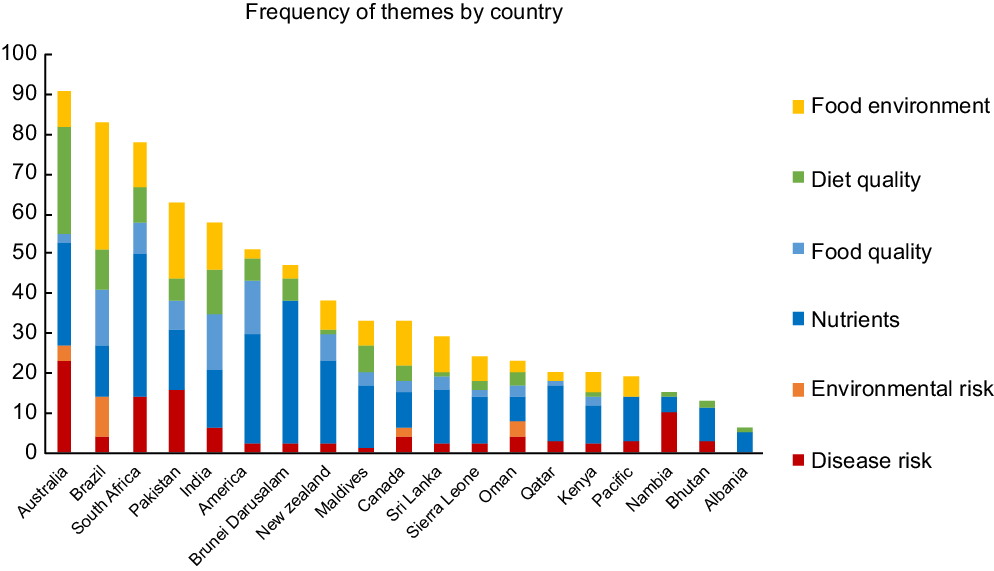
The following sections provide a detailed assessment of each domain, moving from the most downstream (harmful outcomes) to the most upstream (food environment).
Domain 1: harmful outcomes
The most downstream domain focuses on specific health and sustainability consequences associated with the consumption and production of processed foods, predominantly individual disease risks and environmental harms. The messages conveying the increased risk of disease caused by the consumption of processed foods mostly referred to increasing weight, obesity and other NCD such as diabetes and CVD. One example from the Pakistan DG stated ‘Increased and frequent consumption of energy dense nutrient poor foods with high salt, sugar and fats lead to over-weight and obesity and a consequent increase in the prevalence of metabolic syndromes, chronic diseases and premature deaths’. With the exception of Albania, all analysed guidelines mentioned disease risks; however, only Brazil, Australia, Canada and Qatar outlined the impact of processed foods on the environment due to unsustainable production techniques, transportation of foods and the associated waste. As stated by Qatar, ‘Overconsumption of food and eating highly processed and packaged low nutrient foods also increases water use, greenhouse gas emissions and the production of waste’.
Domain 2: food quality
The second domain focuses on the quality of the food itself. The vast majority of messages in this level focus on nutrient content, describing either the high level of harmful nutrients (sugar, salt and fat) or the lack of beneficial nutrients in many processed foods. For example, the New Zealand DG state ‘Highly processed, ready-to-eat foods tend to be low in naturally occurring nutrients such as vitamins, minerals, fibre and other phytonutrients’. Less frequently, the harms of processed foods were also discussed in terms of other ways the food quality is altered during the processing techniques, such as through the addition of harmful synthetic additives to improve the colour or flavour of foods. One example of such harm was outlined in the Indian DG which state ‘Thus, consumption of processed foods may not only affect intake of nutrients, but in addition, increase the risk of exposure to various chemical additives’. Other ways DG discussed altering food quality was by describing the harms associated with hydrogenation and the consumption of trans-fats, with Maldives DG stating ‘The main food source for trans-fat in processed food is industrially produced “partially hydrogenated oil”’.
Domain 3: diet quality
The third domain focuses on the harms of processed foods in terms of their impact on the overall diet quality of the population. This attributed to several factors, including processed foods displacing healthier, minimally processed foods from the diet, overconsumption of processed foods leading to excess energy intake, and by reducing the diversity of many diets. In the DG of Canada, Maldives, Pakistan and Brazil, there are also references to how processed foods are displacing the need to cook for many people, resulting in a reduction in people cooking meals at home, and ultimately the loss of cooking skills across generations, with the Canadian DG stating ‘Further, the increased use of highly processed products has decreased the transfer of food skills from parents, caregivers, and extended family to children and adolescents’.
Domain 4: food environment
The most upstream domain focuses on how elements of the food environment have led to a sustained rise in the consumption of processed foods. The DG of Australia, Brunei Darusalam, South Africa, Canada, Maldives, Sierra Leone, India, Sri Lanka, New Zealand, Pakistan and Brazil all include messages about how sociopolitical drivers such as increasing urbanisation and globalisation are leading to increased consumption of processed foods due to their convenience, accessibility, affordability, palatability and due to the dominance of the processed food industry in the wider food system. For example, the DG of Brunei Darusalam state ‘Increasing production of processed food, rapid urbanisation, and changing lifestyles are transforming the dietary behaviours’. Some messages provide advice to consumers to read labels of food to be aware of what they contained, and to be wary of how processed foods are often heavily marketed.
Discussion
This research has produced an in-depth understanding of how purposively selected DG communicate the harms of processed foods by analysing the language and themes underpinning such advice through qualitative content analysis. This study finds that there is significant variation in the descriptive terms used to refer to processed foods both within and across the DG included in this analysis. Our analysis offers a way to conceptualise explanations of the harms of processed foods in terms of their upstream drivers through to their downstream consequences. While some DG take a more holistic view of the harms of processed foods and discuss upstream drivers of their production and consumption, the dominant narrative across the DG is the downstream harms of processed foods, such as their composition and quality, as well as the poor outcomes associated with their consumption. Below, we reflect on the limitations of this narrow framing of the harms of processing.
The most common reason given to explain why processed foods are harmful in DG was their poor nutrient profile, that is, the high levels of sugars, salts and fat, or their low levels of beneficial micronutrients. Providing nutri-centric dietary advice is contradictory to the most recent evidence outlining that: (1) dietary advice should be provided by using food-based recommendations, rather than by specifying recommended nutrient intakes(11,Reference Mozaffarian and Ludwig33) ; and (2) that the most harmful aspects of many processed foods go beyond their nutrient content, extending to other aspects of the food quality and its role in the wider food environment(Reference Elizabeth, Machado and Zinocker2,Reference Baker, Machado and Santos4) . Very few messages outlined the harms of processed foods in terms of the harmful additives often present, or the harmful processes often used when making processed foods, such as hydrogenation. For many years now, nutritional scientists have argued that consuming foods that have undergone hydrogenation during manufacturing and are high in industrially produced trans-fats may be toxic to humans through a wide range of pathogenic effects(Reference Moodie, Stuckler and Monteiro1,Reference Monteiro38–Reference Zinocker and Lindseth41) . While the harms of UPF are in part linked to their nutrient profile, focusing on nutrients as the key rationale to reduce consumption of UPF risks silencing other issues associated with ultra-processing.
Framing the problem of processed foods predominantly in terms of their nutrient content also invites the possibility for reformulation to be a viable solution to reducing the harmful outcomes associated with processed foods(Reference Scrinis42). Reformulation involves adding beneficial nutrients, such as fibre or vitamins, or removing unhealthy nutrients, such as sugar and fat, from the foods to improve the nutrient profile(Reference Marotta, Simeone and Nazzaro43). Many policy interventions used so far to address poor health outcomes are designed to encourage reformulation, such as taxation on specific nutrients, front-of-pack labelling schemes highlighting specific nutrients or putting limits on the amounts of certain nutrients allowed in foods(Reference Scrinis42,Reference Mozaffarian, Rosenberg and Uauy44) . The food and beverage industry has been supportive of this approach, as it allows them to claim they have a significant role in the solution to the associated burden of disease through the sale of their reformulated products(Reference Scott, Hawkins and Knai45). However, considering the evidence that the harms of processed foods exist independently of their nutrient profile, policies encouraging reformulation are likely to be insufficient and may even exacerbate the poor outcomes associated with consumption of processed foods(Reference Elizabeth, Machado and Zinocker2,Reference Monteiro and Cannon46) .
While many DG focused on the harms of processed foods in terms of their nutrient profiles, some DG presented a more holistic rationale, reflecting more upstream issues that have been raised about UPF in the literature, such as their impact on the overall diet quality, and how elements of the food system drive their consumption. Many DG included specific warnings about misleading marketing of processed foods, and about how a small number of large industry groups producing processed foods are dominating the food environment. Providing dietary advice in the context of dietary patterns and the wider food environment is consistent with a more upstream, public health approach that recognises that poor health outcomes are not adequately explained by the consumption of individual processed foods, but rather the intense availability, affordability, palatability and marketisation of processed foods is driving overconsumption, displacing healthier foods and contributing to a food environment in which making healthy choices is increasingly challenging(Reference Moodie, Stuckler and Monteiro1,Reference Baker, Machado and Santos4) . These ideas are driving a paradigm shift around explanations of NCD, with calls to move away from attributing blame to ‘individual consumption’ and ‘lifestyle factors’ towards instead focusing on ‘toxic exposures’ and ‘environmental risk factors’(Reference Herrick47).
Most of the messages about the harmful outcomes associated with the harms of processed foods were describing the well-established association between processed foods and the increased risk of disease, particularly NCD(Reference Elizabeth, Machado and Zinocker2,7) . However, the inclusion of messages about the environmental risks in three of the DG show a more nuanced interpretation of the harmful outcomes associated with processed foods. The evidence base outlining the environmental impact of the production, distribution and transport associated with processed foods is building(Reference Monteiro, Cannon and Moubarac30,Reference Seferidi, Scrinis and Huybrechts48) . There have also been suggestions that due to the increasing global concern for environmental sustainability, framing recommendations about the harms of processed foods in terms of their environmental impact may be more effective in reducing their consumption, rather than appealing to health concerns(Reference Herrick47).
While it is positive that DG are starting to shift away from a nutri-centric approach and make explicit references to processed foods, the large variety of descriptors referenced in the DG indicate a lack of consensus and overall incoherence around how the concept of ultra-processing is incorporated into dietary advice. For example, there was a large variety of descriptors used to refer to processed foods across the DG, the most common of which was ‘processed’. However, food processing is not in itself harmful and can refer to techniques such as cooking, fermenting, and salting, which can provide benefits to health and the food system(Reference Monteiro, Cannon and Lawrence16). Therefore, using the word ‘processed’ to refer to such foods may not be the most appropriate term to use, as it does not explicitly refer to harmful changes to food structure. Further, many of the other descriptors used to refer to processed foods in the DG could be used interchangeably to refer to minimally processed foods or whole foods. For example, ‘snack food’ can also be used to refer to fruits and nuts, and ‘packaged food’ and ‘take away’ food can also include whole foods and minimally processed foods. This variation in terminology may reflect the evolution of the definition of UPF since its inception in 2009(Reference Gibney49). This ambiguity could present confusion for consumers unfamiliar with the concept of ultra-processing; however, this should not preclude efforts to incorporate the concept of ultra-processing into other food and nutrition policies. Considering the food environment is increasingly complex, with endless varieties of foods that all claim certain health advantages or disadvantages, DG would benefit from using clear and consistent language in messages about the harms of processed foods(Reference Mozaffarian, Rosenberg and Uauy44).
Conclusions
The evidence around the substantial impact of ultra-processed products on human health and on the environment continues to build and strengthen each year. Simultaneously, the availability of ultra-processed products is still increasing all over the world at an alarming rate, with the largest increases seen in low- and middle-income countries(Reference Baker, Machado and Santos4). As one of the major avenues that can improve this public health issue is through the development of comprehensive, evidence-based, nutrition policies, it is necessary to closely examine how existing policies address the harms caused by the production and consumption UPF(Reference Hawkes, Jewell and Allen10).
This study helps to understand how evidence around the harms of UPF has been translated into a sample of DG, and the extent to which this is reflective of the current understanding on how UPF are most harmful to human health and the environment. This research has analysed how DG communicate the harms of highly processed foods via more downstream, individual-level rationales through to a more upstream focus on food environments. This approach helps to understand the extent to which DG take a more narrow or holistic view of the harms of processed foods and can be applied to other DG to assess how they discuss the harms of processed foods.
This research has explored whether and how DG refer to the harms of processed food, and the differences in how guidelines interpret and communicate these harms. It has not analysed why these differences exist. Investigating the results of this study in the context of which stakeholder groups were involved in developing the DG for each country would be a valuable area of future research, as well as comparing stakeholder involvement between the DG that do and do not discuss the harms processing. Future research could expand the scope of the study to non-English DG to provide a better understanding of how different countries and regions communicate the harms of processed foods.
While it is clear that while we are starting to see some of the evidence about the harms of UPFF being reflected in DG, improvements can be made by increasing the clarity of messages around what aspects of UPF are harmful.
This research can inform the development of future DG, to ensure that messages about the harms of processed foods are made in a way that is clear to consumers and policy-makers and effectively communicates both the harms of processed foods and what foods should be avoided to achieve a healthy diet. Further, by portraying the harms of processed foods in terms of more upstream, holistic factors, DG can promote the development of more integrated policies targeting the wider food environment and contribute to fostering food environments and cultural norms that are fundamentally health promoting(Reference Mozaffarian, Rosenberg and Uauy44).
Acknowledgements
Acknowledgements: I would like to acknowledge our colleague Daniela Koios for her work identifying the initial list of all publicly available dietary guideline documents. Financial support: This research received no specific grant from any funding agency, commercial or not-for-profit sectors. Conflicts of interest: There are no conflicts of interest. Authorship: M.Q. and J.L.N. collaborated in developing the project aims, M.Q. completed the data collection and analysis with support from J.L.N. M.Q. wrote the first draft, and all authors contributed to subsequent drafts. All authors contributed to the conceptual development and direction of the project. Ethics of human subject participation: None required.



