1 Introduction
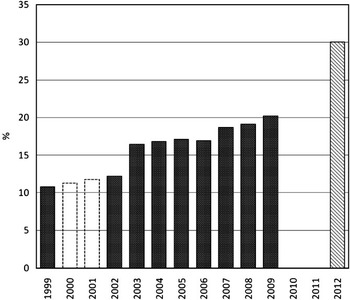
Historically, brand-name pharmaceuticals have enjoyed long periods of market exclusivity in Japan, given the limited use of generics after patent expiration. As Figure 1 shows, the volume share of generic pharmaceuticals was only 20.2% in 2009, which is substantially lower than in other developed countries, including the United States, Canada, the United Kingdom, and Germany, whose generic market shares were above 60% as of 2009.Footnote 1 To improve the efficiency of the health-care system, however, the Japanese government has recently paid much attention to methods of increasing the use of generic drugs. Due to a rapidly aging population and chronically slow economic growth, controlling the growth rate of medical expenditures is one of the most important policy goals for the Japanese government. Not surprisingly, the promotion of generic drugs has formed one of the centrepieces of the medical expenditure reduction effort, as pharmaceuticals constitute a large fraction of total expenditure and increasing the use of generics may substantially reduce pharmaceutical expenditure, which increased about 18% between 1999 and 2006.Footnote 2 In June 2007, the Cabinet Office’s Council on Economic and Fiscal Policy mentioned in its annual agenda that the quantity-based share of generic pharmaceuticals should be increased to 30% by fiscal year 2012 (Cabinet Office, 2007). This amounts to a two-thirds increase of the share within five years. The expected cost reduction was 500 billion yen (approximately 4.1 billion dollars at the contemporary exchange rate) over the five-year period (Ito et al., Reference Ito, Niwa, Mitarai and Yashiro2007).
Volume-based share of generic pharmaceuticals. Source: For 1999–2005, Japan Generic Pharmaceutical Manufacturers’ Association (2007); for 2006, Japan Generic Medicines Association (2009); for 2007–2008, MHLW (2009b); for 2009, MHLW (2009d). The values for 2000 and 2001 are interpolations between 1999 and 2002, as no surveys were conducted in those years. The values for 1999 and 2002–2006 cover the entire fiscal year (April–March). The values for 2007–2009 are for the month of September. The value for 2012 represents the government’s 30% target.

To increase the use of generics, the government has implemented various policies in recent years. This includes the provision of bonuses to prescribing physicians and dispensing pharmacies and, since 2006, the facilitation of generic substitution by pharmacists. It was hoped that such policies would dramatically increase the share of generics towards the 30% target, which is a modest goal given that other developed countries have generic shares well above 50%. Regardless of the government initiatives, the actual share of generics has so far not kept pace with the high expectations, as Figure 1 indicates. There has been a significant increase since 2002, when the share was only 12.2%. However, a large part of the gain occurred between 2002 and 2003, and the increase during 2003–2009 has only been 0.63 percentage points per year on average. A 1.8 percentage point increase between 2006 and 2007 can be observed, but this is largely attributable to a change in the data source: the estimates up to 2006 are from the Japan Generic Pharmaceutical Manufacturers’ Association (JGPMA) and count only the products of JGPMA member firms as generics, while the figures for 2007–2009 are based on surveys by the Ministry of Health, Labour and Welfare (MHLW) that take into account the generic products manufactured by all firms. If the 30% goal is to be attained on time, the share must rise by roughly 50% between September 2009 and March 2013. It is evident that this will require a more focused policy initiative.
At this juncture, we believe that it is imperative to take a closer look at the incentives faced by prescribing physicians, dispensing pharmacies and patients, as well as to re-evaluate the policies that have been implemented in recent years. This is what we attempt to do in this paper.
It should be noted that, in addition to promoting the use of generics, the Japanese government has recently begun promoting the development and introduction of innovative new drugs by letting such drugs enjoy higher-regulated prices for a longer period of time. One can interpret this policy as an attempt to maintain pharmaceutical manufacturers’ incentives to innovate, because, if left unaddressed, new drug manufacturers’ profits would be reduced as generics penetrate the market. While these two sets of policies are closely related, we focus only on the former. This is mainly because the revised pricing scheme for innovative drugs was only introduced in April 2010 on an experimental basis, and it is too early to assess its impact.
The remainder of the paper is structured as follows. After reviewing the past generic drug policy in the next section, Section 3 summarises recent policy changes and Section 4 provides our assessment for these changes. In Section 5, we discuss our policy recommendations. We argue that, first, the incentive payments to pharmacies should be adjusted so that generic substitution is promoted more efficiently. Second, the pricing rule for generic products can be revised so that pharmacies are not penalised financially for dispensing generics. Third, the regulatory framework can be improved so that concerns about the safety and efficacy of generic drugs are alleviated. Section 6 concludes the paper.
2 Situation regarding generic drugs before 2006
2.1 Generics are less costly for patients
Prescription drug prices are regulated in Japan. The prices of generics are lower than those of brand-name drugs, partly through the design of the price control system. When newly approved brand-name drugs are selected for reimbursement by the universal health insurance system, the reimbursement price is determined through comparison with similar drugs that are already marketed. Meanwhile, generic drug reimbursement prices at the time of introduction are set at 70% of the brand-name price, which creates an artificial wedge between the two groups. This price difference widens over time, as generics tend to lower their wholesale prices more rapidly, and reimbursement prices are adjusted accordingly. Until 2002, there was also a floor price for generic drugs, at 40% of the brand-name product’s reimbursement price, below which generic prices do not decline. Since most patients pay 30% of pharmaceutical costs as co-payments, they stand to gain financially if generics are prescribed in the place of the more expensive brand-name products.
2.2 Physicians’ incentive to prescribe generics
In many East Asian countries, medical facilities often both prescribe and dispense medicines, and Japan has also followed this tradition (Eggleston, Reference Eggleston2009). Dispensing hospitals/clinics can earn the difference between the drug reimbursement price and the wholesale price paid by them. As a result, the physician’s incentive to choose generics is likely to differ depending on whether the clinic or hospital both prescribes and dispenses medicines, or engages only in the former.Footnote 3 If the manufacturers of generics can offer higher margins than their brand-name counterparts, generics are more likely to be chosen by physicians at facilities where dispensing takes place. If, on the other hand, margins are lower for generics than for brand-name products, generics may be prescribed less despite their lower prices. Recent research has shown that prescribing practices are indeed influenced by the margins gained by dispensing medical facilities (Iizuka, Reference Iizuka2007).
However, the practice of in-house dispensation by medical facilities has been gradually decreasing: in 1998, only 26.8% of the prescriptions written by physicians were dispensed at pharmacies outside the hospital or clinic, but the ratio had increased to 59.3% by 2008 (MHLW, 2009c). In the case of physicians at hospitals and clinics that do not dispense drugs for outpatients, the margin between the reimbursement price and the wholesale price is not likely to have a significant effect on prescribing behaviour. Moreover, physicians employed at large hospitals may be insensitive to the financial gains of their institutions.
In order to incentivise physicians to prescribe generics, a prescription fee increment was introduced in 2002; a hospital or clinic could receive an extra 20 yen for each prescription containing at least one generic product.Footnote 4 This prompted some health-care providers to switch from prescribing drugs by proprietary name to prescribing by generic name. In addition, the MHLW directed hospitals administered by the national government to increase the use of generics.
In 2003, a fixed fee payment system, similar in spirit to the Diagnosis-Related Group–Prospective Payment System for Medicare patients in the United States, was introduced at 82 major teaching hospitals, called ‘special function hospitals’, that provide state-of-the-art medical care. This system, which fixes daily fees for Diagnosis-Prognosis Combinations, had the effect of increasing the usage of generic pharmaceuticals for inpatient services at participating hospitals.
While these measures may have contributed to the increased usage of generic drugs, many physicians remained unwilling to prescribe generics. Part of their reluctance can be explained by a general lack of knowledge regarding the quality of generic drugs. As recently as 2008, a survey of physicians revealed that 38.1% had almost no knowledge regarding the data required for approval of generic products, such as those pertaining to the bioequivalence of a generic to its corresponding brand-name product; an additional 40% admitted to knowing only a little (Central Social Insurance Medical Council (CSIMC), 2009). Matters have been worsened by misinformation campaigns carried out by the brand-name segment of the industry regarding the supposed inferior quality of generics (Japan Fair Trade Commission, 2006).
2.3 Concerns for quality and availability
However, some concerns regarding the quality of generics have legitimate origins upon examination of the historical development of the regulatory framework. For instance, official guidelines for bioequivalence testing were not released until 1997. Generic products approved before then were subject only to dissolution testing requirements. Strict adherence to good manufacturing practice did not become a requirement for product approval until 1994; consequently, firm reputation played a large role in how users perceived product quality. Generic drug manufacturers, which tended to be smaller and less well known, were less likely to enjoy positive reputation effects. Finally, active pharmaceutical ingredients manufactured outside Japan were not subject to on-site plant inspections by the regulatory agency until 2005. Because Japanese generic drugs tend to use a higher proportion of imported active ingredients than their brand-name counterparts do, this delay in regulation also contributed to the negative perception of quality.
Another reason for physicians’ aversion to generics has been the instability of supply. It has been common for generic manufacturers to withdraw older products from the market in response to reduced sales or lower reimbursement prices, thereby causing problems for prescribers and users. In a 2008 survey, physicians who do not prescribe generics were asked the reasons for not doing so. While quality concerns were the most important (81.3% mentioned it as a reason), 36.3% mentioned the generic manufacturers’ inability to assure a stable supply (CSIMC, 2009: 75).
2.4 Lack of generic substitution opportunities at the pharmacy
While some of the concerns regarding quality and supply stability are well founded, the general aversion among physicians to prescribe generics has been partly based on insufficient knowledge regarding the current regulatory framework. Thus, the promotion of generic substitution by pharmacists (whose educational background and professional interests make them well informed) appears to be a reasonable policy objective. The fact that an increasing share of prescriptions – approximately 60% in 2008 – is being dispensed by pharmacies rather than medical providers also supports the notion that pharmacies should be the focus of policy intervention.
However, before 2006, generic substitution did not exist on a significant scale. The first reason is that even after the generic prescription fee increment was introduced in 2002, most physicians continued to write prescriptions using proprietary names. Second, under the Pharmacists Law, pharmacists are allowed to dispense a product that is different from the one written on the prescription form only if the prescribing physician gives consent. Traditionally, such substitutions were rarely made, as to do so required the pharmacist to contact the physician for consent after receiving the prescription from a patient; this was time-consuming for all parties involved.
Rather than lowering these barriers to generic substitution, the government opted for a policy of providing financial incentives. In 2002, the health insurance system began to pay pharmacies a dispensation fee increment of 20 yen for each prescription against which a generic product was dispensed. In addition, an ‘information provision increment’ of 100 yen was provided each time a pharmacist provided information on the existence and quality of generics to a customer and a generic product was dispensed. However, the precondition for substitution was that the generic name be written on the prescription form. As a result, opportunities for generic substitution continued to be rare.
2.5 Insurers have little influence
Another relevant factor is the passive role played by the insurers that operate within the universal health insurance system. These include municipal governments, health insurance societies for the employees of large corporations, the Japan Health Insurance Association that covers the employees of small and medium enterprises, and other occupation-based insurance societies. Reimbursements are made on a fee-for-service basis, and an individual insurer has no way to limit a physician’s choice between a brand-name product and its generic counterpart, except for the rare case in which the patient visits a medical care provider under an insurer’s control.Footnote 5 Insurers cannot restrict patients’ choices among providers, so that the effect of controlling prescribing practices at affiliated facilities is also limited. Some insurers have provided information to their members on how much they can save by switching to generics, but this was not common before 2006.
3 Recent policy changes
Discussion regarding the facilitation of generic substitution by pharmacies arose intermittently among policymakers during the 1990s, but it was not until 2001 that serious debate was held at the CSIMC, an advisory council to the MHLW that makes recommendations on various matters related to health insurance, including fees and drug reimbursement prices. Consisting of the representatives of insurers, health-care providers, academia, the general public and the pharmaceutical and medical device industries, the CSIMC also functions as a forum for balancing the interests of various stakeholders in the health-care sphere. When the possibility of promoting generic substitution was first raised by the insurers’ representative in 2001, it was summarily opposed by the representative of the Japan Medical Association.
Then, in a 2005 parliamentary session, an opposition member of the House of Councilors asked the government whether it would be possible to promote generic substitution by redesigning the prescription form so that physicians could give prior consent instead of waiting for pharmacists to call them about the possibility of substitution. The government’s answer was in the affirmative, which led to the introduction of a new prescription form in April 2006.
The 2006 form introduced a box that could be signed by the physician to authorise generic substitution by the dispensing pharmacist. If there was no signature, and if the brand-name product was written on the prescription, generic substitution was not allowed. Therefore, allowing generic substitution still required some effort on the part of the physician. Nevertheless, the new design represented a significant departure from the status quo.
The impact of the redesigned form was modest. In a July 2007 survey sponsored by the CSIMC and conducted more than one year after the change was introduced, it was found that only 17.4% of the surveyed prescription forms contained the physician’s signature permitting generic substitution (CSIMC, 2008). Only 8.2% of those forms actually resulted in a generic product being dispensed as a substitute for the brand-name product. Interestingly, in 22.1% of the prescriptions, the physician prescribed a generic product by its proprietary name but did not permit substitution.
Because of this weak response, the MHLW decided to alter the prescription form once again. The form introduced in April 2008 contains a box that the physician signs only if he/she does not consent to generic substitution. Thus, the default is to allow generic substitution at the pharmacy, even if the prescription presents the proprietary name of a brand-name product, or that of a generic product that the pharmacy does not stock. Although a recent survey shows that the share of prescriptions where generic substitution for one or more drugs was permitted, either explicitly or tacitly, was 65.6% in 2009 (CSIMC, 2009: 10), as we saw in Figure 1, the new prescription form did not substantially increase generic use.
Several other policy developments took place in 2008. First, a new incremental dispensation fee component, called the ‘generic dispensation preparedness increment,’ was introduced. If a pharmacy dispensed at least one generic for 30% or more of its received prescriptions, it was eligible for an incremental dispensation fee of 40 yen for every prescription that it dispensed (including for prescriptions that contain no generics). At the same time, the prescription fee increment introduced in 2002 to promote generic prescriptions was abolished, as it was expected that a large number of prescriptions would permit generic substitution even without such financial incentives (MHLW, 2008a).
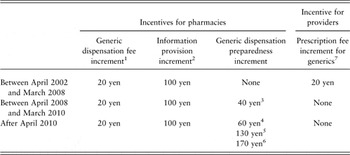
In April 2010, the generic dispensation preparedness increment was revised so that, in order to be eligible, at least 20% of the drugs dispensed by a pharmacy must be a generic. Unlike the 2008 rules, wherein the dispensation rate was calculated on the basis of the number of prescriptions containing at least one generic, the 2010 rule requires the dispensation rate to be calculated on a volume basis. That is, the share of generics is calculated as the proportion of dispensed drugs, in terms of pricing units (e.g. tablets), that are generic. Under the 2010 rule, there are three threshold values for the generic dispensation rate. If a pharmacy has a generic dispensation rate of between 20% and 25%, it can charge an incremental dispensation fee of 60 yen per prescription. If the rate is between 25% and 30%, the dispensation fee increment is 130 yen, and if the rate is above 30%, the increment rises to 170 yen. Table 1 summarises the various incentive payments for pharmacists and physicians.
Incentive payments for generic prescription and dispensation

Source: Ministry of Health, Labour and Welfare, Notification nos. 71 of 2002, 92 of 2006, 59 of 2008 and 69 of 2010.
1Paid to pharmacy, per generically substituted prescription.
2Paid to pharmacy, per generically substituted prescription, where the pharmacist has provided information on the existence, quality and cost reduction benefit of generic product. Notification of substitution to health-care provider was required until March 2008. From April 2008, notification is waived if there is a preexisting agreement between health-care provider and pharmacy regarding generic substitution.
3Paid to pharmacy, per prescription (including those not containing generics), if 30% or more of the prescriptions received by the pharmacy are filled with at least one generic product.
4Paid to pharmacy, per prescription, if between 20% and 25% (volume-based) of the drugs dispensed by the pharmacy are generic.
5Paid to pharmacy if between 25% and 30% of the drugs dispensed by the pharmacy are generic.
6Paid to pharmacy if 30% or more of the drugs dispensed by the pharmacy are generic.
7Paid to health-care provider for each out-issued prescription that contains at least one generic product, prescribed either by generic name (provided that a generic exists) or by the proprietary name of a generic product.
In another interesting development, municipal governments, in their capacity as insurers within the National Health Insurance system, began to actively promote the use of generics among their members by informing them of potential cost savings. This follows the acceleration of an earlier movement among the health insurance societies of large corporations to coax their members to switch to generics.Footnote 6
4 Evaluating the recent policy changes
Have the recent changes in generic drug policy finally boosted the use of generics? As shown in Figure 1, the volume share of generics is still 20.2% as of September 2009, which is far below the 30% target that MHLW has set for year 2012. Moreover, the most recent round of the CSIMC survey indicated that generic substitution at the pharmacy continues to be very limited despite the change in prescription form; only 6.1% of prescriptions containing at least one drug that could be substituted into generics were actually switched to generics (CSIMC, 2009: 18). It appears that even with the various changes in generic drug policy, generic substitution at the pharmacy is still not attractive to patients or to pharmacists. This section attempts to explain why this is the case.
4.1 Costs and benefits of dispensing generics
To understand why generic substitution is not attractive, it is useful to highlight the costs and benefits of generic substitution for patients and pharmacists. As noted in Section 2, a major benefit to patients of choosing generics is the lower out-of-pocket expenses associated with generic drugs. On the other hand, a major cost of switching to generics is the risk associated with changing prescriptions from familiar brand names to newly approved generics. Although generics are bioequivalent to brand names, this does not mean that they are identical. For example, additives (inactive ingredients) contained in generic drugs sometimes differ from those of brand names. This is often attributable to insufficient disclosure of information on additives by the brand-name manufacturer, or to the existence of patents that protect specific formulations of the branded product (Japan Generics Journal, 2005). Concerns have been raised in Japan and elsewhere that such differences can affect health outcomes (Beck, Reference Beck2008; Nihon Keizai Shinbun, 2008). Such uncertainty associated with switching a medication will be a cost for risk-averse consumers.
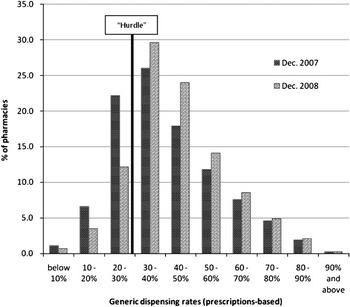
If pharmacists represent patient interests, they will internalise the costs and benefits of patients discussed above. Aside from these considerations, pharmacists face additional costs and benefits. At least two benefits of choosing generics exist. First, as noted in the previous section, starting in April 2008, pharmacies received a higher per-prescription dispensing fee (i.e. 40 yen) if the prescription-based share of generics was above the 30% of the threshold level. This is likely to have encouraged pharmacies to clear the ‘hurdle’ set at the 30% level, because pharmacies could receive the higher fee not only for prescriptions that resulted in dispensing of at least one generic, but also for all other prescriptions that do not contain any generics. Second, if generics offer a higher markup than brand names, this may motivate pharmacies to dispense generics.
However, we can conceive of at least two reasons why pharmacies prefer not to dispense generics. First, to dispense generics, pharmacies obviously need to have additional drugs in stock, which increases stocking costs.Footnote 7 These can be costly, especially in large cities, due to high real estate prices in Japan. Second, it takes more time to dispense generics, as many patients are still not familiar with generics. According to the CSIMC survey, pharmacists need to spend five extra minutes with a patient when the patient switches to generics for the first time (CSIMC, 2009: 29).
4.2 The impact of the ‘hurdle’ policies on generic substitution
What impact did the hurdle policies – the fixing of threshold generic dispensation rates to define eligibility for differential dispensation fees – have on pharmacies’ propensity to dispense generics? Figure 2 shows the distribution of pharmacies in terms of prescription-based generic dispensing rates (the proportion of prescriptions received for which at least one generic product was dispensed) before and after the introduction of the 30% prescription-based hurdle in April 2008. Clearly, the proportion of pharmacies whose generic dispensing rates are below 30% has decreased after the introduction of the hurdle. In contrast, the proportion of pharmacies whose generic dispensing rates are ‘between 30% and 40%’ and ‘between 40% and 50%’ has increased. The proportion of pharmacies whose generic dispensing rates is above 50% has changed relatively little.

These observations suggest that the prescription-based hurdle had two effects on generic dispensing. First, for pharmacies whose generic dispensing rates were close to the hurdle, introduction of the hurdle encouraged them to clear the hurdle and obtain a higher dispensing fee. Second, for the ‘high-performing segments’ (such as ‘between 50% and 60%’ and ‘between 60% and 70%’) whose generic dispensing rates were far above the threshold level, the hurdle had relatively little impact. This is logical because under the prevailing compensation scheme, additional generic substitution was not rewarded after passing the 30% threshold level. The majority of pharmacies had already been above the threshold level before the introduction of the hurdle, and this may explain why the generic share increased only modestly, regardless of the impact that the hurdle appeared to have on pharmacies. As the reader may note, the responses of the pharmacies to the hurdle are not particularly unique to the current setting but rather common when a ‘kink’ (or a hurdle) exists in a compensation plan (Jensen, Reference Jensen2001).
Compared to the prescription-based hurdle, the volume-based compensation scheme introduced in April 2010 is likely to have a stronger impact. This is because a majority of pharmacies (69.4% as of June 2009) are below the 20% threshold for the volume-based generic dispensation rate. The share of pharmacies in the uppermost tier (i.e. those having a volume-based dispensation rate of 30% or higher) is only 10.1% (MHLW, 2009e).
4.3 Do generics offer higher markups for pharmacies?
Even if the 30% threshold introduced in 2008 did not provide a strong additional incentive to dispense generics, pharmacies may still be willing to dispense generics if generics offer a higher markup than brand names. The fact that generic substitution did not substantially increase after April 2006 (when generic substitution was allowed at the pharmacy for the first time) suggests that the markup difference between generics and brand names is not large enough to further motivate generic substitution. In fact, as we see below, generics offer higher markups only for a short period of time immediately after their entry. We argue that this is partly due to the current pharmaceutical pricing rule.
Under the MHLW’s regulations, both brand-name and generic reimbursement prices are subject to biennial revisions, in accordance with the level of actual wholesale prices.Footnote 8 Specifically, the following pricing rule is adopted:

where P R and P W denote reimbursement price and average wholesale transaction price, respectively, and the subscript denotes a two-year period. Rt is a parameter that is fixed by the government (it has been fixed at 0.02, or 2%, since 2000). If the markup between the reimbursement price and the average wholesale price is equal to Rt × the reimbursement price, so that P Rt − 1 − P Wt − 1 = Rt × P Rt − 1, then P Rt = Pt − 1R, and there is no change in the reimbursement price from one period to the next. In practice, however, the actual markup is greater than Rt × P Rt − 1 so that the biennial price revision leads to a decrease in the reimbursement price.Footnote 9
The pricing rule guarantees that the outcome of market competition among different generics – that is, lower wholesale prices – is translated into lower reimbursement prices. It is an example of how market forces can be harnessed and used effectively even in a regulated environment. At the same time, the pricing formula takes away the ability of generics to provide continuously higher markups than brand-name products. For illustration, suppose a drug provides a large markup for pharmacists in period t, through a low wholesale price. Then, equation (1) implies a substantially lower reimbursement price at t + 1. This reduces the room for providing a large markup at t + 1. Since the reimbursement price for generics at the time of entry is set at 70% of the corresponding brand-name product, it quickly becomes difficult for generics to continuously provide a higher markup than the brand-name drug.
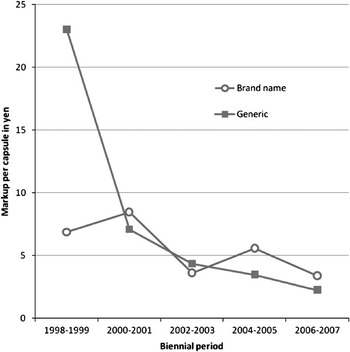
Although there exist no public data on actual markups that allow direct confirmation of this story, by taking advantage of the government’s pricing rule, it is possible to back up the average markup for each drug over time. The government’s pricing equation defines an exact relationship between the reimbursement prices for drug j at periods t and t + 1 (P Rjt and P Rjt + 1, respectively) and the average transaction price (P Wjt). Then, although P Wjt is not observable, it is easy to back this number up using the pricing equation and the data for P Rjt and P Rjt + 1, both of which are observable.Footnote 10 The average markup for drug j at t can be simply computed by Mjt = P Rjt − P Wjt. Although this method provides valuable information on markups, it has an inherent limitation in that the markup can only be computed as an average (Iizuka, Reference Iizuka2007). Depending on the bargaining power between sellers and buyers, the extent of the markup can be different, and some caution is necessary when using this approach.
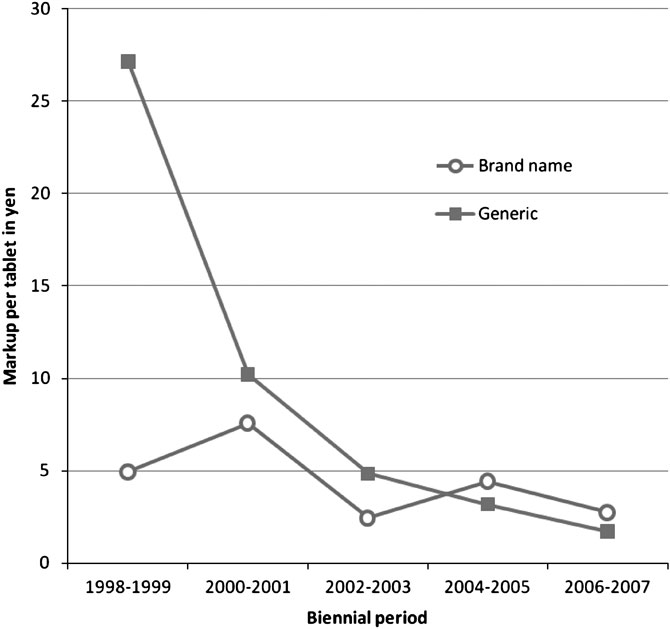
With this caveat in mind, Figures 3 and 4 apply this method to two drugs that experienced first generic entry between 1998 and 1999 and shows how the average markup for generic and brand names changed over time. Though not reported here, other drugs also follow a similar pricing pattern. When multiple generics existed for a given drug, we simply take their average to produce one figure for generics.Footnote 11 These graphs show that on average, generics offer the largest markup during the first biennial period after generic entry and that these markups are larger than those of brand names. Although this markup advantage of generics will provide an incentive for pharmacies to switch to generics, after the initial period, little markup difference exists between generics and brand names. In fact, as the drugs get older, the initial markup advantage of generics disappears and pharmacies are sometimes penalised in terms of a lower markup by dispensing cheaper generics.

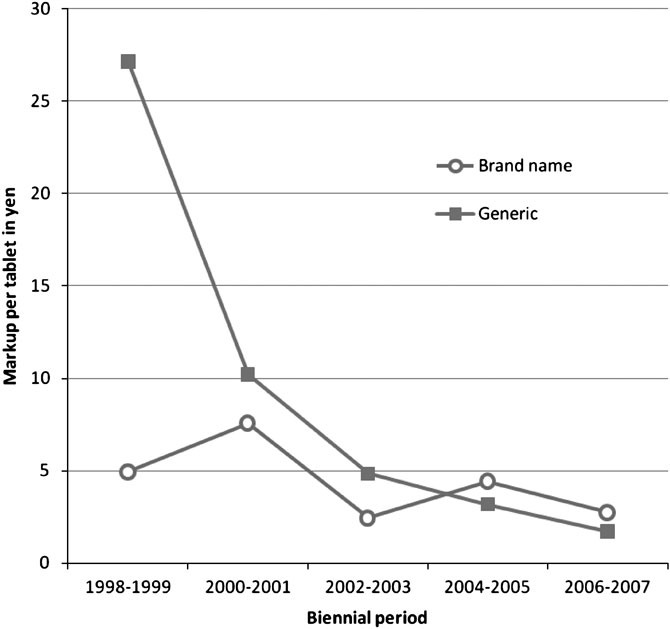
There are two reasons why this pattern of markups declining over time will discourage pharmacies from using generics. First, only a small fraction of generic drugs – those that have very recently entered the market – are attractive relative to the brand-name product in terms of markups. For the remaining drugs, pharmacies may lose money by dispensing generics. Second, as the price and markup of a generic decline, the manufacturing firm may discontinue its production, since it quickly becomes unprofitable to supply the product. Thus, the supply instability that characterises the generics market is being aggravated by the drug-pricing rule. The short lifecycle of generics will in turn negatively affect generic substitution because knowing that a generic product may be discontinued in the near future, pharmacists may not want to switch to it. Ironically, such concerns may be particularly strong for the treatment of chronic diseases, where the cost savings from generics can be the largest.
5 Recommendations
As described in the previous sections, recent changes in Japanese generic drug policy have not been sufficiently effective at realising the government’s objective to boost the use of generic drugs. In this section, we suggest a few policy prescriptions that may increase the use of generic drugs. We focus our discussions on altering the above-mentioned costs and benefits that patients and pharmacists are likely to face.
5.1 Creating proper incentives for pharmacies to conduct generic substitution
A major problem of the ‘pay for performance’ scheme introduced in 2008 was that the hurdle encouraged only pharmacies close to the threshold level to increase generic substitution; pharmacies that were far above or below the threshold were much less affected. In fact, 83.4% of pharmacies were already above the 30% threshold as of December 2008, and the hurdle – if it was left at the previous level – would have been ineffective at further increasing generic substitution. The amendments introduced in 2010 – to use a volume-based measure of generic dispensation rather than one based on prescriptions, and to use three threshold levels rather than just one – made the pay schedule more linearly related to the performance. This provides an incentive to continuously increase generic substitution even for high performers.
The new scheme does, however, contain a few weaknesses that call for closer scrutiny and, possibly, further amendment. In particular, the incentives created by the scheme may prompt pharmacies to increase generic substitution in a way that is not necessarily in the best interest of patients or of society at large. The large increments in the dispensation fee at the threshold generic dispensation rates (20%, 25% and 30%) may lead some pharmacies, especially those at the margin, to ‘push’ generic products to their customers without fully taking into account the benefits and costs accruing to those customers. Moreover, some pharmacies that are on the verge of achieving a target may attempt to do so by fraudulent means – by misreporting their generic dispensation rates, for instance.
Such problems may be alleviated by changing the compensation schedule into a ‘smoother’ function of the generic dispensation rate. This can be done by introducing more threshold points, and decreasing the size of the incremental fee at each threshold. Without large jumps in the compensation scheme, the generic substitution behaviour of pharmacies is expected to reflect patients’ interests more closely. Admittedly, the concern for misreporting the generic dispensation rate still remains even with this change. However, we expect that such concerns will be resolved once insurance claims by pharmacies are made fully electronic and brought online, in accordance with the MHLW’s stated plans (Yakuji Nippo, 2009a).
Another set of issue lies with the calculation of the generic dispensation rate. First, as previously noted, the share of generics is calculated as the proportion of dispensed drugs that are generic. A problem here is that the denominator includes drugs that do not have generic counterparts. If doctors predominantly prescribe brand names that are patent protected, the pharmacy can do little in order to increase the generic dispensation rate. One obvious way to deal with this issue is to base the generic dispensation rate not on all drugs but on the drugs that have generic counterparts.Footnote 12 Although this change may increase both reporting and monitoring costs, it is reasonable because pharmacies will be evaluated on the basis of a performance measure over which they have some influence.
The second problem with the generic dispensation rate is that it is calculated on the basis of pricing units, which generally translate to the smallest physical units. Pharmacists have a stronger incentive to generically substitute those drugs where a single dose consists of a larger number of pricing units. Thus, pharmacists’ efforts may become concentrated on a particular subset of drugs in a way that does not maximise the cost savings due to generic substitution. Moreover, efficiently designed formulations, such as those that allow the patient to take fewer tablets each day, are likely to see less generic substitution. One way to avoid this problem is to base the generic dispensation rate on a more reasonable volume measure, such as the defined daily dosage.
5.2 Applying a different pricing rule for generics
Another obstacle for increasing the use of generics is that the current pricing rule does not allow generic firms to provide continuously higher markups than those offered by brand-name drugs. This not only reduces pharmacies’ incentives to use generics but also causes generics to quickly exit the market, which further reduces the use of generics. Although fundamental reform of methods to regulate pharmaceutical prices is an important issue, it is beyond the scope of this paper. In particular, the introduction of reference pricing, which appears to have been effective at increasing generic usage in several countries in Europe, North America, and Oceania has been considered by some Japanese policymakers but ultimately rejected.Footnote 13 Instead, we focus on how the current pricing rule can be modified to alleviate the above concern.
Currently, the same pricing rule is applied to both generic and brand-name drugs. One way to address the concerns regarding the current pricing rule is to allow generics to follow a different pricing rule – one that allows generics to set higher markups for a longer period of time. For example, as was the case before 2002, the government may set a floor price for the reimbursement of generics (such as 40% of the brand-name price when generics first enter), below which generic prices do not decline. This may make it possible for generic drugs to continuously provide a higher markup than brand-name products. In addition, a higher value for Rt in equation (1) may be used for generic drugs. These policies could motivate pharmacies to use more generics, and generic firms might be able to stay in the market for a longer period of time. Obviously, the potential drawbacks of such changes, including the costs of allowing higher reimbursement prices, should be carefully examined before implementation. In particular, patients and prescribing physicians need to be reassured that pharmacies do not choose particular generic products merely on the basis of the higher margins offered by manufacturers, at the expense of quality.
5.3 Alleviating safety and efficacy concerns
Our discussion so far has focused on how to increase pharmacies’ benefits when dispensing generics. It is also possible to increase the use of generic drugs by reducing the costs of dispensing generics. Safety and efficacy concerns for generics are still prevalent among physicians, pharmacists and consumers, which raises the implicit costs of dispensing generics. For example, in the CSIMC survey, 35.6% of the patients who did not switch to generics after their pharmacist discussed the possibility of generic substitution mentioned that ‘the general sense of insecurity regarding generic drugs’ was the reason for not switching (CSIMC, 2009: 26). In another survey, by a private marketing research company, 63% of the surveyed physicians mentioned that they felt insecure in one way or another about the quality of generics (TM Marketing, 2008). These concerns may prevent health-care professionals from adopting generics even if they wish to contribute to a better resource allocation within the health-care system.
One way to reduce these concerns is to implement more stringent standards for determining equivalence between generic and brand-name drugs. For example, the bioavailability standards for certain drugs with narrow therapeutic windows can be made stricter, as in the case of antiepileptic drugs in Denmark (Wolf, Reference Wolf2007). To this end, it is notable that some Japanese generic firms have already adopted stricter standards than the government’s for the amount of active ingredient contained in their formulations (Nikkei Sangyo Shinbun, 2009).
Another possibility is to require brand-name manufacturers to disclose details of the additives contained in their products so that generic firms can more closely copy the original drugs if they so desire. This will go some way towards alleviating the widespread concern that differences between brand names and generics in the composition of additives can cause different health outcomes.
6 Conclusions
As of this writing, despite the high expectations and various policy experiments made by the government, the Japanese generic drug market has yet to take off. We discussed two major problems that account for this difficulty. First, under the incentive scheme introduced in 2008, pharmacies did not have additional incentives to increase generic substitution once they cleared the hurdle in the pay schedule, a familiar issue frequently discussed in management textbooks. Second, the government applies the same price-control formula for brand names and generics, which often results in penalisation of pharmacies that dispense less expensive, but less profitable, generics.
In April 2010, the dispensation fee schedule was revised so that it gives pharmacies a stronger incentive to increase the generic dispensation rate. While this is significant step towards correcting the first problem, we suggest that the reward be made a smoother function of performance in order to prevent pharmacies from putting their own interests above their patients’. We also suggest the use of a more reasonable measure of volume for calculating the generic dispensation rate.
A pricing rule that allows generics to set a higher markup for a longer period of time will be effective at alleviating the second problem. It is our belief that these changes, in addition to the addressing of remaining concerns regarding the safety and efficacy of generics, will take the Japanese pharmaceutical market to the next stage, where generic firms play a much larger role as in other developed nations.
Acknowledgements
We thank the editors and two anonymous referees for their constructive comments and valuable suggestions. Toshiaki Iizuka gratefully acknowledges financial support from the Nomura Foundation for Academic Promotion and the Grants-in-Aid for Scientific Research (“KAKENHI”) (20530212).