Introduction
Transposition of the great arteries is the most common cyanotic CHD that accounts for 5% of all CHD cases born.Reference Sarris, Balmer and Bonou1 The National Institute for Cardiovascular Outcomes Research found antenatal detection rates of CHD in infants are improving annually, with current rates at around 50% (NICOR 2016), with transposition of the great arteries detection rates ranging between 41 and 84% internationally.2–Reference van Velzen, Haak and Reijnders7 Within the United Kingdom following the British Congenital Cardiac Associations “Fetal Cardiology Standards” (2012) it is recommended that infants with a diagnosis of transposition of the great arteries are born in a tertiary maternity centre.8 There are still 50% who are delivered outside a specialist centre. These infants then require stabilisation in a district general hospital and transfer to a specialist cardiac surgical centre.Reference Sarris, Balmer and Bonou1 In the United Kingdom, it is strongly recommended that these transfers are undertaken by specialist paediatric or neonatal intensive care teams.
These specialised paediatric transport teams have been established over the past 20 years across the United Kingdom to transfer critically ill children from the district general hospital into tertiary paediatric ICUReference Ramnarayan, Intikhab and Spenceley9 and are shown to improve the outcomes of critically ill children.Reference Ramnarayan, Thiru and Parslow10 With the move towards increasing centralisation of specialist services in the United Kingdom, such as paediatric cardiac surgical centres, the requirement for inter-hospital transport of infants with cardiac disease is only likely to increase.Reference Ramnarayan, Intikhab and Spenceley9 This pilot study is the first United Kingdom study to examine the impact of transport times in infants with transposition of the great arteries in relation to patient outcomes. We aimed to examine the outcomes of infants who were externally retrieved from district general hospitals to those born in the tertiary maternity unit adjacent to the specialist paediatric ICU in the South West of England and South Wales.
Materials and methods
A secondary data analysis was undertaken of all infants who had a confirmed diagnosis of transposition of the great arteries and who were born in the South West of England and South Wales who were admitted to one regional paediatric ICU requiring an arterial switch operation as their definitive procedure, between April, 2012 and March, 2018. The data were extracted from the local Paediatric Intensive Care Audit Network database and the local specialist paediatric transport team database. The primary aim of this study was to compare the outcomes of infants who were externally retrieved from a district general hospital to those born in the tertiary maternity unit adjacent to the specialist paediatric ICU. Outcomes examined were length of stay (days) in both paediatric ICU and hospital, paediatric ICU length of stay after balloon atrial septostomy, paediatric ICU length of stay after arterial switch operation and total length of hospital stay. Requirement for a balloon atrial septostomy was recorded and the age of the infant at balloon atrial septostomy and at arterial switch operation repair. The timing of diagnosis (antenatal or postnatal) was collected. Gestational age (weeks), age at presentation (days), weight on admission to paediatric ICU (kgs), and the type of transposition of the great arteries were all collected. Other key variables such as duration of invasive and non-invasive ventilatory support, inotrope requirement, and mortality were collected. The timing of the infants admission to paediatric ICU was calculated from either time of referral of the infant, for those born in a district general hospital or from time of birth for those born in the tertiary maternity unit. The duration of the transport episode for the infants born in a district general hospital was calculated from the time of referral to the time of arrival on paediatric ICU, detailed by arrival of the team to the infant’s bedside, stabilisation time, and infants journey time. We also identified interventions required prior to the team’s arrival and interventions undertaken by the transport team on arrival. In the infants born in the tertiary maternity unit we recorded the interventions that had been completed prior to arrival on the paediatric ICU. Interventions were need for prostaglandin infusion, respiratory support requirements which included both invasive and non-invasive support, inotrope infusions, and vascular access.
Physiological and clinical parameters on arrival to paediatric ICU were recorded. These were arterial oxygen saturations (SaO2), Fraction of Inspired Oxygen (FiO2) requirements, systolic blood pressure, base excess, serum lactate, and paediatric index of mortality 2 score.
Data were analysed using Microsoft Excel and IBM SPSS Statistics for Mac version 24.0 (IBM Corp, Armonk, New York, United States of America). Normally distributed data were analysed using parametric tests and are presented as mean and standard deviation, and non-normally distributed data are presented as median and IQR. To compare groups an independent t-test was used for comparing the means between two groups of normally distributed variables or Mann–Whitney or Kruskal–Wallis test for the non-normal distribution. Differences between categorical variables were compared using chi-square. A p value of <0.05 was considered significant and two tailed tests were used.
This study used anonymised patient data already collected by Paediatric Intensive Care Audit Network, which has ethical approval to collect data in the United Kingdom (PICANet Ref Number is PIAG-4-07-(c)/2002). The local transport database was accessed with permission of the service lead. Ethical approval was obtained from the University of the West of England (Reference number HAS.18.06.181).
Results
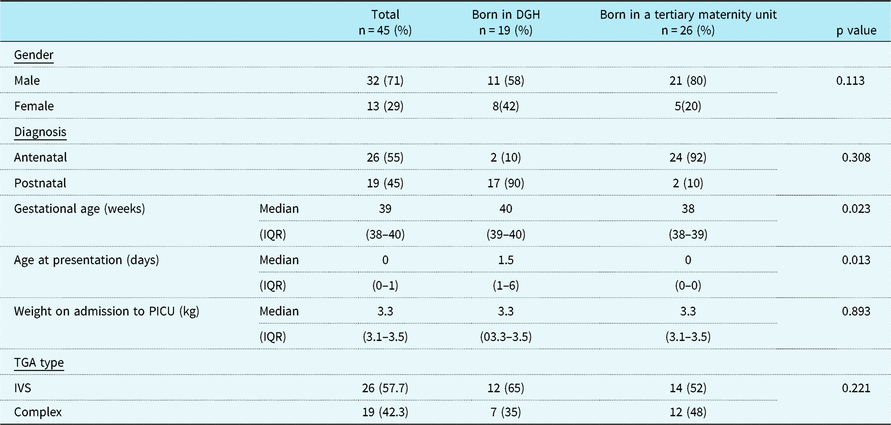
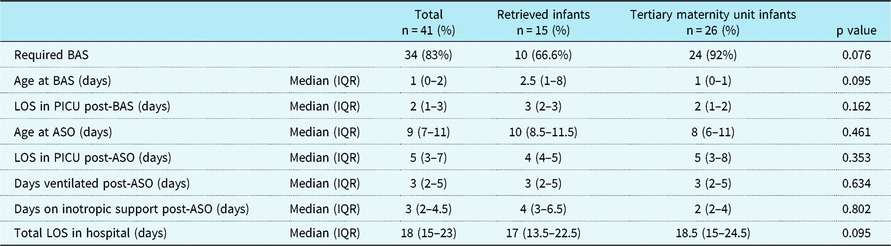
Forty-five infants had a confirmed diagnosis of transposition of the great arteries between April, 2012 and March, 2018. Fifty-six per cent (25/45) of infants were diagnosed antenatally. The majority (92% 23/25) of these infants were born at the tertiary maternity unit, while the majority (90% 18/20) of the postnatally diagnosed infants were born in a district general hospital (Table 1). There were no significant differences in the total length of hospital stay between the two groups. The retrieved infants had a median stay of 17 days (IQR 13.5–22.5) compared with the infants born in the tertiary maternity unit of 18.5 days (IQR 15–24.5) (p = 0.095 95%CI − 9.237–0.689). Eighty-three per cent (34/41) of the infants transferred by either the paediatric or neonatal team required a balloon atrial septostomy prior to the arterial switch operation. Infants born in the tertiary maternity unit had a balloon atrial septostomy earlier than the retrieved infants with a median age of 1 day (IQR 0–1) compared to 2.5 days (IQR 1–7.75), but this was not significant (p = 0.095). Infants admitted from the tertiary maternity unit had a similar length of stay on paediatric ICU after balloon atrial septostomy, compared with the retrieved infants, median 2 days (IQR 1–2) versus 3 days (IQR 2–3) (p = 0.162 95%CI − 0.473–2.330). Length of stay following the arterial switch operation repair was not significantly different between the two groups with those born in the tertiary maternity unit staying for a median of 5 days (IQR 3–8) versus 4 days (IQR 4–5) (p = 0.353). There were no significant differences in age at arterial switch operation repair with the infants born in the tertiary maternity unit having the procedure at a median of day 8 (IQR 6–11) and the retrieved infants on day 10 (IQR 8–11) (p = 0.461) (Table 2).
Demographics of infants.

DGH = district general hospital; IVS = intact ventricular septum complex = VSD, Coarctation of Aorta or Left Ventricular Outflow Tract Obstruction alongside the TGA; TGA = transposition of the great arteries
Interventions in PICU and length of stay.

BAS = balloon atrial septostomy; LOS = length of stay; PICU = paediatric ICU; ASO = arterial switch operation.
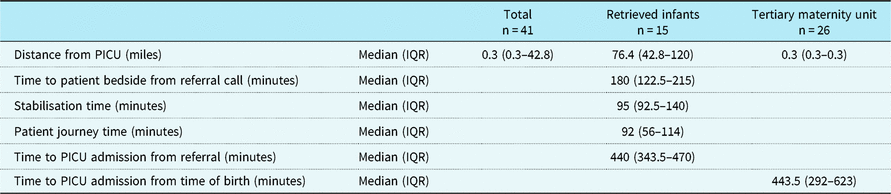
Most infants (91% 41/45) were transferred to paediatric ICU by either the specialised paediatric ICU transport team (33% 15/45) or the local neonatal team (58% 26/45) with 4/45 (9%) being transferred by another team. In the district general hospital born infants, the median time from referral to paediatric ICU arrival was 440 minutes (IQR 343.5–470) and from referral to the transport teams arrival to the infants bedside was a median of 180 minutes (IQR 122.5–215), with a median stabilisation time of 95 minutes (IQR 92.5–140). Transit times from the district general hospital to the paediatric ICU were median of 92 minutes (IQR 56–114). The specialist transport team had a median transit time of 73.5 minutes (IQR 53–112) (Table 3). The geographical area for the service is approximately 15,000 miles with a median distance to the referring district general hospitals being 51 miles (IQR 42–95).
Transport times and distances.

PICU = paediatric ICU.
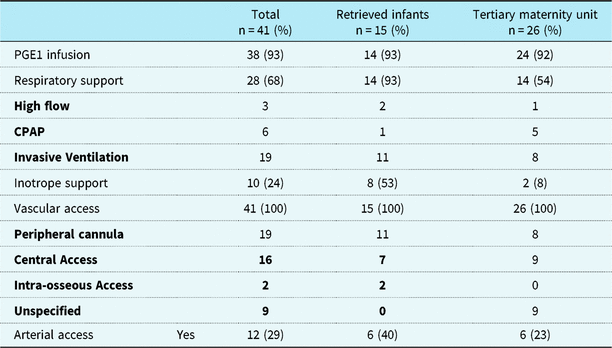
In the retrieved infants, most (93% 14/15) infants required a prostaglandin infusion, 11/15 (73%) required invasive ventilation, one (7%) required Continuous Positive Airway Pressure, and two (14%) required High Flow Nasal Cannula. Inotropic support was required in 53% (8/15) infants, with various inotropes being used; dopamine, with doses between 5 and 20 mcg/kg/min in all eight infants with two also requiring Dobutamine infusion at 5 mcg/kg/min, two needing noradrenaline infusions and one necessitated both noradrenaline and adrenaline infusions. All of the infants had vascular access secured prior to the specialised transport team’s arrival. In the infants born in the tertiary maternity unit, most (92% 24/26) required a prostaglandin infusion, 9/26 (35%) required invasive ventilation, 5/26 (19%) required Continuous Positive Airway Pressure, and one (4%) required High Flow Nasal Cannula. Inotropic support was required in 2/26 (8%), with dopamine used. The dose was 5 mcg/kg/min in one case and 10 mcg/kg/min in the other. All of the infants in this group had vascular access secured prior to admission to Paediatric ICU (Table 4).
Interventions.

PGE1 = Prostaglandin; CPAP = continuous positive airway pressure.
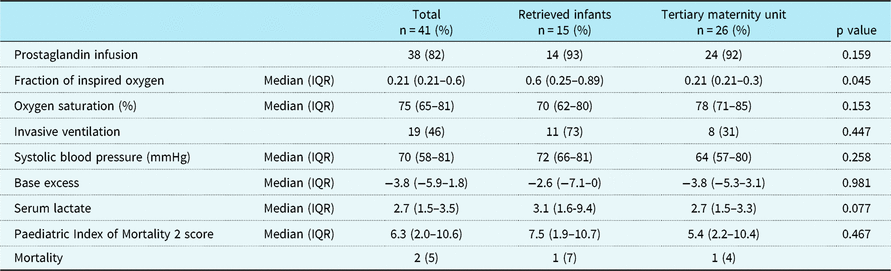
Clinical parameters of the infants are presented in Table 5. There were clinically significant differences in FiO2 on arrival to paediatric ICU between the two groups. Infants born in a district general hospital had a higher median FiO2 of 0.6 (IQR 0.25–0.89) at paediatric ICU arrival compared to those born in the tertiary maternity unit with a FiO2 of 0.21 (IQR 0.21–0.3) (p = 0.045 95%CI .00428–38536). Despite the differing FiO2 levels, the infants SaO2 levels were similar with a median value of 70% (IQR 62–80) in the retrieved infants and 78% (IQR 71–85) in the infants born in the tertiary maternity unit. There was a difference in the rate of invasive ventilation required: 11/15 (73%) in the retrieved group compared with 8/26 (31%) of the infants born in the tertiary maternity unit (p = 0.447). Serum lactate was no different at infant arrival to paediatric ICU was a median 3.1(IQR 1.6–9.4) for the infants retrieved, compared to 2.7 for tertiary maternity unit (IQR 1.5–3.3) (p = 0.077 95%CI -.44772 – 7.72541). There was no difference in paediatric index of mortality score between the groups, the tertiary maternity unit had a median paediatric index of mortality score of 5.37 (IQR 2.2–10.4), and the retrieved group had a median of 7.5 (1.9–10.7) p value (p = 0.467). Two infants died across the cohort, one in each group (5%).
Clinical parameters on arrival to the paediatric ICU.

Discussion
This pilot study is the first United Kingdom study to examine the impact of transport times on infants with transposition of the great arteries in relation to patient outcomes. Other international studies have specifically compared outcomes of infants with antenatal versus postnatal diagnosis of transposition of the great arteries.Reference van Velzen, Haak and Reijnders7, Reference Peake, Draper and Budd11–Reference Blyth and Gnanapragasam15 Studies from AustraliaReference Paul, Resnick and Gardiner16–Reference Woods, Browning Carmo and Wall17 considered the impact of transfer distance and use of a specialist transport team and the impact on infant physiological stability. Both studies identified that transfers of infants over long distances, with a postnatal diagnosis of transposition of the great arteries, can be undertaken safely when performed by specialised teams and appear to have no adverse effects on outcomes. Due to the vastly larger distances, the majority of their transfers took place via air, either fixed wing or rotor. This differs from to the United Kingdom picture as the majority of transfers take place in ambulances with data indicating that only 2% of transfers involve air transfers.Reference Hancock, Riphagen and Ramaiah18 In the United Kingdom, transport services can cover a geographical area that require journey times of over 180 minutes for the critically ill children. However, these studies did not compare the impact of a specialist transport team and the differences to clinical outcomes such as the overall hospital length of stay and time to balloon atrial septostomy or arterial switch operation in infants with transposition of the great arteries.
We did not find any significant differences in outcomes in these infants who were retrieved. This implies that retrieval by specialist transport teams does not delay time to paediatric ICU admission, and more importantly, does not worsen outcomes. In 1993, MacraeReference Macrae19 recommended that all children requiring intensive care management should be moved to a paediatric ICU by dedicated paediatric ICU staff skilled in transport. However, at that time there was no established policy, which meant that most of the transfers were undertaken by a doctor and nurse team from the district general hospital, most of whom may not have been skilled in intensive care. Many studies in the early 1990sReference Macrae19–Reference Britto, Nadel and Maconochie22 reported high levels of morbidity and adverse events occurring when high-risk transfers were carried out by non-specialised teams compared to paediatric transport teams. In 1997 “A Framework for the Future” was published which identifies standards for paediatric intensive care, including the provision of transport services.23 A study published in 2010Reference Ramnarayan, Thiru and Parslow10 showed an improvement in survival rates for children transferred by a specialist paediatric team. Since 2010 across the United Kingdom, specialist paediatric transport teams operate to a set national standard, which is set by the Paediatric Intensive Care Society.24 Emergency and unplanned admissions to paediatric ICUs equal approximately 12,000 per year of which approximately 6000 are carried out by specialist transport teams.Reference Ramnarayan, Dimitriades and Freeburn25
Fifty six per cent (25/45) of the infants in this study had an antenatal diagnosis of which 92% (23/25) were born at the tertiary maternity unit. This is consistent with findings of previous studies that showed that the detection rate for infants with transposition of the great arteries is between 41 and 84%.2–Reference van Velzen, Haak and Reijnders7 We found specialist management was undertaken in the district general hospitals for the retrieved infants with 94% (14/15) on a prostaglandin infusion and 11/15 (73%) were intubated and ventilated for safe transfer. This is supported by other studies which found that between 31 and 77% of infants with CHD required a prostaglandin infusion and were intubated and ventilated for transfer.Reference Meckler and Lowe26–Reference Browning Carmo, Barr and West28 Intravenous prostaglandin is a potent vasodilator that is routinely used to reopen or maintain the patency of the ductus arteriosus.Reference Hellström-Westas, Hanséus and Jögi27 Prostaglandin has well-known side effects of causing apnoeas especially in high doses (>15 ng/kg/min); however, Browning et al.Reference Browning Carmo, Barr and West28 suggest that infants on low dose prostaglandin (<15 ng/kg/min) can safely be transferred with self-ventilating, so long as the transfer is completed by specialist teams. This may reduce risks further as the infants are not exposed to additional risks associated with invasive ventilation.
An interesting finding was that infants transferred in were on higher FiO2 levels despite the same oxygen saturations. Clearly, for transposition of the great arteries, administering more oxygen is unlikely to improve arterial oxygen saturation of the infant until a balloon atrial septostomy is done. This is due to the systematic and pulmonary circuits running parallel and therefore the problem of inadequate mixing. Within this study the infants were transferred to paediatric ICU by either a paediatric or neonatal team. In preterm infants, the accepted management is to give as little oxygen as possible to achieve the desired SpO2 level as they have higher risk factors with hyperoxia, such as retinopathy of prematurity, periventricular leukomalacia, and bronchopulmonary dysplasia.Reference Ruangkit, Soonsawad and Tutchamnong29 We do not fully understand the reason for this finding in this pilot study, and further exploration of this finding is warranted. The use of oxygen is recommended in infants with transposition of the great arteries to try and reduce hypoxia as much as possible, with the aim of maintaining arterial oxygen saturations between 75 and 85%, and help stabilise the infants’ haemodynamic status and improve cardiac output.
The paediatric index of mortality score predicts the risk of mortality for a cohort of critically ill children at the point of paediatric ICU delivery.Reference Morris, McShane and Stickley30 Our study found no difference in paediatric index of mortality, and this is supported by the mortality outcome of 4%; KirznerReference Kirzner, Pirmohamed and Ginns31 identifies that centres around the world are now reporting survival rates of >95% in children who have had the arterial switch operation.
There are a number of limitations in this pilot study that need a mention. The study was completed with the data of a single paediatric ICU and one specialist paediatric transport team with a low number of infants. This study reviewed clinical parameters on admission to paediatric ICU, but not during paediatric ICU admission. However, despite the limitations this is the first United Kingdom study to examine the impact of specialist intensive care transport teams on transfer and outcomes of infants with transposition of the great arteries and its findings as this may not be generalisable to the other specialist transport teams. Further larger-scale work across the United Kingdom is now required to fully establish generalisability of findings.
Conclusion
Ideally, all infants with transposition of the great arteries would be diagnosed antenatally, to facilitate delivery in a tertiary maternity unit. However, there will continue to be a percentage of infants born with undiagnosed CHD in district general hospitals, who will require stabilisation and transfer to a regional specialist centre and paediatric ICU, and this study demonstrates that the use of specialist transport teams to carry out transfer of infants with transposition of the great arteries appears to be a safe practice. This study has demonstrated that the outcomes between infants born with a transposition of the great arteries diagnosis are not significantly different between the two groups. This indicates that the use of a specialised paediatric transport team in the process from referral to admission to paediatric ICU is a useful resource to have access to. With the advice and support offered by the transport team the infants can have the same timely access to the definitive procedures required for the treatment and management of transposition of the great arteries.
Acknowledgements
The authors acknowledge the following for their important roles in this project: Lyvonne Tume, Associate Professor in Child Health University of the West of England, for her patience and guidance in the research process; Will Marriage and Peter Davis, Consultants in paediatric intensive care, for their guidance, input, and support; Marianne Jefferies, paediatric ICU information analyst and clinical data manager, who was able to extract the data required from Paediatric Intensive Care Audit Network for this study; and Zoe Veal, Senior lecturer at the University of the West of England, for the help and support through this project.
Financial Support
This research received no specific grant from any funding agency, commercial or not-for-profit sectors.
Conflict of Interest
None to declare.
Ethical Standards
The authors assert that all procedures contributing to this work comply with the ethical standards of the relevant national guides on the care and use of laboratory animals (please name) and has been approved by the institutional committee (please name).