INTRODUCTION
Cystic echinococcosis (CE) was formerly considered to be caused by one polymorphic species, Echinococcus granulosus. Data on morphology, host range and other biological parameters had eventually lead to a subdivision of E. granulosus (sensu lato) into several strains, most of them named after the principal intermediate host species (Thompson and Lymbery, Reference Thompson and Lymbery1988, Reference Thompson and Lymbery1990; Bowles et al. Reference Bowles, Blair and McManus1992; Thompson and McManus, Reference Thompson and McManus2002). More recently, gene sequence data confirmed the distinctness of some of these strains, and led to the recognition of (at least) five cryptic species, namely E. granulosus sensu stricto, Echinococcus equinus, Echinococcus ortleppi, Echinococcus canadensis and Echinococcus felidis (Nakao et al. Reference Nakao, Yanagida, Konyaev, Lavikainen, Odnokurtsev, Zaikov and Ito2013; Romig et al. Reference Romig, Ebi and Wassermann2015). A comparatively large body of information on distribution, host range and genetic diversity is available for the most widespread and frequent of these species, E. granulosus s.s., which has recently been shown to be responsible for 88% of human cases (Alvarez Rojas et al. Reference Alvarez Rojas, Romig and Lightowlers2014). Based on genetic data, hypotheses have been established to trace back the routes of distribution of this parasite, pinpointing the Middle East as its most probable origin (Nakao et al. Reference Nakao, Li, Han, Ma, Xiao, Qiu, Wang, Yanagida, Mamuti, Wen, Moro, Giraudoux, Craig and Ito2010; Casulli et al. Reference Casulli, Interisano, Sreter, Chitimia, Kirkova, La Rosa and Pozio2012; Yanagida et al. Reference Yanagida, Mohammadzadeh, Kamhawi, Nakao, Sadjjadi, Hijjawi, Abdel-Hafez, Sako, Okamoto and Ito2012). This led to hypotheses regarding historical introduction routes on continental scales (Alvarez Rojas et al. Reference Alvarez Rojas, Ebi, Gauci, Scheerlinck, Wassermann, Jenkins, Lightowlers and Romig2016).
Far less data are available for the remaining species of the E. granulosus sensu lato cluster. Two recent studies found little intraspecific mitochondrial sequence diversity among E. equinus isolates from Europe and Africa (Boufana et al. Reference Boufana, Lett, Lahmar, Buishi, Bodell, Varcasia, Casulli, Beeching, Campbell, Terlizzo, McManus and Craig2015; Wassermann et al. Reference Wassermann, Aschenborn, Aschenborn, Mackenstedt and Romig2015). No comprehensive study has been done so far on the global genetic structure of the E. canadensis cluster, and available data are still insufficient to resolve the taxonomic uncertainty concerning proposed subdivisions of E. canadensis (Thompson, Reference Thompson2008; Nakao et al. Reference Nakao, Yanagida, Konyaev, Lavikainen, Odnokurtsev, Zaikov and Ito2013, Reference Nakao, Lavikainen and Hoberg2015; Lymbery et al. Reference Lymbery, Jenkins, Schurer and Thompson2015a , Reference Lymbery, Jenkins, Schurer and Thompson b ). No data on intraspecific variation are available for E. felidis (due to the lack of isolates suitable for analysis) and for E. ortleppi (Lopez-Neyra and Soler Planas, Reference Lopez-Neyra and Soler Planas1943).
Formerly known as the cattle strain of E. granulosus, or genotype G5, E. ortleppi is well adapted to cattle as intermediate hosts, although other host species may also be affected (Thompson and McManus, Reference Thompson and McManus2002). In contrast to other agents of CE, cysts of E. ortleppi in cattle are often large and fertile, and occur predominantly in the lungs (Kamenetzky et al. Reference Kamenetzky, Gutierrez, Canova, Haag, Guarnera, Parra, García and Rosenzvit2002; Pednekar et al. Reference Pednekar, Gatne, Thompson and Traub2009; Balbinotti et al. Reference Balbinotti, Santos, Badaraco, Arend, Graichen, Haag and Zaha2012; Grenouillet et al. Reference Grenouillet, Umhang, Arbez-Gindre, Mantion, Delabrousse, Millon and Boué2014; Mbaya et al. Reference Mbaya, Magambo, Njenga, Zeyhle, Mbae, Mulinge, Wassermann, Kern and Romig2014; Tigre et al. Reference Tigre, Deresa, Haile, Gabriël, Victor, Pelt, Devleesschauwer, Vercruysse and Dorny2016). The parasite is globally widespread, but even in cattle it is usually rare or of sporadic occurrence (Romig et al. Reference Romig, Omer, Zeyhle, Huettner, Dinkel, Siefert, Elmahdi, Magambo, Ocaido, Menezes, Ahmed, Mbae, Grobusch and Kern2011; Cardona and Carmena, Reference Cardona and Carmena2013; Mbaya et al. Reference Mbaya, Magambo, Njenga, Zeyhle, Mbae, Mulinge, Wassermann, Kern and Romig2014). This has been tentatively explained by the fact, that cattle (in contrast e.g. to sheep) are usually not slaughtered at home even in traditional pastoralist societies, which causes a barrier to transmission to local dogs as definitive hosts (Addy et al. Reference Addy, Alakonya, Wamae, Magambo, Mbae, Mulinge, Zeyhle, Wassermann, Kern and Romig2012). The very few human CE cases caused by this species are scattered throughout the world (Netherlands, South Africa, Mexico, Brazil and Argentina) (Alvarez Rojas et al. Reference Alvarez Rojas, Romig and Lightowlers2014). It is unknown whether the scarcity of human infections reflects the infrequency of the parasite or increased resistance of humans against E. ortleppi.
The present study describes the intraspecific microdiversity within and between sub-populations of this enigmatic parasite from sub-Saharan Africa, Brazil and France, in order to provide baseline data for studies on dispersal routes of the parasite.
MATERIALS AND METHODS
Echinococcus ortleppi isolates
In total, we examined 178 E. ortleppi cyst isolates from Kenya (54 in cattle, three in goat, two in camel, one in sheep), Zambia (52 in cattle, one in pig), Namibia (35 in cattle, three in oryx), Ethiopia (seven in cattle), Brazil (seven in cattle), France (seven in cattle) and Sudan (five in cattle, one in camel). Some of these isolates were from previous reports made available for the present study including 48 from Mbaya et al. (Reference Mbaya, Magambo, Njenga, Zeyhle, Mbae, Mulinge, Wassermann, Kern and Romig2014), seven from Grenouillet et al. (Reference Grenouillet, Umhang, Arbez-Gindre, Mantion, Delabrousse, Millon and Boué2014), and one from Addy et al. (Reference Addy, Alakonya, Wamae, Magambo, Mbae, Mulinge, Zeyhle, Wassermann, Kern and Romig2012). The isolates were obtained from slaughterhouse surveys, except three Namibian isolates taken from euthanized Oryx gazella antelopes (see supplemental file for description of isolates). All cyst isolates (germinal layer and/or protoscoleces) were stored in 70% ethanol until use.
DNA extraction, amplification and sequencing
DNA of the African isolates was obtained by lysing single protoscoleces or tissue pieces in 10 µL 0·02 m NaOH as described by Nakao et al. (Reference Nakao, Sako and Ito2003). This method was modified in some cases by using more tissue and lysing it in 50–100 µL 0·02 m NaOH at 99 °C for 30 min. The lysate was centrifuged at 8000 g for 1 min and the supernatant used directly as template in the polymerase chain reaction (PCR). Where the above approaches yielded inadequate DNA for PCR, and for the Ethiopian isolates, cyst tissues were cut into pieces and treated with proteinase K and DNA was extracted by phenol-chloroform as described previously (McManus et al. Reference McManus, Knight and Simpson1985; Dinkel et al. Reference Dinkel, Von Nickisch-Rosenegk, Bilger, Merli, Lucius and Romig1998). The French isolates were extracted using the iPrep purification instrument (Invitrogen, iPrep ChargeSwitch gDNA Tissue Kit) and the Brazilian isolates were extracted using QIAamp DNA mini kit, Qiagen USA.
The NADH dehydrogenase subunit 1 (nad1) (894 bp) was obtained by nested PCR in a 50 µL reaction mixture containing: 10 mm Tris–HCl (pH 8·3), 50 mm KCl, 2 mm MgCl2, 20 pmol of each external/internal primer, 0·2 mm dNTPs, 1·25 U Ampli-Taq Polymerase (Applied Biosystems) and 2 µL crude lysate/DNA in primary reaction and 1 µL DNA template in the nested reaction. PCRs were thermal cycled 35 times involving a denaturation step at 95 °C for 30 s, annealing at 50 °C for 30 s and elongation at 72 °C for 60 s. The previously designed primer pairs by Hüttner et al. (Reference Hüttner, Nakao, Wassermann, Siefert, Boomker, Dinkel, Sako, Mackenstedt, Romig and Ito2008) were used including forward 5′-TGGAACTCAGTTTGAGCTTTACTA-3′/reverse 5′-ATATCAAAGTAACCTGCTATGCAG-3′ in the primary reaction, and forward 5′-TATTAAAAATATTGAGTTTGCGTC-3′/reverse 5′-TCTTGAAGTTAACAGCATCACGAT-3′ in the nested reaction.
The cytochrome c oxidase subunit 1 (cox1) (1608 bp) gene was also obtained by nested PCR in one fragment including the complete gene or in two overlapping fragments. In both cases, primary PCR was performed in a 50 µL reaction mixture containing 10 mm Tris–HCl (pH 8·3), 50 mm KCl, 1·5 mm MgCl2, 20 pmol of each external primer, 0·2 mm dNTPs, 1·25 U Ampli-Taq Polymerase (Applied Biosystems) and 1 µL crude lysate/DNA. PCR was cycled for 25 times involving a denaturation step at 95 °C for 30 s, annealing at 55 °C for 30 s and elongation at 72 °C step for 90 s. In the nested PCR, the MgCl2 was reduced to 1·375 mm to improve fidelity and reaction cycled for 35 cycles under same conditions as primary PCR. Primers used in amplifying the cox1 gene in one piece include forward 5′-GTGGAGTTACTGCTAATAATTTTG-3′/reverse 5′-TACGACTYACTTATCAC-3′ (Wassermann et al. Reference Wassermann, Aschenborn, Aschenborn, Mackenstedt and Romig2015) in the primary reaction, and forward 5′-TTACTGCTAATAATTTTGTGTCAT-3′/reverse 5′-GCATGATGCAAAAGGCAAATAAAC-3′ (Hüttner et al. Reference Hüttner, Nakao, Wassermann, Siefert, Boomker, Dinkel, Sako, Mackenstedt, Romig and Ito2008) in the nested reaction. When amplifying the cox1 gene in two overlapping fragments, the five prime part was obtained using the primers forward 5′-GTGAAGTTACTGCTAATAATTTTG-3′ /reverse 5′-ACRTAATGAAAATGAGC-3′ (Ebi et al. 2014 personal communication) in the primary reaction, and forward 5′-TTACTGCTAATAATTTTGTGTCAT-3′ (Hüttner et al. Reference Hüttner, Nakao, Wassermann, Siefert, Boomker, Dinkel, Sako, Mackenstedt, Romig and Ito2008)/reverse 5′-CAAGTAAACACCTTTATAC-3′ (Ebi et al. 2014 personal communication) in the nested reaction. While the three prime part was obtained using the primers forward 5′-TTTGCTATGTTTTCTATAG-3′ (Ebi et al. 2014 personal communication)/reverse 5′-TACGACTYACTTATCAC-3′ (Wassermann et al. Reference Wassermann, Aschenborn, Aschenborn, Mackenstedt and Romig2015) in the primary reaction, and forward 5′-CATCATATGTTTACTGTTGG-3′ (Ebi et al. 2014 personal communication)/reverse 5′-GCATGATGCAAAAGGCAAATAAAC-3′ (Hüttner et al. Reference Hüttner, Nakao, Wassermann, Siefert, Boomker, Dinkel, Sako, Mackenstedt, Romig and Ito2008) in the nested reaction.
Nested PCR amplicons of both genes were purified using the High Pure PCR Product Purification Kit (Roche, Mannheim-Germany) following the manufacturer's protocol and sequenced (GATC Biotech AG, Konstanz-Germany).
Data analyses
DNA chromatographs were viewed using GENtle v. 1.9 (Manske M. 2003, University of Cologne, Germany) and manually edited in case of nucleotide base misreads. Isolates sequenced in two overlapping fragments were joined. Amino acid sequences were inferred from the nucleotide sequences by echinoderm mitochondrial genetic code (Nakao et al. Reference Nakao, Sako, Yokoyama, Fukunaga and Ito2000). Percentage divergence of DNA sequences were determined using Kimura 2-parameter model (Kimura, Reference Kimura1980) in MEGA v 6 (Tamura et al. Reference Tamura, Stecher, Peterson, Filipski and Kumar2013). Single locus and concatenated cox1 – nad1 haplotypes were estimated based on statistical parsimony (Templeton et al. Reference Templeton, Crandall and Sing1992) and network drawn at 95% connection limit using TCS v 1.8 (Clement et al. Reference Clement, Posada and Crandall2000). DnaSP v 5 (Librado and Rozas, Reference Librado and Rozas2009) was used to estimate the population indices: number of haplotypes, haplotype diversity and nucleotide diversity. Analysis of molecular variance (AMOVA), degree of genetic differentiation (pairwise fixation index – Fst) and neutrality indices of Tajima's D (Tajima, Reference Tajima1989) and Fu's Fs (Fu, Reference Fu1997) were calculated using the Arlequin v 3.5 software (Excoffier et al. Reference Excoffier, Laval and Schneider2005). The identified cox1-nad1 concatenated haplotypes and representative sequences of E. canadensis G6-10 genotypes and E. oligarthra were aligned using Clustal Omenga in EMBL-EBI before used to construct a maximum likelihood phylogenetic tree in MEGA v 6.
RESULTS
Diversity and neutrality indices
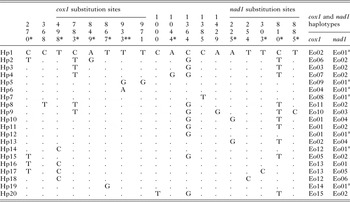
Intraspecific variations were observed in both mitochondrial loci. Nucleotide exchanges could be observed at 13 and five sites in the cox1 and nad1 sequences, respectively, yielding 15 (cox1) and six (nad1) haplotypes (Table 1). Most of these sites, 54% in cox1 and 60% in nad1 were parsimony informative. Synonymous substitutions exceeded nonsynonymous substitutions (4 vs 1) in the nad 1 coding region while half (seven) of the changes in the cox1 coding region were synonymous. A point mutation, thus site 933, showed multiple evolutionary paths whereby the transverse mutation, T – G, was nonsynonymous in Hp5 but the transition mutation, T – A, was synonymous in Hp6. No insertion or deletion was observed within either genes, thus the nucleotide numbers were stable. A pairwise divergence computed among all isolates indicates maximum values of 0·4% in cox1 and 0·3% in nad1. Using the concatenated sequences of the two loci (cox1-nad1), the seven sub-populations were organised into four hierarchical groups consisting of eastern Africa (Ethiopia, Kenya, Sudan), southern Africa (Namibia, Zambia), Brazil and France. Analysis of molecular variance (AMOVA) using these groupings revealed that 53·61% of observed variance was among individuals within sub-populations (F SC = 0·424, P = 0·000) and 39·51% among sub-populations (F ST = 0·464, P = 0·000) and only 6·88% of the molecular variance was among the groups (F CT = 0·069, P = 0·191).
Nucleotide substitutions in the mitochondrial cox1 and nad1 genes in 20 cox1-nad1 concatenated genes haplotypes of E. ortleppi; substitution sites are numbered from the initiation codon.

Numbers are read vertically. All haplotypes reported here were deposited in the GenBank database under the accession numbers KU743915–KU743926, KX010903, KX138067, KX138068 for cox1 haplotypes Eo01 – E012, Eo13, Eo14, Eo15, and KX010904, KU842044 – KU842047, KX138069 for nad1 haplotypes Eo01, Eo02 – Eo05, Eo06, respectively.
Hp, haplotype.
*Synonymous substitution. **Synonymous substitution in Hp6/replacement change in Hp5.
a & b Haplotypes were 100% identical to AB235846 cox1 and nad1 sequences, respectively.
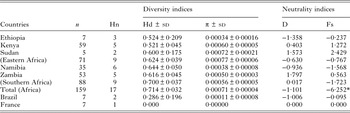
Haplotype and nucleotide diversities for each sub-population and groups were calculated. The eastern African population showed higher nucleotide diversity, but lower haplotype diversity, than the southern African population (Table 2). Most of the eastern African observed diversity was in the (few) isolates from Sudan. The Ethiopian isolates were the least polymorphic (0.00034) but had similar (0·524) haplotype diversity as in Kenya (0·521). The two southern African sub-populations also had similar haplotype diversity (0·644 in Namibia and 0·616 in Zambia) but the nucleotide diversity in isolates from Namibia was only 0.00038 compared with 0 00050 in isolates from neighbouring Zambia. Pulling all the isolates from Africa (sub-Saharan) together revealed relatively higher haplotype diversity of 0·714 and nucleotide diversity of 0.00071. Tajima's D and Fu's Fs shown here (Table 2) indicate rather insignificant deviation of sub-populations and the sub-regional groups from neutrality. The more polymorphic Kenyan, Sudan and Zambian isolates had positive neutrality values (yet insignificant), which indicates observed deficiency of haplotypes. In contrast, the Ethiopian and Namibian sub-populations, that kept less polymorphic mtDNA but relatively high isolates variance, gave negative values, likewise the average polymorphic sum of African isolates (with significant Fu's Fs). These negative values indicate frequent occurrence of some rare haplotypes than would be expected under neutrality. Diversity and neutrality indices of the non-African isolates included here were estimated for the limited Brazilian isolate set giving the lowest diversity indices and negative insignificant neutrality indices. The very low diversity indices here were due to lopsided haplotype or sequence frequencies of Hp16 and Hp17, 6 vs 1, respectively (Fig. 1C). The seven French isolates were all identical.
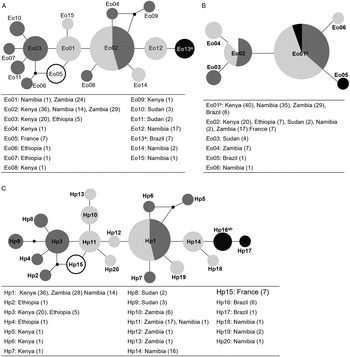
Statistical parsimony networks of E. ortleppi mtDNA haplotypes derived from sequences of cox1 (1608 bp) (A), nad1 (894 bp) (B) and concatenated cox1/nad1 (2502 bp) (C). Isolates number in (A) is less five cattle cysts (one in Kenya, one in Sudan and three in Namibia) whose cox1 gene could not be amplified. Circle and wedge sizes and numbers in parenthesis represent haplotype frequency; black spots represent hypothetical haplotypes. Regional/sub-regional haplotypes are shaded dark grey (eastern Africa), light grey (southern Africa), black (southern America) and white (France). a, b = cox1 and nad1 haplotypes 100% identical to cox1 and nad1 sequences of previous deposit from Argentinian cattle (AB235846).

Diversity and neutrality indices of E. ortleppi populations estimated from concatenated mitochondrial cox1 and nad1 genes (2502 bp)

n, number of isolates; Hn, number of haplotype; Hd, haplotype diversity; π, nucleotide diversity; D, Tajima's D; Fs, Fu's Fs.
*Significant P-value = 0·025.
Parsimony networks of mtDNA Haplotypes
Generally, polymorphism of the cox1 locus resulted in 13 haplotypes (cox1 haplotypes Eo01 – 04, Eo06 – 12, 14 and 15) from the sub-Saharan African isolates, one haplotype (Eo05) from France and another haplotype (Eo13) from Brazil (Fig. 1A). The Brazilian haplotype in this study was 100% identical to the cox1 sequence of a previous deposit from an Argentinian cattle cyst under the accession number AB235846. Haplotype Eo02 was the most predominant, occurring in Kenya, Namibia and Zambia, whereas Eo03 was found only in Kenya and neighbouring Ethiopia. All other cox1 haplotypes were restricted to individual countries. The nad1 locus gave only six haplotypes, five (nad1 haplotypes Eo01 – 04 and 06) in sub-Saharan Africa, two in Brazil (Eo01 and Eo05) and one in France (Eo02) (Fig. 1B). The most frequent nad1 haplotype Eo01 was also widely distributed from eastern to southern Africa and in South America (Brazil) and is 100% identical to the nad1 sequence of the previous Argentinian cattle isolate (AB235846). The second most frequent haplotype Eo02 was found both in sub-Saharan Africa and Europe (France). Concatenating the mtDNA sequences (2502 bp) of 173/178 isolates yielded 20 haplotypes (Table 1). Seventeen of them were found in sub-Saharan Africa (Hp1 – 14, 18–20), one in France (Hp15) and two (Hp16–17) in Brazil (Fig. 1C). Due to the higher discriminatory power, subsequent analyses were based on the concatenated sequences.
The cox1-nad1 combined network (Fig. 1C) showed rather a complex divergence genealogy of the participating haplotypes. No common haplotype was found on the three continents, and only one of the 20 haplotypes (Hp1) had a wider geographical spread within sub-Saharan Africa (in Kenya, Zambia and Namibia). All other haplotypes grouped according to country. The single haplotype from France was positioned far closer to African than to the Brazilian samples. All the haplotypes reported here could be found in cattle (refer to supplemental file for detail descriptions). In addition, Hp1 was found in camel and goat from Kenya and in oryx from Namibia, Hp9 in camel from Sudan and Hp10 in pig from Zambia.
Phylogenetic tree of mtDNA haplotypes
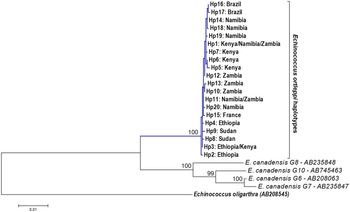
A rooted cladogram was inferred from the concatenated cox1-nad1 genes sequences with E. oligarthra as outgroup (Fig. 2). The E. canadensis genotypes were included to show the relation among the E. ortleppi haplotypes in the clade. Topology of the cladogram depicts a loose grouping of the various haplotypes into the individual countries or sub-region following the limited number of shared haplotypes, but lacks geographic structuring.
A maximum likelihood tree of 20 E. ortleppi haplotypes and their relations to genotypes on the E. canadensis/E. ortleppi clade. ML phylogram was inferred based on the Kimura 2-parameter model with 1000 bootstrap replications, using the concatenated (2502 bp) dataset of mitochondrial cox1 (1608 bp) and nad1 (894 bp) genes and the Echinococcus basal species, E. oligarthra, used as an outgroup. Hp1 – 20 were haplotypes found in this study.

Genetic differentiation index
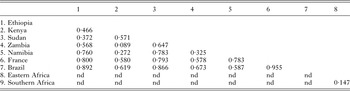
A pairwise fixation index (Fst) was computed using the mtDNA data to estimate the degree of genetic differentiation of E. ortleppi sub-populations in sub-Saharan Africa and outside Africa. Fst index has 0–1 value range, where 0 denotes complete identity of sub-populations and 1 denotes fixed sub-populations. In our analysis, Fst values ranged from 0·089 to 0·955 (Table 3). These values denote significant genetic differentiation between sub-populations except between those in Kenya and Zambia.
Pairwise fixation index (Fst values) between E. ortleppi sub-populations based on concatenated mtDNA sequences of cox1/nad1 genes (2502 bp)

All values were statistically significant at P < 0·01. n d, not determined.
DISCUSSION
After the split of the Echinococcus granulosus sensu lato complex into its various species as recognized today, intraspecific variation within these species has received attention with a view to obtain information on biogeographical dynamics (including anthropogenic translocation of the livestock hosts) and possible genetic markers for differences in host adaptations, including pathogenicity to humans. Several studies have tried to elucidate the diversity of E. granulosus s.s. sub-populations (Nakao et al. Reference Nakao, Li, Han, Ma, Xiao, Qiu, Wang, Yanagida, Mamuti, Wen, Moro, Giraudoux, Craig and Ito2010; Yanagida et al. Reference Yanagida, Mohammadzadeh, Kamhawi, Nakao, Sadjjadi, Hijjawi, Abdel-Hafez, Sako, Okamoto and Ito2012; Casulli et al. Reference Casulli, Interisano, Sreter, Chitimia, Kirkova, La Rosa and Pozio2012; Alvarez Rojas et al. Reference Alvarez Rojas, Ebi, Gauci, Scheerlinck, Wassermann, Jenkins, Lightowlers and Romig2016), but other species of the E. granulosus s.l. cluster have received far less attention. Here we report the intraspecific variation of two mt genes for E. ortleppi in eastern and southern Africa, together with data on isolates from western Europe (France) and southern America (Brazil and Argentina). The complete sequences of the mitochondrial cox1 (1608 bp) and nad1 (894 bp) genes showed 99–100% identity with the previously deposited sequence of the accession number AB235846.
In comparison with intraspecific diversity indices of other Echinococcus species that have been published so far, polymorphism (nucleotide diversity) within E. ortleppi detected here is lower than that found in E. granulosus s.s. elsewhere. Using partial sequences of cox1 Casulli et al. (Reference Casulli, Interisano, Sreter, Chitimia, Kirkova, La Rosa and Pozio2012) and Nakao et al. (Reference Nakao, Li, Han, Ma, Xiao, Qiu, Wang, Yanagida, Mamuti, Wen, Moro, Giraudoux, Craig and Ito2010), reported a polymorphism range of 0·0017–0·0051 among different E. granulosus s.s. populations in China, Eastern Europe and Italy. Outside the E. granulosus s.l., Santos et al. (Reference Santos, Soares, Elisabete, Rodrigues, Siqueira, Gomes-Gouvêa, Alves, Carneiro, Malheiros, Póvoa, Zaha and Haag2012) found 0·0044 in the Brazilian E chinococcus vogeli populations while Nakao et al. (Reference Nakao, Li, Han, Ma, Xiao, Qiu, Wang, Yanagida, Mamuti, Wen, Moro, Giraudoux, Craig and Ito2010) observed 0·0055 in E chinococcus shiquicus from China. The low polymorphism within E. ortleppi may be an indication for a rather recent differentiation from other members of the E. canadensis/ortleppi clade, which appears to contain other taxa in the process of speciation (Lymbery et al. Reference Lymbery, Jenkins, Schurer and Thompson2015a ). In addition, the worldwide dispersal of domestically transmitted Echinococcus species may have facilitated low genetic diversity through introduction of small founder populations and extinctions of ancestral transmission systems involving wild mammals. In contrast, species transmitted in wildlife cycles, for example E. shiquicus and E. vogeli, show higher variation due to conservation of ancient polymorphisms (Nakao et al. Reference Nakao, Li, Han, Ma, Xiao, Qiu, Wang, Yanagida, Mamuti, Wen, Moro, Giraudoux, Craig and Ito2010; Santos et al. Reference Santos, Soares, Elisabete, Rodrigues, Siqueira, Gomes-Gouvêa, Alves, Carneiro, Malheiros, Póvoa, Zaha and Haag2012). The limited polymorphism among isolates of E. ortleppi is reflected by only subtle deviations from neutrality. Collectively, the African E. ortleppi population might be expanding (based on Fu's Fs) but no single sub-population recorded any significant deviation from neutrality. The least polymorphic Ethiopia and Namibia isolates showed some marginal expansion following their comparably high haplotype diversities.
Parsimony networks and the phylogenetic tree presented in this study showed no geographic structuring between the different investigated countries or geographic groups. Indeed, there was more molecular variance within and between sub-population than among the geographic groupings. This is a common phenomenon observed also in E. granulosus populations in Eastern Europe (4% among populations, 96% within populations) (Casulli et al. Reference Casulli, Interisano, Sreter, Chitimia, Kirkova, La Rosa and Pozio2012), Brazil, Australia and Europe (−0·8% among met-populations, 96% within meta-populations) (Haag et al. Reference Haag, Araújo, Gottstein, Siles-Lucas, Thompson and Zaha1999). Santos et al. (Reference Santos, Soares, Elisabete, Rodrigues, Siqueira, Gomes-Gouvêa, Alves, Carneiro, Malheiros, Póvoa, Zaha and Haag2012) found a contrary feature in E. vogeli (39%, F CT = 0·38, P = 0·01) indicating significant geographic structure between populations of the eastern and western Amazon in Brazil, 2500 km apart from each other, which was believed to have been caused by demographic and historic factors such as host vagility. In our study, we observed significant genetic differentiation (Fst), or lack of gene flow, between most E. ortleppi sub-populations, which is an indication of lack of host vagility, except between Kenya and Zambia sub-populations. Nonetheless, geographic structuring was absent, likely due to recent colonization of the endemic regions. The lack of increased diversity within any of the sub-populations included in this study precludes conclusions on a geographical origin of E. ortleppi. It is however important to note that isolate numbers used in this study were very uneven (very small sample panels from Brazil and France) and may demonstrate only partially the actual demographic dynamics.
The majority of the haplotypes, 17/20, found in our study were restricted to individual sub-populations. The eastern African group had Hp3 occurring in the neighbouring Kenya and Ethiopia while Hp11 was found in the southern African neighbours Namibia and Zambia. The most frequent haplotype Hp1 was also the most widely distributed, occurring in livestock of Kenya, Namibia and Zambia, and in two wild Oryx gazella from Namibia. To the best of our knowledge, this is the first account of E. ortleppi occurring in any wild bovid host. Contrary to the star-like distribution of haplotypes of E. granulosus s.s. (Nakao et al. Reference Nakao, Li, Han, Ma, Xiao, Qiu, Wang, Yanagida, Mamuti, Wen, Moro, Giraudoux, Craig and Ito2010, Reference Nakao, Yanagida, Konyaev, Lavikainen, Odnokurtsev, Zaikov and Ito2013; Casulli et al. Reference Casulli, Interisano, Sreter, Chitimia, Kirkova, La Rosa and Pozio2012; Yanagida et al. Reference Yanagida, Mohammadzadeh, Kamhawi, Nakao, Sadjjadi, Hijjawi, Abdel-Hafez, Sako, Okamoto and Ito2012; Boufana et al. Reference Boufana, Lahmar, Rebai, Safta, Jebabli, Ammar, Kachti, Aouadi and Craig2014) and E. canadensis G6/7 (Addy et al. 2016 unpublished results), haplotypes of E. ortleppi showed a divergent structure. It is only in the Tibetan E. shiquicus, where a divergent genetic structure was observed (Nakao et al. Reference Nakao, Li, Han, Ma, Xiao, Qiu, Wang, Yanagida, Mamuti, Wen, Moro, Giraudoux, Craig and Ito2010) and the authors attributed this feature to a long-term geographical segregation to the Tibetan Plateau. Following the wide distribution of E. ortleppi, geographic segregation cannot be the cause of the observed genetic structure. The incomplete assemblage of isolates from all endemic regions in the current study prevents further conclusions on how the E. ortleppi parasite haplotypes might have developed.
It is widely assumed that livestock, particularly cattle, sheep and goats, were domesticated in the fertile crescent of the Middle East and globally distributed via colonization and trade. This assumption presupposes that the cattle adapted form of Echinococcus was introduced with its intermediate host into Africa and other endemic regions. The situation in Africa is, however, more complex, since domesticated cattle originating from the Middle East appear to have mixed with wild northern African aurochs (Bos primigenius) populations on their route to sub-Saharan Africa (Decker et al. Reference Decker, McKay, Rolf, Kim, Molina Alcalá, Sonstegard, Hanotte, Götherström, Seabury, Praharani, Babar, Correia de Almeida Regitano, Yildiz, Heaton, Liu, Lei, Reecy, Saif-Ur-Rehman, Schnabel and Taylor2014), making the region of parasite origin uncertain. The low level of genetic diversity of E. ortleppi might be due to a loss of polymorphism during the domestication of cattle, or due to introduction events of the parasite into the studied regions from elsewhere. More genetic data is clearly needed from other E. ortleppi endemic regions globally, and particularly the Middle East, to be able to conclude on the origin of this parasite.
SUPPLEMENTARY MATERIAL
The supplementary material for this article can be found at https://doi.org/10.1017/S0031182016001840.
ACKNOWLEDGEMENTS
The authors wish to thank all members of the Cystic Echinococcosis in sub-Saharan Africa Research initiative (CESSARi) for their support in various ways including facilitation of sample collection by Dorothy Kagendo, Cecilia Mbae, Eberhard Zeyhle, Erastus Mulinge and Japhet Magambo in Kenya, Abdelmoniem Elhag Elmahdi Elgizooli and Ahmed Madani Elhag Ahmed in Sudan and Chummy Sikasunge in Zambia. Special thanks to our colleague Dennis Ebi for his selfless sharing of primers and constructive opinions that provoked some pertinent analysis in here.
FINANCIAL SUPPORT
This work was supported by the Deutsche Forschungsgemeinschaft–DFG (grant number: Ro 3753/2-1, 3-1) within the Cystic Echinococcosis in sub-Saharan Africa Research Initiative (CESSARi) consortium. Francis Addy received a Ph.D. scholarship from the Deutsche Akademische Austauschdienst–DAAD.