Introduction
Welcome to the world of Legal Journals Index (also known as LJI, Articles or Journals) as compiled by the Current Awareness team at Sweet & Maxwell in Mytholmroyd, Yorkshire! This article aims to provide users of Westlaw with a brief account of the LJI production process as brought to you by a team of dedicated information specialists.
Brief history of LJI
LJI was born in 1986 in Hebden Bridge, just a few miles down the road from its present location at the Sweet & Maxwell Yorkshire office. Its founders, Christine Miskin and Nigel Smith, were law librarians who discovered an opening in the legal information market for a service to assist professionals to track down articles published in UK legal journals. They formed a company, Legal Information Resources, and started work on LJI.
In 1992, the Financial Journals Index (FJI) was launched. Concentrating on banking, finance and pensions, this Index focused on industry journals rather than purely legal content. FJI was discontinued as a separate product in March 2006 with the key, and most popular, titles transferred to LJI.
At first, LJI and FJI were only available in print format but, as technology developed, alternative methods of delivering the services were explored, culminating in their launch on Westlaw UK in 2000, four years after Legal Information Resources was acquired by Sweet & Maxwell.
Today, when you access the Journals tab at the top of the Westlaw UK welcome screen, you will be taken to the complete archive of LJI (and FJI), where you can enjoy the options of both searching and browsing to access information about those journals which are essential for your everyday work.
Articles content is not just available on Westlaw UK and selections of the data we produce can also be found on Lawtel UK, Lawtel EU, Westlaw Ireland, Westlaw International, Current Law, to name just a few.
Initial criteria for journal selection
LJI aims to cover all journal titles which are published in England and Wales, Scotland, Northern Ireland and the Republic of Ireland that are devoted to law or frequently cover items on legal or regulatory matters, or which would be of interest to legal practitioners. It also covers selected journal titles published in Europe in English, or mainly English, which frequently contain items on the law of the European Union, the Council of Europe or European countries.
Journals must comprise original material. Current awareness services, individual law firm newsletters and yearbooks are not included in LJI.
As electronic journals become more popular, LJI will often include these alongside more traditional print products. The same selection criteria are used, but the following issues are also taken into consideration:
• The authority of the online publishers and authors
• The format – PDF is preferred to HTML format
• Ease of retrieval.
A journal's lifespan can be long or short, its publication cycle can be anything from weekly to annual and its page length can vary between four and over 1,000 pages per issue. A journal's longevity can also vary greatly, with some longstanding and respected journals withstanding and overcoming newer journal titles trying to muscle in on their market segment! LJI follows all of these variants and includes 496 current titles with the archive encompassing over 1,200 titles and over 675,000 individual records.
Indexing criteria
Items within individual journals are selected using criteria based on length and the general criterion is that items should be at least one page in length. However there are exceptions to this rule: case comments, case reports, Commission decisions, questions and answers, and publication reviews are indexed if they are at least a third of a page in length – and, yes, we do occasionally get a ruler out and measure the text.
The second criterion is that items must be “sufficiently legal” and this can sometimes be difficult to apply. What is regarded as legal for LJI can be quite broad and would include articles on the regulatory environment, corporate governance, taxation, accounting, amongst others, and any items written by, or specifically for, lawyers. Indexers are instructed to focus on their target audience when applying the selection criteria.
The index entry
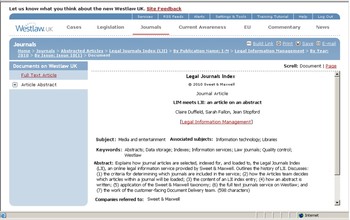
Access any index entry on LJI and you will see that, with the exception of publication reviews, it contains a brief abstract describing the content of the article, keywords and subject to facilitate searching, and bibliographic details to help you locate the original article.
In addition, depending on the content of the article, you may also find references to significant case law and legislation linked wherever possible to the information provided by our sister teams, Cases and Legislation, and to companies or organisations to which the article has made reference.
Depending on the topic under consideration, associated subjects will also be provided to ensure the article can be located via as many avenues as possible.
Publication reviews aim to provide you with details of books under review and include as much bibliographic information as we have to hand, including title, author/editor, publisher, ISBN and price. These items do not contain abstracts. After all, why would you want to read a review of a review?
How an abstract is written
Indexers observe strict criteria when writing abstracts. We try to follow a guideline of 600 characters per abstract, as far as possible, and start each sentence with an “opening verb” which gives an idea of the author's approach in writing the article. For example, we may use “Argues” where the author is trying to reinforce a particular point, or “Analyses” where an article is scrutinising a particular topic in minute detail. We avoid using “emotive” opening verbs.
When writing the abstract, we try to think about what you, the customer, would need to know about the article to determine whether you want to read it in its entirety. Therefore, the opening sentence of each abstract gives a general summary of what the entire article is about. We may feel that this is enough to help you to decide how useful the article is but, if not, we will include additional sentences going into further detail on particular points being made by the author.
At all times we avoid paraphrasing the original article, ensure that we maintain a neutral tone in order to avoid concurring, or disagreeing, with the author's personal opinions, and aim to reflect the article's content, without drawing on its conclusions to inform the abstract.
LJI and the Legal Taxonomy
As mentioned above, LJI entries contain keywords and subjects which facilitate searching on our databases. These keywords and subjects are supported by the Legal Taxonomy, also developed by Sweet & MaxwellFootnote 1. By assigning taxonomic keywords and subjects to our Index entries, we hope we can make it easier for you to track down those elusive journal articles.
The Legal Taxonomy is integrated into the Articles team's bespoke content management system and we assign keywords and subjects at the same time as we write our abstracts. When doing so, we focus on the key aspects covered in the abstract, rather than keywording the article itself. This way we hope to alert you to the main discussion topics within the article and avoid any peripheral issues which the author may have included as an aside.
Going back through the archives of LJI, you will find that index entries have on average four to six keywords, sometimes fewer. This was due to both system constraints within our database and the limited number of terms available in the original legal thesaurus used to index LJI. As technology was developed, and the Legal Taxonomy underwent a rapid expansion, the capacity to store more keywords per entry grew and now we add as many keywords as necessary to accurately reflect the content of the abstract. We will always add a jurisdictional keyword where the article discusses non-domestic laws or developments to further aid searching across the database.
Publication and loading of LJI
LJI is updated on a daily basis. The databases are reloaded each evening with the day's completed and published records. Items which are deemed to be current, discussing a new point of law, or high-profile events, or considering a case which has not yet been reported may be selected by the in-house editorial team to appear in our Current Awareness service on Westlaw as well as in the LJI database to alert our customers to the development in question.
Full text journals on Westlaw
There are currently 100 journals held in full text on Westlaw with more added every year, each loaded with a large archive where available – all of which needs an LJI record to be created for each item. The publication of the LJI record is the trigger for the full text loading process. Only the articles which have been selected from the journal issue for indexing will be converted for loading to full text. The raw data is sent offshore to Beijing along with the LJI records, processed, returned and loaded to Westlaw within five working days of the issue's publication in LJI.
Quality control
In addition to the responsibility assumed by individual editors to check their work both before and after it has been published online, the former to ensure that it is error-free and the latter to verify that it has loaded correctly, compliance with Sweet & Maxwell's high standards of quality is also ensured by a weekly post-publication proof-read of all journal content which has been loaded to our online services, shared on a rota-basis by all in-house editors.
What makes a good legal indexer?
Indexers are expected to extract bibliographic data and create value added content from journal entries and key it into the LJI database using a bespoke content management system. For this reason the most important quality an indexer should possess is attention to detail, as accuracy is crucial. Furthermore a legal background and good writing and grammatical skills are vital. As LJI works to very tight service level agreements (some journals are indexed and the LJI records published within 24 hours of the receipt of the journal) indexers should have good time management skills and need to be flexible. There are a vast number of house style rules to apply, so indexers need to be able to absorb information quickly. IT skills are also useful. We play to an individual's strengths, allocating titles for abstracting in areas where the subject matter is already familiar or where the indexer has shown, through their abstracts, that they understand the topic. We can then build on these foundations to develop specialists, with a clear understanding of the burning issues, and recent developments, in particular subject areas. For example, one of our editors has been indexing in the subject area of tax for almost 18 years.
How are indexers selected?
Potential indexers, for both in-house and freelance positions, undertake a paper-based exercise to determine whether they can apply the LJI selection criteria, house style rules and produce accurate, concise indexing and abstracting data. A grammar and spelling test is also set. Applicants for in-house positions also go through a formal interview process and their indexing and abstracting skills will be tested more than once across a variety of subject areas. These tests are timed so we can assess whether the applicant can quickly find the key driver leading the author to write the article. Guidelines are issued on the turnaround times for all journals and we offer ongoing help and support to all new indexers so that they can meet these targets, improve their skills and maintain compliance with house style rules.
Document Delivery (DocDel)
The “face” of LJI and much, much more. Our very small, customer-focused team fulfils orders for the full text of articles abstracted for LJI where there are no copyright restrictions. All orders are completed within 15 minutes of receipt and we are proud of our track record in that regard. The team also manages the subscriptions to all journals included in LJI, and works with, amongst others, the Copyright Licensing Agency, to ensure that all royalty payments generated from the copying of articles are delivered to the relevant publishers. The team can also advise on publication details and provide contact numbers for other publishing houses.
We hope you have found this quick tour of LJI processes interesting and that it has answered at least some of those “I wonder how they do that?” questions. It has been quite a challenge for us, a team used to summarising large amounts of information into very brief abstracts, to compose a full article. Look out for the abstract and keywords in Figure 1 – they will be making a re-appearance in LJI very soon…
LIM meets LJI: an article on an abstract entry in LJI.