In developed countries, influenza remains the most common infectious disease cause of death. Reference Hansen, Oren, Dennis and Brown1–Reference Teresa, Alicia and Rocio3 Elderly, young children, pregnant women, immunocompromised persons and patients with medical comorbidities represent the most vulnerable patient groups. Reference Paules and Subbarao4 In Switzerland, ~5,000 hospitalizations and 1,500 deaths per year are caused by influenza. 5,Reference Kucera, Krummenacher and Bf6 Given the high prevalence of influenza among patients in acute-care hospitals, healthcare workers (HCWs) are regularly exposed to influenza viruses at work. Reference Kuster, Drews and Green7,Reference Kuster, Katz and Blair8 Interestingly, HCWs do not appear to be at higher risk of influenza than other adults, possibly due to higher rates of vaccination and the use of protective equipment when exposed to known carriers. Reference Kuster, Coleman and Raboud9 Nosocomial transmission and outbreaks of influenza frequently occur in acute care, and HCWs are often involved in transmission events. Reference Menec, MacWilliam and Aoki10–Reference Huttunen and Syrjanen14 Improving patient protection against respiratory viral disease transmission within acute care remains of major importance to prevent adverse outcomes. Likewise, costs associated with absenteeism of HCWs could be substantially reduced if prevention is improved. Reference Rao and Nyquist15 Prevention measures against respiratory infections include social distancing, isolation precautions, respiratory etiquette (including mask use for those with respiratory symptoms), and vaccination against influenza.
Although respiratory viral disease is highly prevalent during winter season, information on its impact on absenteeism and presenteeism of HCWs, and especially HCW adherence to mask use recommendations, remains limited. Reference Esbenshade, Edwards and Esbenshade16,Reference Mossad, Deshpande, Schramm, Liu and Rothberg17 Recently, Jiang et al Reference Jiang, McGeer and McNeil18 reported that 94.6% of HCWs with an acute respiratory illness worked while symptomatic and that physicians were more likely to work when ill than nurses.
Here, we report on a prospective observational study with the aim to evaluate transmission pathways of asymptomatic and symptomatic influenza infection in the acute care setting in a tertiary care hospital (NCT02478905 (clinicaltrials.gov)). Our study provided a unique opportunity to collect information about influenza symptoms and prevention measures among HCWs and to assess absenteeism, presenteeism and adherence to mask use recommendations associated with influenza symptoms.
Materials and methods
Study setting, design, and participants
We conducted a prospective surveillance study at the University Hospital Zurich over 2 consecutive influenza winter seasons, 2015–2016 and 2016–2017. Reference Schwarz, Boni and Kouyos19 The University Hospital Zurich is a 900-bed, adult, tertiary-care center with full complement of services (except for orthopedic surgery) where ~42,000 patients are hospitalized annually.
Active surveillance for influenza infection of all consenting HCWs of 8 participating wards was performed in the 2015–2016 and 2016–2017 influenza seasons. HCWs included nursing staff (ie, nurses and assistant nurses), medical staff (ie, attending physicians and those in training), corporate hospitality staff with direct patient contact, and physiotherapists (in the 2016–2017 influenza season only). Wards participating in 2015–2016 included general internal medicine and infectious diseases, hematology, and pulmonology. Wards participating in the 2016–2017 season included geriatrics and general internal medicine, oncology and radiation oncology, rheumatology, plastic and hand surgery, and cardiology.
HCWs were enrolled prior to the influenza season. Baseline characteristics were obtained through a written questionnaire asking about personal data (eg, age and sex), underlying medical conditions based on Charlson comorbidity index, influenza vaccination history, long-term medication, and household characteristics that may be associated with reduced or increased risk of influenza (eg, household crowding index, defined as the number of people per household divided by the number of bedrooms, and living with children in a household, respectively). Reference Charlson, Pompei, Ales and MacKenzie20 During the entire influenza season, HCWs proceeded with daily self-collection of flocked midturbinate nasal swabs for influenza polymerase chain reaction (PCR) and completed symptom diaries asking for signs and symptoms of influenza infection (ie, cough, sore throat, nasal congestion, weakness, headache, loss of appetite, or myalgia), absenteeism (being absent from work due to influenza symptoms), presenteeism (being present at work despite influenza symptoms), and mask use when respiratory symptoms (defined as cough, sore throat or nasal congestion) were present.
Laboratory analyses: influenza detection
Samples were analyzed in the accredited diagnostics laboratory of the Institute of Medical Virology (University of Zurich, Switzerland). Virus transport medium from flocked midturbinate nasal swab samples was homogenized, divided into aliquots, and stored at −20°C until use. Using a multiplex real-time PCR influenza A (pan A), influenza B (pan B) and amplification inhibition could be detected and discriminated. For the initial PCR screening, pools of 8 samples were tested, and positive pools were subsequently resolved. All specimens from pools revealing signs of PCR inhibition were also tested individually.
Statistical analysis
Categorical data were tested for differences using the Fisher exact test, whereas continuous variables were tested using the Wilcoxon rank-sum test or the Student t test, as appropriate. We used multivariable linear or logistic regression analysis, as appropriate, to evaluate independent predictors for absenteeism, presenteeism, or mask use. Potential predictors were considered for inclusion in multivariable models based on clinical judgment, and final models represented those that best balanced parsimony and fit. Reference Harrell21 Data were analyzed using Stata version 13.1 software (StataCorp, College Station, TX). Two-tailed P values <.05 were considered statistically significant.
Ethical considerations
The study protocol was approved by the cantonal ethics committee of the Canton of Zurich (KEK-ZH-Nr.: 2015-0228). Informed consent of all participants was obtained before enrollment and withdrawal from the study was possible at any time.
Results
Healthcare worker characteristics
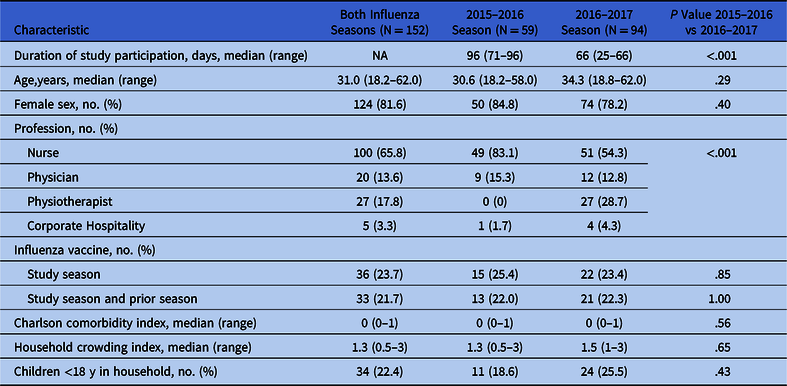
Overall, 152 HCWs from 8 wards in the 2015–2016 and 2016–2017 influenza seasons were included (Table 1). The HCWs had a median age of 31.0 years (range, 18.2–62.0); 81.6% were women; 65.8% were nurses; and 13.2% were physicians. Also, 22.4% reported having children under the age of 18 in their households, and the median household crowding index was 1.3 (range, 0.5–3). Receipt of influenza vaccine prior to study participation was reported by 23.7% of study participants. During the 2 influenza seasons, HCWs completed 7,490 symptom diaries, accounting for a median of 75.4% (interquartile range [IQR], 41.5%–92.7%) of those expected), and 7,171 midturbinate nasal swabs (73.1% of those expected; IQR, 36.2%–88.5%) were collected.
Characteristics of Healthcare Workers Participating in Prospective Surveillance for Asymptomatic and Symptomatic Influenza Infection During the 2015–2016 and the 2016–2017 Influenza Season, University Hospital Zurich

Note. N/A, not applicable.
Data are no.(%) unless indicated otherwise. 1 HCW participated in both seasons.
Signs and symptoms of influenza infection
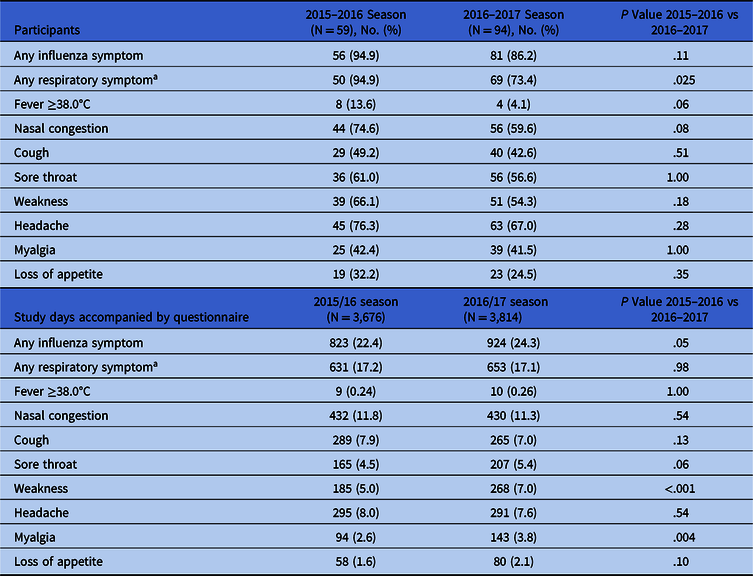
Table 2 depicts signs and symptoms of influenza infection in the study population. Moreover, 89.1% of study participants reported at least 1 influenza symptom, and 77.8% suffered from respiratory symptoms at least once during the study season. Fever was reported by 7.8% of study participants; nasal congestion was reported by 65.4%; cough by 45.1%; sore throat by 60.1%; weakness by 58.8%; headache by 70.6%; myalgia by 41.8%; and loss of appetite by 27.5%. At least 1 influenza symptom was reported on 23.3% of study days with diaries; respiratory symptoms on 17.1%. Fever was present on 0.3% of study days; nasal congestion was present on 11.5% of study days; cough on 7.4% of study days; sore throat on 5.0% of study days; weakness on 6.0% of study days; headache on 7.8% of study days; myalgia on 3.2% of study days; and loss of appetite on 1.8% of study days. The overall proportion of HCW with respiratory symptoms was lower in the 2016–2017 influenza season (Table 2), but there was no difference in the median number of days of any of the influenza symptoms between the 2 seasons in symptomatic individuals (data not shown).
Signs and Symptoms of Influenza Infection in Healthcare Workers During the 2015–2016 and the 2016–2017 Influenza Season, University Hospital Zurich
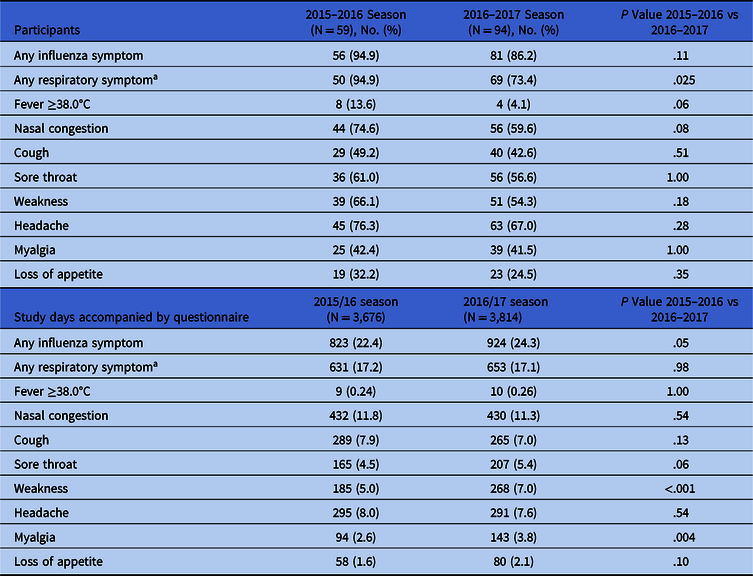
a Nasal congestion, cough or sore throat.
Absenteeism, presenteeism, and adherence to mask use recommendations
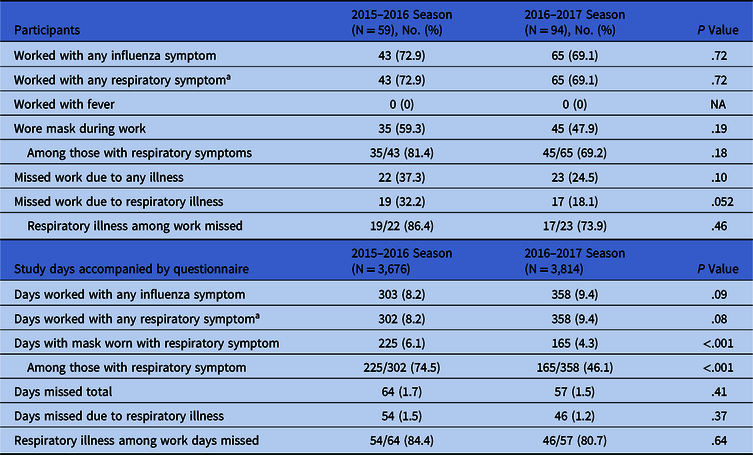
Overall, 67.9% of all participating HCWs worked with symptoms of influenza infection on 8.8% of study days, and respiratory symptoms were recorded on 99.8% of days with influenza symptoms. No HCW worked when fever was present. On 22 study days (0.3%), symptomatic HCWs were shedding influenza virus while at work. Among HCWs with respiratory symptoms, 74.1% were adherent with the policy to wear a mask at work. Of those who wore a mask while symptomatic, they wore them on 59.1% of days with respiratory symptoms. Adherence was better in the 2015–2016 influenza season in univariable analysis (Table 3).
Absenteeism and Presenteeism of Acute-Care Hospital Healthcare Workers During the 2015–2016 and the 2016–2017 Influenza Season, University Hospital Zurich
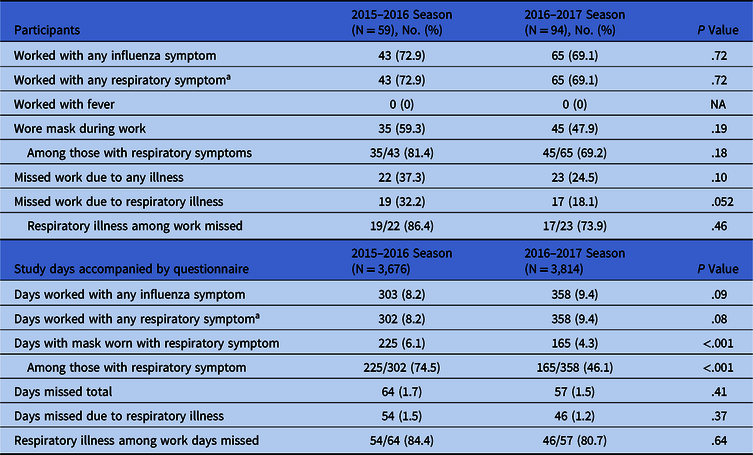
Note. NA, not applicable.
a Nasal congestion, cough or sore throat.
Moreover, 28.3% of HCWs missed at least 1 working day during the study period. In total, 121 working days (1.6%) were lost. Of these 121 days, 100 (82.6%) were missed by 36 study participants (22.6%) because of symptoms of influenza illness. Influenza shedding was detected on 16 of 121 days lost (13.2%).
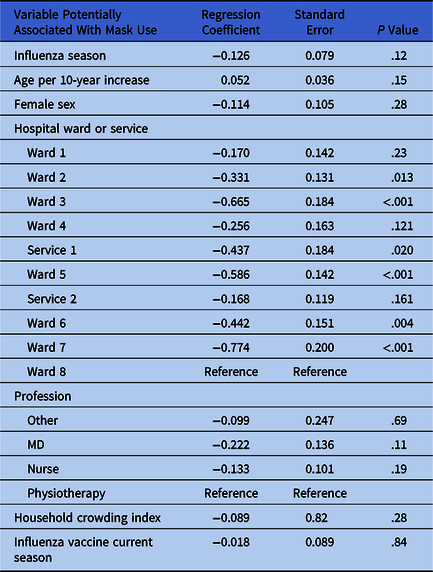
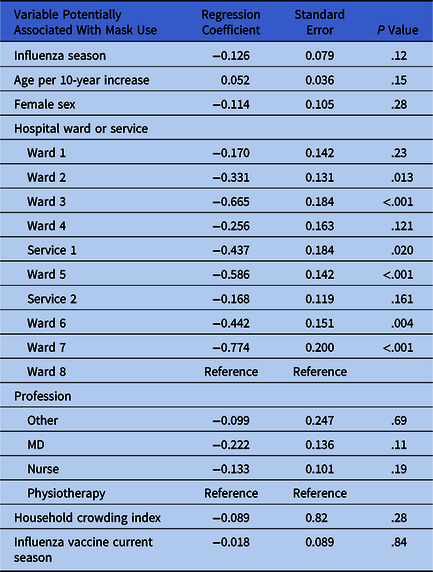
There was no difference in absenteeism or presenteeism between the 2 influenza seasons and there was no association of either absenteeism or presenteeism with age, sex, ward, profession, household crowding index or receipt of influenza vaccine in univariable linear regression analysis (data not shown). However, there was an independent, negative association between adherence with mask-use policy and hospital ward affiliation in 6 of 9 wards and services compared to the ward with the best adherence (Table 4). In contrast, there was no association of receipt of influenza vaccine with ward or service affiliation (data not shown).
Results From Multivariable Linear Regression Analysis of Predictors for Mask Use Adherence in Acute-Care Hospital Healthcare Workers With Respiratory Symptoms During the 2015–2016 and the 2016–2017 influenza season, University Hospital Zurich
Discussion
In a large, single-center, prospective surveillance study in the 2015–2016 and 2016–2017 influenza seasons, we were able to collect almost 7,500 symptom diaries and >7,100 midturbinate nasal swabs from 152 participating HCWs. Almost 80% of HCWs reported having had respiratory symptoms at least once during the season, and nasal congestion, cough, or sore throat were present on 1 in 6 study days, but influenza shedding was rare (<0.5% of days at work) in HCWs. Nevertheless, >1 in 5 HCWs missed at least 1 working day due to influenza symptoms, and influenza shedding was present on 1 in 7 working days lost. HCWs worked with respiratory symptoms on 1 in 12 days during influenza season, and adherence with mask use was ~60% on those days. No HCWs worked when fever was present. In contrast to receipt of influenza vaccine, adherence with mask use when respiratory symptoms were present showed significant variation on different study wards.
Our data are in line with other studies with regard to the extent of respiratory illness, absenteeism, and presenteeism, among HCWs with respiratory symptoms. Reference Esbenshade, Edwards and Esbenshade16,Reference Jiang, McGeer and McNeil18,Reference LaVela, Goldstein, Smith and Weaver22 The extent of respiratory symptoms together with the low level of fever as an indicator of more severe disease clearly demonstrates that social distancing (staying home or at least limit direct patient contact) for the prevention of transmission from HCWs to patients is not a realistic measure during winter season, especially given the fact that bed occupation levels are generally higher during this time of the year and that economic pressure rather points toward higher levels of bed occupation than lower levels. The US Centers for Disease Control and Prevention recommends that HCWs with fever and respiratory symptoms consider temporary reassignment or exclusion from work for 7 days from symptom onset or until the resolution of symptoms. The main intent of the recommendation is to limit influenza spread, but only a limited number of influenza infections can be expected to be covered because most infections do not present with fever. 23 As a consequence, effective prevention efforts must focus on the reduction of either total burden of disease (eg, by promotion of influenza vaccination) as well as barrier protection measures. Our study adds to the existing knowledge by providing detailed information about mask-use adherence by HCWs when experiencing respiratory symptoms. The use of medical masks for the prevention of acquiring respiratory viral infections when being worn by healthy individuals has yielded controversial results. Reference MacIntyre, Chughtai and Rahman24–Reference Bin-Reza, Lopez Chavarrias, Nicoll and Chamberland26 They are generally considered more effective than no protection, and N95 respirators together with eye protection confer the highest efficacy. Reference Bischoff, Reid, Russell and Peters27 The extent to which respiratory protection is efficacious when used by infected individuals has not been formally established, but experimental studies suggest a preventive efficacy. Reference Johnson, Druce, Birch and Grayson28 Considering the uncertainties of the impact of mask use, skepticism among HCWs regarding mask efficacy may be a contributing factor for reduced adherence. But other factors may also influence mask use. Patients have perceived physicians’ empathy lower when they wore a mask. Reference Wong, Yip and Mercer29 Also, other sociocultural factors, such as societal ideologies and traditional cultural beliefs, may largely influence the perception of both HCWs and patients with regard to the use of a face mask. Reference Siu30 Our results indicate that such cultural differences even exist between different wards within a single healthcare institution.
Our study has several limitations. It is a prospective, open-label surveillance study in a single tertiary-care institution in a high-income country. Thus, our results may not be generalizable to other geographic areas or different acute-care or long-term care institutions, particularly those with less strict recommendations for respiratory prevention in place. A further limitation of our study is that recording adherence to mask use is based on self-reports rather than observations. Although true adherence may be lower, a substantial number of particpants indicated no mask use (~40%), suggesting a relatively good recording. Third, we were unable to recruit all HCWs from the included study wards and services into the study. While participation bias may thus contribute to some extent to a systematic deviation of our results from the truth, the average percentage of not participating HCWs per ward was low, limiting their potential impact on the outcome.
In conclusion, respiratory illness occurs frequently among HCWs during influenza season, and the vast proportion of significant respiratory illness during influenza season is not caused by influenza virus. Respiratory disease imposes a significant economic burden on hospitals due to the number of working day lost. However, presenteesim with respiratory illness, including due to infection with influenza, is also frequent. Future research should thus focus on the effectiveness of mask use and other measures for the prevention of acquiring or transmitting respiratory viruses in a real-world acute-care setting.
Acknowledgments
Financial support
Stefan P. Kuster and Alexandra Trkola are supported by the Swiss National Science Foundation (grant no. 32003B_156902).
Conflicts of interest
S.P.K. has received travel grants from Astellas and Pfizer and speakers’ honoraria from Mepha.