Introduction
Children who will later develop schizophrenia exhibit neurodevelopmental problems, such as problems with the development of language and mathematics (Kolvin et al. Reference Kolvin, Ounsted, Humphrey and McNay1971; Crow et al. Reference Crow, Done and Sacker1995). Recently, research has started to explore associations between neurodevelopmental problems and psychotic symptoms in non-clinical populations, commonly referred to as psychotic-like experiences (PLEs). PLEs index increased risk for clinical psychosis (Poulton et al. Reference Poulton, Caspi, Moffitt, Cannon, Murray and Harrington2000) and almost the same spectrum of risk factors applies to PLEs and clinical psychosis (van Os et al. Reference van Os, Jones, Lewis, Wadsworth and Murray2009; Polanczyk et al. Reference Polanczyk, Moffit, Arseneault, Cannon, Ambler, Keefe, Houts, Odgers and Caspi2010). Notably, in a validation study, only auditory hallucinations had good positive and negative predictive values for clinically verifiable PLEs (Kelleher et al. Reference Kelleher, Harley, Murtagh and Cannon2011). Thus, the relatively large group of children with PLEs, chiefly auditory hallucinations, may represent a valuable population for aetiological psychosis research. The possible importance of childhood problems with communication, reading and mathematics in the development of adolescent PLEs remains unexplored, but an association between speech problems and PLEs was indicated recently (Bevan Jones et al. Reference Bevan Jones, Thapar, Lewis and Zammit2012).
Juvenile mania is a childhood-onset mood disorder that is associated with a range of adverse effects (Pavuluri et al. Reference Pavuluri, Birmaher and Naylor2005). In contrast to adult-onset bipolar disorder, juvenile mania is marked by childhood developmental problems (Murray et al. Reference Murray, Sham, van Os, Zanelli, Cannon and McDonald2004). However, the evidence for language problems is inconclusive; van Os et al. (Reference van Os, Jones, Lewis, Wadsworth and Murray1997) and Sigurdson et al. (Reference Sigurdson, Fombonne, Sayal and Checkley1999) have reported speech problems in children who will later develop juvenile mania whereas other studies indicate normal pre-morbid functioning on tasks related to language (Kutcher et al. Reference Kutcher, Robertson and Bird1998).
The aim of the current study was to determine whether childhood problems with communication, reading, speech and mathematics are associated with PLEs and juvenile mania in two samples of Swedish twins, using multiple informants. In addition, we wanted to disentangle genetic from environmental factors behind the observed associations.
Method
Participants
The Child and Adolescent Twin Study in Sweden (CATSS) is an ongoing longitudinal study targeting all twins born in Sweden since 1992 (current n = 11 000 twin pairs). In connection with the children's 9th or 12th birthdays, the parents are interviewed about their children's development (CATSS-9/12). The present study is based on the 5812 children who also have data on a follow-up at age 15 or 18 years; 1966 children were aged 9 years at the time of the CATSS-9/12 interview and 3846 were aged 12 years. At age 15 or 18 years, twins and their parents completed separate questionnaires targeting current PLEs and juvenile mania symptoms (Anckarsäter et al. Reference Anckarsäter, Lundström, Kollberg, Kerekes, Palm, Carlström, Långström, Magnusson, Halldner, Bölte, Gillberg, Gumpert, Råstam and Lichtenstein2010). The total sample consisted of two groups: in one group (n = 3809) the questionnaires were completed at age 15 (the CATSS-15 sample) and in the other group (n = 2003) the questionnaires were completed at age 18 (the CATSS-18 sample). Only 134 individuals overlapped between the two samples. A subgroup of the total sample (n = 349) who screened positive for neuropsychiatric disorders in the CATSS-9/12 interview responded to the CATSS-15 questionnaire regarding clinical examination. Three children were excluded from the analyses because of chromosomal syndromes resulting in mental retardation. The response rate was 80% in the CATSS-9/12 interview and 49%, for both children and parents, in the CATSS-15 sample. In the CATSS-18 sample, the response rate was 47% for the children and 45% for the parents. Ethical approval was obtained from the Regional Ethical Review Board in Stockholm and informed consent was obtained from all participants.
Measures of problems with communication, reading, speech and mathematics
The Autism-Tics, AD/HD and other Comorbidities inventory (A-TAC; Hansson et al. Reference Hansson, Svanström Röjvall, Råstam, Gillberg, Gillberg and Anckarsäter2005; Larson et al. Reference Larson, Anckarsäter, Gillberg, Ståhlberg, Carlström, Kadesjö, Råstam, Lichtenstein and Gillberg2010) was used to screen for problems with communication, reading, speech and mathematics. The items in the A-TAC are organized in modules (e.g. concentration and attention, social interaction, language) and all questions refer to a lifetime perspective in comparison to peers. For each question, the response alternatives are: ‘yes’ (scored 1), ‘yes, to some extent’ (scored 0.5), ‘no’ (scored 0), ‘do not know’ and ‘do not wish to answer’ (both scored as missing).
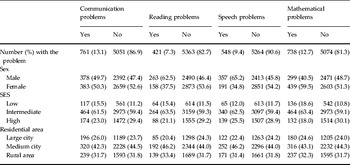
Communication problems were targeted with four questions concerning conversations, word repetitions, high voice pitch or quiet speech and monotonous speech. A sum scale of communication problems was created, with a cut-off at 0.5. The prevalence of communication problems defined this way was 13.1% (Table 1). Problems with speech (delayed speech development), reading (delayed reading development) and mathematics were targeted with one item each, with a cut-off of 1 for reading problems and 0.5 for problems with speech and mathematics. Based on this, 7.3, 9.4 and 12.7% of children were classified with reading, speech and mathematical problems respectively (Table 1).
Descriptive statistics

SES, Socio-economic status.
Values given as n (%).
Measures of PLEs
In the CATSS-15 sample, children and parents were asked eight questions targeting hallucinations (auditory, visual) and delusions (persecution, thought interference, reference, control, special powers, thought broadcasting). The items were derived from previous studies on community samples (Poulton et al. Reference Poulton, Caspi, Moffitt, Cannon, Murray and Harrington2000; Laurens et al. Reference Laurens, Hodgins, Maughan, Murray, Rutter and Taylor2007). In the CATSS-18 sample, only auditory hallucinations were measured. The children had four possible responses in the CATSS-15 sample: ‘yes’ (scored 1), ‘no’ (scored 0), ‘do not know’ and ‘do not wish to answer’ (both scored as missing). They had five responses in the CATSS-18 sample: ‘yes’ (scored 2), ‘yes, to some extent’ (scored 1), ‘no’ (scored 0), ‘do not know’ and ‘do not wish to answer’. For parents in both samples the responses were ‘yes’, ‘yes, to some extent’, ‘no’, ‘do not know’ and ‘do not wish to answer’, which were scored as the children's answers. In a validation study, only auditory hallucinations had good positive and negative predictive values for clinically verifiable PLEs (Kelleher et al. Reference Kelleher, Harley, Murtagh and Cannon2011). Therefore, in this study, auditory hallucinations were analysed separately. We also created a sum scale of ‘other PLEs’, that is all PLEs except auditory hallucinations.
Measures of juvenile mania symptoms
In the CATSS-15 sample, the Child Mania Rating Scale – Parent Version (CMRS-P; Henry et al. Reference Henry, Pavuluri, Youngstrom and Birmaher2008) was used as the screening instrument. Children and parents were asked questions targeting elated mood, irritability, over-energy, grandiosity, less need for sleep, racing thoughts, fast talk, rage attacks and sexually inappropriate behaviour. In the CATSS-18 sample, the Mood Disorder Questionnaire (MDQ; Hirschfeld et al. Reference Hirschfeld, Williams, Spitzer, Calabrese, Flynn, Keck, Lewis, McElroy, Post, Rapport, Russell, Sachs and Zajecka2000) and part of the CMRS-P were used. The items from the MDQ that corresponded to the CMRS-P items in the CATSS-15 study were used in the CATSS-18, but self-reports of rage attacks and parent reports of grandiosity, fast talk, racing thoughts and rage attacks were not asked for. Sum scales were calculated by adding the scores from the juvenile mania items that were included in the respective studies for self-reports and parent reports separately.
Covariates
The following variables may be associated with problems with communication, reading, speech or mathematics in addition to PLEs or juvenile mania symptoms and were therefore included as covariates: sex, socio-economic status (SES), main city residence, autism spectrum disorders, attention deficit hyperactivity disorder (ADHD), conduct disorder, obsessive–compulsive disorder, learning disorder and developmental coordination disorder. The parent's educational level was used as a proxy for SES, and for these questions there were eight responses classified into low (elementary and grade school), intermediate (junior secondary school, vocational school, military school, 2–4 years high school and residential high school) and high (university ⩾2 years) SES. The highest educational level within a family was used. The A-TAC provides cut-off levels based on DSM-IV criteria for the neuropsychiatric disorders considered (Larson et al. Reference Larson, Anckarsäter, Gillberg, Ståhlberg, Carlström, Kadesjö, Råstam, Lichtenstein and Gillberg2010), and variables that coded for neuropsychiatric caseness based on these cut-offs were used in the regression models. The variables targeting problems with communication, reading, speech and mathematics were included in already validated measures of learning problems and autism spectrum disorder. Including these measures of neuropsychiatric disorders as covariates in the statistical models therefore tests the unique effects of communication, reading, speech and mathematical problems after controlling for fulfilment of the criteria for the disorders.
Statistical analysis
The measures of PLEs and juvenile mania symptoms were binary or ordered categories, so we assessed associations between problems with communication, reading, speech and mathematics and PLEs/juvenile mania symptoms using binary and ordered logistic regressions. As several correlated twin pairs could be included in an analysis, a robust sandwich estimator was used to adjust for the correlated data when calculating the confidence intervals (CIs). For the twin analyses, we used the maximum likelihood method to calculate polychoric correlations between problems with communication, reading, speech, mathematics and PLEs/juvenile mania symptoms. All statistical analyses were performed in SAS version 9.3 (SAS Institute Inc., 2012) and Stata version 12 (StataCorp, 2011).
Genetic analyses
Twin methodology relies on the genetic relatedness of monozygotic (MZ) versus dizygotic (DZ) twins. If a trait is influenced by genes, there will be a higher similarity within MZ twin pairs than within DZ twin pairs. Twin analyses can be used to estimate the relative importance of genetic and environmental effects on one or more traits (Riisdijk & Sham, Reference Rijsdijk and Sham2002). The variation in a phenotype can then be decomposed into three factors: additive genetics, shared environment (factors that make twins alike) and non-shared environment (factors that make twins different). In this study, bivariate twin analyses were used to decompose the phenotypic covariation between childhood communication problems and self-reported auditory hallucinations, parent-reported other PLEs and parent-reported juvenile mania symptoms at age 15 into these three factors, using the so-called Cholesky decomposition. The phenotypic outcomes (auditory hallucinations, other PLEs, juvenile mania symptoms) were regressed on the genetic, shared environment and unique environment factors of the predictor variable (communication problems). Because the variables were highly skewed and the responses were ordered categories, the model was estimated using weighted least squares with a mean and variance-adjusted χ 2 statistic using Mplus version 6.11 (Muthén & Muthén, Reference Muthén and Muthén1998–2010).
Results
Descriptive statistics
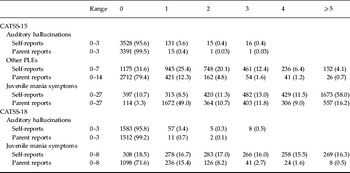
Sample characteristics are shown in Table 1. More male than female children had speech problems and reading problems whereas more female than male children had mathematical problems. Compared with controls, low SES was more common in families with communication, reading, speech and mathematical problems whereas there did not seem to be any difference in urbanicity. The frequencies of PLEs and juvenile mania symptoms are shown in Table 2. Typical of such psychiatric symptoms data, each distribution was highly skewed, with the exception of self-reports of juvenile mania symptoms.
Frequencies of auditory hallucinations, other PLEs and juvenile mania symptoms
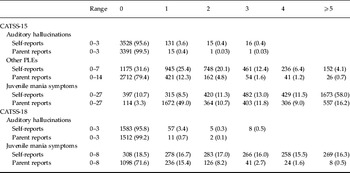
PLE, Psychotic-like experiences; CATSS, Child and Adolescent Twin Study in Sweden (CATSS-15 and -18 questionnaires completed at age 15 and 18 years respectively).
Values given as n (%).
Problems with communication, reading, speech and mathematics as predictors of PLEs and juvenile mania symptoms
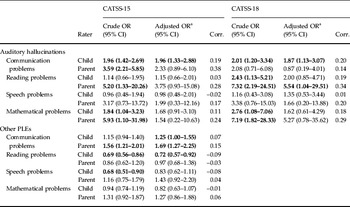
Compared to children without parent-endorsed childhood problems with communication, reading and mathematics, children with these problems had an increased risk of developing auditory hallucinations in adolescence (Table 3). These increased risks were found regardless of whether self-reports or parent reports were used. For example, there was an increased risk for self-reported auditory hallucinations in children with communication problems (OR 1.96) that remained unchanged after controlling for sex, educational level, urbanicity and neurodevelopmental problems (OR 1.96). For one unit increase in childhood communication problems (e.g. going from 0 to 0.5), the risk of reporting auditory hallucinations at age 15 increased by 96%. Problems with communication, reading, speech or mathematics did not seem to be predictive of PLEs other than auditory hallucinations (Table 3).
Associations between problem with communication, reading, speech and mathematics in childhood and PLEs at ages 15 and 18 years
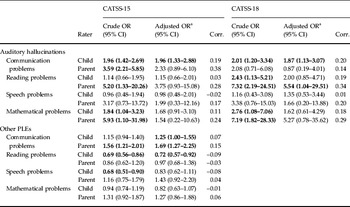
PLEs, Psychotic-like experiences; CATSS, Child and Adolescent Twin Study in Sweden (CATSS-15 and -18 questionnaires completed at age 15 and 18 years respectively); OR, odds ratio; CI, confidence interval; Corr., polychoric correlation.
a Adjusted for sex, socio-economic status (SES), urbanicity and neurodevelopmental problems.
Statistically significant ORs are shown in bold.
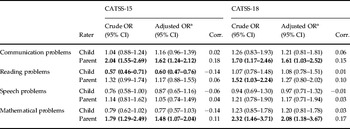
Problems with communication, reading and mathematics were important for the development of parent-reported juvenile mania symptoms (Table 4; e.g. for communication problems, OR was 1.28), but there was less evidence for associations between these problems and self-reported juvenile mania symptoms.
Associations between problems with communication, reading, speech and mathematics in childhood and juvenile mania symptoms at age 15 and 18 years
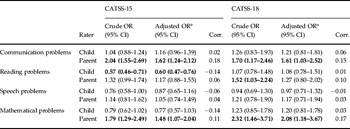
CATSS, Child and Adolescent Twin Study in Sweden (CATSS-15 and -18 questionnaires completed at age 15 and 18 years respectively); OR, odds ratio; CI, confidence interval; Corr., polychoric correlation.
a Adjusted for sex, socio-economic status (SES), urbanicity and neurodevelopmental problems.
Statistically significant ORs are shown in bold.
Genetic analyses
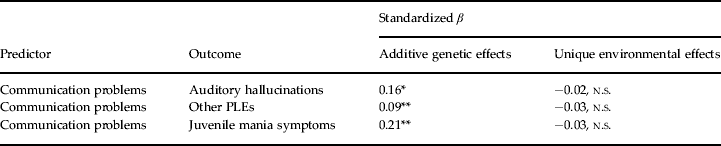
Where significant associations were found, we continued with genetic analyses to determine whether the effects were genetically or environmentally mediated. All associations with polychoric correlations > 0.15 were examined (Tables 3 and 4). As the scores of parent-reported juvenile mania symptoms ranged from 0 to 18, where a score of 1 was much more frequent than a score of 0 (Table 2), we created a new variable with four categories. This variable had a polychoric correlation with communication problems of 0.21. Because the shared environment factor did not contribute to variation in communication problems, it was excluded from the models. It was possible to identify solutions for the associations between communication problems and self-reported auditory hallucinations, parent-reported other PLEs and parent-reported juvenile mania symptoms at age 15, whereas power or distributional problems made it impossible to identify solutions for the remainder of the associations. The bivariate Cholesky decomposition demonstrated that additive genetic effects accounted for essentially the entire association between communication problems and both auditory hallucinations, other PLEs and juvenile mania symptoms, and that unique environmental effects were not important for any of these associations (Table 5). For further details of the twin analyses, see the online Supplementary material.
Genetic and environmental effects on the association between communication problems and auditory hallucinations, other PLEs and juvenile mania symptoms

PLEs, Psychotic-like experiences; n.s., not significant.
* p < 0.05, ** p < 0.001.
Discussion
We found that children with parent-endorsed childhood problems with communication, reading and mathematics had an increased risk of developing both PLEs and juvenile mania symptoms in adolescence. However, it seems that problems with communication, reading and mathematics were important primarily with respect to auditory hallucinations, but not other PLEs, and that they predicted parent-reported, but not self-reported, juvenile mania symptoms. Where significant associations were found and it was possible to perform twin analyses, the results indicate that the associations were entirely due to common genetic susceptibilities.
Pre-morbid communication problems have previously been found in early-onset cases of schizophrenia (Hollis, Reference Hollis1995) and the findings in the current study suggest that these problems may also be evident in children who will later develop PLEs/juvenile mania symptoms. The associations between reading problems and PLEs/juvenile mania symptoms were inconsistent. Of note, reading problems have recently been found to be specifically associated with core features of schizophrenia (i.e. auditory hallucinations) but not with schizotypal traits (i.e. other PLEs; Rössler et al. Reference Rössler, Vetter, Muller, Gallo, Haker, Kawohl, Lupi and Ajdacic-Gross2011). Our results are partially in keeping with these findings, as reading problems were associated with some measures of auditory hallucinations but not other PLEs. The absence of an association between speech problems and PLEs is largely consistent with previous PLE research (Cannon et al. Reference Cannon, Caspi, Moffitt, Harrington, Taylor, Murray and Poulton2002), although Bevan Jones et al. (Reference Bevan Jones, Thapar, Lewis and Zammit2012) recently reported such an association. However, in the latter study PLEs were assessed at age 12, when PLEs may be part of a more typical development than at age 15 and 18, when they are likely to be more pathological (Kelleher et al. Reference Kelleher, Keeley, Corcoran, Lynch, Fitzpatrick, Devlin, Molloy, Clarke, Harley, Arseneault, Wasserman, Carli, Hoven, Wasserman and Cannon2012; Murray & Jones, Reference Murray and Jones2012). In contrast to previous studies (van Os et al. Reference van Os, Jones, Lewis, Wadsworth and Murray1997; Sigurdson et al. Reference Sigurdson, Fombonne, Sayal and Checkley1999), we did not find strong evidence for associations between speech problems and juvenile mania symptoms. However, previous studies used teacher's reports (van Os et al. Reference van Os, Jones, Lewis, Wadsworth and Murray1997) or register information (Sigurdson et al. Reference Sigurdson, Fombonne, Sayal and Checkley1999) to define juvenile mania, which may have different clinical properties than self-reports and parent reports. Mathematical problems have previously been found in children who will later develop schizophrenia (Crow et al. Reference Crow, Done and Sacker1995), and the associations observed in the current study indicate that mathematical problems may already be present in childhood in children who will later develop PLEs and juvenile mania symptoms. Taken together, it seems that problems with communication, reading and mathematics are precursors of PLEs and juvenile mania symptoms, consistent with the picture in schizophrenia. Thus, as noted previously (Polanczyk et al. Reference Polanczyk, Moffit, Arseneault, Cannon, Ambler, Keefe, Houts, Odgers and Caspi2010; Kelleher et al. Reference Kelleher, Harley, Murtagh and Cannon2011), children with PLEs, a large group compared to clinical cases, are likely to be a valuable population for aetiological psychosis research.
The twin analyses showed that there was a common genetic susceptibility for communication problems and self-reported auditory hallucinations, parent-reported other PLEs and parent-reported juvenile mania symptoms at age 15, as genetic factors accounted for essentially the entire phenotypic correlations. These findings suggest that PLEs and juvenile mania symptoms share some common genetic factors with communication problems, which may indicate that, as in schizophrenia and bipolar disorder (Lichtenstein et al. Reference Lichtenstein, Yip, Björk, Pawitan, Cannon, Sullivan and Hultman2009), PLEs and juvenile mania symptoms share common genetic factors.
Previous research suggests that auditory hallucinations are the most valid and clinically significant measure of PLEs (Kelleher et al. Reference Kelleher, Harley, Murtagh and Cannon2011). Our data are consistent with this notion, and future research should ensure that this symptom is included when screening for PLEs. In large population-based studies it is often necessary to use as few items as possible, and in that context we suggest that auditory hallucinations are the most useful symptoms to enquire about.
Through the use of multiple informants, we found that parent reports of PLEs were substantially less common than self-reports in both samples, which raises questions about the pathological significance of parent- versus self-reported PLEs. It is possible that adults may more easily grasp the psychotic values of PLEs than some adolescents, but parents may also not be aware of their children's PLEs as they may tend to keep them to themselves (Laurens et al. Reference Laurens, Hodgins, Maughan, Murray, Rutter and Taylor2007). However, we did not find any clear evidence of a difference in how the problems with communication, reading, speech and mathematics predicted self-reports and parent reports of PLEs. This was not the case for juvenile mania symptoms, where only parent reports were associated with problems with communication, reading and mathematics. In a previous study on Swedish twins (Chang et al. Reference Chang, Lichtenstein, Asherson and Larsson2013), self-reports of ADHD, which is clinically similar to juvenile mania (Pavuluri et al. Reference Pavuluri, Birmaher and Naylor2005), were found to be more prone to contributions of measurement error than parent reports. Thus, we suggest that parent reports of juvenile mania symptoms are likely to be a more useful measure than self-reports.
Possible explanations
There are several possible explanations for the associations observed between problems with communication, reading and mathematics and PLEs/juvenile mania symptoms. It is conceivable that the same genes underlie susceptibility for these childhood problems and PLEs/juvenile mania symptoms, and it has been proposed that the genetic endowment that makes human language possible is evolutionarily related to psychosis (Crow et al. Reference Crow, Done and Sacker1995). Another possible explanation, which does not contradict the notion of shared genetic susceptibility, is that language problems and psychosis represent one disorder with diverse manifestations at different stages of development, in line with the concept of heterotypic continuity (Rutter et al. Reference Rutter, Kim-Cohen and Maughan2006). Through the use of twin analyses, we were able to take one step further in answering these questions, and the results support the notion of shared genetic susceptibility because essentially the entire phenotypic correlations between communication problems and self-reported auditory hallucinations, parent-reported other PLEs and parent-reported juvenile mania symptoms at age 15 were explained by genetic factors. To our knowledge, this is the first demonstration of the importance of genes in associations between communication problems in childhood and psychotic/affective symptoms in adolescence.
Strengths and limitations
This study has several strengths. To date, it is the only evaluation of the developmental characteristics of both PLEs and juvenile mania symptoms in two largely independent samples with participants at two different ages. It is also the first study to use multiple informants of PLEs and juvenile mania symptoms. As far as we know, this study is also the first prospective, longitudinal study to assess associations between childhood problems with reading and mathematics and PLEs, in addition to revealing the relative importance of genes and environment in the observed associations. However, the results in this study should be considered in the context of its limitations. We did not have the opportunity to study precursors of PLEs other than auditory hallucinations in the CATSS-18 sample. Furthermore, all measures relied on self-reports and parent reports, which are less reliable than direct clinical testing, although clinical examinations are not feasible in large epidemiological studies. The response rates in the CATSS-15 and -18 studies were fairly low, and it is possible that children with neurodevelopmental problems and psychiatric symptoms, and also their parents, were more prone to decline participation. This is unlikely, however, as attrition analyses revealed little difference between responders and non-responders in the CATSS-9/12 study (Anckarsäter et al. Reference Anckarsäter, Lundström, Kollberg, Kerekes, Palm, Carlström, Långström, Magnusson, Halldner, Bölte, Gillberg, Gumpert, Råstam and Lichtenstein2010). Moreover, the A-TAC is not formally validated for detection of problems with communication, reading, speech or mathematics, which may have led to some misclassifications of children with such problems. Nevertheless, it is validated to detect other neurodevelopmental problems, where facets of problems with communication, reading, speech and mathematics are included (Hansson et al. Reference Hansson, Svanström Röjvall, Råstam, Gillberg, Gillberg and Anckarsäter2005; Larson et al. Reference Larson, Anckarsäter, Gillberg, Ståhlberg, Carlström, Kadesjö, Råstam, Lichtenstein and Gillberg2010). Furthermore, despite the fairly large sample size, children with parent-reported auditory hallucinations were few, which prohibited genetic analyses on these measures.
The fact that we did not find any significant effects of unique environmental factors on the observed associations was unexpected; it is well known, for example, that childhood trauma is associated with PLEs (Janssen et al. Reference Janssen, Krabbendam, Bak, Hanssen, Volleberg, de Graaf and van Os2004). One explanation could be that the lack of unique environmental effects for the associations is due to limited power (for example, the confidence interval for the unique environmental parameter was −0.11 to 0.07 for the association between communication problems and auditory hallucinations). Another explanation could be that the association between childhood trauma and PLEs is due to genetic effects; genetic effects are important for ostensible environmental influences (Plomin et al. Reference Plomin, Asbury, Dip and Dunn2001) and associations between childhood trauma and other outcomes, such as adult violent offending (Forsman & Långström, Reference Forsman and Långström2012), have been shown to be confounded by genetic effects. Nevertheless, larger studies and/or replications are warranted.
Conclusions
Taken together, our findings suggest that children who display problems with communication, reading or mathematics have an increased risk of developing PLEs and juvenile mania symptoms in adolescence, which further corroborates the existence of neurodevelopmental deviations in PLEs and juvenile mania symptoms (van Os et al. Reference van Os, Jones, Lewis, Wadsworth and Murray1997; Polanczyk et al. Reference Polanczyk, Moffit, Arseneault, Cannon, Ambler, Keefe, Houts, Odgers and Caspi2010). Genetic factors were found to be of importance in these associations. The similar pattern of risk factors for PLEs and juvenile mania symptoms observed in this study also implies shared aetiological factors, which may have implications for molecular genetic research. Thus, the emerging research field of PLEs should consider including symptoms of juvenile mania symptoms and extend the concept of PLEs to also include affective dimensions. Clinical practice may be enhanced through consideration of childhood and co-existing problems with communication, reading and mathematics in children with PLEs and juvenile mania symptoms, as they may have a negative impact on patient function. In addition, cross-professional monitoring of the development of children with problems with communication, reading or mathematics may facilitate early identification of PLEs and juvenile mania symptoms, which in turn may reduce the negative consequences.
Supplementary material
For supplementary material accompanying this paper, please visit http://dx.doi.org/10.1017/S0033291713002018.
Acknowledgements
We thank the children and parents who participated in this study. M.C. received funding from the Swedish Research Council (grant no. 2011-2492).
Declaration of Interest
None.