INTRODUCTION
Tobacco viral diseases are the most prevalent infectious diseases among tobacco plants in China, which often hamper tobacco production and lead to low yields and poor quality. Annual yield losses of 30–40% caused by viral diseases have exceeded the losses caused by fungal diseases. This is because of the difficulty in controlling for the complexity of strains, mixed infections in the fields and the lack of effective chemical treatments. Deploying resistant cultivars is an economical and essential management method in controlling viral diseases. To date, the resistance of tobacco cultivars to tobacco mosaic virus (TMV) is a result of the single dominant N gene of Nicotiana glutinosa, which was cloned and transferred to Nicotiana tabacum. Infection of tobacco plants bearing the N-gene induces the hypersensitive response (HR) and the virus is restricted to a small region surrounding the necrotic spot (Otsuki et al. Reference Otsuki, Shimomura and Takebe1972; Padgett et al. Reference Padgett, Watanabe and Beachy1997; Marathe et al. Reference Marathe, Anandalakshmi, Liu and Dinesh-Kumar2002). There are few cultivars resistant to cucumber mosaic virus (CMV) in production, such as cultivars Ti245 and Tiebazi, which show moderate resistance and are being used as resistant controls in screening for resistant species.
Isolation and selection of new and valuable disease-resistant mutants, for instance by screening for spontaneous mutants and induced mutants, is important for resistance breeding. The rate of spontaneous mutation is only between 10−9 and 10−10, and few of these mutations are beneficial. However, induced mutants can not only produce a highly saturated mutant screen, but also provide a great deal of disease-resistant resources.
North Carolina State University's protracted tobacco genome of 2002 encouraged China to start a tobacco genome project. The first phase of the research was creating tobacco mutants, resulting in 150 000 M2 mutant seeds that were generated by ethyl methyl sulphone (EMS) and T-DNA insertion. These M2 mutants provided a large pool, which needs to be screened for viral disease-resistant tobacco cultivars. To identify mutants resistant to TMV and CMV from the large volume of M2 samples, inoculation and identification methods should be simple, accurate and rapid.
The identification and evaluation of samples for tobacco viruses was performed in accordance with the method of Kong et al. (Reference Kong, Wang, Zhang, Qian, Wang, Chen and Shen2009). To date, three inoculation methods have been used: (i) conventional juice inoculation, which is used widely for equality and ease but is time-consuming since each plant is separately inoculated; (ii) spray gun inoculation, which works quickly but is used only by professionals and (iii) insect inoculation, which requires raising virus-free insects, attaining the viruses and then using the insects to transmit the viruses.
No screening and identification method for viral resistance in young tobacco plants has been applied on a large scale until now. In the present study, high-throughput screening, which included uniform seeding, transplanting into seedbeds, inoculating by cloth brushes and reporting symptoms based on the disease indices, was performed. A total of 4000 second generation segregating (M2) mutants of tobacco cultivar Zhongyan100 were screened and identified.
MATERIALS AND METHODS
Plant material
A total of 4000 M2 mutant seeds of Zhongyan100 were created by EMS. For TMV, N. tabacum var. samsun NN and Gexinsanhao were used as resistant controls, and G140 and Hongda as susceptible controls. For CMV, Ti245 and Tiebazi were used as resistant controls, and G28 and Lianghuang as susceptible controls.
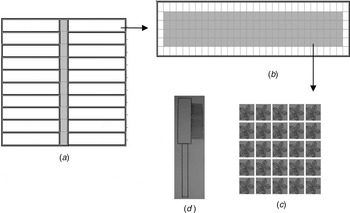
Each tobacco plant seed was placed in a plastic tray of 300 × 200 mm, and then transplanted into a plastic seedling tray containing 25 pots when the plant reached the three-leaf stage. All seedling trays were put in a seedbed (Fig. 1), with experimental plants in the centre surrounded by protective plants. Plants, when grown to the six-leaf stage, were dusted with 60 mesh carborundum particles to help make a wound for the virus to infect and inoculated by viral suspensions.
Cloth brush for viral inoculations and the planting method for high-throughput screening. (a) Greenhouse containing 20 seedbeds (grey zone represents road and white zone represents seedbed), (b) a seedbed containing 6 × 30 seedling trays (grey zone represents mutant plants and white zone represents protective plants), (c) a seedling tray containing 25 plants and (d) cloth brush.

Tobacco mosaic virus and cucumber mosaic virus suspensions
The viruses used for the experiments were TMV-C and CMV-C that had been propagated in N. tabacum var. NC89 and N. tabacum var. samsun NN, which were housed in separate glasshouses. At 15 days prior to the experimental inoculations, viruses were rejuvenated by inoculation, avoiding pathogenic degeneration, in their respective propagating tobacco varieties. Viral suspensions were prepared by grinding virus-infected tobacco leaf tissues in 0·01 m phosphate buffered saline, pH 7·4, containing 8·0 g sodium chloride (NaCl), 0·2 g potassium chloride (KCl), 1·4 g disodium phosphate (Na2HPO4) and 0·2 g monopotassium phosphate (KH2PO4) in 1000 ml water, at ratios of 1 g TMV-infected leaf tissue to 80 ml buffer and 1 g CMV-infected leaf tissue to 40 ml buffer.
Inoculation methods
Conventional juice inoculation
One hand was used to support the leaves while a small amount of sterile cotton, dipped in the viral suspension for 1 min, was used to gently rub-inoculate the first two leaves of each plant. Each cotton dip was used on only one plant (Kong et al. Reference Kong, Wang, Zhang, Qian, Wang, Chen and Shen2009; Lin et al. Reference Lin, Liu, Li, Li and Ding2010).
Improved cloth brush inoculation
The cloth brush was dipped in the viral suspension for 1 min then used to gently rub-inoculate plant leaves in the ridge-up planting bed. Each cloth brush dip was used for three back and forth passes within one seedling tray of 25 pots.
Sheared leaf inoculation
Scissors dipped in the viral suspension for 1 min were used to shear half of the first three leaves off the plant. Each dip of the scissors was used on one plant only.
Hands and tools used in the above three inoculation methods were washed with soap prior to and between inoculations. The inoculated plants were sprayed with water to wash the residual viral suspension, which increases the viral infection rate.
Screening inoculation methods in the glasshouse
Disease ratios of the different inoculation methods
Some N. tabacum var. samsun NN at the five-leaf stage was separated into five treatments: one and two were inoculated with TMV suspension using conventional juice or improved cloth brush inoculation methods, respectively, and three, four and five were inoculated with CMV suspension using conventional juice, improved cloth brush and sheared leaf methods, respectively. The sheared leaf method was not used for the TMV suspension because necrosis via this method was limited and symptoms were difficult to detect. At the five-leaf stage, N. tabacum var. NC89 was separated into six treatments: inoculation with TMV or CMV suspensions using one of the three inoculation methods. There were four replications per treatment, each containing 25 plants. Disease ratios were measured and recorded based on the local lesion number 3 days after inoculation of N. tabacum var. samsun NN and based on mosaic emergence 15 days after inoculation of N. tabacum var. NC89.
Work time for different inoculation methods
A total of 200 M2 mutant strains were inoculated with TMV suspension by one or other of the inoculation methods. There were three replications per mutant and each mutant was transplanted into one plastic seedling tray containing 25 plants. The time taken to complete inoculation on 200 × 25 plants (one replication) was recorded for each inoculation method.
Screening and identification of resistant M2 mutants
A total of 4000 M2 seeds were separated into four sets of 1000 and screened in the glasshouse after being inoculated using the improved cloth brush method. Each seedling was transplanted into a plastic seedling tray containing 25 plants. A single mutant plant highly resistant to TMV or CMV was selected from the M2 and its seeds were harvested. These seeds became the M3, which were grown and again resistance was tested to identify a mutant showing hereditary stability. Seeds were harvested and the resulting seedlings formed the M4.
Identification of hereditary resistant mutants to tobacco mosaic virus in the field
Two hereditary resistant M4 mutants to TMV were identified in the viral disease nursery at Zhucheng Mutants Experimental Farm (119°21′E; 35°12′N; 26 m asl) by natural infection in 2013. The tobacco field was irrigated and fertilized normally as per the farm's management practices. Four replicates were arranged per treatment in a randomized block design, each consisting of 50 plants in single-row plots. The wild type of Zhongyan100 was used as the control. All plants were examined for disease severity before flowering. Symptoms of TMV were rated using the following scale: 0, no symptoms; 1, new leaf vein clearing or mosaic symptoms just beginning; 3, a third of leaves on plant show mosaic symptoms but no deformation; 5, half of the leaves show mosaic symptoms with a few also showing deformation; 7, two-thirds of leaves show mosaic symptoms and deformation; 9, all leaves show mosaic symptoms and severe deformation (Ren et al. Reference Ren, Kong, Wang, Qian, Wang, Zhang, Wang, Chen, Wang and Wang2009). Ten diseased leaves per treatment were selected randomly and TMV was tested for, using the rapid test strip method of the current authors’ laboratory (J. G. Yang, unpublished).
Statistics
All data were calculated using the following formulae and analysed with Duncan's new multiple range test using the DPS data-processing system (Tang Reference Tang2009).
 $$\eqalign{& \hbox{Percent of diseased plants} = \cr & \quad \displaystyle{{\hbox{number of diseased plants}} \over {\hbox{total number of plants}}} \times 100\%}$$
 $$\eqalign{& \hbox{Disease severity} = \cr & \displaystyle{{\eqalign{& \sum (\hbox{disease grade} \times \hbox{number of plants in each grade}) \cr & \quad \times 100}} \over {\hbox{total number of plants} \times \hbox{highest disease grade}}}}$$
Real-time polymerase chain reaction detection of N gene in seven M3 resistant to tobacco mosaic virus
A pair of degenerate primers (NF3: 5′-TACCGATATTYTATGATGTGGATC-3′ and NR3: 5′-YSYAAGTTKTCTAAATCCCCTA-3′) were designed in the present study, based on the coding sequence of N gene published in GenBank Database (U15605·1, AY535010·1, AB333780 and EF091690·1), with a target fragment of 2056 bp.
Total RNA of tobacco leaf tissue was extracted using the RNAiso Plus (TaKaRa, Dalian, China) according to the manufacturer's instructions. First-strand cDNAs were synthesized using a Prime Script first Strand cDNA Synthesis Kit (TaKaRa, Dalian, China) according to the manufacturer's instructions and Oligo dT as the initial primer. The polymerase chain reaction (PCR) contained 2 μl of 10 × EX Taq buffer (Mg2+), 0·2 mM each dNTP, 0·2 μm of each primer, 1 μl template and 0·2 μl Ex Taq DNA polymerase (5 U/μl) in a total of 50 μl. The PCR amplification conditions were: 94 °C for 5 min; 35 cycles at 94 °C for 30 s, 49 °C for 30 s, 72 °C for 2 min; followed by a final incubation at 72 °C for 10 min. The size of PCR production was examined by 1·5% Ago-Gel under UV light.
RESULTS
Percentage of diseased plants following different inoculation methods
Experiments using N. tabacum var. NC89 and N. tabacum var. samsun NN showed that the conventional juice and improved cloth brush inoculation methods could be used to inoculate tobacco plants with TMV and CMV. The sheared leaf inoculation method was successful for TMV in N. tabacum var. NC89, showing a disease ratio of 100%. For CMV, the method's disease ratio was 72·00 and 74·67% in N. tabacum var. NC89 and N. tabacum var. samsun NN, respectively, which was significantly lower (P < 0·01) than the ratios in the conventional juice and improved cloth brush inoculation methods (Table 1). The density of necrotic lesions on N. tabacum var. samsun NN inoculated with TMV and the mosaic emergence on N. tabacum var. NC89 inoculated with both TMV and CMV by the conventional juice and improved cloth brush inoculation methods was the same. These two inoculation methods could be used in high-throughput screening of resistant mutants.
Percent of diseased plants of different inoculation methods for tobacco mosaic virus (TMV) and cucumber mosaic virus (CMV) in tobacco plants (mean ± s.e.m.)

Work time for different inoculation methods
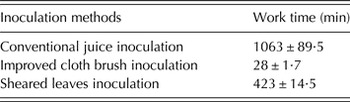
Inoculating 200 × 25 M2 mutant plants using the conventional juice method took 1063·33 min. However, the improved cloth brush inoculation and sheared leaf methods took 28·33 and 423·33 min, respectively, which were both significantly more time efficient (P < 0·01) compared with the conventional juice method (Table 2). Because the sheared leaf method did not successfully cause CMV infection, the improved juice inoculation method was selected for producing the resistant mutants required for high-throughput screening.
Work time required for different tobacco mosaic virus (TMV) and cucumber mosaic virus (CMV) inoculation methods in tobacco plants (mean ± s.e.m.)

Screening and identification of resistant M2 mutants
The high-throughput screening of mutants resistant to TMV and CMV were carried out in a glasshouse from 2011 to 2012. The results are shown in Table 3. Of 3202 mutants screened for TMV resistance, ten highly resistant plants occurred in the M2, with a variation of 0·012%, showing local necrosis on inoculated leaves. In the M3 strains from the ten resistant M2 plants, three showed local necrosis combined with mosaic, and seven were stable resistant strains showing only local necrosis. The seven stable strains came from the M2 of 11MZE2-225, 11MZE2-1079 and 11MZE2-24431; however, 11MZE2-1079 was male sterile.
Screening for tobacco mosaic virus (TMV) and cucumber mosaic virus (CMV) resistant plants in M2, and the identification and evaluation of mutant strains in M3

Of 3183 mutants screened for CMV resistance, seven highly resistant plants occurred in the M2, with a variation of 0·009%, showing mild mosaic or no mosaic in inoculated plants. Of the M3 strains from the seven resistant M2, six showed mild or severe mosaic, and one was a stable resistant strain having six plants with no mosaic and nine plants with mild mosaic. The stable strains came from the M2 of 11MZE2-25364.
All stable hereditary resistant mutant plants were grown and the seeds harvested became the M4.
Identification of hereditary resistant mutants to tobacco mosaic virus in the field
The M4 of two hereditary stable resistant mutants, 11MZE2-225 and 11MZE2-1079, were identified by conventional juice inoculation in the greenhouse and transplanted into the field for field identification in 2013. The greenhouse experiment showed that all plants from the two mutants showed local necrosis on inoculated leaves. The two mutant strains grew well in the field experiment. The disease ratio of 11MZE2-225 and 11MZE2-1079 were 69·85 and 82·19%, respectively, and disease severities were 15·31 and 18·50, respectively, which were significantly lower (P < 0·05) than that of the wild-type Zhongyan100 (Table 4). The detection results by TMV rapid test strip were 0·00 for both mutants but 0·25 for the wild-type ‘Zhongyan100’. No typical symptoms of TMV were found, but severe deformity caused by CMV and vein necrosis on axillary bud leaves was found, which showed the two mutants are not resistant to CMV and Potato virus Y.
Field identification and evaluation of two hereditary mutant strains to tobacco mosaic virus (TMV) in M4 (mean ± s.e.m.)

N gene of the seven stable M3 strains against tobacco mosaic virus
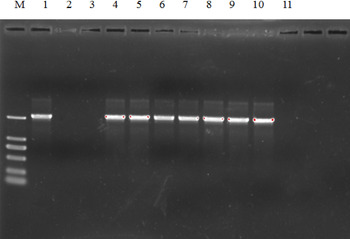
In the present study, the N gene was detected in all seven stable M3 strains against TMV by real-time (RT)–PCR. This corresponded to the phenotype of showing local necrosis after TMV inoculation. The positive control of N. tabacum var. samsun NN also showed N gene, and no N gene was detected in the negative control of N. benthamiana and wild-type Zhongyan100 and NC89 (Fig. 2).
Detection N gene in the seven stable M3 mutants of Zhongyan100 by RT–PCR. M, DL2000; 1, N. tabacum var. samsun NN (positive control); 2, Zhongyan100 (WT); 3, NC89; 4–10, seven stable mutants of M3; 11, N. benthamiana (negative control).

DISCUSSION
The current high-throughput screening will be helpful in identifying cultivars resistant to viral diseases of tobacco, especially when the sample number of plants is very large. Compared with conventional juice inoculation, the improved cloth brush inoculation would ease the work load, save time, decrease experimental error and increase accuracy. The identification and evaluation of tobacco regional trials and germplasm was according to Kong et al. (Reference Kong, Wang, Zhang, Qian, Wang, Chen and Shen2009). The current improved cloth brush inoculation method is efficient for three reasons. The first reason is that with each dip in the viral suspension the brush could inoculate a 300 mm length of 25 plants in 1 min, saving time compared with the time needed for the conventional juice inoculation method. Second, the cloth brush method decreased experimental error, which can be caused by worker fatigue and the decreased efficacy of the viral suspension after being in vitro for a long time. The third reason is the decrease in plant growth error using the ridge-up bed as shown in Fig. 1 for seeding, planting and cultivating uniformly. Seven stable hereditary resistant mutant plants to TMV and one to CMV were identified from 4000 M2 mutants using high-throughput inoculation screening. The stable hereditary resistant mutants will provide important resources for backcrossing with wild-type Zhongyan100 for anti-viral gene identification. The screened plants numbered 3202 for TMV and 3183 for CMV because the seed emergence rate of the mutants was low (Zhang et al. Reference Zhang, Luo and Xu1990).
All the current M2 mutants resistant to TMV showed HR first, and some plants died or were later lost to systemic mosaic or necrotic symptoms when the temperature of the glasshouse increased in the summer. The results matched that of previous research, which had shown that HR was elicited in tobacco plants bearing the N gene upon infection with TMV; however, at temperatures below 28 °C, the plants lose their ability to mount HR and TMV spreads systemically (Holmes Reference Holmes1938; Whitham et al. Reference Whitham, Dinesh-Kumar, Choi, Hehl, Corr and Baker1994; White & Sugars Reference White and Sugars1996).
The N gene was the first resistance gene against TMV to be discovered in N. glutinosa. It is a member of the Toll-IL-1 receptor homology region (TIR)–nucleotide-binding site–leucine-rich repeat region class of R genes and confers resistance to TMV (Dinesh-Kumar et al. Reference Dinesh-Kumar, Tham and Baker2000). The N-TMV interaction was one of the earliest and most studied models of plant–pathogen interaction. The N gene is an efficient way to identify and utilize germplasm resources (Zhang et al. Reference Zhang, Luo, Yin, Hu, Dai and Zhang2013; Chen et al. Reference Chen, Huang, Dai, Liu, Cheng and Wu2014). In the present study, the N gene was detected in all seven stable M3 strains showing local lesions after inoculation with TMV, and none in Zhongyan100 (WT) and NC89 showing mosaic after inoculation TMV. This result suggested there was mutation and evolution of the TMV resistance N gene under the process of mutation breeding (L. Zhang, 2011 personal communication). However, the details of this process are as yet unknown.
The most important current mutant resistant to TMV was the sterile strain from 11MZE2-1079. Chu et al. (Reference Chu, Yuan, Yao, Ge, Yuan, Xu, Li, Fu, Li, Bennetzen, Zhang and Wang2006) and Chu (Reference Chu2011) reported that xa13, a recessive allele conferring disease resistance against bacterial blight, plays a key role in both disease resistance and pollen development. No pollen development related to the N gene or a linked gene has been reported previously.
The hosts of CMV include Vigna ungaiculata, Vicia faba, Chenopodium amaranthicolor, Chenopodium quinoa and Arabidopsis thaliana, which show HR after inoculation (Takahashi et al. Reference Takahashi, Goto and Ehara1994; Canto & Palukaitis Reference Canto and Palukaitis1999). To date, no HR to CMV has been reported in tobacco and the current research supports this. In Chinese tobacco production, CMV-resistant resources and cultivars resistant to CMV are rare (Huang et al. Reference Huang, Wu, Chen and Cheng2013). Heredity in the current resistant mutant, 11MZE2-25364 of M3, was stable in the glasshouse.
In conclusion, the current sterile mutant resistant to TMV may represent a new role of the N gene or a newly related pollen development gene, and the two stable M4 mutants resistant to TMV in the field may be used as parent materials in breeding for viral resistance. Other stable M3 mutants resistant to TMV and CMV should be identified in the M4 and back-crossed with the wild-type Zhongyan100 for anti-viral gene identification.
We acknowledge financial support from the State Tobacco Monopoly Administration (grant no. 110200707022).